Please do not post here.
This thread is intented to host domestic sports, news posts and any other RolePlay or Worldbuilding related content of Löwenburg
This thread is intented to host domestic sports, news posts and any other RolePlay or Worldbuilding related content of Löwenburg
Welcome to the Sports World of Großlöwenburg!
a proud germanic nation on the RP Map of Valsora in The East Pacific
>Großlöwenburg<
a proud germanic nation on the RP Map of Valsora in The East Pacific
>Großlöwenburg<
Großlöwenburg, Löwenburg (or Loewenburg) aka Lionsroar is an absolute federal monarchy with countless regional entities located in the south-western part of the region of Harg on the continent of Araseos on Valsora. The capital of the kingdom is the eponymous city of Löwenburg, located in the western heartlands. With a population of 7,772,273, it is the largest city in Löwenburg and, due to its cultural, political, and economic significance, a primate city. Löwenburg is a regionally divided entity with a federal monarchy and its administrative apparatus on top. Counties, Baronies and Duchies organise themselves in smaller territorial federations, making the government overly bureaucratic.
Löwenburg is a regionally divided entity with a federal monarchy and its administrative apparatus on top. Counties, Baronies and Duchies organise themselves in smaller territorial federations, making the government overly bureaucratic. At the lowest level of the hierarchy stands the commune (= barony), followed by regional districts/areas and the regional entities, like counties or duchies. Then exist the territories, which help the highest federal level, the Kingdom of Löwenburg, in administering. The monarchy is led by an ancient royal family, the Rothmunds, located at the Royal Palace in Löwenburg. The country has a high level of administration with vast amounts of bureaucracy to keep the absolute power system running. The power apparatus of the royal family extends beyond the secret service, police and military of Löwenburg, and is also found through a multi-media presence and extensive ideological support, for example, through Löwenburgs divided polytheistic confessions under the Church of Löwenburg. The bureaucracy slows the economy, but also thrives in certain spots, especially in the wealthy west of the Löwenburgian Heartlands. The political situation is stable, yet cracking in outer regions. The quality of life is solid and the market growing. The country also has a proud history and culture (germanic like), and its regional diverson goes back to the old tribes.
The people of Löwenburg are a mix of different regional cultures, all unified in the nation-states of Löwenburg and the Löwenburger common identity. The economy of Löwenburg is based mainly on manufacturing and trade, but agriculture, the private sector of services and tourism plays a significant role as well. The beautiful and artistic towns of Löwenburg, together with its temperate climate, enduring fertility and especially the garden art are major reasons for the country's outstanding tourism.
Löwenburg's official language is Hochlöwenburgisch (High-Lowenburgian), which is part of the Löwenitsch language family and coexists with hundreds of other smaller dialects. Despite its isolation, the Kingdom of Löwenburg has a long and proud history, and its people are fiercely proud of their culture and heritage. The Löwenwehr is the state military force of Löwenburg, and works with the broader Adelsmiliz (Noble Militias). In particular, the great concept of neutrality is upheld in Löwenburg. Tourists are one of the lifelines of the entire economy, and external conflicts should be avoided as a result. Nevertheless, there is also a darker side to the state. The class-based social system, the absolute monarchy and the democratic past triggered an economic and civil crisis that has yet to be resolved and haunts modern Löwenburg.
Sports in Löwenburg
Sports in Löwenburg are closely linked to everyday life. Every Löwenburg citizen must be a member of a sports club in order to comply with the legal parameters for the "Protection of Body and Health" Act. As a result, there are sports clubs in every town and village, mostly multi-sport clubs that combine different sports. The most popular by far is football (also known as soccer), followed by athletics, tennis and many others. The national teams of Löwenburg as well as the players in Löwenburg are often stars and very popular among the population.
As well as football, there are several other major sports practised within huge multi-sport clubs. Athletics, for example, is the second-largest sporting discipline in Löwenburg. With complex sets of rules, local, regional and national leagues, cup competitions and other tournaments are contested against one another. Close behind is gymnastics, another time-honoured discipline in Löwenburg sport. Gymnastics itself is actually the oldest sport after athletics running and has its origins in the 18th century. It was only later that the gymnastics associations gave rise to the large multi-sport clubs, from which the football clubs also originated. Together, athletics, football and gymnastics form the "big three" traditional popular sports. These are joined by a range of other sports, both new and old. Tennis ranks fourth, a sport particularly favoured by the wealthier middle classes and the nobility. Skiing, another sport associated with the nobility, is also popular, though it has now become readily accessible to the ordinary middle classes as well. Golf and the associated game of polo remain particularly popular amongst the nobility. Polo combines not only golf but also a passion for horses, which also plays an important role for the nobility in activities such as hunting and equestrian sports. We must now briefly mention what is nominally the fifth-largest sport, although it hardly fits the blood-and-sweat-oriented definitions of sport. We are referring to sport shooting. Whether it be competitive shooting, open-range sport hunting or even sport duelling, which is still permitted to a limited extent, it all involves sport with firearms. Particularly popular are long-range shooting with traditional weapons, such as archery or javelin throwing in athletics, but also actual sport shooting, such as target shooting against the clock, at a distance and with a wide variety of firearms. It is particularly popular amongst the lower ranks of the knighthood, especially the military. However, the middle classes have also begun to take an interest.
Let’s get back to the actual sports. In fifth (or sixth, depending on how you look at it) place are the various martial arts. Despised by the nobility, this sport has grown in popularity mainly amongst the general population. Major martial arts competitions in the traditional Löwenburg disciplines, such as mixed martial arts (a mishmash of various martial arts styles), kickboxing in the major western port cities, wooden boxing in the eastern clubs, or bear wrestling in the Northeast, are popular. Martial arts were long regarded as an alternative means of ensuring one’s own physical safety, given the strict gun laws of modern-day Löwenburg. Even today, martial artists can draw on the bloody era of the tribes, thereby fully embracing their Germanic heritage. With the modern era and the shift towards firearms, close combat was quickly looked down upon and regarded as inferior, practised primarily by the "workers", the crude subhumans, as compared to the nobility. This is another reason why this sport remains firmly rooted in the lower classes of society today and thus plays a huge part, for example, in Löwenburg’s football fan culture, the Ultras, or their predecessors, the hooligans.
Motorsport is also a somewhat more recent sport. It emerged following the Great Industrial Revolution and its inventions, such as the steam engine, after which the first cars were developed. Although progress was still very slow, work on the technical details continued steadily in the vast industrial halls of the East, resulting in today’s top-performing engines. However, this took place primarily after the great and devastating civil war, during the heyday of industry, particularly in the 1970s, 1980s and 1990s, when the car became one of Löwenburg’s most significant cultural artefacts. Affordable yet powerful cars opened up sporting opportunities for people across the entire spectrum of Löwenburg society. The nobility and the wealthy bourgeoisie loved to collect them, whilst the common folk, as always, took things a step further. The best known are probably Löwenburg’s major motorsport events. These include the various regional and national rallies, racing through dense forests, steep coastlines and high mountains throughout Löwenburg, as well as classic circuit racing with Löwenburg’s monster machines, whether on F1 circuits in the major cities or the vast tarmac tracks running parallel to Löwenburg’s vast infrastructure, particularly the motorway, as well as the local motor clubs, monster truck and car-wrecking shows, for example in the deepest, most remote eastern regions. Among the sports that are also very new, still small but definitely growing in Löwenburg, are, for example, water polo, basketball, eggball and rugby.
In addition to the winter and summer sports already mentioned, water sports are another major sporting category. These include competitions, particularly in swimming. Whether in a lake, the western sea, the major rivers or the sterile surroundings of Löwenburg’s large swimming pools, which can be found in virtually every town and can be linked together as thermal spas, for example, these activities enjoy great popularity, particularly in summer. The massive ultra-sport competitions and mass-participation events are also consistently astonishingly large. These include, above all, the major marathons in the big cities, which attract tens of thousands of runners. They also include other extreme sports, such as ultramarathons, Ironman events and other madmen trekking through the wilderness. Another major and popular sport is cycling. For many residents, particularly in the major cities, it is the sole means of transport; Löwenburg offers tourists picturesque routes. Löwenburg tours also take place regularly, passing through various sites of the region’s rich history.
In the modern age, there’s no getting away from what is now the most popular activity after football. We’re talking, of course, about gyms. The gyms themselves cater to various sports, be it football, athletics, cycling or others, but also set their own targets. In Löwenburg, "every person must be a member of a sports club or otherwise be involved in sport". This naturally includes, above all, the large multi-sport clubs, for example, in your own little village, but also the gyms. In connection with this, Löwenburg has always hosted beauty contests and, in recent years, bodybuilding competitions.
That is the current situation. However, some sports still exist in niche circles and have survived to the present day thanks to centuries of tradition. The largest and best-known of these, serving as a tolerant middle ground between brutal martial arts and ruthless sport shooting, are the sword sports, particularly the various forms of fencing. An important discipline of the nobility and the military middle class of officers, it involves scarred skin, bloody cuts and the choice between an endless array of metal swords, whether these are swung brutally with both hands or end elegantly in thrusts against an opponent’s rapier. Alongside other historical remnants, such as the spectacle of jousting by noble knights in armour (or, in this case, ordinary commoners LARPing as knights) and the madness of charging at one another on horseback to knock each other out of the saddle. Or the traditional buhurts, in which fully armoured knights charge at one another to beat each other senseless, which then veers back towards martial arts. The grand finale and supreme discipline of aristocratic sport, however, is nothing other than the most secretive aspect of Löwenburg’s aristocratic culture. The magical sport. It is particularly linked to already popular sports, such as fencing. For example, there is the "Alljährliche Adelsmensur" or "Annual Nobility Mensur Fencing" (AAM). The most popular sporting event amongst the knightly nobility and also the high nobility. An open fencing tournament for anyone with noble blood, in which scars, blood and, if necessary, combat to the death are at stake. Yet it is no ordinary fencing tournament. For everyone with noble blood in the arena will possess magical powers and make use of them (for Blood Magic in Löwenburg, see: https://valsora.tep.wiki/wiki/There%27s ... sion_No._5).
Football in Lionsroar
see also: https://valsora.tep.wiki/wiki/Football_in_Lionsroar
see also: https://docs.google.com/spreadsheets/d/ ... sp=sharing
see also: https://valsora.tep.wiki/wiki/Category: ... (Lionsroar)
see also: https://nssportwiki.com/wiki/Category:Lionsroar
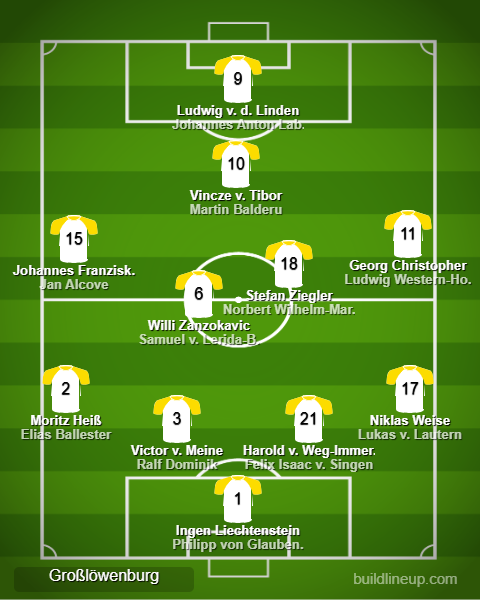
The Löwenburgian Football Association (LFA) is a royal state organization for the administration of the national sport of football (also: soccer) in Großlöwenburg. This encompasses the football system of Löwenburg, as well as Liechtenburg. As an association, the LFA oversees the marketing, and regular operation of the leagues and the cup, as well as the activities and funding of the smaller regional and local associations. Due to Löwenburg's cultural diversity and the historical lack of a unified nation-state, football has also developed very differently. Football as a sport migrated from the west through the country at the end of the 19th century. To this day, football is still very popular and unrivalled in the West. The unique Löwenburgian fan culture was also first established in the West and later reached into the East. Hooliganism is still more commonly found in the East. Löwenburg is an ancient football nation, considered the birthplace of the sport. It has the most active football clubs in any nation with over 50,000 clubs, as well as an amount of 89 % of the population interested in the so-called "Volkssport". With millions and millions of active players, staffers and fans, Löwenburg football dominates the sports landscape of the world. Löwenburgs football is notable for the millions of active fans as well as the millions of organized active fans, the so-called Ultras, Supporters or Hooligans. Löwenburg, as the birthplace of these group of people, has a proud football fan culture.
The LFA is 100% state-administered, with the state of Löwenburg having a strong influence on football. As a result, the national sport is primarily seen as a useful means of controlling and pacifying the population. The practice of sports, especially football, is very popular among the population. With passion and interest, the hundreds and hundreds of football clubs in Löwenburg attract hundreds of thousands of fans every week and millions over a season.[1] The first division is financially incredible strong, generating multiple billion in revenue every year -- mainly from fans. The LFA administrates its own judicial branch of sports law, particularly called the football law. This encompasses multiple law comissions and courts (see Judiciary_of_Löwenburg#Sports) of private law. Stadiums bans, internal competition law, player and club guidelines and the league and cup statutes and system codifications are all part of it. Interesting is for example the special requirements to gain a license every season in the first division, which includes certain standards for players and the opposing team, including medic assistance and certain food (it is required to have at least 3 bananas for the opponents available[2]), or of having a minimum stadium capacity of at least 30,000 fans.The first division is the most attractive league in all of the world and the national cup of Löwenburg the most important national cup in the world.
Football was played in the beginning in regional competitions and league systems, only later being formed with the win of House Rothmund, from 1949 regional cups and competitions were played again, until during the 1950s national leagues were established. In 1951 the LFA itself was formed and experimented with first overarching national leagues, the so called 6 territorial leagues, who together with 2 more divisions now form the seventh divisions. For 10 years, those 6 divisions played out champions and in a knock-out competition a Ganzlöwenburgischer Sieger (Whole Löwenburg Champion). In 1961, a first national league was established, resulting in the win of King's Team. Testing out the system of football, it lasted for many long years and was the start of professionalization and commercialization in football. With the latest switch of the century 99/00 a second unified Löwenburger Football Division System was established, which is still in a lot of change. The Löwenburg football system currently encompasses five competitions. The first competition are the League competitions of the system. Consisting of the first, second, third and fourth divisions, as well as the dual-track fifth divisions and lower. The other three competitions are solely cup competitions. The biggest cup competition is the national cup or King's Cup / Royal Cup, where the teams of the first, second and third division play against themselves. The fourth competition, aka the third cup competition is between the regional clubs on a lower level. The second cup competition are the League Cups, played between the Clubs of the respective Leagues.
Professional football in Löwenburg is the first four divisions and the two dual-track fifth divisions; depending on the sixth and seventh divisions, they are semi-amateur and more or less professionalized.