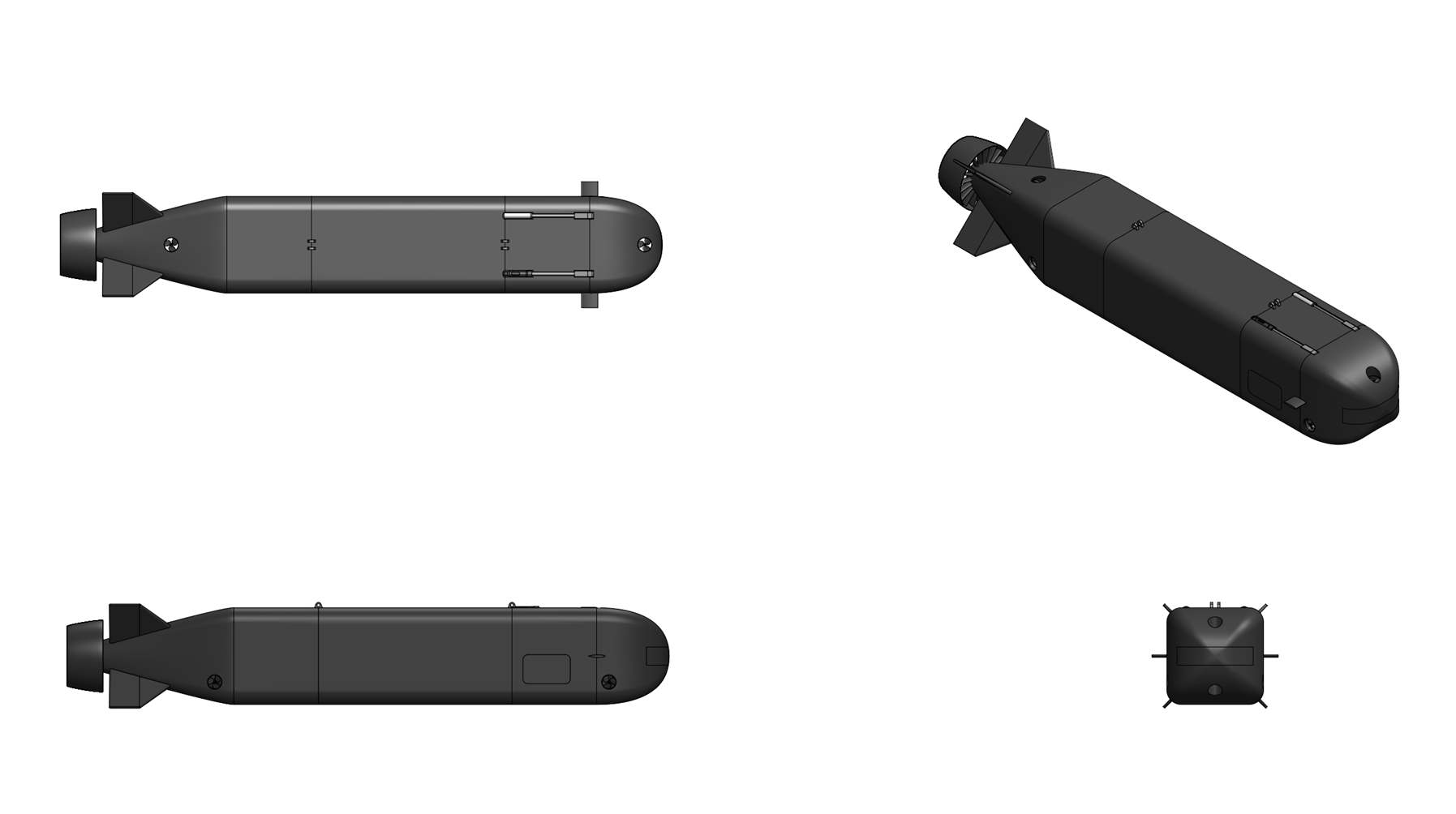
Manta
General Characteristics:
Type:Extra Large Autonomous Underwater Vehicle (XLAUV)
Launch platform:Surface vessel, submarine
Physical Characteristics:
Weight:25,000 kg
Length:12.0 m
Beam:2.2 m
Width:2.2 m
Performance Characteristics:
Propulsion:Electric motor
Power:lithium-ion batterries
Depth rating:6,000 m
Speed:12 knots
Range:2,500 km @ 3 knots, 25 km @ 12 knots
Overview:
The Manta is a multipurpose Extra Large Unmanned Underwater Vehicle (XLUUV) designed by SDI Underwater systems. The Manta is designed with a central modular free-flooding payload volume designed to host a wide variety of payloads including ISR, mine warfare, and anti-submarine warfare (ASW) payloads and is capable of autonomous open ocean transit, seafloor following, and long-duration moored operations on the seabed and can be configured to perform variety of missions including bi-static submarine detection with a towed array sonar (TAS), acoustic passive intelligence gathering with bow, flank and towed arrays sonars, covert minelaying, covert surface & subsurface ISR (Intelligence, Surveillance and Reconnaissance), submarine forward scouting, and special forces support.
Design & Propulsion
The Manta XLUUV features a double-hull design with an outer rectangular shaped light hull containing two pressure vessels separated by a central rectangular payload bay which is designed to provide structural support, electrical power, and data interfaces to host a wide variety of payloads including mines, sensors, small UUVs which the vehicle can deploy and recover. The outer light hull of the vehicle is constructed from graphite/epoxy and fiberglass composite with fore and aft cylindrical pressure vessels constructed from Ti-6Al-4V ELI (Extra Low Interstitial) titanium alloy with a depth rating of 6,000 meters for open-ocean seabed operations. The forward pressure hull is approximately 2.5 meters in length and 1.5 meters in diameter and houses the vehicle's autonomous computing architecture, primary navigation and communication systems, the forward and side looking sonar transducer electronics, and the gravity aided inertial avigation system (INS). The aft pressure hull is approximately 3.5 meters in length and 1.5 meters in diameter and contains the electric drive electronics, ballast and trim system components (variable ballast tanks, trim pumps), and the auxiliary systems including hydraulic plant for control surfaces and mast actuation, bilge system, and thermal management system. The two pressure hulls are connected by a load-bearing structural framework constructed form high modulus carbon fiber that transfers hydrodynamic
and inertial loads between the hulls while providing the structural backbone for the central payload bay. The vehicle is powered by 600V lithium-ion batteries which are carried in packs down each side of the vessel in separate individual pressure vessels located between the outer light hull and the inner pressure hulls with a combined 150 kWh electrical capacity which provide the vehicle with over 360 hours of endurance at a cruising speed of 3 knots or 2 hours of endurance at the vehicle's maximum speed of 12 knots. The vehicle's hotels load (computing, sensors, and auxiliary systems) areserved by a dedicated battery bus with redundant switching, ensuring that a propulsion battery failure does not affect the vehicle's ability to maintain autonomy functions. The vehicle is steered using a series of hydraulically actuated forward retractable dive planes and a set of large rear hydraulically actuated X-plane rudders. Depth control and trim are managed by a variable ballast system consisting of ballast tanks with electric pumps for adjusting overall buoyancy) and a trim system that transfers water between forward and aft trim tank. The ballast and trim system automatically compensates for payload deployment, e.g. dropping mines or launching torpedoes, the system taking on ballast water to maintain neutral buoyancy. Forward propulsion is provided by a rear mounted integrated motor propulsor (IMP), a shaftless rim-driven propulsor with a radial permanent magnets electric motor integrated directly into the rim of the propeller shroud.
The Manta incorporates several acoustic signature reduction measures: the integrated motor propulsor is mounted on shock and vibration-isolation mounts to prevent structure-borne noise from reaching the hull and radiating into the water while he propulsor itself is designed for low cavitation inception speeds, minimizing broadband noise at operational speeds. All rotating machinery (pumps, fans, actuators) inside the pressure hulls are mounted on vibration-isolated mounts. The outer composite light hull fairing is coated with an anechoic tile layer that absorbs incoming active sonar energy. Flow noise is minimized through careful hydrodynamic design of the hull form, mast fairings, and control surfaces, avoiding sharp edges and steps that would generate turbulent flows. The vehicle's magnetic signature is minimized through the use of non-magnetic materials that are used
wherever possible in the hull structure and fittings. The retractable masts are designed with radar-absorbing materials and low-observable shaping to minimize radar cross-section during the brief periods when they are exposed above the surface.
Navigation & Control:
Navigation System: The Manta is designed to use SDI Naval system's Trident, an intelligent, fully autonomous control system designed for integration into unmanned surface vessels (USVs), unmanned underwater vehicles (UUVs), and optionally crewed warships. The Manta's TRIDENT integration provides the same safety-assured, AI-driven autonomy that TRIDENT delivers for surface vessels, adapted for the unique challenges of the subsurface domain including operating without GPS, without continuous communications, and in a three-dimensional environment where stealth is prioritized. TRIDENT's tactical behavior engine manages the Manta's mission execution, drawing from a modular skills library adapted for the subsurface domain. Key autonomous behaviors include goal-based mission autonomy (executing multi-phase missions defined by waypoints, areas, and conditional logic), autonomous obstacle avoidance using the forward-looking sonar to detect and avoid underwater obstacles, fishing nets, and mooring line), terrain following and bottom tracking maintaining a set altitude above the seabed using DVL and FLS data, adaptive speed and depth management (optimizing speed, depth, and heading to minimize energy consumption, maximize acoustic stealth, or exploit favorable oceanographic conditions), covert approach and station keeping (approaching a surveillance position using minimum detectable speed and maintaining station against currents), and autonomous target tracking (using passive acoustics or active sonar to detect and trail a contact of interest, maintaining track while minimizing counter-detection risk). TRIDENT uses pre-loaded mission plans with conditional branching (if/then logic that allows the vehicle to adapt its behavior based on what it encounters without needing to consult a human operator), autonomous threat assessment with pre-authorized responses (the vehicle can classify detected contacts, assess threat levels, and execute pre-authorized defensive actions including evasion, countermeasure deployment without communications), data-gathering-and-report-later protocols (the vehicle collects sensor data throughout its mission and batches reports for transmission during brief, scheduled mast exposures), and fail-safe behaviors (if the vehicle experiences a major malfunction, it executes pre-programmed fail-safe behavior, either rising to the surface for recovery, settling to the bottom in a recoverable position, or returning to a designated recovery point).
The core navigation module of the Manta AUV employs a gravity aided inertial navigation system (GAINS) which combines an SDI TNS 900 6-axis navigation grade inertial measurement unit with a with a gravimeter and three gradiometer sensors which uses gravity field measurements correlated with gravity map data to produce absolute position references to correct IMU drift without reliance on GPS. The SDI TNS 900 is intended for autonomous underwater vehicle applications and contains three digital resonator fiber optic gyroscopes (RFOGs) and three MEMS accelerometers which provide 0.005° Roll & Pitch and 0.01° GPS independent Heading accuracy to the vehicle while underwater. The gravity sensor used with the system to augment the TNS 900 IMU consists of a gravimeter which measures gravity anomalies relative to a nominal earth model and three gradiometers which measures gravity gradient changes in three dimensions. The gravimeter consists of an accelerometer used to determine the gravitational force at sea level by measuring the gravitational acceleration at the submarine's depth and applying corrections for the Eötvös effect, submarine depth below mean sea level, and accelerations from the submarine's current depth change rate which is then subtracted from the earth gravitational model gravity to generate a gravity anomaly value. The gravity gradiometers each consists of an array of four accelerometers mounted at 90° intervals to a rotating wheel to provide measurements of gravity gradients along the baselines of accelerometer pairs, three accelerometer wheels of which are orthogonally mounted to generate inputs for a full nine element (3x3) gradient tensor measurement. The passive navigation algorithm used with the system t combines inertial measurement unit and gravity sensor data which is processed by a Kalman filter to generate IMU error estimates used to correct the IMU sensor. The algorithm uses gravimeter and gravity gradiometer measurements to determine the submarine's position on a stored gravity field anomaly maps, providing an absolute position reference which is used to correct the drift of the IMU. The system can also detect the gravity field variations caused by local terrain, allowing the submarine to generate surrounding terrain estimates which are continuously updated based on Kalman filter IMU position error estimate, providing the navigation system with terrain following and terrain avoidance modes for navigation along the sea floor. The navigation system Manta also includes a forward looking high frequency sonar mounted in the nose of the vehicle which provides additional terrain following, collision avoidance, and under-ice navigation capability.
Siren undersea datalink: SDIs Siren is an undersea acoustic datalink system designed to enable communications between surface vessels, submarines, unmanned underwater vehicles, and other undersea systems. Siren operates across three bands, Siren low( 1-2 kHz), Siren medium (8-12 kHz) and Siren high (20-28 kHz). Siren low is designed for long range communication in deep water and provides a 10 bits per second data rate with incoherent orthogonal space time Bblock coding (OS-TBC) modulation out to a maximum deep water range of 100 nautical miles (185 km). Siren medium is designed for operations in littoral environments (<200 meter depth) and provides a 500 bits per second data rate with coherent M-ary phase position shift keying (MPPSK) modulation out to a maximum range of 20 nautical miles (37 kilometers). Siren high is designed for operations in shallow littoral environments (<20 meter depth) and provides a 1200 bits per second data rate with coherent M-ary phase position shift keying (MPPSK) modulation out to a maximum range of 3 nautical miles (5.5 kilometers).
Sensors:
SDI RMS 330 Bow & Flank Array:The Manta XLAUV is by default equipped with SDI Underwater Systems RMS 330 sonar system, a combined multifunction bow and flank array sonar system designed for UUV and AUV applications. The RMS 330 comprises both a bow sonar which is housed behind the vehicle's acoustically transparent forward nose fairing and a pair of flank arrays mounted conformally along both sides of the vehicle's outer composite light hull fairing. The RMS 330 is designed to function as a short range active and passive anti-submarine warfare (ASW) sonar and as a mine & obstacle detection avoidance sonar. The forward looking bow array features 36 vertical staves with 6 transducers each and operates with a transmission frequency of 25 to 35 kHz and features ±60° horizontal and ±45°vertical coverage, 1.5° bearing accuracy, and <1% range scale range accuracy. Supported pulse modulation modes include both CW (continuous wave) , FM (frequency modulated), and combined CW & FM. The system has a range scale adjustable between 100 and 8,000 meters with typical detection ranges of 3,000 meters for cylindrical bottom mines and 4,200 meters for submarines. Detection, track initiation, tracking, and post track analysis (PTA) is performed by a computer aided target acquisition (CATA) routine that autonomously detects targets of interest and initiates tracking. The tracking algorithm tracks targets in three dimensions (bearing, elevation and range)using the simularenous receive and transmit capability of the horizontal and vertical arrays. The forward looking sonar also has a bottom mapping mode for reconnaissance and navigation purposes. The side looking arrays of the RMS 330 feature 5 to 12kHz active and 2 – 8 kHz passive operating frequency capability with CW (continuous wave) , FM (frequency modulated), and combined CW & FM active transmit modes, and broadband, narrowband, transient, DEMON (Detection of Envelope Modulation on Noise), and Acoustic Intercept passive sonar processing modes.
SDI OKS 150S Ultra-Low Profile Optronic Search Mast: For surface observation the Manta XLAUV is equipped by default with SDI's OKS 150S ultra-low profile search mast, a multifunction non-hull penetrating optronic mast which integrates optronic sensors and electronic warfare in a low-profile package designed to minimize visual, infrared and radar signature. The photonic mast is the Manta's primary means of above-water situational awareness, enabling visual identification of surface contacts, collection of SIGINT/COMINT data, and confirmation of targeting data before engagement or reporting. The retractable mast is actively 3-axis gyro stabilized with image roll stabilization and features 360°azimuth and 10° to +55°elevation capability and houses three optical sensors: a Visible/SWIR (visSWIR) dual band color camera module operating in the visible (0.4-0.7 μm) and SWIR ( 0.9-1.7 μm) spectral range with 3840 x 2160 pixel resolution and continuously variable 32° x 18° to 1.6° x 0.9°field of view, a third generation staring mid-wave infrared (MWIR) thermal imager with 640 x 480 pixel resolution and continuously variable 12° x 9° to 2° x 1.5° field of view, and a 10 km range eye safe Nd:Yag laser rangefinder module. The top of the mast also includes a universal antenna interface for integral EW/ESM and direction and dual L1/L2 band GPS antennas. Imagery and ESM data are processed by the vehicle's Trident AI inference partition, which performs automatic target detection and classification (using the same machine vision models developed for Trident surface vessel operations, retrained on maritime surface targets as seen from near-waterline perspective), and threat assessment.
Communication Mast: The Manta features a second retractable mast, housed in a separate fairing next to the photonic mast, which provides the vehicle with external long-range communications capability. This mast incorporates VLF/LF receive (10 kHz to 170k Hz), MF/HF Transceive
(2 MHz to 30 MHz), VHF LOS transceive (30 MHz to 174 MHz), VHF/UHF LOS transceive (225 MHz to 400 MHz), VHF/UHF SATCOM transceive (240 MHz to 400MHz), IFF Transponder, and L1/L2 GPS receive antennas which are all integrated into a low profile hydrodynamic fairing. The mast is capable of simultaneous transmission and reception for all functions with spatial coverage allowing communication from low angle, line of sight surface assets to high and low angle satellite assets. The communications mast is deployed only when the vehicle needs to transmit or receive with Trident managing the communications schedule, batching outbound messages and timing mast exposures to minimize detection risk based on the assessed threat environment. In low-threat conditions, the vehicle can maintain periodic scheduled check-ins while in high-threat conditions it can operate for days or weeks in full communications silence, relying entirely on its onboard autonomy to execute its assigned mission.
Payload modules:
The central payload bay of the Manta is a free-flooding payload space designed to accommodate interchangeable payload modules. The payload bay has a total useable volume of 16,000 meters and can accommodate payload modules measuring 2.0 by 2.0 meters by 4.0 meters long with a mass of up to 5.0 tonnes. The payload bay is designed to accommodate a standardized set of payload modules that slide in on rails and lock into position using a hydraulic quick-release mechanisms. Each module connects to the vehicle's mission management and autonomy system through a standardized waterproof multi-pin connector providing power, Ethernet data, and control signals. Power is supplied via a 48 VDC primary power bus and a 28 VDC auxiliary power bus while data connectivity includes a 10 Gigabit Ethernet trunk connection for high-bandwidth transfer of sonar imagery, video, and sensor data. The payload modules are designed to otherwise be self-contained, each includes their own waterproof enclosure (either pressure-rated or pressure-compensated depending on the payload), internal power conditioning, and Trident compatible mission plug-in software package. Payload modules can be swapped in approximately 45–60 minutes, without opening either pressure hull. Payloads supported include towed sonar modules for long range ASW, mine modules for covert minelaying operations, and mine countermeasure modules for deploying counter-mine remotely operated underwater vehicles (ROUVs).
SDI SS 1000 Towed Low-Frequency Array Sonar Module: The primary payload of the Manta for anti-submarine operations is the SDI SS 1000, a small, lightweight, active/passive towed variable depth ASW sonar designed to be deployed from small vessels such as OPVs, corvettes, and USVs and UUVs. The towed array provides significantly greater submarine detection range and bearing accuracy than hull-mounted sensors, enabling the Manta to serve as a covert ASW reconnaissance platform. The module includes its own acoustic signal processing hardware, with processed track data passed to the vehicle's Trident system for fusion and tactical decision-making. The elements of the SS 1000 include the winch assembly, tow cable, acoustic array, and array signal processing unit. The winch assembly consists of an electric servo-driven winch with a capacity of 300 meters of tow cable housed in a pressure-compensated enclosure. The winch motor provides controlled deploy and recovery with automatic tension monitoring and emergency cable-cut capability. The winch also includes a slip-ring assembly for continuous electrical connection to the array during streaming. The acoustic array consists of a variable depth active omnidirectional active source with which is further connected a 150 meter long hydrophone array with forward and aft vibration isolation modules which can operate in both active receive and passive modes. The active sound source features 16 transducers in 4 staves and operates at 1 to 2 kHz with both omnidirectional or sector transmission modes while the passive hydrophone array features 5 to 3000 Hz passive mode receive capability with the ability to track up to 20 simultaneous contacts. The array is designed for detection of submarine contacts at ranges exceeding 20 nautical miles under favorable acoustic propagation conditions (convergence zone or deep sound channel) with the ability to classify contacts by acoustic signature and matching observed broadband characteristics against a library of known submarine types. The array can be deployed at depths of 15 to 300 meters and is designed to function at tow speeds of up to 20 knots with a survival speed of 30 knots. The array signal processing unit consists of a dedicated GPU-based signal processor housed in a pressure-rated titanium enclosure within the towed sonar module which performs real-time wideband beamforming, narrowband frequency analysis, broadband energy detection, contact management, and automatic classification. The processed contact data including bearing, classification, confidence, and representative acoustic signature snippets is transmitted via the Ethernet interface for fusion with data from other sensors (hull-mounted bow and flank arrays) and for tactical decision-making.
Mine Module: Contains a magazine of four bottom-influence mines or moored mines that can be deployed individually at programmed locations along a planned route. The mines are arranged in a pair of side by side vertical stack-and-release mechanisms, each mine being held in a cradle with an electromagnetic release mechanism that releases the mines and allows to fall under the influence of gravity from the vehicle's underside through a set of retractable bay doors. Mines supported include the SDI AM88 bottom influence mine, AM70 rocket ascent mine, and AM105 moored mine. The system's Trident software manages the mine-laying plan, ensuring precise positioning using the gravity INS and terrain-reference navigation. The deployment sequence involves the vehicle's autonomy software navigating the vehicle t oa programmed deployment position using both gravity assisted inertial and terrain-relative navigation, the vehicle slowing to deployment speed (1–2 knots) and stabilizing at the target depth, the bay doors opening and the selected mine's electromagnetic clamp releasing, the mine falling free and descending to the seabed. The vehicle's ballast system automatically compensates for the weight loss of each deployed mine,maintaining neutral buoyancy throughout the laying operation. The vehicle's autonomy software can execute a pre-programmed mine plan (laying a field of mines at specified positions along a route) or can adapt the plan dynamically based on real-time seabed conditions observed by the forward-looking and side-looking sonars.
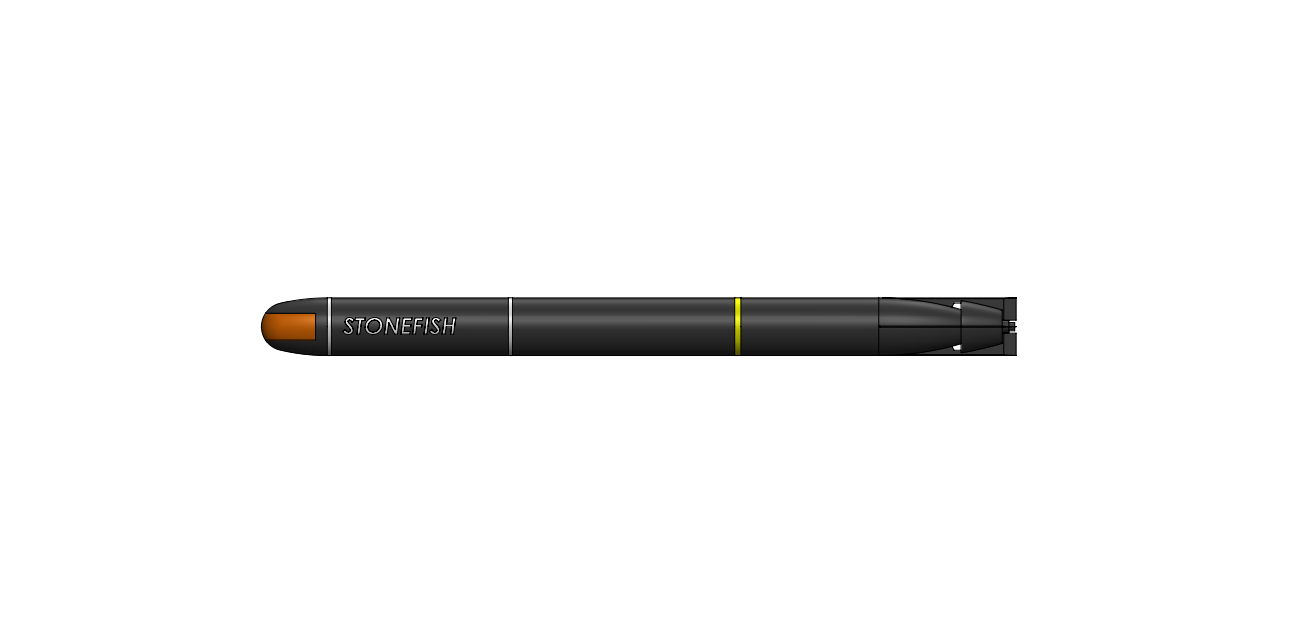
Torpedo Module: The Torpedo Module transforms the Manta from a reconnaissance platform into an offensive strike asset capable of engaging hostile submarines with lightweight torpedoes. The torpedo module contains four SDI Viperfish lightweight torpedoes in four torpedo launch tubes arranged in side by side pairs within the payload bay. Each tube is a 400 mm internal diameter fiberglass cylinder with a gas-impulse ejection system. The torpedo tubes are angled downward and exit through the vehicle's lower hull fairing via retractable doors. The vehicle's autonomous fire control function for torpedo employment includes target motion analysis (TMA) using passive sonar bearings from the hull arrays to estimate target range, course, and speed. Weapon presetting functionnthen calculates the optimal torpedo search pattern and homing mode based on the estimated target position and the weapon's performance envelope. Engagement geometry optimization maneuvers the Manta to an optimal firing position. The vehicle then opens the launch tube doors, performs a final torpedo pre-launch check, and commands the gas-impulse system to eject the torpedo. The torpedo enters the water, activates its propulsion system and homing head, and begins its autonomous search-and-attack pattern. The vehicle will then immediately maneuvers away from the engagement area to avoid counter-detection and potential counter-attack. Post-launch assessment uses the Manta's hull sonar arrays to monitor the engagement, listening for torpedo motor noise, homing head pings, and warhead detonation.