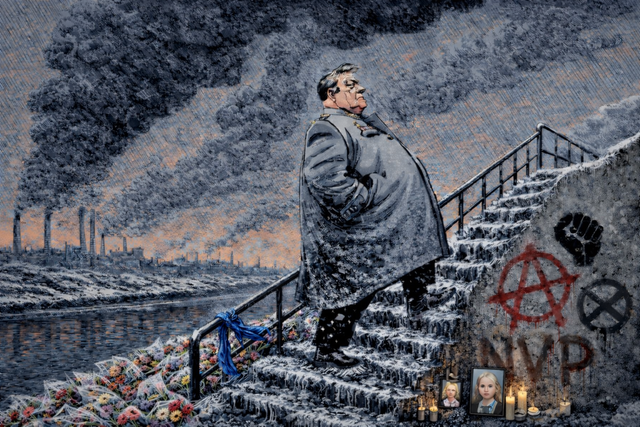

((This thread will detail some major events in Knootoss. It is intended as Act 1 of a 4 Act story. It is open to members of the Western Atlantic region. If you also want to join, let me know via discord or telegram and we can see what we can do!
EDIT: Act II is up as The indignant desert birds [Fall of Maurits Viljoen].
EDIT2: Act 1.5 is up, continuing the Lisbete story in Going to the People))
Dwalmdam Exclusion Zone
Free Republic of Knootoss
Mum had been up before dawn. She'd wiped the gallery window with a cloth that came away black no matter how many times she rinsed it. On the sill, she'd already put back the things she’d brought with her from South Epheron: a chipped enamel mug with faded sunflowers, a little tin of rooibos, a worn keyring in the colours of an amateur football team. There was a photograph taped to the wall of her in a cheap summer dress, squinting into a sun I can barely imagine, her hair pulled back, smiling. She never talked about apartheid, but she’d reminisce about the heat on her skin. About the smell of dust after rain and meat on a braai. Here, today, the air in the flat tasted metallic.
My phone buzzed.
AIR QUALITY EMERGENCY
PM2.5: EXTREME / HAZARDOUS
Shelter in place. Seal windows and vents.
Limit time outside to essential travel only.
Filtration mask required. Exposure may cause acute respiratory distress.
Below that, a second notification, longer, with a little red triangle icon.
CIVIL PROTECTION WARNING — SHELTER ORDER
Merwe Reclaimer Facility 31: containment/filtration failure.
Toxic particulate fallout possible. Avoid contact with deposited residue.
If you experience tight chest, wheezing, dizziness: call emergency services.
Children, elderly, and asthmatics: DO NOT GO OUTSIDE.
I knew the place. The big anarchist-run processing yard with the pipes like ribs and the constant orange flicker at night.
“School?” she asked.
“Remote,” I said. “They sent a video link already.” I turned the phone so she could see the warnings. “The Wi‑Fi’s been cutting out,” I added, quickly, before she could ask why I wasn’t already logged on. Her gaze flicked to the bruise on my cheekbone that I’d told her came from slipping on the stairs, then to my hands, because she always watched my hands when she thought I was lying.
“I’m going to Nomsa’s,” I said. Nomsa from two stairwells over. “Her mum has a computer.”
Her mouth tightened.
I had a mask. A proper filtering one with a grey valve and straps that had been stretched and re-tied twice. I kept it hung on a nail by the kettle. She pointed at it now, chin lifted.
“Put it on,” she said.
“I will,” I said. I looped the straps over my ears. The rubber bit dug into the bridge of my nose. Mum stepped close and pressed the metal strip down with her thumb, checking the seal like she’d seen in a video.
“Don’t take it off outside,” she said. “Not for talking. Not for looking tough.”
“I’m not going far,” I lied, and the words came out muffled, my breath warm against my own face. I pulled on my hoodie and waved.
“Be careful,” she murmured.
I nodded, and I left before she could ask anything else.
Outside, the stairwell stank of stale urine. The building shook faintly when a truck went past on the cracked service road. In the courtyard, the chains of the old swings were dusted dark with the black snow. Where it landed on the thin crust of yesterday’s white, it made it look spotted, like mould on old bread. A few flakes hit the puddle by the drain and spread into oily halos instead of dissolving clean. The filter rasped faintly and the air tasted of hot metal.
Kids were still out, of course. A little boy in a too-thin coat scooped snow into his mitten and showed his sister, laughing.
I kept my head down and walked fast.
The Zone in winter is always ugly, but the black snow made it feel cursed. Every parked car looked abandoned. Every puddle was a mirror of smoke.
My phone buzzed again. It was the group chat.
VeshSpider Where are you, round-ears? We move.
Another message immediately.
Ril: Vuilendam underground central today. Platform 3. Don’t be late.
I hated the nickname. I told myself that I wasn’t really one of them. That I was just… around them. That it was temporary. That when we saved enough, when the social housing list moved, when anything at all moved, I’d stop. But the truth was simple: they were my only friends. When the Steel Covenant harassed our block, calling me the n-word and acting like they owned the place, Vesh and the others made it stop. They kept me safe. And they let me earn something quick, so I didn’t have to go home and ask Mum for money she didn’t have.
I took the tram line that still ran near the cordon. Most people had masks on, so mine didn’t mark me out, but a white woman in a clean parka still clutched her purse as I made my way to a seat.
----------------------------------------------------------------------
Vuilendam
Free Republic of Knootoss
The station was a cavern of poured concrete. Hard angles. Harsh light. Pale tiles scrubbed clean, stainless railings, plastic SIN-portals. Under the PLATFORM 3 - ZUIDERLIJN sign, Vesh waited with Ril and Keth. They were metahumans with ashen grey skin, shocking white hair protruding from dark hoods, and ears shaped like knives. Commuters flowed around them as if there was an invisible barrier. Vesh stood with his hands in his pockets, shoulders relaxed. He smiled when he saw me. “Finally,” he said. “I thought you’d died in your little poison palace.”
Ril snorted. She had a thin face and a habit of tilting her head when she listened, like she was deciding where to bite. A small folding knife sat loose in her fingers, the blade flashing in and out as she clicked it open and shut without looking.
Keth leaned against a pillar, playing with a metal lighter. Making a little flame appear over, and over, and over.
“We’re staying in Vuilendam today,” Vesh said, as if he were announcing a day trip. “The Zone's too hot. Bad for business.”
I glanced up at the cameras. A dark dome watched the platform. Another one watched the escalators.
“What business?” I asked.
Vesh’s smile widened a fraction. “Collection. And maybe a little opportunism. All the little lambs wandering around with expensive coats and even more expensive phones.”
Keth’s lighter clicked again. “We need ducats,” he said, flat. “Good filters are expensive. Your mother likes breathing, yes?”
“I’ll do it,” I said, and I hated myself for how quickly it came out.
Vesh clapped once, in mock applause. “Good boy.”
When we came up out of the underground, the buildings were clean and the pavements solid, but the air still carried the same sour edge. A woman in a business coat held her scarf over her mouth and glared at a passing municipal truck like it was personally responsible. Posters on the tram stop glass showed a poster of the local greens, with a slogan about “Breathable Air, Drinkable Water”. Someone had already scrawled “LIARS” over it. We drifted through the shopping streets where half the shops had their shutters down and the other half were full of people buying bottled water and masks. A siren wailed somewhere distant, doppler-slicing through the low hush of the city.
Vesh guided us towards a canal bridge where the tram lines crossed. Under the bridge, there was a sheltered spot with a bench and a bit of warmth from a vent. “That one,” Vesh murmured.
I followed his gaze and my stomach tightened.
A girl sat on the bench, alone. White. Fifteen, maybe sixteen. She had a pale blue scarf looped twice around her neck and hair the colour of wheat, damp at the ends from the snow. Her cheeks were pink with cold. She was holding a Syntexis Apex X25 Pro Smartphone in both hands, thumbs moving fast. She looked ordinary in a way that made her feel unreal to me, like a picture in an advertisement.
“Easy,” Vesh said, close to my ear. “You do the talking. You look… normal.”
I swallowed. “Just a phone?”
“And her bag,” Ril said, amused. The little knife flicked open with a soft, oily sound, point tracing a lazy line in the air between us. “And if she screams, you shut her up.”
My eyes snapped to her. “No.”
Ril’s expression didn’t change. “Then don’t make her scream.”
Keth’s voice, bored as ever: “Do it or go back without us.”
I stepped forward before I could think too much. I walked up to the bench, slowing as if I was just another person waiting. My heart was banging so hard I could hear blood in my ears. I tried to make my face calm. I tried to make my voice steady. “Sorry,” I asked in Dutch. “Do you know if the tram’s coming?”
She glanced up, annoyed, then looked back at the display board. “It says delayed.”
“Yeah,” I said stupidly. “Because of… this.” I lifted my hand, palm up, catching a few black flakes. They melted into a smear like soot mixed with oil.
She grimaced. “It’s disgusting.”
“It’s dangerous,” I heard myself say, and the sincerity in my voice surprised me. “You shouldn’t be out.”
She gave a short laugh. “You too.”
I didn’t know how to do this. Not like this. Not to someone who looked at me like I was just a boy with bad timing. My phone buzzed again. I didn’t look. I could feel Vesh nearby.
“Listen,” I said, lowering my voice. “I need...”
Her eyes flicked past me, just a fraction, to the movement behind my shoulder. She saw them. She saw the way they stood. Her body tightened. The ordinary annoyance drained out of her face and left something else.
“No,” she whispered, before I’d even said anything.
I felt cold sweat break across my back under my hoodie.
“I’m not...” I started, because I wanted to tell her I wasn’t going to hurt her.
She stood up fast. The bench scraped. The girl clutched her phone to her chest.
“Please,” she said, and the word hit me like a slap. “Please don’t.”
“Just give it. The bag too,” Vesh said softly from behind me, his voice smooth, almost kind. “And we all go home happy.”
The girl’s eyes locked on mine, wide, pleading and furious at the same time. In that moment I hated every part of this. I hated the Zone. I hated the black snow. I hated the way my life had led to this moment.
“I’ll pay you,” she blurted. “I can SIN you something...”
Ril laughed, a quick sharp sound. “Sweet.”
A man across the street looked at us as if considering whether to intervene. Then he saw the glare in Vesh’s lilac eyes and looked away, increasing his pace.
The girl backed up. She turned to run. “No,” I called out. I reached out without thinking, not to hurt her, just to stop her from running into the street. My fingers caught her sleeve. The fabric was cold and wet. She jerked, screaming.
Ril moved fast. I saw a flash of her fist, or maybe a flash of her knife. I couldn't tell. The girl went sideways. For a split second she flailed, arms windmilling, scarf whipping loose. Her foot slipped on the edge of the curb. Her back hit the bridge rail with a dull sound. Then she toppled awkwardly onto the stone steps that led to the lower walkway. Her head struck with a heavy thud.
She stopped screaming. Everything went very quiet, except for the distant siren.
I let go of her sleeve and stumbled forward. I didn’t even feel my legs move. I was already kneeling on the steps, hands shaking, staring at her face. Her eyes were open but unfocused, like she was looking past me at something I couldn’t see. The pale blue scarf had twisted and half-covered her mouth. There was a dark smear where the sooty snow mixed with something red.
“Oh no,” I whispered.
“Get up,” Vesh said, voice suddenly tight. “Leave her.”
“She’s hurt,” I protested.
Ril peered down at the girl with mild interest, speaking in a sing-song way: “That’s what happens when they run.”
Keth was already crouching. He scooped up the girl’s phone and yanked her bag free from her shoulder, the strap tearing with a dry snap. He glanced at the screen once, then shoved the phone into his coat pocket. “We’re done,” he said. “Move.”
“She’s a kid,” I said.
Vesh’s eyes narrowed. “So are you.”
My phone was buzzing again, frantic in my pocket. I didn’t want to look. Footsteps pounded on the bridge above, then down the steps. Someone shouting. I leaned over the girl without thinking, pulling the scarf away from her mouth so she could breathe. My fingers came away stained. “Hey,” I said, too softly, too close, like she could hear me. “Hey, please...”
A voice roared from behind me, raw and full of certainty: “Get away from her, you filth!”
I twisted.
A man stood halfway down the steps, broad-shouldered, face flushed. He held a pistol in both hands. On his coat, a little embroidered patch caught the light: a crossed grey circle with block letters curved around it. STEEL COVENANT. He was dressed in an ordinary dark coat and leather gloves, but the patch and the way he stood gave him away. His eyes were bright with purpose. Righteousness. Excitement.
I lifted my hands, palms out, because what else can you do when someone points a gun at you?
“I didn’t...” I started.
The man’s gaze flicked to my hands, to the girl’s scarf, to the smear on my fingers. I twisted my head, stupidly hopeful, looking past him for Vesh and the others. They were gone. They’d left me behind.
All the man saw was me, and a white girl in black snow.
“You people,” he spat.
“I’m not...” I tried again, and my voice cracked because I was terrified. He stepped down one more stair, gun steady, breathing hard like he’d been dreaming about this moment his whole life.
“Don’t move,” he said, and his voice shook with satisfaction. “Don’t you move.”
I froze. I kept my hands up. I looked at the girl again, because I couldn’t not. Her eyes still didn’t focus. Her lips were slightly parted.
My phone vibrated against my thigh. Someone was trying to call me.
“Help her,” I pleaded. “Please. Call... call an ambulance. She fell. She...”
He barked a laugh, sharp and ugly. “Yeah. She ‘fell’. Of course she did.”
Behind him, a skinhead in a bulbous winter coat had started filming. I saw the the lens pointed at me, the girl, the gun. I saw my own reflection in the glass: hood up, mask on, hands stained.
For a split second, absurdly, I thought I could still get away. The others had gotten away. I lunged for the stairs past him.
Then the world cracked open with sound and white light.
My body jolted as if someone had shoved me hard in the chest. The air left my lungs in a grunt I didn’t recognise as mine. I fell sideways, hands scrambling against stone, and the cold slapped my cheek.
I tasted iron.
The bridge above blurred. The underside of it was a grey ceiling streaked with damp. Black flakes drifted down, settling on my eyelashes.
I tried to breathe.
The man’s voice seemed to come from far away. “I stopped him,” he said, louder now, pitching his voice. “I stopped him. You all saw it. He was going for me.” He drew in a breath, squared his shoulders. “I didn’t want this,” he went on. “I’m not a hero. I don’t want to be a hero. But someone has to stand up. Someone has to do something. For our people.” Behind him, the skinhead adjusted his grip on the phone, angling it carefully. The little black rectangle tracked the man, then dipped, framing me and the girl together in the same shot.
“Keep filming,” the man ordered without looking back. “Get her. Make sure every Knootian can see what he did to her.” His boots thudded down the last steps and past me, close enough that grit sprayed my cheek. “I’ll call an ambulance for her,” he added, almost kindly. I couldn’t turn my head. I could only hear the thin wail of a siren getting closer.
My hand twitched and my phone slid out of my pocket, skittering across the steps. The screen had cracked, spiderwebbing the light. Through the broken glass I could still see the notifications stacked one over another.
Mum ⟶ Missed call (2)
Mum ⟶ Missed call (3)
Mum ⟶ Missed call (4)
Mum ⟶ Missed call (5)
Underneath them, the emergency alert still glowed.
Stay indoors, it said.
As if there had ever been a place for me on the inside.