NATION

PASSWORD

The Winter Of Our Discontent

Where nations come together and discuss matters of varying degrees of importance. [In character]
User avatar
Knootoss
Senator
 
Posts: 4467
Founded: Antiquity
Anarchy

The Winter Of Our Discontent

Postby Knootoss » Tue Jan 20, 2026 12:11 am

((This thread will detail some major events in Knootoss. It is intended as Act 1 of a 4 Act story. It is open to members of the Western Atlantic region. If you also want to join, let me know via discord or telegram and we can see what we can do!

EDIT: Act II is up as The indignant desert birds [Fall of Maurits Viljoen].
EDIT2: Act 1.5 is up, continuing the Lisbete story in Going to the People))


Dwalmdam Exclusion Zone
Free Republic of Knootoss


Mum had been up before dawn. She'd wiped the gallery window with a cloth that came away black no matter how many times she rinsed it. On the sill, she'd already put back the things she’d brought with her from South Epheron: a chipped enamel mug with faded sunflowers, a little tin of rooibos, a worn keyring in the colours of an amateur football team. There was a photograph taped to the wall of her in a cheap summer dress, squinting into a sun I can barely imagine, her hair pulled back, smiling. She never talked about apartheid, but she’d reminisce about the heat on her skin. About the smell of dust after rain and meat on a braai. Here, today, the air in the flat tasted metallic.

My phone buzzed.

AIR QUALITY EMERGENCY
PM2.5: EXTREME / HAZARDOUS
Shelter in place. Seal windows and vents.
Limit time outside to essential travel only.
Filtration mask required. Exposure may cause acute respiratory distress.

Below that, a second notification, longer, with a little red triangle icon.

CIVIL PROTECTION WARNING — SHELTER ORDER
Merwe Reclaimer Facility 31: containment/filtration failure.
Toxic particulate fallout possible. Avoid contact with deposited residue.
If you experience tight chest, wheezing, dizziness: call emergency services.
Children, elderly, and asthmatics: DO NOT GO OUTSIDE.

I knew the place. The big anarchist-run processing yard with the pipes like ribs and the constant orange flicker at night.

“School?” she asked.

“Remote,” I said. “They sent a video link already.” I turned the phone so she could see the warnings. “The Wi‑Fi’s been cutting out,” I added, quickly, before she could ask why I wasn’t already logged on. Her gaze flicked to the bruise on my cheekbone that I’d told her came from slipping on the stairs, then to my hands, because she always watched my hands when she thought I was lying.

“I’m going to Nomsa’s,” I said. Nomsa from two stairwells over. “Her mum has a computer.”

Her mouth tightened.

I had a mask. A proper filtering one with a grey valve and straps that had been stretched and re-tied twice. I kept it hung on a nail by the kettle. She pointed at it now, chin lifted.

“Put it on,” she said.

“I will,” I said. I looped the straps over my ears. The rubber bit dug into the bridge of my nose. Mum stepped close and pressed the metal strip down with her thumb, checking the seal like she’d seen in a video.

“Don’t take it off outside,” she said. “Not for talking. Not for looking tough.”

“I’m not going far,” I lied, and the words came out muffled, my breath warm against my own face. I pulled on my hoodie and waved.

“Be careful,” she murmured.

I nodded, and I left before she could ask anything else.

Outside, the stairwell stank of stale urine. The building shook faintly when a truck went past on the cracked service road. In the courtyard, the chains of the old swings were dusted dark with the black snow. Where it landed on the thin crust of yesterday’s white, it made it look spotted, like mould on old bread. A few flakes hit the puddle by the drain and spread into oily halos instead of dissolving clean. The filter rasped faintly and the air tasted of hot metal.

Kids were still out, of course. A little boy in a too-thin coat scooped snow into his mitten and showed his sister, laughing.

I kept my head down and walked fast.

The Zone in winter is always ugly, but the black snow made it feel cursed. Every parked car looked abandoned. Every puddle was a mirror of smoke.

My phone buzzed again. It was the group chat.

VeshSpider Where are you, round-ears? We move.

Another message immediately.

Ril: Vuilendam underground central today. Platform 3. Don’t be late.

I hated the nickname. I told myself that I wasn’t really one of them. That I was just… around them. That it was temporary. That when we saved enough, when the social housing list moved, when anything at all moved, I’d stop. But the truth was simple: they were my only friends. When the Steel Covenant harassed our block, calling me the n-word and acting like they owned the place, Vesh and the others made it stop. They kept me safe. And they let me earn something quick, so I didn’t have to go home and ask Mum for money she didn’t have.

I took the tram line that still ran near the cordon. Most people had masks on, so mine didn’t mark me out, but a white woman in a clean parka still clutched her purse as I made my way to a seat.

----------------------------------------------------------------------

Vuilendam
Free Republic of Knootoss


The station was a cavern of poured concrete. Hard angles. Harsh light. Pale tiles scrubbed clean, stainless railings, plastic SIN-portals. Under the PLATFORM 3 - ZUIDERLIJN sign, Vesh waited with Ril and Keth. They were metahumans with ashen grey skin, shocking white hair protruding from dark hoods, and ears shaped like knives. Commuters flowed around them as if there was an invisible barrier. Vesh stood with his hands in his pockets, shoulders relaxed. He smiled when he saw me. “Finally,” he said. “I thought you’d died in your little poison palace.”

Ril snorted. She had a thin face and a habit of tilting her head when she listened, like she was deciding where to bite. A small folding knife sat loose in her fingers, the blade flashing in and out as she clicked it open and shut without looking.

Keth leaned against a pillar, playing with a metal lighter. Making a little flame appear over, and over, and over.

“We’re staying in Vuilendam today,” Vesh said, as if he were announcing a day trip. “The Zone's too hot. Bad for business.”

I glanced up at the cameras. A dark dome watched the platform. Another one watched the escalators.

“What business?” I asked.

Vesh’s smile widened a fraction. “Collection. And maybe a little opportunism. All the little lambs wandering around with expensive coats and even more expensive phones.”

Keth’s lighter clicked again. “We need ducats,” he said, flat. “Good filters are expensive. Your mother likes breathing, yes?”

“I’ll do it,” I said, and I hated myself for how quickly it came out.

Vesh clapped once, in mock applause. “Good boy.”

When we came up out of the underground, the buildings were clean and the pavements solid, but the air still carried the same sour edge. A woman in a business coat held her scarf over her mouth and glared at a passing municipal truck like it was personally responsible. Posters on the tram stop glass showed a poster of the local greens, with a slogan about “Breathable Air, Drinkable Water”. Someone had already scrawled “LIARS” over it. We drifted through the shopping streets where half the shops had their shutters down and the other half were full of people buying bottled water and masks. A siren wailed somewhere distant, doppler-slicing through the low hush of the city.

Vesh guided us towards a canal bridge where the tram lines crossed. Under the bridge, there was a sheltered spot with a bench and a bit of warmth from a vent. “That one,” Vesh murmured.

I followed his gaze and my stomach tightened.

A girl sat on the bench, alone. White. Fifteen, maybe sixteen. She had a pale blue scarf looped twice around her neck and hair the colour of wheat, damp at the ends from the snow. Her cheeks were pink with cold. She was holding a Syntexis Apex X25 Pro Smartphone in both hands, thumbs moving fast. She looked ordinary in a way that made her feel unreal to me, like a picture in an advertisement.

“Easy,” Vesh said, close to my ear. “You do the talking. You look… normal.”

I swallowed. “Just a phone?”

“And her bag,” Ril said, amused. The little knife flicked open with a soft, oily sound, point tracing a lazy line in the air between us. “And if she screams, you shut her up.”

My eyes snapped to her. “No.”

Ril’s expression didn’t change. “Then don’t make her scream.”

Keth’s voice, bored as ever: “Do it or go back without us.”

I stepped forward before I could think too much. I walked up to the bench, slowing as if I was just another person waiting. My heart was banging so hard I could hear blood in my ears. I tried to make my face calm. I tried to make my voice steady. “Sorry,” I asked in Dutch. “Do you know if the tram’s coming?”

She glanced up, annoyed, then looked back at the display board. “It says delayed.”

“Yeah,” I said stupidly. “Because of… this.” I lifted my hand, palm up, catching a few black flakes. They melted into a smear like soot mixed with oil.

She grimaced. “It’s disgusting.”

“It’s dangerous,” I heard myself say, and the sincerity in my voice surprised me. “You shouldn’t be out.”

She gave a short laugh. “You too.”

I didn’t know how to do this. Not like this. Not to someone who looked at me like I was just a boy with bad timing. My phone buzzed again. I didn’t look. I could feel Vesh nearby.

“Listen,” I said, lowering my voice. “I need...”

Her eyes flicked past me, just a fraction, to the movement behind my shoulder. She saw them. She saw the way they stood. Her body tightened. The ordinary annoyance drained out of her face and left something else.

“No,” she whispered, before I’d even said anything.

I felt cold sweat break across my back under my hoodie.

“I’m not...” I started, because I wanted to tell her I wasn’t going to hurt her.

She stood up fast. The bench scraped. The girl clutched her phone to her chest.

“Please,” she said, and the word hit me like a slap. “Please don’t.”

“Just give it. The bag too,” Vesh said softly from behind me, his voice smooth, almost kind. “And we all go home happy.”

The girl’s eyes locked on mine, wide, pleading and furious at the same time. In that moment I hated every part of this. I hated the Zone. I hated the black snow. I hated the way my life had led to this moment.

“I’ll pay you,” she blurted. “I can SIN you something...”

Ril laughed, a quick sharp sound. “Sweet.”

A man across the street looked at us as if considering whether to intervene. Then he saw the glare in Vesh’s lilac eyes and looked away, increasing his pace. 

The girl backed up. She turned to run. “No,” I called out. I reached out without thinking, not to hurt her, just to stop her from running into the street. My fingers caught her sleeve. The fabric was cold and wet. She jerked, screaming.

Ril moved fast. I saw a flash of her fist, or maybe a flash of her knife. I couldn't tell. The girl went sideways. For a split second she flailed, arms windmilling, scarf whipping loose. Her foot slipped on the edge of the curb. Her back hit the bridge rail with a dull sound. Then she toppled awkwardly onto the stone steps that led to the lower walkway. Her head struck with a heavy thud.

She stopped screaming. Everything went very quiet, except for the distant siren.

I let go of her sleeve and stumbled forward. I didn’t even feel my legs move. I was already kneeling on the steps, hands shaking, staring at her face. Her eyes were open but unfocused, like she was looking past me at something I couldn’t see. The pale blue scarf had twisted and half-covered her mouth. There was a dark smear where the sooty snow mixed with something red.

“Oh no,” I whispered.

“Get up,” Vesh said, voice suddenly tight. “Leave her.”

“She’s hurt,” I protested.

Ril peered down at the girl with mild interest, speaking in a sing-song way: “That’s what happens when they run.”

Keth was already crouching. He scooped up the girl’s phone and yanked her bag free from her shoulder, the strap tearing with a dry snap. He glanced at the screen once, then shoved the phone into his coat pocket. “We’re done,” he said. “Move.”

“She’s a kid,” I said.

Vesh’s eyes narrowed. “So are you.”

My phone was buzzing again, frantic in my pocket. I didn’t want to look. Footsteps pounded on the bridge above, then down the steps. Someone shouting. I leaned over the girl without thinking, pulling the scarf away from her mouth so she could breathe. My fingers came away stained. “Hey,” I said, too softly, too close, like she could hear me. “Hey, please...”

A voice roared from behind me, raw and full of certainty: “Get away from her, you filth!”

I twisted.

A man stood halfway down the steps, broad-shouldered, face flushed. He held a pistol in both hands. On his coat, a little embroidered patch caught the light: a crossed grey circle with block letters curved around it. STEEL COVENANT. He was dressed in an ordinary dark coat and leather gloves, but the patch and the way he stood gave him away. His eyes were bright with purpose. Righteousness. Excitement.

I lifted my hands, palms out, because what else can you do when someone points a gun at you?

“I didn’t...” I started.

The man’s gaze flicked to my hands, to the girl’s scarf, to the smear on my fingers. I twisted my head, stupidly hopeful, looking past him for Vesh and the others. They were gone. They’d left me behind.

All the man saw was me, and a white girl in black snow.

“You people,” he spat.

“I’m not...” I tried again, and my voice cracked because I was terrified. He stepped down one more stair, gun steady, breathing hard like he’d been dreaming about this moment his whole life.

“Don’t move,” he said, and his voice shook with satisfaction. “Don’t you move.”

I froze. I kept my hands up. I looked at the girl again, because I couldn’t not. Her eyes still didn’t focus. Her lips were slightly parted.

My phone vibrated against my thigh. Someone was trying to call me.

“Help her,” I pleaded. “Please. Call... call an ambulance. She fell. She...”

He barked a laugh, sharp and ugly. “Yeah. She ‘fell’. Of course she did.”

Behind him, a skinhead in a bulbous winter coat had started filming. I saw the the lens pointed at me, the girl, the gun. I saw my own reflection in the glass: hood up, mask on, hands stained.

For a split second, absurdly, I thought I could still get away. The others had gotten away. I lunged for the stairs past him.

Then the world cracked open with sound and white light.

My body jolted as if someone had shoved me hard in the chest. The air left my lungs in a grunt I didn’t recognise as mine. I fell sideways, hands scrambling against stone, and the cold slapped my cheek.

I tasted iron.

The bridge above blurred. The underside of it was a grey ceiling streaked with damp. Black flakes drifted down, settling on my eyelashes.

I tried to breathe.

The man’s voice seemed to come from far away. “I stopped him,” he said, louder now, pitching his voice. “I stopped him. You all saw it. He was going for me.” He drew in a breath, squared his shoulders. “I didn’t want this,” he went on. “I’m not a hero. I don’t want to be a hero. But someone has to stand up. Someone has to do something. For our people.” Behind him, the skinhead adjusted his grip on the phone, angling it carefully. The little black rectangle tracked the man, then dipped, framing me and the girl together in the same shot.

“Keep filming,” the man ordered without looking back. “Get her. Make sure every Knootian can see what he did to her.” His boots thudded down the last steps and past me, close enough that grit sprayed my cheek. “I’ll call an ambulance for her,” he added, almost kindly. I couldn’t turn my head. I could only hear the thin wail of a siren getting closer.

My hand twitched and my phone slid out of my pocket, skittering across the steps. The screen had cracked, spiderwebbing the light. Through the broken glass I could still see the notifications stacked one over another.

Mum ⟶ Missed call (2)
Mum ⟶ Missed call (3)
Mum ⟶ Missed call (4)
Mum ⟶ Missed call (5)

Underneath them, the emergency alert still glowed.

Stay indoors, it said.

As if there had ever been a place for me on the inside.

Last edited by Knootoss on Fri Apr 10, 2026 11:32 am, edited 3 times in total.

Ideological Bulwark #7 - RPed population preserves relative population sizes. Webgame population / 100 is used by default. If this doesn't work for you and it is relevant to our RP, please TG.

User avatar
Knootoss
Senator
 
Posts: 4467
Founded: Antiquity
Anarchy

Postby Knootoss » Tue Jan 20, 2026 1:34 pm

Vuilendam
Free Republic of Knootoss


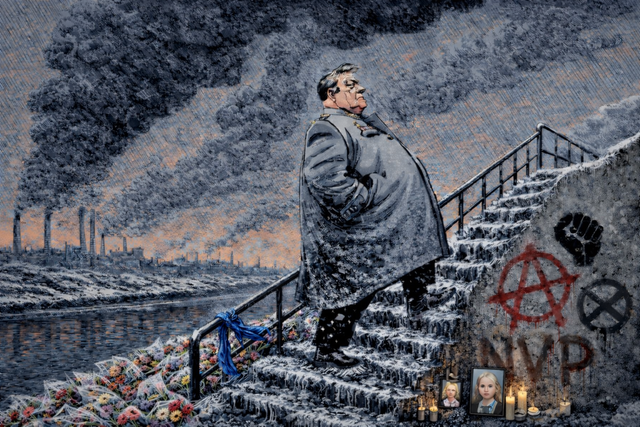
The canal bridge had become a shrine. A pale blue scarf tied to the railing. A row of cheap candles on the lower steps, their little flames guttering in the draught every time a tram rolled past. There were growing clusters of flowers, supermarket colours bright against soot-stained snow. Red-and-white tape fluttered half-heartedly in the wind. A pair of police officers stood idle with their masks on and their hands clasped behind their backs.

On the far side of the tape, KNN’s crew had braced a tripod. A sound technician in a hood with a furry rim swore softly as black snow dusted the foam windscreen. The cameraman had wiped his lens three times already, and the cloth came away dark each time. Lente Laan, KNN News anchor, stood in the middle of the scene. She wore a pristine white mask with the company logo embossed near the seam. Her producer’s voice crackled in her ear. “He’s five out. You’re live in two. Let him make the first move. Don’t interrupt. If he goes off, stay in it. Don’t look scared. You're curious.”

“Always curious,” Lente murmured. She glanced down at her phone. The clip was already being remixed into different shorts. Some blurred. Some not. The vigilante’s voice looped under every edit. The boy’s mask. The girl’s scarf. The gun. The patch. The story had the clean cruelty television liked. Two young people, dead in the same frame. And over it all, the black snow: the idea of the Zone coming to the 'real' Knootoss made physical and cinematic.

Steven Taelman came into view. He walked unhurriedly, thick through the neck and shoulders, heavy in the middle, his face carved into a permanent, displeased squint. Over his uniform he wore a long military overcoat in field-grey wool. For the walk-in it was buttoned high against the cold, collar turned up. But as he reached the tape he let it fall open at the front so that the camera could see the pressed tunic beneath, the neat collar tabs, the bright little rectangles of ribbon and metal on his chest. A black face mask covered the lower half of his face. Lente recognised it for what it was: a prop waiting to be removed.

A small crowd had formed along the tape and the canal railings. Some were bundled commuters who had paused out of reflex. Others were there with purpose, phones held high. A man with a shaved head and a thick winter coat leaned in, whispering to Taelman. Lente saw the embroidered patch on his sleeve, the grey circle crossed, the block letters. Then another Steel Covenant man appeared behind him, then another, moving like a pack.

Lente’s producer whispered, “They’re here. We’re rolling.”

The little red light blinked on the camera. Lente’s shoulders lifted into her on-air posture. She turned her head slightly so the lens caught her good side. She made her eyes soft. “This is Lente Laan, live in Vuilendam,” she said, shaping her voice for calm enunciation. “You’re looking at the steps beneath the canal bridge where the grisly murder of a fifteen year old girl took place yesterday, in what is rapidly becoming one of the most incendiary incidents in recent memory. General Steven Taelman, better known as Staalman, has arrived to meet with members of the local community…”

Steel Covenant men shifted and smiled, flattered by the phrase.

Taelman paused at the tape, looked down at the candles and scarf, and made a small sound in his throat. He stepped forward, and one of the policemen lifted the tape for him. He walked down the steps. His eyes moved over the scene as if inspecting it. Then he reached up and hooked his fingers under the elastic of his mask. He ripped it off in one smooth, violent motion and tossed it aside. A ripple went through the crowd. Phones rose higher. Someone laughed. Someone else began to clap.

Taelman drew in a breath through his nose and lifted his chin so the camera could see the whole face: the ruddy winter flush, the hard-set mouth, the glaring eyes. “Look at this,” he said loudly. He held out his hand and let the blackened flakes land on his glove, before curling his fingers inwards to crush them with a creak of leather. “This is what they did. This is what they are. But I'm not afraid.”

Around him, Steel Covenant men pulled off their own masks. They threw them aside and breathed in together. The short-haired man from the video then stepped forward. His eyes darted to the camera, then back to Taelman, hungry for reflection. “General,” he said, and his voice cracked on the word. “Sir. Thank you. Thank you for coming.”

Taelman’s mouth softened into something that could pass for a smile. He reached out and took the man’s shoulder, gripping hard enough to look intimate and to hurt. “What’s your name?” Taelman asked.

The man swallowed. “Harm,” he said. “Harm van...”

Taelman cut the surname off with a small shake of his head. “You did what our failing state would not. You are a hero.”

Harm’s throat bobbed. He looked as if he might cry. Lente watched the framing tighten, watched the cameraman lean in. Taelman reached up to his own chest. His fingers hovered over a ribbon bar. Then he simply grabbed and yanked. A small medal came free. He held it up between finger and thumb.

Gasps. Phones tilted for a better shot. Someone behind Lente whispered, almost reverently, “He’s giving him one of his own.”

Taelman stepped closer to Harm and pinned the medal to the man’s coat, pushing the clasp through thick fabric. Harm sucked in a breath. Taelman’s hand lingered at the man’s chest a fraction too long. “There,” Taelman said. “You deserve it, son.”

Harm made a small, strangled sound. Half a laugh, half a sob he couldn’t quite swallow. He blinked hard and looked down at the medal. Applause came from above, from the onlookers along the railing.  Taelman opened his arms and Harm fell into them. It was a tight, awkward hug. He held the embrace just long enough for the camera to drink it in, then released him and turned straight into the lens.

Lente felt a tiny lift in her stomach, her fingers tightening around the mic shaft. The noise from the bridge above blurred into a single, anticipatory hush. In her earpiece, her producer stopped breathing for a beat, and Lente let her own face go still as Taelman’s eyes slid past her and locked onto the lens.

“This isn’t complicated,” he said. “They will try to make it complicated. They will lie. They will say anything, anything at all, to stop you seeing what is in front of you.” He jabbed a finger down towards the steps, towards the candles, towards the place where yesterday’s blood had been. “One victim,” he said. “Sanne.”

A nearby girl turned her face into her coat and made a small sobbing sound at the mere mention of the name.

“One hero. Harm,” Taelman went on, and he hooked his thumb back at him. Harm straightened, swelling.

“And one… thing,” Taelman said, and his lip curled. “One lowlife Zone spawn. One filthy little parasite who thought he could take what he wanted, and when he couldn’t, he killed our daughter. Our girl.”

He spat the last words, bright flecks vanishing into the black snow at his boots. Taelman leaned forward a step, invading the camera’s space. His breath fogged faintly in the cold. He was close enough that the lens could see the pores on his nose and the fine lines at the corner of his eyes. “I am tired of being told to accept this. I am tired of being told that this...” he swept his hand at the black snow, at the tape, at the shrine...“is the price of ‘tolerance’. That this is the price of letting an entire poisoned strip of our country fester like a wound because some people enjoy feeling morally superior to the rest of us.”

Behind him, a Steel Covenanter muttered, “Yes,” like a prayer.

Taelman’s voice rose. “We built this country to be safe. We built it to be clean. We built it to be ours. And what do we have instead? A Zone. A lawless Zone, full of people who don’t respect us, don’t obey our laws, don't belong to us. They breathe our air and then poison it. They steal our goods and knife our children and then cry when someone is bold enough to stand up to and stop them.” Taelman’s eyes glittered. “We will cleanse it,” he said. “We will cleanse the Zone. We will eradicate the rot. We will take back what is ours. No more committees. No more ‘working groups’. No more cowardice. There will be order, or there will be nothing.”

He took a breath, and his jaw worked as if he were chewing the air. The crowd behind the tape surged, hungry. A chant of 'STAALMAN' tried to start and then broke into messy applause.

Lente waited a beat, then stepped in with her microphone, with her calm, carefully curated concern. “General Taelman,” she said, and her voice softened, “some people watching this will agree with you. Others will be deeply troubled by what they’re seeing. There are those who interpret the video to suggest that the shooting may have been unwarranted. That there were, potentially, two young victims here yesterday. The girl and the boy. What do you say to those who feel...”

Taelman snapped towards her. Hot, impatient, delighted to have an enemy. His face flushed darker. The vein at his temple stood out. “Two victims?” he barked, and the laughter that followed was sharp enough to cut. “Two victims?” He stepped closer, and for the first time Lente felt an honest flicker of fear. He was still playing, she thought rationally. And she was playing curious.

“Don’t you dare,” Taelman said, pointing at her microphone. “Don’t you dare stand here, where she was killed, and tell the people of Knootoss that the thing that did this to her was a ‘victim’.” His voice climbed. “There is one victim. One. Sanne. There is one killer. One. And there is one hero who did what the state refused to do because it has been infected by a communistic cabal of traitors and Zone Appeasers.” He swung his arm out towards the south. “And if your unnamed sources want to cry about it,” he snarled, “they can go live there. Let's see how long their moral purity lasts, surrounded by these blackaroon thugs.”

The Steel Covenant men laughed. They clapped harder now, emboldened by his anger. Harm looked dazed with happiness. Taelman turned back to the lens. “This is a warning,” he said, and his voice dropped into something quieter, more menacing. “To the Zone. To the criminals. To the cooperatives. To the so-called activists who hide behind socialist slogans while our children bleed and die.” He held the camera with his eyes. “Your time is ending.”

Lente lifted her microphone again. “General Taelman, one final question...”

Taelman ignored her. He lifted Harm’s arm like a referee declaring a winner, and the crowd roared. Lente heard her producer exhale in her ear, equally satisfied and disgusted.

“This is gold,” the producer murmured.

Lente felt the old, ugly satisfaction in her own chest as well. The lift of a segment becoming a moment.

Ideological Bulwark #7 - RPed population preserves relative population sizes. Webgame population / 100 is used by default. If this doesn't work for you and it is relevant to our RP, please TG.

User avatar
Knootoss
Senator
 
Posts: 4467
Founded: Antiquity
Anarchy

Postby Knootoss » Thu Jan 22, 2026 10:31 am

Maurits Viljoen Exhibition, Convention and Exchange Centre
Fronten, Free Republic of Knootoss


Charlotte van Jonkervelde sits in a side room off the main negotiation corridor with two binders open in front of her and a third pushed aside at a precise angle. The room has one long table, a strip of harsh ceiling lights, and a wall-mounted screen that has been turned off. On the wall opposite, a framed portrait of a young Maurits Viljoen hangs a fraction too high, smirking with perfectly white teeth and lacquered hair.

Her assistant has brought coffee that has already cooled. Charlotte does not drink it. She runs a fingertip along a paragraph on the latest draft, eyes moving without stopping. “Trial venue paragraph,” she says, without looking up. “We recommend the Palace of Universal Justice. Why is this item still highlighted?”

Her principal PA, Lisette, makes a face she probably thinks is neutral. It isn’t. “Prime Minister, it’s a terrible building.”

Charlotte’s eyes stay on the page. “It is a courthouse.”

“It's associated with the World Assembly,” Lisette replies. “It also has that useless forever-committee that won't even investigate Anahuac. In people's minds, nothing good happens in that building.”

“We are offering a neutral site with interpretation booths, controlled access points, holding rooms, witness protection capabilities, and a comms spine that can handle the traffic. That is what I 'associate' it with.”

Her second PA, Maarten, leans forward with a tablet. “It's the first search result you get for 'Sick Building Syndrome, Knootoss',” he says. “It has those awful atriums. The acoustics are...”

“Acoustics,” Charlotte repeats, finally lifting her gaze. Her expression rearranges into the mild disbelief. “We still need to do the proximity zones for Cyretopolitanian and Qubtian security details, and you are talking to me about acoustics.”

“It’s not just that,” Lisette says, too fast. “The optics...”

“Optics,” Charlotte says again, flat. She flips a page. “I am not hosting it in that boutique hotel you like because the abstract art looks too severe.”

Maarten opens his mouth, then closes it and glances down. He tries another angle. “The Jrawans will worry it implies World Assembly jurisdiction.”

Charlotte’s pencil pauses, then taps once on the margin. “They have already floated the idea of a neutral venue for trials,” she says. “They want neutral judges. We have a building designed to hold them.”

A phone buzzes. Then another. Then, from the corridor, a scatter of buzzing like insects trapped in plastic. Lisette looks down first. Her face changes. Maarten’s phone is on the table. He checks it, then checks another message. “It’s Vuilendam,” he says.

Charlotte does not look up. Her pencil continues annotating. “We are in Fronten,” she says. “Is this more important than the negotiations?”

“It’s Taelman,” Lisette replies. “He’s doing a visit. KNN is carrying it live.”

Charlotte’s pencil stops. She lifts her eyes as Lisette’s thumb moves on her screen. She is reading, then speaks: “He’s at the canal bridge murder site. He’s sacralising the shooter.”

“Facts,” Charlotte demands.

Lisette swallows. “Facts: a fifteen-year-old girl is dead. The Epheronian boy who tried to rob her is dead. The shooter is associated with a group called the Steel Covenant. Taelman is publicly framing it as ‘one victim, one hero, one thing’. He is saying your government is infected by traitors and ‘Zone appeasers’. He used the word ‘cleanse’ for the Dwalmdam Exclusion Zone.” She looks up, and the political analyst in her breaks through: “Prime Minister, this is not just dog-whistling. This is inviting people to see themselves as a racial public and the state as illegitimate. That is… that is a fascist moment, on live television.”

Charlotte holds her gaze for a beat, expression very still. “He is doing theatre,” she says.

Lisette’s jaw tightens. “Theatre that becomes dangerous when enough people clap.”

Maarten scrolls, adding: “The clip is already being remixed. KNN push alerts went out. The phrase ‘black snow’ is in every headline. Taelman said ‘blackaroon’ on camera and now it's trending. There are calls on social media for ‘citizen patrols’ in Vuilendam and the ringing towns.”

Charlotte’s mouth tightens. “Of course there are.” She looks down at the binders. “Where is Viljoen?” she asks.

Maarten checks. “He’s... uh... posting to his Verve account whilst also doing a doorstep interview in a car park. He’s not denying anything. He’s joking about it. He’s saying he will ‘not apologise for being adored’ and he’s...” Maarten glances at Lisette, then back at the screen. “He’s also on a call with Henda at the same time? Apparently she’s going to do a radio slot.”

Charlotte feels the vindictive, private satisfaction she had been carrying since the tape hit drain into a tight knot in her stomach. It had been meant to keep Viljoen out of her way. To keep him from poisoning the summit. Instead, he is going to be too busy for this distraction. She keeps her face smooth. “So he can do interviews,” she says, icily. “Can't they interview him about this?”

Lisette’s phone buzzes again. She reads, then looks up with the faint alarm. “They’re setting up in the press centre down the hall. KNN is asking for you specifically. They’re saying the country is in shock. It may become today's A-story.”

Charlotte’s mouth tightens. “Shock,” she repeats with contempt.

Maarten says, “We need you to go out. Now. A short statement. Sympathy. Condemnation of violence. Reassurance. Maybe cover air quality...”

“A local crime in Vuilendam is not a matter for the national government,” Charlotte snaps. She sees Lisette’s wince. “And the air quality has mobile alerts. People have phones. They are being told what to do.”

Lisette chooses her next words carefully. “Prime Minister, they want to see you care.”

“But I don't. People die all the time,” Charlotte answered, staring wistfully at the line on the page she has been underlining. “They only care because the girl is photogenic and the boy is not,” she added. “And now every racist with a phone gets to trend because the circus is in town.”

Lisette’s expression tightens. “That may be true of some,” she says, carefully, “but Taelman is building a coalition out of it anyway. Not just racists. People who are frightened and have legitimate concerns about their safety.”

Charlotte looks at her, unimpressed by the framing. “He has theatre,” she says. “He has a uniform he shouldn't be wearing and a camera. I have real, actual work to do. If I go out there, I'll just elevate the story.”

Maarten’s voice drops. “If you don’t speak, his clip is the only clip.”

Charlotte marks the line she was on, then closes the binder. “Fine,” she says. “Get me the facts you have. Only facts. And message them that I am not visiting the site.”

Lisette nods too quickly, relieved by the promise of action. She starts talking into her phone as she walks ahead. Maarten gathers the papers. Charlotte stands, straightens her jacket, and looks at her reflection in the black screen on the wall. The face looking back is calm. It is competent. It is not kind.

They walk through the corridor towards the press centre. Outside the doors, a staffer tries to hand Charlotte a tablet with a live feed. She does not take it. Inside, the press room is a mess of bright lights, with rows of chairs and a raised platform. The backdrop carries the summit’s branding and the flags of Knootoss, Jrawa, Qubti and Cyretopolitania. Cameras swivel as Charlotte enters. She steps to the lectern and adjusts the microphone by a few millimetres. The room quiets into the expectant hush she hates.

“Good afternoon,” she says. “I will be brief.”

“I want to begin by acknowledging a loss of life in Vuilendam. Two young people are dead. Two families have received news that no family should ever receive. On behalf of the government, I extend condolences to those families and to the local community.” She looks up. Her expression remains composed. Cold. “I also want to be clear about what will happen next. The incident in Vuilendam is a criminal matter. The local authorities are conducting an investigation, under the supervision of the public prosecutor. The national police will provide any resources requested. The government will not interfere in operational policing, and I will not speculate on facts that have not been established. I ask the public and the media to refrain from rumours, and to allow investigators to do their work.”

She continues, voice even: “There are people attempting to turn this into political spectacle. I will not participate in that. I will not allow grief to be weaponised to inflame hatred, or to excuse violence in any direction.” Her mouth tightens very slightly, and she does not soften it. “And I will say one more thing, because it should not need saying. The value of a life in Knootoss does not depend on what someone looks like, or what place they live in. The Free Republic will not make policy by responding to viral outrage.”

“I will not be travelling to Vuilendam today. The Mayor and the local police chief are there. That is where operational responsibility sits. I will remain here in Fronten because we are hosting internationally mediated negotiations that can prevent further loss of life in Kemetia. That work continues.”

“Regarding current weather conditions in parts of the country, I will reiterate that residents in affected areas should follow civil protection alerts issued to their mobile devices.” She lifts her gaze again, speaking with a faint edge of impatience: “We have experienced poor air-quality incidents before. The relevant agencies are working with municipal services and facility operators to restore containment and reduce risk. I have been advised that deposited particulate will diminish as temperatures rise and precipitation changes. It will wash away. Beyond that, before you ask, no, I do not control the weather.”

“We will continue to prioritise public safety and the rule of law. Thank you.” She lifts her gaze. “Questions?”

The first reporter asks whether Charlotte condemns “Zone violence”. Her mouth tightens almost imperceptibly. “I condemn violence,” she says. “I condemn criminality. I condemn vigilantism. I also condemn the attempt to exploit grief for political theatre.”

Another journalist stands. This one is older, sharper around the eyes, her hair too neat, her expression already angled for disapproval. “Prime Minister. People are watching a Knootian leader stand in front of a shrine and speak out to say the government has failed. They see a young girl dead. They see toxic black snow from the Zone falling polluting Knootian cities. They see you here, in Fronten, behind closed doors, negotiating foreign wars while a war is starting at home. Why should they believe you understand what is happening to them?”

Charlotte holds still. The room leans forward. “We are hosting internationally mediated talks that can prevent thousands of deaths. That is part of the job,” she says.

“And the girl?” the journalist presses. “Will you go to Vuilendam? Will you stand where she died? If you are too busy, will the Grand Pensionary go? Will he do what you won’t?”

For half a second, Charlotte’s face shows disgust and irritation. Her PA shifts, like she considers dragging her from the stage. Instead, Charlotte leans slightly towards the microphone. “You are welcome to ask the Grand Pensionary what he plans to do with his day. He has clearly found ample time for cameras. As Prime Minister, I am doing my job in my way.”

The journalist’s lips part, ready to follow up. Charlotte does not allow it: “The investigation is local and criminal. It is being handled by professionals. I will not intervene in operational policing for the sake of a photograph.”

“And the black snow?” the journalist asks, quick now, trying to regain control. “People are saying it’s irradiated as well as toxic. People are saying the government is lying. When will it stop?”

Charlotte’s gaze goes briefly to her notes, then back up. “Follow the guidance,” she says. “Seal windows and vents when advised. Wear masks when advised. Do not go outside when advised. That guidance is clear.”

“You said we’ve been through it before,” the journalist says. “People are asking why it keeps happening.”

Charlotte’s patience thins and shows at the edges. “Because industrial systems that we are trying to fix, with funds provided through the Nivelet mechanisms my government brought in, can still fail,” she says. “Because weather and temperature affect dispersion and deposition. Because remediation is complex. We are working on it.”

“So when does it stop?” the journalist repeats, louder.

Charlotte exhales through her nose. “I have been advised it will diminish as temperatures rise and precipitation changes,” she says. “It will wash away. And if you are asking whether I control the weather...” She pauses just long enough for the room to register the contempt. “...then no. I still do not.” There is a small laugh somewhere. Not warm. Not supportive. Charlotte lifts her hand slightly, palm down. “Next question.”

She takes two more. When she steps away from the lectern, the cameras keep following until the door closes. Lisette catches up first, phone still in hand. “Prime Minister...”

Charlotte does not let her finish. “That was a waste of time,” she says. “He gets to parade around and they clap like seals, when he did nothing to solve this issue during his term. I am actually building social housing and cleaning up the mess, and they act like I have spat on this girl's corpse.”

Lisette tries, cautiously, “Do you want to reconsider visiting...”

“No,” Charlotte says. “We are not doing pilgrimages. I am not Saint Charlie of the Martyred Blondes.”

She turns back towards the meeting room before either of them can offer another suggestion.

“Back to work.”

Ideological Bulwark #7 - RPed population preserves relative population sizes. Webgame population / 100 is used by default. If this doesn't work for you and it is relevant to our RP, please TG.

User avatar
Excalbia
Ambassador
 
Posts: 1538
Founded: Antiquity
Liberal Democratic Socialists

Postby Excalbia » Thu Jan 22, 2026 11:08 am

The Minister’s Office, Ministry of State
Citadel Excalbia


“...and then we have the situation in Knootoss,” Alexander Daugvins, the Director-General for the Western Atlantic said, as he reached to pick up his coffee.

“What situation?” Grace Petersen, the Minister of State, asked. She leaned back in her upholstered 19th century armchair beside a roaring fire.

“The murder of that girl by a resident of the Exclusion Zone,” Daugvins said, after taking a sip.

“A domestic matter,” Petersen said, “surely.”

“Indeed,” Dr. Frank Ginkel, the Deputy Minister, said. “However, Taelman is using it for political statements and gaining traction with it. Also, there’s concern of destabilization in the local area…”

“And,” Daugvins said, “did you see van Jonkervelde’s press conference?”

“I saw clips on the news,” Petersen said. “She said the right things. Mostly.” She shook her head. “But damn, that woman is a cold fish. You’d think she was a robot.”

Ginkel nodded.

“Well, let’s keep an eye on it,” Petersen said. She turned to Lady Yulia Terekhovs, the Director-General for Consular Affairs. “Yulia, what’s our Embassy saying?”

“They’re echoing the Knootian authorities,” Terekhovs said, "stay indoors in the affected area, seal windows, etc., etc.. They’re also advising expats to monitor the news, and avoid any large gatherings or demonstrations. And, as always, to avoid the Exclusion Zone.”

Petersen nodded. “You’d think they’d clean that mess up someday.”

Daugvins sighed.

“Ok,” Petersen said, “moving on…”

User avatar
Excalbia
Ambassador
 
Posts: 1538
Founded: Antiquity
Liberal Democratic Socialists

Postby Excalbia » Thu Jan 22, 2026 11:13 am

Holy Saviour Church
Vuilendam, Hartstad, Knootoss


That Sunday, a smaller group than usual gathered for services. Expecting that many would be deterred by the elements and the looming fear of violence, Rev. Lisbete Morgan arranged, through many phonecalls and much hand-holding, to livestream the service on the church’s website.

After the readings, Lisbete stood, readjusted her white vestments, and walked to the pulpit.

“Dear friends, this has been a traumatic week for all of us who live here. As I thought about what to say in the shadow of this tragedy, I found that yet again the lectionary readings helped me order my thoughts.

“In today's reading from Acts, we read about the conversion of Saul. Now, this is a story we all know. It's depicted in one of our stained glass windows,” she gestured to the window. “But it's a story that remains fresh for us today.

“You see, Saul saw himself as a good man. A righteous man. Doing the right thing for his people. But he was a man willing to dabble in violence. Acts tells us that he was full of threats and murder.

“Sadly, it is all too easy for people to convince themselves that whatever situation they are in justifies violence. A difficult life, without hope, without opportunity births a desperate need, which then becomes a justification to take what they need, by violence, if necessary. Just as fear, fear of others, fear of changes you see as unfair or just, becomes an obsession with shows of strength through the instruments of violence. And the results of both are threats and murders.

“But Acts tells us that when any of us give in to this violence, not only do others suffer, not only do we suffer the hardening of our hearts, but Christ, who stands with all who suffer, all who mourn, suffers persecution at our hands.

“The picture we see looks hopeless. Suffering and persecution, threats and murders. Yet, Acts reminds us that hope is never far away. On his way to carry out his mission of violence, Saul encounters the risen Christ. We may feel ourselves far from Christ. We may see others, just as others later in this passage saw Saul, as being impossibly far from Christ. But Christ is always beside us, waiting for us to turn to Him.

“Saul encounters Christ. His life is changed. He abandons the ways of violence, and embraces the love of Christ. Saul becomes Paul, a new man, a new creation. Not removed from the world, not removed from his humanity - no we see Paul's humanity, even his temper and pride, again and again, but now we see him going through the difficulties of life without violence, and with the hope of Christ's love.

“So, today, in a world suffering from the impact of violence, we need to mirror the love and hope of Christ for those suffering. We may say to ourselves, if only Christ would appear here in the midst of the city, as He did on the road to Damascus, but if we take what we say we believe seriously, then Christ is here. In this city. In us.

“Let us mourn with those who mourn. Suffer with those who suffer. And speak the words of hope and peace. Let us do what we can, with what we can, for who we can to alleviate the suffering of those living without hope or opportunity, and equally do what we can to reassure those who fear change and crave security. And most of all, to express the hope and love of Christ as an alternative to the threats and violence of the world.

Grace and peace to you all.”

User avatar
Uncle Noel
Spokesperson
 
Posts: 141
Founded: Antiquity
Corrupt Dictatorship

Postby Uncle Noel » Thu Jan 22, 2026 1:11 pm

Image


“…This is one of the many schools that have been extensively refurbished in Tehuitzco and the surrounding area at the instruction of the People’s Commissariat for Education. These facilities promise to teach our young people the skills necessary for the coming revolution of cybernetic socialism.”

Zyayah Amantecatl, reporter for the Fiefdom’s nightly news, smiled broadly into the camera. “In fact, let’s speak to some of those lucky young people now.” He crouched next to a small table by which a boy, his uniform perhaps a little too clean and tidy, sat with a slightly terrified look.

“…Hello,” continued Amantecatl. “Are you enjoying your new classroom?”

The boy looked anxiously off-screen. “Yes,” he said after a moment. “They are very nice.”

“And what do you make of your new tablet computers?”

The boy looked at him bewildered. “Oh,” he said after a moment, “you mean the PeacockPad?”

Zyayah gave an uneasy laugh. “Well, some people call them that,” he said quickly, “but our tablets are, of course, superior to anything that may or may not be produced overseas.” He laughed again. “What’s your name?”

“Tizoc Acolnahuac, Comrade,” replied the boy quickly, relieved this was a question he could answer.

“And what do your parents do?”

There was another quick glance past the camera. Just within range of the microphone, the voice of a teacher began to speak.

“My mother…” prompted the voice.

“My mother is the Great Socialist Motherland,” he said quickly, “and my father is the wise and kind Comrade Noel Hoogaboom, who…” He trailed off.

“…we expect…” prompted the voice.

“Who we expect will make a full, complete and irreversible recovery.”

Amantecatl turned to the camera. “Awww,” he said behind dead eyes. He turned back. “And what do you want to be when you grow up, Tizoc?”

“An orphan.”

Zyayah stood abruptly. “Ho ho ho,” he said, as suited men were already bundling Tizoc off-screen. “The playful wit of youth. From the Yolichitl Atlpopoca School here in Tehuitzco, back to you in the studio.”

Matcatl Xochimilpan, the main anchor for the Nahuatl version of the nightly news, smiled with the warmth of a broken reactor core. The studio lights were warm. Too warm. Matcatl did not blink.

“Thank you, Zyayah,” she said, wondering if she would ever see him again. “In other news, the People’s Commissar for Foreign Affairs, Comrade Suniefreda Hoogaboom, has been visiting Margat today for talks with her Narvasari counterpart. Our reporter, Dagobert Folda, caught up with her and the rest of the delegation there.”

The screen changed to a cloudless sky and an airport. Folda, his beard giving the impression that he was a Victorian fisherman, smiled at the camera. Or, at the very least, it looked like a smile.

“I’m here with the People’s Commissar for Foreign Affairs, Comrade Hoogaboom. Comrade, how was your flight?”

Sunie smiled. “My flight was excellent, Comrade, and I would have expected nothing less from Intervlug, which is rightly regarded as the envy of the region when it comes to the quality of our aircraft and the diligence of our flight crews.”

“Quite so, Comrade. What are you hoping to achieve in your talks today with President Hauptmann?”

“Interim President,” corrected Sunie.

“Apologies — Interim President Hauptmann and his officials.”

Sunie smiled. “I only correct you, Comrade, because Interim President Hauptmann has worked tirelessly to defend the workers and peasants of Narvasar from the Sabari menace and their Ostmark running dogs. Comrade Hauptmann, whose courage and indefatigability I of course commend, has fulfilled the duties of his post during the present emergency with the utmost diligence and has done so for the past fourteen years. I am hoping that our meetings today will reinforce the Fiefdom’s commitment to the ongoing, and inevitable, progress of a brother socialist country and the many triumphs that the Narvasari Revolution has brought and will continue to bring.”

“Thank you, Comrade. Comrade, I wonder if I could trouble you for a few remarks with regards to the current situation in Knootoss?”

Sunie took a moment to rearrange her face. She adopted an expression that was partly motherly concern but mainly disappointment.

“I am afraid what we are seeing out of Vuilendam is the inevitable consequence of the actions of that illegal criminal gang," as opposed to legal criminal gangs, "that currently squats in The Haag.” Monopolies, even of pettiness, were unsocialist. If Knootoss did not recognise the Fiefdom, then why should she? “The Exclusion Zone is nothing more than managed abandonment: a dumping ground for the surplus population that the inefficiencies of Capitalism can never reconcile. A place of broken land, broken lives, and broken lungs.”

She gave a theatrical sigh. “Of course I find no pleasure in saying ‘we told you so’,” she said in a voice which very much suggested otherwise, “but under such conditions, it is inevitable that people will turn to whatever means lies open to them to survive.”

Folda nodded sadly. “And what of General Taelman’s comments?”

“General?” Sunie spat. “That the jackknife of the Bourgeoisie should be equated with the defenders of the Proletariat does nothing but besmirch the brave soldiers of the Volksleër.” She took a moment to pretend to regain her composure. “But to answer your question, it is worth remembering that for all his talk of strength and purity, Fascism is nothing more than the cancer of Capitalism, attacking healthy and diseased in equal measure. It is nothing more than the mailed fist when the velvet glove fails. I am obviously deeply concerned about reprisals he and his thugs will mete out to the poor and dispossessed of the Exclusion Zone, human and non-alike. That is why the Fiefdom has done, and will continue to do, what Knootoss refuses to do: shelter the living. We will always protect anyone fleeing from the chaos and bloodshed that are always the ancillaries to the death throes of Capitalism we are currently witnessing in what the butchers in charge hilariously term a Free Republic. Free, of course, to poison its poor and laud its racists."
"I am afraid we will see more of this in the coming days. When the snow turns black, the lie turns visible.”

“Comrade, thank you for your time.”
Last edited by Uncle Noel on Thu Jan 22, 2026 1:16 pm, edited 1 time in total.

User avatar
Pantocratoria
Diplomat
 
Posts: 765
Founded: Antiquity
Democratic Socialists

Postby Pantocratoria » Fri Jan 23, 2026 1:58 pm

Lichtenberg,
Knootoss

The air quality emergency had kept the children home from school and obliged Jean to work from home. With five children in the house, Jean had basically barricaded himself in the master bedroom on his computer so that he could attend online meetings, take phone calls, and concentrate without constant interruption by the children. Marie-Théophanie, for her part, chased the aforementioned children about the house, tried in vain to keep the older ones on task with their assigned homework, and tried to keep them away from the hallway where they would disturb Jean. With five children all locked in the house, there was not a dull moment, and Marie-Théophanie hadn't had a moment to herself all day. At one point she had parked the smaller children in front of the television in desperation while she tried to help Anne-Marie with her schoolwork and stop Marc from running up and down the hall. It hadn't achieved any childcare utility, but it meant that when she had a few minutes to straighten the living room after an earlier pillow fort siege, she was distracted by the news from Vuilendam.

Although she had never been a victim or even witness to street violence in Knootoss, living in a busy city like Lichtenberg certainly felt more dangerous than the countryside back home in Pantocratoria. Especially in the first couple of years she had frequently felt unsafe and exposed, walking children to school as briskly as she could manage through the inner city areas. Vuilendam was not terribly far from Lichtenberg. Her friend Lisbete's church was there. Vuilendam hadn't seemed any worse than Lichtenberg to her eyes. The Zone was awful, of course, but the news was a reminder that the Zone did not contain crime or criminals, and the black snow was a reminder that it didn't even contain pollution, at least not well enough to stop it from blighting the rest of the country.

The girl, Sanne the news had said, was fifteen - five years older than Anne-Marie. It was dreadfully young to die, and so violently. Thinking about her gave Marie-Théophanie a lump in her throat. The boy who had apparently killed her before being shot himself wasn't much older. She supposed that he had probably had a very troubled life: that was the excuse the television at home always made for the Pantocratorian Aboriginal kids who were always causing trouble on the news anyway. His was a waste of a life before it was ended, and that should be mourned too. The boy was a criminal, but Marie-Théophanie found this Steel Covenant group almost as scary as the prospect of being set upon by a young criminal. She supposed that she had and her family had the right skin colour, but didn't imagine the Steel Covenant would approve overmuch of foreigners or Catholics, and a private militia group of far-right thugs who were armed and inclined to take matters into their own hands wasn't a phenomenon which she associated with safety regardless.

"Tiffanie, can you make me a coffee?" Jean asked, having emerged from the bedroom after another meeting, walking past the kitchen into the living room while stretching his arms. "The problem with remote work is that all the meetings go online and so everyone can have more of them."

"Yes, mon cœur." Marie-Théophanie said, giving him a sympathetic smile as she walked by him and entered the kitchen to make coffee.

"Oh you're watching this Vuilendam news?" Jean called after her, after a few seconds of watching the television.

"Isn't it awful?" Marie-Théophanie called back as she scooped coffee grounds into the briki.

"It is. Poor girl." Jean replied, looking at the TV and shaking his head. "Did you see Staalman visit the site?"

"No, but I saw them mention it on the ticker." Marie-Théophanie answered. "They don't wait very long before they politicise these things, do they?"

"No." Jean agreed. "He's really capitalized on it. And social media is going crazy with this blackaroon hashtag."

"What hashtag?" Marie-Théophanie asked as she lit the stove. "Can you say that again?"

"Blackaroon." Jean called back.

"What's that mean?" Marie-Théophanie asked in confusion.

"Like savage." Jean explained, using the Pantocratorian derogatory term.

"Oh." Marie-Théophanie said. As she suspected, she did have the right skin colour. "I suppose he is whipping people up like usual."

"He is. And you know, he has a point. Or half a point." Jean shrugged. "People don't feel safe. That little girl should still be alive. But she's not going to be resurrected by beating up a bunch of black kids. They need to look at the cause, and maybe immigration from the wrong sort of place is part of that, but I bet you that savage grew up without a father, and probably without much religion either. Kids need role models, structure. And if they don't get it from home, they're going to get it someplace else, like a street gang, or the wrong sort of friend."

"I haven't seen anything about a gang. Do you think he was in one?" Marie-Théophanie asked as she waited for the coffee to boil.

"Maybe. Probably." Jean answered. "If it helps Staalman's agenda, probably."

User avatar
Xirnium
Diplomat
 
Posts: 608
Founded: Oct 01, 2005
Democratic Socialists

Postby Xirnium » Mon Jan 26, 2026 6:56 pm

[A joint post with the Resurgent Dream of the Caldan Union.]

In the kitchen, Clarisse was preparing a duck thigh stew with beach rose petals.

A glass of sweet red vermouth with a slice of lemon and ice sat beside her on the stone counter.

She sautéed the duck meat in duck fat and flambéed it with Excalbian whisky.

Her Etherdyne phone vibrated gently beside the glass, Nicole’s name lighting the screen.

She tapped to answer.

“Hello, Nicole!” Clarisse said brightly, without looking away from the pan.

“Hey, Clarisse!” Nicole greeted her. “I’m sorry for the voice call. I’m actually driving for maybe the first time since I’ve been in Knootoss. Not that we do it a lot in Narich either.”

Clarisse turned off the heat and leaned back against the counter, pushing her hair back as she shifted the phone against her ear.

“Oh, it’s fine,” she said easily. “I’ve just started dinner.” She picked up her glass and took a sip. “Madeleine’s taken Harriet out for sorbet. What’s up? You’re driving?”

“Yeah. The delivery app messed up my order and I was in a huge hurry,” Nicole said. Like flying, it was something to be explained. “How are you?”

Clarisse tilted her head.

“Oh—what are you having?” she asked.

“I’m making roasted beets with kasha and walnuts,” Nicole said. “I hope Mark likes it.”

Clarisse nodded to herself.

“I’m all right,” she said, brushing a finger over the thin chain at her collarbone. “It was nice catching up with you the other day. How are you?”

“I’m doing well,” Nicole said. “It was nice meeting your mother-in-law. Is she still here?”

Clarisse gave a cool smile. “Yes, she’s quite personable, isn’t she?”

She traced the rim of her glass with her fingernail. “She seems to be enjoying her stay.” She tapped the glass. “Hasn’t said when she plans to return.”

“Have you introduced her to any of the others?” Nicole asked.

“Any of the—” Clarisse looked confused. “She’s only met Tiffanie and Lisbete. And, like, who knows how many Lichtenburgers.”

She finished her vermouth, then shrugged to herself and pulled a bottle of elderflower wine from the rack.

She trimmed the foil and twisted the corkscrew into the cork, working one-handed to pull it free.

“She’s already figured out the magrail underground. I remind her this isn’t Närväryn the Beautiful.”

“Is public transport fundamentally different there?” Nicole asked.

“Not really.”

Clarisse poured a glass.

“Speaking of which—did you hear about that poor girl in Vuilendam?”

“That was awful!” Nicole said. “She was just a kid. She wasn’t that much older than Charlie. Not really.”

“I know, right—it’s crazy,” Clarisse said. “Just dreadful. Scary, too.”

There was a pause, as if Nicole was considering or hesitating. “That doesn’t really make vigilantism ok, I don’t really know exactly what Knootian law says about this kind of thing. I barely know what Caldan law says. But that man wasn’t protecting anyone. He was being judge, jury, and executioner. And they say he’s in some sort of street fascist group like in Pantocratoria?”

“I read the killer was trying to get away, and a passer-by stopped him,” Clarisse said vaguely. She took a sip of wine. “I didn’t realise he was one of those blackshirt types.” She frowned. “I didn’t know they had them here too.”

“I don’t think you’re allowed to stop people after the fact by shooting them,” Nicole said, “just before.”

“Right,” Clarisse said.

In the privacy of her kitchen, her face was free to show she wasn’t especially convinced.

“I wonder what’ll happen to him.” She glanced at her mulberry nail polish.

“I have no idea,” Nicole said. “People seem to be celebrating him.”

Clarisse examined her thoughts as she examined her nails.

She felt no pity for the young killer who had been shot.

As for the man who had shot the killer—they were already saying he had done Lichtenburg a favour—but the boy would have been caught regardless. The girl was still dead. Nothing altered that.

“That general—the one who’s always wearing his service medals. He’ll make the most of this.”

“Do you think that’s a good thing?” Nicole asked. “He’s kind of…you know….” She hesitated.

Clarisse was surprised by the question.

“No,” she said. “Men like that never make things better.”

“No, they really don’t,” Nicole said. Then there was a long pause. “I forgot why I originally called you.”

Clarisse laughed.

“I don’t remember either. What were we saying, again?”

From the entrance hallway came a racket as Madeleine and Harriet returned.

Clarisse’s eyes narrowed.

“Just a moment, Nicole.”

She carried her wine into the hallway.

“Phew—it’s like the Battle of Ingàthern out there!” Madeleine announced cheerfully.

Madeleine had removed her gas mask and let it hang across her chest to dry. Like in the Newly-Modelled Naval Volunteer Reserve.

Clarisse stared levelly at her.

“The civil defence advice was to limit unnecessary travel,” she said.

“It was fine,” Madeleine insisted brightly as she helped Harriet with the straps of her gas mask. “Just like you said.”

Harriet giggled from behind canvas and rubber and talc. The muffled sound was as though from beneath layers of bedclothes.

“I said—” Clarisse looked around, frowning. “Madeleine. You’re tracking the black snow everywhere.”

She shut her eyes briefly and took a deep breath.

“Nicole, I’ll call you back.”

“I’ll talk to you later,” Nicole started to say. “Oh, wait! I remember now. Really quick, are you going to the book club?”

“Yes,” Clarisse said lightly. She stepped into the living room so that whatever Madeleine and Harriet were doing, at least she wouldn’t have to see. “How come?”

“Just checking if you still were,” Nicole said, “given all the chaos.”

“Do you mean the black snow,” Clarisse said, “or my mother-in-law.”

“I meant the black snow,” Nicole said.

It sounded like they were getting buckets and gloves.

“I haven’t heard anything from Lisbete about cancelling,” she added. “I’ll ask in the group chat.”

“Okay,” Nicole said. “I’ll check it when I get home.”
Last edited by Xirnium on Mon Jan 26, 2026 9:31 pm, edited 3 times in total.

User avatar
Knootoss
Senator
 
Posts: 4467
Founded: Antiquity
Anarchy

Postby Knootoss » Tue Jan 27, 2026 2:27 pm

Image

Het Haagse Handelsblad / Hague Business Journal
The most authoritative voice for Knootian Freedom since 1790.


From black snow to black shirts
By Marieke van den Broek, Political Correspondent
Image

By 07:00, office workers at Het Haagse Handelsblad had received work-from-home notifications. By 08:12 the mask shelves in Haag Centraal were empty, again. By 09:30 insurers’ helplines were triaging calls from the Merwe corridor. The particulate will wash out to sea. The political residue, less so. A new poll suggests that the Vuilendam killings and the latest Dwalmdam industrial incident have not merely shaken nerves, but the Knootian political landscape.

A swing you can taste
The survey, conducted by Peilpunt for Het Haagse Handelsblad (3,214 adults, online panel weighted by province, age and 2024 vote; margin of error ±1.7 percentage points), puts the New People’s Party (NVP) on 130 seats. That is 29% of the 450-seat Staten-Generaal, up from 80 seats today (18%). The Social-Liberal Party (SLP) falls to 85 seats (19%), from 113 (25%).

The left shifts more subtly. The United Socialist Front (VSF-FP) slips to 63 (14%) from 71, while the Greens (KGP) dip to 59 (13%) from 64. The Conservatives (CP), by contrast, barely move: 54 seats (12%) versus 55. Smaller parties mostly mark time, except for the Quarantist Movement (QM), which is cut to 6 seats from 13. In other words: the governing centre is shrinking fast, the populist right is consolidating, and the parties that should arbitrate the outcome have not decided what they are going to do about it.

The SLP’s current coalition with the Greens and Socialists was always risky. The coalition’s signature achievements, such as the expanded social-housing programme, stricter environmental enforcement, and social media reforms have created winners who are quiet and losers who are loud. The loudest live in precisely the places now being dusted by “black snow”. Middle-income homeowners in cities near the Zone, already anxious about petty crime and lower property values, are in revolt. In focus groups commissioned by firms that advise retailers and REITs, the phrasing is consistent: “risk”, “decline”, “spillover”. Vuilendam turned those abstractions into a viral short.

Steel, but no plan
Steven Taelman, better known as Staalman, is not merely benefiting from the government’s unpopularity. He is setting the terms of debate. His Vuilendam appearance combined three messages that normally live in separate corners of the right: environmental grievance (“the Zone poisons us, while the Caldans are killing our farmers”), public-order politics (“citizen courage, the absent state”), and ethnic sorting (“real Knootians”). 

How could he govern, if elected? The straightforward parliamentary path would suggest an NVP-led coalition. On the current poll numbers, NVP (130) + CP (54) + KVP (27) = 211 seats, short of a majority (226). Add LA! (10) and you reach 221. Only by adding the KSV (10) does Staalman scrape to 231, at the cost of importing theocratic demands into a government that would already be fighting about the Zone, metahuman policy and civil liberties. The Conservatives, historically secular and socially liberal, would choke on it. The alternative is government by minority and brinkmanship: win the premiership, then dare the parliament to block supply, budgets and security measures in a crisis atmosphere. 

He may be blocked by a “national responsibility” arrangement, as happened during the 1997 crisis. This centrist cordon sanitaire looks plausible on paper and miserable in practice. Numerically it is easy. SLP (85) + CP (54) + KVP (27) + KGP (59) + VSF-FP (63) would be an ample majority. Politically it is combustible. The Socialists will not sign up to a coalition that criminalises the Zone’s cooperatives. The Conservatives will not sign up to one that normalises them.

The hinge that squeaks
The Conservative Party should be the fulcrum of Knootian politics: economically orthodox, institutionally serious, and able to partner with the center. That is its brand after the party’s post-1997 purge of right-populist tendencies. The poll suggests a different reality. The CP is now an electoral holding pen for two incompatible instincts: affluent pro-market voters who would rather back the SLP than risk Staalman, and anxious periphery voters who like business-friendly tax policies paired with NVP rhetoric about minorities.

The party’s leadership vacuum makes this worse. Without a credible oppositional leader, the CP cannot choose a strategy, so it becomes a voting pool that others siphon from. In a direct election for Prime Minister, that matters. Half a dozen percentage points of Conservative voters deciding whether they “lend” their first-round ballot to a moderate, or indulge Staalman and trust parliament to restrain him, can determine who makes the run-off.

Names and knives
Inside the SLP, the question is no longer whether the prime minister’s approach is working. It is whether the party can afford to run on her face. The SLP has a proven track record of removing leaders without admitting they failed, and this poll will encourage creativity.

Two names dominate the chatter. Hendrik de Lange is the safe pair of hands on paper. He brings a foreign-ministry résumé, the right networks, and a reassuring presence. He also drags a long shadow of old scandals, dodgy business relationships and libel-settled insinuations that would be revived within hours of his selection. He would make it easier for Conservative professionals to “lend” him their votes. He might also make it easier for Staalman to sell the entire contest as 'insider versus outsider'.

Jasmijn van Kruissen is the opposite bet: a high-competence technocrat with a modernising pitch, who would break another record as the first trans woman to lead a government in the Western Atlantic. In pure arithmetic she could lift first-round mobilisation in Hartstad, among younger professionals and among voters who like to imagine the state as an engineering problem that can be solved. She could also complicate second preferences in rural Chamaven, the Seven Islands, and other socially conservative pockets.

Either way, the wider problem is structural. In a direct election for prime minister, Staalman does not need a parliamentary majority to win, only a plurality large enough to reach the run-off and a second round in which the “anyone but him” vote fragments. Head-to-head polling included in the Peilpunt fieldwork shows Staalman leading any SLP opponent in the first round:

  • Staalman 42% vs van Jonkervelde 25%
  • Staalman 39% vs van Kruissen 28%
  • Staalman 38% vs de Lange 29%

In round two, the mathematics changes, but the outcome might not. Most voters would like an anti-Staalman front. The Greens and some of the Conservatives would likely transfer to a moderate. The Catholic KVP’s leadership would probably urge it too. Yet the left is not a reliable bloc. Some VSF-FP voters will not vote for an SLP figure they associate with perpetual centrist rule. Some will spoil their ballots. Others will stay home. A small leakage rate can be fatal when the right is unified.

This is why Staalman’s strategic position is stronger than his parliamentary position. Even if he cannot form a stable government, he can win the premiership, claim a mandate, and force every institution to decide how elastic the rules are. The next general election is scheduled for 2028, which in politics is both ages away and alarmingly close. Two years is enough time for a government to recover. It is also enough time for one extraordinary event to make the timetable irrelevant.

Ideological Bulwark #7 - RPed population preserves relative population sizes. Webgame population / 100 is used by default. If this doesn't work for you and it is relevant to our RP, please TG.

User avatar
Knootoss
Senator
 
Posts: 4467
Founded: Antiquity
Anarchy

Postby Knootoss » Sat Feb 07, 2026 3:40 pm

Palladium Arcology
Larushem, Free Republic of Knootoss


A small memorial sat beside the main door: a low stone plinth and a brushed-steel plaque bolted to the wall. It named fifty-three people who died here during the Purendal Disaster, crushed or suffocated outside the entrance when they could not get past the outer lock. A smaller plate beneath the names noted that a compensation fund had been paid for by the residents “for the benefit of the families of the deceased”.

Cécile Prisse d’Yvoy glanced at the plaque once, then went on without slowing. Two plain-clothes security staff waited on the far side of the approach. One of the staff touched an earpiece. A status light above the airlock changed. Motors engaged with a muted industrial whine, and the outer doors split apart with controlled slowness. Cécile stepped over the threshold and into the airlock throat. Behind her, the doors began to close again.

A third member of the security staff arrived by the door with a shallow tray. When Cécile stepped out, she took her phone from her coat pocket and placed it on the tray. She added a slim wallet and a set of keys. The security staff nodded once and carried the tray away.

---

The penthouse interior was bright and spare. A long table of pale wood sat under a strip of ceiling lights. A wall screen showed the Vuilendam broadcast: the shrine, the tape, the crowd, Steven Taelman’s face turned to the lens. The volume was muted. A filtration unit in the corner hummed without variation.

When Cécile entered, Nova Rotsenberg crossed the room with measured steps, took Cécile’s forearms briefly, and leaned in to exchange quick cheek kisses, left then right. “Cécile,” Nova said, low and cordial.

Nova kept one hand lightly at Cécile’s elbow and guided her deeper into the room. She turned her with a small, controlled sweep of her open palm. “Mother,” Nova said. “Cécile is here.”

Eleonora Rotsenberg-Zwartveldt sat in an armchair angled to the table, back straight, chin lifted. Her hands rested on the armrests, fingers still. A cane leaned against the chair within reach. She wore a mourner's black, and a small torch-and-compass pendant lay against her collarbone. Her eyes went to Cécile and stayed there until Cécile stopped at the edge of the table. “Sit,” she commanded.

Cécile took the chair opposite, placed both palms flat on the table, then folded them neatly. Nova tapped the wall screen once. The view changed to a still image of a polling graphic, next to an inset of Charlotte van Jonkervelde behind a lectern. Cécile paused at the seat projections. “He makes the run-off,” she said, as though it was to be expected.

Eleonora’s mouth tightened. “Pathetic.” She looked at the frozen frame and pointed a bony finger at the screen. “It was a failure of our gene-screening that he was not aborted before he could take his first wasted breath. The current clique made a general of a man who is barely an animal, with grievance and entitlement that never ends. He thinks he was denied what he deserved. He should have been denied even more.”

She lowered her hand to the armrest. “In a Republic of Merit, he would have carried letters until his back broke under the weight of ideas written down by smarter men. If he could not tolerate that, he would have dug peat. That he is poised to lead again tells you how far this country has fallen.”

Cécile’s eyes stayed on the screen. “People are frightened,” she said. “They are also bored.”

Eleonora leaned forward a fraction. “Do not varnish it. These grocers and shopkeepers want cruelty done on their behalf. They want someone to hurt the people they already resent and fear. They do not read. They do not weigh anything. They follow the loudest voice and then congratulate themselves for ‘having a say’. And when it goes wrong, they will bleat and demand to be spared the consequences of their own actions. This is what ‘rule by the people’ produces when the people are still unfit to rule themselves. Most of them are too stupid to choose leaders. Leaders must be chosen for them.”

Cécile’s eyes moved to Charlotte’s face on the screen. “She is not surviving the next election,” she said matter-of-factly. “It took all I had to help her beat him twice. It won't happen a third time.”

Eleonora stared at the image for a moment, then looked away. “She is a useful servant. A competent administrator,” she said. “She can execute orders without making mistakes. She can read.” Her voice sharpened. “But she cannot lead. She cannot compel. She cannot dominate the space, the way my late husband did. You chose her because she is manageable, and now you are surprised that the public finally recognises her weakness.”

Nova’s hand rested on the table edge “She is also the face of the SLP. If the party keeps her there, she absorbs every blow. If the party replaces her, it still looks like a panic move.”

Cécile’s gaze shifted to Nova. “Do you want her replaced?”

Nova did not answer immediately. She moved her eyes to the poll again, then to the seat arithmetic. “I want the party to stop behaving like it can spin its way out of gravity,” she said. “If that requires a change, it requires a change.”

Eleonora’s eyes fixed on Cécile again, and this time she held Cécile’s gaze without blinking. “Tell me what you are going to do about it,” she said.

Cécile was deadpan: “I am going to stop trying to prevent his victory.”

Nova’s eyes narrowed slightly. She did not move.

Eleonora’s mouth curved. “Go on.”

Cécile’s tone remained even. “We cannot keep him out. The centre will not hold.” She paused a beat. “So we let him win. And we make sure the world sees him for what he is.”

Nova’s gaze stayed on Cécile. “He will try to use force,” she warned.

“He will,” Cécile replied. “He will send frightened boys with guns into streets they do not understand. He will try to choke the Zone. He will get people killed: squatters, police, soldiers, bystanders. Others will fight back. He will demand emergency powers, fail to secure them, and then lash out anyway. And every time the courts stop him or parliament blocks him, he will scream betrayal and push harder. He will give us a pile of bodies to point to, and a record of treason to hang him by.”

Eleonora’s eyes brightened. She lifted her chin. “And when he breaks things, the people will not blame themselves. They are too stupid for that,” she said. “They will blame the whole arrangement that elevated him. They will crave order instead of chaos. They will need a saviour.” Her hand slid to the cane and rested there without lifting it. “Good.”

Nova’s voice stayed controlled, sceptical: “If he wins, he will weaken the institutions we'll need. Parliament. Courts. Civil service. Military. Foreign alliances. Becoming a flag to rally around creates leverage.” She looked at Cécile. “It also creates risk. Things may not go as you expect.”

Cécile did not look away. “The government is already losing control. The difference is whether we extract a positive outcome from it. As your father was so fond of saying: we can either act on history, or history will act upon us.”

Eleonora’s lips pressed together. When she spoke, her voice dropped. “My Juliaan built a state with limitless potential.” She tapped the armrest once with her fingers. “These corrupt 'democrats' broke it into pieces and sold those pieces amongst themselves. They bartered away the purpose of the state and all the means by which it was to accomplish that purpose.” Her eyes held on Cécile. “I will not continue to watch it rot under their hands until I die. Nor will I allow this ape to burn down what little is left.”

Nova’s head dipped once, a small acknowledgement.

Cécile’s hands unfolded and re-folded, slower this time. “If we proceed on this basis,” she said, “we need control of one office immediately. Not in three years. Not after we let him win. Before.”

Eleonora’s gaze went to Nova, then back to Cécile. “Say it.”

Cécile’s voice did not rise. “The Grand Pensionary.”

Eleonora nodded once, sharply. “Yes.”

“Maurits' term does not end soon,” Nova said.

Eleonora’s eyes hardened. “Then it ends early.”

“That would require a... mechanism,” Nova said cautiously. “And a good reason.”

Eleonora leaned forward again, and this time her cane scraped softly against the floor as it shifted. “You will remove Viljoen,” she told Cécile’s. “You will need my empire to do it, to do anything,” she continued. “And there is a price. Nova will be the next Grand Pensionary.”

Cécile’s eyelids lowered, then lifted. “That is too exposed,” she said, careful and flat. “Too soon. The Rotsenberg name is still too controversial. It would take a lot of favours to shove her through on a plurality. And our enemies will smell the danger. ”

Eleonora’s mouth tightened. “Let them smell it,” she said. Her fingers tightened on the armrest. “If you want to stay in power yourself, you will give me what I want. You are nothing without me.”

Cécile held her gaze. “We can work towards it. Keep doing what we were doing. Use your outlets to open the space for restoration,” she said. “We have time on our side. We should not put the final outcome on Nova's neck by putting her in play on day one.”

Eleonora’s voice sharpened. “No.” She lifted her pale, wrinkled hand, palm down, as if pressing an argument into the table. “You do not get my newspapers whilst keeping my daughter in the shadows.” Her eyes flicked to Nova and stayed there. “Either you accept the price, or you do it without my machine. You will find out how far you can get without being able to set the morning headlines.”

Nova’s fingers moved once along the table edge, then stilled. She did not sit. Her gaze went to Cécile, then back to her mother. Eleonora’s tone dropped, controlled. “Nova. You have been quiet,” she observed.

Nova’s throat moved as she swallowed. “It will be attacked by everyone outside the two parties, and some on the inside,” she said.

Eleonora’s expression did not soften. “Let them mewl” she replied. “You have carried the torch for decades. You have kept the flame of the Second Enlightenment alive while your lessers played at government. You will not pretend you are ‘only’ an executive while they throw it to that right-reactionary dog a second time.”

Nova held her mother’s eyes for a beat, then gave a single, contained nod.

Cécile watched Nova, then looked back to Eleonora. “Accepted,” she said.

Eleonora sat back, satisfied enough to stop moving. “Now speak of the end state,” she said.

Cécile’s eyes flicked to the poll again, then up to meet Nova’s. “After Staalman discredits himself and Nova invokes Article 7, the next Prime Minister must be someone who is with us on restoration. Someone who can be defended abroad and obeyed at home.”

Nova’s gaze stayed steady. “Jasmijn.”

Cécile’s mouth lifted in a small smile that vanished quickly. “Yes.”

Eleonora’s face tightened. “No.” The word came was spat out harshly. “I will not have my Republic led by another sexual degenerate.”

Nova did not react outwardly. “She is an engineer. A minister. She has already changed how the younger children view you and father.”

Cécile added, “She is loyal. She listens. She works hard. She does not chase applause. And she has a public story that survives scrutiny.”

Eleonora’s eyes narrowed. “Its ‘story’ is that it mutilated itself.”

Nova’s voice stayed flat. “Her story is that she changed what she was. She ascended beyond herself. You of all people should be able to appreciate that, mother.”

Eleonora’s gaze moved to Nova, then back again. “If I had been a man,” Eleonora said, slowly, “I would have cleared out the traitors in the Party. We would not be living in these degenerate times. We would be having this conversation on the planet Mars, with the Sword of Excalbia hanging on my wall, like a relic, a trophy of the past.”

Nova’s eyes did not move. “She is what we have,” Nova said. “And she can be directed.”

Eleonora’s fingers tightened on the armrest. For a moment she said nothing. Then she looked at Cécile. “You raised it up,” she said.

Cécile did not deny it. “I taught her how to read a room,” she said. “I taught her how to take a hit and keep speaking.”

Eleonora’s mouth tightened, then opened again. “Fine,” she said. “Use it. Do not ask me to like it. Do not ask me to speak its name with affection.” She lifted her chin. “If 'she' truly wants to ‘ascend’ beyond her original sex, to evolve beyond the stupidity of most men, then she can prove her usefulness to us.”

Cécile’s hands unfolded again. She placed one palm on the paper nearest her and slid it back into a neat stack. “Then we have a sequence,” she said. “Viljoen removed. Nova as Grand Pensionary. Staalman allowed to win. Jasmijn prepared as the successor.”

Eleonora’s eyes sharpened. “And the restoration of the Party. It must be made whole again.”

Nova answered, clipped: “The SLP and the Conservatives do not need to merge. They only need to vote together when it matters.”

Eleonora’s voice dropped. “The State Covenant for Order and Progress existed as a vehicle of historical necessity. This world will remain broken while it is broken.”

Cécile rose from her chair. “Then I will begin,” she said. “Viljoen first.”

Eleonora looked up at her, expression fixed. “Do it quickly,” she said. “And do not bring him to me, so that he can beg for mercy after you have stuck a knife in his back. I want to see him suffer without smelling the stink of his perfume.”
Last edited by Knootoss on Sat Feb 07, 2026 3:40 pm, edited 1 time in total.

Ideological Bulwark #7 - RPed population preserves relative population sizes. Webgame population / 100 is used by default. If this doesn't work for you and it is relevant to our RP, please TG.

User avatar
The Resurgent Dream
Ambassador
 
Posts: 1055
Founded: Aug 22, 2004
Left-Leaning College State

Postby The Resurgent Dream » Sat Feb 07, 2026 4:16 pm

((Joint Post between Knootoss, Xirnium and The Resurgent Dream))

Palladium Arcology
Larushem, Free Republic of Knootoss


Nova waited until Cécile had left and the corridor noise was gone. Then she reached for a heavier folder at the corner of the table and slid it across with two fingers, stopping it precisely in front of her mother. “Today’s update,” she said. “Ophthalmology and internal medicine. They’ve put in graphs, so you will stop calling it ‘a phase’.”

Eleonora let her eyes drop to the page without moving anything else. Nova tapped once, lightly, where the graph rose. “Macular degeneration: progression in both eyes. Visual acuity down again, right and left. OCT shows the atrophy expanding at the centre, and the retinal pigment layer thinning. They want the injections on schedule, not when it suits you. They want the supplements every day, and I want you to stop pretending you can read without a lamp.”

Eleonora’s gaze lifted, unimpressed. “I can read. I am reading right now.”

Nova’s hand stayed on the paper. “You can read large print in good light.” She slid the next sheet forward: a grid of values and abbreviations. “They’ve documented the swelling and the loss of range in both wrists. The imaging shows clear degenerative changes. Their recommendation is physio, splints, and a medication plan that does not depend on you ‘powering through’.” Nova turned a page herself, keeping the folder anchored. “They want vestibular assessment, and they want it now, not after you fall and crack your skull.”

Eleonora’s eyes flicked to the eye-scan image again, then up. “Your point?”

Nova’s tone stayed even, as if continuing an argument they had paused and resumed too many times. “My point is that you are relying on routine care and stubbornness. I can arrange something else. At home. Screened donors. Haematology oversight. Regular scheduling.”

Eleonora’s lips parted in the same thin smile. “And I would drink from a boy in my own house, like a vampire? Is that your proposal, Nova?”

“It is a transfusion,” Nova said. “Of plasma. People track inflammatory panels and ‘biological age’ clocks. There is research into the before-and-after. It is not magic.” She looked down at the folder once, then back up. “You need me to keep you functional. This is one way.”

Eleonora waved her hand once, dismissing it. “My body is not failing me. It is being inconvenienced by time.” Her eyes stayed on Nova, sharp and contemptuous. “I have the genes, the discipline, and what treatments I choose. I will not be strapped to a drip like some frightened pensioner.” Her gaze left the paper behind and returned to the polling on the screen. “Let us instead continue to speak of the future. Perhaps your blood thralls can even have a place in it.”

She clenched her bony fingers around the head of her cane, and banged it against the floor once. 

“You two. Approach. Account for yourselves.” 

Elizabeth Mordaunt was in her early twenties, a Caldan composer and pianist who had, by way of writing music that expressed much the same spirit as the Second Enlightenment, captured the ear and, eventually, eye of its heir. She was an orphan with few ties to the past or her country of birth. Both her parents had died in the bombing of Solomon, a disaster she blamed less on Alekthos Jihad and more on the decisions that had preceded it, decisions she thought showed a rot at the heart of the Caldan system. She had been carrying Nova's embryo for almost a month now, but it barely showed under her sleek black dress which rippled as it ran all the way to the floor while leaving arms and shoulders bare. Her dark hair was cut short, but not too short. Stopping just above the shoulders. She tried to hide her nervousness as she approached Eleanora. Living in Nova's shadow, Eleanora was almost a thing of myth. But she knew that she could not be met with anything but strength. So she approached on command. "I'm Elizabeth Mordaunt, ma'am. I'm the surrogate", she said simply and directly.

Dorian Haugêthar glanced aside at Elizabeth’s hip, like checking the placement of a floor-lamp, then looked back to Eleonora.

“My name is Dorian Haugêthar, madam,” he said dryly. “My purpose won’t be obscure. Still—beginnings are for stating things plainly. I’m a genetic material donor.”

He blinked once. His lashes were long. “Also a match for blood and tissue donation.”

He was thirty-one, from Ingàthern. Tall, broad-shouldered, unnervingly photogenic. Lean with year-round endurance conditioning. His face was striking and knifelike, with clean, symmetrical features, a finely drawn mouth with the suggestion of cruelty, and cold, quiet eyes.

He had entered university on scholarship, studied medicine. He had worked in cancer wards.

At university he’d encountered the politics of the Dictatorship of Progress and National Humanism in after-hours reading groups and graduate seminars. After graduation he’d joined the Newly-Modelled Naval Volunteer Reserve as a medical officer.

He was used to examination. He stood where Nova had placed him, adjusted a cuff-link once, posture straight. He blinked once and stopped blinking.

Eleonora closed her fingers around Elizabeth’s right hand, grip tightening as she drew it into the pool of light on the table, inspecting each nail in turn. “Hands tell you if someone scrubs, or picks their nose,” Eleonora observed with her eyes fixed on the nail beds. “If someone spends an hour making themselves pretty and just five seconds making themselves clean.”

“You introduce yourself as a surrogate,” she spat. “A substitute. Like those carcinogenic little lumps that try to replace sugar. An empty vessel performing the basest of animal functions. Any woman, provided sufficient nutrients, can carry a child.” Her eyes lifted to Elizabeth’s face. “Explain to me why my daughter chose you. If you do not contribute genes, you are interchangeable. If you are interchangeable, you ought to be the cheapest possible product.” Her thumb pressed into the soft pad under Elizabeth’s thumb. “Does it feel degrading, to be treated as equipment?”

Elizabeth looked at her hand and took a breath. "Studies have shown that the mother has an affect on pre-natal development beyond that of merely providing nutrients. Her mood, her psychological health, affect the fetuses development months before it has anything like a conscious thought. So, for bringing forth such an important part of her legacy, your daughter wasn't looking for the lowest common denominator. She wanted someone she judged fit for the task. It is not degrading to labor for her vision, for our vision, with body and mind. Expecting to keep an eye on the pregnancy, she also wanted someone whose company she found pleasant enough."

Dorian watched Elizabeth with mild interest as Nova moved in behind her. Nova did not speak, her fingertips resting lightly on Elizabeth's shoulder in support.

Eleonora’s eyes stayed on Elizabeth’s face. “You said ‘her vision’ before you corrected. Which is it? She leaned forward just enough that the light caught the hollows under her cheekbones. “What is the outcome you are aiming at? What do you want this child to become?”

"Both," Elizabeth insisted. "The Romantics who still have such an audience in the country of my birth believe everyone might have their own idiosyncratic vision and, perhaps, some interesting art has come from that but nothing that offers a future to society. When you actually let them run anything, you get disasters like Solomon. Others blindly follow convention or established authority or pursue reward and flee punishment. That is an animal life. Nova's vision resonates with things I was already thinking and feeling and brings greater clarity to them. I have come to share it from conviction."

Eleonora smiled in approval and released Elizabeth’s hand with a small, impatient flick. “Now. A decision,” she said. Her voice stayed level. “You may have one life and one legacy.” She lifted a single, crooked finger. “One. A child of your own.” Her finger moved to the next count. “Two. A single piece of music that will be remembered by the ages. A true work of genius. But the child dies.”

"Transcendence, to be valued, to be completed, to be continued, must bring forth new generations," she answered. "Every healthy child raised well has the potential to reach new heights, to carry humanity further still."

The corners of Eleonora's mouth rose for a moment on her skull-like face, then settled again. “Good,” she said. “You refused my premise, but answered within the bounds of the dialectic of Reason. You may yet be more than a mere womb. Tell me what you want. Perhaps it shall be in my power to give it to you.”

"The things I want most, that can be provided by others, I already have. Save, perhaps, that you might listen and encourage others to listen to my work. I will not ask approval as a favour. It speaks for itself and might triumph or not on the merits. But a hearing is something I can request," Elizabeth said.

“That can be arranged,” Eleonora agreed, before her attention moved to Dorian. “Your hand,” she demanded. 

He extended his right hand, palm up, and held it still. She pulled it into the same light and tested the thickness of bone and tendon. Then she pressed into the webbing between finger and thumb, pinching the skin and holding, her eyes narrowed as she watched for any movement in his face. The tendons in her own wrist stood out with the effort.

“Ouch,” Dorian said, with a small smile.

She continued to look up at him. “Now explain the latest fashion in my daughter’s house. This blood-sucking business. Your ridiculous surname tells me you are from Xirnium. Pagan. Opium-addicts. With medical schools that are inferior to the institutions of the Republic.”

“I’ve seen the claims,” Dorian said. With his free hand, he touched his tiepin once. “Your daughter isn’t misrepresenting them. There’s limited evidence in humans, and no settled mechanism. If it does anything at all, it’s either specific factors in younger plasma—or dilution of circulating markers associated with ageing.”

Her thumb pressed once into the tendon at his wrist. “Are you telling her what she wants to hear because it buys you comfort? Because you like being near genuine power? Will you feed her any fantasy to stay in its orbit?” A brief pause. “Or are you a fool who believes it. A man who calls himself a physician, who reverted to the leeches and blood-draining of the dark ages, chasing immortality by drinking from bottles of mercury.” She held his hand steady and watched his face. “What are you, Dorian Haugêthar? A liar who wants a place at the table, or the kind of witch-doctor that ought to be exterminated by the march of progress?”

“It won’t make you immortal,” Dorian said. He kept his eyes on hers. “Nothing will—at least not yet. The best evidence-based interventions we have can improve healthspan—especially if started early. They don’t halt ageing. It’s worth managing your expectations.” He lowered his chin a fraction. “You’re already good at that.”

Eleonora’s eyes narrowed. She let his hand go and wiped her own against the edge of her sleeve. “Too clever for your own good,” she said. “And slippery. You leave yourself an exit every time you open your mouth. It is the way of the coward.”

Dorian’s mouth twitched and he gave a small nod. Her voice stayed level as she continued: “The Republic ran the finest programmes in experimental medicine. The trials took all of the failed stock. Those useless, weak, or defective. Those a lesser society would have marked for disposal, or kept around to suffer, so that they might use them as props to signal their virtue. In the Republic, they were instead repurposed for the great advancement of medical science.” She tipped her chin a fraction. “That is how you establish efficacy. You do not feed unproven interventions to the best and brightest. You prove it first, and then you apply it where it can do good.”

“That would be best practice,” Dorian said. His eyes narrowed a fraction. “But it wouldn’t be easy to get ethics approval for that selection now. More to the point, you don’t have time to wait for phase I–III trials. It’s mice, and a handful of methodologically weak human studies.”

Eleonora’s laugh came out dry and brief. “Ethics approval is a joke. They only look at the process and refuse to ask what is owed to the future. They will squirm about ‘consent’, ‘dignity’ and ‘harm’.” She lifted her chin. “A single retarded child vomiting up blood is a fine trade for an additional year of life gifted to our teachers, scientists and engineers. Yet they would never countenance it.” Her mouth tightened. “They have no vision. They lack greatness.”
“You wouldn’t find many researchers who’d mourn the ethics committee,” Dorian said with a small incline of his head.

She held Dorian’s gaze for a beat. “Stay loyal to Nova. After restoration, you will not be begging committees for permission to do anything that has medical value. If your work advances the human species, you will conduct it. Nothing will be permitted to slow the march of progress.” Her fingers tightened on the cane head. “You will have power over life and death in your own domain, like the God-Kings of old.”

Dorian’s expression didn’t change. He gave a small nod.

Eleonora’s gaze cut to Nova. “Take me down to your corridor with the trays and the lights. I want my driver to take me home.”

Nova’s jaw set for an instant, then she moved to bring the wheelchair closer. Eleonora placed both hands on the armrests, shifted her weight once, and let Nova guide her into the chair. Nova came around to the handles and paused just long enough to look towards Dorian and Elizabeth. Her expression stayed composed; her eyes held on them for a beat. “Stay here,” she said as she drove her mother out of the room. “I’ll be right back.”

"Well, that was something," Elizabeth said to Dorian.

"I think she likes us," Dorian said dryly.

“Nova as Grand Pensionary.” His mouth tightened. “Thoughts?”

"You know how I feel about her," Elizabeth said. "I wasn't lying to Eleanora. But I worry she'd find the role more restricting than empowering. The Prime Minister of Knootoss rules. I have sometimes wondered if the Grand Pensionary even reigns at home or if the office merely exists to humour the monarchs of the Western Atlantic who have, frustratingly, not yet been strangled with the innards of the last priest. But, then, no one of substance has yet held the office. Perhaps Nova will transform it?"

“She has to win it first,” Dorian said, frowning. “Having never won public office before. Then she has to hold it. Nobody in Knootoss has more enemies than the Rotsenbergs, and they’ll recognise this for the threat it is.”

He leaned back, crossed his leg, and plucked at his trouser knee. “For what gain? An office that might only be symbolic. Because Eleonora thinks her name has been off the front pages too long.”

"Symbols have power," Elizabeth said. She didn't see herself as contradicting what she'd said a moment before as working through the thought. Transcending, if you would. "We can see what Nova does with it."

Upon returning, Nova went straight to the open-plan kitchen. She took a glass and the white wine, poured, and drank it in one go. She pressed her fingertips to the bridge of her nose, took a second glass, and lifted the bottle. Her eyes swept over Dorian and Elizabeth; the corners of her mouth lifted without a smile. “I’m back,” she said.

He tipped his chin a fraction. “Welcome back.”

She walked to the sunken living area with its beige-grey built-ins. She set the bottle on the low table, placed the empty glass beside it, and raised the spare glass towards Dorian in a small, silent offer. The corner of his mouth curled. Her gaze flicked to Elizabeth’s midsection, then back to her face; her chin dipped once in apology. Nova sat, shifted to the centre, and tapped the cushion on either side. “Come down here,” she said.

As they settled, she caught Dorian’s sleeve near the wrist with two fingers and drew him in, then let go. Her other hand landed on Elizabeth’s forearm, slid to her hand, and held it. She leaned back into the space she’d made, shoulder brushing Dorian’s, knee angled to touch Elizabeth’s leg.

Elizabeth took her seat. She seemed to lean into the touch. Touch was nice.

Dorian’s eyes passed from Nova’s hand on Elizabeth’s to the angle of their knees. His mouth twitched. He shifted closer.

Nova poured again, slower, filled Dorian’s glass, then her own. Her gaze moved between them. “She tested you,” Nova said. “You did well,” she added. She drank, slower this time, then set the glass down. “She likes you, in her own way.” Her lips pressed together for a second. “She’s not convinced about the plasma, but it’s hard enough to get her to change her mind about anything these days.”

"I'm glad," Elizabeth said. "I have a lot of respect for her."

“She’s persuasive,” Dorian agreed. “I wonder if she’s right. About experimental therapies. About seeking high office.” He frowned.

Nova reached for the bottle, topped up her own glass, and left it untouched. “Cécile’s plan could succeed. It could also come apart in ways none of us can predict. It depends on other people making mistakes on schedule, and on institutions, courts, and foreign capitals behaving like we expect them to.” Her gaze moved from Dorian to Elizabeth and back again. “Van der Putten's doctrine counsels patience: the long walk through the machinery of the state. That is the path we’ve been on. This is different.”

Nova drew a slow breath through her nose. “Mother remembers giving orders and being obeyed. She remembers no-one daring to be the first to stop clapping. She remembers the adoration of millions.” Her fingertips slid once along the edge of the table and stopped. “She will not pretend the present arrangement is acceptable. She will not pretend the past was not glorious. And she will not accept that it cannot be glorious again.” She paused. “That is her strength. It is also her blind spot.”

Her mouth softened slightly as she looked to Elizabeth. “On the way down she did give me one practical instructions. Elizabeth, I will put you in front of the right people in KNN’s culture division.” She held Elizabeth’s gaze. “A proper hearing. Good production values. You will earn the rest on merit. I’m giving you access, not guaranteed applause.”

"Thank you," Elizabeth said. "I won't let you down."

She turned back to Dorian, one brow lifting a fraction. “As for making you a God-King,” she said, and the corners of her mouth twitched. “Not today. Possibly not ever.” The look held for a beat, then cleared. “Yes, medical trials are obviously overregulated. Yes, some of that will change. But advances in genetic engineering, neuroscience and Artificial Intelligence have rendered much of what she wants obsolete. We would only need a small number of test subjects to proceed with the New Ascension Project. Not whole segments of the population.”

He nodded once. “So I understand.”

“If the machines do the work, most people become surplus,” he added coldly.

Nova tapped the rim of her glass once with a fingernail. “You heard what was said in the other room. I assume you listened.” Her eyes moved between them again. “Tell me what you really think about this plan.”

"It might work, but your way is working," Elizabeth insisted. "Your vision. If you'll forgive me, I know it is based largely on your mother's, but you have added important insights. People resent what is forced on them. Left to reason for themselves, most of them, more and more of them, make the same decisions your parents would have made. In doctor's offices looking at pre-natal information about genetic issues, in philosophy seminars and science courses where reason is weighed against superstition, and, even many of those who don't reject superstition in so many words, will reject or ignore its answer to any real world problem. In Caldas, where armies did not conquer, ideas largely have and it is further along the same path than most there imagine. The outer trapping of the old order are persistent but carry little real import. The Confederation and Laneria are solidly in your orbit, those the Lanerian Mormons are...embarrassing. Pantocratoria and Excalbia are more difficult cases but the hook has been set. Staalman might upend all of that. He is just a brute but he has the magnetism of any mesmerist and there are men behind him who believe racial pseudoscience or the right kind of superstition is what sets Knootoss apart. It could create quite the mess. Sometimes doing things right requires time and patience."

“I’m not persuaded you should seek high office,” Dorian said. “Why you. Why now?”

He frowned. “And if you were persuaded, it would be you demanding it—not your mother.”

He lifted his glass, thinking. “This asks the most of you—and you’d carry most of the risk. You’re the future of National Humanism. It isn’t wise to gamble with you.”

Nova’s eyes stayed on Dorian. Her hand tightened gently around Elizabeth’s fingers, then eased. “The three of us agree on the preferred strategy. But there are tactical concerns behind Cécile's project.” She slid her glass a few centimetres along the table and left it there. “Maurits was appointed after Staalman was first elected. It stopped him trying to lead the party himself. Which would have threatened Cécile.” Her fingertips traced the rim once and stopped. “So his term runs until just after the '28 general. If she waits, she'd have to try and move someone into that office from a much weaker position.” She leaned forward slightly. “And I suspect Maurits would not resign early for the party’s convenience,” Nova’s gaze flicked to the muted screen and back. “So I can’t talk Cécile out of removing him.”

She sat back, shoulders square. “That answers the ‘why now’, but leaves the ‘why me’,” she said. Her eyes moved between them. “Because mother wants to see restoration. And she wants me to be the one to do it. And... I am not sure how long she's got left. Six years is a long time. And If I refuse, it'll be very difficult for her.”

Nova paused, then spoke more plainly. “So here is where I am,” she said. “If this move is going to be made and I am not going to front it, I need a plausible alternative candidate. Someone I can reason is better-placed to achieve restoration.”

"There is no one better than you," Elizabeth admitted. "But, on everything else, it's your vision and your judgment I trust. I am not sure your mother sees how much you have done to build the future. It is just an exile to her. If she wants you to lead, she should trust your judgment."

“Eleonora will never trust your judgment like she trusts her own,” Dorian said bluntly. “So you’ll have to, the way we do. Whether you lead or not—but especially if you lead.”

Dorian let the silence sit. “Elizabeth and I follow your lead.” He reached for her wrist—then placed his hand on her leg.

User avatar
Itayta
Lobbyist
 
Posts: 25
Founded: Apr 29, 2022
New York Times Democracy

Postby Itayta » Wed Feb 18, 2026 5:41 pm

((Joint Post between Knootoss and Itaya))

Bonifatius Health & Wellness Retreat
Galgewoud, Waterland, Free Republic of Knootoss


The corridor was bright and quiet and the air smelled of disinfectant. Frosted glass doors lined the wall, a display looping the Bonifatius tagline in three languages: ‘holistic wellness of all conscious beings’.Eleonora Rotsenberg-Zwartveldt sat upright in a wheelchair, a black shawl set square over her shoulders. Her hands rested on a folded towel. Her nails were shaped and lacquered a restrained red. Her skin was glossy from a facial and red at the temples. Noémie, a junior nurse pushed the chair with small, careful corrections. “Thirty minutes in the rest lounge are up next, Madame E,” she said softly, her Dutch carrying a melodic French accent. “Then hydrotherapy. Then the vestibular assessment your daughter talked about.”

Eleonora’s chin lifted a fraction. “Do not presume to narrate my day to me. I am not one of the drooling imbeciles you usually ferry around.”

Noémie pressed her lips together and waved her wrist over a sensor to open a door. The rest lounge was spare: pale wood, grey upholstery, a long low window facing hedges and a dark line of trees. Noémie parked the chair beside a small table, set the brakes, and adjusted the shawl. Eleonora continued to stare straight ahead.

Noémie straightened and reached for her phone. The screen lit. She read once, then again. Colour left her face. She covered her mouth. A small sound escaped. She turned her shoulder away from the chair, trying to hide the screen.

Eleonora’s eyes cut sideways. “What?”

Noémie swallowed. “Madame… my mother. There’s been an accident as she was driving home my little brother.” Her fingers shook. “The hospital. They say it’s serious. I have to go.”

Eleonora’s gaze turned on her. Her jaw tightened at the hinge. “You are on duty.”

Noémie’s eyes glistened. She wiped once under one eye with the back of her wrist, leaving a damp streak. “I’m sorry. I’m so sorry. They want me in the hospital now.”

Eleonora’s voice stayed level. “Put the phone away.”

Noémie’s fingers tightened around it. “Madame, they could...”

“If you were a qualified surgeon, you would not be pushing carts of human flesh,” Eleonora cut in. “You could not scoop the brain matter back into a broken skull. You are not even qualified to hand a surgeon the instruments she would need to operate. You would be a shaking girl in a waiting room, getting in the way of people who can actually do something.”

Noémie’s lips parted. Her throat worked. “My mother... my little brother...”

“I do not need you,” Eleonora said. “But you need to stay anyway, because you clearly require the lesson. If you leave now, you will always remain a sentimental failure, who places her emotions above her duty.”

Noémie’s shoulders rose with a fast breath and fell again. “I can’t just sit here while they're...”

“You can,” Eleonora insisted. “You will finish the shift your manager assigned to you. Your presence will not change what happens in that operating theatre.” Her mouth tightened. “So you will do the only useful thing you are capable of today: you will stay where you are, and you will do your job.”

Noémie stared at her, eyes wet, jaw trembling. Her thumb hovered over the call button on her phone without pressing it. “Madame, please. I...”

The lounge door opened. Another wheelchair rolled in, pushed by a woman in her forties with a heavier badge and darker piping on her uniform. Her hair was cut short. A worn watch sat on her wrist. In the chair sat an elderly woman with blue eyes, tanned skin, and grey-white hair tied in a simple but impeccably precise bun. She looked quietly refreshed. Her expression was relaxed, but at the sight of Eleonora, her eyes narrowed in recognition, as though recalling a face from another lifetime.

Marieke’s eyes went to Noémie’s face, then the phone, then Eleonora Rotsenberg. “Noémie,” she said, voice low. She switched to Dutch-accented French without hesitation. “Qu’est-ce qu’il y a.”

Noémie’s breath broke again. She held the phone out, the screen turned away from the clients. “My mother. They say...” She shook her head once, hard. “I need to go.”

Marieke nodded once. “Go to the desk. Tell them I’m taking over. Now.” Her hand settled briefly on Noémie’s shoulder, firm pressure, then off again. “Breathe. Move.”

Eleonora’s head turned a fraction towards Marieke. “And who are you, to interfere in my affairs?”

The senior nurse stepped closer, stance square, hands visible. “Marieke van Asten. I’m senior on this wing.” Her eyes flicked to the towel and the fresh nails. “You just finished your facial and manicure. You need a rest window before hydrotherapy.”

Eleonora’s mouth tightened. “What I need is for your institution to have standards. That girl is not to desert her post.”

“You need thirty minutes of rest,” Marieke replied. She spoke in Dutch now, flat and matter-of-fact. “I'll make sure you have what you need.”

Noémie backed towards the door, eyes fixed on Marieke. “Thank you,” she said, too quickly. “Thank you.” She looked at Eleonora once, then dropped her gaze. “Madame… I’m sorry.” Her hand lifted, then fell. She turned and left.

Eleonora Rotsenberg’s eyes followed her out. When the door closed, her gaze snapped back to Marieke. “You just permitted her to desert a client.”

Marieke’s expression stayed neutral. “Yes.” She glanced back at the second wheelchair, then returned her attention to Eleonora Rotsenberg. “It’s thirty minutes. You will be safe. You will be comfortable.” Her tone softened a fraction. “And you two have something in common.”

Eleonora’s eyes narrowed. “Do not...”

Marieke continued. “Same name. Same age bracket. Similar schedules.” She tipped her chin towards the other chair. “This is Her Royal Highness Princess Eleonora of Itaya.”

"Madame Rutzanbarg," said the princess, coolly, with a heavy accent.

Eleonora Rotsenberg’s lips parted. The pause that followed was short and controlled. “No.”

Marieke’s eyebrows lifted a millimetre, then settled. “No what?”

“No to this arrangement.” Eleonora Rotsenberg’s voice sharpened. “I am not to be parked with foreign relics for your convenience.”

Princess Eleonora calmly raised an eyebrow. Marieke held her gaze. “Thirty minutes,” she repeated. She unlocked the tray station with a code and took out two labelled bottles and two small cups. She set them down. “Electrolyte water. And a biscuit.” She opened a tin and placed two plain biscuits on a saucer.

Eleonora Rotsenberg looked down at the biscuit, then back up. Her jaw worked once at the side. “You are not my assigned nurse.”

Marieke nodded. “For the next thirty minutes, I am.” She angled both wheelchairs towards the window and checked the brakes. She adjusted the blanket on the Itayan Eleonora’s knees, then straightened Eleonora Rotsenberg’s shawl. She looked between both women. “I will be right outside,” she said. “If either of you needs anything, you press the call button.” She indicated the buttons fixed under each armrest. “Do not try to stand without assistance.”

Eleonora Rotsenberg’s eyes flicked to the button, then back to Marieke, growling with menace: “You are about to make a mistake that you will regret for the rest of your life.”

Marieke gave a small nod that did not answer the accusation. She opened the lounge door and stepped out.

Princess Eleonora looked at her Knootian namesake, uninhibited, like one observes a zoo attraction. She chuckled softly, then laughed, the sound growing until it shook her shoulders and tears ran down her cheeks. Her laugh was loud and unashamed. It took some time until she calmed down. She took a deep breath and looked again at her new companion.

"If someone had told me sixty years ago that I would be sitting next La Vedova Nera in a spa, I would never have believed it," she said, sublimely relaxed. "And yet here I am."

Eleonora Rotsenberg’s kept her head face straight forward, her dying gaze faced towards the reflection in the window. “Your emotional display seems to have made you leak more than tears and throat slime. You should press the button and ask them to refresh your piss-stained nappy.”

Eleonora Rotsenberg's swollen fingers tightened around the folded towel in her lap. “You are a dried-out broodmare whose sole purpose died with her womb. Why is it that you still live?” she asked. “While you were failing to push out inbred babies, I was building a Republic. I made priests crawl on their bellies while you knelt before them. I made men with soft hands know true fear, while you had them style your hair and adjust your hem.”

The princess frowned, more out of puzzlement than anger. "You have a foul mouth, Madame," she said. "That's not good, not good at all."

The Knootian Eleonora harrumphed.

"Why do I still live?" she repeated. "That's a good question, one that I have asked myself many times."

She looked out the window, feeling soothed by the green landscape in front of her.

"Probably for the same reasons an old witch like you still does," she said, a slight smile curving her lips. "Good genes, a disciplined lifestyle... and love." She turned to Eleonora. "My family loves me. We are very close." She smiled more. "That gives me purpose."


Her eyes wandered again to the greenery. "And a clean conscience," she added, laughing softly.

“How many girls might have been trained to become engineers, using the resources wasted on you? The palaces. The dresses. Your entire existence was suffered so that you might birth children with some bloated Balkronn.” She lifted her chin with pride. “I gave my Juliaan three children, and a worthy heir, whilst transforming the history of a nation. Irrevocably. Without pity or apology. And without getting lost in the sentimentality of family...” Her eyes narrowed as she threw out, like an accusation: “or getting confused by the dim haze of sapphic lust.”

Princess Eleonora's eyes widened. "Sapphic lust?" she said, dismayed. Her knuckles whitened against the arms of the wheelchair. "You know nothing about me, Madame Rutzanbarg, but I have heard enough about you to know the sort of vampire you are." Her voice did not rise, it cooled. "Who are you to speak of wasted resources? You enriched yourself through dubious means, while preaching reason. It's easy to pontificate from your throne of bitterness, sitting over piles of corpses and lies."

“Dubious means?" Eleonora Rotsenberg called out, shrilly. "I took what I deserved from the feudal relic, the traitor, the terrorist. Those who had no further need of their wealth after my husband was done with them. You were given everything and gave back nothing.” She reached for her cane by instinct, but found it absent, clawing at air in frustration. "Are you not ashamed for failing to serve your family, let alone your nation?"

She looked back, checking for the nurse. Then, she turned at the Knootian, eyes darting arrows of fire. "I am Eleonora de' Medici, Princess of Itayta. I am proud of who I am. History might not remember me, but it will remember you for what you are: a murderer, a sadist, a totalitarian doll. You failed in your attempt to create a dynasty. What you have left, Madame... is television."

“Oh, but I have more than television”, Eleonora Rotsenberg hissed, her gaze turning inward, staring seemingly at nothing. “I have passed on our superior genes to the next generation. Even now, my daughter stands ready to succeed me. And my grandchild grows in the womb, ready to be raised with complete and utter loyalty to the cause of the Future. Whether it is this generation or the next, we shall be vindicated. And no-one shall remember your house, or your history, once your petty little island is subjugated to the grateful yoke of Reason. My children shall reign as Gods over the stars themselves. Yours never even existed."

The princess' jaw dropped. Her eyes lowered and her expression softened slightly. "Quella poveretta," she muttered to herself, sighing deeply. "I have been wrong about her. She's completely mad." She looked at Eleonora Rotsenberg with a mixture of pity and disgust. "You are filled with so much hatred. It's quite sad."

"What is sad, is that you have never known the touch of a man" Eleonora Rotsenberg bit back. "How did you manage to avoid finding some Balkronn, or some cousin of an Alsgood, to take pity on you? You speak of love, but it is clear that no-one ever loved you. If anyone is to be pitied, it is you."

"A Balkronn?" asked the princess, horrified by the thought. "Have you been at the Residenz in winter? An igloo would be warmer!" She smiled softly, amused at her own observation. "Perhaps an Alsgood would have made it, but they are so boring."

Princess Eleonora took one of the bottles and filled her cup. She sipped from it.

"The truth is... I never truly wanted a husband," she said, looking at the Knootian calmly. "I had a few suitors that my family insisted that I meet." She took another sip from her glass. "But I always yearned for freedom. And I got it."

"So", the other Eleonora concluded, still staring ahead. "You are a lesbian. Or some other manner of degenerate. Don't varnish it. A normal woman wouldn't want to grow up an idle spinster. It would be one thing if you had sacrificed the gratification of a man for a career. I could respect that. But you've not even done that."

The princess gave Eleonora a look of disdain. "Were you lobotomized?" she asked, coldly. "The sheer nonsense that comes out of your mouth is astonishing."

"Do you deny it?", Elenora Rotsenberg pressed.

"Madame, I will not engage in stupidity," answered the Itaytan, curtly.

"It would be stupid to speak the truth if it is dangerous to you", the Knootian agreed. "Are you afraid I would see it printed? Don't be. The degenerates that rule this country now would hardly care. It would only make you more sympathetic to the mob."

"Madame, you really mustn't provoke me," said the princess, pressing the button under her armrest. "You are practically all bone. I should have no difficulty whatsoever in overpowering you."

Eleonora Rotsenberg’s gaze stayed flat. “You can spare me your threats,” she said. “You are sitting in a facility that was created while my husband ruled this Republic. You, and all those who have the means of preserving their lives, are being maintained by the fruits of medicine that my doctors and my scientists arrived at through their untrammelled experiments. Not through prayers, not through ‘love’.” Her mouth tightened. “Why do you think that most of this countries' medical institutes are based in this Roman backwater province of onion-eaters, right on the edge of the Gallows' Wood?” She answered her own question with a triumphant smirk: “Because it was most efficient to conduct the trials near the source of the experimental subjects.”

"You mean animals?" asked the princess, but her attention was diverted at that exact moment.

The lounge door opened. Marieke stepped in, tray balanced in both hands. Her eyes went to the princess’s armrest first, then to Eleonora Rotsenberg. “Your Royal Highness,” she said, tone controlled and courteous. “You pressed the call button. Do you need anything?”

"Yes, I do," Princess Eleonora said, sternly. "I demand that you remove me immediately from this vicious woman." She glanced at Madame Rotsenberg for a second, then back to the nurse. "Now!"

“I see, and I had been hoping you two would get along,” Marieke said, as she put the tray down on the table. She looked at Eleonora Rotsenberg, who immediately waved the nurse off with a single, swollen hand, in an imperious gesture:

“You have my permission to remove her from my presence. I will be fine without your absent ministrations until the next therapy.”

“Well. Alright then,” Marieke said, sounding only mildly disappointed. “There is a nice fish tank in the atrium that you might enjoy seeing, Your Royal Highness. If that's alright?” She moved to unlock the brakes on her wheelchair.

"Anything is better than this spider" said the princess, gritting her teeth. "You thought we would get along because we share a name? How silly you are!"

“I wasn't talking about animals,” Eleonora Rotsenberg said by way of goodbye, her gaze again returning to the far distance of the Galgewoud outside.

The princess ignored the Knootian and stared straight ahead, but when she was out of her sight, she thought of Rotsenberg's last words. When they finally hit, she covered her mouth with a hand, and with the other she made the sign of the Cross.
Last edited by Itayta on Wed Feb 18, 2026 5:46 pm, edited 1 time in total.

User avatar
Knootoss
Senator
 
Posts: 4467
Founded: Antiquity
Anarchy

Postby Knootoss » Mon Feb 23, 2026 3:13 pm

((Joint post with Knootoss, Daytanistan, Breucia, Excalbia))

Vuilendam City Hall
Vuilendam, Free Republic of Knootoss


The imam stood by a window when the first brass notes pressed through the closed panes. He cocked his head. “What is that?” he asked. “That music?” He caught Lisbete by the sleeve, drew her towards the front, and stepped out onto the balcony.

Lisbete, slightly startled, followed the imam to the window. "My goodness," she said.

Below, the city hall square had been dressed for spectacle and was already filling with people. A huge portable arch, wrapped in purple, white, and green balloons, straddled the approach lane. Purple banners with Maurits Viljoen’s face hung from temporary poles along the barriers, interspersed with Knootian flags on the city hall’s own mounts. Above it all hovered a blimp, its canvas plastered with the Grand Pensionary’s smug grin. A banner dangled from its belly, reading VILJOEN CHEERS UP VUILENDAM 2026. A spotlight mounted beneath swept slow arcs over the street, then fixed on the road leading into the square.

Phone screens lit in waves. A teenage boy near the front laughed and turned his phone to his friends: a pop-up with a spinning loading circle promised a “unique prize”. A woman beside him frowned at her own notification: “Free sample. Audiobook chapter one. Claim now.” Another screen flashed: “Discount code: MAURITS40. Limited time.” The pinging and vibration became a soundtrack of its own, layered under the approaching music.

From the left-hand street, a black limousine rolled through first, windows tinted. Two more followed, then a gap, then another pair. A man in a municipal hi-vis vest shook his head. “Decoys,” he said. A broadcast van came next, roof mast extended, cables taped along its side. Behind it, a sound truck rumbled in with stacked speakers and a roof rack of floodlights. Then the first of the brass bands appeared: multiple local ensembles in winter coats and matching hats. Woven through the rest of the parade, they ran through patriotic marches and bright crowd-pleasers.

Next came the 6th Chamavic Ducal Cavalry Guard Brigade. Horses stepped into the cleared roadway, hooves clacking on wet paving. The “Purple-born” riders wore ceremonial nineteenth-century-style uniforms with high collars, braided cords, and tall headgear. A man at the barrier nudged his companion. “Prince Lodewijk’s outfit.” The companion, scarf up to his eyes, snorted. “Bunch of Chamavic fakers.” A voice behind them asked, “Shouldn’t the 11th Foot Guard be protecting him?”

Behind the horses, handlers in crisp dark suits and AR-sunglasses walked sniffer dogs at heel on short leads. The dogs wore harnesses with reflective strips. Their heads kept turning, noses working, tails level. One handler paused to let a dog nose along a barrier post, then moved on when it lost interest.

A small open vehicle rolled in next, low-railed, with a handler standing at the back. A flock of peacocks filled it, feathers iridescent in the winter light. A second flatbed followed, carrying an oversized condolence book on a waist-high plinth, strapped down with black webbing. It lay open already. The page showed a large, pre-calligraphed signature line: “Maurits Viljoen,” with flourishes in gold lettering.

Mobile food stalls came after that: rolling stands that swung into place as they entered the square. Bright panels flipped up on hinges. Counter flaps dropped. Staff were already inside, visible through the service windows. Oversized decorations crowned each stand: a papier-mâché cone of french fries, a towering pink-and-white sugar waffle, and a cartoon herring. A cook in a white cap leaned out and waved a pair of tongs at the crowd.

A hype squad ran alongside the stalls and the broadcast van, mostly young women with a few young men, all in coordinated purple jackets with lanyards and tote bags, passing merch over the barriers.

The stylist and make-up van arrived next: bright pink and white lettering that read: “On Tour With Maurits.”

Parade balloons bobbed overhead, including a balloon shaped like Viljoen’s head and fighter jet balloons resembling Knootoss’ X-12 Joint Strike Fighter variants.

Then the main car slipped through the balloon arch. Long and stretched, its bodywork looked armoured, but the top stood wide open, finished with a polished roll structure and grab rails. Purple paint gleamed under the blimp’s moving light. Small flags fluttered from the wings and front corners and the vanity plate said MAURITS.

Lisbete turned to the imam. "It's like Carnivale down there," she said.

Maurits Viljoen stood in the open section, one hand on the rail, the other raised in a slow, deliberate wave that tracked left to right as the cameras followed. He wore his trademark purple suit, hair lacquered into place. He glanced up once, straight towards the balcony, catching Lisbete's eye, then returned his smile to the crowd without lowering his arm. Henda stood beside him with an expression as dead as the herrings, or as dead as the girl.

Lisbete noticed Henda's expression, and muttered, "Poor girl."

A shout rose from the barrier: “Maurits! What about Bianca?!” Another voice answered, hysterical: “Leave Maurits alone!” Closer to the steps, someone yelled, “Show us the tape!” Viljoen kept waving. He leaned forward slightly, touched two fingers to his lips, then extended his hand out towards the crowd.

The stretched car rolled to a halt at the foot of the city hall steps. Viljoen stepped out first. He tugged his lapels straight with both hands, then raised his right hand again to wave towards the left side of the square. Henda followed. Her hair, which had once been dyed a shade of purple (a branding coincidence but it had drawn his attention), had now faded to its natural black. Her clothing was black. Everything was black. Whether she was in mourning for the girl, her relationship or the now likely-cancelled tour of Jrawa remained to be seen.

Viljoen lifted his hand once more, then turned and climbed the steps beside her. At the top, under the city hall crest, he paused, looked back over the square, and threw both arms wide for a beat.

The double doors opened. Viljoen and Henda entered the city hall. The blimp’s spotlight held on the doorway for a moment, then slid back down to the square as the food stalls finished setting their counters and the hype squad resumed handing out bags. A bag was thrust into the hands of Lelooma Amad Kerkas aka Layla Boom, a meticulously maintained beauty in her forties, with warm olive skin, Daytan cheek bones, and big brown eyes framed by dark false lashes which promised trouble. Her long, dark hair was pulled back and was largely held in place by a purple "Viljoen" fitted cap. A tight, cropped sweater barely restrained her augmented chest, and framed her flat abdomen and narrow jeans. She watched the Grand Pensionary enter the city hall and wondered how people could stand it. She had lived in the so-called free world longer than she had lived her native country now, but she would never understand how people would gather themselves into streets and public places and cheer and clap like idiots for a preening fool of a political leader without being forced to do it at gunpoint. She could remember the time when old Mamood Nugat had visited her home, her father's palace, how they all dressed in their socialist-best (which wasn't the same as their actual best) and stood perfectly still as he walked by. The terror which held them in place. What excuse did these so-called free people have to behave like this? Did they like Viljoen? Who could like Viljoen? It was fascinating. She wondered whether her employer wasn't over-estimating the potential impact of the scandal she had been hired to provide on the man's popularity. Here he was arriving at a memorial in a holiday parade, practically glorying in his bad taste, and only a handful of those assembled seemed even faintly offended. She felt her phone vibrate and checked its notifications: was he selling his own audiobook at a memorial? Surely such shamelessness was immune to corruption scandals.

Ideological Bulwark #7 - RPed population preserves relative population sizes. Webgame population / 100 is used by default. If this doesn't work for you and it is relevant to our RP, please TG.

User avatar
Excalbia
Ambassador
 
Posts: 1538
Founded: Antiquity
Liberal Democratic Socialists

Postby Excalbia » Sun Mar 01, 2026 3:39 pm

((Joint post with Knootoss, Breucia, Excalbia))

Vuilendam City Hall
Vuilendam, Free Republic of Knootoss


The city hall interior had been stripped back to pale plaster and old brick, then interrupted by glass partitions and ceiling rails of recessed light. Room 107 was one of its ancillary meeting room: a long pale-wood table, modular chairs, and an early modern crest in stonework above a sealed fireplace. Framed portraits of the mayor (a balding middle-aged man in a suit) and Grand Pensionary Maurits Viljoen (a glossy print with a smug smile) hung side by side. A digital screen on the far wall showed Viljoen’s face again, next to the agenda in a live column. It chimed once and refreshed in clean sans-serif text:

NOW: ROOM 107 - INTERFAITH REPRESENTATIVES MEETING

Around the table, the clergy had already arranged themselves into a loose line of sight towards the door. Father Matthieu van Rijen sat upright in a white-collared black clerical suit, a plain cross resting flat at his chest. Dominee Klaas van Houten sat beside him in a black preaching gown. Drs. Noor de Graaf fiddled with her small lapel pin that represented the Light of the West. Next to them sat Reverend Thabo Maseko, Imam Farid el-Mansouri and Rabbi David Cohen, who was writing in his small notebook. Reverend Lisbete Morgan sat with hands folded in front of her. She wore a dark blue suit with matching shirt, a Roman collar and a small cross on a golden chain.

The clergy rose as Maurits Viljoen came through. He was followed by Henda and two handlers in dark coats and AR-sunglasses. A third handler remained in the corridor, lifting a palm to keep the press further back. The fourth, a large black Epheronian woman with a hard-sided make-up case, took Viljoen by the elbow, turned him a quarter-step towards the light, and dabbed at his forehead with a sponge, then his cheekbones, then the bridge of his nose.

“Seven minutes,” one of the handlers in the dark coats said.

The make-up artist snapped her case shut, stepped back, and let him go. Viljoen smoothed his lapels once, then turned to the assembled clergy. He spread both arms, taking the room in, then pointed at the chairs. “Please. Sit, sit.”

As everyone else set down, Viljoen turned one chair sideways, put one leg up onto the seat, and leaned forward with an elbow on his raised knee, purple trouser crease stretched tight. A handler slid a small card onto the table in front of him. Viljoen ignored it.

“So,” he said, voice pitched to carry. “First of all, I’ve just spoken with Sanne’s parents. They told me they voted for me in twelve. Good people. Raised their daughter well.” He shifted on the chair, his raised foot rocking once. “And they didn’t ask for any of this,” he added, the smile thinning at the edges.

“They showed me pictures of Sanne,” he said. “Very pretty girl. Everyone’s seen the one photo, but still. Her mother has the same face. The same look. I mean, older, obviously.” He turned his gaze on Henda for a second too long, apologetic, before he pulled his expression into respectful stillness. “Tragic,” he said, rolling his shoulders. “Just tragic.”

"Like, very heavy," agreed Henda showing she was capable of emotions beyond wearing hotpants on videos.

“And the mayor. Uh.” Viljoen pointed vaguely at the door and then somewhere beyond it. “He’s doing great work. Air. Police. All of that. You're in good hands.” He glanced sideways to one of his handlers. The handler gave a small nod of approval. “Right,” Viljoen said, and his voice flattened. “So we’ve covered that.”

He shifted again. The raised leg stayed up, but his knee wobbled once; his fingers pressed briefly into his calf through the fabric, wincing before he brought his leg down. “You'll also be pleased to know that Henda and I are working things out. Turns out that little video everyone’s been Verving about is AI. Someone faked it to smear us. Maybe a love rival. Maybe a foreign power. My top people are working on figuring it out.”

Viljoen lifted a hand towards Henda, trying to take hers as he said, in a a warmer tone: “I’ve always been faithful. Always. She’s my Empress.” Henda gave the sort of weak smile reserved for very-obviously-not-hostage-situation. "Just like Ava," she said, "That one I met. She was nice, very Hall monitor chic."

He gestured along the table. “You’re here. You’ve got the faiths. You’ve got the community. Tell me what you need, and I’ll… I’ll see what Ï can do.”

Father van Rijen cleared his throat once. He turned his head slightly towards Lisbete, speaking with a melodic southern lilt: “Pardon,” he said, voice even. “Reverend Morgan chaired the drafting of our plan. It would be best if she presented it.”

Viljoen nodded quickly, once, and turned his open palm towards Lisbete, giving her the floor.

Lisbete cleared her throat, smiled briefly at the Grand Pensionary, then said in accented Dutch, "Your Excellency, our plan consists of four parts. First, we wish to engage with the community. Both the community in Vuilendam and the community in the Quarantine Zone. We want to hear from them about their fears and their hopes for the future. Then, we want to bring them together in a moderated forum to explore their common interests. The second part would to help them advocate with the proper authorities to advance their interests and needs.

"In addition," she continued, "we will 'stand in the gap'. That is, we - along with other community leaders - will go to the points of tension and use our physical presence to hopefully deescalate potentially violent situations and be peacemakers.

"Finally, we will all consistently communicate a message that opposes extremism, racial bias, violence and oppression in all forms."

Viljoen smiled as Lisbete spoke, nodding at the ends of her sentences. As she continued for longer than he had anticipated, the smile tightened and teeth started showing. He spoke immediately, before she could add more: “That sounds like a great plan. Community. Fear. You, going into the Zone personally to confront the violence there. Very brave.”

He turned his head along the table, still leaning forward. “And you,” he said, pointing lightly with two fingers in the direction of Reverend Thabo Maseko, a black man in a dark suit with a very shiny tie. “You’re from the Zone community, yes? So you’re all about what the other side thinks.” His grin held, fixed and wide. “What do you think of this plan?”

Reverend Maseko’s shoulders rose. He sat a little straighter. His mouth opened, stopped, then closed again. Drs. Noor de Graaf, the humanist counselor, reached across and put her hand gently on his forearm, her thumb pressing once through the sleeve as her gaze stayed on Thabo’s face. Maseko exhaled through his nose, then looked back at Viljoen. “It is a plan we all support, Your Excellency,” he said evenly. “All of us here.”

Viljoen’s eyebrows jumped up. “Wonderful,” he said, and the smile loosened into something broader. He sat back, chair legs scraping faintly, and spread his hands. “Then we’re all agreed with my plan. Our plan.” He looked past them to admire his own portrait on the wall. “I’ll put down ducats. Anything from three to five digits. That grand entry did a real number on the budget for saving your town, let me tell you. Those herrings don't come cheap.” He paused for laughter, then added: “Because you're religious, it'll have to be through the mayor, of course. We're not Pantocratoria, ha ha.” He tapped the tabletop twice with his fingertips. “At the end of the event I’m giving him a giant cheque. The cameras love it. And then he can get it to you people, to help cheer up Vuilendam.” He looked to Reverend Maseko, adding: “And the Zone.”

A handler shifted near the door. One of the AR-sunglasses tilted towards Viljoen’s face. Viljoen kept going: “And I want you all there when I give him the cheque,” he said, scanning the table. “In full drip, as the kids say.” His eyes ticked briefly to the imam’s headwear, then to Rabbi Cohen’s kippah. “Bring props too. The books. People like seeing you with the books. It'll be about an hour before the presser so you'll have plenty of time to fetch them.”

Rabbi Cohen’s pen stopped. Dominee van Houten cleared his throat. Imam el-Mansouri’s gaze dropped to the table. Father van Rijen’s jaw worked once, then went still. The handler who kept the time spoke up: “Forty-nine minutes.”

Viljoen snapped his fingers once, sharp, as though a new idea had just occurred to him: “And then you can pray together over the cheque.” He nodded, satisfied with the thought, then paused and tilted his head. “Or, actually. You should pray for the girl so that the people know she's going to Heaven. Simultaneously, just to cover all the bases. After the cheque, before the press opens with their questions. I’ll give you a starting sign.” His eyes moved from face to face, smiling. Henda wondered whether non-Breucians went to heaven, her brow furrowing as she considered this. After a couple of seconds she concluded that this line of thinking was not conducive to the vibes.

The chairs creaked in small adjustments. Reverend Maseko’s gaze shifted to Lisbete. Noor’s hand stayed on his arm. Father van Rijen blinked once and looked at Lisbete without turning his head. The imam’s fingers interlaced, then separated again. Rabbi Cohen’s notebook closed softly. All eyes gathered, in different ways, on Reverend Morgan.

Lisbete sat in silence for a moment. She looked at her fellow clergy for a moment then said, "Thank you for your generous offer to support our efforts. I am sure I speak for all of us when I say we sincerely appreciate it." She paused for a moment. "I also think it would be very appropriate for one of us, in a very ecumenical fashion, to offer a prayer for the soul of the poor unfortunate young lady, and for the peace of all the residents of Vuilendam and the Zone." She paused again. "I am also sure we can express our gratitude for the cheque you present, though I am not sure there is a prayer we can actually offer over the cheque, but we will certainly pray for the young lady, as I said. And express our gratitude."

She turned to her colleagues to try to read their expressions. Father van Rijen gave a small, careful nod, and Dominee van Houten, Reverend Maseko and finally Noor de Graaf followed. Rabbi Cohen’s fingers stayed on the closed notebook as he looked uncomfortable.

Imam el-Mansouri spoke, keeping his voice low. “I can pray for her family, for peace in Vuilendam and the Zone, and for the living to be guided. But I cannot declare where the girl is with God, and I cannot join words that treat all our prayers as one.” He paused, then added, “If you want me there, I can stand respectfully while someone else prays, and I can make a short prayer in my own way. Or in silence.”

Cohen’s thumb slid along the edge of the notebook cover before he spoke. “I can stand while others pray in their own tradition. But I won’t take part in a single combined service.” He glanced briefly down the table, then back to Lisbete. “If you need something we can all share, make it a moment of silence. Or let each of us speak separately, one at a time.”

"Right", said Viljoen with a rueful smile: "We're not going to have the time for everyone to take a turn. We just want the people of Vuilendam to know that you've used your powers to send Sanne off to a better place. 30 seconds, maybe."

Lisbete was silent for a moment, and her hand instinctively reached for the cross around her neck. She looked at el-Mansouri, then turned to Cohen. Finally, she turned back to Viljoen. "I understand the need for brevity, Your Excellency," she said slowly, "but in three interest of showing our unity, I would ask for at least a minute. Maybe a few seconds more. I would like to offer Imam el-Mansouri and Rabbi Cohen the opportunity to say a very brief prayer in their own tradition for Sanne's family and for peace, then I would conclude with a very brief prayer for the dead, offered ecumenically."

She looked again at the el-Mansouri and Cohen. "Would that be acceptable?"

Imam el-Mansouri gave a small nod. After that, Rabbi Cohen nodded too. “Thank you.”

Viljoen lifted a hand, palm out. “A minute is ages on the screen. A whole segment on television, or two shorts. That's a lot of people swiping away.” His mouth pulled into a smile again, quick and glossy. “But. But. That's a sacrifice we may have to make to respect your customs.”

He turned his head slightly towards the handlers by the door, then back to the clergy, voice rising a notch. “People forget, but I have always been adored by the Muslims and the Jews. You ask anyone.” He tapped his chest once with two fingers. “When the knives were out for Jrawa, I made some calls. I said 'no'. And nobody crossed that border. It takes a real Mensch to put their balls on the table like that. And they love me in Ale-Yarok too. Did you know there's at least 11 Viljoencoins there? Probably more now.”

He leaned forward, as if confiding. “And Qubti. Everyone’s watching those horrible scenes. But I got them to stop shooting long enough to talk, right here in Knootoss. That was not easy. The men involved are not exactly choirboys.” He chuckled, glanced at el-Mansouri, then smiled wider, as if pleased with himself. “We’re going to rebuild that place. We’re going to make it work. You’ll see.”

Viljoen lifted both hands, fingers spread. “And yes,” he added, with a quick flick of his eyes towards the corridor where the press had been held back, “I may or may not have been involved in certain international incidents involving sacred objects that may or may not have had magical powers.” He shrugged, palms up. “But if you've read my books you know I always put things to rights by the end.”

One of the handlers shifted, raising a finger slightly. “Time, sir.”

Viljoen kept going for half a beat, then cut himself off with a bright nod, as if she had cued him for a segment change. He swivelled his torso towards Henda and reached for her hand. “Henda,” he said, voice suddenly warm and pleading, “is a minute too long for television?” He squeezed her fingers once and smiled at her, then looked back to the table as if performing an aside for the camera. “I run all the most important decisions by her.”

Lisbete smiled politely and waiting for Henda's opinion. Henda blinked. She hadn't been paying attention. "I...er...I think a minute is okay. I think the stats say that most people watch my music videos for about a minute and a half, they usually stop once they learn the colour of my pants, so I think a minute is fine."

“Right you are, my dear,” Viljoen answered, beaming. He turned back to Lisbete. "Alright, you have your minute. Remember to make it look good! This will be your minute of fame. The world is watching!"

The Grand Pensionary rose and made for the door, raising his hand in a broad, final gesture to the table, before pushing through the doorway with Henda at his side.
Last edited by Excalbia on Sun Mar 01, 2026 3:47 pm, edited 1 time in total.

User avatar
Knootoss
Senator
 
Posts: 4467
Founded: Antiquity
Anarchy

Postby Knootoss » Wed Mar 04, 2026 2:01 pm

Image
No bullshit. Just KNN.


The ticker rolled:

VILJOEN CHEERS UP VUILENDAM | HARTSTAD TRAM STRIKE BANNED BY JUDGE | BONIFATIUS LAUNCHES “CHILL PILL” FOR GEN Z NEUROS | PINK BUNNY COLA “VIOLET FIZZ” WINS PRIZE | WEEKEND WEATHER: WIND, SHOWERS, SUN BREAKS


B-roll on the large screen showed the square in front of Vuilendam City Hall given over to the crowd. People clustered around the food trucks. Balloons bobbed above the barriers. One of the bands was seen - but not heard - playing on a small side stage.

Becky! locked her smile on the lens. “Just look at those Vuilendammers. They want leadership and they want fries.” She held the lens. “And before anyone starts tone-policing, just remember: Staalman did angry. Angry, angry, angry. Viljoen does happy. People like a positive message.”

“Right. Bianca update.” Leonard Levendig pointed his tail at a wall screen. “An anonymous bouncer told KNN that, two months ago, a woman who looked exactly like Bianca Ferrera stayed at an Omsterdam seven star hotel, and he also says he thinks he saw a purple-suited man arrive at that same hotel ten minutes earlier. The evidence would seem to be piling up.”

Becky! turned her body to Leonard. “I knew it. Bianca wouldn’t say no to Viljoen. She wouldn’t. And now she’s trending in Knootoss for free. This has done wonders for her.”

Leonard paced a short line across the studio floor, talking to camera: “We've also got more celebrity reactions. Actress Magda Roos has said Viljoen should ‘apologise to Henda properly, whether he did it or not’. Influencer Nika Nox has launched a ‘Justice for Henda’ merch line.” The wall screen cut back to the square: a Viljoen-head balloon bobbed dangerously close to the lens, showing a close-up shot of the Grand Pensionary's teeth. “On the other side, there's a Professor Kloosterman at the Technical University of Droogenbosch, who says his lab checked the saucy video for the boring, technical stuff. His ruling? It's a fake! He's written this long report about face motion, something called compression blocks, specular highlights on skin, and breath noises and he's 98.8% certain it's fake!”

Becky! strutted past him, stopped dead centre, and fanned her cue cards once like a prop. “Oh honey, I know all about breath noises.” She tipped her head towards the screen. “And ‘ninety-eight point whatever’ means he’s not sure. On one hand you’ve got one professor saying a thing. On the other hand you’ve got most of the internet, and the Knootian people, saying another thing.” She lifted a finger, ticking it off. “Our instapoll this morning said eighty per cent of Knootians think he did it. That's a huge democratic majority!”

She turned her smile back onto the lens. “And before anyone cries ‘But I thought Becky is pro-Viljoen!’, no, please. I’m pro-drama and pro-truth. Do I think he did it? Yes. Do I think Henda is secretly fine with it? Also yes. She just can’t tell you that, because she’s doing her sad era right now, and sad sells.”

The feed showed Henda again, from exterior B-roll: black outfit, black hair, face set as she climbed the steps. A scroll of #SadEra twats ran along it. Becky! watched the screen. “She’ll do a ‘serious’ post, then a single.” She turned back to the lens. “And she’s still standing next to him. What does that tell you?”

Leonard’s in-ear crackled. He froze mid-step, listened, then looked towards something off camera. The live feed cut to the interior of City Hall, where two members of staff were maneuvering a large novelty cheque into place for Viljoen. “Plan is for the clergy to line up next to the mayor, which was going to be a snoozy hard pass for me, but...” He blinked once, then spoke faster. “I'm being told… they’ve got the mother in position.”

Becky!’s head snapped towards him. “The mother?” She lifted her brows, then let her mouth curve into a grin. “Oh. Oh, that’s unexpected. Who knows what she will have to say! Is she on Staalman's side? Or Viljoen's? She does look very serious.”

Leonard nodded “The mother was not on the rundown, but we’re taking it.” Leonard kept his eyes on the screen. “Stay with us. If she reacts, you’ll see it here first.”

The director cut hard. The broadcast snapped to a close-up of Reverend Lisbete Morgan. The “LIVE” bug pulsed. The lower-third of the screen settled:

BREAKING | SANNE’S MOTHER SPEAKS OUT


Lisbete Morgan wore a neutral smile as she waited. She held a copy of the Excalbian Book of Prayer tightly across her chest. The interfaith group stood beside her. Maurits Viljoen stood next to her, smiling rigidly.

“Thank you, Imam el-Mansouri, Rabbi Cohen,” Lisbete said. Then she opened her book and said, “Let us pray. O God, whose mercies cannot be numbered, accept our prayers on behalf of your child Sanne, and grant her entrance into the land of light and joy. Glory to you, O Lord, now and forever. Amen.”

She turned to Viljoen. “Thank you for meeting with us and for your support, Your Excellency,” she said.

The camera immediately cut back to the studio, where Becky! and Leonard Levendig were staring at each other.

“That was… it seems… Sanne’s mother sending up a prayer for her daughter and thanking Maurits for supporting her,” he ventured.

“I’m not so sure about that, hon”, Becky! answered after a few moments. “Could be she’s just a foreign priestess. Did you catch that accent? No way she’s from Vuilendam.” She turned back to the camera: “Anyone know who she is? Let us know. Let’s see if we can solve this little mystery… after the break. Stay with us.”
Last edited by Knootoss on Wed Mar 04, 2026 2:06 pm, edited 1 time in total.

Ideological Bulwark #7 - RPed population preserves relative population sizes. Webgame population / 100 is used by default. If this doesn't work for you and it is relevant to our RP, please TG.


Advertisement

Remove ads

Return to NationStates

Who is online

Users browsing this forum: Baqar

Advertisement

Remove ads