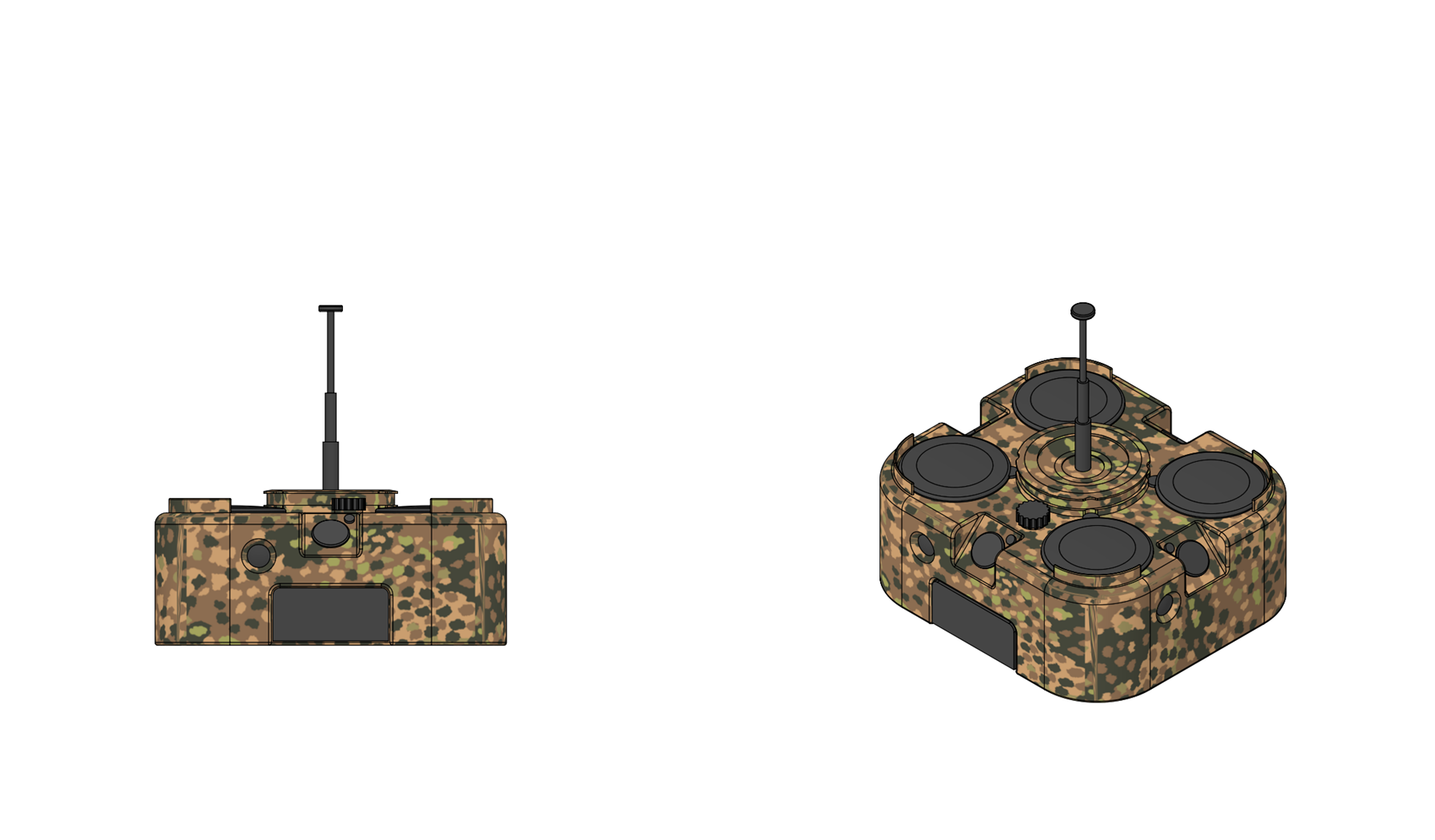
AM 101 Spider
General Characteristics:
Type:Wide-area off-route anti-tank mine
Emplacement method:Hand
Weight:16 kg
Height:380 mm
Diameter:180 mm
Warhead:4.0 kg Sensor Fuzed Submunition
Performance Characteristics:
Azimuth coverage:360°
Effective range:100 m
Operational life:60 days (pre-armed) + 30 days (armed)
Operational temperature:-46°C to +63°C
Submunition data:
Weight:4.5 kg
Length:150 mm
Diameter:147 mm
Descent velocity:24 m/s
Spin rate:30 Hz
Search pattern:100 m width helical
Sensor:LADAR + IIR
Warhead:SEFP + MEFP
Explosive:1.5 kg PBX
Penetration:>150 mm RHA
Overview:
The AM 101 Spider is an advanced wide-area top attack land mine designed to engage armored and unarmored vehicle targets from extended ranges. The AM 101 is capable of engaging vehicle targets 360° around the mine at ranges up to 100 meters and contains acoustic and seismic sensors which it used to detect, locate, and identify moving vehicle targets which it engages using a sensor-fuzed submunition launched over the target. The sensor-fuzed submunition contains both infrared and LADAR (laser radar) sensors which it used to detect the target before firing an explosively formed penetrator (EFP) through the target's roof. The mine body consists of a fiberglass cylinder with eight deployable spring-loaded legs which ensure the mine remains upright on uneven terrain and contains the seismo-acoustic target detection device (TDD), submunition with gas generator ejection system, and a radio communications system designed to communicate with a mine remote control unit (RCU) used to remotely arm and program the mine. The AM 101 comes in two variants, a hand emplaced variant for use by discounted infantry and a submunition variant with a parachute-like deceleration device which is designed to be released from cargo rockets and cluster bombs.
Target Detection Device:
The Spider mine contains a seismo-acoustic geophone sensor and an array of three deployable microphones which it used to detect, locate, and identify vehicle targets. The geophone sensor employs an array of piezoelectric quartz accelerometers to measure the seismic signals generated by moving vehicles and is capable of detecting moving vehicles at ranges up to 1,000 meters. The geophone sensor then queues the three microphones to begin listening for the sound of an approaching vehicle which are used to accurately triangulate the vehicle in both bearing and elevation and are used to discriminate the type of vehicles being tracked (ie wheeled or tracked) and to identity specific vehicles based on their engine sounds. The acoustic array uses time-difference-of-arrival (TDOA) processing to determine the bearing to a detected sound source with an angular accuracy of ±5° and to estimate range by triangulation with nearby networked mines. The acoustic sensors have a detection range of approximately 500 meters for tracked vehicles (tanks, IFVs, SPHs) in typical ambient noise conditions, extending to 800 meters in quiet environments. Wheeled vehicles are identifiable at 200 to 400 meters depending on speed and surface type. The seismic sensor also provides complementary detection of ground vibrations transmitted through the soil, which are less affected by wind noise and atmospheric conditions than acoustic propagation, and is particularly effective at detecting tracked vehicles on hard or frozen surfaces.. The acoustic and seismic signals are processed by a low-power microcontroller running a convolutional neural network classifier trained on a library of vehicle acoustic signatures. The classifier distinguishes tracked armored vehicles (highest priority), wheeled armored vehicles (high priority), heavy logistics vehicles (medium priority), and non-target sources (civilian traffic, weather, animals, gunfire). The classifier operates continuously in a low-power duty-cycling mode, consuming less than 50 milliwatts during surveillance and waking to full processing power only when a candidate detection exceeds the threshold
Warhead:
The Spider mine contains a single EFP submunition which is launched from the mine at the target using a gas generator. When the mine detects a target the mine body tilts at a 45° degree angle towards the vehicle and launches the submunition at the target. The submunition is launched to a height of around 65 meters the submunition deploys an extendable fabric samara wing to stabilize itself as it spins while descending in search of its intended target. After detecting and identifying a target the projectile selects an aimpoint and attacks its weaker top armor with a explosively formed penetrator (EFP). The submunition weighs 4.5 kg, is 147 mm in diameter, and contains a combined passive multi-band infrared (IR) and active LADAR (Laser Radar) sensor and altimeter which searches for targets in a spiral pattern 100 meters in diameter and matches detected targets with an on-board threat-library. The submunition contains a multiple-EFP (MEFP) warhead containing 1.5 kg of polymer bonded HMX explosive (95% HMX, 2.5% BDNPA/F, 2.5% estane) and features a central concave tantalum cone forming the center single EFP (SEFP) which is surrounded by 16 smaller tantalum multiple-EFPs (MEFPs) which creates a shotgun-like blast of smaller EFPs to increase lethality against unarmored or lightly armored vehicles. The main SEFP weighs 450 grams and has a 50 centimeter dispersion at a range of 100 meters with the ability to penetrate 150 mm of RHA at the same distance.
Communication & Networking:
Each AM101 mine is equipped with an ultra-low-power mesh network radio operating in the 900 MHz band with frequency-hopping spread-spectrum modulation and AES-256 encryption. Upon deployment mines automatically discover each other and form an ad hoc mesh network within 30 seconds of completing their arming sequence. The mesh network provides cooperative detection, when one mine detects a target at long range it shares the detection with neighboring mines which correlate the bearing data from their own acoustic arrays to compute a triangulated target position accurate to within 20 meters. This triangulated position is far more precise than any single mine can achieve alone and enables the network to predict the target’s trajectory and assign the optimal mine for engagement. The network further prevents multiple mines from engaging the same target simultaneously, reserving each mine for a distinct target to maximize the number of vehicles killed per minefield. When a mine fires, it broadcasts a “engaged” message, and neighboring mines mark the target as killed and redirect their attention to other contacts. The network can can relay minefield status data (number of mines active, mines fired, battery levels, self-destruct countdown) to a friendly ground station equipped with a compatible receiver at ranges up to 3.5 km, providing the emplacing commander with real-time situational awareness of the obstacle’s condition.
Employment:
The Spider mine has two modes of operation; manual and remote. In manual mode the mine is activated using an arming control switch on the top of the mine. The top of the mine also contains a self-destruct (SD) switch next to the arming control switch which must be actuated in order to unlock the arming switch. The self-destruct (SD) switch is a rotating dial with five time settings (4 hours, 48 hours, 5 days, 15 days, 30 days) which determine after how much time the munition will self-destruct after arming. Rotating the dial to the first self-destruct setting (4 hours) also unlocks the arming control switch which can then be actuated to arm the mine. After arming switch is flipped a four minute arming delay timer is activated after which the mine will begin to listen for and attack targets. The top of the mine also contains a two-position target switch with two positions (hvy and all) which selects whether the mine will only engage heavy tracked vehicles (hvy) or will engage any vehicle target it detects (all). When used in the remote control mode the munition is controlled using a remote control unit (RCU) consisting of a small tablet computer connected to a telescopic VHAM (Variable Height Antenna Mast) which communicates with the mine through a conformal antenna on the side of the mine body connected to a software defined radio (SDR) inside the mine body. When operated in remote mode the mine can sit in a pre-armed state for up to 60 days until being remotely armed using the RCU. In addition to remotely arming the mine the RCU can be used to remotely self-destruct or alter or reset the self-destruct time setting of any mines under its control. The RCU can also be used to temporarily deactivate mines to allow friendly forces to pass through a area covered by emplaced Spider mines. Each RCU can control up to 63 mines from a distance of up to 1,500 meters via separate encrypted pulse-coded frequencies. For control at longer distances individual communications repeater modules (CRMs) can be e placed between the mine and RCU to allow for control at distances up to 3,500 meters.
When used to reinforce a conventional minefield the Spider mine is designed to be deployed in front of the conventional minefield with Spider mines spaced 100 meters apart in two staggered rows of mines 50 to 100 meters in front of the forward edge of the conventional minefield. An additional row of Spider mines can also be placed 50 meters behind the rear edge of the conventional minefield to engage enemy breaching vehicles which make their way through the conventional minefield. When used stand-alone without conventional mine support Spider mines are designed to be deployed in an X-pattern of 20 mines each spaced 100 meters apart which covers a 1,000 by 1,000 meter (1 square kilometer) area. When used as an off-route mine to cover roads or other chokepoints the Spider mine is designed to be used in clusters of 3 to 6 mines placed at 50-meter intervals 25 to 50 meters on either side(s) of a road with clusters of Spider mines spaced 750 to 2,000 meters along each road. To ensure proper mine functionality Spider mines should not be emplaced in terrain with a greater than 15° (27% grade) slope or emplaced in snow or mud greater than 20 centimeters deep. Ambient temperatures greater than 40° C will reduce the employed life of the mine from 60 to 30 days in the pre-armed state and from 30 to 15 days in the armed state.