NATION

PASSWORD

SDI Tactical Ordinance Catalog [DO NOT POST]

A meeting place where national storefronts can tout their wares and discuss trade. [In character]
User avatar
The Technocratic Syndicalists
Minister
 
Posts: 2349
Founded: May 27, 2015
Inoffensive Centrist Democracy

SDI Tactical Ordinance Catalog [DO NOT POST]

Postby The Technocratic Syndicalists » Tue Nov 21, 2017 8:10 am

Artillery Fuzes


Image

AM111 Mortar Point-Detonating (PD) Fuze

Fuze Data:
  • Caliber:
    60/81/120 mm smoothbore mortar
  • Weight:
    375 g
  • Length:
    87.6 mm
  • Diameter (max):
    50.0 mm
  • Operating modes:
    PD-Super-Quick (SQ), PD-Delay

Performance:
  • Arming setback:
    > 650 g
  • Arming airflow:
    > 60 m/s
  • Max setback:
    <20,000 g
  • Operating Temperature:
    -46 °C to +63 °C

Overview:


Image

AM784 Mortar Electronic Time (ET) Fuze

Fuze Data:
  • Caliber:
    60/81/120 mm smoothbore mortar
  • Weight:
    375 g
  • Length:
    91.4 mm
  • Diameter (max):
    50.0 mm
  • Operating modes:
    Time, PD

Performance:
  • Time of flight:
    <100 sec
  • Timer setting:
    0.1 sec steps
  • Timer accuracy:
    1.10E-3 msec
  • Arming setback:
    > 650 g
  • Arming airflow:
    > 60 m/s
  • Max setback:
    <20,000 g
  • Operating Temperature:
    -46 °C to +63 °C

Overview: The AM784 is an inductive settable electronic time fuze designed to be used with 60 mm, 81 mm, and 120 mm smoothbore mortar projectiles including both high explosive and cargo munitions. The fuze consists of a programming coil, a turbine generator with a ram aiflow driven turbine driving a miniature generator through a reduction gearbox, twin electronic timers, impact switch, electronic safe and arm device (ESAD), and expulsion charge. The AM-784 fuze has two independent timer mechanisms and can be set from 5.0 to 199.9 seconds in 0.1 second increments. The fuze has two arming mechanisms which require a setback acceleration of greater than 650 gs and a sustained airflow of at least 60 m/s to arm the fuze.


Image

AM787 Mortar Multi-Mode Fuze

Fuze Data:
  • Caliber:
    60/81/120 mm smoothbore mortar
  • Weight:
    300 g
  • Length:
    95.5 mm
  • Diameter (max):
    51.0 mm
  • Operating modes:
    Proximity, PD-Super-Quick (SQ), PD-Delay,

Performance:
  • Arming setback:
    > 650 g
  • Arming airflow:
    > 60 m/s
  • Max setback:
    <20,000 g
  • Operating Temperature:
    -46 °C to +63 °C

Overview: The AM787 is a multi-mode fuze for 60 mm, 81 mm, and 120 mm smoothbore mortar projectiles. The AM-787 employs a frequency-modulated continuous-wave (FMCW) proximity fuze using a gallium arsenide (GaAs) RF transmitter which acts as a doppler radar proximity sensor with two selectable height-of-burst settings. For safety the AM-787 fuze has two arming mechanisms which require a setback acceleration of greater than 650 gs and a sustained airflow of at least 60 m/s to arm the fuze. Operating modes of the AM-787 fuze are as follows:
  • Proximity high: 4.0 m
  • Proximity low: 2.5 m
  • Point Detonating-Superquick (<250 µs)
  • Point Detonating-Delay (50 to 150 ms)


Image

AM371 Concrete Penetrating (CP) Fuze

Fuze Data:
  • Caliber:
    105/155/203 mm rifled gun
  • Weight:
    640 g
  • Length:
    124.9 mm
  • Diameter (max):
    61.2 mm
  • Operating modes:
    PD-Delay

Performance:
  • Arming setback:
    >1,500 g
  • Max setback:
    <30,000 g
  • Arming rotation:
    >3,000 rpm
  • Max rotation:
    <25,000 rpm
  • Operating Temperature:
    -46 °C to +63 °C

Overview:The AM371 is a point detonating fuze designed specifically for use against reinforced concrete targets. The the fuze is constructed from heat treated 4140 steel with a reinforced ogival nose plug hardened to to 340 BNH used to aid in penetration of hardened concrete targets. The base plug of the fuze contains the threads to screw the fuze into the nose threads of the shell body. The delay assembly is threaded into a cavity at the base of the base plug and consists of a firing pin and an inertial-type delay plunger mechanism with a detonator contained in an eccentric, spin-activated rotor. The delay element results in detonation 10 to 20 ms after impact, allowing the shell to penetrate into reinforced targets before exploding. The booster charge is threaded into the back of the base plug and consists of 22 grams of composition A5 (99% RDX coated with 10-% stearic acid).


Image

AM522 Electronic Time (ET) Fuze

Fuze Data:
  • Caliber:
    105/155/203 mm rifled gun
  • Weight:
    500 g
  • Length:
    133.9 mm
  • Diameter (max):
    61.2 mm
  • Operating modes:
    Time, PD

Performance:
  • Time of flight:
    <200 sec
  • Timer setting:
    0.1 sec steps
  • Timer accuracy:
    1.10E-3 msec
  • Arming setback:
    >1,500 g
  • Max setback:
    <30,000 g
  • Arming rotation:
    >3,000 rpm
  • Max rotation:
    <25,000 rpm
  • Operating Temperature:
    -46 °C to +63 °C

Overview: The AM522 is an inductively set electronic time fuze designed for 105mm, 155mm, and 203mm caliber smoke, illuminating, and cargo projectiles. The fuze can be set from 2 to 199.9 seconds in 0.1 second increments either electronically during loading or manually before loading using a fuze setting device. After programming and firing the fuze will activate at the set time and set off an expulsion charge which ejects the payload from the shell body. The time setting can be programmed an unlimited number of times before firing and is stored permanently until changed or fired. While designed for illumination, smoke, and cluster shells the fuze is also compatible with standard high-explosive rounds and features a point-detonating setting in addition to the standard electronic time setting.


Image

AM782 MMAF (Multi-Mode Artillery Fuze)

Fuze Data:
  • Caliber:
    105/155/203 mm rifled gun
  • Weight:
    800 g
  • Length:
    151.6 mm
  • Diameter (max):
    61.2 mm
  • Operating modes:
    Time, PD-Super-Quick (SQ), PD-Delay, Proximity

Performance:
  • Arming setback:
    >1,500 g
  • Max setback:
    <30,000 g
  • Arming rotation:
    >3,000 rpm
  • Max rotation:
    <25,000 rpm
  • Operating Temperature:
    -46 °C to +63 °C

Overview: The AM782 is an inductively programmable multi-mode fuze designed for 105mm, 120mm, and 155mm caliber high-explosive projectiles. The fuze combines proximity, point detonating, post-impact delay, and electronic time settings which can pre-set by the user before firing or set electronically during the projectile loading process. The fuze contains an integral radar proximity sensor to provide accurate height-of-burst capability and is enclosed in a hardened maraging steel body to ensure high reliability when used in the post-impact delay mode against concrete or other hardened structures. The fuze is armed by the rotational and setback forces of firing with the fuze rotor only moving in-line after the projectile has cleared a preset muzzle safety distance. Operating modes of the AM782 fuze are as follows:
  • Proximity high: 12 m
  • Proximity low: 6 m
  • Time: 2-199.9 sec (0.1 sec intervals)
  • Point Detonating-Superquick (<250 µs)
  • Point Detonating-Delay (16 ms)
  • Foliage: 3m below canopy


Image

AM578 CCF (Course-Correcting Fuze)

Fuze Data:
  • Caliber:
    105/155/203 mm rifled gun
  • Weight:
    1,400 g
  • Length:
    220 mm
  • Diameter (max):
    61.2 mm
  • Steering:
    4x pop-out aerodynamic fins
  • Guidance:
    INS/GPS
  • Operating modes:
    Time, PD-Super-Quick (SQ), PD-Delay, Proximity

Performance:
  • Probable error:
    <30 m CEP (range independent)
  • Arming setback:
    >1,500 g
  • Max setback:
    <30,000 g
  • Arming rotation:
    >3,000 rpm
  • Max rotation:
    <25,000 rpm
  • Operating Temperature:
    -46 °C to +63 °C

Overview:
Last edited by The Technocratic Syndicalists on Mon May 24, 2021 6:49 pm, edited 36 times in total.
SDI AG
Arcaenian Military Factbook
Task Force Atlas
International Freedom Coalition


OOC: Call me Techno for Short
IC: The Kingdom of Arcaenia

User avatar
The Technocratic Syndicalists
Minister
 
Posts: 2349
Founded: May 27, 2015
Inoffensive Centrist Democracy

Postby The Technocratic Syndicalists » Sun Dec 03, 2017 7:43 pm

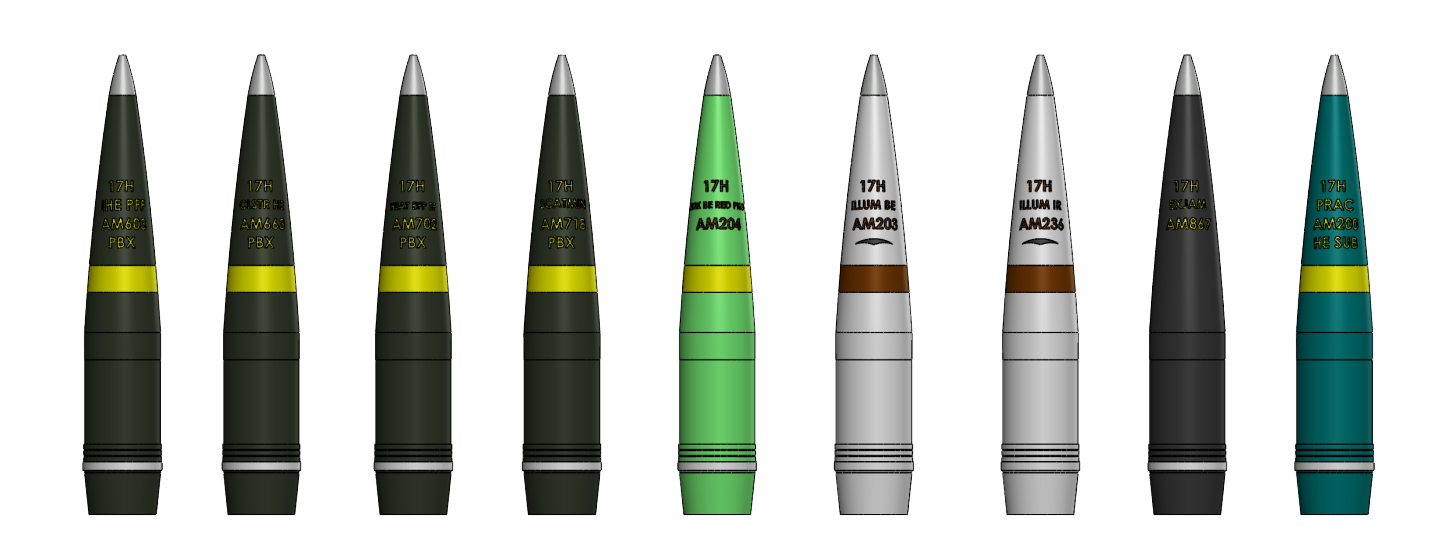
17 cm Artillery Ammunition


Image

Overview

SDI's 17 cm artillery projectile family is a family of ballistically matched 17 cm (172.5 mm) ammunition designed for the 17 cm L/60 artillery gun fitted to the SDI PzH 173 and sFH 78GW artillery systems. All projectiles feature identical external geometry, center-of-gravity range, and aerodynamic coefficients are tightly matched across all members, with Boat Tail and Base Bleed interchangeability on all projectiles. The projectile form factor comprises a long low-drag secant-ogive nose, a cylindrical body of precisely controlled outer diameter, at full bore (172.5 mm ±0.05 mm land diameter) with an aft soft iron rotating band and polymer obturator, and a modular base unit interface consisting of a a threaded and keyed joint at the base of the cylindrical section that accepts either a Hollow Base (HB) unit for shorter-range missions or a Base Bleed (BB) unit for maximum range.

Two interchangeable base configurations are provided for each projectile. The Hollow Base (HB) unit is a precision-machined steel boat-tail base plug that provides a clean aerodynamic termination of the projectile body with a shallow 7° boat-tail angle. The Base Bleed (BB) unit is a drop-in replacement for the HB unit, identical in external geometry but containing a slow-burning, inhibited, compressed HTPB/AP base-bleed grain in an annular combustion chamber with a central orifice plate. The BB grain ignites on gun launch from setback compression of a pyrotechnic initiator and burns for approximately 25 to 30 seconds, injecting combustion products into the base-drag wake and reducing base drag by approximately 40 to 50%, extending range by 25 to 30% for a given charge and elevation. The BB unit is sealed and moisture-proof with a shelf life of at least 20 years. Base unit changeover is a field-level operation requiring only a standard torque wrench and approximately 90 seconds per round. In practice, rounds are delivered from the ammunition supply point pre-configured as either HB or BB; changeover is intended primarily for inventory flexibility and contingency operations.

All projectiles in the family accept fuzes through a common fuze well in the nose. The fire control system programs the fuze inductively during the autoloader rammer stroke via a coil embedded in the rammer head (no physical contact or crew handling required). The fuze interface supports point-detonating (PD) with selectable delay, proximity with selectable height-of-burst, and electronic time (ET) with programmable function time, with support for course-correcting fuze (CCF) capability. All lethal kinetic rounds in the family are designed to meet insensitive munitions requirements, with all main charges and submunition fills using IM-qualified compositions. No round in the family uses Composition B, TNT, or any legacy melt-cast explosive as its primary fill. All fuzes incorporate interrupted explosive trains with out-of-line detonator sliders, dual-independent arming criteria (setback acceleration and spin rate), and electronic safe-and-arm logic with non-volatile arm state memory. High explosive projectile bodies are further designed with controlled venting features that promote burning rather than detonation under slow cook-off and fast cook-off conditions.


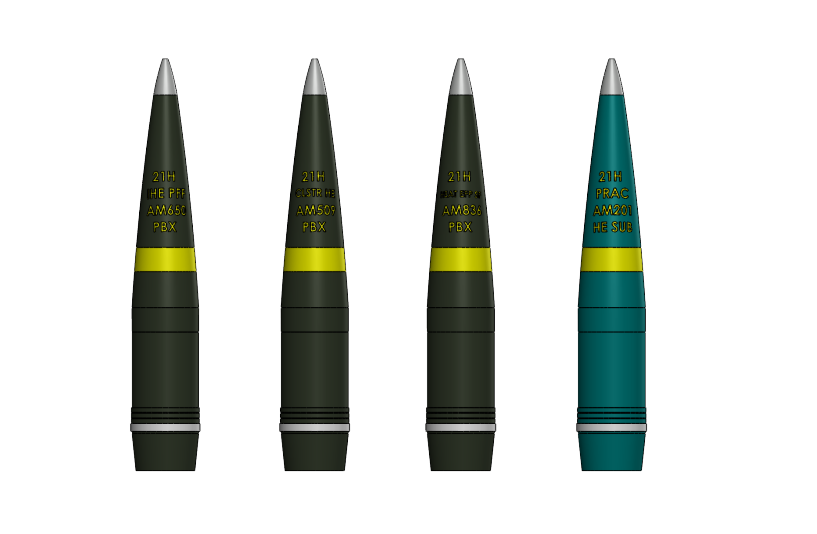
17 cm AM603 IHE-PFF (Insensitive High Explosive - Pre-Formed Fragmentation)

Projectile Data:
  • Caliber:
    172.5 mm
  • Driving band diameter
    174 mm
  • Projectile weight:
    68.0 kg
  • Projectile length (fuzed):
    1,040 mm
  • Explosive:
    15.0 kg PBX
  • Fuze:
    AM782 multi-mode, AM578 course correcting
  • Maximum chamber pressure:
    530 MPa
  • Muzzle velocity:
    17 cm L/60: 1,050 m/s
  • Max range with hollow base:
    17 cm L/60: 48 km
  • Max range with base bleed:
    17 cm L/60: 65 km
  • Probable error:
    0.5% range, 0.1% deflection
  • Service Temperature:
    -50°C to +70°C

Overview:High explosive pre-formed fragment round which provides blast and fragmentation effects against personnel, vehicles, and materiel targets. The projectile features a low-drag design with a long, streamlined von Karman ogive shape with which extends to the rear cylindrical part of the shell. The rear cylindrical portion of the projectile has a bourrelet at its forward end and a soft iron alloy driving band with a PEEK (Polyetheretherketone) obtuator located in a recessed groove forward of the rear cylindrical bourrelet. The rear of the projectile features a threaded base which can accept either a hollow boat-tail (HB) or a base-bleed (BB) unit containing a solid propellant gas generator unit with 2.0 kg of 75% AP/24% HTPB/1% DOA base bleed propellant. The nose of the projectile features a deep-cavity fuze well and can accept either an ADI AM782 multi-mode or AM578 course correcting fuze. When used with delay fuzinf the the AM603 shell is capable of penetrating over 50 centimeters of 45 MPa reinforced concrete with a terminal impact velocity of 350 m/s at an impact angle of 65°. The AM603 projectile contains 15.0 kilograms of insensitive RDX based polymer bonded explosive consisting of 92% RDX, 6% DOA and 2% HyTemp which is pressed into the shell from the rear at a force of 18 tonnes, replacing the melt-cast TNT filling of previous generation artillery projectiles with a more energetic, higher density, and insensitive explosive fill. The projectile also has a supplementary charge consisting of 150 grams of insensitive HMX based based polymer bonded explosive (PBX) consisting of 92% HMX, 6% DOA and 2% HyTemp which is contained in the projectile's deep-cavity fuze well. The projectile body is constructed from high-fragmentation steel alloy and produces approximately 7,000 fragments with a mass greater than 0.5 grams upon detonation.

The natural fragmentation from from the shell body is augmented by a pre formed fragmentation (PFF) liner consisting of a two-layer matrix of heavy metal tungsten alloy (W-Ni-Fe, 93% W) balls in a cured elastomeric polymer binder which lines the ogive and cylindrical sections of the shell. The preformed fragment liner incorporates a total of approximately 26,000 preformed tungsten-alloy fragments in two distinct sizes (5.0 mm and 10.0 mm)arranged in a dual-layer matrix. The outer outer layer of anti-personnel (AP) fragments consists of approximately 20,000 cylindrical pellets 5.0 mm in diameter with a mass of approximately 1.25 grams each. With a fragment velocity at case breakup) of around 1,650 m/s the design lethal radius against exposed personnel is ≥ 50 m, optimized for soft-target defeat and personnel incapacitation at range. The The 1.25 g tungsten fragment at 1,650 m/s delivers approximately 1,700 J of kinetic energy, sufficient for incapacitation through standard-issue personal protective equipment including body armor, and helmets at distances out to 40 m and against unprotected personnel to beyond 80 m. The inner Anti-Materiel (AM) fragments layer consists of approximately 6,000 larger 10.00mm diameter tungsten spheres with a mass of 7.5 g, optimized for the perforation of light vehicle skins. The larger fragments at 1,450 m/s delivers approximately 26,900 J and can perforate 8 mm of RHa at 15 m. The combination of natural and pre-formed fragmentation results in the projectile having a lethal area of over 12,000 m2 when used with a proximity fuze mode at a 65°terminal fall angle. The round is normally used with SDI's AM782 multi-option programmable fuze with point detonating (PD, detonation on nose impact, <1 ms delay. Standard anti-personnel/anti-materiel mode). point Detonating, Delay (PDD, detonation 50 ms after impact, for semi-hard targets, bunkers, field fortifications), Proximity / Variable Time (VT, detonation at a programmable height above the target surface, designed for optimal burst height for the PFF fragment pattern), and Electronic Time (ET, programmable function time from 0.1 s to 199.9 s in 0.1 s increments).


17 cm AM663 Cluster-HEAT (Cluster - High Explosive Anti-Tank)

Projectile Data:
  • Caliber:
    172.5 mm
  • Driving band diameter
    174 mm
  • Projectile weight:
    68.0 kg
  • Projectile length (fuzed):
    1,040 mm
  • Payload:
    81x AM98 dual-purpose HEAT-frag submunitions
  • Fuze:
    AM522 electronic time
  • Maximum chamber pressure:
    530 MPa
  • Muzzle velocity:
    17 cm L/60: 1,050 m/s
  • Max range with hollow base:
    17 cm L/60: 48 km
  • Max range with base bleed:
    17 cm L/60: 65 km
  • Probable error:
    0.5% range, 0.1% deflection
  • Service Temperature:
    -50°C to +70°C

Submunition data:
  • Weight:
    0.3 kg
  • Length:
    82 mm
  • Diameter:
    42 mm
  • Impact Velocity:
    40 m/s
  • Warhead:
    HEAT-Frag
  • Explosive:
    45 g PBX
  • Penetration:
    >130 mm RHA

Overview: Cargo projectile designed to deliver a payload of 81 AM98 dual-purpose anti-armor and anti-personnel HEAT-Frag submunitions for engaging area targets such as mechanized columns or air defense installations. The projectile consist of a front ogive constructed from 7075 aluminum alloy containing a fuze well designed to accept an AM522 electronic time fuze along with an expulsion charge and pusher plate which is threaded into the rear steel alloy cylindrical section of the shell containing the cluster payload and thread adapter for either hollow-base or base-bleed units. The AM98 submunitions are arranged in 9 columns of 9 submunitions each with 8 columns arranged in a circular pattern around one column in the center of the projectile. Payload ejection is accomplished by a nose ogive contained expulsion charge of single base propellant, initiated by the fuze at the programmed ET function time. The expulsion charge pressurizes the nose of the shell, pushing on a piston which shear the base threads and ejecting the submunition payload rearward through the base of the projectile. The combination of spin-induced centrifugal dispersal and aerodynamic drag separates the submunitions into a circular dispersion pattern. Each submunition deploys a small ribbon drogue for stabilization and deceleration. The dispersal pattern at the ground is approximately 240 to 350 meters in diameter, depending on ejection altitude and projectile trajectory. Each AM98 submunition is 82 mm in length and 42 mm in diameter and contains a copper-lined shaped charge warhead with 45 grams of polymer bonded HMX explosive (95% HMX, 3% BDNPA/F, 3% estane) which can penetrate in excess of 130 mm of RHA on impact detonation. The submunition additionally features a series of steel fragmentation rings surrounding the shaped charge warhead which projects over 700 fragments with an average mass of 0.2 grams with a lethal fragmentation radius of 5 meters. Each AM98 submunition contains a mechanical impact fuze and a secondary electro-mechanical self destruct fuze which minimizes the risk of duds.


17 cm AM702 EFP-SFM (Sensor Fuzed Munition - Explosively Formed Penetrator)

Projectile Data:
  • Caliber:
    172.5 mm
  • Driving band diameter
    174 mm
  • Projectile weight:
    68.0 kg
  • Projectile length (fuzed):
    1,040 mm
  • Payload:
    2x ZEPL Sensor Fuzed Submunitons
  • Fuze:
    AM522 electronic time
  • Maximum chamber pressure:
    530 MPa
  • Muzzle velocity:
    17 cm L/60: 1,050 m/s
  • Max range with hollow base:
    17 cm L/60: 48 km
  • Max range with base bleed:
    17 cm L/60: 65 km
  • Probable error:
    0.5% range, 0.1% deflection
  • Service Temperature:
    -50°C to +70°C

Submunition data:
  • Weight:
    11.5 kg
  • Length:
    200 mm
  • Diameter:
    147 mm
  • Descent velocity:
    17 m/s
  • Spin rate:
    8 Hz
  • Search pattern:
    200 m width helical
  • Search area:
    35,000 m2
  • Sensor:
    94 GHZ MMW radar + 94 GHZ MMW radiometer + IR
  • Warhead:
    SEFP + MEFP
  • Explosive:
    1.5 kg PBX
  • Penetration:
    >140 mm RHA

Overview: anti-armor submunition projectile which is designed to dispense two ZEPL sensor-fuzed anti-armor submunitions over the target area. The projectile body and construction is identical to the AM632 cargo shell with the 81 HEAT-frag bomblets substituted for two sensor fuzed EFP submunitions. Payload ejection is accomplished by a nos emounted expulsion charge of compressed black powder, initiated by the fuze at the programmed ET function time. The expulsion charge pressurizes the nose of the shell, shearing the base threads and ejecting the payload rearward through the base of the projectile. The base unit (HB or BB) is jettisoned with the base plate. The submunitions, already spinning at the projectile spin rate, deploy their own deceleration and scanning systems independently. Each ZEPL submunition is a cylinder 147 mm in diameter and 205 mm long with a mass of 12.0 kg and consists of a parachute retarding system, a tri mode active 94 GHz MMW radae/passive 94 GHz MMW radiometer/passive IR target detection sensor, and a multiple EFP warhead bore sighted with the target detection system.

On ejection from the carrier at approximately 1,500 to 2,000 meters altitude (depending on range and trajectory), each submunition deploys a drogue chute to decelerate from ballistic velocity to approximately 30 m/s descent rate while a series of deployable spin brakes deploy from the submunition body to slow its spin rate. Once the projectile has sufficiently decelerated and despun the drogue chute is cut and a vortex ring decelerator (an inflatable toroidal aerodynamic brake) deploys, simultaneously decelerating the submunition to approximately 15 m/s and imparting a controlled spin-scan rotation of approximately 5 rev/s while suspending the submunition body at an approximately 30° angle from the vertical. The submunition's multi-mode millimeter-wave and infrared sensors then activates and begins scanning the ground in a spiral pattern beneath its descent path. The scan footprint is approximately 200 meters in diameter along the ground. The triple-mode sensor suite includes a cooled 128×128 pixel HgCdTe focal-plane array operating in the 8–12 µm LWIR band, a 94 GHz FMCW radar, and a passive 94 GHz radiometer. The MMW radar is the primary sensing mechanisms and distinguishes armored vehicles from terrain clutter by characteristic radar cross-section and range-profile features in all weather and environmental conditions. The infrared sensor provides thermal imaging capability to refine target classification and discriminate decoys. The passive millimeter-wave radiometer is a a radiometric channel on the same 94 GHz receiver and detects the natural thermal emission contrast of vehicles against terrain without any active emission, providing a third independent detection phenomenology that is immune to both IR and radar countermeasures. All three channels feed a fused detection/classification algorithm running on an embedded neural-network accelerator, providing robust target detection even against advanced multispectral countermeasures, decoys, and camouflage nets. The algorithm classifies targets into vehicle-type categories (MBT, IFV, APC, truck, decoy, clutter) with a target classification accuracy of ≥ 90% against operationally representative target arrays. The sensor has the ability to engage moving targets at speeds up to 40 km/h, the systems imaging IR and FMCW radar both providing frame-to-frame target displacement measurement feeding a lead-angle computation that offsets the EFP firing angle to intercept a moving vehicle target. The EFP warhead consists of a 140 mm diameter precision-machined concave tantalum-tungsten alloy (Ta-2.5W) liner and an explosive charge consisting of 1.5 kg of polymer bonded HMX explosive (96% HMX, 3% DOA, 1% HyTemp). Upon detonation, the explosive charge turns the dish-shaped metal liner into a high-speed, high-L/D (>3:1) aerostable slug with a velocity of over 2,200 m/s. The EFP has a 50 centimeter dispersion at a range of 100 meters and is capable of penetrating over 140 mm of RHA at the same distance, sufficient to punch through the roof armor of virtually all tanks or other armored vehicles.


17 cm AM1218 ASM (Advanced Sub-Munition)

Projectile Data:
  • Caliber:
    172.5 mm
  • Driving band diameter
    174 mm
  • Projectile weight:
    68.0 kg
  • Projectile length (fuzed):
    1,040 mm
  • Payload:
    6x AM1218 advanced submunitions
  • Fuze:
    AM522 electronic time
  • Maximum chamber pressure:
    530 MPa
  • Muzzle velocity:
    17 cm L/60: 1,050 m/s
  • Max range with hollow base:
    17 cm L/60: 48 km
  • Max range with base bleed:
    17 cm L/60: 65 km
  • Probable error:
    0.5% range, 0.1% deflection
  • Service Temperature:
    -50°C to +70°C

Submunition data:
  • Weight:
    3.2 kg
  • Length:
    160 mm
  • Diameter:
    65 mm
  • Warhead:
    1200x tungsten fragments
  • Explosive:
    400 g PBX

Overview: Cargo projectile designed to deliver a payload of nine advanced proximity-fuzed HE-PFF submunitions for area-effects engagement of personnel, unarmored and lightly armored vehicles, and soft materiel targets.
The projectile body and construction is identical to the AM663 cargo shell with the 81 HEAT-frag bomblets substituted for nine HE-PFF submunitions packed in a 3×3 configuration. Each XM1106-S1 is a compact, spin-stabilized HE-PFF submunition approximately 65 mm in diameter and 160 mm long, with a mass of approximately 3.2 kg. The submunition contains an integral fragment liner consisting of approximately 1,200 preformed tungsten alloy (W-Ni-Fe) cuves, each 3.0 mm on a side with a mass of 0.5 grams, embedded in an elastomeric matrix inside the thin steel body containing a 400 gram polymer bonded HMX explosive (96% HMX, 3% DOA, 1% HyTemp) charge. Fragment velocity at case breakup is approximately 1,800 m/s with a lethal radius against exposed personnel of ≥ 15 m per submunition. Combined lethality of all nine submunitions from a single XM1218 round detonating in a proximity-burst pattern over the target area is approximately 36,000 m² (3.6 hectares), approximately 3× the lethal area of a single AM603 unitary HE-PFF-DP fired with a proximity fuze. On fuze function the expulsion charge fires and the nine submunitions are ejected rearward from the carrier body. A combination of spin-induced centrifugal dispersal and aerodynamic drag separates the submunitions into a circular dispersion pattern. Each submunition deploys a small ribbon drogue for stabilization and deceleration. The dispersal pattern at the ground is approximately 200 to 300 meters in diameter, depending on ejection altitude and wind.

The submunition features a base mounted fuze combining proximity, impact, and electronic self-destruct fuzing mechanisms to minimize the possibility of duds (designed for <0.25% UXO). The primary fuzing mechanism is a miniaturized 24 GHz Doppler proximity sensor detecting ground approach and commanding detonation at an optimum height of burst of approximately 1.5 to 2.0 meters. A piezoelectric crush switch in the fuze provides a backup point-detonating function in the event of proximity sensor failure or dense canopy/urban environments where ground-proximity sensing may be unreliable. The electronic time self-destruct (ETSD) fuze consists of a precision electronic timer, set at ejection to a function time corresponding to the maximum expected flight time plus a safety margin (30 seconds after ejection). If neither the proximity nor impact fuze has functioned by the ETSD timeout, the self-destruct charge detonates the submunition in the air or on the ground. In the event that all three active fuze modes fail to detonate the submunition (an extremely low-probability failure) a pyrotechnic self-neutralization element renders the explosive fill inert by chemical decomposition of the detonator train within 30 minutes of arming.


17 cm AM825 SMK-WP (Smoke - White Phosphorous)

Projectile Data:
  • Caliber:
    172.5 mm
  • Driving band diameter
    174 mm
  • Projectile weight:
    68.0 kg
  • Projectile length (fuzed):
    1,040 mm
  • Payload:
    12 kg Red phosphorous
  • Smoke time:
    120 sec
  • Fuze:
    AM522 electronic time
  • Maximum chamber pressure:
    530 MPa
  • Muzzle velocity:
    17 cm L/60: 1,115 m/s
  • Max range with hollow base:
    17 cm L/60: 48 km
  • Max range with base bleed:
    17 cm L/60: 65 km
  • Probable error:
    0.5% range, 0.1% deflection
  • Service Temperature:
    -50°C to +70°C

Overview: Long-range shell smoke shell with both obscuring and incendiary effects. The shell is loaded with 120 blocks of red phosphorus (WP) containing 12 kilograms of WP in total which are ejected from the base of the projectile in flight using an expulsion charge and a pusher plate mounted behind the fuze well. Each red phosphorous block is ignited upon ejection from the shell at an altitude of approximately 250 meters which then fall to cover a elliptical area of around 300 by 200 meters on the ground. The red phosphorous smoke is non-toxic and provides effective masking properties in the visual (450-750 nm), near-infrared (750-950 nm), and infrared (1-14 µm) regions to block acquisition and targeting of friendly forces from visual observation, CCD imagers, night observation devices, thermal imagers, laser range finders, laser illuminators, and laser designators. The white phosphorus smoke burns at over 800 degrees C and can also ignite combustible materials in the target zone, adding an incendiary effect to the munition and potentially causing fires to develop in the target area.


17 cm AM483 ILLUM - VIS (Illumination - Visible)

Projectile Data:
  • Caliber:
    172.5 mm
  • Driving band diameter
    174 mm
  • Projectile weight:
    68.0 kg
  • Projectile length (fuzed):
    1,040 mm
  • Payload:
    3.6 kg Illuminating comp
  • Illuminating time:
    110 s
  • Illuminating area:
    > 1800 m diameter
  • Luminosity:
    >1.8 million Cd (white light)
  • Fuze:
    AM522 electronic time
  • Maximum chamber pressure:
    530 MPa
  • Muzzle velocity:
    17 cm L/60: 1,050 m/s
  • Max range with hollow base:
    17 cm L/60: 48 km
  • Max range with base bleed:
    17 cm L/60: 65 km
  • Probable error:
    0.5% range, 0.1% deflection
  • Service Temperature:
    -50°C to +70°C

Overview: Long-range illumination projectile intended to provide visible illumination in low-light conditions. The projectile contains an illuminating flare contained in a canister with an attached drogue chute which is released from the base of the shell in flight using an expulsion charge. The canister is designed to be released from the projectile at an altitude of 1,000 meters where anti-rotation fins on the canister are immediately deployed to reduce the rotation of the canister and a drogue chute deployed which reduces the descent rate of the canister to around 4 to 5 m/s. After reaching a stable spin rate and descent velocity the canister drops away and the magnesium/sodium nitrate illumination flare inside is ignited at an altitude of around 600 meters where the flare then burns as the flare descends to the ground. The illumination flare provides over 1.8 million candela of illumination for up to 110 seconds and illuminates a ground area over 1,800 meters in diameter in diameter.


17 cm AM166 ILLUM - IR (Illumination - Infrared)

Projectile Data:
  • Caliber:
    172.5 mm
  • Driving band diameter
    174 mm
  • Projectile weight:
    68.0 kg
  • Projectile length (fuzed):
    1,040 mm
  • Payload:
    3.6 kg Illuminating comp
  • Illuminating time:
    120 s
  • Illuminating area:
    > 4,500 m diameter
  • Luminosity:
    5,600 Cd (white light)
  • Infrared band:
    0.7-1.2µm
  • Fuze:
    AM522 electronic time
  • Maximum chamber pressure:
    530 MPa
  • Muzzle velocity:
    17 cm L/60: 1,050 m/s
  • Max range with hollow base:
    17 cm L/60: 48 km
  • Max range with base bleed:
    17 cm L/60: 65 km
  • Probable error:
    0.5% range, 0.1% deflection
  • Service Temperature:
    -50°C to +70°C

Overview: Long-range illumination projectile designed to provide illumination at night for forces equipped with night vision imaging systems. The projectile contains an illuminating flare contained in a canister with an attached drogue chute which is released from the base of the shell in flight using an expulsion charge. The canister is designed to be released from the projectile at an altitude of around 1,100 meters where anti-rotation fins on the canister are immediately deployed to reduce the rotation of the canister and a drogue chute deployed which reduces the descent rate of the canister to around 4 to 5 m/s. After reaching a stable spin rate and descent velocity the canister drops away and the illumination flare inside is ignited at an altitude of around 600 meters where the flare then burns as the flare descends to the ground. The infrared illumination flare provides around 5,600 candela of illumination for up to 120 seconds and illuminates a ground area over 4,500 meters in diameter. The shell does not feature a deep cavity fuze well and is designed to be used solely with the SDI electronic time artillery fuze.


17 cm AM867 EWM (Electronic Warfare Munition)

Projectile Data:
  • Caliber:
    172.5 mm
  • Driving band diameter
    174 mm
  • Projectile weight:
    68.0 kg
  • Projectile length (fuzed):
    1,040 mm
  • Payload:
    1x Electronic Warfare Submunito
  • Fuze:
    AM522 electronic time
  • Maximum chamber pressure:
    530 MPa
  • Muzzle velocity:
    17 cm L/60: 1,050 m/s
  • Max range with hollow base:
    17 cm L/60: 48 km
  • Max range with base bleed:
    17 cm L/60: 65 km
  • Probable error:
    0.5% range, 0.1% deflection
  • Service Temperature:
    -50°C to +70°C

Submunition data:
  • Weight:
    24.0 kg
  • Length:
    480 mm
  • Diameter:
    147 mm
  • Frequency coverage:
    30MHz to 6GHz

Overview: Electronic warfare cargo submunition which carries a payload of designed to deliver a cyber/electromagnetic attack (CEMA) payload into the adversary's operational depth, disrupting and degrading communications networks, radar systems, navigation and timing (PNT) infrastructure, and data links without the requirement for manned or unmanned electronic warfare platforms to penetrate contested airspace. The payload is an integrated electronics package 147 mm in diameter and 480 mm long, hardened to survive gun-launch loads (≥ 20,000 g setback, ≥ 10,000 rpm spin). It is ejected from the cargo airframe at a programmed point over or near the target area. Upon ejection from the carrier shell the CEMA deploys a set of spin brakes and a ram-air inflated parafoil which causesd the pod descends at a controlled rate of approximately 5 to 6 m/s. The parafoil is GPS-guided to loiter over the designated target area, drifting with the wind while the electronics payload operates. During airborne operation awideband DRFM transceiver captures, stores, and retransmits adversary radar and communication signals with precisely controlled modifications including time delay, frequency offset, phase distortion, false-target injection. The DRFM operates across a frequency range of 0.5–18 GHz, covering the vast majority of tactical communications (VHF/UHF voice and data), battlefield surveillance radars, counter-battery radars, and tactical data links. For communications jamming and spoofing the pod transmits high-power noise, swept-tone, and follower-jamming waveforms targeting detected adversary communications in the VHF (30–300 MHz) and UHF (300 MHz–3 GHz) bands. Spoofing modes generate false traffic on detected net frequencies, injecting deceptive voice or data content. The pod also transmits spoofed GNSS signals at power levels sufficient to capture and mislead receivers within a radius of approximately 1 to 3 km, degrading adversary positioning accuracy by injecting controlled timing and position errors. Simultaneously, a broadband GNSS noise-jammer denies navigation to receivers not susceptible to spoofing. The pod also carries a software-defined radio (SDR) payload that autonomously scans for, identifies, and attempts protocol-level exploitation of adversary wireless networks detected during descent, targeting known vulnerability profiles of common military tactical radios and data links. Successful protocol access enables injection of malformed packets, routing-table corruption, denial-of-service flooding, and extraction of network topology data for relay to friendly forces.

The airborne phase lasts approximately 8 to 15 minutes depending on ejection altitude, wind conditions, and parafoil steering profile. On ground contact, the parafoil collapses and the pod deploys a series of four spring loaded legs to upright itself as it keeps transmitting as it transitions to ground-emplaced mode. In this mode the pod continues RF jamming and GNSS spoofing using its ground-level antenna configuration which trades altitude-derived line-of-sight coverage for persistence. The cyber intrusion payload continues autonomous network scanning and exploitation from the ground, using omni-directional and directional antenna elements concealed within the pod housing. The pod is powered by a high-density lithium silicon/iron disulfide (LiSi/FeS2) primary battery providing approximately 4 to 8 hours of continuous operation. The pod housing is designed to blend visually with terrain clutter with an olive drab/earth-tone finish and does not emit any visible or audible signature in standby mode.


17 cm AM1115 ISTAR

Projectile Data:
  • Caliber:
    172.5 mm
  • Driving band diameter
    174 mm
  • Projectile weight:
    68.0 kg
  • Projectile length (fuzed):
    1,040 mm
  • Payload:
    1x Electronic Warfare Submunito
  • Fuze:
    AM522 electronic time
  • Maximum chamber pressure:
    530 MPa
  • Muzzle velocity:
    17 cm L/60: 1,050 m/s
  • Max range with hollow base:
    17 cm L/60: 48 km
  • Max range with base bleed:
    17 cm L/60: 65 km
  • Probable error:
    0.5% range, 0.1% deflection
  • Service Temperature:
    [i-50°C to +70°C[/i]

Submunition data:
  • Weight:
    6.0 kg
  • Length:
    480 mm
  • Diameter:
    147 mm
  • Rotor diameter:
    850 mm
  • Maximum speed:
    50 knots
  • Cruise speed:
    30 knots
  • Maximum endurance:
    45 minutes
  • Service ceiling:
    1,500 me

Overview: Cargo round which delivers a hardened, gun-launched reconnaissance UAV into the battlespace at ranges beyond 60 km, providing immediate beyond-line-of-sight intelligence, surveillance, and reconnaissance (ISR) without the requirement for dedicated UAV. The round allows a field artillery battery to self-generate its own ISR in depth, on demand from its own firing position with a launch-to-eyes-on-target time of under 3 minutes at 30 km range. The Argus UAV is a coaxial counter-rotating rotor aircraft that packages inside the cylindrical volume of the standard cargo airframe with all mechanical components folded, survives gun launch at up to 20,000 g, and autonomously deploys, unfolds, starts rotors, and transitions to controlled flight during descent after ejection from the carrier shell.

The Argus airframe is a cylindrical carbon-fiber composite fuselage 147 mm in diameter and 480 mm long containing all avionics & sensors, the battery system, and the rotor drive system. The fuselage is designed to survive 20,000 g axial setback and 10,000 rpm spin with all internal components secured. Two coaxial rotor hubs are mounted at the top of the fuselage. Each hub carries two blades fabricated from carbon fiber reinforced polymer composite with a titanium root fitting and fold rearward against the fuselage for stowage. Blade span (deployed) is 425 mm per blade with a rotor diameter of 850 mm. The rotor drive system is a pair of brushless DC motors with a combined continuous output of approximately 2.0 kW powered by a G-hardened lithium-silicon primary battery with a capacity of approximately 250 Wh. The Argus carries a gimbaled, G-hardened electro-optical/infrared (EO/IR) sensor payload in a ventral turret containing a 1920×1080 CMOS color camera with a 20× optical zoom (35 mm–700 mm equivalent), a 640×512 pixel 12 µm pitch uncooled LWIR microbolometer providing thermal imaging, and an eye-safe 1550 nm laser rangefinder integrated into the gimbal providing range data for target mensuration and laser designation capability for semi-active laser guided munitions. The sensor gimbal provides ±180° azimuth and -90° to +15° elevation coverage, fully stabilized in three axes. The sensor output is compressed (H.265) and transmitted over the LPI data link. The Argus communicates with the battery command network via a directional LPI data link operating in the Ku-band (14–14.5 GHz) which streams full-motion video (FMV) downlink at 720p / 15 fps (~ 2 Mbps), provides telemetry downlink (position, altitude, battery state, sensor status) and command uplink (waypoint updates, sensor pointing commands, RTB/self-destruct). Pre-programmed mission profiles are loaded via the fire control to fuze inductive link during the autoloader cycle. The standard mission profiles include area surveillance (orbit a designated point at a specified altitude and radius, continuous EO/IR scan, auto-detect and flag moving vehicles), route reconnaissance (fly a pre-programmed route at specified altitude, recording FMV and still imagery), target acquisition (loiter over a designated area, auto-detect and classify targets matching a pre-loaded target signature library, transmit coordinates and images), and battle damage assessment (BDA, fly to a specified impact area after a fire mission, record and transmit post-strike imagery.). The operator at the battery command post can override autonomous behavior and fly the Argus manually via the data link if required. At battery exhaustion or on command, the Argus executes a controlled autorotation descent and ground impact. A small thermite self-destruct charge destroys the avionics and sensor payload on ground impact to prevent technology exploitation.

Deployment sequence starts with the carrier fuze functioning at the programmed time where the expulsion charge ejects the Argus pod rearward from the cargo airframe at approximately 2,000 to 3,000 meters altitude. A set of despin vanes and a drogue chute then deploys decelerating the pod and despinning it from the projectile spin rate (~200 rpm at ejection) to < 5 rpm. The rotor blades then unlock and swing outward under spring tension, locking in the deployed position .The electric drive motors then spool up both rotor sets. The drogue chute is then jettisoned and the Argus transitions from ballistic descent to powered rotary-wing flight at approximately 1,000 to 1,500 meters AGL. The onboard flight controller then acquires GPS lock, orients toward the pre-programmed target area, and begins the ISR mission profile.
Last edited by The Technocratic Syndicalists on Mon Jun 22, 2026 9:10 am, edited 117 times in total.
SDI AG
Arcaenian Military Factbook
Task Force Atlas
International Freedom Coalition


OOC: Call me Techno for Short
IC: The Kingdom of Arcaenia

User avatar
The Technocratic Syndicalists
Minister
 
Posts: 2349
Founded: May 27, 2015
Inoffensive Centrist Democracy

Postby The Technocratic Syndicalists » Sun Dec 09, 2018 9:22 pm

120mm Mortar Ammunition


Image

120 mm AM590 HE-PFF (High Explosive - Pre-Formed-Fragmentation)

Projectile Data:
  • Caliber:
    120 mm
  • Projectile weight:
    15.3 kg
  • Projectile length (fuzed):
    840 mm
  • Explosive:
    3.4 kg PBX
  • Fuze:
    AM11 point detonating, AM784 electronic time, AM787 multi-mode
  • Number of charges:
    0+6
  • Maximum chamber pressure:
    225 MPa
  • Muzzle velocity:
    500 m/s
  • Max range:
    9.8 km
  • Probable error:
    0.5% range, 0.3% deflection
  • Service Temperature:
    -46°C to +63°C

Overview: Fin stabilized, high explosive pre-formed-fragmentation mortar bomb effective against infantry, light vehicles, and material targets which is designed to be fired from high-pressure breach-loading 120mm smoothbore mortars. The mortar bomb consists of a high fragmentation bomb body with a plastic obturator, a nose fuze well which can accept either SDI AM11 point detonating, AM784 electronic time, or AM787 multi-mode mortar fuzes, and an aluminium tail assembly fitted with a short stub case. With the stub case removed and with a reduced charge the round is also backwards with standard muzzle loading 120 mm mortar systems. The mortar bomb body features a streamlined steel casing constructed from HF1 high-fragmentation steel which features an embedded pre-formed fragment liner containing some 4,250 tungsten balls 3 mm in diameter which add to the fragmentation effect of the projectile. The bursting charge is 3.4 kg of cast HMX based polymer bonded explosive (90% HMX, 10% HTPB) which in combination with the HF-1steel case and pre-formed fragment liner produces a lethal radius approximately twice that of a conventional 120mm HE mortar bomb against infantry targets when used with an air-burst capable fuze. The tail assembly is fitted with an ignition cartridge and can accept up to six horseshoe type charge increments providing a muzzle velocity of up to 500 m/s when used with a 25 caliber breach-loading 120mm smoothbore mortar.


Image

120 mm AM971 Cluster-HEAT

Projectile Data:
  • Caliber:
    120 mm
  • Projectile weight:
    15.5 kg
  • Projectile length (fuzed):
    900 mm
  • Payload:
    24x AM-98 dual-purpose submunition
  • Fuze:
    AM784 electronic time
  • Number of charges:
    0+6
  • Maximum chamber pressure:
    225 MPa
  • Muzzle velocity:
    500 m/s
  • Max range:
    8.7 km
  • Probable error:
    0.5% range, 0.3% deflection
  • Service Temperature:
    -46°C to +63°C

Submunition data:
  • Weight:
    0.3 kg
  • Length:
    82 mm
  • Diameter:
    42 mm
  • Impact Velocity:
    40 m/s
  • Warhead:
    HEAT-Frag
  • Explosive:
    45 g PBX
  • Penetration:
    >130 mm RHA

Overview: Cargo mortar projectile containing dual purpose anti armor and anti-personnel submunitions effective against armored vehicle and infantry targets which can be fired from both high-pressure breach-loading 120mm smoothbore mortars and conventional muzzle loaded 120mm smoothbore mortars. The tubular aluminum-alloy projectile body contains four rows of six AM-98 submunitions which are expelled radially from the projectile in flight using a central expulsion charge triggered by the projectile's electronic time fuze. Each AM89 submunition is 82 mm in length, 42 mm in diameter, and contains a copper-lined shaped charge warhead with 45 grams of polymer bonded HMX explosive (95% HMX, 3% BDNPA/F, 3% estane) which can penetrate in excess of 130 mm of RHA. The submunition additionally features a series of steel fragmentation rings surrounding the shaped charge warhead which projects over 700 fragments with an average mass of 0.2 grams with a lethal fragmentation radius of over 5 meters. Each AM89 submunition contains a mechanical impact fuze and a secondary electronic self destruct fuze which minimizes the risk of duds. The submunitions are designed to be released from the projectile using an electronic time fuze at an altitude of 300 meters and impact in either an elliptical or circular shaped pattern up to 50-60 meters in diameter depending on projectile trajectory.


Image

120 mm AM532 SMK-WP (Smoke - White Phosphorous)

Projectile Data:
  • Caliber:
    120 mm
  • Projectile weight:
    15.7 kg
  • Projectile length (fuzed):
    840 mm
  • Payload:
    2.1 kg red phosphorous
  • Fuze:
    AM784 electronic time
  • Number of charges:
    0+6
  • Maximum chamber pressure:
    225 MPa
  • Muzzle velocity:
    500 m/s
  • Max range:
    9.8 km
  • Probable error:
    0.5% range, 0.3% deflection
  • Service Temperature:
    -46°C to +63°C

Overview: 120mm smoke projectile that can be fired from both high-pressure breach-loading 120mm smoothbore mortars and conventional muzzle loaded 120mm smoothbore mortars which is designed to provide both visual and infrared screening over a large area. The projectile body is constructed from upper and lower forged steel halves and is designed to be used with a time fuze that at a height of 400 to 500 meters initiates and splits the front and rear body and ejecting 2.1 kilograms of burning white phosphorus payload over the target area.


Image

120 mm AM533 ILLUM (Illuminating)

Projectile Data:
  • Caliber:
    120 mm
  • Projectile weight:
    15.5 kg
  • Projectile length (fuzed):
    840 mm
  • Illuminating time:
    > 50 s
  • Luminosity:
    1,000,000 cd
  • Fuze:
    AM784 electronic time
  • Number of charges:
    0+6
  • Maximum chamber pressure:
    225 MPa
  • Muzzle velocity:
    500 m/s
  • Max range:
    9.8 km
  • Probable error:
    0.5% range, 0.3% deflection
  • Service Temperature:
    -46°C to +63°C

Overview: 120mm illumination round which is designed to be fired from both high-pressure breach-loading 120mm smoothbore mortars and conventional muzzle loaded 120mm smoothbore mortars to provide illumination of target areas at night or during low-visibility weather conditions. The projectile body is constructed from upper and lower forged steel halves and is designed to be used with a time fuze that at a height of 500 to 700 meters initiates and splits the front and rear body, releasing an illumination flare suspended by a parachute proving over 1,000,000 Cd of illumination for over 50 seconds as the flare descends towards the ground.


Image

120 mm AM595 ILLUM-IR (Illuminating- Infrared)

Projectile Data:
  • Caliber:
    120 mm
  • Projectile weight:
    15.5 kg
  • Projectile length (fuzed):
    840 mm
  • Illuminating time:
    > 50 s
  • Infrared band:
    0.7-1.2µm
  • Fuze:
    AM784 electronic time
  • Number of charges:
    0+6
  • Maximum chamber pressure:
    225 MPa
  • Muzzle velocity:
    500 m/s
  • Max range:
    9.8 km
  • Probable error:
    0.5% range, 0.3% deflection
  • Service Temperature:
    -46°C to +63°C

Overview: 120mm infrared illumination round which is designed to be fired from both high-pressure breach-loading 120mm smoothbore mortars and conventional muzzle loaded 120mm smoothbore mortars to provide near- infrared wavelength illumination of target areas at night or during low-visibility weather conditions for forces equipped with night vision goggles. The projectile body is constructed from upper and lower forged steel halves and is designed to be used with a time fuze that at a height of 500 to 700 meters initiates and splits the front and rear body, releasing an illumination flare suspended by a parachute proving illumination in the 0.7-1.2µm wavelength range for over 50 seconds as the flare descends towards the ground.


Image

120 mm AM549 HERA-PFF (High Explosive Rocket Assisted - Pre-Formed-Fragmentation)

Projectile Data:
  • Caliber:
    120 mm
  • Projectile weight:
    24.0 kg
  • Projectile length (fuzed):
    1,200 mm
  • Explosive:
    2.5 kg PBX
  • Fuze:
    AM11 point detonating, AM784 electronic time, AM787 multi-mode
  • Number of charges:
    0+6
  • Maximum chamber pressure:
    225 MPa
  • Muzzle velocity:
    400 m/s
  • Max range:
    17.5 km
  • Probable error:
    0.6% range, 0.4% deflection
  • Service Temperature:
    -46°C to +63°C

Overview:120mm high explosive rocket assisted projectile intended to engage infantry, light vehicles, and material targets. The projectile consists of three components, a streamlined warhead section, a rocket motor section, and a tail assembly. The warhead section features a nose fuze well which can accept either SDI AM11 point detonating, AM784 electronic time, or AM787 multi-mode mortar fuzes and has a streamlined steel casing constructed from HF1 high-fragmentation steel with an embedded pre-formed fragment liner containing some 4,250 tungsten balls 3 mm in diameter which add to the fragmentation effect of the projectile. The bursting charge is 2.5 kg of cast HMX based polymer bonded explosive (90% HMX, 10% HTPB) which is pressed into the warhead section at a force of 18 tonnes. The rocket motor section threads into the back of the warhead section and contains a solid fuel rocket motor containing 4.9 kilograms of HTPB/AP solid propellant. The rocket motor is ignited at launch and burns for approximately 30 seconds. The rear of the rocket motor section contains the nozzle along with a fin assembly containing six spring loaded fins which deploy at launch to stabilize the projectile in flight. The tail assembly attaches to the back of the rocket motor section and consists of a hollow tube containing an ignition cartridge with a stub case attached to the rear and can accept up to six horseshoe type charge increments providing a muzzle velocity of up to 400 m/s when used with a 25 caliber breach-loading 120mm smoothbore mortar.
Last edited by The Technocratic Syndicalists on Wed Oct 09, 2024 8:16 pm, edited 31 times in total.
SDI AG
Arcaenian Military Factbook
Task Force Atlas
International Freedom Coalition


OOC: Call me Techno for Short
IC: The Kingdom of Arcaenia

User avatar
The Technocratic Syndicalists
Minister
 
Posts: 2349
Founded: May 27, 2015
Inoffensive Centrist Democracy

Postby The Technocratic Syndicalists » Tue Dec 11, 2018 10:31 pm

15 cm High-Pressure Smoothbore Ammunition

Image

15 cm AM83 APFSDS-T

Physical Data:
  • Cartridge length:
    1,550 mm
  • Cartridge weight:
    43.5 kg
  • Propellant Type:
    RDX/HNIW/ETPE Fast-core
  • Propellant weight:
    19.5 kg
  • Projectile weight:
    18.0 kg
  • Projectile length:
    1,050 mm

Performance:
  • Muzzle velocity:
    1,800 m/s
  • Maximum effective range
    5,000 m
  • Chamber pressure:
    9,000 bar
  • Penetration:
    >1,000 mm RHA @ 3,000 meters
  • Dispersion:
    <0.2 mil @ 3,000 meters

The AM83 APFSDS-T (armor-piercing, fin-stabilized, discarding sabot with tracer), is an advanced, high velocity armor-piercing kinetic energy round designed for use with the SDI 15 cm L/55 smoothbore gun fitted to SDI's PzKpfw 151 Tiger main battle tank.

The penetrator of the AM83 is 950 mm long, 30 mm in diameter (L/D ratio = 31.67) and masses 12.0 kilograms. The penetrator employs a novel metal-matrix composite construction consisting of tungsten-hafnium-carbide alloy fibers transversely wound into a depleted uranium alloy matrix, significantly improving both the tensile strength and hardness of the penetrator over a conventional monolithic design. The matrix material is a DU alloy consisting of depleted uranium alloyed with niobium (0.95 wt.%) and vanadium (4.5 wt.%) which offers better mechanical properties than legacy DU/titanium alloys used in older perpetrator designs. The beyond-armor effect of the round is enhanced with the use of a friction-activated mixed rare earth (MRE) based pyrophoric coating, giving the penetrator an incendiary effect which is intended to increase probability of a fuel or ammunition fire in the penetrated vehicle. The coating is applied to the penetrator via a vacuum plasma spray process and ignites when subjected to hydrostatic shock upon impact with the target, burning at around 2500 degrees K. The penetrator is encased with an aluminum sheath with an aluminum ballistic windshield and a tail assembly with six aluminum fins and a tracer element which burns out to a distance of 6,000 meters. The penetrator is supported in the barrel by a three-petal carbon-fiber/thermoplastic composite sabot which weighs 5.0 kg (total weight with sabot, penetrator, fins, and tracer 18.0 kg).

The AM83 contains 19.5 kilograms of RDX/HNIW/ETPE propellant, 10.0 kilograms in the aft propellant charge and 9.5 kilograms in the forward charge with the penetrator. The high density (>1.7 g/cc) fast-core propellant utilizes stacked layers of a a fast inner burning propellant and slow outer burning propellant with a burning rate ratio of 3:1 between the fast and slow rate propellants, respectively. This configuration serves to flatten out the time-pressure curve of the propellant after ignition, improving muzzle velocity without increasing the pressure in the chamber and resulting in a lower flame temperature which reduces both the erosion and corrosion of the gun barrel during firing. The fast burning formulation consists of 78.0 weight percent HNIW explosive and the remainder a BAMO/AMMO energetic thermoplastic elastomer (ETPE) binder while the slow burning mixture, which burns approximately 1/3rd as fast as the fast burning mixture, consists of 60.0 weigh percent RDX, 20.0 weight percent TEX coolant, and the remainder BAMO/AMMO energetic thermoplastic elastomer binder. The propellant charge generates a peak chamber pressure of 9,000 bar, propelling the 20.0 kilogram projectile assembly to a muzzle velocity of 1,800 m/s with minimal muzzle velocity variation across a wide temperature range (-46 C to +63 C). A one-way ammunition data link (ADL) interface ring is located on the base of the aft propelling charge which connects to propellant temperature sensors located in both the aft and forward charges and feeds propellant temperature data through an inductive data link to the vehicle's fire control system.


Image

15 cm AM31 HE-T

Physical Data:
  • Cartridge length:
    1,550 mm
  • Cartridge weight:
    58.0 kg
  • Propellant type:
    LOVA
  • Propellant weight:
    15.5 kg
  • Projectile weight:
    38.0 kg
  • Projectile type:
    Multi-purpose high explosive

Performance:
  • Muzzle velocity:
    1,100 m/s
  • Maximum effective range:
    8,000 m
  • Chamber pressure:
    5,400 bar
  • Dispersion:
    <0.3 mil @ 2,000 meters

The 15 cm AM31 HE-T is a full caliber, multipurpose high-explosive round designed to engage dismounted infantry, light vehicles, helicopters, bunkers, reinforced walls, and obstacles. The 15 cm HE-T round uses a fin stabilized high-explosive projectile with a penetrating blast-fragmentation warhead with steel and heavy metal tungsten alloy (HMTA) case and fragmentation liner, insensitive high-explosive (IHE) filling, and base mounted multi-mode electronic fuze. The round has a multi-mode programmable fuze with three fuze settings; impact, impact plus delay, or airburst. Fuze setting is performed automatically by the tank's fire control system and transmitted to the round through an ammunition data-link to the fuze on the round.

The HE-T projectile weighs 38.0 kilograms and consists of a penetrating blast-fragmentation warhead with a base mounted multi-mode programmable fuze and a tail assembly with flip-out tail fins and tracer unit. The penetrating blast-fragmentation warhead is constructed from HF1 high-fragmentation steel and contains 6.0 kilograms of insensitive HMX based enhanced blast explosive (64% HMX, 20% Al, 9.6% BDNPA/F, 6.4% CAB). The warhead features an external slipping nylon driving band for bore obturation and an aluminum ballistic cap attached to the front of the warhead which contains a nose mounted impact switch connected to the base mounted multi-mode programmable fuze. The front face of the projectile behind the ballistic cap contains over 6,000 heavy metal tungsten alloy (HMTA) balls which are ejected forwards and sideways upon warhead detonation in addition to the steel fragments from the warhead casing, creating a lethal zone approximately 100 meters wide and 50 meters long against infantry when the warhead is detonated in airburst mode. When used in impact mode the warhead is capable of blowing a 1 meter diameter hole in a 200 mm double reinforced concrete wall and when used in impact with delay mode the warhead is capable of penetrating 150 mm of RHA or up to 2 meters of 5,000 psi reinforced concrete at 1,000 meters range before exploding. The base mounted multi-function electronic fuze features three different programmable fuze modes; impact, impact with delay, and airburst. Impact or point-detonation (PD) mode uses a noze mounted impact switch to trigger warhead detonation and is intended for use against light vehicles or to create breaches in structures or obstacles. Programmable delay or point detonation with delay (PDwD) mode uses the impact switch to initiate an electronic time delay with various delay settings before warhead detonation to allow the projectile to penetrate into structures such as bunkers or reinforced earthworks before exploding. The airburst mode programs the round to the explode after it has traveled a preset distance in 1 meter increments out to 8,000 meters and is intended primarily for use against helicopters, dismounted infantry, and infantry in trenches or behind cover. The tail assembly of the projectile contains six flip-out aluminum fin which stabilize the projectile and induces an approximately 1,000 RPM spin rate to the projectile in flight along with a base mounted tracer unit which burns out to 8,000 meters.

The HE-T projectile is contained in a combustible ramming sheath acting as the forward propellant charge which contains 5.5 kg of propellant combined with an aft propellant charge that contains another 10.0 kilograms of LOVA (low vulnerability) propellant in a combustible case with a metal stub base containing a mechanical primer. The insensitive and high impetus LOVA propellant consists of 76% RDX , 6.0% BAMO (3,3‐Bisazidomethyloxetane), and 18% GAP (Glycidyl azide polymer) and generates a peak chamber pressure of 5,600 bar, propelling the 38 kilogram HE-T projectile at a nominal muzzle velocity of 1,100 m/s. A two-way ammunition data link (ADL) interface ring is located on the base of the propelling charge case which connects to an RDID propellant temperature sensor located in aft propellant charge. The RFID sensor feeds temperature data through an inductive data link to the vehicle's fire control system and lets the fire-control system program the fuze as the round is loaded into the cannon breech before firing.


Image

15 cm AM107 Glaive

Physical Data:
  • Cartridge height: 1,550 mm
  • Cartridge weight: 54.5 kg
  • Propellant Type: LOVA
  • Propellant Weight: 10.0 kg
  • Projectile weight: 40.0 kg
  • Projectile type: Gun launched precision-guided munition
  • Guidance: Dual mode semi-active laser (SAL) + imaging infrared (IIR)
  • Warhead: Tandem shaped charge

Performance:
  • Muzzle velocity: 800 m/s
  • Target range: 2,000 to 12,000 m
  • Chamber pressure: 4,800 bar
  • CEP: <1 m

The AM107 Glaive is a gun launched, fin stabilized, beyond line of sight (BLOS) guided tank munition designed to be fired from SDI's 15 cm L/60 high-pressure smoothbore tank gun. The AM107 is designed to enable engagements of armor and helicopter targets at ranges greater than the effective range of unguided projectiles and combined a multi-mode shaped charge warhead with a tri-mode semi-active laser, millimeter wave radar, and imaging infrared guidance system enabling autonomous or man-in-the-loop engagement of both moving and stationary targets.

The AM107 projectile consists of a seeker section with a tri-mode semi-active laser (SAL), millimeter wave (MMW) radar, and uncooled imaging infrared (IIR) seeker along with a counter-active protection system jammer, a control actuation section with four deployable canards for steering, a warhead section containing the projectile's tandem shaped charge warhead, and a tail section containing four deployable tailfins which stabilize the munition in flight. The guidance section contains a 6-axis MEMS-based inertial measuring unit and a common aperture, tri-mode seeker which combines a 94 GHz cassegrain twist reflector antenna for active millimeter wave seeking, a 1.06 µm laser spot tracker, and a 256 x 256 pixel uncooled LWIR (8-14 um) infrared detector. When used in fire-and-forget mode the projectile is fired on a ballistic arc where at a predetermined point in the trajectory the guidance canards are extended and the round transitions from ballistic phase to glide phase and guides itself to the predicted target location using it's IMU. When reaching the target area the MMW seeker is activated first and performs a scan of the target area and prioritize targets based on their location and velocity. The IIR seeker will be then be activated and both MMW and IIR seekers will perform automatic target recognition (ATA) in tandem to determine which target in the target area should be attacked. When a target has been selected the The IIR seeker is used for terminal tracking and aimpoint selection with MMW used as a backup should the target become obscured. In man-in-the-loop mode the munition uses its laser spot detector to detect reflected laser energy from a standard 1.06 µm laser designator. In this mode the firing tank or another platform or dismounted observer can provide the designation on the target. When used with the SAL seeker the munition can be fired either in a ballistic mode or a combined ballistic/glide mode which keeps the round's flight trajectory below the cloud ceiling.

For defeating targets equipped with active protection systems the seeker section of the munition also contains a counter-active protection system jammer designed to disable the APS fire control radar so that the targeted vehicle remains vulnerable to the round. The system employs a series of conformal end-fire antennas located around the nose of the round including two receiving antennas and two transmitting antennas. The receiving antennas are used to detect emissions from target APS radars where once detected a jamming signal is generated by a jammer techniques generator built into the round's guidance computer and then amplified using an in-transmitter amplifier and subsequently radiated toward the target APS radar using the transmitter antennas to disable the enemy radar and prevent it from accurately tracking the round and initiating an intercept before the round can strike the target vehicle. The transmitter antennas operate across the 10- 40 GHz frequency range and employ the electronically conductive front end of the munition as an antenna, generating a jamming waveform which is emitted in a +/- 10° cone in the direction of target. The jammer is activated in the last 50 to 75 meters of flight where the round uses IIR for terminal guidance in order to avoid jammer emissions interfering with the round's own MMW radar seeker

The munition is equipped with a tandem shaped-charge warhead combing blast-fragmentation and shaped-charge effects which is effective against both armored and unarmored targets. The main warhead consists of an HF-1 high-fragmenting steel case containing 6.7 kilograms of polymer-bonded explosive (92% HNIW, 4.8% BDNPA/F, 3.2% CAB), a copper shaped charge liner, syntactic foam wave-shaper, central and peripheral detonators, and aluminum electro-mechanical safe & arm device (ESAD) housing. A precursor warhead employing a two-layered molybdenum shaped charge liner and containing 1.0 kilograms of HMX based polymer-bonded explosive is located ahead of the main warhead and acts to defeat any explosive reactive armor (ERA) tiles on the target before the main warhead detonates. When used against armored targets the warhead is detonated using the peripheral detonators which creates a high speed, small diameter penetrating jet capable of penetrating in excess of 1,300 mm RHA after ERA. For attacking buildings, fortifications, or soft targets the main warhead is initiated with the central and peripheral detonators which cause the warhead's copper shaped charge liner and high-fragmentation steel case to break up and release over 9,000 high-velocity fragments, creating a lethal-zone to exposed personnel over 40 meters in diameter.

The AM107 projectile is contained in a combustible ramming sheath acting as the forward propellant charge which contains is combined with an aft propellant charge that contains 10.0 kilograms of LOVA (low vulnerability) propellant in a combustible case with a metal stub base containing a mechanical primer. The insensitive and high impetus LOVA propellant consists of 76% RDX , 6.0% BAMO (3,3‐Bisazidomethyloxetane), and 18% GAP (Glycidyl azide polymer) and generates a peak chamber pressure of 4,800 bar, propelling the 40 kilogram AM107 projectile at a nominal muzzle velocity of 800 m/s. A two-way ammunition data link (ADL) interface ring is located on the base of the propelling charge case which connects to an RDID propellant temperature sensor located in aft propellant charge. The RFID sensor feeds temperature data through an inductive data link to the vehicle's fire control system and lets the fire-control system program the projectile as t is loaded into the cannon breech before firing.
Last edited by The Technocratic Syndicalists on Fri Oct 20, 2023 11:25 am, edited 47 times in total.
SDI AG
Arcaenian Military Factbook
Task Force Atlas
International Freedom Coalition


OOC: Call me Techno for Short
IC: The Kingdom of Arcaenia

User avatar
The Technocratic Syndicalists
Minister
 
Posts: 2349
Founded: May 27, 2015
Inoffensive Centrist Democracy

Postby The Technocratic Syndicalists » Thu Dec 13, 2018 8:05 pm

50 x 330B Autocannon ammunition


Image

AM258 APFSDS-T (Armor Piercing Fin Stabilized Discarding
Sabot - Tracer)

Projectile Data:
  • Caliber:
    50 mm
  • Cartridge length:
    390 mm
  • Cartridge weight:
    3,200 g
  • Projectile weight:
    750 g
  • Propellant weight:
    630 g
  • Cartridge case Length:
    330 mm
  • Cartridge case material:
    Steel

Performance:
  • Muzzle velocity:
    1,640 m/s
  • Effective range:
    3,000 m
  • Chamber pressure:
    6,000 bar
  • Penetration:
    180 mm RHA @ 2,000 meters
  • Dispersion:
    <0.3 mil @ 2,000 meters

Overview: The AM258 is an Armor Piercing Fin Stabilized Discarding Sabot-Tracer (APFSDS-T) round designed to engage armored vehicle targets. The round consists of a steel cartridge case, mechanical primer, extruded LOVA propellant, and semi-telescoped projectile with three-petal composite sabot, nylon obturator, depleted uranium penetrator, and fin assembly with day/night tracer. The 500 gram penetrator is made from depleted uranium alloyed with niobium (0.95 wt.%) and vanadium (4.5 wt.%) and is capable of penetrating 180 mm of RHA at 90° at 2,000 meters range. The beyond-armor effect of the round is enhanced with the use of a friction-activated mixed rare earth (MRE) based pyrophoric coating, giving the penetrator an incendiary effect which is intended to increase the like likeness of a fuel or ammunition fire in the penetrated vehicle. The coating is applied to the penetrator via a vacuum plasma spray process and ignites when subjected to hydrostatic shock upon impact with the target, burning at around 2500 degrees K. The base of the penetrator contains a steel fin assembly with four fins and contains a base mounted tracer unit with 1.1 seconds of burn time. The penetrator is contained in a three-pedal pull-type sabot manufactured from unidirectional wound graphite/epoxy with a nylon slipping driving band obturator. The round contains 630 grams of RDX based RDX/CAB based LOVA propellant (78% RDX, 12% CA, 4% NC) and has a nominal muzzle velocity of 1,640 m/s. .


Image

AM310 HE-PF-T (High Explosive - Programmable Fuze- Tracer)

Projectile Data:
  • Caliber:
    50 mm
  • Cartridge length:
    390 mm
  • Cartridge weight:
    3,500 g
  • Projectile weight:
    1,095 g
  • Propellant weight:
    590 g
  • Cartridge case Length:
    330 mm
  • Cartridge case material:
    Steel
  • Fuze modes:
    Airburst, point detonate, point detonate/delay.

Performance:
  • Muzzle velocity:
    1,175 m/s
  • Effective range:
    3,000 m
  • Chamber pressure:
    3,870 bar
  • Penetration:
    200 mm double reinforced concrete wall @ 2,000 meters
  • Dispersion:
    <0.4 mil @ 2,000 meters

Overview: The AM310 is a multi-purpose air-burst capable high explosive round designed to defeat unarmored and lightly and medium armored vehicles, dismounted infantry, drones, helicopters, and low flying aircraft. The round consists of a steel cartridge case, mechanical primer, extruded extruded LOVA propellant, and semi-telescoped projectile with a day/night tracer unit. The projectile consists of a base mounted tracer, multi-mode inductively programmed nose fuze with 5 programmable modes (proximity, range gated proximity, timed airburst, point detonating, and point detonating with delay modes), and a steel projectile body with embedded heavy metal tungsten alloy (HMTA) preformed fragments. The inductively programmed fuze allows the round to be programmed in the breech of the gun with time to burst for airburst modes calculated based on the nominal projectile muzzle velocity. The projectile walls contain a total of over 1,200 3 mm diameter heavy metal tungsten alloy (HMTA) balls with a bursting charge consisting of 195 grams of polymer bonded HMX explosive (96% HMX, 4% binder). The proximity mode uses a forward looking RF proximity fuze and is intended to allow the round to effectively engage air targets such as fixed and rotor wing aircraft, drones, and cruise missiles and loitering munitions. A range gated proximity mode is also available for enaging aerial targets at extremely low altitude in the presence of ground clutter. When used with the times airburst mode, which is intended to engage personnel or helicopters hovering behind cover, the tungsten preformed fragments and the natural fragments from the steel projectile body combine to create a lethal zone over 200 m2 to exposed personnel. When used with the point detonating with delay mode, which is intended to be used against structures or against lightly armored vehicles, the projectile is capable of penetrating a 200mm thick double reinforced concrete wall or 40 mm of RHA at 2,000 meters before exploding on the other side. The fuze also has a self-destruct function which allows self-destruction of the ammunition to be set at ranges of 3,000 meters to 6,000 meters. The round contains 590 grams of RDX based RDX/CAB based LOVA propellant (78% RDX, 12% CA, 4% NC) and has a nominal muzzle velocity of 1,175 m/s.
Last edited by The Technocratic Syndicalists on Tue Oct 01, 2024 8:29 pm, edited 19 times in total.
SDI AG
Arcaenian Military Factbook
Task Force Atlas
International Freedom Coalition


OOC: Call me Techno for Short
IC: The Kingdom of Arcaenia

User avatar
The Technocratic Syndicalists
Minister
 
Posts: 2349
Founded: May 27, 2015
Inoffensive Centrist Democracy

Postby The Technocratic Syndicalists » Wed Dec 25, 2019 10:12 am

81 mm Mortar Ammunition


Image

81mm AM512 IHE-PFF (Insensitive High Explosive - Pre-Formed-Fragmentation)

Projectile Data:
  • Caliber:
    81 mm
  • Projectile weight:
    4.5 kg
  • Projectile length (fuzed):
    510 mm
  • Explosive:
    0.8 kg PBX
  • Fuze:
    AM11 point detonating, AM784 electronic time, AM787 multi-mode
  • Number of charges:
    0+6
  • Maximum gas pressure:
    148 MPa
  • Muzzle velocity:
    310 m/s
  • Max range:
    7.1 km
  • Probable error:
    0.5% range, 0.3% deflection
  • Service Temperature:
    -46°C to +63°C

Overview:high explosive pre-formed-fragmentation mortar bomb effective against infantry, light vehicles, and material targets which is designed to be fired from SDI's GrW 82 81mm high pressure smoothbore mortar. The mortar bomb consists of a high fragmentation bomb body with a plastic obturator, a nose fuze well which can accept either SDI AM11 point detonating, AM784 electronic time, OR AM787 multi-mode mortar fuzes, and an aluminium tail assembly. The bomb body is constructed from HF1 high-fragmentation steel and features an embedded pre-formed fragment liner containing several thousand tungsten balls 3 mm in diameter which add to the fragmentation effect of the projectile. The bursting charge is 0.8 kg of cast HMX based polymer bonded explosive (90% HMX, 10% HTPB) which in combination with the steel case and pre-formed fragment liner produces a lethal radius of around 55 meters when used with an air burst. The tail assembly is fitted with an ignition cartridge and can accept up to six horseshoe type charge increments.


Image

81mm AM146 SMK-WP (Smoke - White Phosphorous)

Projectile Data:
  • Caliber:
    81 mm
  • Projectile weight:
    4.3 kg
  • Projectile length (fuzed):
    510 mm
  • Payload:
    0.65 kg white phosphorous
  • Fuze:
    AM11 point detonating, AM784 electronic time, AM787 multi-mode
  • Number of charges:
    0+6
  • Maximum gas pressure:
    148 MPa
  • Muzzle velocity:
    310 m/s
  • Max range:
    7.1 km
  • Probable error:
    0.5% range, 0.3% deflection
  • Service Temperature:
    -46°C to +63°C

Overview:bursting smoke bomb designed to produce an instantaneous white smoke screen for spotting, signalling or screening purposes and for incendiary effect against material targets. The round consists of a steel bomb body with plastic obturator, a nose fuze well which can accept either SDI AM11 point detonating, AM784 electronic time, or AM787 multi-mode mortar fuzes, and an aluminium tail assembly. The steel bomb body (identical to the AM512 IHE-PFF bomb body) is filled with 0.65 kilograms of cast white phosphorous surrounding a central bursting charge which is contained in a burster casing threaded to the back of the fuze well. Upon detonation of the bursting charge the shell body is split open and the white phosphorus payload dispersed. The white phosphorous filler self-ignites on contact with air and produces an immediate a smoke screen with an additional incendiary effect.


Image

81mm AM515 ILLUM (Illuminating)

Projectile Data:
  • Caliber:
    81 mm
  • Projectile weight:
    4.5 kg
  • Projectile length (fuzed):
    650 mm
  • Illuminating time:
    > 50 s
  • Luminosity:
    900,000 cd
  • Fuze:
    AM784 electronic time
  • Number of charges:
    0+6
  • Maximum gas pressure:
    148 MPa
  • Muzzle velocity:
    310 m/s
  • Max range:
    6.9 km
  • Probable error:
    0.5% range, 0.3% deflection
  • Service Temperature:
    -46°C to +63°C

Overview: illuminating round which is designed to provide visible light illumination of target areas at night or during low-visibility weather conditions. The round consists of a tubular aluminum-alloy bomb body with plastic obturating band, a nose fuze well designed to accept an SDI AM784 electronic time fuze, and an aluminium tail assembly. The tubular aluminum-alloy bomb body consists of front and rear sections which separate when the AM784 electronic time fuze functions at an altitude of altitude of 500 meters, ejecting an illumination flare attached to a parachute which falls to the ground at a rate of 6-7m/s and produces 900,000 candelas of illumination for 50 to 60 seconds after flare ignition.


Image

81mm AM466 ILLUM-IR (Illuminating- Infrared)

Projectile Data:
  • Caliber:
    81 mm
  • Projectile weight:
    4.5 kg
  • Projectile length (fuzed):
    650 mm
  • Illuminating time:
    > 50 s
  • Infrared band:
    0.7-1.2µm
  • Fuze:
    AM784 electronic time
  • Number of charges:
    0+6
  • Maximum gas pressure:
    148 MPa
  • Muzzle velocity:
    310 m/s
  • Max range:
    6.9 km
  • Probable error:
    0.5% range, 0.3% deflection
  • Service Temperature:
    -46°C to +63°C

Overview:Infrared illuminating round which is designed to provide illumination at night for forces equipped with night vision imaging systems. The round consists of a tubular aluminum-alloy bomb body with plastic obturating band, a nose fuze well designed to accept an SDI AM784 electronic time fuze, and an aluminium tail assembly. The tubular aluminum-alloy bomb body consists of front and rear sections which separate when the AM784 electronic time fuze functions at an altitude of altitude of 500 meters, ejecting an illumination flare attached to a parachute which falls to the ground at a rate of 6-7m/s and produces 250W/Steradian of illumination in the 0.7-1.2µm spectral range for 50 to 60 seconds after flare ignition.
Last edited by The Technocratic Syndicalists on Thu May 27, 2021 7:42 pm, edited 8 times in total.
SDI AG
Arcaenian Military Factbook
Task Force Atlas
International Freedom Coalition


OOC: Call me Techno for Short
IC: The Kingdom of Arcaenia

User avatar
The Technocratic Syndicalists
Minister
 
Posts: 2349
Founded: May 27, 2015
Inoffensive Centrist Democracy

Postby The Technocratic Syndicalists » Mon Mar 02, 2020 7:45 pm

RS-90 300 mm Rocket Family


Image

AM300 Cluster-HEAT

Projectile Data:
  • Caliber:
    305 mm
  • Weight:
    660 kg
  • Length:
    6,100 mm
  • Payload:
    400x AM98 dual-purpose submunitions
  • Range:
    40-200 km
  • Propulsion:
    Solid-fuel rocket
  • Velocity:
    1,800 m/s burnout
  • Guidance:
    INS/GPS
  • CEP:
    <3 m
  • Service Temperature:
    -50°C to +70°C

Submunition data:
  • Weight:
    0.3 kg
  • Length:
    82 mm
  • Diameter:
    42 mm
  • Impact Velocity:
    40 m/s
  • Warhead:
    HEAT-Frag
  • Explosive:
    45 g Octol
  • Penetration:
    >130 mm RHA

Overview:Guided artillery rocket with a cluster-HEAT payload of dual-purpose bomblet submunitions designed to target radar and air defense sites, airfields, artillery weapons, infantry in the open, and trucks and lightly armored vehicles. The rocket has four sections, the guidance and navigation section (GNS) at the forward end, the warhead section, the rocket motor, and the tail control assembly (TCA). The baseline guidance package includes an SDI TNS 900 ring laser gyro / quartz accelerometer inertial measurement unit (IMU), a dual band hardened Selective Availability Anti-Spoofing Module (SAASM) GPS receiver with M-code capability, and a mission computer running a tightly-coupled GPS/INS Kalman filter navigation solution. This baseline configuration provides a CEP of less than 5 meters across the full range envelope under contested GPS conditions. CEP with purely inertial guidance is around 50 meters at the rockets maximum flight range. The rocket motor is a high-performance solid-propellant unit employing an advanced composite case constructed from continuous-filament-wound IM7 carbon fiber in a toughened epoxy matrix with internal aramid-filled ethylene propylene diene monomer (EPDM) insulation and an external aramid fiber overwrap. The motor occupies approximately 60% of the total rocket length and contains 390 kg of GAP/HMX/ADN (25.5% Glycidyl Azide Polymer, 4.5% Plasticizer, 58.5% Ammonium Dinitramide, and 11.5% HMX) insensitive high-energy smokeless propellant in a center-perforated, star-point grain geometry optimized for a progressive-to-neutral thrust profile. This profile provides high initial acceleration for rapid tube clearance followed by sustained thrust during the boost phase, maximizing total impulse delivery efficiency. The motor operates at a nominal chamber pressure of 10 MPa and delivers a total impulse of approximately 1,020,000 N·s with a specific impulse of 265 seconds at sea level. Burn time is nominally 12.5 seconds. The motor accelerates the rocket to a burnout velocity of around 1,800 m/s with the rocket having a maximum ballistic range of 200 kilometers and a flight apogee of 50 kilometers. The nozzle is a submerged-throat design with a carbon-carbon throat insert and ablative silica-phenolic exit cone, canted 1.2° from the rocket centerline to null thrust-axis offset errors. The nozzle expansion ratio of 12:1 provides near-optimal expansion at the average trajectory altitude. An electromechanically initiated pyrotechnic igniter provides reliable motor start across the full military temperature range of −50°C to +70°C. The composite case incorporates an insensitive munition (IM) compliant liner system designed to pass slow cookoff, fast cookoff, bullet impact, fragment impact, and sympathetic detonation tests. The tail control assembly (TCA) provides aerodynamic flight control through four independently actuated folding titanium fins mounted at the rocket base, aft of the nozzle exit plane. Each fin is driven by an electric fin actuator powered by a solid-state lithium battery pack in the TCA section. The TCA provides three-axis attitude control (pitch, yaw, roll) throughout the flight, enabling the rocket to fly a quasi-ballistic or lofted energy-management trajectory to maximize range.

The 400 AM89 submunitions are ejected from the rocket using a expulsion charge running the length of the warhead section. The AM89 submunitions are each 82 mm in length, 42 mm in diameter, and contain a copper-lined shaped charge warhead with 45 grams of polymer bonded HMX explosive (95% HMX, 3% BDNPA/F, 3% estane) which can penetrate in excess of 130 mm of RHA. The submunition additionally features a series of steel fragmentation rings surrounding the shaped charge warhead which projects over 700 fragments with an average mass of 0.2 grams with a lethal fragmentation radius of 5 meters. Each AM89 submunition contains a mechanical impact fuze and a secondary pyrotechnical self destruct fuze which minimizes the risk of duds. The time fuze is designed to dispense the submunitions from the rocket at an altitude of approximately 500 meters which dispenses the submunitions in an elliptical or circular shaped pattern (depending on rocket trajectory) covering an area of approximately 0.20 square kilometers.


Image

AM301 HE-ER

Projectile Data:
  • Caliber:
    305 mm
  • Weight:
    660 kg
  • Length:
    6,100 mm
  • Warhead:
    120 kg unitary penetrator
  • Range:
    40-200 km
  • Propulsion:
    Solid-fuel rocket
  • Guidance:
    INS/GPS
  • CEP:
    <3 m
  • Service Temperature:
    -50°C to +70°C

Overview: Guided artillery rocket which features the same airframe as the AM300 cluster-HEAT rocket but replaces the submunition dispenser with a penetrating unitary high explosive warhead intended to attack hardened and buried targets. The AM301 warhead weighs 120 kilograms and consists of a hardened maraging steel case 180 centimeters long and 20 centimeters in diameter which contains 25 kg of polymer bonded explosive (50% HMX, 30% Al powder, 20% PCP/TMETN energetic binder/plasticizer) and a base mounted fuze. The penetrator is capable of perforating 2.5 meters of standard reinforced concrete or 8 meters of compacted earth/sand before detonating. A smart void sensing fuze incorporating a tri-axis accelerometer void-sensing algorithm distinguishes penetration through successive structural layers and triggers detonation at the optimal depth within the target structure, maximizing internal blast effects. The guidance law for the AM301 includes a steep terminal dive maneuver, commanding impact angles of 70° to 90° from horizontal to maximize penetration depth and minimize the likelihood of ricochet or case breakup on oblique entry. The warhead can also be initiated in impact mode or can be used with an airburst setting with selectable 8 meter or 15 meter height-above-ground airburst using twin side mounted RF proximity fuzes in the nose of the munition.


Image

AM302 ATAS-ER (Anti-Tank Autonomous Submunition - Extended Range)

Projectile Data:
  • Caliber:
    305 mm
  • Weight:
    660 kg
  • Length:
    6,100 mm
  • Payload:
    4x AM39 anti-tank submunitions
  • Range:
    40-200 km
  • Propulsion:
    Solid-fuel rocket
  • Velocity:
    1,800 m/s burnout
  • Guidance:
    INS/GPS
  • CEP:
    <3 m
  • Service Temperature:
    -50°C to +70°C

Submunition data:
  • Weight:
    20.5 kg
  • Length:
    370 mm
  • Diameter:
    190 mm
  • Search altitude:
    50-500 m
  • Search area:
    1,000,000 m2
  • Sensor:
    Passive IR, active MMW
  • Warhead:
    SEFP + MEFP
  • Penetration:
    >200 mm RHA

Overview: Extended range anti-armor rocket which is designed to dispense four AM39 autonomous submunitions over a target area each capable of autonomously seeking out and destroying self-propelled howitzers (SPH), multiple rocket launchers (MRL), and other armored vehicle targets. Each AM39 submunition consists of a rotating warhead and sensor platform with tilting EFP warhead and combined IR/radar sensor system which is coupled to a high lift-to-drag ratio steerable parafoil. The paraofoil is a rectangular ram-air parafoil with a projected area of 3.8 m² and an aspect ratio of 2.5:1, constructed from zero-porosity ripstop nylon with Spectra fiber suspension lines. The parafoil provides a lift-to-drag ratio of 4:1, giving the submunition a glide slope that converts deployment altitude into horizontal search range. From the nominal deployment altitude of 500 meters above ground level, each submunition can traverse a horizontal distance of up to 2,000 meters during its descent, executing a spiral search pattern that scans over 1 million meters squared of terrain. Steering is accomplished by differential braking of the left and right trailing edges of the parafoil through two miniature servo-actuated brake lines. By pulling one trailing edge, the parafoil turns toward that side; symmetric braking reduces airspeed and steepens the glide angle for rapid altitude loss during terminal maneuvers. The control system can command turn rates of up to 30°/sec, allowing aggressive maneuvering to position the submunition over a detected target during the terminal engagement phase. The parafoil is packed in a deployment bag retained by a fabric cover on the upper face of the submunition body, and is extracted by a spring-loaded pilot chute within 1.5 seconds of ejection from the rocket. During operation four canted vanes mounted on the lower body of the submunition generate a controlled spin about the vertical descent axis at a rate of approximately 3 Hz (180 RPM) through interaction with the relative airflow during descent. This spin causes the sensor/warhead assembly, which is mounted on a single-axis pivot allowing variable depression angle, to sweep a conical scan pattern on the ground below the submunition. At the nominal search altitude of 500 meters and a sensor depression angle of 45°, the sensor beam traces a circle on the ground with a diameter of approximately 500 meters. The overscan ratio is maintained at 6:1 or better throughout the search phase by progressively increasing the sensor depression angle as altitude decreases, ensuring that every point within the search area is illuminated by multiple successive scans and providing the multi-look detection redundancy needed for high probability of detection with low false alarm rate.

The sensor suite fuses data from an active millimeter-wave radar and a passive long-wave infrared imager to achieve robust target detection and classification performance across all weather conditions and lighting environments. The dual-mode approach provides fundamental resilience against single-mode countermeasures, decoys or obscurants that defeat the IR sensor (such as smoke screens or thermal blankets) are ineffective against the MMW radar, while radar-absorbing materials or corner reflector decoys are visible as anomalies to the IR sensor. The active sensor is a 94 GHz (W-band) frequency-modulated continuous-wave (FMCW) radar operating through a dielectric lens antenna with a 3 dB beamwidth of 2.4°. The radar achieves a range resolution of 0.75 meters and an angular resolution of approximately 1.0 meters at the 577-meter maximum acquisition range. The radar produces a range-azimuth image of the ground scene that is processed to extract point and extended target returns, rejecting clutter through constant false alarm rate (CFAR) thresholding and ground-plane geometric processing. The passive sensor is an uncooled vanadium oxide (VOx) microbolometer focal plane array operating in the 8–14 µm atmospheric transmission window, with a resolution of 640 × 512 pixels and a noise-equivalent temperature difference (NETD) of 40 mK. The detector is mounted behind a germanium lens providing a 6° × 4.8° field of view and is oriented coaxially with the MMW radar antenna on the pivoting sensor/warhead platform. The LWIR imager provides passive detection of vehicle thermal signatures (engine heat, exhaust plumes, hot gun barrels after firing) at ranges exceeding 800 meters under clear conditions, and can detect recently fired self-propelled artillery even when the vehicle engine is off by sensing the residual thermal signature of the barrel and breech. The imager output is processed through a target segmentation algorithm that extracts candidate target regions based on thermal contrast, size, shape, and spatial context. The sensor processing and autonomous engagement logic runs on a quad-core processor with an integrated neural processing unit (NPU) providing up to 8 TOPS of dedicated inference performance. The target engagement sequence proceeds through four stages: detection, classification, tracking, and fire. In the detection stage, the radar and IR data from each scan are processed independently to extract candidate target detections. Radar detections are generated by CFAR thresholding of the range-azimuth image; IR detections are generated by adaptive background subtraction and connected-component analysis of the thermal image. Detections from both sensors are fused in a common coordinate frame using the known sensor geometry, spin angle, and altitude. In the classification stage, each fused detection is evaluated by a convolutional neural network (CNN) classifier trained on a library of target signatures including self-propelled howitzers, multiple rocket launchers, fire direction vehicles, ammunition carriers, and a diverse set of confuser objects (civilian trucks, construction equipment, buses, buildings, terrain features). The classifier assigns a target confidence score and a class label. Detections with a confidence score exceeding the classification threshold (nominally 0.75) are promoted to tracks and maintained across successive scans. In the tracking stage, the control system evaluates all active tracks and selects the highest-priority target for engagement based on class priority (SPH and MRL targets have highest priority), confidence score, and geometric accessibility. The parafoil steering system maneuvers the submunition toward the selected target, progressively reducing slant range while maintaining the target within the sensor field of view. As the submunition descends, the sensor depression angle increases, providing increasingly steep look-down angles that improve classification confidence and reduce the obscuration effects of vegetation, netting, and adjacent structures. In the fire stage, when the slant range to the target decreases below 200 meters and the target confidence score exceeds 0.90, the sensor/warhead platform pivots to the computed firing angle and the MEFP warhead is detonated, projecting a pattern of tantalum EFP slugs toward the target. The pivoting sensor/warhead mechanism allows the warhead to fire at depression angles from 15° to 75° from horizontal, enabling engagement of targets that are not directly beneath the submunition and providing flexibility to select the optimal impact geometry for the target type.

The warhead is a tantalum multiple explosively formed penetrator (MEFP) charge with an effective diameter of 190 mm. The charge consists of a cylindrical steel housing containing a pressed polymer-bonded HMX explosive (95.5% HMX, 4.5% plastic binder) fill behind a tantalum liner disk that has been precision-machined with an array of hemispherical dimples. Upon detonation, each dimple in the liner forms an individual EFP slug that is propelled toward the target at approximately 2,000 m/s. The array produces a pattern of 21 individual penetrators that spread into a cone approximately 5 meters in diameter at the 200-meter maximum lethal range, providing a high probability of at least one penetrator striking a vehicle-sized target even with moderate aim-point error. Each tantalum EFP slug has a mass of approximately 45 grams and is capable of perforating 80 mm of rolled homogeneous armor (RHA) equivalent at the 200 meter standoff distance, more than sufficient to defeat the upper-deck and roof armor of any fielded self-propelled artillery system. Penetration of the upper hull is expected to cause catastrophic kills through turret or hull ammunition fires, hydraulic system rupture, and crew casualties. The tantalum liner material forms exceptionally stable, aerodynamically efficient EFP slugs that retain their penetration capability over a wide range of standoff distances, from the minimum firing range of approximately 50 meters to the maximum lethal range of 200 meters. The AM39 submunitions are packaged in individual compartments in the warhead section, each containing a piston and gas generator used to eject the submunition's laterally from the rocket. The submunitions are oriented with their sensor/warhead faces pointing forward (toward the rocket nose) and their parachute deployment bags facing aft. The munitions are ejected in opposing pairs 180° apart, dispensing in a circular pattern so that no two submunitions search the same area. The dispensing sequence is initiated by the rocket mission computer at a GPS-determined point along the descending trajectory, computed to place the submunition footprint optimally over the estimated target area. The nominal dispensing conditions are 1,000 meters AGL and a flight path angle of −35° to −50° from horizontal. Following ejection a g-switch and timer in each submunition detects the deceleration event and initiates the parachute deployment sequence. A spring-loaded pilot chute extracts the main ram-air parachute from its deployment bag, which inflates and assumes its gliding shape. The spin vanes deploy simultaneously, and the sensor suite activates as the submunition transitions from ballistic free-fall to the controlled parachute descent that constitutes the search phase. After dispensing, all four submunitions are under canopy and begin their independent spiral search patterns.


Image

AM303 ISTAR

Projectile Data:
  • Caliber:
    305 mm
  • Weight:
    660 kg
  • Length:
    6,100 mm
  • Payload:
    400x AM98 dual-purpose submunitions
  • Range:
    40-200 km
  • Propulsion:
    Solid-fuel rocket
  • Velocity:
    1,800 m/s burnout
  • Guidance:
    INS/GPS
  • CEP:
    <3 m
  • Service Temperature:
    -50°C to +70°C

Submunition data:
  • Length:
    320 mm
  • Wingspan
    720 mm
  • Mass:
    1.6 kg
  • Cruise Speed:
    40 knots
  • Maximum Speed:
    70 knots
  • Endurance:
    90 minutes
  • Flight Altitude:
    300 - 2,000 m AGL
  • EO Sensor:
    1280 x 720 (HD) CMOS, 1.2° to 14.4° FOV
  • IR Sensor:
    640 × 512 VOx LWIR, 12° to 24° FOV

Overview:Rocket which dispenses a payload of canister-deployed unmanned aerial vehicles (UAVs) over a target area, providing persistent autonomous surveillance, automatic target recognition, and battle damage assessment using AI/ML-enabled onboard processing. The AM303 provides organic, on-demand, deep-area surveillance capability, delivering eight autonomous UAVs to a designated area up to 200 km from the launcher. The UAVs disperse over the area and conduct persistent surveillance for up to 90 minutes, transmitting real-time electro-optical and infrared imagery via a secure data link relay. Onboard AI/ML processors perform automatic target recognition (ATR), classifying detected objects against a trained target library and cueing the operator to high-value targets. Following a kinetic strike, the same or additional UAVs perform battle damage assessment (BDA), providing rapid feedback on strike effectiveness without waiting for national asset revisit.

The Corax micro UAV is a fixed-wing, electric-powered, tube-launched, expendable ISR system designed for single-sortie autonomous surveillance missions of up to 90 minutes duration. The airframe features a tubular fuselage with two folding wing panels that stow rearward against the fuselage during canister packaging and deploy forward into the flight configuration after canister ejection. The deployed wingspan is 720 mm with a wing area of 0.064 m², providing a wing loading of approximately 25 kg/m² at the 1.6 kg flight weight. The fuselage is a cylindrical composite shell 88 mm in diameter and 320 mm in length, housing the battery, avionics, and sensor payload. The nose section carries the EO/IR sensor gimbal behind a sapphire window; the tail section carries an electric brushless DC motor driving a two-blade folding pusher propeller. The propulsion system uses a 180 watt brushless DC motor powered by a high-energy-density lithium-sulfur battery pack providing 65 Wh of energy at a mass of 210 grams. The propeller is a two-blade folding design that collapses flat against the motor nacelle during canister stowage and deploys centrifugally upon motor start. Cruising speed is 20 m/s (40 knots) at an altitude of 300 to 500 meters AGL, with a maximum speed of 35 m/s (70 knots) available for repositioning or wind penetration. The UAV is not designed for recovery; at the end of its mission the UAV either enters a terminal dive into the ground. The UAV sensor payload is a dual-mode electro-optical and infrared imaging system housed in a miniature two-axis stabilized gimbal behind in the UAV nose. The EO channel uses an HD (1280 x 720 pixel) global-shutter CMOS sensor with a 1.2° to 14.4° field-of-view and 12x optical zoom capability on a 35 mm equivalent focal length, providing a ground sample distance of approximately 50 mm from the nominal operating altitude of 400 meters. The IR channel uses an uncooled 640 × 512 vanadium oxide microbolometer operating in the 8–14 µm LWIR band with a noise-equivalent temperature difference of 50 mK with a 12° to 24° field-of-view and 2x optical zoom capability, providing a thermal GSD of approximately 120 mm from the same altitude. The gimbal provides ±30° roll and −10° to −90° pitch stabilization, enabling the sensor to maintain a fixed ground stare point while the UAV orbits the target area. The sensor system captures imagery at a rate of 10 frames per second in EO mode and 30 frames per second in IR mode. Raw imagery is processed onboard by the AI/ML processor; only processed results (target detections, classification overlays, compressed image clips) are transmitted via the data link, reducing bandwidth demand by more than 90% compared to streaming raw video. This compression is essential for operating eight UAVs simultaneously on a single data link relay channel without saturating the available bandwidth. When the operator requests full-motion video of a specific target, a single UAV can be commanded to stream uncompressed video at reduced frame rate while the remaining UAVs continue autonomous operation. A miniature GPS receiver and IMU are also co-located with the gimbal, providing 1.5° geolocation accuracy. The onboard AI/ML processor is an SDI Lattice Nano edge-computing module providing 25 TOPS of INT8 inference performance at under 8 watts of electrical power which is used to run SDI's Sentient artificial intelligence software. The processing architecture enables the UAV to run multiple neural network models simultaneously, a detection model that identifies candidate targets in each imagery frame, a classification model that assigns class labels and confidence scores, a tracking model that maintains persistent track files on detected targets across successive frames and orbit passes, and a BDA model that compares pre-strike and post-strike imagery to assess target destruction or damage. The target classification model is a lightweight convolutional neural network trained on a library of military vehicle signatures including armored vehicles, self-propelled artillery, air defense systems, logistics vehicles, command posts, and fixed installations. The model is trained on both EO and IR imagery captured from a range of altitudes, aspects, lighting conditions, and seasonal backgrounds, achieving a classification accuracy of greater than 90% against the trained target set with a false positive rate of less than 2% per square kilometer of surveyed area. For battle damage assessment, the BDA model compares post-strike imagery against pre-strike baseline images stored in onboard memory. The model detects changes including structural collapse, crater formation, burn scarring, debris fields, and vehicle displacement, and assigns a damage category (destroyed, severely damaged, lightly damaged, undamaged, or displaced) to each previously cataloged target. BDA reports are transmitted automatically, enabling rapid restrike decisions without waiting for national asset imagery. The AI/ML models can be updated in the field via the mission data load uploaded to the rocket during pod initialization, allowing the target library to be expanded or refined for specific operations. The UAVs communicates with the ground via a secure, jam-resistant digital data link operating in the L-band (1.35–1.40 GHz) with a directional frequency-hopping spread-spectrum waveform. The data link provides a maximum throughput of 2.4 Mbps at ranges up to 50 km line-of-sight from the UAV to the ground data terminal. For operations at ranges beyond 50 km the data link supports a relay mode in which one UAV from the swarm is designated as the relay vehicle. The relay UAV climbs to maximum altitude, typically 1,500–2,000 meters AGL, and establishes simultaneous data link connections with the other seven UAVs and with the ground terminal, forwarding compressed data between them. This architecture extends the effective data link range to over 200 km from the ground terminal, covering the majority of the rocket's engagement envelope. In the event that data link connectivity is lost, the UAVs continue their surveillance mission autonomously, storing imagery and ATR results in onboard flash memory. When connectivity is restored, stored data is transmitted in priority order with highest-confidence target detections sent first. If connectivity is not restored before the UAV’s battery is exhausted, the onboard data is lost with the expendable vehicle. The UAVs also carry a Mode 5 IFF transponder that responds to friendly interrogation, preventing misidentification as hostile air targets by friendly air defense systems.

The AM303 warhead section is a 1,500 mm long aluminum alloy dispenser housing containing eight UAV canisters arranged in two tiers of four canisters each. The two tiers are separated by structural bulkheads that also serve as gas-seal diaphragms for the sequential ejection system. Dispensing is initiated by the rocket guidance computer at a GPS/INS-determined point along the descending trajectory, at a nominal altitude of 2,000 meters AGL. The dispensing sequence starts with pyrotechnic bolt cutters severing the forward nose section and GNS which separate under aerodynamic drag. A base-ejection gas generator then fires, driving a piston forward through the dispenser bore. The piston pushes the rearmost tier of four canisters forward against the front tier, and the entire stack accelerates toward the open forward end of the dispenser. As each tier of canisters clears the dispenser, it encounters the external airstream and decelerates rapidly. The tiers separate from each other by differential drag. Angled deflector rails at the dispenser mouth impart a lateral kick to each canister, splitting the four canisters in each tier to left and right of the flight path. Following ejection each canister deploys a small drogue parachute from its aft end following dispenser exit, decelerating the canister from the approximately 350 m/s residual velocity to below 50 m/s. At this point, a timer fires the canister ejection gas generator, shattering the forward diaphragm and propelling the UAV out of the canister nose-first. The UAV’s wings then deploy, the motor starts, and the UAV transitions to powered flight at an altitude of approximately 1,200–1,800 meters AGL. The eight UAVs are distributed over a footprint of approximately 800 × 400 meters at the point of transition to powered flight, from which they autonomously navigate to their assigned surveillance sectors. Following UAV transition to powered flight the systems cooperative multi-vehicle control (CMVC) system autonomously distributing the UAVs across the designated surveillance area using a decentralized Voronoi-partition algorithm. Upon deployment, each UAV broadcasts its GPS position and assigned sector to the other UAVs via a low-power UHF band inter-vehicle mesh data link. The swarm then collectively computes a Voronoi partition of the designated surveillance area, with each UAV assigned to the centroid of its partition cell. The UAVs then fly to their assigned sectors and begin orbital surveillance patterns, periodically re-partitioning to adapt to vehicle attrition/battery depletion or operator-commanded area shifts.


Image

AM304 CSDP

Projectile Data:
  • Caliber:
    305 mm
  • Weight:
    660 kg
  • Length:
    6,100 mm
  • Payload:
    400x AM98 dual-purpose submunitions
  • Range:
    40-200 km
  • Propulsion:
    Solid-fuel rocket
  • Velocity:
    1,800 m/s burnout
  • Guidance:
    INS/GPS
  • CEP:
    <3 m
  • Service Temperature:
    -50°C to +70°C

Submunition data:
  • Weight:
    4.8 kg
  • Length:
    360 mm
  • Diameter:
    140 mm
  • Frequency Coverage:
    0.5 - 18 GHz
  • Instantaneous Bandwidth:
    500 MHz
  • Transmit Power:
    10 W peak / 2 W average
  • Antenna:
    4-element conformal notch array, omnidirectional coverage
  • Endurance:
    30 minutes

Overview:Rocket which dispenses a payload of parachute-retarded expendable Digital Radio Frequency Memory (DRFM) jammers to temporarily suppress, deceive, and electronically neutralize hostile air defense radar systems across a designated area, creating windows of reduced radar effectiveness to support friendly air operations or to degrade the enemy integrated air defense system (IADS) prior to a kinetic strike. A single AM304 rocket delivers six parachute-retarded expendable DRFM jammer modules to a designated area containing known or suspected enemy radar positions. Upon deployment, each module descends under a high-drag parachute while actively receiving, processing, and retransmitting radar signals from enemy emitters in the 0.5–18 GHz frequency range, creating a dense curtain of false targets, range deception, and noise jamming that degrades the ability of enemy radar operators to detect, track, and engage real aircraft. The effect persists for 20 to 30 minutes per module, depending on battery capacity and jammer operating mode, during which the enemy IADS in the covered area is significantly degraded. This window can be exploited by friendly air forces for strike operations, or it can be used to degrade the enemy’s ability to locate and engage friendly helicopters, UAVs, and cruise missiles operating in the target area.

Each jammer is a self-contained, expendable DRFM-based electronic countermeasures module measuring 140 mm in diameter and 360 mm in length, with a total mass of 4.8 kg including the parachute assembly. The module is cylindrical with hemispherical end caps and is constructed from a fiberglass composite shell that is RF-transparent across the operating frequency band, allowing the internal antenna array to radiate in all directions without external protuberances. The module is divided internally into four compartments: the antenna and RF front-end section, the DRFM processor section, the power supply section, and the parachute section. The module is activated by a g-switch and timer that detect the dispensing event, begins scanning the RF environment within following canister ejection, and operates continuously until battery exhaustion. The RF front end comprises a wideband superheterodyne receiver covering the 0.5 to 18 GHz band (UHF through Ku band) with instantaneous bandwidth segments of 500 MHz, stepped across the full coverage band by a fast-tuning frequency synthesizer. The receiver incorporates a low-noise amplifier, preselector filter bank, and a 14-bit analog-to-digital converter operating at 2 GS/s, digitizing intercepted radar signals with sufficient fidelity to preserve their coherent properties including phase, frequency, pulse shape, and modulation characteristics. The digitized signal samples are stored in a DRFM memory implemented in high-speed SRAM with a capacity of 256 Mbit, sufficient to store multiple simultaneous radar waveforms including modern pulse-compressed and frequency-agile signals. The DRFM processor is an adaptive SoC combining an FPGA fabric for real-time signal processing with an integrated CPU for threat identification and technique management. The FPGA fabric executes the core DRFM functions including signal detection, parameter extraction (frequency, pulse width, pulse repetition interval, modulation type), waveform capture, digital modification (range delay insertion, Doppler shift, amplitude modulation), and coherent retransmission through the transmit antenna. The CPU runs the threat identification and resource management software, which compares detected emitter parameters against an onboard threat library, prioritizes threats by lethality and engagement status, assigns DRFM time-slots and techniques to each threat, and manages the power budget to maximize effective jamming duration. The system can simultaneously engage up to four radar emitters using time-division multiplexing of the DRFM channel, switching between threats on a pulse-by-pulse basis with a switching time of less than 1 microsecond. The transmit/receive antenna system is a conformal array of four printed-circuit wideband notch antennas distributed around the circumference of the module at 90° intervals, embedded within the fiberglass shell. The four antenna elements can be individually amplitude- and phase-controlled by the DRFM processor to steer a modest directional beam (approximately 60° beamwidth) toward a prioritized threat, increasing the effective radiated power in that direction by approximately 6 dB compared to omnidirectional transmission. The transmitter is a wideband gallium nitride (GaN) solid-state power amplifier operating across the 0.5 to18 GHz band with a peak output power of 10 watts and a duty-cycle-limited average power of 2 watts. The jammer implements a comprehensive library of jamming techniques selectable autonomously by the threat management software based on the identified radar type and its current operating mode. The following principal technique categories are available.

Range Gate Pull-Off (RGPO): The DRFM captures the radar’s transmitted pulse and retransmits a coherent copy with progressively increasing time delay, causing the radar’s range tracking gate to follow the false return away from the jammer’s true range. Once the tracking gate has been pulled to a sufficient distance, the DRFM ceases transmission, causing the radar to lose track. RGPO is effective against pulse-Doppler and conventional pulsed radars in track mode.

Velocity Gate Pull-Off (VGPO): The DRFM retransmits the captured signal with a progressively increasing Doppler shift, causing the radar’s velocity tracking gate to follow the false Doppler away from the real target’s velocity. This technique is effective against continuous-wave illuminators and pulse-Doppler radars in velocity-search and track-while-scan modes.

Inverse Monopulse: The DRFM modulates the retransmitted signal’s amplitude in synchronization with the radar’s monopulse scanning pattern, inducing angular tracking errors that cause the radar antenna to steer away from the jammer’s true bearing. This technique is effective against monopulse tracking radars and is particularly important for degrading fire control radars that are resistant to conventional noise jamming.
Coherent False Targets. The DRFM generates multiple coherent copies of the captured radar signal, each with different range delays and Doppler shifts, presenting the radar processor with a field of realistic false targets among which the real target is buried. This technique is effective against search and acquisition radars and is particularly difficult for radar processors to counter because the false targets are coherent with the transmitted waveform and pass standard coherent integration tests.

Smart Noise: When other techniques are inappropriate or as a fallback mode, the DRFM generates noise modulation centered on the detected radar frequency with a bandwidth matched to the radar’s receiver bandwidth, maximizing the jamming-to-signal ratio. Unlike conventional barrage noise jamming, smart noise is frequency-matched and power-managed, concentrating all available transmit power in the minimum bandwidth needed to affect the target radar.

The threat management software selects and sequences techniques autonomously based on a rules-based expert system that considers the identified radar type, its current operating mode (search, acquisition, track), the jammer’s geometric relationship to the radar (bearing, range, altitude), and the remaining battery life. The technique library is stored in non-volatile memory and can be updated via the mission data load uploaded to the rocket during pod initialization, allowing new techniques to be developed and deployed in response to emerging threats without hardware modification. The jammer is powered by a high-rate lithium thionyl chloride (Li/SOCl₂) primary battery pack providing 120 Wh of energy at a mass of 850 grams. This chemistry is used for its extremely high energy density, wide operating temperature range (−40°C to +85°C), and 10-year shelf life in the sealed rocket pod environment. The battery pack provides 28 VDC nominal output through a DC-DC converter that supplies regulated voltages to the RF front end (5 V), DRFM processor (1.8 V / 3.3 V), and transmitter amplifier (28 V). The power budget is managed dynamically by the threat management software. The threat management software monitors battery voltage and adjusts technique duty cycles and power levels to maximize the total effective jamming time, gracefully degrading from multi-threat engagement to single-threat engagement as battery reserves diminish. Each jammer module is equipped with a hemispherical drag parachute with a nominal diameter of 1.8 meters, constructed from high-strength, low-porosity nylon fabric with Kevlar suspension lines. The parachute is packed in a compartment at the upper end of the module and is deployed by a spring-loaded pilot chute within 1.5 seconds of module ejection from the rocket dispenser. The parachute provides a stable descent rate of approximately 4.5 m/s at sea level, giving a descent time of approximately 110 seconds from the nominal deployment altitude of 500 meters AGL. At the 4.5 m/s descent rate, each module remains above 100 meters AGL (the minimum altitude for effective radar line-of-sight to surface-based emitters at tactically relevant ranges) for approximately 90 seconds after deployment. The module however continues to jam effectively for the full 20 to 30 minutes of its battery life after landing on the ground. Ground-based operation is less effective against distant radars due to reduced line-of-sight coverage but remains effective against radars within 5 to 10 km of the module’s landing point, particularly in flat terrain. In hilly or elevated terrain, modules that land on ridgelines or hilltops can maintain effective line-of-sight to radars at ranges of 15–20 km. The combined effect of the airborne phase (wide area, high line-of-sight) and the ground phase (localized, persistent) provides a layered jamming effect that begins with broad area suppression and transitions to persistent localized disruption.

The AM304 warhead section is a 1,500 mm long aluminum alloy dispenser housing containing six jammer modules arranged in three tiers of two modules each. Each tier contains two modules positioned side by side with their longitudinal axes parallel to the rocket centerline. The internal bore diameter of the dispenser is 295 mm, accommodating two 140 mm diameter modules per tier with clearance for foam cradle segments and the inter-tier bulkheads. The dispensing sequence starts at the GPS-determined dispensing point, nominally 1,000 meters AGL, where pyrotechnic bolt cutters fire to separate the forward nose section and GNS. After a 0.3-second delay a base-ejection gas generator fires, driving a piston forward to eject the three tiers of modules sequentially through the open forward end of the dispenser. Each tier separates from the next by differential aerodynamic drag, producing approximately 40 to 60 meters of spatial separation between tiers. Deflector rails at the dispenser mouth split the two modules in each tier to the left and right of the flight path, producing a lateral separation of approximately 30 meters at 2 seconds after ejection. Each module’s drag parachute deploys within 1.5 seconds of clearing the dispenser. The six modules are distributed over a ground footprint of approximately 600 × 300 meters centered on the dispensing point, with individual module landing points depending on wind conditions during the parachute descent. The footprint is designed to encompass a typical enemy air defense battery position or to cover a segment of the IADS radar coverage fan. For engagement of a larger IADS sector, two rockets can be fired with offset dispensing points to create a continuous jamming curtain spanning 1.5 to 2.0 km.
Last edited by The Technocratic Syndicalists on Sun Jul 19, 2026 10:56 am, edited 38 times in total.
SDI AG
Arcaenian Military Factbook
Task Force Atlas
International Freedom Coalition


OOC: Call me Techno for Short
IC: The Kingdom of Arcaenia

User avatar
The Technocratic Syndicalists
Minister
 
Posts: 2349
Founded: May 27, 2015
Inoffensive Centrist Democracy

Postby The Technocratic Syndicalists » Sun Aug 16, 2020 4:53 pm

20.3 cm Naval Artillery Ammunition


Image


20.3 cm AM650 IHE-BB (Insensitive High Explosive - Base Bleed)

Projectile Data:
  • Caliber:
    203 mm
  • Driving band diameter
    174 mm
  • Projectile weight:
    110 kg
  • Projectile length (fuzed):
    1,120 mm
  • Explosive:
    25.0 kg insensitive HE
  • Fuze:
    AM782 multi-mode
  • Maximum chamber pressure:
    530 MPa
  • Muzzle velocity:
    995 m/s
  • Max range:
    57 km
  • Probable error:
    0.5% range, 0.1% deflection
  • Service Temperature:
    -46°C to +63°C

Overview: Standard high-explosive round which provides high explosive blast and fragmentation effects against personnel, vehicles, and materiel targets. The projectile features a low-drag design with a long, streamlined von Karman ogive shape with which extends to the rear cylindrical part of the shell. The rear cylindrical portion of the projectile has a bourrelet at its forward end and two gilding metal driving bands located in a recessed groove forward of the rear cylindrical bourrelet. The rear of the projectile features a threaded base designed to accept a base-bleed (BB) unit containing an HTPB solid propellant gas generator unit containing 3.0 kg of propellant. The nose of the projectile features a deep-cavity fuze well and can accept all SDI standard fuzes including electronic time, multi-mode, and course-correcting fuzes. The projectile contains 25.0 kilograms of melt-poured, insensitive high-blast explosive containing 88% RDX, 5% HTPB, and 7% plasticizer which replaces the melt-cast TNT filling of previous generation artillery projectiles. The projectile body is constructed from HF1 high-fragmentation steel alloy and produces approximately 19,000 fragments with a mass greater than 0.5 grams upon detonation.


20.3 cm AM509 Cluster-HEAT-BB (Cluster - High Explosive Anti-Tank - Base Bleed)

Projectile Data:
  • Caliber:
    203 mm
  • Projectile weight:
    110 kg
  • Projectile length (fuzed):
    1,120 mm
  • Payload:
    120x AM98 dual-purpose HEAT-frag submunitions
  • Fuze:
    AM522 electronic time
  • Maximum chamber pressure:
    450 MPa
  • Muzzle velocity:
    995 m/s
  • Max range:
    57 km
  • Probable error:
    0.5% range, 0.1% deflection
  • Service Temperature:
    -46°C to +63°C

Submunition data:
  • Weight:
    0.3 kg
  • Length:
    82 mm
  • Diameter:
    42 mm
  • Impact Velocity:
    40 m/s
  • Warhead:
    HEAT-Frag
  • Explosive:
    45 g PBX
  • Penetration:
    >130 mm RHA

Overview: Cargo projectile designed to deliver a payload of 120 AM98 dual-purpose anti-armor and anti-personnel HEAT-Frag submunitions for engaging area targets such as mechanized columns or air defense installations. The projectile consist of a front ogive constructed from 7075 aluminum alloy containg the fuze well and expulsion charge which is attached to the rear 4340 steel alloy cylindrical section of the shell containing the cluster payload and thread adapter for a base-bleed unit. The AM89 submunitions are arranged in 10 columns of 12 submunitions each with 9 columns arranged in a circular pattern around one column in the center of the projectile. The projectile contains a detonator in the nose ogive which when activated by the projectile's fuze ignites an expelling charge which pushes on a piston which then rips off the threaded hollow-base or base-bleed unit of the projectile and dispenses the submunitions from the base of the projectile via the centrifugal force of the spinning projectile. Each AM89 submunition is 82 mm in length, 42 mm in diameter, and contains a copper-lined shaped charge warhead with 45 grams of polymer bonded HMX explosive (95% HMX, 3% BDNPA/F, 3% estane) which can penetrate in excess of 130 mm of RHA. The submunition additionally features a series of steel fragmentation rings surrounding the shaped charge warhead which projects over 700 fragments with an average mass of 0.2 grams with a lethal fragmentation radius of 5 meters. Each AM89 submunition contains a mechanical impact fuze and a secondary electronic self destruct fuze which minimizes the risk of duds. The 120 submissions are designed to be released from the projectile using an electronic time fuze at an altitude of 300 meters and impact in either an elliptical or circular shaped pattern depending on projectile trajectory. Although designed to be used with the SDI electronic-time fuze the ICM projectile features a deep-cavity fuze well and can also accept SDI multi-mode and course-correcting fuzes.


20.3 cm AM836 EFP-SFM (Sensor Fuzed Munition - Explosively Formed Penetrator)

Projectile Data:
  • Caliber:
    203 mm
  • Projectile weight:
    110 kg
  • Projectile length (fuzed):
    1,120 mm
  • Payload:
    3x ZEPL Sensor Fuzed Submunitons
  • Fuze:
    AM522 electronic time
  • Maximum chamber pressure:
    450 MPa
  • Muzzle velocity:
    995 m/s
  • Max range:
    57 km
  • Probable error:
    0.5% range, 0.1% deflection
  • Service Temperature:
    -46°C to +63°C

Submunition data:
  • Weight:
    17.5 kg
  • Length:
    200 mm
  • Diameter:
    175 mm
  • Descent velocity:
    17 m/s
  • Spin rate:
    8 Hz
  • Search pattern:
    200 m width helical
  • Search area:
    35,000 m2
  • Sensor:
    94 GHZ MMW radar + 94 GHZ MMW radiometer + IR
  • Warhead:
    SEFP + MEFP
  • Explosive:
    2.0 kg PBX
  • Penetration:
    >170 mm RHA

Overview: anti-armor submunition projectile which is designed to dispense three ZEPL sensor-fuzed anti-armor submunitions over the target area. The projectile body and construction is identical to the AM509 cargo shell with the 120 HEAT-frag bomblets substituted for three sensor fuzed EFP submunitions. Each ZEPL submunition is a cylinder 175 mm in diameter and 200 mm long with a weight of 17.5 kg and consists of a parachute retarding system, a tri mode active 94 GHz MMW radae/passive 94 GHz MMW radiometer/passive IR target detection sensor, and a multiple EFP warhead bore sighted with the target detection system. Following ejection from the base of the projectile the ZEPL deploys a drogue parachute to despin itself and slow its descent where a second vortex ring parachute then deploys which slowly spins the submunition and suspends it at approximately 30° angle from the vertical where the MMW and IR sensors scan across a decreasing spiral track beneath the submunition, scanning an area about 200 meters in diameter along the ground. The target detection sensor matches objects detected during its scan with an on-board threat-library and immediately activates the EFP warhead upon detection of a target. The EFP warhead contains a 2.0 kg polymer bonded HMX explosive (96% HMX, 3% DOA, 1% HyTemp) charge and features a central concave tantalum-tungsten alloy liner forming the center single EFP (SEFP) which is surrounded by 16 smaller tantalum alloy multiple-EFPs (MEFPs) which creates a shotgun-like blast of smaller EFPs to increase lethality against unarmored or lightly armored vehicles. The main SEFP has a 50 centimeter dispersion at a range of 100 meters and is capable of penetrating over 170 mm of RHA at the same distance, sufficient to punch through the roof armor of most tanks and other armored vehicles.
Last edited by The Technocratic Syndicalists on Fri May 15, 2026 7:59 am, edited 5 times in total.
SDI AG
Arcaenian Military Factbook
Task Force Atlas
International Freedom Coalition


OOC: Call me Techno for Short
IC: The Kingdom of Arcaenia

User avatar
The Technocratic Syndicalists
Minister
 
Posts: 2349
Founded: May 27, 2015
Inoffensive Centrist Democracy

Postby The Technocratic Syndicalists » Thu Oct 29, 2020 4:24 pm

Image

AM90 Bi-Modular Charge System (BMCS)

Charge Data:
  • Diameter:
    174 mm
  • Length:
    184 mm
  • Charge weight:
    5.5 kg
  • Propellant weight:
    5.0 kg

Performance:
  • Ignition Delay:
    <100 ms
  • Pressure Limit:
    500 MPa
  • Operating Temperature:
    -52°C to +71°C
  • Muzzle velocity (SDI 17 cm L/60 artillery gun, 66.8 kg projectile):
    • Zone 1:
      450 m/s
    • Zone 2:
      620 m/s
    • Zone 3:
      750 m/s
    • Zone 4:
      875 m/s
    • Zone 5:
      995 m/s
    • Zone 6:
      1,150 m/s

Overview: SDI's AM90 Bi-Modular Charge System (BMCS) is a bi-modular propellant system designed to be used with SDI's 17 cm L/60 artillery gun system and consists of the green colored AM91 low zone modular charge and the white colored AM92 high zone modular charge. The low zone modular charge, which can only be linked with other low zone modular charges, is used for zones 1 to 2 while the high zone modular charge, which can only be linked with other high zone modular charges, is used for zones 3 to 6. Each modular charge consists of a combustible case with a bi-directional central ignitor which is filled with either 7-holeperforated propellant grains made from a solventless single base propellant (M91 low zone charges) or 19-hole perforated propellant grains made from an SDI developed quadruple-base (triple base with RDX) solvent-less propellant consisting of 35% NC, 22% DEGDN, 33% NGu, 8% RDX, and 2% Akardite II stabilizer (M92 high zone charges). The quadruple-base propellant is designed to provide a higher impetus than conventional double-base or triple-base propellants while meeting strict insensitive munition (IM) requirements including not detonating when hit with high-velocity spall fragments or when impinged upon by hypervelocity shaped charge jets.
Last edited by The Technocratic Syndicalists on Fri Nov 10, 2023 6:32 pm, edited 13 times in total.
SDI AG
Arcaenian Military Factbook
Task Force Atlas
International Freedom Coalition


OOC: Call me Techno for Short
IC: The Kingdom of Arcaenia

User avatar
The Technocratic Syndicalists
Minister
 
Posts: 2349
Founded: May 27, 2015
Inoffensive Centrist Democracy

Postby The Technocratic Syndicalists » Thu Apr 22, 2021 6:03 pm

105 mm High-Pressure Smoothbore Ammunition

Image

105mm AM346 APFSDS-T

Physical Data:
  • Cartridge length:
    1,100 mm
  • Cartridge weight:
    29.0 kg
  • Propellant Type:
    LOVA
  • Propellant weight:
    8.6 kg
  • Projectile weight:
    6.8 kg
  • Projectile length:
    710 mm

Performance:
  • Muzzle velocity:
    1,750 m/s
  • Maximum effective range
    3,000 m
  • Chamber pressure:
    3,900 bar
  • Penetration:
    700 mm RHA @ 2,000 meters
  • Dispersion:
    <0.25 mil @ 2,000 meters

The AM346 APFSDS-T (armor-piercing, fin-stabilized, discarding sabot with tracer) is kinetic energy, armor-piercing antitank round intended for use with the 105mm L/73 gun mounted to the SDI RKpz 101 Wolverine and consisting of a propulsion system and a projectile with depleted uranium alloy penetrator. The propulsion system of the AM346 APFSDS-T consists consists of a steel cartridge case containing granular high energy, low vulnerability (HELOVA) propellant, an electric primer, and a gun tube wear-reducing titanium dioxide liner which is bonded to the interior wall of the steel cartridge case. The projectile portion of the round consists of a subprojectile and a sabot. The projectile of the round consisting of a subprojectile with a monolithic depleted uranium alloy penetrator fitted with an aluminum windshield, a steel ballistic cap, and a aluminum fin assembly with tracer, and a three-part sabot with obturator.

The penetrator of the AM346 is constructed from depleted uranium alloyed with niobium (0.95 wt.%) and vanadium (4.5 wt.%) and is 603 mm long, 23 mm in diameter, and masses 4.0 kilograms. The beyond-armor effect of the penetrator is enhanced with the use of a friction-activated mixed rare earth (MRE) based pyrophoric coating, giving the penetrator an incendiary effect which is intended to increase the probability of a fuel or ammunition fire in the penetrated vehicle. The coating is applied to the penetrator via a vacuum plasma spray process and ignites when subjected to hydrostatic shock upon impact with the target, burning at around 2500 degrees K. The penetrator is fitted with a steel ballistic cap, an aluminum windshield, and a tailfin assembly consisting of a six bladed aluminum fin assembly containing a tracer element which burns out to a distance of approximately 4,000 meters. The penetrator assembly is supported by a three-piece sabot consisting of three 120° aluminum sections which are assembled around the depleted uranium alloy penetrator. A steel bourrelet containing three shear cuts is screwed to the front of the sabot with a silicone rubber seal at the rear of the sabot providing bore obturation.

The propulsion system of the AM346 consists of 8.6 kilograms of granular high energy, low vulnerability (HELOVA) propellant consisting of 76% RDX, 12% Celluose Acetate Butyrate (CAB), 7.6% BDNPA/F, 4% Nitrocellulose, and 0.4% Ethyl Centralite. The steel cartridge case also contains gun tube wear-reducing titanium dioxide liner which is bonded to the interior wall of the steel cartridge case. The propellant charge generates a peak pressure of 3,900 bar and accelerates the 6.8 kilogram projectile assembly to a velocity of 1,750 m/s at the muzzle end.


Image

105mm AM344 HE-T

Physical Data:
  • Cartridge length:
    1,100 mm
  • Cartridge weight:
    29.6 kg
  • Propellant type:
    LOVA
  • Propellant weight:
    5.0 kg
  • Projectile weight:
    12.3 kg
  • Projectile type:
    Multi-purpose high explosive

Performance:
  • Muzzle velocity:
    1,150 m/s
  • Maximum effective range:
    4,000 m
  • Chamber pressure:
    2,750 bar
  • Dispersion:
    <0.3 mil @ 2,000 meters

The AM344 HE-T (high explosive with tracer) is a multipurpose high explosive round intended for use with the 105mm L/73 gun mounted to the SDI RKpz 101 Wolverine. The AM344 HE-T consists of a fin stabilized high explosive projectile fitted with a multimode programmable fuze with impact, delay, and airbursting modes contained in a steel cartridge case containing granular high energy, low vulnerability (HELOVA) propellant, an electric primer, and a gun tube wear-reducing titanium dioxide liner which is bonded to the interior wall of the steel cartridge case.

The projectile of the AM344 HE-T masses 12.3 kilograms and consists of an HF-1 high-fragmentation steel body with a reinforced nose ogive filled with 2.0 kilograms of insensitive HMX based enhanced blast explosive (64% HMX, 20% Al, 9.6% BDNPA/F, 6.4% CAB) and a tailfin assembly with six deployable aluminum tailfins and a tracer element which is fixed to the rear shell body. The AM344 projectile is fitted with a multimode programmable base fuze which can be set to either impact, delay, or airburst settings. The fuze is programmed using a inductive fuze setting mechanism connected to the vehicle's fire control system which allows the fire-control system program the fuze as the round is loaded into the cannon breech before firing.

The propulsion system of the AM344 consists of 5.0 kilograms of granular high energy, low vulnerability (HELOVA) propellant consisting of 76% RDX, 12% Celluose Acetate Butyrate (CAB), 7.6% BDNPA/F, 4% Nitrocellulose, and 0.4% Ethyl Centralite. The steel cartridge case also contains gun tube wear-reducing titanium dioxide liner which is bonded to the interior wall of the steel cartridge case. The propellant charge generates a peak pressure of 2,750 bar and accelerates the 12.3 kilogram projectile assembly to a velocity of 1,150 m/s at the muzzle end.
Last edited by The Technocratic Syndicalists on Sat Apr 24, 2021 7:33 pm, edited 6 times in total.
SDI AG
Arcaenian Military Factbook
Task Force Atlas
International Freedom Coalition


OOC: Call me Techno for Short
IC: The Kingdom of Arcaenia

User avatar
The Technocratic Syndicalists
Minister
 
Posts: 2349
Founded: May 27, 2015
Inoffensive Centrist Democracy

Postby The Technocratic Syndicalists » Wed May 05, 2021 3:55 pm

Hand Grenades


Image

AM51 Fragmentation Grenade

Grenade Data:
  • Height:
    96 mm
  • Diameter:
    56 mm
  • Weight:
    450 g
  • Explosive:
    95 g PBX
  • Total fragments:
    2,500
  • Delay:
    3.5 +/- 0.5 sec
  • Service temperature:
    -50°C to +70°C

Overview: The AM53 is a fragmentation grenade consisting of a plastic case, a steel ball fragmentation matrix, a central explosive charge of 9 grams of polymer bonded HMX explosive (95% HMX, 5% Viton A fluoroelastomer binder), a pyrotechnic time delay fuze mechanism with a 3.5 second delay, and a metal handle with safety pin and pull ring. Upon detonation ejects 3,500 steel balls 2.0 to 2.3 mm in diameter in an even 360° distribution around the grenade with a lethal radius of 15 meters.


Image

AM111 Concussion Grenade

Grenade Data:
  • Length:
    135 mm
  • Diameter:
    53 mm
  • Weight:
    350 g
  • Explosive:
    260 g thermobaric PBX
  • Delay:
    3.5 +/- 0.5 sec
  • Service temperature:
    -50°C to +70°C

Overview: The AM111 is an offensive hand grenade which is designed to provide concussion effects in enclosed areas such as bunkers, trenches, and buildings and for blasting and demolition related tasks. The grenade consists of a thin fiberglass body filled with a polymer-bonded enhanced blast thermobaric explosive (64% HMX, 20% Aluminum, 9.6% BDNPA/F, 6.4% CAB), a pyrotechnic time delay fuze mechanism with a 3.5 second delay, and a plastic handle with safety pin and pull ring. The grenade can be thrown up to 40 meters by an average male soldier and has a casualty radius of around 6 meters in open areas and 12 meters in closed areas.


Image

AM84 White Phosphorous Grenade

Grenade Data:
  • Length:
    155 mm
  • Diameter:
    66 mm
  • Weight:
    900 g
  • Explosive:
    425 g white phosphorous
  • Delay:
    3.5 +/- 0.5 sec
  • Service temperature:
    -50°C to +70°C

Overview: The AM84 is a white phosphorous grenade intended for signaling, screening, and incendiary purposes. The AM84 consists of a thin sheet metal body filled with 425 grams of white phosphorus filler surrounding a central burster charge, a pyrotechnic time delay fuze mechanism with a 3.5 second delay, and a plastic handle with safety pin and pull ring. The grenade can be thrown up to 30 meters by an average male soldier and has a bursting radius of around 17 meters. The white phosphorous filler produces a dense cloud of white smoke upon exposure to air and burns for around 60 seconds at a temperature of over 2,700°C.


Image

AM76 Incendiary Grenade

Grenade Data:
  • Length:
    155 mm
  • Diameter:
    66 mm
  • Weight:
    900 g
  • Explosive:
    750 g TPA (thickened pyrophoric agent)
  • Delay:
    3.5 +/- 0.5 sec
  • Service temperature:
    -50°C to +70°C

Overview: The AM76 is an offensive incendiary hand grenade intended for attacking personnel, vehicles, and structures. The AM76 consists of a thin sheet metal body filled with 750 grams of thickened pyrophoric agent (TPA) surrounding a central burster charge, a pyrotechnic time delay fuze mechanism with a 3.5 second delay, and a plastic handle with safety pin and pull ring. The grenade can be thrown up to 30 meters by an average male soldier and has a busting radius of around 20 meters. The thickened pyrophoric agent (TPA) is a napalm-like substance which consists of 94% triethylaluminum and 6% polyisobutylene thickener and upon exposure to air spontaneously ignites and burns at a temperature of over 1,600°C.
Last edited by The Technocratic Syndicalists on Sun May 17, 2026 6:33 pm, edited 8 times in total.
SDI AG
Arcaenian Military Factbook
Task Force Atlas
International Freedom Coalition


OOC: Call me Techno for Short
IC: The Kingdom of Arcaenia

User avatar
The Technocratic Syndicalists
Minister
 
Posts: 2349
Founded: May 27, 2015
Inoffensive Centrist Democracy

Postby The Technocratic Syndicalists » Mon May 10, 2021 5:48 pm

105 mm Artillery Ammunition

Image

105 mm AM219 IHE-PFF (Insensitive High Explosive - Pre-Formed Fragmentation)

Projectile Data:
  • Caliber:
    105 mm
  • Projectile weight:
    15.8 kg
  • Projectile length (fuzed):
    550 mm
  • Explosive:
    2.3 kg PBX
  • Fuze:
    AM782 multi-mode, AM522 electronic time, AM371 concrete penetrating, AM578 course correcting
  • Maximum chamber pressure:
    400 MPa
  • Muzzle velocity:
    950 m/s
  • Max range with hollow base:
    24 km
  • Max range with base bleed:
    30 km
  • Probable error:
    0.3% range, 0.1% deflection
  • Service Temperature:
    -46°C to +63°C

Overview: High explosive, pre formed fragmentation (PFF) projectile which is designed to be used with SDI's leFH 97 lightweight towed howitzer. The AM219 is intended for engaging light and medium targets such as personnel, trucks, towed artillery, and light armored vehicles and consists of a streamlined projectile body constructed from HF-1 high-fragmentation steel, a fuze well which can accept either SDI AM522 multi-mode, AM782 electronic time, or AM578 course correcting fuzes, a threaded base which can accept either a hollow boat-tail or a base burner unit containing around 390 grams of 75% AP/24% HTPB/1% DOA base bleed propellant. The high explosive fill consists of 2.3 kilograms of insensitive RDX based polymer bonded explosive (PBX) consisting of 92% RDX and 8% HyTemp binder plasticised with DOA which is pressed into the shell from the rear at a force of 18 tonnes. The projectile also has a supplementary charge consisting of 150 grams of insensitive HMX based based polymer bonded explosive (PBX) consisting of 92% HMX, 6% DOA and 2% HyTemp which is contained in the projectile's deep-cavity fuze well. Fragmentation from the HF-1 shell body is augmented by a pre formed fragmentation (PFF) liner consisting of 7,800 3mm diameter heavy metal tungsten alloy (HMTA) balls in a cured polymer matrix which lines the ogive and cylindrical section of the shell. The combination of pre-formed tungsten alloy fragments and the natural fragmentation from the shell body results in a lethal area of around 1,900 m2 with a 6 meter height airburst at an incidence angle of 65°, significantly exceeding the lethality of older generation naturally fragmenting 155 mm high explosive shells (~1,000 m2 lethal area).


Image

105 mm AM444 Cluster-HEAT (Cluster - High Explosive Anti-Tank)

Projectile Data:
  • Caliber:
    105 mm
  • Projectile weight:
    15.8 kg
  • Projectile length (fuzed):
    550 mm
  • Payload:
    42x AM80 dual-purpose HEAT-frag submunitions
  • Fuze:
    AM522 electronic time
  • Maximum chamber pressure:
    400 MPa
  • Muzzle velocity:
    950 m/s
  • Max range with hollow base:
    24 km
  • Max range with base bleed:
    30 km
  • Probable error:
    0.3% range, 0.1% deflection
  • Service Temperature:
    -46°C to +63°C

Submunition data:
  • Weight:
    0.155 kg
  • Length:
    46 mm
  • Diameter:
    31 mm
  • Impact Velocity:
    40 m/s
  • Warhead:
    HEAT-Frag
  • Explosive:
    7.5 g PBX
  • Penetration:
    >70 mm RHA

Overview:Cargo projectile designed to deliver a payload of 42 AM80 dual-purpose anti-armor and anti-personnel HEAT-Frag submunitions for engaging area targets such as mechanized columns or air defense installations. The projectile consist of a front ogive constructed from 7075 aluminum alloy containing the fuze well and expulsion charge which is attached to the rear 4340 steel alloy cylindrical section of the shell containing the cluster payload and thread adapter for either a hollow-base or base-bleed unit. The AM80 submunitions are arranged in 7 columns of 6 submunitions each with 6 columns arranged in a circular pattern around one column in the center of the projectile. The projectile contains a detonator in the nose ogive which when activated by the projectile's fuze ignites an expelling charge which pushes on a piston which then rips off the threaded hollow-base or base-bleed unit of the projectile and dispenses the submunitions from the base of the projectile via the centrifugal force of the spinning projectile Each AM80 submunition is 46 mm in length, 31 mm in diameter, and contains a copper-lined shaped charge warhead with 7.5 grams of polymer bonded HMX explosive (95% HMX, 3% BDNPA/F, 3% estane) which can penetrate up to 70 mm of RHA. Each AM80 submunition contains a mechanical impact fuze and a secondary electronic self destruct fuze to minimizes the risk of duds. The ogive of the projectile contains a detonator which when activated by the projectile's fuze ignites an expelling charge which pushes on a piston which then rips off the threaded base-bleed unit at the rear of the projectile and dispenses the submunitions from the base of the projectile via the centrifugal force of the spinning projectile.


Image

105 mm AM102 ILUM-VIS (Illumination-Visible)

Projectile Data:
  • Caliber:
    105 mm
  • Projectile weight:
    15.8 kg
  • Projectile length (fuzed):
    550 mm
  • Payload:
    0.76 kg Illuminating comp
  • Illuminating time:
    50 s
  • Luminosity:
    600,000 cd
  • Fuze:
    AM522 electronic time
  • Maximum chamber pressure:
    400 MPa
  • Muzzle velocity:
    950 m/s
  • Max range with hollow base:
    24 km
  • Max range with base bleed:
    30 km
  • Probable error:
    0.3% range, 0.1% deflection
  • Service Temperature:
    -46°C to +63°C

Overview:Ilumination projectile intended to provide visible illumination in low-light level conditions. The projectile contains an illuminating flare contained in a canister with an attached drogue chute which is released from the base of the shell in flight using an expulsion charge. The canister is designed to be released from the projectile at an altitude of 500 meters where anti-rotation fins on the canister are immediately deployed to reduce the rotation of the canister and a drogue chute deployed which reduces the descent rate of the canister to around 5 to 6 m/s. After reaching a stable spin rate and descent velocity the canister drops away and the magnesium/sodium nitrate illumination flare inside is ignited at an altitude of around 450 meters where the flare then burns as it slowly descends to the ground. The illumination flare provides 600,00 million candela of illumination for up to 50 seconds.


Image

105 mm AM235 ILUM-IR (Illumination-Infrared)

Projectile Data:
  • Caliber:
    105 mm
  • Projectile weight:
    15.8 kg
  • Projectile length (fuzed):
    550 mm
  • Payload:
    2.8 kg Illuminating comp
  • Illuminating time:
    50 s
  • Luminosity:
    2,500 cd
  • Infrared band:
    0.7-1.2µm
  • Fuze:
    AM522 electronic time
  • Maximum chamber pressure:
    400 MPa
  • Muzzle velocity:
    950 m/s
  • Max range with hollow base:
    24 km
  • Max range with base bleed:
    30 km
  • Probable error:
    0.3% range, 0.1% deflection
  • Service Temperature:
    -46°C to +63°C

Overview:Illumination projectile designed to provide illumination at night for forces equipped with night vision imaging systems. The projectile contains an illuminating flare contained in a canister with an attached drogue chute which is released from the base of the shell in flight using an expulsion charge. The canister is designed to be released from the projectile at an altitude of around 500 meters where anti-rotation fins on the canister are immediately deployed to reduce the rotation of the canister and a drogue chute deployed which reduces the descent rate of the canister to around 5 to 6 m/s. After reaching a stable spin rate and descent velocity the canister drops away and the illumination flare inside is ignited at an altitude of around 450 meters where the flare then burns as the flare descends to the ground. The infrared illumination flare provides around 2,500 candela of illumination for up to 50 seconds.


Image

105 mm AM416 SMK-WP (Smoke - White Phosphorous)

Projectile Data:
  • Caliber:
    105 mm
  • Projectile weight:
    15.8 kg
  • Projectile length (fuzed):
    550 mm
  • Payload:
    2.3 kg White Phosphorous
  • Smoke time:
    90 sec
  • Fuze:
    AM782 multi-mode, AM522 electronic time
  • Maximum chamber pressure:
    400 MPa
  • Muzzle velocity:
    950 m/s
  • Max range with hollow base:
    24 km
  • Max range with base bleed:
    30 km
  • Probable error:
    0.3% range, 0.1% deflection
  • Service Temperature:
    -46°C to +63°C

Overview:Bursting smoke projectile designed to produce an instantaneous white smoke for spotting, signalling, or screening purposes and for incendiary effects against material targets. The projectile consists of a streamlined shell body constructed from HF-1 steel (identical to the M219 IHE-PFF shell body) filled with 2.3 kilograms of cast white phosphorous surrounding a central bursting charge which is contained in a burster casing threaded to the back of the fuze well. Upon detonation of the bursting charge the shell body is split open and the white phosphorus payload dispersed. The white phosphorous filler self-ignites on contact with air and produces an immediate a smoke screen with an additional incendiary effect.


Image

105 mm AM110 SCR SMK (Screening Smoke)

Projectile Data:
  • Caliber:
    105 mm
  • Projectile weight:
    15.8 kg
  • Projectile length (fuzed):
    550 mm
  • Payload:
    2.0 kg Hexachloroethane
  • Smoke time:
    70 sec
  • Fuze:
    AM522 electronic time
  • Maximum chamber pressure:
    400 MPa
  • Muzzle velocity:
    950 m/s
  • Max range with hollow base:
    24 km
  • Max range with base bleed:
    30 km
  • Probable error:
    0.3% range, 0.1% deflection
  • Service Temperature:
    -46°C to +63°C

Overview:Cargo smoke shell designed for obscuring and screening of friendly forces. The shell contains four smoke canisters containing a Hexachloroethane (HC) smoke composition which is ignited when the smoke canisters are ejected from the base of the shell at an altitude of around 350 meters. After falling to the ground the smoke from the four canisters combines to form a dense, thick smoke screen useful for obscuring the movements and locations of friendly forces which provides effective masking properties in the visual (450-750 nm), near-infrared (750-950 nm), and infrared (1-14 µm) regions to block acquisition and targeting of friendly forces from visual observation, CCD imagers, night observation devices, thermal imagers, laser range finders, laser illuminators, and laser designators.


Image

105 mm AM109 IHE-PFF-BB/RA (Insensitive High Explosive - Pre-Formed Fragmentation- Rocket Assisted/Base Bleed)

Projectile Data:
  • Caliber:
    105 mm
  • Projectile weight:
    15.8 kg
  • Projectile length (fuzed):
    550 mm
  • Explosive:
    1.6 kg PBX
  • Fuze:
    AM782 multi-mode, AM522 electronic time, AM371 concrete penetrating, AM578 course correcting
  • Maximum chamber pressure:
    400 MPa
  • Muzzle velocity:
    950 m/s
  • Max range:
    36 km
  • Probable error:
    0.5% range, 0.15% deflection
  • Service Temperature:
    -46°C to +63°C

Overview:
Last edited by The Technocratic Syndicalists on Mon May 24, 2021 7:00 pm, edited 18 times in total.
SDI AG
Arcaenian Military Factbook
Task Force Atlas
International Freedom Coalition


OOC: Call me Techno for Short
IC: The Kingdom of Arcaenia

User avatar
The Technocratic Syndicalists
Minister
 
Posts: 2349
Founded: May 27, 2015
Inoffensive Centrist Democracy

Postby The Technocratic Syndicalists » Wed May 12, 2021 5:55 pm

Image

SDI AM21 Bi-Modular Charge System (BMCS)

Charge Data:
  • Diameter:
    107 mm
  • Length:
    110 mm
  • Charge weight:
    1.2 kg
  • Propellant weight:
    1.0 kg

Performance:
  • Ignition Delay:
    <100 ms
  • Pressure Limit:
    350 MPa
  • Operating Temperature:
    -52°C to +71°C
  • Muzzle velocity (SDI leFH 105/52 howitzer, 15.8 kg projectile):
    • Zone 1 :
      300 m/s
    • Zone 2:
      420 m/s
    • Zone 3:
      500 m/s
    • Zone 4:
      700 m/s
    • Zone 5:
      950 m/s

Overview: SDI's AM21 Bi-Modular Charge System (BMCS) is a bi-modular propellant system designed to be used with SDI's leFH 97 howitzer system and consists of the green colored AM21 low zone modular charge and the white colored AM21 high zone modular charge. The low zone modular charge, which can only be linked with other low zone modular charges, is used for zones 1 to 2 while the high zone modular charge, which can only be linked with other high zone modular charges, is used for zones 3 to 5. Each modular charge consists of a combustible case with a bi-directional central ignitor which is filled with 19-hole perforated propellant grains made from an SDI developed quadruple-base (triple base with RDX) solvent-less propellant consistsing of 35% NC, 22% DEGDN, 33% NGu, 8% RDX, and 2% Akardite II stabilizer. The quadruple-base propellant is designed to provide a higher impetus than conventional double-base or triple-base propellants while meeting strict insensitive munition (IM) requirements including not detonating when hit with high-velocity spall fragments or when impinged upon by hypervelocity shaped charge jets. Each propellant module also contains a non-toxic decoppering agent used to remove copper residue from the rifling of the internal bore of a gun barrel
Last edited by The Technocratic Syndicalists on Sat May 22, 2021 2:26 pm, edited 2 times in total.
SDI AG
Arcaenian Military Factbook
Task Force Atlas
International Freedom Coalition


OOC: Call me Techno for Short
IC: The Kingdom of Arcaenia

User avatar
The Technocratic Syndicalists
Minister
 
Posts: 2349
Founded: May 27, 2015
Inoffensive Centrist Democracy

Postby The Technocratic Syndicalists » Fri Jul 23, 2021 6:17 pm

Shoulder-Fired Weapons


Image

Panzerfaust-600

Launcher Characteristics:
  • Caliber:
    120 mm
  • Launcher length:
    1,300 mm
  • Projectile length:
    925 mm
  • Launcher weight:
    11.0 kg
  • Projectile weight:
    5.5 kg
  • Warhead:
    Tandem shaped charge
  • Explosive:
    2.4 kg PBX
  • Rocket velocity:
    280 m/s
  • Effective range:
    600 m
  • Optic:
    2.5x magnification optical scope
  • Fuze graze angle:
    80°
  • Penetration:
    850 mm RHA after ERA
  • Service temperature:
    -31°C to +51°C

Overview:The Panzerfaust-600 is a single-shot disposable,anti-tank weapon, intended for use by infantry against hostile heavy armor. The weapon consists of a cylindrical aramid fiber-epoxy tube with twin hard foam rubber shock absorbers at each end, a cylindrical one at the rear and a conical one at the front. An additional octagonal shock absorber is mounted near the center of the weapon and acts to protect the weapon's telescopic optic and firing circuit assembly from impact. The telescopic sight is a 2.5x magnification optical scope and is located on the left side of the weapon with a flip-up aperture and a lens that protrudes though the central shock absorber. The reticle has stadia lines for ranges of 200 meters to 600 meters in 100 meters increments. along with windage markings 40 meters to either side of the reticle in 10 meter increments.

The Panzerfaust-600 rocket weighs 5.5 kilograms and contains a tandem-charge HEAT warhead containing 2.4 grams of polymer bonded HMX (95% HMX, 2.5% estane, 2.5% BDNPA-F). The warhead is armed 25 meters from the muzzle and can penetrate up to 850 mm of rolled homogenous armor (RHA) behind ERA or 2,250 mm of reinforced concrete. The rocket is expelled from the launch tube using a double-based cordite charge and accelerates to a velocity of 280 m/s, reaching a distance of 300 meters in only 1.05 seconds and 600 meters in 2.1 seconds. The launch tube contains the rocket along with 1.7 kilograms of countermass consisting of a disintegrating container filled with metal powder which is expelled out of the rear of the weapon during launch to reduce the considerable backblast, allowing the weapon to be fired from enclosed areas.
Last edited by The Technocratic Syndicalists on Fri Jul 30, 2021 6:39 pm, edited 4 times in total.
SDI AG
Arcaenian Military Factbook
Task Force Atlas
International Freedom Coalition


OOC: Call me Techno for Short
IC: The Kingdom of Arcaenia


Advertisement

Remove ads

Return to Global Economics and Trade

Who is online

Users browsing this forum: No registered users

Advertisement

Remove ads