 National Information
The Olympic Committee of Banija, and the Gridiron Football Leauge of Banija, welcomes NTs to the country for World Bowl LII!
The Kingdom of Banija is a country that classifies itself as a semi-constitutional monarchy. A nation that is a member of Arrosia, it is led by the Kabaka(which translates to King), and the current monarch is Kabaka Mwanga. The Kabaka, alongside with the Waziri(translates to Foreign Minister), whom he picks and dismisses solely at his pleasure, is the Head of State and responsible for the country's foreign affairs. Upon reaching age 25, the Isebantu(Crown Prince), becomes the Waziri by constitutional right. The full list of members of the Royal Family can be found
here. Kabaka Sekakama has just ascended to the throne due to the extremely recent death of his great-grandfather, Kabaka Mwanga. Since he is just 6 years old, however, his great aunt Immaculate will rule in his name as the Omukama(Regent) until he reaches the age of majority(17 years old).
The elected unicameral legislature is the Lukiiko(Parliament), and the Lukiiko is responsible for governance of domestic affairs. The Katikkiro(Prime Minister) is elected by the Lukiiko. After over a decade of rule by the left, this traditionally conservative nation has shown its true colors again by electing a government led by the center-right People's Protection Movement, in coalition with the Latter-Day Alliance. The most recent election results
can be found here. The Katikkiro is Boaz Gor, who is currently serving in his first term as Head of Government. A full list of his cabinet, and other leading Banijan political decision-makers,
can be found here.The established church is the Puritan Church of Jesus Christ of Latter-Day Saints, most commonly known as Puritan Mormonism. Well over 90% of Banijans identify as adherents to the state church, though freedom of religion is generally respected by the law and the populace. There is very little patience and open disdain, however, for atheism among the general populace. Courts are sometimes known not to enforce freedom of religion laws when it comes to those preaching atheism, which is considered an 'evil' view by many Banijans. A list of leadership of the Church leadership
can be found here.Due to the massive influence of Puritan Mormonism in this nation, they are relatively socially conservative. Abortion in this country is outlawed unless the mother's life is in danger, and polygamy for males is legal. The church's Universal Call to Motherhood, which teaches that the destiny of each and every woman is to give birth to children and raise faithful Puritan Mormons, has heavily shaped the nation's view on the role of women in society, forming the basis for Banija's prior sports gender segregation laws in the first place. Consumption of alcohol and the recreational use of marijuana in Banija is legal- other harder drugs are banned. Due to Mormon tradition and church law, the purchase/sale of coffee products is illegal within Banija- however, the consumption is not. Fans and teams are allowed to bring in their own coffee products as long as they are declared at customs, where it is then taxed per pound. Any attempt or effort to sell the product, however, can and will result in arrest.
Most people in the country speak both Olusanke, the local dialect, and English. There is a smattering of both Korean and French spoken within the country, thanks to Banija's Quebecois roots. Banija's currency is the shilling. The exchange rate to the NationStates Dollar is 25 shillings to 1 NSD. Conversion kiosks will be available at all hotels and at airports to exchange your money, as well as any banks. However, using the NSDs directly to purchase items is only guaranteed at stadiums and hotels- vendors outside of stadiums or hotels are not required to accept NationStates Dollars. Fans are also advised that street vendors will generally only take cash, although more and more will take card.
Of course, Banija was for a long time known as a developing country and more of a backwater Economically. However, due to a recent discovery of large oil deposits in Hangaza during World Cup 82, the country has been engaged in an economic miracle since then, with the country reaching true developed country status. Public transit within cities is via the
boda boda, though each team/delegation will have passenger busses provided by the
RTC to transport players, coaches, staff, family, etc... To and from the hotel to the games and practices. The climate of Banija has a lot of natural rainforest and jungle, which means that there is no winter, only wet season and dry season. Temperatures generally range at their coldest around 60 degrees Fahrenheit, and at their hottest around 110 degrees Fahrenheit. For the duration of the tournament, average high temperatures will range from 60 to 85 degrees Fahrenheit.
Banijans have a
tendency of being relaxed about time. While, of course, things like flights and matches will run on time, this is something that is observed generally, especially at restaurants. It is considered standard to arrive about 15-20 minutes late for a restaurant reservation, which is something Banijan authorities would like to make note of for travelling fans and visitors to the country for this tournament. This is very true for hangouts with Banijans, dates, weddings, etc... Within the country.
The largest international airports within Banija are South Moravica/Istria International(called SMI International), Jinja City International, and Busukuma International. These serve the country's two largest cities, and the nation's capitol. All teams and dignitaries, upon their arrival to Banija, will fly into Gonzaga International Airport in Busukuma before reaching their final destination. Gonzaga International has long been known as the 'VIP' airport, catering to the royals, high-ranking government officials, and those deemed of special importance by the Government of the day. Most flights will go to one of those three airports before flying to the host city.
In terms of food, Banijans are very heavy meat eaters, and you'll find plenty of chicken, goat meat, beef, pork, and turkey options on your localized menus. In terms of non-meats, popular staple foods are
jollof,
matoke,
Chapati,
a rolex, and
samosas. Strictly vegan restaurants within the country, outside of Istria and Busukuma, are almost non-existent, though of course you'll find non-meat options everywhere.
Per the
latest Census, the national population of Banija is 133 million.
Banija is also well-known for having flourishing and extensive wildlife. It has Arrosia's biggest population of the 'Big 5' game animals- lions, buffalo, leopards, rhinos, and elephants. It also has the region's largest population of hippos, zebra, and antelope. These animals can be found extrensively throughout safaris and savannahs in rural Banija. Banija is known for not only having the biggest populations of those animals in the region- but arguably some of the biggest wildest populations of those animals in the entire multiverse, although of course that is unverifiable. Furthermore, Banija is known for being the only country, to our knowledge, that has a wild, native, and healthy triceratops population- the only living dinosaur species in the country. These are found primarily in Bunyoro and Buganda. Banija has strengthened their relationship with Cardenao by working with native authorities to plant a wild triceratops population in Cardenao.
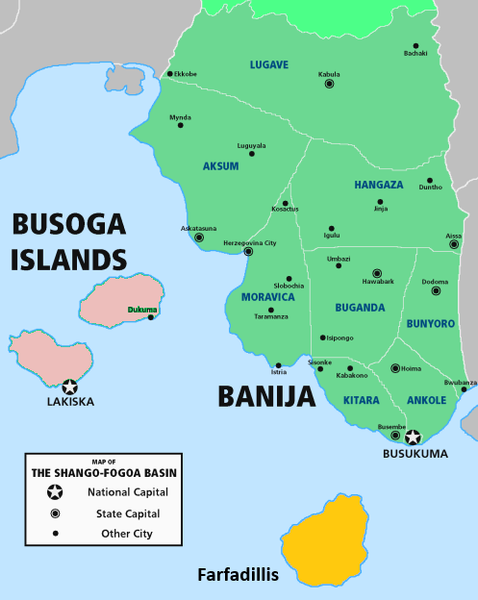
LocationsIstria, MoravicaBanija's largest port and largest city by population, this is in the Moravica region, in Northwestern Banija. It is a city of 4,728,000 people, and it is known as Banija's economic capitol. It is largely considered Banija's most diverse city. Historically, this city served as the second capitol city of the Kasanke Tribe, the historical predecessors of the modern Banijan nation. It is one of two Banijan cities with a major foreign population- the other being the nation's capitol, Busukuma. It has risen in status since its designation as an
Olympic City, having co-hosted the XIV Summer Olympiad with Orean, Liventia. Nearly a third of the city holds citizenship of a country other than Banijan. More of those come from the Royal Kingdom of Quebec or the Busoga Islands, but people come from all over Atlantian Oceania and the rest of the multiverse. It is also known as Banija's wealthiest city and primary economic hub. It is home to Banija's oldest university, the University of Loyola-Istria, and to the country's biggest airport. It is also home to the Regional Transit Corporation, as well as the Istria Stock Exchange.
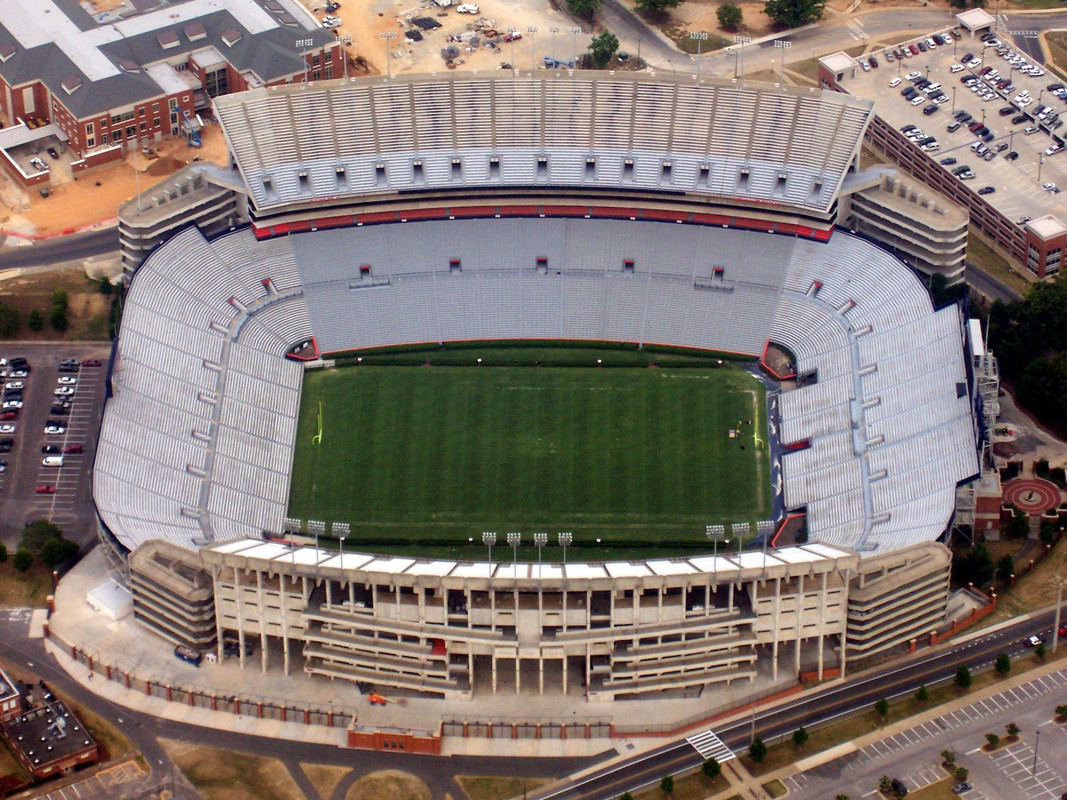
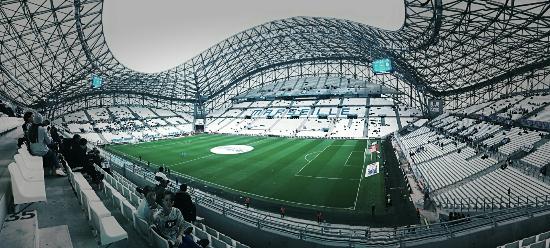
Istria Olympic StadiumCapacity of 80,000The stadium being used in Istria is the Istria Olympic Stadium, with a capacity of 80,000. Per implication by the stadium name, this was the designated main stadium on the Istria side for the XIV Summer Olympiad, purpose built for said event. The stadium played host to the Olympic track and field events, as well as select games in both association and gridiron football, including the medal matches in both sports. It also serves as the primary home venue for the Istria Black Mambas, one of the city's two professional gridiron teams. It hosted matches at AOCAF LXII, BoF 76, and Cup of Harmony 89, as well as games during the 4th and 5th Brevity Challenge Cups.
Matches Held HereOne Round of 16 Match
One Semifinal
Herzegovina City, MoravicaBanija's oldest city, the city by its current name is over 800 years old, when it was first conquered by the Kasanke people. It is a city with a population of over 2.9 million people. It is the heart of the Puritan Church of Jesus Christ of Latter-Day Saints. The national religion was started in this city, and the church's world headquarters, the Herzegovina Temple, is the multiverse's largest Puritan Mormon church. The Bishop of this church, formally titled the Patriarch of Herzegovina, is the most senior member of the church, and the joint head of the global church, alongside His Majesty, the Kabaka. It is home to Banija's largest university, Northern Moravica University. It served as the seat of government for the Kasanke Tribe. It is also the capitol city of the Moravica region. As the original home of the predecessors of the Banijan monarchs, all reigning monarchs are buried on the grounds of the Herzegovina Temple.
Herzegovina City had their own airport finally open just prior to World Cup 83. It is not the largest airport, and much traffic is still directed through Istria. Still, it has permanent international status, and is a city looking to continuously place themselves on the map.
Kavuma FieldCapacity of 83,800Kavuma Field is a relatively new domed stadium in Herzegovina City, with a seating capacity of 83,800. It has the most interesting history of any stadium. For a long time, Istria had a domed gridiron stadium, named Liberty Stadium. But ahead of the XIV Summer Olympiad, which was co-hosted in the city, they tore down Liberty Stadium in favor of an outdoor stadium, the Istria Olympic Stadium. And so up north, in Herzegovina City, the Herzegovina City Cobras wanted to stop sharing a stadium with the city's soccer team, Herzegovina City FC. Therefore, they built a brand new stadium- and put a roof over this one. This has hosted, among other events, and Cobras home games in the GFLB, the NSCF 29 Final.
The name Kavuma Field is after its corporate sponsor, Kavuma Supermarkets- the biggest Supermarket chain in the country.
Matches Held HereOne Round of 16 Match
One Semifinal
Busukuma, National Capitol RegionThis is the nation's capitol, located on the country's Southern coastline. Puritan Mormons believe that their God told the-then chief of the Kasanke, Kabonero III, that he should conquer all of the land that is currently Banija, gave the country it's name(therefore killing the name of the Kasanke nation), and put the capitol in the South. He did it, made Busukuma the capitol, and declared himself Banija's first Maharaja, or Emperor. As the nation's capitol for over 400 years, the city has been the spot for many major events in Banijan history, and the seat of plenty of foreign embassies, a large foreign population, and Banija's first airport.
The city, of course, is known for having two airports- the public, international airport, called Busukuma International, and also the non-public airport, named Gonzaga International Airport- reserved for the royal family and their guests, elected national politicians, foreign diplomats, and the point of entry for high-ranking officials to avoid the general public. Heads of State/Government, Foreign Ministers, AOCAF officials, host committee members, and national teams, upon their first arrival into Banija, will fly into Gonzaga International.
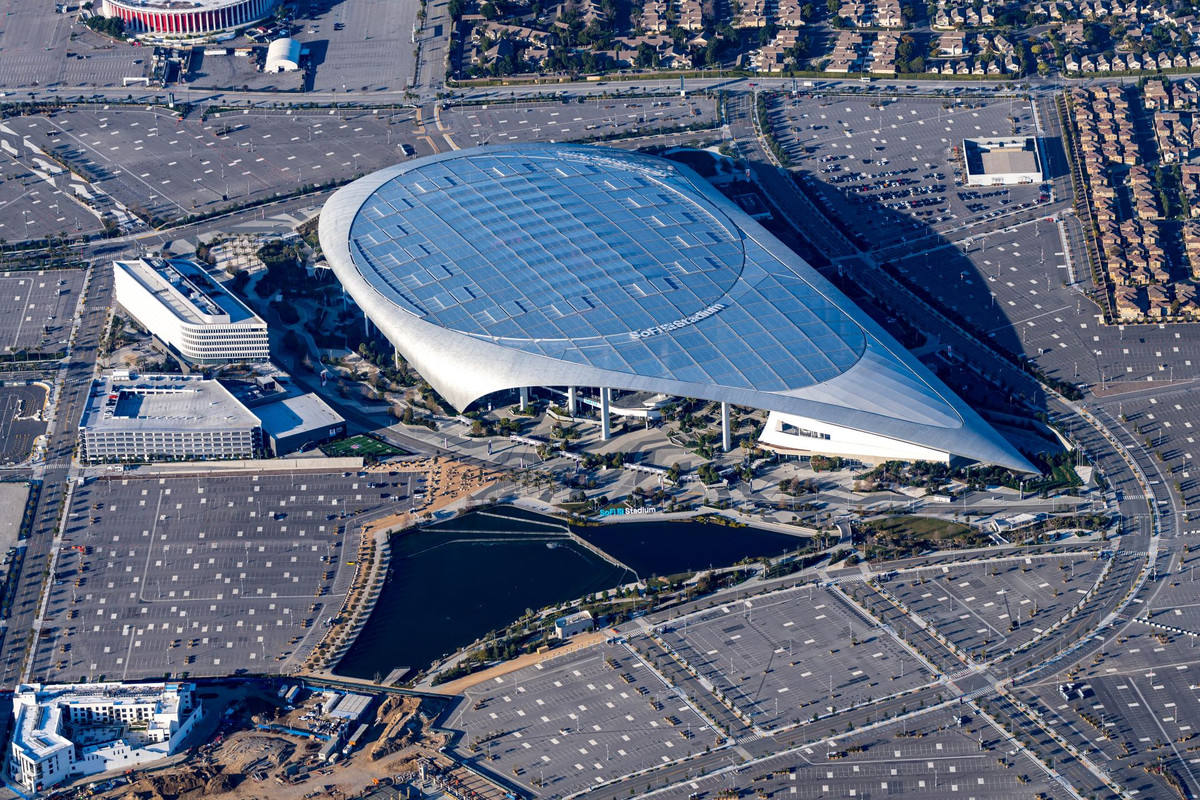
Stadium of the RestorationCapacity of 101,835The national stadium, the Stadium of the Restoration, sits 1011,835. It is the country's largest non-racing stadium. On the stadium's site, in 1835, the Banijan monarchy was restored at this site in Banija's first declaration of independence from the Royal Kingdom of Quebec. When the RBSA was formed, it was the obvious site to build the national stadium. The original facility sat 69,000, and was then, as it is now, Banija's largest soccer stadium. It was home to the Banijan national soccer and gridiron teams, and hosted plenty of international tournaments, including the Finals of a UICA Globe Cup, World Bowl and a Baptism of Fire. However, the ageing facility needed to be rebuilt so that one could fit the WCC's 80,000 seater minimum requirement to host a World Cup opening match, as required when the country co-hosted World Cup 81. The stadium is jointly owned and operated by the Olympic Committee of Banija, the GFLB(Gridiron Football League of Banija), the BCSG(Banijan Collegiate Sports Group), and the RBSA(Royal Banijan Soccer Association).
The
bid from AEP, an architectural firm from Siovanija & Teusland, won the bid to build a new Stadium of the Restoration on the same site in time for World Cup 81. The brand new stadium's capacity, according to the bid, is a nod to Banija's history, of the year that made the site famous in 1835. It has a retractable natural grass surface, used for soccer, and a retractable articifial turf surface, used for gridiron football and during ceremonies like coronations. There are no gaps between the stands, while the South Stand is a single tier, designed to amplify crowd noise. The stadium contains 35 suites, 1 of which is always reserved for RBSA executives, and the second always received for His Majesty, the Kabaka. They built the stadium to a capacity of 91,835. The last 4 digits of the capacity are intentional- 1835, after the year of the restoration of the Banijan monarchy.
However, in preparation for the Golden anniversary of this tournament, the owners of this stadium oversaw an 10,000 seat expansion, to 101,835- which makes it the largest stadium in the country. And, of course, still ending with 1835. This meant that the stadium was closed for World Cup 98 Qualifiers, but re-opened spectacularly in Week 2 of World Bowl L.
This stadium is Banija's most prestigious- having hosted more championship matches than any other. In soccer, this stadium has hosted both the opening match and one of the semifinals of both World Cup 81 and World Cup 83, The final of both AOCAF LVIII and LXII, the Baptism of Fire 76 Final, the Cup of Harmony 76 and 89 Finals, and even an IFCF Champions League Final. Most importantly, the stadium also played host to the World Cup 99 Final. In gridiron, this stadium has hosted two NSCF Finals and three World Bowl Finals, as well as being the annual host of the NSCF Celestia Conference Championship game, and the NSCF Mugisha III Memorial Bowl. It is also the annual host of three of the most important games on the Banijan gridiron calendar- the BCSG National Championship Game, the Simba Bowl(aka the GFLB title game), and Army v. Navy.
Matches Held HereWorld Bowl LII Final
Jinja City, HangazaThis city of 3.3 million people is Banija's largest inland city, and the third largest city in the entire country, in terms of population. This city is the economic center of the Hangaza region, even if its political capitol lies towards the East, in Aissa. Despite being an inland city, it is rapidly diversifying- with migrant groups from across Arrosia, that want a cheaper cost-of-living than the traditional migrant hubs along the Banijan coastline, are moving here in bigger numbers.
Historically, the city is known for being the spiritual home of one of Banija's minority ethnic groups- the Akamba. It is also sight of the first battle of the Kasanke conquest, when they moved from the Moravican coast to take over the entirety of what is now Banija. The city is named after Banija's biggest river, the Jinja River.
Stadium- BCEL StadiumCapacity of 52,400This stadium has a capacity of 52,400. Sponsored by the soft drink company BCEL from Baker Park. It was built to attract matches for BoF 67, and is considered one of Banija's premier stadiums. It is home to Banijan club Jinja City FC, one of Banija's Super 5 clubs. It is one of quite a few stadiums in Banija that are shared between the soccer and the gridiron teams. It has hosted matches at all three WCC tournaments, as well as prior World Bowls that Banija has hosted.
Matches Held HereOne Round of 16 Match
Third Place Match
Aissa, HangazaThis city of 1.6 million is one that is rapidly growing, and finding itself on the map. The regional capitol of Hangaza is situated on Banija's eastern border with Geisenfried, and is quickly becoming one of Banija's largest cities. It's kind of a counter-cultural city. Known for its strong Yue minority community, it is also known for having a big autoracing community- both things that are quite obviously rare within the Kingdom. But like the rest of this country, it's a sports mad town- and one obviously where this sport dominates.
Despite all that, Aissa is the closest thing that Banija has to a true 'hipster' community. If you want to be counter-cultural, this is the place to be.
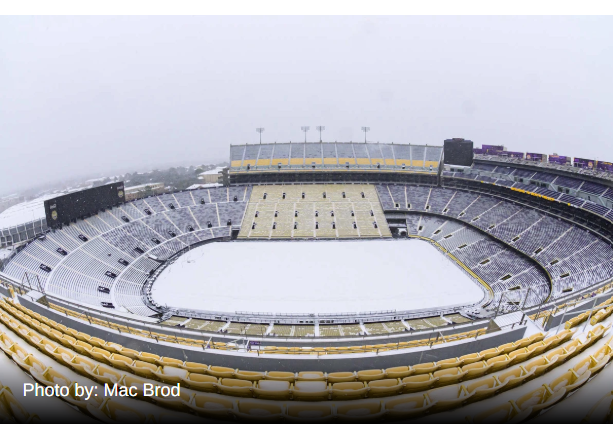
The Crocodile SwampCapacity of 65,000This is stadium is an older stadium, also used the last time Banija hosted the World Bowl. It is the full-time home of the Aissa Crocodiles, one of the premier franchises of the GFLB. The city's fans are known for being rabid and fierce, and fan culture in Aissa is known for being quite rowdy. The tailgate culture is quite strong here- expect tailgating trucks and what not all along the Riverfront.
Matches Held HereOne Round of 16 Match
One Quarterfinal
Hoima, AnkoleNow, while Hoima wasn't a shoe-in per say, it was never really going to be left off of the host list, was it? A city with 2.5 million people, one with a stadium as large as theirs, and the hosting experience- Hoima was always going to be chosen. Now, of course, for a city of its size, it is probably the least multi-cultural big city in Banija, besides maybe Mynda- not surprising considering it is an inland city. Despite that, it is considered very left-wing by Banijan standards.
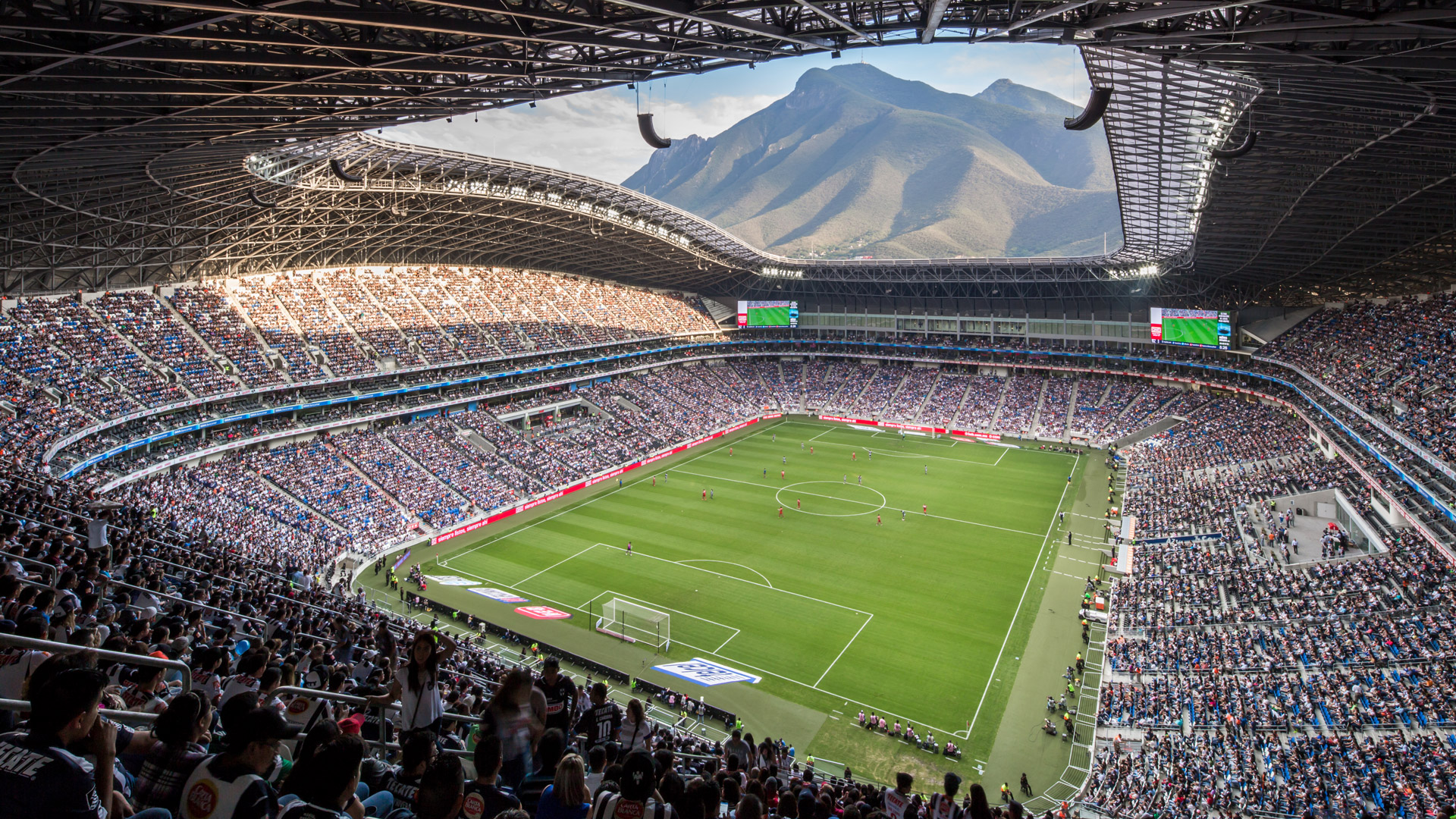
Stadium- Mavuto FieldCapacity of 75,000This is a stadium that was built before AOCAF LVIII, and it is a joint shared stadium between the Hoima Warriors, the S-FPL soccer club, and the Hoima Zebra- the GFLB gridiron team.
Matches Held HereOne Round of 16 Match
One Quarterfinal
Lwanga, BugandaCitizens of Lwanga, Buganda are excited for this moment- it is rare that they are picked to host games at major tournaments, and they look to take full advantage of this opportunity. The only previous tournaments they have hosted games at were Cup of Harmony 76, and World Bowl XXXVII. Lwanga is the second-largest city in Buganda- a city with just barely over 1 million people within its city limits. The RTC has heavily invested in this area to ensure public transit is up to par for the arrival of the Finals. And yet, like Aissa, this Southeastern city does not have the easiest access. To get there directly, you fly into Busukuma International Airport, and then fly to Lwanga. But the highways in Buganda are known for being poor, and it is generally known as the region with the weakest freeway network not only in the country, but throughout the GSW(though, of course, this does not count places like Valanora where citizenry doesn't drive at all).
The city is famous for being host to the remains of the House of Mageba, rulers of Banija from 1618 to 1815. And with the Buganda region as a whole being home to about 40% of Banija's wild triceratops population(around 58% are in Bunyoro), it is a major hub for safari related sightseeing, especially around seeing triceratops.
The Watering HoleCapacity of 63,000This stadium is home to the Lwanga Rhinos, in the GFLB. With a capacity of 63,000, it is Banija's oldest domed gridiron stadium. Why a dome in a country without winter? Buganda is known for having lots of wind- and when the option to put a roof on the building came up, all the stakeholders jumped onto it. It isn't seen as one of Banija's nicest stadiums, but it's relatively large capacity, in addition to the fact that Lwanga rarely gets games like these, ensure that they get to host when this tournament comes.
Matches Held HereOne Round of 16 Match
One Quarterfinal
Dodoma, BunyoroThe Bunyoro Region is now primarily seen as a basketball region, as basketball is the region's highest rated sport in terms of attendance, youth participation, and TV ratings. Still, this being a sports mad country, gridirion is still very popular here, even if it's been years since the region has had a team in Banija's top flight. That team is Bunyoro RSC- more internationally known for their lacrosse success than soccer, who play in Dodoma, a city with just over 1.2 million people. Locals joke that while in the rest of Banija, there is dry season and wet season, in Bunyoro, there is wet and wetter season- it has some of the highest rates of rainfall in all of Arrosia.
Albert III Memorial StadiumThis was built for World Cup 81 under a different name, Paa Nuepe, and is currently used by Bunyoro RSC- a multi-sporting who have professional soccer, lacrosse, and gridiron teams. However, after the assassination of the current Kabaka's father, Kabaka Albert III, during World Cup 82 Qualifying, this stadium was named after him. It has featured in numerous tournaments, with World Cup 81 obviously being the most famous. When Banija won Eagle's Cup VIII, however, this stadium would be renamed again, and designated the country's official Eagle's Club venue. With a stadium capacity of 48,600, and with revolutionary field drainage technology, thoughtful considering the amount of rain that this region gets, this will be some of Banijan engineering technology on full display. Due to the unique structure of the roof, the sound is made to go down onto the ground, and when it is full, it is considered one of the loudest venues in the country. Now of course, considering the pitiful state of Bunyoro RSC, this stadium is rarely full, but what if...
With the destruction of the Eagles Club following the Vilitan cheating scandal, this stadium has reverted back to its second name- the Albert III Memorial Stadium. Since this used to be the country's official Eagle's Club venue, a number of amenities have been added for luxury suite holders. For those in luxury boxes, there is access to a 'VIP Club', formerly known as the 'Eagles Club'. which hosts a fancy exclusive bar, a workout room, and even an indoor pool(that is not open on Matchday). FA executives for teams playing at this stadium will get access to those amenities.
It also features elite field draining technology, as just because rain is frequent here, they are able to maintain the quality of their grass pitches.
Matches Held HereOne Round of 16 Match
Sisonke, KitaraSisonke, Kitara, is the capitol city in the fast growing Kitara Region of Banija. With a population around 1.2 million and growing rapidly, it is a city that is trying to make a name for itself. Just about an hour south of Istria, it is considered a 'new age' city- rapid population growth in recent years makes it a great hub for single young professionals in Banija. Its rapid rise to prominence in Banija means that it is more regularly being selected to host games at major tournaments, and the excitement is palpable. It is most well known for being home to former IFCF Champions League winners, the Kitara Athletic Association.
Keystone StadiumKeystone Stadium(cap. 47,000) is the home of Kitara Athletic Association, the professional sporting club that has had a rapid rise alongside the city of Sisonke, as well as the Sisonke Leopards of the GFLB. The Leopards are an up and down, although have had good days recently with Wagner-Young as their QB1.
Matches Held HereOne Round of 16 Match
One Quarterfinal
 Posted: Sun Mar 01, 2026 8:22 pm