Advertisement

 by BrightonBurg » Thu Feb 09, 2012 10:16 pm

by Offenheim » Thu Feb 09, 2012 11:23 pm
BrightonBurg wrote:Three times since 1870 is enough I think..Besides,I think that sort of thinking is out of the German system at this point...besides,no Helmuth von Molke to run a proper war in Germany these days..
by New Chalcedon » Thu Feb 09, 2012 11:58 pm
Offenheim wrote:New Chalcedon wrote:*snip to avoid quote pyramid*
First, in my reading of Hollande, he is a more moderate type of social democrat than, say, Martine Aubry or Dominique Strauss-Kahn. So it's definitely a plus for the more conservative leaders of Europe that he won. I'm with you on this.
Second, it's totally bad form for a national leader to get so involved with politics. It's one thing to say, "well, I'll be able to form a working relationship with the leader of X Country," when you're campaigning, but when it's someone else's campaign... it's a terrible way to create a productive relationship. I'm with you on this.
I want to supplement some things I'm seeing. Given that Merkel's coalition partner could be routed at the next election, which would seem to isolate her party or at least force it into a grand coalition with the the Social Democrats, there is going to be a leftwards shift in European politics. Likewise, Greece is unlikely to have its caretaker government survive the coming elections (left-wing parties are projected to take at least 42% of the vote; parties further left than PASOK. It's unfortunate for Merkel but Hollande is going to be in a position of power in Europe; campaigning against austerity is going to bring a lot of politicians to power who will be hostile to Merkel and the German position. In some places, it already has.
The question is, will Europe survive?
by Nazis in Space » Fri Feb 10, 2012 5:11 am
I didn't know that saying 'I'd like it if $Person was elected' is the same as dictating election results.Indira wrote:I don't particularly care as to who wins the French election, I must confess I am far more concerned about one country dictating to another how its election should go. As France is still a democracy, it should be up to the French people, not the German Chancellor, who is elected.
by Nazis in Space » Fri Feb 10, 2012 5:13 am
BrightonBurg wrote:Three times since 1870 is enough I think..Besides,I think that sort of thinking is out of the German system at this point...besides,no Helmuth von Molke to run a proper war in Germany these days..
by New Chalcedon » Fri Feb 10, 2012 6:17 am
Nazis in Space wrote:BrightonBurg wrote:Three times since 1870 is enough I think..Besides,I think that sort of thinking is out of the German system at this point...besides,no Helmuth von Molke to run a proper war in Germany these days..Surely you meant to say 'Once, one time less than France did it', yes?
- 1870 France declares war and invades. Is beaten back
- 1914 Germany declares war and invades. Is beaten back
- 1939 France declares war and invades. Is beaten back
by Nazis in Space » Fri Feb 10, 2012 9:33 am
by Pendragonia » Fri Feb 10, 2012 1:22 pm
Offenheim wrote:Forgive the sensationalistic topic title. Anyhow, the general thing is that, as everyone who's been following the Eurozone Crisis (I think it's fair to call it that) knows, Angela Merkel of Germany and Nicholas Sarkozy of France have been the best of friends during this whole thing. There have been discussions that essentially what Germany couldn't do with two World Wars it's doing with banking, though I think that's a bit overblown. Now though, Angela Merkel is intervening in French politics.
Sarkozy faces an election this year (voting in April and May), and opinion polls have consistently shown that he'll go down in defeat, as the majority of the French seem to want someone else. Given that he essentially has two months to turn this around, Merkel has made it clear that her choice for President of France is Nicholas Sarkozy, attacking his major opponent, François Hollande (Socialist Party), while in France. She'll even be undertaking at least two campaign appearances for Nicholas Sarkozy, including appearing when he officially announces his candidacy, according to the Spiegel Online.
The issue is that Holland wants greater interventionism in the Eurozone, including the creation of Eurobonds, something which Merkel has steadfastly resisted.
So the questions I'm putting out are, should Germany be intervening in French politics? Is it right for one nation's leader to make it so publicly known that they prefer a certain candidate?
As both of the articles I linked to have pointed out, the issue is that Merkel has to work with whoever wins the election. And Hollande looks likely to win. This isn't like the US presidential election where who knows who might be the Republican candidate, or where the polls have a far longer time to change and we have months of economic news to go. In Europe, economically, either things are going to get better, or they're going to get worse. I don't think either possibility really holds much hope for Sarkozy, he could still go down to defeat even with an improving economy. I think the self-inflicted wounds of austerity are going to reveal far more economic turmoil in Europe, rather than economic improvement. And I think that politically, Merkel is making a huge mistake. She needs to be friends with whichever person is the next president of France. The Franco-German partnership established since the 1950s is one of the cornerstones of European politics and peace. Merkel needs to smile, shake hands with Hollande, and privately attempt to influence him. Not come out publicly and campaign against him.
However, it does show just how strong that partnership has become if Merkel is willing to do this. Perhaps, if Hollande wins the election, he will return the favor during the next German election.
by Neu Leonstein » Fri Feb 10, 2012 1:37 pm
New Chalcedon wrote:Got any evidence of this, perchance?
by New Chalcedon » Fri Feb 10, 2012 4:55 pm
Neu Leonstein wrote:New Chalcedon wrote:Got any evidence of this, perchance?
http://www.marketwatch.com/story/my-adv ... 2012-01-23
It is impossible to solve the euro crisis like this. He's in the classic French mold of people who see finance as an Anglo (it used to be German, in the interwar years, but they changed tack these days) conspiracy trying to bring down the country. He'll push for PSIs everywhere and do everything in his power to prevent sovereign debt markets from functioning properly. He'll try to use legal pressure to create low yields, so that people don't get a chance to pass judgement on the economic impact of his theory of simply spending and taxing more.
Before our eyes, in the past 20 years, finance has taken over the economy, society, and even our lives. It is now possible, in a split second, to move astronomical amounts of money, threatening the very fabric of states.
“What was once merely an influence has become an empire. And, far from being diminished, it has been strengthened further by the crisis spawned on Sep. 15, 2008.
With this in mind, I can show no mercy to the five-year presidential term now coming to an end. But that is no longer the issue. The judgments speak for themselves. Started in torment, the presidency ends in turmoil. Weighed down by tax breaks for the wealthy, the term finishes with tax increases for everyone in France. Opened with a promise of return to full employment, it concludes with record numbers out of work. Not to mention the deficits, the debt, the de-industrialization, the demolition of public services, including throughout our schools.
by Neu Leonstein » Sat Feb 11, 2012 1:22 am
New Chalcedon wrote:I'm.......not seeing this in your source.
What I'm seeing among this is:
(1) Split the commercial banks from the investment banks. Nothing radical there - it was the law of pretty much every Western country from the 1930s through the 1990s.
(2) An observation - demonstrably true - that the Eurozone, as it is, cannot protect itself against rampant speculation (the present crisis should confirm this), and that this must change if the Eurozone is to move forward. Again, nothing radical here - it's an observation being echoed widely among the center-left (the far-left, as often as otherwise, simply wants the Eurozone to go away), and to some degree among the center-right (although they disagree with M. Hollande and the center-left about the nature of the correct solution).
(3) Another observation - also demonstrably true - that the power of the financial sector has increased vastly over the past 20 years. He gets it slightly wrong, as the timeframe is 30 years (the onset of Reaganomics), but this:Before our eyes, in the past 20 years, finance has taken over the economy, society, and even our lives. It is now possible, in a split second, to move astronomical amounts of money, threatening the very fabric of states.
“What was once merely an influence has become an empire. And, far from being diminished, it has been strengthened further by the crisis spawned on Sep. 15, 2008.
is absolutely, factually and demonstrably correct - the process is called "financialisation". And sound economic policy must be based on fact, must it not?
(4) Yet another widely-echoed statement that the same credit rating agencies presently downgrading various European nations are the same ones that touted subprime bundles as AAA, and are hence.....not at the peak of credibility. With which sentiment I wholeheartedly agree - after their starring role in the subprime crash (greed, corruption, incompetence, blind ideology and management-driven "analysis" all playing key roles in the CRAs' less-than-stellar performance), the CRAs (or at least their analysts' careers) should be crawling into holes to die, not pontificating about financial responsibility.
(5) A rather harsh, but understandable, attack on Sarkozy's term as President.
(6) Taking action against tax havens. Politicians of all stripes love to promise this, and a few even try to follow through. Nothing objectionable there, either, really - I personally loathe tax havens, as they enable companies big enough to reach them to become free-riders, taking advantage of all the services the state provides and dodging their share of the bill.
(7) Banning toxic financial products. Impractical, at best - but I can understand why he'd want to, even if I doubt it's a good idea. On this one, I agree with you: he is sounding at best, impractical, and at worst silly. He is definitely revealing a certain ignorance about how finance works to be proposing blanket bans of types of products, or else he's playing to the five-second soundbite.
(8) A financial transactions tax. I assume - details are not given in the article you link - that this would be constructed so as to only affect transactions of a significant size, rather than everyday ATM withdrawals and the like. I'm ambivalent about this one, but it's firmly in the mainstream of the Left.
(9) A large dose of nationalism - as I understand it, nationalist rhetoric is par for the course on both sides of French politics, and Sarkozy was just as much along this vein five years ago as Hollande is now.
(10) Some rather interesting proposals about the debt bonds, along with an ackowledgement that fiscal discipline (as opposed to austerity; M. Hollande draws a clear distinction between the two, at least rhetorically) is required to prosperity. He wants European governments to start at least some co-ordination of economic policies (a long-overdue acknowledgement of the reality of a unified currency leading to a near-unified economy), rebuild industry (good - a healthy industrial sector is key to a diverse and stable economy),
explore alternative energy generation (an excellent idea, in light of Europe's current - and strategically-unsound - dependence on Russia for energy imports)
and develop instruments to combat speculation.
While I don't have a problem with the idea of speculation (and hence see the whole "speculation as the enemy" thing to be a bit uncalled-for), it cannot seriously be argued that speculation played no significant role in either the Wall Street crash or the Eurozone crisis.
And from what I see, the Eurobond proposal seems to be neither more nor less than making a central bank that acts as a central bank - by being the purchaser of last resort for government debt. That's the case in every other country in the world, NL, as I shouldn't have to tell you - how does it amount to an attempt to "prevent sovereign debt markets functioning properly"?
(11) A swipe at China - which I actually agree with. The Renminbi's under-valuation gives a huge, artificial structural advantage to Chinese exporters, and places Western countries at a significant disadvantage when trying to enter the Chinese market. Take the IMF's estimate (5-27% undervaluation; midpoint of 15%) of the situation. Assuming they're accurate, that 15% undervaluation amounts to a 15% hidden subsidy on all Chinese export firms, and a 15% hidden tarriff on all would-be importers. I am totally in agreement that the rest of the world needs to haul China up on this one (especially as this practice violates WTO rules, which China agreed to uphold when it joined) while it still can - while China still needs the rest of the world, before its own internal markets have developed to the point where it can sustain its own growth.
(12) Finally, M. Hollande concludes with some pro-Europe, and specifically pro-Germany, talk. In fact, I believe he is specifically aiming to take a line of "We're Germany's friends, even if we don't agree on this one issue", which is a far cry from the paranoid conspiracy-theoryism you suggest.
To address your own specific points:
Hollande did not once say a thing about England, and when he spoke of Germany, it was in a positive tone.
I don't get what "PSIs" are in the context of which you speak (and hence will not comment about them), but I don't see anything in this article which leads to non-functioning sovereign debt markets.
Not once does Hollande even speculate about using legal pressure to keep bond return rates artificially low (as opposed to countering a market panic - unless you are pre-emptively accusing him of intent to fix the rates), and while he does advocate two new taxes that I spotted in the article (the transaction tax, and the enviro-tax on imported goods from nations which don't have EU environmental standards), he also acknowledges - and indeed emphasises - the importance of fiscal discipline as one of a few tools the government uses to promote growth.
Therefore, the ECB's "solution" - which rests on a sandy foundation of expansionary austerity - is no solution at all, but merely a prescription for a liquidity trap. Will M. Hollande's proposals work? I'm not sure they will - but I do know (from historical research, from theory, from empirical post-2009 evidence in Europe) that the proposals emanating from Frankfurt and being backed so enthusiastically by Pres. Sarkozy cannot solve this crisis. And so, of the two, I have more confidence in Hollande than of Sarkozy.
by New England and The Maritimes » Sat Feb 11, 2012 2:14 am
Soviet Haaregrad wrote:Some people's opinions are based on rational observations, others base theirs on imaginative thinking. The reality-based community ought not to waste it's time refuting delusions.
by New Chalcedon » Sat Feb 11, 2012 3:51 am
Neu Leonstein wrote:New Chalcedon wrote:I'm.......not seeing this in your source.
No, because it's not in there. But having followed the situation for as long as I have now, and knowing the kind of crazy that comes from the left-leaning members of the European political establishment, it's not difficult to imagine Hollande's response to this kind of crazy. Especially since he demonstrates his lack of pragmatism in this speech.
In short, it was meant to demonstrate his character, not his policies on the euro crisis - since the policies would respond to problems that haven't arisen yet.
What I'm seeing among this is:
(1) Split the commercial banks from the investment banks. Nothing radical there - it was the law of pretty much every Western country from the 1930s through the 1990s.
A pointless exercise, and completely so. It's politics, not policy.
(2) An observation - demonstrably true - that the Eurozone, as it is, cannot protect itself against rampant speculation (the present crisis should confirm this), and that this must change if the Eurozone is to move forward. Again, nothing radical here - it's an observation being echoed widely among the center-left (the far-left, as often as otherwise, simply wants the Eurozone to go away), and to some degree among the center-right (although they disagree with M. Hollande and the center-left about the nature of the correct solution).
There is no rampant speculation.
(3) Another observation - also demonstrably true - that the power of the financial sector has increased vastly over the past 20 years. He gets it slightly wrong, as the timeframe is 30 years (the onset of Reaganomics), but this:
is absolutely, factually and demonstrably correct - the process is called "financialisation". And sound economic policy must be based on fact, must it not?
The facts aren't my issue here. The idea that financialisation is bad is.
(4) Yet another widely-echoed statement that the same credit rating agencies presently downgrading various European nations are the same ones that touted subprime bundles as AAA, and are hence.....not at the peak of credibility. With which sentiment I wholeheartedly agree - after their starring role in the subprime crash (greed, corruption, incompetence, blind ideology and management-driven "analysis" all playing key roles in the CRAs' less-than-stellar performance), the CRAs (or at least their analysts' careers) should be crawling into holes to die, not pontificating about financial responsibility.
Again, irrelevant. Not only has the EU already moved on the CRA issue, but the rating of sovereigns and structured financial instruments is completely different. What Hollande is annoyed with is the fact that incontinent sovereigns aren't given a card blanche by markets anymore. The CRAs are lagging behind this process, if anything, but they do make for a more easily identifiable enemy.
*snips area of agreement*
(6) Taking action against tax havens. Politicians of all stripes love to promise this, and a few even try to follow through. Nothing objectionable there, either, really - I personally loathe tax havens, as they enable companies big enough to reach them to become free-riders, taking advantage of all the services the state provides and dodging their share of the bill.
It's not that politicians don't want to do stuff about it. They just can't. Unless they impose capital controls, it's not within their power. They need to STFU about it.
(7) Banning toxic financial products. Impractical, at best - but I can understand why he'd want to, even if I doubt it's a good idea. On this one, I agree with you: he is sounding at best, impractical, and at worst silly. He is definitely revealing a certain ignorance about how finance works to be proposing blanket bans of types of products, or else he's playing to the five-second soundbite.
And you don't think his ignorance translates to other things he's likely to say and do (and has said already)?
(8) A financial transactions tax. I assume - details are not given in the article you link - that this would be constructed so as to only affect transactions of a significant size, rather than everyday ATM withdrawals and the like. I'm ambivalent about this one, but it's firmly in the mainstream of the Left.
Sarko promised on the other day. Banque de France thinks it's stupid. So do all the countries who ever tried to have one (UK, Netherlands and Sweden come to mind). I suppose all it means is there'll be some French guys to fill the London apartments left unsold because of the UK bonus hunt...
(9) A large dose of nationalism - as I understand it, nationalist rhetoric is par for the course on both sides of French politics, and Sarkozy was just as much along this vein five years ago as Hollande is now.
Of course. France is ugly that way. But Sarko had several years to mellow out and recognise who's paying the bills, whereas Hollande is unlikely to be happy playing second fiddle and yielding opinion-wise.
(10) Some rather interesting proposals about the debt bonds, along with an ackowledgement that fiscal discipline (as opposed to austerity; M. Hollande draws a clear distinction between the two, at least rhetorically) is required to prosperity. He wants European governments to start at least some co-ordination of economic policies (a long-overdue acknowledgement of the reality of a unified currency leading to a near-unified economy), rebuild industry (good - a healthy industrial sector is key to a diverse and stable economy),
No, he doesn't. He is referring to a mythical Europe where there are countries that share the dirigisme vision. There are not, a unified European fiscal policy would cut French benefits to something the state can actually afford. Not to mention the way French industrial policy and social welfare has contributed to a natural unemployment rate at stratospheric levels (which is fair enough, mind you, because the people who suffer are mostly brown people anyway, and hence apparently don't fit into French socialism).
explore alternative energy generation (an excellent idea, in light of Europe's current - and strategically-unsound - dependence on Russia for energy imports)
They've been exploring for 30 years. Empty dribble.
and develop instruments to combat speculation.
While I don't have a problem with the idea of speculation (and hence see the whole "speculation as the enemy" thing to be a bit uncalled-for), it cannot seriously be argued that speculation played no significant role in either the Wall Street crash or the Eurozone crisis.
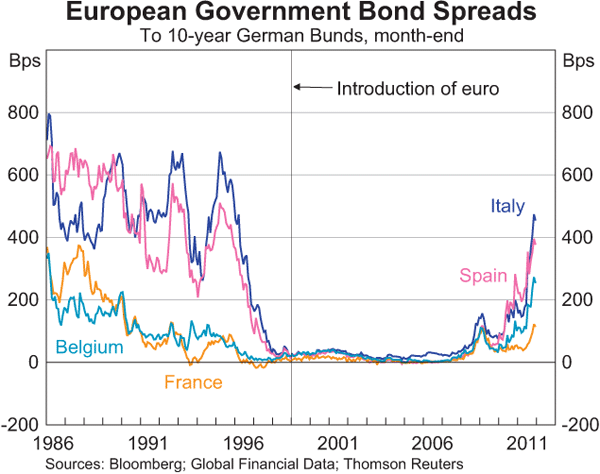
This is the euro crisis in one chart:
There was speculation there: the idea that by joining into a common currency and the associated budget criteria governments would get their act together and would behave like responsible managers of their nation's fortunes. They did not, and this fact has circulated around the markets, followed by the realisation that these governments had neither the intention nor the understanding to deal with the fallout.
Every single word you have heard from European politicians about speculators, traders and market behaviour over the last year or two has been evidence of their lack of understanding of what is going on. There's no point in repeating it here.
And from what I see, the Eurobond proposal seems to be neither more nor less than making a central bank that acts as a central bank - by being the purchaser of last resort for government debt. That's the case in every other country in the world, NL, as I shouldn't have to tell you - how does it amount to an attempt to "prevent sovereign debt markets functioning properly"?
Central banks are not purchasers of last resort of anything. They never have been, and they never should be. They are lenders of last resort. That's different: LTRO is okay, paying for French unemployment benefits is not.
A Eurobond only works if it gets a better rating than the individual country that backs them. That means credit enhancement, which means taxpayers in better-situated countries foot more of the risk. That cannot possibly work well unless those people get the guarantees that the money will be well-spent and the debt issued will be in reasonable amounts. That is so very obviously not given at this stage, which is why I think Eurobonds are not a good idea. Europe should have paid for Greece back in 2010 through a fiscal transfer and then reformed Maastricht and fixed budgets straight away. They didn't, and the waiting has compounded the problem to a point where Eurobonds would not only amount to a straight wealth transfer, but it wouldn't fix anything. Hollande might not mind, but I sympathise with those who have to put their money where his mouth is.
(11) A swipe at China - which I actually agree with. The Renminbi's under-valuation gives a huge, artificial structural advantage to Chinese exporters, and places Western countries at a significant disadvantage when trying to enter the Chinese market. Take the IMF's estimate (5-27% undervaluation; midpoint of 15%) of the situation. Assuming they're accurate, that 15% undervaluation amounts to a 15% hidden subsidy on all Chinese export firms, and a 15% hidden tarriff on all would-be importers. I am totally in agreement that the rest of the world needs to haul China up on this one (especially as this practice violates WTO rules, which China agreed to uphold when it joined) while it still can - while China still needs the rest of the world, before its own internal markets have developed to the point where it can sustain its own growth.
http://www.ecb.int/stats/exchange/eurof ... ny.en.html
It's just not that bad.
(12) Finally, M. Hollande concludes with some pro-Europe, and specifically pro-Germany, talk. In fact, I believe he is specifically aiming to take a line of "We're Germany's friends, even if we don't agree on this one issue", which is a far cry from the paranoid conspiracy-theoryism you suggest.
The conspiracy theories were aimed at Germany post-WWI when France was falling out of the gold standard, and it happened to be the fault of "speculators", who were usually portrayed as German. These days financial market issues (high food prices, high yields, euro too low or too high depending on the flavour of the month) are blamed on those same speculators, except these days they're generally portrayed as Anglo-Saxon. It emits as much a shoulder shrug today as it did then, but it's good for French politicians' careers and has ensured that French banks and the government can continue to work together to make dirigisme fail marginally less badly.
So yeah, he wouldn't say anything bad about Germany. But he still wouldn't make reasonable financial policy, which is why he wouldn't be a good prospect for the euro area. The whole point for the euro area now is that you need a person who "speaks finance", who actually understands both the technical and the macro issues at work here, who can generate solution concepts that take longer than an afternoon for a first-year analyst to shoot down and who can bring this across both to the public and to the actual audience staring at their bloomberg terminals. Such a person does not appear to exist at this stage, though Draghi does say and do good things at times in my opinion,
and Hollande would very definitely be a step in the wrong direction. You don't say 'my personal enemy is finance' and then successful convince a whole bunch of finance people to lend you money cheaply.
The only way he can get access to cheap money then is by screwing with the pricing of sovereign debt somehow - politicians have been doing this already, banning just about every short sale under the sun as well as naked CDS while they're asking for ever more ridiculous haircuts for those poor fools who still hold Greek debt. I would say it is very reasonable to assume that Hollande will do more of the same, or worse.
To address your own specific points:
Hollande did not once say a thing about England, and when he spoke of Germany, it was in a positive tone.
I don't get what "PSIs" are in the context of which you speak (and hence will not comment about them), but I don't see anything in this article which leads to non-functioning sovereign debt markets.
"PSI" stands for "private sector involvement": the idea that you can force your banks to agree to take big write-downs on sovereign debt without triggering CDS by calling the whole thing voluntary. Then, after you have done this, go back on the deal a couple of weeks later and ask for even bigger write-downs. Then, getting pissy about people asking for higher interest rates to own sovereign debt.
The way they've been able to get away with this is by promising time and time again that Greece is special and that PSIs won't be necessary for other governments. Except Portugal is having difficulties meeting its targets, and there have been all sorts of rumours on what pay-off functions politicians might be looking at: give up on silly austerity, give more taxpayer money to Portugal or make evil bankers foot the bill?
Of course, at that point nobody will even pretend to listen to their saying that Portugal and Greece are special and that PSIs won't be necessary for other governments.
Not once does Hollande even speculate about using legal pressure to keep bond return rates artificially low (as opposed to countering a market panic - unless you are pre-emptively accusing him of intent to fix the rates), and while he does advocate two new taxes that I spotted in the article (the transaction tax, and the enviro-tax on imported goods from nations which don't have EU environmental standards), he also acknowledges - and indeed emphasises - the importance of fiscal discipline as one of a few tools the government uses to promote growth.
See above for my extrapolations from his positions, his rhetoric and what has become accepted practice in European political circles.
As for Hollande's distinction between austerity and fiscal discipline, it's pretty clear: austerity means cutting back spending (and raising taxes), fiscal discipline to him means raising taxes by enough to finance all the extra spending. Now, as you know I'm fairly Keynesian fiscally,
and don't buy into the whole expansionary austerity story for all but exceptional cases.
But the idea that France's economy will get through the recession that has presumably already begun by raising taxes and using the cash to make social transfer payments seems rather questionable. Especially given that he'll ultimately have to raise taxes by more than he raises spending if he is going to keep French yields down in an actually properly functioning market.
Therefore, the ECB's "solution" - which rests on a sandy foundation of expansionary austerity - is no solution at all, but merely a prescription for a liquidity trap. Will M. Hollande's proposals work? I'm not sure they will - but I do know (from historical research, from theory, from empirical post-2009 evidence in Europe) that the proposals emanating from Frankfurt and being backed so enthusiastically by Pres. Sarkozy cannot solve this crisis. And so, of the two, I have more confidence in Hollande than of Sarkozy.
It's not the ECB's solution, it's the Troika's. It is completely incomprehensible to me how the many smart folks at the ECB could be part of this Troika (I imagine they're the ones, along with the IMF, who beg for a mention of microeconomic reform in every rescue package) and argue for austerity as an answer. I mean, it must be part of the deal: Greece cannot continue to leak money the way it does. But at the same time people in the market know that expansionary austerity is generally silly.
Anyway, please stop quoting Krugman. You're not going to get any response from anyone that way. If you can find an economist who supports what Krugman says, quote the economist. People have written papers on this issue. The last SMP has a whole box on it. But an over-opinionated newspaper editorialist should be treated as such, regardless of what he used to do for a living 20 years ago.
by Neu Leonstein » Sat Feb 11, 2012 5:16 am
New Chalcedon wrote:Not at all. I note that none of the banks were considered "too big to fail" during the Glass-Steagall era. No one bank would be so large that its failure would crash the whole system; hence, Wall Street was obliged to operate with at least a modicum of caution, because the primary rationale for bailouts was nonexistant. I would think that you'd be in favour of measures to improve prudential financial management and keep speculation to sane levels.
Bullshit. There is massive speculation - wild fluctuations in the price of a financial instrument (the bonds you show in your graph) indicate high speculation levels.
Or do you think that $4trn daily forex volume is warranted by the actual trade of goods and services? That's $1,465 trillion of forex volume annually being traded: over twenty times the actual global economic production. There is only one explanation for such vast quantities of money changing, and then re-changing, hands so quickly - massive speculation. Speculation of commodities futures, speculation on financial instruments, speculation of government and private-sector bonds, speculation on house prices, speculation on shares.....speculation has its place to keep prices in line with reality, but not to twenty times the actual economy!
And I partially support Hollande in his assertion that financialisation is bad - I don't have a problem with finance, but I do have a problem with today's over-powerful financial sector. Wall Street - and the financial sector generally - is far too powerful in any country, wields far too much power and asserts far too much control. Especially for a sector which doesn't actually produce one blessed thing in the real economy, but just shuffles money around, taking for itself a huge cut from the top, bottom and both sides in the process.
I notice you didn't address the main problem with the CRAs - that their credibility should be shot to shit overall, given the high levels of corruption and incompetence which pervaded their halls as recently as 2008. And given that one of the panic signals in the market is the word of the CRAs, then I would argue that their corruption and incompetence are very relevant indeed - the market is responding to unreliable signals as if they're reliable.
I'm sure you're trying to make a point here, but I'm not sure I get it. Not all taxes are the same - Austrian/neoclassical economic theory notwithstanding.
Hollande shouldn't play second fiddle anymore than Merkel or Cameron should. They're the heads of government (or will be, soon enough) of powerful, large nations with long histories.
Got any sources for this otherwise-pointless swipe at French politics?
Bullshit again. Most of the governments (in particular, Spain, which is now being lambasted as fiscally-irresponsible) were reducing their levels of public-sector debt over time - even Portugal had stabilised its debt/GDP levels at 69% prior to the crisis. Slowly, yes, but they were reducing. Which is kinda the point of fiscal responsibility, yes?
Mmm-hmm, I stand partially corrected. The RBA, nonetheless, has a much more active role - as do most central banks - by combining the monetary policy functions and the bond-issuance function than the ECB does, simply because it can co-ordinate the two activities to maintain stability, which the ECB cannot. The ECB prints money (or authorises its printing) as a monetary-policy instrument; while individual nations are left to manage their own bond issuances.
Besides the fact that Germany (with debt/GDP of 84%) is in no real position to be lecturing Spain (with debt/GDP of 60% or so) about "fiscal responsibility" or the wise use of government money generally, there's also the reality that many of these nations have cut back. They've imposed austerity measures that are, frankly, brutal in nature (see: Greece, with 40% across-the-board cuts in pensions, allowances etc.), yet every time they even think about doing things like cutting out tax loopholes to raise revenue to pay for what remains, the right-wing jumps all over them and shouts the idea down. It's ridiculous.
Are you trying to prove sumething here? Beijing allows the RMB to fluctuate, sure - within a very narrow band. And you didn't address the main point I made - that calling China out on its blatantly market-fixing practices is a good thing. And, frankly, one I'd have thought you would applaud as a person who doesn't believe in government interference in the markets. Also, don't tell me that a 15% export subsidy, coupled with a 15% import tarriff, isn't a pretty heavy-handed manipulation, especialyl when it's by misdirection and sleight of hand.
I presume you refer to Mario Draghi, the new President of the ECB? The man who was involved in Goldman Sachs' hiding the extent of Greek debt prior to the crisis? Oh, he's a great person to be in charge of the ECB. /sarcasm
(1) Citations, please.
(2) Like the financial sector hasn't been screwing with things already.
(3) And if Greece defaults, just imagine the "haircut" these speculators will take.
You certainly have not been arguing as one of late. I'm beginning to wonder. While I support some areas of cutting back spending, I certainly do not support essentially getting rid of the welfare state - which the tone of your rhetoric indicates you would. And a central tenet of Keynesian theory is that the welfare state serves as an automatic stabliser.
Which is where we get back to square one of why the Eurozone, as set up, was foolish. Other governments - like Britain, the US and Japan - are able to get through this with very low yields - despite much higher levels of debt - because their governments can print money to cover the bonds if need-be. While this would cause inflation if overdone (and hence reduce the value of these bonds), the risk is about losing part of the bond to inflation, versus losing the whole of it to default, reducing the risk perception and therefore the premium charged to take on the bonds. Despite the fact that, by any reasonable measure, the British Government has been far less fiscally-responsible than the Spanish Government.
And indeed it is - which doesn't stop all manner of people pushing it, who should know better. And I call it the ECB's solution, because the ECB has embraced it. You are correct, "Troika" is a better term - but I believe that more of the momentum came from the ECB than from the IMF, if only because the IMF's head (Dominique Strauss-Kahn at the time) was not exactly a fan of austerity.
by New Chalcedon » Sat Feb 11, 2012 9:48 am
Neu Leonstein wrote:New Chalcedon wrote:Not at all. I note that none of the banks were considered "too big to fail" during the Glass-Steagall era. No one bank would be so large that its failure would crash the whole system; hence, Wall Street was obliged to operate with at least a modicum of caution, because the primary rationale for bailouts was nonexistant. I would think that you'd be in favour of measures to improve prudential financial management and keep speculation to sane levels.
Of course they were too big to fail! That policy has been part and parcel of banking since the 1930s, when we learned what happens when banks can fail without backstop. The whole point of the Glass-Steagall division was that you prevent the big banks from failing, by isolating them from the supposedly risky stuff and make sure they keep to the supposedly safe stuff. But whatever the quality of the reasoning underlying its introduction, the world has come a long way since those days. The idea that Glass-Steagall would have changed anything material about what's been happening in banking in the last five or ten years has never been explained to me (though I've certainly heard it repeated often enough). Bear Stearns, Lehman Brothers, AIG, Goldman Sachs: none of these had material commercial banking operations.
In testimony before Congress in 2007, Robert Kutner said, “Since the repeal of Glass-Steagall in 1999, after more than a decade of de facto inroads, super-banks have been able to re-enact the same kinds of structural conflicts of interest that were endemic in the 1920‟s, lending to speculators, packaging and securitizing credits and then selling them off, wholesale or retail, and extracting fees at every step along the way... The repeal of Glass-Steagall coincided with low interest rates that put pressure on financial institutions to seek returns through more arcane financial instruments. Wall Street investment banks, with their appetite for risk, led the charge.”
Perhaps Camden Fine, the president of a Washington trade group that represents 5,000 small banks, summed up the anti-appeal position best when he said, “We cruise along for 80 years without a major calamity infecting the entire financial system and then less than eight years after the repeal of Glass-Steagall, we have a financial meltdown in this country... That‟s no accident.”
Bullshit. There is massive speculation - wild fluctuations in the price of a financial instrument (the bonds you show in your graph) indicate high speculation levels.
No, they don't. They just indicate a period of time in which people are not sure of the future state of the world, contingent upon which they figure out the prices of things. That says nothing about who they are, or what their intentions are.
Or do you think that $4trn daily forex volume is warranted by the actual trade of goods and services? That's $1,465 trillion of forex volume annually being traded: over twenty times the actual global economic production. There is only one explanation for such vast quantities of money changing, and then re-changing, hands so quickly - massive speculation. Speculation of commodities futures, speculation on financial instruments, speculation of government and private-sector bonds, speculation on house prices, speculation on shares.....speculation has its place to keep prices in line with reality, but not to twenty times the actual economy!
Every swap, every hedge, every portfolio rebalancing...they all involve a forex transaction. And then you have the big central counterparties, constantly trying to square their books and making sure they don't go too long one way or another. All that churns nominal volume.
Which speculator do you think has US$4 trilllion a day to spare? Currency speculators are tiny, they're hedge funds a few billion under management at most. They make most of their money trying to ride the waves of massive corporations dealing with operations all over a planet that's full of individual currencies. I mean, people have tried to pin price movements on what can be identified as speculative investors for years if not decades. They've never been able to do it convincingly. If speculation was that big a force in these markets, if it was physically as large a factor as you seem to suggest, it would not be that hard to find.
And I partially support Hollande in his assertion that financialisation is bad - I don't have a problem with finance, but I do have a problem with today's over-powerful financial sector. Wall Street - and the financial sector generally - is far too powerful in any country, wields far too much power and asserts far too much control. Especially for a sector which doesn't actually produce one blessed thing in the real economy, but just shuffles money around, taking for itself a huge cut from the top, bottom and both sides in the process.
And a heart doesn't actually move me from A to B either. I need it anyway. You can't associate production or usefulness with physical stuff.
I notice you didn't address the main problem with the CRAs - that their credibility should be shot to shit overall, given the high levels of corruption and incompetence which pervaded their halls as recently as 2008. And given that one of the panic signals in the market is the word of the CRAs, then I would argue that their corruption and incompetence are very relevant indeed - the market is responding to unreliable signals as if they're reliable.
Their credibility is pretty much shit as it stands. Note how US yields didn't go up after S&P did their thing? It's the same story in Europe: not only do the CRAs lag actual developments, but their impact is purely technical: too many investors are tied by their mandates and (it must be said) by regulations to particular credit ratings. If two out of three CRAs say the rating is now C rather than A, these investors don't have a choice but to get rid of the securities.
Hence this and this.
I'm sure you're trying to make a point here, but I'm not sure I get it. Not all taxes are the same - Austrian/neoclassical economic theory notwithstanding.
Financial transaction taxes are virtually impossible to implement properly. It's been tried many times, and so far nobody has been able to do it. Politicians still talk about it every so often. Sarkozy's proposal is supposed to cover the purchases of shares in large French companies, high frequency equity trading and naked CDS. Apart from naked CDS being (pointlessly) banned already, there is nothing in any document out there that shows how this is supposed to be done. It's not an ideological point so much as it is a technical/pragmatic one.
So the main thing to happen from an attempt to implement it will be a bunch of French jobs moving to London.
Hollande shouldn't play second fiddle anymore than Merkel or Cameron should. They're the heads of government (or will be, soon enough) of powerful, large nations with long histories.
I find there to be something incredibly democratic about individuals being able to express their opinions freely and as they see fit, and collectively being able to stop governments in their tracks, despite all the capacity for violence these governments possess. But that's a matter of perspective, I suppose.
Got any sources for this otherwise-pointless swipe at French politics?
Well, how much of the German position on budget politics squares up with Hollande's vision?
Bullshit again. Most of the governments (in particular, Spain, which is now being lambasted as fiscally-irresponsible) were reducing their levels of public-sector debt over time - even Portugal had stabilised its debt/GDP levels at 69% prior to the crisis. Slowly, yes, but they were reducing. Which is kinda the point of fiscal responsibility, yes?
Yeah, but Spain's fiscal success was based on a bubble, it should be admitted. The concern there is about what is supposed to take its place, and by the time the housing cycle is through and the banks are back on solid ground, the ratio isn't going to be that low anymore. Not that I'm supporting the austerity measures for the most part: I just don't see the market response to the situation as unreasonable. I wouldn't buy Spanish debt at this stage.
As for Portugal, give it another couple of months. If they're still standing, great, but I don't think they've been that successful in making their targets either, and their institutions aren't all that much better than Greece's.
Besides the fact that Germany (with debt/GDP of 84%) is in no real position to be lecturing Spain (with debt/GDP of 60% or so) about "fiscal responsibility" or the wise use of government money generally, there's also the reality that many of these nations have cut back. They've imposed austerity measures that are, frankly, brutal in nature (see: Greece, with 40% across-the-board cuts in pensions, allowances etc.), yet every time they even think about doing things like cutting out tax loopholes to raise revenue to pay for what remains, the right-wing jumps all over them and shouts the idea down. It's ridiculous.
I'm not a fan of austerity, but Greek pensions and public sector jobs have to go. That's almost more an issue of micro- than macroeconomics. There have been four decades of various Greek families handing out pensions and public sector jobs to people in return for support. That's an institutional feature more than anything, without which I don't see where serious growth is supposed to come from. But they've actually cut nowhere near as much as the programs specified, and they've raised a big fat zero on the privatisation front. It's a pretty sorry sight, as far as progress is concerned.
Are you trying to prove sumething here? Beijing allows the RMB to fluctuate, sure - within a very narrow band. And you didn't address the main point I made - that calling China out on its blatantly market-fixing practices is a good thing. And, frankly, one I'd have thought you would applaud as a person who doesn't believe in government interference in the markets. Also, don't tell me that a 15% export subsidy, coupled with a 15% import tarriff, isn't a pretty heavy-handed manipulation, especialyl when it's by misdirection and sleight of hand.
The Euro has fallen 17% agains the RMB over the past five years. I repeat, it's just not that big a deal.
Of course it's not a good policy: millions of Chinese people are being exposed to unnecessary inflation and capital controls. But competing workers and the politicians vying for their votes need to calm down a bit about the currency.
I presume you refer to Mario Draghi, the new President of the ECB? The man who was involved in Goldman Sachs' hiding the extent of Greek debt prior to the crisis? Oh, he's a great person to be in charge of the ECB. /sarcasm
I cannot emphasise enough how much I don't care about that. The man knows what he's talking about, the politicians generally do not.
(1) Citations, please.
http://www.europarl.europa.eu/news/en/p ... imitations(2) Like the financial sector hasn't been screwing with things already.
The financial sector is not some hive mind. It's a bunch of people trying to buy low and sell high where possible. That's hard now, because no one has a good way of knowing what's going to happen next, whereas usually people can feel more safe about their opinions. But the point is
(3) And if Greece defaults, just imagine the "haircut" these speculators will take.
Generally, CDS contracts assume a loss given default of around 60%.
You certainly have not been arguing as one of late. I'm beginning to wonder. While I support some areas of cutting back spending, I certainly do not support essentially getting rid of the welfare state - which the tone of your rhetoric indicates you would. And a central tenet of Keynesian theory is that the welfare state serves as an automatic stabliser.
Welfare states are all fine and dandy, but not anywhere near as necessary as they're being made by the labour markets created by various European governments over the decades.
Germany got through negative 6-7% GDP growth without shedding jobs in big numbers
, because the government was smart in how it managed businesses cutting back staff hours, and because the labour market was made more flexible through Hartz IV and the like.
But people seem to conflate paying welfare payments when times get rough with measures aimed at protecting insiders in jobs against people who would like to work for less, or work at all. I am not against welfare as a macroeconomic tool, but I am against the "welfare state" as it is commonly understood.
Which is where we get back to square one of why the Eurozone, as set up, was foolish. Other governments - like Britain, the US and Japan - are able to get through this with very low yields - despite much higher levels of debt - because their governments can print money to cover the bonds if need-be. While this would cause inflation if overdone (and hence reduce the value of these bonds), the risk is about losing part of the bond to inflation, versus losing the whole of it to default, reducing the risk perception and therefore the premium charged to take on the bonds. Despite the fact that, by any reasonable measure, the British Government has been far less fiscally-responsible than the Spanish Government.
Mind you, the Bank of England has been buying gilts left right and centre, and Japanese banks have been loading up on JGBs as a consequence of their not lending to the domestic economy. We shall see how this all works out.
But agreed, the euro area has issues that go well beyond the cyclical.
And indeed it is - which doesn't stop all manner of people pushing it, who should know better. And I call it the ECB's solution, because the ECB has embraced it. You are correct, "Troika" is a better term - but I believe that more of the momentum came from the ECB than from the IMF, if only because the IMF's head (Dominique Strauss-Kahn at the time) was not exactly a fan of austerity.
To be honest, I don't understand why the IMF needs a politician-head. It's supposed to be a technical body. But that's just me ranting.
by Neu Leonstein » Sat Feb 11, 2012 4:26 pm
New Chalcedon wrote:Would bringing back Glass-Steagall make much of a difference? Probably - as you argue - not. However, I contend that effective regulations on the financial sector are needed, and urgently, for all our sakes including their own. Particularly in the field of being forced to own their bets, but also in areas such as prudential management, principal-agent issues, and several other areas. And yes, I do believe that the biggest banks should be broken up: banking, as an industry with high entry barriers (the huge amount of money needed to enter the market as a seller) naturally tends toward uncompetitive market structures, and this should be actively compensated-for by government action.
It may not tell me who they are, or what their intentions are - but it does tell me what they are doing. They are speculating - they are buying and/or selling various items, commodities and instruments based purely on what they believe the price will be later on. As I said, some of this is going to happen, and is both good and necessary. But there's too much of it going on, and has been for some years.
Interesting. But I don't argue that any one speculator is that big. And if you want a case of an speculators forcing such shifts, I invite you to examine George Soros and the Asian currency crisis on 1997. He saw what he (correctly) believed to be an unsustainable pattern of fixed currencies out of line with their real value, and systematically attacked them, starting (if I recall correctly) with the baht. And where Soros led, a hundred more followed. Besides this, you have "small" speculators (at a few billion capitalisation) leveraging themselves ten, fifty or a hundred times their worth, and then buying and selling things to make their money off a few cents per item at the margins. And that that stage, you're talking some serious money by any standards.
On the larger point, in the USA, GDP is just 1.9% of annual financial sector turnover. That's not just a rapid rate of exchange/rebalancing/whatever, but an extraordinarily rapid rate. And the big explosion in turnover? Wasn't in forex, or rebalancing, or books maintenance, or anything like that. It was in futures trading - speculation.
By regulations? Interesting - some form of fiduciary responsibility regs? Still, your point is fairly well-taken. I wonder if matters would be helped by the establishment of new CRAs, without the organisational mindset of the old...but I digress.
Not a lot. But given that German debt/GDP figures are higher than French ones, I'm unconvinced of the fiscal superiority of the German vision.
Neither would I, particularly - but that's due to the fact that they might actually default, unlike a country that can print currency. Were Spain in England's shoes, I'd be factoring in a higher inflation expectation, but not a real chance of out-and-out default, and as such I'd charge a smaller premium than the bond markets currently are.
As to the "based on a bubble" point, I'd just like to note in passing that the Spanish government did the right thing in the bubble. Their ability to stop it was limited, so they simply saved money so as to be able to weather the eventual crisis - Spain entered the credit crunch with a debt/GDP ratio of 30%, which should have given them plenty of room to maneuver.
I'd disagree: the list of changes made under the Greek austerity plans can only be described as "sweeping", so far as I can see.
Short version: all that 17% drop in the Euro's value against the RMB did was compensate for the higher Chinese rate of inflation relative to Europe. You're back at square one.
"Competing workers"? Western workers simply cannot compete with the 900RMB wages that Chinese workers will work for monthly. And that's the crux of this whole false paradigm: China's systematic mercantilism - import barriers, export subsidies, infrastructure laid on for companies relocating to China, currency manipulation, suppression of trade unions - has made for the situation we find ourselve in today: that except in the very highest of value-adding situations, Western workers (individually more productive than their Chinese counterparts), as well as firms that wish to remain in their home nations, simply cannot compete with the plethora of advantages being provided by Beijing to Chinese exporters.
He may know what he's talking about, but if those accusations hold water, he's the last person to trust about solving the sovereign debt crisis, being as his actions would have helped cause it in the first place! (By concealing for the Greek government the extent of their deficits in the pre-crisis years, he will have helped to build up the huge pile of debt by helping Greece evade the Eurozone rules for years, back when they could have done some good.)
The financial sector is not some hive mind. It's a bunch of people trying to buy low and sell high where possible. That's hard now, because no one has a good way of knowing what's going to happen next, whereas usually people can feel more safe about their opinions. But the point is
You seem to have left a sentence unfinished. Given that you seemed to be going somewhere important with this, care to amend it?
In which case, I'm fairly sure you'd prefer - as an investor - a 30%, or even a 40% haircut. If it helps the borrower avoid bankruptcy, well and good. If it doesn't, then they were going to default anyway - either way, you lose nothing by going along with the haircut, so long as the underlying assumption that the choice is between haircut, default or both, is correct. And I think it fairly obviously was in the case of Greece.
I disagree (probably unsurprisingly). Bismarck realised, way back in the 19th century, that some form of social welfare was necessary, in order to maintain a middle class and - more importantly for him - stave off large-scale unrest. And he was no fan of workers' rights. The two are not necessarily related, even in Europe's experience.
I wonder what the German underemployment figures look like?
Hmm. From what I can see, the Hartz IV reforms were something of a mixed bag - it takes on too much of the Australian mindset of blaming the unemployed for their unemployment (and hence restricting/cutting benefits), rather than actually helping them tool up to find a job. Because the first is cheaper than the second.
I wasn't aware that labour market regulation was really a part of the welfare state. But even if it was, I do approve of the idea that labour and capital should meet on even bargaining ground, rather than the totally-slanted one that capital invariably seeks to set up by destroying the unions.
Sorry; "gilts"? I'm really not part of the finance industry - I'm just a guy with an economics degree, some background and too much time on his hands. I presume that "gilts" are a specific type of bond?
by The Anti-Cosmic Gods » Sat Feb 11, 2012 5:33 pm
Offenheim wrote:The Anti-Cosmic Gods wrote:You mean...a German spoke their opinion? *GASP*
No. The Chancellor of Germany is openly campaigning for a candidate for President of France. Yes, it's opinion, but it's a political opinion. This is not like "the Chancellor of Germany was asked who she'd like to see be President of France." This is Merkel going to and openly attacking Sarkozy's opponent.
by Augustus Este » Sat Feb 11, 2012 6:25 pm
by Offenheim » Sun Feb 12, 2012 2:19 am
The Anti-Cosmic Gods wrote:Offenheim wrote:No. The Chancellor of Germany is openly campaigning for a candidate for President of France. Yes, it's opinion, but it's a political opinion. This is not like "the Chancellor of Germany was asked who she'd like to see be President of France." This is Merkel going to and openly attacking Sarkozy's opponent.
A super opinionated German you say?
Hold on to your hats folks...
Honestly, France gives its opinion on American presidential candidates often enough. So cry more is really all I have to say.
by Zaras » Sun Feb 12, 2012 5:05 am
by New Chalcedon » Sun Feb 12, 2012 5:23 am
Neu Leonstein wrote:New Chalcedon wrote:Would bringing back Glass-Steagall make much of a difference? Probably - as you argue - not. However, I contend that effective regulations on the financial sector are needed, and urgently, for all our sakes including their own. Particularly in the field of being forced to own their bets, but also in areas such as prudential management, principal-agent issues, and several other areas. And yes, I do believe that the biggest banks should be broken up: banking, as an industry with high entry barriers (the huge amount of money needed to enter the market as a seller) naturally tends toward uncompetitive market structures, and this should be actively compensated-for by government action.
Well, they're trying. It's just pretty effing difficult, and governments around the world are not about to shower their regulatory agencies with the needed funds. For regulators to be able to put things like Dodd-Frank in place properly, places like the SEC have to be places where the best people wouldn't mind working. That means good salaries and excellent organisational resources.
But I don't see how this would justify bringing back a regulation from way back that we both agree probably wouldn't have helped anyway. Glass-Steagall is a catch phrase: it's something Occupy protesters say when they want to sound knowledgable. It's not an actual solution concept.
It may not tell me who they are, or what their intentions are - but it does tell me what they are doing. They are speculating - they are buying and/or selling various items, commodities and instruments based purely on what they believe the price will be later on. As I said, some of this is going to happen, and is both good and necessary. But there's too much of it going on, and has been for some years.
That's your opinion. Mine says it's not a problem. Either way, if all you mean by "speculating" is buying stuff based on what you think its price will be in the future, then virtually everyone in financial markets speculates. When Qantas tries to lock in a price for its petrol, it sends off highly-paid guys to find them the lowest possible futures or forward prices available, time entry into the market right and then execute with the lowest possible transactions costs. According to you, that's speculating - according to me, that's pushing back extra fuel price surcharges for six months.
Interesting. But I don't argue that any one speculator is that big. And if you want a case of an speculators forcing such shifts, I invite you to examine George Soros and the Asian currency crisis on 1997. He saw what he (correctly) believed to be an unsustainable pattern of fixed currencies out of line with their real value, and systematically attacked them, starting (if I recall correctly) with the baht. And where Soros led, a hundred more followed. Besides this, you have "small" speculators (at a few billion capitalisation) leveraging themselves ten, fifty or a hundred times their worth, and then buying and selling things to make their money off a few cents per item at the margins. And that that stage, you're talking some serious money by any standards.
Of course, but the real speculators were just a small part of the avalanche that people like Soros kicked off. A short while after Thailand, he got a bet on for the Indonesian economy. He got swamped by everyone else (including a whole bunch of Indonesians who wanted to get US dollars fast) and lost almost as much money as he made on the baht.
People don't talk about the many times speculators got burned doing these things, because it throughs nuance into a topic in which black and white sells papers. As I said, there are no hive minds here, just people with an opinion. Neither the devaluation of the baht nor the pound was somehow not justified by economic fundamentals, all the speculators ultimately did was spot it a bit earlier than others and (sometimes) make some money in return.
On the larger point, in the USA, GDP is just 1.9% of annual financial sector turnover. That's not just a rapid rate of exchange/rebalancing/whatever, but an extraordinarily rapid rate. And the big explosion in turnover? Wasn't in forex, or rebalancing, or books maintenance, or anything like that. It was in futures trading - speculation.
As I said, futures trading is absolutely vital to the real economy. You want to do a real favour to the poor people of this world? Give them cheap access to the futures (forwards would probably be better for them initially) market. If you get these farmers and food distributors to lock in prices for their produce, you take the uncertainty out of it, and you allow them to sell food at something closer to world prices - rather than half starving to death while knowing that the rice they make sells at ten times what they actually get in New York.
By regulations? Interesting - some form of fiduciary responsibility regs? Still, your point is fairly well-taken. I wonder if matters would be helped by the establishment of new CRAs, without the organisational mindset of the old...but I digress.
Capital requirements, mostly. Banks' asset risk weights are based on credit ratings, so if I own a AAA bond I only have to hold a tiny fraction of capital, while I have to hold much more for a BBB bond.
Incidentally, this kind of artificial demand creation to me seems to be the most likely way governments will try to push down bond yields over the next couple of decades. No better way to create a captive consumer than to decree your own debt so safe that it gets a tiny risk weighting...
Not a lot. But given that German debt/GDP figures are higher than French ones, I'm unconvinced of the fiscal superiority of the German vision.
You are, but the markets are not. Germany has a debt brake written into its legal system at this stage,
it's going well economically
and much of the increase in debt can be attributed to policies which have since shrunk significantly (throwing cash at East Germany, etc). If they can make some progress towards fixing the retirement system, they're basically looking pretty good.
Neither would I, particularly - but that's due to the fact that they might actually default, unlike a country that can print currency. Were Spain in England's shoes, I'd be factoring in a higher inflation expectation, but not a real chance of out-and-out default, and as such I'd charge a smaller premium than the bond markets currently are.As to the "based on a bubble" point, I'd just like to note in passing that the Spanish government did the right thing in the bubble. Their ability to stop it was limited, so they simply saved money so as to be able to weather the eventual crisis - Spain entered the credit crunch with a debt/GDP ratio of 30%, which should have given them plenty of room to maneuver.
They saved, which is good. But they also (much like Ireland) leveraged their revenues further into construction and house flipping. That makes governments look great in the good times, but you wonder how that's going to be replaced in the bad ones.
I'd disagree: the list of changes made under the Greek austerity plans can only be described as "sweeping", so far as I can see.
Yeah, but how much of that stuff has actually been done? As I said, they promised €50b in privatisations, they did zero. They said they would shrink the public sector, to my knowledge they've fired virtually nobody.
And the microeconomic reforms, which are probably the best part of the packages, haven't been touched with a ten-foot pole. You've got to consider what kind of country Greece is. While macroeconomically the austerity measures are going to hurt, within the euro area there is little alternative.
And culturally and microeconomically, a crisis of this severity is probably the only thing that could be powerful enough to break the cycle of nepotism and corruption that's infected so much of life there, for decades.
Short version: all that 17% drop in the Euro's value against the RMB did was compensate for the higher Chinese rate of inflation relative to Europe. You're back at square one.
Ok. So where do you think the RMB would have to be for a European worker and a Chinese worker to compete "fairly"
"Competing workers"? Western workers simply cannot compete with the 900RMB wages that Chinese workers will work for monthly. And that's the crux of this whole false paradigm: China's systematic mercantilism - import barriers, export subsidies, infrastructure laid on for companies relocating to China, currency manipulation, suppression of trade unions - has made for the situation we find ourselve in today: that except in the very highest of value-adding situations, Western workers (individually more productive than their Chinese counterparts), as well as firms that wish to remain in their home nations, simply cannot compete with the plethora of advantages being provided by Beijing to Chinese exporters.
Dude, Chinese people are (on average) poorer than European people. There is nothing unfair about them getting paid less.
Workers in the west expect to work jobs that somebody without an education can do, working 7 hours a day and getting defined benefits when they retire. I don't see why.
I as a consumer am considerably better off buying Chinese-made things instead. Millions of poor Chinese people earn enough money to live, send some back to their families and (if they can find a partner) raise their children with a whole different mindset, plus a pretty fierce desire to see their kids attend great schools and do great things. To that end, they're willing to travel thousands of kilometres, work insane hours in sometimes pretty unpleasant conditions.
As for the future, we've seen this story before, we know how it goes. South Korea, Taiwan, Japan, Germany, the UK: cheap mass migrant labour, paid little and working in appalling conditions. Eventually, the relative benefits move enough for labour to increase the share of the pie it gets
, people begin moving up the value chain...and a bunch of people in Africa end up with the good fortune of having manufacturers relocate there. China's export-driven policies are at this stage driven by the politics of ensuring migrant workers don't become unemployed and the big exporting families don't raise a stink. That can't be sustained for that much longer anyway, even if the CCP thinks in longer time frames than you or me. A rebalancing towards domestic consumption is on the cards, even if it takes another 20 years.
At any rate, within the euro area China is so not the issue. If anything, Germany is. The majority of European trade is intra-European, the majority of the current account deficits of much of the euro area add up to the current account surplus of Germany surprisingly well.
Quite logically it is not possible for every country in Europe to run a trade surplus with every other European country. In other words, the trade deficits of the rest of Europe are just the flipside of Germany’s trade surplus. It is a surplus the Germans reached through hard work, productivity increases and wage restraint. But it is also due to a currency which does not reflect Germany’s export strength but other eurozone members’ export weakness.
He may know what he's talking about, but if those accusations hold water, he's the last person to trust about solving the sovereign debt crisis, being as his actions would have helped cause it in the first place! (By concealing for the Greek government the extent of their deficits in the pre-crisis years, he will have helped to build up the huge pile of debt by helping Greece evade the Eurozone rules for years, back when they could have done some good.)
I don't need to trust him. He knows his stuff, he's got an incentive to fix the euro area.
You seem to have left a sentence unfinished. Given that you seemed to be going somewhere important with this, care to amend it?
Aye. Late night posting...
The point is that these people are engaging in price discovery, which is not the same as intentionally trying to push prices one way or another, as governments are seemingly attempting to do.
In which case, I'm fairly sure you'd prefer - as an investor - a 30%, or even a 40% haircut. If it helps the borrower avoid bankruptcy, well and good. If it doesn't, then they were going to default anyway - either way, you lose nothing by going along with the haircut, so long as the underlying assumption that the choice is between haircut, default or both, is correct. And I think it fairly obviously was in the case of Greece.
The PSI is now asking for a 70%+ loss for bondholders. The banks weren't stupid, they got themselves CDS protection (some a bit late, it seems, but whatever), as their regulators would have liked them to do.
Now the politicians are telling them to take worse losses than if there had been an actual default, and that their hedges won't work. To me, that's pretty low.
I disagree (probably unsurprisingly). Bismarck realised, way back in the 19th century, that some form of social welfare was necessary, in order to maintain a middle class and - more importantly for him - stave off large-scale unrest. And he was no fan of workers' rights. The two are not necessarily related, even in Europe's experience.
In Bismarck's time, recessions were seen in moral terms, as the rightful consequence of the vices that led to a boom in the first place. There was certainly no understanding of macroeconomics as such, and no knowledge of things like hysteresis and natural rates of unemployment.
I wonder what the German underemployment figures look like?
Does it matter? The point is that the ability of employers and employees to cut back on their hours has been one of the most significant advances made in macroeconomic policy for some time: Australia did the same, albeit without government support. You avoid people being out of work for a long time, you ensure they can keep their lives for or less as they were and you make sure that once demand recovers everyone is poised to take advantage immediately. I'd rather take higher underemployment over higher unemployment any day of the week.
Hmm. From what I can see, the Hartz IV reforms were something of a mixed bag - it takes on too much of the Australian mindset of blaming the unemployed for their unemployment (and hence restricting/cutting benefits), rather than actually helping them tool up to find a job. Because the first is cheaper than the second.
The Hartz reforms expanded the "tooling up" budget and made it easier for case workers to help their unemployed. Hell, as much flak as it got in Germany, I even like the idea of the €1 jobs, if it means getting people out of the house and in some sort of regular work rhythm.
The thing is that I don't have to assume someone is lazy a priori to think paying them a decent living wage out of unemployment benefits is a bad idea. People react to incentives,
and looking for a job (especially in a bad economy) is an increadibly disheartening experience. Without the Sword of Damocles hanging overhead, it becomes very easy to give up on oneself, at which point time will do the rest and ensure you won't get back into the labour force for a very long time. I'm not suggesting we should let people starve to death, but there has to be the threat there of significantly lower living standards.
I wasn't aware that labour market regulation was really a part of the welfare state. But even if it was, I do approve of the idea that labour and capital should meet on even bargaining ground, rather than the totally-slanted one that capital invariably seeks to set up by destroying the unions.
I don't buy into this whole unions = good thing. We outlaw price cartels in cardbord boxes for a reason, I don't see how the public is better served by letting worker cartels not only flourish, but even get involved in the political process.
Sorry; "gilts"? I'm really not part of the finance industry - I'm just a guy with an economics degree, some background and too much time on his hands. I presume that "gilts" are a specific type of bond?
Sorry. Yes, UK government coupon-paying bonds (ie your normal government bond) are called "gilts" for some reason. The Bank of England has been buying a lot of them.
The Anti-Cosmic Gods wrote:Offenheim wrote:No. The Chancellor of Germany is openly campaigning for a candidate for President of France. Yes, it's opinion, but it's a political opinion. This is not like "the Chancellor of Germany was asked who she'd like to see be President of France." This is Merkel going to and openly attacking Sarkozy's opponent.
A super opinionated German you say?
Hold on to your hats folks...
Honestly, France gives its opinion on American presidential candidates often enough. So cry more is really all I have to say.
by Neu Leonstein » Mon Feb 13, 2012 2:52 am
Zaras wrote:Worker cartels. ROTFLMFAO. You prefer weaker unions that wouldn't be able to protect workers' rights or stop corporations from pulling massive dick moves on their customers?
New Chalcedon wrote:True enough - and certainly, I dodn't know much better until recently. Try not to be too hard on these people - I'm having trouble keeping up with you here, NL, and I have an economics degree and the brains to use it. This kind of stuff requires really specialised knowledge for people to see the real problems, and that knowledge is not owned by many people. They just know that the system is rotten (that much is fairly obvious, especially in Wall Street), without knowing why, and so they fix on the obvious.
According to me, that is indeed speculation. But - as I have maintained throughout - not all speculation is equal, and not all speculation is bad. That instance you cite - which takes place regularly - is not on par with a hedge fund buying those same oil futures for $100/barrel, and then reselling them five minutes later at $100.10/barrel, with money they leveraged from a bank for 20 minutes to fund the deal. The second form of speculation serves no purpose, does not stabilise the market, and in fact amounts to creating money out of nothing. Not to mention making the commodities more expensive for the poor schmucks who actually use them....
Well, well, well. Even people like Soros occasionally miss a bet, it seems.
True, but in the panic in 1997, the AUD also got devalued, to a low of (if I recall) about USD0.47. Despite no real change in the Australian economic fundamentals - people were just panicking, and noted that Australia was near the affected area (at the time, not all that much of our trade was with SE Asia, most was with China, Japan and South Korea, all of which came through the crisis OK). Sure, the people who bet against the AUD eventually lost out, but in the meantime, Australian importers and tourists got hammered.
An interesting point.
(1) Please explain to me what the difference is between "futures" and "forwards" - I'm not sure I get it.
(2) How would you propose this actually happen? The farmers don't have the individual money to do such a thing, and the grocery chains will fight the issue every step of the way - it would sound their death-knell.
That's an inherent property, one would think, of a low-inflation fiat currency. The only risk is an inflationary risk, and most Western nations have an established track record of low inflation.
Details, please?
Only as long as the rest of Europe does - if the rest of the EU goes under, Germany must follow - something like 60% of their exports are to fellow Eurozone nations.
"Fixing" how?
True enough. What would you have recommended that Spain do in the bubble times, instead?
A little hard to get things done there right now, what with the strikes, the riots, etc. etc. etc.
I wasn't aware that the Greek government was all that much more corrupt than certain German politicians *cough* Helmut Kohl *cough*.
Why, at whatever level it actually floats at. Let the RMB float, and then let the market sort out the parity rate, yes? It may not get it perfect - the AUD, for instance, is significantly overvalued at present - but it's got to be better for all concerned than the way Beijing is presently gaming the system.
You need to remember, NL (as I have to keep myself from forgetting also) that neat economic theory often carries a high human price-tag. And that human life is precious. Sure, the transition may be necessary and inevitable - but this doesn't mean that the governments involved can't, or shouldn't, take every possible step to reduce the human cost, rather than aggravating it as Beijing does.
True enough - but the reality is that, unless steps are taken, the global demand for labour is not going to equalise with the (over)supply - and that's good for no-one in the long run.
Consider: given that these cheap manufacturing enterprises are set up to export to the developed markets, what happens when these developed markets are so hollowed-out that they can't afford the cheap goods anymore? We've already seen this in America - Wal-Mart was far from immune to the downturn, because too many American would-be consumers can't even afford Wal-Mart's cheaper goods. They've got no employment half the time, and the other half, their pay's just enough to pay their bills.
All true, which makes Germany's policy advice of "build a trade surplus too, you lazy bums" particularly asinine.
The first may be true - although knowing how to make problems is not the same as knowing how to solve them. Please demonstrate how the second part is - he can just go back to GS if he wants.
Thank you. I would maintain that, given the oligopoly that is the financial sector - with a handful of huge firms accounting for most of the turnover - this situation isn't the small investors engaging in individual discovery. I maintain that the various big firms that behaved very badly indeed before the crisis are up to their old tricks still. Things like betting against their clients, engaging in the equivalent of financial arson, etc etc.
An interesting - and valid - point. However, I caution you not to adopt an across-the-board approach here. Casual workers in Australia frequently but hte worst of both world - they get locked into casual working hours, lose benefits and rates, and seem to get locked into the casual work patter, rather than transiting into full-time (or even fixed part-time) employment. The labour market is a lot less fluid than many people assume.
And here you're echoing Sen. Jim DeMented (R-SC), when he said that unemployment benefits discourage people from finding a job. Not even in Germany do unemployment benefits make as much as a proper job - and I doubt you'll find someone who insists that they should. But before I moved out of home, the rent cost of a one-bedroom apartment was half of the unemployment benefits here in Perth. And that's not acceptable either.
And so, what then? What do you believe that the optimal unemployment benefits should be relative to the (a) minimum full-time wage, (b) median full-time wage?
Because every corporation is a small-scale cartel: a concentration of capital in one place, so as to be able to effectively dictate terms and conditions to workers, because the workers individually represent far smaller amount of labour than the corporation does capital. I don't favour too-large unions either - but I prefer unionised labour to the alternative of workers slitting each others' throats for the crumbs that the firms toss to them. Absent a full-employment situation (which hasn't been the case since the 1960s), there will always be more jobs than people to work them - it's a feature inherent to modern economic systems. Hence, wages and conditions will always go down, as the employer can always threaten to simply go out and hire someone else.
I thought you said that central banks don't buy government bonds as a rule. Yet this is what you're describing here - the UK's central bank (Bank of England) buying huge amounts of UK Treasury bonds.
Oh, by the way: do you happen to play chess, by some chance? I think I'd relish a match....
Users browsing this forum: -Saiwania-, Andso Mangis, Bombadil, Chess Socialism, Empress Jolthena Pamlia, Grenartia, Holy Tedalonia, Infected Mushroom, Marenmia-Ocasia, Neder Islands, Orlavia, Pasong Tirad, Slembana, The Black Forrest, Washington Resistance Army