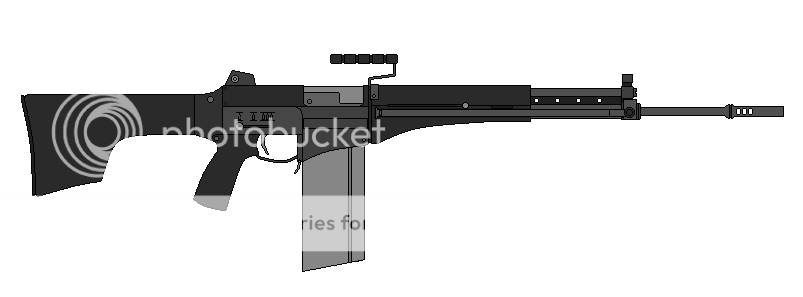
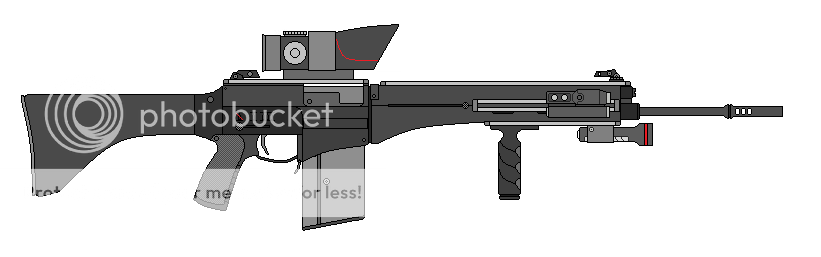
Standard configuration AR3R1 rifle
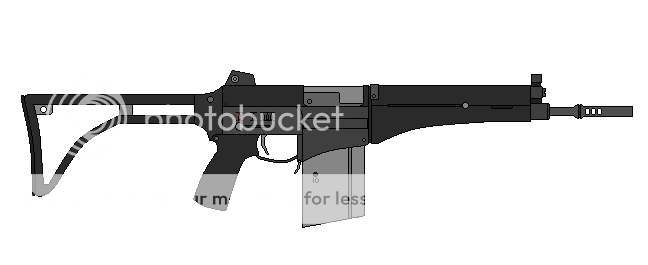
'Carabinyr' pattern AR3R1

The AR3R1 with wooden furniture, as designed for the Weida De Diguo he Chao of Xin Ming

The Xin Ming pattern AR3R1 equipped with a Modelyr 40 telescopic sight

The AR3R1 'Carabinyr' /mod KRL, a modernised but non-polymerised AR3R1 Carbine built for the Republic of Keraliland

The AR3R1 'Carabinyr' /mod KRL with combat attachments
Designer: Arsenal Deimos
Designed: 1965
Manufacturer : Arsenal Deimos, IFAM
Unit cost: 1200 NSD
Produced: 1966-1994
Number built: ~24 million
Common Variants: AR3R1, AR3R1 Carbine.
(statistics are for AR3R1 rifle.)
Weight: 4.2 kg
Length: 1100mm
Barrel length: 545 mm (21.46 in)
Cartridge: 7.7x54mm Arsenal Standard Anemonian
Action: Roller-delayed blowback
Rate of Fire: 600 rpm
Muzzle velocity: 875 m/s (2,871 ft/s)
Effective range: 600 m (1,969 ft)
Feed system: 20 round detachable box magazine.
Sights: Rear receiver aperture sight (with flip-convertible small and large diameter sights) and front hooded post.
Background and History
Between the Anemonian Civil War of 1951 and the accession of Ilfir Erenthi III to the throne in 1964, the newly formed Second Holy Empire of Anemos Major fell into devastating economic decline as a result of the loss of major overseas markets with the dissolution of the Empire. With the introduction of low corporation taxes following the coronation and a focus of state-funded industrial recovery, recovery quickly began that year and in 1965, the Armed Forces, still utilising the venerable Model 1917 self-loading rifle, put forward a design competition for a modern battle rifle that would exhibit greater controllability than the Model 1917. Three corporations (IFAM, Arsenal Deimos and Arsenal Karonin) put forward entries into the competition, but the Arsenal Deimos model, with its highly accurate build and reliability, was chosen over the other two direct impingement weapons. Put into production the following year, the AR3 (and the AR3R1 after 1972) was only replaced by the FA-MAS/AR4 in 1994, much loved by frontline troops due to its hardiness and sheer power; battle-proven during the long and arduous Inquisitorian Crisis in the territory of the old Empire of Ragnos, the AR3 was nicknamed the 'Beast of Ragnos' by its enemies there as a result of its terrifying accuracy and power in the hands of a trained and experienced infantryman. Produced as a carbine as well as some other less well known variants, it proved to be a highly prized weapon in the Anemonian arsenal and is still utilised by select National Service formations today.
Design
The AR3R1 rifle, designed to replace the old Model 1917 rifle, was designed to provide the Anemonian Armed Forces with a rifle and round that was more controllable in semi and automatic fire than the high powered 7.7x56mmR round that dated back to the Model 1908 BASR. As such, the Deimos entry was designed around its new cartridge, firing a 7.7x54mm round that was to be less powerful and thus easier to control than its predecessor (the initial design was taken from late 1940s attempts to develop a similar round). However, further development of the round showed that, in fact, despite the significant decrease in recoil seen in prototype AR3 designs compared to the Model 1917, the 7.7x56mm round exhibited power only slightly lower than that of the Model 1917. Hence, the round was quickly adopted by Arsenal Deimos as their manner of negating recoil, as opposed to the rifle-design based attempts of the company's two competitors. It was thought that the cost of procuring the round was a necessary evil; though the Holy Office of War initially attempted to block the Deimos design as a result of its new cartridge, the weapon's high accuracy and power put together with its controllability when compared to the recoil found in the other two designs led to the acceptance of the Deimos entry, alongside its new cartridge.
The weapon features a roller-delayed blowback system developed by Arsenal Deimos in 1948, and can be fired in semi-automatic or automatic (though the latter is, as a result of the size of the cartridge, hard to control). Designed to be utilised as an infantry service weapon with its ironsights, and as a result, the weapon features a two-mode rear aperture sight protected by 'ears'; with a large diameter rear sight for general firing, this could be pushed forward to bring up a small diameter sight for more accurate firing (and vice versa). The sights are windage adjustable.
In terms of materials, the AR3R1 was the first Anemonian weapon to feature a plastic stock and handguards. The receiver is made of stamped metal. Ergonomically, the weapon is easy to handle, with a high stock allowing for greater control of recoil and a charging handle located in front of the magazine well on the handguard to allow for utilisation whilst maintaining an effective firing position. The magazine features a 5 and 10 round indicator (on Anemonian models) in order to encourage higher degrees of ammunition control and awareness in the field for those who desire it. The AR3 was (in Anemonian service) produced with a fixed bipod in order to further increase controllability.

Standard configuration AR3R3 rifle
The AR3R3 was designed at the request of the Greater Evil Imperial Japanese Dystopia. Rather than drawing directly from the Type 89/AR3R2 design, Arsenal Deimos took the decision to return to the design basics of the original AR3R1. Rather than utilising lightweight polymers, which were viewed as too weak for extended field use, 30% glass composition fibreglass was utilised, with minute texturing achieving the same effects of components such as the polymer grip of the AR3R2. Retaining the polymer magazine introduced in the AR3R2, other changes made with the AR3R3 include the addition of more ergonomically designed selector switches and charging handles, optimised for rapid use and grip in battlefield conditions, and the Deimos Interface System was replaced by a Picatinny standard rail interface system for greater commonality with foreign weapon parts. In light of the AR3 family's role as a weapons system optimised for combat at range, the folding BUIS implemented in the AR3R2 has also been replaced with a rail compatible variant of the long range combat optimised AR5R1 ironsights to give users of the AR3R2 a greater degree of accuracy in the battlefield, even without combat optics. Altogether, the AR3R3 returns to the design basics of the original AR3R1 system, while satisfactorily updating it for use in a 21st century armed force through the utilisation of more efficient materials in its construction, the introduction of a more ergonomic design through changes to various components, and the addition of a globally compatible accessory attachment system.