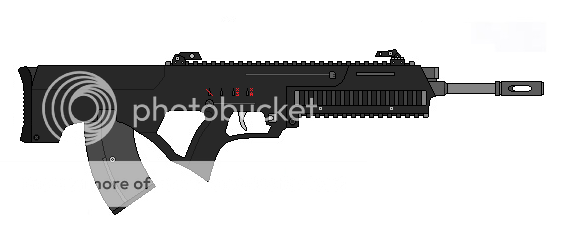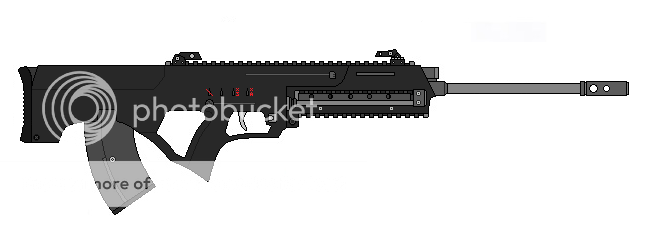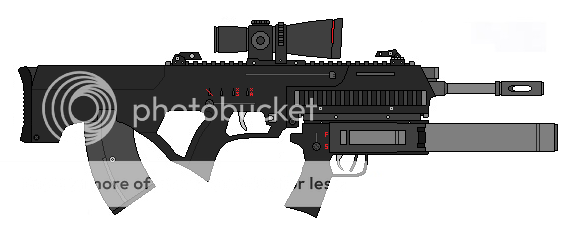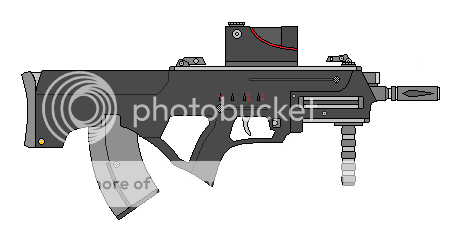
Ultrashort, with Modelyr 08/B forward grip and ICO-S red-dot sight

Carbine, with Modelyr 08/B forward grip, ICO-S red-dot sight, LS/208R1 laser aiming module and Eleclenteryr ML029 tactical flashlight
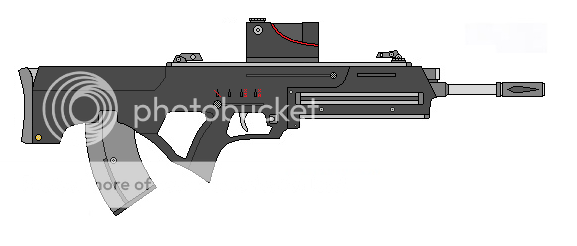
Rifle, with ICO-S red-dot sight
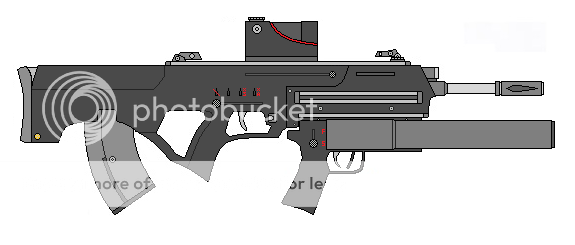
Rifle, with ICO-S red-dot sight and Arsenal Karonin Modelyr 08 40mm Grenade Launcher
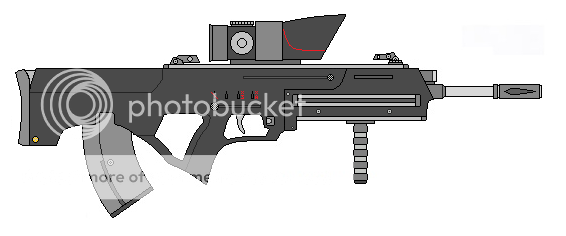
Rifle, with ICO-M 4x optical sight and Modelyr 08/B forward grip

Squad Support Weapon, with ICO-M 4x optical sight and Modelyr 08/B forward grip
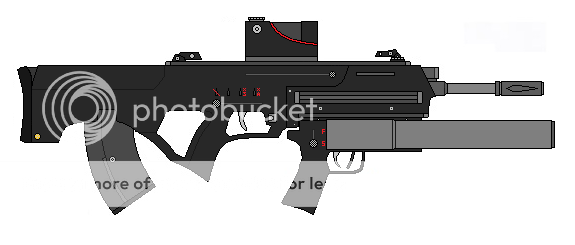
Rifle, with ICO-S red-dot sight and Arsenal Karonin Modelyr 08 40mm Grenade Launcher in Anemonian Military Grey; this is the colour used across the Anemonian Armed Forces in everyday operations.
Designer: Arsenal Lenteryr IECpl (as a subsidiary of IFAM)
Designed: 2009
Manufacturer : IFAM
Unit cost: 1800 NSD (including parts for all configurations)
Produced: 2010-present
Number built: ~14 million
Variants: Ultrashort, Carbine, Rifle, Squad Support Weapon.
(statistics are for Rifle variant)
Weight: 3.3 kg unloaded, 3.5 kg loaded
Length: 806mm
Barrel length: 566 mm (22.28 in)
Cartridge: 6.7x47mm Arsenal Standard Anemonian
Action: Gas-operated (short-stroke gas piston), rotating bolt
Rate of fire: 820 rpm
Muzzle velocity: 850 m/s (2,789 ft/s)
Effective range: 500 m (1,640 ft)
Feed system: 30-round detachable box magazine
Sights: Dual-mode accessory diopter sight and front post, flip up, Deimos interface system for optics.
Background and History
In 2009, the AR8R5 Modular Weapons System came into service with the Armed Forces of Anemos Major. A service rifle unlike those which had come before it, the AR8 brought so great a host of advantages to the table that it was undoubtedly a highly effective replacement for the AR5R1 rifle that had preceded it. A short stroke gas piston system like its predecessor made it a highly reliable weapon. An intermediate cartridge let it punch well above its weight. Its new polymer construction greatly decreased the weight of the Anemonian infantryman's primary weapon. It's modularity turned it from a simple service rifle into a highly flexible family of interchangeable armaments, following an exclusively Anemonian line of both efficient and effective design.
Before the introduction of the AR5 in the year 2000, however, the Anemonian Armed Forces had utilised the FAMAS G2 rifle under the name AR4 with success so great it was still retained in some specialist formations years after its introduction. The adoption of a new standard cartridge meant that this could no longer be the case; as a result, various suggestions from across the Armed Forces, including the Mechanised Infantry, Marine Paratroopers and Fleet Security, all formations who had utilised the FAMAS beyond the introduction of the AR5 rifle, strongly petitioned for the introduction of a bullpup rifle chambered in the new 6.7mm ASA cartridge. Initial plans called for a rechambering of the FAMAS G2 in 6.7mm; however, it was soon realised that this would require the reconstruction of much of the weapon, and thus, the Anemonian Holy Office of War issued a recommendation for the adoption of a wholly new bullpup rifle and a Request for Information to Anemos Major's various weapon manufacturers.
The first to respond was IFAM, the manufacturer of the AR8R5 rifle. Their proposed design was, at face value, a simple recreation of the AR8 design in the form of a bullpup rifle; retaining the modularity of the AR8, as well as its basic operating mechanism, the intention of the design was to retain the many advantages of the AR8 in the smaller frame desired by the Armed Forces. However, it went far beyond this; utilising a forward ejection mechanism and unique ergonomics to maximise its close combat effectiveness, the AR9 was designed to fully and effectively respond to the needs of the Armed Forces' frontline units. What the Holy Office of War had asked for was a simple modification; what emerged was a first class weapons system in its own right. The design was approved in early 2009 and the design was quickly produced and finalised. Coming into production in 2010, and quickly seeing service in flashpoints like Asakura, the units who received the initial batches of the AR9 reported high rates of success; the compact frame of the weapon permitted usage in close quarters environments with little trouble, while its high levels of reliability, power, accuracy and flexibility made it a highly popular weapon on the battlefield. The AR9 in its original form was adopted by units across the entirety of the Armed Forces; from the Anemonian Crown Army Mechanised, who required a compact weapon in the cramped environment of a troop carrying vehicle to Fleet Security, who desired an effective close quarters weapon, the AR9 catered to the specialist requirements of units across the armed forces, quickly becoming the second service rifle of the Anemonian Armed Forces.
Design
Derived from the AR8R5 Modular Weapons System, the IFAM AR9 is an operationally flexible, reliable, powerful and accurate bullpup family of combat weapons designed to provide personnel operating in close quarters combat environments the advantages offered by both the AR8's basic design and the compact nature of a bullpup design. It is, in many ways, a game changer for the Anemonian Arms Industry, a modular weapons system bringing a host of improvements and innovative features to a world class armed force requiring nothing but the best.
The AR9 is composed of a plexiglass outer frame; this glass-reinforced polymer has a 3:7 ratio of glass fibres to polymer, greatly increasing the resistance of the weapon to the wear and tear of battlefield environments when compared to standard all polymer constructions, ranging from standard attrition to hard impact. Metal alloys are utilised in the construction of the inner frame of the weapon; absorbing much of the recoil generated by the weapon, this metal reinforced construction significantly decreases the stress placed on the polymer construction of the AR9, thus increasing its service life through an effective distribution of internal pressure. Heat dissipation is achieved through a series of vents on the upper half of the handguard, as well as heat retention and dissipation through forward ejection port. The barrel is constructed out of cold hammer-forged steel, and is internally chromed. The frame construct and barrel are all quick-detachable by means of several easily accessible screws around the weapon; the forward handguard must be removed before the barrel attachment construct can be accessed, but nonetheless, the simplicity of the AR9's deconstruction process allows it to be taken apart and its modularity to be fully utilised by field soldiers with minimal effort; the separation of the forward barrel and handguard mechanism and the weapon's internals means that transfer of forward parts requires little interaction with the complex internals of the AR9.
The action utilised within the AR9 is a short stroke gas piston with a rotating bolt. This short stroke piston is composed of a piston assembly located in a tube above the rifle's barrel, and a connecting assembly which attempts to minimise the stress placed on the action itself by controlling the energy transfer between the recoiling parts and the bolt assembly. By removing the exposure of the weapon's internals to the gases and heat, unlike a direct impingement system, the short-stroke gas piston greatly increases the reliability and service life of the AR9 system, while the lower mass of recoiling parts means that there is less disruption to the AR9's point of aim during sustained automatic fire; in this way, the short stroke system also manages to make the AR9 a highly stable firing platform. A forward ejection system removes cartridges efficiently; the 'push' mechanism employed prevents spent casings from hurtling out at high speed and removes them in a manner that increases the close combat effectiveness of the AR9, disposing them in front of the AR9's user, preventing spent cartridges from hitting allies in close combat, and does so with minimal force, preventing the cartridges from becoming a nuisance or, worse still, a threat.
The feed device generally used within the AR9 is the 30 round, polymer 6.7mm ASA rifle magazine. The polymer construction greatly increases the durability of the magazine, making it resistant to warping and other changes of shape under stress and all the resultant feed problems associated with such damage; it also covers the internal construction of the magazine fully, thus protecting fragile components like the feed lips from external stress. The internal construction of the magazine features a constant curve, removing bottlenecks where rounds could potentially jam and creating a relatively smoothly feeding magazine. The follower is constructed out of the same fibreglass utilised in the construction of the AR9 itself; shock resistant, and thus greatly resistant to any problems that could potentially lead it to feed incorrectly, the polymer within the fibreglass construction of the follower means that it is also self-lubricating, creating a highly reliable base for the magazine feed. The magazine also features indicator ports on the back, covered with transparent polymers to prevnt the elements from entering the delicate internals of the magazine, that nonetheless allow the operator to quickly determine the ammunition level of the wepaon. 100 round drum magazines are occasionally used by formations who choose to supplement or complement their base of fire with the AR9 Squad Support Weapon.
In terms of sighting, the AR9 is generally employed with the Crown Army's standardised 'ICO (Infantry Combat Optics)' family of sighting equipment in combat. However, the AR9 also features an innovative BUIS system to ensure that each user of the AR9 is provided with a second option if needed. A flip up system, the AR9's BUIS is designed to remain inobstrusive until needed. Fully windage adjustable, the sights feature a circular diopter with a three-prong forward sighting system for simple and accurate target acquisition. Furthermore, the rear sights are dual mode; with flip-changeable diopters with different sighting circle diameters, the AR9's BUIS allows the shooter to choose between different levels of eye relief suited to different operational necessities. With photo-luminescent inserts to either side of the rear diopter's sighting circles and on the central prong of the forward sights, the AR9's BUIS are designed to be unobstrusive when unused, and highly effective when in use.
The interface system used on the AR9's standard configuration is a proprietary, 'in-house' design produced by Arsenal Deimos to remedy some of the inherent problems of a rail interface system. The DIS (Deimos Interface System) revolves around bolts on the accessory attachment fitting into grooves on either side of the 'slides' of the attachment system. Removing the forward part of the DIS unit, two flaps on the accessory attachment system are pushed down to retract the bolts to allow it to be pushed down the slide. When a desired position has been reached, the flaps can be let go of to fit the bolts into the nearest set of grooves to fix it in place. This system's advantage lies in the fact that, while retaining all those of the RIS system, it is both simpler and requires none to very little zeroing in of parts, as the slide, and therefore the grooves, the bolts and the accessory itself, is already aligned with the weapon and its barrel, meaning that any configurations would most likely be for adjustment between weapons and weapons configurations.
In terms of ergonomics, the AR9 is designed for maximum effectiveness at a number of ranges. The polymer construction of the weapon provides 'grip' alongside the uniquely shaped trigger guard of the weapon, greatly decreasing the AR9's tendency to slip during high intensity combat, remedying a significant operational failure of many other weapons on the market. Hand-filling, the integrated pistol grip of the AR9 features texturing to further increase the grip provided by the rough-surfaced external polymer construction of the AR9; keeping the design simple, the pistol grip nonetheless affords a great degree of usability to the weapon. The large thumb hole is large enough to prevent it from becoming constrictive to the operator of the weapon, but nonetheless highly effective in allowing it to be kept under control and in the hand in battlefield environments where a moment of haphazard movement could potentially result in the rifle falling from the hand. Furthermore, the slide selector, also textured to increase grip, is designed to be fully accessible with the thumb of the firing hand, while the magazine eject is accessble with the firing hand's index finger. The charging handle is located just in front of the trigger assembly, where both hands, firing or non firing, can easily operate it; in this way, the user is able to control the vast majority of the rifle's basic necessary functions without trouble and without fully breaking his or her firing stance. Finally, the stock is another highly effective, greatly understated but vital component of the weapon's ergonomics; the rubber buttplate, textured to provide both comfort to the shooter's shoulder and grip, is highly adjustable, catering to the personal preferences and necessities of a wide variety of shooting styles and structures, and the sloping cheek weld maximises user comfort to permit comfortable shooting.
The AR9 is currently utilised by Anemonian formations such as the Crown Army's Mechanised Forces, the 1st Marine Parachutists and Imperial Fleet Security in order to provide the firepower, flexibility and reliability of the AR8R5 in a smaller package. The weapon can be modified into four distinct configurations as deemed necessary, and supports any weapon accessory with a suitable adaptor for usage on a DIS.

The Australien Pattern Rifle AR9/mod Aus, order-made with an extended free-floating barrel (slightly shorter than that of the AR9 DMR) and an extended handguard.
IFAM AR9/mod Aus - The Australien Pattern AR9
Following an application for a modified AR9 model by the Union of the People's States of Australien to serve as their frontline service rifle in early 2011, IFAM participated in a design process that would lead them to remove one of the main design features of the AR9 to turn it into a dedicated bullpup rifle.
The design brief required a dedicated service rifle with an elongated handguard, making it a significantly longer weapon than the AR9's Rifle configuration in Anemonian service. A relatively simple modification, the AR9/mod Aus adds a longer barrel and handguard as per the requests of the Australien government, based on the dimensions of the AR9 Squad Support Weapon. However, it also removes the modularity of the AR9, making it significantly more difficult to deconstruct the AR9;this is due to the fact that the barrel was made free floating to increase the overall precision of the rifle due to a judgement within IFAM that the request for a specific model of rifle suggested that the Australien military would not be utilising the modularity of the AR9 system, while the necessity for a longer barrel suggested a greater degree of accuracy desired by said military amongst its general infantrymen. As a result, this additional design feature was added, sacrificing one design feature to improve another; so far, the mod Aus has not seen service outside its parent nation.

Air Force Pattern AR9/mod ME Rifle, with ICO-M 4x optical sight and Arsenal Karonin Modelyr 08/mod A 40mm Grenade Launcher; order made to specifications requested by Air Force Security, the AR9 Air Force Pattern Rifle features an orthodox pistol grip without a thumb hole and a pistol-grip less grenade launcher to better suit their combat style.
IFAM AR9/mod ME - The Air Force Pattern AR9
The mod ME is a fully ergonomic modification of the original AR9, designed solely to cater to the specialist requirements of the Imperial Air Force of Anemos Major's Air Force Security personnel. It was requested, designed, produced and delivered within three months of the AR9's initial introduction, and constituted one of the few modifications made to the AR9 for use within the Anemonian military complex following its initial release.
As Air Force Security personnel were not required to operate within high intensity combat areas in most cases, but relied on high speed insertion/extraction and aerial mobility to successfully complete their operations, the thumb hole's increased grip was not only unnecessary, but constituted a design flaw to AFS personnel, who more often than not found that, within the bustle of operational deployment, wires for equipment ranging from fast ropes to medical stretchers got caught in the thumb hole, compromising their combat effectiveness in a minor but frequent and highly irritating manner. As a result, IFAM was called to remove all thumb holes on their future production models of the AR9 for the Air Force; they dutifully obliged.
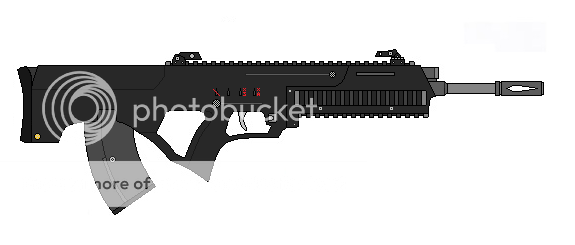
The AR9/mod Ex.
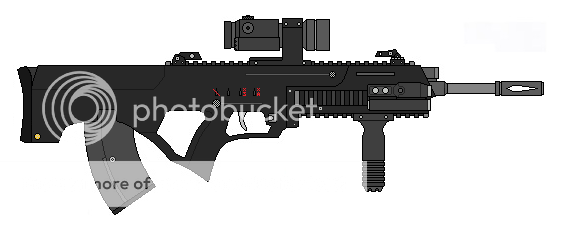
The AR9/mod Ex with forward grip, laser aiming module and red dot sight.
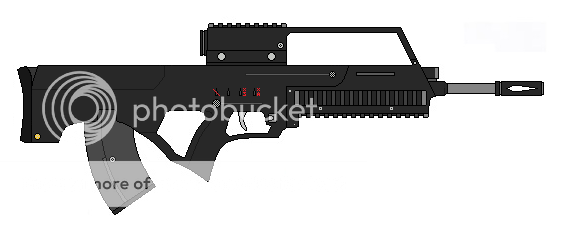
The AR9/mod Ex2.
IFAM AR9/mod Ex/Ex2 - The Export Pattern AR9
When the AR9 was turned over to an export audience, one of the first potential flaws found by IFAM was the utilisation of a proprietary interface system. Though designed to be superior to Picatinny and Weaver style rail interface systems, the DIS's usage was limited to the Anemonian military complex; more cash strapped armed forces would naturally shy away from a weapons system whose interface system required the purchase of adaptors or new weapons attachments, especially expensive optics, when there were more cost efficient weapons on the market. As such, one of the first decisions made by IFAM following the introduction of the AR9 to the export stage was to introduce a variant which utilised a standard Rail Interface System.
The IFAM AR9/mod Ex is just that; an AR9 with a Picatinny rail system where the DIS on the original AR9 had been located. The Ex2 incorporates a carrying handle and integrated 3x magnification combat optics as per the request of a third party potential buyer.

The AR/C-9 Suretyr.
AR/C-9 Suretyr - The Police Pattern AR9
Another potential buyer of the AR9 was the Metropolitan Police of Anemos Major. Following the Law Enforcement Armament Act of 2002 following terrorist attacks by foreign entities across Anemos Major, the Metropolitan Police was authorised for the first time to carry small arms considered to be within the 'heavy' category of weapons. During a period where potential terrorism was a clear and present threat, the possession of automatic rifles by the Suretyr Metropolitanise was greatly reassuring to the citizens of Anemos Major, and they did their job effectively enough, defusing many potential crimes and deterring a great deal more. However, by 2010, the situation had changed. Armed with an increasingly expensive motley arsenal of rifles ranging from the venerable AR3R1 to a variety of imported rifles like the AN-94, the rifle arsenal of the Metropolitan Police was, through a lack of standardisation, proving to be increasingly expensive and, in an age of political and social stability, unnecessary. As society advanced around the Anemonian law enforcement community, with buildings towering over cities and infrastructure improving by the day, average incomes reaching unprecedented levels, the heavy rifles carried by many police officers became out of place; it was clear that their time was over. However, the Metropolitan Police also recognised the role these rifles, expensive as they were to maintain, played as effective deterrents to crime across the urban sprawls of Anemos Major; as a result, the decision was made not to remove them, but replace them. The result was the AR/C-9.
The primary design feature of this carbine-length weapon was the removal of its burst and automatic firing capabilities. The potential collateral damage of automatic fire had always been a preoccupation and concern at higher levels within the police establishment after the passing and implementation of the LEAA 2002, and it was quickly decided that the relative power of the 6.7mm cartridge justified its restriction to semi-automatic fire. This afforded the Metropolitan the amount of firepower necessary to restrict their armaments' capabilities to the required level, leaving the realm of automatic rifles and armed response to the paramilitary Internal Army. This, together with the curvaceous casing of the weapon and its calm white colouring created a weapon that radiated law rather than force; presenting an image to the populace of a Metropolitan Police ready to enter a new age of prosperity and peace, the AR/C-9 allowed them to retain the force they required while removing the potential for high collateral damage, the public perception of the Metropolitan Police as a backwards, outdated organisation and the high costs of non-standardised weapons.