NATION

PASSWORD

The Second Tarao War [IC | GD]

A staging-point for declarations of war and other major diplomatic events. [In character]

Advertisement

Remove ads

User avatar
Solisian Union
Diplomat
 
Posts: 899
Founded: Apr 22, 2018
Democratic Socialists

Yellow Star Rising

Postby Solisian Union » Sat May 30, 2026 9:20 pm

Starlight Chambers—Private Annex, La Victoria Palace
Early Morning, 2 August 2048 (Year of the Yellow Star)


Queen Wessa I stood again at the head of the table. Her hand was resting on top of the updated royal emblem now featuring the radiant Yellow Star flanked by the Sun and Crescent Moon. Once more, the room was filled with her most senior military and civilian advisors.

Her eyes were on her prime minister. Elena had just finished her briefing. “The Tupengan government has agreed to receive our diplomatic team. However, intelligence confirms growing impatience among their leadership and population. They want real security guarantees, not just promises. The Mar’si withdrawal has left a vacuum, and hardliners within the NNRA are applying increasing pressure on us. We must take action very soon.”

Field Marshal Carmona nodded. “We cannot afford to let Ordena or lingering Istoloan influence fill that vacuum. Fustera is rapidly becoming a major Kriegsmarine and air hub. It's already significant. If we wait, the threat moves closer to our northern waters and territories.”

Wessa’s gaze was steady. “Then we will not wait. We move today.”

She turned to the assembled officers of the Solisian military. The Army, the Navy, the Air Force. So many were here. “Dispatch a significant naval and air contingent immediately. Task Force Starlit Wave and the Starfall Expeditionary Wing will escort our diplomatic team to Tupenga. Their presence will ensure the safety of our representatives and make it unmistakably clear to the Mar’si and to everyone watching that Solisia is both willing and fully capable of stepping in to protect our new partners.”

Carmona straightened. “The 11th Armored Division ‘Stormbringers,’ 14th Mechanized Division ‘Iron Tempest,’ and supporting elements from the 17th Light Infantry will begin accelerated preparations for Operation Gold Bayonet. We will also dispatch survey teams to identify optimal locations for permanent naval and air bases in Tupenga as soon as the treaty allows.”

Wessa gave a sharp nod. “Do not waste time. You will do this. I have confidence in that. We will not fail to secure Tupenga as a true ally.”

She paused, then continued. “At the same time, begin immediate upgrades to our northern coastal defenses and the militarization of the northern provinces. Announce plans for large-scale international military exercises with our allies on Solisian soil. We must show strength and readiness. Nobody in this region should think we will be distracted by the shitshow in the south. ”

Elena spoke up. “The High President of Nannasia has already expressed renewed interest and concern for Solisian security. They are prepared to provide substantial financial aid and a convoy of twelve ships loaded with vital military equipment and advanced weapons systems. In exchange, we will deepen trade agreements and strategic cooperation.”

Wessa’s expression softened slightly. “Accept their offer immediately. Nannasia’s support will be invaluable. Coordinate the arrival of their convoy and integrate the equipment into our accelerated preparations.”

The room hummed with focused energy as orders were issued and timetables adjusted.

Later that same day, a powerful Solisian naval task force and air wing began assembling itself in northern Solisia. The diplomatic team was going to be made up of senior NNRA diplomats and military liaisons. This team was already on their way to prepare themselves for the journey to Tupenga on board the ships of the joint task force. They will be protected by a formidable escort that left no doubt about Solisia’s commitment.

In Tupenga’s capital, the arrival of the Solisian delegation, backed by visible naval and air power, sent a clear message: Solisia was not making empty promises.

Meanwhile, in the northern provinces of the Union, construction crews and military engineers began moving in to start making rapid upgrades to coastal defenses and key infrastructure. The government was busying itself with the creation of plans for joint international military exercises that were to be publicly announced soon after approval by the higher leadership of the Solisian armed forces. This was going to be a firm signal to all Solisian allies and to all potential adversaries of Solisia that it was preparing for whatever the future might bring.




2 Fleet Carriers
Wessa’s Resolve (Flagship)
Yellow Star Eternal

4 Guided-Missile Cruisers
16 Destroyers (heavy anti-air and multi-role screen)
8 Attack Submarines (forward screening and intelligence)
4 Amphibious Assault Ships + full landing craft squadrons
Support Flotilla: 6 replenishment ships, 4 fast logistics vessels, mine countermeasures squadron

Total Naval Personnel committed: ~180,000–220,000 (including Marines and support)
Air Component – Starfall Expeditionary Air Wing (Expanded)

180 SAF-7 Yellow Nova (6th-gen stealth multirole fighters)
72 AH-6 Shadowfang attack helicopters
60 SAF-4 Starling multirole fighters
18 SAF-9 Stellar Hammer strategic bombers (rotational alert)
Heavy-lift transport squadrons + large reconnaissance/EW drone wings

Total Air Personnel committed: ~45,000–55,000
Total time until arrival in Tupenga waters/airspace: 13–15 days from today.
Last edited by Solisian Union on Sat May 30, 2026 9:31 pm, edited 2 times in total.
^_^

User avatar
Istoloa
Secretary
 
Posts: 26
Founded: Jul 10, 2024
Iron Fist Consumerists

Postby Istoloa » Fri Jul 17, 2026 4:54 pm

GANCHAS; MARAGUSA, ISTOLOA

The new Laderan-backed marechalisimo of Istoloa hadn't been given much of a chance to exercise power. His thick moustache, which ended in fine curled points, twitched as he looked in the direction of the enemy forces approaching down the main highway. Steady gunfire came from the distance, sounding closer and closer which each passing moment. De Vega's forces, backed by the Ordenites, were arriving imminently. The time had come to flee.

Small units were attempting to block the highway and nearby roads as best they could, but the enemy's forces were much larger and better equipped. Those brave soldiers were sacrifices in exchange for time. Time to escape Maragusa with as many of his picked men as possible.

Ganchas harrumphed. His chief of staff raised an eyebrow. "Not having regrets, are you?"

"No, no," the whipped marechalisimo waved away. "Half of a half-brained idea this all was. What did they think I could do with a few hundred men?"

Boarding a small boat, the two officers joined a larger group of military men belonging to Ganchas' leadership ranks. There were other similarly small boats around them, packed with more men. These forces had a date with a larger cargo vessel officially registered to the Golden Throne. It had hugged the Asadabad side of the shoreline to pass through the straits that had otherwise been heavily mined under Fremonero's orders. The boat's small motor started growling and they put distance between themselves and the shore. Behind the dock buildings, smoke was rising into the air.

De Vega's grand entry into Maragusa went undefended once the highway had been opened. The survivors still in the town surrendered. Not all of them survived capture.


A few days later, the cargo ship belonging to the Golden Throne made its way southward. Passing the Laderan and Sorofian coastlines, it made a call in Teniza.

Irat's capital looked as if transplanted from the 15th century, its skyline dominated as it was by the rigid and beautiful cathedral that gave the city its little fame. On the opposite side of a ravine splitting the northern side of the rocky, fortified outcrop called "Old City," rose the Pilsvot. The Pilsvot was an ancient castle that dominated its surroundings in its prime. Updated over the centuries, the Pilsvot represented a visual museum of Irati military engineering. The oldest part, the stone rectangular keep, had been added later, in the early fifteenth century, and given several new stories and a triangular roof of blue and white ceramic tiles. The original inner walls had always been preserved, though large sections had also been meticulously restored in the 2000s. But the most impressive walls were the two outer rings, built in the sixteenth and eighteenth centuries, respectively. These were built for cannon fire, with the most recent bastions showcasing the star-shaped form common in defensive architecture during that period. The entire Old City retained the buildings of its past, down even to the tenements and schools. Only the parks were modern.

The capital's primary commercial port sat south of this acropolis, in the "New City." Here, several highways cut through residential, commercial, and industrial neighborhoods alike, along with train tracks leading to two major hubs and a surprisingly well-designed and clean subway system. Suffice it to say, most people lived in the New City, but your average tourist might not even be aware that this part of Irat exists.

As it was, Ganchas had to make his way through the New City, from the port to the Pilsvot. He stepped onto the docks at the head of 187 men, the only ones who could get out of Maragusa alive with him. They were expected.

Ganchas had been flown into the city several times throughout the previous days by a small helicopter that could operate from the cargo ship. There, he was met by representatives of the Laderan government. A tough negotiation ensued between Ganchas, the Laderans, and Rui Barretto. Barretto, unofficially general of the Istoloan Army in Irat, commanded 115,000 Istoloan conscripts officially composing the "Irati Defense Forces." These forces had been somewhat rudderless since the start of the coup in Istoloa, and there was much reticence at the idea of simply accepting de Vega's legitimacy, backed by the Ordenites as it was. The Ordenite blade could cut both ways, not only giving de Vega the muscle he needed to dominate Istoloa herself, but also making it clear to any proud Istoloan that as far as their new so-called leader was concerned, the country's sovereignty was up for sale.

It was not easy, but ultimately Barretto agreed to back Ganchas' title, proclaiming to be backing the "True Marechalisimo in Exile." In exchange, the Laderans informally and unofficially agreed to end any contestation of Rogeiro Monteiric's puppet regime in Irat.

Of course, in return, Ganchas was now expected to end support of anti-Laderan forces in Sorofi. They were bitterly holding on to the defensive line that had formed just south of Barbaro, that country's capital city.


DE VEGA; MARAGUSA, ISTOLOA

"Sir," the soldier meekly said, as el Marechalisimo inspected the sorry, decrepit compound that Ganchas had called a headquarters. "The general has fled. He was last reported heading into deeper waters."

De Vega said nothing, not even giving the soldier a look. He only wiggled his sidearm out of its holster, brought it up toward the unfortunate messenger, and pulled the trigger. Flames licked from out of the barrel of the polymer pistol. The soldier, whose only crime was to report on whether Ganchas' body had been found, limply crumpled to the ground. El Marechalisimo continued his inspection, otherwise unperturbed.

"W-w-what should we do with the prisoners, sir?" asked another soldier, who had come with the one who now lay dead. He waited for de Vega to turn his weapon on him.

But, instead, the now undisputed head of Istoloa said, "Execute them all as traitors. Go, give my order."

The soldier scurried away in obedience, happy to get out of there with his head still on his shoulders. By nightfall, 236 captured men were all dead. Shot. They had been officers of the Istoloan army once, sent to fight a dirty war in Ladero, and executed as traitors for backing Ganchas. A handful of Ganchas' other men managed to escape by land. Many would be found in the coming days and weeks; some would eventually make their way to rejoin their commander in Irat. For now, de Vega knew nothing about that anyway. Ganchas' landfall in Teniza was still a few days away, and news would not arrive in Loçalea until the day after that. Then de Vega would rage. For now, his anger was a product of that wily general's escape. He'd have Istoloa's political class, an already small and stolid class, purged, paranoid that the civilian administration had been prepared to defect to the former, and famous, CSA commander.

Neither did de Vega know that the communists had planned another assassination attempt on Ganchas. He had survived a knife attack. This time, they sent several bombs.

A convoy of trucks, heavily and improvisationally armored, punched through a largely unmanned series of checkpoints along the same highway de Vega's forces had briefly fought to open. Their garrisons were inside, or lounging about, with the thought of an enemy attack — what enemy was there who could attack? — far from their minds. Besides, Istoloan soldiers were not known for their commitment to military discipline.

Suffice it to say, de Vega received the news of the convoy very late. In fact, he could already see it headed toward him by then.

Ominously, they thundered toward him. They carried great speed, even as the trucks pumped the brakes, not a football field's distance from el marechalisimo. He could do nothing as they barreled right at him.

And then they flew by, coming to a stop behind him. He turned, perplexed. Pointing to the convoy, he said to a nearby soldier, "Go, go, see what that is about."


A dozen kilometers away, just outside the town, a young female adult wearing brown and green fatigues sat on a tree's tallest branch, hardened tablet in hand.

No matter how many times she pushed the button, nothing happened. There was no explosion.

She fiercely grunted in protest as she continued to push in frustration with her thumb. "C'mon," she said, "come the fuck on."


"No drivers," shouted one of the junior officers who had trotted over to organize the search party gathering around the now-stopped cargo trucks. "Remotely controlled, it seems."

"Impossible," murmured de Vega. "The Mar'si, it must have been." Who else could have provided the technology to whoever organized this attack? The marechalisimo had thought it was targeted at himself, unaware that the intended target was actually Ganchas. He was also blissfully unaware that the connection between the remote driver and the explosive-rigged convoy had been unintentionally and unexpectedly severed by some sort of technical malfunction in the software. It went without saying that he couldn't even fathom these capabilities as being homegrown.

But homegrown it was. The communists had many young minds in their ranks with great ideas. This one had just suffered a minor glitch. That's all. The next one would work out.

One of the men confirmed, frantically shouting, "Explosives! Explosives everywhere!"

The search party scattered. De Vega groaned. Turning away from the scene, he dutifully continued his inspection of Ganchas' facilities. A makeshift bombsquad would soon carefully carry the bomb-laden trucks onto flatbeds with cranes, driven out to the outskirts, and remotely detonate them. A huge ball of fire rose into the sky, a scene captured by countless phones, many ending up on Accelafeed, where people would debate its causes and intentions for weeks.
Last edited by Istoloa on Sat Jul 18, 2026 2:21 pm, edited 1 time in total.

User avatar
Holy Marsh
Negotiator
 
Posts: 6002
Founded: Nov 09, 2007
Mother Knows Best State

Postby Holy Marsh » Mon Aug 24, 2026 3:58 am

Efforts to support Ganchas went down like a bitter pill among Mar’si intelligence. Many M-SAD officers and analysts had very recently spent not an inconsiderable amount of time and effort trying to put him into the ground. Thousands had died in Ladero due to his faux rebellion and he bore responsibility for that bloodshed. His sins remained weighty indeed. He had served the imperial designs of lesser masters in Istoloa, lending his patriotism to ambitions that had nothing to do with the welfare of the people he claimed to defend. Patriotism could be made to serve any nefarious end when it went unbridled by discipline and morality. There would be a reckoning in the future.

Nonetheless, Ordena had continued to become a monument to ambition and cruelty. Istoloa would soon be chained like a dog beneath its influence, barking and snapping whenever its master tugged on the leash. So long as that arrangement endured, the Tarao countries remained exposed to deeper descents into inglorious conflicts. They would be dragged one by one screaming into wars fought to serve international masters. Ganchas had played a role, and now he must play a part in containing it. They did not need to forget his crimes to work with him, and perhaps he would serve a greater good.

The Mar'si therefore would provide significant support to Ganchas. Money and weapons were only the beginning. Intelligence would be passed where appropriate. The relationship would be practical for now. This extended to agreeing with Ladero's call to no longer resist the puppet regime in Irat, as they would prove an invaluable asset. For now, anyway. What was, may come again.
Sorofi demanded a more immediate answer. The Mar'si would make it known to Ladero that they were prepared to provide increasingly heavy air support to the military effort there if the situation required it. The Theocracy continued to regard the entire campaign as a misadventure, made more difficult to justify now that pressure could be brought against Ganchas and Irat to withdraw what had become increasingly obvious support for the conflict. The war had dragged on long enough. Sorofi's political future remained trapped beneath the weight of an unresolved military situation. Whatever was needed, they just wanted it resolved.

Jeweled Eyes would continue, with communications with Istoloan communists ramped up as best they could. There were tremendous issues doing so, but Jeweled Eyes would plow ahead regardless of the obstacles. Anything capable of creating difficulty for the ruling regime would remain on the table.
For the moment, that was enough.

User avatar
Solisian Union
Diplomat
 
Posts: 899
Founded: Apr 22, 2018
Democratic Socialists

The Solisian Sun

Postby Solisian Union » Tue Aug 25, 2026 9:00 pm

The Solisian Sun over Tupenga


The amaranths in the gardens of La Victoria were blooming early, their deep crimson petals mirroring the wax seals on the desks of the Starlight Chambers. From the private annex, the scent of scalded, bitter coffee-tea and Rasur southern pork stew drifted out. Queen Wessa I stood by the tall, rain-streaked window of her study. Her hand rested on the edge of the mahogany table, her fingertips tracing the newly updated royal emblem: the radiant Yellow Star flanked by the Sun and the Crescent Moon.

In the quiet corner of the room, Queen Mother Reina III sat with a soft wool blanket across her lap, softly humming a melancholic Azynian melody to the sleeping twins, Solene Tala and Cassian Altair. One of Wessa's new cats, Ember, sat curled at Reina's feet, purring in time with the rhythmic rocking of the bassinet.

Wessa looked down at her secure tablet. Two worlds stared back at her:

Under the silent gaze of the Northern Theater, the massive hulls of the Yellow Star Eternal and the Dawn’s Radiance had slipped their moorings. They were not going to war—not yet. They were the iron fist inside the velvet glove of Task Force Starlit Wave, sliding across the Shartourn Sea toward Tupenga.

Onboard, the senior NNRA diplomats and a tiny, elite military liaison delegation of one hundred and twenty officers reviewed their notes. They carried Wessa’s personal guarantees: no Solisian combat boots on Tupengan soil, a commitment to local sovereignty that would disarm the suspicious Tupengan communists, and a promise of mutual defense that would quietly, irreversibly slide Solisia into the space the Mar’si had left behind. It was a masterful move to lock the gates of the northwest before Ordena or the Fusterans could even do anything about the Solisians.

But to the south, the world was on fire. There was no room for "Big Sister" diplomacy along the Tharparkar-Kalutara axis. The coded order "Climb Mount Ranyas" had unleashed a storm that could not be recalled.

On the western front, Field Marshal Carmen Olena had stepped into the meatgrinder of the western highway to stabilize the line after Isadora Velez’s tragic death. And thirty kilometers deep behind Sishian lines, in the burning, besieged ruins of Babassar, Major Persai and her fiercely diverse, unbroken Panthera Mar’si soldiers of the 44th Division were digging into the rubble, counting their remaining anti-tank ammunition, and waiting for the armored relief column that was still forty-eight hours away.

The door to the study opened with a soft hiss. Priya Nakamura stepped inside, her eyes immediately finding Wessa's. She didn't say a word, but she didn't have to. She simply walked over and placed a warm hand over Wessa's shoulder, her touch a silent anchor against the terrifying gravity of the throne.

Wessa let out a slow, measured breath, turning her gaze from the peaceful warmth of her family toward the cold steel of the maps.

"Our New Union is making more moves and actively so. I have greater confidence in our military now and I believe we are making the right moves we need to make, but I hope that our future is not going to compromise itself over details. Now, we have to see what our moves, our actions, yield us," Wessa whispered, her voice hardening into the iron that had united the Union. "And may the stars watch over those we send into the dark."


The dawn over the Shartourn Sea bled through a tropical mist, turning the waters off the Tupengan capital into a shimmering expanse of amber and slate. Then came the shadow of the New Solisian Union.

To the watchers on the cliffs of Tupenga, it began as a low, structural hum that vibrated in the soles of their feet. Out of the grey horizon rolled the massive hulls of Task Force Starlit Wave. Leading the armada was the fleet carrier Yellow Star Eternal, its flight deck crowded with the angular silhouettes of SAF-7 Yellow Nova fighter planes. Flanking it was the carrier Dawn’s Radiance, surrounded by a bristling screen of guided-missile cruisers and destroyers.

Overhead, the sky belonged to the Starfall Expeditionary Air Wing. The roar of low-flying transports and the rhythmic thrum of AH-6 Shadowfang attack helicopters shattered the quiet morning, kicking up white spray across the shallow bays.

A calculated, uncompromised demonstration of Solisian majesty and power.

As the heavy ramp of the lead Solisian transport lowered onto the concrete pier, the diplomatic team stepped into the humid heat, wearing the immaculate white-and-gold state tunics adorned with the radiant Yellow Star, flanked by the Sun and Moon. Behind them, however, stood a disciplined contingent of the Special Naval Landing Forces (SNLF), armed with new RSi-21 rifles.

The pier was a microcosm of a country torn by decades of slavery and insurgency. Three distinct factions stood waiting, and the Solisians addressed each with precise, tailored gravity:

The Tupengan Government, for one. The official government leadership stood huddled under umbrellas, clutching leather portfolios. They were tired of foreign overlords, yet terrified of the growing Ordenite Kriegsmarine hub in nearby Fustera.

The Solisian Prime Minister’s representative, Elena Santos Marquez’s deputy, stepped forward and formally presented Wessa’s draft of the Mutual Defense and Strategic Partnership Treaty. They made the Union’s terms loud enough for the gathering crowds to hear:

Solisia would build and defend one major naval base and one major air base on coastal territory, utilizing civilian construction teams from Solisian Renewal Dynamics (SRD) to bring local labor and modern infrastructure.

Crucially, no permanent Solisian ground combat troops would ever be stationed on Tupengan mainland soil. Tupenga would remain sovereign, an ally of equal status, with Solisian forces only surging in if emergency clauses were activated by a threat from Fustera or Ordena.

The sight of the carriers, combined with Wessa’s ironclad guarantees of land sovereignty, struck the government officials like a physical weight. The impatience and doubt that had plagued their ministries for weeks evaporated into a quiet, stunned relief.

Next to deal with were the Tupengan Communists.

Near the edge of the harbor, stood the local communist factions. They were highly suspicious, viewing the Solisians as merely a wealthier, more polite replacement for their old masters.

Instead of sending heavy-handed military police, former Republicans and moderate, left-leaning diplomats from Princess Catia’s political circles approached them. These intermediaries, comfortable with socialist rhetoric from their own civil war, offered dialogue, giving them direct assurances that the Union respected their internal political movement and would not interfere in Tupenga’s governance.

"We are not here to rewrite your laws or silence your voices," a Solisian veteran of the War Between Sun and Moon spoke, showing his old republican scars. "We are here to lock the gates of the Shartourn so that Ordena cannot burn your homes again. Let us hold the shield, so you can build your country up in peace."

The gesture of sending former rebels to speak with rebels disarmed the communists’ propaganda, turning their hostile protests into a wary, observant silence.

By midday, The Solisian Observer published a high-level diplomatic analysis that circulated throughout the embassies of Greater Dienstad, from the Diarcesian Hypurgeum Exoteric to the Haize Directorate of Trade:

"Solisia is playing a great hand with breathtaking speed and diplomatic sophistication. By showcasing Task Force Starlit Wave to the world while guaranteeing Tupenga's internal political freedom, Queen Wessa I has established an ironclad 'Big Sister' shield. Let Fustera and the Ordenite Kriegsmarine take note that the Solisians will no longer ignore or tolerate them so passively. The Northwest is no longer an open sea. The Yellow Star stands in the great sky, and we have drawn our line in the water."


From the elevated concrete parapet of the northern coastal observation redoubt, Field Marshal Ramziyya Artigas looked down upon the synchronized mass of the 1st Army Group "Yellow Star". Below her, tracked armored divisions and heavy mechanized columns rolled in long, dark ribbons through the fortified coastal corridors, their standardized YSAR-47 rifles and dual-mounted autocannons catching the pale morning light. Communications officers worked feverishly, coordinating radar bands and staging grids with the approaching Andrenadian contingents. The first phase of the northern exercises was underway, but the Solisians were moving with deliberate, measured tempo—holding their tactical strike groups at readiness while awaiting the full foreign units to link up on the outer perimeter.

A junior staff officer snapped to attention beside her, holding a stamped courier slate bearing the royal seal. "Field Marshal. High Command has convened in the lower subterranean redoubt. Supreme Military Authority Carmona requires your immediate presence. The strategic council is in session."

Artigas adjusted the collar of her olive service coat and made her way into the fortified bunker depths. The air inside grew warmer, thick with the scent of dried tobacco, damp stone, and electrical hum. Around the expansive holographic planning table sat an imposing gathering of the Union’s military intellect: active field generals, fleet tacticians, and heavily decorated veterans of the Magdaran War and the War Between Sun and Moon. Many bore visible scars and the solemn, unreadable gaze of officers who saw friends drown and burn in the river deltas of Magdara.

At the center of the illuminated table lay the vast expanse of Western Greater Dienstad and the contested Tarao theater. Bright tactical vectors radiated outward from northern Solisia, arcing across the strategic islands, the approaches to Tupenga, and the forward Kriegsmarine bastions of Fustera.

"We are surrounded by tightening rings," a retired general from the Magdaran campaign said, his weathered finger tracing the northern approaches. "The Ordenstaat has turned Fustera into a massive naval springboard. The Istoloan fallout threatens to spill into the Shartourn Sea. If we simply react, our northern heartland will become a firing range."

"Which is why our previous fragmented directives are being retired," Field Marshal Carmona stated from the head of the chamber, his voice cutting through the low hum of the room. "Operations Gold Bayonet and Red West are no longer isolated contingencies. By royal mandate and the consensus of this council, all northern and maritime security imperatives are unified under a single doctrine: War Plan Burning Sun, Cooling Moon."

Carmona tapped the console, and the grand projection shifted into two distinct, sweeping strategic layers.

Phase One: Burning Sun was the offensive spear. It detailed a sudden, violent multi-axis surge of Solisian naval and air supremacy to preemptively strike outward. The 1st Fleet "Yellow Sun" and 4th Fleet "Sakura Blade," reinforced by the Special Naval Landing Forces, would execute high-speed island-hopping landings and amphibious seizures. The objective was uncompromising: rip away airfields, seize forward littoral terrain, eliminate enemy access to the Shartourn Sea, and physically deny foreign fleets any staging platform within reach of Solisian territory.

Phase Two: Cooling Moon was the absolute lockdown. Once the outer island arcs, coastal promontories, and territorial bastions were seized in the initial tempest, Solisian combat engineers, coastal missile regiments, and deep-water submarine screens would turn every captured landmass into an unsinkable fortress. It mandated total area denial, the militarization of all transit straits, and the permanent fortification of the new perimeter to freeze the theater in an unassailable defensive grip.

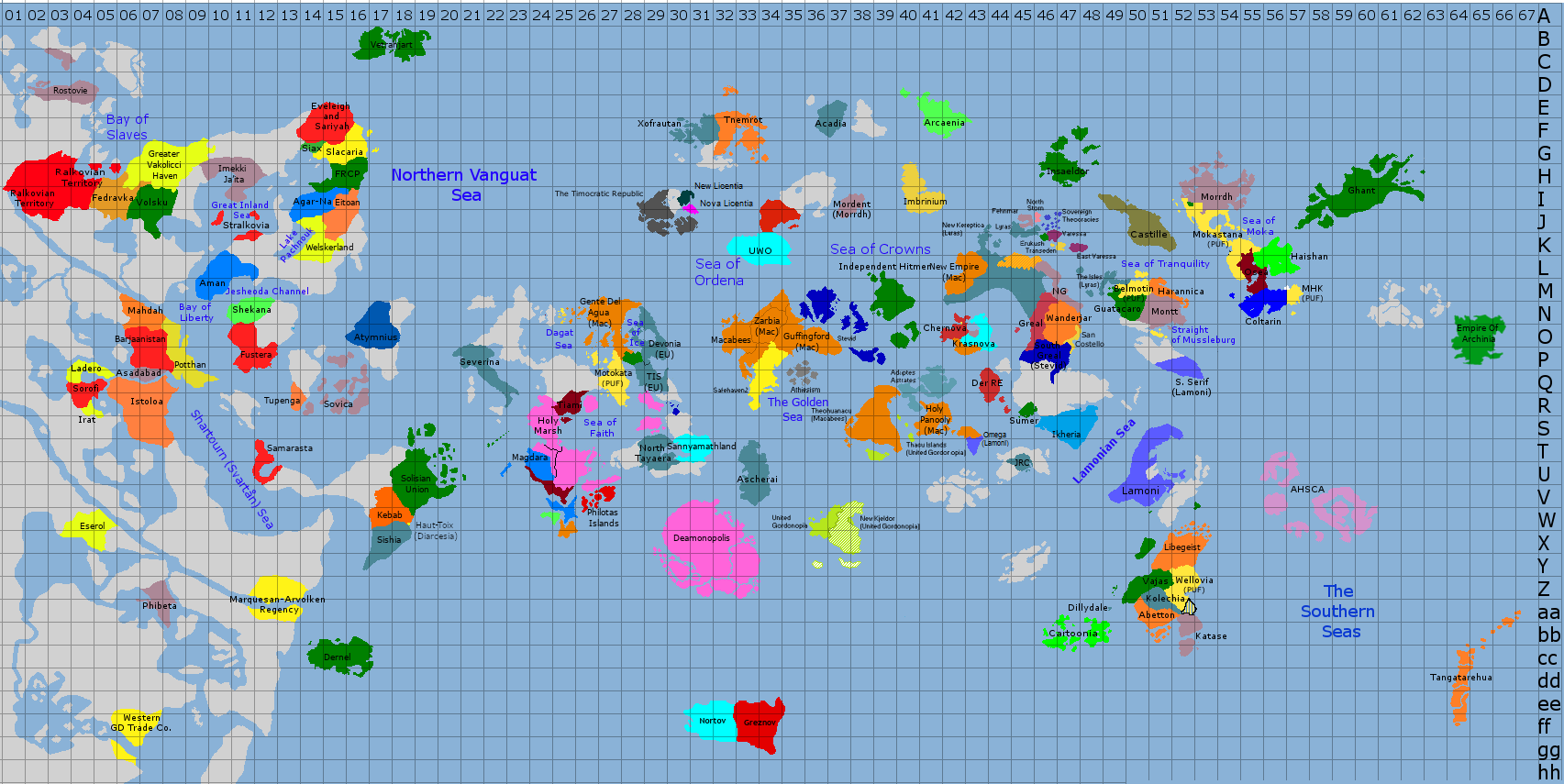
Soon enough, the holographic projection expanded with a sharp electronic hum, widening the theater grid until the entire northern perimeter of Western Greater Dienstad glowed in amber and cobalt light. New operational vectors flared across the map, tracing calculated invasion corridors targeting the sovereign territories of Sovica, Samarasta, Severina, and deep into the strategic borderlands of northern Holy Marsh.

The scale of the projection immediately split the subterranean briefing room into two distinct, vocal camps.

The Expansion faction, driven by aggressive naval tacticians, younger staff officers, and Magdaran War veterans hungry for total strategic preemption, leaned over the table. To them, the vast conventional weight of the Solisian military meant half-measures were an invitation to disaster. They argued that executing full-scale, preemptive campaigns against Sovica, Severina, and Samarasta, while securing the northern territorial buffer of the Holy Marsh, was the only definitive way to build an unassailable iron wall across the north, locking out Ordenite carrier groups, foreign satrapies, and unpredictable regional powers before any coalition could exploit the Union's focus in the south.

"If we leave Samarasta vulnerable or allow Severina and Sovica to become forward staging grounds for foreign fleets, we invite a knife to our throat," a senior fleet commodore insisted, his hand slamming down near the illuminated coordinates. "War Plan Burning Sun, Cooling Moon must be decisive. Phase One: Burning Sun demands we unleash the full mass of our navy and strike wings to invade and seize Sovica, Samarasta, Severina, and northern Holy Marsh in rapid succession. Phase Two: Cooling Moon follows immediately: we lock down those occupied lands, establish absolute air and maritime denial, and fortify the new perimeter so completely that neither Ordena nor our nominal allies can ever contest the northern skies."

Field Marshal Ramziyya Artigas leaned forward, her voice level and cutting through the mounting cross-talk.

"You are planning simultaneous continental wars across four sovereign states while our southern divisions are knee-deep in mud and blood," Artigas said, gesturing firmly toward the southern theater. "General-Marshal Velez and the 3rd Army Group are locked in brutal armor clashes along the Kalutara highway. Major Persai and our soldiers are under siege in Babassar. The hot war is in the south against Sishia and the KNR. Every division diverted to invade Sovica or Samarasta, every supply convoy rerouted to northern frontlines, and every direct assault launched into Severina or the Holy Marsh risks cracking the Union’s logistical spine before Kebab is even secured."

Artigas met Field Marshal Carmona’s gaze squarely. "The threat from Ordena, Fustera, and regional instability is real, but it is a gathering storm, not an active firestorm. If we overburden our northern commands, disrupt the economy, and pull critical support from Carmen and Sofia, we risk disaster on every front."

A tense silence settled over the council as the old veterans and active commanders weighed her counsel.

Carmona gave a slow, measured nod. "Artigas speaks the truth of the field. We will not overburden the north before its time."

The council reached a firm compromise: War Plan Burning Sun, Cooling Moon was formally adopted and codified under royal authority, outlining the full operational blueprints for future campaigns against Sovica, Samarasta, Severina, and northern Holy Marsh. However, its execution was placed on a strictly phased leash. The Solisian military would utilize the ongoing northern joint exercises with Andrenade to coordinate logistics, run landing simulations, and stage strike divisions in reserve.

The actual trigger for the invasions would remain locked—primed to unleash only when the southern war was brought to victory or an aggressive foreign move forced Solisia to strike first.
Last edited by Solisian Union on Tue Aug 25, 2026 9:15 pm, edited 1 time in total.
^_^

User avatar
Marshite Alliance for a Free Tupenga
Lobbyist
 
Posts: 21
Founded: Jul 07, 2021
Democratic Socialists

Postby Marshite Alliance for a Free Tupenga » Tue Aug 25, 2026 11:17 pm

The Solisian influence operation over Tupenga was met with critically mixed results. The Government had been for some time playing a tricky balancing act between the internal polities and factions that constantly threatened to unravel the delicate dance. Prime Minister Nadira Zakia spent most of her days settling disputes between MAFT and communist party officials over a thousand minor issues. The Creoloso People's Party was making gains in local elections as the situation in the country remained stagnant. Likewise, their isolationist desires grew stronger and stronger in the political battlefield. MAFT remained the larger singular force in politics but was being chipped away at.

The Mar’si were leaving Tupenga. War was brewing but even now they did not lean on Tupenga and had agreed to earlier conditions. Perhaps that was unwise of them. MAFT supported continued foreign deployments of some kind. The CPP was opposed to it, m,ost of all the Mar’si. They were agreed to be the saviors and liberators of Tupenga but the CPP did not want to be pressed into their wars or be seen as part of any empire or alliance, never again. MAFT was open to the Mar’si but then again it was a religious militia, of course they would be.

It seemed clear to the Prime Minister that something needed to be done. The situation in the region was all too tense to allow Tupenga to not be allied to anyone. They needed someone who was willing to fight with them and was willing to act as a threat to all enemies. The Golden Throne was tossed about briefly, but was rejected. How many nations were now satrapies? The Theocracy was out of the question for all the reasons noted. Other powers existed but so many were distant or were objectionable in other ways that it seemed no nation would be suitable. Until finally the Solisian Union came up; a nation broadly acceptable ideologically and religiously to both sides.

A diplomatic visit was to be held. And what happened would set back relations a bit.
Solisia came in with a massive display of force, one that the Tupengans had not authorized. Indeed, the air force scrambled and naval forces were put on alert as mobilization orders went out. The alarm was ended quickly when it became clear this was no invasion, but it was an act that would sink Solisian efforts in the short term. The actual meeting was cordial, but the reaction to the move was anything but.
The news covered it even before the politicians could get a handle on it. Briefly, people thought there was a war. The Solisians were speaking about their new sphere, after all. Rumors spread faster than facts in the best of times and in the political climate of Tupenga that was truer than in most other places.

By the time the Prime Minister was able to corral the parties into debate, the tide had turned. The Solisian display of force had seemed to be more of a threat than it was anything else, at least to the parties. That was the prevailing mood of the people as well. Clearly it was not the intent but agreeing to any sort of deal after such a display would seem to be a surrender of sovereignty. No one, not even those who were agreeable to the presence of Solisia. The vote was nearly unanimous: Any basing agreements or offers would be rejected at this time.
The response was delivered to Solisia swiftly, with the final vote being 388-12. In the letter of rejection, Zakia stated that, “no nation will ever impose itself on us through acts of shock and awe”.

The door wasn’t shut, but it was clear that Solisia had serious ground to make up. After all, the Prime Minister still wanted to get somenation to aid her people...

User avatar
Solisian Union
Diplomat
 
Posts: 899
Founded: Apr 22, 2018
Democratic Socialists

Postby Solisian Union » Wed Aug 26, 2026 12:25 am

The initial reception had gone sideways the moment the fleet had entered coastal waters with full air cover. Everything the Solisians brought with them spooked the parliament, unified the opposing factions, and left Tupenga with no political choice but to turn down the treaty on the spot. The Solisian envoys sent messages right away to La Victoria. Then they waited.

In La Victoria, Queen Wessa leaned back in her chair with the report resting against her fingers. Across the table, Prime Minister Elena was looking over the itemized parliamentary breakdown, while Field Marshal Carmona stood near the wall map, a hot mug of coffee untouched beside him.

"That's not great. I feel that we really went a bit far there. Overplayed ourselves.We pushed too hard," Elena said before she put the papers in her hands down on the table. "When our carriers showed up unannounced on their horizon... Well, that happened. They all got this vote going against us before our people could even do more."

"The strategic problem remains a problem for all of us, Prime Minister. Unfortunately so," Carmona said. "Fustera and the Kriegsmarine are not going to ignore this. They're not slowing down. If Tupenga stays open like this, our northern flank is exposed while we're tied down in the south. If diplomacy is dead, we shouldn't waste time letting them invite someone else in. High Command can initiate Operation Western Spears within forty-eight hours."

Wessa shook her head quietly.

"I will admit that I had a part in this. I was wrong about encouraging this much force. But the mistake is made. We fix that now. Tell the fleet to move. Task Force Starlit Wave is going to move deep into international waters. I want their horizon completely empty. No air, nothing in the water, I want everything back, away, bring them 100 nautical miles out."

She turned back to Elena. "Send our people back to the capital and change our tone completely. No escorts, no arms, no uniforms, nothing to make them think that we're here to intimidate them all into signing this and that for us. Just the diplomats and their assistants. Give them open trade access, full infrastructure funding through Solisian Renewal Dynamics with local labor guarantees, joint radar systems, whatever, just get that done and just make it clear we aren't asking for boots on their mainland."

Carmona listened, then he spoke again. "And if they reject that, too?"

"Then you get your orders," Wessa said. "While the delegation is talking, prepare the task force. If they slam the door in our face a second time, or if we see them reaching out to another country behind our backs, launch Western Spears. But we give them the fair offer first."

"Understood, Your Majesty," Carmona replied, nodding once.

Within minutes, the instructions were relayed across the secure network to the fleet.

Out in the Shartourn Sea, the ships of Task Force Starlit Wave swung themselves east, sailing away from the coast until Tupenga faded entirely from sight. The planes and helicopters also went away, moving at speed until nobody on Tupenga could see them anymore. Aboard the ships, SNLF units that were a part of the task force put themselves on standby while a small and unarmed delegation boarded an unescorted transport boat, heading back to the mainland to try one more time.
Last edited by Solisian Union on Wed Aug 26, 2026 12:38 am, edited 1 time in total.
^_^

User avatar
State of Ordena
Envoy
 
Posts: 241
Founded: Jun 07, 2023
Psychotic Dictatorship

Postby State of Ordena » Wed Aug 26, 2026 11:40 am

COITIMA, ISTOLOA


A Istoloan delegation arrived at what was now a full-fledged Ordenite military base situated in Coitma. Upon the death of the Marechalisimo and the extension and expansion of Ordenite commitments to the country, the facilities in Coitma were expanded. This included the construction of additional facilities including command centers, motor pools, signals and communications and better anti air defenses. The atmosphere and aesthetics had also changed as buildings were now draped with the battle banners of the Ordensheer and the Ordenstaat. Flag poles now displayed the national flag of Ordena, the black, white and red with the sunburst in the center representing the OSUP. Armed sentries and checkpoints manned by Ordensheer soldiers and the hustle and bustle of administrative staff, logistics personnel and the everyday laborers. The Istoloan delegation consisted of several generals representing the Istoloan Army's interests in procuring Ordenite military hardware such as main battle tanks. Under the new Marechalisimo there was to be a considerable expansion of the Istoloan Armed Forces including its Army in which it desired fleshing out their armored forces with more proven capable hardware.

The Istoloans were greeted by a pair of checkpoints as their identities were confirmed before being led deeper into the base. They had some choice words among themselves as for what the Ordenstaat's expanded influence on the country was heading. Drones buzzed overhead as part of the bases defenses as the Istoloans arrived at what was a large car park containing row upon row of main battle tanks. Freshly painted and pristine were the Panzerkampfwagen Lowe 1a5s which were a common export model that the Ordenstaat offered to friendly governments and client states. What they were used for once they were sold off was up to the buyer, whether it be putting down rebellions, protests or used in conventional warfare against other nation-states. The Ordenstaat would provide for a cost that was deeper than just currency as the Istoloans had been finding out for some time now. A group of black cladded individuals awaited them as the Istoloans disembarked from their vehicles.

Four of them were standing side by side at attention in front of one of the tanks while three others stood off to the side. The Generals traded words and glances at the rows of main battle tanks as they approached. Standing before them were officials from the Directorate of External Cooridnation which had now recently replaced the historic Foreign Affairs Ministry. Along with them was an assembled full crew of 4 Panzertruppe whom together had served in several campaigns including Wanderjar and Gordonopia.

"Your vehicles." One of the Ordenites said as the Istoloans gazed at the assembled tanks before them. They had expected to be shown a model before the actual exports arrived, however the Ordenstaat instead delivered them the first batch.

"These aren't demonstration vehicles." said one of the Istoloans as the others inspected one of the tanks. The paint was the color used primarily by the Istoloan Army and other identification markings were also fitting of Istoloa. The delegation had been informed before hand that the sale would likely be several billion escudeiro and this was only concerning main battle tanks. The Istoloan Armed Forces and it's government were also intending to purchase lots of Ordenite military hardware and munitions for it's modernization and expansion efforts. This included surface to air missile systems, armored fighting vehicles, various types of missiles and rockets and aircraft.

"No they were made for your army." replied back the DAK representative. "The vehicle was designed around one principle. The crew must survive, and the enemy must not"
Formerly known as; United World Order, Greater Ordena.
Proud member of Greater Dienstad
Condemned by the WA Resolution #272

User avatar
Istoloa
Secretary
 
Posts: 26
Founded: Jul 10, 2024
Iron Fist Consumerists

Postby Istoloa » Sun Sep 06, 2026 2:41 pm

GANCHAS; TENIZA, IRAT

Somewhat begrudgingly, and with resignation, Henrique Dourado Sampón landed on the coast of Irat. There, Marechalisimo Ganchas welcomed him with open arms. The "marechalisimo," in name only really, was, of course, under the proverbial Mar'si gun to treat Sampón in the most munificently possible way. It was the Mar'si who facilitated Ganchas' transportation to Irat and backed him with the authority to take over the 100,000 or so Istoloan troops in the country. Now the Mar'si wanted Ganchas to reward Sampón and promote him to some meaningful role in the resistance against fascist de Vega.

"Marechalisimo!" exclaimed Sampón warmly, though fakely, upon disembarking.

A broad smile colored Ganchas' face. "Major! Welcome to Irat!"

There was some small talk as the marechalisimo-in-exile took the new arrival on a tour of the headquarters just outside of the capital city. Teniza was a harbor town, with small but respectable military and commercial port infrastructure. A convoy of wheeled AFVs escorted them to Barbakán Hida Koloko, located a dozen kilometers southwest of the city's outer suburbs. The conversation turned to business as soon as the convoy hit the highway.

"You are going to Sorofi," said Ganchas.

Sampón looked incredulous. "Sorofi?"

"Sorofi," affirmed the marechalisimo-in-exile. "And you're being promoted. To general, in fact. Congratulations, Brigadeiro Sampón."

"Um," replied the surprised young officer, slowly, "thank you?"

Ganchas toured with Sampón a while longer, going to dinner with him and then giving him leave to go prepare for tomorrow's road trip to Barbaro, Sorofi. The truth was the "marechalisimo" had more important matters to attend to. He wanted to diversify his support base, knowing that the coming war would be a very difficult one to navigate. The future questioned not only his own fate, but that of Istoloa. Would it be occupied? Partitioned? Wrecked? His focus now was solely on doing everything within his power to avoid such a terrible fate for his country and her people. He therefore made a diplomatic overture to the Golden Throne. He was quickly reached out to via an agent of the so-called Diplopalatio, which opened a backchannel line of communication with the exiled Istoloan leader. As it turned out, the Macabéans were quite happy to help out.

But even the Golden Throne had to momentarily put on hold, because Ganchas was due for a momentous summit with the unofficial leadership of Ladero. The topic: Sorofi.


MAXIMO; SOUTHERN SUBURBS OF BARBARO, SOROFI

Gundeiro Maximo scoffed. The Laderan general was debriefing the Istoloan advisor on a failed counterattack made earlier in the week, but it was all a mushy soup of excuses. The enemy is too well entrenched. Their air force makes large-scale maneuvers difficult for us to conduct. Their anti-drone countermeasures have eroded some of our capabilities lately. Excuses, all of them!

The truth was that, though the Sorofian Liberation Army (SLA), the newest name of the growing anti-Laderan resistance forces in the south, had successfully stalemated their much stronger northern neighbors across a line cutting the country in half. The frontlines had moved little in the intervening time. They still cut through the middle of the capital, scarring what would be an idyllic peacetime environment. In any case, repeated Laderan offensives had been ground to a halt without losing much ground.

A phone rang loudly. Maximo raised a finger to interrupt the Sorofian commander, taking the call. He was expecting news from the front lines, where another counterattack was on the way at that very time.

Unfortunately, the news was not good. "No, General, we have not achieved our opening objectives. The Laderans repelled our attacking forces with ease, though casualties have remained miraculously low. We are reorganizing ourselves for another counterattack tomorrow."

Maximo ended the call in disgust. Couldn't any of these Sorofian generals get it right? The enemy was struggling, and the SLA could score an impressive victory against the aggressors. But it was not to be, at least not that day.

An aide came into the war pit then. Maximo looked at him with a gaze that could kill, propelling the man to divulge his message quickly. "S-s-s-i-r," the young soldier stammered. The Istoloan general dully stared back in grave impatience. "Uh, uh," the soldier continued, "we have news from Teniza, general. A Brigadeiro Henrique Sampón will be arriving at our headquarters tomorrow evening. He will be taking over command of the Irati-Istoloan advisory mission to the SLA."

Maximo's face went red. The messenger bowed and left, even without leave, to avoid what was coming. The general let him go. He slowly stood, looked around, and walked away, preferring to be alone rather than to murder every single person in that room, which is what he truly wanted to do in that moment.


CONGREA; LOÇELEA, ISTOLOA

Artur Congrea, Roberto Peres, and Salomão Águas quietly cruised down Rua Passos Comel, a two-lane roadway that connected the capital with various estate-style houses that belonged to the regime's civilian and military leadership. These, in fact, had been intertwined for a long time, now. Roberto was in the driver's seat. Their car was still one of those old-style, old-world ones that you had to drive yourself. The fancy technology from the center hadn't made it to this part of the world yet. Salomão was in the back seat, wide-eyed, and his head swiveling from one direction to the other. He was clearly nervous.

"Hey, calm down," said Roberto, who waved Salomão to chill out.

Salomão nodded. "I'm chill, I'm chill."

"Well, you don't seem like it," said Roberto.

Artur laughed. "You don't even really have to do shit, anyway. You just gotta stay cool."

They rolled up gradually toward an outer gate of one of the estates along the country roadway. They knew who it belonged to. Here lived General Aleixo Rocha, corps commander. The gates were just beginning to open, as if on cue. In reality, the general's daily movements had been closely studied by observers hiding in the nearby area during previous months. What was about to happen had been planned for a long, long time. Everything about it was measured and calculated.

Roberto pushed the car up to block the driveway right as another vehicle began exiting the gated driveway. "Okay, let's go!" shouted Artur.

He stepped out first, Roberto second, on the other side. Salomão was slower, but even he opened his door and brought his weapons to bear quickly enough. The three of them riddled the target vehicle, a Tango et Kartuma town car, with bullets.

"Armored," said Artur. Their bullets were hardly denting the car. Nothing seemed to stir inside. They couldn't see anything, as all of the windows were darkly tinted, so much so that you would have to squint to see even a silhouette. So Artur and Salomão positioned themselves on either side, with their automatic weapons threateningly raised toward the doors, waiting for their targets to try to fight their way out. In the meantime, Roberto opened his own car's trunk and walked over.

Pulling out several explosive packages, he said, "Let's smoke 'em out."

He tossed two of them on the hood, one on the roof, and one on the trunk. The other two men kept the car under guard. Still, nobody inside stirred. Were they not going to defend themselves? As they learned later, watching the outcome on the news, the three men realized that their target had been alone inside, except for his chauffeur. The poor men must have been shaking in their breeches!

No matter, Aleixo Rocha would never know the shameful way in which he died. He was blown to bits.

The communists had struck again, this time successfully.


DE VEGA; LOÇELEA, ISTOLOA

De Vega's government's response to General Aleixo Rocha's assassination was electric and immediate. For three terrifying weeks, armed men arrived at homes throughout the capital, the outlying towns, and even in the distant cities, waking up families in the middle of the night and carrying off their suspects without explanation at all. Those who resisted either came to their senses quickly or were shot. The dead were disposed of quietly. Usually, their families were dispatched as well.

The attention of the country was elsewhere, though. El Marechalisimo, the one with actual power over the country, had announced a new, shocking conscription plan. Millions of Istoloans, mostly men, but also women, were being mobilized into the armed forces for "the coming showdown against the central capitalist powers arraying themselves against fascist self-determination." Not only that, but the government was buying enormous amounts of materiel from abroad. It was coming not just from Ordena, but from other second-hand sources too. Much of it came through Tarn-based arms brokers, a lot of it from outside the region. It was composed of hundreds of ships, tens of thousands of tanks, millions of rifles, hundreds of millions of weapon cartridges, and so much other equipment. Not all of it could be put to use right away. But it was being purchased and stockpiled while the men were conscripted and trained.

Who was paying for all of this? Certainly, Istoloa's pockets did not go deep enough for the ambition of this program.

Of course, it was the Ordenites.

User avatar
Istoloa
Secretary
 
Posts: 26
Founded: Jul 10, 2024
Iron Fist Consumerists

Postby Istoloa » Tue Sep 15, 2026 9:49 pm

SAMPÓN; SOUTHERN SUBURBS OF BARBARO, SOROFI

Henrique crossed into southern Irat the very next day after the rendezvous with Ganchas. Begrudgingly, of course.

The Istoloan advisory mission to SLA had been led by Gundeiro Maximo since the beginning. His troops were reportedly loyal to him. Though they hadn't been receiving pay from the government for several months now, Istoloan soldiers, posing as advisors from the Irati army, had thoroughly looted what they could from battlefields across the frontlines. This was all alongside the SLA, which was by this point a mercenary army of local criminals and hooligans who ruled much of the Sorofi's south with a brutal iron fist.

On the way to a base near the southern outskirts of Barbaro, his convoy had passed a small town named Hermosilla. It had the looks of an antique Istoloan colonial town, and in it lived no more than 2,000 people. In the center, a 13th-century temple still stood. But its walls were being stained with blood in that very moment, as SLA units swept through Hermosilla to remove 37 of its men and 8 women. Henrique would ask about them later. Nobody knew anything. Though local witnesses would claim that they heard gunshots ringing from the nearby woods.

It was within the context of this chaos that the newly promoted brigadeiro prepared himself to complete his orders. Ganchas had sent him to Sorofi to take command over the Istoloan soldiers in the country, and therefore also, in theory, the SLA. But would the SLA listen to him?

Brigadeiro Maximo was waiting for him just inside the gate of the base. Artillery and gunfire thundered and crackled from not very far away. Sometimes the whistling sounded as if it were very close indeed. Once or twice, an errant shell struck near the base. Maximo reassured Henrique, "Don't worry about that. They're not aiming for us. If they hit the base, it'll be by accident." Above them, just as he finished speaking, a quick-moving interceptor drone struck another one. Maximo said, "Every once in a while they get a drone over our airspace, but we're not really a priority for the Laderans."

Henrique held his nerves as a light utility vehicle took them deeper into the small base. It was Maximo who was driving. The general looked at ease and was friendly, but he betrayed an underlying tension in the terseness of his speech.

"The olive branches look good on you, Brigadeiro Sampón," said the host, referring to Henrique's promotion. They were just arriving at an inconspicuous building, drab and rather plain-looking, when he said that.

Somewhat put off by the compliment, Henrique replied, "Thank you."

The convoy with which Henrique arrived trailed them. 43 soldiers and other security personnel stepped out of their vehicles and entered the building with the two generals, following them onto a large elevator platform that took all of them down at the same time. After what seemed a long time, they stopped at the bottom. A vault-like door was closed, but an alarm rang, and the door slowly opened. Valves released steam, obscuring what lay on the other side for some time, until the hazy smoke dissipated.

As soon as the path was clear, they all walked through the door, which closed shut behind them. They followed a central passageway that opened into a surprisingly lively command bunker lying deep beneath the ground. It was nothing fancy. In fact, in some parts of the wall and roof you could still see the earth, which trickled down onto the floors as dirt every time an artillery shell impacted the surface nearby. It was honestly quite claustrophobic, but Henrique held it together. It was good that he did, because the large command room fell silent as soon as they all walked in. There were just over 20 men in the bunker, not counting the new arrivals. Apparently Ganchas had information on the usual entourage down here, giving Henrique enough of a bodyguard to impose himself.

Full of confidence, Henrique said, not long after introductions had been made, "Look, Gundeiro, we all know why I am here."

"Oh?" wondered Maximo. "To report back to Ganchas on the state of the Istoloan advisory mission in Irat, I presume."

"No," replied Henrique. "I am assuming command of the advisory mission in Irat. Marechalisimo Ganchas orders you to return to Irat for further instruction."

Maximo was eerily silent for a while. His face betrayed no emotion. His large frame remained unmoving. Then, finally, he answered, "The only Marechalisimo is Marechalisimo de Vega. I will not obey the orders of a traitor to Istoloa."

Henrique exchanged glances with some of the men who came with them. Maximo's men were looking between themselves too. Seconds felt like minutes suddenly.

Perhaps to ease the tension, the host brigadeiro motioned back to the vault door and said, "As a sign of goodwill, I guarantee you safe passage back to Irat."

"No, I think I will stay here and do my duty, as ordered by the one and true Marechalisimo of Istoloa, Marechalisimo Ganchas," answered Henrique. He made a motion with his hand just then.

Suddenly, the room erupted in a torrent of fire as Henrique's guard raised their weapons and ruthlessly opened fire. Bullets ripped into Maximo and his command staff, tearing through muscle and shattering bone. Bodies were thrown against the wall and strewn across the floor, as wounded soldiers wailed in fear and pain. Some of Maximo's men managed to return fire, but it wasn't long before the command room was quiet again. Quieter, as the wounded still whimpered and wailed.

Half of them lay dead. One of the corpses was that of Brigadeiro Gundeiro Maximo, born M.C. 1981.

With the head of Maximo's clique gone, Henrique did not have much more trouble gaining control over the rest of the small Istoloan force on the base. Other soldiers were spread out, embedded into SLA units. They'd be brought into Henrique's fold soon enough.

For the time being, the new commander of the Irati/Istoloan advisory mission in Sorofi sent word to Ganchas that Maximo would no longer be reporting in.

Then, the bodies in the room were burned and quietly disposed of before anyone knew any better. Henrique Sampón fit the role of Istoloan general better than he had anticipated. Just two days into the job, and he had already committed his first atrocity. The young democratically-minded officer, so young that his promotion was obviously the outcome of geopolitics, felt sick to his stomach. But this was no longer yesterday's Istoloa. The world's stomach would have to get used to what was coming.


GANCHAS; TENIZA, IRAT

Zé Bambaso arrived at Teniza the day after Henrique Sampón's rendezvous with Ganchas. This time the marechalisimo-in-exile hosted the former Laderan prime minister, whose disgrace following the vote of no confidence of his party had been significantly erased by the collapse of the CSA and the death of Fremonero. Now it seemed as if Bambaso simply hadn't been given enough time to see out his plan. Elections were coming up, and the man sought to restore himself to the premiership.

Ganchas needed something very badly from Istoloa. He needed his men. The same men who had served in the CSA. The same men who had bombed and assassinated local political leaders, judges, and officers of peace. He needed those men to mount an invasion of Istoloa.

"The Mar'si will eventually try to liberate Istoloa," he was saying to the ex-prime minister, now the unofficial lead negotiator with the leader of Istoloa's 'pro-democracy faction.' He continued, "I need all the men I can get. I am recruiting more, but I need my men. They are well-trained and combat-tested. With them, once the Mar'si have pinned down the bulk of de Vega's and his master's armies, I can land with my army and depose de Vega. Then resistance to the liberation will collapse, with the Ordenites no longer able to use Istoloan roads, highways, or rail to move around their men or supplies. The Ordenite army in Istoloa will have to surrender. And I will declare free and fair elections to determine both new legislative and executive leadership."

"Very beautiful," responded Bambaso. "But that sounds far away. And what you want is unspeakable. Those soldiers took Laderan lives."

Ganchas scoffed. "And you will fight Istoloa alone when they crush me in Irat?"

Bambaso shrugged, and said, "The Mar'si will defend Ladero. I'm not worried about Istoloa."

"The Mar'si," Ganchas barked a laugh. "You don't know if the Mar'si will be able to sail through the Strait of Asadabad. Ladero will be cut off. Maybe the Mar'si can reopen the straits, but how long will it take them? All that time in between is time de Vega has to accelerate Fremonero's vision for the reconquest of the Tarao. De Vega is already mobilizing the army. They're talking about millions of conscripts. I'm not sure you fully appreciate what's coming."

The Laderan negotiator scowled. "Maybe. But those men took Laderan lives. Besides dreams, what's in this for us?"

Ganchas looked away for a moment, thinking to himself. Then, he answered, "I will order Istoloan forces to withdraw from Sorofi. The SLA will come with us."

"The SLA?" asked Bambaso, bewildered. "The SLA will follow your orders?"

"Not all of them," replied the marechalisimo. "But whoever decides to break ranks and stay will easily be swept up by your forces, I'm sure." The Laderan army's performance thus far had been quite atrocious, all things considered. Repeated offensives against the broad defensive line that cut through the Sorofian capital like a scar had barely managed to budge the SLA from their entrenched positions and impromptu fortifications. Neither had Laderan air power done much, despite having air superiority. Having the SLA be dismantled from within would be very good for Ladero's war effort, which was faltering.

Bambaso said nothing for a long time. Ultimately, he sighed, looked up at the Istoloan, and said, "Agree to withdraw your forces from Sorofi pending electoral results in Ladero." The implication was that peace would come to all of Tarao, and Ladero's disastrous incursion into Sorofi would end, as long as voters kept the UCP in power. It also implied that the UCP would have to make way for Bambaso's return to the position of head of government. But that was not all Bambaso wanted. "You will state that SLA forces are Istoloan army personnel in disguise, and admit the same about the CSA. CSA personnel in Laderan custody will be treated as prisoners of war, returned to the legitimate government of Istoloa, with representation in Irat. You will also sign a permanent alliance with both Irat and Ladero, guaranteeing peaceful relations between our countries in the post-war and after."

"Very well," said Ganchas. Between the advisors and the SLA, that would be another 350,000 personnel folded into the marechalisimo's growing army.

But Bambaso was not yet done. "Finally," he said, "you will agree to a summit after the elections between you, me, the legitimate government of Irat, and the legitimate government of Sorofi to discuss the founding of the IstoTarao Union. The ITU. Once I win back power, I promise you that I will bring lasting peace to Tarao. A peace bound by an economic and political union designed to resolve our differences through political action and litigation."

Harrumphing, Ganchas answered, "Very well." He knew that before anything like the ITU was possible, a war against de Vega and Ordena would have to be won. Bambaso's dreams were all very distant. But the immediate growth of his forces was very relevant to Ganchas' present challenges. There was no reason to say no.

Bambaso returned to Lavença victoriously. Polls following his arrival and news of the possible peace deal in Sorofi showed the UCP holding a commanding lead over opposition parties.
Last edited by Istoloa on Wed Sep 16, 2026 9:40 am, edited 1 time in total.

User avatar
Marshite Alliance for a Free Tupenga
Lobbyist
 
Posts: 21
Founded: Jul 07, 2021
Democratic Socialists

Several Weeks Previous...

Postby Marshite Alliance for a Free Tupenga » Thu Sep 17, 2026 2:27 am

The Prime Minister was one of the few Tupengans with a clear head on foreign relations, or so she believed. So many of her countrymen had been ravaged by such fierce oppression and lived under the auspices of civil war and hardship for so long that it could be hard for them to think beyond their borders unless it was in terms of threats and risks. Nadira could, and she understood that Tupenga would be easy pickings for a large power. Sure they would make their enemy bleed with an effective insurgency, but in a world of empires they were a state to absorb.

It was understood they needed allies; it had been the reason why the Solisians had been sought in the first place. After the diplomatic debacle, other nations were discussed. The Mar’si were no goes due ti the influence of MAFT. They would no doubt be powerful allies but the imbalance internally would be gross- the communists would do everything short of a rebellion. The Golden Throne was already present and reliable, but everyone knew that they were more likely to become a Satrapy in the long run if not a puppet. The Solisians were the best option and enough knew it. When their delegation came back with a bit more tact, they had to do a lot of work. You couldn’t threaten someone’s sovereignty intentional or not and not expect some difficulties.

It would take several weeks before a deal was struck; Solisia would get their bases and deployments but it would come only with more significant financial commitments than before.
Last edited by Marshite Alliance for a Free Tupenga on Thu Sep 17, 2026 2:27 am, edited 1 time in total.

User avatar
Holy Marsh
Negotiator
 
Posts: 6002
Founded: Nov 09, 2007
Mother Knows Best State

Postby Holy Marsh » Thu Sep 17, 2026 2:29 am

The Theocratic Matriarchy Navy had deployed significant assets throught Western Greater Dienstad, and that coverage was backed up with Damocles from orbit. This immense presence and the intellihence developed from that and Jeweled Eyes had grown steadily and dramatically as time went on. Still, there were limits to what even this concentration of resources could hope to achieve in the shorter term. They were not ominscent. Ships still crossed the seas and cargo moved through unfriendly ports. Intelligence had to be examined and reports collected and while analysis was swift and unyielding it still took time, precious time, the resource the Mar'si though their enemies always had too much of. This worked to the State's advantage for a time. Cargo from the military industry of Ordena found purchase in Istoloan hands successfully for a while, and several deliveries would be completed before the Mar'si would have complete knowledge of the events transpiring. One of the hidden flaws of having your eyes everywhere was that you sometimes saw too much to identify a singular problem and this would prevent a swifter response here, even if it had boons elsewhere.
It was only a matter of time until the picture became clear. Ordena was building up Istoloa, and for the Theocracy this crossed a red line. Ordena would not be permitted to fortify the Istoloan regime without challenge. The appearance of Ordenite military support, while expected, added another dimension entirely. The Mar'si had hoped that perhaps Ordena would have limited themselves to advisory roles, but now that they were there in force it became clear that the door must be closed on them. Once intelligence confirmed this facts, the Mar'si started to move across the region.

Operation: Sea Dragon, the blockade of Istoloa from the east, was the primary mission. Organized around two maritime boundaries, it was supposed to choke Istoloa into throwing off the State's yoke or weaken them for invasion. The outer boundary was the Wyrm Line. It had a simple rule but one that the Mar'si would apply ruthlessly: No military vessel lacking approval from the Theocracy would be allowed past it, or would even be allowed to challenge it. Those that did so would be swept away. The Drake Line would follow further inward, closer to Istoloa. Every vessel approaching the Drake Line, sans those of close allies, would be searched and investigated before being allowed into Istoloa. If, of course, the Mar'si even deigned to allow it. Traffic could continue only after this took place. Any vessel that gave even mewling resistance to these commands was to be annihilated.

Responsibility for enforcing this blockade fell primarily on the 3-5 Tactical Fleet commanded by Grand Commodore Evaie. The fleet would form the core of Sea Dragon but it was not orphaned from broader support from the navy.The 3-2 Submarine Group joined the 3-8 Submarine Hunting Group to extend Mar'si dominion below the seas. The 3-9 Convoy Protection, 3-1 Coastal Defense, and 3-1 Amphibious Invasion Fleets were likewise added to support. Together, these formations represented hundreds of vessels, pre-positioned already across the local theater for just this eventuality. Now they began to move. The fleets divided themselves into innumberable task forces according to the requirements of Sea Dragon. They took their places along the lines and in between, as well as task forces ahead to ensure that the blockade was well understood and respected by the Dienstadi. They became part of one machine and one will, aligned to the will of the Theocracy.

It was understood that this would likely trigger a wider war and the Mar'si welcomed this. The crews prepared themselves for open combat and the common assumption was that the State would challenge them immediately, if not attack.
Until such a time came the blockade existed in word alone; blood and blood alone would give it the power of enforcement. Such was the law of Greater Dienstad, where only strength was understood. The 3-1 Amphibious Invasion Fleet prepared boarding parties en masse for the immense inspection effort demanded by the Drake Line. Civilian ships bound for Istoloa would have to be searched, and authorization would have to be enforced physically. Personnel had to be ready to approach vessels whose intentions could not immediately be known and whose willingness to comply was unexpected.

All of this occurred before the Mar’si delivered their message publicly. When that message came, it was simple:

Due to the war-mongering military build-up of the Menace that is Ordena in support of the illegitimate and murderous regime of puppet de Vega, Istoloa's eastern coasts are under a naval quarantine against the disease that threatens their shores. All non-allied military vessels are barred from entering the quarantine zone. All civilian vessels that wish to transit to Istoloa will submit to armed searches and must get authorization. Any vessel, military or civilian, that betrays this order will be sunk. Any nation that takes action against the naval forces involved in this operation will be punished accordingly.

We call on Istoloan patriots to assume their rightful place as masters of their own nation before they become the lapdogs of Ordena, now and forever.


Before this statement was released and Mar'si intentions became clear in theater, moves were made region wide. It was necessary, even as it allowed the deliveries to continue longer than the Mar'si would have preferred. It was understood that they were now on the brink of a wider conflict and that thinking forced them to make moves elsewhere in preparation.

The forces committed to Secure Hawk had to be well and truly secured before the quarantine began. Ladero had been promised the protection of the Mar'si and this protection was possible currently through a long route. The supply line to Ladero passed the Bay of Liberty, continued down the Great River, and eventually reached the waters north of Ladero. The Bay of Liberty was likely to get hot very soon and once it did there would be difficulties until alternate routes were made through Istoloa's seazones or the Bay was made permanently friendly. Deployments that had been expected to proceed at the previous pace were fast-tracked as were materials. They were to be beyond the Bay before hostilities could commence.

Forces deployed to the Mahdah Crusade were placed on high alert, alongside those deployed to Shakana and Aman. Now they knew that it seemed as if war could be hours away. Ladero also had to know. Shortly before Sea Dragon's public announcement, the Mar'si informed Ladero. It was important they were made aware of what may soon follow, for their defense was ever on the minds of the Mar'si. Ganchas would be informed as well, even if the Mar'si did not care much for him. Recent events had created strange necessities and stranger bedfellows and at that moment Ganchas was one of them, and to his credit he was doing his job well. The pressure being lowered down south as well as increasingly empowering Istoloan resistance to de Vega would do a great deal to weaken the State's position.
The Mar'si prepared for the wider war to begin and thus the Theocracy therefore informed its major friends and allies, with the timing deliberately chosen so that Sea Dragon would not catch their allies with their pants down. The Golden Throne was informed, as were their great friends in Eitoan, their Sisters in Solisia, their close allies in Mokastana, the friendly faces of Morrdh, and other major allies. Before the world would hear the declaration these close friends would be made well aware of the bloody days ahead. Then the announcement would come. The Mar’si understood where they stood and they welcomed the fire and flames, if such was the will of the Goddess.

User avatar
Solisian Union
Diplomat
 
Posts: 899
Founded: Apr 22, 2018
Democratic Socialists

The Warnings

Postby Solisian Union » Fri Sep 18, 2026 12:44 am

The Warnings

It was seven in the morning and the Queen was walking in the new gardens that had just opened for the public. La Victoria was alive, not simply alive in the sense that it was the capital of the New Solisian Union, but alive in the sense that so many things were adding to the city. If not that, so many places were renovating. And today was just the perfect day for Wessa to bring herself, some of her guards, and her children to the gardens. Plus her wife.

She and her family stopped walking to come sit at some of the benches under the shade of mango trees, olive trees, and so many more trees. Everywhere around them, there were pots and rows and significant plots of land where flowers and herbs and bushes were. Wessa, for once, looked like she wasn't so tired and overwhelmed with the work of being a Queen. For once, she looked like she was smiling truly instead of smiling politely, her attention divided between conversing with her wife, adoring her twins, or even just looking at some of the children play.

Shifted and Non-Shifted.

Mar'si and non-Mar'si.

Solisians from every corner and place of the Union. The capital was, after all, the home of all whose ancestors have settled here. But even newcomers were welcome.

Wessa pulled Priya close and embraced her from the side, laughing with her when their twins started grabbing and poking at them, patting at their faces with their little hands, getting their fingers into the clothes of their parents, both of them holding their children. Wessa held Cassian while Priya held Solene.

Priya leaned over and said to Wessa, "Look at you. For a long time, I thought you wouldn't let yourself out of the palace or your offices or any of the rooms where you just devoured hour after hour of work."

To that, Wessa blushed and said, "Ah, well, I couldn't just do nothing. I am-"

"The Queen of the New Solisian Union, yes, I know. And I am Priya, Priya Nakamura, your very consort and mother to your heirs. Two of them. I know you couldn't just do nothing, but I know that the very moment you sent for us and secured the fastest train back to the capital, I just knew that you wanted us to see something nice, and this was it. The gardens."

To that, Wessa now smiled genuinely and laughed a little. She reached for little Cassian and allowed her son to play a little with her fingers, saying to Priya, "Of course. I wanted to spend time with my family after such long and tedious work. It wasn't something I could just ignore. When I was informed that the Sinshisha Gardens had just opened, and when I was given an invitation by a very large and mixed family who were responsible for this… I just had to get it. And so I did."

"And now we are here, far away from your palace with all the endless work and all the ceaseless talking that happens there."

"There's also the writing and the reading," Wessa said, rocking Cassian a little when he cried, the boy settling and giggling and cooing when she did that for him. "So much of it, I have to say, I had to start dictating things to one of my secretaries instead of writing everything myself."

"You write by hand, by the Goddess!" Priya said, who was now exposing her right breast to allow Solene to breastfeed. "And when you use a computer or a laptop to type, you do so with furious speed, your secretaries and my secretaries often felt so horrified enough to tell me that your typing speed is…. You literally broke a keyboard that was new."

"Correction, my dear, that wasn't breaking, that was the keyboard failing to meet my standards."

"Standards? Your standards?" Priya scoffed, rolled her eyes, and said to her, "Wes, you really cannot just relax, can you?"

"Oh, yes I can. The Goddess helps me out and so does the Triad faith of our people."

"Your people, my Mar'si ass. I would bet even the oldest Triad priestesses, regardless of some of them being part of the Poly-Pan Sarda or not, would call you out for being so inclusive to the point of trying to make everything so syncretic."

Wessa just shrugged however she could despite carrying Cassian. "So? It's not like it's a big problem or a big deal when our faiths are practically Sisters to each-"

She wasn't able to finish her sentence when someone approached her guards, coming on the back of a fast Azynian horse. The gardens forbade vehicles except emergency vehicles or horses. Wessa and Priya turned their attention to the woman who was on the horse speaking with Wessa's guards.

Of course, nobody was allowed to come so close to the Royal Family just like that. Protection for the Family was done in layers. The closest layer to them was consisting of plainsclothes personnel - mainly Mar'si Matriarchal Protectors, Azynian Angels bearing symbols of the Nyra tribe on their bodies and arm-bands, as well as two new Tensha wearing long-sleeved clothes to shield people from looking at their heavily modified bodies and a few Rantankai wearing simple vests over their plains-clothes. The next layer was farther away and the garden entrances and exits were under heavy security monitoring.

The Tensha were the guards who repositioned themselves quicker than the others closest to the Family. The children cooed when they did, their attention drawn to the very tall and very still women. Though the children loved the guards and feared them not, Queen Wessa and Priya could never stop being surprised when their children just cooed and gave them their attention so solidly.

The Tensha were a new addition, after all, the product of Her Majesty's secret projects that yielded beautiful but severe female combat personnel who were not so very close anymore to the baseline. They were not exactly walking machinery, but…

"Let the courier come," Priya said, waving at the guards farther away, drawing their attention and that of the courier on the horse. "Miyakeisa, Daruei, let her be."

The two guards who had kept the courier from getting closer were both Shifted Mar'si, women of the Eastern Solisian provinces, stepped aside. They were very tall, broad-shouldered women whose dog-like ears moved faster than their faces, and they were Priya's.

The courier proceeded. Unlike the horse, she was not Azynian. Instead, the woman was a Bakednu. She belonged to one of the southern mountain peoples of the Union, and the woman was incredibly dark-haired, her skin made brown from riding and walking under the great Solisian sun so often, and right now, she looked both sweaty and covered in a little dust from the ride. She had a narrow face and the strong build common among people raised in the highlands. She bowed her head to Queen Wessa first before she bowed her head to Priya and the twins. Then, at last, she spoke, saying, "Your Majesty, I have a report from the representatives in Tupenga. Their report had just come early via secure email."

It was not odd for Queen Wessa's news to come by courier in this way. Whenever she wanted peace and quiet, the Queen almost always chose to leave behind her personal terminals and most of the constant electronic traffic that followed her almost everywhere, including the palace.

Queen Wessa nodded to the courier and said, "Thank you. May I please have my tablet, Mrs. Brozaiyen."

To that, the Bakednu courier nodded and removed a tablet from her bag, handing it to the Queen only after the Queen quietly and gently put her son down on the ground and allowed him to walk away. Wessa took the tablet in both hands and began to read from it after pressing the power button and entering her password. Cassian, to his own delight, began toddling around the flowers and bushes nearby, closely followed by one of the Tensha, namely the woman whose movements were so sharp, so precise that Cassian kept on glancing back at her, unafraid, because all he saw of the woman was not a veteran volunteer of the Solisian military but someone who always followed him around and picked him up whenever he stopped and cried and waved his little arms.

Wessa was almost done reading every word on the tablet, and her smile was returning to her, a genuine one, touching the corners of her lips, small, then growing wide. Her eyes went from line to line rapidly, studying the words again and again as her wife drew close and said, "There you go again, smiling. What is it this time? Good news?"

"Yes," Wessa whispered, then grew her voice a little louder, "yes, my love, this is really good news, come, look at this." She quickly angled the tablet so that Priya could read without needing to adjust how she held little Solene, who was now finished with sucking from her breast and was now babbling at a little blue insect that had just landed on her mother's arm.

Priya read it and understood. She, too, smiled, and she said, "No way. They actually…"

Wessa nodded, waiting for Priya.

Priya nodded back and gestured for Wessa.

Wessa turned the tablet off and gave it back to the courier who was waiting on her horse. "Thank you, Mrs. Brozaiyen."

"Your Majesty," said the courier, before Wessa nodded to the courier and allowed her to turn her horse around and started to leave, silently encouraging her horse to walk, not to move too quickly, so as to not spook the children away.

Wessa was hopping a little where she stood before she told Priya, "This is the best news I could ever hope for! Our north is easier to secure now. We can finally have the bases and the agreements we wanted. Our Navy, our Air Force, we can FINALLY have another ally, another state, an actual country joining our circle of nations, our own little association in Western Dienstad, and somewhere… some-"

"-where we can finally deal with, north of us, where our sailors and our pilots can actually operate without having to always depend on our own islands."

"Yes! We can start putting radar in Tupenga, aircraft, ships, and, and-"

"And they agreed," Priya said, taking Wessa's hands to keep her from moving and jumping a bit around too much. "Yes, Wes, we finally have their agreement. Tupenga stands with us now."

'Yes! Even when it costs us a little more than usual," Wessa said, as if what she was saying was something like a young mom simply enjoying a purchase that probably cost way more than any salary she was ever able to actually get for herself.

Priya sighed at that and said, "And now you're going to go think about how to work all those money issues out with Minister Mendes, aren't you?"

To that, Wessa said, "Yeah! Wait, no, I mean-"

Priya just laughed and said, "I am just being silly with you, hon. Relax. And I am pretty sure Minister Mendes can take care of things very well. Just like the rest of your cabinet. You haven't needed to replace any of them+ since you came to rule Solisia!"

"And I hope I never will. My ministers have been the best I found and they will continue being the best for the country."

Priya was about to say something else, something more, and keep on talking with her wife, the Queen, about something like another joke for Wessa to consider until the courier returned on her horse, a little faster and, this time, performing no careful slowing until she was almost at the security line.

Queen Wessa looked away from her wife, her attention on the courier now stopping to actually get off the horse and present the tablet again to Her Majesty while the guard following Cassian quietly picked him up.

The courier said, "Your Majesty, this one is marked urgent. This one came from Director Cherenya herself. It has her confirmation and the counter-confirmation from our naval intelligence people."

She read carefully. Very carefully. And in a matter of her seconds, her youthful face went still. Her smile was gone.

Priya wanted to draw close, to break the silence with perhaps another little joke, but she refrained. Nobody spoke, and it seemed like even the children noticed, their faces a little more observant, watchful perhaps, especially because both of their mothers stopped talking, laughing, and smiling.

Then, at last, Queen Wessa the First of her name spoke, saying, "This is- What even…" She frowned now. "Mrs. Brozaiyen, is this actually confirmed? The Mar'si, their ships, did they move before they told us?"

"Yes, Your Majesty. The Theocracy's ships are moving already. They have only told us this now."

Wessa blinked a lot, and rapidly so. She opened her mouth to speak again but stopped. Her eyes scanned every line on the tablet. Fingers trembled just a little. Not fear, but also not just simple anger. Concern, maybe? Now, she found the will to speak.

"Your Majesty, the Mar'si have just committed hundreds of ships to the region."

"That cannot be. They just withdrew from Tupenga. And all because of…" Wessa chose to let the sentences forming quickly in her mouth to die, and she shook her head at the tablet, rereading some lines. "They told us after they had already decided…"

And in her mind, each and every concern flew and flew, like Elizaran patterned terns coming in as one column to build their nests.

The war to liberate Kebab. The war to destroy Sishia. The plans after getting Tupenga to agree. The crisis and war of Tarao, the second of its kind. And, most dreadfully of all, the old enemy from Magdara: Ordena.

But it wasn't just locations.

Wessa remembered. The bases. The articles concerning defense. Her military reserves. The Solisian Navy, split with most of her strength in the Sishian War, and the rest either stationed at Xofrautan or at a significant distance from Tupenga. And the economy.

The Solisian economy that she hoped to rebuild since the end of the War Between Sun and Moon. Her economy. The economy Mendes wanted to work on. In peace.

For once in her life, since the attacks by Ordena against the Solisian Desaan islands, and since the coming of Ordenite naval exercises in response to perceived Solisian "aggressions," the monarch of all Solisian civilization felt her fingers tighten around the tablet as her eyes moved nowhere except for her children. Cassian in the arms of a Tensha. Solene in the safe and loving arms of Priya.

And neither Priya nor Wessa could say a word to each other after that. But Priya knew what she saw in her wife's eyes.

But what was the first thing? The strongest feeling she could understand in every bit of her eyes? Was it fear? Exhaustion? Was Wessa calculating? Was she angry?

Was she angry at me?

But Wessa spoke first. Not Priya. Not anyone. Only the Queen. And the Queen said, "I need Carmona. I need them."

"Wes," Priya said, voice almost like pleading, as if trying to keep her wife from leaving them alone again.

"I must meet him, Elena, Cherenya, someone… Someone from the Navy, and I need… I must call Morales now… I need to go."

"Wes," Priya said again, but Wessa was already on the move. The Queen gave the tablet back too quickly and one Tensha followed immediately, silent. Rantankai, Angels, Tensha, and Protectors moved. Half the detail remained with the family. The rest followed the Queen, with two drawing themselves very close to her sides.

And now the Consort couldn't follow. Not when she had little Solene in her arms, and certainly not when Cassian returned to her, his hands clinging to the leg of her trousers.

She couldn't even call after the Queen. Her wife. Mother of her children.

But beyond all of them, her Wessa was matriarch of all Solisia.
^_^

User avatar
The Macabees
Senator
 
Posts: 4323
Founded: Antiquity
Anarchy

Postby The Macabees » Fri Sep 18, 2026 9:43 am

FEDALA, THE GOLDEN THRONE
________________________________


BY COMMAND OF THE EMPEROR, TO ALL KRÍERLORDS: IMMEDIATE RECALL.

You are summoned to Fedala to advise the throne on urgent matters concerning the far west. Report in person within eighteen hours of receipt. This summons takes precedence over all other duties.

Acknowledge receipt. Make haste.


Kríerlords, councilors to the emperor, His monitors over the many governors, satraps, and other regional executives, and the extension of His Will in concerns of foreign policy, were rarely summoned to the palace with such urgency. That is why all of them, without exception, set aside their prior duties and took the fastest transportation available. For most, these were the 'ballistic jets,' as they were called — the atmospheric skippers. For many, the travel was far. Even conventional air travel would have been too slow. Like for Cassandra, in Samarasta. And Jaso Barenka, in San Castello.

Lara Surr was there, along with her junior partner on Makria, Darus vis Konkordán. Ger Venamenud, Garnér Bíank, and Jakal Níelsen came from New Empire; their old partner, Migalo Kor, now posted in Krasnova, arrived before night fell on the first day. Ana Fávela traveled from Mokastana, where only the gods and the emperor knew what she was up to (nothing, said the rumor). Lato Viversa, the diplomat-turned-kríerlord and posted in Elokeum, had left behind ongoing conversations with the Mahdavians to attend. Fedor's right-hand man, Daryl Novelle, was there, of course. As he always was. Roland Peskual was there too, even if he was still in the 'freezer,' so to speak, for his early mistakes in Krasnova on the eve of the second war there. He had since been sent to oversee the diplomatic missions in the far southeastern corner of Greater Díenstad, where he managed things as exciting as the tourist subsidization program to AHSCA. Fourier Vereda, Cassandra's senior partner in Samarasta, had come too, separately. Angiko Bas, whose work in Holy Panul was being celebrated, was there as well. Dedaelus Marco Serón, the half-Zarbian, was one of the last to arrive, despite being so close (relative to others). Andro Kilomen, the GDRC representative, entered just before Serón.

Others arrived in due order, and the conference hall with theater-style seating filled quickly. The throne below, at the front, stood empty. Talking amongst themselves at first, they grew quiet as imperial security officers streamed into the room. As the soldiers stood at attention, they all stood and bowed to honor the entrance of His Imperial Majesty Fedor. "Sit," He said. To his guards, he added, "At ease."

Saying nothing, they all waited for Him to begin the session. After a moment, he said, "You have all learned of the news coming from the far west. The Marshites are deploying to blockade Istoloan vessels and their supporters from passage through the adjacent seas. I do not think it has been lost on them that Istoloa's benefactor, the Ordenites, are likely to resist the attempt with violence. Already, in the intervening hours, warships from all sides are converging on the Shartourn Sea to join for battle. Furthermore, as you all are aware, the empire has been slowly preparing for its own war against Ordena. Our intention was to launch our attack next year, only after the Ordenites further entrench themselves in Chernova and Potthan. Now the question is, do we go to war now?"

"Like with Imbrinium, in Krasnova?" asked Kor. "When the empire does not follow its own lead, it tends to get led into pit traps." There were a few nods of agreement around the room.

Surr spearheaded the dissent. "The Mar'si are an important ally and the Ordenites are our natural enemy, against whom we are bound to fight another war sooner or later. Why not make it sooner? Out of solidarity? Certainly, we have the fleet to squeeze Ordena throughout the region. And we have the armies to fight simultaneous wars in Krasnova, Killia, and elsewhere. Even if our timetable is moved forward by a few months, is it not worth it for the sake of our nations' friendship?"

Vis Konkordán, usually tempted to take the opposite side as his senior, but this time himself also eager for war, joined in support. "We pushed them out of Magdaran. Why not out of all the far west?"

"The far west?" asked Vereda, who eyed Cassandra. He expected the emperor's wife to side with Surr, but he had his own opinions. "The far west is a distraction. Better for the Mar'si to draw Ordena into a bigger fight there before we join. The more ships that sail to the Shartourn, the fewer they will have to oppose us in the Sea of Crowns, and the faster we will be able to isolate them from their eastern holdings."

"I suspect the Mar'si will not be pleased," said Cassandra, then. The, appropriately, Mar'si woman — an outsider to the kunsil, really; her position was owed to her relationship with Him — continued, "They have always supported us when they've needed to. Should we not do the same now?"

Quiet reigned among them for some moments after, as they all pondered their choices. A few talked between themselves. Then, Jaso Barenka spoke, saying, "If we go to war now, San Castello is at risk of being overrun. Though we are unsure as to how many Ordenites there are in Wanderjar, San Castello is a small country, and our garrison there is no more than 20 million regulares, with half as many limikari. The fleet there is smaller still. 300 ships, no more. We put our most vulnerable constituents at risk by going to war too early. In San Castello, Castille is just now bringing in its forces. I'm sure my peers in Samarasta, including Cassandra, would enjoy a few more months to prepare their own defenses. After all, should the Mar'si fail in this initial gamble, the Ordenites may very well find the seas clear for them to contest our rule there and in Elokeum. The latter shares a land border with an Ordenite-held vassal, no less."

"And Killia?" inquired Venamenud, who, despite still being officially based in New Empire, found himself more often in New Hemett and mainland Killia. "A war between Ordena and the empire will be fought in many places. But, most of all, it will be fought on the continent of Hugen. Remember, we are responsible for the reconquest of Killia's lost states. That is our greatest responsibility to any ally, anywhere. If we go to war, we should be fully prepared, or else we stand to lose the rest of Killia in the process."

"The troops," added Bíank, "the troops are tired. It has not been long since the last war. It has not been long since the Gothic campaign. You have all heard of the mutinies in New Empire. It can get worse still, believe me."

"The troops?" balked vis Konkordán, in all his bluster, "the troops will follow the emperor's orders. Those who refuse will be executed as traitors."

"Quiet, boy," barked Novelle. He was an old man now, slow-moving, and he only very gradually turned to face vis Konkordán. "It was your greed in Magdaran that almost cost us our alliances with the governments of the Coalition. Mokan soldiers lost their lives because of choices you made. I hardly think it should be you urging us to war, a mere boy with so little experience and too much ego!" Behind, Surr tried her best to hide a smile, even if this time the junior kríerlord was on her side.

"The boy is right," came in Surr in vis Konkordán's defense, despite enjoying seeing the young kríerlord reprimanded. "War is coming, whether it is tomorrow or next year. War is coming, and the troops will have to fight it."

Bíank seemed unmoved. But, he only said, "Then we'd better be deliberate in their use. The people were expecting a longer peace. They were expecting the non-aggression pact to hold for longer."

Venamenud added, "Neither is the Killian Army ready for war. I suspect it will never be, not realistically, not within the timeframe we have. But even a few more months could make a world of difference. It could mean the difference between many hundreds of millions of personnel. This difference is crucial, because our forces in Killia are expeditionary compared to what Ordena will bring to bear." There were 160 million regulares in Killia. "And we will have to fight for control of the Sea of Crowns, meaning that there will likely be times when our supply lines to eastern Killia are disputed! Imagine the catastrophe that could befall us if we are not careful with our decision-making! I vote for neutrality. I vote to reject the Mar'si call for war. We, and we alone, determine when it is optimal for the Golden Throne to fight."

Murmurs of agreement floated across the chamber. Other kríerlords were adding their "no" votes as well. Cassandra, Surr, and vis Konkordán voted "yes." Angiko Bas, with his beautiful, flowing white hair, surprisingly also voted "yes." But all of New Empire's kríerlords, including the ones residing in Kranova and New Hemmett, voted "no." Peskual went with the tide, also voting "no." And so it was in favor of neutrality that most of the kunsil voted. But the final choice was always His.

Fedor had sat on His throne pondering the arguments and cases of His advisors. He had been quite disappointed with His allies in the past. The Imbrinumians had instigated what became the Fourth Krasnovan War, but left the empire to do the bulk of the fighting. Would it be the same again now? That is why He too was of the opinion that the Golden Throne should wait. He said nothing immediately. Instead, He continued to sit and think, letting the kríerlords grow anxious to know whether He'd abide by the results of their vote. "Our non-aggression pact with Ordena is still active and, for our honor, we shall continue to abide by it. The decision to bring the Golden Throne to war shall not be made by any party other than the Golden Throne, and at the moment it behooves the empire to remain neutral. The question, then, is not whether we should go to war with Ordena now; it is whether Ordena will go to war with us now. Will they attack us, assuming that we will enter in aid of the Mar'si?"

"Not if we signal to them very obviously that we are strongly committed to neutrality," replied Vereda.

Fedor arched an eyebrow. "And how do we do that?"

Vereda cleared his throat, as the room suddenly started feeling very hot for him. He answered, "We declare our ports closed to all combatant warships. We disallow the Mar'si from using our port infrastructure in support of their operations in the region. For now, of course. And we open them to all commercial ships and any damaged or retreating warships seeking safe haven. All it needs to do is buy us a few months. Surely the Ordenites will comply, as I doubt they will want to immediately engage the combined Mar'si and imperial fleets."

"The Mar'si will be unhappy," muttered Cassandra.

The emperor turned His gaze to her. "Then you must console them and make them understand our decision."

"I don't know if they will," she responded, her eyes looking back into His unwaveringly, unintimidated. "Would you, if you were in their shoes?"

"I wear my shoes, and my shoes alone," He said in response. "My interests are the interests of the empire and her people, not the interests of the Mar'si. Do you understand?"

The chamber was dead silent then, other than the emperor and Cassandra. She replied, perhaps surprisingly meekly, "Yes, Your Imperial Majesty. I understand." She paused, perhaps thinking better of it. But then, more confidently, she added, "War against Ordena is inevitable. Be it tomorrow or be it in a few months, the war will be long, difficult, and it will require a great sacrifice. In my opinion, the value of the spirit of solidarity and friendship is more important than the tactical advantages of waiting a few months."

Fedor did not respond immediately. He let her words settle. Finally, "I hear and appreciate your concern for our ally. I agree that our friendship with the Mar'si is one of the most important, if not the most, at the moment. However, prior to convening with you all here, I met with high command elsewhere on palace grounds. I was briefed on the disposition of imperial military forces throughout the region. The generals were unanimous in their belief that the forces required to conduct a successful opening phase of our war with Ordena require some additional preparational runway. So, as you can see, it is in the empire's interests to remain neutral. You will go to explain this decision to the Mar'si. Host them in Tongolosi. Tell them that the Golden Throne is not yet ready for war."

He turned his icy gaze to Bíank. "But war is inevitable. Cassandra is right. And when that war comes, we must win it. There is no excuse among the troops for their insolence. If they resist deployment orders, it is because they have become too comfortable where they are. Those soldiers who have lost discipline must have it restored immediately. There is no room in our forces for the insubordinate. I will issue an imperial decree empowering military commanders to enforce punishments up to and including decimation for units refusing redeployment orders."

Níelsen, a senior kríerlord who commanded respect, interjected. "Your Imperial Majesty, the situation among the Theohuanacan regulares in southern New Empire is quite serious."

"That serious?" Surr was incredulous. "Surely, discipline among the army cannot be that bad."

Níelsen sighed. In reply, he said, "New Empire's position in the empire is unique in that it was the primary port of entry for the hundreds of millions of soldiers returning from Gholgoth. We hosted hundreds of millions of personnel intending to ship them out overseas, but the war's end resulted in a significant number of soldiers who remained in their interim posts for years. No longer destined for Gholgoth, there was no room for them elsewhere. They remained in New Empire, which became a convenient marshalling ground for the empire, whether it be in support of war in Killia or in Krasnova. Being embedded among the subterranean cities in the south, where they have supported our ongoing pacification campaign, they've had time to intertwine themselves with the local criminal gangs and mafias. They've created their own economy, their own place in these cities' underworlds. New Empire...New Empire is a country like no other, with challenges like no other, and its corruption has seeped into the Ejermakt through these Theohuanacan corps. There are tens of millions of them, organized together. If we try to enforce a decimation, they will rebel. Mark my words."

Shock seemed the most common reaction to Níelsen's words. It was known that the troops in New Empire were becoming unruly, but apparently news of the disgruntlement was being suppressed so viciously that even the kunsil didn't know of its full extent. The emperor had, of course, been kept abreast since the beginning. Still, his face showed puzzlement, perhaps concern, or maybe uncertainty. Holding His hand up to silence Surr, He said, "The Theohuanacan corruption must not be allowed to spread."

"Of course," said Níelsen, who bowed. "They are being quarantined, so to speak. The policy has partly made things worse by isolating them further. But it also helps to protect the other armies from infection."

"Excellent," responded Fedor. "But they must be made to come to terms with their duty as soldiers of the empire."

Níelsen and Bíank dipped their heads in acquiescence. Venamenud looked worried. Surr noticed, but she said nothing about the matter. The emperor was right; the army's discipline was non-negotiable. She could not even begin to understand of what was brewing in New Empire. Nowhere else, and among no other troops — even within the satrapy itself — had conditions gotten so bad. Sooner or later, the confrontation with the Theohuanacans would come to a head. Better to resolve it now, before the war with Ordena began.

The emperor, seeming to sense what she was thinking, or at least thinking the same thing Himself, said, "The Theohuanacans are to have their orders revised. They will not be headed to Killia. Instead, they will be serving the empire in Krasnova. Not immediately. We must not undermine our deception efforts in the lead-up to OPERATION LANSA. But they will be exercised in the meantime and gradually moved up to the surface as part of their preparations. Slowly, we will separate them, where we can instill discipline without fear of triggering a larger revolt. So that by the time OPERATION LANSA begins, they will be fully ready to reinforce our armies on that island."

"As commanded, Your Majesty," answered Niélsen, Bíank, and Venamenud in unison. What they thought of the plan, they left undisclosed. But it was better than forcing the issue on the Killia deployment with the unruly Theohuanacans.

The kunsil went on to talk about other matters. Fedor spoke of negotiations with the Senatorial Government to raise additional taxes to fund another war. There were discussions on asset sales, as well as on the health of other revenue streams, like the taxes on overseas revenues earned by multinationals registered as Macabéan firms. Money was always important, because money greased the wheels of war. But the empire had spent a lot of money on conflicts throughout the region, and even outside of it, and the treasury had only a short time to replenish before the Mar'si had once again escalated the geopolitical situation. Beyond Killia, the security situations in Samarasta, Elokeum, Nicaro, Krasnova, and San Castello were discussed. These were considered the likeliest and most vulnerable targets of potential Ordenite attacks. The debate went deep into the night and it wasn't until midnight that they all retired to their quarters in the imperial capital. They'd meet the next day again, and the next. Only afterwards did they return to their areas of responsibility.

As it concerned events in the far west, the more relevant actions that took place afterward were the request for the Mar'si to meet with Cassandra in Tongolosi, the Samarastan capital. It would not just be Cassandra present. Vereda, the senior kríerlord in that part of the region, would also be there. But Cassandra also made sure to invite Surr, with whom she was beginning to develop a special bond. Vis Konkordán was left out.
Last edited by The Macabees on Fri Sep 18, 2026 3:10 pm, edited 1 time in total.
Former Sr. II Roleplaying Mentor | Greater Dienstad founder (Current active GD RPs) | Factbook

The Macabees' Guides to Roleplaying, Worldbuilding, and Other Stuff
(Please upvote if you found value in them!)

User avatar
State of Ordena
Envoy
 
Posts: 241
Founded: Jun 07, 2023
Psychotic Dictatorship

Postby State of Ordena » Fri Sep 18, 2026 10:56 pm

BERLINA, THE ORDENSTAAT


The atmosphere in the Berlina Nationalstadion was especially electric with what was going to be a very competitive and fun to watch game of football. Over 100,000 passionate fans packed themselves into the massive stadium to witness a classic Ordensliga rivalry between Berlina Viktoria and the Göttingen Dynamo. The former was one of the oldest football clubs in Berlina and known to have a very passionate fan base that would have otherwise filled up their own stadium if it were not for the attendance of Der Herrscher Erich Oberlander. This justified the match to be moved to the national stadium. The Göttingen Dynamo were in enemy territory and one of if not the most successful football club to come out of Northern Ordena and had delivered Berlina Viktoria a upset before. There last encounter had ended in a close 3-2 game in which was an upset for one of the long-standing clubs in Berlina and Viktoria sought to write that wrong here with a decisive victory.

The arrival of Der Herrscher Erich Oberlander and his entourage of OSUP and State Presidium officials was a spectacle of its own. There security detail alone made them essentially impenetrable as they were escorted to the VIP sky box afforded to them in the national stadium. The bands begun to play the national anthem which was really the anthem of the Ordenite Socialist Unity Party as they were all encompassing in Ordena. Once the many pleasantries were said and done the game would begin as the main referee did the coin toss in which Berlina Viktoria won and therefore conducted the first halve kick off. The first half of the game went as expected with Berlina Viktoria having much of the momentum despite not being able to score a goal yet due to Dynamo's defense-oriented playstyle. Meanwhile within the VIP sky box, Erich Oberlander sat thoroughly entertained by the going on of the match so far. Every so often a State Presidium or OSUP official would engage in conversation with him largely discussing topics related to matters that would ultimately need his input and decision for.

The half time performance consisted of an athletic demonstration by a class of youth belonging to the state youth apparatus. Once the second halve of the match began the Göttingen Dynamo seized the initiative which led to the first goal of the match being made. The crowd was deafening as the Dynamo fans made their celebrations heard as the Viktoria fans grumbled and began chanting encouraging words for their team. In the VIP skybox conversations were abound on the course of the match and who everyone sided with as Oberlander watched on before a knock came to the door in which the personal security entrusted with the safety and wellbeing of Der Herrscher validated who was coming in.

It was no other than Pankraz Moller the longtime confidant to Oberlander and one of the most powerful in the state. Everyone in the room tensed up and saluted him as he made his way to Oberlander's side with a tablet in hand. He bent down so he could whisper into his ear before powering the tablet on and handing it to Oberlander.

FLASH: COMMUNICATIONS BETWEEN MAR'SI AND FEDALA INTERCEPTED: MAR'SI NAVY MOVING TO SHARTOURN SEA FOR OFFENSIVE ACTION.

He stared at the screen for several moments as the whole room went silent looking to what was the matter. He never intended for war to occur so soon as there were preparations that still needed to be done for his grand plan of restructuring the geopolitical status quo in Greater Dienstad. Now forces outside of his control had squandered them and he would have to make sense out of it all and guide the nation for what was to come. Pankraz Moller signaled the staff which were present in the skybox as they enabled the privacy screens which would hide the skybox from being viewed by the stadium's spectators. The security detail swiftly got to work getting Oberlander and his entourage out of the skybox and the stadium as a emergency session of the State Presidium would need to be convened immediately. Further communications were made notifying relevant members of the State Presidium and other officials that such a session would be privy to.

FLASH: EMERGENCY SESSION OF THE STATE PRESIDIUM CALLED. URGENT. ALL MEMBERS OF THE NATIONAL SECURITY COMMITTEE ARE REQUESTED TO CONVENE AT THE STATE PRESIDIUM GOVERNMENT COMPLEX.

Instead of meeting in the usual chambers that normal sessions would take place in, the State Presidium members were brought to a more secured conference room beneath the government complex. The Chief of the General Staff of the Ordenite Armed Forces was already present along with the Minister of War. Then came the Minister of State Security and the Director General of the Central Security Directorate who were already present in Berlina when they were summoned. Then came the Minister of Administration and Director General of the Civil Protection Directorate. Others were not immediately already in the capital and took direct flights in such as the Minister of Overseas Territory Affairs who had been in Skitoslavija at the time.

The Director General of the External Coordination Directorate also arrived bringing with him the state monitors for Fustera, Potthan and Istoloa who also had to take flights to the capital. Monitors for Wanderjar and Gordonopia were put on notice that they would soon be summoned as well to the capital in follow on meetings. The same was done for the State Presidium members that had not been immediately summoned and or were not on the National Security Committee. The conference room was abound with murmurs and conversations pertaining to why they had been so urgently summoned here, with some guessing that the Golden Throne had perhaps made it known that they would be leaving the non aggression pact. Others guessed that maybe another war of conquest would be on the agenda even as the Ordensheer still remained embattled in Chernova.

Some even guessed correctly and assumed that the Theocratic Matriarchy had finally decided it was time to make war on the Ordenstaat. Then the doors of the conference room swung open as Der Herrscher Oberlander and his entourage including his personal security detail entered the room in which all the chatting stopped immediately and the room fell silent. A tablet in the middle of the conference table lit up as a holographic projection of a ZSD official came to view of everyone in the room.

"Communications were intercepted between the Mar'si and The Golden Throne through our assets in Fedala. The Theocratic Matriarchy intend on moving there naval forces in order to enforce a blockade of Istoloa's eastern shores in the Shartorun Sea."

A stunned silence came over the conference room as it was confirmed that war with the Mar'si would be inevitable in no less than 24 to 48 hours. It had been a number of years since the Ordenstaat had faced off against the Mar'si, with the last engagement being in what was formerly known as Krasnova. Much of the room believed a renewed war with the Golden Throne was more likely to be sooner than this. In any case the Golden Throne would at some point join the war with their ally and look to deal the Ordenstaat similar defeats it had in the past under previous leadership. Those defeats ultimately culminated into the assassination of Kristian Richtofen by a more hardline militarist faction within the Ordenite Socialist Unity Party. Under Erich Oberlander it was intended that the Ordenstaat would rewrite its past transgressions and assert Ordenite supremacy over all in Greater Dienstad no matter how many billions would need to perish in order to see this realized.

The hologram ceased as the Chief of the General Staff of the Armed Forces spoke up to the assembled State Presidium members. Otto Friedrich Sturmwald had been newly appointed under Oberlander following the passing of the previous long time Chief who had served largely during the reign of Richtofen. He had been responsible for the conduct of the war in Magdaran and later conquests such as Wanderjar and Gordonopia. Now came the moment he had been envisioning for the Ordenstaat, a existential war with one of the biggest foes in the region.

"Satellite imagery and reconnaissance flights have confirmed the movement of the Mar'si Navy to the Shartourn Sea." Sturmwald spoke up to the members of the State Presidium. "We estimate that they will arrive in force within a matter of days at this current rate. It is their intention to enforce a blockade of Istoloa's eastern shores in order to force the Istoloan government to submit and to expel our Navy and personnel from the country."

"We have forwarded our findings to the governments of Istoloa and Potthan." said the Director General of the External Cooridnation Directorate. "Generalissimo Batista in Fustera has signaled his willingness to contribute to the coming war effort by any means necessary. Once this information becomes public we will monitor our other partnerships for responses." he finished as the Civil Protection Directorate head stood up next.

"The Civil Protection Directorate can assure the necessary civil protection measures in regards to this war to come to fruition in several days time. Wider efforts across the Ordenstaat will need upwards of several weeks to a month to implement." The Civil Protection Directorate primarily specialized in civil protection concerning disaster response, invasion, widescale disorder and instances of the use of WMDs on Ordenite soil.

"Current initiatives to relocate and deport existing Mar'si populations in the overseas territories have yet to be completed entirely. Whatever remains during this war could become future combatants for the Theocratic Matriarchy. They will need to be neutered immediately by our security forces and even the Armed Forces as these populations generally will resist our control in territories such as Fustera." said the Minister of State Security. A considerable population of Mar'si still remained in places like Fustera and Wanderjar, both were also experiencing heightened levels of instability due to insurgencies.

"These troublesome populations will need to be dealt with swiftly. While for now the Mar'si are our only adversary so far it is likely that the Golden Throne and the rest of it's allies will soon join there cause." Sturmwald chimed in again. It was likely that Iron Veil protocols would need to be put into action across much of the overseas territories of the Ordenstaat.

"War with the Mar'si was inevitable." Oberlander replied having been sitting through the discussion so far. "The non-aggression pact with the imperials still stands. We will prolong that pact for as long as possible and deal with the Mar'si directly. Our position in Western Dienstad must not be lost and I intend for it to be defended to the last. By the time those imperials decide to intervene on behalf of there ally, we will be in a position to finally end the status quo in the region once and for all."

It was with that being said that Oberlander stood from his seat along with his entourage and left the conference room. He intended to convene other meetings that would follow this one as Pankraz Moller stayed behind before the meeting was adjourned.

"So be it. You've all heard the intentions of Der Herrscher in regards to this coming war. This meeting is now adjourned. Glory to the Ordenstaat."

"Glory to the Ordenstaat."

Following the emergency session of the State Presidium's national security committee. The General Staff of the Armed Forces convened and drew up plans for what was to be the opening moves of the Ordenstaat to face this war head on. The Grand Western Fleet was the second largest concentration of the Ordenite Navy in the region with the Homeland Fleet being the largest overall. The former was based out of Fustera with the fleet's geographic responsibilities being the Shartourn Sea and the Bay of Liberty of which this war with the Theocratic Matriarchy was likely to call it's battlefield. By the time the announcement of the blockade became public for the international community, two task fleets had been formed and mobilized for deployment out into the path of the Mar'si warships.

In the coming days a joint effort between the Navy and the Aerospace forces would take place in regards to a considerably large mining operation which would see hundreds if not thousands of OMK naval mines which would be laid defensively in chokepoints from which it was likely that naval movements from the Northern Vanguat Sea would move through. These mines would also be laid in the waters of Fustera, Potthan and Istoloa in the likely event that the Theocratic Matriarchy Navy would attempt offensive naval action targeting these countries. The defense readiness state across the entire Ordenstaat would be raised to level two as the Armed Forces were expected to deploy as a whole for engagements in less than 24 hours with certain assets and units expected to deploy sooner.
Formerly known as; United World Order, Greater Ordena.
Proud member of Greater Dienstad
Condemned by the WA Resolution #272

User avatar
Ladero
Civil Servant
 
Posts: 9
Founded: Jul 02, 2025
New York Times Democracy

Postby Ladero » Sat Sep 19, 2026 3:33 pm

BAMBASO

Bright lights shone on Zé, hiding the gathering crowd below behind a painful, blinding whiteness. It wasn't anything he wasn't used to, and it wasn't deterring him as he thundered on in his speech. "For centuries, Ladero's rise has been stunted by the enormous shadow cast upon us by Istoloa. In 1991, we won our independence, and even then we've existed only as junior partners trembling in fear at the threats of the increasingly totalitarian Loçelean regime. As our country continues to achieve breakthroughs in its capabilities, the Istoloans have sought to suppress us. For months, their army operated Camarzela under the guise of the 'CSA.' It was a psy op. Hybrid warfare. And it was intended only as the prelude to a much larger invasion, an invasion that is very likely to still happen unless the Istoloan regime and their Ordenite partners can be brought to justice. That justice cannot be delivered by the weak and meek ASD."

The Aliança Social-Democrata (ASD) was the primary opposition party to Ze's União Conservadora Popular (UCP). Both parties together tended to command over sixty percent of the vote even in a bad election year. A long-established informal alliance with the Frente de Defesa da Pátria (FDP), the main far-right party, had given the UCP an 18-year hold on power over the government. That hold was now in contention, at risk in the coming elections, because of the initial failures against the CSA insurgency and the ongoing Sorofi quagmire. The polls had the ASD with record numbers. The Partido da Justiça Social (PJS), Partido da Solidariedade Popular (PSP), and Bloco da Emancipação Popular (BEP) were also gaining in popularity, though they remained, by all means, small, marginal parties. Still, the threat was that a burgeoning left-wing alliance could upset the long-term hold on power that the UCP had commanded. Of course, the last UCP prime minister, the one who had been forced to resign due to lack of progress in the wars, was the very one standing before the podium at that very night, rallying the crowd around his message. Zé Bambaso was looking to make a comeback.

His aides said that he would need a "political miracle" to win the upcoming elections. But Zé had an ace up his sleeve. For now, though, he kept it in reserve.

"ASD would have you believe that Ladero has stagnated under the UCP. That, in fact, we are headed backwards." He paused. Then, "The truth is the opposite, of course. We've headlined a five percent GDP growth rate since coming into power 18 years ago. When the UCP was first voted into power by the Laderan people, only 47 percent of you had access to the internet. Today, it is available to all, for free." That was largely thanks to Proyekt Liberty, but that's neither here nor there right now. "The cost of food represents a smaller portion of the average Laderan's income than it ever has in the history of our country. Isn't that remarkable? We are not yet as wealthy as some of the mightier countries to our north and east, but Ladero is on the cusp of a revolution that will forever change our status in relation to the great, tall tree that has for so long blocked us from the warmth of the sun."

Zé stopped to lick his lips. His forehead was warm beneath the lights. "The ASD will ruin that opportunity. You will be just approaching the heights of our endeavor, ready to reach the summit, to change the momentum of our history, and the ASD will pull the rug from under your feet. Mark my words. They do not have the guts to stand up to Istoloa. Under them, we will lose our hard-won independence. All the gains that our society has made under the UCP will be erased under the thumb of totalitarianism."

The crowd was entranced. "Make no mistake, Istoloa will invade Ladero. The newly installed de Vega regime sees itself as immune thanks to the garrison of Ordenite forces protecting him. I know that despite all of the progress we've made, that life can still be hard, that times can be tough, and it's not always easy to make ends meet. I know the government can do more for you. I can promise that under my leadership, Ladero can continue to make strides in improving the well-being and happiness of our people. All the same, we face an existential crisis, and the question really is: who would you rather lead you into a certain war? The weak left, or the strong right?"

"Already," he continued, "though temporarily incapacitated in my duties as head of government of Ladero, I have continued to work bringing us fresh victories. Military and diplomatic. I first negotiated the surrender of the CSA. Now, I have negotiated the end of the war in Sorofi."

A strong claim. The crowd, fully engaged thus far, had their interests piqued only further by it. The war in Sorofi had turned into a stalemate, despite what on paper was a clearly larger, better-equipped, and stronger Laderan military. Her ground forces had simply been unable to achieve a lasting breakthrough against the stiff Istoloa- and Irati-backed SLA. But that fiasco could be close to resolution. "Ganchas, the true and legitimate head of the Istoloan state and government, has agreed to pull Istoloan and Irati soldiers, including the fake Sorofian Liberation Army, another hybrid warfare-esque scheme concocted by Loçelea to re-subdue the Tarao and annex it once again to itself. Thanks to my leadership, there is light at the end of the Sorofian tunnel. We can have peace in the south within weeks, secure Sorofi for the side of freedom, and gain an ally in the coming fight against the illegitimate totalitarian de Vega regime." He said nothing of the hundred thousand former CSA operatives he had promised to release upon election.

"We need the troops at home!" shouted someone from the crowd.

"Yes!" said Zé, ecstatic. "Yes! The war in Sorofi must be brought to a satisfactory conclusion so that we may focus all of our attention on defeating our totalitarian enemy. That conclusion is at hand. If the UCP wins, the UCP can deliver a peace that leaves Ladero stronger and more secure. Only the UCP can deliver that."

Watching from backstage, President Nogueira looked half-amused. But also half-annoyed. Zé was using his negotiations with Ganchas for political leverage. He was holding the country hostage, but dressing it up under the guise of deliverance. It wasn't just about re-electing the UCP. A re-elected UCP still needed to decide who would lead it as party and government leader. Until now, that was never to be Zé. He had already failed once. What would change this next time? Somehow, though, the man had managed to stage a remarkable comeback.

Nogueria had never met Ganchas, but from what he had been told about the man, it seemed that Ganchas and Zé had a lot in common. They were both brilliant in their domains. And they were both desperate men who had fallen from power, grasping at whatever they could to generate another, this time positive, reversal of fortune. And, strangely, for both men, their gambits were so far working. The president watched on as the crowd's cheers grew louder and louder. You could hear his name, "Bambaso! Bambaso! Bambaso!" reverberate off the walls of the amphitheater as the people chanted it.

The UCP's outlook had been dire before the CSA's collapse. Indeed, the ASD was poised to take a historic win. But Ze's deal with Ganchas over Carmarzela had given the country its first significant victory in the escalating conflict against Istoloa and suddenly the UCP was once again the favorite to retain power. But its fortunes were increasingly resting on Zé Bambaso's star, as the once-ruined, now-lauded ex-prime minister stood poised to deliver yet another coup d'grace. If Zé could truly negotiate the withdrawal of the SLA and its backers from Sorofi, bring democratic elections to the country, and secure Ladero's southern flank, it would set the nation up handsomely for the quickly brewing existential war that was undoubtedly about to spark through the central far west of Greater Díenstad.

Rumors swirled of massive Mar'si fleets converging upon the Shartourn Sea, with the Ordenites rapidly deploying in opposition. Istoloa faced a blockade. The world was changing, rapidly. An existential crisis did loom just over the horizon. Its dark clouds were already gathering over the Tarao, threatening a great storm. Zé did not have to sell the urgency of the crisis. He needed to sell the leadership of the UCP as essential to a successful resolution of said crisis.

"Remember, Laderans, the ASD can only lead you into the chains of Istoloan slavery," Zé roared, "only the UCP can deliver an ascendant Ladero, a Ladero not just equal to Istoloa, but superior to it."

"Remember that when you head to the polls to vote this Tuesday!"

"Bambaso! Bambaso! Bambaso!" the crowd rallied.

User avatar
Istoloa
Secretary
 
Posts: 26
Founded: Jul 10, 2024
Iron Fist Consumerists

Postby Istoloa » Mon Sep 21, 2026 2:25 pm

DE VEGA; LOÇELEA

Wearing his sunglasses even as the last rays of the sun seeped through the elevator's closing doors, de Vega stood at the head of his entourage as they descended toward the center of the earth. Quiet prevailed over the elevator platform, aside from the mechanical grunts and creaks from the platform mechanism. The generals with him were seeing all of this for the first time. De Vega had already been down here before, though even he had only learned of this place, and others like it, after Fremonero's death. The old man had been keeping secret weapons.

De Vega had to give it to his predecessor. After ascending to leadership, de Vega learned of the secret underwater supply tunnels to the Tarao, and with that knowledge came the reveal of vast underground drone manufactories. The extent became clear as soon as the platform stopped and its doors opened again. The vastness of the space was immediately evident, but it was only after the group stepped out onto the raised gallery onto which the elevator opened and from which they could observe the main assembly hall below that they could appreciate the enormity of the operation. Even just while stepping out, the colossal steel and concrete walls and structures made more than a few of the generals lose themselves in study. Below, thousands of uniformed workers wearing colored helmets were attending assembly lines, or going someplace or another, labored under armed supervision. In the back, neat rows of drones, sitting with folded wings, were being prepared for shipment. The entire floor was crisscrossed with light rail lines, connecting other bays, halls, and stations separated from this one by blast-proof walls. Steel doors opened and closed at places to allow the movement of personnel and materiel.

"Welcome to the Complexo Industrial Subterrâneo de São Jerónimo," — named after the eponymous suburb of Loçelea — "the largest subterranean drone factory in Istoloa. The largest, but by no means the only one. Underground factories like these dot our country. New manufactories were ordered to be constructed in Irat, even. Fremonero may have been a paranoid man, but I think that maybe he was a visionary. Given all I have learned after his preparations for the upcoming war, I truly believe that we can win. That we can achieve not just an outcome favorable to our government and its security, but to its power and prestige in the Shartourn Sea."

The Istoloan commanders were no strangers to drone warfare. Many had already been experimenting, and most recently these efforts had culminated in Ganchas' magnificent RED REAPER attack on the Laderan Esquadra do Oriente. What was surprising about what they were seeing was the scale. It was clear that de Vega envisioned a war like the one Ganchas had fought in Camarzela, but on a much larger scale.

None of them had heard anything more than rumors about the Mar'si intention to blockade Istoloa. Until then, that was. It was de Vega who confirmed it. "We are at war with the Mar'si. The Ordenites have provided me with a warning of intercepted communications confirming their intention to blockade our country."

The commanders said nothing at first. Some of them looked incredulous. Threats of a larger war were of course compounding already, but many of them preferred to believe otherwise.

It was General Vicente Soares who spoke and broke the silence. "We must bring the armed forces to immediate readiness, marechalisimo."

"Indeed," replied de Vega. "Indeed. Which is why orders to activate all naval mines around the coastal waters of Istoloa, including the Straits of Asadabad and Marvão, have already been issued as we stand here. Effective immediately, our forces will cease recognizing all foreign identification codes except those of the Ordenstaat. All other ships will have to brave our mines and our drones. I have, to see out that end, further ordered the navy to increase the density and reach of our fields, mining the waters between Ladero and the large island off the Barjaanistani coast in the Mar Khaldívico. Istoloa has no purpose for the high seas. They serve only as a highway for our enemies to invade us. So we shall close them altogether."

"Neither are we simply going to fight on the defensive," he continued. "I will not hand the initiative to our enemies. Istoloa will be striking first."

"Strike first? You mean attack the blockading fleet?" asked General Soares.

De Vega profferred a hearty laugh. As if Soares was thinking too small. "I do not intend to fight the war on home soil," he answered. Just what exactly he meant by that, he did not say.


FALCÃO; MAR KHALDÍVICO [ATTN. HOLY MARSH]

A medley of UAVs, UUVs, and USVs kept track of the forward lines of the Mar'si fleet in the Mar Khaldívico. This inner sea, on the other side of the Asadabad Strait, was strategic because if Istoloa held it, then Istoloa could operate against nearby countries at will. Even if it could not totally dominate it, denying the areas closest to itself and the Tarao would give de Vega's military the room to reassert its dominance over its neighbors. But first, the Mar'si fleet would have to be defeated.

The opening blow in the first battle for the Khaldívico would be delivered in the form of Operação Céu Negro (Black Sky). But how could Istoloa engage such a mighty fleet without an equally large navy of its own? The answer: drones.

Spread out over thousands of square kilometers, the Mar'si fleet was watched by a combined 3,000-or-so ISR drones that combed the expansive sea to map out as much of the enemy task force as possible. Some of these had been tracking the Mar'si for weeks, since the task force first entered the Khaldívico, but the reconnaissance activity undoubtedly became much more frequent after warning of Mar'si intentions was received from Berlina. Neither was the intelligence gathering restricted to aerial drones. Small, cheap unmanned submersibles slipped through patrol lines, helping to explore the interior of the Theocracy's armada. It was spearheaded, in the figurative sense (given that they'd be protected by layers upon layers of escorting warships), by two Longsword superdreadnoughts. They made mouth-watering prizes.

Céu Negro involved more than just ISR UAVs and UUVs. Like a locust plague, expendable attack drones took flight from "runways" and batteries across the northwestern coastline of Istoloa. These batteries came in many shapes and sizes, but mostly cargo containers modified as launchers and carried by all sorts of vehicles, including trucks and trains. Larger attack drones were fired from mobile silos. Almost none of the infrastructure was permanent, or even meant to be reused.

Across the coastline, these launchers bloomed like spring flowers. De Vega had given the order to attack. He wanted to strike before formal hostilities had even been announced, to catch the Mar'si off-guard. They wanted to blockade his country? Well, it'd be more difficult than they thought!

Some 27,000 attack drones made their way across the ~1,000–2,000 kilometers (OOC: Back-of-the-envelope estimate of the distance between Istoloa's northwestern coast and latitude, I think, O on the map) distance. About 2,000 of these were drone carriers, meaning they themselves transported smaller, shorter-range drones or cruise missiles. Another 700 were larger carrier drones, outfitted with heavier hypersonic anti-shipping missiles. Apart from missiles, hundreds of these unmanned aerial vehicles were also sporting UUVs and rocket-assisted torpedoes. Like machines suddenly duplicating themselves in flight, the skies grew darker with another 15,000 of these smaller UAVs and missiles. These attacking and transporting UAVs were shadowed by a force of 6,000 interceptor drones, which provided a layer of protection against enemy air defense systems.

The bulk of the EW was carried out by a contingent of 8,000 UAVs outfitted as decoys or jammers. To the Mar'si, it wouldn't look as if almost 60,000 drones were attacking them. It would be as if they were facing an onslaught of 120,000 or more. Jammers rolled across the battlefield intermittently, creating channels of coverage or lack thereof. Some of the UUV and USV munitions dropped by the carrier drones participated as well, augmenting the amount of noise on the enemy's screens.

Like mechanical plague clouds, the assault unfolded over a mind-boggling oceanic surface area. As already mentioned, this part of the Mar Khaldívico measured in the thousands of square kilometers. Even very large fleets were spread out, defending very large areas with their missile umbrellas and other weapon systems. The targets had been defined over the preceding weeks by those ISR assets that had been tracking the movement of the Mar'si ships. They were also very specific. These tens of thousands of drones hunted the forward elements of the Mar'si task force in packs, as they also spread out, not presenting themselves as one big concentration of targets for the enemy to focus on. Their exact positions were difficult to pin down anyway, as new decoys emitted signals mimicking inbound missiles and unmanned aircraft to distract and draw away the defender's sensors and defenses.

Around this swarm, blue skies were interrupted by blotches of pitch-black smoke, along with explosions of red and orange fire. Columns of grey debris rose as air defense systems began swatting the attacking Istoloan assailants out of the sky. They splashed into the watery depths of the sea.

The entire Mar'si fleet was composed of several hundred ships, including those Longswords and many aircraft carriers. Though the Istoloans did not necessarily know exactly how many of which ships the enemy had, or exactly where many of these ships were, it was nevertheless reasonable to assume that the Mar'si fleet would have depth to it to protect capital ships from attacks like this one. Any strike on those capital ships would have to go through multiple layers of air defenses. That is why this drone attack did not target the Mar'si capital ships. These tens of thousands of drones were concentrated on a much less ambitious objective: severely degrading the task force's outer defenses.

Hundreds of decoys simulated various attacks on the capital ships by thousands of drones, and some true attack drones were sent toward areas with known carriers in their vicinity. But they weren't meant to inflict significant damage; they were meant to keep the Mar'si defenses busy. It was the escorts protecting the capital ships, specifically those forming the outer screen, that were targeted by separate groups of drones hunting individual targets in waves.

This battle for the Khaldívico would be a long one. Control of the sea would have to be established one attack at a time.

Watching the opening play unfold from his underground command post, Comandante-Geral Rui Falcão's eye twitched in anticipation. It tended to do that when he got nervous.

The Marechalisimo had put him in command of what was now named the Exército do Noroeste (Army of the Northwest). Though the army was swelling in size, it was still small compared to the mammoth armies of the central powers. He had more than 200,000 men under his command now, though de Vega told him that soon he'd be commanding millions. Mobilization was kicking off around the country. More than a million were already in training. They'd soon be given a rifle and sent to a fortified post as part of one of the coastal armies, which were being beefed up as rapidly as possible.

But it wasn't as riflemen that his soldiers best served him as now. It was as drone operators. Most of the UAVs, UUVs, and USVs used in Céu Negro were autonomous or semi-autonomous, but their use was still subject to the enormous planning effort made by the drone corps. These units and their personnel made up the prize of Falcão's forces. At least, for now, while the war was still out at sea.

Nervous and anxious, his right boot tapping up and down on the ground, the general observed the outcome of Céu Negro's first wave.


In the meantime, a little under 2,000 UUVs left underwater launches from northern Istoloa in small waves following different routes. They did not head toward the Mar'si fleet. They went around it — the long way around, using the big island in the Mar Khaldívico to hide.

They continued far north. It would be three weeks, traveling at four knots, before they reached their destination.


VASCONÇELOS; STRAIT OF ASADABAD [ATTN. EITOAN]

The ES Azoy had been navigating the Strait of Asadabad committed to minesweeper operations. So far, it had been left alone. Istoloa had been acknowledging the identification codes broadcast by neutral shipping, which was all shipping at that time. But now that it was clear the Mar'si sought to instigate a war, the Eitoani presence was no longer to be tolerated. As such, Exército Setentrional — commanded by the aristocratic Fernando Vasconçelos, a man of old money — was ordered to launch Operação Portão Fechado.

In comparison to the scale of the attack on the Mar'si, the strike on the Azoy was far smaller. Fewer than 200 drones in total would be involved in Portão Fechado. Their intent: to flush the Eitoani out of the strait.

It happened as soon as Istoloa stopped acknowledging the Azoy, navigating through the mine-infested strait nearer to the Asadabad coast than to Istoloa's. Suddenly, communication from Kríergrup Tongolosi — the Macabéan fleet group that had been supporting PMC operations in Asadabad — was only coming through intermittently, as the jamming began. Then, in an instant, contacts began appearing across their screens, only to suddenly disappear. Contradictory objects seemed to occupy the same space depending on the sensor that detected them. Those were the decoys.

Like small dots in the far distance, they grew in size to their Eitoani target as they drew nearer. Just over one hundred attack drones sliced their way toward their target.


An official communiqué was transmitted later that day:

In response to the Mar'si Theocracy's unlawful attempt to blockade the Republic of Istoloa, the Government of Istoloa hereby closes all Istoloan territorial waters and naval facilities to foreign vessels, effective immediately. These waters include all of the Straits' of Asadabad and Marvão waters, up to and including those adjacent to the coasts of Asadabad and Ladero. Only vessels of the Republic and the Ordenstaat are authorized to enter, remain in, or transit these waters. All military and commercial vessels are ordered to withdraw without delay, with all previous permissions hereby revoked. Any unauthorized vessel within the closed zone will be presumed hostile and is considered a legitimate military target. The Republic of Istoloa will defend the integrity of its territory and its freedom of navigation against blockade.

By order of Marechalisimo Roque Cipriano de Vega

User avatar
Holy Marsh
Negotiator
 
Posts: 6002
Founded: Nov 09, 2007
Mother Knows Best State

Postby Holy Marsh » Tue Sep 22, 2026 3:11 pm

The Golden Throne: And Then Unexpected Silence From the Court of Gold


The matter of the Golden Throne weighed heavily in matters of regional import. By reputation and desire most Mar'si did not see themelves as stewards of regional stability nor as shepherds of a greater polity. Empire building and power projection as state policy were best left to others, and in Greater Dienstad there stood no power best suited for these mighty roles than the Golden Throne. For long eons had they been a major power in the region, even as the fortunes of Macabea itself waxed and waned. Empire was always their destiny and Empire was their role and as an Empire their influence was incredible. Many former nations, some ancient and many proud, bent like sullen reeds at the mighty headwinds of the Imperial march. Satrapies abound the region and the sun never truly set on the Sona Emperor and His subjects. Glory was their birthright. The Mar'si always respected the power of the Throne and found in them often enough the fruits of a powerful friendship. Borne less out of ideological alignment and more from a macrocultural respect for the righteousness of great authority, this alliance was rarely burdensome yet always had a small smoketrail of lingering alarm. The prospect of a break was never truly considered but they had considerable differences in smaller affairs that brought forth innumerable small conflicts. Never would these cause a separation but they engendered in both parties headaches that inevitably cropped up from time to time.

This would prove to be one of those times. The Mar'si were not fully shocked that their moves caught the Throne off-guard. Not that they didn't anticipate the movements of the Theocracy, of course- the Mar'si had been rather blatant about the buildup and movements. Rather the fact it simply happened with no greater warning. Understandable that this would prove difficult. After all, despite the power of the Sona Emperor he still allowed his underlings to direct elements of his attention. The Throne was made up of many small parts. A mighty beast undermined by its constituent organs that rebelled against righteous action. In time it would be roused for the State was a threat to the Throne's power, a challenge to its prestige, and a thrust at its regional influence. The Mar'si had apparently in vain hoped that this mighty nation would heed the better instincts that surely called out to its boiling blood eager for battle, but they chained themselves. To agreements struck with its own enemies. To the concerns of a people not properly drummed into the grand will of the Throne. To the political ambitions of Krierlords. May the Goddess show mercy for their passivity in the face of cruelty, for surely those that did not strike with fiery power when called upon would not share in the full bounty of victory.

Of course, the Mar'si were disappointed beyond measure as Cassandra revealed the results during the meeting in Tongolosi. Military affairs had not been planned with close coordination with the Throne considered essential for just this eventuality, but M-SAD had eagerly looked forward to the day when the Theocracy and Throne drew swords and bled joyfully together. Today would not be that day and it appeared that it would not be for some time. That was part of the Mar'si disappointment, so eager were they to engage in combat against evil with a nation of such righteous power. More to their anger was the idea that they would allow retreating warships to use their ports as safe harbor. Would they truly allow the State to use their time and resources to recover from blows struck in a wider conflict? Exasperation and anger, these were the great majority of reactions. Of course, Mar'si diplomats played it cooler. There was still understanding that the mighty wheel of empire needed time to turn and the Sona Emperor, no matter his power, could only force it to go so quickly. He ruled a beautiful yet fractured people. In time the Throne would engage in a wondrous conflict. For now, the glory of war would bestow upon the Mar'si their joy. They informed the Throne that they recognized that the Empire needed time to form up for a major conflict, even if the Theocracy was disappointed by the lack of militant zeal on display. They did ask for clarification on the state of neutral ports; they could not fathom that Ordenite ships would find shelter in the Throne's ports. No?

Istoloa: Céu Negro, Fogo incandescente


The Mar’si had known they were being tracked for some time. It was impossible not to over the course of weeks as the drones were picked up and return paths charted. When more than three thousand were tracked, alarm bells were rang. Of course, alarm bells were already ringing. The Mar’si had already engaged the Istoloans under the guise of the CSA and in Sorofi and when Sea Dragon was put into action, they were alerted long before any announcement was made. The Istoloan attack did not catch the Mar’si off guard in that regard.

What surprised them was the scale when that attack finally came. The overwhelming deluge of drones was certainly beyond what had been expected. The first full launch found the fleet in defensive posture immediately. Aircraft in the air received new orders and carrier flight decks became hives of activity as squadron after squadron were launched. The vessels of the 3-6 moved as well as they could into defensive cordons, assuming initially the attacks would target the Longswords or Carriers. Helicopters took off in their hundreds. Many were tasked with ASW duties where possible, working with the fleet’s submarines to track underwater threats. Others were contributing to the anti-drone effort, but many more were deployed to work as rescue teams.

The electronic warfare effort, spearheaded by the Citizen Clusters, moved swifter still. Cluster Garaboon M helped coordinate the effort. What was noise to the flesh and blood crew was a mild stimulant to him. The Cluster had already spent time building models based on the ISR drones. The arrival of Céu Negro gave them an immense flood of new information to consume.

The opening seconds were the worst. Istoloan electronic warfare filled the battlespace with false returns and duplicated threats while genuine attack drones advanced beneath the confusion. Garaboon M began tearing through the picture as quickly as the sensors could feed it to him. The full suite of one of the most advanced militaries on the planet was orchestrated by a being who consumed the information near instantly. It went through the task of breaking through the electronic warfare efforts, and was met with general success. The blanket of noise vanished, even if jamming was harder to deal with. The process never stopped. Every new event no matter how small or swift taught Garaboon M something.
Every blessed interception and every decoy that was revealed and discarded became a bundle of information against which the attack envelope could be studied. Jamming patterns could be breached with increasing success and the relationships birthed from them catalogued and remembered. When mother drones changed their behaviors before birthing tehir war machines into the unknown skies, that transition from mechanical fetus to living war machine was remembered and soon it was predicting the births before power could be detected. He was not fighting the same attack ten minutes after it began, nor the same ten minutes after. By then he possessed a world of data more and processed it at speeds no biological staff could reproduce. The Mar’si could see and understand the threat before them.

Cluster Jana LXXXIV was a different creature all together- she attacked the swarm directly. What datalinks were present were monitored to establish their geographic relationship, filled with junk data, and then cut off. Other times she tried to piggbyback into a drone’s internal network in an attempt to override and take command. Each success was celebrated but it was in failure Jana would learn. Electronic warfare efforts in general fed false information and tried to bring down the drones passively, or mislead them where necessary. False navigation information was fed into systems that could be reached. Coordination was broken wherever possible. Swarm coordination was disrupted wherever weaknesses appeared. Before the Drones were fired upon, the Mar’si were already whittling them down considerably.

The overall calculation provided by the emerging information network helped inform the physical Mar’si response to the attacks. Heavy ASHM drones carried the highest priority, followed by the drone carriers. The EW drones had been the heaviest targets of attempts by Jana to take them over followed by Interceptors- beyond that, priority was determined by an individual ship’s threat determinant. A frigate was unlikely to be the target of a heavy ASHM but rather the innumerable smaller munitions. A blanket of long-range missiles were fired as Mar’si aircraft engaged. As they drew closer, other weapon systems- short range missiles and gun systems firing specialized smart shells primarily- merged with even increasing passive defenses and other countermeasures before efficient CIWS systems tore into many more. The defensive network proved highly effective at destroying drones and the Mar’si were pleased with those results.

Still, the Mar’si had cause for concern.
The attack was truly immense, yes. More important, Secure Hawk was widely dispersed. They had just been involved in the blockade of Ladero and Sorofian waters after all. Sea Dragon was announced and actgivated, and the war situation now activated, before the 3-6 had time to settle into their more concise formation. With the activity of drones used by the CSA, it was expected that Istoloa would rely on them. Yet the scale of the attack was simply tremendous. Nearly 60,000 drones launched against a formation dispersed from Sorofi to the Khaldivico.

There was also the matter of the Istoloans doing the unexpected and not going for the Longswords or Carriers. Had they tried to do so, the Mar’si were confident the attack would have been beaten off. Instead, they targeted the outer cordons of the fleet, which put the Longswords out of position. The TMN outfitted their Longswords as defensive pieces; yes they had offensive potential due to the sheer volume of their launch capacity meaning they had some weapons for offensive operations, but each one carried, on average, more than fifteen thousand anti-air missiles of various stripes. Arsenal ships leaned defensive as well. Few of this could meaningfully engage to the south, however- the area deemed too vulnerable to risk them.

Yet the fact was you could have all that and more but geography was geography and time was time. Mar’si vessels to the greater south took the brunt of the damage. Three cruisers had been destroyed and another heavily damaged- it would limp back where efforts from attached logistics and repair teams would see about stabilizing it to act as a defensive piece while they worked with Ladero to dock it for more significant repairs. Seven destroyers were destroyed. Three more were too heavily damaged to truly take part in significant action. Ten frigates had been sunk as well as ten corvettes. One helicopter was forced to land in Ladero; two others crashed at sea and two more were destroyed by wayward drones. One MAF-50 landed in Ladero after a major malfunction while another had suicided into a drone to save the crew of the TMN Cauj’n X. Several others had been lost in the drone swarm. Multiple vessels had been damaged but not in a way that would impact their operations considerably.

Recovery efforts had been planned even before engagement took place and casualties varied. Many sailors were rescued and still others had evacuated well in advance once it became clear they were doomed. Some vessels saw their crews remain to fire everything they had to save another vessel before they tried to leave. Vessels further south were not as lucky, with recovery taking longer. Many would make for Ladero, Irat, or Sorofi.

Underwater, the SSKs would track the nearly 2,000 underwater USVs. In conjunction with local ASW help they could track and try to do damage, but with the heavy drone campaign underway on top, most assets needed to stay on station. The 3-6 petitioned for the aid of the Tel’Quessir and other special mission assets to deal with them.

The Mar’si had been bloodied but did not wait to respond- indeed, they had begun to counter even as the waves of drones were being identified. The main striking power outside of the aircraft of the 3-6th was found in the Cruisers and Arsenal Ships and they launched a punishing counter-attack. LY589B 'Hellion 2's made up the majority of the attack, the LY589B having transformed over the years in Mar’si service to the E variant. The Citizen Cluster assigned to the operation felt itself split into thousands upon thousands of smaller fragments, each one with martyrdom on its mind. The goal was not the drone launchers since it seemed unlikely they mattered at all anymore, but rather the conventional Istoloan military. Radar, air defense, the air force on the ground, command and control nodes. It was a swift and powerful counter-strike perhaps, but it was more so an immediate reaction to the attack more than a long term play. The MI365s Hunter-Killers remain leashed as they waited confirmation of the location of the drone controllers.

The 3-6 pulled closer into the Sea, the Longswords pushing themselves to be closer to the outer edges. The fleet took damage but nothing it would not survive, and it was perhaps better suited to repel an attack of that nature again. The attached logistics forces went about restocking and rearming and working to ensure the fleet was ready for another wave of the size, with the whole fleet on immediate alert. They were better protected now, true. However, thirty vessels had been sunk and the Mar’si presence off of Sorofi and Ladero’s coastlines looking east were gone. The vast majority of Mar’si- dead or alive- had been recovered, but more then fifty sailors in the far south were unaccounted for.

Solisia: Worries of a Royal Nature


The Solisian response was not fully unexpected. Their military still needed to blossom for its great ambitions to come to pass. It was known to the Mar’si that their former Union partner desired to grow beyond its former shell, and they welcomed this. When your ally grows in power, so do you grow in Faith’s protective light. Yet they were not truly ready for the vigor that came with the status of a great power and as such they were less militarily flexible. They had a war to their south and it was proving more demanding than expected. While they were prepared for war with Ordena and were creating their levers across the western dienstadi region they were not prepared for war in the immediate moment. They had expected greater lead-up time to announcement.

The Mar’si were confused by this. Their forces had moved in earlier and once Ordena’s support for Istoloa became clear, shouldn’t all allied powers have been prepared? It really wasn’t the Solisian desire for more time that the Mar’si found alarming. A letter had been sent to the Arsi’Elkon by Queen Wessa herself and while the personal correspondence was appreciated, it was also alarming. The Solisians needing time was understood if disappointing, but the notes of panic or fear that leapt off the page was distressing. Wessa was a Queen. Queens needed to have a certain steely resolve. And she was Mar’si! It was expected that even if one did not wish to fight that desperation and fear found no purchase in you. Oh Wessa, Sasha thought as she read the letter, fall away from the shyness of the human soul in matter of glory and embrace the greatness that was being offered you!

The response was a bit more diplomatic. The Mar’si made no demands on the Solisian’s timetable but let them know that their future as a great power relied wholly on their desire for righteousness. They promised to support the Solisians in their efforts. For all that and their endless friendship, the Mar’si expected more militant zeal from them in the future.

Ordena: The Battle of the Shartourn Sea


Ordena’s swift response caught the Mar’si off-guard to some degree. Clearly they had a degree of insight into their dealings with other governments- likely the Throne, if only because no doubt they were the widest ranging and most problematic target for Ordena. Their first and second Task Force steamed towards the operational lines of Sea Dragon and did so in force. The 3-5 and 3-2 Tactical Fleets and their associated components would face a mighty test to start the conflict. And start the conflict they would, because as word reached them of the Istoloan drone launch, it was decided that there was no longer reason for pretense. They would attack as Damocles and other recon elements made the Mar’si aware of the threat- just as they were sure the State was aware of them.

The opposing fleets had certain strengths. The State had an advantage under the waves with significantly more SSBGN, their well-regarded Speerfisch-class. They had more SSNs but not a significant amount more while the Mar’si had the advantage in SSKs and a greater ASW capability. In the smaller surface fleet the Mar’si believed they had an advantage. There were far more missile-armed FACs, Frigates, and Corvettes when combined against the steely Goetz class. In median surface combatants the Mar’si had an edge with a few more cruisers and nearly thirty more destroyers but it was not decisive. In the major surface combatants the Mar’si did have a significant edge, with half as many more arsenal ships as well as the only four supercapital ships. In terms of a missile war, the Mar’si had the edge.

However, the State had an edge in the air of more than five-hundred aircraft that were of combat use. If they sat back it was believed the State could use this advantage to its full affect. The Mar’si naval air aviation looked forward to the incoming scrap, but the State presented a serious threat. The Mar’si had more and a winder range of helicopters- it would help, sure. But still, the air battle would be critical.

As was common doctrine, the Longswords were equipped for defensive operations. They would prove critical to repelling the expected Ordena counter-assault. They brought to these soon to be bloody seas nearly sixty thousand anti-air and anti-missile munitions. The Anubis-class Arsenal Ships brought their own weight, mixed but leaning defensively as well while the Pijl-class leaned offensively. Tens of thousands of additional missiles were ready for launch. Mar’si Lamia-class Destroyers by doctrine were defensive and launched considerably number of helicopters to aid in ASW operations, though each still packed a punch. Lacto-class Cruisers were offensive juggernauts and threw their weight into the effort. The Libertas-class Frigates and Legatus-cass corvettes did what was needed alongside the large number of FAC-36 Crocodiles, bringing tremendous weight to the fight through sheer numbers.

Under the waves the Mar’si would play more defensively. Significant ASW assets would help claim the ocean depths while protecting the fleet. Over the horizon anti-submarine missiles and other weapons from above would join dedicated teams below the water. LA-601 Xiphos class SSNs would prove cagey opponents in the coming fight alongside the crews of the LA-602 Kukri SSK AIPs as they sought to bleed and defeat their underwater enemy. The LA-603 Dadao class SSBN/SSGNs simply waited and bid their time, for when enemy SSBGNs had been detected would they reveal their fury.

The air attack was two fold. First launched were strike fighters who would only launch their missiles and get out, likely not doing a significant amount of damage. The real attack was next- squadron after squadron of fighter jets, primarily MAF-50S Silent Pegasi but also the MAF-50 Pegasus and MAF-52 Drake, were prepared to meet either waves of ASF aircraft or missiles. Supported by the E-20 Pontus and a wide raft of support and EW aircraft, they planned for the engagement to happen where the long-range AA umbrella of the Longswords could lead to an uneven exchange.

Electronic warfare vessels and tilt-rotors would help create a blanket of coverage. Citizen Cluster Jam-Juna-Endikar VI (Jajuen VI) would help coordinate Mar’si defensive efforts while her rival and partner in chess Bovriku XX launched waves of attacks aimed at the State’s information battlespace in an effort to cut the fleet apart. The 3-5 Tactical was already in position but the 3-2 Tactical was entering from the south. This meant the Mar’si from a strategic perspective formed into an L-shape. It made coordination in the earliest attacks more difficult, but it also prevented a larger angle of attack for the State to respond to.

Events Now In Motion


The moment Istoloa was confirmed to have launched a drone attack, even before the first shot was fired by the Mar’si, the confirmation initiated a series of actions that put to rest any hope the pacifist or coward may have had.

Secure Hawk was under attack. Importantly, the situation in the Khaldivico was stressed. The pre-planned war surge was activated and soon they would see a dramatic escalation of force. Getting there meant running through what was now a warzone. Multiple of them, to be exact. Nonetheless, they had jobs to do. Operative Riverrine Fleets in the Great River were told to prepare for combat in the east while following objectives to move further west and then south, into the entrance into Khaldivico. They were told to ensure the safety of the travel through the river at all costs.

Sea Dragon was becoming the Battle of the Shartourn Sea. It was the most important current engagement and drew the most attention, as of course warfare against Ordena had macrostrategic concerns. It too was now earmarked for considerable reinforcement.
With the war now in full swing, Mar’si naval forces in the Tupenga-Fustera-Samarasta triangle (TFST) were activated for combat operations. It would try to rule the waves in the area, including attacking the coasts of Fustera itself. Separated from the Shartourn Sea battle by a massed island(not that the two couldn’t involve themselves with aircraft and certain missiles), this move would aggressively force the State to defend both sides swiftly.

Naval forces assigned to the Mahdah Crusade, already alerted and mobilized moved into their wartime efforts to secure the Bay of Liberty and the dual entrances into the Great River and Inland Sea. The same mission was given to the forces in Aman, bringing tremendous firepower into the Bay of Liberty while also protecting the Jeshoda Channel. In Shakana, the same mission was assigned as they were moving to secure the Channel and transit into the Vanguat.

Forces assigned to the Vanguat ingress into Western Dienstad were the largest of the 5th Strategic Fleet. The 7th Strategic had the larger operation in the Northern Vanguat to cut off the west from Ordena, but the forces assigned here nonetheless were vital. They would act as a reserve for the rest of the 5th Strategic Fleet but also would aggressively engage anything that got past the 7th Strategic Fleet.

Forces moved into combat position but the reserve fleets of the 3rd and 5th Strategic were set up to support combat operations. In Ladero, the Mar’si ground forces already present prepared for larger conflicts. The support being sent for the navy was being joined by significant additional ground forces. AFB Canjua in Aman fueled its aircraft and prepared for strike packages while the large Mar’si presence in Shakana was fueled up and ready to go. And in the Theocracy itself, the deployment of an entire Kardan Army across the region- a plan already developed and whose forces were already mobilized- was put on standby for when the seas were made safe.

Now that the situation was clear and obvious, the Mar’si engaged with all their allies. Not all of them were expected to go to war, but it was known that some were preparing for this conflict. Everyone, friend and foe, received a short and simple diplomatic missive:

Fortunately, a state of war now exists between the Theocratic Matriarchy of Holy Marsh and the State. Praise be the martyrs and glory in Her name. The Faith Triumphant!

From there, messages to her allies were more direct. They had discussed warplans with allies in the past, but now was the time to set events into motion.
Last edited by Holy Marsh on Thu Sep 24, 2026 1:02 am, edited 2 times in total.

User avatar
Eitoan
Chargé d'Affaires
 
Posts: 364
Founded: Jan 04, 2018
Anarchy

Postby Eitoan » Thu Sep 24, 2026 4:46 pm

Aboard the ES Azoy
Strait of Asadabad


So far so good. Minesweeping activities proceeding as expected. Yesterday was a busy day, as crew members disarmed three AS-400 Class A mines; dangerous to smaller craft. Communications Officer Hornik was monitoring communications, both with Istoloan transmissions and with Kriergrup Tongolosi. The Istoloan signal dropped. A half hour later, Kriergroup communications became spotty. Hornik moved through the standard debugging procedures, and the Kriermada signals became more erratic. Les Hornik and two assistants dove deeper into detailed transmission logs, and archived procedures trying one test after another. Tongolosi messaging all but ceased.

Hornik pulled over Lt. Joe Briggs, Captain Zach Thruston's XO. "Joe, you better let the Captain we have a bad problem over here. It must be a hardware bug. We've done about every test we can run available, but can't depend on any patch downloads as long as this interference is.."

Long range LIDAR went buggy. Random clusters of unidentified bees, wasps and sparrows flitted around, disappeared, and reemerged on tracking devices. After about seven minutes of the staticy reception, They appeared on the horizon. A little over a hundred small and small-medium single charge kamikaze attack drones. Captain Thruston called out the Safety Positions alarm. Sailors on deck scurried to cover. Damage control crews assembled and awaited the unknown.

The FRAML Antidrone Wave Defense system activated automatically. By the time to attacking swarms reached within 500 yards of the Azoy, 79 had dropped into the water, their guidance systems fried. Of the survivors, 19 dropped charges short of target. Five found their target 2-7 yards above the water line on the forward hull. Two put divots in the forward Main Deck. No charges penetrated the hull. No sailors were injured.

Les Hornik communicated the damages to Commander Anna Bray's staff aboard the Kilgour, using the Low Frequency Emergency Backup.

Startled, Commander Bray thought for a moment about the implications of the attack. Was this Istoloa? Was it Ordena? A lone wolf. Reviewing her orders, she paused for a moment. "Tell Azoy to complete mission for the remainder of the week, then put in to home base for repairs. I am relieved that we didn't lose anybody." The she turned to the business at hand. This had all been gamed out in Vladarsik, but it was for her to pull the trigger.."

"Send a message to Guided Missile Cruiser ES Slogar. Steps Protocol OCAV-7, Steps A and B. Will follow up after launch".

Message received aboard the Slogar. Coordinates for the command center that sourced the attack on Azoy fed into the front right battery. The first of the two midrange cruise misssiles headed to the command center. Three minutes later, taking another low altitude but more circuitous route, the drone fabrication facility 1000 yard from the Istoloan command center was the next target.

User avatar
Eitoan
Chargé d'Affaires
 
Posts: 364
Founded: Jan 04, 2018
Anarchy

Postby Eitoan » Fri Sep 25, 2026 2:15 pm

Vladarsik, Eitoan

He was screwed. Screwed royally. Compromised. Compromised by dark forces. All he had worked for, everything. Already estranged from his harpie ex-wife, his two kids hardly knew he was alive, except for the alimony payments. Now he was EMILIA, or, rather, EMILIA owned him. He only knew his handler, a shady, oily figure. And Ralph was certainly aware from coequals in Diplomatic Intake covering the Shartourn that a big blow up was imminent down south. But that wasn't his concern, just the Northern Cap. That's why the fucks up north painted a target on his ass, a target he couldn't erase.

Like most Eitoans, he hadn't been too concerned about the neighbors upstairs. Noisy, but not a threat. And like many he welcomed Chairman Pelsh's initial opening to Dienstadi business. But overall, not concerned much. Their geriatric generals - blowhards, dependent on some mysterious Esprit, years behind Eitoan technology and training. Never gave that capability much thought. "What a sap I was!" he reminisced. Still, in the actual dispatches from the Sevyich embassy, it looked like many were straining at the bit. He saw some of this coming thru in the info from Broken Shield.

Ralph Sezdak did not sleep well that night. He called in sick the next morning. Dragging himself out of bed about 11, Sezdak poured coffee down his treasonous gullet until he wanted to retch. He was the Information Intake Team Lead at the Northern Cap desk at the Office of the National Intelligence Organization. Not a stratosphericly high level job, but one that demanded trust, absolute loyalty to the Republic. He could hang for this, for what he was about to do and for what he had done. Either way, fucked.

He slunk out of the house the next morning, a damp early fall morning, the mist from the Ruzek still lingering above the capital city. Bought a new laptop, cheapo, standard model. Inserted the thumb drive that could cost him his neck. Then he made for the poor side of town, the one that still had long obsolete internet cafes.

Revolted by the information decoded last night, he followed up to review the laundering moves. Documents sent to the provided URL, to be dropped off later to the vendor near the library. He needed to personally review all watermarks and verification tracking signatures. One slip up would have the audit team on his neck. That would require a trip to Harvel, a small city about 75 miles from the capita where he would review the forgeries with an operative for correction before passing it on. Bits and bytes would move. They would have to move fast, and convincingly before he could hustle them back to ONI at home without raising suspicions. Bits and bytes to fix the information took time. Bits and bytes moved slowly without a network connection, only moving between devices long outdated.

Would the forgeries be convincing? He was maybe 55% sure. A horrible risk, but this was the fix he was in. He felt a tightening around his neck, like a noose at Banaleva Prison, where traitors are sent to die a traitor's death.


Vladarsik, Eitoan
Office of the National Intelligence Organization
Annex C, Fourth Floor


Another Tuesday, another paycheck for Wenceslaus White. Information Analyst II, ONIO, Diplomatic Information Validation and Reconciliation. WW, as friends knew him was a bored man. Pay, average. Work average. Average, average, average. Four years out of goddam law school. The "glamourous life" of an intelligence agent, stuck behind a desk, stuck behind older, even more bored Information analysts in the most boring backwater of Eitoan's intelligence apparatus. A pile of input from the Sevyich embassy was in the First Review queue. Once, just once, could he get a shot at partying it up across the border? Any border. He didn't care. Just once.

Blah blah blah. Czaslyudian pig iron production. Czaslyudian cabbage crop forecasts. Czaslyudian this and Czaslyudian that. Oh, look. Ammanite marine traffic northbound on the Vanguat. Well, that was certainly refreshing!

Bolstered by mild enthusiasm, WW broke for lunch. Back to the office. More blah blah blah. Oh, look, conversations from the embassy in Mars'i about possible Ordenstat moves in the Shartourn. Spicy. The day droned on. Validation bots ground away on the objects presented, each one varying in time with sensitivity and relative security risk. The end of the day beckoned. Sezdak's treacherous documents were the last in the pile to evaluate. WW glanced at them quickly, then set the parameters for first cut audit.

Quitting time, at last. The fakes from the Czaslyudian Embassy in Agar would be first in line tomorrow.

He headed home.
Last edited by Eitoan on Sat Sep 26, 2026 2:06 pm, edited 2 times in total.

User avatar
Solisian Union
Diplomat
 
Posts: 899
Founded: Apr 22, 2018
Democratic Socialists

The Great Protection War

Postby Solisian Union » Sat Sep 26, 2026 9:37 pm

La Victoria - Royal Strategic Meeting

The doors of the room opened. Her guards inside the room stiffened. This time, only her Solsai and Azynian guards were with her. Wessa waved for all of them to relax. They obeyed, stepping out of the way of the small delegation of priestesses. They wore the gold of the sun, the radiant white of the moon, and the yellow and orange and red and blue of the many. The Solisian Triad. The Faith of the Solsai, one Faith spread all over Solisia, one faith… among so many more.

The Queen noticed the priestesses wore shorter and revealing clothes. They usually wore long, loose, and flowing garments. Now they wore robes and dresses that showed the colorful paintings on their skin, the markings of children and old people upon their clothes, and the little ribbons tied or wrapped around their arms and their hair. All of them wore their hair long, all kept back in ponytails, and yet, all of them were different.

Two of them were Azynian, of Western Solisia. Three were Eastern Solisians, and one seemed to be half-Elizaran. Four were Shifted, two of them hailing from Central Solisia, and the other two hailing from Southern Solisia. And one stood in front of them all, leading them, bringing them forward to the Queen. Eyrai. A Northerner. And she seemed to be older than the rest. Not that age had made her ugly. The Mar'si Medical System, which came to Solisia before The Great Shift, worked wonders for this Eyrai woman.

"Eirasei," Wessa said, not using the royal voice.

"Wessy," Eirasei said, not speaking like a priestess either.

The two women stared at each other. Wessa's blue eyes and Eirasei's silver eyes. They embraced with all the firmness they could give. They laughed and they sighed, letting each other go at roughly the same time.

Wessa couldn't get rid of her smile, and she willed herself not to summon so many tears into her eyes. She said, "Eirasei, I can't believe it. You've made it so far. You're not just a priestess of the old northern temple where we played. You're now…"

"I am now the Ayone-Airaseitaimaka. All the Ayone-maka wanted me to come before you as their leader."

The Queen nodded and she encouraged them all with a gesture to please sit. And so they did. Wessa even offered her chair, her favorite in this room, but Eirasei made a sound and slapped at Wessa's hands, saying, "No, no, no! That won't do. I may be a keisuiru-maka but I am no woman above your-"

"Oh, please, you're older than me and my Azynian heritage wills me to-"

"Bahhh," Eirasei said, waving away at Wessa even though Wessa was pushing Eirasei into her chair, "You have never really gone too deep into your Azynian heritage, Wessy, you're just-"

"Shut. Take my chair. I insist," Wessa said, pouting at her.

And Eirasei pouted back, but she shrugged and said, "Okay! You're the Queen, whatever you say~"

And the two women laughed until Wessa sighed and said, looking straight into Eirasei's eyes. "So… Direct to the matter now, shall we?"

"Yes," said Eirasei, still smiling very happily at Wessa. She sighed but it was warm. Then she said, "The Ayone of the Triad Faith have all come before you because we have matters to discuss. I assure you, Your Majesty, that we did not come before you to deliver bad news."

"When a woman like you comes before me, Honored Maka, I assure you that there is no such thing as bad news." Then a beat. "Unless you are talking about the time you overcooked the fu-"

To that, Eirasei slapped Wessa's knee, causing the Queen to yelp, and the guards to almost move in, but Wessa raised a hand and waved them back to their posts. The Ayone-maka behind Eirasei shifted and murmured a little, but Eirasei just waved away at them and they fell silent.

"Do not speak of the incident, Your Majesty. As much as we are friends since we were girls, please don't em-"

"-barass you? Nah. But, well, yes, do continue."

Eirasei scoffed, shook her head, and said, "You really are a Mar'si kurusini."

"And you, my dear Honored Maka, are a little-"

"Wessy, please."

"Okay, okay, fine~! I just missed you, you know."

Eirasei nodded, sighing one more time, and said, "I know. But please. The Ayone-maka do not know your humor."

To that, Wessa finally nodded and gestured for Eirasei to continue.

Eirasei said, "I have to speak with you not just as your old friend, but also as the woman responsible to the Ayone-maka with me, to all of the Ayone who are not with me. Your Majesty, we came here to ask you for your formal recognition of the Ayone, of me, of all of us, as the Faith's current leadership. And… Because we have come to reaffirm to you, personally, our recognition of you."

"Of me? But you have already recognized me before. Not just as friends, but when I first came to power over all of Solisia. Eira- I mean… Honored Maka. Surely, this is-"

And to that, Eirasei shook her head and said, "Your Majesty. What I say is what I mean to say. Formally recognize us as the new leadership of our Faith. Recognize me as their Ayone-Airaseitaimaka. And in return, we formally recognize you, once more, as Queen of all Solisia. By doing this, we recognize you also as our Queen."

Wessa blinked. She realized it. This was more than just tradition or ceremony or… No. This was far more. "And… What else have you come to me for?"

"For the blessings, Your Majesty. We ask you for your royal blessings and we hope you will accept our blessings, for the blessings come not just from our hands but from all of the peoples of all Solisia who entrusted us and all the other priestesses of our civilization with their faith, their honor, their love, and their lives. What comes from above must also come from below."

"And… all under heaven may become the earth, just as the earth may all come above heaven."

"Exactly, Your Majesty."

"Do you understand just how much you are coming to ask of me?"

Eirasei nodded. "Our Faith, including the many faiths of all of the country, have deep concerns for the future. We come to you in a time that is so urgent. We wish it not so. We wish to support you because you have done nothing but support us ever since you have returned to the country to put an end to the War Between Sun and Moon."

The Queen swallowed and turned away. She looked at herself. Her tattoos. Given to her by her mother. Blessed by the Mar'si when she visited the Theocracy and sought their favor after coming to power in Solisia. She looked at Eirasei again. "The other faiths? The Azynian tribes? The Elizarans?"

Eirasei nodded at her and said, smiling a little, "We actually spoke to all of them. Their leaders. To all corners of the country, just after our own Faith chose us to be part of the Ayone. The Western Faiths, the Southern Callings, the Eastern Faiths, and the Northern ones. Some of them told us that there is no need for them to seek you because they already feel content with the measure given by their faiths in history to this civilization. But all the others have spoken with us and given consent that we come to you for our own behalf and for their sake."

"That is-"

"Impossible?" Eirasei laughed a little and said, "Yes, it might be impossible, but not now, not when you are Queen."

'But why me?"

"Because, Your Majesty, you are the first Mar'si queen in the long history of our civilization, of all Solisian peoples, to ever choose us, to choose us forever, despite the temptations to bring us closer to the Theocracy. You are the only Mar'si Queen we have, but you are also the only Mar'si Queen who chose to make us stronger by treasuring our independence and our common culture of having nobody to be subordinate to except our own Sovereign.

"Wessa, both the old and the young, they know you. They love you. You are their first and only Mar'si Queen of Solisia who chose to reshape us with undeserved mercy for all of the factions of the civil war, who chose to return home instead of staying out of the civil war which divided your sister against your brother and forced your mother into an exile which you invited her out of, and who chose to call us to not simply be content where we were after rebuilding our country, but to be ambitious. You've been such a shy and bookish girl when you were younger, when we were still playing in the North, and now you are our Queen, strong and wise and young. The first to lead us out of that civil war and into a foreign one, a war that reunited all Solisia under you.

"And we came here because we want to do more for you, just as you are doing so much for us. For all Solisia. It is why we came here to also seek permission to invoke our holy military conditions."

Wessa stood. Shocked. "Your… military conditions. Honored Maka…. Eirasei, but the fai-"

At once, Eirasei immediately fell upon the floor and bowed deeply.

"Eira-!"

"Your Majesty, please!" Eirasei shouted, and all the Ayone-Maka behind her also bowed themselves before Queen Wessa. Eirasei said, "Please listen to my words. I only seek that you at least hear me out. Please."

Wessa hurried down to her knees and started lifting Eirasei up from her bowing, saying, "Yes, yes, of course, I will listen. Just please don't embarrass yourself! You're my friend and the Ayone-Airaseitaimaka of my people who follow your Faith. You need not-"

"Your Majesty, please," Eirasei said, gesturing at Wessa to stop helping her up.

The Queen let go of her and she watched her friend simply kneel on the floor, just as the Ayone-Maka with her did. The Queen didn't even return to her chair. She was almost kneeling on the floor like they were, crouching.

Eirasei said, "Your people are now at war. Southern Solisia cried for you and you answered their cries by your authority for war. And now a new war is coming for us from the north. Our Mar'si sisters from the Theocracy are confronting the Ordenites, the same enemy who threatened us by using the Magdaran Nationalists.

"War is a great work of your civilization. From the Warring Kingdoms up to the unification under the kingdom of Solsia. From the Shatterings up to the War Between Sun and Moon. Now we face a most urgent time, a war bigger than any we know. A war beyond Solisia's soil.

"And I firmly believe in you, Your Majesty, I have believed in you all my life, and I know you know that the great work of your state, your civilization, is a most urgent work, one that demands life and death, answering us only in victory or defeat. I know that Your Majesty is an honest and careful woman, one who seeks to keep us together as one civilization against the test of time.

"We come to you because we want to share in your work, to be instrumental in your efforts, to prepare for a war that we feel may reshape all the region surrounding us, a war that we cannot ignore. And so we ask you, Your Majesty, for permission to do more. Give us this right to extend ourselves in our communities, in our prayers and our duties and all our obligations, even up to the point of calling our Kyarysho into your military's hands."

"Eira-"

The Ayone-Airaseitaimaka shook her head and said, "Wessa. My Queen. I am your Ayone-Airaseitaimaka. Please speak to us."

Wessa stiffened. She nodded and stood and said, "Honored Maka. Rise. Together with all the Ayone-Maka."

And so all the Ayone-Maka stood, together with their Ayone-Airaseitaimaka.

The Queen of Solisia now said, "Honored Maka. Eirasei. I knew your brothers and your sisters. They were in my Army. And they… And they died for Solisia in Magdara."

"I know, Your Majesty."

"Your requests are extraordinarily significant, Honored Maka. I have listened. But I must know, now, what you specifically can give to me. If you must persist in this, speak now."

Now, the Ayone-Airaseitaimaka said, "The Faith is prepared to begin working with greater duties. We continue our ordinary duties, but we also extend ourselves into the most extraordinary conditions that must be done in times of war such as this. And we promise to you our Kyarysho. The other faiths will come to you with their own contributions, but I am told the major ones shall give you just as we promise. They will come over the days and weeks. Will you receive them, just as you receive us?"

"I will."

"I thank you, Your Majesty. This is what we can give you. Their lives. 100,000 are already in the order. 90,000 are not yet in your armed forces. And we have 392,599 qualified candidates awaiting induction. The Ayone can discuss more. Tomorrow is the day the order accepts the candidates. The Order will take all of them into their ranks. And we have reached out to your armed forces. We gave letters to the Army. We wait for their reply."

"I shall read your letters and I will speak with my Army. And now?"

Wessa swallowed.

"Your Majesty. Fear not for us. And when that day comes that the war might arrive on Solisian soil, do not think us unprepared to fight, too. Though not all Maka are Kyarysho, it is the obligation of all Maka to protect their communities. Even those not of our faith, so long as they belong to our communities, are within our responsibility. We will act, even if there may be fear."

"You commit even yourselves."

"Yes, we do. It is what we must do as Maka."

Wessa looked at herself again, and this time, she touched the Mar'si necklace given to her by Priya, and then she touched her tattoos, noting that the ones under her necklace spoke of the Queens who died in the Warring Kingdoms Period and the violence of the Second Shattering. She didn't want to let her fingers go, not from the stars representing the Sardas that she and her wife follow, not from the tattoos which spoke of the Queens who died fighting for their people, their deaths violent and their bodies put to ruin after people looted them for weapons and other things they needed for more fighting, and not from the tattoos that spoke of Queen Soroniya and how, despite her strength and youth, lost the war to the Republicans. She shook her head. "I will be better than the past, because I stand now rather than never stand at all," Wessa whispered to herself. She then turned to her friend and to the priestesses with her. She said to them, "Thank you for coming to me and speaking with me. I am honored by all of you. I will not reject your petitions nor tell you to return to your communities with nothing. I have thought of asking you to wait for my answer, but since I am to meet with specific members of my cabinet and my government soon."

Eirasei said, "Of course, Your Majesty, it is no trouble for us to wait."

Wessa nodded and gestured to two guards. "Myasai and Onserre, please bring the Ayone-Maka to my house. Please tell my servants that my friend, the Ayone-Airaseitaimaka Eirasei, is with them."

Myasai and Onserre stepped out of their posts inside the room. Both of them were Mar'si Solisians, Protectors and Tensha. Myasai was Solsai and Onserre was Azynian. The two women followed the Oathsworn Sarda in Solisia, and they wore their oaths upon their uniforms, their weapons, and their bodies. They bowed their heads to the Queen and came close to the Ayone-Maka. Before she allowed the guards to bring the Ayone-Maka away, the Queen turned to Eirasei and said to her, "Honored Maka. Know that though I ask you to wait for my answer, be glad to know that my answer to your petitions is favorable. I will not go against them, but if you must start making good on your requests, then I hope it is not inconvenient for your Ayone-Maka to begin working as soon as you have all made yourselves comfortable in my house. My servants will let you and your sisters in the Faith have access to my personal internet and to my landlines."

To that, all the Ayone-Maka bowed their heads to the Queen, thanking her without words, and then they departed from her.

The Queen sighed, returned herself to her favorite chair, and asked a guard to please confirm with the people she called for the meeting. The guard told her that they are all coming together in 30 minutes. Good. That means plenty of time for the Queen to revitalize herself with some hot Eastern Solisian instant noodles with two poached eggs, several pieces of barbecued duck with fat, and a tall cup of refreshing Solsai tea.


Emergency Meeting, La Victoria

Wessa watched Carmona take his place inside the meeting room and then observed the rest of the people she called.

Her Prime Minister, Elena, was taking a chair near Wessa. Elena looked completely tired. It made Wessa frown and she reached for Elena, touching her shoulder. The older woman noticed, turned to Wessa, and smiled. "I'm okay. I had coffee."

The Queen just hugged Elena and then turned to the rest of the room.

Director Cherenya sat around the middle. Cherenya was reading a report. People who didn't pay close attention would think the Director was reading a book, a romantic war novel written by an Easterner named Vesaira Natikai Nesavarel. She was not.

And then there was Minister Morrana, and he was having a conversation with Carmona. While Morrana handled internal security, Cherenya took care of counter-intelligence inside Solisia and she also took care of problems outside of Solisian borders, and that meant a lot of work. Solisian special forces, Rantankai, and Nemseitai. That wasn't all of them. Both Morrana and Cherenya were very good at working with the rest of the institutions of the country. They both had come a long way. But even with both of them at the peak of their combined efforts, the stress was getting to them.

Cherenya was reading faster than usual, her posture anxious. Morrana also was rubbing his fingers more often.

And now there was also Foreign Minister Rafael Morales and Carlos Mendes. Morales was okay now. Wessa was really glad that Morales recovered from that accident. As for Mendes, Wessa privately promised to apologize to him next time. The economy of the entire Union was better, stronger now. Months, probably years now, the Union had spent significant resources and time rebuilding itself. The War between Sun and Moon, though a shorter civil war compared to all the other wars inside Solisia, hurt the country a lot. Mendes helped the Queen and her government make the country stable again, using the South to feed the Union and using the West to restore the industries of the Center and the North while also rebuilding the East's capacity and access to the wider world. That also meant building new infrastructure in the South and the North so that Solisia wouldn't depend too much on Eastern Solisia and the Elizarinian Islands and the Desaan Islands for access and trade with foreigners. And then came the Magdaran War.

Wartime demand helped expand the economy and it proved itself a great force of good for boosting the reconstruction of the New Solisian Union because of Coalition, Mar'si, and Nannasian efforts. Solisians contributed to Xofrautan, bringing the civilization-state back into the international community, and so did their contributions to stabilizing and supporting the Socialist Republic of Magdaran, providing security to that state using the Southern Defense Command. And then came the war against Sishia and the KNR. The Southern War.

Mendes continued working to make and improve the Solisian economy, and the Southern War did benefit Solisia, but Southern Solisian agriculture and the rest of their economy needed help from the rest of the Union. And now came this war.

Solisia was going to deal with two wars. And Solisia must now protect what Mendes worked for, what the Queen wanted for Solisia, what the whole civilization could have benefited from instead of fighting forever. Optimistic estimates place total revitalization of the Solisian economy at 90% but more conservative experts in the ministry of Mendes spoke of the status of the economy to be more or less around 86%. It was somewhat the same for the total reconstruction of the entire country. Hopeful estimates go up to 93% but others claim it was probably at 85%

Wessa sighed and closed her eyes. Then she felt someone touch her shoulder. It was Elena. "Your Majesty, it's time to begin the session."

"Of course. Thank you, my Prime Minister."

The Queen stood up and said to everyone, "Thank you everyone for coming at my request. First, I want to get an update on the northern situation. Carmona?"

Carmona said, "Your Majesty. The Mar'si forces are coming into the north. The situation is changing very rapidly. This is why we continue all preparations for a wider war, especially with Ordena and their allies in Istoloa and the other countries of the Tarao Region. We could have had more time, but it appears that time is not so generous for our civilization."

"Northern Solisia and the approaches to it are our immediate concern. However, we must not forget about the Southern War."

He nodded to the aide and she presented a new slide that focused on the cities of Ashoned and Vandar. He continued, saying, "We have the situation in our favor, but we cannot afford to be complacent, nor can we afford to significantly weaken our forces in the south. Our compatriots in the south still require plenty of reinforcements and resupply to keep on fighting this war."

"Our SNLF forces are still trying to seize the cities of Ashoned and Vandar. The 8th SNLF is still trying to take the center districts of Ashoned, but the enemy keeps on pushing them back. In Vandar, the 6th SNLF, the Myriad, was pushed away from the Mazarat Interchange approach, so they don't have control of the Vandar–Zafarkand Coastal Highway yet. To weaken GTIA Mazarat, 57th Artiri Brigade is firing in support of Myriad, and several units are also going to support Myriad's next attacks on the objective.

"Field Marshal Olena and General-Marshal Velez are going to report on this matter of the Southern War further in their own words."

Now the screen showed Olena and Sofia. Both of the Solisian Army officers were remotely attending the meeting from the 3rd Army Group’s forward headquarters somewhere in central Kebab.

Sofia said, "With Carmen's help, I've called in Lady Maragoya's Wing, the 68th, as well as several other formations from the Air Force and Army Aviation. We're going to use them together with our ground forces in a combined arms operation to secure the Qasira River crossings and advance through Kawthar, where we believe there is more than enough room for our forces to turn the Sishian positions holding up our central front. Specifically, six of Maragoya’s eight squadrons are on their way from Southern Solisia. We are still preparing for this operation, so…"

Wessa listened, but she already made up her mind. She liked what they were doing. When Carmona looked in her direction, she pointed at him, then she turned her open palm toward the screen, and then she twisted her wrist a little and raised two fingers.

Carmona understood. After Sofia finished speaking, Carmona said to both of them, "Her Majesty approves your plans and encourages you both to proceed with them. You both stand as the highest level Army commanders in the Southern War. I will make time to have a separate meeting with the both of you concerning the details of your efforts after we conclude this session."

The two women looked at each other, then at Wessa. The Queen said nothing and she looked away. Their faces vanished from the screen.

Now Carmona said, "We turn to the North again. Our Army in the North shall be considered as the Nasetadeyega. That stands for Northern Solisian and Tupenga Defense Expeditionary Army Groups. Also known as the NSTDEAG. This is the Nasetadeyega. Artigas, you may speak now."

Artigas. The old heroine of the Republicans. She appeared on screen, looking straight at the Queen with eyes that were gentle only for her, Carmen, and very few others. She said, "Your Majesty. Carmona. All the defensive works in the North are complete. Because of them, our forces are making good use of them now. I am also grateful to report that The First Army Group, Northern Stars, has also concluded its exercises with the Andrenadians. We are giving it priority for reinforcement.

"Nasetadeyega shall have the Northern Stars Army Group, the Fourth Army Group, Silent Blade, and the Seventh Army Group, Triad Guard. Field Marshal Echevarena will work with me. Silent Blade and Triad Guard are updating their rosters. Our officers are making sure the Nasetadeyega will prepare the best formations first for movement ahead of the formations which still require more equipment and manpower.

"The northern command is close to their target of organizing at least 29 Army divisions, including 4 additional divisions, together with 2 additional support formations, so that all of these formations can be made ready for all necessary operations in the north. Plus the chosen SAIF contingent. I have also received reports from the 4th and 5th Special Naval Landing Divisions. Both of them are joining our northern preparations. The 4th goes first because it is closer to our positions. I aim to have them arrive within two days, but both divisions will require more reinforcement before we can consider them fully prepared for their assigned duties.

"Echevarena and our officers are dealing with our supply and transportation requirements, but I still need the other services and our civilian authorities to assist us. I will leave the details of the present readiness of our sisters to the respective commanders of the Navy and the Air Force. They can explain what they have available, what is moving, and what they still require.”

The Air Force and the Navy reported they were both assisting the Army in these preparations. The Air Force had an easier time moving everything except the most important defenses for the center and the capital. The Navy was more swift in the movement of every asset they had in the east. But the Air Force took more time transferring the necessary fixed wing and rotary assets from the West because of the terrain, and the Navy was still pushing the SNLF to move more formations to the north, accepting a more limited use of the SNLF in the south due to the need being greater in the north.

It wasn't enough for Wessa. She frowned. She caught Carmona's attention and flashed an open palm to him and then made it level, horizontal, flashing 5 fingers. Carmona nodded and told them what the Queen wanted.

Half of the entire contribution of Solisia to Xofrautan must be recalled home. People first, and then the assets. The South Defense Command would also need to give up half their strength up to the homeland for the necessary wars closer to Southern Solisia and Northern Solisia.

The Navy and the Air Force accepted the new orders, but warned that this would consume more time. But the Queen made a gesture that discouraged more unnecessary discussion.

4 fingers raised. Then a fist. The Four Military Regions of Solisia. South, North, East, West. With the immediacy of the two wars so close to homeland. She accepted no compromise for it. The duty of the armed forces was, above all else, not the protection of territories and interests outside of the core. No. Their most important duty was the very homeland of their homelands. Everything else was secondary.

Mendes stood. Wessa noticed him taking notes and listening. He said, "Your Majesty, we'll do all we can to support the preparations. I'll be working with the other ministries that have not come to the meeting, with much appreciation for Prime Minister Elena for her encouragement." He nodded to the woman, and Elena smiled and nodded back. A good sign of continued collaboration. Wessa smiled, happy that her cabinet was a very tight and competent team. The same one she kept since the end of the War Between Sun and Moon.

He continued. "Northeast Solisia and Eastern Solisia, plus the Elizarinian Islands, can receive our people. So can Southern and Southeastern Solisia. The Desaan Islands can also be where our people from both Magdara and Xofrautan go so they can have shorter travel from the east into the continental heart of our country."

Now Wessa spoke. "Thank you. He is correct. I accept his proposals. Please prepare the reception points and ensure all onward transport is ready to bring our people into the homeland. Thousands will be returning."

"Yes, Your Majesty. I also must caution that our economy, though stronger and larger now, is not complete in terms of revitalization and the national reconstruction is not yet complete either. However, I have confirmed the levels of revitalization to be 89% and the reconstruction to be 91%"

That was much better news than expected. Her country was not only close to healing, it was, in fact, just inches away. It made her nod vigorously to Mendes and she said, "Minister, you've brought honor upon your name with that news. Please. Continue."

And at once, Carlos said, a little smile also on his face, "Of course, Your Majesty. And to end my report, I will report that reconstruction and revitalization efforts continue in Southern Solisia, despite the ongoing war. I accept responsibility for the reception points and the rest of transportation."

And then Elena stood. Wessa allowed it. It was her turn. Elena said, "Thank you, Minister Carlos. I also speak, as Prime Minister, that I shall be responsible for coordinating and working with the rest of the ministries and the cabinet. We will make things as smooth as possible. I will brief the rest of the cabinet concerning the developments in our meeting today, Your Majesty."

And Wessa nodded to it. Now she listened to the rest of her ministers. Everyone picked up the hint that it was time to give summaries.

Morrana spoke first. "I will be reinforcing the internal security groups of our state and coordinating with Prime Minister Elena and Minister Carlos. The MISR will make sure both our civilians will still have access to necessary services while I ensure that the reception points, transport routes, and other important facilities will be secure."

Cherenya said, "Counter-intelligence operations continue. My people abroad are still doing good work. I will keep on working with Minister Morrana as well. We are dealing with Sishian special forces in Southern Solisia. Rantankai, Nemseitai, and several of my agents have neutralized 5 teams and we are hunting down the rest. We believe there are 6 more to go. They will not go very far. The Sishians are professional, but they have the habit of assuming that Southern Solisia would be as vulnerable as it was before our intervention. Our new surveillance systems in the South do well to make our work… More efficient."

Now Morales spoke. "My office has informed the Socialist Republic of Magdaran and our GDRC partners in Xofrautan that we are moving our personnel and assets. I have also instructed my ministry to continue communicating with both of them so that the recalls are understood and all coordination is intact. Besides this, I have also continued contact with Tupenga, and we have reassured their government that we will protect their people, their land, and their independence. We are still waiting for the Tupengan people and their government to give permission for the movement of our ground forces on their soil."

To that, Carmona said, "Thank you, Minister Morales. To prepare the facilities given to us as per the agreements made with Tupenga, am I correct in understanding that Solisia can at least improve and expand them with our Naval and Air Force engineers and other personnel?"

Morales nodded and said, "As long as no combat ground forces are on Tupengan soil before the Tupengans give permission, I am confident that the Navy and the Air Force can do their jobs without objections from the Tupengans. So, the answer is basically yes."

"Very good, Minister. Thank you so much," said the Queen, rising now. Morales sat down.

Now, the Queen turned to everyone else. She said, "If there are no more major reports or concerns to express, then I wish to take the room and make my final decisions." The Queen took one deep breath. Wessa said, "First of all, our civilization will declare herself at war in support of our sisters in Holy Marsh. If I must hear objections, I invite you to speak out now."

Nobody spoke against it.

"Very well. The Nasetadeyega will be responsible for all military operations in Northern Solisia. All operations concerning Tupenga must be approved by Tupenga. The Nasetadeyega shall be the principal instrument of the state in this war against Ordena and their allies. But our first actions must make good use of our Navy and our Air Force. The Army needs time, and both the Navy and Air Force can buy the time our ground forces need. Until we have the opportunity.

"The Southern War under Carmen and Sofia. I am giving them responsibility for all military operations against the KNR and Sishia. Designate them as Southern War Joint Command. Sowajoicom. Carmona. You have full authority to execute the orders already given. With all haste. All civilian authorities must do what is necessary to maintain order and function of the state. Please carry out the needed measures."

She turned away and listened to everyone else except one person leave. When she turned, she saw Carmona. Wessa remained standing where she was. Carmona came over. And Wessa looked at him. She tried to stand tall. She did. She tried to look him in the eye. And she did. The Queen of Solisia swallowed once and said, "Our war flags must fly again. All Solisia must obey. There is no way out except to fight our way out."

"Your Majesty."

Wessa nodded and she reached for Carmona with shaking hands. Wessa just said, "War was the great work of our ancestors, and war shall be our great work now."

And Carmona, her soldier, bowed his head and held her hands, no longer shaking in his, and he pressed his forehead against them. And all he said was, "My spear, my rifle, they are yours, O Solisia."


Emergency Consultation with the Solisian Navy

Wessa resisted the urge to close her eyes and surrender to the temptation of sleep. A Queen like her could not just rest until more work has been accomplished in the name of the country. And right now, Wessa had to endure more and more and more.

"Your Majesty? Are you all right?"

She looked at the computer. The Admiral was looking at her. Wessa nodded and raised a hand, palm down, moving it to let the admiral know that she can continue.

The Admiral said, "The Navy is able to do this, Your Majesty. Our southern actions will continue, and with the help of our FRCP allies, we are free to continue our northern preparations. I personally have no problem with the 4 day objective to concentrate all necessary forces in Northern Solisia. We are still trying to sort out all of the 100 hulls and 240 Naval aviation assets. Some are already in Northern Solisia and Tupenga, but I am waiting for verification. It should all be coming to me within 30 minutes."

"And what do you need from me, Admiral Hilaria?"

"Your Majesty, we are fighting two wars at the same time. The Navy wishes to make the mobilization of reserves and additional personnel faster. We want to expand all naval recruiting efforts, expand training, and expand our ability to replace our crews."

"And what else, Admiral?" said Wessa, rubbing her forehead, stopping when she noticed one of her guards offering a brown face towel to her, and Wessa used it to wipe her face before returning it.

Hilaria now said, ignoring all of that, "We really need more access to shipbuilding and we need better maintenance done faster. Some of our hulls need it. The rest just need repairs. But equipment… we could use more. We-"

Wessa sighed and said, taking a black writing pen from the left hand drawer of her working table and started writing on some writing paper she had placed in front of her after pulling a dozen of them out of her right hand drawer, "I approve it all, Admiral. I will also tell you that I am already in the middle of communicating with more… Honestly, I apologize, Admiral Hilaria, but we are going to be all right. I thought I was not asking too much when I said I wanted half the navy to go north and the other half to keep working in the south."

"You're not asking too much of us, Your Majesty, but many of my concerns are long-term. The Navy has long anticipated and prepared for complicated situations like this one. But we are not invincible. That's why I returned to Southern Solisia to properly discuss this with you. And… Your Majesty, I really must ask. The Nannasians used their larger forces, especially their own Navy, to help us fight against the Magdaran Nationalists and the Ordenites. I was hoping to ask you if we could purchase more ships from the Nannasians, and gather more naval equipment from them. If not, we cou-"

"We could hire former Nannasian personnel to crew those ships and the equipment they all need. And if we can buy the ships, then the crews can bring them into the region from Varathron. I understand that this takes time, Admiral, but I see the point and I agree. We need the ships. We need the people. We need whatever and whoever we can get. I will get it for you. Even if it means…"

"Your Majesty?"

Wessa shrugged and shook her head. "I am just thinking of what to do next, Admiral Hilaria. But from what I see in your face…"

"I wish I did not have to trouble you so much, Your Majesty, but I can assure you that time is not going to be an extreme problem. We have already recalled half of all Naval assets from Xofrautan and from the Southern Defense Command in Magdara. And I'll inform you very soon of any updates, any reports, from our northern forces concerning the arrival of more naval personnel and assets into Northern Solisia and Tupenga. Your Majesty, if I may…?"
Wessa nodded.

"I notice that you have been working very hard. I understand that you are our sovereign, but I request you get some rest. Please. We can do the rest of the work that you wish your Navy to do. I will personally make sure that your government is always informed of developments or changes should they happen."

Wessa frowned, but she knew Hilaria was right. "Thank you, Admiral, but I really must insist. I am fine. I wish to work and ensure that you have everything you need from me."

"And I do, Your Majesty. Perhaps while you rest, I can speak with Carmona, and when you are able again, he can speak with you about the rest of the matter?"

"Yes, that would be good. Thank you, Admiral."

"Your Majesty. I must return to my duties."

Of course. "You may go, Admiral. Thank you."


Northern Solisia - City of Yurakai

Today was Sending Off Day.

The morning was bright and the Northern Solisian news channels reported no chance of rain until the late afternoon. In the streets surrounding Station 11, crowds and crowds and crowds of Solisians everywhere. That was why the Yurakai Nemseitai had to come in and maintain public safety by closing some streets off to vehicles, and that was also why the Solisian Army Kyashreibashai, which was also known as the Solisian Army Military Police, had to also come into the city and assist the Yurakai Nemseitai by helping the city keep all of the important lanes for buses and trucks open, because they needed to bring in hundreds of military personnel from other parts of the city and also from outside of the city.

Train 989 was due to arrive in North Yurakai Station Number 11, because the other North Yurakai Stations were too busy dealing with other trains, and half of them were military trains, just like Train 989. But unlike the other trains, 989 was especially made for the swiftest movement of hundreds and hundreds of Solisian military personnel. And 989 was just one out of 1599 military troop trains made by the Solisian state company named after the old general Kinasavai, a Southern heroine who made herself popular in Yurakai. And Kinasavai Industries was never incapable of delivering purpose-built military trainsets for the Union. And thanks to them, 989 was going to deliver one more batch of military personnel from this city to the bases under the Nasetadeyega.

And one young woman among the hundreds of Solisians who must leave for war was named Madavira Kelunaga. Madavira was just 26 years old. She had never known life outside of the city of Yurakai except to visit relatives in other cities or other provinces. She rarely dreamt of going to other parts of the New Solisian Union because she felt so content with the life she had with her 14 sisters and the rest of her growing family. Sometimes, she liked to play video games with her friends from Western Solisia because the Western Solisians loved to play far more intensely than any other regions of the country. And often, she found herself eating far too many Southern Solisian dishes and cooking way too many of their recipes to ever think of stopping because her family also loved how cheap and delicious and plentiful the Southern foods were. And always, she had loved to say to visitors from other parts of the country that Yurakai was, is, and always will be her home. And now she was leaving it.

Not because she was forced to. Not really. Like so many other young Solisian women, how could you be forced into such a thing? All her life, she grew up learning about the military of Solisia. All her life, she grew up with stories of her ancestors being good women who became soldiers for Solisia. All her life, she grew up with neighbors and friends and lovers and teachers and so many other people who were soldiers or who knew people in their own lives who were soldiers. And now she was a soldier who was going to war.

What war was this going to be? Her friends and the people around her started calling it the Protection War. Why was it the Protection War? Because they were going to protect Northern Solisia. From who? The Ordenites. Because the Ordenites hit the Desaan Islands with missiles and provoked the New Solisian Union into entering the Magdaran War. And now Northern Solisian News Network and every other news organization in the Union couldn't shut up about how the Ordenites and their Istoloan allies had just launched a very large drone attack against Solisia's Mar'si allies! How dare they! The Mar'si were very good friends of Solisia. And so many Mar'si were friends of Madavira, too.

So many Mar'si lived in Yurakai, and all her life, Madavira grew up with Mar'si playmates, with Mar'si classmates, with Mar'si neighbors, with Mar'si shop owners, with Mar'si security guards, with Mar'si farmers, and so many other Mar'si. And now so many Mar'si are either dead or dying in the waters far from Northern Solisian waters.

The Mar’si Tactical Fleets were said to be fighting against the Ordenite fleets in the Shartourn sea. And they were winning! But was that really true? The war had just started happening.

And now she was here, at Station 11, waiting for Train 989, and she couldn't stop thinking about the very fact that she was going to war.

More notifications. Her phone. "Ogoyo…" She said, starting to bring her phone out of-

Her mother slapped her wrist and the young soldier immediately pulled her hand away, crying out from the pain of the slap. "Language, Mada! Language! Your little sisters are so close, they could hear you say such a word…"

Her little sisters giggled and said things to one another. All except one. Little Gyunaisurei, who instead walked over to Madavira and hugged her leg.

Mada wished she could go down to her height and hug her, too, but she really had to look at her phone and…

She paled. The train was coming faster than scheduled, and so, that cut down the time she could spend with her family. She looked around and saw other soldiers noticing the same notifications from their battalion.

And then came the message, in full, from the train station PA system. "Battalion! All personnel of the 3rd Mechanized Infantry Battalion, 11th Armored Division, your attention please. You have 30 minutes until formation. All companies must form and be accounted for when the time is up. Finish up your goodbyes to your families and friends."

Madavira turned to her mother, her little sisters, the older ones, and to the rest of her family. Her aunts from Central Solisia stopped arguing with each other about cigarettes, coffee, and other things. Her grandmother from Northeastern Solisia, an Eyrai woman, came over and started kissing and blessing Madavira with kind words and prayers that she survive. And her mother's boyfriend, a kind man from Azynia who used to be in the Army during the War Between Sun and Moon, looked on at her with what probably was pity or a measure of envy that she was going to go to war.

Some of the little ones didn't understand what the whole point was concerning 30 minutes, but when they saw the adults changing their behavior for their beloved older sister, they started hugging her legs. Others started giving her some of her smaller and lighter gear, like her pouches and her helmet and her gloves.

Syuni, one of the older ones, took Mada's helmet from Auna, before she could drop it, and gave it to Mada after the 26 year old put her gloves on and thanked sweet little Kyureisa with a kiss to the forehead. She also gave Auna and Syuni kisses to their foreheads before she went down to a knee so she could hug Gyunaisurei, and the little one hugged her tight before she let go and looked up at Mada as she stood.

Mada never saw little Gyunaisurei tear up, nor did she hear her sniffle as Mada's attention diverted to standing still and making it easier for Yarainokaisora to press her pouches close while everyone else was fussing over Mada.

But only the Azynian man wasn't fussing. Instead, he waited until Yarainokaisora was able to drive away the rest of the women and make them focus on double checking their sending-off gifts. He came close to Mada and helped her fix some of the straps and pouches that Yarainokaisora was not able to do. He told her, "Stay with your unit as much as possible. You get far from them, you look for them, or you look for another unit you trust because you've fought together with them. Don't ignore the NCOs, they're more present because we're still short on officers. Eat as much as you can when you have breaks and get used to sleeping everywhere you go. And please don't try to prove you are courageous. Younger, more stupid soldiers will bully you into doing things, but you don't let them. And this is not the War Between Sun and Moon anymore. This is a foreign war, you're not going to be able to just swim the entire water between Tupenga and Northern Solisia, so you need to focus on survival. And listen to the veterans. Okay?"

Mada could only nod.

NCOs moving back and forth, going from group to group, family to family, "10 minutes! 10 minutes!"

Her sisters started moving faster. As did the adults. Mada's sisters were all younger than her, but the older ones were desperate to give photographs to their big sister. The rest shoved food and very small items into her bag. But everyone, including the younger ones, hugged and kissed and made promises to Mada that they would help mother, love her boyfriend like he was their dad, and take care of grandmother. Mada reminded them to be good for the aunts and to always be kind and helpful to their neighbors.

And then came her mother. In her hands was the most special gift any soldier like Mada could ever receive. A Good Luck flag. Yarainokaisora thrust it into Mada's hands.

The young soldier looked down at the gift in her hands.

It was the flag of the New Solisian Union. Her homeland. Her country. Her civilization. But it was also the homeland of her mother, of her grandmother, of her mother's lover, of her aunts, of her co-workers, and of everyone else she cared about. The flag of the country flew above buildings and barracks and schools. But this flag was hers to carry, hers to bring with her to war.

The upper red field was bright and fierce, for it symbolized the blood of Solisians. The lower dark brown field represented the everlasting soil of the homeland. And the most important symbols of all were in the center. That was where the yellow star spread around the dark sun, and the white moon still curved against it, so that all of Solisia, Wessa's star, and Reina's moon could still be seen.

Untold measures of names written everywhere. Crossing over the cloth in all directions.

Her mother wrote on it. Come back to us.

Her grandmother wrote on it. A prayer.

One of her aunts wrote on it. A blessing.

Another wrote her own name on it. Good luck, little one.

Her mother's boyfriend wrote fewer words. Return alive. Stay with your unit. Don't waste your ammo.

But nothing they wrote compared to everything her sisters did to the flag.

Small, uneven, but very honest words. Crooked, sometimes clumsy looking signatures. Small hearts. Flowers, suns, food, moons, mountains, and stars. Badly drawn rifles and tanks. One of her little sisters wrote only Mada and then drew several stars all around it. Another sister drew the whole family as figures holding hands. Gyunaisurei also put something on the flag. A clumsy little mark of herself and her older sister beneath it.

For what might be the last time she would ever see her family again, Madavira gave way to tears and embraced the flag against herself. Even though her gear was getting in the way, it did not matter.

“THIRD MECHANIZED! FORMATION!”

It was time. When Madavira hesitated, her mother pushed her, shoved her. Not because she didn't want her child to go. If not for the war, she would have preferred to keep her child closer to home. But war had come. And like so many Solisian mothers, the woman just had to let go.

Madavira waved away to her family and they waved back at her before she found her unit. 3rd Mechanized Infantry Battalion.

People cheered. Some cried. Little flags waved above the heads of the crowds. And as the crowds moved just as the battalion marched, it wasn't so hard to notice that other battalions were marching too. Buses everywhere. MPs doing their best to keep people back. Freight trains everywhere. Solisian tanks and Solisian infantry fighting vehicles and Solisian trucks and so many other Solisian vehicles on flatcars. But most especially the tanks. This was, after all, the 11th Armored.

And just as Madavira marched, her family followed with the crowds. And then one of her sisters broke away from the family and started following the formation while staying on the civilian side of the barriers, ducking through the crowds, squeezing herself around people, and just trying her best to keep up.

Madavira didn't notice until she heard her sister's voice over the incredibly noisy city. "Mada! Mada! Wait! Please don't go!"

Mada turned as she kept on marching, but only just enough to catch sight of Ayrarosia following the formation as best as she could. Mada wished that she could turn back, stop, and embrace her one last time. But she had to keep on marching, and none in the battalion could let her through. It would be a breach in discipline, and the NCOs marching with the battalion were ruthless in maintaining it.

And just as the formation finally made it to the station's largest entrance, reserved for the seemingly unending number of battalions marching out of the city and into it, that was when Ayrarosia could no longer keep up with her sister in the battalion, and the younger one could only watch together with her family from one of the many civilian viewing areas as her beloved Madavira boarded Train 989 and the train carried her and hundreds of other Solisian soldiers far away from the city.

But Train 989 was not the only military train to think about. All over Solisia, hundreds, if not thousands, of trains were bringing troops and their equipment into the North. From the West and from the East, and especially out of Central Solisia, so many different trains were coming and going.

On the roads of Solisia, buses kept on arriving and leaving, their passengers soldiers, sailors, airmen, and more. Planes and helicopters were constantly flying in and out of bases and airports. Solisia's coastal cities and ports were busy, too. Ships were either preparing or departing. And just as trains and trucks and buses and planes and helicopters and ships were coming north, so were some of them coming south, for all Solisia had to feed not just one war but two.


Solisian Storm Rising

Northern Solisian ground crews were fueling and arming hundreds of planes as hundreds of pilots ran out of their hangars and buildings. Alarms and alerts were happening, ramping up the urgency, and soon enough, the pilots were climbing into their machines and working with the ground crews on their check-lists while Solisian coastal radar stations, Solisian satellites and Solisian Navy recon planes watched the Shartourn Sea as best as they could. The rest had their sensors focused on the waters between Northern Solisia and Tupenga.
All the while, several secure Solisian military comm networks were in the middle of rapidly exchanging information both internally and externally, making contact with the Mar'si who were still fighting the enemy in many places.

Solisia found it impossible to simply keep on making preparations. And it was more pressing upon them to act now when Her Majesty finally gave word to every bit of the Solisian armed forces that it was time to act. And so, it was no surprise that the first Solisian Air Force planes would soon fly out of Northern Solisia, from the 3 island bases and the 3 other bases in the rest of coastal Northern Solisia. All of them watched as wing after wing rose into the sky and began forming into larger groups. Fighters and multirole aircraft went first. Tankers and electronic-warfare aircraft followed them, while reconnaissance aircraft and drones continued feeding information into the same expanding battle picture.

But the Shartourn Sea was still far away. Too far away for the land-based aircraft to simply fly out of Northern Solisia, fight, and come home again. So the first movement of the Solisian Air Force was not directly toward the battle. It was toward Tupenga. Toward the airbases and facilities already available to Solisia there, where the land-based aircraft could move closer to the war, refuel, rearm, and prepare themselves for the attacks that would come afterward.

Over the vast waters north of Solisia, Solisian Naval Aviation was also moving. Carrier planes from Vice Admiral Aira Sanukara's northern naval command. But the carriers themselves could not remain where they were if their aircraft were going to have an easier time joining the fighting. Aira's carriers began moving themselves forward, closing the distance between themselves, Tupenga, and the battles happening farther west and around the Shartourn Sea.

The 17th Fighter Wing, Starfall, which was part of the older Starfall Expeditionary Wing when Solisia was still dealing with Tupenga before this whole war started, pushed ahead of the entire land-based group, pushing their Yellow Novas outward so that they could take care of clearing the way for everything behind them. 48 Yellow Novas. Plus 48 from the 19th Fighter Wing and 54 from the 23rd Multirole Wing, the Northern Comets.

From the Navy, 4th Carrier Air Wing “Northern Tide” and 7th Carrier Air Wing “Dark Wave” remained with the carriers already available to Aira's northern command, each wing bringing 48 combat aircraft. Their carriers were moving closer to the fighting, and when they were close enough, their aircraft would finally have a much easier time reaching the enemy.

12 EW aircraft from the 26th Electronic Warfare Wing, Night Sun, followed Starfall, covering them and helping protect the movement toward Tupenga, while their crews continued preparing themselves for the electronic fight that would come when the Solisian formations finally entered the battlespace.

The 33rd Maritime Strike Wing, Sea Spear, was behind them, all 24 strike planes carrying anti-ship weapons, while the 12th Reconnaissance Wing, Far Sky, was careful with their 8 ISR/recon aircraft, as they had to keep on working, doing their best to keep everyone in touch with radar stations, satellites, Navy reconnaissance aircraft, and dealing with new information coming directly from the Mar'si fleets.

And to make sure this wouldn't be the only movement the Solisians were going to make, 41st Air Refueling Wing, Long Reach, remained farther behind, keeping all of their 20 tankers at a safer distance from everything, as they would have to take care of the wings moving between Northern Solisia and Tupenga, and later the wings coming in and out of the battle itself. Neither the Navy nor the Air Force wanted to simply make one attack and stop. Not after this one.

"Mar'si 3-5. Mar'si 3-2. This is Nasetadeyega Air. We say again. This is Nasetadeyega Air. We are Solisian. Say again. Solisian. We are bringing 270 combat aircraft forward for Shartourn operations. Our land-based aircraft are moving toward Tupenga. Our carriers are moving closer to the battle. Send us your friendly tracks, engagement zones, threat pictures, and anything you want dead first. We are coming, sisters."

And so they went. Solisia's first moves were simple. Her first wave would strike. But first, it had to get there. The land-based wings would move into Tupenga. The carriers would move closer to the Shartourn and to the fighting west of Tupenga. While all of them were moving, the reconnaissance aircraft and drones would keep watching, the tankers would keep the aircraft moving, and the Mar'si and Solisians would continue sharing what they knew about the enemy. And once everything was in place, then the first wave would strike. While the first wave was still working, the second would already be preparing. Any aircraft coming home would refuel, rearm, and return. Because doing all of that would buy the time the Army needed. Time that the SNLF needed. Time that the rest of the Navy and the Air Force needed. Time until the whole Solisian war spirit could finally turn herself against the great foe from the Magdaran War.
Last edited by Solisian Union on Sun Sep 27, 2026 6:54 pm, edited 2 times in total.
^_^

User avatar
State of Ordena
Envoy
 
Posts: 241
Founded: Jun 07, 2023
Psychotic Dictatorship

Postby State of Ordena » Sun Sep 27, 2026 5:33 pm

SHARTORUN SEA


Task Fleet I and II had been deployed hastily to meet and deter the Mar'si naval movements towards the Shartourn Sea. Initially it was intended for the Ordenite fleets to wait for the Mar'si to arrive before they began hostilities however not every plan survives first contact. A screening force had been sent ahead of the main bulk of the two Task Fleets comprised of 42 Goetz-Class Frigates and Ritter-Class Destroyers which were to act as a initial trip wire for the arrival of the Mar'si fleet. Then came the electronic disruptions as the screening force began to experience delayed tracking of enemy targets with some even being contradictory to what they were seeing. So when the initial missile contacts began coming in from the Mar'si strike fighters the response was underwhelming as the effective EW measures caused much of the responding defensive fires to be inefficient and others targeted contacts that did not actually exist preventing incoming missiles from being successfully intercepted.

The consequences were immediate as incoming ani-ship missiles that slipped past struck multiple warships that made up the screening force. Two destroyers and two frigates would ultimately have to be abandoned as they begun to sink, with life rafts being deployed by the survivors. Other ships while not having been sunk had been damaged enough that it warranted their withdraw from the battlefield as they would need emergency repairs. The rest suffered light to medium damage but were still combat effective and would remain though they begun to pull back towards the greater two task fleets. The disruption would last for nearly 30 minutes before it subsided as the there own electronic warfare suites began to come online and in order to defend themselves from future attacks while also attacking the Mar'si themselves in return.

Under the waves much of the U-boat contingent belonging to the Task Fleets had generally remained closer to there surface brethren. However several Poseidon-Class SSNs had accompanied the screening force and had now been detected by Mar'si ASW efforts. Though the vast majority of SSN's, the Speerfisch, and the Osche-class diesel electric submarines had avoided being detected for now and were arraying themselves for combat. Similarly to the Mar'si the task fleets also had airborne ASW assets which were now also looking to detect enemy submarines from which the Posiedon-Class SSN's would be primarily tasked with engaging said submarines upon detection. The Osche-Class diesel electric submarines entered a minimal activity sort of state as they sought to remain as little of a foot print as possible in order to potentially catch unaware Mar'si surface vessels or submarines unawares of their presence.

The Speerfisch guided missile submarines would be further back from the Mar'si fleets as they could afford to due to there VLS cell armament of anti-ship cruise missiles which they could employ. They intended to add additional firepower to the surface warships but also maintained offensive armaments that could engage enemy submarines if necessary. Then came another wave of Mar'si fighter aircraft larger in number than the initial air raid as several combat air patrols comprised of KF-112 Seefalke multi-role carrier fighters responded to the incoming threats. Additional squadrons of KF-112 fighters including electronic warfare variants were also scrambled as a major air battle was expected, however with the presence of the two Longsword super capital ships and what had just befallen the initial screening force. The responding KF-112's were ordered not to directly pursue the enemy fighters after they launched there compliments of medium-range AAMs. Nearby surface escorts consisting of Goetz-Class frigates outfitted for anti air duties also responded by launching seepfeil Light Naval SAMs.

Now with the battle in full swing orders were swiftly dispatched through the battlefield management system as a counter attack would be launched. Utilizing information being fed from reconnaissance aircraft whether they were manned or unmanned, strike packages were formed and the necessary procedures followed. What followed was a multi-vector attack designed to overwhelm the enemy as electronic warfare suites looked to disrupt the enemy fleet's cohesion. While flights of KF-112 maritime strike variant fighters taking off from there aircraft carriers accompanied by electronic warfare aircraft took to the skies looking to engage without entering the defensive envelope of the Longswords. From relatively standoff range and flying at low altitudes from different directions over 50 KF-112 maritime strike fighters launched their 2 ASM-88 Seesturm long range anti ship cruise missiles. The batch of 100 ASM-88 cruise missiles would be directed towards the Mar'si's fleet escorts, looking to gradually wear away the protection afforded to the aircraft carriers and capital ships.

The Kampfarsenal-Class Arsenal ships had been under development with the Krijgsmarine for years before it's introduction in the early 2000s. However their prevalence in Ordenite formations would not be seen until after the previous war as the Krijgsmarine began to move away from aircraft carrier centric only formations. Twenty of these large guided missile platforms would be present among the two task fleets now engaging the enemy fleets. Each one was comprised of over 500 VLS cells which afforded them thousands of missiles that could be expended in combat before they would need to visit a ammunition replenishment vessel. In some cases when observed from above the arsenal ships could to the untrained eye be mistaken for oil tankers. Unlike the other present surface warships, the arsenal ships missile inventory consisted of ASM-88 Seesturms and FKM-202 Falken anti ship cruise missiles.

However not all of the arsenal ships would be immediately launching salvos with only 3 of the 20 launching a combined salvo of 150 cruise missiles which were also targeting enemy escort ships among the Mar'si tactical fleets. Then came the Ficke-Class guided missile cruisers and Ritter-Class Destroyers who would make up the majority of the counter attack as each warship launched six anti-ship missiles. The combined 660 anti ship missiles would look to saturate the tactical fleets and give the cruise missiles a better chance at not being immediately shot down or intercepted. Finally the Speerfisch guided missile submarines would make their presence felt as they collectively launched over 500 anti-ship missiles before repositioning in order to avoid ASW scrutiny in return. The Battle of the Shartourn Sea was now in full swing.

+++++


The early warning of the Mar'si naval movements and intention in the Shartourn Sea had bought time for other elements of the Ordenite Armed Forces to be able to join the developing battle. The Strategic Air Command who commanded the Ordenstaats massive strategic bomber fleet had relayed orders to airbases in Fustera and Potthan to come to maximum readiness. The primary bomber was the FBS-90 Sturmrabe or Storm Raven named after a title held by many historic Ordenic chieftains and kings. They would be outfitted with a maritime strike package consisting of 16 ASM-88B anti ship cruise missiles with a flight of 12 FBS-90 strategic bombers being scrambled from Fustera and Potthan.

These two flights of bombers would be accompanied by FJ-128 fighters initially as there primary escort along with there EW variants as the bombers flew out into the vast Shartourn sea. Several aerial refueling tankers would also join them and once the FJ-128 escorts departed they would be replaced for the rest of the journey by KF-112 multirole carrier fighters and there EW variants. Throughout there nearly 3,000 km journey the accompanying EW escorts and the bombers own EW suites would be active ensuring that non friendly forces could not detect them. Once the strategic bombers were within over 500km of the ensuing battle in the Shartourn Sea did they launch there payloads. A additional 192 cruise missiles would follow the larger volley from the Task Fleets looking to overwhelm the Mar'si tactical fleets escorts.


SHARTOURN SEA NEAR WESTERN TUPENGA


Not long had passed since the 300 strong fleet that had took part in blockade exercises in the waters near Western Tupenga had been reinforced by additional warships from Fustera. This brought there total contingent to just over 492 surface and submersible vessels that were now seemingly poised to begin contesting the former Istoloan colony. The Ordenite General Staff had relayed war goals to theater commanders in Fustera that Tupenga was to be seized in order to draw Mar'si forces away from other areas within Western GD. Reconnaissance efforts had identified a considerable Mar'si fleet now operating in the area and with the first shots of the war occurring near Istoloa there was no question that the fight would be brought here too. High Fleet Tupenga as was the naval forces that would be involved in the Battle for Tupenga were referred to as would be divided into multiple surface and carrier groups with the U-boats arranged into there own grouping.

Another group consisting of amphibious assault ships, landing craft and troop transports kept to the coastline of Southern Fustera. There importance would come after the High Fleet had successfully routed any Mar'si naval forces in the area. The invasion of Tupenga would consist of a initial landing of 25,000 naval infantry along with several thousand Fallschirmjager and a detachment from the Black Guard in order to secure a foothold. Granted that naval supremacy in the area remained firm a Ordensheer Army Group of over 2 million would be transported into the country and conduct further offensives to secure it. It would be likely that this would draw in significant Mar'si forces and it's allies such as the Solisian Union, a strategy currently also being employed against the Golden Throne in a theoretical war scenario.

Tupenga had originally been abandoned strategically by the Ordenstaat under Herrscher Richtofen when the Theocratic Matriarchy initially intervened as another war so soon after coming out from a major war was not in the cards. Instead the Ordenstaat had prioritized entrenching itself and propping up Fustera which had come to be the better choice in the long term. Now under Oberlander and with what was shaping up to be the next great war, Tupenga was seen by Ordenite military planners in the General Staff as strategically viable. The already underway mining efforts of the approaches to Fustera including the natural chokepoint just north of the waters from which the High Fleet were operating in were only the beginning of greater things to come.


BAY OF LIBERTY

The bay of liberty had been theorized by the Ordenite General Staff as a point of major contention in a war such as the one currently taking place. The Theocratic Matriarchy depended on it for access to the Great strait that fed not only towards Ralkovia but also to the tarao countries which they had sworn to protect. For some time they had transited from there holdings in the east through the Northern Vanguat, Shartourn sea and the Jesheoda channel to the bay. The west would have to be fought for and defended as the war planners in Berlina saw it they would need to cut all of the Theocratic Matriarchy's strategic lines of communication in and out of the geographical region. This would be especially necessary if and when the Golden Throne a close ally entered the war themselves. Despite their very public claims of committing to uphold the non-aggression pact that had been signed between there two nations, there were plenty in the capital that believed the NAP should be done away with.

That the non-aggression pact was a metaphorical slap in the face to the Ordenstaat regarding to how the previous major war which saw a significant territorial change in Krasnova and all the losses suffered during it. Though despite the warmongering that even Oberlander and his more radical militarists had fanned through the Ordenite Socialist Unity Party, he knew that the pact was just as useful. Divide and conquer was the overall plan, once the war had been won against the Mar'si they would turn there attention to the continent of Hugen and the lost territories in Krasnova and beyond. Until then the Bay of Liberty would need to become hotly contested and overall made unsafe for maritime traffic whether civilian or military for the Theocratic Matriarchy and only then could the Istoloans truly begin to realize there reassertion of control over the Tarao countries.

High Fleet Liberty would be formed to contest the bay and confront the Mar'si navy in the area. Much of it's components would come from the Grand Western Fleet based in Fustera and would comprise of almost 1,000 surface warships and submersibles. The surface assault groups were far more numerous in the fleet than others currently embattled in the Shartourn so far. Also included was a sizable U-Boat assault group that would look to interdict and destroy enemy warships, submarines and even shipping.


KHALDÍVICO SEA

The first shots of the war had been fired here by Istoloa through it's drone corps against Mar'si assets in the Khaldivico sea. A mass of over 60,000 drones whether aerial or naval had swarmed the enemy fleet. Istoloa and De Vega intended to clear the sea between them and Ladero to facilitate a invasion which was suppose to happen earlier in the conflict. However the entry of the Theocratic Matriarchy to Ladero's aid, the conflict became a low intensity insurgency that was inevitably defeated. Now with the war in motion these invasion plans would be put into action and the Mar'si fleet operating there needed to be defeated. The Khaldivico had been watched by the Ordenite Armed Forces just as much as the Shartourn Sea with flights of UDS-100 Wachter long-range surveillance drones flown out of Istoloan airfields. Therefore a flight of 12 FBS-90 Storm Raven strategic bombers were scrambled from there base in Istoloa outfitted with ASM-88 Seesturm cruise missiles and accompanied by land based FJ-128 EW variant fighters.

Once airborne and due to the short distance between the Istoloan mainland and the enemy fleet the 12 strategic bombers flew just outside of Istoloa's territorial waters before launching there 12 cruise missile payloads targeting the fleet and then turned back. Despite this the Ordenite Krijgsmarines naval forces in the area were primarily concentrated in the Asadabad strait and for the immediate future had no desire to muster and move into the wider Khaldivico itself. Activities in the strait for the Krijgsmarine now were patrols and laying IFF coded naval mines similarly to what the Istoloans had done already. However a uninvited visitor, the ES Azoy a Eiotan Navy minesweeper had been routinely traversing the strait in order to clear placed naval mines. The ES Azoy had been catalogued and observed by Ordenite reconnaissance craft since it's arrival in the strait and with war now upon them the minesweeper was a legitimate target.

The Istoloans had already launched a drone attack against the minesweeper which did little to any damage to the vessel and a nearby Eiotan Navy warship retaliated in kind. A pair of Ficke-Class guided missile cruisers, the ORS Siegfried and ORS Skuld maneuvered to engage the ES Azoy first. ASM-88 Seesturm cruise missiles were fired from there respective VLS cells about 3 from both Cruisers. Once confirmation was had once the cruise missiles met there target they would either fire again or seek out the Eiotani missile guided cruiser that had fired in anger.
Formerly known as; United World Order, Greater Ordena.
Proud member of Greater Dienstad
Condemned by the WA Resolution #272

User avatar
Istoloa
Secretary
 
Posts: 26
Founded: Jul 10, 2024
Iron Fist Consumerists

Postby Istoloa » Mon Sep 28, 2026 12:46 pm

FALCÃO; MAR KHALDÍVICO [ATTN. HOLY MARSH]

"Yes, sir," said Rui, over a hardened, secure landline. "That's right, sir. Thank you, sir."

It was not a long call, and when the general hung up, he let out a long breath. The initial attack on the Mar'si fleet had gone surprisingly well, though it fell short of a stunning opening blow. But it was believed that more than fifteen, perhaps twenty, enemy ships had been sunk (Ordenite intelligence would later confirm to their allies that, in fact, thirty Mar'si ships had been sunk). Others were damaged. But the aggregate result was to push the 3-6 Tactical Fleet back.

Even if that only meant the Mar'si in the Khaldívico were pushed back temporarily while they reconsolidated and reconsidered their approach, it was an important initial victory for Rui Falcão. One that the Istoloans were immediately following up on with the expansion of the mine belt all the way up to the Laderan northeastern coast, including the waters between Ladero and the large island in the Khaldívico. A variety of mines were spread in clusters, including bottom and moored influence mines, encapsulated torpedoes, mobile, rising, and decoy mines, as well as anti-clearance mines to counter minesweepers and other clearance systems. Drifting mines scoured the commercial sea lanes connecting Ladero to the rest of the world, liable to hit the errant cargo ship — these would become a rare sight in the coming days, even more so than they already were. "Do not let a trade vessel through," the Marechalisimo had said over the phone.

Complementing the growing mine belt were SIGINT and EW UUVs, sometimes traveling in schools, oftentimes alone, or in small groups. They were launched at different times, with no apparent rhythm to their timing. It was indeed part of a continuous effort, intending to maintain an advanced picket line close to 3-6, composed of passive acoustic sensors, aided by disposable UUVs equipped with an active sonar that could be triggered by the passive sensors to further refine an identification. In shallower waters, including the various straits and along coasts, there were UUVs equipped with magnetic sensors to detect passing hulls.

To an officer like Rui, the most important benefit of de Vega's alliance with the Ordenites was not the tanks, artillery pieces, munitions, and those other weapons. It was the technology. While Istoloa had its domestic technological sector, capable of outfitting advanced drone equipment in factories dispersed across the country, the Ordenites made possible an...elevation, a leveling up of the Istoloan military's overall command and control system. That was because Ordena had partnered with Pythia, among other Macabéan tech companies, who operated subsidiaries in the fatherland during the peace between the two countries prior to the Fourth Krasnovan War. Those subsidiaries were all subsequently nationalized, and now the Ordenites were sharing parts of it with their newfound allies. But it came at a cost.

Next to him, in the command bunker, Generalleutnant Matthias Tietjen seemed mildly impressed by the drone attack. All the same, he wasn't quite exuberant, and perhaps it was best to say that he simply seemed to be in a good mood. You didn't often find Ordenites in good moods.

In any case, the adoption of Ordenite technologies — technologies that now powered Istoloan UUVs and informed not the Istoloan battlefield network, but Ordena's — required in effect the gradual subversion of the Istoloan military to their Ordenite benefactors. It wasn't just Tietjen either. Ordenite junior officers and even enlisted men were embedded among Rui's drone corps and other units. Some of them were there to help, others to learn, and some to...help instill discipline.

It was exactly the kind of nightmare that men like Rosa and Ganchas wanted to prevent. Even Fremonero had been smart enough to abstain from calling in the Ordenites (Rui did not know that Fremonero had issued an order to invite the Ordenites in, but the order had never actually been sent before his death). But de Vega had not thought twice about it. Now he was fighting the Ordenites' war, and Istoloa was at the center of it. The results promised to be ruinous for the nation. But the die was cast; the Ordenites were now here for the long haul, and commanders like Rui could do nothing except uphold their duty to defend their people from the enemy.

Hunkered down in his bunker, committed to victory, and with gritted teeth, Rui weathered the Mar'si counterstrike. Despite Ordenite technology and Istoloan drones, it was nevertheless clear that the Mar'si had the advantage of cutting-edge munitions. Their Hellions sliced through Istoloan air defenses, composed of scattered SAM sites, their radars, and a layer of intercept drone launchers that came in a multitude of forms and sizes. Many were simply disposable containers, part of the production line, designed to allow for the rapid deployment and utilization of these interceptors. Cheap, fast, and efficient production was crucial, because the Mar'si would undoubtedly be testing Istoloan air defenses mightily in the coming weeks. They were not a people known to take half-measures, and soon enough a certain hell would be raining down upon Istoloa. Already, the Hellion counterstrike had required the consumption of 10 percent of the available interceptor drones.

It wasn't just the interceptor drones that would need replenishing. The opening drone attack of the war would prove to be modest by the standards of what was to come, but now that Istoloa was at war, the ramping up in production as her economy slipped into wartime would need to keep up with the raw utilization pace. Overall, Rui's opening strike and defense expenditures against the counterstrike consumed 12 percent of the drone assets under his command. More were being delivered on a continuous basis, but despite this, the Exército do Noroeste's drone stock was shrinking. As it stood, the general's use of his drones had proven to be particularly efficient this time around, but this would not always be the case. The attrition rate was only likely to get worse, much worse. [Note 1]

Now that war had been undoubtedly joined with the Mar'si, it meant that the war against Ladero could also begin in earnest. Rui was put in charge of the opening air war. Turning its attention temporarily away from the Mar'si, the Exército do Noroeste's drone corps opened its strategic drone campaign over Ladero. Launched in various swarms, from different places, and at different times, sometimes from the back of a flatbed on the highway, other times from autonomous vessels released from their pens, a total of 40,000 drones targeted Ladero in a series of "terror bombing" waves. This opening round promised to be especially devastating, as the defenders would only have a short warning to prepare their defenses. The people of northern Ladero would be caught by surprise. [Note 2]

Separately, waves totalling some 60,000 drones of various types and makes made their way across the Mar de Qadrezim in discrete, widely dispersed swarms. Decoys, jammers, interceptors, carriers, suicide drones, you name it, the whole lot of them were used.

Along the Sorofian coast was Ladero's Legião II, under the command of General-Tenente Gil Fonseca. His predecessor, Iago Lancastre, had been sacked for bad results. Fonseca's were not much better. But today it seemed that God was on his side, because his coastal radars miraculously caught the incoming barrage while it was still several hours out at sea. The men of Legião II scrambled to fortified positions, like their trenches and bunkers, while their air defenses engaged the incoming volley.[Note 2] But it seemed like the Istoloans had received plenty of intelligence from the SLA concerning the positions of Fonseca's army, and the attack was targeted on the very assets now opening fire in the Legião II's defense.

While awaiting the results of these two strikes, Rui attended to the newest reports on damages from the Mar'si Hellion counterstrike. One of the newest radar units had been completely obliterated. A coastal early warning unit was hit by several missiles, cratering it. Both would be very difficult to replace. They would have to come through the Ordenites. The Mar'si also severely damaged two of the stronger air defense batteries, and a third smaller battery further to the east. Six aircraft were destroyed, all resulting from one strike on a major airfield. Ten more were damaged. This airfield and another one suffered extensive physical destruction. Most importantly, two communication relay stations were so thoroughly rocked that they went down, significantly degrading offensive capabilities against the Mar'si fleet.

103 dead and 212 wounded were the tallies of the opening Mar'si missile strike on Istoloa.


VASCONÇELOS; STRAIT OF ASADABAD [ATTN. EITOAN]

If Rui Falcão's attack in the Khaldívico had impressed, Fernando Vasconçelos' strike on the Eitoani minesweeper left a lot to be desired. The ES Azoy was still sailing, and its escorts were returning fire.

Two cruise missiles screamed back toward the Istoloan coast. They were both picked up by radar units on the coast. One of them was intercepted by a conventional surface-to-air missile launched from one of the inland batteries, but the other one was untouchable as it continued to roar over the verdant Istoloan lands below. It traveled for some time, followed by its powerful red flame and column of dark-gray smoke, until it smashed into a small electrical substation servicing an attached military base. The fenced concrete yard was left a pile of smoldering ruins, and a gaping hole was torn into the otherwise plain utility building housing the installation's control unit. The windows were all blown out, with glass strewn across the charred grounds.

A loud explosion that rocked the nearby town of Almacer was immediately followed by the sudden extinguishment of lights throughout the base and the town. On base, the lights quickly came back as backup generators took over. But the civilian town was left without power overnight. Power wouldn't be restored to Almacer until late the next morning, after the army had set up an emergency power generator outside the town while the substation was repaired.

As for the Azoy and Vasconçelos' mission of sinking it, the general decided to withhold his firepower while observing the outcome of the Ordenite cruise missile strike on the ship. Instead, a handful of Istoloan ISR drones tracked the ES Azoy from a distance as it continued to conduct its mine-sweeping operations under fire.

It wasn't just that the Ordenites had joined the fight with the Eitoanis. Vasconçelos' drones were also needed elsewhere for the time being.

A mix of ISR, EW, direct strike, and other drones, totalling perhaps 10,000, spread out across various swarms and passed over the Strait of Asadabad. They flew right over any ships that may have been sailing below, and they soon entered Asadabadi airspace. Like carrion birds, they circled over the dozen or so fortified outposts that Golden Throne-funded PMCs had established along the length of the coastline. The Golden Throne had wanted to use them to circumvent Istoloa's initial laying of the minebelt in the strait, but with the war now in full swing, these positions were vulnerable.

Impact after impact, drone after drone, these installations were getting hammered. Smoke soon started rising towards the clouds above, like columns of death. Fires abounded, flames dancing and licking the skies. Concrete walls began collapsing. Roofs started to fall in on themselves. The PMC outposts were getting pulverized, but yet there was almost no resistance. Scattered gunfire against the drones came from nearby militias, but otherwise no serious opposition was mounted to the strikes.

Initial surveillance of the targets also left Vasconçelos and his commanders scratching their heads. There was no movement in or out of the base. Were there people inside? Had they all been killed? Vasconçelos received no immediate answers. [Note 3]


SAPATEIRO; ASADABAD

The answers Vasconçelos needed to gauge the success of the drone strike would only come after Istoloan troops physically touched down in Asadabad. This operation was placed under the command of Tenente General Tito Sapateiro, who led the I Corpo Expedicionário de Asadabad.

In the early morning hours, a combination of 80 Ordenite medium-lift and 30 heavy-lift transports began a series of short trips between northern Istoloa and Asadabad, beginning the transfer of the 18,000 personnel of the 1 Divisão de Infantaria Aerotransportada across the strait. The division had several first-day objectives. First, it was tasked with securing the various fortified positions built by the PMCs over the previous months. Second, it was to secure an initial area of operations for control of al-Tariq al-Watani 4, or "National Route 4" (NR4), the main highway heading from the port town of An Naji to the capital city, Abu Qilyana. This area of operations would also help in simultaneous operations to take An Naji, an objective set for completion by the second day of the invasion and a crucial one. An Naji was the primary supply port into Asadabad.

1 Divisão de Infantaria Aerotransportada was helped by elements of 2 Batalhão de Comandos and a special reconnaissance company attached to the corps. On either side of An Naji, about ten Ordenite cargo ships ferried the 9 Divisão de Infantaria Mecanizada, 22 Brigada de Artilharia Expedicionária, 37 Brigada de Defesa Antiaérea, 27 Brigada de Engenharia, and 19 Agrupamento de Sistemas Não Tripulados over the strait. By day three, the 17 Divisão de Infantaria Mecanizada and 6 Divisão Blindada would also cross. The entire corps was to be across the strait in no more than four days, including their heavy equipment. Waves gently lapped against their hulls as they went back and forth.

An Naji was placed immediately under siege, with heavily armored formations entering the outskirts less than an hour after the initial landings took place. These were landed on beaches with access to coastal roads headed to the port city. The 9 Divisão was spearheaded by two mechanized infantry brigades, with a third held in reserve and landed later. Simultaneously, units of I CEA began moving up NR4 with the intention of reaching the outskirts of Abu Qilyana as soon as possible, ideally by the end of day two. This push would be facilitated by 6 Divisão, whose heavy armored firepower would be crucial for the eventual thunder run into the capital city. Before then, 17 and 6 Divisões, supported by elements of other units, would have to secure their lines of communication along NR4.

Though the amphibious landings did receive some light resistance in the form of fire from the port town, the fortified coastal positions were found to be empty. The drones had done some substantial destruction, but there were no signs of PMCs or, really, any form of life at all, excepting cockroaches and rats. It looked as if the PMCs had already abandoned these positions, not necessarily long ago, but for at least several days or weeks. The Istoloans figured they'd abandoned the sites as soon as the war began.

Where those PMCs had gone, the Istoloans did not know, though the rocket fire from the town got progressively heavier as the first day progressed. Resistance along NR4 also got tougher throughout the day, with local militias contesting the garrisons at strongholds left along the route behind the attacking forces, securing their lines of communication. It was in this fashion that the first battles of Istoloa's Asadabad invasion began.

For his part, Tito landed in Asadabad via aircraft, settling in with 9 Divisão outside of An Naji. Though the absence of the PMCs perplexed him, he figured they had holed themselves up in the town to contest its taking.


Note 1: Each Istoloan army or sector starts with a supply of 100. Each turn, a roll is made for attrition (depletion) and a separate roll is made for resupply. The attrition roll is unique to the attack, meaning that the attrition rate is dynamic in response to the intensity of the fighting. The resupply mechanic is more stable, though it too will reflect changes in the amount of drone production. Currently, a full turn's worth of resupply for an Istoloan army or sector is 8. The roll determines how much of that 8 is actually delivered. Sometimes, like with a natural 20, more than 8 can be delivered in a turn. This system gives a finite budget constraint on Istoloa. I'm currently testing it, but am thinking of applying this mechanic more broadly. That way battles can be "forced" to come to a close when one side has their munitions depleted. It can always be rejoined, et cetera, but that way battles have a conclusive outcome in terms of "game progress."

In this case, the roll was 17 for attrition of Istoloa's drones for defense use (higher being better for Istoloa; -10 in this case). For resupply, it was 11, which was a 100 percent day (8 supply points). For attack use, I rolled it for the last attack, before this mechanic was designed, but nevertheless relevant to Istoloa's top-of-turn stock. That roll came out to an 18 (-2). At that point, Rui Falcão's Exército do Noroeste sits at 96 supply points (-4). The 17 and 18 were very favorable.

Also favorable was the first of the attrition rolls for the two attacks on Ladero: 16 (-7). The second one was not so favorable: 5 (-25). This leaves Rui's end-of-turn drone stock at 64.


Note 2: Stealth checks of 15 and 8, respectively.


Note 3: Same attrition mechanics. The Exército Setentrional starts at 100. The small initial attack was rolled at 4 (-0.8/) and the air defense phase was rolled at 19 (-0.1). The resupply roll was a 7, which earns it 75 percent of its daily base allotment of 4 points (because resupply is being prioritized for Falcão's Exército do Noroeste). Vasconçelos is left at 102.1 at the top of the turn. The Asadabad attack involved a 17 on the attrition roll (-0.5), leaving this sector at 101.6.
Last edited by Istoloa on Mon Sep 28, 2026 2:45 pm, edited 1 time in total.

User avatar
Holy Marsh
Negotiator
 
Posts: 6002
Founded: Nov 09, 2007
Mother Knows Best State

Postby Holy Marsh » Mon Oct 05, 2026 10:14 pm

Battle of Shartourn Sea


Fortune held true for those who kept Faith in dark times, and the first blows struck against the State were more effective than the Mar'si would have hoped. It was the MAF-50S in particular who proved most effective, the stealth aircraft operating at near the water line unleashing anti-ship missiles from unexpected angles. The attack's success was a pleasant surprise and task force leaders quickly processed what this meant. No doubt the Kriegsmarine would quickly move to rectify this, but it was still a truth that for that brief time their outer defensive cordon was in chaos.

The real hope was that this would provoke a wider response from the Kriegsmarine naval aviation into an aggressive action under the aegis of the Longsword's devastating anti-air and anti-missile systems. This did not happen. The Kriegsmarine naval aviation proved disciplined enough to not fall for the trap. Mar'si aircraft still took to the skies, however, both to take advantage of Strike A and to present an aggressive response to the Kriegsmarine. When bombers from Potthani airspace made an appearance, they would try to follow as well.

In addition, the Mar'si electronic warfare efforts were having considerable success. Mar'si jamming and aggressive EW programs that tried to infiltrate and interdict the battlespace network and the sensors of individual vessels while confusing signals and filling their screens and feeds with junk data and misdirection. Bovriku XX bid his time and waited for the State's own EW defenses to come into play. When they did, he analyzed and copied parts of their code. In his own secured digital SCIF he tried to replicate it. With every new activity detected in the cyber effort he would learn more about the State's defenses and use it to improve his own cloned versions of it, new ones which were being created one after another. These digital lives were snuffed out ruthlessly and as quickly as during an atomic bombing, every new iteration closer to replicating his target. As he did so, he would share new knowledge with the fleet's standard electronic warfare and support programs, helping to create new version updates to help them successfully penetrate and damage the Kriegsmarine. His real magnum opus was being crafted, but for now the effect was noticeable.

The combination of the raid's effectiveness at creating disorientation and the Mar'si EW systems creating an additional window of opportunity made the 3-5 and 3-2 realize there was a significant opening. Strike A was approved and launched with great speed. A generalized missile attack at the State's fleet to apply pressure was the cover, which of course could have significant results, but the real attack would come through the gaps before they could be covered. Aircraft would be launched mostly to peel apart the already disordered screening forces and penetrate deeper in. This attack would be led exclusively by stealth aircraft using SSM-7C ASHMs, hopefully cutting deeper into the fleet and causing significant damage. They were not the main thrust of the attack, however. That would be the missile fire from surface warfare vessels. Using localized breakdowns in the Kriesgmarine's defensive networks as well as their screening collapse, large volleys of missiles were sent to penetrate deep into the fleet. Hypersonic HK7 Vikings were used to target major surface vessels and put a dramatic emphasis on their survival while smaller Muraena anti-shipping missiles fell upon the denuded defensive grouping in a swarm. The groupings of SSM-7 Mk. 2 Block IIs heavy ASHMs, however, had more discerning targets in mind. Through the confusion and chaos brought on by the attacks and the successes of EW and screening vessels they were targeting the major vessels of the Kriegsmarine, especially the aircraft carriers and arsenal ships. In total, the attack included nearly two thousand missiles, two hundred targeting the weakened screen area, with five hundred dedicated to the specific targeting of heavy vessels through the gaps.

Of course, such attacks take time. The Kriegsmarine was moving to restore their balance, but could they do so before the Mar'si Strike A struck?

Under the waves, the confirmed readings and signatures of the Kriegsmarine would lead to a swift attack. ASW helicopters would drop bundles of torpedos and missiles would be fired, anti-submarine rockets and scores of torpedos from Xiphos and Kukris.

It wasn't all offense, however. Their foe had summoned their major fleet from the shores of Istoloa. This would compound their advantages and mitigate their weaknesses, which is why the Mar'si chose to attack the same formation as before. They wanted to focus on the imbalanced portion of the enemy fleet. It was also this cause which meant that the 3-5 maintained its position. The four Ordena Task Forces were on either side of it while the incoming attack appeared as a hat on it. Grand Commodore Evaie chose this position for a reason. By staying here, he could prevent the Task Forces from linking up. As more reinforcement's flooded in, the task forces coming from Fustera would likely be pushed away, probably to the north. This would isolate Istoloa even as the northern fleets of the 5th Strategic controlled the Bay of Liberty through the Vanguat. For this reason, he must defend his position. This would reduce the fleet's tactical flexibility and defensive maneuvering, though he was confident that the defenses of the fleet were beyond stout enough to handle anything thrown at it. Active ECM and EW efforts were undertaken while the fleet's considerable anti-missile and anti-air missiles were launched in volleys to handle the attack.

The result of the attack was bloody beyond what they had hoped, closer to what they had feared. The positioning of the fleet made a full defense difficult, and the aggression of the fleet didn’t help matters. The attack penetrated the dense Mar’si defense in multiple location, with many vessels being hit. The destroyer TMN Endara took a direct hit which set its weaponry off- a flash of light that vaporized men and metal alike. It was joined by many others in short order, a fate which carved through many escort vessels. Helicopters flew through the ongoing storm of fire to conduct rescue missions while damaged vessels had teams of mechanics and engineers unloaded to try and conduct repairs, aided by logistics vessels which moved aggressively to support. The effect was still the same though, with a heavy blow against the edges of the fleet resulting in a necessary defensive change. The 3-5 would deploy the Longswords more aggressively near the front, so their titanic batteries of defensive fire could hopefully forestall more successful movements.

Istoloan Affairs


The fleet felt far more comfortable now, even if it had taking a licking from the initial attack. The nature of their enemy was different than they had expected, even if going heavy on drones was not wholly unexpected. Garaboon M had consumed tremendous amounts of raw data on the drone swarm attacks and was specializing and optimizing for future engagement, creating and refining simulated attacks and testing them against the Mar'si defense. He made sure to leave open room for unexpected developments since flesh and blood people were always quite creative. It also baked in the assumption that future attacks would be considerably larger. Hopefully, Mar'si electronic warfare would prove much more effective now. Additionally, the existence of growing numbers of more isolated drones would allow both him and Jana to test theories on how to take over the drones and turn them to Mar'si use without triggering any higher order response mechanism. Offensively, Jana LXXXIV had done well but entered into the second phase of her attacks. During her previous operations trying to break the swarm offensively she learned a great deal about the network infrastructure and digital pathways they used. Now, she would use this in an effort to infiltrate the Istoloan battlespace and communication architecture. Her goal was not simply to allow the Mar'si to gain access into Istoloan communications, but to infiltrate deep into command and control facilities and drone networks to identify their locations for attacks. Later efforts would be more elaborate, but for now Jana contented herself with this effort. Mar'si electronic warfare and cyberwarfare programs also attacked Istoloan networks where possible.

DAMOCLES satellites had come into range by now- Marsh knew there were so many- and were set to on-station in the area, providing rapid satellite data. They couldn't exactly spot the Istoloans picking their nose but the tremendous information capability that this added to the tactical and strategic warspace was immense. As more of the network was authorized and paired with the Mar'si's own satellite network, there would soon be total and complete coverage of the combat zone.
Mar'si SIGINT and MASINT efforts were given considerable boosts in other areas as well. The DCV Bri'flovia launched multiple cruise-missile sized objects, but this was no attack. Each RCDDV (Recoverable Cluster Drone Delivery Vehicle) deployed eight of the newer UARV-03 Jackalope ISR drones. Each drone was equipped with a full suite of advanced reconnaissance features and was deployed further from the fleet, providing even greater coverage. Networked, they helped extend the fleet's EW range even further and would provide swift updates on incoming attacks faster than before. Each Jackalope had twelve hours endurance but was solar powered. Weather and threat conditions permitting they could stay out there indefinitely. If weather did not permit, they would return back to the DCV when possible. The RCDDV itself, after unleashing its payload, would maneuver back to the DCV and land in nearby waters. It would be recovered and outfitted with more Jackalopes. The DCV would launch the Jackalopes consistently, but would also launch MLM-05 'Howl-Howl' loitering munitions. Similar to the Jackalopes in terms of endurance and power, the Howl-Howl was kept in position around the Jackalopes. If enemy air defenses, drones, aircraft, or otherwise tried to interfere with the Jackalopes, the Howl-Howl would respond. As more were launched, the hope was to create a critical mass that could respond to future drone launches by striking deployment before the attacks could materialize in full. Of course, there were flaws. The DCV carried a total of 3,500 drones, 1,500 of them being Howl-Howls. The attached logistics fleets could keep the DCV re-armed multiple times but there were limits. Even if they all connected it was an drone attrition rate that the Istoloans would win. The DCV also had access to only a few drone types; other DCVs in the special task forces were spread out and had been outfitted accordingly. It was also the only DCV in the sea. Lonely was the Bri'flovia.

In Istoloa itself, HUMINT would flow back to the fleet from Jeweled Eyes. The penetration mission had managed to reach commanders of some repute before everything went to hell; operators would pass information along if possible and applicable to the fleet, especially anything they knew of the drone force. Otherwise, they would continue their efforts as before.

The initial attack on Istoloa hadn't done as much damage as the Mar'si had hoped for, but it had given them information on how the Istoloans planned to defend themselves. As drones went about their interception duties, Mar'si electronic surveillance would track them. Their patterns, speeds, capabilities were better understood with every successful interception. The Mar'si then followed up with another wave of missiles, another thousand Hellion IIs. Each Hellion II would split into thirty independently mobile and AI powered submunition which would independently find targets, evade defenses, and work within the broader battlespace to see the objective complete. This time, the Citizen Cluster attack- frustrated and invigorated in equal measure by the attack previous- used the new data that was being fed into him. As the attack was launched and when the thirty submunitions would split apart, it would do so moments before interception, and the thirty submunitions would be fed ongoing data to help his evasion efforts. Targets were the conventional Istoloan army again, not the drone force. Continued attacks on radar facilities and anti-air defenses were married by more attacks on air bases. If intelligence could detect them, command and control targets that the Hellion detected it could defeat (avoiding bunkers and other heavily armored structures) would be struck too. The larger Mar'si land attack missiles remained unused.

With the nature of the threat better understood, the Mar'si outfitted themselves. Vessels took their turns having their general anti-air munitions exchanged for anti-drone and anti-cluster missile munitions with the logistics fleets positioned with them, ammunition tenders moving in quickly as hundreds of hands worked with heavy machinery and helicopters to move swiftly.. Sardai Close Defense Rockets and MND-990s Fleet Defense Missiles replaced many of the standard anti-air missiles on most vessels, though the Longswords remained untouched by this effort. This would take some time, but with the fleet under heavier coverage than it was before and EW countermeasures and recon assets operating at a higher level, it was considered a safe time to do so. Once finished, the fleet would be dramatically more efficient in fighting drones, though the logistics fleet cautioned that it fewer stocks of the anti-drone munitions than others. Mar'si search and rescue efforts continued, and of the thirty vessels sunk the casualties were four hundred and fifty, with forty dead and another thirty-one still missing.

During this refit, the Ordenite air movement from Istoloa occurred. The TMN Adara and TMN Cantara each launched two fighter squadrons, the MAF-50s Stealth Pegasi fighters itching for a fight as soon as contacts were established. The missiles would likely be fired before a real scrap began, but with enemy air defense degraded in the region and the Stealth Pegasus living up to its name, it was hoped to catch them on the way back, a quick ambush before darting back. Whether they had enough time was up for debate.

Istoloan mining operations proved adventurous. The Mar'si had not pulled back beyond the Laderan coasts; nor had they evacuated their positions between the island in the sea and Ladero. They had pulled back from their cordon from Ladero's eastern coast and Sorofi, but northeastern Ladero was well within the Mar'si zone. Istoloan mining efforts would be contested, mostly by submarines and air strikes from the carriers. Smaller vessels, mostly the FACs, were on naval drone duty. They had enough munitions of the appropriate sort to handle the task without tremendous expenditure.

In Ladero itself, Mar'si ground forces that had been in-nation before the larger conflict exploded prepared for anti-drone warfare. The attached drone battalions of the ground forces would launch hundreds of drones per battalion. Small and medium reconnaissance drones were flown in their hundreds, many of them personally launched by tradition. The MQA-12 Anguli carried one 35mm, 21-inch rocket mounted beneath its frame, launched it at short to medium range, and returned once it had done so. A small drone with the mini-rocket already larger than it, the drone was nearly silent. Hundreds were in the air at any given time. A hundred or so were kept up at any time. They were broadly only somewhat effective as the rocket was unguided, but they would target the larger, slower drones.
The MQA-17 Vajra was a compact quadcopter engineered to deliver concentrated firepower into confined or fortified environments utilizing specialized deployment racks of grenades. By standard, it carried ten LY1002 thermobaric grenades in two racks of five on top of one another. Total payload mass, including the racks, was 4.5 kg. This one was mostly useless and was used more as a suicide drone. A personal favorite was the MQA-21 Shakti, a high-speed suicide drone designed for dual-mode lethality. It combined microblades that had proven effective at tearing through men easily enough and a small explosive, around 2kg, for a twofold kill effect. A few hundred were kept at any time. These would hopefully prove very effective in their role today.
The MQA-19 Asi was designed to provide sustained small-arms support fire. Armed with a single MIP Advanced Battle Carbine chambered in 5.56 Marshite Caseless, the Asi carried a 240-round magazine feed system, integrated recoil compensation mount, and precision gyro-stabilization. In testing these were mildly effective- they could be reused and tended to take out several drones in one go, but low ammunition count meant they could only engage before so long and often could be outran.
Heavier drones came in many types- larger suicide drones, multi-missile attack drones, and drones of even larger scale. While around fifteen hundred light drones were kept at flight at any given time by each dedicated battalion for operations against the oncoming drone swarm, larger ones were launched against the nearby mining efforts.

The Mar'si also had a multitude of ground defenses. Anti-air vehicles would network with the broader SACHERI battlespace network. Manticore C-DRAMMs were historically very effective in this sort of role and had been a mainstay of the Theocracy for some time. It took time for the drones to arrive but the Mar'si would change out the missiles in their LY65s and rockets in the MATW-9EBs, while BALCOTH aided firing solutions from rifleman would hopefully prove accurate enough. If BALCOTH couldn't do it, no one could. Vehicles of all types changed their munitions as needed. SAGL-25 grenadiers prepared their airbursting thermobaric weapons for combat against drones. The Mar'si air forces in Ladero did not sit idly by. They launched what they could, fighters and EW aircraft, with the EW Aircraft themselves attached to the wader SACHERI battlespace network. This would connect them to the fleet in the same way that the fleet was connected to the Karda, with information from the drone assault on the fleet helping to inform efforts here. The Mar'si would defend themselves here; they would more importantly defend the Laderans, as had been the ground force's job the whole time.
Tracking efforts against the USVs had done well enough, and the SSKs tracking them believed they had the right idea as to what they were dealing with. They would attack and destroy as they could, but they were limited. The seriousness of the threat was recognized, and considerable aid from helicopters was assigned to the effort. Tel'Quessir support was authorized and they would arrive soon, but even with all that there were so many. As such, the fleet contacted the riverine fleets to inform them of what the expected route was and to prepare efforts to aid the effort. This would give them time to outfit appropriately, but still. There were simply too many contacts for the assets immediately available.

The Battle of Tupenga


Near Tupenga, the fleets assigned to the Tupenga-Fustera-Samarasta triangle would face their own challenges. Ordena had sent High Fleet Tupenga to claim the waters just as the Mar'si had assigned their forces to do the same. This time, it was the Kriegsmarine with the advantage in arsenal ships and while the Anubis-class ships that made up roughly a third of the Mar’si arsenal force had nearly double the offensive output of the Kampfarsenal, the numerical superiority meant that the top-level fire support advantage was not theirs. They had a significant edge in medium tonnage and on the whole the Mar'si were confident that they could engage in the battle effectively. Once again though, they had issues in the skies. The Kriegsmarine enjoyed similar advantage as in other regions currently and under the waters the same song was repeated- minor advantages that were outdone by Ordena's extensive deployment of strategic submarine assets. Nonetheless, the Mar'si would not cede the waters. Their strategy would be to endure until reinforcements arrived and continue an attritional conflict. Due to the actions of the 2nd, and 7th Strategic as well as the Romandeans, they believed they would have the advantage.

With that in mind, intense electronic warfare measures would start proceedings in the same manner as in areas of conflict, with Citizen Clusters Varia LI and Ael'i XXV joining offensive and defensive efforts alike. ASW efforts moved aggressively to ensure that the Kriegsmarine underwater element would not find purchase in the defenses of the fleet, with orders to pursue. Anti-ship weapons were fired from helicopters while every carrier sent up squadrons of air superiority and anti-ship fighters, multi-roles and electronic warfare aircraft, both to defend the fleet perimeter as well as to launch their own long distance strikes at the opposing fleet. The fleet itself launched a powerful and aggressive opening strike against the Kriegsmarine; while the mix of missiles would try and find able targets across the spectrum, the initial series of strikes would see the Mar'si trying to whittle away at the perimeter defenses by primarily targeting frigates and destroyers. The initial attack saw 2,800 anti-ship missiles launched. The Mar'si knew that blood and oil would mix on the seas and even as the missiles launched, hymnal and joyful music was broadcast on open frequencies. What joy in the fires of war and to be found in the oily waters when the cradle of this mortal shell could once more be shattered! The Battle of Tupenga had begun.

The Battle of the Bay of Liberty


Forces from Tieste and the Mahdah Crusade had joined together in the Bay of Liberty and had done some initial operations easily enough, and were soon joined by the forces assigned to support Secure Hawk that would need to transit the river. The arrival of High Fleet Liberty would create dramatic issues. They were outmanned and outgunned, but their orders did not change. The swirl around them had. High Fleet Liberty, the single largest concentration of the Kriegsmarine yet, had moved into the theater. The High Fleet enjoyed significant advantages in everything but light tonnage, where the Mar'si brought three hundred and eighty vessels and the High Fleet had zero. Advantages that the Kriegsmasrine had underwater were less significant but still existant and once again there was simply more aircraft involved. The real difference was in the large number of Kampfarsenals deployed. The Mar'si knew that they were at a disadvantage thusly and resolved, as always, to attack. If they attacked first, if they were the first to pull the trigger, they might be able to get the advantage.

Indeed, it was the most aggressive Mar'si attack thus far. Unlike in other battles where the attack saw the Mar'si preparing an attritional battle, here the decision was made to get to grips with and bloody the Kriegsmarine with absolute ruthlessness. Like all Mar'si combat zones they sent up mixed squadrons and hunted submarines; activated their electronic warfare and support systems(with Cclusters Rejais HC and Faja II); joined in group hymns and sent up reconnaissance and loitering drones. Unlike in other areas however, the Longswords pressed closer to the front. Their defensive and anti-air umbrella would stretch further than before, providing dense coverage for the fleet. It would also be a juicy target. If ignored, it provided tremendous defensive coverage for the Mar'si and would dramatically reduce damage done to the fleet. Destroying it was incredibly difficult of course, and every missile wasted in the effort would be one that did not strike an offensive weapon system elsewise.
This hyper-aggressive strategy was married by selecting Cruisers and Destroyers as the primary targets. This was especially true of Mar'si lighter tonnage, who were tasked with thinning or eliminating the High Fleet's outer coverage. Other missiles would use the battlespace network to try and find the most likely target to score a hit against, piggybacking off of the shared intelligence to try and ensure maximum coverage. Mar'si naval air would launch a first wave of over four hundred strike aircraft alongside almost a thousand fighters and support craft, with the strike fighters launching a wave of missiles before pulling back. Fighter aircraft stayed behind, openly challenging the bravery and skill of their Kriegsmarine foe. Under the waves, the submarine contingent probed the depths in search of their opponent, aided by the overwhelming majority of helicopters.

With the Bay of Liberty being the home of perhaps the most important combat zone in the theater, AFB Caunja in Aman designated it as the zone for the heaviest engagement. Squadrons of MAF-52 Drakes would contribute to the sea battle, but it was the presence of the MIHB-17 Mailed Fist that was the real threat. Each of these supermassive bombers carried fifty anti-ship missiles each, meaning a squadron of them carried over one thousand missiles. The Bay of Liberty was so close that the Mailed Fist did not have to fly far to unload powerful waves of attacks to contribute to the combat while still existing well within the defensive envelope of the airbase. With two squadrons of Mailed Fists located there, one squadron could be in the air at all times. Their attacks would be timed to coincide with the fleet.

As attacks from the AFB were being authorized, a sister operation was set into motion. A major part of the Shakanan deployment was the deployment of ten batteries of the heaviest artillery available to the army during a standard deployment, the MRLA-08 Dragon. The massive and overwhelming firepower of the system would prove useful in the coming conflict, but it was in the Bay of Liberty where it would make its first real impact. Two of the ten batteries had been moved into position and primed in earlier weeks when the importance of the Bay was already well known. When the call came, twenty-four MRLA-08s opened up- and through a sustained volley, over one thousand SSM-7 Mk. 2B Block IIs were set on their path. Once fired they would be moved under dense anti-air and anti-missile coverage with anti-counter battery fire measures to prevent an attack, though nothing would prevent the effort from being made. This attack came from the east, perhaps unexpected, and at worst diverting attention away from the fleet battle it was hoped.

The attack would include a total of 12,468 anti-ship missiles. HK7 'Viking' Hypersonic Cruise Missiles; SSM-7 'Mary Sue' ASMs; SSM-7 Mk. 2 Heavy Anti-Ship Missile 'Mary Blues'; MIM-75 Martyr Maker Stealth SASM; the list was numerous. Each presented unique issues and required different counters, and in their mass they presented a wave of issue for the enemy. The counter-attack was expected to be fierce, but the Mar'si hoped this opening salvo would give them the aggressor's initiative.


Events Now in Motion


The 7th Strategic Fleet and its varied support fleets moved deeper into the Northern Vanguat, moving to cut northern access to the western inner seas from Ordena. Thousands of vessels would work as the second barrier to further Ordenite involvement in the west. The first barrier was moving closer into position, though it would still take time and was riskier than all others. The 2nd Strategic Fleet and all its own associated fleets were now assigned to the Sea of Ordena itself and would move in time to entrench itself and fight bloodily to contest the Kriegsmarine in the very seas that the Ordenites called home. This would not be quick, and for now the 2nd Strategic was massing to the east of the Sea of Faith.

In the Shartourn Sea, the first large-scale reinforcements started to move into position to have an impact. Led by the 3-1 Main Tactical Fleet, the flagship fleet of the entire 3rd Strategic Navy headed by the Hood-class Superdreadnought TMN Alserta in addition to the normal allotment of vessels, they were well aware of the ongoing fighting and hoped to tip the scales. Initial plans were to swing into the Ordenite Task Forces coming from Istoloa while forces on station continued to engage the first task forces from Fustera. Grand Admiral Davri La'Chaurbrok would take overall command even as the Sea was on fire.

Meanwhile, it was clear that the Battle of the Bay of Liberty was shaping up to be decisive. While the Mar'si had thrown the first punch, they were currently the underdogs. Fully aware of the importance of the Bay of Liberty it was decided to authorize all reinforcements planned for the 5th Strategic's area of operations to move to the Bay of Liberty, making transit through the Jeshoda Channel all the more important. Recognizing the surge, forces assigned to the Vanguard Crusade barrier were reduced with the expectation that between their valued partner of Eitoan and the actions of 7th fleet it was a reduced concern. These reductions would see them form the smaller reserve force for the 5th's area of operations.

They were not alone. Nasetadeyega Air made contact with 3-2 even as the chaos of the battle unfolded. Quickly, the Solisian battlespace network would be connected with SACHERI, a marriage made all the easier by their status as former RMU states. This would give the Solisians full context for battles around Tupenga and the Shartourn Sea. The Mar'si would always be pleased to have their Solisian comrades in combat with them, and the Mar'si fleets had none of the concern that so roughly wearied Luboski.

The Theocracy was abuzz with the sound of aircraft moving in response to long-held plans. Routes towards conflict in the west and conflict with Ordena more generally had been chewed over by the military incessantly and the combats as they occurred caused a cascading series of events. More than twenty thousand aircraft began shifting across the Theocracy. Many were not bound directly for western Dienstad, where Mar’si basing remained limited. Many instead moved to staging grounds in the Sea of Faith or on the west coast of the Theocracy. Most were reserves intended for future operations. Bombers in their thousands positioned themselves in the west while fighters moved with them in groups sized according to the missions they were expected to support. Support aircraft moved in extraordinary numbers. Entire fleets of unmanned tankers began moving into pre-planned routes, modified and tweaked only by the conditions ogf their operations. Unmanned electronic-warfare aircraft followed in their hundreds, spreading outward ahead of the larger formations and preparing the information environment for what would come later.

What would be unmistakable to any observer was the takeoff of more than two hundred LY912 Dragonhawks, each more similar to a warship than an aircraft. Each squadron was sponsored by a Sarda, and as they took off each belted out different war hymns. Except for the Singularity Sarda; their squadron of cyber-organic crew gave out excited code and chirps as they took off. They all headed west, lighting up every sensor in the world. It was not a very subtle operation. They were joined by scores of other clear assets, and the whole package included non-stealth assets. Fighters, electronic warfare aircraft, whole air divisions moved in concert. These would all take considerable time to show up, of course, as the tanker network still needed to be developed. The Dragonhawks had no such need but would remain close to their allied assets. In all, more than eight hundred strategic bombers and a similar numbers of fighters moved west. Less well known was an equal number of stealth assets doing much the same.

St. Huskai Naval Facility


St. Huskai Naval Facility's immense expanse sprawled along much of the coastline. Those that worked and lived there in the millions spoke about shops and codes rather than the neighborhoods and fortresses of Mar'si cities and they were better for it, for such was their task: To expand the fleet, to maintain the fleet, to serve Her through the fleet. Great covered docks and slips where whole fleets could vanish for months, entire cities of workshops of all types and value where the sound of industry was forever reverberating, rail lines that vanished into shops in their entirety and appeared elsewhere, and the ever-present hum of humanity as every nook and cranny was dedicated to the great work. Farther along the coast rested one portion of the Theocratic Matriarchy Navy Reserve Fleet, maintained in long anchorages where completed warships waited under militia supervision for the possibility that the active fleet would require them again.

The Maester of Assets was responsible for the dispersal of the reserve fleet. This task was always important for in a fleet as vast as the Mar'si accidents happened and required maintenance. In war it happened at a fast pace but the process for the Maester was much the same, as the narrative of conflict didn't change the process of their divine work. The opening engagements in Greater Dienstad began appearing in his work quickly. The cause of hull loss changed with the coming of war, as there were significantly more damaged hulls sinking below the waves. Every time a loss was confirmed a request for a replacement hull of the same class of vessel was sent out. Often time even before the vessel vanished from view the request would be logged and would appear at the Maester's desk. Other vessels would be damaged and would find their way back to the facility for repair. And all the while new orders for hulls would come in. The facility was truly all-consuming and they were thankful all they had to do was their own small part. These weighty events were simple matters for the Maester to digest.

The reserve at St. Huskai was composed of the standard vessels of the Theocracy. Hundreds of Dolphins, just as many Lamias, Lactos, Libertas, Legatus, Labruscas, Xiphos, and Kukris were ready for deployment. They were similar to seven other facilities in that way, with others dedicated to more specialized assets such as carriers and arsenal ships. They were kept maintained to the level of any other vessel in the fleet and were brought out to sea routinely on trials and wargames by the militia, who were always ready to impress. These tests allowed flaws and mechanical issues to be found and identified and for electronic failings to be addressed swiftly, so when called upon the vessels would be ready to go. And one by one the Maester authorized deployment, the process requiring a simple matching of requirement in the system. Once authorized, the process beyond began. Crews would be mobilized from their nearby lodgings and one ship after another would be made seaworthy in terms of crew. Most ships were armed to some level already but tens of thousands of workers would swarm over every vessel with heavy machinery to stock them in full. Provisions were already pre-slotted and were moved with swiftness. Endless layers of planning and sheer manpower saw vessel after vessel readied before many other navies would have authorized deployment. In any event, these ships were destined not for the fleets engaged in combat, but for the reserve formations of the 3rd and 5th Strategic. With knowledge of these replacements being confirmed within an hour of the initial vessel being hit, these fleets would authorize their own on-station vessels to move to reinforce the fleets in combat- separate from the large waves of reinforcements already arriving, instead acting as one to one replacements of lost vessels. The reserve fleet vessels from St. Huskai would arrive in time to these reserve areas, where they would undergo final preparation to being them up to the speed required by the leaders of the Strategic fleets and the task forces within. In this way the fleet kept up the pressure. Losses in battle were replaced by localized reserve formations. These reserve formations were reinforced by the reserve fleet in places like St. Huskai. And the Mar'si war machine was already putting in thousands of orders for new vessels, unusual not in action but volume, for the shipyards were already busy with creation.
The Master of Assets at St. Huskai was but one such man. Each facility that contained the reserved moved the same. Losses were being replenished up and down the chain. The machinery of war was greased endlessly.

User avatar
Marshite Alliance for a Free Tupenga
Lobbyist
 
Posts: 21
Founded: Jul 07, 2021
Democratic Socialists

Postby Marshite Alliance for a Free Tupenga » Tue Oct 06, 2026 3:30 pm

The situation could scarcely have been more chaotic for Tupenga. They had recently agreed to basing deals with Solisia when the Mar’si threw open the gates of war and soon the waters of Tupenga and beyond would see titanic conflict. They had not been informed. Not that it likely would have mattered much. The small and inconsequential Tupengan Navy would take little time to mobilize and would have been even quicker to destroy. The Air Force was somewhat more capable of defending itself but still nothing that would make it capable of mattering to the large-scale naval battle. Still, the Prime Minister knew that whether they stayed out of it or nor that Tupenga was in a state of war. If the Mar’si and Solisians were ejected from the waters then no doubt there would be an invasion. Beyond the hate that Fustera had for the Freepeoples, they were a jumping off point for their enemies. With this in mind, she summoned the political might of Tupenga to a meeting in the capital to call for greater cooperation with the enemies of Fustera.

Her point was simple: They were going to be the targets of their wrath should they take the seas. Therefore, it was in Tupenga’s best interest to prepare to defend itself. She called on the development of new facilities and deals with Eitoan, Solisia, the Theocracy, and all those who were willing to defend Tupenga. When and if the allied forces took the seas of Tupenga, then they would declare a state of war against the State of Ordena and Fustera.
Most agreed quickly. Patriotic and brave speeches followed. Some resisted, but they were always too few. This was true mostly of the communist parties, who sought to keep Tupenga out. They only counted a few voices as even the majority of the communists stood behind her. When the vote was held, only four voted against. The sealed session ended and Nadira was allowed to get to work.

The Tupengan Air Force was fully mobilized for the defense of the nation. It would not fly out to engage in the sea battle but it would aggressively defend the borders and attacks coming from outside of it. It was small, numbering only 72 aircraft. The navy was deployed within Tupengan territorial waters. Fusteran and Ordenite mining efforts had long been a thorn in the side of Tupenga and the six MCVS would now have to work under considerable strain, as the small collection of corvettes and frigates stuck purely to defense efforts. The flagship of the navy, the destroyer TSDN Ujasiri, will provide defense. In all, the force numbered 12 Corvettes, 6 Frigates, 1 Destroyer, 6 MCMVs, and 15 OPVs.

The army would take longer. They maintained only 50,000 under arms and even that was disparate, but as chaos gripped the nation the Prime Minister used the economic downturn as cause enough to activate the national guard. This would bring another 200,000 under arms, while MAFT and communist militia networks would bring another 100,000 under arms over time. Nadira did not start a drive to expand the army just yet, though the military started to covertly stand up command elements for a potential mass conscription.

Tupenga would send messages to Solisia, Eitoan, and Holy Marsh. Its previous barriers to hosting ground forces were rescinded, and it was open to massively expanding basing agreements with all powers. They were even drafting possible locations for massive new air bases. However, there was a serious catch. They needed the waters around them to be safe for any massive expansion of efforts. Until then, it was perhaps too dangerous to try and move large ground forces into Tupenga for all save Solisia.

Previous

Advertisement

Remove ads

Return to International Incidents

Who is online

Users browsing this forum: Stralkovia, Woodlock Corporation

Advertisement

Remove ads