NATION

PASSWORD

Das Seebergundian SuperLiga (closed domestic newswire)

A battle ground for the sportsmen and women of nations worldwide. [In character]
User avatar
Seeberg
Attaché
 
Posts: 69
Founded: Apr 26, 2007
Father Knows Best State

Das Seebergundian SuperLiga (closed domestic newswire)

Postby Seeberg » Mon Jun 08, 2026 5:06 am

Das Seebergundian SuperLiga

This is a closed domestic sportswire. Please refrain from posting here unless you are, in fact, Seeberg.

Welcome to the Heimat of Seebergundian FußBall!

This is die richtige place to go for all your FußBall related needs, at least if those needs are Seebergundian in nature. If you’re not interested in FußBall, but curious about The Gemeinschaft, you might still find this place interesting. If you’re not interested in Seebergundia, then this clearly is not the place for you. If you’re interested in FußBall, but find Seeberg tedious, or perhaps ridiculous, we recommend Taxhavn’s Solitary Soccer League, seasons 89 up until the hundreds. That’s where we go when we want to enjoy ourselves, anyway.

On the Gemeinschaft.

The Gemeinschaft of Seeberg is a small and landlocked country located high up in the misty mountains. It is a unitary state governed by the Landsrat. The political structure is semi-parliamentary in nature, but weak democratic traditions and love of consistency has ensured continued governance by the establishmentarian and more than slightly reactionary Verein für den anhaltenden Ruhm der Bergvölker (VfdaRdB) for as long as most people can remember.

Our capital is Brinterberg. A sprawling «urban village», situated at the foot and on the slopes of the Horkenheim mountains, where over two thirds of the population reside. An old and storied city, it is made up of Jugend and Tyrolean style housing, Baroque palaces and Gothic places of worship. The heart of the city, and its western and southern parts, lies beneath the great mountains, whereas the northern and eastern parts are predominantly situated on the hills and up the mountains. The smaller towns of Kügeldorf, Bernsdorf, Hinterdorf and Rothaus are to be found in neighboring valleys. We do not recommend you go there; it’s dull.

Our main exports are violins and critical theory, the latter supplied by the renowned Brinterberg Institute for Sozial Research. The Gemeinshaft is a deeply conservative society, characterized by Cremeschnitte cakes, large mustaches and repressed sexuality. Some of the Brinterberg School’s most prominent theorists claim that this is likely the only form of society where a truly critical theory could ever emerge, although this is generally regarded as poppycock. National pastimes and preferred sports are Graeco-Roman wrestling, various equestrian disciplines, archery, and nowadays, FußBall.

However, the game of FußBall had something of a difficult birth around our parts. It’s a long story, but our friend, Herr Sigismund Schiltze, can tell you all about it. We initially asked him to just introduce the Seebergundian SuperLiga and the participating teams; who’s who, what colors do they wear, what’s the deal with their crests, etc. but it turned into something different altogether. You don’t have to feel obligated to listen to him, but he has prepared a lecture of sorts. And it would be pretty rude of you to at least not browse it a bit. Seriously.

User avatar
Seeberg
Attaché
 
Posts: 69
Founded: Apr 26, 2007
Father Knows Best State

Postby Seeberg » Mon Jun 08, 2026 5:24 am

On the history of Seebergundian FußBall, courtesy of Herr Sigismund Schiltze.

“They told me to do some commentary about current events, like who’s shaping up to claim the coveted trophy in this years Seebergundian SuperLiga title race,” said Sigismund Schiltze and adjusted his feathered green felt cap, “but how can you say something about today and tomorrow without firstly discoursing protractedly on the many yesterdays of time gone by,” he continued and took a long swig from his stein as he looked out over the big oak trees lining Gamsbart Allee in the heart of fair Brinterberg. “So, while you might expect a small treatise on the current season, I instead invite you to sit down and marvel at the story of how we came to play the beautiful game around here below the Misty Berge.” Herr Schiltze devoured his last piece of flamküchen and smacked his lips in contentment, before continuing: “Call me old fashioned, but I suggest we begin with the start of it all, laid out in most uncertain terms.”

1. Wherein we dwell on the very beginning of things in folkloric days of yore, or something to that effect
“Now, the origin story of Seebergundian FußBall is not shrouded in mystery or especially tall tales. The reason is that, for most of known time, few - if any - of the people who were most likely to engage in that kind of chronicling, and dwelled beneath the great mountains, ever deemed FußBalling a sort of activity worthy of serious consideration - never mind documenting its beginnings, or perpetuating embellishments, or, for that matter, even wasting a thought on. I suppose the reasons behind kids way back when finding out that kicking around something round was an amusing manner to pass the time were the same as in most other places out there beyond the mountains.

We don’t know, and can’t say, that he or she made the very first kick of a roundish object here or there at such and such a time. But it is safe to assume such childish nonsense is almost as old as time itself, and eventually developed into something akin to a structured game with rudimentary rules. Although, such activities remained reserved for the playground or peripheral parts of adult spheres, and never found their way into organized education or proper society until fairly recently. And if we want to talk about the game of FußBall as we know and play it today, its genesis is even younger still. Because the current ruleset was not indigenous, but rather came to the valleys below the mountains from outside; like some invasive species sneaking into your territorial waters through the ballast of shady cargo vessels, wreaking havoc on your ecosystem.

Indeed, for many, many years, the game that developed into what we today know as FußBall was played with a combination of hands and feet. And while the objective was very much to get the roundling (often tightly rolled-up lederhosen) in between two posts, much was different from today in the way the game was played; perhaps above all, the number of players engaging, and the more or less complete lack of rules concerning health and safety. While this was perhaps only a minor nuisance as long as it was kept in the younger demographics, it did become something of a problem when it inevitably travelled upwards and became a preoccupation for young adults - and even adults in their own right. Because, in stereotypical fashion, this kind of pastime predominantly came to occupy members of the proletariat: workers and lesser craftsmen from the factories making constituent parts of violins, or academics from institutes of low repute that had never been any good at producing truly critical theory.

The game was violent and chaotic. And while Seebergundian society of that day and age was no stranger to either violence or chaos, they preferred their violence institutionalized and their chaos repressed, as any deeply conservative society with a bit of dignity would. Of course, when we speak of "society" in this regard, we speak not of an all-inclusive concept, like an all-you-can-eat breakfast buffet that includes everything - even the Nutella and pancakes at the end - but rather Society as in: ladies and the occasional gentleman constituting a fraction of the population at large, keen on dressing up for the opera on Quietscheentchen Straße, just in the middle between Kinkerlitzchen Platz and Philharmonisches Platz, and failing at suppressing their sexuality while gossiping about each other and securing prosperous marriage connections for the next generation while their husbands are away forcing poor people to build railroads or something common like that. But of course, there were layers to Society as well. And even though the very icing of the social cake perhaps numbered in the few, the ones making up the top sponge of the tiered cake - those who aimed to reach the top or at the very least please it - were indeed numerous.

Society was not amused by the advent of this new game and did its very best not to acknowledge it. And this worked out perfectly well for a long period of time, due to the effectiveness of social stratifications and more or less outspoken segregationism, which allowed the parallel worlds of Seebergundian life to coexist to a reasonable degree, where the one world didn't make too much fuss about the second’s disdain, as long as the second left the first to themselves. But this all came crumbling down when the scruffles that constituted the birth of Seebergundian FußBall became somewhat more organized, and visible.”


2. Wherein more details come to light and especially so concerning a tournament-like event sparking controversy

“For the longest time, games of ursprünglich FußBall - or HändeFußy, as it was really called back then by those who played - were something rather obscure and disorganized. Groups of various sizes would band together on short notice to literally battle it out on fields or in parks on the outskirts of towns across the Gemeinschaft. Although it must be said it predominantly started as a Brinterberger phenomenon, it did eventually spread all over the valleys beneath the great mountains. And while an agreed-upon ruleset (apart from the very fundamentals) was lacking, you could always make a game work because of the inherent flexibility in the pragmatic anarchy that characterized the game in those days. A common element everywhere was the lack of structure in terms of designated teams. People might represent one side of the fray in one game and a totally different side the next. Sometimes, players even switched affiliation mid-game - which was always confusing but also a source of much fun, especially for the spectators. Spectatorship, yes, that was initially sparse and deeply intertwined with participating in the game, since the first spectators were really just players tending to their wounds. This, too, eventually changed. Over time, you had people showing up with no intention of playing, but merely observing and enjoying the unfolding chaos. It was this development that eventually paved the way for local and social rivalries, which in turn contributed to more geographically fixed groupings of players, which over time became a staple of the game.

Society took little notice of these developments, or, at least, they neglected to acknowledge them. The balance was easily upheld as long as HändeFußy remained something peripheral: an activity taking place outside the cities, or at least on the very outskirts, and never constituting any real threat to more socially acceptable pastimes like Graeco-Roman wrestling, archery, and various equestrian disciplines. But this all came to a head when interests started competing, and the ruffian newcomer at times managed to upstage the preferred athletic activities. This was precisely what happened when a gathering of up to seven different groups of HändeFußy enthusiasts arranged a big tournament of sorts on the rolling hills and flowing fields just south of fair Brinterberg, at the same time as the annual Heroes of the Mountain Slopes’ Wrestling Championship was to take place in the great gymnasium on Paul-und-Gretchen Straße, just off Gneisbänderung Platz.

What made this concurrence especially embarrassing was that not only did many people of all lowlier creeds actively seek out the highly improper event south of the city, instead of attending the traditional wrestling extravaganza, but the most efficient way of getting there was to pass directly by Gneisbänderung Platz. This made the outrageous shift in zeitgeist all the more difficult not to acknowledge, and as if to pour flakes of sea salt into an open wound, it also transpired that many who usually wrestled - and normally would’ve contested the great annual tournament - had taken a liking to HändeFußy due to the very violent and physical nature of the game; they decided instead to participate in the frenzied and ugly battles on the field, as opposed to the controlled beauty within the gymnasium’s hallowed walls.

That humble HändeFußy tournament, where various collections of citizens from different parts of town met up to fight for the right to call themselves Masters of The City Below And On The Slopes Of The Great Mountains, would subsequently be viewed as the very first Brinterberger Cup. This is an event still contested to this day - although now in the form of the conventional modern kind of FußBall - between the different contemporary Brinterberger teams. But it would be a long, long hiatus between the inaugural tournament and any second iteration, because society found it almost impossible not to acknowledge the slight against proper civilization that the debauchery on the fields and slopes represented. And so, they went to great lengths to ban the sport altogether.”


3. Wherein society regains the initiative and works to make unwanted developments a thing of the past

“When it seemed there was little alternative to ascertain that HändeFußy was indeed a Ding, and almost an sich to boot, you might think outlawing it would be a straightforward endeavor. However, that only shows a lacking understanding concerning Seebergundian society and lawmaking. First of all, outlawing something meant actually acknowledging its existence and if it was something Seebergundian society disliked it was actually acknowledging deviance, because that makes it real and a part of society - in the widened sense of the word - which in turn reflected badly on it and nobody wanted that, so rather the preferred method of making sure people would refrain from engaging in something unwanted was to weave an intricate legal tapestry around the real target without ever mentioning it explicitly. However, they made a point about being precise in their lawmaking, Seebergundian lawmakers, and political and legal doxa required precise and stable definitions, whereas a vexing aspect of this particular situation was that a very key feature of the unwanted game, as it was being played back then, was the utter fluidity of rules and ways of playing, making it all but impossible to pin down. It was a dilemma packed into a conundrum, like old Alfberg Gugelhupf described it at the time.

Because it was doktor Gugelhupf, of the Committee for Public Health and Suitable Physical Exercise, that was given the assignment of swiftly making sure the heinous activity of ursprünglich FußBall disappeared. And yes, that would be the same Gugelhupf as in Gugelhupf Allee, which was at this point in time called Dinkelhopf Allee but was re-named in honor of the good doktor and his many contributions to society shortly after his untimely demise in a bizarre equestrian accident a few years after his work on - or rather, around - HändeFußy. Now, given sufficient time, I am sure doktor Gugelhopf would have found an elegant way of outlawing HändeFußy, after all, he was the one that managed to effectively outlaw gluten intolerance without ever mentioning bread or yeast, but a sufficient amount of time was not a resource made available to him. Society was fuming - in a properly suppressed manner - after the very public spectacle on and around Gneisbänderung Platz and demanded a swift and efficient solution. True to form, doktor Gugelhupf and a few select colleagues spent many hours sharing some strudel and herbal infusions in the back rooms of the Vergoldete Mackrell Bäckerei on Grimmaische Straße – cornered with Gugelhupf Allee, yes, and of course it was no coincidence that the good doktor had an allee named after him in these the eastern parts of town – putting the pieces together on what would be society’s answer to unwanted developments in the athletic sphere.

In the end, doktor Gugelhupf and his diligent civil servants opted to solve the problem by implementing a ban on private citizens' ability to organize athletic events of any sort, and instead such organizing had to be done by an officially certified athletic association. None of the already existing associations would ever dream of touching something so vile as HändeFußy, of course, and the Gugelhupf initiative brought with it sharpened rules about who was eligible to start an athletic association. This resulted in all sorts of unforeseen problems, of course, like effectively banning children from engaging in any kind of physical activity not sanctioned by a certified athletic association, but this was rectified fairly quickly by sanctioned associations either broadening their existing options for children or even starting up dedicated youth sections for things like hide-and-seek and tag, which all agreed was really a nice and good thing. As for the true objective of the Gugelhupf initiative, to start with it did seem to take away much of the momentum from the burgeoning HändeFußy movement. However, as with much of Seebergundian society of this time and age, things looked rather different when you delved just a tad below the surface of things.”


4. Wherein underground activities keeps a game alive and over time also gains it unlikely allies

“There was no HändeFußy to be found on the streets or in the parks of fair Brinterberg, or other cities of the Gemeinschaft, in the aftermath of the legislative Gugelhopf initiative, because people in general were lawabiding folks and not about engaging in flaunting deviance for the sake of it. That’s not to say there was no HändeFußy to be found, because people in general were pragmatic folks and not about to let the asphyxiating straitjacket of Seebergundian legal code keep them from getting their preferred exercise.

It was never that people in general were a rebellious bunch with no respect for the law, it was just that the letter of the law was often so rigid that complete abidance was overly arduous and a perfectly good compromise was keeping it clean on the surface of things and keeping the rest on the downlow. It was easier and kept the peace for everyone, and this wasn’t something unique to HändeFußy but rather a quintessential Seebergundian trait and cornerstone of society as such.

While you had to get out of the cities to engage in your more-or-less organized HändeFußy, the planning of those get-togethers was almost exclusively a city phenomenon. History tells us that Wolfberg Konstanzer - a self-employed cabinetmaker of lesser skill - was one of the centrally placed characters in the «prohibition era», and for many years he chaired a group of enthusiasts, organizing folks on the eastern and northern parts of fair Brinterberg from his stamtish at the Heidendegger Brauhaus on Dinkelbrot Straße up in the Münsterheim Quarter.

These covert activities were initially kept small in scale and seldom constituted more than a weekend game, or possibly two, up in one of the bigger glens of the forested slopes way north of the city, but over the years, and especially after Konstanzer took the helm, it slowly grew larger in scale and eventually attained a higher degree of formalization and structure with more people taking part, more games being played, dedicated schedules and eventually tournament-like special events. The Konstanzer crowd, or the Münsterheim Verband, sprung out of a pre-existing enthusiasm for the game and many of the leading figures’ parents and other relatives had represented the northeast in that fateful erste Brinterberger Cup years back, and there were similar clandestine initiatives in the south and western parts of town, organizing their own woodland and mountain gatherings, with their basis in descendants of earlier groups dating back to the Gneisbänderung debacle, and if the much despised first Brinterberger Cup in a sense birthed local city rivalries it was the «secret years» of post-Gugelhopf prohibition that properly cemented them and laid the foundations for their longevity in times to come.

History has been kind to Wolfberg Konstanzer, even though he was by no means the only, or even the most prominent, pioneer of this era. For example, Helmut Dünkelbrotkopf - a proficient carpenter and worker at the Felina Violin Fabrik, down south on Purzelbaum Straße just by Knackwurst Platz, who specialized in crafting violin bridges from the master violinmakers’ designs - was a leading figure of southern HändeFußy tendencies during many years of the prohibition era and played a vital role in how that part of the burgeoning movement organized their members into more stable teams and facilitated a form for competitive serialization.

The historical prominence of the Konstanzer name largely comes down to the work of renowned critical theorist Jürgen Klinkenklossstein, one of the leading figures at the Institute für Sozial Research - out west in the St. Paulina Quarter - at the time, who together with his colleague Albrecht Diggerdeigerschtroumph would come to cultivate an academic interest in the history of - and at the time still ongoing - covert HändeFußy activities and subsequently develop theories about its radical potentiality as a mode of subversing hegemonic societal structures. While doktor Diggerdeigerschtroumph contributed to several of the articles contained in the famous anthology Head, Shoulders, Knees and Toes: Radical Disruption and The Social Order, it was largely the work of doktor Klinkenklossstein that highlighted the work of specific individuals, and especially accentuated the role of the, by that time, late Wolfberg Konstanzer. Later academic work by historians have criticized Klinkenklossstein for overestimating Konstanzer’s real contributions to fit with theories about charismatic revolutionary leadership, romanticizing and framing his advanced drunkenness and propensity for domestic violence as part of a revolutionary Urkraft and glancing over the limited part his organizational and logistical contributions actually had in the development of what would become modern Seebergundian FußBall. Still, the Konstanzer name occupies a prominent place on the Seebergundian pantheon of sports to this day.

When the work of Klinkenklossstein, Diggerdeigerschtroumph et. al started hitting the journals and bookshelves, being read by upstanding people in the cafes and bierpalatzen in the heart of fair Brinterberg, along Rheingutstraße, Zuzuzurren Straße, Mohnkloß Allee and on Philharmonisches Platz, it made explicit what had previously long rested comfortably below the covers, and it violated the frail social contract that had made cohabitation between covert HändeFußy and Seebergundian law possible for a long time.”


5. Wherein talks of a regulated legalization is brought up

”It was by no means unknown, the existence of widespread organized HändeFußy activity. Everybody knew that certain elements of society ventured out into the woods or onto the mountain slopes during the weekends to contest this weird and lawless game, and had been doing so for a long, long time. The bruises adorning faces of the lower working classes every Monday told the whole story, but before the Klinkenklosstein, Diggerdeigerschtroumph, et al Intervention there existed a sort of fragile truce wherein, once again, no one acknowledged what everybody knew; it was imperfect, but it allowed some peace and dignity to remain on the surface of things; at least the illegal activity was not flaunted and did not disrupt the traditional wheels of society, which made simply not acknowledging it a somewhat tolerable solution.

When we use words like «fragile», «imperfect» and «somewhat», it denotes that even though ignoring was the prevailing modus operandi of the ruling elite and lawmakers, there was a considerable minority who would’ve rather dealt with matters in the old fashioned way of batons and whips. For, even though not acknowledging deviance - trusting the law to banish unwanted behavior to the shadows of civility through legislative maneuvering - was the preferred way of dealing with things, there was also a deep and timehonored tradition of beating people to a pulp if they openly - and flagrantly - failed to comply with this understanding. And this was precisely what irked certain elements of society’s upper echelons: they had gotten their chance, these HändeFußy deviants, upstanding people whispered to each other while strolling along Mohnkloß Allee or having Käsekuchen in Die Alte Bäckerei on Rheingutstraße; society had been very gracious in simply not acknowledging this affront at earlier intervals, but when the plebs insisted on keeping up circumventing the law only a good old flogging could set things right. This tension was very present after the Gneisbänderung debacle in earlier days, and it continued to burn slow in the extended «secret era» years following the Gugelhopf Initiative, but when the Klinkenklosstein, Diggerdeigerschtroumph, et al Intervention made everything previously covert utterly explicit, it pushed the issue of HändeFußy, lawbreaking and how to deal with lawbreakers into a very public debate.

There were many open calls for dealing with the rulesbreakers harshly - especially after Klinkenklosstein and his colleagues had branded them a subversive force - but it never won a majority of cultured public opinion. For, over the years, there had been other concurrent societal developments that pointed towards the matter being handled otherwise. Winds of temperance had been blowing, facilitated in no small part by Matheus Tolleknolle’s leadership within the governing VfdaRdB. There had been extensive legislative efforts to curtail the often excessive use of force by the Seebergundian Sicherheitsabteilung (ßa) in policing and enforcing the law of the land, but perhaps foremost there had been a shift in zeitgeist concerning the openly accepted athletic sphere.

During the prohibition years, several new sports had been introduced and sanctioned via the proper legal channels, like crossbow archery and freestyle wrestling. Many of these new sports came about through foreign influences, which was very much frowned upon and therefore downplayed, but they shared many traits with traditional Seebergundian athletic pastimes and were easily integrated. This new era of offenheit characterized much of the official reception of the HändeFußy issue in the aftermath of the Klinkenklosstein, Diggerdeigerschtroumph, et al Intervention, although complete and direct integration was never a real possibility, because the anarchic nature of the sport, with its core of unrepressed violence, made it so fundamentally un-Seebergundian that bringing it into the fold rather required some creative interpretation.

Within months of the initial publication of the works by Klinkenklosstein, Diggerdeigerschtroumph, et al, the good Doktor Kanzler Tolleknolle - a suitably progressive reactionary - had appointed a special commission dedicated to solving the HändeFußy problem via some sort of assimilation into proper society. It was Doktor Lothar Meersburgenheimstadt, of the legal department at Universität Kripkenstein in the Puddingkuchen-Quadrat, who was tasked as First Commissionary and he assembled a top-rate team of scholars and civil servants to find a solution. They worked tirelessly for weeks and months from their dedicated floor at the Ministry of Recht on Fisimatenten Platz, nestled between Rheingutstraße and Schönes Brinterberg Allee, zoning in on codifying a properly proper and safe ruleset that would underpin a societally acceptable version of HändeFußy, something that would prove to be most challenging."


6. Wherein a foreign man in a tophat bring new ideas, which ushers in the birth of Seebergundian FußBall

“They struggled initially, the special Meersburgenheimstadt Commission, having problems with wrapping their head around multiple accounts that purportedly presented fundamentally agreed upon characteristics and «rules» of HändeFußy that all violently differed from one another. They gathered written statements and interviewed participants, and even went to the lengths of covertly observing games in the woods way out west, but never managed to understand neither the rules of the game nor why on earth people found it so engaging, which made conceptualizing a way of transforming it into a proper pastime very challenging indeed.

It was to be a wet night in one of the more seedy gentlemen's salons in the eastern parts of town - on Wackeldackel Straße, just off Grimmaische Straße and Gugelhupf Allee, in the nähe of Saiteninstrument Platz in the Heilige Birgitta Quarter - that constituted the big turning point in their struggles. Meersburgenheimstadt and his colleagues were in the process of drowning their frustrations and crying into the bosoms of disreputable ladies of the night when one of the lowlier civil servants stumbled onto their salvation. Florian Tinkerteilmann was his name, the civil servant that is, not the salvation. He was a young man - still Tinkerteilmann - of lesser social standing but capable intellect, despite originally hailing from the provincial town of Kügeldorf in the northern valleys, who had worked long and hard to attain a position within the Ministerium and was appointed with handling some of the commission’s lesser administrative burdens. He first met the strange foreign man - the salvation - while in the process of tossing his cookies in one of the flowerbeds on the upper balcony.

He was indeed a strange man. He wore a tweed dress, crowned with a burgundy colored tophat. He had a monocle hanging from a slim golden chain attached to his vest that he never seemed to use, apart from swinging it round and round as he spoke in a most dreadful foreign tongue or a heavily accented version of the pure and strong Seebergundian sprache. Neither Florian Tinkerteilmann, Doktor Meersburgenheimstadt, nor any of the others from the Commission, ever managed to catch his name, but after he rescued young Tinkerteilmann from falling to a certain death he insisted on all of them celebrating life by consuming dangerous amounts of absinthe and smoking opium-laced cigarettes as he discoursed on the nature of beauty and the pungent benevolence of Bùa. It was in the early hours that someone brought up the HändeFußy predicament and the strange foreigner laughed heartily and started explaining how he had solved similar situations elsewhere. It was the diligent Tinkerteilmann who - despite being violently intoxicated - thought of taking notes, and it was these scribbles that he presented to the commission when they reconvened a few days later.

The Tinkerteilmann Notes were somewhat chaotic and not always coherent, but they contained enough of a direction for the Commission to see a solution to their problem. The irony of something homegrown requiring something foreign to make it suitably Seebergundian was not lost on anyone, but was of course never mentioned. They again worked tirelessly for months, and after putting on the finishing touches they finally presented their suggestion on how to civilize HändeFußy and assimilate it into the officially sanctioned athletic sphere.

Firstly, they banned carrying the ball by hand - later amended to allow the use of hands by what became known as the Torwart, a concept that had been utterly absent from HändeFußy. They introduced concepts like delineated and size-standardized playing fields (complete with such newfangled ideas as throw-ins, goal kicks, and corners to reintroduce the roundling into play), setting the length of a game to 2x30 minutes with a ten minute pause in between, and perhaps most importantly rules banishing direct and aggravated violence and regulations concerning fairness and foul play, severely limiting physical contact between players. This included a tiered warning system, featuring the purple card (five minute timeout for philosophical misconduct), the blue card (ten minute timeout for aesthetic violations), the green card (15 minute timeout for excessive celebrations), the orange card (20 minute timeout for tactical nihilism), the yellow card (30 minute timeout for any perceived violent foul or disruption), and any repeat offender would be shown the dreaded brown card, which simply meant to go home and think about what you had done. There was no offside rule of the variety we know today, although this was later amended to a somewhat rudimentary rule that required at least three opponents between the attacker and the goal. They suggested rules that stated the game was to be played between two separate opponents (HändeFußy sometimes had up to five different «teams» playing against each other at the same time) of 12 players per team, and that it was forbidden to switch allegiance midgame, and they also codified dress rules, where players were to wear long-sleeved cotton or wool shirts in different colors to facilitate distinguishing between participating opponents. Heavy, knee-length trousers, or knickerbockers, long woolen socks, woolen caps and sturdy workers' leather boots were also made mandatory. The formal, thick and cumbersome kits were purposely designed to be inflexible and lower the tempo and intensity of the game. The original setup was for the game to be self-regulating, with participating players collectively acting like arbiters, but after implementation this was soon amended to having dedicated judges - ministerium trained and sanctioned - present at all future games.

The work of the special Meersburgenheimstadt Commission sparked a lively debate. Many believed the idea of giving an official blessing to grown men running around chasing a ball was ludicrous and most un-Seebergundian, whereas others took a more pragmatic approach and saw the benefits of channeling the seemingly unquenchable HändeFußy enthusiasm into a somewhat more socially acceptable and safe activity. In the end, the pragmatic view won, and the [i[Gemeinschafttag[/i] voted to implement the Landsrat’s suggested amendments to the laws governing athletic activities. This is often viewed as the birth of modern Seebergundian FußBall, or The Bewegungsspiele FußBall, which became its official name.”


7. Wherein we witness the beginning of FußBall, the advent of proper teams and an officially sanctioned organized competition.

”Farewell to HändeFußy and hallo to FußBall, that was the melody of those days. This transition was to be accomplished by a two-pronged approach, where great effort and much resources was put into introducing the new game, and a hardline approach was implemented to make sure the old - undesirable - game truly became a thing of the past. Among the initiatives to facilitate an accelerated introduction of FußBall was a loosening up of laws and rules regulating the creation of athletic associations, grants to fund the acquisition of necessary attire and other materials, widely disseminated information about the rules of the game and the setting up of several designated playing fields adhering to official standards, the latter actualized by a combination of setting aside parts of the city’s many parks and working up suitable facilities on the fields outside the city proper. The drive to make sure nobody was going to keep on sneaking away and do HändeFußy on secluded fields or on the forested slopes was straightforward enough, with dedicated squads of the purpleshirts of the ßa monitoring known locations and striking down violently on any group deemed to be out of order. A few enthusiasts kept at it for a couple of years, but the slowing down of the momentum correlated very heavily with the accumulated amount of lost teeth and broken bones.

The result of the authorities’ campaign was that a vast majority of those who had previously engaged in HändeFußy transitioned to playing the new game of FußBall, together with many other newcomers. There was intense activity in the first few years, where a plethora of different new athletic associations saw the light of day all over fair Brinterberg.The reason behind the new game almost exclusively being organized in new associations was that the existing athletic associations were often solely dedicated to one sport - like archery or wrestling or various equestrian disciplines - and few had any tradition of being multisport organizations and fewer still had any interest in becoming one. There were some exceptions, most notably the distinguished Sportverein Brinterberg, that eventually began integrating a FußBall section alongside their traditional wrestling and archery departments.

The establishing of new associations followed clear local patterns that could trace their roots back to earlier HändeFußy activity, but as opposed to earlier times there was a greater division into smaller and even more local groups. The first round of establishments cropped up in the south parts of town, who had long had a tradition of organizing themselves into distinct HändeFußy groups, and after the formalities were in order the southside quickly saw the birth of associations like Knackwurst FußBall, Ballspielverein Gneis and Felina FußBall. While the «Northeast» had always been a big joint group of HändeFußy enthusiasts that took turns playing in various constellations, they eventually also adopted to the new era by dividing themselves into distinct associations like Münsterheim FußBallverband, Ballspeilverein Oxwaldstadt, Dinkelbrot Fußball, Baden-Baden-Baden FußBallverein and Verein für Bewegungsspiele Hügelheim. The reason was mostly financial, because by dividing themselves into smaller units each individual association was eligible for government grants and other types of official support. The same tendencies were present all over town, with associations like Ballclub am Fluss, Ballspielverein Allmannsdorf and Verein für Bewegungsspiele St. Paulina in the west, and even a few in the central heart of the city, like Staad FußBallverein.

Initially, there were no formal competitions and few crosstown interactions between the newly established associations. While FußBall in the north and east was divided into different associations, they still very much acted like one group and often trained and played together in informal events on the newly established playing fields on some of the slopes just north of the city or the two pitches in Baden-Baden-Baden Park in the eastern Heilige Birgitta Quarter. Much the same was the case for the western contingent of associations, while the southerners took a more competitive approach and developed something akin to a more structured league with scheduled rounds and a tally of points based on a system of their own making, although this was never officially sanctioned by the relevant ministries.

As time went by, calls were made for elevating the sport’s status and instituting proper and officially sanctioned competitive arenas. Olof and Ingela Dingdonglebensraum - a married couple of lesser sozialwissenschaft academics and enthusiasts actively engaged in Ballclub am Fluss - were central in propagating this cause in society by taking part in organizing petitions and being the main authors of a Bürgervorschlag for the ministry’s consideration. The petitioners sought a wide mobilization strategy and managed to craft an alliance of sorts bridging geographical divides and even certain social ones by securing the support of some of the older wrestling associations and select journal commentators. The Dingdonglebensraum couple also tried to recruit prominent names from the Institute for Sozial Research, with reference to earlier enthusiasm from the late Klinkenklosstein et. al, but the tides had turned down at the renowned home of critical theory in the St. Paulina Quarter, and the general consensus at that point was that the transition from HändeFußy to FußBall had drained any revolutionary potential and instead turned the new officially sanctioned activity into yet another opium for the people.

Despite the lack of support from the Institute, the campaign eventually succeeded. It took time, like things to do in the Gemeinschaft, but the efforts led to the establishment of the Brinterberger Cup as an annual event, contested as a knockout tournament by all the city’s recognized FußBall associations. At the time, it was officially branded as the inagural Brinterberger Cup, but today we often refer to it as the second annual, as it’s clearly both a spiritual and defacto successor to the tournament sparking the Gneisbänderung debacle a century or so earlier. BSV Oxwaldstadt from the northern parts of fair Brinterberg won the first officially sanctioned Brinterberger Cup, although teams like BSV Gneis, Felina FußBall, Münsterheim FBV and Staad FBV would soon establish themselves as the most accomplished and dominant teams in the early years of Seebergundian FußBall.

Oh, yes, Seebergundian FußBall. I suppose technically we should call it Brinterbergian FußBall, because contrary to popular opinion the Gemeischaft actually does encompass more than the gem of our capital. So, I suppose we should momentarily leave fair Brinterberg and briefly chronicle the state of Fußball affairs in the other towns of the valleys beneath the great mountains.

But why would you ever want to leave! Oh fair Brinterberg! Such a marvel of beauty. The north and eastern parts perched atop low ridges, buildings hugging cliffs, winding staircases, stone pathways, hillside plazas and parks with panoramic viewpoints watching over the quiet sophistication of the city’s heart! How it stretches to the south and to the west, our city! The grand tree-lined boulevards, the ornate facades, the columns, the domes, the decorative stonework! And the rushing river to the west! A place where art, order and altitude meet! A blend of imperial charm and alpine clarity, oh fair Brinterberg!

There is indeed much to be said about fair Brinterberg, and for our purposes it also has the added usage of describing everything that the other towns of the Gemeinschaft are not. Kügeldorf, Bernsdorf, Hinterdorf and Routhaus. They are all sehr boring and ugly! Provincial holes with ghoulishly inbred goat farmers and generally high levels of cultural retardation. I suppose you could call these hamlets quaint, perhaps, and there might very well be some redeeming qualities that they possess; I wouldn't know, I have never been there.

Despite all this, the history of Seebergundian FußBall is regrettably also the history of FußBall in these lesser places. We need not dwell on things, everything I have previously said covers the fundamentals: HändeFußy was played here, also in the prohibition years, although with less gusto and smaller crowds. When HändeFußy made way for FußBall, the rural folk of the other valleys diligently stopped playing the one and started playing the other, the few that kept on playing were brutally assaulted by the ßa, etc. etc.; like in most aspects of life, the history of these places is the history of fair Brinterberg, only with lesser flair, interest and Schönheit.

One difference, perhaps worth mentioning, was that the introduction of Fußall out in the provinces did not result in an abundance of new athletic associations. Instead, the already established associations rather expanded their scope to include the new sport. The reason was likely that these minor places only had one association to begin with and not enough people to warrant going around making new ones. Pferde- und Fußballgemeinschaft Hinterdorf adjusted its name and became the home of Fußall in the very north, while the same was true for Sportvereingenossen Kügeldorf and Sportsgemeimschaft Rothaus in the eastern valleys, although these refrained from changing their names and this was probably due to them being multisport associations to begin with. In the western valley, it was Verein für Leibesübungen Bernsdorf that brought Fußball into its fold. I assume they might’ve competed against each in one way or another during the early years of FußBall, at least in the northeastern valleys; Gott knows what those yokel Bernsdorfians got up to in their isolation!

That’s it, really. There’s no reason to spend more time musing on these dreadful places than absolutely necessary. Their relevance would continue to remain near nil up until the foundation of the Seebergundian SuperLiga, but that’s still some yesterdays away.”


8. Wherein the game becomes a proper societal fixture with emerging stars, that still left people wanting more

”The years went by, and FußBall - once the unruly cousin of respectable athletic pursuits - slowly but surely ingrained itself into the fabric of Seebergundian life. It was still very much a pastime for the working classes and lesser academics, but over time, even the upper echelons came to tolerate it. Much like they had previously come to tolerate public hand-holding, and how they would eventually come to tolerate jazz music and women wearing trousers.

The new sporting associations developed, becoming increasingly adept at managing their growing organizations. They started running regularly scheduled training sessions, introduced age-divided subdivisions and concocted rules and procedures for picking members best suited to feature in the yearly Brinterberger Cup. The Cup quickly grew in popularity after its inauguration/rebirth and soon became the most anticipated yearly event for large parts of the proletariat of fair Brinterberg.

Early spring was when it all started brewing; allegedly the excitement was tangible! For this was when the ministry released the determined fixtures, and people all over fair Brinterberg could start talking about initial opponents and building unrealistic expectations about glory to come. Would your local heroes come up against the likes of Felina FußBall, with their violin-factory precision and unrelenting midfielders, or perhaps other southerners like the boys of Ballspielverein Gneis, known for their aggressive pressing, but also questionable hygiene? Would it be possible to put a dent in the smugness of FußBall’s posher elements by knocking out Staad FußBallverein or Sportsverein Brinterberg, who prided themselves on playing with elegance and losing with dignity? Or would your team fall prey to the giants of Münsterheim FußBallverband, whose tactical rigor was matched only by their fondness for sauerkraut? Oh, the Aufregung of it all!

The Cup itself was played over the course of two weeks in late may and momentarily transformed the face of fair Brinterberg. Hundreds of people attended the matches, and you could hear FußBall being discussed in cafés and even reported on in the pages of lowlier publications like The Brinterberger Beobachter. Children and the occasional adult wore the colors of their local teams, and passionate arguments about formations, rulebreaking and the judge’s decisions permeated the makeshift stands (those arguing rarely really knew what either meant, but still). Star players emerged and became heroes. Names like Rolf-Dieter Schnitzelkopf, the left-footed maestro from Knackwurst FußBall, and Lothar-Lothar Mauseer of Ballclub am Fluss, who became known for his thundering shots, are among those still known and revered by FußBall enthusiasts to this day. The earlier overarching geographical loyalties remained, but simultaneously these years also saw the development of new, more localized, rivalries. A northerner would always support Dinkelbrot against Knackwurst, even though he or she was perhaps primarily a Münsterheim supporter, but over time people would run into the issue of local teams being pitted against one another and soon enough an unavoidable social process of tribalization sparked fierce local rivalries, especially so in the northeast where earlier fellowship tendencies eventually devolved into bitter feuds.

The only real problem with the Brinterberger Cup, from the perspective of the participants and the spectators, was that it only happened once a year. Even though the emotional buildup was prolonged, and most definitely an appreciated tradition, the event itself seemed to fly by in an instant and the fate of waiting another whole year until the next time was heartbreaking. Over the years, this dissatisfaction grew. Alas, the authorities were hesitant to give in to popular demands for more Fußball. The introduction of the new game was indeed deemed a great success, with the dispelling of HändeFußy to the Schrottplatz of history and the channeling of proletarian energy into a more socially acceptable pastime. However, there were still potentially adverse aspects of it all, for instance the enormous outpouring of emotion associated with different teams clashing on the pitches. The physical dangers on the field of play were less of a concern, due to the meticulous ruleset and diligent judges, but the crowds sometimes worked themselves up into a most un-Seebergundian frenzy on the sidelines. Professor Theodor Adorableheim, of the Institute for Sozial Research down in the St. Paulina Quarter, did his part in fuelling government paranoia with his acclaimed work within a Critical Theory subfield - Critical Group Psychology - where he drew on field work before and during the 15th Brinterberger Cup to develop his theory on guided mass hysteria and charismatic revolutionary leadership as a potent potentially for subverting hegemonic societal structures.

Official hesitancy lingered, while popular demands for Mehr Fußball continued. The resources and ßa-manpower devoted to keeping the social order intact during the Cup-Wochen was significant, and the ministerium feared that allowing a competitive expansion would prove overwhelming and erode the fabric of society (like theorized by Professor Adorableheim!). There were examples of things going awry, like when overly refreshed supporters of BSV Oxwaldstadt and Dinkelbrot Fußball got into a heated exchange and started calling each other names outside of Die Alte Bäckerei on Rheingutstraße in the heart of fair Brinterberg, severely discomforting the upstanding patrons, or when a young man was sternly told off by the locals after he wore a scarf with the light purple and yellow colors of Felina FußBall when visiting his grandmother just off Saiteninstrument Platz up in the eastern Heilige Birgitta Quarter.

There were different factions within the government, divided along familiar lines, concerning the future of FußBall. Some wanted to end the uncouth experiment of FußBall altogether, like old VfdaRdB backbencher Adolf von Magamann - known for his particularly shiny riding boots and longstanding political struggle to build a wall around the central parts of fair Brinterberg - who proposed to outlaw the game and make sure people gained the proper understanding by releasing the purpleshirts and giving them free reigns to make the point abundantly clear. Rumours have it that von Magamann and a few of his allies actually conspired with elements of the ßa - mostly retired officers that still held considerable sway - to manufacture elaborate preemptive strikes by concocting undesirable situations and provoking violence in connection with Cup games during the 21st Brinterberger Cup. These plans never came to fruition though, because old Adolf died in a bizarre ceremonial sabre incident after an arrack punsch-fueled bender during a hunting party in the spring months before the Cup-Wochen. Sad.

Other factions included those who were content with the status quo, some that proposed increasing the amount of Cups to two a year, with one held during late spring and the other in early autumn, and finally a growing group of proponents for meeting public demand by instituting a serialized and seasonal form for league competition. The latter contingent was spearheaded by the newly appointed Kanzler, Doktor Willy Krautheimer - a suitably reactionary progressive - and it was therefore unsurprising that it eventually, after much deliberation, tea, and passive-aggressive correspondence, ended up as official VfdaRdB policy. The reasoning behind this turn was not merely giving in to the movement for Mehr Fußball - even though it is said that Doktor Kanzler Krautheimer secretly held an interest in Fußball and was rumored to be a SV Brinterberg supporter - but rather a strategic-pragmatic manner of trying to contain public excitement by directing it into a properly institutionalized framework.

So, at the conclusion of the 25th Brinterberger Cup - where Staad FBV had been crowned champions after dispensing with BSV Gneis - the founding of the Seebergundian Fußballverband was announced. It was to be the new overseeing and governing body of Seebergundian Fußball, and they were tasked with both the formation of a seasonal competition for the capital - to be called the Brinterberger Liga - and ensuring the propriety and safety both on and off the playing field.”


9. Wherein the Brinterberger Liga is born, serialized competition becomes the norm, and the people rejoice

“So, the Seebergundian Fußballverband (SFV) was founded in the aftermath of the 25th Brinterberger Cup, and the ministerium thereby handed over responsibility for all things FußBall to the new governing body, charging them with managing the rules, training and certifying judges, developing the new capital league system, administering the Brinterberg Cup (and probably whatever kind of competition they were up to out in the provinces as well, I would assume), scheduling fixtures, ensuring that the stands didn’t devolve into anarchy, etc. etc. There was a considerable transference of competence and resources, where both employees and vast annals of documentation accompanied the establishment of the SFV on the top floors of the old Haus Tolleknolle on Sehr Altes Pumpernickelstraße, just off Morgenmuffel Platz in the heart of fair Brinterberg.

The first SFV chairman was one Doktor Eberhardt von Wackelstein, a retired bureaucrat of middling fame and considerable girth, known for his work on the Regulation of Public Umbrella Usage in Windy Conditions. He had little to no prior knowledge of FußBall, but was a master of procedural nuance and in many ways he seemingly had a calming effect on crowds simply by existing. Under his leadership, the SFV introduced the Code of Spectatorial Decency, which banned excessive shouting and unauthorized festive or otherwise suggestive movements in the stands, and also the wearing of rival team colors outside of the stadia in sensitive districts. He also implemented a semi-paramilitary branch of the SFV - officially called the Game-Gastgeberstaffel - of burly men in red-white striped blazers armed with batons who attended all games and made sure the Code was upheld. These GGs were often recruited from retired ßa purpleshirts, but operated under their own strict code of conduct - authored by Doktor von Wackelstein - and were generally fairly well-regarded by FußBall fans and associations alike. That’s not to say there weren’t any questionable incidents, but von Wackelstein’s tenure was mostly marked by stability and a notable reduction in spectatorial chaos.

The considerable task of establishing a Brinterberger Liga was of the utmost priority, and the SFV only spent two years developing and refining their plans, launching their intentions in the summer months following the 27th Brinterberger Cup (which, by the way, was deemed a great success with very well-behaved crowds and a rare triumph for Ballclub am Fluss, claiming their first ever cup win). The Liga was to be a seasonal affair, stretching from the first day of spring until the last manageable frost of autumn, with a suitable summer break. Each of the recognized FußBall associations of fair Brinterberg - 14 in total - would participate, and the format was to be round-robin, with points awarded for wins, draws, and, at the judges’ privilege, particularly elegant losses as part of a Points of Panache system, where the losing team could be awarded a bonus point for things like particularly stylish goals, commendable team effort or laudable dedication to fair play.

The autumnal build-up in preparation for the inaugural Liga start had large parts of fair Brinterberg buzzing with excitement, and those who preferred having their strudel or bier without a side of Fußall struggled greatly to find a cafe, brauhaus or kneipe of the lowlier variety not completely occupied by the spirit of the game; many of the teams even had small droves of spectators present at their weekly training sessions. And then, finally, came the Brinterberger Liga’s first matchday. It was a spectacle. Crowds gathered in the parks, plazas, and designated pitches, waving flags, and shouting slogans. The GGs had their hands full with maintaining order and in parts of town they had to rely on reinforcements from the ßa to keep things proper. The upstanding people of Brinterbergundian Society observed the tasteless straflosigkeit with the required detached disdain, but by this time it was a poorly kept secret that FußBall had started to become a topic of cautious excitement and suitable intrigue also in some of the salons along Schönes Brinterberg Allee, on Philharmonisches Platz and all around the heart of fair Brinterberg, where people of course supported either Staad FBV or SV Brinterberg.

The matches themselves were played with fervor, and while the quality of play varied wildly, the passion was undeniable. As the weeks went by, the Liga developed its own rhythm. Matches were played every Sunday, with Monday reserved for recovery, Tuesday for gossip, Wednesday for tactical overanalysis, Thursday for withdrawal symptoms, Friday for training, and Saturday for a potent mix of overexcitement and existential dread. The Brinterberger Beobachter eventually started running a dedicated Liga section, complete with scores, stats, player ratings and scandalous rumors. The latter often acted as fresh firewood on already smoldering local rivalries, like when you could read in the paper, in the days leading up to the anticipated clash between Dinkelbrot Fußball and BSV Oxwaldstadt, that Dietrich Marlenerheimer of the former was seriously considering changing his membership to the latter, something which sparked many a heated exchanges on the streets of northern Brinterberg. These tendencies were not exclusive to the north, but rather rivalries intensified all over town. Both inaugural Liga games between Felina FußBall and BSV Gneis became infamous for mean-spirited pre-match banter, and even fans of the central teams, Staad FBV and SV Brinterberg, found themselves embroiled in disputes, although mostly over pitch etiquette and the proper way to fold a matchday program.

As the inaugural season drew to a close, the standings were tight. Felina FußBall of the southern neighborhoods was tied on points with northerners Münsterheim FBV and Staad FBV from the heart of fair Brinterberg. The final matchday promised ecstasy for the winners, heartbreak for the losers and drama all around. The people of fair Brinterberg held their breath, flags, and streuselkuchen, in anticipation, and the events did not disappoint in terms of drama and excitement. However, perhaps not in the way one would have expected or hoped for, because the three associations fighting for the title lost their games, all seemingly ending on the same number of points. That would've normally meant going to the Goal Difference column of the table, where both Felina and Münsterheim sat at +17 (opening up a whole other can of würmer) as opposed to Staad’s +5, but moments after the game between Staad FBV and Baden-Baden-Baden FBV had ended it transpired that the judge of the day had awarded Staad a Point of Panache for Jürgen von Windelmann managing to score his team’s only goal from their own half of the pitch with a kanon of a shot. This pushed Staad FBV to the top of the inaugural Brinterberg Liga table, and there was much rejoicing in the central parts of fair Brinterberg.

The 1st Brinterberger Liga - final standings.
Staad FBV
Felina FußBall
Münsterheim FBV
BSV Gneis
Ballclub am Fluss
SV Brinterberg
Dinkelbrot Fußball
BSV Oxwaldstadt
VfB St. Paulina
Baden-Baden-Baden FBV
BSV Mordorheim
Knackwurst FußBall
VfB Hügelheim
BSV Allmannsdorf


I will not say that parts of the city descended into riots, but there was definitely a feisty and somewhat hostile atmosphere in the northern and southern parts of fair Brinterberg after news of the fateful Point of Panache started spreading, but it was nothing some good old flogging by the purpleshirts couldn't handle. The events of the final match day prompted plenty of debates, both about the use of the Panache system, a potential bias towards central teams like Staad amongst judges and within the SFV, and more broadly about the ethics of long-range shooting. The results of the inaugural season stood, but the SFV subsequently published a memorandum stating that going forward, Panache privileges were not to be utilized on the last match day of the season.

The dissatisfaction eventually died down, and soon enough people started looking forward to the next season. Despite its quirks, the Brinterberger Liga was a resounding success, and would usher in what has been called the Vergoldete Age of Seebergundian FußBall.”

User avatar
Seeberg
Attaché
 
Posts: 69
Founded: Apr 26, 2007
Father Knows Best State

Postby Seeberg » Mon Jun 08, 2026 7:21 am

10. Wherein we briefly chronicle the vergoldete age of Seebergundian FußBall

”After its inception, the Brinterberger Liga quickly grew even greater in popularity. FußBall became not just a game, but truly a societal fixture. A weekly ritual, a source of Stolz, identity and more often than not unhealthy expectations and heartbreak. Attendance quickly soared, local economies flourished and local rivalries became ever more entrenched.

Doktor von Wackelstein remained head of the SFV for well over two decades and presided over a fairly harmonious and largely successful period. The crowds were more or less well-behaved and the game itself developed into a true national pastime and was no longer the exclusive domain of the lower classes. Sunday afternoon on the sidelines could be quite the social mixer at times, at least when the elite’s preferred teams were playing, and upstanding publications like Algemeine Newspaper, The Welt-am-Berge and Brinterbergundia Daily all expanded their athletic coverage to include FußBall and started rivaling The Brinterberger Beobachter for the position as prime purveyor of FußBall related news and analysis.

On the pitch, the first decades witnessed the dominance of teams like Münsterheim FBV, Felina FußBall, Staad FBV and BSV Gneis, who all took turns claiming the Liga title. Smaller, at the time less successful, associations instead made the still ongoing Brinterberger Cup their priority with some luck, and associations like Dinkelbrot Fußball, BSV Oxwaldstadt, and BSV Allmannsdorf became known as Cup specialist and together they came to claim many a Cup trophies over the years. It was Münsterheim FBV that truly emerged as the standout force of Liga dominance of the first decades though, with three consecutive triumphs in the 6th, 7th and 8th Brinterberger Liga, returning with a vengeance to claim both the 10th and 11th editions, and continuing to be successful in the following years. The Münsterheim team of those days boasted stars like the relentless midfield engine Ingo Quartzheim and the nimble striker Johann Straussler, but most will agree it was the tactical prowess of the aptly named coach, Ingemar von Taktik, that made the northerners such an overwhelming opponent. It was von Taktik that pioneered Das Alte 3-5-3 formation, which was a 3-3-3 with two flying wide midfielders who were tasked with constantly running up and down the pitch, making the team an aggressive 3-3-5 in attack and a robust 5-3-3 in defending themselves. The success of Münsterheim was a huge inspiration for other associations and it didn’t take long until the 3-5-3 was a standard formation and strategy amongst the Liga teams, with a few honest exceptions, like Felina FußBall and Baden-Baden-Baden FBV, who stayed true to their respective philosophies of 4-6-1 and 7-2-2.

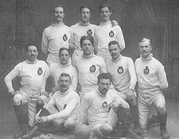
Image
Münsterheim FBV, after claiming the 11th Edition of the Brinterberger Liga

Doktor von Wackelstein eventually passed the SFV torch to Michael von Schilling-Schultz. The eldest son of a prominent Brinterberg family with deep VfdaRdB connections, some say he was unqualified for the position and only attained it through filthy nepotism, although his record of service within the ministerial world was pristine enough and he had previously proved himself a competent administrator within the cultural sector. However, there was no denying that von Schilling-Schultz was an unsuitably progressive progressive, and his tenure is marked by ambivalent feelings for many. While he retained the Code of Spectatorial Decency, its implementation was significantly more lenient. The SFV downsized the Game-Gastgeberstaffel, and transferred considerable responsibility for spectatorial propriety to the associations themselves. The result became a significantly more feisty atmosphere during games, with singing, waving of flags and other explicit gestures, serving of bier during games and overall heated emotions.

Wir sind die alten Jungs aus dem schönen Münsterheim, scheiß auf Dinkelbrot, Oxwaldstadt, BBB und Hügelheim

Example of chant from Münsterheim fans during the von Schilling-Schultz era

Some look back upon this period with nostalgic fondness, saying that the game had never experienced such a festive Rahm, and while this is no doubt true, the downside of this hands-off approach was an unvermeidlich increase in unwanted chaos. Drunken spectators often quarreled before, during and after games, and while the remaining GGs and the purpleshirts of the ßa never had any real trouble keeping the social order at large, there were several incidents that stand out for remarkable and unfortunate brutality. Amongst the most infamous incidents was the so-called Terrible Tuesday, which occurred during the 26th Brinterberger Liga, where Knackwurst taunts against the Dinkelbrot side they’d just beaten a few days before escalated into a fullblown fistfight in the park just off Neues Altes Rathausstraße causing a spectacle that would last long into the night and only reach its conclusion after four full squads of purpleshirts managed to disperse the rambunctious crowds by breaking a sufficient amount of legs and noses. Incidents like this, and the overall debaucherous atmosphere in the stands, tainted the game’s reputation amongst the upstanding people of Seebergundian society and was something of a setback in terms of the game acting like a socially cohesive force, and for a good few years old lines of conflict reemerged and there was once again loud whispers of discontent amongst the flâneurs on Schönes Brinterberg Allee, Rheingutstraße and Morgenmuffel Platz.

The situation was defused by several parallel developments. The Institute for Sozial Research, out west in the St. Paulina Quarter, released a scathing critique of institutionalized FußBall titled “From Subversion to Serialization: The Death of Radical Play,” arguing that despite the occasional emotional outburst, the Liga had domesticated the spirited potentiality found in guided mass hysteria and turned it into a tool of hegemonic pacification. Even the elderly Professor Adorableheim conceded that the Liga’s revolutionary potential was «moderate at best», and this contributed to cooling down the most inflamed FußBall opponents. At the same time, von Schilling-Schultz’s tenure as head of the SFV was brought to an early end after only nine years and he was replaced by the significantly more strict Doktor Amadeus Wingholter, who would go on to lead the SFV for the next thirty years.

Doktor Wingholter was a hardliner - some say an excessively reactionary reactionary - and swiftly centralized implementation of the Code of Spectatorial Decency, also making several revisions that severely limited the crowd’s abilities to express themselves (and took away the opportunity to drink bier at the games), including re-staffing the GG and broadening their authority in keeping the order around stadiums before, during and after games on Sundays and turned large parts of town into a fortress during the Cup-Wochen.

The von Schilling-Schultz years saw a shift in the center of gravity at the top of capital FußBall, where Felina and Gneis continued to be regular contenders but associations like VfB St. Paulina, Ballclub am Fluss and Knackwurst FußBall replaced earlier giants Münsterheim and Staad, who rather slumped into a deep decline. This era of south-western dominance carried over into the reign of Doktor Wingholter, and the lacking Liga fortune of northern and eastern associations - and to a large extent central ones, although SV Brinterberg would eventually become an outside challenger - resulted in local rivalries in these parts of town cooling off, together with a general decline in FußBall interest as such with decreasing attendance numbers. This is often pointed to as the first sign of the decline of the Vergoldete Age of Seebergundian FußBall.

The decline was gradual and it’s hard to pinpoint a date when the golden age was over, but most agree it was a fact during the later stages of the Wingholter era. Contributing factors, apart from an already developing lack of interest in certain parts of town, was that the game itself changed and evolved in different ways. Doktor Wingholter was of the mind that FußBall had grown far too intense, and further rules designed to slow the tempo of games were added. Among the most notable changes was no longer allowing substitutions and shortening the break between the first and second half to three minutes, making sure the tempo of games would naturally slow down towards the end, or players themselves slowing down throughout the game to last all 60 minutes. Doktor Wingholter also revised judging guidelines, making refereeing stricter and ushering in an era of unseen use of the tiered warning system. Punishments for philosophical misconduct, tactical nihilism and aesthetic violations skyrocketed, and this contributed to games being increasingly chopped up into short segments of actual play in between prolonged breaks for bookings or players getting a «talking-to». This eventually changed how the game was played, and over the years FußBall increasingly turned into a game based on strategic use of set-plays upon resuming play after breaks, making it almost resemble staccato foreign sports like gridiron or a sort of human chess. This fairly fundamental shift in how the game was played once again reshuffled the usual suspects at the top of the table, because some were clearly better at adapting than others. Previous perpetual underachievers BSV Mordorheim, from the central parts of town, rose to the top due to the coaching geniuses of Herman Frank and Friedrich Dohlmainzer, who pioneered a toxic blend of tactical cynicism and long throws that perfectly suited the «new» game, whereas old FußBall royalty like Felina and BSV Gneis failed to adjust and struggled to remain contenders.

Wingholter’s proper version of FußBall survived his tenure as head of the SFV - and Wingholter himself, but that’s a different story - becoming the unquestionable norm during the reigns of his successors for the following decades. FußBall, both the game itself and everything around it, grew into a well-oiled machinery and a pinnacle of efficiency. This also contributed to it growing in something even more important, namely respectability.”


11. Wherein we bear witness to the declining popular interest in FußBall, but also learn of an amusing cultural backlash with a renaissance of sorts for HändeFußy

“I suppose it was inevitable, really. FußBall had become respectable, a true part of society. And with respectability, came evermore bureaucracy, and with evermore bureaucracy, came greater predictability, and with greater predictability, came unavoidable staleness, and with that popular interest soon waned. FußBall, in a word, had become langweilig.

The increasingly geriatric leadership of Doktor Wingholter’s successors - men like Wolfgang Scraderknopf, Johann Müdemann and Thomas Pattsituation, none of whom had ever kicked a ball, but all had extensive experience in filing paperwork about balls - ushered in an era of what was generally - in the ministerial world and in Society - considered procedural perfection. The games themselves had evolved - or devolved, depending who you asked - into a finely choreographed and precise machinery, with more likeness in a train timetable than the passionate bouts of old. The stands were different as well. The Code of Spectatorial Decency had grown into a 1093-page document, complete with appendices, footnotes, and even a glossary of what was acceptable crowd facial expressions. The Game-Gastgeberstaffel, which at this point had been rebranded as the Spectatorial Harmonie-Korps, patrolled the stands in great numbers, ensuring that no one cheered too loudly.

Over time, the once-packed stands of places like Baden-Baden-Baden Park Stadia and Knackwurst Sportplatz became sparsely populated affairs, with the gentleman-officers of the SHK outnumbering the attending spectators, which now mainly consisted of select upstanding members of society and the odd senior citizen reminiscing about the glory days of Felina FußBall and the tactical genius of Ingemar von Taktik. Because the people, well, the people had largely moved on. The Brinterberger Beobachter, once the standout voice of FußBall enthusiasm, now ran its Liga section next to the obituaries and sudoku puzzles, and even the Brinterberger Cup, that grand old tournament of yore, had lost its luster. Children no longer wore team colors, grown men no longer argued in cafés, and the sidewalks outside Die Alte Bäckerei on Rheingutstraße remained unmolested.

Despite all this, the game persisted. Because this was Seebergundia, and once something becomes properly institutionalized, it cannot simply be undone. The SFV existed, the infrastructure was in place, the judges were trained and sock-length regulations were properly codified. And so, FußBall continued. Not because of any popular demand, but because it was now a properly Seebergundian activity, on par with Graeco-Roman wrestling, various equestrian disciplines and archery. The nature of the associations changed as well, as membership dwindled when older enthusiasts died and recruitment was almost nonexistent. The youth sections remained, because despite everything FußBall was still a great place to store your kids, but few stayed on for long and had moved on when they reached late adolescence. Ironically, since FußBall had started as a dirty activity of lowly workers and lesser academics, it was now the elites that pushed their children to persevere with FußBall beyond the standard Mittelstufe years, stating the required structuredness of understanding and properly executing FußBall at a higher level built character. This greatly contributed to associations from the heart of fair Brinterberg - Staad FBV, SV Brinterberg and BSV Mordorheim - gaining a significant advantage and developing into the undisputed kings of Post-Wingholter FußBall. Their advantage was mainly the ability to replenish their Liga squads with young blood, and there are several amusing anecdotes of young and energetic central teams completely obliviating an opposition made up of balding and bierbauched northerners, southerners, and men of east and west alike.

This push on young Men of Society to engage in FußBall led to an amusing social development, wherein these descendents of the men who had once banned the game of HändeFußy, now suddenly found themselves nostalgic for the very chaos their forebearers had tried to suppress. They gathered in salons and parlors, sipping herbal infusions and sekt, reading aloud from the old anthology Head, Shoulders, Knees and Toes: Radical Disruption and The Social Order by Klinkenklossstein, Diggerdeigerschtroumph, et al and lamenting the loss of an authentic Seebergundian spirit. They spoke of HändeFußy as a cultural treasure, an unrefined gem buried beneath layers of modernity and compromise, and eventually they started organizing private gatherings to try their hand at playing. They didn't play in the woods or on the mountain slopes, like in the old days, but rather in their parents' manicured gardens, and while I am sure the intention truly was to recreate HändeFußy in its original, anarchic form, their attempt at chaos and violence was only ever curated and aestheticized, complete with silk gloves and tailored knickerbockers. This fascination for the old game was not kept a secret for long, although the scandal was only modest and society mostly just rolled their eyes overbearingly at these silly boys. The critical theorists of the Institute for Sozial Research, down out west in the St. Paulina Quarter, couldn't help themselves, of course, and released a mean pamphlet about the nostalgic reactionism of the upper classes and how HändeFußy’s return was a clear symptom of a society unwilling to confront its own contradictions and therefore unable of subverting its hegemonic social structures.

This “renaissance" of HändeFußy was mostly just a ridiculous anachronism and not indicative of anything more than silliness, really. If it shows us anything, however, it would be that it was especially the young people of Brinterberg that had either completely abandoned FußBall, or yearned to escape it. Because, the younger generations - those born after the Vergoldete Age, who had never known the thrill of a properly executed 3-5-3 or the joy of a well-timed aesthetic violation - found the game utterly obsolete, if they even wasted a thought on it whatsoever. They preferred the syncopated rhythms of newfangled foreign imports like jazz music and improvised interpretive movement in dimly lit underground clubs on Kaufleute Platz, Ordensgemeinschaft Straße and Gneisbänderung Platz in the south, or along Gugelhupf Allee in the eastern Heilige Birgitta Quarter.

Fußball, to them, was a relic. A museum piece. A pastime for the elderly and the snobs. Still a weekly ritual, sure, but for the few and no longer for the many. Perhaps something their grandparents would discuss over lukewarm herbal infusions in the back rooms of the Vergoldete Mackrell Bäckerei on Grimmaische Straße, which was cornered with Gugelhupf Allee, but still a world away.”


12. Wherein we look closer at the idea of Seeberggundian Fußall competing internationally

”Many yesterdays had transpired between where we left off, and where we now jump back in. Forget about society tolerating jazz music and women wearing trousers, for example. At this point, the former was a celebrated artform, and the latter was the latest fashion amongst the ladies of society. We had experienced the Great Umwälzung, the reformation of the ßa with a dissolution of the purpleshirts, and The Gemeinschaft had even introduced television (SeeTV now gathered families in the evenings for a daily hour of wholesome entertainment). As is evident, many things had changed, although remarkably many other things had not. However, I suppose that is only natural for a deeply conservative society hidden high up in the Misty Berge. For our purposes, it is of relevance that one of the things that had not changed, was Fußball.

Withal, this is a truth with some need of modification. Because, strictly speaking, the continued lack of popular interest in Fußball did not necessarily mean a lack of development within Fußball itself. The game remained its stale and boring self, of course, but development in the world of FußBall was instead chiefly manifested by the growth of SFV bureaucracy. The organization now occupied not only the entirety of Haus Tolleknolle, but four of the adjacent buildings along Sehr Altes Pumpernickelstraße, just off Morgenmuffel Platz in the heart of fair Brinterberg. The different departments, sections, divisions, offices, teams, boards, branches and units were all busy enough and more or less self-sustaining in generating work for themselves and each other, and while the vast majority of the organization was completely content with administering the status quo, certain elements were of a different mind.

On the second floor of the newest addition to the expanded base of operations lay The Unit for Non-Radikal Innovative Implementation of Neues Ideas (TUNRIINI), who was tasked with careful consideration of cautiously original ways to potentially do things differently but more often than not conclude it was best not to (all public institutions had one of those back then; it was all the rage). Amongst the diligent civil servants in TUNRIINI were Erich Fromm and Augustus Messermann. These two men - the former a newcomer to the SFV-ranks and the latter a longtime servant - came to bond over their shared notion that FußBall, both as a game and as a societal phenomena, was not all that it could be, and both harbored a deep wish to bring back the crowds of old to the sidelines. Young Fromm had ambitions and visions and wanted to make a name for himself, whereas the elderly Messermann was a nostalgic historian with an obsessive interest in the Vergoldtete Age (which was yet to be named as such at this point in time; the official discourse of the day rather described those early years as «the troubled birth of FußBall» and described the old version of the game as «underdeveloped»).

Fromm and Messermann had several different ideas, which all shared the characteristics of cautiously and incrementally changing the game back towards the Pre-Wingholter days of the Liga’s heyday. They met with stiff opposition at every turn, and it was almost like the very existence of their unit was an elaborate joke, because clearly no one - least of all their superiors - seemed even remotely interested in actually doing things differently. Over a long career in the service of the SFV, they only ever managed to push one of their initiatives all the way to the point of implementation (lengthening the pause between the first and second halves from 3 to 5 minutes), and in that sense they never amounted to much. What they did do, however, was to give birth to an idea, and make sure that idea survived.

It all started with young Fromm bursting into their shared office room one day with determined eyes and a big smile. He had learned of something cooking abroad, out in the world beyond the great mountains. A competition was to be arranged that aimed to bring together the best FußBall players of different nations into distinct teams representing their home, and have them competing against one another, much like an international version of the Brinterberger Cup. The event was to be hosted somewhere far away in a place called The Boreal Islands, and an open call had been made for contestants to sign up.

It’s unclear how Fromm had been made aware of the preparations for the inaugural Independent Associations Championship, seeing as news of, or from, the outside world was still very sparse at this time. However, despite the Gemeinschaft being a deeply conservative society hidden high up in the Misty Mountains, they had never been utterly isolated. The exports of fine violins and pristine Critical Theory was a fundamental building block of Seebergundian society and had contributed to travellers and traders coming and going for as long as most could remember. Even though the authorities went to great lengths to keep visitors separated from the daily life of Brinterberg and the Gemeinschaft at large, every now and then the odd visiting libertine evaded standard protocol and before you knew it there were foreign influences roaming around the city and fraternizing with the locals (that’s how we got jazz music and the idea of females wearing trousers, for example).

It stands to reason that Fromm first caught wind of the IAC from one of these foreigners - some accounts say it was a strange man in a tweed dress and a burgundy tophat - but in the grand scheme of things it matters little. What did matter was that he and Messermann quickly identified the establishment of a national FußBall team, and having them play internationally, as a possibility of breathing some much needed popular interest back into Seebergundian FußBall. Having a national team jousting against foreigners had the added usefulness of boasting patriotism, Fromm and Messermann reasoned, and their suggestion would therefore likely be looked favorably upon by the government, they theorized. Perhaps the government of those days would’ve supported the idea, but alas, they never got the chance. Fromm and Messermann authored a memorandum detailing their suggestions and sent it to the unit higherups, where it was quickly shot down and deemed a far too radical change to the established order.

The duo was disappointed, but not deterred, and they made a point of submitting the same memorandum yearly for the remainder of their careers, where it continued to be shot down. However, time and exposure are funny things and would come to work in Fromm and Messermann’s favor, because as the years went by, their idea gradually lost its radical newness. The recurring suggestion to establish a national FußBall team started to become a familiar concept to their immediate superiors, which led to them not automatically resisting it, eventually approving of it and in the end the submission was cleared and passed on to the next level in the hierarchy, where it was resolutely shot down. And so time went by, and every other year or so the suggestion passed yet another hurdle and continued its climb towards the top of the SFV pyramid. Fromm kept at it after Messermann retired, and when Fromm eventually left the SFV to pursue a career in aromatherapy, he entrusted their mission to his younger colleague, Walter Freudlingen.

Freudlingen diligently continued his predecessors’ work, even though he hardly shared the latter's enthusiasm. Still, he was a loyal colleague and kept honoring his word by yearly submitting the memorandum, and it soon became a part of his routine, on par with visiting the dentist or traveling up to the northern lakes in the summer. Then, one day when Freudlingen entered his office, he was greeted by a letter proclaiming that the head of the SFV had decided upon the establishment of a national FußBall team. The memorandum had gone full circle and returned as an order from the top, and the order also prosaically specified that the new national team was to compete in the 21st Independent Associations Championship.

The tournament was to take place somewhere far away in something called Tanirinthia, and only a month or two after the order came down from the top. It quickly became apparent that the making of haste was a necessity, and since the establishing and administering of a national FußBall team did not fit neatly into the existing organizational chart, a new impromptu unit (called Internationales Endeavors, or IE for short) was therefore hastily strung together.


13. Wherein we chronicle the struggle of adapting to international standards.

”Our old acquaintance Walter Freudlingen was among those commandeered to man the new IE unit, along with the likes of Jürgen Dammholt from the Abteilung for Rules und Regulations, Willy Brandenburger from the Statistikamt and Angela Mortelz from the Department of Ligaangelegenheiten. They quickly set out to do further research, and immediately encountered challenges.

Dammholt and Freudlingen had been tasked with examining potential IAC peculiarities and soon learned that the game they called Football out there beyond the great mountains significantly differed from what they called FußBall at home beneath the great mountains. The games were no doubt kindred and had many overlapping aspects, but some of the differences were striking.

Firstly, they only had 11 players per team as opposed to the standard 12, and their warning system was less granular and only consisted of a yellow card (a warning) and a red card (leave the pitch!). While the yellow card seemingly did cover many different types of offenses, it was obviously used more leniently and the recipient was not forced to take any sort of timeout, although getting two yellow cards did equal a red one, which was similar to the Seebergundian brown card for repeating FußBall offenders. The ratio of open-play to the referee’s whistle blowing was staggering in favor of the former, and it seemed like the game of Football was primarily played continuously in a flowing session with short breaks of play, as opposed to FußBall’s short and strategically executed bursts of play between extended referee-induced breaks for rule violations. Football games were also to be played in the format of 2x45 minutes, and there was a 15 minute break, which seemed excessive. Above all and most importantly, by all indications it seemed Football was a far more intense, fast-paced and physical game than Seebergundian FußBall.

Someone remarked that this foreign version somewhat resembled descriptions of how FußBall was played in the pre-Wingholter era, and it was decided to seek the aid of Professor Baltazar Oxmaan of Universität Kripkenstein, who was a known historian of athletics with a special interest in the history of FußBall (it was professor Oxmaan that would subsequently define the era, and coin the phrase, of the Vergoldete Age of Seebergundian FußBall). Professor Oxmaan was fairly well-acquainted with Beyond-The-Berge-Football after having interviewed stray foreigners loitering in the Puddingkuchen-Quadrat, and he played a pivotal role in providing required insight and educating the SFV functionaries. The international version of the game was indeed more similar to the older version of FußBall, but there were still considerable differences that IE and the SFV quickly had to get acquainted with, and this also influenced their work with putting together a team.

It was Brandenburger and Mortelz, with their knowledge of the Brinterberger Liga and FußBall statistics, who were in charge of initially assessing possible players. Due to Football’s rapid and physical nature, they sought to map players with sufficient speed and strength. A vital part of this story, however, is that FußBall had been going through a steady decline over the years. Not so much in terms of popularity, which had consequently and reliably been low, but rather in the lacking regrowth of the capital associations.

Several of the old clubs had in practice gone defunct, due to a lack of members willing to administer the activities, and as a consequence the SFV had forced a series of mergers. Old southern clubs BSV Gneis, Felina FußBall and Knackwurst FußBall had been merged into one, named FußBall Club Felina, whereas the western contingent of clubs - Ballclub am Fluss, VfB St. Paulina and BSV Allmannsdorf - had become Ballspielverein St. Paulina, and the northern and eastern clubs - Münsterheim FBV, Dinkelbrot Fußball, BSV Oxwaldstadt, Baden-Baden-Baden FBV and VfB Hügelheim - had all been merged into a big association called Verein für Bewegungsspiele Brinterberg. Staad FBV, BSV Mordorheim and SV Brinterberg were still functional in their original form, but were a long way from their heydays in terms of quality. In general, few youngsters kept on playing beyond the traditional young adolescent years and even though the big association mergers had organizationally concentrated activities and recruitment, it was still the case that several of them at times struggled to field full teams for Liga and Cup games.

So, one problem was that the available player pool for a national team was very much limited, whereas another one was that the way FußBall was played produced players capable of short stints of actions but severely lacking in stamina. Despite these challenges, Brandenburger and Mortelz conducted a thorough assessment of all active capital club players and ended up with a list of 30 or so names. Spontaneously, one would perhaps have expected their «roster» to be dominated by players from Staad, Mordorheim and SV Brinterberg, both because it traditionally would have been prudent to award the honor of representing The Gemeinschaft to players from clubs closely connected with Seebergundian Society, but also because they were undoubtedly the most prominent and choicest FußBall teams in all the land. However, catering to the sensitivities of the old families from the heart of fair Brinterberg was less of priority now than it had been, and Brandenburger and Mortelz weren’t necessarily after the best FußBall players, but rather players who could plausibly perform well in a game of Football. A group of twenty players - fairly evenly spread out between the remaining capital FußBall associations - were appointed, and the IE contracted Ludvig Adorno to act as their coach. Adorno had previously coached the youth section in Dinkelbrot FußBall, before the club died and was merged into the new VfB Brinterberg, and was seen as a suitably pragmatic traditionalist.

It was Dammholt who suggested the new team be nicknamed The Horkenheimers - a tribute to the great mountains - as a way of fostering a sense of fraternal cohesion amongst the players, and this was universally supported within the SFV. Adorno and his Horkenheimers spent two weeks «learning» to play Football, under the advice of Professor Oxmaan, and then - in a most un-Seebergundian fashion - they travelled abroad. Their experiences in going abroad and encountering that strange world beyond the mountains for the first time is really worthy of being its own story, but let’s not dwell on the finer details and suffice to say The Horkenheimers struggled greatly in adapting to Football and did not fare well.”


14. Wherein the Seebergundian SuperLiga is born

“It was never a given, the continued existence of The Horkenheimers and their escapades abroad. The very establishment of a national FußBall team, not to mention actually sending them out Beyond-The-Berge, was clearly an anomaly in Seebergundian history. Alas, that is what happened.

The IE did a thorough evaluation of participation in the 21st IAC, and they concluded with a recommendation of continuing the Horkenheimer program. It’s unknown whether their driving force was to do with notions of sunk cost or thirst for revenge, but it matters little.

The most surprising thing of all was of course that the top management of the SFV, and its head Doktor Armin Kluckhohn, went along with their recommendation, but it is likely that he and they never really grasped the implications of it all at the time. The reports were filed and passed forward according to all the rules of the game, and no one seemed to mind or care. Perhaps it is an inherent vice of an overly bureaucratized society that sometimes things get lost in the mix, to speak in the parlance of our times, and in general that first IAC endeavour mostly went under the radar for top brass and simple peon alike, with none of the big newspapers or SeeTV (which at this point had significantly broadened their repertoire) reporting on it.

Doktor Kluckhohn was aware, of course, but he never seemed very interested and long insisted on keeping those Horkenheimers playing Football somewhere far-off a completely separate issue from the domestic game of FußBall being played at home, seeing no real natural connection between the two. This state of affairs no doubt acted as a hindrance for FußBall development, since Coach Adorno only had intermittent access to «his» players in the years between competitions, and when he was finally able to collect them all it was often a matter of once again un-learning their FußBall proclivities and re-learn how to best play Football.

As the years went by, and SFV functionaries performed their traditional post-IAC evaluation, at some point word of The Horkenheimers’ embarrassing performances was reported on in the capital press and eventually reached the halls of government, and the desk of Doktor Kanzler Hieronymus von Schopenhegel.

The good Doktor Kanzler - a traditionalist progressive with a slight reactionary bent - was not amused with learning about the shameful antics of The Horkenheimers, let alone learning of the existence of The Horkenheimers altogether. The rumours speak of a very tense cabinet meeting, where Doktor Kanzler Schopenhegel and others loudly complained about a rouge SFV establishing unauthorized national teams and having them represent The Gemeinschaft abroad without government blessing, only to be confronted with documentation unquestionably proving that they had in fact not only been informed, but also approved of, both the establishing of The Horkenheimers, their IAC participation, and even the evaluation reports recommending continuing the Horkenheimer program. In the cabinet’s defense, they handled a comically huge amount of case papers on a daily basis, and the mentioned documents had likely been presented to them as parts of voluminous packages of SFV orientations about changes in FußBall regulations, but still.

The scandal was a fact. The minister in charge of Seebergundian Leichtathletik - one Tilman Neuner, who later died in a bizarre bratwürst accident - was fired and Doktor Kanzler Schopenhegel himself resumed oversight of the SFV directly. The expected rolling of SFV heads (figuratively, of course, those times were behind us) surprisingly never occurred, and instead Doktor Kluckhohn was ordered in no uncertain terms to dedicate his resources towards redeeming the Gemeinschaft’s damaged reputation by making The Horkenheimers a competitive force, and preferably winning this Grässliches IAC competition so the World-Beyond-The-Berge could truly understand Seebergundian superiority. It was a pivotal moment, no doubt.

Doktor Kluckhohn was a loyal civil servant and diligently followed orders. All the Horkenheim players were to relinquish their usual FußBalling duties and train with Coach Adorno full time. At the same time, Doktor Kluckhohn was adamant that the Horkenheim program was still something different from domestic FußBall, and he wanted no cross-contamination whatsoever. The people out there Beyond-The-Berge could have their Football, and it was unfortunate that the situation required the continuation of the Horkenheim program, Doktor Kluckhohn reasoned, but the proper way of doing this was allowing Coach Adorno to train his men and win that dreadful foreign Wettbewerb as quickly as possible. Then, the niedrige World-Beyond-The-Berge would understand Seebergundian superiority, the improper Horkenheim experiment could be disbanded, and The Gemeinschaft and the SFV could go back to playing FußBall.

After eventually achieving some IAC success, Doktor Kanzler Schopenhegel developed a taste, not only for international acclaim, but for Football. The good Kanzler dismissed Doktor Kluckhohn as head of the SFV and appointed Walter Freudlingen from the IE in his place, giving the new director a radical order of restructuring the entirety of Seebergundian FußBall to make it compliant with the internationally recognized version known as Football. This, of course, kicked off an unprecedented organizational overhaul within the SFV and the world of FußBall, where rules and regulations needed to be updated, changed or scrapped, all the judges needed reschooling, copious amounts of information leaflets being produced and distributed, and teams and players learning to adapt to the new game (which was still, somewhat confusingly, to be called FußBall).

The most visible result of all this effort was the disbandment of the Brinterberger Liga and establishment of the Seebergundian SuperLiga (SSL). The most radical part of the new Liga - apart from the fact that for all intents and purposes it housed a different game than its predecessor - was that it widened its geographical reach and included not only the capital clubs, but also the associations from the smaller towns in neighboring valleys.

The reason for this expansion was twofold. For one, Coach Adorno had initiated a project of mapping potential Horkenheimers from provincial clubs and had found them full of potential. Secondly, with increasingly fewer capital clubs (Staad FBV had recently incorporated the remains of a BSV Mordorheim torn to pieces by an infected internal conflict) it was deemed necessary to include the provincial clubs to achieve a suitable number of participating associations.

Eventually, it was decided that the new SSL would contain 10 teams: FC Felina, BSV St. Paulina, VfB Brinterberg, Staad FBV, SV Brinterberg, SG Rothaus, SVG Kügeldorf, VfLü Bernsdorf, PuFg Hinterdorf, and the newly formed Associazione Calcio Casa Rossa, which was a club hailing from the town of Rothaus, founded by people from the Vulgo-Latinisch linguistic minority (discriminatory laws against these people speaking or otherwise communicating in their preferred tongue had recently been lifted, and they were suddenly just all over the place and in your face).

A pivotal moment indeed, when the Liga of today was born!


15. Wherein lacking popular interest persists and people in general engage themselves in most everything except FußBall

”As part of the transition from Altes FußBall to Neues FußBall and from the Brinterberger Liga to the Seebergundian SuperLiga, many aspects of the still functional Code for Spectatorial Decency was upheld, although the Spectatorial Harmonie-Korps was disbanded and things like singing and non-explicit handgesturing was to be allowed in the stands (inspired by IAC-experiences). This seemingly created perfect conditions for a return of flair and favor to the pitches of Seebergundia. But what of the people? A National Team, people travelling abroad, international humiliation and redemption, government scandals, the complete overhaul of FußBall, the establishing of a new Liga. The intricate Spannung of it all?

No.

As a citizen of fair Brinterberg, throughout the 21st, 22nd, 23rd and 24th IAC, and the birth of the SSL, you’d be forgiven if you walked the streets and thought it was just another Dienstag. Because it was. Because nobody cared. Nobody gathered around screens or newspapers to dissect the latest tactical catastrophe, discuss the latest rulings or stylish goals, no matter if The Horkenheimers did well or not. Nobody felt an inkling of loyalty or affection for, or interest in, the domestic teams (this might have been different out there in the provinces; who knows). The distinction between Football and FußBall had not taken hold, and people's view of FußBall as antiquated and extremely boring was still very much the norm.

No, throughout the astonishingly rapid developments in the world of FußBall, the citizens of Brinterberg were rather deeply engrossed in doing what they did best: being Brinterbergian.

Many were keeping themselves engaged in bureaucratic jousting, a time-honored tradition in the Gemeinschaft. Take, for instance, Günther von Tulpe, my good friend and tireless chairman of a northeastern tenant association, who is also a part-time detective. While The Horkenheimers were busy mostly losing and occasionally winning, and the SFV laboured with remodelling FußBall, Günther was busy debating the legality of pressure valves or the ethics of water charge adjustments by day, and solving the mystery of the missing Seebergundian words by night. “It’s not that interesting a story,” he said, after cracking the case wide open and receiving thunderous applause from the Council for the Preservation of the Seebergundian Sprache. But it was.

On the other side of town, the academics of the Institute for Sozial Research were as critical as ever, but had long since tired of rejecting FußBall as a bourgeois opiate, with prominent critical theorists like Walter Fromm and Helga Benjamin more interested in pointing out symptoms of late-stage Gemeinschaft decay or dissecting how the metaphysical implications of municipal water pressure or the semiotics of pastry layering was key to subverting hegemonic social structures, if they weren't laughing about feeble attempts by lesser academics to prove how Systemvertrauen was a legitimate mechanism for reducing sozial complexities. Hah! Nicht very kritisch at all! Among them was also another acquaintance of mine, young Hedvig Bergson, a visiting doctoral student and professional nihilist who proposed taking Critical Theory in a new direction, but likewise had no time for football. She was too busy proving that life is a biological error and that consciousness is a cruel joke played by evolution and that humanity’s only real option is to embrace Fistelförmig. A word that, in Brinterberg, denotes a hollow so deep it echoes through your soul and socks.

And the older kids and young adults among us? Had they taken notice of this rediscovery of the beauty of the beautiful game? Nein. The ones who perhaps first truly abandoned the game of FußBall had no time and interest in looking back. They were too busy dressing and dancing provocatively in the squares and salons of southern Brinterberg, on Gneisbänderung Platz or along Ordengeimschaftstraße, shaving their moustaches, refusing to wear tophats and chant along to the newest tunes from the Teutonic Tang Clan and their hypnotizing blend of critical theory lingo with equestrian slang and some heavy misogyny over chopped up violin beats. If they weren’t instead engaged in the theosophical revival scene in the rustikal Heilige Birgitta Quarter, being lured into all sorts of spiritual awakenings by bearded men and attempting to achieve direct communion with the übersinnliche Welt through smearing themselves with scented oils and practicing eurythmie, and other interpretive movements, in the parks, particularly Baden-Baden-Baden Park and Hügel Albrecht.

Even the national broadcaster, SeeTV, did initially not deem following the sudden renewal of FußBall very interesting. They instead tried to capture the attention of young people by producing hidden camera shows like Pardon My Straflosigkeit, which had been cancelled after three episodes, but not before traumatizing half the city with custard-based pranks and screaming “Abspritzen!” at innocent pedestrians. This changed after Doktor Kanzler Schopenhegel’s growing interest in FußBall, however, and SeeTV did air all Horkenheimer games from the 24th IAC. Not that anyone was watching, but still.

Of course, there were exceptions to the rule and some citizens of fair Brinterberg did embrace the «discovery» of Neues FußBall. It was just that their interest didn’t necessarily manifest in following The Horkenheimers or any of their local teams. No, it was rather playing the game Fußball Manager X3000, which was so immersive they preferred it to the real thing. Because here, they could implement their own tactical systems - The Tülpe mit Stinging Bees, Das Exploding Tannenbaum or The Bohrkopf Pyramid, so much more exciting than Das Alte 3-5-3 - and lead obscure teams like Roterlicht Knokschäft to virtual glory.

And the upstanding people of Brinterbergundian society? They had also mostly abandoned FußBall. There was simply not enough time to keep engaged in such prosaic nonsense when the very fabric of society was crumbling, mostly due to what all the other citizens of Brinterberg were up to and how the government was consistently failing at keeping all these unwanted developments at bay and allowing the degeneration of society. The cafés along Rheingutstraße and Philharmonisches Platz were filled with furrowed brows, murmured outrage and tingling pants over the latest essays, Tv-shows, new age gurus, provocative clothing and schrecklich music. The old guard spent their days sipping herbal infusions and twirling their moustaches in dignified rage, whispering about how it «was all out there now.»


16. Wherein the flame of Seebergundian FußBall is reignited, in no small part with the help of talking horses

”The modern FußBall Revolution was a quiet one, and remarkably went by more or less unnoticed by anyone not directly involved. That would all change however, when somebody suggested to Coach Adorno and the SFV that they should broaden their competitive arena and sign up for qualifications to the 100th World Cup and its preceding Baptism of Fire.

When SFV Director Walter Freudlingen initiated the process of signing up The Gemeinschaft for participation, a prudent functionary of the World Cup Committee alerted him to the fact that Seeberg was also eligible to take part in a competition preceding World Cup qualifications and open only to those who had never before competed in a WCC sanctioned event. It was called The Baptism of Fire, or BoF for short. Thereby, Coach Adorno and his Horkenheimers would not only try to qualify for The World Cup, but also travel to the distant lands of Arrosia to participate in the biggest ever rendition of the BoF.

In the time since The Quiet Revolution, things had begun to slowly settle in the world of Seebergundian FußBall. The SSL was now operational and the associations of Seebergundia had taken some massive strides in adapting to Neues FußBall. While the inaugural SSL title was claimed by capital powerhouse SV Brinterberg, the biggest surprise of the early SSL days was the prowess of the provincial associations, where SVG Kügeldorf clinched the very first runners-up position and northern neighbor PuFG Hinterdorf ended a respectable 5th, above such prestigious associations as BSV St. Paulina and VfB Brinterberg. Attendance was still very sparse, however, despite considerable SFV promotion about there being «a new game in town».

The Horkenheimers were to play their initial BoF games in a place called Banija, and they did fairly well. Sadly, this feat went by utterly unnoticed by the vast majority of people in Brinterberg. I viewed all three group games at the Altes Faxen kneipe on Schnickschnack Platz up in the Münsterheim Quarter, and while there was a few other patrons, I was indeed the only one even remotely interested in the SeeTV broadcast. I even had to plead with the proprietress to make her put on the games! Yet, this all changed when The Horkenheimers were to play in the baptismal Round of 64(!).

Because of talking horses.

Or, perhaps I should say talking ponies. Or Earth ponies, [/i]Pegasi[/i], and Unicorns, apparently coexisting with other talking animals like griffons, dragons, changelings, and buffalo! Yes, the host of The Horkenheimers’ next game was the ancient and strange lands of Equestria. A supposedly sorcerous dominion inhabited primarily by sapient ponies living in harmony through friendship and magic, this was a place where mastery of the arcane had created a prosperous and environmentally conscious society, that still waged their share of wars every now and then, if you are to believe publications like Einsamer Planet.

As exciting as talking horses are for me personally, the most important part about The Horkenheimers travelling to Equestria was that this also caught the eye of virtually everyone in The Gemeinschaft. The youngsters quickly fell madly in love with the adorableness of these ponies and youth fashion transformed overnight, whereas the critical theorists of the Institute for Sozial Research were deeply fascinated with the ponies’ egalitarian principles, the revolutionary potential of their Friendship concept, and how the use of magic could contribute to subverting hegemonic societal structures. And the upstanding people of Brinterbergundian Society, they were predictably horrified by it all.

Whatever your take, the result was that Equestria, The Baptism of Fire, The Horkenheimers and FußBall was suddenly on everyone's lips, and if I had the SeeTV broadcast of the group stage games to myself, I was hardly able to get through the door at the Altes Faxen when The Horkenheimers played their Ro64 game. Which they subsequently won! In extra time, no less.

And this is where it starts to get exciting, because once the talking ponies had lured people to the TV-screens, they were motivated to stay by the sheer excitement of their countrymen excelling at this strange and beautiful game (which was nothing at all like the FußBall they pictured in their minds). I would say it was around when Sebastian Grünberg - a VfB Brinterberg player playing with the precision of a man raised on military drills - scored both once and twice, securing Horkenheim progression, that the flame of FußBall passion was reignited amongst the people of fair Brinterberg (and the rest of the Gemeinschaft too, I imagine).

The Horkenheimers were subsequently eliminated down the line, and failed to qualify for the World Cup, but yes, the flame was lit. Today, attendance numbers for the SSL are increasing, children are again proudly wearing the colors of their preferred local team, and grown men and women have rekindled the age old tradition of discussing tactical failures and questionable refereeing in cafes and beer palaces.

User avatar
Seeberg
Attaché
 
Posts: 69
Founded: Apr 26, 2007
Father Knows Best State

Postby Seeberg » Mon Jun 08, 2026 7:25 am

On the Seebergundian SuperLiga

The Seebergundian SuperLiga is the premier, and only, domestic FußBall series in the Gemeinschaft. It encompasses the entire Gemeinschaft and consists of 10 teams playing each other twice, once at home and once away. You are awarded 3 points for a win, 1 point for a draw and 0 points for losses. The traditional Points of Panache system was disbanded when Seebergundia adapted to international standards. There is no second tier, and therefore no system for relegation or promotion. There are strict rules for ownership in place, with the model being association based. This means that at least 51 % of all associations - i.e clubs - must be collectively owned by the paying members of the association. 49 % of shares are open to other private citizens or business interests, but no one may own over 20 %.

There is no national Cup, as you often find in other places. There is, however, the Brinterberger Cup, which is contested yearly amongst the capital associations.

The Seebergundian Fußballverband (SFV), founded in the aftermath of the 25th Brinterberger Cup, is the governing body, charged with the responsibility for all things FußBall. They manage the rules, train and certify judges, administer the SSL and the Brinterberger Cup (and probably whatever kind of Cup-like competition they might be up to out in the provinces as well, I would assume), schedule fixtures, ensuring that the stands do not devolve into anarchy, The Horkenheimers and their occasional outings in international competitions, etc. etc. The SFV occupies not only the entirety of old Haus Tolleknolle on Sehr Altes Pumpernickelstraße, just off Morgenmuffel Platz in the heart of fair Brinterberg, but four of the adjacent buildings.

The capital teams contesting the Brinterberger Cup are:


ImageImageImageImageImage

In the SSL, they are joined by:


ImageImageImageImageImage
Last edited by Seeberg on Tue Jun 16, 2026 11:41 am, edited 2 times in total.

User avatar
Seeberg
Attaché
 
Posts: 69
Founded: Apr 26, 2007
Father Knows Best State

Postby Seeberg » Mon Jun 15, 2026 1:30 pm

The tenth annual Seebergundian SuperLiga

A new SSL season commences, the tenth in order. SV Brinterberg are our defending champions, having bested SG Rothaus on the final day of the season to beat Staad FBV to the title. The revival of FußBall - as in the ongoing revitalization of popular interest - continues, and last season could boast an average attendance figure of 2 400; a modern SSL era record.

Starting from the tenth season, the SFV has decided to allow SSL teams to compete in ICFC-tournaments. Therefore, the winners of this edition of the SSL will be playing to get into the Champions League next season, whereas the teams ending in 2-4 will be eligible for the Challengers Cup. The SFV is still debating whether to open up for FFI participation, and a group of SFV bureaucrats are currently investigating if ICFC regulations allows the winner of the Brinterberger Cup to compete in the Cup Winners’ Cup, the problem being that it is strictly speaking not a national cup.

As always, our teams competing in the SSL are:

Image
FußBall Club Felina

Nickname: The Fiddlers, Die Fiedlerbande, Stoltz of the South, Die Gneisbändiger, Die Würste.
Home Ground: Felina Stadion, located in Kreuzlingen Park, just south of Gneisbänderung Platz and in the nähe of Blechnerei Straße (capacity 2 500).
Geographical area/fanbase: The south of fair Brinterberg.
Main Rivals: Primarily BSV. St. Paulina and VfB Brinterberg, but also Staad FBV and SV Brinterberg from the heart of fair Brinterberg.
Last season: 3rd.
Colours: Yellow and lilac shirts (hoops), light grey shorts, light green socks.

Short history:
The Felina of today came about from a SFV-forced merger between the old southern clubs Knackwurst FußBall, Ballspielverein Gneis and Felina FußBall, which was effectuated in the latter years of the prolonged decline in popular interest of the Post-Wingholter era. The old southern clubs were the very first new FußBall associations founded in the aftermath of the work of the special Meersburgenheimstadt Commission, resulting in specific amendments to the laws governing athletic activities (founding and allowing The Bewegungsspiele FußBall, also known today as Altes FußBall). The southern clubs had a strong tradition for organization and innovation, and FC Felina has a proud FußBalling legacy. Primarily historically in the guise of the old teams and their prime years during the latter Vergoldete Age, but in parts also after the merger. The modern crest of FC Felina, and the colors they wear, is a montage of the three older clubs that together formed FC Felina; the grey stylized rendition of Gneisbänderung Platz of BSV Gneis, the yellow and lilac shield of Felina FußBall, and the three lightning-shaped sausages on light green of Knackwurst FußBall.

The renowned Felina Violin Fabrik owns 10 % of shares in the association, continuing a tradition harking back to the old days when the former club Felina FußBall was exclusively made up of employees at the factory. While the new FußBall Club Felina is not as intricately linked to Felina Violin as its predecessor, the factory is still a vital partner and often organises violin (and other classical music) concerts at home games, either at the start or during halftime. The south of fair Brinterberg is one of the places where the revival of interest in FußBall and the SSL have been most prominent, and FC Felina regularly play for a near full capacity Felina Stadion. Often, many of the Felina faithful even follow their team on away games, although of course never to the yokel teams of the neighboring valleys. The youth of the south is a fleeting bunch, however, and while FC Felina have fared better than others in capturing and retaining the attention of today’s kids, the stands still carry the distinct smell of middle-age and the elderly.

FC Felina plays offensively, usually in a 4-2-4 formation. After Seebergundia adapted to the international standards of Neues FußBall the team has been moderately successful in the modern SSL era, but had one of their strongest SSL seasons in the 9th edition, finishing 3rd.

Player to look out for:
Setting them apart from the other teams, FC Felina sport the first ever foreign player in their team. His name is Erik Klaerre, a midfielder from Paradystopia, and he arrived as a free agent from SC Oldetoun New Newetoun. Klaerre was originally meant to be playing already, but issues with residence and work permits prevented him from joining the squad properly last season. He’s a bit of a drunk, by all accounts, and has taken a perhaps overly enthusiastic liking to Seebergundian Bier. Nobody has ever seen him play, but word around Kaufleute Platz, along Ordensgemeinschaft Straße and on Gneisbänderung Platz is that he has a very delicate left foot.

Expectations:
FC Felina are clearly hungry for more. If they manage to get Erik Klaerre up and running, and off the bottle, and if he is indeed the playmaker they say he is, the upcoming season could be fun for the southerners. He’s old though, Erik Klaerre, closing in on 32, so the question is if he’s really up for it. Thankfully, Seebergundian FussBall is generally a bit slower than the international standard, and many of the players are even older than Klaerre, so maybe that’ll suit him.

Squad:
(Position, age, defining characteristic)
Johann Falkenheimer (GK, 27, selbstbewusst)
Ernst Adlersohn (GK, 34, sehnig)
Maximilian Horkenberg (D, 25, ausdauernd)
Theodor Weissmann (D, 36, leichtfüßig)
Friedrich Benenwald (D, 30, sprungstark)
Karl Rotenbach (D, 19, agil)
Wilhelm Geistmann (D, 25, kraftvoll)
Reiner Benjamin (D, 28, dominant)
Anton Breitenfeld (D, 22, standfest)
Rudolf Sternheim (D, 23, drahtig)
Maik Marcuse (M, 35, kreativ)
Marcus Negt (M, 18, dynamisch)
Alex Wingert (M, 19, reaktionsschnell)
Erik Klaerre (M, 32, taktisch) (PDT)
Otto Lindenberg (M, 23, unermüdlich)
Heinrich Morgenfeld (M, 26, fokussiert)
Ludwig Habersohn (M, 17, treffsicher)
Georg Adlerstein (M, 21, technisch)
Matthias Kronenberg (F, 32, aufmerksam)
Nikolaus Herzfeld (F, 24, nervös)
Sebastian Reichenwald (F, 22, konzentriert)
Daniel Rosenkranz (F, 23, schnell)
Felix Grünwald (F, 41, langsam)
Paul Eisenberg (F, 33, ruhig)

Image
Ballspielverein St. Paulina

Nickname: The Scholars, Die Studenten, Stoltz of the West, Boys-am-Fluss
Home Ground: Schönes Paulina Sportplatz on Benjamin Andauer Straße, nestled just by the eastern riverbank (capacity 1 500)
Geographical area/fanbase: The western parts of fair Brinterberg
Main Rivals: Primarily FC Felina, but also Staad FBV and SV Brinterberg from the heart of fair Brinterberg. To a lesser extent VfB Brinterberg.
Last season: 7th.
Colours: Red and old gold shirts (checkered), white shorts, white and grey socks.

Short history:
Much like fellow Brinterberg clubs FC Felina and VfB Brinterberg, the modern rendition of BSV. St. Paulina was founded on the back of a SFV-forced merger of older clubs during the latter years of the prolonged decline in popular interest of the Post-Wingholter era. In BSV’s case, it was the remnants of the western contingent of clubs - Ballclub-am-Fluss, Verein für Bewegungsspiele St. Paulina and [/i]Ballspielverein Allmannsdorf[/i] - that collectively became Ballspielverein St. Paulina. The western predecessor clubs date their founding to the early days of Seebergundian FußBall and experienced their heyday towards the end of the Vergoldete Age, particularly so VfB St. Paulina and Ballclub-am-Fluss, who were then regular Brinterberger Liga title contenders, together with southern clubs like Felina and Gneis. Unlike their southern colleagues, however, the western clubs managed to somewhat navigate Doktor Wingholter’s transformation of FußBall (harsh new rules designed to slow the tempo of games, no longer allowing substitutions, shortening the break between the first and second half, revised judging guidelines ushering in an era of unseen use of the tiered warning system, etc.) to remain relatively successful in the altered game, where matches increasingly became chopped up short segments of actual play, based on strategic use of set-pieces, in between prolonged breaks for bookings. Despite this moderate success, the western clubs were not spared from the deep decline in popular interest that characterized the Post-Wingholter era (due to the game having become insufferably boring).

BSV. St. Paulina is loosely connected with some of the academic institutions of the St. Paulina Quarter, somewhat continuing the tradition of VfB St. Paulina, which to a large extent only fielded students and lesser academics in their team. Universität Kripkenstein owns 5 % of association shares, and there’s a program in place where the university pays membership fees for students (unfortunately, interest is low). The revival of popular interest in Fußball has been less pronounced in the western parts of fair Brinterberg and at BSV St. Paulina, which continues to struggle to attract spectators to Schönes Paulina Sportplatz. For example, the club has largely failed to retain the short and surprising surge in youth interest that peaked during The Horkenheimers’ travels to the talking horses of Equestria. It also faces an image problem, wherein many residents west of the great river (the Allmannsdorf District) feel the club only represents the snobbish academic districts on the eastern bank rather than them. Which is no doubt true, in a way, but simultaneously almost two thirds of the BSV squad do hail from west of the river.

The modern crest of BSV. St. Paulina, and the colors they wear, is - as is the custom of the merged Brinterberger teams - a montage of the three older clubs; the grey and white wave of Ballclub-Am-Fluss, the stylized rendition of the western city wall of BSV Allmannsdorf and the parchment on old gold of Vfb. St. Paulina. The fourth quarter of the club crest, a golden crown on blue, was added upon the founding of the new club as a way of instilling a sense of shared history and identity; the concrete meaning and symbolism of the fourth quarter remains utterly unclear.

BSV. St. Paulina plays in a straight 4-4-2 formation and usually focuses on compact defending and counterattacks. They have been a perpetual underachiever in the modern SSL era, finishing last on six occasions. Last season was an improvement, landing them in 7th place.

Player to look out for:
Young Hermann Rosenfeld looks like a player that has a certain something making him stand out. He’s young, for one, which seems like a blessing in itself for the ageing gang of FußBallers making up the BSV. St. Paulina squad. There is more than youthfulness though, for word along the river is that Rosenfeld is both strong, fast and has that “eye for the game”, whatever that means. The few loyal BSV. St. Paulina fans have him painted as nothing less than a reincarnation of old Ballclub-am-Fluss hero Lothar-Lothar Mauseer, who was known for his thundering shots in the early days of FußBall and the Brinterberger Cup. It’s likely an exaggeration, because he impressed no one last year. That’s the thing with the young though, a lot can happen over the off-season.

Expectations:
With a little bit of luck, The Scholars might recreate last year’s feat of ending up in the lower midtable.

Squad:
Position, age, defining characteristic
Karl Kluge (GK, 35, souverän)
David Morgenstern (GK, 22, reaktionsschnell)
Justus Kirchheimer (D, 31, zweikampfstark)
Samuel Adler (D, 33, robust)
Jakob Silbermann (D, 42, abgeklärt)
Felix Rosenbaum (D, 25, dynamisch)
Leopold Grünberg (D, 28, laufstark)
Jonas Hirschfeld (D, 26, diszipliniert)
Oswald Bergmann (D, 36, standfest)
Jonathan Habermas (M, 34, spielintelligent)
Fritz Offe (M, 38, erfahren)
Alfred Sternwald (M, 31, präzise)
Hermann Rosenfeld (M, 20, kreativ)
Kurt Lindenauer (M, 32, passsicher)
Ernst Kornfeld (M, 40, willensstark)
Wilhelm Eisenstadt (M, 37, konstant)
Rudolf Hirschmann (M, 22, agil)
Georg Blumenfeld (F, 28, torgefährlich)
Heinrich Sternberg (F, 25, abschlussstark)
Jacob Apel (F, 34, effizient)
Friedrich Rosenberg (F, 19, explosiv)

Image
Verein für Bewegungsspiele Brinterberg

Nickname: Pentagram of the Slopes, Stoltz of the North and East, Disciples of Heilige Birgitta, Old Boys Nordosten
Home Ground: Silbernes Lärchenstadion on the slopes just north of fair Brinterberg, there’s a designated walking path up to the arena at the end of Kauderwelsch Straße (capacity 7 000).
Geographical area/fanbase: The northern and eastern parts of fair Brinterberg
Main Rivals: Staad FBV, SV Brinterberg, FC Felina, BSV St. Paulina.
Last season: 6.
Home Colours: Navy blue and white shirts (vertical stripes), white shorts, blue socks.

Short history:
In many ways the biggest of the capital clubs, but surely not in any of the ways that matter. VfB Brinterberg holds the record for most old clubs being forced into merging by the SFV, as it was founded by moulding together the remaining pieces of Münsterheim FußBallverband, Ballspielverein Oxwaldstadt and Dinkelbrot Fußball from the northern parts of fair Brinterberg, and Baden-Baden-Baden FußBallverein and Verein für Bewegungsspiele Hügelheim from the rustikal Heilige Birgitte Quarter in the east. There is so much FußBalling history crammed into this behemoth of the slopes! BSV Oxwaldstadt won the first ever officially sanctioned Brinterberger Cup, Münsterheim FBV quickly established themselves as one of the giants of early Seebergundian FußBall, and nowhere were the local rivalries as intense and festering, and the stands as boiling with festive passion, than in the north and east of fair Brinterberg.

The early years of the Vergoldete Age of Seebergundian FußBall was in many ways the age of FußBall in the north and east, although, in all honesty, perhaps mostly in the north. Dinkelbrot FußBall and BSV Oxwaldstadt focused on the Brinterberger Cup and became known “cup specialists”, claiming the coveted cup title on many occasions. Münsterheim FBV were the undisputed titans of the early years of the Brinterberger Liga and won six of the first ten seasons, with northern neighbours BSV Oxwaldstadt often claiming the runners up position. These were the years of relentless midfield engine Ingo Quartzheim, the nimble striker Johann Straussler and the tactical genius of aptly named Münsterheim coach Ingemar von Taktik. The latter invented the Das Alte 3-5-3 formation, which quickly became the premier way of playing FußBall during the Vergoldete Age. The latter years of the golden age saw a shift at the top, and both Münsterheim and the other northern teams slumped, whereas a new era of south-western and central dominance saw the light of day. This carried over into Doktor Wingholter’s transformation of FußBall and into the Post-Wingholter era, and the continuing lacking Liga fortune of northern (and eastern) associations resulted in local rivalries cooling off, together with a general decline in FußBall interest as such with decreasing attendance numbers. A fickle bunch, one might say, the northern and eastern fans, but this was also in many ways a potent forerunner to the more general decline in popular interest that characterized the Post-Wingholter era.

VfB Brinterberg is 100 % owned by its members, lacking any prominent sponsor/partner. Membership fees and grants from the government make up the considerable bulk of their financing, along with the odd extra donation from fans with a little bit of extra cash in the bank. The government grants are fairly substantial though, since they are based on membership and VfB sports the highest numbers of all the capital clubs. Which is ironic, because interest is generally low, few attend the games and you have to dig deep to find much enthusiasm for either FußBall or the Pentagram of the Slopes in the northern and eastern parts of fair Brinterberg. The massive Silbernes Lärchenstadion, which is also the national arena and home of The Horkenheimers, feels eerily deserted on VfB home games, with home spectators only numbering in the low hundreds. No, the revitalization of popular interest for FußBall is still not necessarily very advanced in the Nordost. Still, Vfb is the only team for people around these parts - which are some of the most heavily populated areas of fair Brinterberg - and there seems to be a certain stubborn pride making people retain their membership and pay their dues, despite not necessarily being very interested in FußBall as such. The club is truly the proverbial sleeping giant.

The crest of VfB Brinterberg is, as is the custom, a montage of the older clubs; the winged white serpent staff of Baden-Baden-Baden FBV, the red horse on white and moss green of Münsterheim FBV, the deer on white and indigo of Dinkelbrot FußBall, the black oak on yellow of BSV Oxwaldstadt and the stylized Hügel Albrecht lookout tower on red of VfB Hügelheim. At the club’s founding, there were attempts at designing a uniform blending elements and colors from all the old clubs, much like FC Felina and BSV. St. Paulina, but this proved unsuccessful because nobody could agree on a fair color distribution. Instead, VfB play in striped blue and white jerseys with white shorts and blue socks. The color scheme, which is also included in the club crest, is supposed to represent the mountains, although it is unclear in what way.

VfB Brinterberg continues to play Das Alte 3-5-3, which of course has been altered into a 3-4-3 after the adaptation to international standards of Neues FußBall. They have had little success to boast about in the modern era, with a third place finish in the 5th SSL season their highest acclaim to date. They ended in 6th place last year.

Player to look out for: “The Wingback who took off”, that’s the nickname young Siegfried Löwenthal was given after he neglected to accompany The Horkenheimers to the 92nd Cup of Harmony, which sparked considerable drama and mystery in fair Brinterberg, culminating with the uncovering of a crazed sex cult operating within the revived theosophical scene in the eastern parts of fair Brinterberg. Not that young Siegfried had anything to do with the cult, rather he had just gone to Kügeldorf, in the northern valleys, to spend time with his new girlfriend and when questioned about his absence he had simply claimed he thought nobody really cared about the Cup of Harmony. Anyways, he’s a very capable wingback, and perfectly suited for playing Das Alte 3-5-3, which is really a 3-4-3. He’s energetic and has been said to harbor a “will to play the game”, whatever that means. It’s a shame, really, that many of his teammates seemingly do not share the same sentiment.

Expectations: Likely 6th or 7th place. That’s usually where they end up.

Squad:
(Position, age, defining characteristic)
Leo Nachtigall (GK, 27, reaktionsschnell)
Jonaz Falkenberg (GK, 21, nervenstark)
Felix Grünwald (D, 24, zweikampfstark)
Jakob Lichtmann (D, 22, beweglich)
Siegfried Löwenthal (D, 23, robust)
Leopold Feigenbaum (D, 25, diszipliniert)
Sepp Gruber (D, 28, standfest)
Hannes Leitner (D, 26, laufstark)
Alois Hinteregger (D, 29, kampfstark)
Franzl Moser (D, 20, agil)
Toni Hofer (M, 24, kreativ)
Xaver Aigner (M, 23, passsicher)
Ludwig Eberhuber (M, 27, vielseitig)
Josef Huber (M, 22, dynamisch)
Konrad Obermeier (M, 26, spielintelligent)
Benedikt Stadler (M, 28, präzise)
Matthias Schwaiger (M, 21, leichtfüßig)
Heinrich Lindenfeld (M, 25, ausdauernd)
Georg Unterberger (F, 24, torgefährlich)
Lorenz Riedl (F, 23, abschlussstark)
Vinzenz Kogler (F, 22, explosiv)
Leonhard Brandstätter (F, 27, effizient)
Sebastian Grünberg (F, 20, unberechenbar)

Image
Sportverein Brinterberg

Nickname: Die Alte Dame, Stoltz of Brinterberg.
Home Ground: Brinterberg Wettkampfstätte, located just off Morgenmuffel Platz, where Schönes Brinterberg Allee and Rheingutstraße cross (capacity 1 800).
Geographical area/fanbase: The heart of fair Brinterberg
Main Rivals: Staad FBV
Last season: 1st.
Home Colours: Red shirts with white diagonal sash, white shorts, white socks.

Short history:
SV Brinterberg. The old lady of Brinterbergian sport. The oldest and most prestigious sports association in all of Seebergundia. Not the oldest FußBall association though, amusingly, for the old southern clubs robbed them of that accolade by founding themselves before SV Brinterberg expanded their already existing archery, Graeco-Roman wrestling and equestrian departments with a FußBall section. This they happily ignore though, down in the heart of fair Brinterberg, and instead highlight how they are the oldest continuous FußBall association in all the lands. Which is probably not quite true either, for allegedly both SVG Kügeldorf and SG Rothaus were early adapters when Altes FußBall was legalized. Of course, nobody cares about the provincials so for all intents and purposes SV Brinterberg is the oldest FußBall club still up and running.

Die Alte Dame has not always been a top FußBall contender, even though they claimed a Brinterberger Cup and a Brinterberger Liga title here and there during the Vergoldtete Age. It was rather in playing the transformed game of the Post-Wingholter era that SV really became a dominant force. At this point, FußBall had reached its height of respectability (and low in terms of popular interest) and it was now the elites that pushed their children to persevere with FußBall beyond the standard Mittelstufe years, stating the required structuredness of understanding and properly executing FußBall at a higher level built character. This greatly contributed to associations from the heart of fair Brinterberg, like SV Brinterberg, but also Staad FBV and BSV Mordorheim, gaining a significant advantage and developing into the undisputed kings of Post-Wingholter FußBall. Their advantage was mainly the ability to replenish their Liga squads with young blood, and there are several amusing anecdotes of young and energetic central teams completely obliviating an opposition made up of balding and bierbauched northerners, southerners, and men of east and west alike. Consequently, the heart of fair Brinterberg was mostly the only part of the capital not utterly entrenched in the prolonged decline in popular FußBall interest (although it made itself known here as well, for the game of those days was indeed incredibly boring).

49 % of shares in SV Brinterberg are owned by six of the oldest and most prominent Brinterberg families (divided so that no one owns more than 20 %; rules are important!), and while not overly generous they do indeed donate enough to make SV the indisputably richest FußBall association in Seebergundia, which has allowed SV to attract much talent from other parts of the capital. SV Brinterberg has always been the preferred team of Society, especially its upper echelons, and well-supported with a relatively large fanbase. We say relatively, because the nature of the elite is of course that it is never numerous, so while not necessarily large in quantity, the share of potential fans actively supporting the team is indeed great. Brinterberg Wettkampfstätte is always full on match days, but SV fans never travel to other locations on principle, which probably also have to do with the vast majority of them being more than slightly geriatric (the kids of central Brinterberg tend to favor Staad FBV).

SV Brinterberg managed, perhaps surprisingly, the transition from Post-Wingholter Altes FußBall to the international standard of Neues FußBall remarkably well. They play a 4-3-3 formation with an emphasis on possession and high press, and have been the outstanding giant of the modern SSL era, winning the inaugural season, the second, third and fourth, before losing out to rivals Staad FBV in the fifth and sixth. SV came back with a vengeance and won the seventh and ninth (we don’t speak of the eight season, where provincial yokels SVG Kügeldorf somehow managed to end on top; the horror).

The crest of SV Brinterberg is the same as it has always been for as long as anyone can remember: the white lion on red protecting the city from unwanted elements across the western river.

Player to look out for:
Sigismund von Drachenfels is not only a midfielder, but also the youngest son of Albrecht von Drachenfels, head of the very old and most prominent high society von Drachenfels family. That’s not entirely unique, several of the prominent and old families have had their boys playing for Die Alte Dame, and also today we have Karl-Theodor of the von Schönburgs, Ernst-August of the von Bismarck-Weissenfels, Georg of the von Wartenbergs, Dietrich of the von Lauenburgs and Rupert of the von Thalheims, just to name a few. Young Sigismund still stands out though, partly because talk along the cafes on Rheingutstraße and amongst the flaneurs on Morgenmuffel Platz is that he is an utterly remarkable player, and partly because the von Drachenfels are allegedly the richest family in all of fair Brinterberg, which is a bit exciting in its own right.

Expectations:
Anything but another title would be a massive disappointment. Not only have they retained their championship winning team from last year, but they have also poached a record number of three players from their competitors, namely forwards Oscar Honneth and Fritz Fromm, from FC Felina and VfB Brinterberg respectively, and also solid defender Georg Eisenberg from BSV. St. Paulina.

Squad:
(Position, age, defining characteristic)
Friedrich von Hohenberg (GK, 30, abgebrüht)
Maximilian von und zu Altenburg (GK, 21, aufmerksam)
Armin von Kracauer (D, 22, flexibel)
Leopold von Falkenstein (D, 23, widerstandsfähig)
Heinrich von Lichtenfels (D, 28, kräftig)
Karl-Theodor von Schönburg (D, 24, stabil)
Wilhelm von Greifenwald (D, 27, energisch)
Karsten Kompridis (D, 26, widerständig)
Georg Eisenberg (D, 25, robust)
Heinrich Lindenfeld (D, 30, belastbar)
Otto von Rheinsberg (M, 25, variabel)
Johannes von Eichenwald (M, 27, ideenreich)
Ludolf von Hardenberg (M, 34, abgeklärt)
August Lieblein (M, 28, zielstrebig)
Ernst-August von Bismarck-Weissenfels (M, 29, durchschlagskräftig)
Albrecht von Tannenberg (M, 32, dominantwirkend)
Georg von Wartenberg (M, 21, risikofreudig)
Sigismund von Drachenfels (M, 17, inspiriert)
Konrad von Silberstein (M, 26, ballschnell)
Nikolaus von Arnsberg (M, 29, effizient)
Rupert von Thalheim (F, 22, konterstark)
Dietrich von Lauenburg (F, 27, offensivfreudig)
Christian von Westerwald (F, 25, durchsetzungsstark)
Oscar Honneth (F, 30, gefährlich)
Fritz Fromm (F, 27, zielstrebig)

Image
Staad FußBallverein

Nickname: Der rote Gardist, Stoltz of The City, Die Wächter der Stadt
Home Ground: Brinterberg Wettkampfstätte, located just off Morgenmuffel Platz, where Schönes Brinterberg Allee and Rheingutstraße cross (capacity 1 800), and Knackwurst Sportplatz, just south of Kaufleute Platz (capacity 2 000).
Geographical area/fanbase: The heart of fair Brinterberg
Main Rivals: SV Brinterberg
Last season: 2th.
Home Colours: Red shirts, yellow shorts, red and yellow socks.

Short history:
Founded as a dedicated new FußBall association in the early days of Seebergundian FußBall - although considerably later than most of the other new associations - Staad FBV has always been the spiritual little brother of SV Brinterberg; If SV is the team of high society, Staad is the team of those who manage and administrate society’s pillars: the leading functionaries, the mid-level bureaucrats and the higher officers of the police force (Seebergundian Sicherheitsabteilung, or ßa for short); a class encompassing many people in a deeply conservative and over-bureaucratized society high up in the misty mountains. In terms of sporting prowess though, Staad FBV is likely one of the most continuously successful FußBall clubs in all of Seebergundia. They quickly established themselves as one of the most accomplished and dominant teams in the early years of Seebergundian FußBall, and upon the foundation of the Brinterberger Liga, Staad came away the winners of the inaugural season (controversially, we might add, due to use of the old Point of Panache system). Staad FBV then continued to be a strong contender, rivaling northern strongholds like Münsterheim and Oxwaldstadt in the early Liga days. While they could never really compete with the likes of Felina FußBall, BSV. Gneis and VfB St. Paulina in the era of south-western dominance, they, much like SV Brinterberg and neighboring club BSV Mordorheim, would once again excel in the transformed game of the prolonged Post-Wongholter era. At the cusp of the modern SSL era, Staad FBV incorporated the remains of BSV Mordorheim, which had been torn to pieces by an infected internal conflict. This was not a merger, if you are to ask Staad; only the lowlier teams from the outer parts of fair Brinterberg were forced to engage themselves in those sorts of things. Which is sort of true, but still.

Staad FBV sports a large and active membership base, and additionally the Freunde von Staad FBV Foundation owns 20 % of shares in the association. The foundation is like something of an extra, external, layer to the association and is really just a way of bypassing financing rules to facilitate extra fundraising amongst members. The Von Knorring Würst Factory owns an additional 10 %. Staad FBV is generally well-supported, and always plays in front of a full capacity crowd. Their home ground is the Brinterberg Wettkampfstätte, which they officially share with SV Brinterberg, but the latter always has priority if and when both teams are scheduled home fixtures on the same day. On those occasions, Staad FBV games are moved to the old Knackwurst Sportplatz in the south, which often contributes to attendance numbers dropping a fair bit. This is understandably a source of much annoyance for Staad, but they are and have always been a loyal ”little brother” and don’t make any fuss. They really want their own arena in the heart of fair Brinterberg, but of course there’s really no room to fit in a new stadium. Unlike many of the other capital clubs, Staad FBV have been relatively successful in enthusing the younger generation. Unfortunately, you might say, their young fans predominantly hail from the excessively reactionary elements of the youth scene, heavily linked to the purpleshirt revivalist scene, and fans usually wear purple scarves around the neck on the stands; you know what they say, not all youth supporting Staad have fascist tendencies, but most do. Fans of Staad FBV always travel to capital away games in large numbers, but obviously never to away games in the neighboring valleys; nobody wants to go there.

Staad FBV usually line up in a 3-5-2 formation, playing cautiously where they combine long spells of seemingly pointless possession with sudden and swift attacks from their capable wingers and strong forwards. They have been very competitive and successful in the modern SSL era, claiming the title twice in the fifth and sixth editions.

The crest of Staad FBV portrays the red guardsman on yellow beneath the city wall, and has remained unchanged since their founding. There were suggestions of incorporating black and white elements from BSV Mordorheim’s old crest, but that notion was swiftly put to death.

Player to look out for:
Markus Eberhardt is generally thought to be the most accomplished midfielder in all of the SSL. He was awarded player of the season last year, very deservedly. An academy product, he is the captain and anchor of Der rote gardist.

Expectations:
Staad came within an inch of the title last year, and surely they aim to rectify that and end on top this year. They’ve retained their team from last year, minus one or two retirements. Fresh recruits from their prestigious academy should help bridge that gap though.

Squad:
(Position, age, defining characteristic)
Hermann Grünstein (GK, 26, konzentriert)
Friedrich Albrecht (GK, 30, sicher)
Hans-Dieter Vogel (D, 23, zweikampfhart)
Dieter Schumann (D, 25, kräftig)
Ulrich Brenner (D, 31, standfest)
Friedrich Morgenfeld (D, 22, wendig)
Klaus Reinhardt (D, 35, abgeklärt)
Ernst Silberfeld (D, 18, leichtfüßig)
Wolfgang Hartmann (D, 28, belastbar)
Gerhard König (D, 26, energisch)
Rolf Dietrich Weber (D, 30, widerstandsfähig)
Heinrich Falkenberg (M, 31, variabel)
Kurt Adlerstein (M, 18, risikofreudig)
Ferdinand von Falkenberg zu Riedheim (M, 24, spielintelligent)
Stefan Klausner (M, 22, ballschnell)
Markus Eberhardt (M, 29, zielstrebig)
Caspar von Edelstein (M, 33, souverän)
Alfred Rosenstein (M, 19, inspiriert)
Wilhelm Hirschberg (M, 20, engagiert)
Jürgen Adler (M, 27, effizient)
Thomas Bergmann (F, 31, durchschlagskräftig)
Samuel Dornfeld (F, 24, konterstark)
David Sternbach (F, 28, gefährlich)
Karl-Heinz Stein (F, 32, abschlussstark)
Andreas Vollmer (F, 18, antrittsstark)

Image
Pferde- und Fußballgemeinschaft Hinterdorf

Nickname: Die Pferdejungen, Stoltz of Hinterdorf.
Home Ground: Hinterdorf Austragungsstätte (capacity 4 000)
Geographical area/fanbase: Hinterdorf and northernmost valley.
Main Rivals: SVG Kügeldorf, SG Rothaus, AC Casa Rossa.
Last season: 5th
Home Colours: Blue shirts, yellow shorts, blue socks.

Short history:
I’ve heard they mainly dealt with horses and equestrian activities, Pferdegemeinschaft Hinterdorf, before FußBall came along. After the work of the special Meersburgenheimstadt Commission contributed to founding and allowing The Bewegungsspiele FußBall (also known today as Altes FußBall), PG Hinterdorf added FußBall to their name and started playing the new game. Hinterdorf itself is also mostly known for their horses of both great beauty and utility. Few in Brinterberg would acknowledge it openly, but it is a poorly kept secret that the most pristine horses hail from the northernmost valley of Seebergundia. Other than that, it’s likely a ghastly and boring place, like most of everything outside of fair Brinterberg.

They do know how to play FußBall though, annoyingly, and PuFG Hinterdorf has definitely been one of the standout surprises of provincial FußBall after the adaptation of international standards, and the establishment of the SSL. Who knows what they’ve been up to between the founding of Seebergundian FußBall and the establishment of the SSL, but they’ve been a top 5 team in all nine seasons to date, which you must, however begrudgingly, acknowledge as deeply impressive. They’re the pride of their little forlorn hamlet, The Pferdejungen, and I’ve been told people usually come out in droves to fill the Hinterdorf Austragungsstätte. It is in any case a fact that they travel in support of their team, because large groups of inbred horse farming yokels draped in blue and yellow have become something of a fixture on the streets of fair Brinterberg on match weekends. It’s all rather unseemly.

Player to look out for:
Otto Stallknecht is supposedly one of the finest defenders in all of the land.

Expectations:
I suppose there’s no reason to expect them to do any worse than top 5.

Squad:
(Position, age, defining characteristic)
Heinrich Bauer (GK, 28, aufmerksam)
Friedrich Kaltzug (GK, 25, reaktionsschnell)
Denis Schweinitz (D, 25, zweikampfstark)
Wilhelm Pferdemann (D, 32, robust)
Otto Stallknecht (D, 28, standfest)
Gustav Hufner (D, 34, abgeklärt)
Alwin Ackerfeld (D, 26, beweglich)
Klaus Hirschbauer (D, 23, diszipliniert)
Dietrich Kornmeier (D, 34, widerständig)
Sepp Weidenhof (D, 23, laufstark)
Johann Pferdner (M, 27, passgenau)
Rudi Mistbauer (M, 22, dynamisch)
Franz Stallinger (M, 30, vielseitig)
Egon Haferkamp (M, 24, kreativ)
Ludwig Ochsenknecht (M, 29, zielstrebig)
Werner Feldmann (M, 26, konstant)
Bruno Hufschmied (M, 31, kräftig)
Karl-Heinz Wiesenberg (M, 25, präzise)
Ernst Karrenbauer (M, 33, willensstark)
Udo Pferdekopf (M, 28, energisch)
Manfred Tannenhof (M, 34, durchschlagskräftig)
Gerd Weideknecht (M, 23, risikofreudig)
Hermann Zuchtmann (M, 30, belastbar)
Volker Ackerloh (M, 21, leichtfüßig)
Berthold Rappenhof (M, 35, souverän)
Theo Stallbaum (M, 27, effizient)
Per Steuermann (F, 23, torgefährlich)

Image
Sportvereingenossen Kügeldorf

Nickname: The Ziegen, Stoltz of Kügeldorf.
Home Ground: Kügeldorf FußBall Arena (capacity 3 000)
[b]Geographical area/fanbase:
Kügeldorf and the upper northeastern valley.
Main Rivals: PuFG Hinterdorf, SG Rothaus, AC Casa Rossa.
Last season: 4th.
Home Colours: Brown shirts, gold shorts, brown socks.

Short history:
Apparently it’s all about agriculture, and goats in particular, over there in the upper northeastern valley. They say a large share of the food we consume originates from Kügeldorf and the surrounding lands, but I can’t recall seeing my dinner or cakes labeled as such. And FußBall. They’re annoyingly good at the beautiful game up there, which seems like a fundamental contradiction speaking of something which is very likely a terribly ghastly and ugly dump of a town. Gott knows what they’ve been doing since SVG Kügeldorf added a FußBall department back in the very earliest days of Seebergundian FußBall, but no one can deny they’ve excelled at playing it, or at least the Neues FußBall of international standard. They might’ve been proficient at Altes FußBall as well, for they’ve styled themselves Könige der nördlichen valleys for as long as anyone can remember, or so I’ve been told. But really, who cares.

We’ve mentioned goats, and that truly seems to be a big thing. It’s on their crest, it’s their nickname (yes, literally, just The Goats; so incredibly common), a goat cheese manufacturer owns 20 % of the shares and the fans have a tradition called the Gebrüll der Goat, where the lot of them bleat frantically - Määäääääääääääääääh - for an extended period of time during games to intimidate opponents. They’ve been banned from doing it while in the capital, thankfully, due to complaints from SV Brinterberg, but apparently they’re still at it at home in the Kügeldorf FußBall Arena and while traveling the other valleys. They’ve been runners up on several occasions and even won the eight edition of the SSL, the only team besides SV Brinterberg and Staad FBV to have claimed that honor; it’s an affront to good taste and just plainly ridiculous.

Player to look out for:
Berthold Ziegenacker won the Golden Stiefel last year, outscoring the closest competition with 5 goals.

Expectations:
I suppose it is pointless to deny that these goats will once again be a contender.

Squad:
(Position, age, defining characteristic)
Helge Ehrenstein (GK, 22, zweikampfstark)
Friedrich Bockmann (GK, 24, standfest)
Wilhelm Ziegenbauer (D, 23, robust)
Otto Stallbock (D, 25, widerstandsfähig)
Klaus Ziegenknech (D, 21, diszipliniert)
Dietrich Bockfeld (D, 26, abgeklärt)
Helmut Ziegenfurt (D, 23, beweglich)
Heinrich Ziegenhof (D, 20, laufstark)
Gustav Geißler (D, 22, dynamisch)
Alwin Zickhof (D, 19, agil)
Sepp Geißenbauer (D, 23, passsicher)
Johann Ziegenstall (M, 20, variabel)
Rudi Bockwirt (M, 24, kräftig)
Franz Ziegenberger (M, 22, kreativ)
Egon Geißbock (M, 25, zielstrebig)
Ludwig Stallgeiß (M, 21, ausdauernd)
Werner Ziegenkamp (M, 23, effizient)
Bruno Bockschmied (M, 26, belastbar)
Karl-Heinz Ziegenwald (M, 24, präzise)
Ernst Bockhof (M, 25, willensstark)
Udo Zickermann (M, 19, leichtfüßig)
Manfred Geißhofen (M, 22, engagiert)
Gerd Ziegenloh (M, 20, risikofreudig)
Hermann Bockweiler (M, 26, souverän)
Volker Geißner (F, 23, spielintelligent)
Theo Bockbaum (F, 21, vielseitig)
Norbert Geißkamp (F, 24, konstant)
Tom Selig (F, 21, abschlussstark)
Berthold Ziegenacker (F, 25, torgefährlich)
Rolf Bockental (F, 22, explosiv)

Image
Sportgemeinschaft Rothaus

Nickname: Das Haus, Stoltz of Rothaus, Haus am See.
Home Ground: Rothäuser Stadion (capacity 5 000)
Geographical area/fanbase: Rothaus and the lower northeastern valley.
Main Rivals: AC Casa Rossa, PuFG Hinterdorf and SVG Kügeldorf.
Last season: 8th.
Home Colours: Yellow, blue and red shirts (checkered), white shorts, yellow, blue and red socks (horizontal stripes).

Short history:
Ah, Rothaus of the lower northeastern valley. Das Haus am See! Unlike many other places littering the neighbouring valleys, Rothaus is almost a town, of sorts. The location is pristine, or so I’ve been told, right by a silver lake with a mountain backdrop. Not the true Horkenheim mountains, of course, but still. There are real houses here, like the kind you find in proper cities. Not as nice, surely, but still. I hear there’s even a Gothic Cathedral, but don’t take my word for it. What I do know is that they excel at brewing bier up there. Rothaus Bier is even sold in the cafes and bierpalatzen in the heart of fair Brinterberg, along Rheingutstraße, Zuzuzurren Straße, Mohnkloß Allee and on Philharmonisches Platz.

However, what is perhaps most redeeming about Rothaus is that they understand the natural order of things in terms of FußBall, namely that the provincial teams are really just there to fill out the vacant spaces and not cause too much fuss. They’ve been playing FußBall in Rothaus ever since the game was allowed, and after the transition to Neues FußBall and the SSL came about, SG Rothaus have been the most pleasant provincial team, utterly performing according to expectations. SG Rothaus is a dependable team in this regard, seeing as they rarely venture too far from the bottom spots of the table. That’s not to say that the people of Rothaus do not cheer for their team, quite the opposite. They say Rothäuser Stadion often comes alive with massive crowds when Das Haus play, even though they often lose, and there’s a certain dignity in that. Since the start of the SSL, SG Rothaus has developed a fierce rivalry with the new upstart association AC Casa Rossa. Apparently, things can get rather feisty when the two meet.

Player to look out for:
Xaver Rainle is one of many new, young players in the SG squad this season. Fielding the undoubtedly oldest team of the SSL last year, many of their old servants have retired their FusßBall boots and taking their place are a big group of academy graduates. Young Xavier is allegedly the most capable of the lot, however since this is Rothaus we’re talking about that probably doesn’t mean much.

Expectations:
Good old, dependable SG Rothaus will likely end up somewhere between 7th and 10th, like Gott always intended it.

Squad:
(Position, age, defining characteristic)
Franz Gütle (GK, 18, reaktionsschnell)
Berthold Schnaitmann (GK, 32, abgeklärt)
Carsten Uiberreither (D, 30, zweikampfstark)
Sepp Häberle (D, 19, agil)
Karl Maierhofer (D, 20, robust)
Hermann Wiesenmaier (D, 17, leichtfüßig)
Uli Ketterle (D, 34, standfest)
Rudi Dengler (D, 32, widers­tandsfähig)
Alfons Häusle (D, 19, beweglich)
Gottlieb Ackerle (D, 26, diszipliniert)
Manfred Stallmaier (D, 27, kräftig)
Eugen Riehle (D, 17, wendig)
Helmut Schafwirt (M, 24, dynamisch)
Jakob Hofacker (M, 32, souverän)
Isaak Hencke (M, 29, spielintelligent)
Theo Bächle (M, 27, variabel)
Norbert Fildner (M, 19, kreativ)
Kurt Feldhäusle (M, 29, passgenau)
Erwin Tannhof (M, 25, ausdauernd)
Martin Zoller (M, 18, leichtfüßig)
Dietmar Kinzler (M, 23, zielstrebig)
Xaver Rainle (M, 17, risikofreudig)
Willi Güntner (F, 28, torgefährlich)
Volker Bräunle (F, 25, effizient)
Lothar Wiesle (F, 19, explosiv)
Hannes Riedlinger (F, 21, antrittsstark)
Georg Aicherle (F, 38, abgebrüht)
Otmar Hofmaier (F, 18, unberechenbar)
Sigmund Dörfle (F, 19, abschlussstark)

Image
Associazione Calcio Casa Rossa

Nickname: Gli stalloni bianchi, L’orgoglio della casa rossa, Bella Ciao
Home Ground:St. Neulingen Sportplatz (capacity 2 000)
Geographical area/fanbase: Casa Rossa (Rothaus)
Main Rivals: SG Rothaus.
Last season: 9th.
Home Colours: White shirts, red shorts, white socks.

Short history:
Associazione Calcio Casa Rossa is the youngest of all Seebergundian FußBall associations, founded just 12 or so years ago by people from the Vulgo-Latinisch linguistic minority who primarily dwell up in Rothaus and around the lower northeastern valley. I suppose they’ve always been there, but it wasn’t until quite recently people really started to notice properly. That’s probably because there has been draconian discriminatory laws against these people speaking or otherwise communicating in their preferred tongue since forever, and these have just recently been lifted a decade or so ago. And now they’re suddenly just all over the place and in your face, at least that’s what the Rothäuser are saying.

The White Stallions have had a hard time in the SSL, never ending above 8th place. A prudent provincial team, in that regard, much like their older neighbor SG Rothaus. Unlike SG Rothaus, however, the AC fans - of which there are surprisingly many - are extremely loud and unsuitably energetic and frantic, insisting on banging on drums and chanting nonstop during games. The drums have been banded from the capital arenas, but they’re still allowed to sing, which they continue to do. It’s undoubtedly annoying, but at the same time oddly catching. You will struggle to find any Brinterbergian admitting it, but I suspect a fair few rather envy the atmosphere.

Seemingly, AC Casa Rossa’s main concern is beating SG Rothaus, which they often do

Player to look out for:
Salvatore Esposito, team captain and capable goalkeeper.

Expectations:
With the same squad as last year, it would be very surprising if AC managed to break their curse and do any better than 8th. But the important thing is beating SG Rothaus, of course.

Squad:
(Position, age, defining characteristic)
Gianni Conti (GK, 33, affidabile)
Salvatore Esposito (GK, 27, reattivo)
Luigi Bianchi (D, 34, roccioso)
Antonio De Luca (D, 29, disciplinato)
Marco Ferraro (D, 31, tenace)
Franco Greco (D, 36, esperto)
Vincenzo Russo (D, 28, resistente)
Paolo Mancini (D, 32, solido)
Gennaro Coppola (D, 30, combattivo)
Domenico Carbone (D, 27, dinamico)
Alessio Ricci (D, 26, rapido)
Pietro Lombardo (M, 35, intelligente)
Giovanni Gramsci (M, 30, creativo)
Fabio Moretti (M, 28, versatile)
Carmine Santoro (M, 33, preciso)
Roberto Serra (M, 31, costante)
Matteo Barbieri (M, 25, agile)
Stefano Rizzo (M, 34, determinato)
Claudio Villa (M, 29, tecnico)
Massimo Romano (M, 36, esperto)
Ezio Marchetti (M, 27, energetico)
Angelo Longo (F, 32, pericoloso)
Davide Gallo (F, 26, veloce)
Michele Fiore (F, 30, efficace)
Enzo Palumbo (F, 34, cinico)
Giorgio Fontana (F, 28, imprevedibile)
Bruno Rinaldi (F, 31, potente)
Alberto Prosciutto (F, 29, finalizzatore)

Image
Verein für Leibesübungen Bernsdorf

Nickname: Stoltz of Bernsdorf.
Home Ground: Bernsdorfer Nebenplatz (capacity 2 000)
Geographical area/fanbase: Bernsdorf and the southwestern valley.
Main Rivals: No one, really.
Last season:10th.
Home Colours: Blue and white shirts (checkered), white shorts, white socks.

Short history:
I’ve heard people say it’s beautiful there, but I wouldn’t take their word for it. Little is known of the southwestern valley, really. It’s widely thought to be a ghastly backwater overrun by wildlife and hicks. Some say they farm, and that they supply us with food. Oh, really, I thought that was Kügeldorf? Make up your mind. Anyways, Gott knows what they’ve been doing since VfL Bernsdorf started playing Altes FußBall and eventually transitioned to Neues FußBall, but clearly not striving to excel at the beautiful game because they’re frankly terrible. I don’t think they’re very passionate about FußBall out there either, for unlike their northern yokel compatriots I’ve never seen a Bernsdorfian draped in blue and white on the streets of fair Brinterberg, and for this we should be thankful.

Player to look out for:
I can’t in good conscience single out anyone. They’re all terrible.

Expectations:
They have only ever escaped 10th place when BSV. St. Paulina had a particularly off season. Don’t bet on that happening this time around.

Squad:
(Position, age, defining characteristic)
Klaus Kuhlmann (GK, 34, abgeklärt)
Jürgen Sohn-Rethel (GK, 29, nervenstark)
Hein Tiedemann (D, 36, robust)
Wilke Jürgens (D, 31, zweikampfstark)
Fritz Bollmann (D, 38, abgebrüht)
Harm Petersen (D, 27, beweglich)
Diedrich Kuhlke (D, 33, standfest)
Claus Benthin (D, 30, diszipliniert)
Johann Redmann (D, 35, widerstandsfähig)
Gerd Tamm (D, 28, laufstark)
Uwe Mählke (D, 32, kräftig)
Hinnerk Voss (M, 34, souverän)
Karl Bröker (M, 29, variabel)
Ewald Krüger (M, 37, konstant)
Hannes Lübke (M, 30, spielintelligent)
Friedel Dargatz (M, 33, zielstrebig)
Otto Wichmann (M, 28, präzise)
Ernst Teschke (M, 36, abgeklärt)
Manfred Rusch (M, 27, dynamisch)
Horst Lemke (M, 31, effizient)
Bernd Sagemann (F, 35, torgefährlich)
Rolf Hinz (F, 30, abschlussstark)
Kurt Pahlke (F, 38, abgebrüht)
Willi Domscheit (F, 26, explosiv)
Gerhard Zander (F, 33, durchschlagskräftig)
Lothar Reddig (F, 29, konterstark)
Heinz Guske (F, 32, gefährlich)

User avatar
Seeberg
Attaché
 
Posts: 69
Founded: Apr 26, 2007
Father Knows Best State

Postby Seeberg » Tue Jun 16, 2026 9:24 am

10th Seebergundian SuperLiga: First third of the season - Matchdays 1-6.

Oh all the trepidation and motivation and determination and celebration and anticipation in preparation of the tenth Seebergundian SuperLiga and now we’re already a third into the thick of it.

And what a start to the season it has been, where almost everything seems the complete opposite of how it should be! Indeed, after the first six games, let’s just say this is not at all what we expected. Oh sure, Staad FBV on top and FC Felina chasing them seems fairly according to plan, but if you had gone around the streets of fair Bringerberg telling people that SG Rothaus and BSV. St. Paulina would achieve most uncharacteristically strong starts to the season, resting in 3rd and 4th place, or that VfLü Bernsdorf (!) would be sitting in sixth, the good people of the capital would have laughed and pointed fingers at your obvious delusion.

Alas, this is the state of things.

To make matters worse, you could well argue that these are not the most shocking developments. For what has happened to Die Alte Dame? SV Brinterberg find themselves in 9th place, with only 6 points to their name, whereas perennial contenders SVG Kügeldorf are dead last with their measly haul of 5 points.

The feeling of a world out of joint made its mark already on the very first matchday, when SV Brinterberg welcomed SG Rothaus to a full capacity Brinterberg Wettkampfstätte and the good people of the city expected a festive occasion and a customary 3 points to begin the road to success. Instead, SG Rothaus came out swinging and seemed to play with none of the respect you would’ve expected the SSL champions to be afforded. It’s these new Rothäuser kids, nothing like the sluggish men they replaced and young Otmar Hofmaier managed to beat the SV Brinterberg defence twice to seal the deal for Das Haus. While the SV players were not booed at the final whistle - the upstanding people from the heart of fair Brinterberg would never degrade themselves to engage in that sort of behavior - the disappointment and disapproval of the crowd was palpable.

Double wins, away at SVG Kügeldorf and at home against VfLü Bernsdorf, seemed to indicate that the opening blunder was merely an exception to the rule, but Die Alte Dame then proceeded to lose three games in a row against PuFG Hinterdorf, BSV. St. Paulina and FC Felina. You don’t have to be any sort of profound FußBall expert to see that they are sweating down there in the heart of fair Brinterberg and likely working tirelessly to find a way of turning things around.

At the top, Staad FBV opened with a comfortable win against SVG Kügeldorf (played at Knackwurst Sportplatz, since SV Brinterberg occupied the Brinterberg Wettkampfstätte) and then produced three draws against VfLü Bernsdorf, PuFG Hinterdorf and BSV. St. Paulina, before ending the first third of the season with wins against FC Felina and VfB Brinterberg. Looking steady for Der rote Gardist.

Second placed FC Felina had a similar run, with an opening home win against PuFG Hinterdorf, a share of the points with BSV. St. Paulina and VfB Brinterberg, before losing to Staad and then beating SV Brinterberg. Erik Klaerre - the only Ausländer in the SSL - played none of Felina’s opening games due to an injury sustained in a bizarre flamküchen accident. He’s reportedly on the mend.

Of course, it is early days still, and much can change. However, our key takeaways from the first third are that Staad FBV looks predictably strong, Die Alte Dame looks worryingly shaky, the kids of SG Rothaus look inappropriately dangerous and SVG Kügeldorf seems to finally have understood their place in the natural order of things.

POS	Team	        P	W	D	L	F	A	GD	Pts
1 Staad FBV 6 3 3 0 12 8 4 12
2 FC Felina 6 3 2 1 9 7 2 11
3 SG Routhaus 6 2 3 1 10 9 1 9
4 BSV St. Paulina 6 2 3 1 4 3 1 9
5 PuFG Hinterdorf 6 2 2 2 8 9 -1 8
6 VfLü Bernsdorf 6 2 1 3 6 6 0 7
7 VfB Brinterberg 6 1 3 2 11 11 0 6
8 AC Casa Rossa 6 1 3 2 10 11 -1 6
9 SV Brinterberg 6 2 0 4 5 8 -3 6
10 SVG Kügeldorf 6 1 2 3 7 10 -3 5

Match days 1-6.
MD1
VfB Brinterberg 1 1 AC Casa Rossa
PuFG Hinterdorf 1 0 BSV St. Paulina
SV Brinterberg 0 2 SG Routhaus
VfLü Bernsdorf 0 1 FC Felina
Staad FBV 4 2 SVG Kügeldorf
MD2
BSV St. Paulina 0 0 VfB Brinterberg
SG Routhaus 2 2 AC Casa Rossa
FC Felina 2 1 PuFG Hinterdorf
SVG Kügeldorf 0 1 SV Brinterberg
Staad FBV 2 2 VfLü Bernsdorf
MD3
VfB Brinterberg 5 3 SG Routhaus
BSV St. Paulina 0 0 FC Felina
AC Casa Rossa 2 2 SVG Kügeldorf
PuFG Hinterdorf 1 1 Staad FBV
SV Brinterberg 1 0 VfLü Bernsdorf
MD4
FC Felina 2 2 VfB Brinterberg
SVG Kügeldorf 0 0 SG Routhaus
Staad FBV 0 0 BSV St. Paulina
VfLü Bernsdorf 2 0 AC Casa Rossa
SV Brinterberg 0 1 PuFG Hinterdorf
MD5
VfB Brinterberg 1 2 SVG Kügeldorf
FC Felina 1 2 Staad FBV
SG Routhaus 1 0 VfLü Bernsdorf
BSV St. Paulina 2 1 SV Brinterberg
AC Casa Rossa 4 2 PuFG Hinterdorf
MD6
Staad FBV 3 2 VfB Brinterberg
VfLü Bernsdorf 2 1 SVG Kügeldorf
SV Brinterberg 2 3 FC Felina
PuFG Hinterdorf 2 2 SG Routhaus
AC Casa Rossa 1 2 BSV St. Paulina
Last edited by Seeberg on Tue Jun 16, 2026 11:47 am, edited 2 times in total.

User avatar
Seeberg
Attaché
 
Posts: 69
Founded: Apr 26, 2007
Father Knows Best State

Postby Seeberg » Fri Jun 26, 2026 2:48 am

10th Seebergundian SuperLiga: Second third of the season - Matchdays 7-12.

Zurück zum Spiel!

As spring slowly starts making way for summer, the SSL marches on with its second third of the season. The first leg of the decennial SSL anniversary brought with it many unexpected surprises, and unwanted surprises, should you ask the good people of fair Brinterberg. At least the upstanding people of central Brinterberg who support SV Brinterberg and expect their team to go more or less uncontested. Not so this time around, es tut mir leid, because Die Alte Dame had a dismal start to the season and found themselves amongst the bottomdwellers. I suppose the only consolation was that provincial upstarts SVG Kügeldorf did even worse.

However, that is all in the past, whereas we now turn our attention towards the middle section of our fair Liga. The season usually begins to take shape around this time, but with all the commotion so far who knows where we’ll end up. What we do know is that Staad FBV have continued sporting excellent form, collecting 10 pts. in the last 6 matches, including strong wins over SG Rothaus and PuFG Hinterdorf, and remain at the very top of the table. The midfield trio Markus Eberhardt, Caspar von Edelstein and Alfred Rosenstein have been a stable, and at times dominant force, and young Andreas Vollmer (only 18 years old) has grown into a fearsome finisher with 6 goals to his name only in the second third of the season (9 in total, so far). Despite losing out to Staad, annoyingly capable provincial side PuFG Hinterdorf also had a strong second third and they too collected a cool 10 pts. Somewhat surprisingly, northern rowdy revellers AC Casa Rossa did the same, producing a wild tour of the capital where they beat FC Felina, VfB Brinterberg and even Staad FBV (!). Their momentum slowed down towards the end of the second third, including a gruelling defeat to perpetual rivals SG Rothaus. Schlecht indeed!

At the other end of the table, BSV. St. Paulina and VfLü Bernsdrof are back to their old ways, where the former can’t seem to stop drawing games, and the latter is in a customary freefall and only managed 2 measly points from six attempts.

The big story of the second third, however, is Die Alte Dame. Indeed, head coach Ingolf von Falkenstein must’ve held one hell of a bollocking to his SV Brinterberg players after that terrible, terrible start to the season. Whatever he said, it worked, because SV have been in outstanding form, bagging all of 14 pts (!) with 4 wins and 2 draws. Offensive midfielders Ernst-August von Bismarck-Weissenfels and young Sigismund von Drachenfels have been unmatched, and newly poached Oscar Honneth and Fritz Fromm have finally started producing goals upfront.

Erik Klaerre - the only Ausländer in the SSL - has mostly recovered from his injuries and played three of FC Felina’s midsection games. And he did well, among other things featuring heavily in the buildup to Felina goals in wins against Kügeldorf and Bernsdorf.

So, as we close the books on the second third of the 10th SSL season, we find Staad FBV at the top with 22 pts and a fairly consistent 6W-4D-2L record. Their older brother, SV Brinterberg, trail being at 20 pts, which is a remarkable turnaround. Just below we find SG Routhaus, who have continued to impress with a steady, defensive approach, FC Felina and PuFG Hinterdorf all at 18 pts. VfB Brinterberg, BSV. St. Paulina, AC Casa Rossa and SVG Kügeldorf trail behind, whereas it’s just a fight for survival for VfL Bernsdorf, with only 9 pts. to their name. Sad.

POS	Team	        P	W	D	L	F	A	GD	Pts
1 Staad FBV 12 6 4 2 22 14 8 22
2 SV Brinterberg 12 6 2 4 14 12 2 20
3 SG Routhaus 12 4 6 2 19 15 4 18
4 FC Felina 12 5 3 4 16 16 0 18
5 PuFG Hinterdorf 12 5 3 4 13 16 -3 18
6 AC Casa Rossa 12 4 4 4 17 16 1 16
7 VfB Brinterberg 12 3 5 4 19 18 1 14
8 BSV St. Paulina 12 2 7 3 6 10 -4 13
9 SVG Kügeldorf 12 3 3 6 16 18 -2 12
10 VfLü Bernsdorf 12 2 3 7 11 18 -7 9

Match days 7-12
Match day 7
VfB Brinterberg 2 1 VfLü Bernsdorf
Staad FBV 0 0 SV Brinterberg
SVG Kügeldorf 0 1 PuFG Hinterdorf
FC Felina 1 3 AC Casa Rossa
SG Routhaus 0 0 BSV St. Paulina
Match day 8
SV Brinterberg 2 0 VfB Brinterberg
PuFG Hinterdorf 2 2 VfLü Bernsdorf
AC Casa Rossa 2 1 Staad FBV
BSV St. Paulina 0 4 SVG Kügeldorf
SG Routhaus 4 1 FC Felina
Match day 9
VfB Brinterberg 3 0 PuFG Hinterdorf
SV Brinterberg 1 0 AC Casa Rossa
VfLü Bernsdorf 0 0 BSV St. Paulina
Staad FBV 2 1 SG Routhaus
SVG Kügeldorf 1 3 FC Felina
Match day 10
AC Casa Rossa 1 0 VfB Brinterberg
BSV St. Paulina 0 1 PuFG Hinterdorf
SG Routhaus 1 1 SV Brinterberg
FC Felina 2 0 VfLü Bernsdorf
SVG Kügeldorf 2 1 Staad FBV
Match day 11
VfB Brinterberg 2 2 BSV St. Paulina
AC Casa Rossa 1 2 SG Routhaus
PuFG Hinterdorf 1 0 FC Felina
SV Brinterberg 3 2 SVG Kügeldorf
VfLü Bernsdorf 1 4 Staad FBV
Match day 12
SG Routhaus 1 1 VfB Brinterberg
FC Felina 0 0 BSV St. Paulina
SVG Kügeldorf 0 0 AC Casa Rossa
Staad FBV 2 0 PuFG Hinterdorf
VfLü Bernsdorf 1 2 SV Brinterberg

User avatar
Seeberg
Attaché
 
Posts: 69
Founded: Apr 26, 2007
Father Knows Best State

Postby Seeberg » Mon Jul 20, 2026 10:57 am

10th Seebergundian SuperLiga: Closing third of the season - Matchdays 13-18.

Es ist der letzte Countdown!

There in an instant, gone in the next. That is the nature of the beautiful game, at least that is how we like to do it up here below the Misty Berge. It is oh so swift, our beloved SSL, which has now already concluded its tenth edition. However, what an edition it has been! In der Tat, we have been treated with unusual thrill and spice, all the while ending up just about where you would have expected, and where decency and good taste dictates. At least close to the mark, if not entirely on it.

Let us all extend our congratulations and well wishes to the winners of the 10th Seebergundian SuperLiga:

Image

Yes indeed, Staad FußBallverein have done it. Der rote Gardist! Stoltz of The City! Die Wächter der Stadt! Navigating the closing third with prudent consistency and enviable levelheadedness, Staad FBV managed to retain their lead, not once relinquishing the champion spot, collecting 10 pts. during the closing six games. They ended the season with a respectable 9W-5D-4L record and an impressive +9 goal difference, claiming their third ever SSL title. Now, that is still a far cry behind the six titles of undisputed SSL giants SV Brinterberg, like some of the upstanding people walking along Schönes Brinterberg Allee and Rheingutstraße are prone to whisper, but no one can deny that Der rote Gardist and their coach Martinus Schmidt-Eckels are building something formidable down there in the heart of fair Brinterberg.

Speaking of SV Brinterberg, Die Alte Dame surely made spectators and society commentators proud enough with their most impressive closing third. They had already started righting that wrong of a first third – where they embarrassingly floundered in the very bottom of the table – when we started upon the last six games and their resolute run of form would only continue, earning them a hefty 11 pts. in staging a most credible contention for the SSL championship.

Likely the game of the season – or at least the biggest Societal Event – SV Brinterberg were trailing behind Staad FBV with four points and only three games left when the two FußBalling maestros of central Brinterberg went head-to-head on the Brinterberg Wettkampfstätte. A full capacity arena of 1 800 spectators was boiling, although naturally in a suitably restrained manner, for all in attendance understood that this was surely to be a so-called 6-Punkte-Spiel. The players of Staad FBV, usually the very ideal of calm and collected, were visibly nervous during the opening half-hour, struggling to create offensively and barely managing to stave off a relentless SV attack. The ageing feet of Oscar Honneth looked transformed into the likes of a young ballerina as he twirled between the Staad defenders, and the most freudige midfielder Ernst-August von Bismarck-Weissenfels produced a flurry of excellent through passes that even earned courtly applause from the stands. Goals from Honneth and his partner Christian von Westerwald made it 2-0 at halftime, even though the score could easily have been doubled. Der rote Gardist regained some of their composure, and a bit of momentum, in the second half (a slightly less sparkling affair) but never managed to stage any credible attempt at a comeback, where instead a late thundering Konrad von Silberstein shot from long range settled the final scoreline to a resounding 3-0 win for Die Alte Dame. Which now was only one measly point behind their rivals and most definitely had all to play for!

The SV crusade for a seventh SSL title came to a halt already on the next matchday, however, when they could only muster a feeble 1-1 draw away against an uncharacteristically feisty VfB. Brinterberg, whereas Staad sealed the deal when they won against a ghastly AC Casa Rossa (more on that implosion later). Now unable to catch up, it was therefore inconsequential that Die Alte Dame shattered the same AC Casa Rossa 3-1 on the last matchday, whereas Staad lost a closely contested game against this season’s biggest surprise, SG Rothaus.

Der rote Gardist could once again lift the Wackelstein Trophy (named after the late honorable Doktor Eberhardt von Wackelstein, the very first SFV chairman), and droves of their fans took to the streets of fair Brinterberg to celebrate. It was, naturally, mostly the younger contingent of the Staad fans that made a big heehaw about everything, unfurling big purple banners with excessively reactionary slogans and imagery of old purpleshirt brutality. Not that anyone did anything about it, of course, no, boys will be boys and all that, people said, as they usually do, at least when talking about their own children; upstanding young men from the heart of fair Brinterberg. Indeed, it’s all fun and games until somebody burns down the Reichstag, but jedenfalls.

Die Alte Dame had to make do with second place, then. Unsatisfactory and hugely displeasing for their supporters, otherwise known as Brinterbergian Society, no doubt, but with a little distance from it all, I am sure SV Brinterberg will be most pleased with their ability to rise from that horror of a first third.

Looking past the race for the title, this season has offered even more in terms of surprises and entertainment. The closing third gave us both extremes – a shooting star and a sinking ship – courtesy of SVG Kügeldorf and AC Casa Rossa respectively.

Starting at the bottom, as is customary, the loud and obnoxious fremdsprachige lot of AC Casa Rossa – ever the underachiever – shocked all with an explosive second third of the season (they even beat Staad!) and looked poised for a comfortable midtable finish. Their last six games, however, were nothing short of a Disastro totale, in the parlance of the local minority. The White Stallions added only 1 point to their total tally in the closing third, losing 5 out of 6 games (they even lost to VfLü Bernsdorf!). “It is the way of those Vulgo-Latinisch people”, I have heard it said along the streets of fair Brinterberg, “as soon as they face some adversity, they start sulking and give up”. Others, like the sports section at the Brinterberg Beobachter, who are usually fairly well-informed, claim that it was rather a series of crippling injuries to key players – including their goalkeeper – that was instrumental to their unprecedented run of bad form, but truly who knows.

There was more to cheer for in the neighboring upper parts of the northeastern valley, where SVG Kügeldorf performed one of the most bizarre and unlikely comebacks in known history. To jog your memory slightly, the “Goats” – who have made a nasty habit of being very proficient FußBallers in the modern SSL era – had seemingly lost their ability to understand and execute the beautiful game for two thirds of the season. After 12 games they had amassed only 12 pts, and while there is surely a certain beauty to that kind of symmetry, it left them sitting squarely second to last, with only hopelessly horrible VfLü Bernsdorf below them. Oh, the ridicule and the schadenfreude on the streets of fair Brinterberg! How surprising, then, that the very same team went from almost being relegated (a turn of phrase; we do not concern ourselves with multitiered FußBall in the Gemeinschaft) to ending in 5th place with a 13-point surge in the last six games. Oh, the Seltsamkeit of it all! All of a sudden, they were back! Those pesky provincial with their unrelentless speed and dexterity, catching opponents on the counter and never missing an opportunity to punish you at set pieces! They scored 9 goals in their last six games, and all but two of them came from the boot of that Berthold Ziegenacker, who surely had his mind set on reprising last year’s Golden Stiefel accolade.

For the rest of the teams from fair Brinterberg, it was indeed a season of mixed bags. VfB Brinterberg surprised everybody – perhaps themselves most of all – by ending a respectable 6th and thereby claiming the “prize” of being the third most accomplished capital side, whereas it was all disappointment down south for the FC Felina fans who saw their side lose momentum and only amass a paltry 5 points from their last 6 games. They ended in 7th place, when their ambition was contending for the title. Schlecht indeed. Erik Klaerre – the only Ausländer in the SSL – played none of the last six games, having injured himself in a bizarre beer bottle accident. Thankfully, I’ve heard it said, the injury was not to his left foot (which is rumored to be very delicate). BSV St. Paulina, on the other hand, will likely be fairly content with their 8th place finish, having accumulated an unusual 10 draws in 18 matches. They turned out hard to beat, The Scholars. Now, if they can only start scoring some more goals, things might actually be starting to look vaguely promising out in the western parts of fair Brinterberg.

As for the other provincials? Well, PuFG Hinterdorf did what they usually do, namely be stable and dependably accumulate their tally of points without making much fuss about it. All of 28 pts. they managed this season, and they ended third. I am sure they are very pleased about that. SG Routhaus, on the other hand, was perhaps the biggest surprise of the season (did I mention that already?). From always being a dependable source of points for their competitors, this new generation of Das Haus players produced a laudably steady performance and climbed all the way to a fourth place finish, which is a club best from the Rothaus crew.

POS	Team	        P	W	D	L	F	A	GD	Pts
1 Staad FBV 18 9 5 4 30 21 9 32
2 SV Brinterberg 18 9 4 5 23 16 7 31
3 PuFG Hinterdorf 18 8 4 6 20 23 -3 28
4 SG Routhaus 18 6 8 4 27 22 5 26
5 SVG Kügeldorf 18 7 4 7 25 23 2 25
6 VfB Brinterberg 18 5 8 5 29 27 2 23
7 FC Felina 18 6 5 7 20 22 -2 23
8 BSV St. Paulina 18 4 10 4 13 16 -3 22
9 AC Casa Rossa 18 4 5 9 19 26 -7 17
10 VfLü Bernsdorf 18 4 3 11 20 30 -10 15

Match days 13-18
Match day 13			
VfB Brinterberg 0 0 FC Felina
SG Routhaus 0 1 SVG Kügeldorf
BSV St. Paulina 0 2 Staad FBV
AC Casa Rossa 0 2 VfLü Bernsdorf
PuFG Hinterdorf 1 0 SV Brinterberg
Match day 14
SVG Kügeldorf 3 1 VfB Brinterberg
Staad FBV 1 0 FC Felina
VfLü Bernsdorf 2 4 SG Routhaus
SV Brinterberg 1 1 BSV St. Paulina
PuFG Hinterdorf 1 1 AC Casa Rossa
Match day 15
VfB Brinterberg 3 3 Staad FBV
SVG Kügeldorf 1 0 VfLü Bernsdorf
FC Felina 0 1 SV Brinterberg
SG Routhaus 0 1 PuFG Hinterdorf
BSV St. Paulina 1 0 AC Casa Rossa
Match day 16
VfLü Bernsdorf 1 3 VfB Brinterberg
SV Brinterberg 3 0 Staad FBV
PuFG Hinterdorf 2 1 SVG Kügeldorf
AC Casa Rossa 0 1 FC Felina
BSV St. Paulina 0 0 SG Routhaus
Match day 17
VfB Brinterberg 1 1 SV Brinterberg
VfLü Bernsdorf 3 1 PuFG Hinterdorf
Staad FBV 2 0 AC Casa Rossa
SVG Kügeldorf 2 2 BSV St. Paulina
FC Felina 3 3 SG Routhaus
Match day 18
PuFG Hinterdorf 1 2 VfB Brinterberg
AC Casa Rossa 1 3 SV Brinterberg
BSV St. Paulina 3 1 VfLü Bernsdorf
SG Routhaus 1 0 Staad FBV
FC Felina 0 1 SVG Kügeldorf
Last edited by Seeberg on Tue Jul 21, 2026 9:02 am, edited 1 time in total.

User avatar
Seeberg
Attaché
 
Posts: 69
Founded: Apr 26, 2007
Father Knows Best State

Postby Seeberg » Tue Jul 21, 2026 5:35 am

10th Seebergundian SuperLiga: End of the season, The Brinterberger Cup and IFCF/FFI qualifiers.

Alles ist vorbei!

The next season is still far off, and the withdrawal symptoms are already setting in!

Well, maybe not quite. There is indeed still some way to go until the revival of popular interest in FußBall has gripped the entirety of our Gemeinschaft. However, the signs and trends are obvious, with ever slightly rising attendance numbers serving as hard proof that more and more leute are indeed starting to treat FußBall as the preferred national pastime it once was.

Today, the third day after the conclusion of the Liga, the SFV, as is their custom, have released their official Die 11 der Season. There are several competing outlets that concern themselves with rating player performances throughout the SSL season. The sports section at the Brinterberg Beobachter is one, and their competitors at Brinterbergundia Daily another. With varying methods, these providers of numbers usually derive varying results, and if you’ve seen their preferred team of the season, you will notice that they differ significantly from one another. The latter, being the preferred newspaper of society, usually have a clear bias towards capital teams in general, and the central teams in particular (last year’s top 11 was really just the SV Brinterberg team), whereas the Brinterberg Beobachter claim to have secret savant employee that attend all Liga games (this is clearly not possible, but still) and bases his picks on fair and objective firsthand accounts. Another secret is the algorithmic SFV formula for assessing player performances, which is the foundation for the official team of the season. The secret is fairly well-kept, but most people who stroll the streets of fair Brinterberg are in agreement that the rating mechanism is the brainchild of the late mathematics professor Ignatius Dunkel-Pfeiffling of Universität Kripkenstein, a brilliant man who was once accused of sequestering his wife – whatever that means – but later had his name cleared when it turned out she had only died of pneumonia.

Anyway, here is the official SFV Die 11 der Season:

Goalkeeper:
Friedrich von Hohenberg – SV Brinterberg (8,0)

Defenders:
Siegfried Löwenthal – VfB. Brinterberg (7.1)
Oswald Bergmann – BSV. St. Paulina (7.7)
Karl-Theodor von Schönburg – SV Brinterberg (7.9)
Sepp Häberle – SG Rothaus (7.6)

Midfielders:
Ernst-August von Bismarck-Weissenfels – SV Brinterberg (7.6)
Markus Eberhardt – Staad FBV (7.6)
Bruno Hufschmied - PuFG Hinterdorf (7.5)

Attackers:
Oscar Honneth - SV Brinterberg (7. 4)
Otmar Hofmaier – SG Rothaus (7.9)
Andreas Vollmer – Staad FBV (8.0)

Golden Stiefel: Andreas Vollmer – Staad FBV: 17 goals.

The Brinterberger Cup:
The Brinterberger Cup is the oldest formal competitive FußBall tournament in all of Seebergundia. It is contested yearly amongst the capital associations. Since there are now so few, and also an uneven number of, teams, a system of byes has been implemented. The previous year’s winner gets a bye to the second round, whereas the remaining spots are drawn randomly amongst the last four. This year, Staad FBV was guaranteed a spot in the second round, due to being the reigning champions. The rest of the draw produced the following bracket: BSV. St. Paulina vs. VfB. Brinterberg in the first round, where the winner goes up against FC Felina in the second round. SV Brinterberg were drawn to face Staad FBV in the other part of the second round.

Round 1			
BSV. St. Paulina 3 1 VfB Brinterberg
Round 2.1
BSV. St. Paulina 3 4 FC Felina
Round 2.2
SV Brinterberg 2 4 Staad FBV
Final
FC Felina 3 1 Staad FBV


Let us all extend our congratulations and well wishes to the winners of this year’s Brinterberger Cup:

Image


IFCF/FFI qualifiers
The SFV have decided to allow the teams of Seebergundia to compete for qualifications to the prestigious international tournaments under the IFCF and FFI banners. A historic decision indeed. Staad FBV will be the first ever Gemeinschaft team to attempt to qualify for the IFCF Champions League, whereas SV Brinterberg, PuFG Hinterdorf and SG Routhaus will compete in the IFCF Challengers Cup. Staad and SV will also take part in the FFI League of Victors, whereas PuFG Hinterdorf will try their luck in the FFI Confederations Trophy. Poor FC Felina, who had hoped their dismal SSL season might be put aside by the fact of a Brinterberger Cup trophy landing them a place in the IFCF Cup Winners' Cup. Alas, the bureaucrats of the SFV seem to have concluded that the Brinterberger Cup winner is in fact not eligible for the IFCF Cup Winners’ Cup, seeing as it is not a national cup but rather a regional cup. Rumors along Morgenmuffel Platz state that the SFV is planning on revamping the Cup system next year, where the winner of the Brinterberger Cup will face the winner of the Cup of Valleys for a Cup Winners’ Cup spot. Yes, apparently there’s a Cup of sorts being played out there in the provincial sinkholes of the neighboring valleys. I’ve recently learned they’ve been doing it for years, almost as long as the Brinterberger Cup, in fact; who would’ve thought!

Seeberg qualifiers
Primary Association
IFCF Competitions
Champions League: Staad FBV
Challengers Cup: SV Brinterberg, PuFG Hinterdorf, SG Routhaus
FFI Competitions
FFI League of Victors: Staad FBV, SV Brinterberg
FFI Confederations Trophy: PuFG Hinterdorf
Last edited by Seeberg on Tue Jul 21, 2026 9:01 am, edited 1 time in total.

User avatar
Seeberg
Attaché
 
Posts: 69
Founded: Apr 26, 2007
Father Knows Best State

Postby Seeberg » Fri Sep 04, 2026 6:33 am

The 11th annual Seebergundian SuperLiga

Well, you know what they say, jetzt geht das schon wieder los.

A new SSL season commences, this time the eleventh in order. Staad FBV of fair Brinterberg are our defending champions. Steady as a stein, they parked themselves in first and never let go. Not that proverbial “big brother” and all-time SSL giant SV Brinterberg did not try their best to spoil things. And they nearly did, falling just one measly point behind after an impressively strong finish to the season. Sehr aufregend, indeed. It was all provincial dregslands bringing up the rear of the top, as we’ve unfortunately come to expect. PuFG Hinterdorf produced their strongest SSL effort to date with finishing third, whereas a much rejuvenated SG Rothaus surprised absolutely everybody - likely themselves included - by climbing all the way to fourth place. It long looked like the goat farmers of SVG Kügeldorf would end up bottomdwellers - and it would’ve served that cocky lot right - but an utterly deranged final third, where they somehow accomplished a 13-point surge, elevated them to fifth place. An affront to taste and decency, for sure.

The eleventh season of the SSL marks the start of a new era. For, this is the first time that Gemeinschaft teams will be competing in the international club tournaments administered by the ICFC and FFI. Staad FBV - as champions - will try and gain entry to the 28th IFCF Champions League, whereas SV Brinterberg, PuFG Hinterdorf and SG Rothaus are set to compete for a spot in the 28th IFCF Challengers Cup. Concurrently, Staad FBV and SV Brinterberg will also participate in the League of Victors, and PuFG Hinterdorf in the Confederations Trophy, under the umbrella of FFI competitions.

This is all rather exciting, because it entails these teams travelling out into the World-Beyond-The-Berge, but also that foreign teams from strange and farflung places will come here.

For the IFCF competitions, Staad FBV will go up against a bunch called Topaz Cove City, from someplace named Aphrilia, SV Brinterberg will compete against Tijhuis Archimedes of Taxhavn (a place the Gemeinschaft does have some ties with, primarily through longstanding cultural and linguistic links with the western Nibelungen region), whereas PuFG Hinterdorf and SG Rothaus will likely shame our great Gemeinschaft by being yokels against Internacional Binar of Zenic and Sadeg Strikers of Drawkland. There is no doubt that PuFG Hinterdorf have drawn the strangest of lots here, seeing as they are not only travelling abroad, but also interstellarly, because apparently they’re competing against space lords from another planet altogether. And you thought the talking horses of Equestria were the height of bizarreness! Oh, The World Beyond, ever a surprise.

As always, our teams competing in the SSL are:

Image
FußBall Club Felina
Nickname: The Fiddlers, Die Fiedlerbande, Stoltz of the South, Die Gneisbändiger, Die Würste.
Home Ground: Felina Stadion, located in Kreuzlingen Park, just south of Gneisbänderung Platz and in the nähe of Blechnerei Straße (capacity 2 500).
Geographical area/fanbase: The south of fair Brinterberg.
Main Rivals: Primarily BSV. St. Paulina and VfB Brinterberg, but also Staad FBV and SV Brinterberg from the heart of fair Brinterberg.
Last season: 7th.
Colours: Yellow and lilac shirts (hoops), light grey shorts, light green socks.

Transfer activity:
FC Felina have been quite active in the offseason, and their efforts have been targeted at acquiring more foreigners. Queer, one might interject, for previous foreign signing, Erik Klaerre - known as the only Ausländer in the SSL - can hardly be said to have been a great success. Seemingly cursed with ill fortune - and quite possibly advanced alcoholism - old Erik only played a few of last season’s games. He did well when on the pitch, true enough, but people down south, around Kaufleute Platz and along Ordensgemeinschaft Straße, are reportedly a bit sceptical about their team putting so many of their eggs in the foreign basket, so to speak.

But anyways, it’s a colorful lot they’ve picked up. Uthamu Tuzmabshaudhen - yes, it’s a handful, and everyone agrees he’ll just go by “Ut” - has joined after being left without a contract at Triangle FC of Ko-oren. FC Felina is hoping he’ll score goals. Young Oswald Vonnegut - now there’s a name to chant from the stands! - is another Free agent, from Club of Choppyhausen City, and is thought to be a future bedrock of The Fiddlers’ defence, whereas Quebecois forward Kim Sang-Wook - previously of Mount Shilling Casuals in Taxhavn - could potentially be the kind of “impact player” you throw one towards the end of games to shake things up, maybe. 17 year old Quintus Boom - another good, strong, name - was reportedly mostly brought in to battle the homesickness of fellow Paradystopian Erik Klaerre. However, it has come to light that young Boom actually hails from Erroropolisish Paradystopia, which is apparently some sort of breakaway state, and people are now really just hoping it won’t come to blows between the two of them.

In other developments, young defender Karl Rotenbach has left for capital rivals VfB. Brinterberg, whereas forwards Nikolaus Herzfeld and Paul Eisenberg have both gone to the western parts of fair Brinterberg and BSV. St. Paulina.

Defender and Felina legend Theodor Weissmann has retired at the tender age of 37, and was joined by notorious goal poacher Felix Grünwald, who held out all the way to 42 years of age.

Expectations:
FC Felina had big ambitions last year that eventually fizzled out into profound disappointment. They are back at it this year, loudly proclaiming to be title contenders. We have our doubts.

Squad:
(Position, age, defining characteristic)
Johann Falkenheimer (GK, 28, selbstbewusst)
Ernst Adlersohn (GK, 35, sehnig)
Maximilian Horkenberg (D, 26, ausdauernd)
Friedrich Benenwald (D, 31, sprungstark)
Club of Choppyhausen City (CHP) → Oswald Vonnegut (D, 19) (CHP)
Erroropolisish Schools System (ERP) → Quintus Boom (D, 17) (ERP)
Wilhelm Geistmann (D, 26, kraftvoll)
Reiner Benjamin (D, 29, dominant)
Anton Breitenfeld (D, 23, standfest)
Rudolf Sternheim (D, 24, drahtig)
Maik Marcuse (M, 36, kreativ)
Marcus Negt (M, 19, dynamisch)
Alex Wingert (M, 20, reaktionsschnell)
Erik Klaerre (M, 33, taktisch) (PDT)
Otto Lindenberg (M, 24, unermüdlich)
Heinrich Morgenfeld (M, 27, fokussiert)
Ludwig Habersohn (M, 18, treffsicher)
Georg Adlerstein (M, 22, technisch)
Matthias Kronenberg (F, 33, aufmerksam)
Sebastian Reichenwald (F, 23, konzentriert)
Daniel Rosenkranz (F, 24, schnell)
Triangle FC (KOR) → Uthamu Tuzmabshaudhen (F, 27) (KOR)
Mount Shilling Casuals (TAX) → Kim Sang-Wook (F, 35) (QUE)


Image
Ballspielverein St. Paulina
Nickname: The Scholars, Die Studenten, Stoltz of the West, Boys-am-Fluss
Home Ground: Schönes Paulina Sportplatz on Benjamin Andauer Straße, nestled just by the eastern riverbank (capacity 1 500)
Geographical area/fanbase: The western parts of fair Brinterberg
Main Rivals: Primarily FC Felina, but also Staad FBV and SV Brinterberg from the heart of fair Brinterberg. To a lesser extent VfB Brinterberg.
Last season: 8th.
Colours: Red and old gold shirts (checkered), white shorts, white and grey socks.

Transfer activity:
Sporting one of the oldest squads in the SSL, it was perhaps inevitable that Die Studenten would bid adieu to a fair few of their old servants this time around. Defenders Jakob Silbermann and Ernst Kornfeld have hung up their boots, as have midfielders Fritz Offe and Oswald Bergmann. All four have been regular starters since the SSL started, so it is quite the event. However, none of them can have been said to excel either on the pitch or at the beautiful game as such. Maybe with the exception of Fritz Offe, who has always been a dependable defensive midfielder and even made a few appearances for The Horkenheimers.

However, let us not dwell on those who have left and instead look at the “Gang of 6” that have arrived. Indeed, BSV. St. Paulina have had an uncharacteristically active off-season and signed a wide variety of players. No Ausländers here, like they’re doing it down south in Felina, but rather the old fashioned way of picking up aging players from fellow capital clubs who are struggling to keep up. Not the most offensive way of going about things, perhaps, but some of the names The Scholars have snatched are fairly reputable! Forwards Nikolaus Herzfeld and Paul Eisenberg from FC Felina are perhaps not the most exciting or capable of names, but old SV Brinterberg hero Ludolf von Hardenberg and solid SV defender Karsten Kompridis are indeed. Add to that offensive midfielder Jürgen Adler and the highly experienced striker Karl-Heinz Stein, both from Staad FBV, and all of a sudden the BSV. line-up is starting to look interesting.

Expectations:
They haven’t proclaimed anything highly ambitious, but then again they rarely do. Their new signings hint at a hidden ambition of climbing up from bottom-of-the-table obscurity though. Die Studenten have been a perpetual underachiever since the SSL started, and perhaps we shouldn't expect too much this time around either. Something is in the works though, I can feel it in my toes.

Squad:
Position, age, defining characteristic
Karl Kluge (GK, 36, souverän)
David Morgenstern (GK, 23, reaktionsschnell)
Justus Kirchheimer (D, 32, zweikampfstark)
Samuel Adler (D, 34, robust)
SV Brinterberg → Karsten Kompridis (D, 27, widerständig)
Felix Rosenbaum (D, 26, dynamisch)
Leopold Grünberg (D, 29, laufstark)
Jonas Hirschfeld (D, 27, diszipliniert)
Jonathan Habermas (M, 35, spielintelligent)
SV Brinterberg → Ludolf von Hardenberg (M, 35, abgeklärt)
Alfred Sternwald (M, 32, präzise)
Hermann Rosenfeld (M, 21, kreativ)
Kurt Lindenauer (M, 32, passsicher)
Staad FBV → Jürgen Adler (M, 28, effizient)
Wilhelm Eisenstadt (M, 38, konstant)
Rudolf Hirschmann (M, 23, agil)
Georg Blumenfeld (F, 29, torgefährlich)
Heinrich Sternberg (F, 26, abschlussstark)
Jacob Apel (F, 35, effizient)
Friedrich Rosenberg (F, 20, explosiv)
FC Felina → Paul Eisenberg (F, 34, ruhig)
FC Felina → Nikolaus Herzfeld (F, 25, nervös)
Staad FBV → Karl-Heinz Stein (F, 33, abschlussstark)


Image
Verein für Bewegungsspiele Brinterberg
Nickname: Pentagram of the Slopes, Stoltz of the North and East, Disciples of Heilige Birgitta, Old Boys Nordosten
Home Ground: Silbernes Lärchenstadion on the slopes just north of fair Brinterberg, there’s a designated walking path up to the arena at the end of Kauderwelsch Straße (capacity 7 000).
Geographical area/fanbase: The northern and eastern parts of fair Brinterberg
Main Rivals: Staad FBV, SV Brinterberg, FC Felina, BSV St. Paulina.
Last season: 6th.
Home Colours: Navy blue and white shirts (vertical stripes), white shorts, blue socks.

Transfer activity:
The sleeping giant of the northeast have also made changes. In an unusual move, they have doomed two of their players to having to endure life out in the provinces by selling fullback Alois Hinteregger and offensive midfielder Ludwig Eberhuber to SVG Kügeldorf. This is highly irregular, a capital club doing business with the provincials. However, these transfers weren't the only one of this kind, but we’ll get back to that. Very solid stopper Felix Grünwald has also left, although in a more proper move he will now defend at Staad FBV.

As for incoming, VfB have managed to entice target man Thomas Bergmann from Staad and docile playmaker Albrecht von Tannenberg from SV Brinterberg. Both of them in their mid-thirties, it wasn't perhaps that difficult of an operation since they’ve clearly seen their best days. Young defender Karl Rotenbach from FC Felina is more of “man of the future”, but it is very unlikely that he’ll be able to fill the shoes of Felix Grünwald. Then, however, we have the signings of Sepp Weidenhof and Egon Haferkamp, both from PuFG Hinterdorf (!). Indeed, VfB have not only sent players to the hinterlands, they’ve also brought some of them back home. The straflosigkeit of it all. However unseemly the move, there is no denying that the pair of them are very capable FußBallers, and were an integral part of the Hinterdorf team that climbed all the way to third place last year. So, you know, maybe it’ll work out. The brain behind these signings, clearly, is the new VfB. Brinterberg head coach, which is perhaps the most intriguing of their “signings”. None other than former Horkenheimer head coach Ludvig Adorno is now at the VfB helm.

Expectations:
VfB have finished 6th two years in a row. This can be interpreted as a welcome sign of stability for a club that has had a penchant for jumping between 6th and 8th place for the better part of the SSL. Bringing in these provincials seem like a gamble, but with Adorno pulling the strings, who knows what can happen.

Squad:
(Position, age, defining characteristic)
Leo Nachtigall (GK, 28, reaktionsschnell)
Jonaz Falkenberg (GK, 22, nervenstark)
Jakob Lichtmann (D, 23, beweglich)
Siegfried Löwenthal (D, 24, robust)
PuFG Hinterdorf → Sepp Weidenhof (D, 24, laufstark)
FC Felina → Karl Rotenbach (D, 20, agil)
Leopold Feigenbaum (D, 26, diszipliniert)
Sepp Gruber (D, 29, standfest)
Hannes Leitner (D, 27, laufstark)
Franzl Moser (D, 21, agil)
Toni Hofer (M, 25, kreativ)
Xaver Aigner (M, 24, passsicher)
Josef Huber (M, 23, dynamisch)
Konrad Obermeier (M, 27, spielintelligent)
Benedikt Stadler (M, 29, präzise)
SV Brinterberg → Albrecht von Tannenberg (M, 33, dominantwirkend)
PuFG Hinterdorf → Egon Haferkamp (M, 25, kreativ)
Matthias Schwaiger (M, 22, leichtfüßig)
Heinrich Lindenfeld (M, 26, ausdauernd)
Georg Unterberger (F, 25, torgefährlich)
Lorenz Riedl (F, 24, abschlussstark)
Vinzenz Kogler (F, 23, explosiv)
Leonhard Brandstätter (F, 28, effizient)
Sebastian Grünberg (F, 21, unberechenbar)
Staad FBV → Thomas Bergmann (F, 32, durchschlagskräftig)


Image
Sportverein Brinterberg
Nickname: Die Alte Dame, Stoltz of Brinterberg.
Home Ground: Brinterberg Wettkampfstätte, located just off Morgenmuffel Platz, where Schönes Brinterberg Allee and Rheingutstraße cross (capacity 1 800).
Geographical area/fanbase: The heart of fair Brinterberg
Main Rivals: Staad FBV
Last season: 2nd.
Home Colours: Red shirts with white diagonal sash, white shorts, white socks.

Transfer activity:
Not much to report from Die Alte Dame. The undisputed giant of Seebergundian FußBall has made no new signings, and only off-loaded Karsten Kompridis and Ludolf von Hardenberg to BSV. St. Paulina and Albrecht von Tannenberg to VfB. Brinterberg. Head coach Ingolf von Falkenstein is apparently content with, and confident in, his team. They are no doubt one of the strongest sides in the SSL, but still, a bit audacious, perhaps? Especially given that Die Alte Dame will have the added strain of international FußBall this year?

Expectations:
As always, anything but another title would be a massive disappointment. The joker here is how they’ll manage playing in the ICFC and FFI in parallel with staying competitive in the SSL. They have mostly retained the team that finished the season so strongly last year, but will it be enough? We say maybe.

Squad:
(Position, age, defining characteristic)
Friedrich von Hohenberg (GK, 31, abgebrüht)
Maximilian von und zu Altenburg (GK, 22, aufmerksam)
Armin von Kracauer (D, 23, flexibel)
Leopold von Falkenstein (D, 24, widerstandsfähig)
Heinrich von Lichtenfels (D, 29, kräftig)
Karl-Theodor von Schönburg (D, 25, stabil)
Wilhelm von Greifenwald (D, 28, energisch)
Georg Eisenberg (D, 26, robust)
Heinrich Lindenfeld (D, 31, belastbar)
Otto von Rheinsberg (M, 26, variabel)
Johannes von Eichenwald (M, 28, ideenreich)
August Lieblein (M, 29, zielstrebig)
Ernst-August von Bismarck-Weissenfels (M, 30, durchschlagskräftig)
Georg von Wartenberg (M, 22, risikofreudig)
Sigismund von Drachenfels (M, 18, inspiriert)
Konrad von Silberstein (M, 27, ballschnell)
Nikolaus von Arnsberg (M, 30, effizient)
Rupert von Thalheim (F, 22, konterstark)
Dietrich von Lauenburg (F, 28, offensivfreudig)
Christian von Westerwald (F, 26, durchsetzungsstark)
Oscar Honneth (F, 31, gefährlich)
Fritz Fromm (F, 28, zielstrebig)


Image
Staad FußBallverein
Nickname: Der rote Gardist, Stoltz of The City, Die Wächter der Stadt
Home Ground: Brinterberg Wettkampfstätte, located just off Morgenmuffel Platz, where Schönes Brinterberg Allee and Rheingutstraße cross (capacity 1 800), and Knackwurst Sportplatz, just south of Kaufleute Platz (capacity 2 000).
Geographical area/fanbase: The heart of fair Brinterberg
Main Rivals: SV Brinterberg
Last season: 1st.
Home Colours: Red shirts, yellow shorts, red and yellow socks.

Transfer activity:
A few of the old guard have left, specifically ball-winning midfielder Jürgen Adler and striker Karl-Heinz Stein to BSV. St. Paulina and fellow attacker Thomas Bergmann to VfB. Brinterberg. These are all good players who have been an important part of Staad’s very successful SSL era. They are getting on though, no doubt, and I suppose the rationale behind their move is that they’d likely struggle to compete for starting positions within Der rote Gardist. They’ve not been very offensive in bringing in new players, a bit in the vein of SV Brinterberg. Two signings in total, a mountain of a young man in Felix Grünwald from VfB. Brinterberg, and one of last year’s biggest standouts in young Otmar Hofmaier. From SG Rothaus. Yes, you read that correctly. The Stoltz of The City has gone shopping out in the provinces. Mein gott, the Welt really is out of sync! He is a remarkable FußBall player though, young Otmar, there is no denying that. SG Rothaus climbed all the way to fourth place in large part because of his goal production last year, and I assume Staad has gone for cold pragmatism apart from traditional prudence. Schlecht indeed.

Expectations:
Staad are the reigning champions, and they aim to make it a double. Much like SV Brinterberg, it’ll be very interesting to see who they’ll cope with simultaneously fighting to retain their title and trying to compete with international opponents in the IFCF and FFI. If you were to ask us, if anyone can do it, it’s Staad.

Squad:
(Position, age, defining characteristic)
Hermann Grünstein (GK, 27, konzentriert)
Friedrich Albrecht (GK, 31, sicher)
Hans-Dieter Vogel (D, 24, zweikampfhart)
Dieter Schumann (D, 26, kräftig)
Ulrich Brenner (D, 32, standfest)
Friedrich Morgenfeld (D, 23, wendig)
VfB. Brinterberg → Felix Grünwald (D, 25, zweikampfstark)
Klaus Reinhardt (D, 36, abgeklärt)
Ernst Silberfeld (D, 17, leichtfüßig)
Wolfgang Hartmann (D, 29, belastbar)
Gerhard König (D, 27, energisch)
Rolf Dietrich Weber (D, 31, widerstandsfähig)
Heinrich Falkenberg (M, 32, variabel)
Kurt Adlerstein (M, 19, risikofreudig)
Ferdinand von Falkenberg zu Riedheim (M, 25, spielintelligent)
Stefan Klausner (M, 23, ballschnell)
Markus Eberhardt (M, 30, zielstrebig)
Caspar von Edelstein (M, 34, souverän)
Alfred Rosenstein (M, 20, inspiriert)
Wilhelm Hirschberg (M, 21, engagiert)
Samuel Dornfeld (F, 25, konterstark)
David Sternbach (F, 29, gefährlich)
Andreas Vollmer (F, 19, antrittsstark)
SG Rothaus → Otmar Hofmaier (F, 19, unberechenbar)


Image
Pferde- und Fußballgemeinschaft Hinterdorf
Nickname: Die Pferdejungen, Stoltz of Hinterdorf.
Home Ground: Hinterdorf Austragungsstätte (capacity 4 000)
Geographical area/fanbase: Hinterdorf and northernmost valley.
Main Rivals: SVG Kügeldorf, SG Rothaus, AC Casa Rossa.
Last season: 3rd.
Home Colours: Blue shirts, yellow shorts, blue socks.

Transfer activity:
Die Pferdejungen of Hinterdorf had an annoyingly stable and quietly domineering season last year, which ended with them achieving an historic third place and qualification to international FußBall. It has been a hectic offseason up there, with old maestro Berthold Rappenhof retiring, the much experienced Wilhelm Pferdemann and Gustav Hufner going to VfLü Bernsdorf (poor men), young and capable players Sepp Weidenhof and Egon Haferkamp moving to our fair capital (good for them, I suppose) and VfB. Brinterberg, whereas Denis Schweinitz and Bruno Hufschmied left for SG Rothaus. That is a lot of capable players disappearing all at once! The Horse Boys are hoping that Klaus Ziegenknech and Rolf Bockental joining from SVG Kügeldorf, and defender Alfons Häusle moving up from SG Rothaus, will be enough to compensate.

Expectations:
They have never done worse than top 5, but the intensity of experience and youthful talent leaving must be concerning.

Squad:
(Position, age, defining characteristic)
Heinrich Bauer (GK, 29, aufmerksam)
Friedrich Kaltzug (GK, 26, reaktionsschnell)
Denis Schweinitz (D, 26, zweikampfstark)
Otto Stallknecht (D, 29, standfest)
SVG Kügeldorf → Klaus Ziegenknech (D, 22, diszipliniert)
SG Rothaus → Alfons Häusle (D, 20, beweglich)
Alwin Ackerfeld (D, 27, beweglich)
Klaus Hirschbauer (D, 24, diszipliniert)
Dietrich Kornmeier (D, 35, widerständig)
Johann Pferdner (M, 28, passgenau)
Rudi Mistbauer (M, 23, dynamisch)
Franz Stallinger (M, 31, vielseitig)
Ludwig Ochsenknecht (M, 30, zielstrebig)
Werner Feldmann (M, 27, konstant)
Bruno Hufschmied (M, 32, kräftig)
Karl-Heinz Wiesenberg (M, 26, präzise)
Ernst Karrenbauer (M, 34, willensstark)
Udo Pferdekopf (M, 29, energisch)
Manfred Tannenhof (M, 35, durchschlagskräftig)
Gerd Weideknecht (M, 24, risikofreudig)
Hermann Zuchtmann (M, 31, belastbar)
Volker Ackerloh (M, 22, leichtfüßig)
Theo Stallbaum (M, 28, effizient)
Per Steuermann (F, 24, torgefährlich)
SVG Kügeldorf → Rolf Bockental (F, 23, explosiv)


Image
Sportvereingenossen Kügeldorf
Nickname: The Ziegen, Stoltz of Kügeldorf.
Home Ground: Kügeldorf FußBall Arena (capacity 3 000)
[b]Geographical area/fanbase:
Kügeldorf and the upper northeastern valley.
Main Rivals: PuFG Hinterdorf, SG Rothaus, AC Casa Rossa.
Last season: 5th.
Home Colours: Brown shirts, gold shorts, brown socks.

Transfer activity:
After a shockingly poor start to the tenth edition of the SSL, The Goats of Kügeldorf managed to end on a high note and climbed all the way to fifth place. It left us all, who rather enjoyed watching those cocky bastards on their knees, much disappointed. For the upcoming season, these yokels will have to do without defender Klaus Ziegenknech and explosive striker Rolf Bockental. Instead, they’ve gone and done a “Felina” in bringing in a couple of Ausländers! Yes, it’s true. Do not ask me how they managed to convince these poor fellows to move up there, but I'm sure much lying was involved. Young Carl McDuerr joins from Choppyhausen club Arkan Estrau, and I suppose he will at least be able to communicate and understand the language. Another youngster, Martin Schuster, comes all the way from South Newlandia. But it does not end there, for SVG has also managed to get their filthy goatfarming hands on Alois Hinteregger and Ludwig Eberhuber from VfB. Brinterberg (the horror for those poor boys). In addition, the goats have also called up a few young bucklings from their academy.

Expectations:
I suppose it is pointless to deny that these goats will once again be a contender.

Squad:
(Position, age, defining characteristic)
Helge Ehrenstein (GK, 23, zweikampfstark)
Friedrich Bockmann (GK, 24, standfest)
Wilhelm Ziegenbauer (D, 24, robust)
Otto Stallbock (D, 26, widerstandsfähig)
Dietrich Bockfeld (D, 27, abgeklärt)
Helmut Ziegenfurt (D, 24, beweglich)
VfB. Brinterberg → Alois Hinteregger (D, 30, kampfstark)
Heinrich Ziegenhof (D, 21, laufstark)
Gustav Geißler (D, 23, dynamisch)
Alwin Zickhof (D, 20, agil)
Sepp Geißenbauer (D, 24, passsicher)
SVG Kügeldorf Academy → Hinnerk Tönjes (D, 16)
Johann Ziegenstall (M, 21, variabel)
Rudi Bockwirt (M, 25, kräftig)
Arkan Estrau (CHP) → Carl McDuerr (M, 19) (CHP)
Franz Ziegenberger (M, 23, kreativ)
Egon Geißbock (M, 26, zielstrebig)
VfB. Brinterberg → Ludwig Eberhuber (M, 28, vielseitig)
Ludwig Stallgeiß (M, 22, ausdauernd)
Werner Ziegenkamp (M, 24, effizient)
Bruno Bockschmied (M, 27, belastbar)
Karl-Heinz Ziegenwald (M, 25, präzise)
Ernst Bockhof (M, 26, willensstark)
Udo Zickermann (M, 20, leichtfüßig)
Manfred Geißhofen (M, 23, engagiert)
Gerd Ziegenloh (M, 21, risikofreudig)
SVG Kügeldorf Academy → Willi Dörfler (M, 15)
Hermann Bockweiler (M, 27, souverän)
Volker Geißner (F, 24, spielintelligent)
Theo Bockbaum (F, 22, vielseitig)
Norbert Geißkamp (F, 25, konstant)
Tom Selig (F, 22, abschlussstark)
Berthold Ziegenacker (F, 25, torgefährlich)
Unaffiliated → Martin Schuster (F, 18) (SNL)
SVG Kügeldorf Academy → Sepp Krambauer (F, 17)


Image
Sportgemeinschaft Rothaus
Nickname: Das Haus, Stoltz of Rothaus, Haus am See.
Home Ground: Rothäuser Stadion (capacity 5 000)
Geographical area/fanbase: Rothaus and the lower northeastern valley.
Main Rivals: AC Casa Rossa, PuFG Hinterdorf and SVG Kügeldorf.
Last season: 4th.
Home Colours: Yellow, blue and red shirts (checkered), white shorts, yellow, blue and red socks (horizontal stripes).

Transfer activity:
Das Haus shocked everyone last year by being impressively good. Old Rothaus playing international FußBall? Who would have thought! It’s all those new youngsters; nothing like the docile men that preceded them. Georg Aicherle - one of those fine men that still remained last year - has retired. Alfons Häusle went north to PuFG Hinterdorf, and Otmar Hofmaier has moved to fair Brinterberg and Staad FBV. Especially that last one will be felt up north. But they recruited some new muscle: Denis Schweinitz and Bruno Hufschmied from PuFG Hinterdorf - both capable and durable types - and a string of new youngsters from their academy.

Expectations:
Let us hope these new young men are not as capable as the other lot, or SG Rothaus could find themselves repeating last year’s accomplishments. International FußBall is a joker, of course! But they’ll likely end up embarrassing our Gemeinschaft at their first asking and won’t have to worry themselves about added strain.

Squad:
(Position, age, defining characteristic)
Franz Gütle (GK, 19, reaktionsschnell)
Berthold Schnaitmann (GK, 33, abgeklärt)
Carsten Uiberreither (D, 31, zweikampfstark)
Sepp Häberle (D, 20, agil)
Karl Maierhofer (D, 21, robust)
PuFG Hinterdorf → Denis Schweinitz (D, 26, zweikampfstark)
Hermann Wiesenmaier (D, 18, leichtfüßig)
Uli Ketterle (D, 35, standfest)
SG Rothaus Academy → Konrad Pötschl (D, 17, abgebrüht)
Rudi Dengler (D, 31, widers­tandsfähig)
Gottlieb Ackerle (D, 27, diszipliniert)
Manfred Stallmaier (D, 28, kräftig)
Eugen Riehle (D, 18, wendig)
Helmut Schafwirt (M, 25, dynamisch)
Jakob Hofacker (M, 33, souverän)
Isaak Hencke (M, 30, spielintelligent)
Theo Bächle (M, 28, variabel)
Norbert Fildner (M, 20, kreativ)
PuFG Hinterdorf → Bruno Hufschmied (M, 32, kräftig)
SG Rothaus Academy → Alois Hintermeier (M, 16, diszipliniert)
Kurt Feldhäusle (M, 30, passgenau)
Erwin Tannhof (M, 26, ausdauernd)
Martin Zoller (M, 19, leichtfüßig)
Dietmar Kinzler (M, 24, zielstrebig)
Xaver Rainle (M, 18, risikofreudig)
Willi Güntner (F, 29, torgefährlich)
Volker Bräunle (F, 26, effizient)
Lothar Wiesle (F, 20, explosiv)
Hannes Riedlinger (F, 22, antrittsstark)
Sigmund Dörfle (F, 20, abschlussstark)
SG Rothaus Academy → Dieter Wurzbacher (F, 17, explosive)

Image
Associazione Calcio Casa Rossa
Nickname: Gli stalloni bianchi, L’orgoglio della casa rossa, Bella Ciao
Home Ground: St. Neulingen Sportplatz (capacity 2 000)
Geographical area/fanbase: Casa Rossa (Rothaus)
Main Rivals: SG Rothaus.
Last season: 9th.
Home Colours: White shirts, red shorts, white socks.

Transfer activity:
No new faces at the White Stallions this year. Franco Greco, Pietro Lombardo, Stefano Rizzo and Massimo Romano have all retired, and no replacements have been reported. An ill omen for what was already one of the weakest squads in the SSL. Perhaps they should rethink their rather strict policy of only recruiting from their own language group, because it makes for slim pickings. Maybe they’ll eventually pick up some washed-up Snestaryans from Division Beta?

Expectations:
With much experience gone, and no fresh blood, AC Casa Rossa seem doomed to end up dead last. Of course, the important thing is beating SG Rothaus.

Squad:
(Position, age, defining characteristic)
Gianni Conti (GK, 34, affidabile)
Salvatore Esposito (GK, 28, reattivo)
Luigi Bianchi (D, 35, roccioso)
Antonio De Luca (D, 30, disciplinato)
Marco Ferraro (D, 33, tenace)
Vincenzo Russo (D, 29, resistente)
Paolo Mancini (D, 33, solido)
Gennaro Coppola (D, 31, combattivo)
Domenico Carbone (D, 28, dinamico)
Alessio Ricci (D, 27, rapido)
Giovanni Gramsci (M, 31, creativo)
Fabio Moretti (M, 29, versatile)
Carmine Santoro (M, 34, preciso)
Roberto Serra (M, 32, costante)
Matteo Barbieri (M, 26, agile)
Claudio Villa (M, 30, tecnico)
Ezio Marchetti (M, 28, energetico)
Angelo Longo (F, 33, pericoloso)
Davide Gallo (F, 27, veloce)
Michele Fiore (F, 31, efficace)
Enzo Palumbo (F, 35, cinico)
Giorgio Fontana (F, 29, imprevedibile)
Bruno Rinaldi (F, 32, potente)
Alberto Prosciutto (F, 30, finalizzatore)


Image
Verein für Leibesübungen Bernsdorf
Nickname: Stoltz of Bernsdorf.
Home Ground: Bernsdorfer Nebenplatz (capacity 2 000)
Geographical area/fanbase: Bernsdorf and the southwestern valley.
Main Rivals: No one, really.
Last season:10th.
Home Colours: Blue and white shirts (checkered), white shorts, white socks.

Transfer activity:
The worst team in the SSL seems rather on track to continue being ghastly, however AC Casa Rossa might just give them a run for their title this year. Hein Tiedemann, Fritz Bollmann, Ewald Krüger and Kurt Pahlke have all retired, but somehow the Bernsdorfians have managed to convince Wilhelm Pferdemann and Gustav Hufner - previously of PuFG Hinterdorf - to join their ranks. Both old men, but still few would argue against them as dependable defenders.

Expectations:
Maybe this is the year when they don’t finish last?

Squad:
(Position, age, defining characteristic)
Klaus Kuhlmann (GK, 35, abgeklärt)
Jürgen Sohn-Rethel (GK, 30, nervenstark)
PuFG Hinterdorf → Wilhelm Pferdemann (D, 33, robust)
PuFG Hinterdorf → Gustav Hufner (D, 35, abgeklärt)
Wilke Jürgens (D, 32, zweikampfstark)
Harm Petersen (D, 28, beweglich)
Diedrich Kuhlke (D, 34, standfest)
Claus Benthin (D, 31, diszipliniert)
Johann Redmann (D, 36, widerstandsfähig)
Gerd Tamm (D, 29, laufstark)
Uwe Mählke (D, 33, kräftig)
Hinnerk Voss (M, 35, souverän)
Karl Bröker (M, 30, variabel)
Hannes Lübke (M, 31, spielintelligent)
Friedel Dargatz (M, 34, zielstrebig)
Otto Wichmann (M, 29, präzise)
Ernst Teschke (M, 37, abgeklärt)
Manfred Rusch (M, 28, dynamisch)
Horst Lemke (M, 32, effizient)
Bernd Sagemann (F, 36, torgefährlich)
Rolf Hinz (F, 31, abschlussstark)
Willi Domscheit (F, 27, explosiv)
Gerhard Zander (F, 34, durchschlagskräftig)
Lothar Reddig (F, 30, konterstark)
Heinz Guske (F, 33, gefährlich)

User avatar
Seeberg
Attaché
 
Posts: 69
Founded: Apr 26, 2007
Father Knows Best State

Postby Seeberg » Tue Sep 15, 2026 6:19 am

11th Seebergundian SuperLiga: First third of the season - Matchdays 1-6.

The Seebergundian SuperLiga is back! I just know you’ve been pining for it all to kick off again. Well, maybe pining is taking it a bit too far, but I’m sure you’ve at least found yourself thinking interestedly about when that little Liga from below the great mountains will be back and maybe even looking forward to it just a little. Or perhaps not, because maybe you’ve never quite got into it and prefer some of the other leagues around, or maybe you’ve never heard of it all together. And that’s ok too.

It’s always exciting, kicking off again. And this year there’s also the international tournaments to look forward to. But we’ll get back to that. Now, judging by last year’s edition, we maybe shouldn’t take too much stock in what the first third of the season showed us, because a lot changed during the course of the season. With the exception of that which didn’t, of course, like Staad FBV running the show.

Anyways.

It seems like SV Brinterberg’s confidence in their squad – as regular readers will remember they brought in a total of zero new players in preparation for the 11th season - was not ill-founded. Die Alte Dame towers at the top of the Liga after the first six games, collecting 13 points and sporting a dependable 4W-1D-1L record that included wins against both SG Rothaus and SVG Kügeldorf, which are the teams occupying the second and third spots in the table after the first third. Yes, indeed, that means that last year’s champion – Staad FBV – is off to a rather slow start and lags with their haul of 9 points. Schlecht indeed! It all got off at the wrong foot for Der Rote Gardist, with the team losing away to SVG Kügeldorf on the opening matchday. Bouncing back with a win against dreadful AC Casa Rossa was followed by meek performances and draws against FC Felina, SG Rothaus and even VfLü Bernsdorf (!). Mixed in there, however, was a dominant win against none other than SV Brinterberg, and that game really showed us what Der Rote Gardist is capable of when things click, which they haven’t really done that much during the first third. Of course, international games were played concurrently here, and it wouldn’t be unreasonable to claim that this has influenced matters. But, again, we’ll get back to that.

Speaking of dreadful AC Casa Rossa, and their usual brothers in dreadfulness VfLü Bernsdorf, these yokels have shocked everybody by not being completely dreadful. The Bernsdorfians came away from the first third with a symmetrically pleasing 2W-2D-2L record and only trail Staad FBV with one measly point. The horror. And if that wasn’t surprising enough – true, there are mitigating circumstances here, for it seems like Bernsdorf’s acquisitions of Wilhelm Pferdemann and Gustav Hufner from PuFG Hinterdorf has turned out well, with the two defenders bringing some much needed stability at the back; yes, they still concede more than they score, but it’s now only -2, which is an improvement – behind them at 7 points are none other than the White Stallions of AC Casa Rossa. Imagine everyone’s surprise when they beat both VfB Brinterberg and BSV. St. Paulina, and drawed FC Felina! Quite the tour of the capital!

The other capital teams, yes. How depressing. BSV. St. Paulina are tied with AC Casa Rossa on 7 points, but surely The Scholars had hoped for a little more after all their newly purchased players. These things take time though, at least that’s what they’re saying along the great river out west. VfB Brinterberg and FC Felina, on the other hand, are seemingly competing in self-flagellation or something similar. VfB managed to lose against VfLü Bernsdorf, SG Routhaus, AC Casa Rossa and BSV St. Paulina. That’s not a good look on anyone! A win against SVG Kügeldorf was both surprising and welcome, as was the opening day triumph over PuFG Hinterdorf. But still, Ludvig Adorno’s tenure as head coach at VfB has not gotten off to a stellar start. Perhaps there is some consolation in FC Felina doing even worse? Because they are. It’s a language thing, apparently, and quite literally. All these new foreign signings blending with native players have produced a team environment where no one understands each other. Young Oswald Vonnegut is an exception, of course, but pairing Uthamu Tuzmabshaudhen with Kim Sang-Wook and Quintus Boom has resulted in nothing but confusion and despair so far. Erik Klaerre – whose nickname has been adjusted to The First Ausländer in the SSL – could potentially have been a stabilizing factor, having some experience of being foreign and not understanding anything, but apparently he and young Boom have gotten off on the wrong foot and the old midfield maestro is refusing to play as long as Quintus is sharing the field. Only five points they’ve mustered so far. Oh dear. But who knows, maybe it’ll all work out in the end!

POS	Team	        P	W	D	L	F	A	GD	Pts
1 SV Brinterberg 6 4 1 1 17 12 5 13
2 SVG Kügeldorf 6 4 0 2 11 10 1 12
3 SG Routhaus 6 3 2 1 15 12 3 11
4 Staad FBV 6 2 3 1 14 12 2 9
5 VfLü Bernsdorf 6 2 2 2 10 12 -2 8
6 AC Casa Rossa 6 2 1 3 11 10 1 7
7 BSV St. Paulina 6 2 1 3 9 11 -2 7
8 PuFG Hinterdorf 6 2 0 4 9 11 -2 6
9 VfB Brinterberg 6 2 0 4 6 10 -4 6
10 FC Felina 6 1 2 3 13 15 -2 5


Match days 1-6.
MD1
VfB Brinterberg 1 0 PuFG Hinterdorf
VfLü Bernsdorf 1 4 SV Brinterberg
SVG Kügeldorf 2 1 Staad FBV
SG Routhaus 3 1 FC Felina
AC Casa Rossa 1 0 BSV St. Paulina
MD2
VfLü Bernsdorf 3 2 VfB Brinterberg
PuFG Hinterdorf 0 1 SVG Kügeldorf
SV Brinterberg 3 2 SG Routhaus
Staad FBV 2 1 AC Casa Rossa
FC Felina 5 3 BSV St. Paulina
MD3
VfB Brinterberg 3 1 SVG Kügeldorf
SG Routhaus 2 2 VfLü Bernsdorf
AC Casa Rossa 1 3 PuFG Hinterdorf
BSV St. Paulina 2 2 SV Brinterberg
FC Felina 1 1 Staad FBV
MD4
SG Routhaus 1 0 VfB Brinterberg
SVG Kügeldorf 3 2 AC Casa Rossa
VfLü Bernsdorf 0 1 BSV St. Paulina
PuFG Hinterdorf 4 3 FC Felina
SV Brinterberg 3 5 Staad FBV
MD5
VfB Brinterberg 0 4 AC Casa Rossa
BSV St. Paulina 2 3 SG Routhaus
FC Felina 1 2 SVG Kügeldorf
Staad FBV 1 1 VfLü Bernsdorf
SV Brinterberg 2 0 PuFG Hinterdorf
MD6
BSV St. Paulina 1 0 VfB Brinterberg
AC Casa Rossa 2 2 FC Felina
SG Routhaus 4 4 Staad FBV
SVG Kügeldorf 2 3 SV Brinterberg
VfLü Bernsdorf 3 2 PuFG Hinterdorf


International play
Very exciting indeed, for the first time ever, SSL teams are competing in the IFCF tournaments.

Let’s start with the expected, and inevitable, disappointments and disgraces. SG Rothaus crashed out against Internacional Binar of Zenic with 1-4 on aggregate. And just like that, their international adventure is over. Embarrassing! PuFG Hinterdorf weren’t any better, also very much living up to expectations, in losing with the same aggregate numbers against the space lords in Sadeg Strikers. It was apparently quite the shell shocking experience, traveling to another planet through the means of portals and such.

How fortunate, then, that the pride of our capital, Die Alte Dame, was able to uphold some Seebergundian honor in edging out Tijhuis Archimedes of Taxhavn over the course of two closely contested games. SV Brinterberg will therefore move on into the third round of qualifying for the 28th IFCF Challengers Cup.

That is not all to be jubilant about, however, for our capital’s second team – Staad FBV – achieved something even greater. Firstly, they dispensed with a lackluster Topaz Cove City in the second round of qualifying to the 28th IFCF Champions League, but then went one better and conquered the fabled Drawk Corps (another set of space lords) to reach the third round.

Erstaunlich.

The capital teams once again truly show why they are the best our Gemeinschaft has to offer. Of course, it takes its toll, being awesome abroad. Especially so for Staad FBV, who had to play an additional four games in the first third of the SSL season, including traveling to another planet! Is this the explanation for their less than stellar form at home? All signs point to yes.

User avatar
Seeberg
Attaché
 
Posts: 69
Founded: Apr 26, 2007
Father Knows Best State

Postby Seeberg » Tue Sep 29, 2026 4:53 am

11th Seebergundian SuperLiga: Second third of the season - Matchdays 7-12.

The zweite drittel is done!

And what a flurry of Aufregung it did provide. Expectations met here, and unusual upsets there, much like what the SSL has come to, it seems. Do we miss the early days, when it was more or less written in stone who would win and who would flounder at the bottom? Yes, in many ways that was no doubt preferable. However, life is life and has a tendency to evolve. So geht das, no matter how we feel about it.

But jedenfalls, let’s get on with what the second third of the season brought us.

The standout story of the second third - in terms of impressing - must surely be SG Rothaus. Surprisingly, I feel like adding, but clearly that’s just my hankering for the early days rearing its head again. No, Das Haus have changed and are no longer the quaint and docile bottomdwellers we all had a soft spot for. “Everybody’s second favorite team”. Apart from AC Casa Rossa, of course, who have always hated Das Haus. But that’s besides the point. SG Rothaus were strong last season, and they started the 11th season in an equally capable manner. Their international sejour was a faux paux deluxe, of course, but we have seen no such tendencies domestically. They started out shakingly, true enough, with a draw against northerners PuFG Hinterdorf and and a loss to neighbouring SVG Kügeldorf, but it was all 3-pointers from there, confidently dispensing AC Casa Rossa, SV Brinterberg, FC Felina and VfLü Bernsdorf. Very beeindruckend, no doubt! Old Bruno Hufschmied, formerly of PuFG Hinterdorf, has developed into a maestro of the Rothaus midfield, and new youngsters like Alois Hintermeier and Dieter Wurzbacher seem to force everyone to begrudgingly confirm that they are doing something right in their youth academy up Rothaus way.

However, let us not forget Staad FBV! Indeed, Der Rote gardist did precisely what SG Rothaus accomplished, and what SV Brinterberg did in the first third, and also went 4W-1D-1L. Their slow start in the first third means they’re still trailing Das Haus, but quite the display they put up in their six games of the second third, including a dominant performance against SVG Kügeldorf. Not much in terms of international battles for Staad during this third, and perhaps this helped them in focusing on performing at home?

The Goats of Kügeldorf are still up there, of course. Annoyingly, they followed up on their steady start to the season and collected another 10 points during the second third. I suppose we should really be beyond feeling like it’s such a surprise to see a provincial team up there. For several reasons really. First of all: SG Rothaus. But secondly, SVG Kügeldorf have always been good. I know, I know, it hurts, but it is true. Apart from that truly dismal start to the 10th SSL, SVG have never been anything but a fierce contender for the title. There, I said it. It doesn't mean I have to like it, or them.

On a more positive note, the rest of the capital teams are doing surprisingly well!

BSV. St. Paulina, VfB Brinterberg and FC Felina all navigated the second third of the season bagging some great results! And it was The Scholars who stood out as the top performers. Just let that sink in. Because that is something we rarely see. So, they lost against SVG Kügeldorf. But many do, so that wasn’t too unexpected. And yes, a loss against rivals FC Felina surely stung, but perhaps not as much as only managing to draw against dreadful AC Casa Rossa. However, I’m sure securing wins against Staad FBV and SV Brinterberg made any feelings of disappointment disappear! Seriously, those are some results! And they did it in the giants’ own playground. Die Alte Dame was defeated at the Brinterberg Wettkampfstätte and Staad FBV couldn’t keep up at the Knackwurst Sportplatz (which is where Staad play their home games if the Wettkampfstätte is occupied due to SV Brinterberg also having a home game). With a reasonably strong first third as well, BSV. sits in 4th place as we close the books on the second third. The Überraschung of it all!

VfB Brinterberg and FC Felina, as stated, also did well. Among other wins, they both bested SV Brinterberg, which I’m sure the fans of the respective teams particularly enjoyed!

Ludvig Adorno seems to have managed to shape up his team considerably, and VfB are looking like a completely different outfit compared to the first third of the season. They even beat SVG Kügeldorf, which is saying something. Sepp Weidenhof and Egon Haferkamp, both freshly transferred from PuFG Hinterdorf this season, have played a vital part in that transformation. Steady Sepp has been a bauta in the defensive line, and Eager Egon’s creativity has blossomed under Coach Adorno. Well played for the former horse boys.

The Fiddlers of southern Brinterberg also look different. More harmonious, perhaps? Rumours have it that a relationship counselor was brought in to smooth over hostilities between Quintus Boom and Erik Klaerre, and while the latter has yet to be featured on the field, reports hint at a progressing reconciliation between the two almost-countrymen. Uthamu Tuzmabshaudhen has really found his stride though, and is pouring in goals for Felina. Quite the catch, indeed, and people down south don’t seem to be too preoccupied with his foreignness and incomprehensible name anymore (Utha works perfectly fine!).

Both VfB and FC Felina trail in the table of things though, down to that ghastly start to the season. If they can keep this momentum, however…

The Pferdejungen of Hinterdorf - usually a dependably capable team - continued with their slumping form from the first third. They managed to collect 8 points, which is better than their haul from the first third, but still not good enough. Actually, if there was ever a standout story of the season so far, it would probably be how well former Hinterdorf players are performing in their new clubs, and how incapable the team from the northern valley has been in replacing them! Schlect indeed!

VfLü Bernsdorf and AC Casa Rossa?

The former had a most surprisingly strong start to the season, and they didn’t do too shabby in the second third either. That’s based on their standards, of course. Again, it’s former Pferdejungen who are credited with the effort. Defenders Wilhelm Pferdemann and Gustav Hufner have been outstanding. Again, by Bernsdorfian standards, of course. They still concede more than they score, but without Pferdemann and Hufner, that GA column would look even more disastrous. 12 games into the season, and VfLü are in 6th place! What a crazy time to be alive!

Poor AC Casa Rossa. Only a win and a draw to their name in six attempts. And they lost to SG Routhaus. It’s bleak.

But hold on, you forgot about Die Alte Dame, you might say. What of those giants of the capital? The best and strongest team of all the Gemeinscahft? Surely they tower at the very top of things? Sadly, no. Their strong start to the season still have them sitting in 5th, that much is true. However, SV Brinterberg had the worst second third of a SSL season ever. One win and five losses! Five goals scored and 12 (!) conceded. I struggle to wrap my head around this collapse and comprehend the Wahnsinn of it all. The entire team has looked like a pale shadow of itself. I blame the extra strain of international tournaments. Die Alte Dame only had to play four extra games, some might say, but that’s almost another third of an SSL season on top of a third! And the distances required to travel, mein gott. It’s starting to look like a slightly worrying pattern, doing well in the international sections of the season and failing at home, whereas losing out beyond the mountains equals excelling at home.


POS	Team	        P	W	D	L	F	A	GD	Pts
1 SG Routhaus 12 7 3 2 27 18 9 24
2 Staad FBV 12 6 4 2 35 27 8 22
3 SVG Kügeldorf 12 7 1 4 20 18 2 22
4 BSV St. Paulina 12 5 2 5 23 22 1 17
5 SV Brinterberg 12 5 1 6 22 24 -2 16
6 VfLü Bernsdorf 12 4 3 5 16 20 -4 15
7 VfB Brinterberg 12 5 0 7 15 22 -7 15
8 PuFG Hinterdorf 12 4 2 6 24 24 0 14
9 FC Felina 12 4 2 6 26 27 -1 14
10 AC Casa Rossa 12 3 2 7 17 23 -6 11


Match days 7-12.
MD7
VfB Brinterberg 1 0 FC Felina
Staad FBV 3 5 BSV St. Paulina
SV Brinterberg 1 0 AC Casa Rossa
PuFG Hinterdorf 1 1 SG Routhaus
VfLü Bernsdorf 0 0 SVG Kügeldorf
MD8
Staad FBV 5 1 VfB Brinterberg
FC Felina 3 2 SV Brinterberg
BSV St. Paulina 4 3 PuFG Hinterdorf
AC Casa Rossa 4 3 VfLü Bernsdorf
SG Routhaus 2 3 SVG Kügeldorf
MD9
VfB Brinterberg 1 0 SV Brinterberg
PuFG Hinterdorf 4 4 Staad FBV
VfLü Bernsdorf 0 2 FC Felina
SVG Kügeldorf 1 0 BSV St. Paulina
SG Routhaus 2 0 AC Casa Rossa
MD10
PuFG Hinterdorf 3 2 VfB Brinterberg
SV Brinterberg 1 2 VfLü Bernsdorf
Staad FBV 2 1 SVG Kügeldorf
FC Felina 1 3 SG Routhaus
BSV St. Paulina 0 0 AC Casa Rossa
MD11
VfB Brinterberg 0 1 VfLü Bernsdorf
SVG Kügeldorf 1 0 PuFG Hinterdorf
SG Routhaus 3 1 SV Brinterberg
AC Casa Rossa 1 3 Staad FBV
BSV St. Paulina 2 4 FC Felina
MD12
SVG Kügeldorf 3 4 VfB Brinterberg
VfLü Bernsdorf 0 1 SG Routhaus
PuFG Hinterdorf 4 1 AC Casa Rossa
SV Brinterberg 0 3 BSV St. Paulina
Staad FBV 4 3 FC Felina


International play

The great adventures of Staad FBV in trying to qualify for the 28th IFCF Champions League came to an end in the final playoff round. Katzestadt AFC turned out to be a too formidable opponent, and Der Rote Gardist eventually lost 3-5 on aggregate. Still! What a run from Staad! On their very first ask.

And, it’s not over yet! Seeing as they performed so well in qualifying, Der Rote Gardist get to go to the group stage of the 28th IFCF Challengers Cup!

Sadly, they will not be joined by Die Alte Dame. Not for a lack of trying though! SV Brinterberg clearly had their sights set on not letting Staad FBV being the only Seebergundian team to play group stage IFCF FußBall! They hammered Sivolvia Central AC in a most brutal Third Round display, progressing to the Fourth Round of qualifying. That is some achievement in and of itself! Unfortunately, Aminey CS ultimately proved too strong, and SV Brinterberg had to bow out just before the true fun starts. Was it worth it? Giving 110 % on their travels up and down the crazy world beyond the mountains? Looking at their domestic record, perhaps not…


Advertisement

Remove ads

Return to NS Sports

Who is online

Users browsing this forum: Google [Bot], Google Adsense [Bot]

Advertisement

Remove ads