


Being the successor polity to the People's Republic of China, Huaxia has the largest, most sophisticated infrastructure network in the world, being a world leader in both transportation technology and infrastructure construction, with its sheer scale outmatching even that of the entire west combined by several orders of magnitude. The physical state and comprehensiveness of Huaxia's transport infrastructure spans from the more-wealthier coastal regions in the eastern half of the nation all the way to the more-remote rural frontiers in the western half.
Rail transport is the most important mode of transportation in Huaxia, and as of 2040, the country has more than 971,320 km of mainline railways, of which 94.85% (921,297 km) are electrified. Huaxia's railway network is nationalized, although a number of dedicated industrial lines are owned by private companies. The nation also has the world's largest high-speed railway network, with operational length of 639,740 km, as well as the world's largest high-speed maglev railway network, with operational length of 14,862 km. The railway sector in Huaxia is essentially operated by the central government, with almost all rail operations being handled by the Huaxia State Railway Group Company, Limited, also known as Huaxia Railway for short.
Operationally, Huaxia's railway network is divided into three; the conventional railway network, which goes by the name Huaxia Railway Classic Rail and is mixed-use, handling both freight and passenger service, with railway lines operating at speeds of 160 km/h or below on single or double-tracked lines with very-high degrees of electrification; the high-speed railway network, introduced on April 18th, 2007 and fully-operational since August 1st, 2008, operating under the brand Huaxia Railway High-Speed (HRH) and mostly handling passenger service with limited high-speed freight service, while the fastest railway lines operate at speeds of up to 400 km/h; the high-speed maglev railway network, introduced on September 30th, 2029 and fully-operational since June 28th, 2031, also operating under the HRH brand and handling only passenger service, with the fastest railway lines operating at speeds of up to 600 km/h.
Thanks to the sheer scale of Huaxia's railway network, every single city in the country is connected to the conventional railway network, thus allowing for the mass movement of goods and people across the entire nation. Not only that, 100% of cities over a million inhabitants have been connected to the high-speed railway network, while 98% of cities over 200,000 have been connected to the high-speed railway network, thus allowing for quick and extremely-convenient travel and mobility across Huaxia which also helps boost domestic tourism and allowing connected cities to experience sheer economic growth, all while allowing for regular intercity commute between two cities that may otherwise take several hours just to drive back and forth.
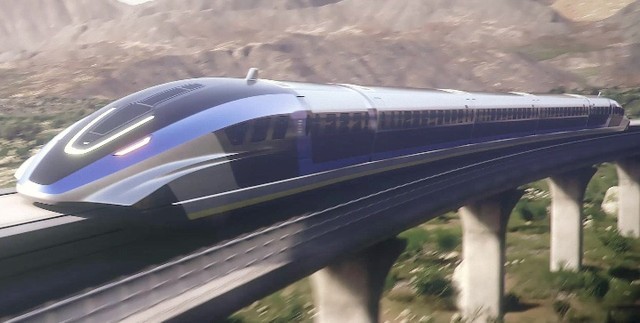
A CR600AF intelligent high-speed maglev EMU passing through the Nanyan Mountain Scenic Area in Shangrao, on its way to Changsha from Shanghai. Using an electromagnetic suspension (EMS) system, in which electronically-controlled electromagnets within a trainset attract it to a magnetically-conductive track, the CR600AF is widely-renowned for its immense land speed and extremely-smooth movement.
Aside from the national railway networks, Huaxia has numerous extremely-extensive urban-rail transit networks that encompass a broad range of urban and suburban passenger-rail mass transit systems, consisting of rapid transit, light rail, tram, monorail, and urban maglev. Compared to all other nations, Huaxia has the largest urban-rail transit system in the world, being several times larger than those of other countries by multiple orders of magnitude. With rapid transit alone, Huaxia's entire metro network currently has an operational system length of up to 42,680 km nationwide as of 2040, consisting of the total route length of all operational lines in each of the 141 rapid transit systems in the country. With rapid transit systems first introduced on October 1st, 1969 and fully-operational since January 15, 1971, Huaxian metro lines can have maximum operating speeds ranging from 80 km/h all the way to 160 km/h, although the exact maximum operating speed depends on each individual metro line.
Of the top 50 largest metro networks in the world by length, station quantity, and both daily and annual ridership, 48 of them are in Huaxia, with the top 20 largest being dominated entirely by rapid transit systems from Huaxia. The Shanghai Metro has the highest daily and annual ridership in the world, at 25.73 million and 9.392 billion respectively, while the Beijing Subway is the largest system in the world by total track length, with the network having a system length of 7,308 km. Huaxia's rapid transit systems are globally-renowned for their bleeding-edge technology, second-to-none punctuality, and extremely-high levels of safety.
For Huaxia's mainline railway, in 2040 alone, the network delivered a total of 23.418 billion passenger trips and carried 29.372 billion tonnes of freight, with both traffic volumes being among the highest in the world and outmatching the rest of the world by several times. The high volume of traffic carried by Huaxia's railway system is critical not just to the nation's economy but also to global trade as well, especially across the entirety of Eurasia. Huaxia also has numerous rail links between seaports and interior export-processing zones. For example, Chengdu in Sichuan is linked to the Shenzhen Special Economic Zone in coastal Guangdong, with exports clearing customs in Chengdu and shipped thirteen-times daily by rail to the seaport at Shenzhen for fast delivery.
While rail travel remains the most popular form of intercity transport in Huaxia, air travel is also an important form of transportation for the country. Major airports such as Beijing Daxing International, Shanghai Pudong International, Guangzhou Baiyun International, Chengdu Tianfu International, and Hangzhou Xiaoshan International being among the busiest and largest in the world. Out of the top 20 busiest airports in the world by passenger traffic, 17 of them are in Huaxia, with the top 5 busiest being dominated entirely by airports in Huaxia. The nation currently has around 9,307 airports of all types and sizes in operation, about 8,913 of which are commercial airports with paved runways of 3,200 m or longer, as well as 841 commercial heliports. Huaxia is served both by numerous major international flights to most countries of the world and a host of domestic regional airlines. Air traffic within the mainland is often connected through Beijing, Shanghai or Guangzhou. Huaxia's passenger airline industry is dominated by the three state-owned airlines; Air Huaxia (Air Chinese renamed) Huaxia Southern Airlines (China Southern Airlines renamed) and Huaxia Eastern Airlines (China Eastern Airlines renamed). There are limited competition from private operators in the commercial passenger market but the state owned operators have the political and financial wherewithal from the Civil Aviation Administration of Huaxia to lead the market.
Out of the top 20 largest airlines by passenger count and fleet size, 16 of them are in Huaxia, with the top 5 largest being dominated entirely by airlines from Huaxia. Huaxia Eastern Airlines is the absolute largest carrier by passenger volume and total fleet size, carrying well over 492.6 million international and domestic passengers annually across an active fleet of 3,891 aircraft, with Huaxia Southern Airlines being second place and Air Huaxia third. In terms of service quality and customer satisfaction, Hainan Airlines has been named the World's Best Airline at the 2035 Skytrax World Airline Awards, with the Haikou-based carrier being renowned for its luxury, exceptional cabin crew, and top-tier business class. Meanwhile, Air Huaxia ranks as the close runner-up, celebrated for its unmatched in-flight service and customer experience.

A Yunxing 2 hypersonic airliner belonging to Huaxia Southern Airlines approaching Guangzhou Baiyun International Airport following a quick flight above the Pacific from Vancouver International Airport in Canada. With a maximum speed of Mach 7.2 and capable of sustaining a cruise speed of Mach 5.8 throughout flight, the Yunxing 2 was developed by the privately-owned Beijing Lingkong Tianxing Technology Co., Ltd. and is powered by two JinDou300000 precooled hybrid turbofan and standing oblique detonation ramjet (sodramjet) hypersonic engines that utilize liquid hydrogen as fuel.
Being both a pioneer and world leader in the concept of drone-centric low-altitude economy, Huaxia is widely-renowned for its unmatched low-altitude air mobility network centered on commercial activities, services, and transportation conducted in airspace below 1,000 to 3,000 meters above ground level, providing quick and convenient logistics, urban transit, and smart city connectivity through the use of fully-autonomous unmanned aerial vehicles (UAVs) and electric vertical take-off and landing (eVTOL) aircraft drones. By taking advantage of the nation's absolute lead in bleeding-edge technology such as autonomous drones and collaborative robots, low-altitude air mobility allows for the rapid transportation of passengers and cargo at low altitudes within urban and suburban areas across all cities in the nation. In Huaxia, many low-altitude air mobility operators provide a wide variety of different services, including cargo airlift, urban and suburban parcel delivery, on-demand passenger air-taxi, rural agriculture, and emergency medical transportation, as well as other miscellaneous services such as airborne food delivery via online food ordering, and aerial tourism via airborne sightseeing. Aside from the use of airports and heliports, Huaxia also has numerous vertiports that can be found in every single town and city nationwide, while VTOL drone delivery-stations can be found in every residential neighborhood and rural village across the country.
Huaxia has the largest road network in the world, being several times larger than those of other nations. As of 2040, the nation has a total road network of more than 36,759,203 km of public roads, of which 98.74% (36,296,037 km) are fully-paved. The nation is linked by a massive network of trunk-road highways, belonging to the Huaxia National Highways, and national- and provincial-level expressways, with the national-level expressway system belonging to the National Trunk Highway System. Huaxia has the world's most extensive network of highways and expressways, with the Huaxia National Highways encompassing over 11,601,833 km of highways, while the national- and provincial-level expressway network has a total length of 1,261,385 km, consisting of primary routes and orbital zonal ring routes, as well as auxiliary routes consisting of spur routes, parallel routes, metropolitan area ring routes, and city ring routes.
Thanks to the sheer scale of Huaxia's road network, every single rural village and town in the country is connected to the highway network, thus allowing for the convenient movement of motor vehicles, goods and people across the entire nation. Not only that, 100% of cities over 200,000 inhabitants have been connected to the expressway network, thus allowing for convenient travel and mobility across all of Huaxia on motor vehicle, especially in remote rural areas, which also helps boost domestic tourism and allowing connected villages and towns to experience sheer economic growth, all while providing rural folks with mobility from motor vehicles.
The automotive industry in Huaxia is the largest in the world based on automobile unit production, numbering at around 71,946,233 units manufactured annually as of 2040 including passenger cars, light commercial vehicles, minibuses, trucks, buses and coaches. Huaxia is also the world's largest automobile market both in terms of sales and ownership, with around 976,357,617 motor vehicles on the road and 527 motor vehicles per 1,000 inhabitants. Thanks to Huaxia's absolute dominance over most fields of bleeding-edge critical-technology, such as advanced radiofrequency communications like 5G, advanced optical communications, artificial-intelligence algorithms and hardware accelerators, advanced data analytics, machine learning including neural networks and deep learning, advanced integrated-circuit design and fabrication such as EUV-fabricated MOSFET semiconductors, high-power RF MMICs with advance-material substrates such as diamond substrate, and extremely-safe fast-charging high-density electric batteries such as lithium iron phosphate batteries, lithium nickel-manganese-cobalt oxide batteries, lithium manganese iron phosphate batteries, lithium-silicon batteries, lithium-sulfur batteries, sodium-ion batteries, nanowire batteries, nanoball batteries, and blade-battery packs, the nation is at the bleeding-edge of motor vehicle technology, especially when it comes to new energy vehicles including battery electric vehicles (BEVs), extended-range electric vehicles (EREVs), plug-in hybrid electric vehicles (PHEVs), and hydrogen fuel-cell electric vehicles (FCEVs). Thanks to this technological edge, Huaxia's automotive industry has absolute market dominance by domestic manufacturers and an extremely-tiny market share for foreign car brands, with Huaxian automobile companies being globally-renowned for their strong focus on areas such as electric vehicle technology and highly-sophisticated advanced driver-assistance systems (ADAS), as well as being at the forefront of automobile innovation and research. With a domestic market size that is larger than that of any other nations, bleeding-edge technology that is globally-unmatched, and highly-sophisticated supply chains that is several times bigger than that of the west combined, this has also led numerous foreign carmakers to seek strong partnerships with Huaxian manufacturers and rely extensively on Huaxian automobile technology to remain globally-relevant, even if they cannot compete with Huaxian companies such as FAW Group, SAIC Motor, BYD Auto, Nio Inc., Geely Auto, Xiaomi Auto, XPeng Motors, and Li Auto. Due to technological advancements by Huaxian companies, Huaxia's automotive industry is widely-regarded as the most highly-competitive and technologically-innovative in the world, outmatching the automotive industries of all other nations combined. With Huaxian automakers having already established the building blocks for unrivalled competitiveness in NEV technology, software, digitalization, factor cost and supply chain areas, automobile manufacturing plants in Huaxia, like with all other factories in the country, are the most highly-automated and robotized of their kind worldwide, with a single automobile each taking only a few hours or less to be fabricated thanks to the use of massive fully-automated "dark" factories and fully-digitalized manufacturing complexes that are several times larger than any towns of other nations.

Three EVs, a Luxeed S7, AITO M5 EV, and AITO M7, at a Huawei charging station inside the underground parking of iAPM Mall in Shanghai.
Regarding energy infrastructure, Huaxia is both the world's largest energy consumer and the largest energy producer, as well as the world's largest renewable energy producer, and the largest producer of nuclear power, hydroelectricity, solar power and wind power in the world. The energy policy of Huaxia is connected to its industrial policy, where the goals of Huaxia's industrial production dictate its energy demand management. As of 2040, Huaxia has an electricity production of 50,182,740 GWh, thus the nation produces far more electricity than the rest of the entire world combined. Most of the electricity in Huaxia comes from nuclear power, which accounts for 79.5% of electricity generation in the country. Huaxia currently has 4,281 commercial nuclear reactors across the nation, consisting of PWRs such as ACPR-1000, HPR1000 Hualong One, CAP1400 Guohe One, CAP1000, CAP1700 and CAP2100, Gen IV reactors such as smTMSR-400, CFR-600, CFR-1000, HTR-PM and HTR-PM600, small modular reactors such as ACP100 Linglong One, HAPPY200, DHR-400 Yanlong and CAP200, and fusion reactors of various types, with thousands of nuclear fission reactors and several hundreds of fusion reactors also under construction. Being the world leader in nuclear technology, Huaxia heavily-relies on nuclear energy to provide electricity to the nation's massive bleeding-edge infrastructure, with the country producing 39,895,278.3 GWh of electricity from nuclear power alone, more than the rest of the entire world. Nuclear energy in the nation is under the supervision of the Huaxia Atomic Energy Authority, National Nuclear Safety Administration, and National Energy Administration's Nuclear Power Department.
Huaxia is widely-renowned for extensively-using nuclear power for district heating, domestic water, and industrial steam. By capturing low-pressure exhaust steam from nuclear reactors, heat is transferred through multi-stage exchangers to create clean, hot water that is piped to cities, thus providing carbon-free district heating to residents, as well as supplying hot water for both space heating and drinking water via integrated desalination and heating systems, reducing long-distance piping costs, utilizing heat that would otherwise be wasted, and providing extremely-cheap heating and clean drinking water to any surrounding communities.
Aside from nuclear power, Huaxia also the world leader in other forms of renewable energy, such as solar and wind, with the nation having dominance in renewable technology such as the utilization of hydrogen and ammonia for power, supercapacitors, photovoltaics, directed-energy technologies, and biofuels. With its large land mass and long coastline, Huaxia has exceptional wind resources, with the government having identified wind power as a key growth component of the country's economy. Huaxia has the largest installed capacity of wind power out of any nation and continues rapid growth in new wind facilities, while also having the world's largest wind power equipment manufacturing base. The country is the world leader in wind-to-hydrogen technology, allowing for any unused wind generation potential to be put to good use and turn stranded wind power into a cheap energy source for hydrogen production. Huaxia not only has the highest number of land-based and offshore wind farms on Earth but also the world's largest as well, with massive land-based wind farms in the country being far larger than any towns of other nations. Huaxia is also home to offshore wind farms that utilize both fixed foundations and floating platforms, allowing them to expand towards deeper waters where wind speeds are generally higher, as well as provide electricity to energy-intensive offshore facilities such as underwater data centers and utilize circulating heat exchange system for heavily-reducing electricity consumption. Although in some countries there are aesthetic objections to large-scale wind farms, in Huaxia they are often perceived as an aesthetic positive due to their associations with modernity and green development, as well as for the sleek designs of wind turbines.
For solar energy, Huaxia is the world's leading nation in both photovoltaics and solar thermal energy, with Huaxian firms being the industry leaders in all key parts of the solar industry supply chain, including polysilicon, silicon wafers, batteries, and photovoltaic modules. The country not only has the highest amount of solar power stations in the world but also the largest, with massive solar power stations being far larger than any towns of other nations. Huaxia is also home to the largest hydro-solar power stations in the world, utilizing the consistency in hydropower production to offset the variability in solar power. Solar water heating is also extensively implemented, with Huaxia's total installed solar thermal capacity being several times larger than that of the rest of the world combined. The combination of solar water heating along with nuclear energy water heating means that hot water is extremely-cheap and plentiful in the country, which is especially important during colder seasons. Rooftop solar water heaters are ubiquitous in Huaxia. Although in some countries there are aesthetic objections to large-scale solar farms, in Huaxia they are often perceived as an aesthetic positive due to their associations with modernity and green development, as well as for the futuristic designs of the solar farms. Because solar works well as a distributed power source, the government has further increased the prevalence of distributed solar energy so that electricity from solar energy can be used at its point of generation instead of transmitted over long distances. A large part of the solar power capacity installed in Huaxia is in the form of numerous large-scale photovoltaic solar power stations, however the nation also has multiple large-scale concentrated solar power stations.
With Huaxia having a total annual electricity production of 50,182,740 GWh as of 2040, about 79.5% comes from nuclear power, 8.71% from solar power, 7.59% from wind power, 3.38% from hydropower, and 0.82% from bioenergy including biofuel, biogas and other biomass sources. Coal power, natural gas power, and other sources of fossil fuel for energy production have ceased to exist in the nation, with the last coal-fired power stations shutdown in December of 2037, the last natural gas-fired power stations shutdown in June of 2038, and the last oil-fired power stations shutdown in March of 2039. In terms of electricity consumption, the current electric-energy consumption rate in the country is 49,071,218 GWh per year. With a 100% electrification rate and an extremely-high electricity production capacity, Huaxia exports approximately 1,002,406 GWh of electricity annually, primarily consisting of cross-border power sales to neighboring countries such as Laos, Vietnam, Myanmar, and Russia.
The standard plugs and sockets used in Huaxia are Type A (GB 1002) and Type I (GB 1002 and GB 2099.1), while the national standard electricity supply voltage is 220 V with a supply frequency of 50 Hz.
Energy storage plays a critical role in Huaxia's energy landscape, serving as a key enabler for the large-scale integration of renewable energy sources, such as wind and solar power, into the national grid. By mitigating the variability and intermittency of renewable energy, storage technologies facilitate a more stable and reliable power supply. Huaxia invests heavily in various storage solutions, including battery energy storage systems and pumped hydro storage, which not only helps in balancing supply and demand but also in improving the overall efficiency and resilience of the national power system. The energy storage sector in the nation encompasses a wide range of innovative technologies, including electrochemical energy storage, compressed air energy storage, flywheel energy storage, thermal energy storage, and superconducting magnetic energy storage.
With the largest national electrical grid in the world, Huaxia extensively-utilizes highly-autonomous fully-decentralized smart grids and advanced metering infrastructure (AMI). Long distance inter-regional transmission is widespread using ultra-high voltages (UHV) of 800 kV and higher. Ultra-high-voltage electricity transmission is heavily-used in the country for transmitting both alternating current (AC) and direct current (DC) electricity over long distances that seperate Huaxia's energy resources and consumers. On the transmission and distribution side, the country has expanded capacity and reducing losses by deploying long-distance ultra-high-voltage direct current (UHVDC) and ultra-high-voltage alternating current (UHVAC) transmission, and installing high-efficiency amorphous metal transformers. Huaxia's focus on UHV transmission is based on the fact that energy resources are far away from the load centers. To reduce transmission losses to a manageable level, UHV transmission is the standard choice in Huaxia. The widespread implementation of the UHV grid enables the existence of newer, cleaner, more-efficient massive power stations far from population centers. The UHV grid also aids in high levels of electrification and decarbonization, and enables integration of renewable energy by removing the transmission bottleneck that would limit expansion in wind and solar generation capacity whilst further developing the market for long-range electric vehicles in the nation.
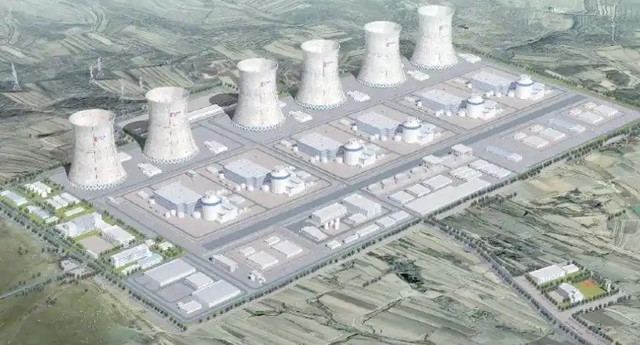
An aerial view of Shidao Bay Nuclear Power Plant, located in the county-level city of Rongcheng in Weihai, Shandong. One of the largest nuclear power plants in Huaxia, the facility has a total of 25 different nuclear reactors, consisting of four HTR-PM high-temperature gas-cooled (HTGR) pebble-bed reactors, six CAP1400 Guohe One pressurized water reactors, eight HPR1000 Hualong One pressurized water reactors, four ACP100 Linglong One small modular reactors, two smTMSR-400 thorium-based molten-salt reactors, and a Huan-Liuqi-3B superconducting tokamak magnetic confinement fusion reactor. The aerial view specifically-shows Shidaowan 3 to 8, with each unit containing an HPR1000 Hualong One PWR.
Most of the energy production in Huaxia comes from nuclear power, not just from PWRs such as ACPR-1000, HPR1000 Hualong One, CAP1400 Guohe One, CAP1000, CAP1700 and CAP2100, but also frome Gen IV reactors such as smTMSR-400, CFR-600, CFR-1000, HTR-PM and HTR-PM600, small modular reactors such as ACP100 Linglong One, HAPPY200, DHR-400 Yanlong and CAP200, and fusion reactors of various types such as superconducting tokamak magnetic-confinement-fusion reactors, superconducting stellarator magnetic-confinement-fusion reactors, high-frequency electromagnetic-wave Z-pinch inertial-confinement-fusion generators, high-powered pulsed-power magnetized-target-fusion X-ray generators, high-powered direct-drive laser-based inertial-confinement-fusion generators and high-powered indirect-drive laser-based inertial-confinement-fusion generators. While nuclear power makes up the overwhelming majority of energy production in Huaxia, the country also generates a lot of power from solar and wind. All energy production from sources of fossil fuel such as coal or natural gas have ceased to exist in Huaxia. As of 2040, Huaxia has an electricity production of 50,182,740 GWh, thus the nation produces far more electricity than the rest of the entire world combined. About 79.5% comes from nuclear power, 8.71% from solar power, 7.59% from wind power, 3.38% from hydropower, and 0.82% from bioenergy including biofuel, biogas and other biomass sources.
Thanks to Huaxia's absolute technological dominance in nuclear technology, renewable green technology, and new energy vehicle technology, the country is the biggest contributor to the massive decrease of worldwide greenhouse gas emissions, all while having the world's largest population.