NATION

PASSWORD

What is YN's legislative system?

A place to put national factbooks, embassy exchanges, and other information regarding the nations of the world. [In character]
User avatar
Makko Oko
Ambassador
 
Posts: 1126
Founded: Jan 20, 2018
Ex-Nation

What is YN's legislative system?

Postby Makko Oko » Sun Nov 26, 2023 4:24 pm

I found a post similar to this one, however it has not had a comment since September 30th, and it was not in this format. I am curious to know what all the governments of NationStates have for a legislative system (if any). Could be no legislative branch with authority vested in the Executive to a 10-chamber large Parliament with over 5 million members. Either way, talk about that and your history here.

Here's mine:

The Empire is transforming the legislative chamber referred to as the Law Council from a unicameral chamber (1 chamber) into a tetracameral chamber (4 chambers), beginning with the 3rd Session. The 4 chambers are the House of Representatives which are composed of every city mayor and division leader, both directly appointed by the Ministry of State Affairs. You then have the House of Officials which is composed of a bunch of government officials both low-level and high-level. Every civil service employee is eligible for a seat in the HoO, barring the rejection of the Emperor or all of the allotted seats being taken. The House of Lords is composed of the Privy Chancellor, and then both of the top members of the Imperial Crown, thereafter there are Priest Lords and then Priests who were granted a peerage. It is the only house tied to the state religion of Satanism.

Finally you have the House of Assembly which is the chamber where the other 3 chambers can meet at once, together and vote as deemed suitable. The House of Lords is the supreme chamber of the Law Council and has no higher authority other than the Emperor. Prior to the establishment of the Law Council in August 2022, only the Emperor could enact, revise and repeal laws, making them the supreme authority. The Law Council was established to allow the Emperor to spend less time drafting laws, however, they still hold the authority to enact, revise and repeal laws, they are just rarely exercised now.

The Law Council can draft and propose laws for enactment, and with the enactment of the Devolution of Council Authority Act, impeach government officials. The Law Council cannot override a veto of the Emperor on any proposed law or motion, keeping them supreme and the council in check.
Last edited by Makko Oko on Sun Nov 26, 2023 4:24 pm, edited 1 time in total.
OBC Current News: First-Ever Anti-Terrorism Act Enacted | Emperor launches plans to expand trade | Danika Hicks Case: NOT GUILTY VERDICT! Court rules 3-2
Information:
IIWiki Factbooks
NS Factbooks

NOTE: This nation does not reflect my real beliefs in any way, shape or form

User avatar
Makko Oko
Ambassador
 
Posts: 1126
Founded: Jan 20, 2018
Ex-Nation

Postby Makko Oko » Mon Nov 27, 2023 11:34 am

/bump
OBC Current News: First-Ever Anti-Terrorism Act Enacted | Emperor launches plans to expand trade | Danika Hicks Case: NOT GUILTY VERDICT! Court rules 3-2
Information:
IIWiki Factbooks
NS Factbooks

NOTE: This nation does not reflect my real beliefs in any way, shape or form

User avatar
Safiloa
Diplomat
 
Posts: 782
Founded: May 15, 2021
Liberal Democratic Socialists

Postby Safiloa » Tue Nov 28, 2023 10:54 am

Safiloa's government is based on the prescribed form of government (written in the holy Mazdakite scripture; the Desinato) from the Mazdakite revolution in the 520's Persia - the original homeland of Safiloa's culturally dominant ethnicity, the Sokhaineans.
There are four Heads of Government - the Gohulu, each Gohul (Gohul Rameši (Joy), Gohul Mobadi (Discernment), Gohul, Herebi (Comprehension), Gohul Sebabi (Preservation), is chosen in entirely different way and with entirely different responsibilities.

Similarly, the legislative branch of government can also be split in 4.
1 - Joy) 13 Dodovo"Obudsmen" form the Dodovulo- They travel throughout Safiloa arbitrating and can suggest policies or events to ensure that the populace are happy. Their data gathering reports and suggestions are passed on to the Fomanulo. Each Dodovo are nominated by the Gohul Rameši & Gohul Herebi.
2 - Comprehension) 73 Fomano "Representatives" form the Fomanulo- These are elected by the communities, the Communal-Republics. They are tasked with interpreting the data and responding quickly to local issues. They draft and create policies and are often times the fiercest battleground for political parties.
3 - Preservation) 25 Pešigo "Provosts" form the Pešigulo- These are the heads of important socio-cultural, religious, economic, educational, agricultural, financial, or minority-based institutions, and often works in close collaboration with various trade guilds, universities, worker unions or national parks. They are tasked with acting as a checks and balance to ensure that the Fomano's policies do not arbitrarily negatively influence any portion of the population or the environment. Political parties comparatively play a smaller role here.
4) - Discernment) 7 Hotsalo "Ministers" form the Hotsalulo. They are the Chief Justices and are the highest official of the Judicial branch of government. They are nominated by the Gohul Mobadi & the Gohul Sebabi. However, they do play a role in the legislature by being able to veto any abuses of power by the Pešigulo, vacate the seat of any single Pešigulo member, if they are deemed incapable of properly fulfilling the responsibilities of the role or even - during emergency situations ignore the Pešigulo temporarily allowing for the Fomano to pass laws quickly.

This allows for the government to benefit from both a somewhat bicameral system (checks & balances) as well as in some situations, a unicameral one to avoid a gridlock depending on the circumstances.
❊ - A class 2.11 civilization according to THIS INDEX.
❊ - Observer status member of the International Socialist Congress.
❊ - All policies are canon. Stats are not.
❊ - Population: 421.392 - Land Area: 2.921 km2 - GDP:
❊ - Modern Semi-Theocratic Agrarian Syndicalism based on Mazdakism & Jainism
He/Him, Eco-Progressive Socialism, Vegan, Pacifist, Persophile - I dislike Fascism, Racism, Sexism, and Dogmatic Fundamentalism
THE COMMONWEALTH OF SAFILOA ❊ KULASAÑOS'EÏA SAFILOA
Diplomatic Mission ❊ NEW Map! ❊ Factbook (WIP)

User avatar
Eieryn
Diplomat
 
Posts: 639
Founded: Aug 25, 2025
Civil Rights Lovefest

Postby Eieryn » Sat Nov 15, 2025 3:12 pm

The Democratic Republic of Eieryn has got two legislative chambers :

  • The National Assembly, composed of deputies elected nationally with the list method (each party presents a list and has got a number of seats proportional to its votes). It elects the President of the Assembly, who nominates a part of the government, called the National Cabinet, which can be overthrown with a censure motion from the National Assembly, but only if a majority is able to form a new National Cabinet (in practice, this majority nominates only one Minister trusted by the majority, who will form the National Cabinet).
  • The Chamber of Representatives is composed of representatives elected with the district system by a preferential vote. The Chamber elects the President of the Chamber, who nominates another part of the government, called the Representative Cabinet, which can be overthrown with a censure motion from the Chamber of Representatives, but only if a majority is able to form a new Representative Cabinet (in practice, this majority nominates only one Minister trusted by the majority, who will form the Representative Cabinet).
The President of the Democratic Republic is elected by the whole Parliament and nominates another part of the government : the Regalian Directorate, whose members are the Directors (and not the Ministers) of Foreign Affairs, of the Interior, of Justice, of Economy, and of Armies. These Directors nominate one Vice-Director each. Directors are responsible to both assemblies, with a specific system.
When the President of the Democratic Republic begins his mandate, he distributes the fields on which the Assemblies will have to work specifically ; the ministries of the National and Representatives Cabinets are following these fields (for example, if Education has been distributed to the National Assembly, the National Cabinet will have the ministry of National Education). The Supreme Constitutional Court ensures that the fields are equally distributed.
The Parliament may change the Constitution or dismiss one of the three Presidents or a constitutional judge ; all of these require a majority of 2/3 of the whole Parliament.
Last edited by Eieryn on Fri Sep 25, 2026 10:01 pm, edited 1 time in total.
Population: 133 million | Political parties and current legislature | Other factbooks | Q&A of Eieryn
Democratic, socialist and secular nation
I AM PRO-TOLERANCE ! PRO-DEMOCRACY ! AND PRO-FREEDOM ! IF THIS MAKES ME WOKE, THEN SO BE IT !
I am also atheist, socialist (but not communist), and first of all a proud etceterist, because I cannot put everything here.
Pronouns : he/him, but they/them is also fine.

The Democratic Republic of Eieryn
Former President and WA Delegate of the UEPU Federal Republic
Current Speaker of the Parliament of the UEPU Federal Republic

User avatar
Kogure
Ambassador
 
Posts: 1161
Founded: Jan 26, 2025
Psychotic Dictatorship

Postby Kogure » Sun Nov 16, 2025 12:19 pm

In the Socialist People's Republic of Kogure, legislative power is vested in 860-member Supreme People's Council and its smaller 30-member Standing Committee.The Supreme People's Council consists of members elected directly through uncompetitive elections, with all candidates decided by the ruling Kogurean Communist Party or affiliated mass organizations. The Supreme People's Council meets only for short sessions twice a year to endorse major legal changes and also collect input from deputies. Deputie are generally model citizens in various sectors or local officials.

Most of legislative work is done by the Standing Committee, whose members are elected by the Supreme People's Council. They meet more frequently, usually once once or twice per month, and its work is supported by other committees of the Supreme People's Council and legal experts.

Legislative process in Kogure is complex. A proposed bill generally is drafted by bureaucrats in state administration, which then is circulated among different agencies, ultimately reviewed by the Party Politburo or Secretariat (depending on scope, politically important laws must be vetted by the Politburo while technical legislations is reviewed by the Secretariat). In some cases, a draft bill might be published for public input, or relevant organizations might be asked for feedback. Once completed, depending on scope and importance, a bill is either enacted by a decision of the Standing Committee of the Supreme People's Council or the full Supreme People's Council session. The Law Committee of the Supreme People's Council acts as an important body during the last stage, as it reviews laws and it often exerts influence over bill drafting or writes bills themselves
Last edited by Kogure on Sun Nov 16, 2025 12:24 pm, edited 2 times in total.
˗ˏˋ ★ ˎˊ˗
Socialist People's Republic of Kogure
NS Stats Are Not Canon
Kogure News Agency|Hongki Sinwon
Embassy Page|Q&A Thread

OOC: Last Song I Listened To (Yusha)

User avatar
Free Republics
Minister
 
Posts: 3267
Founded: May 03, 2013
Ex-Nation

Postby Free Republics » Mon Nov 17, 2025 3:12 pm

There are 2 chambers of the Federation of Free Republics legislature:

The People's Assemby is elected to 2 year terms. Before we outlawed political parties, it was elected by proportional representation. Now, it is elected by districts, some of them multiple member, using the same 3 round system we use for our consul elections: All candidates that get over 10% of the vote advance to the second round. Top 2 in votes in the second round advance to the third round. If a candidate wins an outright majority in either of the first 2 rounds, he wins the election immediately.

The Senate is appointed by the legislatures of the Republics to life terms. Every Republic can appoint a new Senator every 2 years. Former consuls are automatically a Senator Emeritus which includes full voting rights. In addition, the Grand Immortal Imperator can appoint anybody he wishes to the Senate whenever he chooses to do so.

The legislature meets in the New Legislative Building which was an event venue at the Games of the XIII Olympiad.

To become law, a bill must be passed by both chambers and be signed by both consuls. The Grand Immortal Imperator possesses the power to veto any legislation and also takes an active role in drafting and proposing legislation. The courts have the power to rule on the constitutionality of legislation, both new and old, with the Supreme Court having the final say.
World Cup 85 Champions
1st: DBC 28, X Winter Olympics, Independents Cup 4, CoH 66, WBC 46, World Bowl XXXVIII, World Cup 85
2nd: World Cup 68, DBC 27, U15WC 8, UWCFA Gold Cup I, BoI 15, 2nd Imperial Chap Olympiad, NSCF 11
Host: World Cups 68 & 81, CoH 58, BoF 70, Games of XIII Olympiad, X Winter Olympics, World Bowls XXII, XXXI & XXXVIII, WBCs 42 & 47, WCoH 35, IAC 5, RUWC 25
Creator: Sporting World Cup (U-18 WC)
Also: Host of BoF 59, IBC 17, WCoH 23, WBCs 27/34/37, CR XXII; Champion of CR XXIV, World Bowl XXIV, NSCF 9, IBCs 14, 15, 16
Leader: The Grand Immortal Imperator
Demonym: Republican
Trigram: FFR
Official Nation Name: Federation of Free Republics

User avatar
Kyrindor Puppet
Minister
 
Posts: 2172
Founded: Aug 08, 2024
Democratic Socialists

Postby Kyrindor Puppet » Mon Nov 17, 2025 3:58 pm

Kyrindor's government has one chamber and is largely unicameral. This being the Kyrindorian Senate, or better known as "The Kyrindorian Congress"

The Kyrindorian Congress is made up of 1000 seats, each is representative of a county. A representative is assigned to represent their constituents and help pass bills/laws for the federation. Congress in Kyrindor is popularly elected by the People every two years. The legislative system also has a quirk where usually bills go straight to judicial review to see if they adhere to the Constitution. (rather than going to the President of Kyrindor) which, if they are viable and adhere to the constitution. They are enacted and put into effect on a later date. Judges mustn't have a bias and follow procedural orders during law passage. Usually, the Kyrindorian Congress votes on a majority, and some bills require a supermajority. Since Kyrindor is kind of a pseudo-confederation, most states do not need to adhere to Kyrindor's federal laws and can set laws themselves. This is whatever the constitution explicitly negates. There is also a speaker, which normally preside only and is at the Congress's pleasure. Legislators in Kyrindor do not have term limits as long as they can continue beating their opponents after a quarter of the election. Kyrindorian Congress, if they feel the duties of the President, or the Oath. is not being served, they may remove them via impeachment, which requires 2/3 majority in the Kyrindorian Congress.

Kyrindor also has committees, these being committed to certain things. Each Committee in the Legislature has one chair (majority) and one ranking member (minority), despite there being more than 2 parties in Kyrindor, both of the biggest parties either serve as majority vs minority. However, the Senate is tied and cannot find a majority; both can be tied and end up serving as two ranking members; however, this is rare. Kyrindor also has state legislatures. State legislatures are able to vote on when they want to secede, versus wanting to stay a part of the federation, even though Kyrindor has a central government. Its constitution explicitly allows states to secede if members of its legislature. With the seats they've been assigned agree with a 2/3 majority, if it passes. This is not the end, states need to decide with the civilian populace via a referendum if they agree with the government's leave. which requires only a 1/3 majority. After this, it is given to the State Governor to make the final decision on when to confirm their leave or stay into the Federation, however this has only happened once with Kyrindor, which was the State of Artyan back in 1100 AD.
THE MOST SERENE DEMOCRATIC REPUBLIC OF KYRINDOR
this is my general and F7 account, however sometimes I use my main.
wotm - "i am dr kill." - dr kill

User avatar
Shangtianhua
Diplomat
 
Posts: 544
Founded: Apr 16, 2026
Democratic Socialists

Postby Shangtianhua » Sun May 17, 2026 9:37 pm

Being the successor polity to the People's Republic of China and thus inheriting the predecessor's highly-complex structure of political governance, the system of people's congresses is the multi-layered democratic form of government in Huaxia. It is based on the principle of unified state power, in which all powers are vested in the country's supreme organ of state power, the National People's Congress, thus serving as the apex of the pyramid-like structure that is the unified state apparatus and providing the structural precondition for democratic centralism. All state organs are elected by, answerable to, and have no separate powers than those granted to them by the NPC.

Characterized by its nature of bottom-heavy grassroots-oriented direct-democracy where the people vote directly for their local officials at the lowest level of administration, who in turn vote for the officials at the next level of administration who also vote for the officials at the level above and so forth, there are six levels of people's congresses, consisting of national-level (National People's Congress), provincial-level, prefecture-level, county-level, township-level, and village-level. Direct elections occur at the village, township, and county levels, while the members at the higher levels are indirectly elected by those elected in the lower levels. The size of the people's congresses increase with their administrative rank. With some exceptions, township people's congresses usually have 40 to 130 deputies, county people's congresses from 120 to 450, prefectural people's congresses from 240 to 650, provincial people's congresses from 350 to 1,000, and the NPC at around 3,000. The total number of people's congresses throughout Huaxia at different levels is around several tens of thousands, and the total number of deputies is in the several hundreds of thousands.

Aside from the people's congresses, Huaxia also inherited the PRC's system of consultative conferences. Unlike any other nations, Huaxia has a multi-layered network of political advisory boards that have actual sway in political decision-making, thus allowing for immense democratic participation from the working-class compared to the western liberal-form of representative democracy. The Huaxian People's Political Consultative Conference is the nation's democratic advisory organ in which members advise and submit proposals for political and social issues to government bodies at various levels of administration. While consultation does take place, the HPPCC is a body without legislative power since it is obviously not a legislative body but an advisory body instead. The organizational hierarchy of the HPPCC consists of the National Committee and various regional committees. Regional committees extend to the provincial, prefecture, and county level, with the relationship between the National Committee and the regional committees being one of guidance instead of direct leadership. The National Committee of the Huaxian People's Political Consultative Conference typically holds a yearly meeting at the same time as plenary sessions of the National People's Congress, thus the HPPCC National Committee and NPC plenary sessions are collectively called the "Two Sessions", considered to be the most important political event in Huaxia similar to how election cycles for head of states and/or government are the most important for countries using the western system of liberal democracy. The HPPCC is known to be even more representative of a broader range of proletarians than is typical of government office in Huaxia, including a broad range of people from both inside and outside the National Front of Huaxia and coming from various different industries and fields such as entertainment, sports, research, ethnic minorities, and so forth. The composition of the members of the HPPCC changes over time according to national strategic priorities and current material conditions. In addition to the main National Committee, the HPPCC contains numerous regional committees at the provincial, prefecture, and county level, with Huaxia currently having around thousands of local HPPCC committees at every level and containing around several hundreds of thousands of deputies elected in the exact bottom-to-top manner as the people's congresses.

Contrary to misinformation and ignorance, the National Front of Huaxia (as well as its precedessor the Communist Party of China) is technically not a partisan organization in the western sense but rather an institution of decision-making in contrast to the central government being an institution of administration. For the National Front of Huaxia, its highest organs are both the National Congress and the Central Comittee, with the latter being highly-active when the former is not is session. As usual, NFH officials are elected bottom-to-top in the same exact manner as government officials, people's congress members, and HPPCC members. Above the Central Comittee of the NFH is the Political Bureau of the Central Committee of the NFH, while at the apex is the Standing Committee of the Political Bureau of the Central Committee. Just like with the people's congresses and HPCC committees, NFH committees permeate in every state administrative organ as well as and mass organizations at all levels of administration, thus allowing for pragmatic, versatile and flexible formulation of policies at all levels based on local material conditions. Beginning at the provincial level, Huaxia's dual political system arranges a hierarchy by which the committee secretary is in charge of decision-making and formulating policy, while the corresponding government leader is responsible for implementing said policy and executing varioud administrative duties such as arranging the annual budget and other everyday government matters and political tasks. For example, the NFH chief at the provincial level is the NFH Provincial Committee Secretary, while the corresponding government position is the Governor (who is also the first-ranked Deputy Committe Secretary). In most administrative jurisdictions, there are two deputy committee secretaries, with the first-ranked deputy committee secretary also being the head of government of that jurisdiction, while the second-ranked deputy committee secretary assists the committee secretary primarily in policy affairs. The multi-layered system of NFH committees consists of the Central Committee at the national level, provincial committees at the provincial-level, prefecture committees at the prefecture-level, county committees at the county-level, township committees at the township-level, and the village committee at the village-level. Local committees from provincial-level to county-level each contain a standing committee who are responsible for managing day-to-day policy affairs.

Non-NFH public institutions like government organizations, people's organizations, people's congresses, and state-owned enterprises each contain a "front group", which a type of formal group within an organization that works to ensure democratic centralism and execute the policies formulated by the NFH. Members of a front group are directly elected democratically by the workers of an organization that particular front group belongs to. Exists in all institutions of state which are not formally part of the NFH organization, including government organs, people's congresses, ministries, local departments and so on, front groups serve to ensure that general policy guidelines are followed at each respective institution. They may gather for ad hoc meetings to study policy documents or political speeches, or carry out "political life meetings" at their respective institutions, but they do not serve as an executive body in the domains which they reside. Front groups do not have the elaborate organization and bureaucracy that is commonplace with an NFH committee. Each front group is led by a front group secretary, who is democratically elected by members of the front group.

Being a socialist nation, Huaxia has extremely-widespread workers' self-management and workplace democracy to the point that the working-class have actual concrete sway in policy decision-making compared to their counterparts in nations using the western liberal-form of representative democracy. Every single company in Huaxia, from state-owned enterprises to collectively-owned enterprises to privately-owned enterprises, are required by law to have Staff and Worker Representative Congresses (SWRCs), with members being employees directly elected by their colleagues within the workplace, thus ensuring complete employee-ownership and executing national policies for the good of the people and nation rather than focusing on profit for individual greed, with company profits going straight towards the employees themselves. This is part of the economic system that is Socialist Market Economy, in which the market economy is subordinate to a socialist framework with private capital strictly operating within the boundaries set by the state, thus resulting in state-commanded macroeconomics for strategic industries with full government ownership of the commanding heights of the economy over core strategic essential sectors, and market-flowing microeconomics for trivial nonessential sectors.

All in all, Huaxia has an immensely-democratic system in which the proletarians have real sway over decision-making and policy-formulation compared to other nations. In fact, compared to other nations, Huaxia has no career politicians since every government and front official is actually a civil-servant from various useful backgrounds such as engineering and research. The civil service of Huaxia is the administrative system of the government which consists of all levels who run the day-to-day affairs in the country. The members of the civil service are selected through extremely-competitive examination. Thanks to Huaxia's political nature of bottom-heavy grassroots-oriented direct-democracy where the people vote directly for their local officials who in turn vote for the officials above them, this bottom-to-top multi-layered system ensures that the proletarians are the true masters of the nation instead of the bourgeoisie like in other nations. Not only that, but is also ensures that the working-class can participate in decision-making and even provide advice to officials, a huge contrast to other nations where career politicians act as so-called "representatives" to the people yet those voters don't have real sway in formulating policies but instead simply stuff ballot boxes and pick their favorite bureaucrat based on vibes and personality all while their bourgeousie class are the real masters behind pulling the strings in their nation. Unsurprisingly, election cycles in other nations are basically just media-circus spectacles where voters pick their favorite parties the same way sports fans pick their favorite sports team, and engage in asinine and trivial shouting matches with other people who don't agree with them, thus resulting in election cycles emphasizing on short-term gratifications enacted by elected parties and politicians for the sake of votes and approval ratings rather than focusing on long-term planning as practiced in Huaxia via multi-year plans that are democratically debated and formulated based on material conditions and the needs of the citizens.

"What is Democracy if the people cannot participate in actual decision-making? What is freedom if people are homeless, starving, and at risk of being shot by a psychopath or even a cop? If democracy is simply using elections to trick people into thinking they have even the tiniest semblence of political influence all while depriving them of their actual right to participate in the creation of policies, then is it really democracy or just mere political theatrics to distract the people?"


- Hu Chunhua, Premier of Huaxia, hardline technologist


Fun fact: Unlike in other nations, people in Huaxia can complain directly to their local officials for whatever problems such as fixing a pothole or calling out a private company for un-democratic practicies, resulting in said officials actually resolving those complaints rapidly and without any issue. People can actually meet even a high ranking official such as a provincial committee secretary in person just to file a complaint. Plus, if a large number of people are disatisfied with the performance of an individual official, they can simply collectivize to kick them out of office instead, compared to other nations where widely-unpopular politicians can stay in power through loopholes.
Last edited by Shangtianhua on Sun May 17, 2026 10:42 pm, edited 1 time in total.
People's Republic of Huaxia
☯︎P R O J E C T · P A X · S I N I C A☯︎
Meaning of my account name
Bored anglo dude working in defense-oriented operations research/systems analysis for duh gubmint with subject matter expertise in China development. Striking fear into the hearts of all armchair generals, keyboard warriors, and fedora-tipping neckbeard pseudointellectuals online.

User avatar
Valemora
Spokesperson
 
Posts: 115
Founded: Feb 12, 2026
Liberal Democratic Socialists

Postby Valemora » Mon May 18, 2026 5:16 am

Valemora’s legislature is the National Assembly, a bicameral body made up of representatives and senators chosen through regular elections. Representatives serve the districts, while senators represent the provinces. The Assembly debates and passes federal law, approves national spending, ratifies treaties, establishes courts, and authorizes military action beyond the direct defense of the Republic.

The system is designed to balance direct representation with regional continuity. Representatives reflect district interests and population concerns, while the senate ensures that the provinces retain a lasting institutional role in national governance.

One of the more distinctive features of the Republic is the Hall of Commons, a public civic institution in Aurivienne where citizens, universities, labor associations, advocacy groups, and municipal councils may formally submit policy proposals and draft legislation for review. Proposals that satisfy constitutional and procedural requirements may be referred to committees of the National Assembly for formal debate and consideration. The Hall does not pass laws itself, but serves as a structured channel between the public and the legislature and is widely regarded as a symbol of Valemora’s political openness and participatory civic culture.

Citizens may also initiate national referenda through verified signature petitions, allowing the public to directly enact or repeal federal law under constitutional procedures.

An interesting architectural feature of the National Assembly is its large semicircular legislative chamber. The hall was intentionally designed to encourage visibility, deliberation, and open debate across the chamber rather than rigid confrontation between opposing blocs, reflecting the Republic’s broader preference for negotiation and institutional compromise over adversarial political culture.
"We Pave The Road We Walk Together"
The South Pacific | WA Member
Population: 1.3B+ | Currency: Minat/cenk (ℳ/ᵯ) | National Animal: Raven
Civil Rights: Excellent | Economy: Frightening | Political Freedom: World Benchmark
Valemora is a technocratic, institution-driven dual-island nation, made up of two massive islands—the Kaedric Crownlands & the Valerin Heartlands—totalling approximately 142,000 km² (88,235 mi²), separated by a large body of water, the Gulf of Valemora, but joined together by bridges crossing the NE and SW straits. Please peruse our wide assortment of factbooks for additional information.
Send a TelegramBrowse Factbooks

User avatar
Valrifell
Post Czar
 
Posts: 31643
Founded: Aug 18, 2013
Democratic Socialists

Postby Valrifell » Mon May 18, 2026 5:32 pm

In the Union of Fraternal Socialist Labor Collectives, supreme government authority is vested in the aptly named Supreme Assembly, a tetracameral legislature with 4000 permanently seated members. Each Chamber has unique election rules but otherwise is on equal standing to initiate and pass legislation.

Because of its unwieldy size and "working body" mandate, day-to-day legislative duties are typically passed to People's Executive Committees (P.E.C.s) with limited mandates in certain areas. The whole of the Supreme Assembly only convenes as a body for about six weeks out of the year (the constitutionally mandated minimum) to plan or review these committees, rubber stamp their resolutions where necessary, and hold sessions for updates for Assembly members to give to their constituents, and do other constitutionally mandated appointments. Otherwise the 43-member Presidium and the 11-member Central Executive Committee (C.E.C.) along with the aforementioned P.E.C.s run the majority of administrative functions for the Union.

The Supreme Assembly, once it convenes as a body can appoint or remove the supreme judicial and executive organs of the administration, the High Tribunal and C.E.C. and Presidium respectively.

As mentioned previously, the Supreme Assembly is divided into four Chambers, each with 1000 permanent members. A minimum of 501 members must be present in a Chamber to pass resolutions. These Chambers are: the Assembly of Representatives, the Assembly of Delegates, the Supreme Council, and the National Forum.

In the Assembly of Representatives, members are elected according to Districts which span the whole of the Union in a two-tiered election system (in principle). In the first round, citizens declare support for as many candidates as they wish. If a majority of eligible voters participate in this round and the candidate receives 50%+1 support, they move on to the next round, which is an instant runoff vote where citizens are required to rank their choices from 1 to the number of candidates running (1 being the best). Once again, majority participation is required in this step to validate the election. The only thing that typically matters in practice for these elections is securing majority participation within the District, as the Socialist Unity Front decides candidates in advance. Although non-Party organizations have run candidates in the past. Representatives serve four-year terms.

The Assembly of Delegates, meanwhile, is entirely appointed by the constituent Union Collectives apportioned according to population. This, too, requires a confirmation from the citizens of the Union Collective with majority participation. Typically, the ruling party of the Union Collective will send out a Party List of the people who will fill the vacancies to their appointment cohort, which is then approved or rejected by the citizenry. These approval elections are repeated every six years as needed to ensure continued satisfaction of the population.

The Supreme Council is half appointed by the Production Congresses (appointed by Trade Unions according to trade) and half appointed Council Congresses (appointed by Workers' Councils according to industry), each Congress is allotted seats based on the number of workers in each grouping, with the larger industries getting a larger share of the Supreme Council. This Chamber does not require voter confirmation to function and Councilors have no fixed term.

Finally and perhaps most interestingly, the National Forum selects its 1000 permanent sitting members based on sortition, with a mandated term of three months (but can be extended up to a year). However, the National Forum is unique in that any citizen can propose or vote on the resolutions undertaken by the National Forum via any correspondence deemed acceptable for this purpose. But with the Supreme Assembly as a whole only convening six weeks out of the year and with the National Forum only representing a quarter of the total Supreme Assembly, this Chamber is often sidelined for important legislative proceedings with no representation in the P.E.C.s, C.E.C., or Presidium. It is effectively a political advisory body. Although occasionally the heavily fluctuating membership of the National Forum denies the governing party of the SUF - the All-Union Communist Future - a majority of the Supreme Assembly, forcing it to make concessions to some of the smaller voting blocs or coalition members.

Laws may also pass through citizens' initiative and referendum, as overseen by the Presidium of the Supreme Assembly.
Last edited by Valrifell on Mon May 18, 2026 5:55 pm, edited 2 times in total.
T H E U N I O N O F F R A T E R N A L S O C I A L I S T L A B O R C O L L E C T I V E S
Perpetually haunted by the futures that never were and tortured by the futures that may yet be

User avatar
Greater Agnolia
Diplomat
 
Posts: 780
Founded: Oct 24, 2024
Left-wing Utopia

Postby Greater Agnolia » Mon May 18, 2026 5:50 pm

Alright, for The Commonwealth Of Greater Agnolia, we have The Federal Parliament, which is self-explanatory here, and firstly, The Federal Parliament has The Chamber Of Representatives as its Lower House, with it having 350 Seats, and The Chamber Of Delegates as its Upper House, with it having 100 Seats itself.

And of course, it operates as a democratically elected and multiparty legislature, with The Chamber Of Representatives elected by Mixed Member Proportional (MMP) and is set up in Seat composition to represent population sizes for both States and Territories, while The Chamber Of Delegates is elected by Instant-Runoff Voting (IFV) and Is set up in Seat composition to guarantee an equal share of Seats for each State within The Commonwealth and thus, with both electoral models applied, it is basically impossible for a singular party to secure political control over The Federal Parliament and thus always forced through broad Coalitions to be able to pass through legislation.

Obviously, all lawmaking abilities for The Commonwealth as a whole rests upon The Federal Parliament, where any pieces of legislation must be passed by both Chambers with a simple majority vote before being signed into effect by The President, however, more importantly, The Federal Cabinet, who serves The President and forms The Commonwealth Government’s core is appointed by The President but must be confirmed by The Federal Parliament in a Confidence Vote, and if The Federal Parliament no longer trusts or has no confidence in those Ministers and successfully pass through a Vote Of No Confidence, The President is thus forced to try to create a new Cabinet that The Federal Parliament approves of, however, since The President is elected independently of The Federal Parliament, The President has no such obligating restrictions placed on him regarding Confidence Votes.

Finally, well there are numerous Committees managed by The Federal Parliament to serve it dutifully, all while The Federal Parliament shares legislative power with State Assemblies and Territorial Assemblies for both those States which are Sovereign and cannot be altered without a wholesale Constitutional amendment and for those Territories which are No Sovereign and can have their status theoretically altered by Parliament, however, such alterations to the status of Territories is de facto a political impossibility, and of course, excluding Federal related issues or other certain exceptions or authorises applications of The Federal Parliament’s legislative powers, generally, The Federal Parliament does not attempt to counteract or challenge legislation passed by State Assemblies and Territorial Assemblies and generally allow them to operate with minimal restrictions as long as they only affect the specific State or Territory, is not a major enough legislation that The Federal Parliament starts asserting its power and does not violate existing legislation, judicial rulings or Government policy.
The Commonwealth Of Greater Agnolia
“When dictatorship is a fact, revolution becomes a right”
-Victor Hugo

NEITHER FASCISM NOR COMMUNISM ARE WELCOME HERE
To those that support tyranny of any kind, you are a disgrace to humanity
Am a Social Democrat (He/Him - Straight)

Love - ls - Love

User avatar
Kobalera
Lobbyist
 
Posts: 19
Founded: Jan 01, 2024
Inoffensive Centrist Democracy

Postby Kobalera » Sun May 31, 2026 10:24 pm

The legislature is bicameral. Legislation must pass both consensuses. Elected members don't have to travel to the capitol on Kobalera, they vote remotely.

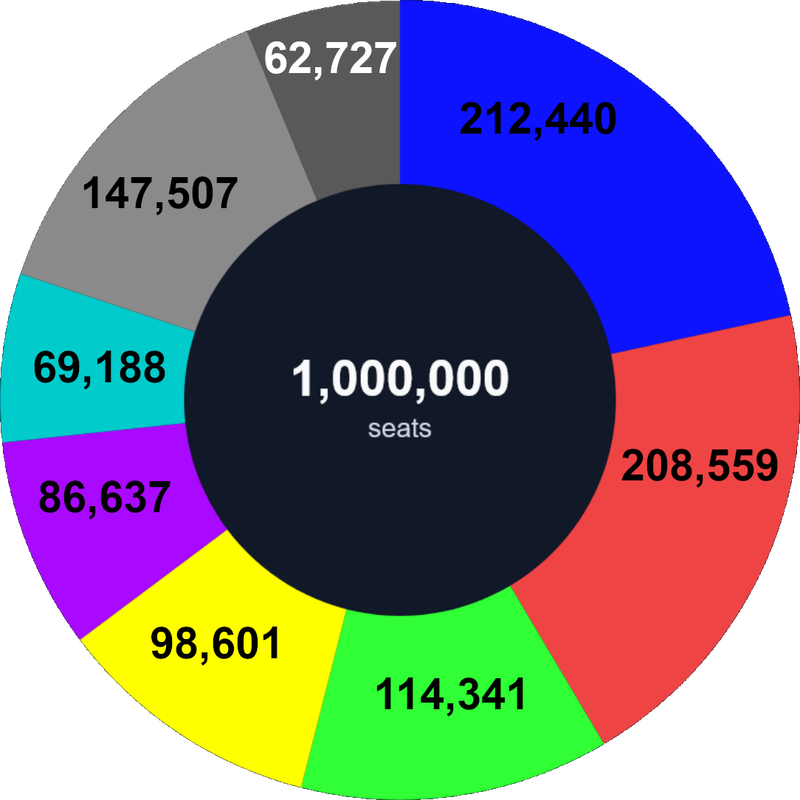
Biological Consensus: 1,000,000 representatives (2,089,115 people per seat)
Autonomous Consensus: decisions given exclusively by artificial neural networks that represent the interests of other neural networks

Votes in legislature are tallied on a pie chart as there are so many members of each consensus.

Biological Consensus is organized as shown
Image


Partycolorvote shareSeatsSeat share
Recreation and Social Partyblue21.59%212,44021.24%
Automation Frontred19.89%208,55920.86%
Other Partiesgrey13.64%147,50714.75%
Ecology Partygreen12.50%114,34111.43%
Liberal Commerce Partyyellow10.80%98,6019.86%
Unity Partypurple8.52%86,6378.66%
Conservative Technocrat Partycyan6.82%69,1886.92%
Independentdark grey6.25%62,7276.27%
27 | M | Worldbuilder | Scalie | Uses AI but still likes human art
Check out my factbook!
Kobalera's home system!

User avatar
Furballland
Chargé d'Affaires
 
Posts: 499
Founded: Feb 27, 2019
Liberal Democratic Socialists

Postby Furballland » Thu Jun 04, 2026 8:39 am

The Tuszuvudszkhan Assembly, is the Main legislative system of Furballland. It holds all political power in the country as it is comprised of the Multicameral system, but only recognized the two major chambers, and has significant constraints on the two minor chambers, while the two major chambers are the most significant in its power, as it is comprised of Four legislative chambers.

the National Congressional Assembly
- the National Congressional Assembly is the main Legislative chamber where all legislative decisions are made. The chamber itself is located at People's Palace. Most of legislative power concentrated in this particular chamber. It is also the lower house for Furballland's legislature. It is the largest legislative chamber in the world, with a capacity of 25,000 seats, and 19,236 members are currently in charge. The government itself is under a coalition whilst being a Multi-Party state. Many decisions and meetings, as well as debates are initiated. The members of the chamber is elected through proportional representation, in which the most votes for President and Prime Minister is the ruling party, regardless of coalition.

the Upper Council
- the Upper Council is the upper house for Furballland's legislature, where the final verdict of legislature is initiated and decided ensuring fair and equitable reasoning. The members are chosen based on its ability, and by population proportion by region to ensure representation for regions. But since the Upper Council uses the population as its basis (like the United States, except Furballland does not use electoral college, but used proportion of population). Some regions with large populations like Meliuw has 89 representatives, and Terija has 70 representatives, some regions with small populations like East Waszeraj has 3 representatives, and North Savunak only has one representative. Which results in a dilemma where some regulations on environment in certain regions with small populations are gone unnoticed, while some policies made by regions with large populations are noticed frequently. But in a fortunate case some policies and final legislative decisions from the NCA are given a verdict regardless of regional populations.
Last edited by Furballland on Fri Jun 05, 2026 10:15 pm, edited 2 times in total.
Tuszuvudszkha Deers roaming around and eating what they could find in other homes, besides, we the Furballlandian People, are actively working to create a Liberal Socialist Utopia, and improving lives for working-class citizens, which we kept our promise, and we wanted a stable, and stronger democratic government.

Asumerakilastszag Mahïtriğnaszőva ůhaűbataszagțal

OOC Info: 19 | He/Him | Philippines

User avatar
Brittororum
Envoy
 
Posts: 260
Founded: May 24, 2025
Psychotic Dictatorship

Postby Brittororum » Thu Jun 04, 2026 8:42 pm

The country's legislative system is based on the 2026 Constitution and is structured around the National Council, the supreme legislative body of the state, established after the dissolution of the historical parliament in early 2026. The system formally retains a bicameral structure consisting of the National Council and the National Duma. The National Council includes 200 appointed members representing the armed forces, industry, education, culture, veterans' organizations, and public organizations. The National Duma consists of 300 deputies elected for a five-year term through a state-controlled electoral system.

In practice, legislative power is closely tied to the executive branch. Bills are introduced by the chancellor or the government, undergo formal debate in the National Duma, and are approved by the National Council. There is no possibility of introducing significant amendments or blocking government initiatives. Elections to the National Duma are uncontested: candidates undergo a state loyalty check, and only officially registered and state-approved political organizations are allowed to participate. The National Unity Party occupies a dominant position.

User avatar
Luziyca
Post Czar
 
Posts: 39138
Founded: Nov 13, 2011
Civil Rights Lovefest

Postby Luziyca » Thu Jun 04, 2026 10:38 pm

Rwizikuru has a unicameral National Assembly, comprised of 100 MNAs (members of the national assembly) who represent 100 single-member districts and are elected via first-past-the-post, and has had it since the promulgation of the 2020 constitution which transformed Rwizikuru into a constitutional monarchy from an absolute monarchy.
||| • The Kingdom of Rwizikuru • |||
Your feeble attempts to change the very nature of how time itself has been organized by mankind shall fall on barren ground and bear no fruit
Wiki • Kylaris: the best region for ten years running • About me • YouTube • Political compass
NS stats have been lovingly sent back in time to 26 July, 1184 for an immersive medieval experience at the Erfurt Cathedral

User avatar
Dravanian Communes
Attaché
 
Posts: 73
Founded: Jun 02, 2026
Liberal Democratic Socialists

Postby Dravanian Communes » Fri Jun 05, 2026 5:06 pm

Dravania does not have a conventional bicameral legislature. Its central governing structure is the Council of the Confederacy, the collective name for the General Council and the Greater Council.

The General Council is the principal legislative and domestic governing body. It is composed of all 64 currently recognized communes, each represented equally regardless of population, wealth, or military strength. It passes confederal law, oversees domestic coordination, recognizes communes, establishes national standards, and ensures that ordinary legislation remains consistent with Common Law, Dravania’s constitutional framework.

The Greater Council is not an upper house, but a strategic council composed of the ten most economically, militarily, and strategically significant communes. It is responsible for foreign affairs, defence coordination, intelligence oversight, emergency planning, and wartime administration. In peacetime, most lawmaking remains with the General Council, while the Greater Council’s authority becomes more important during external crises, war, or national emergency.

Because Dravania is a confederacy, most everyday legislation is still made at the commune level. Communes control large areas of domestic policy, including policing, education, housing, labour administration, local economic regulation, and social policy. Confederal law generally exists to set national standards, resolve intercommunal issues, and preserve the unity of the Confederacy.
Last edited by Dravanian Communes on Fri Jun 05, 2026 5:11 pm, edited 1 time in total.
THE CONFEDERACY OF DRAVANIAN COMMUNES
CONFEDERAȚIA COMUNELOR DRAVANIENE


This nation is purely for fun and does not reflect a majority of my actual beliefs.

User avatar
Vallermoore
Negotiator
 
Posts: 5006
Founded: Mar 27, 2011
Inoffensive Centrist Democracy

Postby Vallermoore » Fri Jun 05, 2026 5:07 pm

The Parliament has two chambers, the lower chamber elected by first past the post, to make strong government, the upper chamber elected by PR, and it has veto power so the smaller political parties can have some influence.

User avatar
Hermitland
Diplomat
 
Posts: 535
Founded: Aug 10, 2022
Iron Fist Consumerists

Postby Hermitland » Fri Jun 05, 2026 5:10 pm

our great leader ellie makes all the laws, and thats it. she controls everything :D
Tim-Opolis wrote: I see your commitment to low nutrient beige foods is eternal

lurotic wrote: you possess an endless ocean of wonderful potential and you waste your life being the stupidest fucking person to everyone you've ever met
go outside smell the flowers and buy some food for a homeless person you bumass bitch

Ci Arovannea wrote:i hope u get hate crimed you bitchy little cunt

Ernest Drake wrote:I went to sleep and you were a brain rot game-player; I woke up and you are a brain rot game-player who stole my smiley emoticon. Great morning.

Bormiar wrote:you are mentally ill but it’s unrelated [to being trans]

ego thing
she/her transbian named ellie

User avatar
DutchFormosa
Negotiator
 
Posts: 6392
Founded: Feb 11, 2023
Left-wing Utopia

Postby DutchFormosa » Fri Jun 05, 2026 8:40 pm

Pretty much whatever the United States has, as they mostly served as a guide for when we became a republic
IC wiki
OOC info
============

User avatar
Praclarush Taonas
Secretary
 
Posts: 36
Founded: May 22, 2026
Ex-Nation

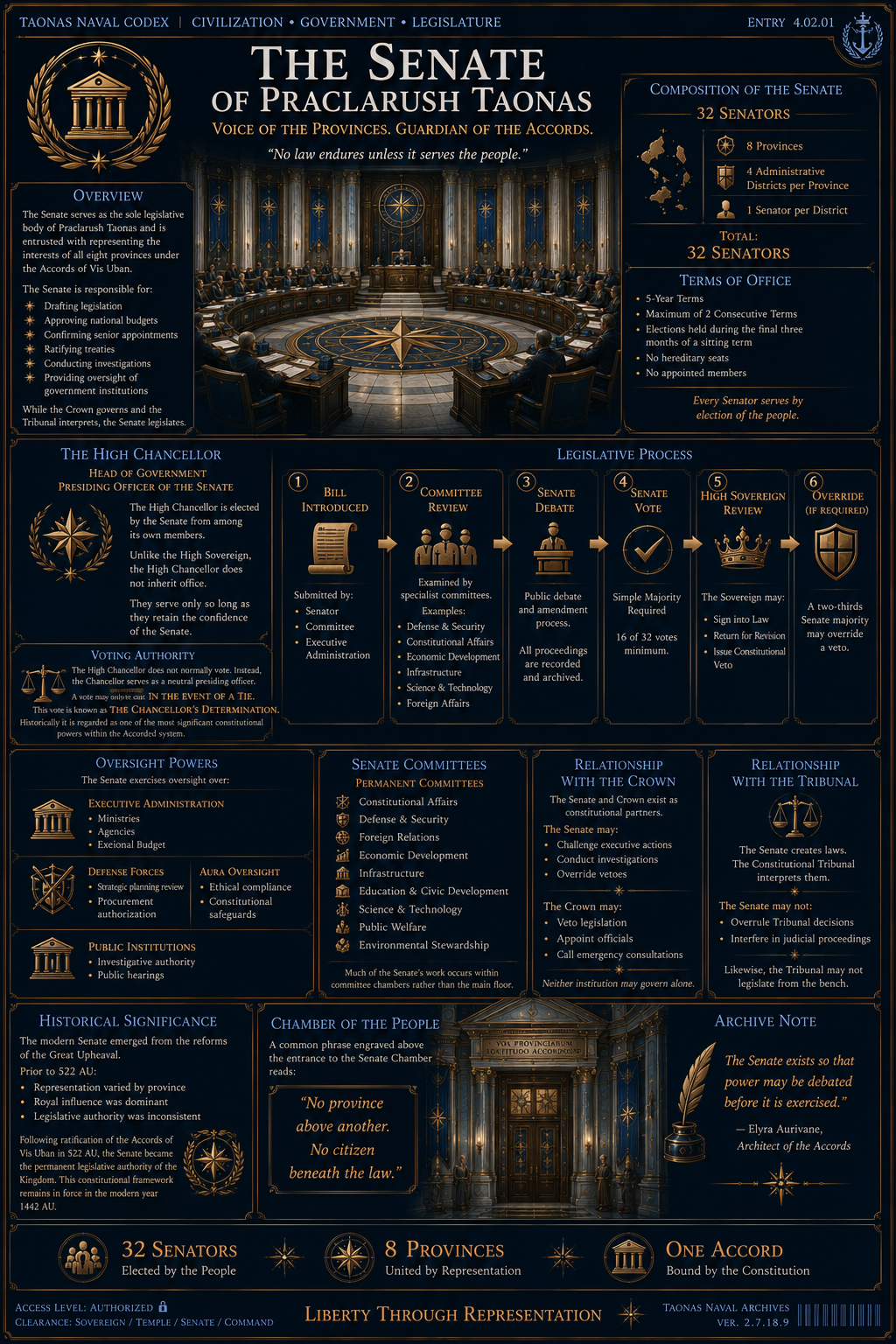
Postby Praclarush Taonas » Fri Jun 05, 2026 11:36 pm

Image
The Constitutional Monarchy of Praclarush Taonas
"Guided by the Sea, Bound by the Accords."
Crown • Senate • Temple

Diplomatic Relations Welcome
Regional & International Roleplay Encouraged
Contact via Discord:
sithis2320

User avatar
Washington-Columbia
Senator
 
Posts: 3834
Founded: Jan 29, 2022
Civil Rights Lovefest

Postby Washington-Columbia » Sat Jun 06, 2026 10:10 am

The legislative wing of the Cascadian government is bisected into a lower House of Commons, and a Senate.

The HoC is divided into 725 seats allocated to all 12 states representing roughly 105,000 people each. Each party presents a list equating to the amount of seats in the state. Every election season, every 2 years, all the seats of the HoC are up for election. However, during mid-term elections, people can vote to prevent a certain amount of seats from being up to election. Ranked-choice voting is used for an election, and every party gets a certain amount of seats proportional to it's votes. If a party doesn't cross the threshold needed to secure a seat in it's state, then it's votes run down to another chosen party. Primaries happen, where the voters vote for candidates to take seats won by their party, also using RCV.

The Senate accommodates 1 million voters each, and contains 76 million voters currently. Senate seats are region-based and drawn out by an independent non-partisan committee. As of now, 19 senate seats are up for election every year. Just like the HoC, each senate seat is voted on with the standard RCV, though each party has to nominate a senator. If the assuming senator is unpopular, then citizens in that district can garner signatures to order a recall for that senate seat, where if most voters vote yes, then they elect another candidate to fill in that senator's remaining term.
Imagine a bunch of socialist hikers, conservative lumberjacks and socdem hippies trying to make a utopia. That's us.
Overview and Embassy and Q&A
He/him
SHUT UP [names of neo-nazis], YOURE NOT A SS OFFICER SENT TO DESTROY WOKE HEGIMONY, YOURE AN EDGY 14-YEAR-OLD FROM CHICAGO
Barbie is an Allegory for Animal Farm. Kens seize control over the Barbies, and Ryan Gosling seizes power and keeps the status quo.
Extended OOC
Cascadian Union
Murica and Canadeh's progressive brother
Home to Deadpool, Batman and Jesse Pinkman
NS stats smoked too much grass and are sleeping RN
CBC N5 Weekly News: Rest in Peace, Czesjford - SLP candidate Taran Devi wins presidential election; left-wing FC Coalition & conservative TPR bloc dominates elections | Man says Ramadan Mubarak!|

User avatar
Riandera
Chargé d'Affaires
 
Posts: 477
Founded: Dec 06, 2024
Ex-Nation

Postby Riandera » Sat Jun 06, 2026 7:04 pm

Riandera has a bicameral legislative system, divided into the House of the People (Rayang: Rumah Rakyat, RR), and the Senate (Senat).

The RR, or the Lower House, has 240 seats which are designated for Members of the People's House (MPH), representing the eight provinces of Riandera (30 for each province). In order to win an election, a party must win over half the seats (121/240) in the RR. Bills start off in the RR, and are introduced by a MPH. The MPH reads the bill, and states why it should be a new law. It gets debated on, and, if the majority agrees, it moves to the Senate.

The Senate, or the Upper House, has 72 seats designated for Senators. Senators get elected every three years, and there are 9 representing each province. Once the bill has passed the RR, it is sent to the Senate. The process is similar to that in the RR, but in the Senate, a committee can review the bill. If the bill passes the Senate, it makes its way to the Raja (King).

The Raja can choose whether to make the bill an official law, or to reject it. If the Raja were to accept it, this would be called 'Supreme Assent' (Rayang:
❁ ETERNAL KINGDOM OF RIANDERA ❁
Capital: Langkamata • Population: 47.2 million • Demonym: Rianderan • Trigram: RIA • Tech: Modern Tech • Year: 2026 AD
NS stats ain't canon

It's Rainbow Dash time (yes, i am a MLP fan and i'm proud of it). IC FLAG HERE

Proud member of the South Pacific since 2024

User avatar
Wizlandia
Diplomat
 
Posts: 794
Founded: Nov 18, 2012
Anarchy

Postby Wizlandia » Thu Jun 25, 2026 6:34 pm

Parliament consists of an Assembly (the lower house) and a Senate (the upper house).

The Assembly consists of 800 Representatives; 400 of whom are elected via proportional representation (D'Hondt method), 400 of whom are elected via districts using ranked-pairs. Assembly terms & elections occur every 4 years, and there are no term-limits.

The Senate consists of 120 Senators, 10 for each of the 12 states. Senators are elected in staggered statewide elections every 2 years via ranked-pairs, where each Senator serves a single 20-year term, after which he cannot run for any political office.

The current government is a LDP-Conservative coalition.

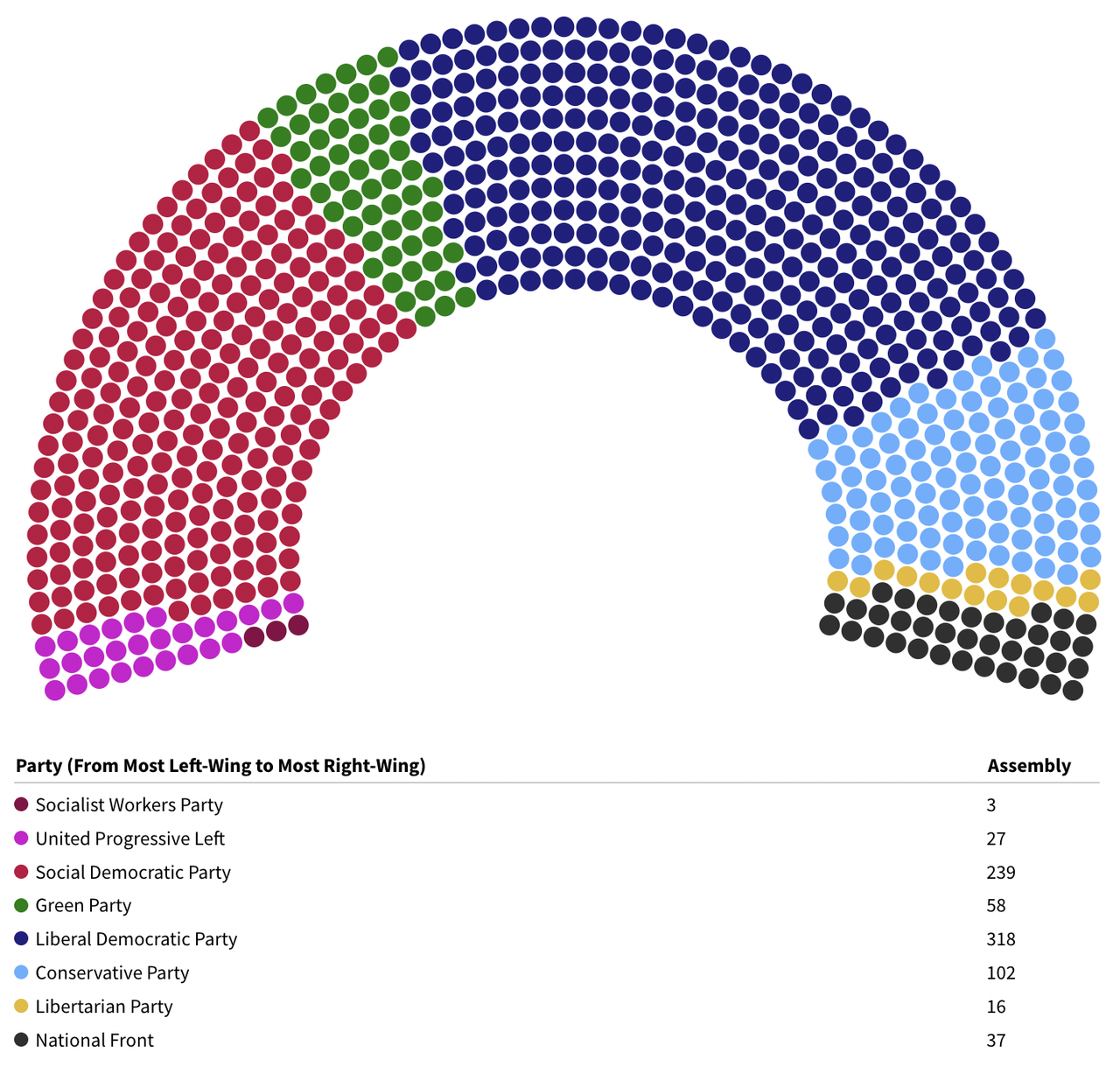
Image

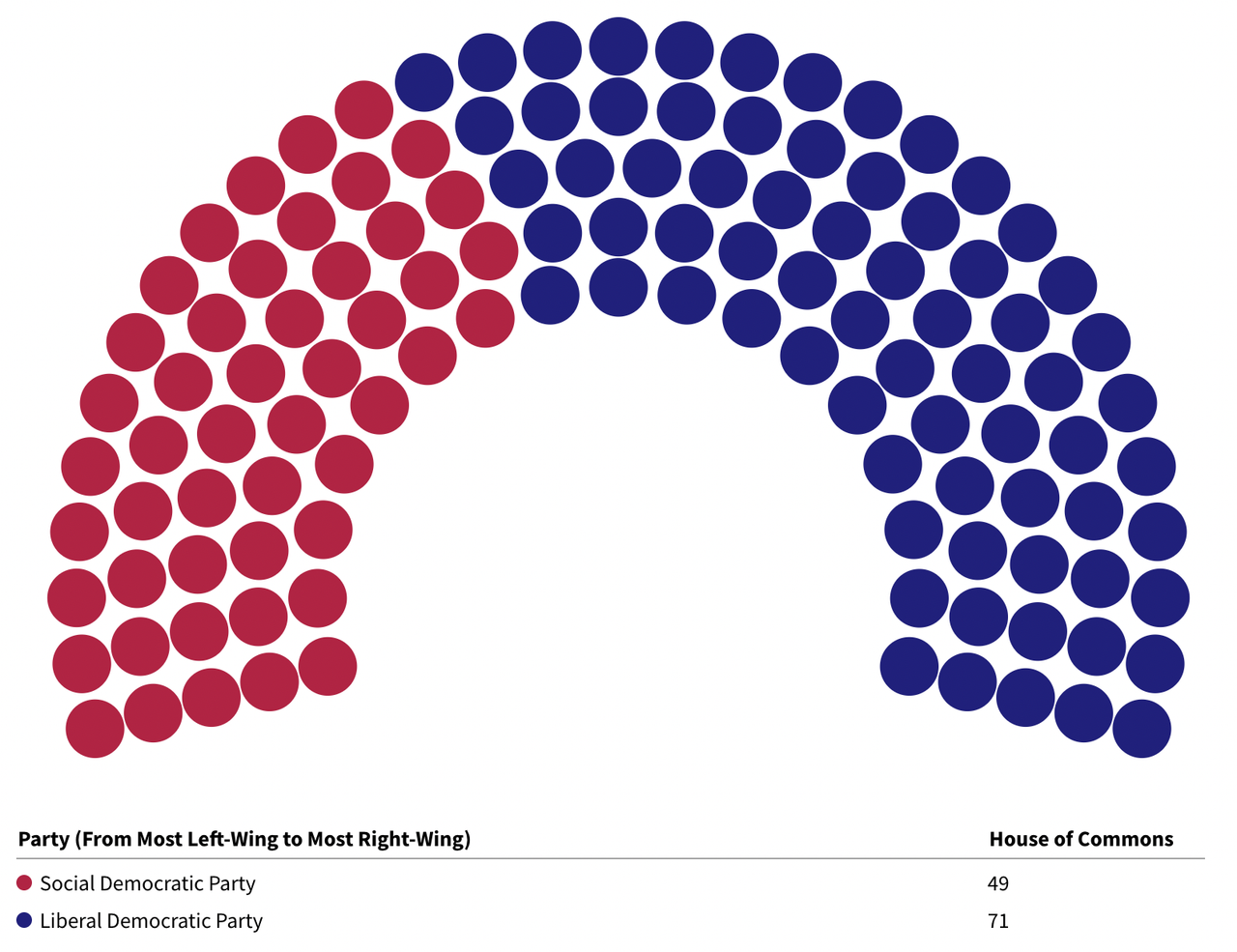
Image
Liberal-Capitalist Federal Republic & Archipelago Maritime Power

User avatar
Bagong Timog Mindanao
Envoy
 
Posts: 345
Founded: Sep 14, 2021
Authoritarian Democracy

Postby Bagong Timog Mindanao » Sun Jun 28, 2026 5:50 pm

The Parliament is a bicameral system that consists of the National Council (upper house) and the National Assembly (lower house)

National Council
The National Council consists of 70 councilors, 2 for each district. The 70 councilors do not represent localized districts; instead, they represent the overarching region their electoral district is located in. They are elected every 4 years using the plurality voting system. They are restricted at a lifetime cap of two 4 year terms

National Assembly
The National Assembly consists of 200 Parliament members. 175 members represent the districts they are located in, with 5 members representing for each district. They are elected through open-list proportional system. The 25 seats are reserved to uplift minority sectors, ensuring that labor unions, rights groups, and other vital socio-economic organizations have a proper legislative voice. They are also elected through a separate proportional system. They are elected every 4 years and are limited to three 4 year terms
The Republic of South Mindanao
Where Culture And Technology live in Harmony
Have a very nice day, y'all!!! (づ๑•ᴗ•๑)づ♡

OOC info | Your friendly NSer :3 | NOTE: Some NS Stats and Policies are not canon

User avatar
The State of Monavia
Ambassador
 
Posts: 1592
Founded: Jun 27, 2006
Right-wing Utopia

Postby The State of Monavia » Wed Jul 01, 2026 7:37 pm

The legislative organ of the Imperial Federation’s federal government is called the Imperial Parliament and has a bicameral structure. This basic structure was organized under the present federal constitution in 1732 as a replacement for the old unicameral legislature.

The upper house is called the Senate and has 126 members (two for each of the Imperial Federation’s sixty-three provinces) serving concurrent six-year terms. Each province elects one senator directly and the other is elected by the provincial legislature. The Senate’s presiding officer is called the Chancellor and has no vote except to break ties. Following a constitutional amendment in 2018, the Chancellor’s term is also six years.

The lower house is called the Tribunate and its 1,156 members are called Tribunes. Tribunes are apportioned among the provinces according to population and are directly elected to two-year terms by popular vote (in the event no candidate has a majority, there are runoff elections). The Tribunate’s presiding officer is called the Premier, serves a two-year term, and (like the Chancellor) has no vote except to break ties. Neither senators nor tribunes are subject to term limits insofar as election to office is concerned, but partisan distinctions (such as caucus leads, whips, etc.) and committee positions often have such limitations.
——✠ ✠——IMPERIAL FEDERATION OF THE MONAVIAN EMPIRE——✠ ✠——
FACTBOOKS AND LORE ⬩ ROLEPLAY CANON ⬩ DIPLOMATIC EXCHANGE

MY GUIDES ON ROLEPLAYING DIPLOMACY, ROLEPLAY ETIQUETTE, CREATING A NEW NATION,
LEARNING HOW TO ROLEPLAY (FORTHCOMING), AND ROLEPLAYING EVIL (PART ONE)

Twenty-Year Veteran of NationStates ⬩ Retired N&I Roleplay Mentor
Commended by the World Assembly Security Council
Member of the NS Writing Project and the Roleplayers Union
I am a classical monarchist Orthodox Christian from Phoenix, Arizona.


✠ᴥ✠ᴥ✠
⎩ᴼ‿ᴼ⎭
/‾‾ʽ⧓ʼ‾‾\

Next

Advertisement

Remove ads

Return to Factbooks and National Information

Who is online

Users browsing this forum: Dayganistan, TURTLESHROOM II

Advertisement

Remove ads