Delte 0 (Guénolé-Tonnelier Jonque missed penalty 48', Guénolé-Tonnelier Jonque red card 89')
Saint Eleanor 2 (Steve Pilchard goal 45', Guénolé-Tonnelier Jonque own goal 84')
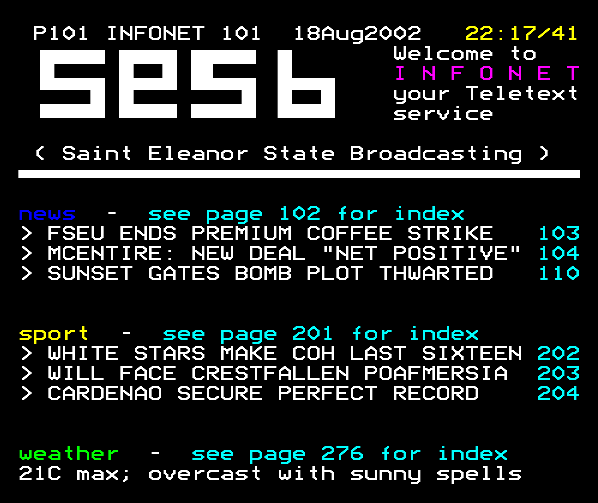
OOC: Teletext source

Premium Coffee agrees pay deal with FSEU workers after epic dispute
Chief Business Correspondent Bill Hoskin reports on the end of Saint Eleanor's longest strike in almost fifteen years, and why the union sees it as a coup
Originally published on Saturday 17th August 2002
The past two weeks been shrouded for many Eleanorians by the ongoing Cup of Harmony. But for members of the Foodservice Employees Union who work at Premium Coffee it has been an epic struggle. They are members of Saint Eleanor's biggest and most powerful union; they work at Saint Eleanor's most prominent, chain of coffee stores - and Saint Eleanor seems to be almost terminally addicted to the imported beans.
For a nation that prides itself on being open to itself and the world for as long as it can possibly take, Saint Eleanor has an astonishingly strong union culture in retail and hospitality, two of the largest sectors of the economy - and ones which have historically been dominated by low pay and miserly conditions. Some estimates suggest that 80% of those workers are unionised; many of the rest working in small, independent shops where they can bargain independently yet effectively, but some small businesses tolerate and even welcome unionisation.
And they often get their way, too; many trade disputes have been rapidly resolved by the government threatening to step in and give the workers what they want. The most famous concession came fourteen years ago last month, after workers at retail giant OPAL went on strike for 25 days, leaving many shops open only between 10am and 6pm, and often with just one cashier. They demanded that OPAL increase their annual paid holiday allowance from three days to fourteen, in line with almost completely-unionised challenger Intershop. When they refused to listen, the Holiday Decree 1987 was enacted - giving everyone a two-week holiday allowance - and both sides backed off.
George Mitcham, Charlotte Morgan and friends are willing to put a stop to unfair working practices, lacklustre conditions and mismanaged pension schemes. But under no circumstances will they countenance a minimum wage - which proved a sticking point for the FSEU as its pay deals with two of Saint Eleanor's big three quick service restaurants, Willis and Premium, came up for negotiation this summer. (Unionised Torch employees have had their pay raised by inflation plus half a percent since 1993 as part of their rolling deal, agreed when staff threatened to engage a full indefinite walkout unless chief executive Gexavera zaPravela personally agreed - although he insists on offering similar pay to his few non-union workers.) When Willis offered 1.5% in early July and FSEU workers there said no, union leadership negotiated a 2.25% pay raise and agreed to bump up sick leave payments to $180 per week, a 20% increase; the members gobbled the offer up the second time around.
At Premium Coffee, however, the dynamic was completely different: the FSEU grudgingly accepted an eighteen-month pay freeze at the very start of 2001, meaning that when negotiations rolled around last month, unionised Premium workers were being paid less in real terms compared to 1990, itself a historic low ebb for Premium-union relations. The union had three core demands: extending time-and-a-half nighttime payments, which already covered 10pm to 6am, to be extended to between 8pm and 8am; an increase in Premium contributions to the company pension scheme from the legal minimum of 3% to 3.5%; and the crown jewel, an immediate, one-off 7% pay increase to compensate for historic deterioration. Premium threw all of that out, offered to freeze store manager pay until 2004 (in a perhaps misguided attempt to placate the union) and promised everyone else 3% increases for most workers over the next two years. The increases were deemed insufficient - but the pay freeze for managers, who themselves had a lot to deal with and were historically more supportive of unions than their Torch and Willis counterparts, was massively detested.
Although negotiations plodded on for weeks on end, there was hardly any news from either side, leaving many to believe that an improved agreement was in the works. The first sign of breakdown came on the afternoon of 30th July, the day of Saint Eleanor's first group game and a few hours after Willis workers had agreed to the company's proposal, when FSEU Local St George general counsel Lisa McEntire - who had been leading the union's negotiations with Premium - announced that there were "irreconcilable differences" on all three fronts. Negotiations formally collapsed the following morning and a swiftly-organised strike ballot showed near-unanimous support for a walkout until their demands were met.
The results were cataclysmal. As soon as the clock struck 6am on Friday 2nd August, unionised Premium workers walked out - and if they were not on duty at the time, they just did not go to work at all. Regular pickets were held outside most branches reiterating their demands: the banners invariably blared "Fair Pensions, Fair Pay, Fair Future." Anybody who wanted Premium Coffee would have to get past them, put up with reduced opening hours (if any), barebones staffing, and even occasionally raised prices. Anybody who wanted to cheat and buy coffee from the local supermarket would, more often than not, be left disappointed. The same goes double for independent coffee stores - at least outside Collegiate district, where the summer holidays are upon the University and Premium has never been able to secure a foothold.
This was, as I have said and everyone has feared, most certainly not a case of the government swooping in to give Premium what they wanted on multiple counts. So what exactly happened? Public pressure: Exandra Davies and Jessica Martin were the first to step into the fray, of course. A few other league jobbers here and there had their say, too - although only David Newcastle joined them in earnest. But it was Derek Pitta,- always sceptical of the unions, who almost clinched it in decrying the conditions of the Premium workers "who serve me and tens of thousands of others every day" who almost clinched it. The day after he made those comments, August 13th, Premium offered to return.
They didn't want any changes to overtime, at least until a new negotiating round to be held in April 2004; ttempts to get them to at least increase overtime pay were rebuffed, but that was brushed aside in a matter of hours. What the FSEU loved was a proposal to bump up employer pension contributions to 4%, beyond union demands, and offer every worker a 3.25% rise the following year - followed by a 2.65% rise every year until 2007. When the vote to confirm the pay deal landed on union workers' desks, they supported it by an 80% margin. McEntire tells me that the union was seriously considering keeping on the strike when they first heard of the Premium offer, but that "after a great deal of thinking, we reckoned it would be good for workers, good for Premium, and good for everyone who comes into their shops and treats the union folk with due respect."
The focus for 2004 will be on overtime: pay, duration, and conditions. But that is a sideshow, for now: the focus is on this week's successes, when union action effectively forced Premium to offer a long-term pay agreement that has not been seen anywhere in the hospitality sector other than Torch, make guarantees about workplace pension contributions (a subject too little discussed by the FSEU) - and yes, to go into the next batch of negotiations with a clear roadmap. Government action has taken the unions far, but the recent Premium strike is the first time in a while - perhaps since the chain last suffered large-scale nationwide walkouts in November 1990 - that the union has gone on strike and then extracted crucial demands directly from the business.
Do not be under any illusions that the FSEU has brought about an end to disputes. At Torch, certainly - but the Willis agreement was shaky in and of itself and might not survive the negotiations of summer 2004. OPAL and Intershop have fared little better in their post-1998 negotiating rounds, and their actions have repeatedly threatened walkouts, but they have only saved themselves by caving in and agreeing to most of the demands just in time (or two days later, as Intershop discovered to the union's surprise in March 2001). With that said, the Premium Coffee dispute was protracted almost as much as it was progressive - and the union is convinced it hasn't gotten such a good deal in a decade.