NATION

PASSWORD

Tumbran Database (CLOSED)

A place to put national factbooks, embassy exchanges, and other information regarding the nations of the world. [In character]
User avatar
Tumbra
Minister
 
Posts: 2184
Founded: Aug 29, 2013
Civil Rights Lovefest

Tumbran Database (CLOSED)

Postby Tumbra » Fri Apr 16, 2021 1:40 pm

Please do not post in this thread unless you are a mod or authorised to do so by Tumbra.

Image
Image


TUMBRAN NATIONAL DATABASE
Jointly Administered
by the National Archives of Tumbra, the National Library of Tumbra,
and the Tumbran Broadcasting Corporation


The following thread serves as a compendium for Tumbran information in general. For news, please refer to the Tumbran newswire at this link.
Last edited by Tumbra on Mon Jun 23, 2025 10:58 pm, edited 28 times in total.
THE FEDERAL REPUBLIC OF TUMBRA
Tumbra - a sprawling, modern federal democratic republic located in Esportiva. Strong economy, strong civil rights, strong freedoms.
Population: 125 million | TLA: TMB | Capital City: Straton | Largest City: Couno
Constitution | Domestic Database | Domestic Newswire | Domestic Motorsports | Wiki Article
President: Bertram Andrews (Labour) | Prime Minister: Sandra Campbell (Labour)
U-18 World Cup 13, 21 Champions | Di Bradini Cup 51, 57 Champions | Campionato Esportiva 31, 33, 34, 38 Champions | Eagles' Cup 13, 14 Champions
World Grand Prix Championship 21 — World Drivers' Champion (Ted Pressley — Ælund)

User avatar
Tumbra
Minister
 
Posts: 2184
Founded: Aug 29, 2013
Civil Rights Lovefest

Postby Tumbra » Sat Apr 17, 2021 12:13 pm

Tumbra — Main


Flag
Tumbra's flag is officially known as the Red, Black, and Blue. Officially, the flag is described as such:

The flag, in a 3:2 ratio, is a tricolour Tumbran fess which consists of three horizontal fesses in a ratio of 1:2:1, with the top fess being red, the middle fess black, and the bottom fess blue. The central charge, positioned on the black fess, is a gold eagle displayed, surrounded by an annulet of 25 gold five-pointed stars.

Coat of Arms
Arms:
On a roundel Sable, an eagle displayed Or within an orle of twenty-five mullets of five points of the same; all within a double bordure Gules and Azure.
Supporters:
To dexter, Lady Liberty, proper, vested Argent, the shoulders bare proper, wearing a Phrygian cap Gules, holding in her dexter hand a sword erect Argent and with her sinister arm supporting the roundel, to sinister, Lady Justice, proper, vested Argent, the arms bare proper, blindfolded, holding in her sinister hand a balance Or and with her dexter arm supporting the roundel.
Compartment:
The whole upon a grassy mount Vert, rising in form of a hill, semé of cornflowers Azure slipped and leaved proper, the roundel resting thereupon.
Motto:
Beneath all, on a scroll Argent edged Or, the motto in letters Sable: LIBERTY AND JUSTICE FOR ALL.

Motto
Tumbra's official motto is Liberty and Justice for All.

Anthem
Tumbra's national anthem is the Song of the Tumbrans. It can be heard here.

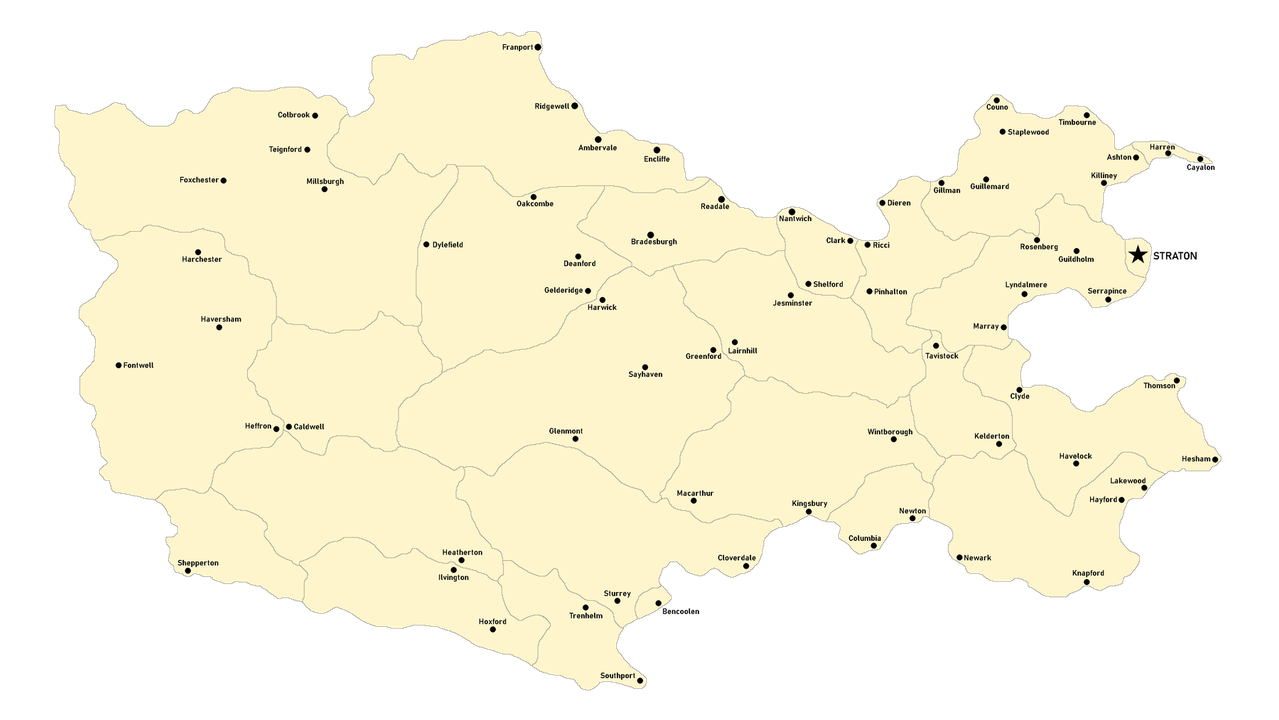
Map
Image
Image


Demonyms
The official way to refer to someone from Tumbra is as a Tumbran.
Usage: I am a Tumbran/I am Tumbran/These are my fellow Tumbrans

Official Languages
Tumbra's official language is Tumbran, and is the only federally recognised official language. Individual states may recognise other languages as co-official; for example, many of the Southwestern states, which have a high Licentian Dutch-speaking population, recognise Dutch as a second official language at the state level. Government communications are often only in Tumbran, but increasingly there has been a push to include other languages, such as Dutch, Yue, Savigliano, Riennese, and Shingoryeoite.

Name
The official name of the country is the Federal Republic of Tumbra.
In Yue, however, the name of the country is 海涛国.

Tumbra — Statistics


Population
Tumbra's population as of its 2040 census was 128 million. This is expected to hit 134 million by the next decade. Tumbra's total fertility rate is below the 2.1 replacement rate, at 1.65. The average life expectancy is 82 years for males and 85 years for females.

Density
Tumbra is a relatively dense nation when it comes to population size, with the national population density being about 208/km2.

Ethnic groups
Tumbra is a relatively multi-ethnic society. As of the 2041 census, Tumbra was 85.8% White, with 8.2% Asian (Yue, Shingoryeoite, Riennese, and other heritage), 5.5% Black, and 0.5% other. Within the White demographic, a substantial minority population in the Southwest of the country claim Licentian Dutch heritage.

Religion
Tumbra is majority non-religious, with 55.3% of the population in the 2041 census responding with "No religion". 15.1% of respondents were Emberican Christian; 10.7% of the population was Catholic, 9.1% were of other Christian denominations, 2.5% Jewish, and 7.3% were of other faiths.

Area
GDP
Gini
HDI

Date format
Tumbra uses the Day/Month/Year format for dates.

Mains electricity
Tumbra operates on a 230V supply voltage at a frequency of 50Hz.
The plug format used in Tumbra is the BS 1363 three-pin plug.

Driving side
Tumbra drives on the left.

Calling code
Tumbra's calling code is +90.

Trigramme
Tumbra's trigramme in all international sporting events is TMB.

Internet TLD
Tumbra's internet TLD is also .tmb
Last edited by Tumbra on Wed Feb 11, 2026 9:14 am, edited 15 times in total.
THE FEDERAL REPUBLIC OF TUMBRA
Tumbra - a sprawling, modern federal democratic republic located in Esportiva. Strong economy, strong civil rights, strong freedoms.
Population: 125 million | TLA: TMB | Capital City: Straton | Largest City: Couno
Constitution | Domestic Database | Domestic Newswire | Domestic Motorsports | Wiki Article
President: Bertram Andrews (Labour) | Prime Minister: Sandra Campbell (Labour)
U-18 World Cup 13, 21 Champions | Di Bradini Cup 51, 57 Champions | Campionato Esportiva 31, 33, 34, 38 Champions | Eagles' Cup 13, 14 Champions
World Grand Prix Championship 21 — World Drivers' Champion (Ted Pressley — Ælund)

User avatar
Tumbra
Minister
 
Posts: 2184
Founded: Aug 29, 2013
Civil Rights Lovefest

Postby Tumbra » Sun Apr 18, 2021 12:06 pm

Tumbra — Government


Executive Branch: The President and Vice-President
Image


The President of Tumbra is the head of state of the Federal Republic of Tumbra. Together with their deputy, the Vice President of Tumbra, they form the Office of the President. The President nominally has ultimate executive power in the country, but this power is bound to what the Prime Minister of Tumbra wishes. Nevertheless, the Office of the President still retains significant checking powers against the other branches of government, and acts as the guarantor of the Constitution of Tumbra. Both the President and Vice President are elected together every six years in a two-round election, where the top two candidates proceed to the second round of the election if no candidate garners a majority in the first round of the election. The President and Vice President are constitutionally limited to a single term. The Vice President of Tumbra also officially presides over the Senate of Tumbra, the upper house of the Tumbran Parliament, and is first in line to succeed the President should the office become vacant. The Vice President also exercises the functions and duties of the President when the President is otherwise unable to do so.

Collected Miscellany: The Presidency

Collected Miscellany: The Vice-Presidency
With Tumbra being a parliamentary federal republic, with executive power vested in the Prime Minister and their — currently his — Cabinet, the position of Vice President of the Federal Republic remains but a curiosity. Most Tumbrans who sat through social studies lessons at the Secondary One level will be able to recite from memory that the Vice President is the first to succeed to the role of President if they — currently he — suddenly becomes incapacitated or dies, and also serves as the President of the Senate, the upper house of the Federal Parliament. Most will think that the former role — that of being a surrogate President — is the more important one, but in reality it is their role as President of the Senate that makes their role uniquely important — and uniquely political, as compared to that of the President.

While the President is allowed to be a member of a political party — this restriction was lifted in 1877 — they are widely expected to be above party politics, and many Presidents downplay their party membership in favour of being the guarantor of the Constitution, no such restriction exists for the Vice President. They have often been nakedly partisan in their role as President of the Senate — unlike the Speaker of the House of Representatives, they have no need to be impartial when voting — and possess a key tiebreaking vote when the chamber is tied. There was no equivalent role to that of vice-president in the short-lived United States of Tumbra, with only the President and the Chancellor, whose modern-day equivalent would be the Prime Minister. In the old system, the position of chief steward of the upper house of the Congress was simply just one member of the fifty-four, while if the President happened to pass away in office, a contingent election would simply be held to fill the previous president's term. While the framers initially flirted with not having the position of Vice President altogether, the twin roles of providing an easy line of succession, as well as their role as President of the Senate was deemed too important to give to another individual, meant the Vice President position stayed, but only has these two responsibilities, plus any other responsibilities the President may choose to assign them.

One hurried amendment was made to the Constitution soon after the first presidential election, however, as the possibility of a president and their vice-president working against each other was too serious to bear. The 1864 election saw the only separate election for president and vice-president, though both took place on the same day; the election for vice-president ended up being one of the most keenly contested in the new republic. Former Chancellors Michael Turner and Ralph Davidson, by now heated personal rivals, vied for the position of president of the Senate; Davidson would win by a hair, but was unable to parlay the vice-presidency into the actual presidency when he made his own run for the top job six years later.

Most Vice Presidents have used their role to advocate for important issues they deem personally important; while most of these issues have been perceived as apolitical, some have gained controversy for being outwardly political. The 31st Vice President, Thomas Carmichael, used his tenure in office to continually hold the Labour government to account on the issue of the Northlands, with him using his position as President to give Senators from his party, the Greens (who were opposed to the invasion) ample time to speak on the issue. Other Vice Presidents have chosen less controversial topics to champion, with the 26th Vice President, Desmond Lewis, using the good offices of his position to urge reform to how children in school were fed. Amanda Perry, the 29th Vice President, championed cancer research, owing to her sister having passed away from the disease while both were young.

As of 2044, thirty-five people have served as Vice President. The 34th Vice President, Brendan Barker, was the youngest ever Vice President to serve in the office; taking office at the age of just 42. Because the President and Vice President are elected upon the same ticket, they are usually used to balance out the ticket geographically. To take one example, the 32nd President, David Hardcastle, when he was a parliamentarian, represented the southeastern state of Clearmont; Barker, meanwhile, represented the northwestern state of Grantfeldt. The ticket they defeated in the 2038 election, Nigel Scanlon and Melanie Coburn, had broadly similar dynamics — Scanlon was also from Clearmont, while Coburn was from the western state of Marlsbruhe. The selection process for vice presidents is often held behind closed doors and is often dominated by party bosses, during which the presidential nominee has a say, but not the defining one. Labour, for example, gives their Senate caucus leader the largest say in the vice-presidential pick, because if elected they will have to work together with the new Vice President. The right, in contrast, used to split the posts when they were two parties in coalition; the larger, Liberal Party got to pick the presidential nominee, while the smaller National Party got to nominate the Vice-President. For this reason, despite the Liberals being by far the dominant centre-right party in government, they have only had four Vice-Presidents — the agrarian-focused Nationals, meanwhile, had six. With the right now merged into a single superparty, however, their selection process now more closely resembles that of Labour, but with surprising outcomes; Scanlon, for example, was formerly a member of the Nationals, and would never have been considered for the Presidential nomination under the old system.

The tickets also often balance themselves out in terms of characteristics, with the Vice President typically being younger than the President. This has led to some criticism that the selection criteria for Vice President often boils down to "mid-40s to late-50s sophomore Senator from a swing state." Both tickets mentioned in the previous paragraph held to this unspoken rule; Brendan Barker, Labour's vice presidential nominee, was 42 at the time of the election and came from the swing state of Grantfeldt; Melanie Coburn, his opposite number, was 48 and came from the swing state of Marlsbruhe.

Vice Presidents have often had varying reactions to their position. Edgar Brandis, the sixteenth Vice President, wrote of it as "a great bore with little to do except sit there and bang the gavel at the start and end of each day," while David Young, the 22nd Vice President, enjoyed his work as President of the Senate and was often deeply involved in the passage of legislation through the Senate. Whether or not Vice Presidents have enjoyed their job almost always boils down to whether they have Senate experience or not, though this is not a defining characteristic. Julian Munro, the 32nd Vice President, reportedly hated the job and only accepted the Vice-Presidential nomination in order to help his ticket win the swing state; in fact, Munro hated it so much so that he sparked a mini crisis within the government when he made clear his intention to resign barely a year into his term to return to state politics. Munro had previously served as Premier of Clearmont; being Vice President was his first role in federal politics. In contrast, his successor, Lucas Clark, has spoken of his time as Vice President as "deeply fulfilling"; the elderly political operative was nominated for the post after Munro's resignation (and a giant quarrel over whether the Liberals or Nationals would get to nominate Munro's successor) and was ranked by political scientists as the most able Vice President of the current century despite also never having served a day in the Senate.

The position of Vice President has fallen vacant for various reasons four times in Tumbra's history. One, as mentioned above, was when Julian Munro resigned as Vice President. Twice, the position became vacant because the Vice President ascended to the position of President upon their death; this happened to Arthur Meyrick in 1924 and Walter Hinchcliffe in 1970. Once, the position has fallen vacant because the Vice President themselves passed; this happened unfortunately to Roy Monteith, who died in 1986. In each case their successors were nominated by the President and confirmed by the Senate, usually with little objections from the sitting Senators after a confirmation hearing, typically in front of the Senate Judiciary Committee or a special committee to discuss the matter.

Four Vice Presidents have become President themselves through an election. The first to do so was William Cohen, the second Vice President, who served as Michael Turner's — the 2nd president — vice president and gained his personal endorsement in the election of 1876, riding it to victory. The second was Richard Halleck, a personally popular politician who had made his name in the United States era by serving as Minister for Railways, and who had himself served as Cohen's vice president. He garnered Cohen's endorsement for the 1882 election, and won handily. Robert Stephens, the eighth Vice President, was the second; though there was a six-year gap in between his stint as Vice President and President thanks to him losing the 1912 presidential election. His term as President would be cut short by his passing at the age of 70. The last was Matthew Cox, the twelfth Vice President, who successfully navigated a complicated nomination process to win his own term. The reason why only three Vice Presidents have become President themselves through the ballot box have been discussed. Vice Presidents often fail to garner their party's nomination, passed over in favour of a nominee who might be more palatable to the electorate; or when they do, they end up losing in the general election. There have been three cases of this; the aforementioned Robert Stephens, who lost in 1912, Thomas Hughes, who served as vice-president from 1960 to 1966, lost to the young and charismatic James Miles in 1966 (though Miles would end up passing away three years later of a heart attack), and Desmond Lewis, whose 2002 candidacy was scuppered due to associations with the controversial Hazel Moore presidency due to her actions during the September Crisis. The supposed inability of vice-presidents to ascend to the Presidency has been a topic of some discussion as the Presidency (and consequently the vice-presidency) rarely stays with one party. Labour winning two presidential elections in a row in 1972 and 1978 is seen as a historical anomaly, even when they would subsequently repeat the feat in 2038 and 2044.

While the role of Vice President is often overlooked, they are more important than they look. To political parties, the Vice President is often more important than the actual presidential nominee; because the role of President as a figurehead often pales in comparison to the active legislative work that the Vice President does. This has resulted in some times where the President and Vice President barely seem to come from the same administration; but most presidential tickets have enjoyed warm relationships with each other, with the sole exception being the presidency of Edward Merryweather; his first Vice President Julian Munro's utter dislike for the job of Vice-President, as mentioned above, is said to have permanently caused a rift between the two. Munro's successor, Lucas Clark, enjoyed a much more cordial relationship with Merryweather, the two of them being lifelong friends; but the optics of two elderly men occupying the two highest offices in Tumbra is said to have been the main reason why Labour ended up winning the most recent, 2038 presidential election.

Executive Branch: The Federal Government
Image


The federal government of Tumbra, defined in the Constitution as the executive branch comprising the Prime Minister of Tumbra and their cabinet, oversees the day-to-day running of the Federal Republic. The government is the central executive of the Tumbran state, and is led by the Prime Minister, who appoints ministers to the Cabinet. The government is selected after any federal election, where any MP that is able to win the support of the House of Representatives (the lower house of the Federal Parliament) will be elected as Prime Minister. Typically, this will be the leader of the largest party in Parliament.

Collected Miscellany: The Prime Minister
Collected Miscellany: The Cabinet

Legislative Branch: The Federal Parliament
Image


The Federal Parliament of Tumbra, based in Straton, serves as the legislative branch of the Tumbran federal government. Comprising an upper chamber, the Senate, and a lower chamber, the House of Representatives, the Federal Parliament is the primary lawmaking body of the Tumbran government. Based, like most of the rest of the federal government, in the capital city of Straton, the Federal Parliament has 900 members in total — 675 in the House and 225 in the Senate, all of whom are directly elected by the people at four-year and six-year intervals, as set out in the Constitution. Parliament is also where all members of the Cabinet are drawn from, and a majority of Cabinet ministers are typically drawn from the lower house. Cabinet ministers, therefore, are responsible for to the respective house in which they sit. Any Member of Parliament may be recalled, and a by-election held, if voters totalling either one-third (House) or one-fifth (Senate) of the total registered voters for the seat sign a petition calling for the recall of any particular Member. Since the passage of these amendments to the Constitution in 2029, one member has been removed in this way: Senator Kathleen Nielsen of Georgia. In 2044 the power of recall was substantially altered, even though the power had been rarely used; a member of the House or Senate must have committed a specific offence or been suspended for a recall petition to be valid.

Image


The House of Representatives is the lower house of the bicameral Federal Parliament of Tumbra and is the primary chamber of its body. It meets in the House Wing of the Federal Parliament building in Straton, Tumbra. The House's presiding officer is the Speaker, who is also third in line to succeed the President.

The House, comprising of 675 members known as Members of Parliament (MPs), is elected via full preferential instant runoff voting. MPs are elected to represent constituencies until Parliament is dissolved, either by reaching the term limit or by Parliament being dissolved earlier by the Prime Minister. Elections are held every four years, and Members of Parliament are elected by Tumbran citizens over the age of 18. The House has several functions - it elects the Prime Minister, who has to be a member of the lower house, is responsible for executive oversight, and sets the Federal Budget. It is able to originate legislation in the form of Private Members' Bills, scrutinises legislation brought forth by all three of the executive branch, the Senate and private members by referring matters to Legislative Committees. Most attention from the media and the public is focused on the House, due to its higher level of power and more combative style of debate. Particular attention is paid to Prime Minister's Questions, held at noon on Wednesdays, where the Prime Minister and Leader of the Opposition go head-to-head, trying to embarrass each other politically. Most legislative activity occurs in the House, and over 90% of legislation passed in the 2025-2029 term of Parliament originated in the House of Representatives.

Image


The Senate of Tumbra is the upper house of the bicameral Federal Parliament of Tumbra and is often considered to be the secondary chamber of its body. It meets in the Senate Wing of the Federal Parliament building in Straton, Tumbra. Comprised of 225 Senators, the body elected via party-list proportional representation. Each state sends between 7 and 12 Senators to the Senate, the exact composition of which is determined by the Federal Elections Composition every twenty years. Elections to the Senate occur every six years, concurrent with those for the Presidency.

The Senate has several functions that are unique to upper houses throughout the region, but with several caveats - it has the same power to raise legislation as the House, with the exception of all money bills. It cannot, however, fully reject bills, but only delay their passage. The Senate, however, has the power to accept or reject political appointments to various statutory boards and other posts as outlined by legislation and other conventions. Such posts include ambassadorships, and the appointment of federal judges to both the Supreme and Federal Constitutional Courts. Its intended function, as some statesman in history has put it, is to serve as a chamber of "sober second thought." Due to its smaller sizes and longer terms, is generally seen to have a more collaborative relationship than in the House of Representatives.

Open-list proportional voting is the name of the game when it comes to the Senate voting system; while it is possible for independents, theoretically, to win a Senate seat, the high thresholds for a party to win a seat means that in practice, political parties tend to win every seat in the chamber. The jockeying for a favourable list seat on individual party's list has led to fascinating studies of internal party conflict, most particularly present in the centre-left Labour Party; with two prominent factions, the left and right of the party, the party has resorted to 'twinning' Senators; one left-faction Senator candidate has to be accompanied by one right-faction Senator candidate, and vice-versa. The question of who comes first in that list is typically left up to the individual state parties.

As a result of the proportional representation system used, the Senate is more politically fragmented than the House, with no one party having ever achieved a majority of seats in the Senate. As such, the two major parties must negotiate with the smaller parties to get legislation passed. The government of the day typically appoints the Leader of the Government in the Senate, who represents the Government in questions and is typically also the caucus leader of the party that the Senator represents. Proportional representation for the Senate only came into force from the 1930 election, however; before then, a litany of electoral systems were used. For the 1864 and 1870 elections, for examples, each state sent four Senators — two elected by state legislators, and two Senators elected through plurality block voting, with the top two candidates gaining election to the Senate. The number of Senators per state has differed, too; until 1966, each state sent the same number of Senators to the Senate.

For the 1864 election, each of the 18 states sent four Senators to the Senate. Two were elected by state legislatures, and two were elected through plurality block voting.

For the 1870 election, the seven Western states joined and added eighteen Senators, electing a total of 100 Senators.

From the 1876 to the 1924 election, each state sent four Senators to the Senate, electing a total of 100 Senators. From the 1876 election, all Senators were elected through proportional representation.

From the 1930 to the 1960 election, each state sent six Senators to the Senate, electing a total of 150 Senators.

From the 1966 to the 2038, the number of Senators per state varied; the total number of Senators was fixed at 200, and each state had between six and twelve Senators.

In 2040, both Houses agreed to expand the Senate; giving seven Senators to the Northlands and eighteen distributed amongst the other states, for a total of 225. When the Northlands voted for independence in a 2043 referendum, the seven Northlands seats were redistributed amidst the other 25 States.

In contrast to the House of Representatives, where the presiding officer — known as the Speaker — is chosen from one of the MPs that form that chamber, the Senate's presiding officer is the Vice President of the Federal Republic, who has often been referred to as the 226th Senator. Officially known as the President of the Senate — "it's nice to be President of something, at least," former Vice President David Young is reported to have quipped — the President presides over all Senate sessions and casts a tiebreaking vote whenever votes are tied. Unlike in the House of Representatives, where the Speaker is bound by certain rules on how to cast their tiebreaking vote, the Vice President may freely cast their vote. In the absence of the Vice President, the longest-serving Senator in the chamber takes on the office of President of the Senate for that day, and is referred to as the President pro tempore of the Senate.

The Senate, together with the president, is elected every six years; their election date falls on the first Friday of February, simultaneous to the first round of the presidential election. From 2050, however, this will change to the first Friday of May. Party leaders, by convention, do not directly campaign in an opposition party leader's state; though given that party leaders are often first on their state's list anyway, the chance that a party leader is not re-elected is slim. Senators are rarely involved in national campaigns, anyway; the odds that a given Senator has name recognition is exceedingly low, despite their lower numbers. This has been attributed, at various times, to the fact that Senators do not really conduct constituency surgeries, or the fact that Senators represent an entire state rather than a constituency of about a hundred and thirty thousand voters. Some Senators do achieve national name recognition, but this is very much an anomaly rather than the norm.

Senators rarely sit in Cabinet; the most Senatorial representation gets is the Leader of the Government in the Senate, who effectively serves as the Prime Minister of the day's surrogate. The position is given out, as the name suggests, based on the party that forms government, regardless of how large their Senatorial presence is. To this date, while it has not been tested, a possible constitutional quirk that exists involves a party with no representation in the Senate forming government, thus making it impossible for a Leader of the Government in the Senate to be appointed. While the position is nominally appointed by the Prime Minister, both the centre-left and centre-right have effectively given their right to elect their caucus leader to their Senate caucuses; though the Prime Minister normally makes their preferred candidate known to their party's Senate caucus beforehand. Similarly to Prime Minister's Questions, a half-hour grilling session of political theatre in which the main aim is to embarrass their opponent, the Leader of the Government in the Senate also has a similar Question Time reserved for them; half an hour at two p.m. on Thursdays. Far less attention is given to this session, however, than Prime Minister's Questions.

In the chamber, the parties are arranged in a hybrid between a hemicycle and the oppositional benches found in other Straton-style parliamentary democracies, which is meant to emphasise the collegial nature of the chamber. The chamber uses red seats, as opposed to the House of Representatives' green; why these colours were chosen is a mystery lost to time, though the prevailing explanation is that fabrics in these two colours were more easily available in the post-Civil War environment as compared to other colours, as well as the fact that red and green are complementary colours.

Before the 2020s, when Senators died or resigned, the power to appoint a replacement was down to the individual state, with the caveat that the Senator had to be from the same party from the departing Senator. This process would usually be perfunctory; the state parliament would usually handwave a candidate through with little opposition. After constitutional amendments in the 2020s, however, special elections were held to determine the successor to any departing Senator; this was said to negatively impact smaller parties, by virtue of the fact that the larger parties were practically favoured in just about any election held in the country. Proponents of the scheme, however, said that it increased accountability and made people care more about the Senate. In 2045, this power was again altered; now, Senators can be appointed, but they face a special election on the "date of the next election for the state legislature." In practice this means that Senators appointed to their position in the first three years of a Senate term serve until the mid-term; Senators appointed in the second half of the Senate term serve all the way until the next regularly scheduled Senate election.

Over the years, there have been many proposals for Senate reform; almost all of them have to deal with how seats in the Chamber are apportioned. By far the most popular reform proposal has been to equalise the number of seats in the Senate per state; the number of seats each state would receive in this new chamber has varied, from 8 (vehemently opposed by the larger states), to 12 each (which has been balked at the moment anyone realises that giving each state 12 seats would increase the number of Senators to 300). The current system of apportionment has been defended by Senators past and present, from large and small states alike; meaning that the chance of apportionment reform is unlikely. In recent years, however, Senators from the two biggest states of Napier and Clearmont have begun agitating to raise the number of Senate seats apportioned to their states to either fourteen or sixteen. The minority of proposals have to deal with the Senate's explicit powers of review, with those proposals saying that both houses should be co-equal; those proposals have been shut down almost unanimously by everyone in Parliament, saying that two co-equal houses would lead to deadlock.

Judicial Branch: The Federal Constitutional Court
Image


The Federal Constitutional Court of Tumbra is the highest court in the Federal Republic, and serves as the final court of appeal for almost all cases that progresses through the Tumbran federal court system. The Court's has both original and appellate jurisdiction, and its responsibilities are set out under Article 35 of the Tumbran Constitution. In general, however, the Court only chooses to hear cases that have questions that relate directly to the interpretation of the Constitution of Tumbra. This means that it hears about 80 to 100 cases per year. The Court also retains the power of judicial review over all laws passed by both houses of the Federal Parliament of Tumbra, which is activated either through a case progressing through the Tumbran court system or via the President, via use of their reserve power, referring a potential law to the Court for their review. In the past, the Court has also heard cases that have become matters of significant public interest, involves a conflict within lower courts or is in the interest of the administration of justice in Tumbra.

The court has nine justices, comprising of one Chief Justice and eight Associate Judges. Judges are nominated by the President, typically on advice by the Prime Minister, and confirmed by the Senate of Tumbra. All judges must retire at the age of 75. Typically, only one person from each state serves on the Supreme Court at each time, to maintain geographical balance — however, this is merely a convention, and is not inscribed in any legislation or statute. The current Chief Justice, the Hon. Alexander Mitchell SC, was appointed by Prime Minister Kenneth Everett in 2026. The longest-serving judge on the court is Associate Justice Keith Lethbridge-Stevens SC, who has served on the Court since 2008, and is due to retire in 2031.

Justices of the Tumbran Federal Constitutional Court


Title Name State Age Tenure Nominated by
Chief Justice Alexander Mitchell SC Napier 54 2026- K Everett
Associate Justice Keith Lethbridge-Stevens SC Bechor 74 2008- D Hayes
Associate Justice Mark Davis SC Grantfeldt 70 2014- D Hayes
Associate Justice Eleanor Matthews SC Kingsbury 73 2015- D Hayes
Associate Justice Kelly Holland SC Caduke 55 2018- K Everett
Associate Justice Richard Whittaker SC Hamilton 61 2020- K Everett
Associate Justice Janice Evans SC Iswilyn 54 2023- K Everett
Associate Justice Christopher Potter SC Bencoolen 49 2024- K Everett
Associate Justice Angela Jarvis SC Dartmoor 47 2028- M Kirkland
Last edited by Tumbra on Wed Feb 18, 2026 11:00 am, edited 26 times in total.
THE FEDERAL REPUBLIC OF TUMBRA
Tumbra - a sprawling, modern federal democratic republic located in Esportiva. Strong economy, strong civil rights, strong freedoms.
Population: 125 million | TLA: TMB | Capital City: Straton | Largest City: Couno
Constitution | Domestic Database | Domestic Newswire | Domestic Motorsports | Wiki Article
President: Bertram Andrews (Labour) | Prime Minister: Sandra Campbell (Labour)
U-18 World Cup 13, 21 Champions | Di Bradini Cup 51, 57 Champions | Campionato Esportiva 31, 33, 34, 38 Champions | Eagles' Cup 13, 14 Champions
World Grand Prix Championship 21 — World Drivers' Champion (Ted Pressley — Ælund)

User avatar
Tumbra
Minister
 
Posts: 2184
Founded: Aug 29, 2013
Civil Rights Lovefest

Postby Tumbra » Tue Apr 27, 2021 7:25 am

Tumbra — Places


Regions

Image


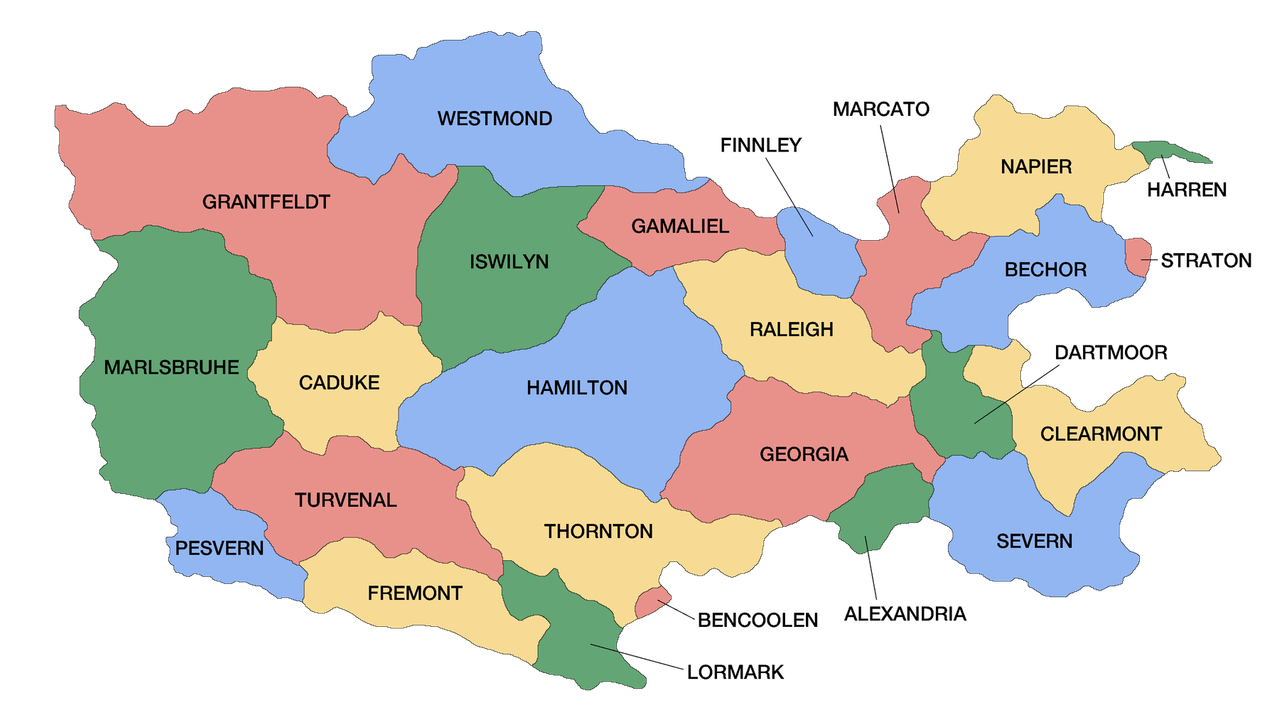
Tumbra has 25 states. The 25 states are often separated into six regions, each named after their geographic region which they are located in; though for electoral purposes, the North and West are often placed in a single "Northwest" category, despite their cultural differences. Depending on who you ask, then, there are either five or six regions of Tumbra.

NORTHEAST
States: Harren, Napier, Bechor, Straton, Marcato, Finnley

The Northeast is the richest and most populous of the six named regions, being home to over 40 million people as of the 2030 census. Home to three of Tumbra's biggest cities — Couno, Serrapince, and Straton, its capital city, in decreasing order — this region is the most heavily associated with Tumbra in popular culture, with most movies depicting Tumbra focusing on those three cities. Other large cities, like Nantwich and Clark, also find themselves in this region, albeit much further west on the map. Historically, this is where the Tumbran Civil War broke out, meaning that even though the republican spirit is strong throughout the country, it is particularly strong in this region. The Northeast is also an extremely culturally diverse region, with this and the Southeast being the two regions where most immigrants to the country began their journey in Tumbra. Being an economic powerhouse, the Northeast is also extremely desirable to live in; and as such has been described, most notably, by poet Richard Yerkes as that "shining castle upon that glorious hill," even back in the 1880s.

SOUTHEAST
States: Clearmont, Dartmoor, Severn

Often described as the "region that does everything," the Southeast's 20 million people is home to a diverse collection of three states which include areas of great national beauty — including the Dartmoor Marshes, the country's largest collection of wetlands — and great industrial efforts, with the state of Clearmont seemingly having its history divided between both coal mining and agriculture, while the state of Severn, and particularly the city of Lakewood, got its fame through being the second centre of industrialisation of the newly-born nation. Also culturally and ethnically diverse, thanks to a long history of immigration, the Southeast is slightly more gritty and working-class than the Northeast; but it takes that reputation in stride.

CENTRAL
States: Raleigh, Georgia, Alexandria, Hamilton, Thornton, Bencoolen

NORTH
States: Gamaliel, Iswilyn, Westmond

SOUTHWEST
States: Lormark, Fremont, Turvenal, Pesvern

WEST
States: Grantfeldt, Marlsbruhe, Caduke

Cities

Image


STRATON
The country's capital, Straton sometimes gets an unfair reputation for being overly gray. It's understandable, of course — most federal government buildings are distinguishable by the exact same material used to clad their walls, a sort of gray slate that's given members of the civil service a somewhat dour nickname of "The Grey Men." Regardless, there is fun here if it's looked for; the northern part of the city, which is home to the country's biggest and most prestigious post-1864 university is known for being the main place where fun happens; and, well, failing that, there's always the country's largest observation wheel, standing tall at 169m and pretty much defining the city's skyline. Most institutions of national importance are housed here; including the National Air and Space Museum, co-located with the National Science Museum, the Natural History Museum, National Arts Gallery, and so on. Most impressive, probably, is the National Library; the country's biggest library which is co-located with the National Archives. All three branches of government are housed here, too; as well as most monuments to the country's founding fathers, and the Tomb of the Unknown Soldier, commemorating lives lost during the Civil War.

SERRAPINCE
Home to the city's financial industry — which directly means that the city is also known for its debauchery and nightlife (what do you expect when you have a heavy concentration of people in the financial sector in close proximity to each other?), Serrapince is Tumbra's second largest city, but one that's still diverse enough to essentially be an everycity. Of particular interest to tourists would probably be the spiky building known as the Modern Hedgehog, but really is the Serrapince Museum of Modern Art, which serves as the country's largest collection of art produced post-1950. Or, as some more traditional critics would call it, "art". Apart from that, the country's largest Yoshiman Garden is located here, as well as Exhibition House, a giant glass building that was built in 1882 for the country's turn at hosting the Universal Exposition.

MARRAY
Tumbra's top party city, Marray is home to the finest beaches in Tumbra; unusually for the northeast of the country, its sun, sand and sparkling-clear waters. Marray is where Tumbra's main cruise terminal is; and the city is renowned for its bustling nightlife. Come for the sand dunes; stay for the sea. Of particular note is the city's promenade, where most of the city's nightlife is; the most renowned clubs are Enigma, Paradise Inferno, and Aventurine, the last of which is located right on the beachfront and is probably the most exclusive club in the whole city. What happens in Marray, stays in Marray, some say; and while casinos may still be illegal here, the city's not known as the country's entertainment capital for nothing. Theme parks, film studios...it's all glamour here.

CLYDE
Clyde is known for being the beating heart of Tumbra's coal industry, with this being where Tumbra's coal is exported to the world. The coal supply chain ends here; here, Tumbran coal goes to the world, after its starting journey in central Clearmont. Unsurprisingly, the city is unashamedly working-class, and has suffered something of a post-industrial decline with Tumbra's coal industry declining somewhat, though it is slowly going through something of an economic regeneration with a new focus on renewables.

HESHAM
Despite its size and proximity to Lakewood, Hesham is seen as a relatively laid-back city, more than content to let time pass it by. This is where Clearmont's agricultural industry — carried mostly by wheat — sends its cargo for it to be exported to the world. It's lost a bit of its cultural identity as time's gone on and Lakewood has begun to slowly subsume the city into the amorphous blob that is Greater Lakewood, but locals will never let anyone forget that modern Tumbran football was born here; after all, the meeting between club executives that formed the first-ever league competition was held here. Perhaps unsurprisingly with all that wheat passing through the city, it's got a high amount of breweries; and also the highest number of pubs per capita in Tumbra.

LAKEWOOD
The industrial powerhouse of the South East, Lakewood made its fortunes during the Industrial Revolution (which arrived late on this country's shores — thanks, empire!) due to the burgeoning textile industry that was essentially spawned large waves of migration to the city. It helped that Lakewood was one of the few ports where immigrants to the country were able to be processed, alongside Nantwich and Couno; meaning that the city, more than others, has become more of a cultural melting pot than others. Homage is paid to this through the Museum of Immigration, located on the site of a former immigration processing centre. The city has grown so large in recent years that the city's suburbs have essentially spilled over into Hesham; the two form what is essentially a giant urban conurbation. It helps that the same international airport serves both cities.

NEWTON
That Tumbra has a long history in maritime trade is unsurprising; nearly all of its major cities of note are located on the coast. Newton is no different; but adds a different spin on the matter. Back in its heyday, Newton was the capital of Tumbran piracy and a city where even the most strict imperial rule couldn't get bring it down (until unification, of course — but that's a different matter). The entirety of the city centre could be a historical monument in itself; and that's not forgetting the fact that Newton is a canal city, where you're just as likely to catch a bus as a ferry over the waters to your next destination. Expect plenty of monuments to maritime heroes here; this city, alongside Cloverdale and Nantwich, is one of the three homes of the Tumbran shipbuilding industry.

KINGSBURY
The old imperial capital, Kingsbury's Historic Quarter is worth a whole afternoon on its own. The last castle of the Terenbergs (the old imperial family) was located here; nowadays it's a walkthrough museum, which takes a surprisingly neutral tone on the whole royalty thing. One of the wings of the castle has been converted into a public library, which probably shows the amount of attention the former royals receive these days. Apart from that, there's the Kingsbury Cathedral, which is the seat of Emberican Christianity and the Archbishop of Kingsbury; though it's probably telling of religion's place in public life that nobody gives a toss about them either.

CLOVERDALE
The shipbuilding city of the south, Cloverdale's history quite literally revolves around the sea. A fishing city, Cloverdale is home to the largest port in the country; it's also home to the Southern Fleet of the Tumbran Navy. The city's port is so large that the federal government embarked upon a project in the 1990s to dredge up an entire island to host the docks. As a result, the old Docklands district has been regenerated into an artsy area. The city is also home to the tallest bridge in the country; the Duff Bridge, named for the state's first and third premier, links the reclaimed island that hosts the city's docks to the rest of the city. The city is also home to the country's longest pleasure pier in the country. Historically and strangely, cricket has always been the dominant sport here as compared to football; the city has no professional football team within the city's boundaries.

BENCOOLEN
The most colourful (and gayest, statistically) of Tumbra's cities, Bencoolen is possibly the most liberal place in the country. Many social movements that eventually grew to become nationwide movements began here; women's liberation in the 60s and gay rights in the 70s can all trace their origins to this city. Most well known for the litany of low-rise, pastel-coloured houses that dot the seafront, as well as the tight, windy high-rise apartment buildings that are so close together it doesn't really feel like a Tumbran city, Bencoolen is different from the rest of the country, and likes to make it known. Bencoolen is known for being the place where bohemians want to live, by trading on art; and many a Tumbran artiste, thespian, author, and poet cut their teeth here. As for sports, try sailing, or watersports; the surfing culture is strong here, and the sport of yachting is mostly concentrated here as well, with regattas dotting the horizon. It helps that the weather is really conducive for this sort of thing. Historically, this is also where cricket made landfall on Tumbran shores; Grearish sailors brought the game to Tumbra and Bencoolen has been one of the centres of cricket since.

SOUTHPORT
An idyllic, laid-back city, Southport is home to the Tumbran navy's submarine fleet, and is therefore somewhat of a military town. Ignoring that, however, Southport is another city that retains quite a lot of its historicity; it helps that the RTS Majestic, an eighteenth-century Tumbran naval frigate which dates from the era of empire, is moored here and serves as a permanent floating exhibition. The Tumbran Maritime Museum is one of the biggest museums in the country, and brings to life the story of Tumbra's relationship with the ocean. The city is also home to a substantial Licentian population; which is fitting, considering that the southwest of the country as a whole has a substantial Licentian diaspora, and the language of Dutch is essentially the southwest's second language.

HOXFORD
Perhaps sometimes derisively labelled a "university city," Hoxford is best well known for the Hoxford Technological University, which is Tumbra's foremost post-1864 university; its genetics department and experimental physics department are the best in Tumbra, and possibly the entirety of Esportiva. There are plans to build a larger particle accelerator to further boost the university's rankings; but outside of that, Hoxford's relative youth means that the city is keen to present itself as a 'city of innovation', with lots of spaces in the city's centre open to start-ups. And it's worked; Hoxford is where many a Tumbran tech start-up is based. Unsurprisingly, a lot of the architecture here is very glass-based; the city is also extremely eco-friendly, and has touted itself as a "city in a forest". Less should be said about increased rent, however.

SHEPPERTON
Originally called Shepperton Falls thanks to the natural small waterfalls running through the centre of the city, Shepperton is the heart of the idyllic southwest; but often comes off as quite unfriendly to foreigners, which is quite ironic as it is located right on the western Tumbran border. Shepperton is the home to many things, but especially Tumbran conservatism; many a conservative politician cut their teeth here, including former Prime Minister Lawrence Newell, widely regarded as one of the most conservative politicians in the country. If you can get past that, however, the Patrida Revival style architecture is a sight to behold on its own; and the food here, especially the barbeque, is one of the highlights of the city. There were plans to build the Assembly of Esportiva right in this very city, but locals' opposition to the idea meant that the building was eventually built in Kingsbury.

FONTWELL
The biggest city in the West, Fontwell's an underrated gem of a city; and it's also probably one of the best places in Tumbra to learn about a side of the country's history that sometimes flies under the radar — the Western Republic. The Museum of Western History is located here, and it's chock-full of almost everything the uninitiated would need to know about the unrecognised republic, which fought a guerilla war against the Empire of Tumbra in its waning days, and contributed heavily to the latter's losses in the brutal civil war. Apart from that, why not try looking at the automobile industry? Cheap foreign imports have shrunk the domestic market somewhat these days, but the legacy is still there — Carlton Motors still chugs out variations of the Carlton Cross, the original Tumbran car, and they've got a fantastic museum as well. Go a fair bit east, into the neighbouring state of Caduke, and you'll be able to see Tumbra's most stunning natural beauties; Mount Vernon, Tumbra's highest mountain, as well as visit Mount Fesmos Circuit, which is one of the highest-rated motorsports circuits in the world. It's even hosted a round of the World Grand Prix Championship before, but it's unlikely to return. Being the westernmost stadium hosting games this tournament, Fontwell presents a unique opportunity for tourists to visit the west in general, an area of stunning natural beauty.

MILLSBURGH
One of Tumbra's 'forgotten cities', Millsburgh was the home of the now-flagging Tumbran steel industry; it now potters on, though the chemicals industry still goes strong in the north. It's probably the least tourist-friendly city out of the eleven host cities — no dedicated airport, nothing really exciting to do on the surface — but there is the National Museum of Steel here. The Museum of Industry and Technology is also here, which documents the history of Tumbran technology, and has a full-scale replica of the first-ever steam train to ever run on Tumbran railways. And bridges. Lots of bridges. The city can get fairly cold, but one thing the city does excel in is the sheer amount of flora in its borders; it's shed most of its dreary reputation gained in the previous century, and the streets are lined with trees and grass. In autumn, it's really pretty. In summer, they do provide a good amount of shade from the sun.

RIDGEWELL
A northern powerhouse, Ridgewell used to be the gateway to the world for northern Tumbran coal and steel; but with manufacturing fleeing to less expensive countries, and the coal mines closing thanks to The Eighties (and a focus on renewables this century), it's struggled to redefine itself. It's still the largest city in the North, though, and an effort to pivot the city towards tech and research has given it a new lease of life. For tourists, the main attraction in this area is the historic Wyndham Castle, located on the outskirts of the city; it's been stunningly well preserved, and historical demonstrations of medieval life occur every Saturday. Helps that a flea market sets up shop every weekend there too. This is probably one of the coldest cities in the country, too.

READALE
Readale is known largely for being halfway between Ridgewell and Nantwich, the two cities along the country's northwestern coast; but it is significant for being the home of Tumbra's fishing industry. Fittingly, it is also the home of the country's marine-agriculture technology sector, and also home to several members of the country's so-called Iron Pentagon — the country's military-industrial complex. The city gets cold in winter, but has more mild summers; but the city's waters are nothing to write home about. Straton gets a reputation for being a grey city, but is probably much-maligned in that respect; Readale is the true grey city of Tumbra.

NANTWICH
A naval city through and through, Nantwich essentially made its name from two things: shipbuilding and having a naval base on its outskirts. Both industries, perhaps miraculously, survive to the present day; and Nantwich has always had a more gritty, subdued vibe to it. That hasn't stopped it from becoming one of Tumbra's largest cities in the midwest; and it helps that the food here's cheap, as well. It's also known for being exceptionally windy; mainly due to its position near the closest thing Tumbra has to an inland lake, the North Tumbra Sea. For attractions: Deep-dish "Nantwich-style pizza" may seem like a cultural travesty to anyone from outside the state (to say nothing of the Grande Cucinans, who steadfastly refuse to refer to it as "pizza" and prefer the term "pie"), but it's a refreshing take on the ever-popular dish, invented, ironically, by someone from Grande Cucina who couldn't find a proper pizza pan when he first arrived in the city.

CLARK
A city known for its culture — cathedrals, clothes, theatres, and museums — Clark is known for being much more highbrow than its neighbour Nantwich, and those who can't stand the working-class vibe of Nantwich will enjoy Clark. Beware, though, of the exorbitant prices nearly everywhere; from restaurants to shopping malls (pay a visit to the Clark City Gallery, the country's oldest shopping mall), everything meant for the upper classes will make you pay through the nose for it. It's also home to one of the country's oldest universities; making the city also a place of revered learning. This is the place of Tumbran high fashion; surprisingly spared from most of the Civil War, the city's 15th-century architecture survives to this day.

RICCI
Ricci is another city that was well-involved in the country's steel industry, though instead of the raw materials, Ricci was where quite a lot of the by-products of steel were made. The most famous of these by-products was cutlery; and it wasn't just steel products that were made here. No, Tumbra's ceramics industry was (and still is, albeit on a smaller scale) focused around Ricci and the state of Marcato in general. Nowadays, Ricci is more of a sleepy city in the middle of the Couno-Straton-Serrapince conurbation that forms the economic powerhouse of the northeast, and the Clark-Nantwich conurbation that forms the bulk of the midwest. But that's not to say it's got no charm; it's a haven for archaeological digs, and on its outskirts there are some of the oldest remnants of human activity in Tumbra. People here are very much opposed to Nantwich-style deep-dish pizza; this is because there is a hefty Savigliano diaspora in this city, and prefer their Savigliano food served traditionally.

COUNO
Couno is Tumbra's largest city — there's a little bit of something for everyone here. The city is Tumbra's most famous; and is renowned for historically being a centre of innovation. Go for a long walk along the majestic Promenade, complete with statue walks (there's a park with busts of every Prime Minister of the country, with a short blurb of their achievements or lack thereof); or head up the hill on the opposite side of the skyline and stadium for a bit of nature. Don't miss the majestic Couno Harbour Bridge, though it's pretty difficult to do that; it's literally everywhere in the city's marketing, and opportunities exist to climb up the bridge. Seafood lovers should pay a visit to the Couno Fish Market, where the day's freshest catches are hauled in every morning for hungry tourists and shoppers alike. Looking for history? Visit the aptly-named Old City, where brick-and-mortar department stores still survive; and marvel at how narrow the streets are. As for nightlife, by far and away Couno's most famous nightclub is B*A*S*H, located on the 50th to 53rd floors of the Stevenson Tower. Then further marvel at how racing drivers manage to slalom cars through these streets every September, when the Couno Grand Prix takes place. Further inland, there's Tumbra's biggest amusement park, Galaxy Studios (one of three in the country), complete with rides from your favourite entertainment franchises.

HARREN
The city's easternmost large city, Harren — the capital city of the eponymous state — is a city of many cultures. Set around a huge mountain known as the Rock of Harren, the city is extremely dense, exceptionally around the Historic Quarter of the city. The city's distinctive low-rise buildings contrast nicely with the limestone mountain; and sunsets here are known to be a sight all on their own. But the city's other industry, located somewhere outside the core of the city, is gambling. Harren is the only state that has legalised gambling; and so almost every tourist that wants to gamble will take the short hop over from Couno to while their money away. Unsurprisingly, gambling is quite highly regulated; but the historic casinos, dating back to the 19th century, are the main attraction this city has. The Tumbran Navy's Eastern Fleet is based out of the other settlement in the state, Cayalon; the tip of the state of Harren is also a popular tourist destination.

Tourist Attractions
Last edited by Tumbra on Sat Jul 12, 2025 9:49 pm, edited 26 times in total.
THE FEDERAL REPUBLIC OF TUMBRA
Tumbra - a sprawling, modern federal democratic republic located in Esportiva. Strong economy, strong civil rights, strong freedoms.
Population: 125 million | TLA: TMB | Capital City: Straton | Largest City: Couno
Constitution | Domestic Database | Domestic Newswire | Domestic Motorsports | Wiki Article
President: Bertram Andrews (Labour) | Prime Minister: Sandra Campbell (Labour)
U-18 World Cup 13, 21 Champions | Di Bradini Cup 51, 57 Champions | Campionato Esportiva 31, 33, 34, 38 Champions | Eagles' Cup 13, 14 Champions
World Grand Prix Championship 21 — World Drivers' Champion (Ted Pressley — Ælund)

User avatar
Tumbra
Minister
 
Posts: 2184
Founded: Aug 29, 2013
Civil Rights Lovefest

Postby Tumbra » Fri May 07, 2021 11:57 am

Tumbra — Economy


Sectors

Currency
The official currency of the Federal Republic is the Tumbran dollar (TM$), which has a fixed exchange rate of NS$1=TM$1.33. The Tumbran dollar is further subdivided into cents, of which 100 Tumbran cents (¢) make up TM$1. There are five denominations of coins and seven denominations of notes; from the most recent series. The details of these series are noted below.

Coins
ValueObverseReverseMetalSymbolism
5 centsCoat of arms, year minted, mottoValue, sheaf of wheat and rice stalkYellow steelAgricultural beginnings
10 centsCoat of arms, year minted, mottoValue and cornflowerGray steelNational flower
20 centsCoat of arms, year minted, mottoValue and Mount VernonGray steelTallest peak
50 centsCoat of arms, year minted, mottoValue and birch treeGray steelNational tree
1 dollarCoat of arms, year minted, mottoValue and golden eagleYellow/Gray steelNational animal

Notes
ValueObverse/Person featuredReverseColourSymbolism
2 dollarGordon HamiltonClark City Opera House; various paintings, an orchestraGreen1st President of Tumbra/Arts
5 dollarJames EdwardsMount Vernon and Caduke National ParkBlueInfluential writer and philosopher in the struggle for independence/Nature
10 dollarMalcolm HaywoodPrime Ministerial Office building, Presidential Palace building, Federal Parliament building, Federal Constitutional Court buildingRed23rd and longest serving Prime Minister of Tumbra/Government
20 dollarHelen ScottPort of Lakewood and Couno skyline; Intercity trainYellowImpressionist painter/Economy
50 dollarJeanette BlackthornTumbran National Stadium; sportspeoplePurpleAward-winning biologist/Sports
100 dollarElizabeth LockeMonument to the Fallen; aircraft carrier RTN IndependenceOrangePoet, writer, composer of the national anthem, the Song of the Tumbrans, and notable classical composer otherwise/Military
1000 dollarSamuel CohenScientific research; a lecture being conductedSalmon1st Chief Justice of the Federal Constitutional Court/Science


Trade

Transport
Last edited by Tumbra on Tue Apr 16, 2024 4:25 am, edited 7 times in total.
THE FEDERAL REPUBLIC OF TUMBRA
Tumbra - a sprawling, modern federal democratic republic located in Esportiva. Strong economy, strong civil rights, strong freedoms.
Population: 125 million | TLA: TMB | Capital City: Straton | Largest City: Couno
Constitution | Domestic Database | Domestic Newswire | Domestic Motorsports | Wiki Article
President: Bertram Andrews (Labour) | Prime Minister: Sandra Campbell (Labour)
U-18 World Cup 13, 21 Champions | Di Bradini Cup 51, 57 Champions | Campionato Esportiva 31, 33, 34, 38 Champions | Eagles' Cup 13, 14 Champions
World Grand Prix Championship 21 — World Drivers' Champion (Ted Pressley — Ælund)

User avatar
Tumbra
Minister
 
Posts: 2184
Founded: Aug 29, 2013
Civil Rights Lovefest

Postby Tumbra » Fri May 07, 2021 12:03 pm

Tumbra — Society


Religion

Holidays
Tumbra has seventeen statutory federal public holidays.

HolidayDateReason/Traditions
New Year's Day1 JanuaryTo celebrate the start of the new year. Often celebrated with a countdown and copious amounts of alcohol.
Republic Day5 JanuaryTo commemorate the day that independence was declared. Often commemorated with the hanging of flags outside apartments, and parades in various cities.
Day of Youth14 FebruaryTo celebrate the nation's youth and future. Often commemorated with small acts of gift-giving and quality time.
Vernal Equinox20 MarchTo celebrate regrowth and regeneration. Often associated with life, love and friendship of all kinds, though most strongly associated with romantic love. Romantic gestures are most commonly celebrated on this day.
Constitution Day15 AprilTo commemorate the first day that the modern Constitution of the Federal Republic came into force in 1864.
Labour Day1 MayTo commemorate the labour movement. Often commemorated as a day of recreation, creativity, and hobbies as a celebration of the tendency of man to produce.
Memorial Day14 MayTo commemorate the signing of the Treaty of Staplewood, which officially ended the Tumbran Civil War, and later expanded to include commemorating veterans. Often commemorated with a reading of the ceasefire proclamation, and other related military-related ceremonies.
Summer Solstice20 JuneTo celebrate the high point of summer. Often associated with environmentalism and water; many tree-planting and beach-cleaning events take part on this day.
Mist Day12 JulyTo celebrate the oceans that surround Tumbra, and the rivers that run through it. Often commemorated as a spiritual successor to the Summer Solstice's focus on environmentalism; most nature-related movements/commemoration events will start on 20 June and end on 12 July.
Heritage Day1 AugustTo explore heritage of all kinds, whether cultural or local. Often a celebration of multiculturalism. Town festivals are often held on this day.
Autumnal Equinox22 SeptemberTo celebrate the autumnal harvest. Often associated with earth; celebrations often involve copious amounts of alcohol and filling food. Also functions as a thanksgiving festival and celebration of friendship.
Unification Day15 OctoberTo commemorate the day that the seven Western states joined the Federal Republic of Tumbra in 1869.
Day of the Elderly14 NovemberTo pay tribute to the nation's elderly and history. Often associated with acts of service such as volunteering and charity.
Winter Solstice21 DecemberTo celebrate winter. Often associated with family; this is traditionally the day when people would arrive in their home town to spend time with family. Often celebrated with a reunion dinner.
Winterval25 DecemberTraditional winter festival. Often associated with gift-giving and freedom; people traditionally give gifts to loved ones on this day. Often followed by copious amounts of alcohol and filling food.
Day after Winterval26 DecemberSecond day of the traditional winter festival. Often associated with hangovers; people often open their gifts received on Festivus on this day, nurse hangovers, and celebrate winter.
New Years' Eve31 DecemberEnd of the old year. Often celebrated with a countdown and copious amounts of alcohol.


All election days are also designated as public holidays. These normally occur on a Friday. The only explicitly gazetted ones are elections for the President and Senate, which take place on the first Friday of February every sixth year. Elections to the House of Representatives are also typically held on Fridays.

If a federal holiday falls on a weekend (regardless of whether it is a Saturday or a Sunday), then the following Monday is declared a holiday in lieu. While religious holidays are not prohibited outright — a Federal Constitutional Court case determined that allowing religious holidays did not violate the country's secular foundations or provisions for religious equality — they are typically avoided.

Food

Culture

Tumbran Orchestras — The Big Two

Two places come to mind when thinking of the musical arts in Tumbra: Clark and Kingsbury. The Clark Symphonic Orchestra and Kingsbury Philharmonic Orchestra are the two most renowned orchestras in Tumbra, and their rivalry is emblematic of the lesser-known, but still-present, north coast-south coast rivalry in Tumbra. The Clark (CSO) orchestra is more renowned globally — the city itself is often seen as the home of high Tumbran culture, and the CSO is an entirely-private organisation established in 1907. While it has flitted about various homes, Bianchi Concert Hall in the middle of the city has been its permanent home since 1974. It often does tours of Tumbra, though never plays in Kingsbury or the wider state of Georgia (where Kingsbury is).

The Kingsbury Philharmonic (KPO) is the older orchestra, and has its beginnings in the early republican era, as musicians from the old imperial orchestra banded together after the end of the civil war to try and restart their careers. While they were suspected of having monarchist sympathies in their early years — performances would normally begin with an orchestral rendition of the old imperial anthem — those have somewhat faded, but not disappeared completely, as time has moved on. Key to this lingering sentiment that the orchestra is pro-monarchy is the orchestra's largely symbolic request, submitted once a year, to the Kingsbury city council, requesting that they be allowed to move into Ashington Palace, the former home of the Tumbran royal family. The city council, out of formality, turns this down; the palace is now a museum dedicated to Imperial history, and letting an orchestra play there is deemed to be impractical. Of course, both parties know this, but the request is made as more of a tradition than anything. The KPO also does tours of Tumbra, but never plays in Clark, or the wider state of Finnley (where Clark is).

While there are several other orchestras in Tumbra (the third most notable is the TBC Symphony Orchestra, which is mainly a broadcast orchestra for the state-funded Tumbran Broadcasting Corporation, and is based out of the Tumbran capital in Straton) the rivalry between the CSO and KPO is well-known. Other than their mutual touring schedules where they do not intrude upon each other's 'territory', it used to be that signing for one of the orchestras typically precluded one from playing for the other for the rest of their professional career. The first to break this unofficial barrier was Abovian cellist Jyrki Järvinen in 1988, who deemed the restriction "utterly juvenile" when he signed for the CSO that year from the Hattmark Symphonic Orchestra in Graintfjall. Järvinen had, from 1975 to 1979, played for the KPO. A lengthy lawsuit brought about by the KPO was found in Järvinen's favour, with both orchestras' lifetime non-compete clause deemed illegal and unenforceable under Tumbran labour law. Despite that, few — just four since Järvinen — have made the jump across, and none have done so directly, with both having a standing internal policy and understanding that neither will hire directly from the other.

Both orchestras also differ in their styles. The KPO is seen as stridently traditionalist and conservative, and maintains a strict policy of only playing pieces composed before the year 1920. Its stated reason for doing so is to "serve as the premier musical archive for pre-1920 music and perform the best of humanity's, and Tumbran in particular, music and compositions." A relatively strict calendar is kept by the KPO; the nine-month playing season that the KPO organises is relatively rigid when it comes to monthly theming, only differentiating in the exact composer and pieces played. The September performances, for example, are dedicated to Tumbran composers from the Imperial era; but there are about five to six musicians whose pieces they play.

The CSO, meanwhile, is seen as more forward-looking; while it does play older pieces, it also tends to play scores from movies and contemporary pieces from more modern composers. The average age of players at the CSO is also younger than at the KPO, but only slightly. Both orchestras tend to figure quite prominently in the Tumbran cultural imagination, being featured in a few films; Adagio is a Tumbran film directed by Joshua Müller that deals with the desire of a young musician, who could potentially become the youngest first chair in the KPO's history, to transfer to the CSO directly, and become the first ever musician to do so.

Sport
Last edited by Tumbra on Sat Dec 27, 2025 10:40 pm, edited 19 times in total.
THE FEDERAL REPUBLIC OF TUMBRA
Tumbra - a sprawling, modern federal democratic republic located in Esportiva. Strong economy, strong civil rights, strong freedoms.
Population: 125 million | TLA: TMB | Capital City: Straton | Largest City: Couno
Constitution | Domestic Database | Domestic Newswire | Domestic Motorsports | Wiki Article
President: Bertram Andrews (Labour) | Prime Minister: Sandra Campbell (Labour)
U-18 World Cup 13, 21 Champions | Di Bradini Cup 51, 57 Champions | Campionato Esportiva 31, 33, 34, 38 Champions | Eagles' Cup 13, 14 Champions
World Grand Prix Championship 21 — World Drivers' Champion (Ted Pressley — Ælund)

User avatar
Tumbra
Minister
 
Posts: 2184
Founded: Aug 29, 2013
Civil Rights Lovefest

Postby Tumbra » Fri May 07, 2021 12:04 pm

Tumbra — Companies


Airlines
flySPORTIVA
Ultra low-cost carrier focusing on destinations within Esportiva. Known for its promotions during summer. Not entirely based within Tumbra; does intra-regional flights as well.

Northern
Low-cost, regional carrier focusing largely on the north of the country. Hub airports include Fontwell and Marlsbruhe.

Republic Air
Full-service, legacy airline that rivals Tumbran Airlines in size and scope. Hub airports include Kingsbury and Hesham-Lakewood.

Starbrook
Low-cost carrier that specialises in both the domestic market and long-haul low-cost market. No traditional hub airport but strongest presence in Nantwich.

Tumbran Airlines
National flag-carrier and full-service airline. Renowned for their black-and-yellow liveries. Hub airports include Couno and Straton-Serrapince.


Applications and websites
www.EvEv.tmb
Short for Everything, Everywhere. E-commerce site which allows companies to set up digital storefronts and also let individual sellers auction their own products. Widely known for large advertising campaigns and monthly sales when the month matches the date (1/1, 3/3, 11/11).

www.oponia.tmb
Short for the Open Online Encyclopedia, Oponia is one of the world's biggest resources of free online knowledge; funded entirely by the non-profit Oponia Foundation.


Automotive/transport manufacturers
Adam's
Tumbra's leading bicycle maker.

Carlton
Automotive maker focused on small, cheap cars. Most famous product is the Carlton Cross, a small two-seater car popular in the 20th century.

Elcaro
Biggest maker of buses in Tumbra.

Fallerton Hawthorn
Maker of locomotives for railways. Primary consumer is Tumbran Railways and other heavy rail systems in the country. Based in Kirkby, Alexandria.

Holtzmann Rolling Stock
Maker of rolling stock for railways. Primary consumer is the various rapid transit systems in Tumbra.

Hunter
Upper-middle-market car maker. Also makes trucks.

Rochester
Luxury sports car maker whose car-making business really only exists to fund its racing division.

Thornton Motor Works (TMW)
Middle-market car maker which specialises in making its own engines. Also specialises in heavy vehicles.


Banks/Financial institutions
Development Bank of Tumbra

Fortescue & Manning Credit Union

Lazarus Bank

United Bank of Tumbra

Williams-McLaren Bank


Brick-and-mortar stores
Arrowhead Department Store
Chain of department stores widely regarded to be past their heyday. Still going strong; largest department store chain in the country.

Chest
Big-box membership-only warehouse-club wholesaler that is widely renowned for having ludicrously low prices on bulk items.

Firenze
Third largest supermarket chain in the country; emphasis on freshness. Part of the Firenze Co-operative Group, which is a consumer co-operative.

Flatpak
Furniture company that sells furniture that can either be delivered or taken home by oneself, often in flat packs. Assembling these is often considered a major test of relationships, despite the ease of instructions. Also has a surprisingly successful food side-business, and children's toys' side-business, including a stuffed llama named Luotuoae that is a meme on the internet.

Markham
Fifth largest supermarket chain in the country; known for only really having stores in upper-middle to upper-class suburbs.

Orion
Fourth largest supermarket chain in the country. Discount supermarket chain known for low prices.

Ramsay's
Second largest supermarket chain in the country; often seen as a contemporary of Spencer's. Famed for their prepared foods; bakery, sushi, and delicatessen departments are present in every full-sized store.

Spencer's Supermarkets
Largest supermarket chain in the country; mid-range prices. Famed for their in-house brand of generic products with distinctive marketing. A 30% stake is owned by Pacitalian giant Mundo; several stores in the southeast are named MegaMundo.


Charities and philanthropic foundations
Fairchild Foundation
Private philanthropic foundation for medical research and arts funding. Part of a few foundations instituted by 'old money' Tumbran families; in this case, the Fairchild family.

Kynes Foundation for Desert Research
Research foundation for desert and other tropics-related ideas. Chief in distributing vaccines, aid, etc. to underserved areas overseas.


Coffee & Café chains
Chestnut Coffee

Fortuna

Moonbeam Coffee


Conglomerates/Investment companies of note
Ashburn Industries
Holding company owned by John Ashburn, the richest person in Tumbra. Specialises in electronics (particularly semiconductors) but holds investments all throughout the Tumbran economy and abroad. See Ashburn Semiconductors and Machinery Corporation.

Crenshaw Volanger
Holding company chaired by financier Sophie Cowling. Very diversified portfolio means that this is one of the most valuable stocks in Tumbra.

Tage Capital
Investment company.

TK Corp
Holding company established by tech billionaire Thomas Kim. Mainly involved in investing in "future" tech.

Waldron Group
Investment company specialising in commodity trading.


Entertainment companies
Galaxy
See also Galaxy Studios.

Sonata Records
Largest music-publishing company in Tumbra.

Olympus Records
Second largest music-publishing company in Tumbra.

Entertainment venues/Nightclubs/Nightlife
Aventurine

Blue Flag

B*A*S*H

Cavallino Rampante

enigma.

Galaxy Studios

Honey Badger

Paradise Inferno


Fast-food chains
Happy Mac's
Largest fast-food chain in Tumbra. Focuses on serving burgers and fries. Has a substantial desert selection, too; and an in-built café chain called Mellow Mac's. Renowned for their extra value meals.

Pete's
Slightly smaller, but still extremely popular fast-food chain. Focuses on fried chicken and spaghetti. Has an anthropomorphic chicken mascot, known as Pete, who carries around a bucket of fried chicken.

BreadTime
Fast-food chain that serves sandwiches. Often touts itself as a healthy alternative to Happy Mac's and Pete's, with marketing focusing on how its food is prepared fresh.

Uncle Jack's
Baked goods chain specialising in pastries. Cheap; often found everywhere. Has a distinctive brown logo.


Food companies/brands
Allan
Food processing corporation whose most famous product is their instant mac and cheese, but has a hand almost everywhere. Forms part of the Allan-Souza Corporation.

Cornucopia
Multinational company that started out importing fruit into Tumbra but expanded its operations into essentially being the entirety of the fruit logistics chain.

Hayward Breweries
Tumbra's largest brewery company; brands under its stable include Eagle Beer (a beer), Mittels (a soju).

Hexagon Corporation
Multinational corporation specialising in food and drink processing; products include baby food, powdered beverages, frozen foods, and snacks.

KitKraft
Food processing corporation specialising in chocolate and desert; products include ice cream, chocolate, and gummies.

Ohio Foods
Largest meat processing company in Tumbra; founded by John D. Ohio. Headquartered in Dorival, Iswilyn.

Souza
Food processing corporation that specialises in sauces, soups, and tinned foods. Forms part of the Allan-Souza Corporation.

Thymefield's
Dairy and confectionary company that sells and prepares milk, butter, cheese, snacks, etc.

ZAP!
Energy drink company.


Funerary services
Colfax & Sons
Funeral parlour known for being the parlour of choice amongst the upper classes.


Gaming and gaming-related companies
Elen
Gaming corporation and publisher with a particular focus on live-service games that include microtransactions. Widely disliked but still extremely profitable. Short for Electronic Entertainment.

Imagination Games
Game developer best known for their Ultimate Football series of football games, which includes a game-mode known as Dream Team, where players can buy card packs and make teams with the players pulled from them.

Tempest Games
Small-scale game developer best known for the Back of the Net football management series of games.


Heavy Industry/Resource Extraction
Ashburn Semiconductors and Machinery Corporation
Ashburn Industry's semiconductor manufacturing wing. At great expense, also manufactures the lithography machines required for semiconductor manufacturing. See also Ashburn Industries.

CritikalEnergy
Manufacturer of solar panels.

Horizon
Construction, engineering, and procurement company.

Wells
Multinational pharmaceutical and biotech company that specialises in making medicines.

Northern Energy
Energy-related holding company. Owns WesternOil; conducts operations for Northern Gas.

Northern Gas
State-owned gas exporting company, focused on the Northlands. Subcontracted operations to Northern Energy.

Severn Instruments
Semiconductor company based out of Lakewood that is also the country's leading producer of graphing calculators. Develops analog chips and embedded processors.

Sheppard Steel
Country's largest steel-producing company; has a hand almost everywhere in the steel-producing value chain.

Southwestern Prospecting Interests
Biggest mining company in Tumbra; mines coal and copper, etc.

WesternOil
Oil upstream/midstream company with major operations worldwide. Subsidiary of Northern Energy, a general holding company for the Fairchild family's energy interests.

Whitecroft Chemicals
Tumbra's largest chemicals company, specialising in petrochemicals.


Insurance Companies
Seele
Biggest general-purpose insurance group in Tumbra.


Light Industry
Lakewood Textile Company
Textiles multinational that has largely outsourced manufacturing operations to the third world.


Luxury goods
Ronan Group
Holding company and conglomerate that specialises in luxury goods.

Sigma Watches
Luxury watch group.


Logistics/Shipping lines/Other transport
Cotesworth Port Holdings International
Private port operator who used to own seven of Tumbra's biggest ports outright but now focuses on global logistics and port operations in other countries.

Kerner Shipping Lines
Tumbra's biggest cargo shipping line, owned by Kotzellachian billionaire Helmuth Kerner.

Saturn Occident Line
Tumbra's second biggest cargo shipping line.

Tumbran Postal Service
State-owned mail delivery and last-mile logistics delivery corporation.

Tumbran Railways
State-owned railway company which also runs Tumbra's high-speed and intercity services.


Media outlets (Broadcast media)
Aurora Media Group

Tumbran Broadcasting Corporation (TBC)
National public broadcasting corporation for both television and radio. Often seen as a major component in manufacturing Tumbran soft power, given its investment in Tumbran culture and media in general. Has offices throughout the world.

National Broadcasting Service (NBS)
Hybrid public-private broadcaster that focuses on bringing multicultural and multilingual content to Tumbra. Most watched in the Southwest, where Dutch-language broadcasts are the mainstay. Broadcasts in other languages, like Yue, Savigliano, Juven, Riennese, Shingoryeoite, etc. also available.


Media outlets (Print media)
Bencoolen Globe, The
Mainstream centre-left paper headquartered in Bencoolen. Known for their culturally liberal sensibilities. Run by The Green Trust.

Couno Herald, The
Mainstream centrist paper headquartered in Couno. Oldest newspaper in Tumbra and is often considered the country's most prestigious. Owned by the Chevalier family, which also owns BannerSports.

Hawk, The
Right-wing tabloid. Until the 2020s published pictures of topless women on page 5 of its newspaper until pressure from feminist groups and the government.

Financial Times
Centre-right financial paper headquartered in Serrapince. Often seen as the single most objective source of news related in Tumbra. Published on orange paper. Owned by the Ruysch family.

Independent, The
Socially liberal paper targeted at younger readers. Focuses on investigative journalism and has a very opinionated editorial team.

Kingsbury Tribune
Conservative paper based in Kingsbury. Often known as the most difficult paper to be hired to in the country. Owned by the Harrison family.

Lakewood Gazette, The
Largely centre-right paper based in Lakewood. Broadly in favour of markets and positions itself as a paper of the middle class. Owned by the Ruysch family.

Millsburgh Chronicle
Liberal paper based in Millsburgh, but opinions skew decidedly in favour of more devolution of powers to states. Owned by the Chronicle Group, which also owns most non-Tumbran language newspapers in the country.

Serrapince Post, The
Largely centre-right paper based in Serrapince. Broadly in favour of markets and positions itself as a paper of the middle class. Since 2045 has been owned by the Straton Times and largely shared content and an editorial desk.

Straton Times, The
Centrist (though add favourite flavour of neoliberal or neoconservative) paper that publishes news primarily aimed at public servants. Does not offer political endorsements as a matter of principle. Owned by the Ruysch family.

Tumbra Today
Middle-market "colour" paper that focuses more on human interest stories and colourful infographics.


Media outlets (Magazines/Niche journalism/Online media)
AXBY
Gaming-focused magazine.

Chequered Flag
Part of the BannerSports family. Sports magazine focused on motor racing, particularly WGPC and Tumbran Super Formula.

International Relations
Foreign-policy focused magazine that looks at foreign issues with a Tumbran perspective.

Matchday
Part of the BannerSports family. Sports magazine focused on football, particularly the T-League, Esportivan football, and IFCF and WCC competitions.

psephos.tmb
Election-focused website focusing on using mathematical modelling to predict the results of elections.

ResPublica
Political and policy-focused digital magazine focusing on the ins-and-outs of federal politics.

SixSevenFive
Statistics-focused website that aims to analyse current affairs and polls based on trends. Run and owned by Nicholas Gold.


Military-industrial complex
Cromwell-Krieger
Small arms manufacturer.

Hanegraff Shipbuilding Corporation
Partially state-owned shipbuilding constructor. Part of the "Pentagon" of the Tumbran military-industrial complex.

Palatine
Company that specialises in big data analysis, including intelligence and defence tools.

PEWS Corporation
Full name of Pemberton Eastfield Whitmore Shawcross. Defence congolomerate. Part of the "Pentagon" of the Tumbran military-industrial complex.

Redline Meridian
Part of the "Pentagon" of the Tumbran military-industrial complex.

Sterling Aegis Group
Part of the "Pentagon" of the Tumbran military-industrial complex.

TNAe Systems
Full name of Tumbran Naval and Aeronautics Engineering Systems. Part of the "Pentagon" of the Tumbran military-industrial complex.


Other companies of note
Penumbra Research
Research firm focused on defence and public policy. Often referred to as a think tank.

Quotient Labs
Industrial research and scientific development company. Based in Hoxford. Known for giving researchers a wide berth of academic freedom, but largely focused on materials science, computer science, and telecommunications. Owned by telecommunications company qTMB.

Valeheart Stud
Horse ranch in Tumbra based in Iswilyn.

Wellesley Publishing House
Largest publisher of books in Tumbra; based out of Lakewood.


Payment processing services
Sterling


Petrol brands
Black Eagle Energy

Cowrie

Peton


Polling and political forecasting firms
Butler Institute for Democracy
General non-partisan thinktank that focuses on research on democracy, psephology, polling, and representation. Established in 1974 with help from Guildholm University; still shares a campus with them.

CampbellStewart
Opinion polling firm established by D. Morris Campbell and J. James Stewart in 1935. Widely seen as the final voice in polling in Tumbra; predicted the result of every federal election correctly every time but once from 1936 to 2021, only missing out on the 2001 election result.

FIPPO
An acronym of Fremont Institute of Polling and Public Opinion (in English) or Fremont Instituut voor Peilingen en Publieke Opinie (in Licentian Dutch), FIPPO was established in the 1950s as part of the Hoxford Technological University, but was spun off into an independent company in 1963.

Kythera Research
Polling and market research agency known for more granular polls, including in individual constituencies. Does not provide seat projections for politics.

Orrery Research
Opinion polling and consultancy firm established in 1950 by Gordon McCargo. Also provides other services such as personality tests.

Surveyor's Standard
Polling and market research agency that prioritises face-to-face and telephone panels. Based out of Couno. Does not provide seat projections for politics.

YourVoice
Internet-based market analytics firm founded in 1999. Known for its ability to gain a very large sample size for its polls.


Professional services
Couno Consulting Group
Strategy and management consulting firm. Largest in Tumbra.

Jennings, Wrigham, and Young (JWY)
Auditing, accounting, and general advisory firm.

Sherman, Halleck and Grant (SHG)
Law firm.


Real estate companies/Hospitality companies
Kensington Hotels
Biggest hotel chain in the company; owned by old-money Kensington family.

Newlands Property
Specialised housing builder and preferred partner of the federal government for housing contracts.


Restaurants/Eating places
Raconteur


Tech-related companies
Gateway
Developers of Gateway OS, the most popular computer operating system in Tumbra.

Metcalfe Systems
Database software provider, general enterprise software provider.

Sinclair
Developers of Sinclair Antivirus and general digital security services provider.


Telecommunications and internet service provider companies
Lightning Telecom

qTMB

Tumbra Telecom


Tobacco companies
Tumbran Tobacco
Holding company with over 15 brands under its umbrella; notable ones include Duluth, Rolling Stone, Morningstar, Talbott's, Silverleaf, Desert Rose, Westmond Wind, Triple Eights, and First Cut. Recently expanded into e-cigarettes under the brand nuos. Began life as Bellwether & Townshend's Tobacco Products; later merged with Livingstone Tobacco to acquire its current name.


Other companies/companies that operate in Tumbran orbit
Atlas
Car-rental company.

Crux Logistics
Xinhuanese unified logistics company handling everything from shipping to last-mile delivery.

Golden Dragon Holdings
Xinhuanese sovereign wealth firm.

KVKB
Kotzellach Vermogen-und Kapitalberater — One of Kotzellach's numerous sovereign wealth firms.
Last edited by Tumbra on Fri Feb 20, 2026 3:26 am, edited 68 times in total.
THE FEDERAL REPUBLIC OF TUMBRA
Tumbra - a sprawling, modern federal democratic republic located in Esportiva. Strong economy, strong civil rights, strong freedoms.
Population: 125 million | TLA: TMB | Capital City: Straton | Largest City: Couno
Constitution | Domestic Database | Domestic Newswire | Domestic Motorsports | Wiki Article
President: Bertram Andrews (Labour) | Prime Minister: Sandra Campbell (Labour)
U-18 World Cup 13, 21 Champions | Di Bradini Cup 51, 57 Champions | Campionato Esportiva 31, 33, 34, 38 Champions | Eagles' Cup 13, 14 Champions
World Grand Prix Championship 21 — World Drivers' Champion (Ted Pressley — Ælund)

User avatar
Tumbra
Minister
 
Posts: 2184
Founded: Aug 29, 2013
Civil Rights Lovefest

Postby Tumbra » Mon Jul 26, 2021 8:54 am

Tumbra — Government Organisations

Listed by responsible ministry/organisation. This is a non-exhaustive list. Names in brackets are either abbreviations or the common name.
An agency might be independent by statute but be classified under a ministry under this list, as they may still report to the Minister in charge of the relevant department.


Cabinet Office
Responsible ministers: Prime Minister, Deputy Prime Minister, Minister for the Cabinet Office, Minister without Portfolio*
*The Deputy Prime Minister and Minister without Portfolio may be assigned to assist with other portfolios at the Prime Minister's pleasure; the latter role is often used as a mixture between a sinecure and as a job title for a minister who assists with multiple portfolios at once.


The Cabinet Office is the department of Cabinet that directly supports the Prime Minister and Deputy Prime Minister in their duties. It is often alternatively known as the Prime Minister's Office. It serves as the major co-ordination centre for government, and has in its remit the ability to plan long-term policy directions on the Prime Minister's direction. It also oversees the civil service as a whole, and also co-ordinates cross-ministerial policy initiatives or issues, like intelligence-gathering, national security, and crisis response. Lastly, through the Office of Intergovernmental Relations, it is the main ministry in charge of federal-state relations. Other issues that may not fit 'neatly' into any one department's remit might end up under the Cabinet Office as well.

Civil Service Commission (CSC)
Permanent bureaucracy that supports the activities of the nineteen federal ministries and certain government departments. Also regulates employment and regulations surrounding civil servants, etc, and acts as a central human resource agency for the federal government and its employees.

Government Logistics Agency (GLA)
Manages the basic logistics and supporting operations of the federal agency, including property management and procurement, and Government publishing. Also manages the Government's motor vehicle pool.

National Security and Crisis Council (NSCC)
Joint action group for security and crises.

Office of National Intelligence (ONI) and the Intelligence Community
Joint action group comprising the Tumbran Intelligence Service (foreign intelligence), Internal Security Department (domestic intelligence), Defence Intelligence, National Communications Security Bureau (signals and cyber intelligence), and the Geospatial Intelligence Bureau. The ONI acts as a co-ordinator for the intelligence community as a whole, but is otherwise equal to the other five departments in terms of ranking.

Office of Intergovernmental Relations (OIR)
Main office in charge of federal-state relations. As the Deputy Prime Minister is also, by convention, the Minister for Intergovernmental Affairs, they often oversee this office entirely.

Policy Strategy Group (PSG)
Longer-term policy strategy group. Also a general political research wing for the Cabinet Office.

Government Communications Directorate (GCD)
Whole-of-government government communications office to co-ordinate media responses, etc.


Treasury
Responsible minister: Minister for Finance

The Ministry of Finance, more commonly known as and referred to as the Treasury*, is responsible for Tumbran fiscal policy and economic strategy, including the collection of taxes and customs, as well as government expenditure. The ministry also handles financial services and banking regulation in Tumbra. The Treasury is also in charge of printing and minting currency, and is the sole stakeholder in the Tumbran sovereign wealth fund. Monetary policy is not determined by the Ministry of Finance, rather by the entirely independent Tumbran Central Bank.

*Both are official names, but the Treasury is the name that most refer to it as.

Tumbran Central Bank (CENT)
Central and reserve bank of Tumbra, in charge of the country's independent monetary policy through interest rates. The Central Bank is wholly politically independent of the Treasury, but the nine-member Board of Governors (one of whom serves as Chairperson) is nominated by the Prime Minister and confirmed for staggered nine-year terms by the Senate.

Internal Revenue Authority (IRA)
Tax collection agency.

Tumbra Customs and Excise Authority (CEA)
Customs and excise agency.

Federal Investment Fund (FIF)
Sovereign wealth fund.

Goldlion Holdings
State-owned multinational investment firm. Largely independent to give the firm flexibility in its dealings, but the Treasury is its sole stakeholder.

Federal Mint
Responsible for printing currency and minting coins.

Securities, Exchanges, and Derivatives Commission (SEDC)
Main regulator of securities, exchanges, and derivatives.

Financial Services and Insurance Commission (FSIC)
Main regulator of financial services and insurance companies.

Government Actuary's Office (GAO)
Actuary's office.

Tumbran Deposit Insurance Corporation (TDIC)
Government-run insurance corporation for bank deposits up to $100,000. Also has reserve powers to administer and liquidate failed banks.

Financial Intelligence and Analysis Office (FIAO)
Monitoring office for financial crime and securities fraud. Also has oversight powers over accreditation agencies for the financial sector, which are the Tumbran Institute of Chartered Accountants (TICA) for accountants, auditors, and tax advisers, and Chartered Institute of Financial Analysts (CIFA) for investment advisers, insurance salespeople, analysts, and actuaries.


Ministry of Foreign Affairs
Responsible minister: Minister for Foreign Affairs

The Ministry for Foreign Affairs is responsible for Tumbran foreign policy, including advocating for Tumbran interests worldwide and managing diplomatic relations. It is the primary ministry responsible for consular affairs worldwide, and negotiates treaties and agreements with other parties. It is also the main ministry responsible for foreign embassies and international institutions present in Tumbra. Other aims of the Ministry include counter-terrorism; to this end, the Ministry has oversight over the Tumbran Intelligence Service and National Communications Security Bureau.

Office of International Law (OIL)
Main office within the Ministry that provides legal advice on treaties and international law more generally.

Tumbran Intelligence Service (TIS)
Intelligence agency with remit for foreign affairs. Wholly political independent, but reports to the Minister for Foreign Affairs. Part of the Tumbran Intelligence Community.

National Communications Security Bureau (NCSB)
Principal signals intelligence body. Has increasingly been afforded foreign cyber intelligence responsibilities as well. Wholly political independent, but reports to the Minister for Foreign Affairs. Part of the Tumbran Intelligence Community.

Foreign, Diplomatic, and Consular Corps (FDCC)
Personnel system for all foreign-based employees of the federal government. Umbrella system for all departments, but managed by the Ministry of Foreign Affairs.

Tumbran Foundation
Agency dedicated to promoting Tumbran culture, academic exchanges, international opportunities, running international Tumbran-language exams, and encouraging cooperation with Tumbra. Works closely with the Ministry of Culture and Communication.


Ministry of Home Affairs
Responsible minister: Minister for Home Affairs

The Ministry of Home Affairs is responsible for public safety, civil security, citizen registration, federal policing, prisons, and immigration. It oversees issues like federal drug policy, domestic counter-terrorism, law enforcement, but also the issuance of most government documents such as passports and identity cards. It also has full power over immigration and asylum policy, meaning that organisations such as the Coast Guard are under its remit. The Ministry often tops lists of government employee headcount, often due to its sheer size and scale of responsibilities. The agencies under the Home Office can be broadly classified between uniformed and regulatory agencies.

Uniformed Agencies

Federal Police (FEDPOL)
Federal police agency. Special federal remit for assisting the judiciary, as well as explosives and firearms regulation.

Federal Prisons Service (FPS)
Federal prison operator.

Tumbran Coast Guard (TCG)
Coast guard of Tumbra. Often unofficially termed as the fourth uniformed service.

Emergency Response and Management Authority (ERMA)
Federal disaster response coordination authority.

Federal Civil Defence Reserve (CDR)
Reserve and volunteer civil defence responders. Civil defence is otherwise a devolved matter.

Central Alcohol, Tobacco, and Narcotics Bureau (CATNB)
Drug and general banned-substance enforcement agency.

Immigration, Registration, and Border Authority (IRBA)
Border police, immigration authority, and issuer for passports, identification cards, and other potential registration documents.

Regulatory Agencies

Internal Security Department (ISD)
Intelligence agency with remit for domestic affairs, like counterterrorism. Utilises the FEDPOL for enforcement/arrests. Part of the Tumbran Intelligence Community.

Tumbran Gambling and Casino Regulatory Authority (GCRA)
Regulates physical casinos as well as other private sector-run online casinos/betting. The state-run betting agency is instead run by the Tumbran Pools.

National Cyber Security Agency (NCSA)
Law enforcement activity for domestic cyber-related activities.


▌ Ministry of Law and Justice
Responsible minister: Attorney-General/Minister for Law

The Ministry of Law and Justice is responsible for the administration of the judicial system of Tumbra, including access to it. The Ministry also oversees intellectual property law, and provides legal services to the Government. It also provides legal advice to the other eighteen federal Ministries through the Office of the Solicitor-General, and takes an active role in legal and constitutional reform. The ministry also has oversight for law professionals, but the profession is generally independent and self-regulating. The judicial branch is wholly independent of the Ministry, but the Ministry aids its functioning through its work on appointments and access. The Attorney-General is also ex officio the Minister for Law.

Office of the Solicitor-General (OSG)
Provides legal services and advice for the Government as a whole.

Tumbran Intellectual Property Office (TIPO)
Intellectual property office of Tumbra. Deals with patents, copyright, etc.

Federal Anti-Corruption Authority (FACA)
An operationally independent agency that has the power to investigate corruption at any level of the federal government. It can initiate investigations by itself.

Office of the Public Prosecutor
Public prosecutor's office. The Director of Public Prosecutions heads this department, and is the third-most senior ranking legal official in the federal government, after the Attorney-General and Solicitor-General; however, the DPP is a civil servant rather than a political appointee.

Judicial Appointments Commission (JAC)
Federal board that screens and decides on nominees for judicial vacancies before being formally nominated to the Senate.

Legal Aid Commission (LAC)
Assists those unable to afford legal costs.

Judicial Administrative Branch (JAB)
Assists the judicial branch in their administrative needs.

Legal Reform Commission (LRC)
Reviews and recommends changes to existing laws when applicable. Also the main drafting body for Government-sponsored legislation.

Law Society of Tumbra (LST) and the Tumbran Bar Council (BAR)
Professional body for both barristers and solicitors, and admits practicing lawyers through examination and training. The Bar Council regulates higher legal advocates. Both have oversight from the Ministry.


Ministry of Defence
Responsible minister: Minister for Defence

The Ministry of Defence is responsible for national defence policy, and oversees the country's military. It also undertakes defence diplomacy with other nations, and takes care of veterans' affairs.

Tumbran Armed Forces
The military of the Federal Republic. Has three branches; the Army, Navy, and Air Force, under the command of the Chief of Defence Forces (CDF).

Tumbran Army (TA)
Principal land warfare force of the Federal Republic.

Tumbran Navy (TN)
Principal naval warfare force of the Federal Republic. Split into four operational fleets; the Northern Fleet, based out of Nantwich, the Southern Fleet, based out of Cloverdale, the Eastern Fleet, based out of Harren, and the Submarine Fleet, based out of Southport.

Tumbran Air Force (TAF)
Principal air warfare force of the Federal Republic.

Defence Intelligence (DI)
Principal military intelligence body. Part of the Tumbran Intelligence Community.

Geospatial Intelligence Bureau (GIB)
Principal geospatial intelligence body. Part of the Tumbran Intelligence Community.

Defence Technology Research Group (DRG)
Primary research agency for defence-related science and technology.

Agency for Veterans' Affairs (AVA)
Civilian agency handling veterans’ benefits, pensions, disability support, and memorials. Also co-ordinates with other federal ministries on healthcare, housing, and related services.


Ministry of Commerce and Industry
Responsible minister: Minister for Commerce

The Ministry of Commerce and Industry oversees internal commerce and trade in Tumbra, and sets business policy more generally. It works to advocate for economic development and progress throughout the country, and is also the ministry in charge of statistics, standards, cartography, and the decennial Census. It is also the principal ministry in charge of consumer protection.

Tumbra Postal Service
Federal postal service. Previously a Cabinet department; the head is still called the Postmaster-General.

Consumer and Trade Competition Commission (CTCC)
Consumer protection and antitrust commission for all industries, including the financial sector. Enforces civil antitrust law.

Consumer Safety Commission (CSC)
Consumer product safety commission.

Enterprise Tumbra
Agency promoting entrepreneurship, while mainly focusing on supporting small to medium businesses, and start-ups. Provides business loans and technical support to small and medium enterprises.

Economic Development and Diversification Strategy Group (EDDSG)
Main strategy group of the Ministry that promotes ways for Tumbra to diversify and further develop its economy.

Department of Statistics (TMBSTAT)
National statistics agency in charge of government data and statistics. Also in charge of the decennial census.

Tumbran Cartography and Survey Institute (TCSI)
National mapping agency of Tumbra. Also does geological surveys/land science research for other ministries.

Institute of Standards and Measurements (ISM)
Federal measurement standards laboratory. Maintains the national measurement system, and enforces weights and measures regulations in commerce.


Ministry of Health
Responsible minister: Minister for Health

The Ministry of Health is responsible for the Tumbran Health System, the federal single-payer universal healthcare system. It also regulates allowed medicines in Tumbra, and is in charge of public health more broadly. It also has an oversight role for the accreditation of medical professionals.

Tumbran Health Service (THS)
Single-payer universal healthcare service.

Drug and Medicine Authority (DMA)
Drug/medicine regulator for medicines used in clinical treatments. Does not criminalise drugs; that is the work of the Central Alcohol, Tobacco, and Narcotics Bureau under the Ministry of Home Affairs.

Centre for Communicable Disease Control (CCDC)
Federal manager for communicable and infectious diseases.

Office for Public Health (OPH)
Catch-all organisation for public health involving statistics, health advocacy, etc.

Tumbran Institute for Healthcare Research (TIHR)
Healthcare research agency that conducts and co-ordinates biomedical and health research.

Healthcare Accreditation Department (HEALTHCRED)
Umbrella oversight group for healthcare accreditation organisations. Includes the Tumbran Medical Council (TMC, for doctors, medical specialists, and accredits medical schools), Tumbran Nursing and Allies Council (TNAC, for nurses, midwives, allied health professionals), Pharmacy Board of Tumbra (PBT, for pharmacists and dispensary standards), Dental Council of Tumbra (DCT, for dentists), and General Healthcare Professions Board (GHPB, for other healthcare professionals like sports medicine, psychology, physiotherapists, etc.)


Ministry of Education
Responsible minister: Minister for Education

The Ministry of Education is responsible for the education system in Tumbra at the macro-level, ensuring that standards and schooling formats across the 25 states are harmonised, as education is largely a devolved matter. It is also principally responsible for the setting and conduct of national-level examinations. It also oversees and accredits universities and other continuing education institutions, and their education.

Universities Commission
Disburses federal funds for federally-funded universities, and acts as a general steering board for higher education. Most universities, including the top twenty-five universities in Tumbra are otherwise all autonomous and wholly independent of the Government.

National Examinations and Assessments Board (NEAB)
Principal board in charge of setting and marking national-level examinations.

National Schools, Teaching, and Curriculum Standards Board (NSTCSB)
Has oversight for and regulates state curriculums, school standards, and teachers' standards across states. Also has oversight over the Tumbran Teachers’ Accreditation Council (TTAC), which accredits teachers.

Continuing and Further Education Institute (CFEI)
Accreditation agency for fully-private further education institutions, as well as other institutions for continuing/lifelong education.

Institute for Skills Training (IST)
Encourages skills education, and oversees access to skills training courses and apprenticeships.

Institute for Pedagogical and Educational Research (IPER)
Conducts education-related research.


Ministry of Transport
Responsible minister: Minister for Transport

The Ministry of Transport is responsible for transport policy in Tumbra. It oversees transport across four domains: road, rail, air, and sea, and is in charge of federal funding for public transportation. Items under its remit include the maintanence of federal expressways. It is also the direct owner of the state-owned high-speed rail corporation, Tumbran Railways.

Tumbran Railways
State-owned high-speed railway company. Also the operator of last resort for state-level railways if needed.

Civil Aviation Authority of Tumbra (CAAT)
Civil aviation authority.

Tumbran Federal Maritime Authority (FMA)
Maritime and port activity regulator.

Federal Road Transport Authority (FRTA)
Authority charged with regulating road transport, vehicle regulation, and maintaining federal expressways.

National Public Transit Agency (NPTA)
Body administering federal subsidies and assistance for public transportation systems, which are otherwise a devolved matter. Encourages the construction of public transit more generally, and co-ordinates with the Ministry of Urban Development to integrate public transit with urban development.

Transportation Safety Commission (TSC)
Investigative body for civil transportation accidents (road, rail, major vehicle, sea, and other infrastructure).

Transportation Statistics Bureau (TSB)
Focuses on transport-related statistics.


Ministry of Labour and Social Security
Responsible minister: Minister for Labour

The Ministry of Labour and Social Security is responsible for labour policy and industrial relations, as well as overseeing all forms of social security in Tumbra. The former includes formulating policy related to workers' rights, and being involved in labour arbitration as a third party. The latter takes two primary forms; the pension system, also known as the National Endowment, which is a compulsory savings plan, and the National Insurance, which provides temporary unemployment insurance as well as fuller social security for other groups, for example, the disabled.

Tumbran Labour Relations Council (TLRC)
Enforces laws related to workers' rights, and serves as a body for arbitration between employees and employers during industrial disputes.

National Endowment Fund (NEF)
Investment arm of the National Endowment, Tumbra's compulsory savings plan.

National Insurance Authority (NIA)
Manages the National Insurance, Tumbra's unemployment and benefits scheme.

Industrial Safety Investigative Commission (ISIC)
Investigative body for workplace health and safety incidents, including chemical, radiological, biological, and nuclear accidents.

Labour Information Bureau (LIB)
Ministry data analysts, including trends on employment, wages, and workforce trends.


Ministry of Agriculture, Food, and Natural Resources
Responsible minister: Minister for Agriculture

The Ministry of Agriculture, Food, and Natural Resources oversees agriculture policies in Tumbra, offering farm support and other agriculture-related policies. It also regulates food and food safety. The Ministry's third mandate is to oversee the country's national resources, like fisheries and forests. It is the steward of federally-owned land in non-urban areas, generally.

Water, Irrigation, and Utilities Commission (WIUC)
Agency in charge of stewarding freshwater resources, as well as ensuring water security. Both a regulator and executor of policy; also in charge of building canals, etc. for irrigation purposes.

Tumbran Food Authority (TFA)
Food safety and food standards authority.

National Oceans and Fisheries Commission (NOFC)
Oversees and general stewards of Tumbran oceans, fisheries and marine life. Both a research body and a regulatory body for Tumbran waters.

Agricultural Services Agency (ASA)
Assists farmers and other agriculture producers through the provision of loans, technical assistance, marketing, etc.

National Grains and Food Security Board (NGFSB)
Sets and regulates prices for key foodstuffs like grains. Also chief steward of the government's food reserves, and in charge of disbursing food during emergencies and other crises.

Animal-Plant Health Board (APHB)
Animal and plant health board. Responsible for ecosystem maintanence and invasive species management.

Forestries Commission
Responsible for the maintanence of forests.

Mineral and Extractive Resources Commission (MERC)
Responsible for the stewardship of other natural resources like coal, oil, and natural gas. Also has a research wing that focuses on longer-term strategy.

Geological and Minerals Survey Institute (GMSI)
Minerals and physical science research institute. Wholly funded by the government.

Office for Agricultural Research (OAR)
Agricultural research institute. Wholly funded by the government.

Office for Federal Land Management (OFLM)
Manages non-urban federal lands assigned to the Ministry.


Ministry of Urban Development
Responsible minister: Minister for Urban Development

The Ministry of Urban Development oversees housing and urban infrastructural policies, overseeing the federal Government's flat-building programme, new towns programme, as well as its urban revitalisation programme. It is the steward of federally-owned land in urban areas, generally.

Housing Development Authority (HDA)
In charge of planning and building public housing, particularly in new towns. Post-building maintanence is a matter for local government.

Urban Development Board (UDB)
In charge of urban revitalisation and planning for new towns on federal and state land, and is the land-use steward for urban state-owned land more generally. Also has oversight powers over accreditation agencies for surveyors through the Surveyors’ Institute of Tumbra (SIT)

Building and Construction Commission (BCC)
Regulates the construction industry in Tumbra, regulates building safety standards, and standards for personnel involved in the construction industry. Also has oversight powers over accreditation agencies for the construction sector, with the Tumbran Board of Architects (TBA) for architects and Professional Engineers Council (PEC) for civil, mechanical, and electrical engineers.


Ministry of Rural and Regional Development
Responsible minister: Minister for Regional Development

The Ministry of Rural and Regional Development oversees rural development and connectivity policies, and oversees regional investment corporations. It also maintains limited oversight over the affairs of local government when required.

Western Investment Corporation (WESTIC)
Investment corporation that primarily funds and supports the west and south-west of Tumbra, regions which have historically fallen behind the more wealthy, more populous East in terms of economic prosperity and development.

Rural Services and Infrastructure Commission (RSIC)
Plans and takes charge of projects related to rural infrastructure and connectivity, including Internet access, rural schools, and healthcare.

Local Government Oversight Authority (LGOA)
Secondary auditing board for local government organisations throughout the 25 states (the primary responsibility for auditing is on the province). Also encourages harmonisation and standardisation of local government standards and operating procedures. Vested with reserve powers to temporarily take over and administer local government services when needed or requested, as the administrator of last resort.


Ministry of Energy and the Environment
Responsible minister: Minister for Energy and the Environment

The Ministry of Energy and the Environment oversees energy policy, including the forms of energy utilised in Tumbra's energy generation, and environment and conservation policies, including efforts to decarbonise the Tumbran economy. It is also the ministry in charge of climate change response.

Federal Environment Agency (FENVA)
Environment protection agency, charged with enforcing environmental law in all domains, including air, land, and sea. Also conducts environmental-related research.

Energy Infrastructure Management Agency (ENIMA)
Federal energy infrastructure management agency.

Energy Market Regulatory Authority (ENMRA)
Sister agency to ENIMA; regulates the energy market such as prices.

Atomic and Nuclear Energy Agency (ANENA)
Office charged with planning the introduction of nuclear power in Tumbra, as well as the eventual disposal of nuclear waste.

Office of Clean Energy and the Energy Transition (OCENTRAL)
Office charged with encouraging and managing clean/renewable energy in Tumbra, and supports efforts to move Tumbra away from nonrenewable energy sources.

Office of Climate Change Management (OCCM)
Office charged with managing the impacts of climate change on Tumbra through policy, and ensuring Tumbra adheres to globally-agreed climate change agreements and targets. Also handles international carbon trading schemes and other international-related climate change targets.

Energy Security Directorate (ENSEC)
Ensures Tumbran energy security from a national-security perspective.

Hazardous Land Management Agency (HLMA)
Manager of land sites turned over to the Government that are deemed environmentally hazardous.

National Parks Bureau (NPB)
Manager of national parks, and conservation/other protected areas more generally. Steward of Tumbra's natural heritage.


Ministry of Culture and Communication
Responsible minister: Minister for Culture

The Ministry of Culture and Communication oversees government policy related to culture, tourism, the arts and entertainment, and sports. It also oversees the Tumbran media landscape, such as regulating broadcasting and the Internet. Due to its position, it is often seen as the main cultivator of Tumbran soft power.

Digital Broadcasting Regulatory Authority (DIGIBRA)
Regulatory and licensing authority for broadcasting, and other most forms of digital media content.

Telecommunications Regulatory Authority (TELERA)
Regulatory and licensing authority for telecommunications, telecommunications infrastructure, and the Internet.

Film Board of Tumbra (FBT)
Agency that promotes the film and television industry, particularly independent filmmaking.

Creative Industries Development Board (CIDB)
Agency that promotes other creative industries, such as video games, online content creation, and music.

Tumbran Tourism Board (TTB)
Tourism and cultural promotion agency.

Sports Council of Tumbra
Sport promotion office. Umbrella organisation for otherwise independent sports governing bodies in Tumbra (e.g. Tumbran Football Federation for soccer/football).

Federal Arts Council (FAC)
Disburses grants and scholarships for the arts at the federal level in Tumbra.

National Museum System
Umbrella organisation for museums that receive federal funding/are owned wholly by the government. Examples include the National Museum in Straton, the National Museum of Immigration in Lakewood, and the National Museum of Air and Space in Dylefield.

National Heritage Commission (NHC)
Steward of most cultural monuments and historic sites, and commissioner of official histories.

The National Library
Federal library system that archives government publications and papers. Has one physical, central library in Straton.

The National Archives
National archive of Tumbra. Co-located with the National Library but otherwise has separate responsibilities. Archives all types of media and other objects/etc. deemed significant.


Ministry of International Trade and Development
Responsible minister: Minister for International Trade and Development

The Ministry of International Trade and Development oversees international trade policy and international aid policy. It encourages foreign domestic investment and Tumbran exports, searches for and secures access to new markets for Tumbran investment, and investigates and imposes remedies against other unfair trade practices from other countries. It also oversees foreign aid and official development assistance given out by Tumbra. Its work closely complements the Ministry of Foreign Affairs in negotiating trade treaties, providing technical and economic expertise in that respect.

Tumbran Trade and Investment Authority (TTIA)
Agency that promotes Tumbra as a destination for foreign investment. Also supports overseas Tumbran chambers of commerce and Tumbran businesses abroad more generally.

Tumbran Agency for International Development (TMB-AID)
Primary body responsible for the provision of international aid from Tumbra.

Tumbran Development Finance Corporation (TDFC)
Primary body responsible for foreign investment in infrastructural and other development programmes in developing countries.

Tumbran Export-Import Bank (TXMB)
Export credit agency providing loans, guarantees, and insurance to support Tumbran exporters, and foreign buyers of Tumbran goods.

Tumbran Overseas Volunteer Corps (TOVC)
Civilian volunteer corps that assists developing countries in development projects and other statebuilding projects.


Ministry of Social Affairs and Communities
Responsible minister: Minister for Social Affairs

The Ministry of Social Affairs and Communities oversees social policies, including religion, civil society, charities, and community service programmes for underprivileged or marginalised groups (particularly women, children, the elderly, and minorities). It is also the main ministry in charge of integrating immigrants into society, and runs the state-franchised lottery. It is generally perceived as a "catch-all" ministry for social affairs that do not fit neatly into other ministries' remits.

Social Support Agency (SSA)
Oversees homeless shelters and food aid. Also accredits social workers through the Institute of Social Workers of Tumbra (ISWT).

Civil Society and Charities Register (CSCR)
Register and regulator of civil society organisations (NGOs, community groups, and charities).

National Pools
State-run national lottery. Proceeds go to charitable causes. Also consolidates revenue from gambling on horse-racing and other sports.

Civil, Family and Marriage Registry (CFMR)
Marriage, births and deaths registry. Works with the Ministry of Health, and the Ministry of Home Affairs, but marriage remit means it has stayed here strongly.

Office for Religious Affairs (ORA)
Maintains relations with religious bodies, promotes interfaith dialogue, and supports and protects religious freedoms within the context of the secular Tumbran state.

Communities Development Agency (CDA)
Funds community and other grassroots projects, with a special focus on marginalised groups. Also serves as the national volunteering industry.

National Youth Council (NYC)
Co-ordinating agency for non-educational youth programmes and youth development nationwide.

Agency for Integration and Inclusion (AII)
Integrates legal immigrants and new citizens into society through classes and orientation.

Office for Disability Inclusion (ODI)
Disability inclusion board, and also seeks opportunities for the disabled.

Council for Gender Equality (CGE)
Institutional advocate for gender equality, particularly women.


Ministry of Science and Technology
Responsible minister: Minister for Science and Technology

The Ministry of Science and Technology oversees national science and technology programmes, including research funding for Tumbran organisations. It also oversees the Government's digital products, and is the main driver for the Government's digitisation drive.

National Science and Research Foundation (NSRF)
Main government organisation that oversees disbursement of federal funds and grants for science and research. Along with the Ministry, serves as a steering committee for the overall direction of research in the country. Further serves as a co-ordinating agency for all Ministry-level research institutions. Also has oversight over the scientific profession through the Institute of Professional Scientists (IPS), which is entirely voluntary but is a chartered body for scientists, researchers, and technologists and helps them recognise their professional status.

National Meteorological and Atmospheric Agency (NMAA/MET)
Weather/Meteorological data and climate forecasting agency. Responsible, among other things, for the shipping forecast.

Space Agency of Tumbra (SAT)
National space agency of Tumbra. Has responsibility for all civilian space activity above the Kármán line.

National Laboratory System
Overseer of physical laboratories wholly owned by the federal government.

Office for Emerging and Future Technology (OEFT)
Research office and offers support for "future" technology and its implementation. Has a substantial focus on AI development, strategy, and ethics.

Innovation and Technology Transfer Office (INTTO)
Sister agency of the OEFT. Encourages the use of technology and innovation in Tumbran business.

Digital Government Projects (DigiGov)
Agency that focuses on improving digital access to government products, as well as developing digital products for the Government. Also promotes adoption of digital and tech-based solutions, and computer literacy.

National Quantum and Supercomputing Centre (NQSC)
Computing resource centralisation and general computing research institute for government.


Parliament
Responsible individual: The Speaker of the House of Representatives

Parliament is not a ministry, but it is generally where most independent agencies (bar the Tumbran Central Bank) report to. Typically, agencies that report to Parliament generally are deemed to be in need of protection from overt partisanship, such as Elections Tumbra.

Auditor-General's Office (AUD-GEN)
Audit agency for the federal government. Headed by the Auditor-General; one of the few positions to be explicitly mentioned in the Constitution. Wholly independent, and reports to Parliament.

Elections Tumbra
Responsible for the conduct of federal elections in Tumbra, and for apportionment/constituency boundary delineations. Redistributions occur every 10 years for the House of Representatives and every 20 years for the Senate. Also serves to oversee and advise the operations of the 25 state election agencies. Wholly independent, and reports to Parliament.

Parliament Budget Office
Responsible for providing independent budgetary and economic information and forecasts to both Houses of Parliament. Nonpartisan by mandate.

Parliamentary Ethics and Standards Commission (ESC)
Watchdog for MP/Senators' ethics and conduct; can initiate investigations if not done by internal means.

Office of the Ombudsman
General government feedback agency and handles complaints against government agencies.

Parliamentary Human Rights Commission (PHRC)
Parliamentary watchdog for human rights and freedoms.

Parliamentary Commission for Government Accountability and Transparency (PCGAT)
Parliamentary watchdog for government accountability and transparency, with a focus on items like freedom of information requests.

Library of Parliament (LIBPARL)
Research wing of Parliament, supporting MPs and Senators.
Last edited by Tumbra on Sun Aug 31, 2025 6:58 am, edited 60 times in total.
THE FEDERAL REPUBLIC OF TUMBRA
Tumbra - a sprawling, modern federal democratic republic located in Esportiva. Strong economy, strong civil rights, strong freedoms.
Population: 125 million | TLA: TMB | Capital City: Straton | Largest City: Couno
Constitution | Domestic Database | Domestic Newswire | Domestic Motorsports | Wiki Article
President: Bertram Andrews (Labour) | Prime Minister: Sandra Campbell (Labour)
U-18 World Cup 13, 21 Champions | Di Bradini Cup 51, 57 Champions | Campionato Esportiva 31, 33, 34, 38 Champions | Eagles' Cup 13, 14 Champions
World Grand Prix Championship 21 — World Drivers' Champion (Ted Pressley — Ælund)

User avatar
Tumbra
Minister
 
Posts: 2184
Founded: Aug 29, 2013
Civil Rights Lovefest

Postby Tumbra » Thu Aug 05, 2021 7:23 am

Tumbra — Education


Primary and Secondary Level

Taken from Ministry of Education, Tumbra. "A Brief Overview of the Tumbran Education System." Accessed August 9, 2041. https://moe.gov.tmb/schools/overview

[...] The Tumbran education system's focus is a holistic one; we believe that by the age of 19, when most students will leave their third and final stage of education, that they will embody several outcomes that go beyond the mere retention of knowledge and skills. We believe that an ideal Tumbran student is:

1. a confident and curious person, with the ability to speak out for what they believe in, think critically, are able to communicate those ideas that they have, and have a strong moral compass;
2. an engaged citizen, with a strong sense of civic consciousness and their place in wider Tumbran society, with a strong rooting in both the country while remaining agile and respectful of the wider world and being prepared to take their place in a globalised society;
3. a leader and contributor, knowing how to collaborate with others in teams and know how best to put forth their ideas, knowledge and skills, to prepare them for both the world of work and whatever comes forth in their future;
4. resilient and adaptable, knowing how best to take on whatever challenges are ahead of them while remaining confident in their knowledge and skills.

[...] In tests administered by international authorities, Tumbra has scored well above the developed nation average in terms of reading, science, and mathematics; scoring 503 in reading, 495 in science, and 490 in mathematics, reflecting the success of the approach that Tumbra has to pedagogy.

[...] The three phases of schooling that all Tumbran students will go through, are, respectively, primary, secondary, and tertiary education. Primary schooling starts in the year that a child turns seven and lasts for six years; students graduate in the year that they turn the age of twelve. Secondary schooling starts the next year — typically when the student turns thirteen — and lasts until the year in which the student turns sixteen. Here, students are given a choice of three types of tertiary education; they can either go to a high school, alternatively known as a junior college, which lasts for three years, a polytechnic, which also lasts for three years, and a technical or vocational institute, where the length of courses vary. Most Tumbran students seeking to enter a university will enter a high school, while those who already know what they want to do, or engage in more specialised education, will head to polytechnics or technical institutes.

[...] Two major exams — or three, if a student chooses to go on to a high school — are administered to all students. The first, at the age of twelve, is officially known as the Primary Educational Attainment Test, or PEAT. Students at this level are examined on subjects that vary according to what subjects students offer at this level; though, in general, students will offer:

Terranean: which consists of two written components (an essay and a comprehension component), an oral component, and a listening component;
Mathematics: which consists of two papers (one multiple choice and one open-ended paper);
Science: which consists of two papers (one multiple choice and one open-ended paper);
One Other Language: which consists of one written component (a comprehension component), an oral component, and a listening component.


The One Other Language requirement was instituted in 1993 in response to the growing multiculturalism of Tumbran society, as well as a belief that learning additional languages would allow Tumbrans to be more conversant throughout the world and gain a greater cultural appreciation for worldwide cultures. Languages offered include Yueyu, Dutch, Riennese, French, Juven, Teus, Faroleran, and Shingoryeoite. Students with a racial background in a language offered must take the language that corresponds to their ethnicity, if one exists; otherwise, they are given a free choice of which language they wish to learn. The decision is made by students in accordance with their parents.

Students begin learning Science and the Second Language at the start of their third year in school; Terranean and Mathematics are taught beginning at the first year in school. In addition to these four examinable subjects, multiple other non-examinable subjects are taught, such as Music, Art, Physical Education (which includes basic swimming lessons), and Social Studies. Lessons to teach students about information technology (ICT/Computer Studies) are also given, and have been given an increased focus in recent years.

It is important to note that the results of the PEAT do not affect the schools that a student is eligible to go to; instead, most will go to a school that is close to their place of residence. The PEAT, however, acts as a check on students' abilities and allows for them to be 'streamed' into different knowledge levels for different subjects at the next level, secondary school.

[...] Streaming at the secondary school level refers to individual subjects. Subjects at the secondary school level are often offered at three levels, simply called Level One, Level Two, and Level Three. Not all subjects will have a Level One curriculum. PEAT results are used to ascertain which level of a subject a student should sit for. They are allowed to take subjects at different bands; for example, a student with particular aptitude for Mathematics may be allowed to take Mathematics at Level Three, while they might choose to take Terranean at Level Two.

[...] At the end of four years, students will undergo the General Certificate of Education — Secondary (GCE-S) exam; where students will offer various subjects depending on their choice of subjects. Most, however, will offer a "mixed bag" of subjects, which include six compulsory subjects, including:
Terranean;
Second Language;
Mathematics, with the option for students offering Mathematics at Level Three to offer Further Mathematics alongside Mathematics;
At least One Science Subject: Biology*, Chemistry*, Physics*, Computing, Design and Technology, Food and Nutrition;
Social Studies;
At least One Other Humanities Subject: History, Geography, Literature (Terranean).

Other subjects are available to suit individual students' needs and interests, including Visual Art, Music, Drama, Physical and Sports Science, and Accounting. Most students at the secondary school level will study seven to eight subjects.

*These subjects are only available at Level Two or above. At Level Two, two of these subjects are combined to form a "Combined Science" subject, which fulfills the requirement for "At Least One Science Subject".


Visual Art, Music, and Drama are also available as non-examinable subjects, meant to expose students to a wide variety of subjects.

Tumbra — Universities


University education in Tumbra is considered a fundamental priority of the Tumbran state. To this end, school fees are heavily subsidised by the state. By law, universities are autonomous, but almost all of them are considered public research universities, as they receive heavy funding from the government. Almost all undergraduate degree programmes in Tumbra are four-year programmes; with Masters degree programmes taking about two to three years to complete, and doctorate-level programmes taking four to six years to complete. The overall federal regulatory board for universities in Tumbra is the Board of Universities.

Wisteria League

The Wisteria League is a collective of nine universities instituted before the formation of the Empire of Tumbra in 1601. Collectively, these are the oldest institutions of higher learning in the modern-day Federal Republic; and are known for their relatively low acceptance rates, academic excellence, longstanding culture, outstanding athletics programmes. They are usually associated with the elite of Tumbra; and often rank amongst the highest in subject rankings for academic subjects within Tumbra. Of particular note are Guildholm University's history programme, the University of Clark's law programme, the University of Couno's political science programme, and Coromandel University's agricultural studies programme, which are the highest-ranked in the nation. In terms of sports, the University of Kingsbury's aquatics programme is one of the best in the nation.


UniversityLocationFoundedUndergraduatesPostgraduatesTeaching staffEndowmentNicknameColours
Guildholm UniversityGuildholm, Bechor121618,4463,4471,469$12.48 billionWasps... ...
University of ClarkClark, Finnley122415,0132,9381,208$20.15 billionKnights... ...
Straton UniversityStraton, Straton126814,9171,8831,063$18.92 billionTigers... ...
University of CounoCouno, Napier129012,3834,8821,557$15.33 billionCrimson Hawks... ... ...
University of KingsburyKingsbury, Georgia131620,0498,7733,162$24.81 billionLilywhites... ...
Severn UniversityKnapford, Severn133716,4485,0121,449$16.48 billionViridians... ...
Alexandria UniversityNewton, Alexandria13497,9938641,039$11.42 billionWattles... ...
Coromandel UniversityHesham, Clearmont140823,0927,2391,449$13.88 billionBig Blue... ... ...
Bencoolen UniversityBencoolen, Bencoolen14928,0161,039998$10.74 billionStallions... ...


League of Sixteen

The League of Sixteen are a collection of universities established after the institution of the Federal Republic. They were established for what are now acknowledged are three reasons. One, to bring higher education to less-served parts of the country; two, to give rapidly-industrialising cities a local knowledge base, and three, to establish somewhat more subservient institutes that could be given preferential treatment in the wake of the Civil War, and pull power away from the Wisteria League universities, who were still heavily associated with the Tumbran Empire. The biggest of these institutions, the Tumbran National University, is today Tumbra's largest and most famous university; sporting the best medical school in the country. The other standout university amongst the League of Sixteen is the Hoxford Technological University; which has Tumbra's best physics and computer engineering department.


UniversityLocationFoundedUndergraduatesPostgraduatesTeaching staffEndowmentNicknameColours
Tumbran National UniversityStraton, Straton186835,44812,3944,066$30.35 billionEagles... ...
Clearmont UniversityClyde, Clearmont1870,,,$4.66 billionLions... ...
University of NantwichNantwich, Finnley1872,,,$8.71 billionMariners... ...
Marlsbruhe UniversityFontwell, Marlsbruhe1872,,,$11.85 billionDragons... ...
Westmond UniversityRidgewell, Westmond1874,,,$4.88 billionThunder... ...
Hoxford Technological UniversityHoxford, Fremont1875,,,$9.12 billionEngineers... ...
Dartmoor UniversityTavistock, Dartmoor1878,,,$4.07 billionPride... ...
Marcato UniversityChesterfield, Marcato1880,,,$5.38 billionWolves... ...
University of LakewoodLakewood, Severn1883,,,$2.79 billionGryphons... ...
Hamilton UniversityWashington, Hamilton1883,,,$3.04 billionBears... ...
Trinity University IswilynDenhelm, Iswilyn1885,,,$1.29 billionWarriors... ... ...
Northwestern UniversityMillsburgh, Grantfeldt1886,,,$1.86 billionSteelers... ...
Gamaliel UniversityReadale, Gamaliel1886,,,$1.14 billionOwls... ...
Bechor UniversityMarray, Bechor1886,,,$3.55 billionBulls... ...
Lormark UniversitySouthport, Lormark1888,,,$1.29 billionWildebeest... ... ...
Pesvern UniversityShepperton, Pesvern1888,,,$1.41 billionRenegades... ...
Last edited by Tumbra on Tue Aug 26, 2025 12:21 am, edited 11 times in total.
THE FEDERAL REPUBLIC OF TUMBRA
Tumbra - a sprawling, modern federal democratic republic located in Esportiva. Strong economy, strong civil rights, strong freedoms.
Population: 125 million | TLA: TMB | Capital City: Straton | Largest City: Couno
Constitution | Domestic Database | Domestic Newswire | Domestic Motorsports | Wiki Article
President: Bertram Andrews (Labour) | Prime Minister: Sandra Campbell (Labour)
U-18 World Cup 13, 21 Champions | Di Bradini Cup 51, 57 Champions | Campionato Esportiva 31, 33, 34, 38 Champions | Eagles' Cup 13, 14 Champions
World Grand Prix Championship 21 — World Drivers' Champion (Ted Pressley — Ælund)

User avatar
Tumbra
Minister
 
Posts: 2184
Founded: Aug 29, 2013
Civil Rights Lovefest

Postby Tumbra » Sat Feb 26, 2022 1:31 am

Tumbra — Geography
Last edited by Tumbra on Mon Jun 23, 2025 11:44 am, edited 6 times in total.
THE FEDERAL REPUBLIC OF TUMBRA
Tumbra - a sprawling, modern federal democratic republic located in Esportiva. Strong economy, strong civil rights, strong freedoms.
Population: 125 million | TLA: TMB | Capital City: Straton | Largest City: Couno
Constitution | Domestic Database | Domestic Newswire | Domestic Motorsports | Wiki Article
President: Bertram Andrews (Labour) | Prime Minister: Sandra Campbell (Labour)
U-18 World Cup 13, 21 Champions | Di Bradini Cup 51, 57 Champions | Campionato Esportiva 31, 33, 34, 38 Champions | Eagles' Cup 13, 14 Champions
World Grand Prix Championship 21 — World Drivers' Champion (Ted Pressley — Ælund)

User avatar
Tumbra
Minister
 
Posts: 2184
Founded: Aug 29, 2013
Civil Rights Lovefest

Postby Tumbra » Wed Apr 06, 2022 1:09 am

Tumbra — International Relations


Grand Strategy and National Objectives

Relations with specified states

This section largely covers relations with countries that are OOC puppets of the users behind this nation.

Members of the Alliance of Democratic Nations (ADN)

Xin-hua
Xinhua and Tumbra are strong allies. The two have a Free Trade Agreement between them. Both Xinhua and Tumbra are part of the Alliance of Democratic Nations (ADN), an intergovernmental diplomatic treaty organisation that links together seven liberal democratic nations. A substantial Xinhuanese diaspora exists in Tumbra. The two co-operate on a wide range of issues outside of politics. Both Tumbra and Xinhua invest heavily in each other.

Kyrast
Tumbra and Kyrast are strong allies. Both Kyrast and Tumbra are part of the Alliance of Democratic Nations (ADN), an intergovernmental diplomatic treaty organisation that links together seven liberal democratic nations. The two have strong links economically and culturally, and Tumbra is Kyrast's largest trading partner. Both have highly developed relations, and have visa-free (or visa-on-arrival) passport access. Both countries have a free trade agreement.

Fontes
Tumbran and Fontes are strong allies. Both Tumbra and Fontes are part of the Alliance of Democratic Nations (ADN), an intergovernmental diplomatic treaty organisation that links together seven liberal democratic nations. The two have strong links based off their shared system of government, and both are highly economically interdependent. The public perception of Tumbra in Fontes, however, is slightly coloured by perceptions of neocolonialism, due to some incidents in the past. Both countries have a free trade agreement.

-Gyllene-
Tumbra and Gyllene are strong allies. Both Tumbra and Gyllene are part of the Alliance of Democratic Nations (ADN), an intergovernmental diplomatic treaty organisation that links together seven liberal democratic nations. The two are considered to have the strongest bilateral relationship within the ADN, with the relationship between the two being described as a "special relationship." The Prime Ministers of Tumbra and Gyllene meet up at least twice a year — once in Tumbra and once in Gyllene — to discuss bilateral ties. Both countries have a free trade agreement.

Togoku
Tumbra and Togoku are strong allies. Both Tumbra and Togoku are part of the Alliance of Democratic Nations (ADN), an intergovernmental diplomatic treaty organisation that links together seven liberal democratic nations. The two are considered to have a strong bilateral relationship, with the Prime Ministers of Tumbra and Togoku meeting up at least once a year to discuss bilateral ties. Both countries have a free trade agreement.

Termales
Tumbra and Termales are allies, albeit lukewarm ones. Both Tumbra and Termales are members of the Alliance of Democratic Nations (ADN), an intergovernmental diplomatic treaty organisation that links together seven liberal democratic nations. However, Termales' outlook toward the alliance is significantly more conservative than Tumbra's, and they are the main opposition to further integration of the ADN, including that of a collective security alliance.

Members of the Proletariat Pact

Union of Fiorre
Tumbra and Fiorre are generally cordial towards each other. Before Fiorre underwent a communist revolution in the 1920s, Tumbra was a strong ally of the Kingdom of Fiorre. While Tumbra and Fiorre had bad relations in the immediate aftermath of the Fiorrean Revolution, rapprochement in the 1970s have led to a cordial relationship since. While the two have a relationship described as uneasy, they are at least friendly, and both invest in each other. Fiorre and Tumbra have an implicit understanding that the other will not interfere in each others' politics.
Fiorre is the formal leader of a bloc of socialist, or socialist-aligned nations, known as the Proletariat Pact. Full members of this pact are one-party socialist states (Fiorre, Moledet, Tamazight, Wellstone, and Yetiwilidi), with states that are democratic but controlled by socialist parties like Szülőföld and Hayrenik remain in the Pact’s orbit as associate members, though both recently disclaimed this associate membership. Fiorre overthrew its monarchy in a socialist revolution in 1923, and the Partito Comunista di Fiore (PCF) has ruled over the nation since. Fiorre is a sprawling, multi-ethnic communist nation, which explains the lesser number of nations in its bloc.


Moledet
Tumbra and Moledet have largely neutral relations.

Tamazight
Tumbra and Tamazight have largely neutral relations.

Yetiwilidi
Tumbra and Yetiwilidi have largely neutral relations.

Wellstone
Tumbra and Wellstone have generally negative relations. Both speak a common language, and both have accused each other of attempting to meddle in each other's politics in the past. Tumbra has consistently criticised Wellstone for refusing to let people emigrate to Tumbra should they so choose.

Members of the Concordat of Iron

State of Varennes
Tumbra and Varennes have very bad relations with each other. After Varennes experienced a fascist takeover in the 1920s, Tumbra has undergone various stages of relationships with the Varennais State, ranging from friendly to the current strong ideological opposition that both sides have to each other. Tumbra often issues strong condemnations of Varennais actions, and has openly called for regime change in Varennes.
Varennes is the formal leader of a fascist bloc of nations known as the Brotherhood of Iron. A prolonged period of instability during a liberal democratic government in the 1920s led to the electoral victory of the Union nationale de Varennes (UNV), which quickly transformed the nation into a single-party dictatorship. The UNV continues to rule Varennes to this day through a succession of handpicked leaders, appointed for life. Previously content with isolationism, Varennes has recently sought to expand its influence, toppling a liberal democratic government in Kultainen and replacing it with a fascist government under the veneer of an absolute monarchy. It formed a long-term alliance with the country of Rodnaya, whose royal family embraced fascism to maintain absolute power over the country in the face of revolution. Recently, it also displaced governments friendly to the Union of Fiorre in the countries of Szülőföld and Hayrenik, putting a previously lukewarm relationship in grievous harm.


Kultainen
Tumbra and Kultainen have very bad relations with each other. Tumbra has repeatedly called for regime change in Kultainen, which has a fascist government propped up by the State of Varennes. The government governs under the veneer of an absolute monarchy, but they are the ones calling the shots. Tumbra hosts the democratic Kultainenese government-in-exile within its borders.

Rodnaya
Tumbra and Rodnaya have very bad relations with each other. Rodnaya and Tumbra's diplomatic rivalry goes back centuries, with Rodnaya continually accusing Tumbra of espionage even before it fully embraced fascism. Now that Rodnaya has become a clear-cut ideological enemy of Tumbra, the country continues to scapegoat Tumbra for everything wrong with the world.

Non-aligned nations

Kotzellach
Tumbra and Kotzellach are generally friendly. However, between the two, there is some friction over Kotzellach's status as a tax haven utilising Base Erosion and Profit Shifting strategies to allow companies to reduce their tax burden. As Kotzellach does not commit to formal alliances, Tumbra does not have any real diplomatic partnerships with Kotzellach. Kotzellachian magnate Helmuth Kerner owns Kerner Shipping Lines, based out of the city of Bencoolen. Kotzellach and Tumbra have shared security interests in the form of anti-piracy, and have collaborated militarily in the past. Both Tumbra and Kotzellach invest heavily in each other.

Kadlubek
Tumbra and Kadlubek are generally friendly. Tumbra views Kadlubek as a key partner of the ADN, and has sought to bring the country into its orbit multiple times. Part of this is simply geopolitical; Kadlubek's second biggest city, Ojców, is located at the mouth of the River Weiss, a key river that runs through the nation of Kadlubek. Kadlubek's location on the coast also means that it is of strategic importance to Tumbra.

Pulang
Tumbra and Pulang are generally friendly. Tumbra and Pulang have diplomatic offices in each other's capitals. Despite ideological differences, with Pulang being socialist and Tumbra being liberal democratic, the two have found grounds for co-operation and international investment, with Tumbra assisting Pulang in its industrialisation. Both regard each other as partners of growing importance. The two are working towards a free trade agreement.

New Tamarind
Tumbra and New Tamarindian relations are nearly non-existent. Tumbra's strong separation of church and state has drawn it ire from the theocratic New Tamarind, who describes Tumbra's secularism as one of the great evils of the world. Tumbra generally does not pay New Tamarind much attention on the international stage despite New Tamarind's large oil reserves, with the bulk of Tumbra's oil being imported from elsewhere. While Tumbrans are free to practice the official faith of the New Tamarind nation, known simply as the Faith, these sects are kept under close watch by the Internal Security Department.

Montego-
Tumbran and Montegan relations are generally frosty. This stems from Montego playing the role of permanent host to the exiled Tumbran imperial family, the Terenbergs. Because the Terenbergs also hold much sway in Montegan politics, they generally do not interact with Tumbra unless needed.

Szulofold
Tumbra and Szülőföld had neutral relations before the latter moved closer to the Brotherhood of Iron. Tumbra previously provided covert funding to liberal and social democratic parties in Szülőföldian elections. Because Szülőföld was largely accepted to be in the general orbit of the Proletariat Pact, Tumbra did not previously engage much with Szülőföld to try and convert them.

Hayrenik
Tumbra and Hayrenik had neutral relations before the latter moved closer to the Brotherhood of Iron. Tumbra previously provided covert funding to liberal and social democratic parties in Hayrenik elections. Because Hayrenik was largely accepted to be in the general orbit of the Proletariat Pact, Tumbra did not previously engage much with Hayrenik to try and convert them.

Gouden
Tumbra has a very good relationship with Gouden. Tumbra has consistently been trying to get Gouden to join the ADN, but Gouden has steadfastly remained neutral. Gouden is, however, much closer to the ADN than either the People's Pact or Brotherhood of Iron, and has often been nicknamed an unofficial eighth member.

Yolcan
Tumbra has a very good relationship with Yolcan. This relationship, however, has come under close scrutiny. While Yolcan is a democracy on paper, it is in reality a single-party captured state with little electoral competition. Critics of the relationship accuse Tumbra of hypocrisy simply because Yolcan is not a true liberal democracy, and instead one reliant more on a need to keep Yolcan happy. Tumbran companies also have substantial business interests in Yolcan, in particular Tumbran Tobacco, which grows tobacco in the country and which has led to calls of neocolonialism.

Carolingian Confederation
Tumbra and the Confederation have neutral relations. This is not due to any incident on either end — indeed, Tumbra and the Confederation have a high common trading volume — but the Confederation stays ardently neutral in diplomacy.

Greater Haeseo
Tumbra and Greater Haeseo have a positive, if strained relationship. Because Greater Haeseo has a long-standing historical rivalry with Togoku, and consistently sides with Togoku on Togoku-Haeseo relations, relations can be strained. Despite this, Tumbra invests in Haeseo and Haeseo conglomerates have a big standing in Tumbra.

Chrysi
Tumbra and Chrysi have a generally positive relationship. Chrysi occupies a geopolitically important position, spanning a strait that controls access to an ocean. Owing to this, Tumbra and Chrysi have a strong trading position, and Chrysi participates in Tumbran anti-piracy operations.

Talayi
Tumbra and Talayi have neutral relations. Talayi is generally an isolationist nation, meaning that they generally decline to have diplomatic relations with most nations outside of their immediate neighbours.

Dhuchais
Tumbra and Dhuchais have a positive relationship. Tumbra has always backed Dhuchais in its diplomatic stance against Wellstone, supporting Dhuchais in its quest to reclaim its northern territory. Part of this is because of Dúchasaigh diplomatic overtures, but a large part of it is to prevent greater Varennais relations with Dhuchais, who exhibit a similar support for the country.

Pathom-
Tumbra and Pathom have largely neutral relations. Pathom is one of Tumbra's top tourist destinations, but its notably conservative government has declined to seek a closer relationship with Tumbra, instead choosing to get closer to Varennes.
Last edited by Tumbra on Thu Jun 04, 2026 1:26 am, edited 37 times in total.
THE FEDERAL REPUBLIC OF TUMBRA
Tumbra - a sprawling, modern federal democratic republic located in Esportiva. Strong economy, strong civil rights, strong freedoms.
Population: 125 million | TLA: TMB | Capital City: Straton | Largest City: Couno
Constitution | Domestic Database | Domestic Newswire | Domestic Motorsports | Wiki Article
President: Bertram Andrews (Labour) | Prime Minister: Sandra Campbell (Labour)
U-18 World Cup 13, 21 Champions | Di Bradini Cup 51, 57 Champions | Campionato Esportiva 31, 33, 34, 38 Champions | Eagles' Cup 13, 14 Champions
World Grand Prix Championship 21 — World Drivers' Champion (Ted Pressley — Ælund)

User avatar
Tumbra
Minister
 
Posts: 2184
Founded: Aug 29, 2013
Civil Rights Lovefest

Postby Tumbra » Fri May 27, 2022 12:55 am

Tumbra — Political Parties


Current Parties

While Tumbra's cast of political parties ebbs and flows with time, this entry provides a somewhat up-to-date overview of the political parties present within Tumbra at the present time. Parties are listed in order of their prominence.

Labour
Image

Ideology: Social democracy, Democratic socialism
Political position: Centre-left
Colour(s): Red

The standard-bearer of the country's centre-left, Labour have provided twelve of the country's thirty-four Prime Ministers, eleven of Tumbra's thirty-one Presidents, and have been in power for seventy-four years in total. Founded in 1900 by radical breakaway factions of the Commonwealth Party who lambasted the party for not being sufficiently radical, and more moderate factions of the United Socialist Party who repudiated the party's refusal to commit to multiparty democracy, the party saw almost immediate success in the election of 1903, electing 74 members and coming one seat short of forming the Official Opposition. It first formed government in 1910, under Prime Minister Nathaniel Webb; since then it and the Liberal Party (now called the People's Party) have been the two biggest parties in Tumbra. Its dominance was briefly challenged by the Social Democratic Party (the successor to the United Socialists) in the 1920s, who managed to swing several affiliated trade unions away from it; however, by the 1940s, Labour had become the main party representing trade unions.

Out of power for the 1950s, the party elected Malcolm Haywood as leader in 1961, who would later lead the party to six consecutive election victories from 1963 to 1979. Haywood was a heavy proponent of what most political scientists today call 'Old' Labour; favoured utilising state power to direct the economy, including heavy reliance on Keynesian economics, nationalising industries, the welfare state, and taxes to redistribute wealth. However, after its defeat in the 1980 election, Labour would face internal factional strife between the many factions in the party. These factions have lasted to this day; the three biggest factions in the 1980s were the Haywoodites, who largely adhered to Haywood's Old Labour policy and have largely become to be known as the 'soft left'; the Mannites, led by Edmund Mann and focusing on reformist, market-based solutions, and the Socialist Left, which was the smallest and furthest left faction of the party. The Socialist Left faction, also known as the Hard Left, was one of the dominant factions, together with the Haywoodites' predecessors, from the party's foundation until around the 1980s. The factions have grown and waned in size over the years; leaders of the party are often required to be able to appeal to both factions and keep their interests balanced, with a leader from one wing of the party often being balanced by a deputy leader from the other wing. In the 21st century, the Progressive Left faction formed, taking a left-wing populist approach to politics, and 'Blue Labour', which advocates for socially conservative views and a focus on class justice over social justice.

Labour have been responsible for the creation of most of the modern Tumbran welfare state, with it being able to lay claim to the formation of the Tumbran Health Service, the National Insurance, and the National Endowment. Under the sixteen year-long premiership of Malcolm Haywood, Tumbra also began construction on its high-speed rail system in the 1960s. Labour have been responsible for the shift from first-past-the-post voting system to instant-runoff voting (in 1916), the implementation of compulsory voting (in 1934), and the lowering of the voting age from 21 to 18 (in 1965). The party's main voter base has historically been the working classes in urban areas, though recent years have seen middle-class working professionals become a base of its support. Minorities are a known voter base for Labour. Geographically, the party is strongest on the eastern coasts and weakest in the insular west.

People's
Image

Ideology: Conservatism, economic liberalism, liberal conservatism, federalism; (factions) agrarianism, conservative liberalism, classical liberalism
Political position: Centre-right to right
Colour(s): Blue, Cerulean, Azure

The People's Party is a relatively recent force in centre-right politics, only being formed in 2036 as the United Party. That was, in itself, a merger of four parties on the right of Tumbran politics, being the centre-right Liberal Party, the agrarian National Party, the conservative Federalist Party, and the libertarian New Democratic Party. Of those, the Liberals and Nationals had the longest history; the Liberals provided sixteen of Tumbra's thirty-four Prime Ministers, and with the Nationals they have provided eleven of Tumbra's presidents. The Liberals themselves, until their merger, were Tumbra's oldest extant party; participating in every election from 1864 to 2033, and becoming the dominant force in centre-right politics after 1882. Seen largely as the party of the intelligentsia and the elites when founded in 1864, the party gradually claimed a constituency of upper-middle class voters; those remain the People's Party's main voting bloc today, though religious voters and older voters also form a key part of its mandate.

The party has become known as the party of social conservatism and economic liberalism, generally preferring market-based solutions; though the mainstream of the old Liberal Party were considered middle-of-the-road when it came to market economics, from the 1980s market fundamentalists came to dominate the party's view on economics. The party has also long sought to delegate more powers on the federal level to individual states; this has gained it supporters in the west, which has traditionally advocated for more federalism. Accordingly, the party is strongest in the west of the country; until recently it dominated elections in the country's southwest. A key portion of its support is also drawn from the rural parts of Tumbra, in large part due to the success of the National Party; from 1935 until 2033, whenever they were in government, they participated in a coalition, even if the Liberals could form government themselves.

Dissatisfaction with the status quo and a perception that the Liberals were abandoning their federalist principles under centrist prime minister Stephen Williams in the 2030s led to the foundation of the Federalist Party in 2034 by former Georgia premier Max Young, who had mounted an independent bid for president in 2032. After arch-conservative Lawrence Newell took over the party's leadership in 2035, the parties swiftly merged, including the National Party; the minor libertarian New Democratic party joined as well. This new party, at first named the United Party, represented a fundamental rightward shift in the party's politics, including the marginalisation of the party's centre-right, moderate wing; most of them left the party subsequently, or, in the case of former leader Williams, expelled. After defeats in several elections, however, the party renamed itself the People's Party. It has yet to win an election outright on the federal level.

Moderate
Image

Ideology: Centrism, social liberalism, economic liberalism, classical liberalism
Political position: Centre to centre-right
Colour(s): Yellow, Cyan, Magenta

Long held as the standard-bearer of the country's 'sensible middle', the Moderates proclaim that they are exactly that — the party of the Tumbran middle, both in terms of the political spectrum and their target constituency of the middle class and social liberals. Founded in 1907 as a liberal party opposing protectionist tariffs while also building up a mild welfare state, the party found mild success amongst the intelligentsia of Tumbran urban areas. Promising to be a moderate — hence the name — option between what they called the 'twin evils' of the left's socialism and the right's paternalism, the party quickly grew; and after subsuming what remained of the moribund Commonwealth Party in 1915, quickly staked its claim as a reliable coalition partner for both Labour and the Liberals, promising to be a moderating influence on both. In fact, from 1914 until 2037 the party was in government nine times across twelve governments; five times with Labour and four times with the Liberals. Not all of those have been without controversy; the party came dangerously close to being turfed out of Parliament in the 2001 election after the Moderates decided to cross the floor and desert the incumbent Labour government the previous year; they lost 28 seats in the subsequent election and Labour have not collaborated with the Moderates since.

The party's commitment to the at-best nebulously described concept of liberalism has led it to embrace several strands of thought; political scientists have described it as wavering between different strands of liberalism. Classical liberalism, a position taken up by those on the right of the party, is described as being the 'intellectual history' of the Moderates. Members of that faction often are more inclined to support free trade, property rights, and deregulation. Meanwhile, the 'modern' liberal wing of the party appeared later, and is more committed to social liberalism and a mixed economy. They, too, claim their history from the very founding of the party; citing the party's support for the welfare state. Over the years the party's factions have grown and waned; the 2040s seemed to see a decisive break with that trend, with Alex Kincardine, a little-known state legislator of the so-called "Iswilyn Mafia," seizing control of the party's leadership by the horns and embarking the party in the direction of a more classically liberal direction. Some, fearing that their party was going the same way as the People's Party, jumped ship; most found a home in the Liberal Democratic Party. Kincardine's case was bolstered in the 2041 federal election when he not only quadrupled their seat count, but also won a majority of seats in Iswilyn both federally and on the state level, resulting in the first Moderate-led state government in over sixty years.

The party, long since seen as a relatively minor player in Tumbran politics, have often been accused of outrageous promises in their manifestos; the common criticism of them is that since the party isn't going to win outright anyway, they can promise whatever they want in order to garner more votes. Historically, the party was the first to support gay marriage in Tumbra (adopting that stance in the 1980s), and other LGBT rights; meanwhile, outside of a commitment to property rights and economics, their stances on the economy have changed according to the leader; a more environmentalist bent in the 2020s and 2030s was replaced with an ardent free-market stance in the 2040s. The party has been consistent on electoral reform, however; they have consistently called for a shift to proportional representation for the House of Representatives, and have also consistently advocated for hung parliaments in federal elections. Their key demographic has been the middle class, though they also have reached out to voters displeased with the two major parties; in particular, young people were a major demographic of the party until the rise of the Alliance.

Alliance
Image

Constituent Parties: the Greens and the Progressive Party
ImageImage

Ideology: Green politics, environmentalism, social liberalism, progressivism
Political position: Centre-left to left
Colour(s): Green, Pink

A permanent political coalition of two parties — the Greens and Progressives — the Alliance came into being in time for the 2025 federal election, firstly as a loose coalition opposed to the Tumbran takeover of the Northlands, then as a formal coalition — the Alliance seeks to represent the self-proclaimed 'new left'. The Greens were formed in 1993, riding off, surprisingly, off the back of billionaire Michael Sinclair's money; Sinclair declared that neither major party cared enough about the environment and formed the Greens to much fanfare. His money both got the party off the ground immediately and also ensured that the party would have a distinctly neoliberal bent to its policy; however, Sinclair was known to have allowed the membership of more ideological hardliners in the party to continue to build strength. As another concession (and supposedly to prove his commitment to the cause), he also instituted the policy of the Greens having two co-leaders, one male and one female. In the 1996 federal election campaign, Sinclair bombed the airwaves with advertisements; the result was six members of Parliament elected, including Sinclair himself. He, however, resigned immediately after to become party President. Since then, the party has become a constant presence in Parliament; while its two factions, the ideological hardliners (Idolo) and the governing realists (Realo) often are in conflict, factional disputes are much less prevalent than in other parties. The party's neoliberal streak has remained even though the party has been perceived to move to the left; surprisingly, their manifestos are often more economically conservative than that of Labour in terms of spending commitments.

The Progressives, meanwhile, are explicitly part of the progressive-left; they split from Labour over the issue of the Northlands in 2025, and hastily formalised a political coalition with the Alliance post-2025 election. Their status as a breakaway party attracted many who were disenchanted with the Social Democrats'-then turn away from social progressivism; then-Social Democratic leader, Cressida Granger, defected from the Social Democrats to the Progressives explicitly for this reason. She would end up leading the Alliance into the two elections of 2029, bringing them to their highest-ever seat totals; however, a failure to arrive at a governing agreement with the Labour Party after the August 2029 election, leading to a Liberal-Moderate coalition, saw their numbers plateau. Granger resigned after the 2033 election as leader of the Alliance and from politics, but would end up rejoining politics in 2042 — surprisingly, under the auspices of the Labour Party.

The coalition is more integrated than most in the world, and have effectively operated as one party since the disappointing results of the 2033 elections, in which they fell from 57 seats to 21. Key issues that have caused friction within the party have been over the development of housing and increasing the country's reliance on nuclear energy; the Greens are steadfastly against the usage of it, while the Progressives are more neutral on it. The key binding points of their agreement, however, remain; including a commitment to social, economic, and environmental justice; participatory democracy, nonviolence, and diversity, which underpin most progressive parties worldwide. The party focuses on urban areas; young people make up a lot of its constituency, and it actively paints itself as the party for the youth.

Social Democratic
Image

Ideology: Democratic socialism, anti-neoliberalism, anti-fascism, left-wing populism
Political position: Left
Colour(s): Violet (official), Maroon (historical), Purple

The history of the radical left in Tumbra is surprisingly deep for how little political power the Social Democrats have held in Tumbra; they have never once crossed the 10-seat mark after 1933 and have been shut out of the upper house of the country, the Senate, on several occasions. Despite only forming in 1900, after the United Socialist Party splintered into the more moderate Labour Party and the more radical Social Democrats, the party is able to trace its history all the way back to 1864, with the National League, a proto-socialist party based on Georgist ideas. This then morphed into the United Socialist Party, which explicitly committed to socialism, in 1881. Differences in how the party should approach power — through collaborating with more centrist parties or sticking it out alone — and whether the party should commit entirely to parliamentarism or refuse to commit to it resulted in the split. The vast majority of members joined Labour; the radicals, now left licking their wounds, eventually acquiesced to committing to multiparty democracy and re-named itself the Social Democratic Party.

In a rare show of political acumen, the Social Democrats would negotiate a coalition government with Labour in 1932, after Prime Minister James Carlton refused to work with the Moderates in the height of a recession. This led, however, to outcry across the political spectrum, including within the Labour Party itself; Carlton was almost immediately replaced as Prime Minister by William Roberts, who froze the Social Democrats out and called an election for the next year, which he won convincingly. This renewed left-on-left antagonism meant that the party would deem Labour as its primary enemy, and would focus on tussling with Labour for the status of pre-eminent party of the left, despite its more fringe status. The rest of the 1930s would see the party adopt more Communist ideals, and attempt to wrest the support of the all-important trade unions away from Labour. This policy failed, however, and in 1951 new leader George Brennan announced that the party would commit itself to representing the true working left. From then until the 2020s, the party would be seen as the bastion of the 'Old Left'; seen as culturally conservative, the party would always win a handful of seats but never seriously threaten Labour. A brief progressive interlude in the 2020s would be abruptly curtailed as progressive leader Cressida Granger would leave the party for the Progressives; and until the 2042 National Conference, the party would again be led by culturally conservative but economically socialist leaders.

The 2040s saw another turn in the party's fortunes, with an entryist, left-wing populist and socially progressive faction taking over a vast majority of the posts of power in the party. Under new leader Janice Steinbach, the party decisively turned against neoliberalism, embracing social progressivism and other related causes. This was seen as a move to try and compete for the demographic of young, urban, highly-educated voters, which had turned towards the Alliance but had become somewhat disappointed by their neoliberalism. Otherwise, the party retains a loyal, working-class base concentrated in working-class towns; those, however, are growing rarer.

Republican
Image

Ideology: Regionalism, Dutch-speakers' interests, Southwestern interests, Liberalism
Political position: Centre-left to centre-right
Colour(s): Orange, Dark blue

The Republicans are the country's only regionalist party, focusing on the interests of the four states that collectively make up the country's Southwest. They did not start as that, however; the party's origins can be found in the Turvenal Democratic Party, founded by Ben Hoekstra in 2031. Founded out of an intra-party dispute within the state's liberals, Ben Hoekstra — then the state's minister for health — found himself in a very public dispute with his state's premier, Tony King, over a slate of massive cuts to public services while also cutting taxes. The subsequent state election saw the Turvenal Democrats form a coalition with the Labour Party. The party would morph into the Republicans in 2037 after that year's federal election, in a coalition with Southport mayor Zoë Vollebregt; it was then that the party started its focus on Dutch-speakers' interests, utilising its main rallying call of making Dutch a federally recognised second language to garner support from Dutch-speakers in the region.

From there, the party went from strength to strength, winning four Senators in the 2038 Senate elections and nine seats in the 2041 federal election. It has commonly been described as a liberal political party, though the party describes itself as centrist and a big tent; Hoekstra is commonly described as being economically liberal, while Vollebregt, who leads the party in the House of Representatives, is described as a social democrat. The Republicans only run candidates in the southwest, and form two of the four state governments in the region; both are in collaboration with Labour, but the party has stated that it is open to supporting the Peoples' Party as well. Opponents have described it as a clientelistic party focused on pork barrelling policies for the Southwest; party members have claimed that the Southwest has long been ignored by members of both the centre-right and centre-left, owing to the region's status as a safe place for votes for the centre-right. They have an unofficial partnership with the Liberal Democrats, with whom they overlap largely in terms of policy stances; in return for them not running candidates in the southwest, the Republicans have indicated a willingness to let potential Liberal Democratic parliamentarians caucus with them for the sake of committee assignments and funding.

Liberal Democratic
Image

Ideology: Social liberalism, Radical centrism, Green liberalism, Localism
Political position: Centre
Colour(s): Green, Azure

The turn of the People's Party to the right — and in doing so, effectively abandoning its moderate-to-centrist wing, with expulsions and sheer numerical force (what with the Federalists and New Democrats and Nationals joining the new part of the right severely overwhelming them) saw a great exodus of centrists. Some retreated to the Moderates, but Alex Kincardine's election as party leader in 2039, promising a classical liberal approach to centrism, seemed to put paid to that. In the Northeast, meanwhile, former Prime Minister Stephen Williams, now politically homeless after being expelled from the People's Party, held his seat for two additional terms as an independent. In between his personal appeal as a local MP and there being appetite for a reasonable party of the centre, Williams' son, Fabian, decided to capitalise on this and formed the Liberal Democratic Party two weeks after the 2041 elections, in which he was elected as a state legislator to the Napier parliament.

The party has since presented itself in multiple ways to the electorate; despite Stephen Williams ardently refusing to join the party so long as he remained the MP for Yarwood, the party was very clearly modeled after the moderate Prime Minister's policies and beliefs. Since its formation it has marketed itself as a party of the middle classes; to this end it has advocated for social liberalism and radical centrist economic policies, with its signature economic plan being calibrated deficit spending and relaxed limits on high-skilled immigration. A focus on environmentalism, localism, and green liberalism has become a focus of the party as well; with the party advocating for environmentalism while at the same time "refusing to engage in dogmatic leftism in the process," which they charge the Alliance of doing.

The party is strongest in the affluent Northeast, but has state branches established everywhere except the Southwest; there, it has sought to reach a working alliance with the Republicans, which involves not participating at all under the Liberal Democratic party name. Republicans, meanwhile, have been receptive. Its strongest voter base is amongst the upper-middle-class; founding party leader Fabian Williams explicitly advocated for the party to focus on small commuter towns as a geographical base. Other famous members include former Labour premier of Marcato Elaine Cho, who is the unofficial leader of the party's localist wing.

Homeland Front
Image

Ideology: Right-wing populism, National conservatism, Tumbran nationalism
Political position: Right to far-right
Colour(s): Cherry, Navy blue (official), Black, Purple (customary)

While the hard right of Tumbra has a history stretching back to John Seagrave's Democratic Party of the 1910s, the minor faction of Tumbran politics had largely been in disarray after the voluntary winding-up of the scandal-hit Conservative Party in 2037 after losing its final two seats in Parliament. For a party that had been riding strong as recently as 2025, the relevation of a fundraising scandal and subsequent turn of former party leader Alan Spalko to neo-fascism irrevocably destroyed the party's reputation, meaning that the hard-right of the country was rendered essentially politically homeless for nearly a decade. Some, including the final leader of the Conservative Party, Derrick Atkinson, would end up joining the People's Party. Other dissidents, like former Senator for Thornton Alan Hadley, would remain as independents until the foundation of the Homeland Front in 2043.

Founded by several former Conservative senators, the Homeland Front is the newest addition to the Tumbran repertoire of political parties, representing right-wing populism and anti-immigration rhetoric. Officially described as national conservative, the party's hallmark policies are a reduction in immigration, supporting a points-based immigration system and the limitation of asylum seekers to 'recognised conflicts' as would be determined by Parliament. It has also stressed the importance of new migrants assimilating into Tumbran culture, and the prevention of the build-up of 'parallel societies' in the country. The party is set to contest its first federal election in 2044, hoping to run Senate candidates in every state and at least 100 candidates for the House of Representatives. Unusually for a far-right party, however, it suffers from a lack of political recognition, possibly hampering its chances of gaining any elected representation at any level in Tumbra. Parties on the left, including the Republicans, have universally already ruled out working with the Homeland Front in the future should it ever get any representation in Parliament.

Independents
ImageImageImage

Ideology: Varies
Political position: Varies
Colour(s): None official; Pink (for left-leaning), Bronze (for centre-leaning), Mint (for right-leaning), Grey(customary)

Independents have historically never been too successful in Tumbran politics; the main reasons given for this have been a) the large number of mass parties in Tumbran politics who cater to most ideologies on the political spectrum, b) a lack of resources and name recognition, and c) the perceived low quality of independent candidates. "Independent candidates" in the Tumbran context have acquired shifting meanings throughout the years; while the traditional definition of 'no party affiliation' remains constant, in recent years minor parties have come to be defined under the "Independents" label as well, with the Federal Elections Commission defining the full name of the term as 'Independents and Others'. In this sense, minor political parties as well as actual independents are now classifiable under this label with no distinction, something that has generated controversy amongst the aforementioned minor parties.

The most successful independent politician of recent times is former Prime Minister Stephen Williams, who after his expulsion from the People's Party ran and defended his seat as an independent in 2037 and 2041. His success was attributed largely to his name recognition and substantial personal vote as a long-time constituency MP; marking him out as an anomaly among independent candidates. Despite candidates being assigned pink, bronze, or mint based on their supposed political leanings, this is a recent trend and is mostly for television purposes; the traditional colour of independents has always been grey, and individual candidates can choose whatever colour they wish to campaign on; Williams, for example, used dark green as a campaign colour.

Historically, the most successful independents in Tumbran politics have been localists, which at least provides some common ideological thread for them. Independents have also just been as likely to be former party politicians expelled from their party or having left over a dispute. They have also been much more successful, unsurprisingly, on the state or municipal level than at the federal level.

Minor parties also perhaps merit a mention here as well, but most of them exist on the very fringes of Tumbran politics, and tend to be short-lived parties with an initial burst of energy that fizzles out immediately after. Most longer-term minor parties tend to be parties focusing on one or a small amount of issues. Some of these include Liveable Tumbra, which is a party that focuses on animal rights and degrowth; the Commuter-Cyclist Co-operative, which focuses on commuters' and cyclists' interests, and the Pensioners' Party, which focuses on the interests of older people. More ideological parties exist, such as the Reform-Independence Party, which is essentially a continuation of the anti-establishment party that popped up in the 2020s and faded out of relevance just as quickly. Radical! represents radical centrism, while the Western Independence Party advocates for the independence of the seven western states of Tumbra.

Minor parties are also found on the ideological fringes, with the left being home to the most. Of these, The Communist Party of Tumbra is the most successful leftist party, adhering to a standard Marxist-Leninist line. The Revolutionary Socialist Workers' Labour Party adheres to Luxemburgism, while the Justice and Liberation Front takes a Maoist line. Socialist Action, meanwhile, is the main Trotskyist party in Tumbra.

On the right, the minarchist Libertarian Party is also notable, but mainly for their longevity than any electoral success. The Country Alliance, which purports to represent agrarian interests while also representing rural big businesses serves as an effective continuation of the old National Party (which merged into the People's Party), while the Citizens' Party advocates for zero immigration and social conservatism. One interesting party on this end is the New Conservative Party, which aims to disestablish the House of Representatives, expand the number of Senators per state to fourteen, and return a large amount of lawmaking powers to the states, which essentially recreates the United States of Tumbra. The furthest right party in Tumbran politics is Vanguard, founded by the disgraced former leader of the now-dissolved Conservative Party, Alan Spalko; it veers into explicitly Identitarian and nationalist politics.

Lastly, there are the parties which are largely based around satire. The joke Have A Blast At The Party is probably the most well-known minor party, which perhaps says more about the state of minor parties than anything else; they are well known for their outlandish costumes and satirical policies, and are generally treated with good humour by mainstream politicians and society alike.

Party Systems
Tumbra has had several party systems since the modern Constitution was ratified in 1864. Brief descriptions of the various party systems are provided.

Image

First Party System (1864 to 1879)

Image
Visual representations of the main parties in this era. From left-wing to right-wing: Radicals (red), the Centre-Agrarians (green), the Federalists (yellow), the Liberals (blue), and the True Westerners (orange)

The major issues of this first era were:
1. How much power the newly-formed federal government would be given (federalism),
2. The political integration of the newly-minted western states into the country,
3. Whether Tumbra would pursue a course of free trade or a tariff regime, and whether the country would be one giant internal free trade zone, and
4. How Tumbra should industrialise,

Overall, two major blocs formed; the Federalists and Liberals occupied the political centre-right, while the Centre-Agrarians occupied the centre. The Radicals occupied a relatively minor part in this political space, but were the main representatives of the left. Most of the political divisions evolved out of the First Republic's political divide; with the Federalists and Liberals having generally been in favour of the ratification of the new Constitution, while the Centre-Agrarians generally were not. The Federalists and Liberals tended to agree on most issues, with the sole exception of external trade — the Federalists were in favour of a tariff regime to allow for Tumbran industry to develop, while the Liberals were stridently in favour of free trade (hence explaining their naming scheme). Both were relatively conservative otherwise; but both were in favour of a stronger federal government with greater power (except intervening in the economy).

The Centre-Agrarians, formed largely of those who opposed the ratification of the new Constitution, came to embody a more agrarian view, emphasising states' rights to manoeuvre economically; they opposed both free trade externally and wanted to allow states to set their own tariff regime, even against other states in Tumbra. Soon realising that this view was unpopular, however, they officially dropped it after 1874. The Centre-Agrarians, however, continued to internally bicker about the free trade-protectionism dispute, which would eventually lead to their split in 1879. This split would lead directly to the Second Party System.

The incorporation of the western states into the country proved to be a temporarily thorny issue in the country. After the Civil War ended in 1852, the seven western states (Grantfeldt, Marlsbruhe, Caduke, Pesvern, Turvenal, Fremont, and Lormark) had declined to join the United States of Tumbra, instead forming the Republic of West Tumbra. By 1869, the Western Republic was insolvent, and had applied to join the Federal Republic; coming merely five years after the ratification of the new Constitution, the issue of how much incorporating the western states into Tumbra would cost became a topic of debate. Ultimately, the states would join, and in that year's federal election, a short-lived party called the True Westerners would form, advocating for Western interests; they would quickly merge into the Centre-Agrarian Party after that election. The Liberals would be the other main party in the West, solidifying their near century-old stranglehold in the region.

Second Party System (1879 to 1900)

Image
Visual representations of the main parties in this era. From left-wing to right-wing: the Radicals (red), the Commonwealth (purple), the Centre-Agrarians (green), the Federalists (yellow), and the Liberals (blue)

The main issues of this era were:
1. Whether Tumbra should establish a welfare state,
2. What rights would be extended to workers,
3. What role religion would play in the politics of the country,
4. How much immigration Tumbra should allow, and
5. How much the federal government would intervene in the economy.

Third Party System (1900 to 1933)

Image
Visual representations of the main parties in this era. From left-wing to right-wing: the Social Democrats (maroon), Labour (red), Moderates (yellow), Democrats (indigo), and Liberals (blue).

Fourth Party System (1933 to 1996)

Image
Visual representations of the main parties in this era. From left-wing to right-wing: the Social Democrats (maroon), Labour (red), Moderates (yellow), Liberals (blue), Nationals (viridian), and Conservatives (dark blue).

Fifth Party System (1996 to 2025)

Image
Visual representations of the main parties in this era. From left-wing to right-wing: the Social Democrats (maroon), Greens (green), Labour (red), Moderates (yellow), Liberals (blue), Nationals (viridian), and Conservatives (dark blue).

Sixth Party System (2025 to present)

Image
Visual representations of the main parties in this era. From left-wing to right-wing: the Social Democrats (violet), Alliance (green), Labour (red), Moderates (yellow), Republicans (orange), Liberal Democrats (light blue), People's Party (dark blue), and Homeland Front (red/blue).
Last edited by Tumbra on Sun Feb 22, 2026 7:39 am, edited 25 times in total.
THE FEDERAL REPUBLIC OF TUMBRA
Tumbra - a sprawling, modern federal democratic republic located in Esportiva. Strong economy, strong civil rights, strong freedoms.
Population: 125 million | TLA: TMB | Capital City: Straton | Largest City: Couno
Constitution | Domestic Database | Domestic Newswire | Domestic Motorsports | Wiki Article
President: Bertram Andrews (Labour) | Prime Minister: Sandra Campbell (Labour)
U-18 World Cup 13, 21 Champions | Di Bradini Cup 51, 57 Champions | Campionato Esportiva 31, 33, 34, 38 Champions | Eagles' Cup 13, 14 Champions
World Grand Prix Championship 21 — World Drivers' Champion (Ted Pressley — Ælund)

User avatar
Tumbra
Minister
 
Posts: 2184
Founded: Aug 29, 2013
Civil Rights Lovefest

Postby Tumbra » Wed Jul 06, 2022 10:08 am

Tumbra — Politics and Political Miscellany


Central bank
The Tumbran Central Bank was established in 1877 under the Centre-Agrarian/Commonwealth/National League government of Walter Robinson to form the central banking system of Tumbra. Originally controversial when first established, and heavily opposed by Liberals and Federalists, the Bank has become an integral part of Tumbra's financial system. It has the ability to set interest rates independently in order to maintain price stability, and has taken on the role of the regulator of the financial sector in the meantime.

Electoral systems
Tumbra utilises several electoral systems to elect its politicians.

- For the role of President and Vice-President, an instant-runoff system is used. The President and Vice-President run on the same ticket.
- For the Senate, the upper house of the Federal Parliament, open-list proportional representation is utilised. Voters may either vote for a specific party (therefore accepting the list of candidates in order of how the given party has listed them) or a specific candidate. If a specific candidate wins at least 12% of their party's votes, they are given preference when seats are allocated.
- For the House of Representatives, the lower house of the Federal Parliament, full-preferential instant runoff voting is utilised.
- At the state level, every state uses mixed-member proportional representation to elect its state representatives.
- At the local level, the single transferable vote is utilised broadly, though other systems may be utilised as well. This means that independents are much more prevalent on the local level than at other levels.

Electoral terms
The President and Senate are elected every sixth year. Since 2035, state governments have synced their election dates to the six-year calendar, calling elections simultaneously on the third year of the six-year presidential cycle so as to be able to call elections twice per cycle. The House of Representatives has resisted calls to synchronise their election calendar to the presidential calendar, with governments affirming (and the Federal Parliament reaffirming) their right to dissolve the House at any time, citing established constitutional precedent.

Federalism
Tumbra is a federal republic, with twenty-five states. As a result, a substantial amount of political power is left to the states, with the federal government having the exclusive ability to legislate on things like foreign relations, defence, industrial relations, and most criminal law. Most of these topics were enshrined in the Constitution in 1963, during a constitutional review. Should legislation not exist on the federal level concerning a particular topic, states are able to legislate on it until legislation exists regarding that topic on the federal level.

This level of federalism is often termed as 'weak' federalism, because there are no domains that are explicitly exclusive for state governments; if anything, the federal government could theoretically reserve a domain for its exclusive legislation; however it has only done this once, in 1872, when both Houses of Parliament legislated that the regulation of commerce between states would be an issue exclusively left up to the federal government. It followed this immediately with a piece of legislation that disestablished all tariffs between Tumbran states, effectively establishing a giant free trade zone within the country. Curiously, the issue of internal trade barriers was not written into the Constitution in 1964, despite there probably being wide-ranging support for it; presumably the drafters of the Constitutional amendments did not wish to relitigate that situation nearly a century after it was dealt with.

The issue of federalism resurfaced during the 2030s during the premiership of Stephen Williams, who spoke of a "New Federalism"; his grand plan of merging states such that only ten remained spooked federalists into banding together. This was despite the fact that Williams would have delegated more power to the new super-states to run their own matters. The former Liberal premier of Georgia, Max Young, staged an independent run for the presidency in 2032 in response to this. While he lost, support for Williams' version of federalism essentially died that night, and the states seem largely content with the current version of federalism that Tumbra has.

Ministries
Currently, there is a statutory limit of 25 full Cabinet ministers, who are eligible to draw that salary. While successive Prime Ministers have regularly maximised that amount, Tumbra only has nineteen ministries on the federal level. Eighteen of these have one minister, while the Prime Minister's Office encompasses two ministers (the Prime Minister themself and their deputy). Ministers without Portfolio are regularly appointed as well.

Upon the transition from the United States to the Federal Republic in 1864, Tumbra had nine federal ministries — the Cabinet Office, Treasury, Foreign Affairs Ministry, Attorney-General's Office, Army Ministry, Navy Ministry, Postmaster-General's Office, Trade and Commerce Ministry, and the Railways and Public Works Ministry. The country's first Cabinet, appointed by Richard Barker, had ten ministers; one for each of the nine ministries, and a Deputy Prime Minister. The post has evolved from a position guaranteed by political convention into one mentioned by statute; the Deputy Prime Minister is today ex officio the Minister for Intergovernmental Affairs, responsible for mediating federal-state relations.

Before long, the Government's Chief Whip, the Leader of the House, and Leader of the Government in the Senate also began attending Cabinet meetings, albeit without the pay equivalent to that of a Minister. Reforms in 1882 gave the latter two positions Cabinet-level status. After the 1868 elections, a department was formed to manage Western integration into the country; named the Ministry of Western Affairs, its first occupant was the last President of the Western Tumbran Republic, Anthony Yardley. The department was disestablished in 1910. Upon the election of Henry Makepeace in 1872, a new department was formed to consolidate the operations of new policing and immigration powers; this was called the Ministry of Home Affairs. In 1876, under the Centre-Agrarian Party, the Ministry for Agriculture and the Interior was created, which disseminated advice to farmers and also oversaw forest management. External tariffs were collected by the Ministry of Trade and Comemrce.

Under the first-ever Labour government of Nathaniel Webb, several changes were made; a new Ministry was established to oversee labour law and the welfare system in 1911, known as the Ministry of Labour. The Army and Navy ministries were also merged into a single Ministry of Defence. The Attorney General's Office was also renamed the Ministry of Law, but the Attorney-General's title remained the same. In the 1930s, two ministries — the Ministry of Fisheries, Ports, and Oceans, and the Ministry of Air and Communications were founded in response to new technologies; they were abolished in the 1960s and merged into the transport portfolio, with the communications portfolio being spun off into its own ministry. The Ministry of Public Works and Railways had, by the 1950s, become a super-department; not only was it in control of railways and federally-controlled infrastructure, but it was also the manager of the nation’s energy policy and housing policy, and urban land use planning.

The next major reforms to Cabinet positions occurred in the 1960s. The Postmaster-General job was stripped of its Cabinet status, and given to a non-elected official, reflecting the decreased importance of the postal service. To oversee the new Tumbran Health Service, the Ministry of Health was established in 1964. The International Trade portfolio was split from the Ministry of Commerce and given its own remit then too. The Transport ministry was formed via the aforementioned merger of the Ministry of Oceans and Ministry of Air and Communications. The Communications portfolio gained its own department, with the Culture tag appended in the 1970s. To take on non-transport infrastructural planning, energy policy, and housing policy, the Ministry of National Development was formed. This ministry, however, would last only a decade; by the end of Haywood’s premiership, it had split into the Ministry of Rural Development, Ministry of Urban Development, and Ministry of Energy. The 1970s also saw the foundation of the Ministry of Social Affairs, which was originally derided as wasteful government spending; however, it has stayed as part of the machinery of government since, and has been a way for the government to keep itself abreast of civil society and developments there. Several ministries were also renamed or had their remits changed; the Ministry of Agriculture, Food, and Natural Resources was renamed from the Ministry of Agriculture and the Interior.

This rapid foundation of ministries led to a panic in Parliament that these new ministries expanded the mandate of the federal government substantially. After the 1973 election, where Haywood came close to losing his majority, several backbenchers rebelled against the Government, and against the wishes of then-Prime Minister Malcolm Haywood, created the statutory limit of 25 Cabinet members.

Undeterred, the formation of new ministries continued. The formation of the Ministry of Education in 1977 to oversee and harmonise standards federally was extremely controversial, but the ministry was not repealed under the subsequent Andrew Rainier government and has become part of the furniture. Under Labour Prime Minister Edward North, the energy ministry had the environment remit appended to it, while the international trade ministry had the development portfolio added to it.

In 1981, the immigration functions of the Ministry of Home Affairs were spun off into a separate department known as the Ministry of Immigration, but this department was merged back into the Ministry of Home Affairs in 2021. A local government ministry was formed in 1993 with an attempt to be a federal overseer of local government, but it was eventually disestablished in 2017 and replaced with a Ministry of Science and Technology, which oversees federal research funding at all levels.

University constituencies
From 1864 to 1964, the lower house of Parliament had seats reserved to represent graduates from certain prestigious universities. From 1864 to 1910, 12 seats were allocated to the universities of the Wisteria League; from 1910 to 1964, four additional seats were added to represent the newer League of Twelve universities, as well as certain other eligible universities. The seats were allocated as follows:

UniversitySeatsYears
Guildholm University21864-1964
University of Kingsbury21864-1964
Straton University21864-1964
University of Couno11864-1964
University of Clark11864-1964
Severn University11864-1964
Alexandria University11864-1964
Coromandel University11864-1964
Bencoolen University11864-1964
Combined Northeastern Universities11910-1964
Combined Southeastern Universities11910-1964
Combined Northwestern Universities11910-1964
Combined Southwestern Universities11910-1964


The Combined Northeastern Universities constituency represented the Tumbran National University, University of Nantwich, Marcato University, and Readale University. The Combined Southeastern Universities constituency represented Bechor University, Clearmont University, Dartmoor University, and the University of Lakewood. The Combined Northwestern Universities constituency represented Trinity University Iswilyn, Westmond University, Hamilton University, and Northwestern University, while the Combined Southwestern Universities constituency represented Hoxford Technological University, Lormark University, Marlsbruhe University, and Pesvern University.

The seats came to be known as a reliable seat bank for the Liberal Party, which held sway in the upper and middle classes. A given university graduate was able to vote twice, once for their "true" local MP, and once for the representative of the University. Several Liberal governments included Cabinet MPs who were elected from these university seats, much to the dismay of Labour, who were the party mainly disadvantaged by these seats. In 1964, the 100th anniversary of the Federal Republic, the Labour government of Prime Minister Malcolm Haywood abolished the constituencies, citing their anti-egalitarian nature.

Voting
Voting in Tumbra is compulsory at the federal and state levels and is enforced via financial penalty. This has led to consistent turnout rates of over 90% in federal elections. The age of majority (therefore the voting age, etc.) is 18. While most voters choose to vote on Election Day itself, from 2033 onwards the Federal Elections Department has begun to aggressively encourage voters to vote early. Early voting is often done in person, while domestic postal votes are only accepted up through to Election Day itself.

Voting hours in Tumbra start at 8am and last until 8pm. Until the 2044 presidential election, the cut-off for voting was 10pm, but the Federal Elections Department has cited the high turn-out rate in early voting (in the 2041 federal election, over 30% of votes were cast before Election Day) and turn-out between 8 and 10pm accounted for less than 5% of all votes cast. Voting registration is automatic upon turning 18.

War
Article IV, Clause 17 of the Constitution explicitly forbids the federal government from declaring war as an aggressor, only being allowed to act "in defence of the State and its allies." While this interpretation of Clause 17 was extremely strict for about the first hundred and twenty-five years of the country's existence, the ruling was re-interpreted by the Federal Constitutional Court in 1988 in Meechum v. Tumbra. Since then Tumbran governments have been essentially free to conduct military operations as they see fit, with the revised interpretation of the clause.
Last edited by Tumbra on Thu May 21, 2026 2:21 am, edited 20 times in total.
THE FEDERAL REPUBLIC OF TUMBRA
Tumbra - a sprawling, modern federal democratic republic located in Esportiva. Strong economy, strong civil rights, strong freedoms.
Population: 125 million | TLA: TMB | Capital City: Straton | Largest City: Couno
Constitution | Domestic Database | Domestic Newswire | Domestic Motorsports | Wiki Article
President: Bertram Andrews (Labour) | Prime Minister: Sandra Campbell (Labour)
U-18 World Cup 13, 21 Champions | Di Bradini Cup 51, 57 Champions | Campionato Esportiva 31, 33, 34, 38 Champions | Eagles' Cup 13, 14 Champions
World Grand Prix Championship 21 — World Drivers' Champion (Ted Pressley — Ælund)

User avatar
Tumbra
Minister
 
Posts: 2184
Founded: Aug 29, 2013
Civil Rights Lovefest

Postby Tumbra » Thu Jul 07, 2022 7:50 am

Tumbra — Leaders


Presidents

Vice Presidents

Prime Ministers
No.Prime MinisterPartyTerm StartTerm End
1Richard BarkerFederalist15 April 186414 January 1870
2William ButlerFederalist15 January 18705 May 1872
3Henry MakepeaceLiberal6 May 18727 February 1876
4Walter RobinsonCentre-Agrarian8 February 18766 February 1882
5Leonard EverettCommonwealth7 February 188228 May 1886
6Ross HargreavesLiberal29 May 188622 September 1890
7Thomas TurnerCommonwealth23 September 189028 December 1895
8William RodgersCommonwealth29 December 18954 April 1898
9Adrian ParkesLiberal5 April 18986 April 1903
10Peter FitzpatrickLiberal7 April 190312 May 1907
11Joseph LancasterLiberal13 May 190714 August 1910
12Nathaniel WebbLabour15 August 19101 September 1919
13Quentin ReedLabour2 September 191910 July 1920
14John HattersleyLiberal11 July 192014 August 1926
15Robert GoldingLiberal15 August 192618 June 1928
16James CarltonLabour19 June 19284 March 1932
17George HighburyLabour5 March 193210 February 1936
18Colin ForrestLiberal11 February 19369 February 1942
19Alistair EverettLabour10 February 194213 August 1951
20Christopher BradshawLiberal14 August 195131 December 1956
21Peter CartenLiberal1 January 19573 September 1957
22Brian FosterLiberal4 September 195711 March 1963
23Malcolm HaywoodLabour12 March 19634 April 1979
24Holly PhilipsLabour5 April 197914 July 1980
25Andrew RainierLiberal15 July 198017 August 1992
26Edward NorthLabour18 August 19924 March 2000
27Peter RoscoeLiberal5 March 20009 May 2005
28Ian RandallLabour10 May 20056 July 2009
29Darren HayesLiberal7 July 200915 May 2017
30Kenneth EverettLabour16 May 20178 September 2027
31Michael KirklandLabour9 September 202715 August 2029
32Stephen WilliamsLiberal16 August 202913 June 2035
33Lawrence NewellLiberal/United14 June 203529 June 2037
34Bertram AndrewsLabour30 June 203730 June 2043
35Sandra CampbellLabour1 July 2043incumbent


Chief Justices of the Federal Constitutional Court
tr][/tr]
No.NameTenureAgeState
1Samuel Cohen1864-187062-68Napier
2George Hughes1870-188660-76Harren
3Richard Brown1886-190064-78Raleigh
4Fabian Carrington1900-192062-82Severn
5Francis Cameron1920-193070-80Iswilyn
6Clement Morrison1930-194853-75Napier
7David Wright1948-195258-62Bechor
8Quentin Crowe1952-196562-75Georgia
9Walter W. Blair1965-198159-75Grantfeldt
10Eleanor Stewart1981-198954-62Clearmont
11Edwin Ramsey1989-199556-62Marlsbruhe
12Jonathan Hu1995-200664-75Straton
13Elizabeth van Wijk2006-201957-70Lormark
14Michael Turner2019-202661-68Westmond
15Alexander Mitchell2026-204352-68Napier
16Victoria Keown204349Fremont
Last edited by Tumbra on Sun May 24, 2026 6:19 am, edited 14 times in total.
THE FEDERAL REPUBLIC OF TUMBRA
Tumbra - a sprawling, modern federal democratic republic located in Esportiva. Strong economy, strong civil rights, strong freedoms.
Population: 125 million | TLA: TMB | Capital City: Straton | Largest City: Couno
Constitution | Domestic Database | Domestic Newswire | Domestic Motorsports | Wiki Article
President: Bertram Andrews (Labour) | Prime Minister: Sandra Campbell (Labour)
U-18 World Cup 13, 21 Champions | Di Bradini Cup 51, 57 Champions | Campionato Esportiva 31, 33, 34, 38 Champions | Eagles' Cup 13, 14 Champions
World Grand Prix Championship 21 — World Drivers' Champion (Ted Pressley — Ælund)

User avatar
Tumbra
Minister
 
Posts: 2184
Founded: Aug 29, 2013
Civil Rights Lovefest

Postby Tumbra » Sun Jul 10, 2022 11:40 am

Tumbra — History


Prehistory to 500 AD

Middle Ages (500 to 1400)
Last edited by Tumbra on Tue Jun 24, 2025 8:55 pm, edited 20 times in total.
THE FEDERAL REPUBLIC OF TUMBRA
Tumbra - a sprawling, modern federal democratic republic located in Esportiva. Strong economy, strong civil rights, strong freedoms.
Population: 125 million | TLA: TMB | Capital City: Straton | Largest City: Couno
Constitution | Domestic Database | Domestic Newswire | Domestic Motorsports | Wiki Article
President: Bertram Andrews (Labour) | Prime Minister: Sandra Campbell (Labour)
U-18 World Cup 13, 21 Champions | Di Bradini Cup 51, 57 Champions | Campionato Esportiva 31, 33, 34, 38 Champions | Eagles' Cup 13, 14 Champions
World Grand Prix Championship 21 — World Drivers' Champion (Ted Pressley — Ælund)

User avatar
Tumbra
Minister
 
Posts: 2184
Founded: Aug 29, 2013
Civil Rights Lovefest

Postby Tumbra » Wed Oct 19, 2022 9:29 am

Tumbra — History


Confederation era (1400 to c.1580)
Last edited by Tumbra on Mon Jun 30, 2025 6:08 am, edited 20 times in total.
THE FEDERAL REPUBLIC OF TUMBRA
Tumbra - a sprawling, modern federal democratic republic located in Esportiva. Strong economy, strong civil rights, strong freedoms.
Population: 125 million | TLA: TMB | Capital City: Straton | Largest City: Couno
Constitution | Domestic Database | Domestic Newswire | Domestic Motorsports | Wiki Article
President: Bertram Andrews (Labour) | Prime Minister: Sandra Campbell (Labour)
U-18 World Cup 13, 21 Champions | Di Bradini Cup 51, 57 Champions | Campionato Esportiva 31, 33, 34, 38 Champions | Eagles' Cup 13, 14 Champions
World Grand Prix Championship 21 — World Drivers' Champion (Ted Pressley — Ælund)

User avatar
Tumbra
Minister
 
Posts: 2184
Founded: Aug 29, 2013
Civil Rights Lovefest

Postby Tumbra » Sun Nov 06, 2022 8:15 am

Tumbra — History


The Imperial Era (1580 to 1852)

Empire; Or, A Question of Chronology and Periodisation

When discussing the Empire of Tumbra, the natural first question is of where to begin. How should the Empire's chronology be defined? The answer is not simple, and there has been plenty of academic discourse on the topic. There is little dispute over where histories of the Empire end, of course — 1852, when the Royal Family boarded the HMS Temerity and departed Kingsbury for the tiny principality of Montego, where the House of Terenberg still exists today. Far more disputed is when the Empire begins. Some put the Empire's history as beginning from 1585, when Edward I, simultaneously scion and patriarch of the House of Terenberg, declared Empire after successfully invading the Southeast. Others prefer 1601, when Edward I entered the city of Fontwell, the final holdout of resistance to the self-proclaimed inevitability of his ascension. Certain historians prefer this because this is when the Tumbran Empire properly became an empire, according to most common definitions of the term. Yet to begin the history of the Empire — and therefore, of the first unified Tumbran polity — in 1601 ignores the two decades of change and conquest that preceded it, irregardless of whether the 1581-1601 Terenbergian empire was one or not. This history of the Empire takes the 1585 view, not to express a particular view on the topic (though in choosing one it implicitly does) but to provide a longer-term view on the concept of Empire, and whether the Tumbran Empire really was one.

The 250+ year history of the Empire can, as always, be split into several periods. The most easily identifiable era of these is the Georgian era, where the Empire under George I Terenberg (who also provided his name to the modern-day state of Georgia) reached its zenith. As always in historical periodisation, eras overlap; yet utilising periods allows for a more coherent story of the rise and fall of the Empire to be told. This history broadly splits the imperial history into four sections; that of its ascendancy (from 1585 to 1688), its zenith (1688 to 1747), centralisation (1747 to 1809) and finally, decline (1809 to 1852). An additional section on historical memory, modern-day perceptions, and legacy of the Empire is located at the end. Across fifteen monarchs and an era of great historical changes, the Empire pulled out all the stops to maintain control throughout its existence, and largely managed to do so amongst the ordinary populace. What caused its end, however, was not some proletarian revolution, but rather one brought about by members of the landed gentry which established themselves as the White League.

Terenbergian Kingsbury

Edward I 1585-1609

...in which life in Kingsbury is discussed, and the exploits of Edward I Terenberg of Carinthia, and the declaration of Empire in 1585 up to the defeat of the West in 1601 are covered

Ascendancy, Supremacy, Hegemony

Alexander I 1609-1638
Alexander II 1638-1670
William I 1670-1688


...in which the later reign of Edward I, as well as the reigns of Alexander I, Alexander II, and William I are covered, as well as discussions on the nature of the nobility and landed gentry following the shake-up of the old order are present

The Georgian Era

William II 1688-1694
George 1694-1740
William III 1740-1747


...in which the reigns of William II, George, and William III are covered, as well as the nature of the Tumbran Enlightenment and general Georgian Era are discussed

Intercontinental Aspirations

William IV 1747-1771
Edward II 1771-1809


...in which the reigns of William IV and Edward II are covered, as well as the Tumbran monarchy's ambitions of territorial expansion and the problem of its incongurency with the desire for centralisation are discussed

The Crisis of the Third Century

Michael I 1809-1822
Michael II 1822-1825
Alexander I 1825-1835


...in which the reigns of Michael I, Michael II, and Alexander I are covered, as well as the gradual decline, financial misadventures, and bad luck of the early 19th century are discussed

Year of Three Kings

Joseph 1835-1840
Alexander II 1840


...in which the reigns of Joseph and Alexander II are covered, as well as the desire for reform, assassination of the reform-minded Alexander UU, breakaway of Oceania from the now-moribund Empire, and installation of the reactionary William IV are discussed

The End of Empire and the Last King

William V 1840-1852


...in which the reign William IV is covered, as well as whether the Empire could have done anything including reform to survive, or whether a bourgeois revolution was now made inevitable by the reactionary crackdown on much of the Tumbran Enlightenment is covered, with a brief discussion on the Civil War and the Imperial forces

Memories of Empire

...in which the events surrounding the Royal Family post-Civil War, including their exile and subsequent head of the House of Terenberg, the legacy of the Empire, the historical memory concerning the Empire, as well as modern-day perceptions of the Empire are discussed
Last edited by Tumbra on Wed Feb 11, 2026 6:09 am, edited 21 times in total.
THE FEDERAL REPUBLIC OF TUMBRA
Tumbra - a sprawling, modern federal democratic republic located in Esportiva. Strong economy, strong civil rights, strong freedoms.
Population: 125 million | TLA: TMB | Capital City: Straton | Largest City: Couno
Constitution | Domestic Database | Domestic Newswire | Domestic Motorsports | Wiki Article
President: Bertram Andrews (Labour) | Prime Minister: Sandra Campbell (Labour)
U-18 World Cup 13, 21 Champions | Di Bradini Cup 51, 57 Champions | Campionato Esportiva 31, 33, 34, 38 Champions | Eagles' Cup 13, 14 Champions
World Grand Prix Championship 21 — World Drivers' Champion (Ted Pressley — Ælund)

User avatar
Tumbra
Minister
 
Posts: 2184
Founded: Aug 29, 2013
Civil Rights Lovefest

Postby Tumbra » Fri Feb 10, 2023 9:40 am

Tumbra — History


Civil War (1848 to 1852)

Declaration

The White League and the Sea

Readale and Ridgewell

Safe Haven No More

Glenmont

Southeastern Campaign

Clover Hill
Last edited by Tumbra on Mon Jun 30, 2025 7:09 am, edited 7 times in total.
THE FEDERAL REPUBLIC OF TUMBRA
Tumbra - a sprawling, modern federal democratic republic located in Esportiva. Strong economy, strong civil rights, strong freedoms.
Population: 125 million | TLA: TMB | Capital City: Straton | Largest City: Couno
Constitution | Domestic Database | Domestic Newswire | Domestic Motorsports | Wiki Article
President: Bertram Andrews (Labour) | Prime Minister: Sandra Campbell (Labour)
U-18 World Cup 13, 21 Champions | Di Bradini Cup 51, 57 Champions | Campionato Esportiva 31, 33, 34, 38 Champions | Eagles' Cup 13, 14 Champions
World Grand Prix Championship 21 — World Drivers' Champion (Ted Pressley — Ælund)

User avatar
Tumbra
Minister
 
Posts: 2184
Founded: Aug 29, 2013
Civil Rights Lovefest

Postby Tumbra » Fri Mar 10, 2023 8:36 am

Tumbra — History


The United States of Tumbra (1848 to 1864)

Image
The flag of the United States of Tumbra


When independence from the Empire was declared in 1848, two successor republican nations broke away from the Empire of Tumbra, with both implicitly working together to secure their political futures. In the east was the United States of Tumbra, formed by and led by the White League. In the west was the Western Tumbran Republic, led by the former Commander-General of Western Forces, Benjamin Washington. Because of the low-level rebellion in the West that had lasted longer, the West was effectively abandoned early by the Empire as it tried to hold on to its eastern holdings; Washington was effectively able to govern unopposed from his capital in Fontwell. This section covers political developments within the United States of Tumbra, essentially serving as a political chronicle of the United States of Tumbra in 1848 to its eventual reformation into the Federal Republic of Tumbra in 1864.

A League, A Project, And A Flag

Most of the preparatory work for the United States had been done in secret in the years leading up to the Revolution; in essence, the entirety of the United States had been an elite-driven project foisted upon a populace at its limits and willing to accept any alternative. The White League had essentially done zero public consultation when it came to how the new United States would work; it was so secret that Benjamin Washington, who would seize power in the West and rule for three terms as President there, was not even included despite his stature in that region. Little wonder, then, did the leader refuse to join the new United States. Yet, with its cabal of carefully-chosen elites sprinkled amongst the eighteen states that would eventually join the United States, the transitions went relatively smoothly at first; by the time of the first elections, every state would be able to send a Congressional delegation to Couno, with the Imperial Forces only really having control over the centre of the country.

The new Articles of Union of the United States were not adopted by any referendum or democratic manoeuvre; when the Civil War was declared on the morning of 5 January, those joining the United States had implicitly accepted the new terms with which they were to be governed under. To be fair, they were much more liberal than the highly-centralised Empire had been; but, as the later history of the United States would prove, perhaps they were too liberal. Individual states were effectively sovereign nations within the United States, with full abilities to levy taxes, set tariffs, and so on; the only authority they would delegate to the central government, first based out in Couno, would be on foreign affairs, treaties, and currencies and measures. Outside of that, the new central government — the Congress of the United States — had little real power. It had no power to tax, regulate commerce outside of standard currencies, nor levy an army; instead, the individual states would provide funding and manpower. The founding document of the Congress gave them the power to elect a President of the United States, with overall responsibility for foreign affairs and the administration of the extremely lean central government; the President could choose a small Cabinet, including the role of Chancellor — who would essentially serve as the President's plenipotentiary to the eighteen states to negotiate for funding and to essentially serve as a intermediary between them in case of conflicts. Yet this was not accepted by everyone who signed on to the new political project.

Two factions of politicians formed as early as the First Congress, elected in 1848. The first of these were the Perpetualists, who sought to maintain the highly-decentralised nature of the United States, seeking to maintain the Union as simply a confederacy through which the eighteen states would act in tandem on the world stage in matters such as treaties and diplomacy. The other faction were the Reformists, who sought to further reform the United States into what would eventually become a federal republic with a central government. These groupings, at first, were loose and politicians were not elected under any official party lines; in fact, the Reformists would not become an actual faction and party until after these first elections. Later, the Perpetualists would try to re-invent themselves as the Democrats, given their (formal) organisational name of the Democratic Party for the Perpetual Union of the United States of Tumbra, but the name had stuck. The Reformists would stick to their popular name, even as the Perpetualists attempted to call them Republicans, given their formal organisational name of the Reformist Movement for a Federal Republic of Tumbra. The first elections in the United States of Tumbra were held a mere two months after the Declaration of the Republic; people would directly elect 225 members of the Chamber of Deputies, while state legislatures would elect three Councillors per state to seat in the Council of States. While each state was supposed to be split into legislative districts, the hasty nature of the elections, the ongoing chaotic war situation, and desire to get things off to a running start meant that fourteen of the eighteen states elected their prospective members of the Chamber of Deputies at-large.

The first Congress met hastily in Couno five months after the Declaration and two after the first set of elections; many were unfamiliar with each other, but of the 279 members of the First Congress, all of them came from the middle class at minimum. Many were part of the landed gentry in the Empire. There were no working-class members of the First Congress, nor would there be any working-class members in any of the Eight Congresses of the United States. For later historians, this drove home the point that the United States was an elite-driven governance movement, with suffrage only extended to male members of the working class in order to get them onboard the nascent political project. The romantic narrative of a liberal revolution did not matter; power only truly shifted hands from the old royals to a new, perhaps more democratically-chosen set of elites, but elites nonetheless.

There were two questions for them to discuss; the nature of a flag, and that of the chief executive. The flag chosen by the White League was accepted easily, but there was still the question of the symbol in the middle; there was much debate on an eighteen-pointed star, an eagle, and others. Eventually, a single tree, representing the birth of new life and the hope that the United States would be as sturdy as one, would be chosen.

The new and exciting political project, as Alexander Marsh, a newly-elected Member of the Chamber of Deputies so described it, was now under way.

The United States Chooses A President — Henry Shaw

Henry Shaw would eventually be chosen as the first President of the United States by Congress, with the main justification given by the presses being that Shaw was the highest-ranked diplomat in the Empire to defect, and would thus be best-placed to negotiate support and international recognition for the fledgling political project from other countries. Shaw was seen as a mild Perpetualist, and he took little action to fight this sentiment; his choice of Chancellor in the form of a Perpetualist, Louis Richardson, would reflect this. Shaw, however, was not elected without opposition. Gerald Evander Gerritsen, a newly-elected and little-known Councillor from Alexandria, and who was also a committed hardline Reformist, would self-nominate on the floor of the Congress. To describe Gerritsen as a Reformist at the time of his self-nomination would be anachronistic, as it was Gerritsen's fiery speech on the floor of Congress in favour of immediate Constitutional reform into a Federal Republic that would eventually lead into the formation of the Reformist faction of the United States. Gerritsen would, however, be handily defeated 188-87. This would be the first of six presidential runs across both Republics and the beginning of a long political career full of controversy; he would eventually come to become the known as the "gadfly" or "bugbear" of the United States, a term he would come to take with pride.

Shaw's choice of Cabinet members would essentially be handwaved through by the Council of State. It was a small Cabinet, comprising of seven members; outside of Shaw as President and Richardson as Chancellor, Simon Pearson-Stanley would serve as Minister for Foreign Affairs, John Seymour as Treasurer, William Ravencroft as Attorney-General, Oliver Cavendish as Minister for War, and future Chancellor Pierre Crowley as Postmaster-General. Most of them were members of the White League, and before that, part of the Imperial machinery.

Chiefly devoting his time in office to securing international recognition for the fledgling republic, Shaw spent his first six months in office "putting affairs in order" and shepherding some legislation through Congress; but afterwards departed to make international goodwill trips, trying to secure materiel for the Civil War. In total, Shaw spent nearly half of his presidency abroad; such were the breadth and depth of his trips to as many countries as possible. While his role as President meant that he had the force of his office behind him, in his personal writings Shaw wrote of his discomfort at essentially being "an absentee President." Shaw's long absences also meant that most of the domestic war effort was led by Chancellor Louis Richardson and Minister for War Oliver Cavendish; who, in tandem with General of the Army Gordon Hamilton and Admiral of the Navy Henry Jackson, directed the military front of things. Richardson's personal writings, published after his retirement, tell of a "great sadness" that Congress could not help more with the perpetual food shortages and supply line interruptions the states suffered during the Civil War, hinting at an early, and eventually fatal, limitation of the governance model of the new United States. Yet he seemed to almost fatalistically accept them. Others, like the Reformists and Gerald Gerritsen, chose not to.

The Apex and Decline of Perpetualist Power — Edmund Reid and James Fairbanks

At the end of his two-year term, Shaw declined to run for re-election, citing his belief that he would be better placed in a diplomatic role. Richardson, too, declined to run for the presidency, instead running for Governor of Westmond. After the 1850 elections, the Perpetualists then put forth Edmund Reid, who had served as the Perpetualist leader in the Council of States, evidently to fend off the threat put forth by Gerald Gerritsen, who again was the effective nominee of the Reformists. Reid would end up beating Gerritsen handily on the floor vote of Congress, but polarisation was evident; candidates who had run on explicitly reforming the United States won 83 seats in the Chamber of Deputies, up 36 from just two years prior; additionally, some Perpetualists and Reformists had begun explicitly identifying as such in their election campaigns.

Reid's Cabinet, despite his lack of involvement with the Shaw administration, would be seen as a continuity Cabinet; he would end up selecting Shaw's Postmaster-General, Pierre Crowley, as his Chancellor. Simon Pearson-Stanley and Oliver Cavendish would remain as Minister for Foreign Affairs and Minister for War, respectively; new to the Cabinet would be George McDonohue as Treasurer, Leonard Hood as Attorney-General, and Jasper Grant as Postmaster-General. Former president Shaw would be appointed as Ambassador-at-large, allowing for him to focus fully on his diplomatic duties, and be invited to sit in Cabinet, but he declined, citing that Pearson-Stanley should be the chief and only person in charge of the Union's foreign affairs. Reid's presidency would end up overseeing the largest expansion of the nascent country's diplomatic corps to date, largely at Pearson-Stanley and Shaw's urgings. The Ministry of Foreign Affairs would eventually be established in Straton, which would mark the beginning of the gradual shift in the country's power centre from Couno to Straton.

The greatest achievement of the Reid presidency, however anaemic the presidency of the United States was, ended up being the final victory of the Republic over the Empire at the Battle of Clover Hill in 1852; months before the elections due to take place that year. The amount of goodwill generated toward Reid's Perpetualist administration allowed for the Perpetualists to win both houses of Congress easily; but once again the Perpetualists, basking in victory, faced a crisis of nominating a suitable next President. Reid would decline, following the manner of Shaw, to run for a second term, instead choosing to take the lead on negotiations for the eventual final Peace Treaty; Chancellor Crowley and Minister for War Cavendish would follow suit, and both would become Reid's right-hand men in the negotiations. An attempt to nominate Foreign Minister Pearson-Stanley for the presidency was aborted when the indignant Bechor native angrily wrote from Straton to not choose him; he was eventually named as Ambassador to [].

While realising he had no chance of winning the Presidency, Reformist leader Gerald Gerritsen lambasted the Perpetualists on the floor of the Council of States for winning an election "with no plan to win the Peace that our brave soldiers have so gallantly fought and died for." Gerritsen's own political future was hanging by a thread; his penchant for making enemies in politics had effectively killed a run for Governor of Finnley before it had even began. His two runs for President, alongside nationwide campaigning for the cause of the Federal Republic, had left the state legislature extremely annoyed that he had not been in fact executing his primary role as a Councillor, and was only re-elected by them as the third and final representative to the Council of States after days of debate. Still, running unopposed for the nomination of the Reformists, there was a real chance he could win by default if the Perpetualists failed to nominate anyone. Factional disputes within the Perpetualists meant that at this point, this was a real possibility; several candidates from both within and outside the scene of federal politics proposed were rejected out of hand. Cecil Wood, the Governor of Napier, was deemed too divisive within the party; Jack Redfern, the Governor of Alexandria, was thought of to be too friendly to Reformists for congressional Perpetualists' liking.

In the end, the Perpetualists coalesced around James Fairbanks, a member of the Chamber of Deputies from Clearmont; the little-known Fairbanks was primarily selected on the basis of his previous writings that had argued on the merits of the United States, as opposed to the Federal Republic, and his "agreeableness to everyone and hostility from no-one." In the end, despite his own reported doubts about his suitability for office, Fairbanks was shepherded through the electoral process; with an absolute majority in both Houses, he won easily, handing Gerritsen his third defeat for President. Lacking prominent allies in Congress, Fairbanks was effectively forced to select internal power-broker Russell Chatham as Chancellor.

Fairbanks' Cabinet choices would essentially be Chatham's choices; the selection of Hugo Weathers and Benjamin Northfield as Foreign Affairs Minister and Treasurer respectively were essentially patronage appointments for Chatham loyalists; other prominent members of the Perpetualists either negotiated themselves onto the Cabinet or appointed surrogates. This left Fairbanks with remarkably little space for manoeuvring; for his two years in office, remarkably little would come to pass as individual states worked amidst themselves to rebuild. The withdrawal of military forces was so stark that at one point Congress considered disestablishing the position of Minister for War, since almost every state had stood down their armies or taken back control; but a small, rump volunteer force was kept under central government control in order for operational readiness.

Historians have come to describe Fairbanks' two years as a critical time period of missed opportunities, especially when it came to post-war reconstruction. Some have remarked that thanks to Chatham's interference, Fairbanks' presidency was "over before it even began;" biographer Amanda Henley's verdict was that Fairbanks "was a mediocre politician, with an ultimate limited ability, unwillingly thrust into a spotlight through his writings, which are the only true part of his legacy that cannot come in for criticism." The country was now ready for a change, and the 1854 elections delivered; merely two years after giving the Perpetualists an overall majority in the Chamber of Deputies, they would give the Refomists a plurality.

The Student Repudiates the Master — Quentin Lykens

It was quite evident early into Fairbanks' term that he would not even attempt to run for re-election, thus effectively solidifying the norm of presidents serving one two-year term. In his absence, Chancellor Russell Chatham would secure the 1854 Perpetualist nomination for president, despite strident opposition from within his party; even with a diminished caucus, he still easily saw off a challenge from Michael Hartington, a more moderate member of the Perpetualists, who argued that the now quasi-official party needed to reinvent itself. Chatham had a path to the presidency, even with the Perpetualists now only controlling 101 seats in the Chamber of Deputies and 28 in the Council of States to the Reformists' 110 in the Chamber and 22 in the Council; all he needed was to get a majority of unaffiliated members in either House to side with him.

But his opponent this time would not be Gerald Gerritsen, who had finally been defeated in his re-election push for a spot on the Council of States by the state legislature. In the fiery Reformist's absence, Gerritsen's deputy Quentin Lykens, a relatively mild-mannered Severnian, would quickly establish himself as the frontrunner for the nomination. The election was widely expected to be the first truly contested election for President in Congress' history, but Chatham would utilise the threat of a potential Lykens presidency seeing Gerritsen appointed to Cabinet; perhaps mirroring his own experience with Fairbanks, he accused Lykens of being a Gerritsen puppet.

In his speech to Congress two days before the presidential vote, Quentin Lykens would thoroughly repudiate Gerald Gerritsen, saying that his confrontational approach had harmed the country more than it had helped it; that even though he was a Reformist, he would not push for immediate reformation of the United States into a federal republic, and that he would not appoint Gerritsen to any role in his Cabinet. Gerritsen, who had by now decamped to Nantwich following his election loss, was enraged when he read the full text of the speech; he immediately began penning an indignant reply, but it was too late. Lykens would beat Chatham handily in the final vote, and become the first Reformist to become President. The Straton Times, then the most pro-Perpetualist paper in Tumbra, would describe Chatham's defeat as "ultimately a brief Lykensian interlude" and lambasted Chatham as "a candidate tarred with inaction and by association to the Fairbanks presidency, which squandered most of its goodwill almost instantly." Ever-ebullient on the chances of the Perpetualists, the paper endorsed Michael Hartington to lead the party for at least the next two years, and cautioned the country against overreach from the Lykens administration.

Lykens' cabinet, while relatively inexperienced, was not the menagerie of horrors that the Perpetualists had attempted to paint the then-party of opposition as. The membership of the Reformists was effectively drawn from the ranks of the same elite that comprised the Perpetualists; Gerritsen, the middle-class firebrand philosopher, was the anomaly. The ever-indignant Gerritsen would return to Couno a few days after Lykens' election, demanding an audience with the new President. It was granted; Lykens' and Gerritsen's diaries have different accounts of the meeting (Lykens' diary describes it as cordial; Gerritsen says he and Lykens had a heated argument), but the eventual conclusion was the same. Gerritsen was not welcome in Lykens' government, and Gerritsen once again left for Nantwich after three days.

The new president would stay true to his campaign promise of not explicitly pushing for reformation into a federal republic, but instead chose to push issues to instead demonstrate the need for a federal republic while at the same time working within the system. With his Chancellor, Philip Moore (a moderate Reformist from Gamaliel), they chose to push on the issue of a single unified tariff for the entire country. This would fall under regulating commerce — which was not a power that the Congress of the Republic, let alone the presidency, had — but the salience of the issue was clear and growing. Each of the eighteen states could set individual tariffs; each were essentially in competition with each other, generating tensions between them. It did not help that states often set tariffs on each other as well. The strategy the President-Chancellor duo essentially settled on was for Moore, in his role as plenipotentiary to the states, to publicly negotiate with states to lower their tariffs to a more common level; and when that inevitably failed, for Lykens to subtly hint that a single, national, enforceable tariff was perhaps preferable, while neither did any concrete action to actually put one in place — all operating within the bounds of the Articles of the Union.

Predictably, the response when Lykens addressed Congress on the issue was fast and sharp; the pro-Perpetualist newspapers, which dominated the media landscape, did not let up on the president. Crucially, however, they did acknowledge — even if only in passing — that the issue of tariffs, as well as the issues of railway-building (different states were finding it impossible to co-ordinate railway gauges or station locations, leading to situations where travellers were forced to disembark and change trains at almost every state borders) and that of the issue of a National Navy (the Navy was under the auspices of the Minister for War, but maintanence costs and the costs of procurement of new ships had increased) were severely hindered by the lack of a central government — or, more specifically, the lack of authority that one had.

The naval issue was resolved relatively quickly, in one of the few legislative victories for the beleaguered administration, with Congress authorising the formation of a ministry to handle the Navy; the small peninsular state of Harren was chosen to host the nation's Civil War-era fleet.The railways issue was quietly put back in the closet for future administrations to use; the tariff issue would dominate popular discourse across the second year of Lykens' presidency. Lykens, having been a banker before the Civil War, welcomed it; he would frequently write rebuttals in the very same newspapers that would criticise him for overstepping the bounds of the presidency, correctly predicting that the newspapers' desire to sell papers bearing the President's writings far outstripped any ideological leanings they held.

The rest of Lykens' presidency would be relatively more calm, though near the end of the twenty-four months the papers would begin their attacks on him again to get the population to vote Perpetualist. But, as historian Peter Lloyd would put it, the election and subsequent administration of Quentin Lykens as president would prove to be pivotal in the short history of the Republic. Outside of the obvious — that Lykens was the first Reformist to serve as President — the movement now had spokespeople with enough credibility outside of the divisive Gerald Gerritsen who could be put forth as leaders of the party in the future. More crucially, they had a strategy to gradually convince the population of the need of a centralised, federal government. Ever shrewd, Lykens toyed with the idea of running for re-election, but eventually announced that he, too, would stick with established tradition and step down after two years in office.

The Pendulum Swings Back — Jacob Fitzwilliam

The concerted media campaign backing the Perpetualists had a tangible effect on the 1856 campaign, with the party winning a small majority in the Chamber of Deputies. This election saw the party take a different tack when it came to its presidential candidate; it chose him before the full election campaign, and essentially centred their whole campaign around their presidential candidate. Such a move was lambasted as improper by the Reformists, but the Perpetualists' choice of candidate lent itself well to this strategy. Most had been expecting Michael Hartington, who wrested control of the party from former Chancellor Russell Chatham in the wake of the 1854 debacle, to be the Perpetualist nominee; but the party, with Hartington's explicit blessing, chose Jacob Fitzwilliam, charismatic war hero and two-term Governor of Georgia.

Later historians would claim the Perpetualists' campaign was light on substance and essentially centred around Fitzwilliam's agreeable personality, but it was the ability of the party to put a recognisable face to the campaign that helped them beat the Reformists, who lacked one. Fitzwilliam was no Fairbanks, either; instead of coming off as a reluctant, plucked-from-the-sky backbencher, Fitzwilliam was public about his ambition, with his letter accepting the nomination being published nationwide in pro-Perpetualist papers. The result was still closer than most expected, however; Perpetualists who were expecting to win about 125 seats in the Chamber of Deputies were severely disappointed when they ended up with an overall majority of three. Yet this was still enough for Fitzwilliam to become President with 146 votes to Treasurer Daniel Scott, the eventual Reformist candidate's 133.

Most of the concerns that might have curtailed a Fitzwilliam candidacy, and did end the candidacies of talented individuals such as Cecil Wood and Jack Redfern (see the above section on the Fairbanks presidency) — such as his outspoken personality and lack of time spent in Couno — were passed over simply because of the Perpetualist desire to win back the Presidency. Party elders in Couno expected for Fitzwilliam to reverse most of the reforms made during the Lykens administration, but would eventually be disappointed; Fitzwilliam, in his opening address to Congress, explicitly said he would maintain key reforms, including the formation of the Navy Ministry. What shocked most, however, was his ambitious plan to move the capital of the United States from Couno to elsewhere. He did not explicitly state where in his speech, but it was understood that Fitzwilliam privately wished for it to move to Kingsbury, the old imperial capital.

The speech garnered mixed reviews from both Perpetualists and Reformists. A common thread around both was that Couno was too far in the north-east to be be a place of unity for the country, and while the previous administration had considered floating the idea of moving the capital, the lack of a suitable location and the choice of the tariff issue to press meant that it was not raised. For Fitzwilliam to do so practically defied political logic, but it would come to define his term, and also serve as a useful distraction for the public from other issues that could potentially swing the federalism-confederation debate either way. Georgia had been one of the states most divided by debates on both federalism and the capital, with most Georgians still stinging at the fact that Kingsbury was no longer the heart of the country, and that they were now expected to be loyal to a government so far away. Fitzwilliam himself was weary of treading on the issue, considering that he nearly lost his bid for re-election in 1854 thanks to the Reformist wave; while he had been an outspoken Perpetualist in his first term, he had moderated considerably in his second term.

Stunningly, however, Fitzwilliam would eventually find common cause with Reformists on the issue of the capital city, though they did warn him in no uncertain terms that Kingsbury would not be an acceptable location for the new capital. Acquiescing, they went through several locations — Hesham, Lakewood, and the construction of a new capital in the state of Keybrook, along the River Hewnbrook — before settling on Straton as a compromise choice. The city itself, given Free City status during the Imperial era, was considering merging into the neighbouring state of Bechor due to revenue issues. Crucially, Straton pleased everyone to some extent but nobody fully. The move meant that the capital wags still in the northeast, which pleased the most populated region of the country to the detriment of those further west. It took power away from the country's most populous state, Napier, and gave it to the relative minnows of Straton, which pleased everyone not from Napier. It essentially settled the argument over the capital, as there was a move, but not as drastic as what some wanted.

Yet as much as Fitzwilliam used his personal charm to govern, his administration would largely paper over the cracks that had continued to set in regarding the problem of the federalism-confederalism divide. Noted Perpetualist grandee Dalton Everett, patriarch of the long-running family of politicians which would later encompass three Prime Ministers, would defect to the Reformists on the floor of the Chamber of Deputies; late in his administration, a corruption scandal involving Treasurer Alfred Browning also raised questions about whether Fitzwilliam knew about his dealings, and whether the President was involved. Ultimately, he would ride out the scandals, but the Perpetualists seemed to be on a course of decline that was beginning to feel irreversible.

The Presidency Goes Executive — Philip Moore

1858 would, for the first time, see the Reformists become the largest party in both Houses of Congress for the first time, which made the election of their chosen presidential candidate a near certainty. This time, there would be no hesitation on former Chancellor Philip Moore's part to run for the Reformist nomination; most stepped aside for him. The Perpetualists attempted to do a rerun of their 1856 campaign, by confirming their nominee — Michael Hartington, who by now was the last prominent party member standing after scandal rocked the party — early, but the country returned a comfortable Reformist majority. Hartington's lack of geniality or true name recognition meant that his campaign missed out on most of the energy that Fitzwilliam was able to bring to his, and the results were evidence of this.

Moore, while still adhering to the Lykensian playbook of gradual change by calling attention to pressure points on the political infrastructure of the United States, privately wished to accelerate the process of change a little. "Year by year, as processes and traditions solidify, the chance that we will be able to move decisively toward our ultimate aim of a new Republic grows dimmer," he wrote in a letter to his eventual Attorney-General Chester Warburton, attempting to convince him to join his Cabinet. Renewed attention was paid to the question of the single national tariff — which had gone unanswered during the Fitzwilliam administration — as well as what Moore termed "projects of great national interest," which were essentially large public works projects that individual states often lacked the capacity to finance or build individually.

Seizing upon the change in the location of the nation's capital, Moore chose to focus on the construction of a railway between Couno and Straton, which had long been in the works yet had never really taken off. The Napier, Bechor, and to a lesser extent Straton state governments could not come to an agreement on the route; the Napier state government wanted any route to pass through the state's second largest city of Timbourne, while the Bechor government wanted it to pass through the town of Guildholm, the site of the country's oldest university, and their second largest city, Rosenberg. Chancellor Richard Halleck would eventually bring the three states to the table and offer the central government's help to construct both lines, but only if they were granted express permission by Congress. Despite the Reformist plurality in the Council of States and their majority in the House, this was easier said than done; some balked at the pace with which Moore was moving.

Image
A map of the proposed Couno to Straton rail link. The line in red represents the government of Napier's proposed route, while the line in blue represents the government of Bechor's proposed route.


After much political wrangling, the railway-building legislation would eventually pass Congress. The expected Perpetualist backlash arrived on cue, but Moore's patience with them had run out; unlike Fitzwilliam and the Reformists, few in the Perpetualists were willing to extend the same hand of co-operation to Moore. Attempts to stymie the building of the railway failed in both states' courts, which meant that the first true cross-state public infrastructure project — which Moore felt was key to convincing people of the need for federalism — was now underway. Disparagingly, hardline Perpetualists would both decry this as simultaneously an attempt for the government to regulate commerce and also something so pithy it did not deserve the government's time. Late in 1859, Perpetualist deputy Paul Oakton would call Moore the "President of the United States of Tumbran Railways" on the floor of the Chamber of Deputies; the Reformists' Majority Leader, Harald Hakkinen, would respond that Moore could claim to at least the president of something.

Hakkinen's comment, while made in the heat of the moment, reignited the confederation-federalism debate; while it was fought largely in newspapers, the continued laggard pace of postwar reconstruction due to the lack of a central government was only stoking discontent in the country. The western border states — Westmond, Iswilyn, Keybrook, and Thornton — were all losing population to the Western Tumbran Republic, which had stronger economic growth on average. The squabble over the railway might have been relatively minor, but it was proof that perhaps a more centralised approach to governance was looking more and more palatable each day. In public, Moore said nothing about Hakkinen reigniting the debate on federalism; privately, Moore was at first worried, then relieved when he saw the response to Hakkinen's comments.

Moore would have two last legislative actions before Congress broke for the election period. The first would be to establish a ministry overseeing the railways. This one was established at Chancellor Richard Halleck's insistence, and afterwards the presumptive front-runner for the 1860 Perpetualist nomination announced publicly that he would not, in fact, be running for the presidency; but he would like to be appointed as the minister in charge of that ministry if the Reformists won in April. The other was to establish a commission on establishing a single external national tariff, which would essentially draw the battle lines for the election and was regarded by the Perpetualists as a mortal sin. To the ever-eager press, this was finally the sign that they needed that the Reformists were just Imperials in disguise, looking at the first moment to re-establish a centralised government which paid zero heed to economic liberties.

The short-term effect of Moore's presidency was that people began to finally warm to the idea of a central government with more power. He became the first president to since Henry Shaw to actually attempt to govern; except where Shaw attempted to busy himself with external affairs, Moore would be the first to truly focus on internal issues. His more active presidency was both an effective continuation and slight repudiation of Quentin Lykens'; but that administration occurred in a different context. The more forceful, executive style with which Moore moved proved to be more suited to meet the growing frustration with the lack of central administration and leadership the country faced; the immediate impact of the Couno-Straton railway ended up being the states of Dartmoor and Clearmont agreeing to turn over their own stalled railway project between their capitals of Tavistock and Hesham to the Reformists.

In the end, Halleck not running for the presidential nomination of the Reformists opened up the field to multiple characters who saw where the wind was blowing and were eager to take their chances. Harald Hakkinen, the Majority Leader of the Reformists in the Chamber of Deputies, was the frontrunner. Perpetualist-turned-Reformist Dalton Everett was chomping at the bit to take the reins of power in his new party, but he had no real base in the party. There were the ambitious young hotshots of Michael Turner and Ralph Davidson, who were rapidly rising through the ranks of the party. Last but not least, nobody could forget the party's founder, Gerald Evander Gerritsen, who had held his tongue for the past two years but felt that now was the time to re-enter national politics.

Disciplined Momentum — The Election of 1860 and Harald Hakkinen

The results of the 1860 elections were unexpectedly good for the Reformists, who were expecting a modest gain of about 10 seats but instead ended up winning 155. Wary of squandering the party's new-found advantage in a manner similar to how the Perpetualists did after the 1852 election, the Reformist Majority Leader, Harald Hakkinen, attempted to centralise party discipline more. The caucus had no way of influencing who ran under the Reformist banner, as that decision was made, more often than not, locally; but Hakkinen now had to juggle his personal ambitions for the presidency, party discipline, and getting legislation through both chambers of Congress. There were less problems on the side of the House of Councillors, where Hakkinen's close personal friend Oliver Grosvenor led the chamber with an iron fist; with only four additional Councillors there, he had less of a problem attempting to herd that particular group of legislators.

Back in the lower chamber, Hakkinen's first problem was keeping Gerald Gerritsen — who had chosen a district in Finnley to run in and be comfortably elected, ending a six-year period of exile from national politics — away from the levers of power. While Gerritsen was a forceful speaker and had admirers nationwide, party leaders were convinced that letting Gerritsen anywhere near the presidency would cause immense harm to the federalist cause, considering how brash and abrasive he could be. Dalton Everett, the Perpetualist defector, had all the markings of high office, but did not hold strong support from any part of the party; Hakkinen himself was suspicious of Everett's motives for his defection and sought to keep him at arm's length.

The Reformists had no perfect candidates for the presidency in 1860. At least outwardly, Hakkinen was reluctant to let go of the Majority Leader role for one that demanded more scrutiny and would likely be a thankless one. Ralph Davidson and Michael Turner, two Deputies widely regarded as the future of the party, were seen as too inexperienced for the presidency. Richard Halleck, the early frontrunner and current Chancellor, had designs on the Railway Ministry, which he saw as the pathway toward federalism. Whether or not it was personal ambition or the fact that the party had nobody else to nominate, Hakkinen became the nominee after reportedly refusing twice, handily defeating Gerritsen and Everett. Everett was made the Perpetualist nominee for Speaker of the Chamber of Deputies after Hakkinen decided to bring the Napier politician into his tent. It was unprecedented for a single politician to hold this much influence in the Reformist caucus, but Hakkinen was one of a select group who had served continuously since 1848; his seniority was a gift in this situation.

Winning the actual vote on the floor of Congress easily, defeating Perpetualist nominee, Thornton Governor Daniel Thorneycroft, Hakkinen now had to turn to the more complicated task of assembling a Cabinet. This was a normal dilemma faced by most Presidents, but factionalism was rife; Hakkinen somehow had to make his presence known while also letting the factions have an about-equivalent share of the power. In the end, most of his potential opponents were given places in his Cabinet; Michael Turner was made Chancellor, while Ralph Davidson was made Postmaster-General. The move to put Turner above Davidson turbocharged a decades-long rivalry that Hakkinen managed to mediate while he was in office, but which exploded after; the disdain the two men held for each other continued beyond the time of the United States. Richard Halleck was, as expected, given his position of Minister for Railways; while future luminaries such as Alexander Henderson, Richard Barker, and William Butler also entered Cabinet.

Hakkinen had long since decided that decisive action was now required to force the issue of federalism during this term after the progress the Moore administration had made on the issue; in a letter reply from the former President, who was now enjoying retirement on the southern coast of the country, Moore would concur with Hakkinen's outlook on the situation. Theoretically, Hakkinen could force it now; the Reformists had a two-thirds majority in Congress. The Perpetualists had gone into what felt like a death spiral; the closest thing the party had to a federal leader, Michael Hartington, had passed away during Moore's term and they were struggling to find a replacement. The press was still hostile, but there was a general sense that the issue of federalism had popular support throughout the country, most for a variety of reasons. The very visible project of railway-building was perhaps the most visible driver of popular support for the issue; most people now associated national infrastructure with economic rebuilding, which had started and stopped at various times after the war, and the second-order association was with a strong central government.

The commission that was started under Moore on a single national tariff returned its report in November 1860; while it did return that a single, unified national tariff would boost national competitiveness as a whole, the central government implementing it would likely be unconstitutional. Instead, it would require all eighteen states to agree to harmonise their tariff rates, but the report said that such an action would be exceptionally difficult to achieve. Hakkinen let the report stew across the holidays; then, in his 1861 New Year's Address, published in the newspapers, he announced that he would be looking into the establishment of a new constitutional convention, and would convene a drafting committee to write a draft constitution.

"Our Nation has suffered greatly from War, and yet the pace of rebuilding and progress is slow," read the now-famous third paragraph of the address. "For twelve years, our Nation's potential has been held back by those who would prioritise the rights of individuals above those of the greater citizenry. It is true that individual liberties will lead to prosperity, and that the yoke of kings and royals will lead to stagnation, as those of us who lived before the War will remember. Yet the Nation now requires an effort which will require the entirety of its populace; for a select few, whom Providence has looked upon kindly, to be able to succeed while the country languishes behind its neighbours. To this end, our Nation has failed its citizens, to which its first priority should be."

The head of the drafting committee would be the Chancellor, Michael Turner; but there would be several other famous personages, too. The two most notable of these were jurist Samuel Cohen and former General of the Republican Army, Gordon Hamilton. Hamilton was reluctant to enter the realm of politics, but had been convinced over the course of the past few years that the country needed a new structure of governance. Both Reformists and Perpetualists had attempted to get him to join on their side, but Hamilton made clear that him joining the Committee did not mean he was partisan in any way. If anything, this somewhat assuaged Perpetualist fears that the new drafting committee would be unfairly biased in favour of the Reformists. It still would be, numerically, but Hamilton was respected enough on both sides of the aisle that the fears were sated. Given their mandate, the drafting committee began their work in March 1861.

That the Perpetualists in Congress put up less than a fight than the presses that backed them was a reflection of several things. It was an acknowledgement that they were simply numerically outclassed — they had just 55 members in the Chamber of Deputies, down from 114 just two years earlier. It was also an acknowledgement that the disastrous, do-nothing Fairbanks and Fitzwilliam presidencies had seemingly permanently tainted the party's brand, when compared to the more activist Moore and now Hakkinen presidencies. Lastly, it was likely an acknowledgement of popular sentiment, which after the past four years seemed to have its momentum permanently swung in favour of federalism, and the new reality that there would likely be a new political calculus in the next decade — and it was better to have at least some input into it than risk being shut out permanently. The Perpetualist nominee in the 1860 election, former Thornton governor and now-Councillor Daniel Thorneycroft, summed up the mood pervasive in the party. "Our political experiment is approaching an end," he would say in one speech, particularly morosely according to a later press report. "Reformists would have us be slouching toward federalism, but seem to be doing so at a speed all too inappropriate for the current landscape." Senate Majority Leader Oliver Grosvenor would fire back almost immediately: "That may be so, but if the Hon. Councillor would deign to tell this Chamber what his and his party's preferred speed would be, it would likely be zero."

The imagery of trains and the speed of progress would ultimately lend itself well for the Reformists' 1862 election campaign. "The march of Progress," one pamphlet with a triumphant image of a train and President Hakkinen would read, "can only be achieved with Reform." While there were once again plenty of claimants for the Reformist nomination, a lot more of the prominent faces stood back. This included Chancellor Turner and Postmaster-General Davidson, who both now did not wish to ascend to the apex of Tumbran politics this early. Gerald Gerritsen would once again put his name forth, attempting to position himself as the final steward of the United States and the one who would bring the country into a new era; but Hakkinen would put his thumb on the scale for Oliver Grosvenor, who he personally thought was far more suited to the task. With the Reformists holding on to their two-thirds majority in the Chamber of Deputies and gaining a two-thirds majority in the Council of States after the April elections, the path forward was now clear.

The End of the Experiment — Oliver Grosvenor

Oliver Grosvenor would end up defeating Reformist leader Daniel Thorneycroft easily in what would turn out to be the last-ever presidential election in the United States. While he privately wished to retain Harald Hakkinen's services as Chancellor, the outgoing President assured Grosvenor that he would be retiring from politics. In his absence, Grosvenor effectively had two choices; he could keep incumbent Chancellor Michael Turner on for a then-unprecedented second term, or he could bring on Ralph Davidson, the Postmaster-General. Both men wrote to Grosvenor, but Davidson, who had taken the time to cultivate a closer relationship with Grosvenor when in Cabinet, ultimately prevailed. Turner took this as a slight from Grosvenor, and ultimately he turned down the new President's offer of the Attorney-General role; his friendship with Davidson also ended.

Grosvenor saw his role as President as largely a shepherding one, but one with unique power to determine how much power the next government would have, especially when it came to the expanded civil service. His first year, however, would largely be concerned with the final stage of the shift in the capital from Couno to Straton; there was also the question of determining how exactly the new Constitution would be amended and, ultimately, ratified. Garnering a two-thirds majority in both chambers of Congress was obvious; but whether there would be a national referendum and ratification by thirteen or more states was up for debate. Ultimately, Grosvenor decided all three. He thought it best, after how the Articles of the Union were effectively foisted upon a population who did not know better, that the new Constitution should have as wide a democratic mandate as possible.

The draft Constitution would end up being presented to Congress in January 1863, with several amendments made by Congress; but the main changes would be undisputed. A new system of federalism was the main change, but the system would now be a parliamentary one. The President and upper house — to be renamed the Senate — were now elected every six years. The President, too, would have substantially less powers and be more of a national figurehead. The lower house, meanwhile, would have four year term limits, but the Prime Minister could go to the country largely whenever he wished. The executive government, now entrusted to a new position called the Prime Minister, would have greater powers over more issues, and he had to come from within Parliament. But the biggest new thing was a national court system, which could hear certain cases. After two months of debate, the Constitution passed Congress; now it would be sent for a referendum, to be held in July, and ratification by at least thirteen states. With the Reformists in control of fifteen of the eighteen state governments — the last holdouts being Thornton, Keybrook, and Raleigh — the latter was easy.

"I choose to believe that it is the people's widespread frustration with the current system of government over a true desire for change that has left us in the driving seat of what is to come," wrote Grosvenor in his personal papers — which are widely regarded as the best, most well-preserved sources on the United States as a whole — the day after Napier ratified the new Constitution in May, perhaps catching on better to the public mood than he intended. "Should the Opposition be in a stronger position, no doubt they would be able to publish some thousand and one reasons why each individual should not vote for the new Constitution, and each individual need only select one grievance they have to declare their opposition to the document in its entirety." This was the pervasive fear amidst Reformists; and while they finally let Gerald Evander Gerritsen out of the virtual quiet cell he'd been locked in politically to campaign for the new Constitution, there was still a fear that voters would reject the entire exercise on July 1.

That, thankfully, did not come to pass; by a near six-to-four margin, voters overwhelmingly chose to enact the new Constitution. The nation would now enter a nine-month transitory period, with the first elections for the new Federal Republic to be held on 25 March 1864, with Grosvenor now charged with managing the transition and beginning to establish the civil service and judiciary. There would be three new ministries established for the new Federal Republic, at least initially; one for regulating trade and commerce, one to oversee national policing and national security, and the office of the deputy Prime Minister — which would have oversight over items like poor laws and healthcare. "It is in the interest of the new Federal Republic for it to have a well-staffed civil service," Grosvenor would write in his papers. "I have received requests, from people like Kempinski [the Governor of Bechor] and Butler [the former Attorney-General] to run for President; but I have gently refused, citing my main cause as ensuring the transition." He was more worried about an impending split in the Reformists, between Richard Barker and Alexander Henderson, on the issue of tariffs and free trade; but did not see it proper to intervene.

The prophesised splits did eventually occur, with Richard Barker and Ralph Davidson on one side, and Alexander Henderson and Michael Turner on the other; the split would eventually become the pro-tariff Federalists and the pro-free trade Liberals which would come to dominate the first party system of the Federal Republic. By the time the Federal Republic was finally instituted on 15 April 1864, Grosvenor was well-regarded by both Perpetualists and Reformists, and would retire to his home in Westmond with the flag of the United States of Tumbra. Thus the United States of Tumbra did come to a close, replaced by a new Federal Republic; ending the democratic experiment that had lasted for merely sixteen years.

Legacy

What was the legacy of the United States? The short sixteen-year interlude between the old monarchy and the modern Federal Republic was the first time that a near-unified Tumbra experienced democratic government on a large scale, even with the government itself barely being one. The experiment clearly succeeded on its merits. While lambasted in its time for its ineffectiveness, most leading Reformists (perhaps with one glaring exception) would defend its merits. While the United States' central government clearly fell short of what was needed in the immediate post-war reconstruction needs, its model of federalism was mostly strengthened and reinforced in the early days of the new Federal Republic, before it was weakened to prioritise the federal government.

Historically, the era was home to perhaps the most interesting set of historical personages in Tumbran history, and the sixteen-year interlude is perhaps still one of the most-analysed periods of Tumbran history, at least on the academic level. Several of those mentioned here would go on to hold high office in the new Federal Republic. Gordon Hamilton, who served as General of the Army and who later reluctantly joined the Drafting Committee for the new Constitution, would be elected as its first President in a landslide. Michael Turner would serve as his Vice-President, defeating Ralph Davidson in the next chapter of their rivalry. Richard Barker, William Butler, and Alexander Henderson would go on to serve as Prime Minister in future governments; while Gerald Evander Gerritsen would run for President thrice more. What does remain interesting to analyse is how little each of the eight Presidents of the United States ended up being involved in the new Federal Republic; while this was unavoidable for some — Hakkinen, for example, passed away in 1863, and by the time the new Constitution was ratified Henry Shaw was enfeebled by old age — the other six chose to stay out of politics. Oliver Grosvenor's personal writings hint at there being a concord between the six remaining Presidents, but for others, such as Fairbanks, there might just have been a simple disinterest towards being involved in politics despite their status as a former President.

Little of the United States is celebrated today. The two major nation-building holidays of modern Tumbra — Independence Day on 5 January and Memorial Day on 14 May — both do not really hold the United States as the centrepiece of their celebrations, despite independence transitioning the country from a monarchy to a republic, and the war ending under the United States. It is taught in schools to a certain level of detail, but an emphasis on the post-1864 nation-building reality and progress has meant that the sixteen years of largely stagnant governance are sometimes glossed over. Perhaps interestingly, and in contrast to the academic level, the curiosity, nostalgia, and romanticism that surrounds the Western Tumbran Republic has led to the United States' contemporary to be regarded with more interest by the public at large. Most cannot name a single president of the United States — the answer to 'Who was the first President of Tumbra' is, more often than not, 'Gordon Hamilton'. Despite being largely well-documented, the lack of esteem the United States is held in by public memory is deeply puzzling — and is perhaps the last enigma of that era for contemporary historians to unravel.
Last edited by Tumbra on Fri Jun 27, 2025 11:25 pm, edited 21 times in total.
THE FEDERAL REPUBLIC OF TUMBRA
Tumbra - a sprawling, modern federal democratic republic located in Esportiva. Strong economy, strong civil rights, strong freedoms.
Population: 125 million | TLA: TMB | Capital City: Straton | Largest City: Couno
Constitution | Domestic Database | Domestic Newswire | Domestic Motorsports | Wiki Article
President: Bertram Andrews (Labour) | Prime Minister: Sandra Campbell (Labour)
U-18 World Cup 13, 21 Champions | Di Bradini Cup 51, 57 Champions | Campionato Esportiva 31, 33, 34, 38 Champions | Eagles' Cup 13, 14 Champions
World Grand Prix Championship 21 — World Drivers' Champion (Ted Pressley — Ælund)

User avatar
Tumbra
Minister
 
Posts: 2184
Founded: Aug 29, 2013
Civil Rights Lovefest

Postby Tumbra » Fri Jun 07, 2024 1:28 pm

Tumbra — History


The Western Tumbran Republic (1848 to 1868)

Image
The flag of the Western Tumbran Republic


The Other Revolution (1830-1848)

Strongman (1848-1860)

Aftermath (1860-1864)

Declinism and Debate (1864 to 1868)

The End of the Republic and the Last Westerner (1869)

Historiography and Legacy
Last edited by Tumbra on Wed Feb 18, 2026 10:10 am, edited 4 times in total.
THE FEDERAL REPUBLIC OF TUMBRA
Tumbra - a sprawling, modern federal democratic republic located in Esportiva. Strong economy, strong civil rights, strong freedoms.
Population: 125 million | TLA: TMB | Capital City: Straton | Largest City: Couno
Constitution | Domestic Database | Domestic Newswire | Domestic Motorsports | Wiki Article
President: Bertram Andrews (Labour) | Prime Minister: Sandra Campbell (Labour)
U-18 World Cup 13, 21 Champions | Di Bradini Cup 51, 57 Champions | Campionato Esportiva 31, 33, 34, 38 Champions | Eagles' Cup 13, 14 Champions
World Grand Prix Championship 21 — World Drivers' Champion (Ted Pressley — Ælund)

User avatar
Tumbra
Minister
 
Posts: 2184
Founded: Aug 29, 2013
Civil Rights Lovefest

Postby Tumbra » Sat Nov 30, 2024 8:50 am

Tumbra — History


The New Republic (1864 to 1908)
Last edited by Tumbra on Tue Jun 24, 2025 8:53 pm, edited 2 times in total.
THE FEDERAL REPUBLIC OF TUMBRA
Tumbra - a sprawling, modern federal democratic republic located in Esportiva. Strong economy, strong civil rights, strong freedoms.
Population: 125 million | TLA: TMB | Capital City: Straton | Largest City: Couno
Constitution | Domestic Database | Domestic Newswire | Domestic Motorsports | Wiki Article
President: Bertram Andrews (Labour) | Prime Minister: Sandra Campbell (Labour)
U-18 World Cup 13, 21 Champions | Di Bradini Cup 51, 57 Champions | Campionato Esportiva 31, 33, 34, 38 Champions | Eagles' Cup 13, 14 Champions
World Grand Prix Championship 21 — World Drivers' Champion (Ted Pressley — Ælund)

User avatar
Tumbra
Minister
 
Posts: 2184
Founded: Aug 29, 2013
Civil Rights Lovefest

Postby Tumbra » Sat Nov 30, 2024 11:39 pm

Tumbra — History


The growth of modern Tumbra (1908 to 1940)
Last edited by Tumbra on Tue Jun 24, 2025 8:52 pm, edited 2 times in total.
THE FEDERAL REPUBLIC OF TUMBRA
Tumbra - a sprawling, modern federal democratic republic located in Esportiva. Strong economy, strong civil rights, strong freedoms.
Population: 125 million | TLA: TMB | Capital City: Straton | Largest City: Couno
Constitution | Domestic Database | Domestic Newswire | Domestic Motorsports | Wiki Article
President: Bertram Andrews (Labour) | Prime Minister: Sandra Campbell (Labour)
U-18 World Cup 13, 21 Champions | Di Bradini Cup 51, 57 Champions | Campionato Esportiva 31, 33, 34, 38 Champions | Eagles' Cup 13, 14 Champions
World Grand Prix Championship 21 — World Drivers' Champion (Ted Pressley — Ælund)

User avatar
Tumbra
Minister
 
Posts: 2184
Founded: Aug 29, 2013
Civil Rights Lovefest

Postby Tumbra » Sat Dec 07, 2024 7:41 am

Tumbra — History


Middle Power (1940 to 1980)
Last edited by Tumbra on Tue Jun 24, 2025 8:52 pm, edited 2 times in total.
THE FEDERAL REPUBLIC OF TUMBRA
Tumbra - a sprawling, modern federal democratic republic located in Esportiva. Strong economy, strong civil rights, strong freedoms.
Population: 125 million | TLA: TMB | Capital City: Straton | Largest City: Couno
Constitution | Domestic Database | Domestic Newswire | Domestic Motorsports | Wiki Article
President: Bertram Andrews (Labour) | Prime Minister: Sandra Campbell (Labour)
U-18 World Cup 13, 21 Champions | Di Bradini Cup 51, 57 Champions | Campionato Esportiva 31, 33, 34, 38 Champions | Eagles' Cup 13, 14 Champions
World Grand Prix Championship 21 — World Drivers' Champion (Ted Pressley — Ælund)

User avatar
Tumbra
Minister
 
Posts: 2184
Founded: Aug 29, 2013
Civil Rights Lovefest

Postby Tumbra » Sun Mar 09, 2025 11:23 am

Tumbra — History


Modern Tumbra (1980 to 2025)
Last edited by Tumbra on Tue Jun 24, 2025 8:52 pm, edited 37 times in total.
THE FEDERAL REPUBLIC OF TUMBRA
Tumbra - a sprawling, modern federal democratic republic located in Esportiva. Strong economy, strong civil rights, strong freedoms.
Population: 125 million | TLA: TMB | Capital City: Straton | Largest City: Couno
Constitution | Domestic Database | Domestic Newswire | Domestic Motorsports | Wiki Article
President: Bertram Andrews (Labour) | Prime Minister: Sandra Campbell (Labour)
U-18 World Cup 13, 21 Champions | Di Bradini Cup 51, 57 Champions | Campionato Esportiva 31, 33, 34, 38 Champions | Eagles' Cup 13, 14 Champions
World Grand Prix Championship 21 — World Drivers' Champion (Ted Pressley — Ælund)

User avatar
Tumbra
Minister
 
Posts: 2184
Founded: Aug 29, 2013
Civil Rights Lovefest

Postby Tumbra » Wed Mar 26, 2025 8:07 pm

Tumbra — History


Tumbra, colonial power (2025-)
Last edited by Tumbra on Tue Jun 24, 2025 8:51 pm, edited 5 times in total.
THE FEDERAL REPUBLIC OF TUMBRA
Tumbra - a sprawling, modern federal democratic republic located in Esportiva. Strong economy, strong civil rights, strong freedoms.
Population: 125 million | TLA: TMB | Capital City: Straton | Largest City: Couno
Constitution | Domestic Database | Domestic Newswire | Domestic Motorsports | Wiki Article
President: Bertram Andrews (Labour) | Prime Minister: Sandra Campbell (Labour)
U-18 World Cup 13, 21 Champions | Di Bradini Cup 51, 57 Champions | Campionato Esportiva 31, 33, 34, 38 Champions | Eagles' Cup 13, 14 Champions
World Grand Prix Championship 21 — World Drivers' Champion (Ted Pressley — Ælund)

Next

Advertisement

Remove ads

Return to Factbooks and National Information

Who is online

Users browsing this forum: Kusatsu

Advertisement

Remove ads