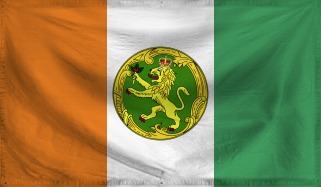
The MP was none other than the young backbencher who had made the usurped Amy Yarley realise her time was up, Preston Armitage. The representative for Karkland North had been a Yarley advocate and ally, leading to exile from any hope of ministerial office under the Smith administration – until the Foxchester Declaration came along. Armitage, then, would become an unlikely beneficiary of the ensuing chaos. He was a young, hot prospect of an MP with previous experience in Euran Oceania and a solid understanding of regional affairs in that area of the world, and therefore the perfect candidate to be plucked from the party’s ranks and given rapid promotion to a ministerial role. Nothing was confirmed yet, but he had been given reassurances by the party whips that he would soon become the first ever Minister for Anaian Affairs within the Ministry of Foreign Affairs.
Armitage was going from being nobody to somebody very quickly, and soon found himself in a bizarre mismatch of status in Cathair. Audioslavia’s government was clearly keen to persuade the Euran Oceania Territories and their Rushmori motherland to transfer the regional allegiance of the fledgling dominion to Anaia, but Armitage was taken by surprise to find himself briefly meeting First Minister Wilbur Hawes. It turned out this was perhaps just a coincidence, but even so, it sent a signal. Soon Armitage and the officials with him were joined by their real host, Audioslavia’s Foreign Minister Paolo Duffy-James, and so a marathon schmoozing session would begin.
----------
After shaking a few hands, Carl Rutherford made his exit from Stelburg without fuss. His early departure was planned and no surprise, but nevertheless he wanted to be extra sure to leave quietly once he’d said his piece, leaving his junior ministers and officials to do the more granular work for the rest of the summit. The Euran Foreign Secretary was perturbed by a number of things he had seen and heard. Mainly, the division on show; he had hoped the Oceanian’s would have got their act together to make it simple for the Euran government to respond to this crisis, but their internal divisions were already making matters more complex than they had to be. Rutherford was an experienced diplomat before entering politics and one of Ian Smith’s genuinely specialist cabinet appointments, but even this clusterfuck was beyond his powers of strategy. There were forty-five million people depending on him to somehow overcome that reality.
Also worrying Rutherford was the man supposedly representing those people, Governor-General Richards. As happy as Rutherford was happy to entertain Richards’ lofty notions of statesmanship, the old admiral had gone way beyond his remit in setting down red lines at Stelburg. Yes, border control and immigration policy were within the devolved powers held by the Territorial Administration, but that did not give him the right to unilaterally set policies that would impact Euran foreign policy. He had also gone much too hard and much too soon on the messaging around factionalism within the region. Rutherford was already writing all of this up in his report back to the Prime Minister, trying not to mutter angrily under his breath as he did so on the Euran Air Force plane home.
As the aircraft crossed the southern reaches of Calania towards his overnight stay in Fligsive, he was disturbed by one of his staffers popping their head through the curtain. ‘Carl, sorry to disturb, but you’ve got a call from Bastion. It’s the PM, on line one.’
‘Ahhh shit. I was hoping this could wait until I got back. I’ll take it on line one, thanks.’ Rutherford shook his head as he reached for the navy-blue official phone that he carried with him at all times for high priority calls. ‘Good evening Ian. Or morning there I suppose?’
‘Indeed. I just saw your man’s “performance”. Does he realise how many times he put his foot in it or not?’
‘I tried to reel him in, I really did, but the man is a law unto himself. We’ll just have to manage it.’
‘You will have to manage it Carl’ replied the PM, sounding equal parts irritated and nervous, ‘you are supposed to be my Foreign Secretary. I need a strategy and I need it now.’
‘This is a complex situation, Ian. Its going to take time. If you give me that we can work out what’s best for the Territories, what’s best for us, and get a good outcome. In the meantime, I suggest we put out the holding statement.’
‘Fine. When you’re back though, we need to talk. I’ve been having thoughts about how to deal with this, and the rest of it really.’ Rutherford tensed slightly. The PM had been all over the place ever since his polling went sour, and had been agitating for a big, one size fits all solution to his problems through some radical legacy-setting policy or scheme. Rutherford had been one of several senior cabinet members trying to talk Smith down from his mostly catastrophic ideas for doing so. ‘Why don’t you get some rest Ian? Sleep on it, seriously. You know my feelings about all this “home run” stuff. Its fantasy politics. Let us just deal with this issue then we can move onto the rest.’
----------
By the end of the next day, Armitage was on his way to the Territories, and Rutherford on the plane back to Eura. The Euran Ministry for Foreign Affairs put out a bland statement to offset the growing sea of speculation from the national press:
In the past twenty-four hours, the Government has had constructive and open conversations with our colleagues and compatriots in the Euran Oceania Territories, and international partners across Atlantian Oceania and the breakaway region known as Anaia. The Government will continue these conversations as the situation in the region(s) unfolds. As of this evening, the Government has begun a period of internal consultation on what these events mean for the Euran Oceania Territories and Eura, including consideration of any need for constitutional or legal reform. The Foreign Secretary, Carl Rutherford, will lead a cabinet subcommittee to manage this process and will report directly to the Prime Minister on its progress.
----------
Sometime later
Sometime later
‘He’s got to be joking. Please tell me he is. Don’t fuck me about here.’
‘Sadly, our beloved leader is not.’ Armitage shrunk in his seat as his old boss – well, she was sort of his boss now too – gave him a verbal hair dryer treatment.
‘Has he thought about the ramifications? How this could end? On my own life, I’d bet good money that bloody moron hasn’t thought this through beyond shower thoughts. I’m going to speak to him now.’
‘I’m not sure that’s a good ide-‘
‘Don’t argue with me Preston. Thank you for telling me this, by the way.’
‘O-ok. This can’t lead back to me, can it? I only just got the role!’
‘No, that prick knows I have eyes and ears everywhere in this party. He’ll think it could be anyone. Just don’t resign if he gets suspicious about you, alright? Now, if you don’t mind…’ Amy Yarley stood up from her seat and marched out of the room.
The former Prime Minister had kept her head down since resigning.
Not today.
By the time she’d found her traitorous successor Yarley had spent enough time stewing to uncharacteristically fluff her lines. ‘Smith, you…you…arse!’ The Prime Minister and his Foreign Secretary were sat alone in the cabinet room and were surprised to see Yarley emerge from nowhere. Smith was typically smug as he always was in front of his slain nemesis. ‘Amy! Back from gardening leave are we?’
‘Oh, give the whole affable fool nonsense a rest, will you? I’m here to address the giant turd you’re about to lay on the Liberal Party and this country. A “Day of Democracy” sounds nice, but when you look at the details, this whole thing is a fucking bomb vest on your premiership and our government.’
‘Amy’ he started, patronising tone employed to maximum effect, ‘I know it’s been difficult for you to adjust to the new state of play. Of course you want to get back behind the steering wheel. I would urge you though to take the dignified route here. Which is out of that door, in case you weren’t sure. Before you make a fool of yourself, mmm?’
‘This isn’t about me, you silly bastard. Carl, please tell me you at least tried to get him to see sense?’ Rutherford avoided Yarley’s gaze and fiddled with some papers on his table. When he had left Fligsive, he had been determined to steer Smith away from one of his big ideas. Time and bad polling had worn down his resistance until, eventually, Smith made a suggestion that the Foreign Secretary wasn’t willing to fight anymore. ‘I have my reservations. But Ian commands the support of cabinet, so, unless you have done something very naughty, I’m not sure what to tell you.’
Flabbergasted by their response, Yarley almost lost her temper. It took a deep breath and moment of thought to stop short of giving Smith the outburst he was clearly trying to provoke. ‘Ian. Set aside our…rivalry…for just a moment. This constitutional hole-in-one attempt is madness. You could legitimise Sameban nationalism, fuck our party’s dominance of the electoral system and start a civil war in our largest dominion five minutes after we fixed the last one there. Have you completely taken leave of your senses? Is there not a small part of you that’s thinking, hmmm, maybe I shouldn’t drink this container of political bleach? Or is this just some daft attempt to escape from the truth that you’ll never be as popular as I was? What is it?’ Yarley had once upon a time been an unchallengeable titan of Euran politics, and something of a rock internationally too. Power slipping away had been hard for her. This, however, was very real anger and for very good reasons.
If Smith had any sense, he would have recognised this and chucked the whole thing in the bin.
The Prime Minister of nearly three billion people, somehow, did not have any sense.
‘Democracy will save us, Amy’ he confidently asserted with a smile cast across his face, ‘and before long you will see that in practice.’ He marched out of the cabinet room triumphant, chirpily singing as he went, ‘We’re gonna’ victor, we’ll victor, Eura’s gonna’ victor…’
----------
emplor.eur/main/worldnews
SMITH SAYS: ITS TIME FOR A REFERENDUM, OR THREE
PM claims referenda campaigns are honest, truth-led, settle issues for good, prevent division - historians skeptical
- Euran PM seeks to resolve Euran Oceania Territories, Sameban and Euran instability with “hail-mary”
- Vote on regional status of EOT throws question to 45 million population
- Social leader Barnham: PM has admitted he is too weak to rule by calling votes
- Capital and Unionists condemn possibility of relaxation of Sameban political restraints
- Former PM Yarley pledges to plot against “self-destructive” votes
In what must be considered one of the great political gambits of the modern era, Prime Minister Ian Smith has announced that a trio of referenda will be held in a matter of weeks to resolve what he describes as the “three great constitutional questions of our time” – the regional status of the Euran Oceania Territories, the existence of the Provisional Government In former Sameba, and the nature of the Euran electoral system.
In a statement to Parliament, Smith pledged that the government would immediately move to pass legislation in order to run three different referenda on the same day:
- A referendum in the Euran Oceania Territories, on whether the dominion should constitutionally stay part of Atlantian Oceania, or join the new region of Anaia;
- A referendum in the 250 Euran parliamentary constituencies representing former Sameba, on whether the devolved Provisional Government should be abolished (effectively ending prohibition of Sameban nationalist politics and ending post-war Sameban devolution);
- A referendum across Eura, on whether parliamentary elections should retain the first-past-the-post electoral system or adopt a system of proportional representation.
The announcement has delivered a profound shock to the Euran political system, with the governing Liberal Party thought to be deeply divided over the proposals, although it is highly unlikely there will be enough rebels to prevent legislation for the referenda, with the Social Party set to vote with the Government. In the Euran Oceania Territories, Governor-General Richards has said he is ‘fully supportive’ of the proposed referendum on the Territories’ status the year before it holds its first devolved government elections.
Social leader Harry Barnham gleefully poked at the Liberals wounds in response to Smith’s statement, saying that while the opposition felt the proposed votes ‘were no bad thing if they give the people more power’, they demonstrated that Smith was ‘incapable of running the country’ and ‘too weak to make a case for these decisions himself’. Smith angrily rejected Barnham’s claims as ‘baseless smears’, and accused the opposition of admitting they had no alternative to offer by voting with his Government on the issue.
Other opposition parties have given mixed reactions. The Capital Party and the insurgent Unionist Party have both condemned the possibility of a referendum in former Sameba, with Unionist leader Tom Bannister going as far as to accuse Smith of ‘betraying his country’ by offering such a vote. The Euran right – and a significant minority in the centre and even on the left – strongly oppose abolition of the Provisional Government in Sameba, fearing it will allow Sameban nationalists to seize representation in Parliament.
Former Prime Minister Amy Yarley is perhaps the most intriguing opponent of the government on the issue, threatening to lead a backbench rebellion against Smith and possibly even a vote of no-confidence, although it is thought this is highly unlikely to succeed. The left wing Civil Federalist Party is the only major party whose leadership have not yet offered a clear position on the proposals, instead suggesting they will consult their membership and trade unions before taking a stance.