
Advertisement

 by Care Lyon » Tue Nov 20, 2018 5:31 pm
by North Saitama » Tue Nov 20, 2018 10:54 pm
by Mattopilos II » Tue Nov 20, 2018 11:36 pm
North Saitama wrote:Mattopilos II wrote:
If they don't influence the government like that, they could still simply influence the market by being very, very large.
Of course they will influence the market. Except that influencing the market is better for competition, not for building monopolies. Unlike influencing government, which allows companies to gain an unfair advantage, influencing the market means that competitors will react to what the leader is doing, either by copying, improving, etc.
by Union of the Great Lakes (Ancient) » Tue Nov 20, 2018 11:40 pm

by Elwher » Tue Nov 20, 2018 11:42 pm
Mattopilos II wrote:North Saitama wrote:
Of course they will influence the market. Except that influencing the market is better for competition, not for building monopolies. Unlike influencing government, which allows companies to gain an unfair advantage, influencing the market means that competitors will react to what the leader is doing, either by copying, improving, etc.
Sure, copycatting and aiming to outdo the leader can occur... squashing the competition in the first place is something that tends never to be discussed because it is explained away as "not being able to occur without a strong state".
by Mattopilos II » Tue Nov 20, 2018 11:44 pm
Elwher wrote:Mattopilos II wrote:
Sure, copycatting and aiming to outdo the leader can occur... squashing the competition in the first place is something that tends never to be discussed because it is explained away as "not being able to occur without a strong state".
There are only two ways to squash the competition. Either one can offer better product, lower prices, or better selection, in which case the competition deserved to be squashed; or one can use government regulation to eliminate the competitors. The latter, however, requires a large enough government presence to make such regulation possible.
In the first case, the consumer is better served by the organization which squashes than they were by the one squashed and, if the squasher raises prices or lowers quality, other competitors will arise to challenge their market position. In either case, the consumer is well served which is, to me at least, the goal of the market.

by Darussalam » Wed Nov 21, 2018 12:29 am
Mattopilos II wrote:Elwher wrote:
There are only two ways to squash the competition. Either one can offer better product, lower prices, or better selection, in which case the competition deserved to be squashed; or one can use government regulation to eliminate the competitors. The latter, however, requires a large enough government presence to make such regulation possible.
In the first case, the consumer is better served by the organization which squashes than they were by the one squashed and, if the squasher raises prices or lowers quality, other competitors will arise to challenge their market position. In either case, the consumer is well served which is, to me at least, the goal of the market.
You haven't really attacked the formation of a monopoly here, which I am sure you think is not a good thing for a consumer.
by Mattopilos II » Wed Nov 21, 2018 12:30 am
by Darussalam » Wed Nov 21, 2018 12:35 am
by Mattopilos II » Wed Nov 21, 2018 12:52 am
Darussalam wrote:Mattopilos II wrote:
Depending on how it is formed? So... when is monopoly good?
Monopoly of the state on violence, for example.
Tongue-in-cheek answer aside, obviously when it gains monopoly power through competitive advantage so blatant that no sane consumer would opt for other options. Which is the only way a monopoly could form 95% of the time in unregulated market economy, which is why you have never seen monopolizing firms 99% of the time.
Of course actual monopoly might result in overall reduction of aggregate welfare, but they're far rarer than anti-trust/"pro-competition" regulations which has nothing to do with existing models of imperfect competition whatsoever and are often abused for regulatory capture.
by Darussalam » Wed Nov 21, 2018 5:22 am
Mattopilos II wrote:This sounds less like the idea it is better for the consumer, but that they have no other "rational" choice, that to choose something else than that monopoly is irrational. I hope the hole in the logic here is obvious.
by Elwher » Wed Nov 21, 2018 9:06 am
Mattopilos II wrote:Elwher wrote:
There are only two ways to squash the competition. Either one can offer better product, lower prices, or better selection, in which case the competition deserved to be squashed; or one can use government regulation to eliminate the competitors. The latter, however, requires a large enough government presence to make such regulation possible.
In the first case, the consumer is better served by the organization which squashes than they were by the one squashed and, if the squasher raises prices or lowers quality, other competitors will arise to challenge their market position. In either case, the consumer is well served which is, to me at least, the goal of the market.
You haven't really attacked the formation of a monopoly here, which I am sure you think is not a good thing for a consumer.
by North Saitama » Wed Nov 21, 2018 12:07 pm
Mattopilos II wrote:North Saitama wrote:
Of course they will influence the market. Except that influencing the market is better for competition, not for building monopolies. Unlike influencing government, which allows companies to gain an unfair advantage, influencing the market means that competitors will react to what the leader is doing, either by copying, improving, etc.
Sure, copycatting and aiming to outdo the leader can occur... squashing the competition in the first place is something that tends never to be discussed because it is explained away as "not being able to occur without a strong state".
by Mattopilos II » Wed Nov 21, 2018 1:17 pm
Darussalam wrote:Mattopilos II wrote:This sounds less like the idea it is better for the consumer, but that they have no other "rational" choice, that to choose something else than that monopoly is irrational. I hope the hole in the logic here is obvious.
No, what I said just completely flew over your head.
What I'm saying is that dominance over market share still doesn't shield a firm from competition.
Unless the firm commits itself to vertical collusion - that is, through state-enforced regulatory barrier, but that would be a mark against criticism to a laissez-faire government.
Elwher wrote:Mattopilos II wrote:
You haven't really attacked the formation of a monopoly here, which I am sure you think is not a good thing for a consumer.
I do not think that a monopoly is inherently good or bad for the consumer. If it is using economies of scale to reduce consumer prices, it is good for them. If it is using the buying power of a large firm to increase choice, it is good for them. If it is raising prices after absorbing the competition, it is bad for them. If it is lowering quality standards because of a lack of other options, it is bad for them.
If a monopoly forms in an actual free market system, there is probably a good reason that it did. If the market is such that the monopoly persists, that is probably for a good reason as well.
Where a monopoly exists because of government regulation or due to the elimination of the competitors by violence or threat of violence, that is bad for the consumer, I agree. That, however, lies outside of the realm of the free market.
North Saitama wrote:Mattopilos II wrote:
Sure, copycatting and aiming to outdo the leader can occur... squashing the competition in the first place is something that tends never to be discussed because it is explained away as "not being able to occur without a strong state".
As I keep saying, though, a true monopoly is so hard to form that it isn't really a reasonable fear. Especially now, with the internet.
Even then, a true monopoly is still subject to the market, and the consumer, anyway; even on the off chance that one company is able to build a monopoly, they still need to attract customers, or they won't profit. Never mind that a monopoly can either be destroyed or be rendered worthless if change happens (which, as I have established, occurs frequently).
For example, let's say that Company X has a firmly-established monopoly on the widget market. However, Company Y, a new start-up, comes-out with a new product, rendering Company X's products obsolete. Now Company Y has become a competitor, and is also now curb-stomping Company X and their old-fashioned ways.
The problem with assuming that free market monopolies are invincible, on the rare occasion that they do form, is that it falls for the same trap of not accounting for change, and assuming that everything will just remain the same forever, a mistake that even Karl Marx is guilty of.
by Vince Vaughn » Wed Nov 21, 2018 1:20 pm
by North Saitama » Wed Nov 21, 2018 9:58 pm
Mattopilos II wrote:North Saitama wrote:
As I keep saying, though, a true monopoly is so hard to form that it isn't really a reasonable fear. Especially now, with the internet.
Even then, a true monopoly is still subject to the market, and the consumer, anyway; even on the off chance that one company is able to build a monopoly, they still need to attract customers, or they won't profit. Never mind that a monopoly can either be destroyed or be rendered worthless if change happens (which, as I have established, occurs frequently).
For example, let's say that Company X has a firmly-established monopoly on the widget market. However, Company Y, a new start-up, comes-out with a new product, rendering Company X's products obsolete. Now Company Y has become a competitor, and is also now curb-stomping Company X and their old-fashioned ways.
The problem with assuming that free market monopolies are invincible, on the rare occasion that they do form, is that it falls for the same trap of not accounting for change, and assuming that everything will just remain the same forever, a mistake that even Karl Marx is guilty of.
You are mentioning ways how they can be destroyed, but like the posters above, it all seems to be relying on the fact they have competition simply destroys them (or has the ability to). Start-up products can certainly become a worthy competitor to larger companies that monopolise the market. What I am saying is that this requires a large enough capital to get to that stage in the first place, and to find a way to attract costumers away from said monopoly in such a way that the monopoly cannot respond to the shift in the market... which I imagine is pretty hard, unless the new product is super hard to top or replicate or outdo with a larger brand.
This doesn't require suggesting CAPITALIST free market monopolies are invincible, it suggests they have an advantage by being a monopoly in the first place.
by Mattopilos II » Wed Nov 21, 2018 10:09 pm
North Saitama wrote:Mattopilos II wrote:
You are mentioning ways how they can be destroyed, but like the posters above, it all seems to be relying on the fact they have competition simply destroys them (or has the ability to). Start-up products can certainly become a worthy competitor to larger companies that monopolise the market. What I am saying is that this requires a large enough capital to get to that stage in the first place, and to find a way to attract costumers away from said monopoly in such a way that the monopoly cannot respond to the shift in the market... which I imagine is pretty hard, unless the new product is super hard to top or replicate or outdo with a larger brand.
This doesn't require suggesting CAPITALIST free market monopolies are invincible, it suggests they have an advantage by being a monopoly in the first place.
If you look at history, though, it is also full of examples of this, so it is not like I am even speaking purely theoretically. Look at what online shopping, for example, has done to the entire retail market. Wal-Mart has, before, been seen as an invincible main street-killer, the subject of documentaries and much criticism. Now they are fighting and actually losing a battle with Amazon; last February, they fell $31.6 billion in value, and had their worst sales performance in 35 years. And, sure, Wal-Mart is trying to react to this, but not in any way that crushes Amazon.
Furthermore, the actual disadvantages of monopoly are largely outweighed by how hard it really is to build and maintain a monopoly. From the bigger picture, a monopoly is neither inevitable nor invincible. Their ability to be harmful to the consumer and the people is, thus, limited, especially compared to how harmful out-of-control government can be (government's monopoly on power is much more secure, and an authoritarian government can go indefinitely so long as the trains run on time).
by Darussalam » Wed Nov 21, 2018 11:59 pm
Mattopilos II wrote:Okay, so then we have to look into this example a bit closer.
- Was Wal-mart's monopoly formed prior to the internet shopping boom? What about Amazon?
- How large was the monopoly Wal-mart has ever had, versus that of Amazon?
- Why is the reaction to Amazon's rise, as a largely internet entity by what was largely a on-internet entity, been such a struggle?
And I don't see how the implausibility itself is something that outweighs a disadvantage, especially since it isn't THAT implausible. It occurs quite often, but just happens to be overshadowed by a new monopoly, then another, then another, then another. The internet, as shown with Amazon, might simply mean the monopoly can be spread further - it has a larger platform than simply a physical storefront. And the implausibility (that isn't that implausible) still needs to be weighed against the magnitude. And also, you have to focus on more than just the consumer, but also the worker and the provider. They do kinda exist in this framework, yes?
While the stability of a monopoly is shakier than that of a government, it can still certainly be large and influential. Take the government out of the picture and I don't see why this suddenly lessens the dangers monopolies can pose. companies influence people outside the government, after all, in most of our everyday life.
by Mattopilos II » Thu Nov 22, 2018 11:31 pm
Darussalam wrote:Mattopilos II wrote:Okay, so then we have to look into this example a bit closer.
- Was Wal-mart's monopoly formed prior to the internet shopping boom? What about Amazon?
- How large was the monopoly Wal-mart has ever had, versus that of Amazon?
- Why is the reaction to Amazon's rise, as a largely internet entity by what was largely a on-internet entity, been such a struggle?
And I don't see how the implausibility itself is something that outweighs a disadvantage, especially since it isn't THAT implausible. It occurs quite often, but just happens to be overshadowed by a new monopoly, then another, then another, then another. The internet, as shown with Amazon, might simply mean the monopoly can be spread further - it has a larger platform than simply a physical storefront. And the implausibility (that isn't that implausible) still needs to be weighed against the magnitude. And also, you have to focus on more than just the consumer, but also the worker and the provider. They do kinda exist in this framework, yes?
While the stability of a monopoly is shakier than that of a government, it can still certainly be large and influential. Take the government out of the picture and I don't see why this suddenly lessens the dangers monopolies can pose. companies influence people outside the government, after all, in most of our everyday life.
This is why we shouldn't have ignorant people writing op-eds and telling uninformed people wrong definition of words and unsubstantiated claims.
Amazon (and by extension Wal-mart) is a monopsony, and this is not just a pedantic clarification - the effect of monopsony and monopoly insofar as understood are basically polar opposites.
by North Saitama » Sat Nov 24, 2018 2:17 am
Mattopilos II wrote:North Saitama wrote:
If you look at history, though, it is also full of examples of this, so it is not like I am even speaking purely theoretically. Look at what online shopping, for example, has done to the entire retail market. Wal-Mart has, before, been seen as an invincible main street-killer, the subject of documentaries and much criticism. Now they are fighting and actually losing a battle with Amazon; last February, they fell $31.6 billion in value, and had their worst sales performance in 35 years. And, sure, Wal-Mart is trying to react to this, but not in any way that crushes Amazon.
Furthermore, the actual disadvantages of monopoly are largely outweighed by how hard it really is to build and maintain a monopoly. From the bigger picture, a monopoly is neither inevitable nor invincible. Their ability to be harmful to the consumer and the people is, thus, limited, especially compared to how harmful out-of-control government can be (government's monopoly on power is much more secure, and an authoritarian government can go indefinitely so long as the trains run on time).
1. Okay, so then we have to look into this example a bit closer.
A. - Was Wal-mart's monopoly formed prior to the internet shopping boom? a. What about Amazon?
B. - How large was the monopoly Wal-mart has ever had, versus that of Amazon?
C. - Why is the reaction to Amazon's rise, as a largely internet entity by what was largely a on-internet entity, been such a struggle?
2. And I don't see how the implausibility itself is something that outweighs a disadvantage, especially since it isn't THAT implausible. It occurs quite often, but just happens to be overshadowed by a new monopoly, then another, then another, then another.
3. The internet, as shown with Amazon, might simply mean the monopoly can be spread further - it has a larger platform than simply a physical storefront. And the implausibility (that isn't that implausible) still needs to be weighed against the magnitude. And also, you have to focus on more than just the consumer, but also the worker and the provider. They do kinda exist in this framework, yes?
4. While the stability of a monopoly is shakier than that of a government, it can still certainly be large and influential. Take the government out of the picture and I don't see why this suddenly lessens the dangers monopolies can pose. companies influence people outside the government, after all, in most of our everyday life.
by Great Minarchistan » Sat Nov 24, 2018 9:06 am
by The South Falls » Sat Nov 24, 2018 9:10 am
Great Minarchistan wrote:Can't see amazon being a monopoly -- 50% of ecommerce and 5% of total retail don't really qualify -- lest a harmful one (as per data on institutional trust where Amazon is placed in ~3rd place out of 20)
by Mattopilos II » Sat Nov 24, 2018 5:41 pm
Great Minarchistan wrote:Can't see amazon being a monopoly -- 50% of ecommerce and 5% of total retail don't really qualify -- lest a harmful one (as per data on institutional trust where Amazon is placed in ~3rd place out of 20)
by Great Minarchistan » Sat Nov 24, 2018 6:10 pm
by Mattopilos II » Sat Nov 24, 2018 6:13 pm
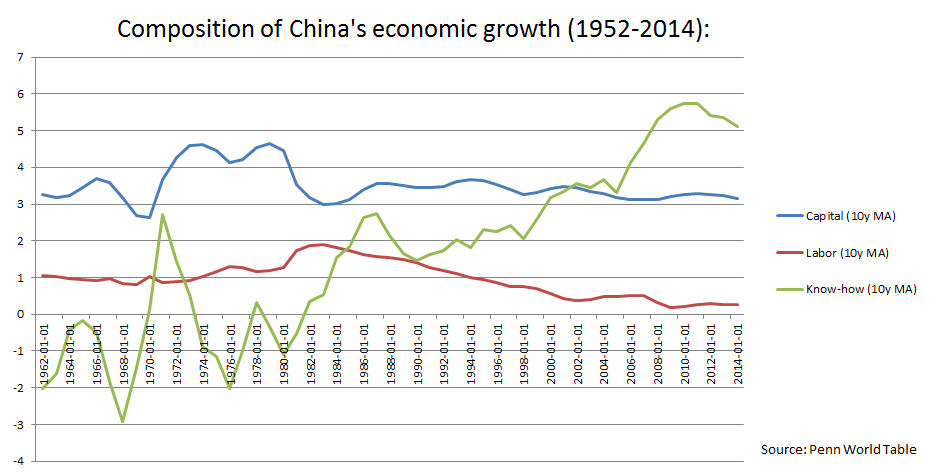
Great Minarchistan wrote:Yet further proof on the damage that socialist policies cause on the economy (c.f. know-how growth and on how it only skyrocketed with the abandoning of socialist policies and by kickstarting market/Dengist reforms):
(Image)
Given the constant/falling growth rates of capital and labor factors after Mao's tenure, it's logical to deduce that China only became a powerhouse thanks to Deng and the market liberalization performed by him.not that it wasn't obvious before, but now there's data proving it, eagerly waiting tor's take on this ;')
Users browsing this forum: Ameriganastan, Felid Robloxia, Gran Patria de las Antillas, Greater Mushroom Kingdom, Kurgao, Plandistria, Shrillland, The Empire of the Fatherland