NATION

PASSWORD

History from your nation

A place to put national factbooks, embassy exchanges, and other information regarding the nations of the world. [In character]
User avatar
Walosia
Diplomat
 
Posts: 803
Founded: Jul 17, 2012
Ex-Nation

History from your nation

Postby Walosia » Wed Jul 16, 2014 9:40 am

Here you can post historical facts, longer texts or just important dates regarding your nations history, may it be modern or ancient, good or bad. Everything is allowed as long as it has something to do with your nations history.
Member of the following Alliances
IATA Member
Full Member of the International Space Agency

CANON UPDATE (OOC):
I have given this a lot of thought and I have decided to do some major changes to the Walosian History Canon.

The largest change that I will be doing is the removal of the “Walosian-Khelsharian War of 2009” and the following abdication of Empress Liat as well as the removal of the character Liat completely. The reason why is because I have developed my nation into a more realistic fashion during the 2014-2015 era and after reviewing older post I see that the war and abdication of Liat is both unrealistic, doesn’t fit with the overall nation and is simply unprofessional.

User avatar
Walosia
Diplomat
 
Posts: 803
Founded: Jul 17, 2012
Ex-Nation

Postby Walosia » Wed Jul 16, 2014 9:41 am

There is a historical theory that Emperor Quintillus I may have had a son. When he established the empire back in 200BC, he was 28 years of age. He died 19 years later, in 181BC. He never married but according to several historical records, he had several lovers. Some records even say he had over 300 sexual partners, some slaves and some not. This was a time before contraception so it’s not a shock that the rumor of him having a child existed. In 192BC, one of the many house slaves said that he overheard Quintillus talking to a woman. The slave overheard Quintillus say that the women had to leave the city. Quintillus gave her a villa on the outskirts of Fairhaven and told her to go there and never return to Waldovia. The slave could not hear why she had to leave, but the rumor say that the girl became pregnant and because Quintillus did not want to become a father outside of marriage, he sent her away to the villa with instruction to never return.
Last edited by Walosia on Fri Jul 18, 2014 8:59 am, edited 1 time in total.
Member of the following Alliances
IATA Member
Full Member of the International Space Agency

CANON UPDATE (OOC):
I have given this a lot of thought and I have decided to do some major changes to the Walosian History Canon.

The largest change that I will be doing is the removal of the “Walosian-Khelsharian War of 2009” and the following abdication of Empress Liat as well as the removal of the character Liat completely. The reason why is because I have developed my nation into a more realistic fashion during the 2014-2015 era and after reviewing older post I see that the war and abdication of Liat is both unrealistic, doesn’t fit with the overall nation and is simply unprofessional.

User avatar
Walosia
Diplomat
 
Posts: 803
Founded: Jul 17, 2012
Ex-Nation

Postby Walosia » Wed Jul 16, 2014 9:43 am

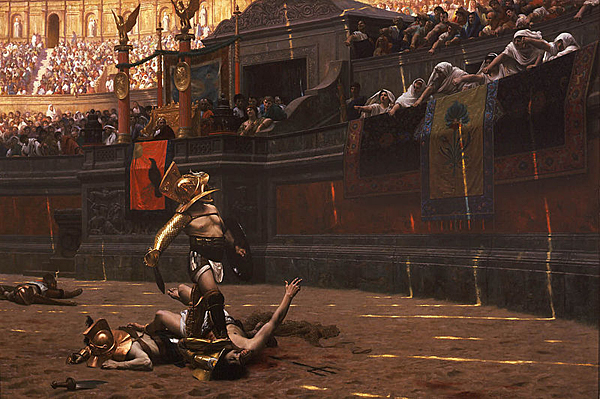
In Ancient Walosian times, gladiator fights where common and numerous amphitheaters were raised. Some of them are still in use today. The most known amphitheater is located in Waldovia and is simply named Amphitheatrum Hadrianis (Hadrian’s Amphitheater after Emperor Hadrian who had it constructed). This amphitheater showed gladiator fights, public executions, theater plays and dramas. It was built in 80BC and is one of the ten most important historical landmarks in Waldovia. The last play on this theater was conducted in 1002AD because the Department of Historical Preservation and Archeological Excavation had decided that the Amphitheater was a historical landmark and should therefore be preserved.

Gladiator fought on these arenas and on many other arenas all around in Walosia. There where five kinds of gladiators in Walosia.
Gladiatore Captivus (Prisoners of war)
Gladiatore Criminalis (Criminal)
Gladiatore Servus (Slaves)
Gladiatore Voluntarius (Those who volunteered to fight)
Gladiatore Femina (Female gladiators)
Gladiators where usually criminals and POWs, but some volunteers wanted to prove themselves in the arena. One notable example of a volunteer was Emperors Constantine I son, Trajan.
There where numerous sub-categories. To read more about them, click this link
http://en.wikipedia.org/wiki/List_of_Ro ... #Andabatae

When a gladiator was defeated, the emperor (or the highest ranking officer at the event) stood up. If he/she signed with a thumb up, the defeated gladiator was allowed to live, if he/she signed either a thumb down or with the thumb closed inside the fist, the defeated gladiator should die. In famous painting depicting this was made by Marcus Julius Agrippa in 308AD and depicts the audience with either a closed fist or a thumb down. On the royal seat you can see Emperor Trajan thinking of wheatear the gladiator shall live or die.
Image


Amphitheatrum Hadrianis
Image
Last edited by Walosia on Sun Aug 03, 2014 4:10 pm, edited 2 times in total.
Member of the following Alliances
IATA Member
Full Member of the International Space Agency

CANON UPDATE (OOC):
I have given this a lot of thought and I have decided to do some major changes to the Walosian History Canon.

The largest change that I will be doing is the removal of the “Walosian-Khelsharian War of 2009” and the following abdication of Empress Liat as well as the removal of the character Liat completely. The reason why is because I have developed my nation into a more realistic fashion during the 2014-2015 era and after reviewing older post I see that the war and abdication of Liat is both unrealistic, doesn’t fit with the overall nation and is simply unprofessional.

User avatar
Yulis
Chargé d'Affaires
 
Posts: 368
Founded: Mar 12, 2012
Inoffensive Centrist Democracy

Postby Yulis » Wed Jul 16, 2014 9:07 pm

Yulis was formed in 2079 by Emperor Taukron Jobein II of Hosbiarna. For a while it was a colony of Hosbiarna but it gained independance in 2106 at the start of the War of The Dark Ages. The Leaders of Yulis refused to assist in Hosbiarna's Civil War and they seperated from Hosbiarnan rule when the hosbiarnan troops were taken out of Yulis to assist in the war.

The Kingdom of Yulis was first lead by King Jamesk I. Crowned in 2107 he ruled Yulis and managed to keep it from succumbing to a similar fate to that of Hosbiarna. Under Jamesk I Yulis grew to be the dominant and only power in The Lonely Plains. In 2145 Yulis took in New Hosbiarna which was the only nation beside Yulis itself that was still around.

In 2163 King Jamesk I was killed while on a visit to the "Free People's Empire of Hosbiarna" and his eldest son Tælsten took his place.
Under King Tælsten I Yulis began to succumb to the Dark Ages and fall apart. New Hosbiarna rallied under Jamesk's third son Mærdek and broke away from Yulis. New Hosbiarna soon fell under a civil war sparked by Jamesk's second son seeing New Hosbiarna as his birthright.
In 2186 Tælsten I was killed and his son Tælsten Jr became king. The seventeen year old Tælsten II was hated by almost everyone in Yulis and within 6 weeks he had been deposed and executed. With no heir to take Tælsten's place Yulis fell into a dispute about who should be King. After only a few months it had become an all-out Civil War.

Tælsten's cousin Holthejän Jr (son of Jamesk's second son) came out of exile in New Hosbiarna and attempted to claim the throne for himself but he was rejected by the people of Yulis. Holthejän's army continued to fight under their new leader Bolskæn. The War of The Throne began in 2187 and went on for 11 years. Bolskæn Senior was killed fighting in 2194 and his son (also Bolskæn) took his place.

In 2198 Bolskæn's army captured New Hoz City and renamed it Holthejän. The Empire of Yulis was founded by Bolskæn right there. He was crowned by his Senior General in the middle of Holthejän minutes after founding his Empire. Following the founding of the Empire of Yulis Holthejän's people came flooding in from New Hosbiarna, where they had been rebuilding their lives. In 2199 after a decree by Emperor Bolskæn I a mass genocide began of the people who had owed their allegiance to Mærdek and Tælsten I. In 2201 The Empire of Yulis annexed New Hosbiarna and a small uninhabited part of Hosbiarna. Over the next decade and a half Emperor Bolskæn I slowly captured parts of Hosbiarna for his Empire.

In 2214 Taukron III of Hosbiarna was alerted to what was happening to the west of his homeland and left Eastern Hosbiarna with the majority of his army to rectify the situation. In 2215 Taukron annexed the area of Bolskæn's empire that was formerly New Hosbiarna and reclaimed the parts of Hosbiarna that had been captured.

Finally in early 2216 Taukron reached the city of Holthejän. He imprisoned Emperor Bolskæn and began debating on what to do with him. His time in Yulis was cut short when one of the important towns in the war in Hosbiarna was captured by the enemy. Taukron decided to return to his homeland and defend his lands. Before he left he executed Bolskæn I and defaulted the Empire of Yulis.

In Taukron's absence, Bolskæn's son reinstated the Empire of Yulis and crowned himself Emperor Jamesk I. Instead of aggravating Taukron further, by attempting to reclaim New Hosbiarna, Jamesk looked west, to the city of Diallen and former Prolais.
Prolais had been occupied by New Hosbiarnans and Yulisians loyal to Mærdek who had sought to escape the genocide in Yulis. The cities of Karize and Diallen had been rebuilt following The War of The Ages which had sparked a revolution in Prolais, one that had left the northern city of Deaux raised to the ground. The Mærdetians, as they called themselves, had crowned a king, Dömendrál I, and built an army.

Dömendrál, who was Mærdek Senior's grandson, considered himself the true Emperor of Yulis. On account of Bolskæn being simply a general and not an Emperor. Dömendrál believed that, with the combined armies of the Mærdetians, the Yulisians, the New Hosbiarnans and possibly even the people of Greckel in the southeast, they could defeat Taukron of Kæthlen and make Jobenoton the capital of the New Empire of Yulis.

In 2219 Jamesk I sent an army of 16,000 to capture the City of Diallen. In this famous battle Jamesk believed that 16,000 would be sufficient to subdue the city's "scanty" inhabitants and secure it for the Empire of Yulis. Dömendrál replied by sending out 160,000 men from inside the city. What Bolskæn had forgotten was that Prolais had possession of Esteldōr. Esteldōr was the first colony city created by Emperor Taukron I to be the capital of Jobein, Hosbiarna's first colony. Esteldōr was, at the time, larger than Holthejän and the people were loyal to Mærdek (this was because Mærdek had been Governor of Former Jobein before he inherited New Hosbiarna) and his descendants.

Jamesk's 16,000 were slaughtered and the city of Diallen was left untouched. For his birthday that year Jamesk recieved 16,000 yulisian army helmets, all were covered with the dried blood of those who had worn them.

In late 2220 Dömendrál marched upon the city of Holthejän and laid seige to it. After two days the southern gate fell and 200,000 Mærdetian soldiers poured into the city. Upon catching sight of Jamesk I Dömendrál had an arrow shot through the Emperor's heart. The following day Dömendrál had himself crowned Emperor Dömendrál I and he renamed the City of Holthejän; "Mærdegárd" (because "Holthejän" is a holthejian name not suitable to a Mærdetian Emperor).

In 2250 Dömendrál died and his son was crowned Dömendrál II. Under the rule of the second Dömendrál an almost eerie peace came over the Empire of Yulis. To the east Hosbiarna was under the firm and stable rule of Emperor Showerhead Four, to the south the Kingdom of Jobein had reasserted its independence and their king, King Jamesk III had assumed full power. Despite being almost seventy Jamesk had somewhat youthfully built a kingdom for his son. To the west the Prolaisian Mærdetians had adjusted to Yulisian society.

In 2259 the Tælstenians started a small a small rebellion in Tælstine and crowned an 18 year-old the Duke of Tælstine. After the rebellion was finally subdued in 2262 it was confirmed that this man, now 22 years old, was indeed the great-great-great-grandson of King Tælsten I, descended from his second son (Tælsten II's uncle). This man, Jamesk of Tælstine, was stripped of his ducal title but he was made Mayor of Tælstine.

Soon afterward the city of Diallen in former Prolais was renamed "Holthejän" in response to the Holthejians stirring up trouble about not having a city that took the name of their eponym.

In 2279 Dömendrál II died and his son Mærdek became Emperor. In 2280 it was agreed that the religious and political eponyms "Mærdek", "Tælsten" and "Holthejän" would fall out of use as given names and would become the surnames of the three families descended from King Jamesk I.

Mærdek I was followed by his son Jämesk III (who technically should have been Jamesk I, on account of the continuation from King Jamesk I) who was crowned in 2320. Jämesk III had no sons so the throne passed to his daughter's son. Jämesk's daughter Meya had married the great-grandson of Jamesk of Tælsten, Jamesk Asmörne Tælsten. Their son, Asmörne was born in 2332. When Jämesk III died in 2348, his grandson became Emperor Asmörne I.
When Asmörne was crowned, the Imperial Family was now the House of Tælstine. Instead of renaming the capital city "Tælstine" (it had been "Mærdegárd" since 2220), Asmörne renamed it "Jaméor" and the city of New Asgard now became "Mærdegárd".

The transition into the twenty-fifth century was relatively peaceful affair. The first half was only notable for the skirmishes along the southern border with Taukron VIII. Social issues, many that lead to the rise of public nudity and other practices, came into prominence and with it, greater use of the government that had been underused for the past 150 years.

In 2437 Emperor Jamesk V was crowned. He and his son, Jamesk VI, would change and reshape Yulis over the following 60 years. Jamesk V's reign saw an increased Imperial involvement with the government (almost parallel to the interest of the younger generation of the public) and increased military action.

In late 2464 a campaign was launched that would change Yulis forever...

On Martéance 20 2464, while the Emperor Taukron VIII in Jobenoton was barely out of bed, 100,000 Yulisian troops marched down the streets of Jaméor. Only hours before the news had filtered through that Yulis was at war. A rebellion orchestrated in the colonial capital of Glandefal (the Duchy of Aeron) had gained the support of three colonies (Aeron, Dessimar and Dythnara) and had attacked the Imperial forces stationed in their cities. The colonies challenged Yulisian Sovereignty and wanted independence. The Yulisian troops originally won out and subdued the rebellion but later agreed to relinquish sovereignty and grant independence to all four colonies.

The short war with the colonies served only to arouse the Emperor's slumbering military. In Kedréance 2474, after some political clashes between the two countries, Yulisian troops annexed a large area northern Jobein and over the following six years they slowly consolidated their hold on the land and the Jobeïse were forced to surrender the land. This did little to help relations with the King of Jobein and His Majesty's Government and the tension between the two nations remains today, somewhat aggravated by the Tældone war in the 2540s and 50s.

The following two decades were slightly rocky, large amounts of publicity was given to the rise of nudity and the greater tension as the younger, more liberal generations took over. But no serious conflict arose. In 2502 Emperor Tældon I was crowned and Yulis entered a peaceful state that would last four decades.

Tension among the media a public began to build in the late 2530s but it wasn't until 2541, when part of Merste broke away from Yulis to join New Prolais and the country of Vilidec declared independence from Hosbiarna and Grecie, that any trouble began. In Yulis, for now nearly 70 years there had been a significant difference between the north and south and many groups began to campaign to break away from the north or to keep Jaméor and kick those north of it out. These campaigns remained prominent throughout the entire decade.

In 2544, following the marriage between the prince of New Princeton and the Prince of Nusshu, war broke out between the nations of Dethklok 1000. The main branch of the war, which became known as the Tældone War, between the Tældone Alliance (including Nusshu, New Princeton and Yulis) and the Brown Alliance (including Brown Dictatorship and Pietree) lasted only a short period of time and was resolved fairly peacefully after only a few months. Soon after the Tældone War broke out Jobein, as allies of Brown Dictatorship, declared war on Yulis. The conflict escalated and continued for thirteen years before finally ending in Amathance 2557. The Yulisian troops, perhaps spurred on by the recent death of their Emperor, began a strong new campaign and defeated the Jobeïse troops. In the settlement that followed, Jobein lost around half of its territory. All land north of 27°N was ceded to Yulis (which became Yulis' 23rd state, Dontes, named for its capital city) the rest of the land north of 20.5°N ceded first to Grecie before declaring independence and becoming Eiós (Yulisian name Eós), named for the country of Eós which had been on the same land 350 years before.

Emperor Asmörne IV, Tældon's son, was crowned soon after the Treaty of Quinsin (named for Lake Quinsin, which held the intersection between the borders of the four countries) was signed. In 2562 Prince Jamesk married Princess Anastasia, the daughter of The Grand Emperor Titus of Fioreto. This was the first of a number of marriages between the Yulisian Aristocracy and the Royal Families of nations outside The Lonely Plains. Prince Jamesk was assassinated in 2571, Emperor Asmörne IV died in 2589 and his grandson became Emperor Jamesk VII, but apart from that nothing interesting happened for the rest of the century.

In 2553 Lèn Omenèn Benèx dun Yulis (shortened to 'LOBDY' and later lengthened to 'Lobedy') was founded. They intended to liberate Yulis of its Government, Aristocracy and Imperial Family and bring widespread democracy to the people of Yulis. It was originally lead by Lon Tréo Gran ('The Big Three' or more correctly 'The Big Trio'), Ladogan Daresil, Martan Alonar and lanera Thérosan. Daresil, arguably the leader of the three, was killed in 2556 fighting in the Taeldone war and was relplaced by Artan jelonere. All three were assassinated while in Jaméor, the Grecien Secret Service, aliens and football hooligans are often cited as the assassins.

After the Big Three were killed Lobedy was taken over by Cómos Inodril. Inodril is believed to be directly responsible for Prince Jamesk's death in 2571 and he remained a fugitive until he died, after spending two decades in hiding. Lobedy is also believed to be responsible for several assassination attempts during the 2570s and 80s on Emperor Asmörne IV. Cómos Inodril's son, Laniel, took over control of Lodeby in 2584 but died only two years later. It was then taken over by a new Big Three (who were actually known as 'Lon Tréo Gran Niu'), brothers Paol and Asmörne Staben and Lanera Thérosan's son, Canton Darsyn. The Big Three spent the next two decades planing the fall of the Yulisian Government.

Finally, in 2603, they were ready. Their first target, the Duke of Holthejän, was assassinated in 2604 after two failed attempts. The second of which resulted in the deaths of the Duke's mother, wife and son. The Duke's grandson, Jamesk, then became the Duke of Holthejän as he had survived all three attempts on his family and went into hiding with his mother. Lobedy's next target was the city of Anasorei, which fell after a two day seige (16.05.2604). The state of Guare, which had been the home of Lobedy since its creation in 2553, was under Lobedy's control by the end of 2604.

In Kadrellance 2605 Guare declared itself to be part of Lan Tersa Libra delen Populèn ('Lan Terce Libre delèn Populèn,' in Jaméor Dúclan), The Free Land of the People. Jutal, Abédo and Onovec followed and Lobedy soon began recruiting men for an army. Lan Tersa Libra delen Populèn declared war on The Empire of Yulis on 11 Vendrance 2605 (11.08.2605) and invaded Yulis the following month. A small scale war continued for nearly a decade until it flared up in mid 2614. A full scale civil war began. The Yulisian Government appeared to have the upper hand until an extreme imperialist group (Lan Yulisia) declared war on the Government, seeking to restore absolute monarchy to Yulis.

With the Yulisian Government having to divert a number of soldiers to control the riots caused by Lan Yulisia's supporters and those opposing them Lan Tersa Libra delen Populèn was able to advance further up and across the nation. In late 2617 the state governments of Jobein, Sanios, Cuoinsain, Prolasia and Entravin separated from Yulis and formed Lon Oneźion dun Cian (The Union of the Five). The loss of a quarter of the population and an around a third of its army severely disadvantaged The Empire of Yulis and within a year Lan Tersa Libra had reached Jaméor and executed Emperor Jamesk VII. What followed was effectively the extermination of the Yulisian Aristocracy. Although it was later satirised in a popular sitcom "How to Exterminate your Surplus Aristocracy," a show that involved Daleks, an enormous cast, extensive inbreeding, extravagant teenage weddings, and death, it was no laughing matter at the time. Brutal forms of execution unseen for centuries resurfaced. Almost all of the Yulisian Aristocracy had been killed by the end of 2618 alone.
HI! *waves furiously*
Yulis is a big nation of football-loving Socialists, metal-heads, and cat videos. In the way that American "left-wing extremists" are centre-right politicians to the rest of the world, Yulisian "right-wing extremists" are centre-left politicians to the rest of the world.

I'm a person, I live in New Zealand. If you wondered, I am probably laughing at your country right now, but I'll be crying fairly shortly. This stuff is great.

User avatar
Walosia
Diplomat
 
Posts: 803
Founded: Jul 17, 2012
Ex-Nation

The history of the Walosian Kingdom

Postby Walosia » Fri Jul 18, 2014 8:45 am

Today, the Walosian Empire consists of five major islands and around 20 smaller ones, but the Empire was not created just out of the blue. The empire was built on top of the ruble that was the Great War of 200BC. This war united the four major kingdoms under one banner and formed the Empire of Walosia. But the history presiding the empire is almost as long as the history of the Empire itself.

Gaius Lucius Quintus founded the city that would later evolve into the Empire on the eastern bank of the Neptune River in late 12th century BC. This tiny city became known as Latina and consisted merely of twenty houses, a harbor and a temple to Venus. This little city lived along the Neptune River and grew in size as the years went by. Just after 40 years, the city´s population had grown to about 1 200 from a mere 75 when they started. This due to massive immigration and a baby boom. Latina was located in a part of the island where tribals and barbarians where the norm and more than ones did the city face extinction by barbarians and rivaling tribes, but miraculously, they survived. Latina was not a kingdom and neither a republic, but this city was governed by a Consul, someone who was in complete power, but the Consul was elected by popular vote by the citizens of Latina. Latina, and later Waldovia and Walosia is categorized as kingdoms, but Walosia did only became a kingdom in early 400BC when Consul Tratius removed the law that said every Consul could only sit for a period of 1 year. When they year was over, the former Consul was publicly questioned by the public for his actions during his rule. (I am saying “his” actions, as there never where a female consul)

In 785BC, Consul Lanius decided that enough was enough and decided to invade and conquer the territory of the enemy tribals. The enemy tribes of Latina coalesced and formed The Tribal Coalition. The fighting was hard, but as of a miracle made by the gods themselves, the little town of Latina soon found themselves as victorious and with the territory from the former tribes under their rule. This led to the creation of multiple centers and the need for protection soon arises. This also resulted in more attention by the hands of some stronger tribals in the area. However, Latina stopped their expansion and focused on rebuilding the territory they had recently conquered.

Around the decade of the 750s BC, Consul Tiberius`s wife of 30 years passed away to something we thing was cancer. Tiberius `s wife was named Valencia and as a last gift to her, Tiberius decided to change the name of Latina to Valdovea (Which is the ancient form of Valdovensis). In English, Valdovea becomes Waldovia, which is the name of the Walosian capital. I will continue to referee to the city of Valdovea by its English name, Waldovia.

Around the years of 719BC, a huge wave of refugees came from the west, refugees from the conflict between the kingdoms of Oksavidus, Haules and Javes. These refugees flocked to the gates of Waldovia. The citizens and Consul of Waldovia welcomed the refugees with open arms and the city´s population grew exponentially and rapidly. Historians like to separate the migration of the refugees into three large waves. The first wave, originally called “The first refugees” took place from 719 to about 717BC and in that period of time, about 7 000 refugees were taken in to Waldovia. The second wave, the “Grand Arrival” took place from 715 to 714BC and the population of Waldovia grew with over 12 500 new citizens. The last wave, called “The final Expand” took place from 711 to 709BC and accompanied a total of 4 500 new refugees. Now, the total population of Waldovia was around 150 500. A population this high required new territory and crops. This forced the city to engage in a large offensive against the territory and tribals in the outskirts of the city´s borders. From 775 to 770BC Waldovia grew both in size and economy and granted the city with a well-equipped army and naval fleet.

In 659BC, Consul Domitian changed the name of the city from Waldovia to Walosia and started establishing new cities on the frontlines. This resulted in Walosia becoming more of a nation-state than city and with a growing population, the nation of Walosia needed to expand into yet undiscovered territory. With numerous skirmishes, some lost and some won, the little nation of Walosia could soon expand and by the 500BC, the total area of the nation Walosia had reached almost a hundred times that of the city Latina back in 1100BC.

Consul Tratius came to power by election in 423BC and soon changed the laws into his liking. He removed the clausal that stated the consulship and its system of terms and election. He made himself king (or Imperator) and introduced a system of succession and absolute monarchism. This, off course, did not suit well with the public and a resistance movement started growing. However, because of the strong army build up with the conquering of the territories, striking down the protestors was easy. The largest protest took place on, what was to become known as Revolution Square, when over 10 000 protestors took to the streets of Walosia, demanding democracy and justice. Even some of the soldiers joined the protestors as they marched towards the Imperial Palace (Not to be confused with Caesarions Palace, Imperial Palace was a building located in the Walosian kingdom and housed the king and royal family). Many of the protestors brought weapons and swords to the protests and when the military was ordered to intervene, both sides lost numerous men. The exact number is uncertain, but we believe that about 3 600 lost their lives. This happened March in 416BC.

Even though the resistance was outnumbered, they managed to cause quite a lot of damage. The resistance stood behind numerous assassinations, arsons, protests and sabotages during the 400-250BC years. A total of 8 kings saw their demise by the hands of a rebel assassin, but despite this, they where never able to overthrow the rule of the kings. Not before one man made it all possible again.

Gaius Quintillus Caesarion, a bastard born to a Walosian prostitute and a Javian soldier, he grew up with a hatred for the king and the kingdoms on the island. An orphan deemed to walk the streets of Walosia begging for money. The death of his loyal companion, the dog Canis, by the hands of the king’s soldiers, Quintillus developed a hatred for the king and his rule. In 210BC he drafted himself to the army in hope of getting a better life. He quickly shot through the ranks, as he was a good logical thinker and strategist, he made centurion by 208BC and Primi Ordines by 203BC. As the Great War broke out, Quintillus was made Legatus Legionis, the highest position in the Walosian military. This gave Quintillus complete control of the army and the navy of the Walosian kingdom. After three years of battle, the Walosian kingdom saw victory in the Great War. However, the spoils of war taken from the other nations, gold, silver, land and profit went exclusively to the richest 2% of the kingdoms population, which sparked new protests. Only now, the protestors had one man on the inside. Quintillus, even before he joined the military, had strong connections to the rebel group in Walosia (a connection the king and his associates did not know about). When he was given the title and role of Legate, he immediately started to work on his plan to overthrow the king and his rule.

Quintillus became quite popular among his soldiers and of the Walosian plebs (plebe=the Walosian lower class, peasants and farmers). Most of the Praetorian Guard, the army and navy sided with Quintillus so when he gave the signal, both the plebs and soldiers stormed the building that housed the king. Soldiers and plebs also stormed the houses of prominent statesmen and royal officials. However, the king was not his palace, when he returned, two armed praetorian guards jumped him and put him in chains. What to follow was a period of political turmoil and conflicts internally in the population, but on August 8th 200BC, Quintillus announced the constitution and the establishment of the senate. Two weeks prior to this announcement, the very first election was held to choose who should represent the people in the senate. A total of 20 senators were to be chosen, five from each city under Walosian rule. August 8th marked the date in which Quintillus announced the names of the winners and continued to sign the constitution. The first 20 senators also signed as well as the five who co wrote the constitution with Quintillus. Quintillus then continued to, out loud, read the rights and laws from the constitution. Today, the constitution is over 40 pages long, but in 200BC, it was only two pages long. Thus marked the beginning of the Empire of Walosia with Emperor Quintillus on the throne.


Image
Gaius Lucius Quintus meeting with Venus in the outskirts of the soon to be City of Latina

Image
The Walosian Kingdom in 500BC

Image
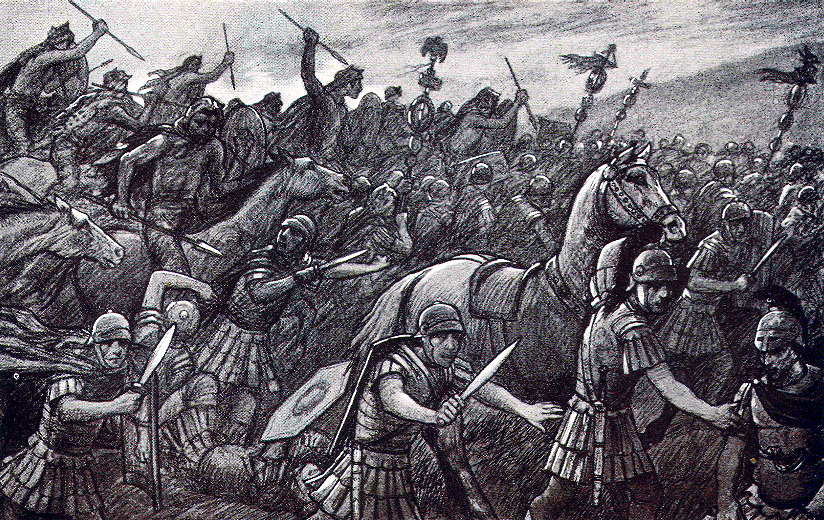
A Walosian Legion in fight with some of the tribals they had to fight to conquer the areas outside of the city. This picture depicts the Cumulus Tribal campaign in 898BC.

Image
Painting showing the third wave of refugees arriving at the Kingdoms doorsteps

Image
Assassination of Imperator Domitian I in 338BC
Last edited by Walosia on Wed Jan 21, 2015 6:39 am, edited 4 times in total.
Member of the following Alliances
IATA Member
Full Member of the International Space Agency

CANON UPDATE (OOC):
I have given this a lot of thought and I have decided to do some major changes to the Walosian History Canon.

The largest change that I will be doing is the removal of the “Walosian-Khelsharian War of 2009” and the following abdication of Empress Liat as well as the removal of the character Liat completely. The reason why is because I have developed my nation into a more realistic fashion during the 2014-2015 era and after reviewing older post I see that the war and abdication of Liat is both unrealistic, doesn’t fit with the overall nation and is simply unprofessional.

User avatar
Walosia
Diplomat
 
Posts: 803
Founded: Jul 17, 2012
Ex-Nation

Postby Walosia » Fri Jul 18, 2014 9:13 am

Image
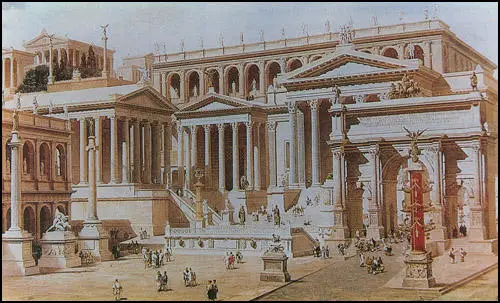
The Latina Forum, constructed by Emperor Domitian I in 376 until his death in 389 and continued by his daughter, Empress Lavina I from 389 until the Forum stood finished in 398, was named after the very first city founded by Gaius Lucius named Latina. This forum is mostly intact today and is one of the major tourist attractions in Waldovia today.
Member of the following Alliances
IATA Member
Full Member of the International Space Agency

CANON UPDATE (OOC):
I have given this a lot of thought and I have decided to do some major changes to the Walosian History Canon.

The largest change that I will be doing is the removal of the “Walosian-Khelsharian War of 2009” and the following abdication of Empress Liat as well as the removal of the character Liat completely. The reason why is because I have developed my nation into a more realistic fashion during the 2014-2015 era and after reviewing older post I see that the war and abdication of Liat is both unrealistic, doesn’t fit with the overall nation and is simply unprofessional.

User avatar
TurtleShroom
Negotiator
 
Posts: 5942
Founded: Oct 13, 2009
Ex-Nation

Postby TurtleShroom » Fri Jul 18, 2014 2:17 pm

On July 19th, in the year 1219 AD, a race of Mongoloid peoples directly associated with the vassalized Mongolian Empire arrived at the behest of their overlord, known today as the Greater Evil Imperial Japanese Dystopia, on the eastern shores of what is today Soviet Putinland. The rapidly expanding Mongol Empire had many dissidents and other Mongoloids (such as the Tatars, the Cumans, and the Khazakhs, etc. etc.) that needed to be removed to make way for Mongolian infrastructure and trade.

With the assistance of GEIJD, the Mongol Empire banished these groups away. While GEIJD had been using the Land of Power as a penal colony for centuries, the Mongol Empire only began when its leader swore fealty to the GEIJD overlords who were planning to fight the remnants of the Chinese population.

Their Khan, whose English name translates to (Khan) Pawley Myrtle, was a Mongolian aristocrat and administrator ordered to protect and expand the expatriate colony in all directions. He, and his descendants, chose to go west-southwest. Generations of nomadism led the Pawleeds (as their tribe became called) to discover what is now TurtleShroom in the early fourteenth century. They constantly and speedily moved from year to year, always westward, leaving their ruins, villages, artifacts, and such behind. These artifacts are still scattered across the southern landscape of the Land of Power, from Darrusalam to Kavck to the nomadic Undead Gypsies.

In the late thirteenth century, the entire Pawleeds tribe ultimately shifted into TurtleShroom and, having discovered the native turtles and mushrooms, immediately subjugated those who refused to surrender. For the next hundred years, these Mongols would rule over the turtles, and after a short, but bloody, pretender war, the Myrtleds would split from the Pawleeds and subjugate the mushrooms.

Though the exact date of human extinction is still unknown, the last Mongol humans died out sometime before 1515 AD, having successfully outlived the entire Mongolian Empire (which was directly absorped into GEIJD as time went on). While many theories exist as to why the Mongolian presence ceased to exist, most believe that the turtles and mushrooms, whose tribes were united under Mongol subjugation, attacked the Mongols and managed to kill them all off.

From there, the turtles, fearing future attacks, united under a Khan of their own, who was the first of the Ticktock Khanate (a name dubbed by English settlers). They called themselves the Pawley Hoard. Their Khan died shortly before the arrival of the very first Missionaries. Without him, the turtles struggled in succession wars (for the Khan had spawned thousands of offspring) and were unable to muster an effective defense from humanity, and were ill-conditioned to fight the Missionaries, had they not come in peace. The mushrooms fared no better.

In 1750 AD, the ailing, second Khan of the Pawley Hoard converted to Christianity (following the vast supermajority of his subjects after resisting for decades) and decreed that the humans were surely favored by the Khans. His final decree before his death urged the turtle race to cooperate and grow alongside the humans as equals. (The mushrooms had issued a similar decree in 1714 AD.)

In 1751 AD, the Pawley Hoard was vassalized by the colonial TurtleShroomer state without firing a shot. In 1794 AD, the third Khan of the Pawley Hoard officially abdicated and declared Jones Found (who arrived in 1790 AD) the official Pawleed Khan. The mushrooms followed suit in 1795 AD, declaring him the Myrtled Khan. He was pronounced the Khagan of Turtle Mushroom and, much to everyone's surprise, he settled the tree-way debate on who would rule TurtleShroom by the casting of lots, forming a turtle and mushroom diarchy.

The rest, as they say, is history.
THE FUTURE
IS IN THE
PAST!!

Jesus Loves You and Died for You!!
●▬▬▬▬▬▬▬▬▬▬▬▬ש✞ש▬▬▬▬▬▬▬▬▬▬▬▬●
NationStates' only surviving States' Rights Democrat/Dixiecrat (minus the rascism)!


User avatar
Bungo
Political Columnist
 
Posts: 3
Founded: Jul 17, 2014
Ex-Nation

Postby Bungo » Fri Jul 18, 2014 3:19 pm

On July 17, 1960 we gained our independence
Last edited by Bungo on Fri Jul 18, 2014 3:21 pm, edited 1 time in total.
The Codifinist Republic of Bungo

User avatar
Pimps Inc
Powerbroker
 
Posts: 9761
Founded: Jul 08, 2013
Ex-Nation

Postby Pimps Inc » Fri Jul 18, 2014 4:56 pm

It was 1938,the Nazi power was rising and Pimps Inc for the first time in history was falling short on budget.The economy was already bad as it was but now it was horrible.The only way the President could think of that could work was a second world war.They had already started one world war.Why not another?Pimps Inc then supported Germany in its rise to power.When the war started in 1939,Germany had superior weapons(courtesy of Pimps Inc at its fingertips).As the war went on Pimps Inc stopped funding Germany until 1944 when the D-Day invasion of Normandy turned the tide of the war.Pimp scientists started to work overtime to try and win the war for Germany but alas it was too late.
Roleplay Information
2024: The Long Peace - United Mexican States


Risottia wrote:
United States of White America wrote:Although Nietzsche was a god-fearing atheist and his quote is positive, I believe it is negative. I think God has died because of our corrupt, open society, where there is no objective sense of right and wrong. Instead, I propose to resurrect God and avenge him.


No way.

When we meet aliens from outer space, we'll yell:

We poison our air and water to weed out the weak!
We set off fission bombs in our only biosphere!
We nailed our god to a stick!
Don't fuck with the human race!

Kanye West 2024

User avatar
Snakelan
Chargé d'Affaires
 
Posts: 497
Founded: May 30, 2014
Ex-Nation

Postby Snakelan » Fri Jul 18, 2014 9:06 pm

The Snakelan Counter-Revolution
In 1929, Former-soldiers and three former-generals that fought for the Grand-duchy started an uprising against the new Socialist government in three cities which lasted one month. The three cities were Willialoskoshk, Citiashka Marx, and Vlashkimir. Willialoskoshk was held for 10 days, Citiashka Marx was held for 9, and Vlashkimir only for 7 . The Former-soldiers and Former-generals made a monarchistic like-kingdom in all the three cities, With one of the former-generals being appointed King and the other prime minister. Vlashkimir was its capitol and the King exercised power over all three cities from the city. Once all three cities were under there control, They declared there new kingdom "The Kingdom of New-Zmeya(zmeya is Russian for Snake)." On the fifth day of the insurgency, Premeir Daniel Ekrashkilov gave a speech about what he plans to do to make sure that "Snakelan shall never be chained once more to the tyranny of that of both capitalism and monarchism."

Here is the transcript of his September speech.
September 8th, 1929 11:00AM.

Greetings, My people. Now, I have a sad, sad thing to say. It appears that even with the mighty bravery that we fought with, with all the courage and selfless towards each other we did in the war to liberate ourselves from the tyranny of the Grandduke and the Capitalists just only six years ago, It appears they have not been wiped out entirely. Almost three weeks ago, Monarchists who fought for our slavery in the civil war have organized together and have taken over three cities. We fear that they will spread their power and their territory, And thus their slavery and exploitation of us, The Workers.

And thus, I am going to take action. They sadly do not know of our strategies, our brilliant tactics, our great plans. They do not know of the genuis strategical brains the Socialist People's Army of Snakelan has, planning the right moves, the right tactics, and along with that, we have the right guns, the right men, and the right strength. We will not let a gold, imperialist crown rise above the people, forever enslaving us under Capitalism and tyranny, if anything should rise above us, it should be a flag! Not just any flag, no no no, It should be the People's Flag! For we must unite under our mighty crimson red flag, the Workers and the People! Red Shall Rise!


The morning after the day of the speech, Daniel Ekrashkilov lead the SPAS into Willialoskoshk once more, Leading to a two-day battle, Which lead to a SPAS victory. Over the next weeks, The SPAS went on to retake Citiashka Marx and Vlashkimir. On September 30th, The SPAS reached Vlashkirmir, And after fighting off the "Royal New-Zmeyan Army" for almost five-hours, They reached the palace and executed the King and Prime Minister right on the spot. Every soldier and general of the RNZA was taken and was executed, Even though one escaped and vowed revenge. This revenge was successful when the former-soldier ran up to Ekrashkilov with a gun and shot him point blank in the chest. The assassin was shot immediately after his assassination was done. At the hospital, Ekrashkilov was pronounced dead sometime later. This lead to "The Days of Depression", Which was a week of mourning from the people of Snakelan over their dead leader. Leadership Elections were started, And a new Premier was elected. The Snakelan Counter-Revolution is still remembered as "When Red Made Sure Gold Was Dead", Inspiring the phrase "Red Shall Rise, Gold Shall Die!" in the Snakelan National Anthem.
Name: The Socialist Dictatorship of Snakelan
Capitol: Snakashke
Population: 1,860,000
Government: Single-party autocratic dictatorship
Premier: "Fishy"
Number of Active Military Personnel: 239,000

Likes: Communism, Socialism, Atheism, Russia, Europe, 'Talia, Karl Marx, Friedrich Engels, Vladimir Lenin
Dislikes: Capitalism, Imperialism, Fascism, Racism, Sexism, LGBTQ-Phobia, Religion, United Empire of America, Adolf (S)Hitler, Josef Stalin, North Korea

Economic Left/Right:-6.75☭
Social Libertarian/Authoritarian:-5.64Ⓐ

☭Об'єднатися під нашої могутньої, малиновий прапор, робітникам!☭
☭Unite under our mighty, crimson flag, Workers!☭


In reality, I am a ⒶⒶLibertarianⒶ☭Communist☭☭

User avatar
Walosia
Diplomat
 
Posts: 803
Founded: Jul 17, 2012
Ex-Nation

Postby Walosia » Sat Jul 19, 2014 9:59 am

In his self biography/memorial/war records Comentarii ex Legatus de magna bello, Emperor Quintillus I opened with a poem he wrote when he was 17 years old. He wrote the poem in latin and it goes like this:
Haec terra mea est, Deus hanc terram dedit mihi
Fortem hanc et antiquam terram mihi
Cuius cum colles campumque sol matutinus revelat
Tum terram video ubi pueri possunt currere liberi.

Prehende ergo mihi manum et hanc terram perambula mecum
Et hanc venustam terram perambula mecum.
Quamquam homo tantum sum, cum ad latus meum es,
Deo iuvante, scio me fortem esse posse.

Quamquam homo tantum sum, cum ad latus meum es,
Deo iuvante, scio me fortem esse posse.

Vt hanc terram faciam domum nostram
Si pugnandum est, pugnabo ut hanc terram faciam nostram
Donec moriar haec terra mea est.


This poem was later translated and made into song by the Walosian artist Emanuell Constantin in 1976. The song can be heard here:https://www.youtube.com/watch?v=QEYmomUuveU
Last edited by Walosia on Sat Jul 19, 2014 10:05 am, edited 1 time in total.
Member of the following Alliances
IATA Member
Full Member of the International Space Agency

CANON UPDATE (OOC):
I have given this a lot of thought and I have decided to do some major changes to the Walosian History Canon.

The largest change that I will be doing is the removal of the “Walosian-Khelsharian War of 2009” and the following abdication of Empress Liat as well as the removal of the character Liat completely. The reason why is because I have developed my nation into a more realistic fashion during the 2014-2015 era and after reviewing older post I see that the war and abdication of Liat is both unrealistic, doesn’t fit with the overall nation and is simply unprofessional.

User avatar
Hyfling
Minister
 
Posts: 2478
Founded: May 25, 2013
Ex-Nation

Postby Hyfling » Sat Jul 19, 2014 6:25 pm

Copy-pasted directly from my national factbook. It still a Work In Progress, so is naturally riddled with minor issues and is mostly incomplete.

History
Human habitation of Hyfling is believed to have begun some 32,000 years ago, by the Native Hyflingian tribes. These tribes were widespread across the mainland despite numbering around 40,000 at their peak and likely arrived by small canoe style boats from the Cradle of Civilization in the large West Pacific region. To do so, these early travelers would have battled stormy seas and traveled for weeks on end to reach the Eastern Seaboard of Hyfling. Arriving in what is now known as the Mercury Passage, from then on it is evidenced by artifacts discovered on location that they spread westwards in a nomad like fashion, abandoning their camps as they went. The never reached any of the Islands surrounding the massive Mainland.

Colonisation
The landmass of Hyfling was first discovered by are Bar Vistian charterd ship, the BHS Hawkwood in 1672 after mapping an unexplored part of the ocean to the North of Bar Vista itself. Hawkwood traveled along the South Coast of Hyfling for several weeks before landing at what is now known as Stratton Head. The discovery of a piece of land this large was great news for the fledgling empire of Bar Vista, the land was claimed and Hawkwood returned to Bar Vista, inspiring the creation of the North Hyfling Company, a charter company that would handle trade and colonisation of the new land.

Colonisation by White settlers from Bar Vista began in 1675, landing on the coast surrounding the Sea of Ages on the Western part of Hyfling. The Bar Vistian town of Double Bay was founded. Timber was common and the land was fertile in this region, but there was a disappointing lack of minerals and coal in the area, nevertheless, the timber industry began to boom in the area, exporting to the small timber-starved islands of Bar Vista.

In 1679 the Empire of Ormill began to colonise the East of Hyfling, Ormill believed this area to be a separate island to the one Bar Vista had claimed. The land was rich in precious minerals and good for growing sugar and spice, the colony expanded quickly via gold-rushes. Despite these few qualities, the land was relatively barren. With thin eucalyptus forest and older soil unsuitable for growing most crops. Unknown at the time, the Ormillians were quite close to the semi-desert arid area.

Finally, in 1981 unbeknownst to Bar Vista, the older more experienced Empire of Blackwater Harbor began to colonise the North, claiming huge tracts of land and founding the town of Blackwater. The North was rich in minerals, iron ore and coal, as well as stone suitable for building. Timber was plentiful as well, but areas to grow food were quite scarce, especially during the Winter.

This three-way colonisation of Hyfling lead to conflict among the three empires, very nearly leading to war. Eventually though, an agreement was reached: each nation would take a third of Hyfling each, and in return would work together to explore and exploit the vast land for wealth. Bar Vista's segment was made up of three dominions, Ormill's two and Blackwater's one making a total 6 separate self governing colonies. As the three empires expanded inwards to the center of Hyfling, it was discovered for the first time there were natives living on Hyfling. The Native Hyflingians lived predominantly inland in the thick forests. The natives were very hostile to outsiders, killing several exploring parties before armed forces were sent in to escort the explorers. Although most fights between natives and colonials were minor, several major Skirmishes occurred, such as the battle of Hyde River, before almost 96% of the natives were wiped out.

By the time the center was reached and the official lines of the empires were drawn, the Empires of Blackwater and Ormill had fallen on hard times, while Bar Vista flourished. Ormill had several massive uprisings in it's other colonies to deal with and was losing at a war with another nation, Ormill had no money, men or resources to spend on the upkeep of it's colonies at Hyfling, so in 1693, the treaty of Double Bay was signed and Ormills colonies were handed over to Bar Vista, in exchange for 80% of the income from the land it had given up for 80 years along with support for it's war effort.

Blackwater meanwhile was experiencing severe financial difficulties, it had over-extended it's empire by picking up masses of worthless land elsewhere which demanded high upkeep. The trading dynasty it had built in it's capital Blacwater Harbor, had stalled due to low demand for the resources supplied by it's producing land, including the Hyflingian colony. Blackwater was nearly crushed by the debt it had accumulated maintaining it's large empire. And in 1696, a mere 3 years after Ormill, conceded its colony to Bar Vista in exchange for a very large economic bailout. This left Bar Vista as the sole owner of the massive Hyflingian colony.

Bar Vista continued to flourish for some time, propelled into a golden age by the vast wealth locked away in Hyfling it acquired many other colonies during this period. Bar Vistian culture spread throughout the world, the colony itself began to develop, with thousands of settlers pouring into the three early cities of Double Bay, Blackwater and the former Ormillian towns of Orham and Ormill. The population swelled to 1.5 million by 1703 and showed no signs of slowing down. People began to expand into the uninhabited but explored areas to the center of the continent and the signature dragons of Hyfling were first discovered in the Central-North region.

The burgeoning Hyfling Colony had reached 5.4 million by 1722, with the original settlement of Double Bay and the newer town of Stratton being the largest towns and trading ports of the colony.

Independence
By 1768, large areas on the West, North and East had been built up, with roads joining the many new, little towns popping up everywhere. The colony held 12.4 million and a push for independence began, small at first but spreading among the people very quickly. Until, in 1770, a group claiming to represent over 500,000 people demanded independence from Bar Vista, peaceful at first it descended into riots when the request was denied. Bar Vistian soldiers were sent in to quell the riots, resulting in hundreds of self-proclaimed Hyflingians dead.

Rather than put a stopper on the independence movement it merely fed the flames of revolution. In the same year a group of 800 so called 'freedom fighters' captured the cities of Double Bay and Stratton by force raising the Green Crescent flag that is still visible in the upper left hand corner of the modern flag to this day. Bar Vistian soldiers managed to retake the land and publicly executed all 800 of the freedom fighters. Bar Vista now faced constant small-scale revolutions in its colony, each time it tried to stopper one another one would pop up elsewhere, the cost and logistics of keeping the colonials down was astounding. It took ships more than a week to travel to Hyfling, meaning locations could be held by the Independence Movement for day before they were finally knocked back. the I.M. was gaining ground, slowly at first but more so each following day. Exports from Hyfling collapsed and with it brought down Bar Vista's trading economy.

Despite never having an all-out organised war for independence, Bar Vista, scared of losing it's largest colony but knowing at this point it was hopeless to fight without bankrupting itself admitted de-facto defeat. A deal was struck in 1772 to make Hyfling a semi self-governing constitutional monarchy, which would still allow Bar Vista to exploit the land while giving Hyfling autonomy over itself. This agreement was repealed two years later by both the Hyflingian Government and the Bar Vistian Monarchy, Hyfling would offer 40% of it's wealth generated for 60 years in exchange for full autonomy. It would also initiate a defense pact and free trade agreement.

User avatar
Zhouran
Powerbroker
 
Posts: 7995
Founded: Feb 09, 2013
Ex-Nation

Postby Zhouran » Sat Jul 19, 2014 7:03 pm

Thousands of years ago, a nomadic group called the Youmu roamed the plains of Tiantang. In 3120 BE, Emperor Zhizhe unifies the Youmu people, starting the Tongjia Dynasty. Ancient texts describe him as a "pure man sent from the heavens to bring peace to the world." In 3008 BE, Ancient texts states that Emperor Zhizhe went to the heavens to rest. In reality, he died. So far, no burial site of Emperor Zhizhe has been found. With Emperor Zhizhe no longer in power, the Tongjia Dynasty collapses in 3007 BE. Da Si lin, commander of the Tongjia Army, becomes the new emperor. As a result, the Silin Dynasty was born.

Although Da Si lin died in 2994 BE, the Silin Dynasty continues as several military commanders become emperors as years past by. Because of this, the Silin Dynasty becomes militarized, waging several wars against several warlords. By 4 AE, during the time of Emperor Tie Laohu, the Silin Dynasty began to expand towards space, turning it into one of the greatest space powers in the ancient world. This was all thanks to the Tian Element, which gave the people of Tiantang a technological boost. The Silin Dynasty had conquered and colonized several planets in the Draco Constellation.

In 562 AE, Nianqing, the last emperor of the Silin Dynasty, dies at the age of 42 or 43. As a result, the Silin Dynasty, onced enjoying thousands of years of power, began to crumble, bringing the whole empire into a bloody and destructive civil war. Several military commanders fought for control of the empire. It is estimated that 35% to 40% of the total population of the empire had died due to the civil war.

In 572 AE, after years of fighting, the Silin Dynasty collapses. Xin Di, a Silin Army general, becomes emperor of the Yaxun Dynasty. After taking power, he ordered the people to "rebuild this glorious empire." Sadly, due to the civil war, many of the Silin Dynasty's colonies gained independence, and so, the Yaxun Dynasty could not take back the planets that were colonized by the Silin Dynasty.

The Yaxun Dynasty began rebuilding Tiantang, after the planet was damaged from the civil war. By 845 AE, the Yaxun Dynasty had rebuilt Tiantang, but they could not grow as strong as the Silin Dynasty.

On Geng 24, 1644 AE , the Empire of Zhouran replaces Yaxun Dynasty. The new empire had also established the Zhouranese Imperial Army, consisting of the Zhouranese Imperial Ground Force and the Zhouranese Imperial Navy. By 1862 AE, the Zhouranese Imperial Army was much more stronger than the Silin Army.

On Xin 7, 1912 AE, Wang Su, a general in the Zhouranese Imperial Navy, staged a bloodless coup against Emperor Li Ya. After 3 hours, Wang Su, backed by several military hardliners, became emperor. Li Ya was publicly executed for “not promoting the growing strength of the Zhouranese Imperial Army.”

With Wang Su in power, the Empire of Zhouran turned into a far-right wing, fascist empire. As a result, the Empire of Zhouran invaded and occupied planets in the Draco Constellation that were once occupied by the Silin Dynasty.

On Ji 3, 1916 AE, the People’s Party was established. Wang Su listed the party as “an illegal party that exploits the people.”

Wu 14, 1935 AE was the start of the Zhouranese Civil War. The People’s Front, the armed wing of the People’s Party, fought against the Zhouranese Imperial Army. The civil war started in Gaoyuan Province in Tiantang, and spreaded throughout several colonies. It all started when people throughout Tiantang and several colonies protested against Wang Su’s totalitarian rule, which ended when soldiers crushed the protests. As the civil war quickly raged on, many soldiers from the Zhouranese Imperial Army had defected to the People’s Front.

On Ren 8, 1936 AE, Wang Su was assassinated by several officers from the Zhouranese Imperial Army. The People’s Front took control of Tiantang and several Zhouranese colonies. On Ren 9, 1936 AE, with the Zhouranese Civil War finished and the Empire of Zhouran collapsed, Yuehan Yi, who was commander of People’s Front soldiers near Heping, established the Greater Democratic Republic of Zhouran. He was chosen as the General Secretary of the People’s Party and a marshal in the newly formed Zhouranese People’s Army.

This was the start of a new era, an era of peace, prosperity and wealth.

User avatar
Bunkeranlage
Negotiator
 
Posts: 5174
Founded: Oct 24, 2013
Ex-Nation

Postby Bunkeranlage » Sun Jul 20, 2014 3:09 am

http://www.nationstates.net/page=dispatch/id=207235

My nation's history is a little TLDR, so I'll post a link instead.
~+~+~ RIP, Mr. Lee | (1923 - 2015) ~+~+~
Economic Left: 4.00 Social Libertarian: 1.59 | Ich bin INFP
My Manga Gallery | Bertrand Russell: The Case for Socialism | On Holocaust Denial | My Views
"What a talentless bastard! It irritates me that this self-fellated mediocrity is acclaimed as genius."

- P. I. Tchaikovsky, on Brahms

~+~+~+~

"I liked everything about the opera. Everything, except for the music."

- B. Britten, on Stravinsky's The Rake's Progress

~+~+~+~

"Hell is full of musical amateurs."

- George Bernard Shaw

User avatar
The Nation of Pen Island
Secretary
 
Posts: 31
Founded: Jul 06, 2014
Ex-Nation

Postby The Nation of Pen Island » Mon Jul 21, 2014 10:46 am

Hundreds of years ago, Pen Island was a haven for pirates. At least until they were all caught by the British and executed. Fast forward a few hundred years and you have Jebediah Pen and hundreds of settlers coming to Pen Island to revolutionize pen manufacturing. They created the town of Springfield and started manufacturing pens. Explorers, the most famous one being John Johnson, set out to explore the rest of Pen Island. They came across many of the monsters that call Pen Island home including Fluffy the monster cat, the Yahoo: Pen Island's version of Bigfoot, a talking immortal all knowing black cat with magical powers, a green phantom which rips out the heart of its victim and eats it, a giant caterpiller which sucks out all the bodily fluids of its victims, and many more. Several frontier towns were set up. John Johnson while exploring the southeast, found that there were large deposits of gold there. A town named Johnsonville was set up there and it became the center of gold mining and railroading on Pen Island. But the gold ran out and with most of the towns already connected, gold mining and railroading became unprofitable. Jebediah Pen was assasinated around this time and his son Will Pen took over. Nearly the entire population of Johnsonville moved to Pen City, where Will Pen had shifted the pen manufacturing business to. And that my friends is just a portion of Pen Island's history.
Last edited by The Nation of Pen Island on Mon Jul 21, 2014 4:32 pm, edited 1 time in total.

User avatar
Luziyca
Post Czar
 
Posts: 38927
Founded: Nov 13, 2011
Civil Rights Lovefest

Postby Luziyca » Mon Jul 21, 2014 4:36 pm

|||The Kingdom of Rwizikuru|||
Your feeble attempts to change the very nature of how time itself has been organized by mankind shall fall on barren ground and bear no fruit
WikiKylaris: the best region for ten years runningAbout meYouTubePolitical compass

User avatar
Auzkhia
Postmaster of the Fleet
 
Posts: 28923
Founded: Mar 11, 2010
Civil Rights Lovefest

Postby Auzkhia » Mon Jul 21, 2014 4:53 pm

We have thousands and thousands of years of history.
Me irl. (she/her/it)
IC name: Celestial Empire of the Romans
Imperial-Royal Statement on NS Stats
Factbook
Trans Lesbian Good Girl Greco-Roman Pagan Democratic Socialist

User avatar
Thaxanos
Lobbyist
 
Posts: 19
Founded: Jun 09, 2014
Ex-Nation

Postby Thaxanos » Mon Jul 21, 2014 9:30 pm

History and formation of Thaxanos. Please read my nations factbooks for more information about its recent history.

421 years ago the land of Thaxanos was discovered by a group of nomads who were seeking a peaceful place to call home. They were able to create a life for themselves but after 4 years of living in their new home and enduring bad harvests they required outside trade & larger settlements if they wanted to survive, so they sent out trading caravans to the people outside of Thaxanos to tell them of the lands that were full of natural wonder and riches that ripe for the taking for the courageous people that were willing to seek them.
Six months after the caravans were sent out hundreds of settlers arrived, the largest groups were comprised of traders seeking to establish trading posts. The first trading post was built six months later at the nomad settlement of Braxen in 1598. Over the next 6 years with the help of the nomads, the traders spread out all over Thaxanos founding small towns & outposts that both eventually grew into cites due to the large number of incoming settlers. Over time these cities would develop small conflicts over resources that would eventually become full-scale war.

195 years after the first settlements were founded, Thaxanos had became a land full of disparate city-states that constantly fought each other for control of land, resources, and small villages. But after numerous natural disasters and attacks by foreign invaders the leaders of the city-states knew they had to band together to combat theses problems or risk being destroyed. After a year of negotiations they banded together to form Thaxanos, a land of free people that would be controlled by an elected Senate that would be led by a chancellor.
Last edited by Thaxanos on Mon Jul 21, 2014 9:31 pm, edited 1 time in total.
Cure the Krogan and upgrade the Geth. I love the Mass Effect, Fallout, Elder Scrolls, and Dragon Age games. http://www.nationstates.net/nation=thax ... l=factbook

User avatar
Yohannes
Postmaster-General
 
Posts: 13068
Founded: Mar 17, 2010
Ex-Nation

Re: History from your nation

Postby Yohannes » Mon Jul 21, 2014 10:04 pm

Etymology and history

Image
First tribal meeting (1437) Image
The name Yohānnes originated from the Papatuuanuku tribe's decision to establish an 'entrepot of wealth' beside the Weir river delta. 'Te Whanganui-a-Tara' is roughly translated in English to 'City along [the] wide river' or 'the [great] harbour', a reflection of the respect Papatuuanuku tribe had for the land. As a result of its rather lengthy name, most English speakers abroad commonly simplify the city - and its surrounding metropolitan area - as 'Wellington', or 'Greater Wellington'. Following the amalgamation of the island as 'one nation of diverse people, ruled by one monarch' in 08 April 1608, the tribal council formally acknowledged and registered the island as that of Yohānnes - meaning 'the land of Your Highness of Te Whanganui-a-Tara (Wellington).'

Despite the effort of Her Majesty's Government to combat the 'butchering of Yohānnesi names by the dominant English speakers of this world', and the English-ification of many Yohānnesi words by young Yohannesians, the trend has proven to be a development too strong to tackle.

The earliest Yohannesian people descended from the migration of two sub tropical Maredoratic tribes since the early 12th centuries and the gradual arrival of English-speaking Alisna settlers, starting from the early 16th century onward. Their descendants are known today respectively as Yohānnesi (English: 'First people') and Pākehā (English: 'People of light complexion'), and together have formed the unified foundation of Yohannes' largely bicultural history as a nation state.

Ancient & feudal era (407-1507)

The earliest discovery of historical account originating from Te Whanganui-a-Tara is simultaneously the oldest engraved record in Yohannesian history. It recognised - albeit somewhat vaguely - the original home of the three indigenous tribal ancestors of today's 'First People'. Andrew Pipitea - the renowned Yohannesian historian of the 16th century, translated the inscription, describing of its rather 'lacking' content, and revealing that the three tribes had migrated from a 'semi-tropical, far-flung continent west of Yohannes and the region the nation is located in.' Not surprisingly, national historians of the four countries have for long debated as to whether, 'Pipitea's [and the object]'s claim should be taken with anything other than a grain of salt.'

Nevertheless, it was widely recognised - following the revelation of other artefacts - that the three tribes were able to successfully adapt to Yohannes' cool to warm temperate climate, upon their arrival to the island around the 5th century. The island's relative isolation for the next ten centuries ensured the insulated evolution of the three tribes: establishing in the process a moderately advanced social structure, society and economic activity throughout Yohannes. Coastal and inland trading operations were conducted between the three tribes - and their sub-tribal divisions - while ethos, governing method and relatively civilised tradition as well as system of beliefs were spread throughout the land.

With the exception of the rather aggressive and war-like Papatuuanuku tribe, the three main tribes of Yohannes' early historical period engaged in relatively peaceful terms toward their neighbours. It was around the early 14th century that the largest, and most advanced, of the tribes - that of the Ranginui - established the trading port of 'Te Whanganui-a-Tara', roughly translated in English to 'City along [the] wide river' or 'the [great] harbour.' By the end of the 16th century, the newly established city of Te Whanganui-a-Tara had grown to become the largest coastal establishment and trading port of the the three tribes' land.

Wiremu restoration era (1508-1831)

The early modern period saw conflicting socio-economic and technological disparity between Yohānnesi and Pākehā people. It was in 1508 that the ancestors of today's Pākehās - Yohannesians of immigrant ancestry or 'light complexion citizens' of Yohannes first arrived. The 3rd Great Chief Hongi Tika conceded to the tribal council's 14 sagacious elders that to safeguard Yohānnesi future sovereignty and equal partnership of the land, the adoption of Pākehā socio-political and economic structures must be advocated. The Great Chief and Tribal Council's 'To promenade Yohannes into the enlightened world' (PTIEW) policy was then implemented, sometime during the 1520s. As its realisation was proven be crucial to Yohannes' future existence as an independent unified entity under equal bicultural partnership of two people, widespread education was required to enlighten the general population of Yohānnesi people.

Image
Our first shipwright port (1741) Image
The decades between 1520 to 1540 was consequently the period in which the island nation first realised the establishment of its 'Education for all' policy, where public education was made available to every subject of the Great Chief. The tribal council realised the importance of not simply imitating the practice of Pākehā settlers, but also at the same time adopting as well as incorporating the positive aspects of their culture, while maintaining the essential meaning and core values of Yohānnesi culture. 'We learn what is require [for the sake of progress]... and leave out what is not required', the 3rd Great Chief Hongi Tika once explained to the elders.

In 1604, the tribal council and elders unanimously accepted the suggestion of the Great Chief that Yohannes must adopt its own version of monarchy, to resemble the form of governments of the Pakepakehas' nations-of-origin. One member of the council suggested that Yohannes should adopt the principle of democratic participation in the form of a republic. He was quickly shunned by his fellow members, ruling out the possibility of such a form of government as 'too foreign for us to adopt, and for our people to accept.' After careful consideration, it was decided that the ideal political system of a future Yohannes would be that of a constitutionally-bound hereditary monarchy, with an elected head of government and executive body democratically elected by the people, and for the people. In 1608, the Great Chief Wiremu Erewhon assumed his incumbency as the 'Yohannesian King' or 'King of the Yohannesian people', under the name of Wiremu I. His Majesty appointed Amiri Timoti, formerly the tribal chief's budget adviser as our first Pirimia, roughly translated to English as Premier.

Government-funded missions - composed of at least two senior government staff accompanied by representatives of local businesses and education institutions - were dispatched to various 'enlightened' nations, with those having distinctive political freedom and civil rights as well as the existence of rule of law and an advanced education system chosen as preferred destinations. At the same time as Yohānnesi knowledge of social institutions and responsible governance under one rule of law was expanding - houses, halls and temples were constructed on land claimed from previously unexplored forests. The original native people of the land adopted pakepakeha method of navigation - with the initial assistance of Pakepakeha instructors for the first 58 years of its PTIEW enlightenment programme - and were able to intensely colonise the flora and fauna of the previously undiscovered geographical extremities of surrounding land.

Throughout Yohannes collectively, these unrestrained exploitations of its flora and fauna in the name of 'enlightenment and progress' had a traumatic impact and wreaked havoc upon regional ecologies. And as far as mineral resources were concerned, every exploring parties - led by the private and not government initiatives - hoped to find gold and silver, the one seen as the basis for genuine prosperity, the other as valuable means of extending the little Kingdom's purchasing power to afford the best Pakepakeha constructed ships, objects and knowledge the most expensive Pakepakeha advisers and institutions can offer to the relatively backward, young small kingdom.

Seeking 'formal protection' from the Morivaine government in 1610 - and thus becoming a de-facto protectorate of that nation, for the next three hundred years, the PTIEW policy - with the initial support of Van Luxemburger capital and Morivaine assistance - transformed the Kingdom of Yohannes into an industrialising nation, with an economy and technological capacity closely resembling the enlightened as well as industrialising world of the time.

Modern era (1832-present)

Image
Yohannes' merchant fleets linked
its network of trade of more than
400 nations around the world. Image
Throughout the early and middle 19th century - particularly intensifying in force around the 1840s to the 1850s - Yohānnesi institutions underwent a significant uplift in domestic popularity, while the Yohānnesi culture experienced its first wave of revival; both closely linked to the nascent growth of national pride among Yohannesians - both Yohānnesi and Pākehā alike, gradually cemented as the small island joined the rank of the world's enlightened and industrialising nations.

While Yohannesian of Yohānnesi descents were proud of their accomplishment in acquiring de-facto cultural, institutional and political equalities with the outside world, Pākehā Yohannesians were instinctively pleased with the contributions and somewhat benevolent assistance their ancestors have provided to Yohānnesi of the previous generation. Although the government included prominent individuals of great social and commercial statures from both cultures within its rank, racial tensions throughout certain parts of the four countries, however, remained intact still.

As Yohannes industrialised, the unicameral States-General gradually proposed further social reforms, including - but not limited to - the rights of women to vote in 1881, institutionalised elderly care and superannuation, and the creation of a somewhat limited social welfare system closely linked to one's inability to find short-term jobs. With the exception of a few amendments, the forementioned systems have been kept intact up to the present day.

In 1921, Yohannes was granted its special administrative region status, and subsequently joined the Brezier Group and the Trade Network Association. By the end of the 20th century, Yohannesian capital investment presence, engineering and shipbuilding export can be found in no less than 400 nations and countless geographical regions, supported by its long-held policy of diplomatic neutrality, and the commitment to bring into reality for its people - Tauhokohoko me te whai rawa: commerce [growth, prosperity] and peace.

In 2010, following the resignation of His Majesty Wiremu IV and the succession of the throne to his one and only daughter, Her Royal Highness Garnet til Alexandros announced the Imperial Promulgation, subsequently elevating the status of the monarchy from that of a royal to an imperial house. The concept 'Empire' in Yohānnesi culture, however, is not the same as the western world, for 'Emepera' in Yohānnesi is literally translated to 'King/Queen of Kings/Queens', emphasising the nation as a collection of four peaceful countries, which are in turn, ruled by their own monarchs, subordinated to the Monarchy of Yohannes.
The Pink Diary | Financial Diary | Embassy Exchange | Main Characters
The Archbishop and His Mission | Adrian Goldwert’s Yohannesian Peace | ISEC | Retired Storytelling Account
Currency | HASF Materials | Bank of Yohannes | SC Resolution # 237 | #teamnana | Posts | Views
Retired II RP Mentor | Yohannes’ [ National Flag ] | Commended WA Nation
♚ Moving to a new nation not because I "wish to move on from past events," but because I'm bored writing about a fictional large nation on NS. Can online personalities with too much time on their hands stop spreading unfounded rumours about this online boy?? XOXO ♚

User avatar
The New Greater Roman Empire
Lobbyist
 
Posts: 11
Founded: Jul 22, 2014
Ex-Nation

a la wip.

Postby The New Greater Roman Empire » Tue Jul 22, 2014 1:21 am

The Novi Romani Maioris was founded shortly after a coup on October 23, in the midst of the March of Rome. General Emilio De Bono, popular fascist and one of the leaders of the march studied communism and other various left wing literature before deciding that Fascism was a abhorrent and gruesome ideology when stripped to the bone. Him & a small paramilitary brigade of 3,500 socialists dubbed the Italian Social Resistance intercepted the march early October 22nd, ruthlessly slaying all Fascists. The Italian Social Resistance then accepted Fascist remnants who were not a member of the march purpousfelly to help them remove the King of Italy. Early October 23rd, the ISR stormed Imperial Italian Palace and spared all except King Vittorio Emmanuel IV, a rather corrupt larrikin compared towards his father.
Returning member.

User avatar
Hazamaeia
Diplomat
 
Posts: 562
Founded: Dec 21, 2010
Ex-Nation

Postby Hazamaeia » Tue Jul 22, 2014 2:53 am

In the beginning there were the Mountains, the Sea, and the Sun.
The Sun gave birth to the plants
The Mountains gave birth to the animals
and the Sea gave birth to the fish and humans.
The Mountains melted their snow and they formed rivers.
The Sea swashed up his waves and current to form beaches.
One river met with one beach on the H-snu.

Sun fed our rice fields so we cannot be hungry anymore.
The Sea nurtured us with herrings and tunas,
while the Mountains kept us supplied with wind.

Bless this land of the estuary.
Bless this land where our hoes and ploughshare are active*
and our fishnets and rods are floating.
Bless this land of our children
Bless this beautiful land.

-Chronicles of Niktumua, page 1B, ca. 4th bicentury Rahernw

Note: *) the Old Hasnunian word of kh-r-3 translated as active to mean something that keeps working.

The Chronicles of Niktumua is the featured collection of the National Museum of Hazamaeia for 13-19 July 2014.
Visit Hazamaeia!
Travel guide | Hazam phrasebook
Overview | Embassy and Consulate Program | NSWiki.org
Please keep Hazamaeia beautiful!

Hi, Earth! I'm Rimarua from the Hazameian Ministry of Foreign Affairs. I'll be handling this account now for Hazamaeia replacing Vice-Minister Ranuwavimranure so he can focus more on his higher duty in the ministry.

I also play badminton and will represent my nation in the next Olympic. At that time, I'll be most likely replaced by my roommate here, Arina. She works at the grocery store next to our apartment.

Why are you saying bad things about me, Rima? I am an author and I own that grocery store!
Oh look! She won the gold medal. Now I should stand her bragging about it.

This is still my eyes though.

User avatar
Neo Philippine Empire
Negotiator
 
Posts: 6700
Founded: Oct 17, 2013
Ex-Nation

Postby Neo Philippine Empire » Tue Jul 22, 2014 3:38 am

See our factbook
THE GRAND REPUBLIC OF MAHARLIKA

User avatar
Walosia
Diplomat
 
Posts: 803
Founded: Jul 17, 2012
Ex-Nation

The Great War

Postby Walosia » Fri Jul 25, 2014 10:28 am

The Great War was fought between the Kingdom of Walosia, Kingdom of Javes, Kingdom of Haules and the Kingdom of Oksavidus from 203BC to early 201BC and resulted in the merging of the four kingdoms into the Empire we know of today. But what happened.
First lets look over the participants of the war.

NB: This is just a “short” summary of the war. I have left a lot of things out.

Kingdom of Walosia

Strength:
720 000 men (Swordsmen, longbow men, spearmen, cavalry)
Image
380 triremes (Assault triremes, melee triremes, Artillery triremes)
Image

Commanders:
Imperator Brutus I of Walosia
Legatus Legionis Gaius Quintullus Caesarion
Various Duxes and Centurions

Kingdom of Oksavidus

Strength:
655 000 men
Image
290 triremes

Commanders:
King Maximus IV
General Tiberius Juventius Fortunatus
Various Officers

Kingdom of Haules

Strength:
420 000 men
Image
122 triremes

Commanders
King Lelex
Legatus Legionis Eurotas Tygetus
Various Duxes and Centurions

Kingdom of Javes

Strength:
366 000 men
Image
125 triremes

Commanders:
Imperator Julius IV
General Septimus Cantaber
Various officers


Before the war

Before the war, there were four major kingdoms on the island, The Kingdom of Walosia, Javes, Haules and Oksavidus. The kingdom of Javes and Haules both separated from Oksavidus sometime around 900BC. The reason why these two kingdoms separated from Oksavidus was mostly of political and religious disagreements. Haules was mostly populated by the native group of Palaios, who spoke Greek and worshiped Hellenism. They got an ally in Javes and managed to push back the Oksavian forces. This lead to the forging of an alliance between Javes and Haules and it lasted until the kingdoms demise in the Great War. However, when the Kingdom of Walosia started to expand into yet unknown territory, the other kingdoms found it of too much a threat and decided to coalesce and destroy Walosia. They waged numerous small skirmishes against the Walosian Kingdom and numerous fights were fought between Oksavian forces and Walosian forces. However, in 203BC, the three other kingdoms began a full-scale invasion of the Walosian kingdom.

Battle of the border
Image


The Kingdoms of Javes, Haules and Oksavidus began a full-scale invasion of the Walosian territories. The combined forces of Javes, Haules and Oksavidus sent 250 000 troops to invade three key cities of the Walosian frontline, the city of Avieno, Cularo and Matrica. However, the Walosian king had anticipated an attack for a long time and as a result of that, he had ordered numerous defensive structures to be built along the Walosian border, especially in the towns of Avieno, Cularo and Matrica, so when the Javen, Haulian and Oksavian forces (herby referred to as The Coalition Force) attacked, they walked right into a death trap. As a result of the defensive structures, the Walosian forces was able to kill most of the 250 000 soldiers who attacked. Ancient records say that when the soldiers of the Coalition force started retreating, only one tenth of the original force manage to escape. They attacked 2nd February 203BC.

The defensive structures included several walls and outposts and over 300 000 Walosian soldiers stationed both in and between the three cities on the frontline. When the spotters managed to see the incoming forces from the other countries, they ordered the crossbowmen and artillery to open fire. The arrows and fireballs lit the skies and severely damaged the Coalition forces offensive lines. When the offensive lines were severely damaged, the commanders ordered the melee soldiers to attack. At all the three cities, over 40 000 Walosian melee units overpowered the enemy forces and managed to force them back to the Walosian border. There, about 50 000 Walosian soldiers flanked them and slaughtered almost the entire enemy force. 20 000 POWs was taken and over 200 000 enemy soldiers were killed during this first face of the war.

Image
Walosian soldiers attacking the Coalition force
Image
Animation of the soldiers from Haules


Battle of Olympia
Image


The city of Olympia has always been an important city. The Oksavian city of Olympia had the second highest number of citizens in the Kingdom of Oksavidus and the highest grossing city in the Oksavian kingdom. So when the city fell into Walosian hands, the Oksavian kingdom, the strongest part of the Coalition force, was hit hard. Without the income and manpower from this very city and with the food production from this city directed to Walosia, most of the Oksavian citizens deserted to Walosia. The Walosian Kingdom took inn most of the citizens and provided them with shelter and food (as long as they were civilians and not from the military of Oksavidus.)

After the victory at the border, Legate Quintillus saw an opportunity in taking the costal city of Olympia, which would deliver a devastating blow to both the moral of the enemy forces and also provide a good economic boost and an excellent strategic location. After the victory at the borders, half of the Walosian soldiers stationed there were ordered to march toward the city of Olympia. At the same time, over 150 triremes were dispatched from Walosian harbors with order to attack the cities costal defenses. The soldiers arrived first but where ordered to wait for the arrival of the triremes. When the triremes arrived, the soldiers opened fire by charging at the enemy’s gates with swords and arrows. The triremes opened fire as well, severely damaging the costal defense. This did not go without casualties. Of the 150 triremes that arrived at Olympia’s gates, about 39 sunk by the Oksavian navy. However, due to massive pressure from both the gate and the harbor, the Walosian soldiers managed to push through the defensive structures and focus their strength on eliminating the soldiers on the inside. 7 500 soldiers bordered the harbor and started pushing up towards the city center as well.

After 24 hours of fighting, Centurion Magnus Cantius Agrippa was able to raise the Walosian flag in the city center. With over 25 000 soldiers lost, the city of Olympia was finally within Walosian hands. All women, children and elderly over 60 years of age and non combative men was granted a Walosian citizenship while all men who fought against Walosia was either executed or sent back to the Oksavian capital. The city of Olympia was soon filled with Walosian soldiers, triremes and constructers. The Walosian forces immensely upgraded the defensive structures of the city and even build a second wall, two hundred meters from the first one. This city now became the Walosian second main base. And despite numerous attacks from the Oksavian forces, this city remained in Walosian hands throughout the war.

Image
Two of the many triremes from Walosia
Image
Walosian navy clashes with the Oksavian navy
https://www.youtube.com/watch?v=2Yn5mLvWN-I
Imagine the attack on Olympia going something like this (but without the elephants)


Battle of Pyrrius
Image


In the early months of 202BC, the Walosian forces had managed to push the Coalition force back and also managed to take down Olympia, the second largest city of Oksavidus. And with Olympia in his hands, Quintillus began pushing south into the hearts of Haules and Javes. He ordered 275 000 soldiers and 100 triremes to ascend on the costal city of Pyrrius, the largest city of Haules and the de jure capital. However, as the taking of Olympia took 24 hours, the fight for Pyrrius would four weeks and push the Walosian soldiers to their breaking points. Its even discussed to this day how they manage to take the city. But they did and as a result, the Kingdom of Haules`s capital stood wide open, without any defense and with their army fleeing, after the collapse of Pyrrius, it took a mere ten days to overthrow the king and place Haules under Walosian rule.

How did they take the city of Pyrrius? Most of the ancient records from the very battle are lost, but it most likely went like this.
As the Walosian soldiers manage to push back the fleeing Haulian soldiers, 275 000 soldiers was tasked with following them and taking the major port city of Pyrrius. After two months of marching through forests and long plains and fighting numerous skirmishes against Javian and Haulian forces, they finally arrived at the Pyrriusian gates. Of the 275 000 who was tasked with taking the city, about 254 000 soldiers arrived at the city`s gate. There they were met by arrows and spears and the commander ordered the troops to fall back. The commander on scene was Dux Caius Herennius Murena. He ordered his men to create a camp just a kilometer away from the Pyrriusian gates. Numerous Haulian scouts were sent out to spy on the camp but they were captured and held as prisoners. The triremes soon arrived and set stage for one of the largest military operations in Walosian history. When the triremes opened fire, 150 000 of the 254 000 soldiers stationed outside of the city`s gates were ordered to attack. Arrows flew from both sides and numerous people were killed in the turmoil, but despite this, the Haulian soldiers managed to keep their defenses. After twelve hour of constant fighting, the Walosian commander (Caius) ordered a withdrawal to think of a new strategy.

Quintillus had sent numerous catapults and siege towers to the soldiers rescue (along with resources like food, arrows, armor, swords). When these reinforcements arrived, the catapults were almost immediately put to work. They started shelling the wall protecting the Pyrriusian city and its soldiers and civilians with stones and fireballs. This severely damaged the city walls and quite a few buildings inside as well. Then the Walosian soldiers started using their siege towers and found themselves soon to be fighting on top of the very wall, not just beneath it. And as the triremes started shelling the harbor, the Haulian soldiers found themselves pushed back. The Walosian soldiers had now reached the main entrance of the wall and started pushing through. This is where we must start to guess what really happened. Some historians claim that after the Walosian soldiers had managed to knock down the first door, they were met with swords and axes. When they managed to push the soldiers in to the city, Walosian archers on top of the wall opened fire and killed ¼ of the total Haulian force present in the city. Facing total destruction, many Haulian soldiers chose to surrender and this caused a breakdown in the internal command of the Haulian army, which resulted in the takeover of the city in early March 202BC. After the capitulation of the Haulian forces in the city, Caius was able to raise the Walosian flag and declare the city as Walosian. 20 new triremes now laid into bay with resources and manpower, as the Walosian soldiers prepared for the attack on the Haulian capital.

Image
Painting showing the fall of Pyrrius


Battle of Haliana, capitulation and surrender of Haules and Javes
Image


After the heroic sieging of Pyrrius, the Walosian soldiers focused their sights of Haliana, the capital of Haules. Pyrrius was the largest city and the city the king chose to defend with almost all his force. When the city fell into Walosian hands, the king fled from his castle in Haliana and as the Walosian soldiers entered the city gates of Haliana, they were met with capitulating soldiers. Most of the Haulian soldiers threw their arms in front of the Walosian soldiers and begged for mercy. A group of 75 Walosian soldiers went immediately for the castle, trying to capture the king. The king had fled to Javes, but his son was still in Haliana. He was immediately captured and he agreed to capitulate. The Kingdom of Haules was now under Walosian rule. With the capitulation of Haules, numerous cities and towns on the outskirts (who belonged to Javes) surrender and join the Walosian kingdom. In fact, when Walosian forces arrived at the Javian capital “Aegina”, they did not have to shot a single arrow. The king was waiting for them when they arrived. In front of him, he had gagged the former king of Haules as a sign of loyalty to the Walosian crown. Centurion Quintis Vibius Germanicus, with orders from Quintillus himself, immediately stepped forward and killed the king of Haules. The Javian king was then given the option; hand over all territory of Javes to the Walosian crown or face utter destruction. The king reluctantly handed over his crown and was escorted out. The flag of Walosia was then raised on the castle and Aegina was declared to be under Walosian rule. However, one city, with the commander of Tertius Severus, refused to surrender. This city would be the last one to fall.

Battle of Gaulos
Image


Now, with the other kingdoms in ruin, Quintillus focused his military on taking the final capital, the city of Gaulos. This city was the largest on the island and was the capital of Oksavidus. Quintillus ordered 300 000 men and the remaining triremes to attack the city at the dawn of June 201BC. This would show to be a lot harder than first anticipated. This city was even larger than Waldovia and with three walls separating the city from the outer world, this seemed as an impossible task. Over 100 000 soldiers was still tasked with defending the newly acquired cities, Quintillus had 300 000 men to spare and they, along side most of the Walosian navy was ordered to siege the city. Dux Herius Fadius Felicissimus was put on the task and he ordered the Walosian catapults and triremes to bombard the city. This bombardment started on June 20th 201BC and did not stop until November 8th of the same year. Causing enormous damage to the three walls Herius thought it was safe to siege the city and ordered his men to storm the city. The Oksavian soldiers answered with brutal force and thus started a fight unlike anything seen before.

When Herius gave the command, all 300 000 soldiers attacked the city on 30 different locations, stretching the soldiers on the wall to the limit. However, when the Walosian soldiers manage to enter the first wall, they were immediately trapped between two layers of Oksavian soldiers. But with the assistance of the catapults and triremes, most of the Walosian soldiers managed to push through the rest of the walls. After 14 hours of fighting, the Walosian forces was first able to set foot inside the city. There they where met with angry soldiers attacking with all they had. At one point, it was so intense that the Walosian soldiers had to back out of the city completely. After 6 week of constant fighting and over 102 000 deaths, the Walosian forces managed to push the Oksavian forces into the center of the city. The king then stepped out and surrendered to the Walosian forces. The Oksavian forces were taken as POWs and the king was taken prisoner and paraded through the city of Waldovia. The Kingdom of Oksavidus officially surrendered on 4th of January 200BC.

Now, all the former capitals was under Walosian rule and they became victorious in the Great War, however, almost 60 percentage of the former cities of the former kingdoms still held their ground and refused to accept the surrender of their former leaders and it would take another 9 years to fully remove all pockets of resistance against the newly formed empire. This war also gave Walosia the opportunity to explore and conquer all the unclaimed land, so when the last city fell to Walosian rule in 191BC, the entire island was under Walosian rule.

Image
Fall of Gaulos


This was just a summary for the most important battles and faces of the war. I left out a lot of history and what happened. The war also included several small skirmishes as well as many larger campaigns outside of the cities, but the four battles I talk about here are the four most important ones.
Last edited by Walosia on Mon Oct 20, 2014 3:46 am, edited 6 times in total.
Member of the following Alliances
IATA Member
Full Member of the International Space Agency

CANON UPDATE (OOC):
I have given this a lot of thought and I have decided to do some major changes to the Walosian History Canon.

The largest change that I will be doing is the removal of the “Walosian-Khelsharian War of 2009” and the following abdication of Empress Liat as well as the removal of the character Liat completely. The reason why is because I have developed my nation into a more realistic fashion during the 2014-2015 era and after reviewing older post I see that the war and abdication of Liat is both unrealistic, doesn’t fit with the overall nation and is simply unprofessional.

User avatar
Anollasia
Postmaster of the Fleet
 
Posts: 21935
Founded: Apr 05, 2012
Ex-Nation

Postby Anollasia » Sat Jul 26, 2014 7:23 am

I'll include a timeline:

c. 800: The Lyrian civilization is thought to have started.
c. 1400: The Lyrian civilization is thought to have ended.
1650: British explorers James Anoll and Arthur Jefferson discover Anollasia and found the colony of Anolland.
1655: Ottoman admiral Mehmed Pasha invades Anolland in the English - Ottoman War and succeeds. Anolland is divided into British Anolland and Ottoman Anolland.
1677: French General Louis Marquis invades British Anolland in the Battle of the English, Ottoman, and French.
1680: All of British Anolland is under French control.
1686: Ottoman Sultan Mehmed IV and King of England Charles II sign the Treaty of Anollasia, merging the colonies and creating the Colony of Anollasia. Anollasians repel the French from Anollasia.
1691: Christianity becomes the official religion of Anollasia, which is confronted by protests by the Ottomans, later known as the Protest of Christianity. Ottoman Anollasians create much damage and so Islam becomes the official religion.
1692: Governor Henry Kensington increases taxes on the Ottoman Anollasians because of the damage in the Protest of Christianity.
1699: Ottoman Anollasians decide to strike and so Henry Kensington decides to lower taxes again. This is later called the Ottoman Tax Strike.
1725: Anti-government protests spark in Jefferton, Anollton, Bayville, and New Istanbul. The protests turn into riots and so Britain and the Ottoman Empire declare war on Anollasia. This marks the beginning of the Anollasian War of Independence.
1745: The Ottoman Empire loses control of Anollasia.
1750: The Royal Kingdom of Quebec helps Anollasia fight against the British. This nation becomes Anollasia's first ally.
1755: Smoya helps Anollasia fight against the British as well. This nation becomes one of Anollasia's closest allies.
1760: The last and most important battle of the Anollasian War of Independence, the Battle of Avon, takes place in Avon, Anollasia. The British have outnumbered the Anollasians, but a local warrior, Richard Shephard, risks his life by killing many of the British troops. This battle was an Anollasian victory, and so Anollasia became independent. Anollasia was declared a republic and the Liberal Party was elected to power. Richard Stevens becomes the first Prime Minister. The first Constitution is written. Democracy and Liberalism becomes Anollasia's ideologies.
1844: Henry Bakersfield is elected Prime Minister. He introduces the Anolla as the currency (still used today). Riots happen in Jefferton, because some believe a new currency is bad or they had no say. Bakersfield stops the Currency Riots through his famous "Be rational" speech. Socialism becomes one of Anollasia's ideologies.
1870: Ahmet Çelebi is elected Prime Minister. He introduces secularist reforms, such as banning of religious apparel in public and secular education. Secularism becomes one of Anollasia's ideologies.
1885: The National Anollasian Railway (NAR) is founded.
1886: Abdullah Hezarfen is elected Prime Minister. A few months later, he declares absolute power and becomes dictator. Anollasia becomes a military dictatorship.
1889: Ahmet and Deborah Rüştü are sent to discover new land, due to Anollasia's overpopulation and the rule of Abdullah Hezarfen. They discover and found Absonthorpe.
1896: Abdullah Hezarfen is executed. This marks the end of his military dictatorship. Anollasia returns to the state it was before. The death penalty is also abolished. Absonthorpe also becomes independent.
1912: Harry Goodman is elected Prime Minister. He introduces the Anollasian Act of Peace, which transforms Anollasia into a pacifist state. Military spending decreases, gun control is introduced, a new flag, a new motto, a new national animal, and a new official nation name are introduced, and Anollasia vows not to enter wars, unless absolutely necessary for the future of the nation. Pacifism becomes one of the ideologies of Anollasia. On June 17th, Goodman is assassinated on the steps of the Anollasian Government Building by Joe Steele. This day is commemorated as Assassination Day. Women are given suffrage.
1914: Anollasia is neutral in World War I.
1939: Anollasia is neutral in World War II. Bayville is accidentally bombed by foreign warplanes.
1954: Anollasia faces its largest economic crisis.
1956: The government recognizes the LGBTQ community.
1959: The economic crisis ends.
1963: The Anollasian Space Agency (ASA) is founded.
1964: National Anollasian Television (NATV) is founded.
1969: Due to low rainfall, droughts occur across Anollasia. This is later known as the Drought of 1969. The government decides to only give water and food to government officials and the elite. Millions of people die. The drought eventually ends with extreme floods.
1971: Same-sex marriage is legal.
1974: Alcohol, recreational drugs, pornography, and prostitution are banned.
1976: Colour photography and television are introduced.
1979: Anollasia sends a manned mission to the Moon.
1991: Anollasia faces another drought, but it is not as severe as that of 1969. This is later called the Drought of 1991.
1999: Internet is introduced.
2012: George Albenbury is elected Prime Minister. He strengthens the economy and introduces more civil rights and political freedoms. He resigns after the death of his wife, Linda Albenbury. Anollasia also makes a new important ally, Slovenya.
2013: Selim Atacan is elected Prime Minister. Alcohol, abortion, and euthanasia become legal.

User avatar
Troerra
Lobbyist
 
Posts: 19
Founded: Jul 25, 2014
Ex-Nation

Postby Troerra » Sat Jul 26, 2014 8:26 am

Here is the short, one page version we give to fifth-graders.

Before being colonized by the British, Troerra was populated with hunter-gatherer Amerindians, named the Caribs. Since the Caribs did not have a writing system, not much is known of them, only the knowledge that can be gleaned from archaeology digs.

Troerra was first discovered by Spanish navigators in the late 15th century, who claimed it for Spanish Crown. The Spanish didn't have much interest in the island outside of fresh slaves for the slave trade. The first English ship, the Olive, arrived in Troerra in 1627. They took possession of it in the name of the British Crown. In 1629 the first permanent settlers arrived from England, and it became an English and later British colony. The settlement was led by James Howell, who was appointed governor of the island by King James I in 1630. To appease the farmers of the island, in 1633, he established the Assembly House, Troerra's parliament. During the British Civil War, the island was a major outpost of Royalists, as was Lord Bell, the governor of Troerra. From 1649-1653, the island had a brief period of independence. It wasn't until early 1653, when the new British government sent a fleet a ships to take back Troerra, did Lord Bell and his allies in the Assembly House surrender. For next hundred or so years, Troerra was just an average sugarcane-farming-slave-trading colony.

This changed when slavery was finally abolished in the British Empire in 1834. Full emancipation from slavery was preceded by an apprenticeship period that lasted four years, to help the former slaves adjust to life in Troerra. Later, in 1860, a chloera outbreak tore through the island, killing 22,000, mostly freedmen.

The next major event was in 1933, with the rise of the Troerra Progressive Party. The party won in the 1934 elections, and placed Nathaniel "Hazel" Thomas as prime minister. He got rid of the income qualification to vote, and introduction of universal adult suffrage in 1935. He also somewhat liberalized the markets, and welcomed foreign investment. The TPP ran the country from 1933-1948. After retiring at age 62 in 1940, the TPP chose Walton Errol to be it's next leader. As WWII came to a close, many Troerrans wanted independence from Britain. Errol, a defender of the crown, postponed negotiations for independence until 1948, when his party was voted out of office and replaced with the Conservative Alternative Party. CAP chose Simon Wallace as it's Prime Minister, and pushed for independence.

Troerra, with Wallace at the helm, was able successfully to negotiate its independence at a constitutional conference with the United Kingdom in June 1952. After years of peaceful and democratic progress, Barbados finally became an independent state and formally joined the Commonwealth of Nations on June 15th, 1952, with Simon Wallace serving as its first and last Prime Minister. In 1953, the TPP sponsored a referendum to change to a Presidential system. The vote passed with 65% voting yes. Charles Thomas, son of Nathaniel Tomas, was elected in 1954. After a bad response to a hurricane, Sergeant Jacque Martin and other military officials staged a July 9th, 1957 coup, overthrowing Thomas. Martin and his Junta moved away from democracy, and staged several fake elections that his Authentic Choice party "won". The island became a client state of the US during his rule, which ran from 1957-1960. Many were angry that he pretty much let US corporations run the government.

Surprised by the success of the Cuban revolution, Martin started a purge of his government's Communists. One of them, General Frederick Hawk, decided to try and emulate the Cuban revolution on Troerra. He got the word out to Castro that he wanted to create another Communist state, and Castro secretly sent weapons and advisors. From 1959-late 1960, the country was in a state of civil war, with the Hawk Rebeles using guerilla tactics. Finally, on December 2nd, three days after Martin fled the country and received asylum in the U.S.A, the Workers Communist Party of Troerra, WCP, solidified their control. On New Years Day, 1961, Hawk was officially commended by the U.S.S.R and Cuba, the former of which promised more support and monetary aid. Like with Cuba, the U.S.A sanctioned the country. Like Wallace with the Communists, Hawk decided to purge the old guard. This time, however, was much worse, with members of the old guard sent to the "Vale Resort", the name for the prison camp Hawk set up for dissenters. While this was going on, Hawk nationalized major businesses, collectivized farms, set up a food-distribution system, banned all non-state run media sources, and shut down dissent using his new secret police, the "Police Cadre", usually called "The Cadre". The only way to escape the country was to flee to the nearby Cayman Islands, and request asylum in the US. From 1961-1976, over 42,000 people received asylum in the US.

Due to a mixture of mismanagement and corruption, a small-scale famine hit the country in 1964, 68, and 76. Finally, in 1976, a protest erupted in Revolution Square in the capital of Hazelton. 379 protestors, all students or intellectuals, were killed, and 143 were arrested. The rest of the protest, led by Hazel University professor of Economics Earl Rodgers, sought refuge in the nearby Belizean embassy. The ambassador refused to hand the 400 protesters over to police, and instead sent them to the US for asylum. Upon hearing the news that the protestors had been spirited away in the night, a furious Hawk demanded to speak to the Belizean ambassador, Ignacio Ramirez. When he denied the request, Hawk resent the message, which was delivered by a group of troops. Soon, the Corporal of the Army was bickering with the Belizean gate guards, and swung at one. Soon, the group of Troerran troops of Belizean diplomatic security fought for 15 minutes, leaving 3 Belizeans and 2 Troerrans dead. Upon hearing the news, President Ford met with the protestors, and the C.I.A soon hatched a plan to overthrow Hawk. With cooperation from the Belizean government, the C.I.A started "Tropical Freedom" on August 14th, 1976. It involved providing aid to the "Top-Hatted Rebels". The group, who received their name from an editorial in the Troerran Worker Newspaper, was a small rebel force fighting the Communists. The C.I.A sent weapons and tactical advisors, and many Troerran refugees came back to fight with the group. At first, Hawk wasn't afraid of the rebels, but they soon gained the upper-hand. After a year of sustained warfare, Hawk fled to Cuba on April 28th, 1978, and Troerra was back in Capitalist hands.

Earl Rodgers, the man who led the group from the US, served as interim president while Troerra was being, as he called it, "reborn". During his administration, he cracked down on Communist and Socialist groups. He was condemned for the killing of 12 pro-Communist protesters in Hazelton who had clashe with the police, with many saying he responded with disportionate force. Soon, he outlawed the WCP, and 20 were sent to jail, including a Representative in the Assembly House. Rodgers soon pardoned his sentence under growing scrutiny from the rest of the world. He held elections May 4th, 1980, which were won by CAP. In 1988, TPP won. In 1992, CAP won again. In 1996, CAP held on. However, a new party called "The Nationalist Revivalists" appeared, and took 23% of the vote. The NRs won the 2000 election, but lost in 2004 to the TPP. In 2012, after 12 years of TPP rule, CAP won again. The current president is David Belgrade.
I'm Murkwood's RP Nation.
Pride and Progress!

Next

Advertisement

Remove ads

Return to Factbooks and National Information

Who is online

Users browsing this forum: Enimero

Advertisement

Remove ads