NATION

PASSWORD

Wyvern Military Industries [CATALOGUE] [READ ONLY]

A meeting place where national storefronts can tout their wares and discuss trade. [In character]
User avatar
Aeyariss
Powerbroker
 
Posts: 7547
Founded: Mar 26, 2010
Civil Rights Lovefest

Wyvern Military Industries [CATALOGUE] [READ ONLY]

Postby Aeyariss » Tue May 02, 2023 9:44 pm

Tag: Hard MT, Realism

Image


ABOUT US
Si vis pacem, para bellum.

"If you want peace, prepare for war."

At Wyvern Military Industries, we believe that lasting peace is secured through strength, preparedness, and credible deterrence.

Every sovereign nation possesses the inherent right to defend its territory, protect its people, preserve its way of life, and safeguard its independence against aggression, coercion, and tyranny.

Wyvern Military Industries represents the collective strength of the Aeyariss defence-industrial base, bringing together advanced engineering, military experience, industrial capacity, and operational innovation under a single international defence enterprise.

Our portfolio is built upon technologies, systems, and concepts developed for the Armed Forces of Aeyariss—solutions engineered around real operational requirements, subjected to rigorous military evaluation, and, where applicable, proven through operational service.

From individual equipment and autonomous systems to armoured vehicles, aircraft, warships, sensors, weapons, integrated defence networks, and complete force-modernisation packages, WMI provides nations with access to a comprehensive spectrum of defence capabilities.

Our ambition is simple:

To become the world's premier one-stop centre for defence procurement, military technology, and integrated security solutions.

Whether equipping a single unit, modernising an entire service, or building a national defence capability from the ground up, Wyvern Military Industries stands ready to provide solutions tailored to your nation's strategic requirements.

Welcome to Wyvern Military Industries.

Feel free to browse through our catalogue.


TERMS & CONDITIONS
Our storefront is currently open for services to all members of the international community with the exception of the following: terrorist organizations; enemies of Aeyariss and Aeyariss' allies.

We also reserve the rights to deny any orders if we deem such transaction will be detrimental to the interest of our state, our allies or the global peace.

Ordering: Right now there isn't a separate Ordering form thread but if you are interest do send a telegram.
Last edited by Aeyariss on Wed Sep 30, 2026 9:02 pm, edited 42 times in total.
The MOST SERENE EMPIRE of AEYARISS
The Wyvern Empire
International Alliance: (Primary) United Defense Accords|| Other: CSL | SACTO | Imperion|| Region: Kali Yuga|| Misc Link: Database|| UDA Joint War College ||Wyvern Military Industries|| Lore: SoTW

User avatar
Aeyariss
Powerbroker
 
Posts: 7547
Founded: Mar 26, 2010
Civil Rights Lovefest

Postby Aeyariss » Tue May 02, 2023 9:46 pm

This section is currently under construction.
Last edited by Aeyariss on Wed Dec 06, 2023 11:22 pm, edited 3 times in total.
The MOST SERENE EMPIRE of AEYARISS
The Wyvern Empire
International Alliance: (Primary) United Defense Accords|| Other: CSL | SACTO | Imperion|| Region: Kali Yuga|| Misc Link: Database|| UDA Joint War College ||Wyvern Military Industries|| Lore: SoTW

User avatar
Aeyariss
Powerbroker
 
Posts: 7547
Founded: Mar 26, 2010
Civil Rights Lovefest

ARMY SYSTEM

Postby Aeyariss » Tue May 02, 2023 9:48 pm

This section is currently under construction.


SMALL ARMS & LIGHT WEAPON SYSTEMS
    Battle Rifle || SIR-77 (7.62 x 51mm)

    Sniper Rifle|| MSR-79 (7.62 x 51mm) | MSR-69 (.338)

    Submachine Gun ||SMG-50 (5.56×45mm)

    Pistol ||P-89 (5.7 x 28mm)

    Machine Gun || LMG-49 (7.62 x 51mm)(Squad Automatic Weapon) || GPMG-59 (7.62 x 51mm) (General Purpose)|| HMG-69 (50cal)

    Multiple Grenade Launcher || Type 230 (40mm)

    Automatic Grenade Launcher || Type 808 AGL(40mm)

    Anti Tank || Karl Gusat (84mm Recoilless Riffle) |A T-6 Lancer ATGM | AT-8 Rocket Propelled Grenade | AT-9 Keris


MORTAR


ARTILLERY
    105mm Dáinsleif

    155mm Kusanagi


MULTIPLE ROCKET LAUNCHER


MAIN BATTLE TANK


MINE RESISTANT AMBUSH PROTECTED
    Type-3 Rhino MRAP


ARMORED PERSONNEL CARRIER


INFANTRY FIGHTING VEHICLE


MOBILE GUN SYSTEM

    MGP A11 Striker


ARMORED ENGINEERING VEHICLES


ARMORED VEHICLE LAUNCHED BRIDGE


AMPHIBIOUS BRIDGING VEHICLE


ARMORED RECOVERY VEHICLE


NUCLEAR, BIOLOGICAL, CHEMICAL RECONNAISSANCE VEHICLE


UTILITIES TRUCK & OTHER VEHICLE


DE-MINING VEHICLE


MEDICAL AND RESCUE VEHICLE
Last edited by Aeyariss on Mon Sep 21, 2026 7:41 am, edited 45 times in total.
The MOST SERENE EMPIRE of AEYARISS
The Wyvern Empire
International Alliance: (Primary) United Defense Accords|| Other: CSL | SACTO | Imperion|| Region: Kali Yuga|| Misc Link: Database|| UDA Joint War College ||Wyvern Military Industries|| Lore: SoTW

User avatar
Aeyariss
Powerbroker
 
Posts: 7547
Founded: Mar 26, 2010
Civil Rights Lovefest

NAVAL SECTION

Postby Aeyariss » Tue May 02, 2023 9:52 pm

Last edited by Aeyariss on Sun Sep 20, 2026 6:34 am, edited 31 times in total.
The MOST SERENE EMPIRE of AEYARISS
The Wyvern Empire
International Alliance: (Primary) United Defense Accords|| Other: CSL | SACTO | Imperion|| Region: Kali Yuga|| Misc Link: Database|| UDA Joint War College ||Wyvern Military Industries|| Lore: SoTW

User avatar
Aeyariss
Powerbroker
 
Posts: 7547
Founded: Mar 26, 2010
Civil Rights Lovefest

AIR FORCE

Postby Aeyariss » Tue May 02, 2023 9:55 pm

This section is currently under construction.


MULTIROLE COMBAT AIRCRAFT


INTERCEPTOR


LIGHT COMBAT AIRCRAFT/ TRAINER

    Type-11 Tebuan (Jet version)
    Type-05 Penyengat (Turbo prop)


BOMBER

    FEA-400 Thunder Heavy Strategic Bomber
    FY-500 Lightning Long Range Stealth Strike Bomber


ELECTRONIC ATTACK/SUPPORT


AIRBORNE EARLY WARNING & CONTROL


MARITIME PATROL

    Type 420 - Dolphin


AIRLIFT & LOGISTIC

    A310 - Medium Lift Transport Aircraft
    A330 - Heavy Lift Transport Aircraft
    TF17 - Heavy Lift Transport Aircraft


HELICOPTER

    H1200 - Orion Class Heavy Transport Helicopter
    H1100 - Centaurus Medium Transport Helicopter
    H1000 - Crux Light Transport Helicopter


ATTACK HELICOPTER

    H4000 Hydra Medium Attack Helicopter
    H4100 Draco Light Attack Helicopter
Last edited by Aeyariss on Wed Sep 30, 2026 8:59 pm, edited 18 times in total.
The MOST SERENE EMPIRE of AEYARISS
The Wyvern Empire
International Alliance: (Primary) United Defense Accords|| Other: CSL | SACTO | Imperion|| Region: Kali Yuga|| Misc Link: Database|| UDA Joint War College ||Wyvern Military Industries|| Lore: SoTW

User avatar
Aeyariss
Powerbroker
 
Posts: 7547
Founded: Mar 26, 2010
Civil Rights Lovefest

Drones

Postby Aeyariss » Tue May 02, 2023 10:08 pm


UNMANNED AERIAL VEHICLE


UNMANNED GROUND VEHICLE


Combatant

Combat Support


UNMANNED MARITIME OPERATIONS SYSTEM


LOITERING MISSILE

Last edited by Aeyariss on Sat Mar 16, 2024 6:35 am, edited 19 times in total.
The MOST SERENE EMPIRE of AEYARISS
The Wyvern Empire
International Alliance: (Primary) United Defense Accords|| Other: CSL | SACTO | Imperion|| Region: Kali Yuga|| Misc Link: Database|| UDA Joint War College ||Wyvern Military Industries|| Lore: SoTW

User avatar
Aeyariss
Powerbroker
 
Posts: 7547
Founded: Mar 26, 2010
Civil Rights Lovefest

SPACE

Postby Aeyariss » Tue May 02, 2023 10:11 pm


GLOBAL POSITIONING SYSTEM
    Archangel GPS Network


ORBITAL DEBRIS CLEAN UP PLATFORM


SATTELITE LAUNCHING SERVICE
Last edited by Aeyariss on Sat May 06, 2023 7:02 am, edited 12 times in total.
The MOST SERENE EMPIRE of AEYARISS
The Wyvern Empire
International Alliance: (Primary) United Defense Accords|| Other: CSL | SACTO | Imperion|| Region: Kali Yuga|| Misc Link: Database|| UDA Joint War College ||Wyvern Military Industries|| Lore: SoTW

User avatar
Aeyariss
Powerbroker
 
Posts: 7547
Founded: Mar 26, 2010
Civil Rights Lovefest

ELECTRONICs & ELECTRONIC WARFARE

Postby Aeyariss » Tue May 02, 2023 10:13 pm

This section is currently under construction.


GROUND BASED PLATFORM


AIRBORNE PLATFORM


NAVAL PLATFORM


COMMUNICATION SYSTEM
Last edited by Aeyariss on Wed May 10, 2023 5:38 am, edited 6 times in total.
The MOST SERENE EMPIRE of AEYARISS
The Wyvern Empire
International Alliance: (Primary) United Defense Accords|| Other: CSL | SACTO | Imperion|| Region: Kali Yuga|| Misc Link: Database|| UDA Joint War College ||Wyvern Military Industries|| Lore: SoTW

User avatar
Aeyariss
Powerbroker
 
Posts: 7547
Founded: Mar 26, 2010
Civil Rights Lovefest

MISSILE AND ROCKET SYSTEM

Postby Aeyariss » Tue May 02, 2023 10:21 pm

This section is currently under construction.


BALLISTIC MISSILE

Neraka Class ICBM
Reaper Class MRBM
Shinigami Class SRBM


ANTI-SATTELITE MISSILE


AIR DEFENSE SUPPRESSION MISSILE


ANTI SHIP MISSILE MISSILE (AShM)


SURFACE TO SURFACE MISSILE


AIR TO AIR MISSILE


AIR TO GROUND MISSILE
Last edited by Aeyariss on Wed May 10, 2023 5:39 am, edited 6 times in total.
The MOST SERENE EMPIRE of AEYARISS
The Wyvern Empire
International Alliance: (Primary) United Defense Accords|| Other: CSL | SACTO | Imperion|| Region: Kali Yuga|| Misc Link: Database|| UDA Joint War College ||Wyvern Military Industries|| Lore: SoTW

User avatar
Aeyariss
Powerbroker
 
Posts: 7547
Founded: Mar 26, 2010
Civil Rights Lovefest

INFANTRY COMBAT KIT

Postby Aeyariss » Thu May 04, 2023 8:53 pm

This section is currently under construction.


TACTICAL BALLISTIC HELMET


BODY ARMOR


EXOSKELETON

    Mark-III Combat Exoskeleton Frame


FIELD UNIFORM


TACTICAL BOOTS
Last edited by Aeyariss on Wed May 10, 2023 6:45 am, edited 5 times in total.
The MOST SERENE EMPIRE of AEYARISS
The Wyvern Empire
International Alliance: (Primary) United Defense Accords|| Other: CSL | SACTO | Imperion|| Region: Kali Yuga|| Misc Link: Database|| UDA Joint War College ||Wyvern Military Industries|| Lore: SoTW

User avatar
Aeyariss
Powerbroker
 
Posts: 7547
Founded: Mar 26, 2010
Civil Rights Lovefest

MEDICAL & STIMULANT

Postby Aeyariss » Thu May 04, 2023 8:55 pm

This section is currently under construction.


PSYCHOACTIVE COMBAT STIMULANTS


COMBAT PROSTHESIS
Last edited by Aeyariss on Wed May 10, 2023 5:43 am, edited 3 times in total.
The MOST SERENE EMPIRE of AEYARISS
The Wyvern Empire
International Alliance: (Primary) United Defense Accords|| Other: CSL | SACTO | Imperion|| Region: Kali Yuga|| Misc Link: Database|| UDA Joint War College ||Wyvern Military Industries|| Lore: SoTW

User avatar
Aeyariss
Powerbroker
 
Posts: 7547
Founded: Mar 26, 2010
Civil Rights Lovefest

AMMUNITION

Postby Aeyariss » Thu May 04, 2023 10:17 pm

(Placeholder for ammunition catalogue)
Last edited by Aeyariss on Thu May 04, 2023 10:18 pm, edited 2 times in total.
The MOST SERENE EMPIRE of AEYARISS
The Wyvern Empire
International Alliance: (Primary) United Defense Accords|| Other: CSL | SACTO | Imperion|| Region: Kali Yuga|| Misc Link: Database|| UDA Joint War College ||Wyvern Military Industries|| Lore: SoTW

User avatar
Aeyariss
Powerbroker
 
Posts: 7547
Founded: Mar 26, 2010
Civil Rights Lovefest

MISC

Postby Aeyariss » Thu May 04, 2023 10:18 pm

(placeholder)
The MOST SERENE EMPIRE of AEYARISS
The Wyvern Empire
International Alliance: (Primary) United Defense Accords|| Other: CSL | SACTO | Imperion|| Region: Kali Yuga|| Misc Link: Database|| UDA Joint War College ||Wyvern Military Industries|| Lore: SoTW

User avatar
Aeyariss
Powerbroker
 
Posts: 7547
Founded: Mar 26, 2010
Civil Rights Lovefest

SIR-77A2

Postby Aeyariss » Wed May 10, 2023 6:25 am


TYPE-77 STANDARD INFANTRY RIFLE (SIR-77A2)


Image


SIR-77
Full-Power Modular Service Rifle

The SIR-77 is a modern 7.62×51 mm modular service rifle developed for armed forces requiring greater reach, barrier performance, and precision than conventional intermediate-caliber infantry weapons.

Built around a robust short-stroke gas-piston system and rotating bolt, the SIR-77A2 combines the durability expected of a frontline battle rifle with the accuracy and digital integration normally associated with specialist weapons.

Its standard 16.5-inch configuration is designed as the core infantry model, balancing handling, effective range, and full-power performance. A 13.5-inch compact SIR-77K and 20-inch precision-oriented SIR-77L extend the same common architecture across close, general-purpose, and designated-marksman roles.

The rifle can operate completely independently of its electronics, while the optional SmartAim fire-control sight provides rangefinding, ballistic assistance, environmental sensing, and digital overlays. Integration with the MANTIS soldier system allows additional battlefield information to be presented without making network connectivity essential to weapon operation.

A dedicated SIR-77A2/GL configuration supports a modular 40 mm grenade launcher for grenadier units.

Designed around modularity, commonality, and degraded-mode reliability, the SIR-77A2 offers a single full-power rifle family suitable for general infantry, specialist, and precision applications.

Design Specifications

Specification SIR-77A2
Type Full-Power Modular Service Rifle
Caliber 7.62×51 mm
Operation Short-Stroke Gas Piston
Locking System Rotating Bolt
Fire Modes Safe / Semi-Automatic / Automatic
Cyclic Rate Approx. 600 rpm
Barrel Length 16.5 in / 419 mm
Magazine 20-round detachable box magazine
Practical Effective Range Approx. 600 m
Accuracy Objective Approx. 1.5–2 MOA class
Bare Weight Approx. 4.1–4.4 kg
Typical Equipped Weight Approx. 6.2–6.5 kg
Controls Fully Ambidextrous
Stock Adjustable
Primary Sight Conventional optic or SmartAim fire-control sight
Soldier-System Integration MANTIS-compatible
Suppressor Compatibility Yes
Grenade Launcher Compatibility 40 mm modular launcher
Network Requirement None for basic weapon operation

SIR-77 Family

SIR-77K
13.5-inch compact variant for vehicle crews, specialist units, and confined environments.

SIR-77A2
16.5-inch standard service rifle and principal family configuration.

SIR-77L
20-inch precision variant for designated-marksman and extended-range infantry roles.

SIR-77A2/GL
Standard rifle fitted with modular 40 mm grenade-launcher capability.

Key Features

Full-power 7.62×51 mm performance
Modular common-family architecture
Short-stroke piston reliability
Precision-capable standard configuration
Optional SmartAim digital fire-control system
MANTIS soldier-system integration
Full conventional operation if electronics or network systems are unavailable
Compact, standard, precision, and grenadier variants
Common training, ammunition, and support philosophy across the family

PRICE

Variant --Estimated Unit Price
SIR-77K --5,250 NSD
SIR-77A2 --5,500 NSD
SIR-77L --7,250 NSD
SIR-77A2/GL --7,750 NSD
SmartAim fire-control sight --12,500 NSD
SIR-77A2 + SmartAim --17,500 NSD
SIR-77L + SmartAim --19,250 NSD
SIR-77A2/GL + SmartAim --19,750 NSD

Image
Last edited by Aeyariss on Sun Sep 20, 2026 2:53 am, edited 20 times in total.
The MOST SERENE EMPIRE of AEYARISS
The Wyvern Empire
International Alliance: (Primary) United Defense Accords|| Other: CSL | SACTO | Imperion|| Region: Kali Yuga|| Misc Link: Database|| UDA Joint War College ||Wyvern Military Industries|| Lore: SoTW

User avatar
Aeyariss
Powerbroker
 
Posts: 7547
Founded: Mar 26, 2010
Civil Rights Lovefest

Postby Aeyariss » Wed Aug 16, 2023 8:09 am


TYPE 109 NAGA
MAIN BATTLE TANK


Image
Price: 18,000,000 NSD


OVERVIEW

Built around the **VES-45 Vertical Engagement System**, the Type-109 Naga is Aeyariss’ 60-ton next-generation main battle tank, combining a four-person crew, 1,500 hp turbine-hybrid powertrain, layered active protection, networked sensors, organic reconnaissance UAS, and unusually broad −10° to +45° main-gun elevation. The Naga is designed as a general-purpose MBT for high-tempo maneuver warfare, dense urban terrain, broken ground, and engagements involving sharply elevated or depressed targets. Its architecture prioritizes crew survivability, modular protection, strong reverse mobility, field maintainability, and graceful degradation under systems damage.

KEY FEATURES

Armament
120 mm smoothbore cannon
VES-45: −10° / +45° vertical engagement | Turret Traverse: 360° in approximately 9 seconds
40-round isolated main ammunition stowage


Secondary Armament
1 × 12.7 mm Remote Weapon Station
1 × 7.62 mm coaxial machine gun
1 × 7.62 mm auxiliary machine gun

Organic UAS
1 × Light Tactical Reconnaissance Drone

Perfomance
1,500 hp multi-fuel gas turbine
25 hp/tonne
70 km/h forward speed
35 km/h reverse speed

Protection
Main armor: layered modular composite armor architecture
Iron Shield hard-kill APS
Sentinel soft-kill protection suite
Modular reactive protection provisions
Internal spall liners
Protected fuel and energy zoning
Isolated ammunition compartment
Blow-out protection architecture
Automatic fire suppression
CBRN-protected crew environment
Multispectral signature reduction
Thermal and exhaust management

Overhead Protection:
MOPS — Modular Overhead Protection System


Sensors
Compact multifunction AESA radar
Multispectral commander and gunner sights
MOPS modular overhead protection
Organic light reconnaissance drone
160 kW integrated generation
70 kWh battery system
~3-hour silent-watch capability
Networked BMS and sensor fusion
Modular field-replaceable powerpack

Crew Sensor:
Commander: Independent panoramic multispectral EO/IR sight || Hunter Killer System
Gunner: Stabilized multispectral primary sight
Situational Awareness: Distributed day/night camera network
Radar: Compact multifunction AESA vehicle radar
Threat Warning: Laser and multispectral warning systems

Mission Computer: Integrated sensor-fusion and machine-learning-assisted combat computer

Battle Management: Networked BMS with tactical data sharing and cooperative situational awareness

STAT BLOCK

GENERAL
Crew: 4 — Commander, Gunner, Loader, Driver
Combat Weight: 60 tonnes
Maximum Growth Weight: 65 tonnes

Overall Length: 9.70 m, gun forward
Hull Length: ~7.75 m
Width:3.65 m
Maximum Fixed Structural Height: ~2.66 m
Ground Clearance: ~0.47 m

Turret Ring: 2.30 m clear diameter
Road Wheels: 7 per side
Track Width: ~720 mm
Nominal Ground Pressure:** ~86 kPa

PROPULSION
Engine: 1,500 hp multi-fuel gas turbine
Architecture: Turbine-hybrid
Power-to-Weight Ratio: 25 hp/t

Transmission: Integrated tracked-vehicle cross-drive architecture
Battery: ~70 kWh usable class
Integrated Generator: ~160 kW class
Silent Watch: ~3 hours in standard surveillance configuration

Suspension: Torsion bar
Road Wheels: 7 per side

MOBILITY

Maximum Forward Speed: 70 km/h
Maximum Reverse Speed: 35 km/h
Reverse Stretch Capability: ~40 km/h

Nominal Operational Range: ~450 km
Extended Road Range: Up to ~500 km under favorable conditions
Fuel Capacity: 1,900 L

Maximum Gradient: 60% nominal
Maximum Side Slope: 20% nominal

COMMUNICATIONS

Secure tactical RF communications
Battlefield data networking
Directional laser communications capability
UAS datalink
Cooperative sensor-data exchange

Image
Last edited by Aeyariss on Tue Sep 08, 2026 3:55 am, edited 14 times in total.
The MOST SERENE EMPIRE of AEYARISS
The Wyvern Empire
International Alliance: (Primary) United Defense Accords|| Other: CSL | SACTO | Imperion|| Region: Kali Yuga|| Misc Link: Database|| UDA Joint War College ||Wyvern Military Industries|| Lore: SoTW

User avatar
Aeyariss
Powerbroker
 
Posts: 7547
Founded: Mar 26, 2010
Civil Rights Lovefest

WindBlade Loitering Munition

Postby Aeyariss » Wed Aug 16, 2023 8:24 am


WB-1 WINDBLADE II
TACTICAL FIXED-WING LOITERING UAS FAMILY
Light • Persistent • Modular • Networked • Numerous

Image


OVERVIEW

The WB-1 WindBlade II is a family of compact electrically powered tactical unmanned aircraft developed by Wyvern Military Industries for high-volume, distributed battlefield operations.

WindBlade II replaces the earlier WindBlade concept with a completely redesigned airframe and systems architecture centered upon endurance, affordability, modular networking, simplified logistics and mass production. Rather than pursuing extreme speed or strategic range, the WindBlade family is optimized to provide a large number of relatively inexpensive, persistent unmanned aircraft that can be distributed throughout tactical formations and integrated into wider battlefield command networks.

The family consists of two principal air vehicles:

WB-1A WindBlade Light
Compact, high-volume tactical variant optimized for portability, launcher density and affordability.

WB-1B WindBlade Extended
Larger endurance-oriented variant providing greater persistence, communications capacity and mission-system volume.

A maritime-qualified WB-1B(M) configuration is also available for naval and coastal operating environments.


DESIGN PHILOSOPHY
WindBlade II was developed around a simple principle: [i]"Every gram must purchase flight time, reliability or useful capability." The air vehicles therefore use conventional high-efficiency aerodynamic design rather than missile-style geometry.

Both variants incorporate:

  • High-aspect deployable wings
  • Electric pusher propulsion
  • Compact V-tail configuration
  • Modular electro-optical mission systems
  • GNSS-aided inertial navigation
  • Autonomous flight-control architecture
  • Human-supervised mission operation
  • Containerized logistics
  • Common WB-CORE avionics architecture
  • Common WindBlade Mission Control System

WindBlade aircraft are intended to be inexpensive enough for large-scale procurement while retaining sufficient reliability and systems integration to operate as part of modern networked forces.

WB-1A WINDBLADE LIGHT
The WB-1A is the primary high-volume member of the WindBlade family.

Designed around portability and low logistical burden, it provides tactical formations with a compact unmanned aircraft capable of reconnaissance, surveillance, targeting support and configuration-dependent strike missions. Its comparatively large deployable wing allows efficient fixed-wing flight despite the aircraft's compact transport dimensions.

TECHNICAL DATA

TypeTactical fixed-wing expendable UAS
Length~0.70 m
Wingspan~1.10 m deployed
Wing Area~0.16 m²
Aspect Ratio~7.6
Maximum Normal Mass4.6 kg
PropulsionElectric pusher
Endurance, Threshold≥45 minutes
Endurance, Nominal~50 minutes
Upper Endurance Envelope~55–60 minutes
Planning Operating Radius~25–30 km
Cruise Speed~80–90 km/h
Upper Dash Speed~155–160 km/h
NavigationGNSS/INS with degraded-mode capability
CommunicationsTactical line-of-sight datalink
Observation SystemCompact modular EO/IR system
Payload MassUp to approximately 0.6 kg mission payload


Primary Roles

  • Tactical ISR
  • Reconnaissance
  • Targeting support
  • Battlefield observation
  • Border and perimeter surveillance
  • Configuration-dependent precision strike
  • Area-denial support
The WB-1A's principal advantage is not exceptional individual performance, but its ability to provide useful tactical capability in very large numbers.

WB-1B WINDBLADE EXTENDED

The WB-1B is the endurance-oriented member of the WindBlade family.
Its larger airframe carries additional electrical energy, communications equipment and mission-system capacity, allowing the aircraft to remain airborne significantly longer than the WB-1A while supporting operations at greater distances from its controlling unit. The WB-1B is particularly suited to missions where persistence is more valuable than maximum launcher density.

TECHNICAL DATA
TypeExtended-persistence tactical fixed-wing UAS
Length~1.20 m
Wingspan~1.85 m deployed
Wing Area~0.34 m²
Aspect Ratio~10
Maximum Normal Mass12.5 kg
PropulsionElectric pusher
Endurance, Threshold≥90 minutes
Endurance, Nominal~100 minutes
Upper Endurance Envelope~110–120 minutes
Planning Operating Radius~50–60 km
Network-Supported EnvelopeUp to approximately 70–75 km
Cruise Speed~85–95 km/h
Upper Dash Speed~155–165 km/h
NavigationGNSS/INS with modular growth architecture
CommunicationsTactical network / relay capable
Observation SystemExpanded modular EO/IR system
Payload MassUp to approximately 2.0 kg mission payload


Primary Roles
  • Extended tactical ISR
  • Persistent surveillance
  • Reconnaissance
  • Targeting support
  • Infrastructure monitoring
  • Border and coastal surveillance
  • Configuration-dependent precision strike
  • Networked battlefield support

Where the WB-1A emphasizes quantity, the WB-1B emphasizes time and reach.

Image


WB-1B(M) MARITIME CONFIGURATION
The WB-1B(M) is a maritime-qualified configuration of the WB-1B intended for naval and coastal employment. Rather than representing an entirely separate aircraft, the WB-1B(M) retains the standard Extended airframe while introducing additional environmental qualification and naval integration provisions.

These include improved resistance to:
  • Salt exposure
  • High humidity
  • Shipboard storage conditions
  • Transportation vibration
  • Coastal operating environments

The configuration is intended for maritime surveillance, coastal monitoring and ship-supported tactical operations.

WB-CORE AVIONICS ARCHITECTURE
All WindBlade II aircraft are built around the WB-CORE vehicle-management architecture.

WB-CORE integrates:
  • Flight control
  • Navigation management
  • Vehicle health monitoring
  • Electrical management
  • Communications management
  • Mission-system interfaces
  • Configuration management
  • Diagnostic reporting
  • Artificial Intelligence Targetting

The aircraft conduct routine stabilization and navigation autonomously while remaining under human mission supervision. This allows the operator to manage aircraft behavior at the mission level rather than continuously flying the vehicle manually.

NETWORKED OPERATIONS

WindBlade II is designed from the outset as a networked UAS. Supported control architectures include:

DIRECT
Aircraft communicates directly with its controlling station.

RELAYED
Communications are passed through another compatible network node.

DISTRIBUTED
Multiple aircraft and control stations participate in a wider tactical network.

This allows WindBlade units to operate as distributed airborne sensors and mission platforms rather than isolated unmanned aircraft.


LAUNCHER FAMILY

WindBlade is supported by the WBL Modular Launcher Family.

WBL-1

Individual WindBlade launch system.

Nominal capacity:
1 × WB-1A-class aircraft

Designed for highly distributed employment and low logistical footprint.

WBL-12
Light modular launcher architecture.

Maximum nominal configuration:
Up to 12 × WB-1A
or
Up to 6 × WB-1B

Final capacity depends upon aircraft container configuration.

WBL-48
Heavy truck-mounted modular launcher.
Maximum-density configuration:
Up to 48 × WB-1A-class aircraft
WB-1B and mixed configurations are supported subject to container and vehicle arrangement.
The WBL-48 is intended to provide concentrated launch capacity while retaining the common WindBlade logistics and command architecture.

OPERATING ENVIRONMENT

WindBlade II is engineered around realistic tactical operating conditions including:

  • Tropical heat
  • High humidity
  • Rainfall
  • Dust and sand
  • Transport vibration
  • Storage cycling
  • Coastal environments
  • Moderate cold

Maximum published endurance and range values represent favorable-condition envelopes.

Mission-planning performance varies according to:
    atmospheric conditions
    wind
    aircraft configuration
    battery state
    communications architecture

PRODUCTION PHILOSOPHY
WindBlade II is deliberately engineered for industrial scale. Wyvern Military Industries emphasizes:
  • Low part count
  • Modular electronics
  • Standardized interfaces
  • Repeatable composite structures
  • Automated manufacturing where appropriate
  • Multiple-source component qualification
  • Common operator software

The objective is not to produce the most sophisticated individual unmanned aircraft possible. The objective is to manufacture large numbers of predictable, reliable and useful aircraft.

WB-1 WINDBLADE II

Light enough to distribute.
Persistent enough to matter.
Simple enough to manufacture by the thousands.
Last edited by Aeyariss on Sun Sep 06, 2026 7:30 am, edited 16 times in total.
The MOST SERENE EMPIRE of AEYARISS
The Wyvern Empire
International Alliance: (Primary) United Defense Accords|| Other: CSL | SACTO | Imperion|| Region: Kali Yuga|| Misc Link: Database|| UDA Joint War College ||Wyvern Military Industries|| Lore: SoTW

User avatar
Aeyariss
Powerbroker
 
Posts: 7547
Founded: Mar 26, 2010
Civil Rights Lovefest

Type 99 Paladin Main Battle Tank

Postby Aeyariss » Fri Aug 18, 2023 5:18 am


TYPE 99 PALADIN
MAIN BATTLE TANK


Image

Price: 6,750,000 NSD / unit


Built for armies that need tanks by the regiment rather than by the showroom, the Type 99A Paladin is Aeyariss' economical, mass-production main battle tank.

The Paladin combines the firepower of a modern 120 mm MBT with a compact three-man crew, automatic loading system, strong battlefield mobility and modular protection architecture. Expensive premium systems have been deliberately stripped from the standard vehicle in favor of proven, maintainable and easily manufactured equipment.

The result is a tank designed for large armored formations, sustained operations, rapid wartime production and affordable fleet expansion.

Where the heavier Type-109 Naga represents maximum combat capability, the Paladin represents something equally important: combat capability in quantity.


GENERAL SPECIFICATIONS

Role: Main Battle Tank
Crew: 3

Commander
Gunner
Driver

Combat Mass: 42.5 tonnes
High-Threat Combat Mass: approximately 45.5 tonnes
Maximum Design Mass: 47.5 tonnes

Length: approximately 9.5 m, gun forward
Hull Length: approximately 7.0 m
Width: 3.50 m
Height: 2.20 m

ARMAMENT
Main Armament
1 × 120 mm Smoothbore Cannon

The Paladin retains full-size 120 mm main armament despite its lower weight and cost, giving the vehicle sufficient lethality for frontline armored warfare while maintaining ammunition-family compatibility across the wider Aeyariss armored force.

Ammunition Capacity: 38 rounds
22 rounds in automatic-loading ready magazine
16 rounds in protected reserve storage

The main ammunition compartment is isolated from the crew and fitted with blowout panels to improve crew survivability following ammunition penetration or ignition.

Secondary Armament
1 × 7.62 mm Coaxial Machine Gun
1 × 12.7 mm Roof-Mounted Heavy Machine Gun
A stabilized remote weapon station may be fitted as an optional upgrade.

AUTOLOADER

The Paladin utilizes a ruggedized automatic loading system, reducing crew requirement from four personnel to three.
The system is deliberately optimized for mechanical simplicity, ease of maintenance and high-volume manufacture rather than unnecessary complexity.
The autoloader allows the Paladin to retain a compact turret, lower silhouette and reduced protected volume while maintaining a competitive rate of fire.

MOBILITY

Engine: 900 hp turbocharged multi-fuel diesel
Transmission: Automatic cross-drive
Suspension: Torsion bar
Power-to-Weight Ratio: 21.2 hp/tonne at standard combat mass
Maximum Road Speed: 65 km/h
Reverse Speed: 25–30 km/h target
Operational Range: approximately 400 km
Maximum Road Range: approximately 475–500 km

The Paladin uses a conventional diesel powerpack rather than the more expensive turbine and hybrid-electric architecture found in premium vehicle programs. This significantly reduces procurement cost, maintenance complexity and logistical burden while retaining sufficient mobility for mechanized operations. The complete powerpack is designed as a removable module to simplify field replacement and depot maintenance.

PROTECTION

The Type 99A does not attempt to match the passive armor mass of heavyweight MBTs. Instead, protection is built around a modular layered survivability architecture.

Standard protection includes:
    Modular passive composite armor
    Reinforced frontal protection
    Spaced side armor
    Internal spall liners
    Protected crew compartment
    Isolated ammunition storage
    Blowout panels
    Automatic fire detection and suppression
    CBRN overpressure system
    Laser warning receivers
    Multispectral smoke and obscurant launchers
    Mine and underbody protection provisions

Additional armor can be installed according to mission and threat environment.

ACTIVE PROTECTION

The standard Paladin is manufactured Fitted For But Not With a hard-kill Active Protection System.
Power, structural mounting points and electronic interfaces are incorporated during production, allowing the vehicle to receive additional protection without major reconstruction.

Optional Systems
Iron Shield Hard-Kill APS - Designed to provide an additional defensive layer against incoming guided anti-armor threats.

Sentinel-Lite Defensive Aid Suite
Available for formations requiring enhanced soft-kill and threat-warning capability. This modular approach allows customers to equip frontline vehicles with premium protection while maintaining inexpensive baseline vehicles for reserve, training and lower-threat formations.

FIRE CONTROL AND SENSORS

Despite its reduced cost, the Paladin retains a modern digital fire-control system.

Standard equipment includes:

    Stabilized gunner's day sight
    Thermal imaging sight
    Laser rangefinder
    Digital ballistic computer
    Automatic target tracking
    Main-gun stabilization
    Stabilized commander panoramic sight
    Independent commander thermal observation
    Hunter-killer target engagement capability
    Driver day/night vision systems

The standard vehicle does not carry an expensive battlefield-surveillance AESA radar.
Radar and associated sensors are installed only when required as part of optional protection or mission packages.

BATTLEFIELD MANAGEMENT SYSTEM

Every Type 99A is equipped with BMS-Lite, allowing the tank to operate as part of a digitally networked formation.

Capabilities include:

    Digital tactical mapping
    Friendly-force tracking
    Navigation
    Mission orders
    Target-coordinate sharing
    Battlefield reports
    Artillery-support requests
    Basic sensor-data sharing
    Vehicle status reporting
    Formation messaging

The Paladin is designed to receive targeting and reconnaissance information from UAVs, reconnaissance vehicles, command networks and higher-end combat platforms without requiring every tank to carry expensive long-range sensors.

DIGITAL VEHICLE SYSTEM

The Type 99A uses a conventional digital mission computer rather than a dedicated high-cost AI processing suite.

Functions include:
    Fire-control computation
    Navigation
    Vehicle diagnostics
    Threat-warning management
    Automatic target tracking
    Communications management
    Battlefield-management processing

The architecture remains open to future software and processor upgrades as technology and operational requirements evolve.

HIGH-THREAT PACKAGE

For high-intensity operations, the Paladin can receive additional modular protection.
The Type 99A-H High-Threat Package may include:

    Explosive Reactive Armor
    Enhanced side protection
    Additional roof armor
    Counter-UAS protection
    Improved defensive sensors
    Remote weapon station

Combat mass rises to approximately 45.5 tonnes depending on configuration.

IRON SHIELD CONFIGURATION

The Type 99A-P adds the Iron Shield hard-kill APS and associated sensors to the high-threat protection architecture.

This configuration provides enhanced survivability for first-line armored formations while remaining significantly less expensive and lighter than the Type-109 Naga.

PRODUCTION PHILOSOPHY

The Paladin was designed around mass manufacture from the beginning.

Construction emphasizes:

    Welded armor structures
    Standardized components
    Common fasteners and connectors
    Modular line-replaceable units
    Conventional torsion-bar suspension
    Easily accessible maintenance points
    Quick-change powerpack
    Simplified electronics
    Replaceable armor modules
    Reduced dependence on exotic materials
    Common ammunition and logistical standards

The design deliberately avoids sophisticated systems where their battlefield benefit does not justify fleet-wide cost.

This makes the Paladin suitable for both large standing armies and states seeking to modernize armored forces without purchasing premium heavyweight MBTs.

VARIANTS
TYPE 99A PALADIN

Standard Main Battle Tank
Combat Mass: 42.5 t
Unit Price: 4,250,000 NSD

TYPE 99A-H PALADIN
High-Threat Main Battle Tank
Adds modular ERA, enhanced side and roof protection and additional counter-UAS provisions.
Combat Mass: approximately 45.5 t
Indicative Price: 4,700,000 NSD

TYPE 99A-P PALADIN
Protected Main Battle Tank
Adds Iron Shield hard-kill APS and enhanced defensive sensors.
Indicative Price: approximately 5,200,000 NSD

The Type 99A Paladin is not intended to be the most expensive tank on the battlefield. It is intended to be the tank that arrives with an entire regiment behind it.
Last edited by Aeyariss on Tue Sep 08, 2026 6:20 am, edited 10 times in total.
The MOST SERENE EMPIRE of AEYARISS
The Wyvern Empire
International Alliance: (Primary) United Defense Accords|| Other: CSL | SACTO | Imperion|| Region: Kali Yuga|| Misc Link: Database|| UDA Joint War College ||Wyvern Military Industries|| Lore: SoTW

User avatar
Aeyariss
Powerbroker
 
Posts: 7547
Founded: Mar 26, 2010
Civil Rights Lovefest

Type-44 MLRS

Postby Aeyariss » Wed Dec 06, 2023 7:43 pm


TYPE 44 MLRS


NSD 6,000,000
Technical Data Sheet

Type: Multiple Launch Rocket System
Country of Origin: The Most Serene Empire of Aeyariss

In Service: Since 1990
Mass: 15,000kg

Length: 7.2m
Height: 3.3m
Width: 2.9m

Crew:
1x Commander;
1x Operator;
1x Driver

Main Armaments: From 127mm to 600mm Rockets
Secondary Armament:
7.62mm x 51 Remote Weapon System or 12.7mm anti aircraft HMG Remote Weapon System
Suspension: 6x6 wheeled manual transmission
Operational Range: 500km
Maximum Speed: 100km


Type 44 is a modular weapon system; it can be fitted with from smallest 127mm caliber unguided rockets to 600mm tactical guided rocket depending on battlefield mission requirement.

Designed for rapid deployment across all terrain, the Type-44 with its base 15,000kg weight is light enough to be transported using strategic airlift aircraft. It has a with maximum speed of 100km, and operational range of 500km.

Crew compartment is protected by armor, giving extra protection from small calibers up to 7.6mm and as well as ballistic debris and is the crew compartment is also rated for CBRN environment.

Each launcher is also equipped with crane that allows for easier reloading.


ARMAMENTS

Rocket TypeTube LoadMax Operational Range
127mm (unguided)3232km
180mm (Unguided/GMLRS)1648km
227mm (Unguided/GMLRS)676km
300mm (GMLRS)4124km
450mm (Tactical Cruise Missile)2240km
600mm (Tactical Cruise Missile)1360km


TYPES OF ARMAMENTS

  • High Explosive
  • Fragmentation Explosive
  • Bunker Busting Explosive
  • Thermobaric Explosive
  • Anti Tank Missile (Guided Variant)
  • Anti Helicopter (Guided Variant)
  • Cluster Munition
  • Anti Tank Mine
  • Chemical Tip


TYPE 44 MLRS BATTERY PACKAGE


Core Components
VEHICLE TYPEUNIT TOTALPRICE
Command and Control Vehicle1x2,500,000
Fire Control and Radar Vehicle1x5,400,000
MLRS System9x45,000,000 NSD
Resupply Vehicle3x1,500,000
Field Maintenance Vehicle1x1,000,000


TOTAL PRICE: 55,400,000 NSD


Optional Purchase (Coming soon)
VEHICLE TYPEPRICE/UNIT
Point Defense Vehicle - High Energy Directed Laser Weapon Varianttbc
Point Defense Vehicle - CRAM Varianttbc
Point Defense Vehicle - Air Interceptor Launchertbc
Decontamination Platformtbc


PURCHASE FORM
Last edited by Aeyariss on Sun Feb 04, 2024 7:24 pm, edited 12 times in total.
The MOST SERENE EMPIRE of AEYARISS
The Wyvern Empire
International Alliance: (Primary) United Defense Accords|| Other: CSL | SACTO | Imperion|| Region: Kali Yuga|| Misc Link: Database|| UDA Joint War College ||Wyvern Military Industries|| Lore: SoTW

User avatar
Aeyariss
Powerbroker
 
Posts: 7547
Founded: Mar 26, 2010
Civil Rights Lovefest

Orca Class Fast Attack Craft - Missile

Postby Aeyariss » Mon Jan 29, 2024 12:36 am


TYPE 203 ORCA
FAST ATTACK CRAFT (MISSILE)


Image


GENERAL CHARACTERISTICS
BuilderOrca Light Engineering Shipbuilding
OperatorImperial Aeyariss Navy
TypeFast Attack Craft (Missile)
RoleHigh-Speed Littoral Anti-Surface Strike
HullWave-Piercing Catamaran
Full Load Displacement~445 tonnes
Length54 m
Beam12.8 m
Draught1.8 m
Crew24


PROPULSION & PERFORMANCE
Main Engines4x MAN 20V175D-ML Marine Diesels
Propulsors4x Kongsberg Kamewa S71-3 Waterjets
Installed Power17.6 MW
Maximum Speed58 knots
High-Speed Transit38–45 knots
Economic Cruise15–18 knots
Range~1,800 nmi
Endurance~6 days


ARMAMENT
Anti-Ship Missiles8x
Short-Range SAM16x
Main Gun1x 35 mm Stabilized Automatic Cannon
Remote Weapons2x 12.7 mm RWS
CountermeasuresRF / IR Decoy Launchers and Smoke / Obscurant System


SENSORS & COMBAT SYSTEMS

Primary RadarCompact 3D Multifunction AESA Radar
Surface RadarX-Band Surface / Navigation Radar
Electro-OpticsEO/IR Fire-Control Director and Panoramic EO/IR Surveillance
Electronic WarfareESM / RWR, Laser Warning Receiver and ECM Suite
Combat ManagementIntegrated Combat Management System
NetworkingSecure Tactical Data Link and Cooperative / Offboard Targeting

Image
Last edited by Aeyariss on Mon Sep 21, 2026 6:41 am, edited 7 times in total.
The MOST SERENE EMPIRE of AEYARISS
The Wyvern Empire
International Alliance: (Primary) United Defense Accords|| Other: CSL | SACTO | Imperion|| Region: Kali Yuga|| Misc Link: Database|| UDA Joint War College ||Wyvern Military Industries|| Lore: SoTW

User avatar
Aeyariss
Powerbroker
 
Posts: 7547
Founded: Mar 26, 2010
Civil Rights Lovefest

Type-69 Wyvern

Postby Aeyariss » Wed Jan 31, 2024 3:32 am


TYPE-69 WYVERN
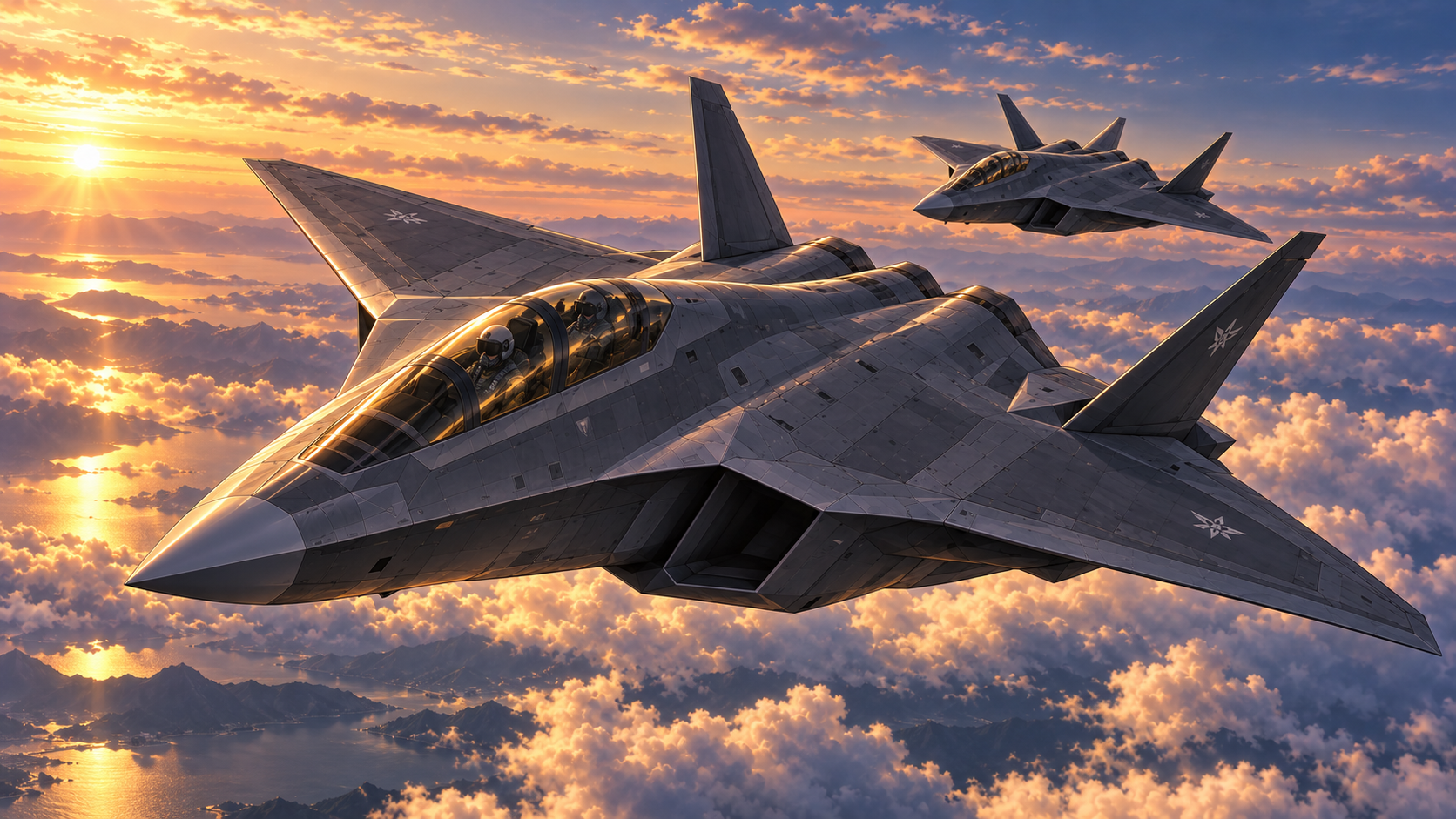
5TH GENERATION AIR DOMINANCE STEALTH FIGHTER


Image
“Dominance Over All, From Above”


OVERVIEW

Nation: Aeyariss
Manufacturer / Design Authority: Wyvern Aerospace Engineering
Program: Type-69 Wyvern
Role: Heavy air-dominance, multirole and networked battle-management fighter

1. AIRCRAFT OVERVIEW

The Type-69D Wyvern is a large twin-engine, tandem-seat, low-observable air-dominance fighter designed around long range, high energy, information superiority, survivability, networked operations and substantial future-growth capacity.

The aircraft is optimized as a high-energy heavy fighter, rather than as an ultralight close-range maneuver platform.

Its design philosophy prioritizes:

SURVIVABILITY → INFORMATION SUPERIORITY → RANGE → ENERGY → NETWORKING → FUTURE GROWTH

The Type-69D combines:

Heavy-fighter range and persistence;
High-altitude and sustained-supersonic performance;
Integrated multispectral sensing;
Electronic-warfare capability;
Two-crew workload distribution;
Extensive onboard electrical and thermal capacity;
Distributed mission computing;
Manned-unmanned teaming;
High maintainability;
Strong lifecycle growth margins.

2. CREW

Crew: 2
Configuration: Tandem

Front Seat
Aircraft Commander / Pilot
Primary responsibility for: aircraft trajectory; formation and maneuver; immediate flight safety; aircraft recovery; tactical command.

Rear Seat
Deputy Pilot / Mission Systems Officer
Primary responsibility for: battlespace interpretation; sensor management; electronic-warfare supervision; networking; cooperative mission management; unmanned-system supervision; battle-management functions.

The rear cockpit retains sufficient flight controls and displays for aircraft recovery and landing.

Image


3. DIMENSIONS

Parameter Specification
Length 19.20 m
Wingspan 13.40 m
Reference wing area ~77 m²
Aspect ratio ~2.34
Mean aerodynamic chord ~6.57 m
Root chord ~9.40 m
Chord at crank ~5.80 m
Tip chord ~1.80 m
Crank semispan ~3.40 m
Inner leading-edge sweep ~48°
Outer leading-edge sweep ~35°
Maximum centerbody/inlet width ~5.1–5.3 m design envelope
Structural body depth ~2.2–2.4 m design envelope

Wing Configuration
Blended low-aspect-ratio cranked delta.

Primary optimization emphasis for:
    High-subsonic performance;
    Transonic acceleration;
    Sustained supersonic flight;
    High-altitude energy retention;
    Structural depth and internal-volume integration.

4. MASS

Parameter Specification
Planning operating empty weight ~19.05 t
Preferred OEW engineering region ~19.0–19.2 t
Engineering OEW band ~18.8–19.5 t
Internal fuel 10.8 t
Representative full-fuel internal launch mass ~31.55 t
Representative maneuver mass ~29.25 t
Maximum takeoff weight 36.0 t
Provisional normal maximum landing mass ~31.5–32.0 t

5. MASS PROPERTIES AND CG
Planning OEW CG
~8.70–8.75 m aft of nose

Normal Operational CG Target
~8.55–8.65 m aft of nose

Mission CG Migration Objective
≤~2% MAC

Stretch objective:
~1% MAC

Fuel distribution and automatic transfer are integrated with the aircraft's mass-state and flight-control architecture to limit excessive CG migration.
Exact CG, inertia tensor and allowable aerodynamic CG boundaries remain configuration/model dependent.

6. PROPULSION
Engines: 2 × advanced low-bypass afterburning turbofans

Nominal Engine Class
Parameter Per Engine Total
Maximum augmented thrust ~165 kN ~330 kN
Dry-thrust design class ~115–120 kN ~230–240 kN

Propulsion Features
    Full Authority Digital Engine Control;
    integrated starter-generators;
    high electrical-extraction capability;
    high thermal tolerance;
    conventional thrust axis;
    no baseline thrust-vectoring system;
    integrated aircraft/engine health monitoring.

Aircraft performance is based on installed propulsion performance, accounting for inlet, nozzle, cooling, electrical and installation effects rather than uninstalled engine thrust alone.

7. AIR INTAKE SYSTEM

Configuration: twin shoulder-mounted external-compression inlets

Features include:
    mostly fixed external geometry;
    serpentine internal ducting;
    compressor-face obscuration;
    controlled boundary-layer management;
    internal bypass/bleed capability where required;
    integrated inlet/engine control.

Exact capture area remains installation-model dependent.

8. PERFORMANCE

Maximum speed ~Mach 2.0
Nominal supercruise ~Mach 1.4
Upper supercruise capability ~Mach 1.5 class

Service ceiling >18,000 m
Long-range air-dominance combat radius ~1,350–1,500 km target, profile dependent
Aerial refueling Yes

Performance Doctrine
Mach ~1.4

Primary sustained-supercruise design condition.
Mach ~1.5

Upper-envelope, lower-confidence supercruise condition.
Mach ~2.0

High-altitude dash / maximum-speed condition rather than routine cruise. Actual radius varies with altitude, speed, fuel reserves, maneuver allowance and mission profile.

9. MANEUVER ENVELOPE

The Type-69 uses mass-scheduled maneuver limits rather than permitting maximum g at every weight.
Aircraft Mass Development Limit
≤~29.25 t +9.0 g class
~31.55 t ~+8.3 g
36.0 t ~+7.25 g

These conditions form an approximately 2.6 MN-class gross maneuver-load family.

The aircraft is characterized as a high-energy heavy fighter with emphasis on: acceleration; climb; high-altitude maneuver energy; supersonic persistence; range; fuel endurance; strong instantaneous maneuver authority.

10. AERODYNAMIC CONTROL
Flight-Control System
Quadruplex digital fly-by-wire

integrated with an: Integrated Vehicle Management System

Functions include:
    automatic trim;
    angle-of-attack protection;
    departure prevention;
    structural-load limiting;
    mass-state-aware control laws;
    fuel-state-aware scheduling;
    configuration-dependent limits;
    active structural-load management;
    degraded/damaged control modes;
    graceful redundancy degradation.
    Aerodynamic Devices
    multifunction trailing-edge controls;
    leading-edge movable surfaces;
    automated camber scheduling;
    load-alleviation functions.

The aircraft retains a relaxed, near-neutral stability philosophy without deliberately requiring extreme inherent instability.

11. STRUCTURAL ARCHITECTURE

Primary construction uses a hybrid mix of:

    Advanced composites;
    Titanium;
    High-strength metallic structures;
    Specialized high-temperature materials where required.

      Major Load-Path Architecture
      deep multi-cell wing center box;
      central structural keel;
      upper structural bridge;
      structural internal sidewalls;
      lower longerons;
      closed outer-wing torque boxes;
      direct main-landing-gear attachment into primary structure.

Structural/LO Planning Mass
~6.8 t
Review band:
~7.0–7.2 t

Lifecycle Philosophy
    damage-tolerant;
    fatigue-aware;
    mission-spectrum usage tracking;
    individual aircraft structural-health monitoring.

12. DESIGN LIFE
~8,000 flight hours

Actual lifecycle management considers:
    flight hours;
    cycles;
    maneuver-load spectrum;
    dynamic pressure;
    landing severity;
    thermal exposure;
    structural-health data.


13. INTERNAL FUEL SYSTEM

Internal fuel mass: 10.8 t
Usable liquid volume: approximately 13.5 m³

Fuel Architecture
Fuel is distributed principally through:
wing/root cells;
centerbody cells;
trim/balance cells.

The system incorporates:
automatic transfer;
CG management;
fuel-temperature monitoring;
thermal-management integration;
fault-isolated pumping and transfer logic.
Gross Tank Envelope

14. ELECTRICAL SYSTEM
Main Generation

~500 kW-class continuous
Nominal arrangement:
2 × ~250 kW engine-driven starter-generators

Normal Aircraft Demand
~365–390 kW class

Short-Term System Capability
~600 kW class

through appropriate overload, storage and load scheduling.

One-Generator-Out Essential Load
≤~180–220 kW target

Electrical Architecture
separate vehicle-critical and mission domains;
protected essential buses;
fault isolation;
load shedding;
emergency-power capability;
physical routing separation where practical.

15. THERMAL MANAGEMENT
Continuous Thermal Architecture
~420–450 kW class

Transient Thermal Architecture
~550–650 kW class

Cooling System

Multi-temperature liquid cooling incorporating:
cold loop;
medium-temperature loop;
high-temperature loop;
liquid heat exchangers;
ram-air heat rejection;
transient use of fuel as a heat sink.

Fuel is not the sole heat-rejection mechanism.

Critical design condition:
low fuel + hot ambient + high systems demAnd + high thrust
Electrical load shedding and thermal load shedding are coordinated.

16. AVIONICS AND MISSION SYSTEMS
Architecture incudes:

    multifunction AESA-class radar;
    distributed infrared sensing;
    electro-optical sensing;
    integrated electronic-support systems;
    communications/navigation/identification;
    high-capacity tactical data links;
    distributed mission computing;
    cockpit/HMI electronics;
    integrated health monitoring.

Mission computing is distributed and partitioned rather than dependent upon one unrestricted central processor.

17. SENSOR FUSION

The Type-69D uses an object-centric fused battlespace model.
Information from onboard and external sources is correlated into fused tracks containing, where available:

position;
velocity;
track history;
classification;
confidence;
contributing sources;
network information.

Crew may inspect underlying source data when required.

The architecture supports operation in: COOPERATIVE, DEGRADED and AUTONOMOUS network states.

18. ELECTRONIC WARFARE
Integrated EW/ESM architecture supports high-level functions including:
    threat warning;
    passive emitter detection;
    emitter classification;
    geolocation support;
    countermeasure management;
    fusion with the common tactical picture.

Exact classified sensitivities, techniques and threat-library parameters are not canonically specified.

19. NETWORKED OPERATIONS

The Type-69 is designed as a distributed combat-network node, capable of exchanging tactical information with compatible:
    fighter aircraft;
    airborne early-warning platforms;
    unmanned aircraft;
    surface combatants;
    ground-based command-and-control systems;
    allied networks.

The aircraft remains operational when external networking is degraded or unavailable.

20. MANNED–UNMANNED TEAMING

The rear-seat Mission Systems Officer may supervise cooperative unmanned systems through intent-based tasking.
A demanding representative workload involves approximately: four cooperative unmanned teammates. The crew supervises mission intent rather than manually piloting individual unmanned aircraft.

21. INTERNAL MISSION CARRIAGE

The Type-69D incorporates protected internal mission-volume architecture with:

  • 6 primary internal stationS
  • four central primary stations;
  • two rapid-access side stations.


1x 30mm Autocannon

22. LANDING GEAR

Tricycle retractable landing gear

Parameter Specification
Nose-gear station ~x = 4.0 m
Main-gear station ~x = 9.6 m
Main-gear track ~4.5–4.8 m

Main gear retracts primarily into wing-root/shoulder volume.
Primary gear loads transfer directly into the wing-center-box/frame structure.

Landing-Mass Doctrine
Normal maximum landing mass: ~31.5–32 t provisional nsspecification
36 t: overweight/emergency landing condition requiring appropriate post-event inspection.

23. MAINTAINABILITY

Maintainability is a primary design requirement.

Features include:

modular avionics;
line-replaceable units;
built-in diagnostics;
centralized aircraft-health monitoring;
condition-based maintenance;
accessible service panels;
isolated cooling branches;
defined equipment-removal envelopes;
aft-dominant engine removal architecture;
structural-usage tracking;
brake and thermal-event tracking.

No routinely replaced mission-system module should require removal of an engine, primary structural element or unrelated avionics assembly.

24. DEGRADED-MODE PHILOSOPHY

The aircraft is designed for graceful degradation following selected failures such as:
    one engine unavailable;
    one generator unavailable;
    partial sensor loss;
    tactical-network loss;
    cooling-system degradation;
    individual mission-computer/module failures;
    selected flight-control-channel faults.

Vehicle-critical functions remain isolated from higher-level mission-system failures.
Last edited by Aeyariss on Fri Sep 11, 2026 6:18 am, edited 25 times in total.
The MOST SERENE EMPIRE of AEYARISS
The Wyvern Empire
International Alliance: (Primary) United Defense Accords|| Other: CSL | SACTO | Imperion|| Region: Kali Yuga|| Misc Link: Database|| UDA Joint War College ||Wyvern Military Industries|| Lore: SoTW

User avatar
Aeyariss
Powerbroker
 
Posts: 7547
Founded: Mar 26, 2010
Civil Rights Lovefest

Type-39 Phoenix MRCA

Postby Aeyariss » Sun Feb 04, 2024 8:01 pm


TYPE-39 PHOENIX
4.5th Generation Multirole Fighter / Strike Aircraft


Image


TYPE-39 PHOENIX
Manufacturer: Lunamaria Aerospace Industries
Primary Operators: Imperial Aeyariss Air Force, Imperial Aeyariss Navy, Peacemaker International Groups
First Flight: 2007
Entered Service: 2009
Variants: Type-39A Phoenix, Type-39M Sea Phoenix

OVERVIEW

The Type-39 Phoenix is a single-seat, single-engine advanced multirole combat aircraft developed by Lunamaria Aerospace Industries to provide a flexible, affordable and highly capable complement to heavier air-dominance platforms. Designed around the principles of range, energy, awareness and payload, the Phoenix combines long internal endurance, high supersonic performance, modern sensor fusion, integrated electronic warfare and substantial external weapons capacity within a compact medium-heavy fighter airframe.

The aircraft is classified as an advanced 4.5th-generation reduced-observable combat aircraft. Rather than relying upon full very-low-observable shaping and internal weapons bays, the Phoenix employs selective signature reduction, radar-absorbent treatments, shielded engine geometry and low-signature sensor integration while retaining extensive external carriage. This approach allows the aircraft to maintain a significantly lower acquisition and operating burden than larger fifth-generation platforms while still providing credible performance in heavily networked modern air operations.

The Type-39 is intended to serve as the primary high-volume multirole fighter of Aeyariss tactical aviation, undertaking missions ranging from air defence and fighter escort to maritime strike, precision interdiction and suppression of enemy air defences.

AIRFRAME

Image


The Phoenix is built around a blended trapezoidal wing-body arrangement intended to balance high-speed performance with useful low-speed handling and internal volume. The airframe incorporates a moderately swept main wing, pronounced leading-edge root extensions, large trailing-edge flaperons, full-span leading-edge high-lift devices and twin outward-canted vertical stabilizers. Relaxed static stability is managed through a quadruplex digital fly-by-wire control system. The resulting aircraft is optimized for high-energy maneuvering, emphasizing acceleration, vertical maneuverability, transonic performance and energy retention rather than extreme post-stall behavior.

General Characteristics

Crew: 1
Length: 15.80 m
Wingspan: 11.00 m
Height: 4.40 m
Wing Area: 45.60 m²
Aspect Ratio: approximately 2.65
Empty Weight: 12,800 kg
Basic Operating Weight: approximately 13,200 kg
Typical Air-Superiority Combat Weight: approximately 22,500 kg
Typical Strike Takeoff Weight: approximately 24,000–25,500 kg
Maximum Takeoff Weight: 29,800 kg
Internal Fuel: 8,300 kg
Maximum External Stores: approximately 8,000 kg


PROPULSION

The Type-39A is powered by a single XF-390 low-bypass afterburning turbofan. The engine was designed specifically to provide sufficient thrust for a relatively heavy single-engine aircraft while simultaneously supporting the substantial electrical and thermal demands imposed by its radar, electronic warfare and mission systems.

XF-390 Performance
Dry Thrust: approximately 135 kN
Maximum Afterburning Thrust: approximately 200 kN

At a representative air-combat weight of approximately 22,500 kg, the Phoenix achieves a maximum thrust-to-weight ratio of approximately 0.91. At lighter fuel states, the aircraft may approach or exceed unity thrust-to-weight under maximum afterburner. Two lateral air intakes feed the single central engine. Curved internal ducting obscures direct line-of-sight to the engine compressor face and contributes to reduced frontal radar signature.

PERFORMANCE

The Phoenix combines high fuel fraction with strong engine performance, giving it substantial operational reach for a fighter of its size.

Maximum Speed: approximately Mach 2.0 at altitude
Maximum Clean Supercruise: approximately Mach 1.25–1.30
Light Combat Supercruise: approximately Mach 1.1–1.2
Service Ceiling: approximately 15,500 m / 50,850 ft
Ferry Range: approximately 3,000 km on internal fuel
Air-Superiority Combat Radius: approximately 1,100–1,250 km
Typical Planning Combat Radius: approximately 1,200 km
Hi-Hi-Hi Strike Radius: approximately 1,050–1,150 km
Hi-Lo-Hi Strike Radius: approximately 850–950 km
Maritime Strike Radius: approximately 950–1,100 km
Sustained Supersonic Mission Radius: approximately 600–700 km


Performance varies with fuel state, external load, altitude, mission profile and required recovery reserves.

FLIGHT CONTROL AND MANEUVERABILITY
The Phoenix employs a quadruplex digital fly-by-wire flight-control system.

The system provides:
automatic trim
flight-envelope protection
angle-of-attack management
departure resistance
automatic maneuvering-flap control
stores-dependent g limiting
structural load management
automatic recovery assistance


In clean or air-to-air configuration, the aircraft is rated for approximately:+9 g / -3 g

Strike configurations are automatically restricted to lower maneuver limits depending upon weapon mass and station loading.

The aircraft's relatively high wing loading places it firmly in the medium-heavy fighter category, but powerful flight controls, LERX-generated vortex lift and high available thrust preserve strong combat maneuverability.

RADAR AND SENSOR SYSTEMS

The Type-39 carries a multifunction active electronically scanned array radar as its primary active sensor.

The AESA integrates multiple functions within a single system, including:

    Air-to-Air
    long-range search
    track-while-scan
    multiple-target tracking
    missile fire control
    target identification support
    Air-to-Ground
    synthetic-aperture radar mapping
    terrain mapping
    moving-target detection
    precision targeting
    Maritime
    sea-surface search
    surface-target tracking
    maritime targeting support
    Electronic Functions
    low-probability-of-intercept operating modes
    electronic-support functions
    limited electronic attack

The Phoenix therefore does not require separate dedicated air-search and fire-control radar systems.

PASSIVE SENSORS
The Phoenix incorporates an integrated IRST / electro-optical sensor system capable of detecting and tracking airborne targets without requiring radar transmission.

Distributed passive RF and electronic-support receivers provide additional detection of hostile emitters.

The passive sensor architecture supports:
    radar-emission detection
    emitter classification
    bearing determination
    cooperative emitter geolocation
    passive target cueing
    silent interception

Multiple Phoenix aircraft can combine electronic-support measurements through datalink, allowing improved location of hostile emitters without activating their own radars.

SENSOR FUSION
The aircraft's integrated mission computer combines onboard and offboard information into a single tactical picture.

Potential inputs include:
    AESA radar
    IRST
    passive RF/ESM
    missile-warning sensors
    laser-warning sensors
    airborne early-warning aircraft
    surface vessels
    ground radar
    unmanned aircraft
    other fighters
    satellite-derived data

Rather than forcing the pilot to manually compare multiple independent sensor displays, the mission computer attempts to correlate these sources into common tactical tracks.
This significantly reduces workload and enables the Phoenix to operate as part of a wider networked combat system.

ELECTRONIC WARFARE
The Phoenix uses an integrated Defensive Aids and Electronic Warfare Suite.

Systems include:
    digital radar-warning receiver
    electronic-support measures
    active RF jamming
    digital countermeasure generation
    missile-approach warning
    laser-warning receivers
    chaff dispensers
    flare dispensers
    expendable active decoys
    fiber-optic towed RF decoy

The defensive system automatically prioritizes detected threats and can coordinate multiple countermeasure types according to the tactical situation.

COCKPIT

The Type-39A is operated by a single pilot.
The digital cockpit is centered on a wide-area multifunction display and helmet-mounted cueing system.

Features include:
    wide-area tactical display
    digital moving map
    integrated threat display
    hands-on-throttle-and-stick controls
    helmet-mounted sight
    high-off-boresight missile cueing
    digital engine instrumentation
    voice-warning systems
    secure communications
    integrated navigation

Sensor fusion and automation are used extensively to keep workload within manageable limits during complex combat missions.

ARMAMENT
The Type-39A is fitted with one internally mounted 30 mm autocannon.

Ammunition: approximately 150–180 rounds
The gun provides capability against both aerial and lightly protected surface targets.

EXTERNAL WEAPON STATIONS

The aircraft possesses 10 external weapon stations.
Station Layout
2 × wingtip stations

Primarily intended for short-range air-to-air missiles.
2 × outboard wing stations

Suitable for air-to-air missiles and lightweight precision weapons.
2 × mid-wing stations

Suitable for air-to-air missiles, guided weapons and fuel tanks.
2 × heavy inboard wing stations

Primary stations for large strike weapons, stand-off missiles, anti-ship missiles and external fuel tanks.
2 × semi-recessed fuselage stations

Primarily intended for medium- and long-range air-to-air missiles.

Maximum combined operational external stores capacity is approximately: 8,000 kg

REPRESENTATIVE AIR-SUPERIORITY LOAD

A standard air-superiority configuration may carry:
2 × short-range air-to-air missiles
6 × medium/long-range air-to-air missiles
internal 30 mm cannon
internal fuel

This configuration provides a balance between weapon quantity, range and aerodynamic performance.

PRECISION STRIKE
A representative strike configuration may include:
2 × short-range air-to-air missiles
2 × medium-range air-to-air missiles
up to 4 × guided strike weapons
internal cannon

The aircraft can carry precision-guided bombs, air-to-surface missiles and stand-off weapons depending upon operator integration.

MARITIME STRIKE
The Phoenix is particularly well suited to maritime operations.

Representative load:
2 × short-range AAM
2 × medium-range AAM
2–4 × anti-ship missiles

Targeting information may originate from the Phoenix's own radar or from naval vessels, maritime patrol aircraft, unmanned aircraft, satellites or other networked platforms.

SUPPRESSION OF ENEMY AIR DEFENCES

For SEAD operations the aircraft can carry:
anti-radiation missiles
stand-off strike weapons
self-defence air-to-air missiles
additional electronic warfare equipment

The aircraft's passive RF suite is able to detect and classify hostile emitters, providing targeting information without requiring continuous active radar operation.

REDUCED OBSERVABILITY
The Phoenix is not a full very-low-observable aircraft. Instead, the airframe uses selective signature-management techniques to reduce detection ranges relative to conventional fourth-generation aircraft.
Features include:
    aligned major aerodynamic edges
    radar-absorbent materials
    compressor-face shielding
    curved intake ducts
    low-profile antennas
    conformal sensor apertures
    low-reflectivity canopy treatment
    reduced panel discontinuities
    low-signature weapon pylons
Because the Phoenix normally carries weapons externally, radar cross section varies substantially according to configuration and viewing aspect.
No universal radar-cross-section value is published.
RCS: Classified / configuration dependent.

NETWORK-CENTRIC OPERATIONS
The Type-39 was designed from the outset to operate as part of a distributed combat network. The aircraft may receive targeting information from platforms located well beyond its own sensor horizon.

Potential network participants include:
    Type-69D Wyvern aircraft
    other Phoenix fighters
    airborne early-warning aircraft
    naval surface combatants
    ground-based air-defence networks
    unmanned combat aircraft
    reconnaissance platforms

This enables one aircraft to detect a target while another conducts the engagement.
Within Aeyariss doctrine, the Phoenix frequently acts as a networked shooter, providing weapons capacity and sortie volume behind more specialized forward sensor platforms.

VARIANTS

TYPE-39A PHOENIX
The Type-39A is the principal land-based version.

Primary Missions
defensive counter-air
combat air patrol
fighter escort
air superiority
interception
precision strike
interdiction
maritime strike
SEAD
reconnaissance

The Type-39A forms the core high-volume tactical combat aircraft of the Imperial Aeyariss Air Force.

TYPE-39M SEA PHOENIX
The Type-39M Sea Phoenix is the carrier-based derivative.

It retains the majority of the Type-39A's avionics, weapons systems and propulsion architecture but incorporates substantial structural modifications.

Principal Naval Modifications
enlarged wing
approximately 51 m² wing area
approximately 11.8 m unfolded wingspan
folding outer wing panels
reinforced landing gear
strengthened fuselage
carrier arrestor hook
CATOBAR launch fittings
enhanced corrosion protection
enlarged high-lift surfaces
carrier-specific flight-control laws
Type-39M Characteristics

Empty Weight: approximately 13,800 kg
Maximum Takeoff Weight: approximately 30,000 kg
Engine: XF-390
Maximum Thrust: approximately 200 kN
Air-Superiority Radius: approximately 1,000–1,150 km
Strike Radius: approximately 900–1,050 km
Carrier Approach Speed: approximately 215–230 km/h
Maximum Airborne Structural Limit: approximately +7.5 g

The Type-39M is optimized for:
fleet air defence
carrier combat air patrol
maritime strike
escort
precision strike
SEAD
OPERATIONAL ROLE

The Type-39 Phoenix is not intended to replace the heavier Type-69D Wyvern. Instead, the two platforms occupy complementary positions within Aeyariss air doctrine. The Type-69D Wyvern serves as the high-end fifth-generation air-dominance and penetrating sensor platform. The Type-39 Phoenix supplies greater numbers, weapons capacity, mission flexibility and sortie generation.

In cooperative engagements, a Wyvern may penetrate forward and generate high-quality target tracks while Phoenix aircraft remain farther from the threat and launch weapons based upon shared targeting information. This division allows Aeyariss forces to preserve scarce high-end platforms while exploiting the Phoenix's greater numerical and economic efficiency.

The Phoenix is built around the idea that a modern multirole fighter does not need to dominate every individual performance category to dominate operational tempo. It must travel far enough to matter, arrive with sufficient energy to fight, understand the tactical environment before committing, carry enough weapons to influence the engagement and return quickly enough to do it again.The Type-39 Phoenix was designed to do exactly that.

Image
Last edited by Aeyariss on Tue Sep 08, 2026 1:47 am, edited 8 times in total.
The MOST SERENE EMPIRE of AEYARISS
The Wyvern Empire
International Alliance: (Primary) United Defense Accords|| Other: CSL | SACTO | Imperion|| Region: Kali Yuga|| Misc Link: Database|| UDA Joint War College ||Wyvern Military Industries|| Lore: SoTW

User avatar
Aeyariss
Powerbroker
 
Posts: 7547
Founded: Mar 26, 2010
Civil Rights Lovefest

Type-19 FALCON

Postby Aeyariss » Sun Feb 04, 2024 8:39 pm


TYPE-19 FALCON
4th Generation Multirole Combat Aircraft


Image


Unit Price: 27,000,000 NSD

The TYPE-19 FALCON is Wyvern Aerospace Engineering’s lightweight-to-medium fourth-generation multirole fighter, designed around a deliberately practical proposition: deliver useful combat radius, high endurance, Mach 2-class performance and substantial air-to-air firepower in an aircraft affordable enough to field in numbers. Rather than pursue stealth shaping, twin-engine redundancy or oversized mission systems, the Falcon concentrates cost and weight where they matter operationally: fuel, acceleration, missile carriage, sortie generation, maintainability and upgrade margin.

The result is a compact single-engine fighter suited to air defence, combat air patrol, interception, escort, tactical strike, maritime attack and reconnaissance.

AIRFRAME

The Falcon uses a close-coupled canard-delta configuration combining a cropped-delta main wing with fully moving foreplanes and a single vertical stabilizer.

The layout provides a broad lifting surface, substantial internal fuel volume and strong pitch authority while retaining a compact overall footprint. A relaxed-stability airframe is controlled through a quadruplex digital fly-by-wire system with automatic trim, g-command, angle-of-attack limiting, departure protection, stores compensation and automatic scheduling of the canards and leading-edge surfaces.

Length: 15.6 m
Wingspan: 9.9 m
Height: 4.55 m
Wing Area: 42.5 m²
Aspect Ratio: ~2.31
Wing Sweep: ~42°
Canard Area: ~5.6 m²
Crew: 1

The aircraft is rated to a design manoeuvre envelope of +9 g / −3 g.

Primary construction uses high-strength aluminium alloys, selective titanium in high-load and high-temperature areas, and composites where they offer worthwhile reductions in weight or maintenance burden. The baseline structural-life objective is 8,000 flight hours.

WEIGHTS & FUEL

Empty Weight: ~8,900 kg
Internal Fuel: ~4,400 kg
Typical Air-to-Air Combat Weight: ~13,500–14,000 kg
Maximum Takeoff Weight: 19,000 kg
Maximum External Stores: ~5,500 kg

The Falcon's unusually generous internal-fuel allocation is central to the design. Fuel is distributed through the center fuselage, wing roots, wet-wing volume and dedicated feed tanks, with automatic fuel management used to control center-of-gravity movement throughout the mission.

External wing and centerline tanks can be carried for extended-range operations.

Probe-and-drogue aerial refuelling is standard.

PROPULSION

Power is supplied by a single WAE TF-190 low-bypass afterburning turbofan.

Maximum Dry Thrust: ~70 kN
Maximum Afterburning Thrust: ~112 kN

Twin lateral intakes feed the centerline engine through inward-curving ducts. The fixed-geometry intake arrangement avoids the weight and maintenance burden associated with complex variable ramps while supporting the Falcon's intended Mach 2-class envelope.

The TF-190 emphasizes transonic acceleration, cruise efficiency, modular maintenance and service life rather than exceptional peak thrust.

At a representative 13.8-tonne combat weight, afterburning thrust-to-weight is approximately 0.83, increasing toward unity as fuel and stores are consumed.

PERFORMANCE

Maximum Speed: Mach 2.05+
Operational Supersonic Dash: approximately Mach 1.6–1.8
Service Ceiling: approximately 17,000–18,000 m
Maximum Load Factor: +9 g / −3 g

Air-to-Air Combat Radius, Internal Fuel: ~900–1,000 km
Long-Range Air-to-Air Combat Radius: ~1,150–1,300 km
Strike Combat Radius: ~850–1,050 km
Ferry Range: ~3,500–4,000 km
Extended Patrol Endurance: ~2.7–3.2 hours with external fuel

The Falcon is optimized less around spectacular post-stall manoeuvres than around energy retention, rapid roll response, sustained turning and useful transonic acceleration.

ARMAMENT

The Type-19 carries an internal:

1 × 30 mm aircraft cannon
Ammunition: 135 rounds

External armament is distributed across nine hardpoints:

2 × wingtip stations
2 × outer-wing stations
2 × mid-wing stations
2 × inner-wing stations
1 × centerline station


The aircraft is structurally biased toward missile carriage rather than maximum bomb tonnage.

A standard air-superiority configuration can carry six air-to-air missiles, while a dedicated interception configuration supports up to eight AAMs, subject to launcher and missile compatibility.

Compatible stores may include: short-range AAMs • BVR AAMs • precision-guided bombs • general-purpose ordnance • stand-off weapons • anti-surface weapons • anti-ship missiles • targeting pods • reconnaissance pods • ECM pods • external fuel tanks

The inner wing stations are reinforced for heavier stores and fuel tanks, while the wingtip and outer stations are optimized for lighter air-to-air weapons.

RADAR & MISSION SYSTEMS

The baseline Type-19A is equipped with a multimode pulse-Doppler fire-control radar providing:

    look-up / look-down capability
    track-while-scan
    air-combat acquisition modes
    target ranging
    ground mapping
    maritime search
    basic moving-target functions

The aircraft's nose volume, electrical generation and thermal-management system incorporate growth margin for later AESA radar installation.

Standard avionics include: digital mission computer • INS/GNSS navigation • wide-angle HUD • multifunction displays • HOTAS • tactical datalink • digital stores-management system • onboard fault diagnostics

Later variants may incorporate helmet-mounted cueing, improved sensor fusion, AESA radar, expanded datalinks and enhanced targeting systems without requiring a new airframe.

ELECTRONIC WARFARE

Baseline defensive systems include:

    radar warning receiver
    chaff dispensers
    flare dispensers
    jammer interface
    programmable threat-library management
    centralized defensive-system controller

Growth provisions support later installation of digital receivers, missile-approach warning, internal electronic countermeasures and more tightly integrated defensive aids.

Approximately 20–25 percent electrical and cooling growth margin is retained for future mission-system upgrades.

COCKPIT

The Falcon uses a raised single-seat cockpit with a large bubble canopy designed for strong forward, lateral and over-the-shoulder visibility.
Pilot workload is reduced through: HOTAS controls • digital flight controls • multifunction displays • wide-angle HUD • automated navigation and stores management • integrated warning systems
The philosophy is simple: give the pilot information that is immediately useful without turning the cockpit into an exercise in complexity.

SURVIVABILITY

The Type-19 is not a stealth aircraft.

Survivability instead rests on: speed • manoeuvrability • electronic warfare • situational awareness • compact size • tactical flexibility • redundancy • damage tolerance
Limited signature-management measures are applied where they do not undermine cost or maintainability, including cleaner antenna integration, controlled panel joints and careful intake and surface treatment.
There are no internal weapons bays or maintenance-intensive low-observable coatings in the baseline design.

LANDING GEAR & DISPERSED OPERATIONS

The Falcon is equipped with robust tricycle landing gear optimized for repeated tactical use.
Approximate main-gear track is 4.0 m, with a wheelbase of roughly 5.1 m.

The design emphasizes operation from dispersed bases, highway strips and less-than-perfect airfields, supported by: anti-skid braking • nosewheel steering • rugged gear structure • accessible wheel and brake assemblies • emergency arresting provision

MAINTENANCE
Maintainability is treated as a combat capability.

The Falcon incorporates:

    modular avionics
    line-replaceable units
    large service panels
    centralized servicing points
    onboard diagnostics
    accessible engine installation
    standardized fasteners
    simplified ground-support requirements
    accessible cannon and ammunition bay
    replaceable flight-control actuators

The single-engine architecture also reduces the number of major propulsion components requiring inspection, overhaul and spares support.

The design objective is high aircraft availability and rapid turnaround rather than minimum theoretical maintenance man-hours on paper.

VARIANTS

TYPE-19A FALCON
Baseline single-seat multirole fighter.

TYPE-19B FALCON
Two-seat combat-capable operational conversion trainer.

TYPE-19C FALCON
Improved radar, digital avionics and weapons integration.

TYPE-19D FALCON
Major modernization incorporating AESA-compatible mission systems, improved EW, updated cockpit architecture and advanced datalinks.

TYPE-19E FALCON
Strike and maritime-attack specialization.

TYPE-19R FALCON
Tactical reconnaissance and sensor-platform derivative.

TECHNICAL DATA
Specification TYPE-19 FALCON
Generation 4th
Crew 1
Length 15.6 m
Wingspan 9.9 m
Height 4.55 m
Wing Area 42.5 m²
Empty Weight 8,900 kg
Internal Fuel 4,400 kg
MTOW 19,000 kg
Engine 1 × WAE TF-190
Dry Thrust ~70 kN
Afterburning Thrust ~112 kN
Maximum Speed Mach 2.05+
Service Ceiling ~17–18 km
Internal-Fuel A2A Radius ~900–1,000 km
Long-Range A2A Radius ~1,150–1,300 km
Ferry Range ~3,500–4,000 km
Load Limit +9 / −3 g
Hardpoints 9
Maximum Planned AAM Load 8
External Stores ~5,500 kg
Cannon 1 × 30 mm
Cannon Ammunition 135 rounds
Refuelling Probe-and-drogue
Structural Life Target 8,000 hr

Unit Price 27,000,000 NSD

TYPE-19 FALCON

The Falcon is not built around the assumption that every mission requires the most expensive fighter available.
It is built around the assumption that range, readiness and numbers still matter.
At 27 million NSD, the Type-19 provides operators with a fast, long-ranged and heavily armed tactical fighter designed to spend less time consuming resources on the ground and more time protecting the airspace above it.

Image
Last edited by Aeyariss on Tue Sep 08, 2026 1:46 am, edited 7 times in total.
The MOST SERENE EMPIRE of AEYARISS
The Wyvern Empire
International Alliance: (Primary) United Defense Accords|| Other: CSL | SACTO | Imperion|| Region: Kali Yuga|| Misc Link: Database|| UDA Joint War College ||Wyvern Military Industries|| Lore: SoTW

User avatar
Aeyariss
Powerbroker
 
Posts: 7547
Founded: Mar 26, 2010
Civil Rights Lovefest

WINDSTRIKE LONG RANGE LOITERING MUNITION

Postby Aeyariss » Tue Mar 12, 2024 10:55 pm


WS-1A WINDSTRIKE
LONG RANGE LOITERING STRIKE SYSTEM


Image


LONG REACH • LOW COST • MASS • PERSISTENCE • MODULARITY


The WS-1A WINDSTRIKE is Aeyariss’ full-rate-production long-range loitering strike platform, developed to deliver persistent precision-strike capacity at a cost and production scale normally associated with much smaller unmanned systems.

Designed around endurance rather than extreme speed, WINDSTRIKE combines a fuel-efficient heavy-fuel piston engine, folding endurance wing, autonomous flight-management system and integrated long-range communications architecture into a compact, containerized platform suitable for dispersed deployment.

Rather than concentrating capability into a small number of expensive weapons, WINDSTRIKE is designed around a different philosophy:

Generate the greatest possible amount of persistent long-range strike capacity for the available industrial and financial investment.

GENERAL INFORMATION

Designation: WS-1A WINDSTRIKE
Type: Long-range loitering-strike / one-way-attack UAV hybrid
Manufacturer: Aeyariss Defence Industries
Production Status: Full-rate production
Unit Price: Approx. 50,000 NSD at mature production volume
Crew: Uncrewed

DIMENSIONS & PERFORMANCE
Specification WS-1A WINDSTRIKE
Launch Mass ~300 kg
Length ~3.6 m
Deployed Wingspan 4.2 m
Wing Area ~2.0 m²
Mission Payload Allowance ~45 kg
Fuel Allocation ~82 kg class
Propulsion Heavy-fuel piston engine
Propeller Rear-mounted pusher
Nominal Cruise Speed ~190 km/h
Maximum Qualified Speed ~250 km/h class
Maximum Operating Ceiling 5,000 m
Endurance 14–18 hours
Maximum Mission Reach Up to 2,500 km

Maximum Mission Reach represents an optimized one-way mission profile. Available endurance and loiter time vary with transit distance, payload, weather, routing, altitude and communications requirements.

AVIONICS & MISSION SYSTEMS

WINDSTRIKE employs a modular digital avionics architecture centered on the WINDCORE Mission Computer.

Standard functions include:
    autonomous flight management;
    multi-source navigation;
    route and fuel management;
    aircraft-health monitoring;
    EO/IR sensor management;
    encrypted tactical communications;
    mission updates and retasking;
    predefined degraded-network and lost-link behavior.
The standard observation package consists of a stabilized EO/IR multispectral sensor turret providing daytime and infrared observation capability.

PROJECT SENTINEL INTEGRATION
WS-1A is designed from the outset to operate inside the wider UDA Project SENTINEL architecture.

The standard aircraft carries a low-bandwidth SENTINEL-compatible beyond-line-of-sight interface supporting:

    aircraft telemetry;
    status and health information;
    supervisory command;
    authorized mission updates;
    network synchronization.

When available, WINDSTRIKE may interact through: SENTINEL LINK → SENTINEL EDGE → SENTINEL NEXUS allowing the vehicle to participate in a wider UDA intelligence and command environment.

Basic aircraft control remains onboard. Loss of strategic-network connectivity does not automatically result in loss of vehicle control.

Customers requiring substantially greater network bandwidth may select the dedicated WS-1B WINDSTRIKE-N derivative.

AIRFRAME

WINDSTRIKE uses a slender modular fuselage combined with a moderate-to-high aspect-ratio folding endurance wing.

The configuration emphasizes:

    aerodynamic efficiency;
    compact storage;
    containerized deployment;
    straightforward manufacture;
    low structural cost;
    high-volume production.

The forward fuselage houses the observation and mission-equipment section.

Fuel and principal avionics are concentrated close to the aircraft's center of gravity, while the propulsion unit and pusher propeller occupy the rear fuselage.

CONTAINERIZED OPERATIONS

The aircraft is compatible with the WLC-1 Universal Launch Canister, providing a common container for: factory transport → storage → deployment → launch preparation

The containerized architecture reduces handling requirements and permits WINDSTRIKE units to be dispersed across a broad operating area without specialized aviation infrastructure.

The standard heavy launcher concept is the: WLX-8 WINDSTRIKE LAUNCHER

A vehicle-mounted eight-cell launcher supporting rapid deployment of multiple containerized WINDSTRIKE systems.

MISSION PROFILE

WINDSTRIKE is optimized for operations where persistence, reach and mass matter more than high speed.

Potential roles include:

    long-range strike;
    persistent armed reconnaissance;
    network-enabled observation;
    maritime support;
    distributed unmanned operations.

The aircraft is designed to spend the majority of long-range missions under autonomous flight management while remaining available for authorized supervisory updates through tactical or SENTINEL networks.

SURVIVABILITY PHILOSOPHY

WINDSTRIKE does not attempt to reproduce the survivability architecture of a high-end stealth aircraft.

Its design instead combines:

    relatively small physical signature;
    dispersed launch capability;
    long stand-off reach;
    inexpensive replacement cost;
    high production volume;
    networked employment;
    modular manufacturing.

The platform is deliberately designed around attritable economics.

Losing an individual aircraft should not represent the loss of an irreplaceable strategic asset.

PRODUCTION

WINDSTRIKE has completed Aeyariss qualification and industrialization programme and is released for full-rate production.

Mature production has demonstrated:

    production yield above 95%;
    modular configuration control;
    distributed supplier architecture;
    serial traceability;
    standardized acceptance testing;
    recurring flyaway cost of approximately 50,000 NSD.

The system is designed around automotive-style production principles rather than traditional high-cost aerospace manufacture.

WINDSTRIKE FAMILY
WS-1A WINDSTRIKE
Standard long-range strike configuration.

WS-1B WINDSTRIKE-N
Enhanced networking and higher-bandwidth SENTINEL integration.

WS-1M SEA WINDSTRIKE
Maritime-oriented derivative.

WS-1R WATCHSTRIKE
Unarmed long-endurance reconnaissance and surveillance derivative.

WS-1E WINDVEIL
Electronic-support and communications-relay derivative.

WS-1X
Experimental development platform.

Image
Last edited by Aeyariss on Mon Sep 21, 2026 5:43 am, edited 4 times in total.
The MOST SERENE EMPIRE of AEYARISS
The Wyvern Empire
International Alliance: (Primary) United Defense Accords|| Other: CSL | SACTO | Imperion|| Region: Kali Yuga|| Misc Link: Database|| UDA Joint War College ||Wyvern Military Industries|| Lore: SoTW

User avatar
Aeyariss
Powerbroker
 
Posts: 7547
Founded: Mar 26, 2010
Civil Rights Lovefest

HORNET LIGHT TACTICAL DRONES

Postby Aeyariss » Fri Mar 15, 2024 8:40 am


HORNET SERIES

LIGHT TACTICAL DRONES


PRICE: from 250 NSD to 1,000
(Drone Unit Only*)

Specifications:

Weight:
Length:
Height:
Operational Range: 40 km
Battery Time: 60 minutes.
Maximum Speed:
Maximum Flight Altitude: 120m

Variants:
  • Small Arms Drone
  • Grenadier Carrier
  • Kamikaze/Ordnance Drone
  • Counter-Drone Interceptor Drone
  • ISR / Target Designator Drone

Feature:
  • Fully or semi autonomous mode
  • Enhanced uplink transmitter to Aeyariss 5G satellite constellations network for extended BLOS operations.
  • Networked Swarming Capability (Networked Battlefield SmartAim Fire Control System required)
  • HD Resolution Camera
  • Thermal and night vision sensors optional

Weapons Package:
- Anti-Tank Grenades
- Anti-Personnel Grenades

{wip}
Last edited by Aeyariss on Sat Mar 16, 2024 10:23 am, edited 2 times in total.
The MOST SERENE EMPIRE of AEYARISS
The Wyvern Empire
International Alliance: (Primary) United Defense Accords|| Other: CSL | SACTO | Imperion|| Region: Kali Yuga|| Misc Link: Database|| UDA Joint War College ||Wyvern Military Industries|| Lore: SoTW

User avatar
Aeyariss
Powerbroker
 
Posts: 7547
Founded: Mar 26, 2010
Civil Rights Lovefest

Postby Aeyariss » Fri Mar 15, 2024 9:21 am


TYPE-103 GRIFFIN
MEDIUM ALTITUDE LONG ENDURANCE DRONE


{WIP}
The MOST SERENE EMPIRE of AEYARISS
The Wyvern Empire
International Alliance: (Primary) United Defense Accords|| Other: CSL | SACTO | Imperion|| Region: Kali Yuga|| Misc Link: Database|| UDA Joint War College ||Wyvern Military Industries|| Lore: SoTW

Next

Advertisement

Remove ads

Return to Global Economics and Trade

Who is online

Users browsing this forum: Somewheretopia

Advertisement

Remove ads