MYTANIJA TRAVEL GUIDE - PART 1INTRODUCTIONWelcome to the 31st edition of the Copa Rushmori in Mytanija. The FSM is honoured to be bringing the region's most prestigious tournament to the country for the very first time and is looking forward to showcasing the country to the rest of the region following an extremely difficult period in Mytanija's history. This tournament was bid for by the FSM (Mytanar Football Federation) under the Regeneration and Reconciliation Programme, a government programme which is aimed at rebuilding a country still recovering from the aftermath of the Mytanar Conflict and creating a culture of reconciliation between the various regions and ethnic groups within Mytanija, which may have found themselves on different sides during the Mytanar Conflict. The Regeneration and Reconciliation Programme hopes to use football's special place within the national psyche as a focal point for the country to unite around and further both key aims of the Programme.
Mytanija is a country made up of 7 different regions, each with their own ethnic group, culture and quirks and this can make the country a somewhat complicated place to visit. This guide is designed in the hope that it may make a travellers trip easier and provide them with useful information so that they can truly make themselves at home within the country throughout the tournament.
HISTORYMytanija has had a somewhat stormy history, with war and revolution characterising the country's experience of the past millennium, more or less. Around 75 years ago Mytanija was ruled by an absolute monarchy, the House of Kombarov, who had united all of Mytanija's regions under one ruler about 100 years prior. People were poor and had to work under what was essentially a feudal system if they didn't live in one of Mytanija's cities. Eventually, people became tired of this situation and political theorists like Juri Tolic and Alex Util began to agitate and organise for a socialist revolution. This eventually occurred with the exceedingly blood Mytanar Revolution. Post-revolution, the country was looking for leaders and the revolutionaries weren't exactly sure where to go and there was a short-lived attempt at constitutional monarchy. This failed quickly and the revolution therefore continued, with many hardliners feeling the country's massive wealth issue and the disparity between rich and poor had to be addressed before the revolution could be considered to be complete. This led to massive purges of and retribution taken against members of the former ruling class.
Juri Tolic and Alex Util came to the forefront of the country's politics as the leaders of the revolution and they were increasingly important post-revolution too. Tolic was a member of the more hard-line faction of the Government and promoted policies such as rapid industrialisation, the theory of socialism in one country, a totalitarian state, collectivisation of agriculture, a cult of personality, along with class-based violence and purges of those considered to be part of the bourgeoisie. Tolic became Premier and whilst some of his policies were popular due to the improved standard of living they helped create, the authoritarian nature of his regime was despised by many across Mytanija. Alex Util was part of the more liberal socialist wing of Government and his debates with Tolic in the House of Representatives are legendary. Tolic lost the support of the House when he encouraged the military to move in to crush dissent in various cities around the country and his Government fell, he was killed shortly after by an unknown assassin and Util swept into power. Util was pragmatic and did what he believes to be the best thing for Mytanija, promoting a policy he called 'openness and restructuring', in which he allowed private actors to become involved in the Mytanar economy and he encouraged the idea of democratic elections for the first time. Util died a hero in his home city Thessia, aged 74.
The first democratic elections in Mytanija were won by Radnika, the big-tent centre-left party that was created in the wake of Util's premiership. Premier Pamic became the first democratic leader of the country and was in power for 15 years (three terms), before retiring from the political scene. Pamic oversaw years of unprecedented growth and opened Mytanija up to investment from foreign countries for the first time. He also was active in foreign policy, defending the rights of ethnic Mytanars in Pobedyvika against Citiz oppression. Pamic is seen as another political hero in Mytanija and is arguably one of the few politicians who opponents found it very difficult to say a bad word about due to the success he had. He combined a quiet and unassuming nature with fierce intelligence and diligence and led the country from a very poor economic position towards the realms of most modern Rushmori countries.
Ten years after Pamic's rule ended there was a real power vacuum at the top of Mytanar politics and a lack of good politicians to fill it. This led to a military coup, headed up by young upstart Natella Kalinina. Kalinina was soon in power and people likened her leadership of the country as a cross between the Kombarov's absolute monarchy and Tolic's socialist rule. She implemented discriminatory policies against those she personally considered undesirable, include concentration camps and enforced labour. This was soon met with violent resistance, particularly in the areas hit hardest by her policies (i.e. Thessia, Visoravna and Rauchnya), she particularly didn't like the people of those regions and she didn't like Catholics, Muslims and Jews either. She felt the Zentrian Orthodox Church was the only legitimate religious group in Mytanija and tried to enforce it upon the people of the country, even in regions where it had never existed before. She was eventually removed following the Mytanar Conflict, one of the worst modern day (civil) wars seen anywhere in the world, but arguably the worst in Rushmore. The Otpor, supported by the Eurans organised resistance against Kalinina's rule and eventually the Eurans landed troops to support the Otpor in a significant land campaign. Kalinina fled to Sargossa and was eventually caught by Otpor agents, notably Elita Ryzaev, and extradited to face charges in Eura. Her treatment of certain ethnic and religious groups, LGBT+ people, left-wing academics and activists, gypsies etc was horrific and her crimes against humanity will never be forgotten. Many in Zentria, Magevskaya and certain parts of Vojovitica (i.e. Miago), and Nasto and Avnalia supported her rule, though, and that is what makes the reconciliation process now so difficult.
GEOGRAPHY & CLIMATEMytanija is located in south-west Rushmore just off the Goose Coast. The country is made up of the mainland and five islands, with the majority of the nation's population living in mainland Mytanija. The largest of the southern islands is called Nasto, with the chain of three smaller islands known as Avnalia. Magevskaya is located just off the north-east coast of the mainland, close to Princess Béatrice Island and Astograthian possession Bakartirla. Close neighbours include Swartaz (the only country Mytanija shares a land border with), and then Goose Coast nations such as Cotdelapoms to the south and Astograth and Civil Citizenry to the south-east.
Much of the mainland is covered by swathes of pine forests, which stretch from the north of the Thessian region, south through Vojovitica and east across north-western Zentria and southwards around Eskobirsk. Many will know this already, with Mytanar timber being well known for its quality.
In the far north, the region of Visoravna is essentially a large coastal plain, with this also being the case for much of northern and north-eastern Zentria, in central Zentria there are two mountainous areas: one just north of Eskobirsk and the second around Pozrozhdeny, the rest of the region is largely made up of grassy plains, including around Esca and the areas towards the southern coast. Rauchnya in the north of the country is Mytanija's smallest region and its two major cities are both coastal, with sharp hills then separating them from lowlands in the southern part of the region.
Thessia, as aforementioned, is covered in pine forest and there is a major mountainous region (including Mytanija's highest peak, Ebena), in the western areas of the region close to the border with Swartaz, the rest of the region is more flat, particularly when you cross the River Etva around the cities of Thessia and Ibon and close to the shores of Ozero Lisica, the largest lake in the country. Vojovitica is also covered with pine forest, but is a little less mountainous and instead of high-altitude peaks has a lot more short and sharp hilly terrain. This is best seen around Prizren, with one of the country's favourite Spring Classic cycle races Cieszin-Prizren utilising the terrain around the latter city to great effect.
Magevskaya has a singular large mountainous region in the middle of the island, with the coastal areas all being low-lying as you would expect, including around Stratenberg and Vostochnaya Tochna. Nasto has a band of mountainous terrain through the centre of the island, with a couple of significant peaks, this mountain chain almost surrounds the city of Dyka in the middle of Nasto. Apart from this the terrain on Nasto, especially around the coastal areas is excellent arable land and very flat. Avnalia is all low-lying, arable land and this has led to the three islands becoming known as the breadbasket and greengrocer of Mytanija, with much of the nation's agricultural produce coming from the three islands.
The weather across Mytanija can vary quite a bit but for the most part the country has a largely temperate climate, characterised by warm summers and rainy, cold-to-mild winters. This is quite a general description and different cities around Mytanija can experience quite different weather patterns over the course of the year.
The far north of the country - i.e. Visoravna - possesses a somewhat more Mediterranean climate to the rest of the nation experiencing hot and dry summers, albeit with extremely wet and windy conditions through autumn and winter. The Thessia region, being entirely inland, experiences colder conditions than much of the country and no small amount of rainfall. Snow is not uncommon during winter, particularly in the mountainous south-west of the region around Sigurno and Zavolje. Summer temperatures in Thessia tend to be a little milder than the rest of Mytanija. Vojovitica has fairly similar weather to Thessia for the most part, with slightly warmer summers and this increasingly being the case the further south you go.
Zentria is Mytanija's largest region and the region where the capital, Esca, is located. Zentria tends to have relatively long, warm summers and then like much of the country experiences a lot of rainfall during autumn and winter, with temperatures varying between cold and mild. Vojovitica, the region in the south-west of Mytanija, has very similar conditions to Zentria. Magevskaya, off the north-east coast, tends to experience the most rainfall of any of the Mytanar regions and can also be bitterly cold during autumn and winter.
Nasto and Avnalia, the islands off the southern coast of the mainland essentially have a shared climate, similar in nature to that of Visoravna, with hot, sunny summer conditions and then extreme rain and wind during autumn and winter. Nasto and Avnalia experience their summer season for longer than much of the country to, usually starting about a month before the rest of the country.
More information on the weather to be expected in each host city can be found in each specific host city tab.
TRANSPORTGiven the proliferation of modern air travel, getting to Mytanija should be relatively easy for the Copa Rushmori. The vast majority of international flights will arrive in either Esca International Airport or Thessia Alex Util Airport, although it is likely that most major Rushmori cities will also have the odd flight to Prizren International each week also. Put simply, flying to Mytanija is straightforward and will be the main method for supporters to travel to the tournament.
Once landed, onward travel from the major airports may be necessary and this can be done by domestic air travel. Tickets for domestic air travel can be purchased online with a number of operators.
Tickets tend to be relatively expensive, particularly when compared to the price of rail fares for example. Planes used for domestic flights will tend to be quite old and cramped, but flight times will be quick (~0.5-2hrs) and domestic flights are the recommended method of travel for supporters trying to get from the major airports in Esca, Thessia and Prizren to games in Arsika given the favourable journey time compared to the identical route(s) on the rail network.
For most supporters the primary method of travel will be by train. Železnice Mytanija (Mytanar Rail, whose logo can be seen to the right, all stations will have a large sign outside featuring the logo and the station name), is the state-owned rail company that operates the rail network within the country. Tickets are generally cheap and quite flexible and the trains operate regularly, with major routes often running services every 30-45 minutes. The trains are modern and major routes are all high-speed, making for approximately 2hr45min journeys on the Esca-Thessia, Esca-Prizren and Thessia-Ebor routes and an even shorter 1hr30min journey on the Thessia-Miago line. The exception is on the Esca-Arsika route and that journey can take anywhere from 6hr30min to 8hrs, depending on which route is taken, given the slower railway in Nasto and the need to travel across the recently rebuilt Trunca-Istina LINK Bridge. Domestic flights are the recommended method of travel for supporters attending games in Arsika. Rail stations in Mytanija tend to be quite ostentatious with grand entrances and works of art and murals lining the walls, a relic of the Kalinina regime. The stations boast many amenities including bars and restaurants and are generally kept clean and in good working order.
Some may choose to hire private vehicles (cars and coaches), in order to do this the driver must be able to present their national driving licence and a Foreign Driver Permit to the rental company. The Foreign Driver Permit can be applied for online and simply confirms that the driver has been tested to the required standard the Mytanar Driving Test would expect. Many Rushmori nations have a test that is similar to the Mytanar version and would meet the standard of the Mytanar Driving Test, so this is not particularly prohibitive. Private vehicles may be convenient for supporters that plan to be in Mytanija for more than one game or indeed the entire tournament and coaches will likely be a very favourable method of travel for Supporters' Clubs/Groups that plan to arrive at games and walk to the stadium together or are bringing large flags, drums and other equipment they may wish to use to help cheer them team on. Mytanar Autoput (i.e. motorways/interstate highway/autobahn etc) roads are not the best outside the major routes (i.e. Esca-Thessia, Esca-Prizren, Thessia-Prizren; those travelling to Miago benefit by the city being on the Thessia-Prizren route), and for those travelling to Ebor and Arsika driving is not particularly advised due to the lengthy travel time and road conditions. Driving is a good way to see the natural beauty of Mytanija, though, so for travellers for whom time is not prohibitive it could be a great way to travel around the country. It should be noted that traffic in Mytanija drives on the left and almost all vehicles in the country will possess manual transmission gearboxes, will run on petrol or diesel and tend to be older models than many travellers may be used to.
More information on local travel in each host city can be found in each specific host city tab.
SOCIETY & CULTUREEach different region of Mytanija speaks a different language, for the most part these are mutually intelligible though. Zentrian (OOC: Serbian), the language that is spoken in the country's largest region, traditionally used a Cyrillic alphabet but this is falling out of use in modern times with people tending to use Latin script. Some signs in Esca may still be in the old Cyrillic alphabet and if you pick up copies of certain newspapers they may have parts of their front page written in Cyrillic but it shouldn't be a huge issue. Vojovitican (OOC: Croatian), the language that will be spoken in Miago and Prizren, is mutually intelligible with Zentrian and indeed with Thessian (OOC: Bosnian), so a rough translation in any of those languages should see you on your way if you need to find out some information. All three are widely spoken across Mytanija and you will find people in Ebor speaking Zentrian and people in Arsika speaking Thessian, that's just the way it goes. In Visoravna, i.e. Ebor, they speak Visorav (OOC: Slovene), and in Nasto, i.e. Arsika they speak Avnali (OOC: Macedonian), a language that began in the trio of Avnali islands and spread across Nasto too. These are more local languages and whilst people will appreciate tourists trying to speak the local language in Ebor and Arsika, they won't be offended if you address them in Zentrian, Vojovitican or Thessian as they will most likely have some understanding of those too.
There is significant regionalism in Mytanija and in the past many would have felt a tie to their region first before Mytanija as a whole, this is slowly changing though, with the nation's relatively young population beginning to start feeling Mytanar first according to recent polls conducted by Prizren's Kavka University. This regionalism was historically based upon ethnic nationalism, with each region generally corresponding to an ethnic group of the same name. This ethnic nationalism was played upon by Kalinina's regime and was a cause of the Mytanar Conflict, her belief that Zentrians, Magevs and Vojoviticans were superior to the other ethnic groups in Mytanija resulted in discriminatory laws and eventually the people of Thessia, Visoravna and Rauchnya fought back. Kalinina's regime operated concentration camps during the Mytanar Conflict to exterminate so called undesirables, mostly Thessians and Rauchiks, but also left-wing activists, LGBT+ individuals, gypsies etc. There are still deep scars in the national psyche surrounding the Mytanar Conflict and the reconciliation process between different groups remains ongoing. For reference, the seven regions of Mytanija are: Visoravna, Thessia, Rauchnya, Magevskaya, Vojovitica, Zentria, Nasto and Avnalia.
Religion is relatively important in Mytanija, with many in certain regions being fiercely devout, particularly in rural areas. The Zentrian Orthodox branch of Christianity is particularly important in Zentria and Magevskaya, whilst Roman Catholicism is more popular in Vojovitica, Thessia and Visoravna. Thessia is a good example of how people of different faiths can live alongside each other within Mytanija: there is a strong Liberal Islamic community with the Great Mosque in the city being the biggest in Mytanija, they live alongside Thessia's Catholics and the large Jewish community in the city in perfect harmony. The Avdivedjic Synagogue is similarly the largest Jewish place of worship in the country. There is a large Jewish community in Prizren, too. In Nasto and Avnalia, the population is roughly split between Catholics and Zentrian Orthodox. Increasingly people describe themselves as irreligious or atheist, particularly young people.
Mytanija is generally a fairly liberal, economically centre-left nation. It is legal to drink alcohol aged 16 and cannabis is perfectly legal, indeed, it is common to see people smoking a joint at a bar or even walking through any Mytanar city. There is no smoking ban in public areas which could be an issue for some people, especially given the fact that smoking (particularly of cigarettes) is extremely popular to the point that it is believed to be Mytanija's number one health issue with an extremely high incidence of respiratory disease in the country. Purchasing firearms is very difficult in the country due to the tough gun laws, but in practice it is quite easy to purchase a firearm given the fact that many weapons used during the Mytanar Conflict have never been recovered and it is believed many are now in the possession of organised crime groups. Since the Mytanar Conflict there has been a degree of toughness when it comes to discriminatory language based on ethnicity/region, with the scars of that war still being there and many believing that it has been necessary in order for the country to recover. Historically the country has had free speech written into its constitution but this is currently a little bit of a murky area, although many satirical political magazines are prepared to push the boundaries as much as they can especially when it comes to things like religion, ethnicity etc. The country is headed into its first election since the end of the Mytanar Conflict and the Copa Rushmori is seen as the final success of the Provisional Government that has acted in the interim under Bruno Petric's stewardship.
Mytanija is a culturally rich place, with more information available about the culture of each host city in each specific host city tab. For an overview, musically Mytanija is extremely diverse with all sorts of music being popular and no shortage of music venues to be found around the country. Otskok is a national phenomenon, with electronic repetitive beats and spoken word lyrics it is a mixture between old and new and some of the best artists and collectives really paint a picture of what it is to live in modern Mytanija, highlighting many of the ills and problems of modern society etc. Indie music is also extremely popular with bands such as The Aurora and The Pink Skies holding massive gigs at outdoor venues around the country to thousands of people. In terms of the arts and literature there are many reputable Mytanars that have been enormously skilled in both areas: artists include Akavov, Etcepin, Jovac-Savic and Zlaticanin and their works can be seen at galleries all over the country. There have been many wondrous Mytanar wordsmiths down the years, the most well known is perhaps Dorde Arsic, the creator of the seminal
Laertiades a story about the day-in-the-life of a number of protagonists who lived in Thessia, there is also Evgeny Pivec, the dystopian novelist, as well as modern writer Anastasija Darkovic, known for her feminist allegories. Food is crucial to life and given the melting pot of cultures, nationalities and religions that call Mytanija home there is such a range of food that it is hard to identify one singular Mytanar cuisine. Get out and try the street food, its often of excellent quality and much more reasonably priced than many of the pricier restaurants.
Click here for Part 2!
 Posted: Tue Nov 20, 2018 7:43 pm














 KF Trosoc 42 41 0
 Southern Star 22 21 0
 Klyde 9 3 0
 FK Metropola Borograd 3 1 0
 Pascal Maschu 43 37 21
 Loconstead United 33 14 6
 Hoima Warriors 26 6 5


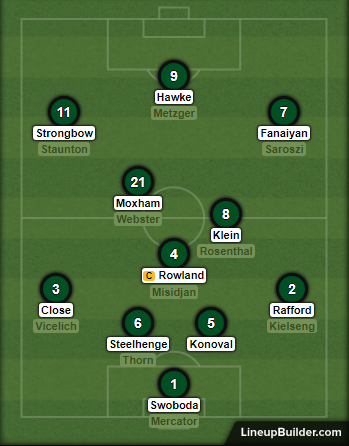
 Holdenberg) - Age 32 - 27 caps, 15 clean sheets
 Eastweald) - Age 26 - 9 caps, 6 clean sheets
 Creed United) - Age 27 - 5 caps, 2 clean sheets
 KT Moreazerua) - Age 33 - 128 caps, 4 goals
 Ramusok United) - Age 28 - 38 caps, 1 goal
 Kingsgrove) - Age 25 - 21 caps
 Raynor City United) - Age 27 - 8 caps, 3 goals


 ,
,  (Abanhfleft)
 (Cosumar)
 (Dunnes)
 (Fhulghamous Peninsula, playing in the Fleftic Premier League)