NATION

PASSWORD

Wyvern Military Industries [CATALOGUE] [READ ONLY]

A meeting place where national storefronts can tout their wares and discuss trade. [In character]

Advertisement

Remove ads

User avatar
Aeyariss
Powerbroker
 
Posts: 7550
Founded: Mar 26, 2010
Civil Rights Lovefest

Postby Aeyariss » Mon Mar 18, 2024 9:47 am


HOSPITAL VESSEL


Image
Last edited by Aeyariss on Sun Sep 20, 2026 3:14 am, edited 3 times in total.
The MOST SERENE EMPIRE of AEYARISS
The Wyvern Empire
International Alliance: (Primary) United Defense Accords|| Other: CSL | SACTO | Imperion|| Region: Kali Yuga|| Misc Link: Database|| UDA Joint War College ||Wyvern Military Industries|| Lore: SoTW

User avatar
Aeyariss
Powerbroker
 
Posts: 7550
Founded: Mar 26, 2010
Civil Rights Lovefest

Postby Aeyariss » Wed Mar 20, 2024 3:45 am


ST-218 CLASS || SUBMARINE TENDER / RESCUE VESSEL


Image


Manufacturer: Aeyariss Naval Auxiliaries
Type: Submarine Tender / Deep-Submergence Rescue Vessel
Status: Available for Export
Unit Price: 1,450,000,000 NSD
Complete Rescue Package: 1,650,000,000 NSD

OVERVIEW

Modern submarine forces depend upon more than the boats themselves. Behind every sustained undersea deployment stands an immense network of technicians, spare parts, workshops, divers, rescue systems, medical teams, fuel, power, specialized gases and highly trained support personnel.

The ST-218 Submarine Tender / Rescue Vessel brings that infrastructure to sea.

Designed as a mobile technical base for submarine fleets operating far from established naval facilities, the ST-218 combines the functions of a submarine tender, floating repair yard, deep-submergence rescue mothership, saturation-diving platform, logistics ship and emergency medical facility within a single 218-meter hull. It is intended to deploy alongside submarine squadrons during extended operations, establish temporary forward-support hubs and provide rapid-response rescue capability wherever an undersea emergency occurs. Rather than forcing damaged or depleted submarines to return to distant naval bases, the ST-218 brings much of the naval base to them.

PRINCIPAL CHARACTERISTICS

    Parameter Specification

    Length Overall 218 m
    Beam 31.5 m
    Full-Load Draft ~8.5 m
    Light Displacement ~20,500 t
    Operational Displacement ~25,500 t
    Full-Load Displacement ~28,500 t
    Maximum Speed 18 knots
    Cruising Speed 14–15 knots
    Range ~12,000 nautical miles at 15 knots
    Endurance 60 days
    Ship's Company ~165
    Mission Specialists ~180
    Normal Complement ~345
    Maximum Personnel Capacity ~545
    Propulsion Integrated Diesel-Electric
    Propulsion Motors 2 × ~12 MW
    Installed Electrical Generation ~42–48 MW
    Shafts 2
    Dynamic Positioning DP2-class concept
    Aviation Capacity 1 medium SAR / utility helicopter
    Medical Capacity 40 beds / 80 surge
    Operating Theatres 2
    ICU Beds 8
    Ship Complement: 200-300 depending on mission
SUBMARINE SUPPORT

The core mission of the ST-218 is to sustain submarines beyond the reach of permanent naval infrastructure.
The vessel can provide alongside support to: 1 large nuclear-powered attack submarine or up to 2 smaller conventional submarines under suitable harbor and sea conditions.

Dedicated submarine-support systems include:

  • High-capacity electrical supply
  • Freshwater transfer
  • Fuel transfer
  • Compressed-air services
  • Technical gas supply
  • Chilled-water services
  • Sewage and waste reception
  • Battery-support equipment
  • Machinery servicing
  • Electronic-system maintenance
  • Hull and structural repair
  • Welding and fabrication
  • Precision machining
  • Spare-parts distribution
  • Submarine stores and consumables

Large service galleries along the vessel's working side allow submarine crews and tender personnel to transfer equipment directly between the tender and alongside submarines.

FLOATING REPAIR YARD

The ST-218 incorporates approximately 3,000–4,000 m² of dedicated technical and workshop space.

Facilities include:
  • Mechanical Workshop || Heavy machinery repair, pumps, valves, hydraulic systems, piping, mechanical components and propulsion auxiliaries.
  • Machine Shop || Lathes, milling machines, CNC equipment, precision machining and component fabrication.
  • Electrical Workshop || Generators, motors, power distribution equipment, electrical controls and cabling systems.
  • Electronics Workshop || Navigation systems, communications equipment, sensors, circuit assemblies and submarine electronics.
  • Welding and Fabrication ||Steel, aluminum and specialist fabrication capability for emergency structural repair.
  • Composite Workshop || Repair and fabrication of composite covers, fairings and specialist components.
  • Technical Stores || Large inventory spaces for submarine-specific spare parts, tools and consumables.

The ship therefore functions as a deployable intermediate-maintenance facility rather than simply a supply vessel.

SUBMARINE RESCUE SYSTEM

At the heart of the ST-218's rescue mission is a dedicated deep-submergence rescue complex. The standard vessel includes permanent support infrastructure for: 1 Deep Submergence Rescue Vehicle, with accommodation for additional modular rescue equipment when required.

The ship's rescue complex includes:

    stern DSRV handling area
    heavy launch-and-recovery A-frame
    rescue vehicle maintenance bay
    rescue control center
    underwater navigation systems
    acoustic localization equipment
    diver support
    hyperbaric treatment facilities
    transfer-under-pressure infrastructure
    decompression system
s

A typical embarked rescue vehicle may carry approximately 12–16 rescued submariners per transfer cycle, depending upon the selected DSRV.

HEAVY RESCUE A-FRAME

The reinforced stern incorporates a large rescue A-frame capable of handling approximately:

70 tonnes Safe Working Load

The system supports deployment and recovery of:

    DSRVs
    diving bells
    rescue chambers
    subsea equipment
    ROV systems
    heavy recovery equipment

The stern working area is engineered around controlled launch and recovery during demanding offshore operations.

DIVING COMPLEX

The ST-218 serves as a fully equipped deep-diviving support platform.

Standard facilities include:

    saturation-diving control center
    multi-lock hyperbaric chambers
    diver preparation rooms
    equipment workshops
    gas-management systems
    diving bells
    decompression facilities
    underwater communications
    medical monitoring

The baseline system supports approximately: 18–24 saturation divers with a target operational diving capability of approximately: 300 meters depending upon mission equipment and certification.

ROV AND AUV OPERATIONS

Submarine rescue rarely begins with the rescue vehicle itself. The ST-218 therefore carries extensive unmanned underwater systems for locating, inspecting and preparing distressed submarines.

Typical mission inventory: 2 × Work-Class ROV

Used for:
    wreck inspection
    obstruction removal
    cable handling
    emergency connections
    debris clearance
    underwater repair assistance

2–4 × Observation ROV

Used for:
    visual inspection
    rescue monitoring
    hull survey
    diver support

2 × Autonomous Underwater Vehicles
Used for:
    seabed search
    sonar mapping
    route survey
    wreck localization

The vessel also supports containerized mission systems for specialized seabed and rescue tasks.

HEAVY LIFT SYSTEMS

The ST-218 carries substantial lifting equipment to support repair and rescue operations.

Typical installation:

    1 × 120-tonne main offshore crane
    1 × 60-tonne secondary crane
    2 × 20–25-tonne service cranes
    1 × ~70-tonne stern rescue A-frame

Reinforced mission-deck zones allow the handling of large machinery modules, rescue systems, containers and submarine components.

MEDICAL FACILITY

The ST-218 carries a dedicated medical department optimized for submarine and diving emergencies.

Capacity

40 permanent medical beds; Up to 80 surge patients
Critical Care || 8 ICU beds
Surgical Capability || 2 operating theatres
Emergency Department || 6 trauma / resuscitation bays
Isolation || 6 isolation beds

Additional facilities include:

    hyperbaric medicine
    decompression-injury treatment
    burns treatment
    trauma surgery
    emergency surgery
    digital X-ray
    ultrasound
    clinical laboratory
    blood storage
    pharmacy
    dental treatment room

The medical complex is specifically designed for:

    rescued submariners
    decompression sickness
    diving accidents
    burns
    smoke inhalation
    blast injuries
    trauma
    prolonged rescue operations

HYPERBARIC MEDICINE

The vessel's hyperbaric complex can treat approximately: 20 patients simultaneously depending upon chamber configuration. Multi-lock chambers permit treatment to continue while personnel enter or leave adjacent compartments. The complex supports both rescue operations and routine saturation-diving missions.

AVIATION

A medium helicopter flight deck provides rapid transport of:

medical teams
spare parts
specialist personnel
rescue equipment
casualties

Normal air detachment: 1 × medium SAR / utility helicopter.
The flight deck supports helicopters in approximately the 10–13 tonne class, subject to operator-specific certification.
A compact maintenance and support facility is provided for embarked aviation operations.

DYNAMIC POSITIONING

Submarine rescue demands precision. The ST-218 therefore incorporates a DP2-class dynamic-positioning architecture using:

    twin main shafts
    bow thrusters
    precision satellite navigation
    acoustic reference systems
    wind sensors
    inertial navigation
    automated propulsion control

This allows the vessel to maintain position above a distressed submarine during diving, ROV and rescue operations without relying solely upon anchors.

SENSORS

Mission sensors include:

    X-band navigation radar
    S-band navigation / surface-search radar
    weather radar
    helicopter-control systems
    multibeam echo sounder
    underwater telephone
    USBL underwater positioning
    LBL compatibility
    acoustic rescue-beacon detection
    sonar survey systems
    subsea navigation systems
    meteorological sensors

The ST-218 is not intended to function as a frontline combat surveillance vessel.

COMMUNICATIONS

Extensive communications facilities allow the ship to coordinate multinational submarine-rescue operations.

Systems include:

    secure SATCOM
    naval communications
    submarine support communications
    aviation communications
    emergency frequencies
    underwater communications
    rescue coordination networks
    telemedicine
    high-bandwidth engineering data transfer

A dedicated rescue coordination center can act as the command hub for large multinational rescue operations.

LOGISTICS

The ST-218 carries substantial supplies for both itself and supported submarines.

Typical capacities include:

    2,500–3,000 tonnes ship fuel
    up to ~1,000 tonnes transferable mission liquids and submarine fuel depending upon configuration
    600–800 tonnes potable water
    approximately 400–500 tonnes/day freshwater production
    dry stores
    refrigerated provisions
    submarine spare parts
    technical gases
    lubricants
    medical supplies
    engineering consumables
    containerized mission equipment

The vessel can establish a temporary forward submarine-support point without requiring a fully developed naval installation ashore.

SURVIVABILITY

The ST-218 is an auxiliary support vessel rather than a surface combatant.

Survivability therefore emphasizes:

    extensive watertight subdivision
    redundant power generation
    separated machinery spaces
    duplicated fire pumps
    emergency electrical distribution
    redundant navigation systems
    damage-control stations
    comprehensive fire detection
    protected machinery and control spaces
    emergency medical capability

Critical rescue and ship-control systems are distributed to reduce vulnerability to single-point failures.

ARMAMENT

The ST-218 carries only limited defensive armament for ship security.
Typical fit: 2–4 × remotely operated 12.7 mm weapon stations plus crew-served and individual small arms.

OPTIONAL EQUIPMENT

Customers may select additional mission packages including:

    Deep Submergence Rescue Vehicle
    second rescue submersible
    additional work-class ROV
    additional AUV systems
    advanced saturation-diving package
    atmospheric diving suits
    salvage equipment
    enhanced medical package
    larger helicopter support package
    submarine training facilities
    command-and-control module
    modular workshops
    additional technical stores
    unmanned surface vehicles
    seabed survey package

PROCUREMENT
ST-218 SUBMARINE TENDER / RESCUE VESSEL

Base Unit Price
1,450,000,000 NSD

Includes:
complete vessel
propulsion and electrical plant
submarine support infrastructure
workshops
heavy cranes
diving complex
hyperbaric facilities
DSRV handling infrastructure
ROV support infrastructure
medical facility
aviation support
standard navigation and communications systems

COMPLETE SUBMARINE RESCUE PACKAGE
1,650,000,000 NSD


Adds a complete operational submarine-rescue mission package including:

DSRV
rescue support equipment
transfer-under-pressure equipment
rescue control systems
ROV rescue package
initial specialized rescue spares

Embarked helicopter is priced separately.
Last edited by Aeyariss on Sun Sep 20, 2026 10:20 pm, edited 6 times in total.
The MOST SERENE EMPIRE of AEYARISS
The Wyvern Empire
International Alliance: (Primary) United Defense Accords|| Other: CSL | SACTO | Imperion|| Region: Kali Yuga|| Misc Link: Database|| UDA Joint War College ||Wyvern Military Industries|| Lore: SoTW

User avatar
Aeyariss
Powerbroker
 
Posts: 7550
Founded: Mar 26, 2010
Civil Rights Lovefest

Postby Aeyariss » Wed Mar 20, 2024 3:56 am


TYPE 569 PEARL CLASS HYDROGRAPHY RESEARCH VESSEL


General Specifications:
Image


Role: Deep-ocean hydrography, bathymetry, oceanography, seabed survey, maritime charting, environmental data collection
Parameter Specification
Length Overall 112 m
Waterline Length ~106 m
Beam 19.5 m
Design Draft ~5.8 m
Full-Load Draft ~6.2 m
Light Displacement ~5,250 t
Normal Operating Displacement ~6,400 t
Full-Load Displacement ~7,200 t
Maximum Speed 16 knots
Cruise Speed 13 knots
Survey Speed 4–10 knots
Range ~12,000 nmi at 13 knots
Endurance 60 days
Ship’s Company 38
Survey / Scientific Personnel 52
Normal Complement 90
Maximum Berths 100
Propulsion Integrated Diesel-Electric
Main Propulsors 2 × azimuthing electric propulsion units
Main Propulsion Power ~2 × 4.5 MW
Installed Generation ~14 MW
Bow Thrusters 2
Dynamic Positioning DP2
Stabilization Active fin stabilizers + passive anti-roll provision
Freshwater Production ~150–200 t/day
Aviation 1 medium helicopter
Flight Deck 1 × 12–14 t-class landing spot
Hangar 1 medium helicopter
Survey Launches 2 × ~11 m
RHIB 1 × ~7 m
USVs 4
AUVs 4
ROVs 2
Moon Pool Yes
Stern A-Frame ~35 t SWL
Main Mission Crane ~20 t
Secondary Service Crane ~5 t
Mission Deck Area ~700–900 m²
Hydrographic sensor fit

Primary Sonar Systems

Deep-water multibeam echo sounder
Medium/shallow-water multibeam echo sounder
Precision single-beam echo sounder
Towed side-scan sonar
Sub-bottom profiler
Multibeam water-column imaging
Acoustic Doppler Current Profiler

Survey positioning

Dual redundant GNSS
RTK/DGNSS
INS
Precision gyro
Heave, roll and pitch reference
USBL positioning
LBL compatibility
Acoustic transponder tracking

Geophysical options

Marine magnetometer
Marine gravimeter
Seismic profiler
Sediment coring
Grab sampling
Bottom camera
Water-column sampling
Oceanographic capability
CTD rosette system
Sound velocity profiling
Water samplers
Ocean-current measurement
Meteorological suite
Wave monitoring
Surface temperature and salinity monitoring
Biological and chemical sampling
Deep-water instrumentation deployment
Uncrewed systems

4 × AUVs

deep-water bathymetry
synthetic-aperture sonar
seabed imaging
cable/pipeline route survey

4 × USVs

coastal hydrography
shallow-water bathymetry
autonomous survey lines

2 × ROVs

one work-class
one inspection/light-work system
Laboratories
Hydrographic data laboratory
Oceanographic laboratory
Wet laboratory
Dry laboratory
Geophysical laboratory
Electronics workshop
AUV/ROV maintenance shop
Survey equipment calibration room
Data center / mission server room
Data processing
Real-time multibeam processing
GIS/chart production
Bathymetric cleaning
Sonar mosaicking
Oceanographic analysis
3D seabed reconstruction
Mission planning
Large-scale onboard data storage
SATCOM data transfer
Aviation

1 × medium utility / survey helicopter

Uses:

survey team transfer
aerial mapping support
SAR
logistics
remote sensor deployment
casualty evacuation

The ship should not be designed around aviation. The helicopter is a support tool, not the mission centerpiece.

Medical
4-bed sickbay
1 treatment / resuscitation room
basic isolation capability
telemedicine
minor procedure capability
medical stores
Acoustic quieting

Because the vessel depends heavily on sonar accuracy:

resilient machinery mounting
low-noise electric propulsion
isolated generator foundations
optimized propellers
vibration-controlled piping
quiet survey operating mode
machinery shutdown hierarchy during sensitive sonar work
Survivability and safety
double-bottom construction
extensive watertight subdivision
redundant generators
separated switchboards
emergency generator
duplicated fire pumps
redundant navigation systems
emergency steering
DP redundancy
enclosed rescue stations
helicopter crash/fire response capability

This is a civil/military hydrographic vessel, not a warship.

Armament
Standard configuration: unarmed.

Optional naval configuration:
2 × 12.7 mm RWS
crew small arms


LOA: 112 m
Beam: 19.5 m
Full Load: ~7,200 t
Speed: 16 kn
Range: ~12,000 nmi
Endurance: 60 days
Crew: 38
Scientific / Survey Personnel: 52
Normal Complement: 90
DP: DP2
Propulsion: Diesel-electric, twin azimuth drive
Moon Pool: Yes
AUV: 4
USV: 4
ROV: 2
Survey Launches: 2
Helicopter: 1 medium
Main A-Frame: ~35 t
Mission Deck: ~800 m²
Last edited by Aeyariss on Sun Sep 20, 2026 10:07 pm, edited 5 times in total.
The MOST SERENE EMPIRE of AEYARISS
The Wyvern Empire
International Alliance: (Primary) United Defense Accords|| Other: CSL | SACTO | Imperion|| Region: Kali Yuga|| Misc Link: Database|| UDA Joint War College ||Wyvern Military Industries|| Lore: SoTW

User avatar
Aeyariss
Powerbroker
 
Posts: 7550
Founded: Mar 26, 2010
Civil Rights Lovefest

Type-805 Electronic Intelligence Vessel

Postby Aeyariss » Wed Mar 20, 2024 4:04 am


TYPE-805 CLASS
ELECTRONIC INTELLIGENCE VESSEL (ELINT)


Image
Last edited by Aeyariss on Sun Sep 20, 2026 3:23 am, edited 1 time in total.
The MOST SERENE EMPIRE of AEYARISS
The Wyvern Empire
International Alliance: (Primary) United Defense Accords|| Other: CSL | SACTO | Imperion|| Region: Kali Yuga|| Misc Link: Database|| UDA Joint War College ||Wyvern Military Industries|| Lore: SoTW

User avatar
Aeyariss
Powerbroker
 
Posts: 7550
Founded: Mar 26, 2010
Civil Rights Lovefest

Postby Aeyariss » Wed Mar 20, 2024 4:24 am


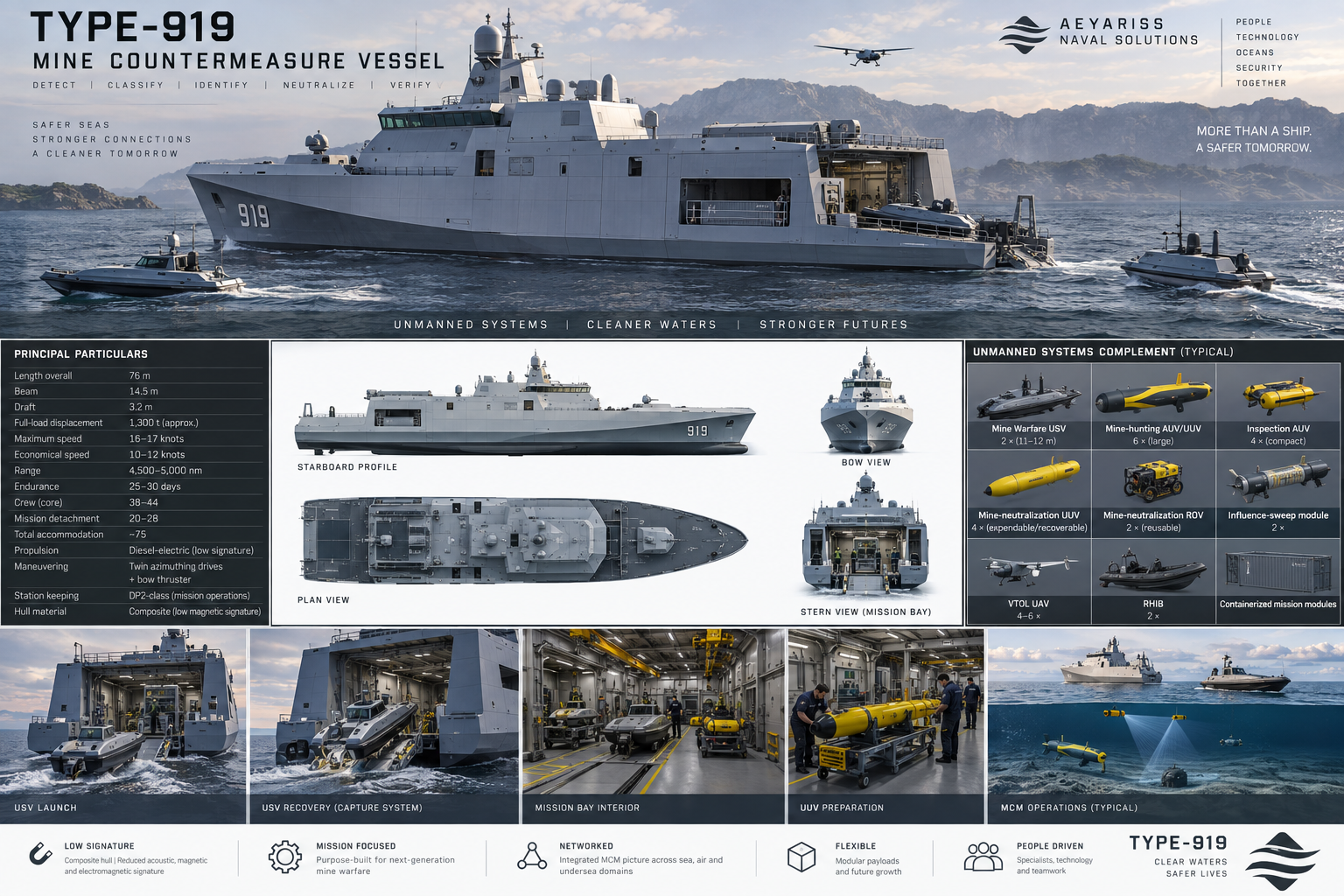
TYPE-919 MINE COUNTERMEASURE VESSEL


Image
Last edited by Aeyariss on Sun Sep 20, 2026 3:38 am, edited 2 times in total.
The MOST SERENE EMPIRE of AEYARISS
The Wyvern Empire
International Alliance: (Primary) United Defense Accords|| Other: CSL | SACTO | Imperion|| Region: Kali Yuga|| Misc Link: Database|| UDA Joint War College ||Wyvern Military Industries|| Lore: SoTW

User avatar
Aeyariss
Powerbroker
 
Posts: 7550
Founded: Mar 26, 2010
Civil Rights Lovefest

Postby Aeyariss » Wed Mar 20, 2024 4:30 am


TYPE-312 MASTIFF CLASS
FLEET OCEAN TUG


Image


TYPE-312 MASTIFF — FLEET OCEAN TUG / SALVAGE & RESCUE VESSEL

SpecificationValue
TypeFleet Ocean Tug / Salvage & Rescue Vessel
RoleOcean towing, emergency tow, salvage, firefighting, diving support, ROV operations, rescue and humanitarian support
OperatorAeyariss Navy – Fleet Logistics Command
Length overall82 m
Beam18.5 m
Draft~6.0 m
Full-load displacement~5,700 t
PropulsionDiesel-electric
Installed power~13 MW
Propulsors2 × azimuthing stern drives
Bow thrusters2
Dynamic positioningDP2
Maximum speed15.5–16 kt
Economic cruise12 kt
Range~10,000 nmi @ 12 kt
Endurance45 days
Bollard pull≥145 t continuous / ~160 t maximum
Core crew32–36
Mission personnel25–35
Accommodation~80 personnel
Emergency survivor capacity80–120
Mission/work deck~550 m² reinforced
Primary towing systemAutomatic-tension ocean towing machinery
Secondary towing systemIndependent secondary/emergency towing machinery
Primary tow wire~900–1,100 m
Towing equipmentHydraulic towing pins, shark jaws, stern roller, load monitoring and emergency release
Main crane1 × 40 t active-heave-compensated offshore crane
Utility crane1 × 10 t
ROV capability1 × permanent work-class ROV; second major ROV available as modular mission fit
Diving capabilitySurface-supplied diving system with decompression chamber
Firefighting capability~4,000–5,000 m³/h total external firefighting capacity
Fire monitors2 × high-mounted remote-controlled monitors
Flight deckMedium helicopter landing/refueling deck
HangarNone
Small craft2 × RHIB + 1 × workboat
Mission centerIntegrated Mission Operations Center / Salvage & Tow Control
Navigation radarDual navigation and surface-search radar suite
EO/IRMulti-spectral electro-optical / infrared surveillance system
ESMIntegrated electronic support measures suite
CommunicationsSATCOM, fleet datalink, HF/VHF/UHF and civilian maritime communications
Underwater supportUnderwater positioning, forward-looking sonar and salvage/ROV navigation support
Standard defensive weapons2 × 30 mm RWS + 2–4 × 12.7 mm mounts/RWS
Soft-kill defensesESM, chaff, IR decoys and laser warning
Optional point defense1 × RAM-class launcher (wartime fit)
Damage controlFire/watertight subdivision, redundant power, high-capacity dewatering and distributed damage-control stations
Propulsion redundancySeparated DP2 machinery groups with independent port/starboard propulsion trains
Mission modulesSalvage, diving, ROV/UUV, firefighting, pollution response, disaster relief and submarine rescue packages
Typical service life35–40 years


AVAILABLE VARIANTS

VariantDesignationRole
TYPE-312AMASTIFFFleet Ocean Tug
TYPE-312BMASTIFF-SSalvage & Diving Support
TYPE-312CMASTIFF-RSubmarine Rescue Support
TYPE-312DMASTIFF-FEmergency Response / Firefighting


MISSION PROFILE

The TYPE-312 MASTIFF is an ocean-going fleet tug and salvage vessel designed to recover damaged warships, conduct emergency towing, support diving and ROV operations, fight shipboard fires, assist casualties, and provide modular salvage and humanitarian support. Its stern is built around a dedicated clear towing corridor, while diesel-electric propulsion, azimuthing drives and DP2 station keeping provide the low-speed control required for demanding rescue and salvage operations.
Last edited by Aeyariss on Sun Sep 20, 2026 10:21 pm, edited 5 times in total.
The MOST SERENE EMPIRE of AEYARISS
The Wyvern Empire
International Alliance: (Primary) United Defense Accords|| Other: CSL | SACTO | Imperion|| Region: Kali Yuga|| Misc Link: Database|| UDA Joint War College ||Wyvern Military Industries|| Lore: SoTW

User avatar
Aeyariss
Powerbroker
 
Posts: 7550
Founded: Mar 26, 2010
Civil Rights Lovefest

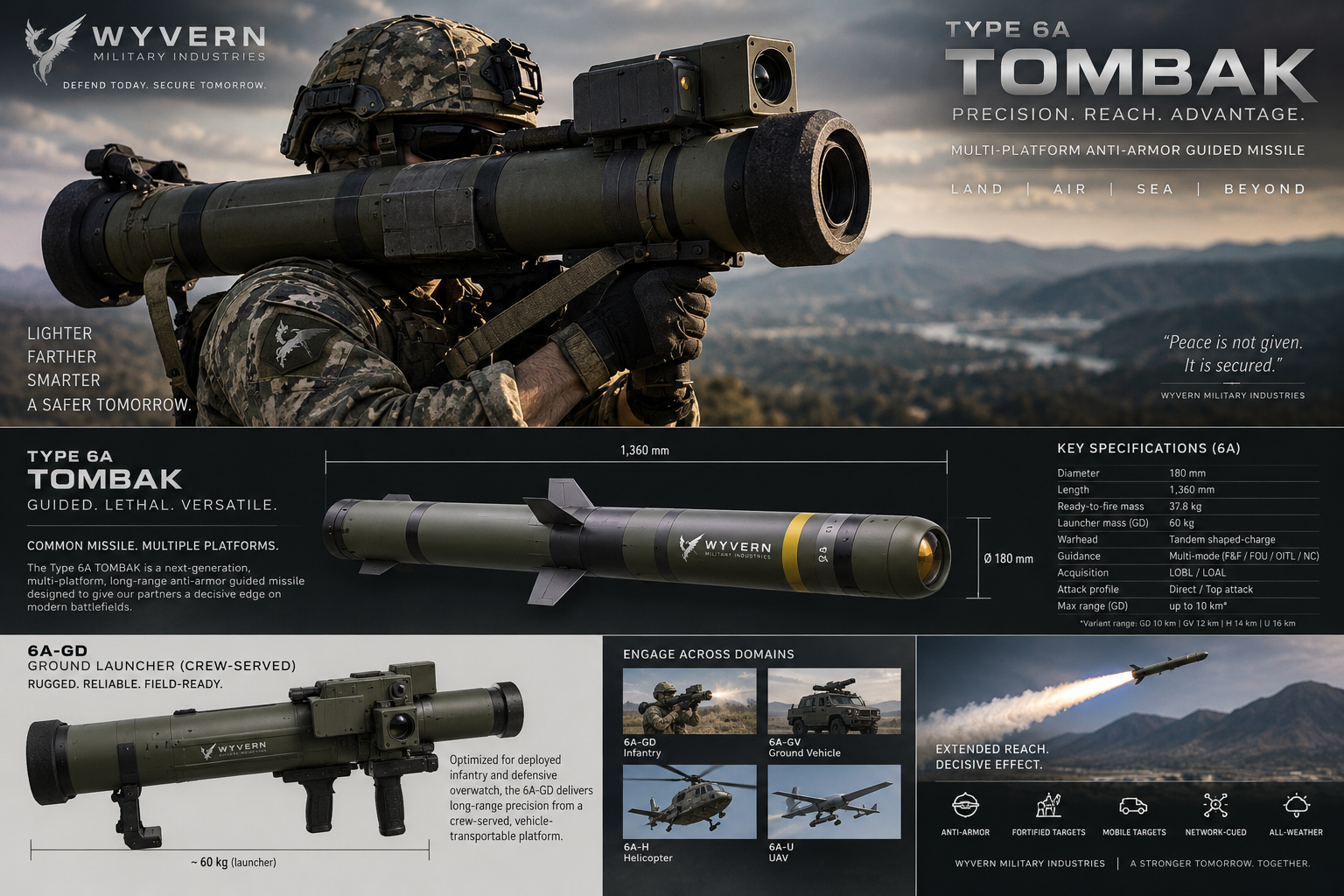
Type 6A - Tombak (Lance)

Postby Aeyariss » Fri Nov 22, 2024 5:13 am
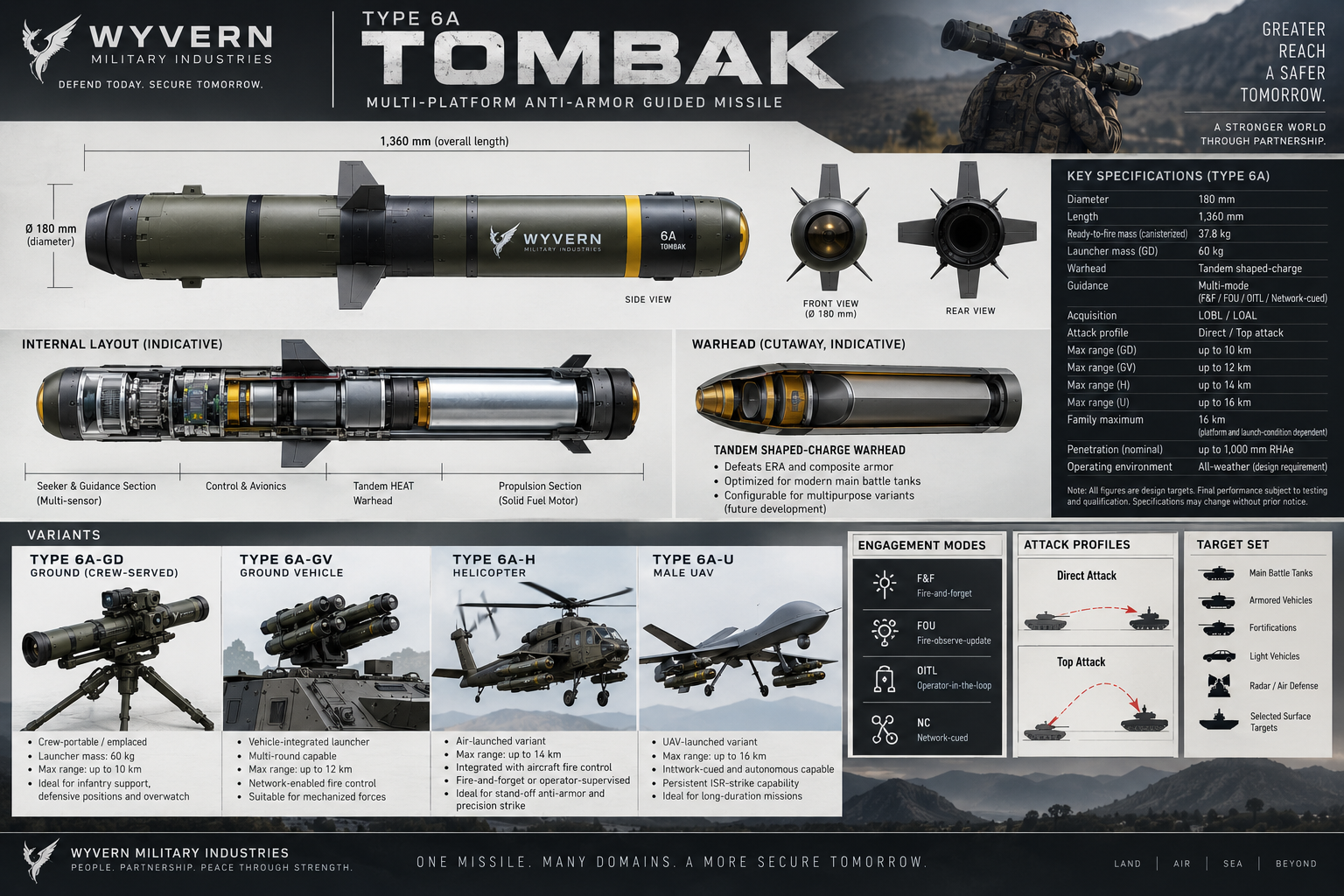


Type 6A Tombak Anti Tank Guided Missile


Image
Image

(Price: NSD 250,000 per unit)
Last edited by Aeyariss on Sun Sep 20, 2026 3:17 am, edited 10 times in total.
The MOST SERENE EMPIRE of AEYARISS
The Wyvern Empire
International Alliance: (Primary) United Defense Accords|| Other: CSL | SACTO | Imperion|| Region: Kali Yuga|| Misc Link: Database|| UDA Joint War College ||Wyvern Military Industries|| Lore: SoTW

User avatar
Aeyariss
Powerbroker
 
Posts: 7550
Founded: Mar 26, 2010
Civil Rights Lovefest

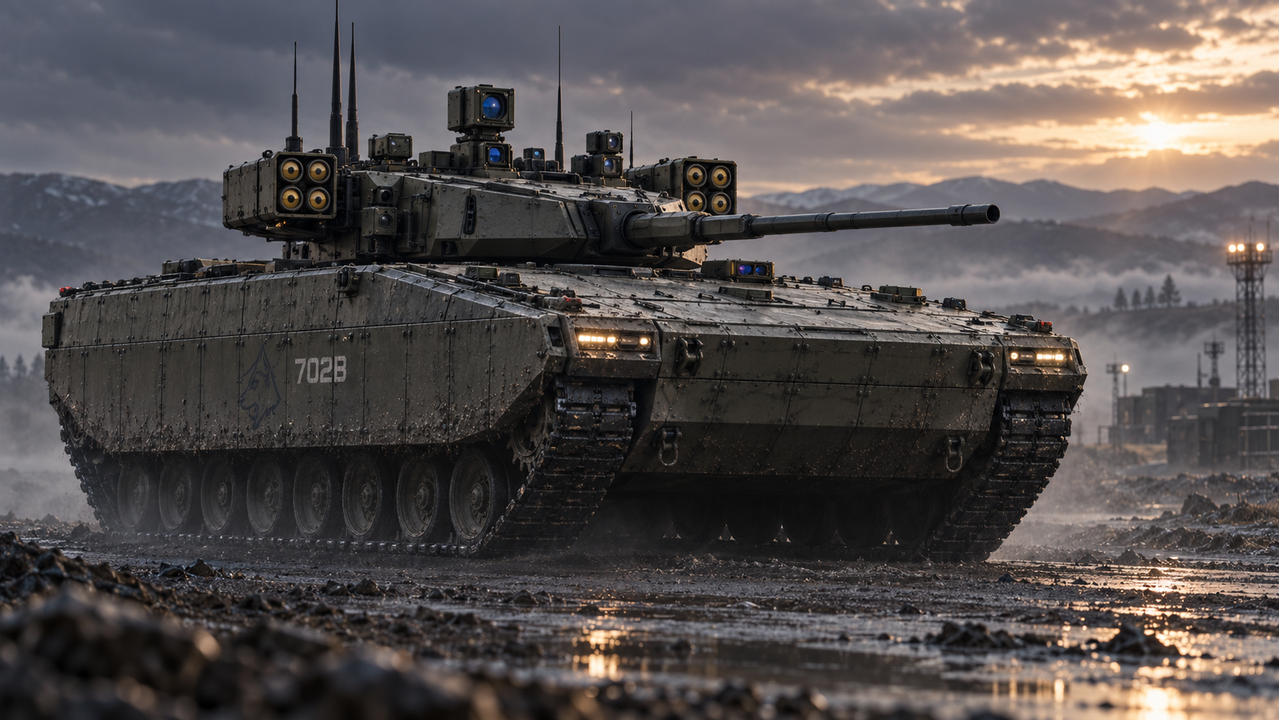
Type-702B Wolf IFV

Postby Aeyariss » Fri Jun 26, 2026 3:29 am


TYPE-702B WOLF
INFANTRY FIGHTING VEHICLE


Image


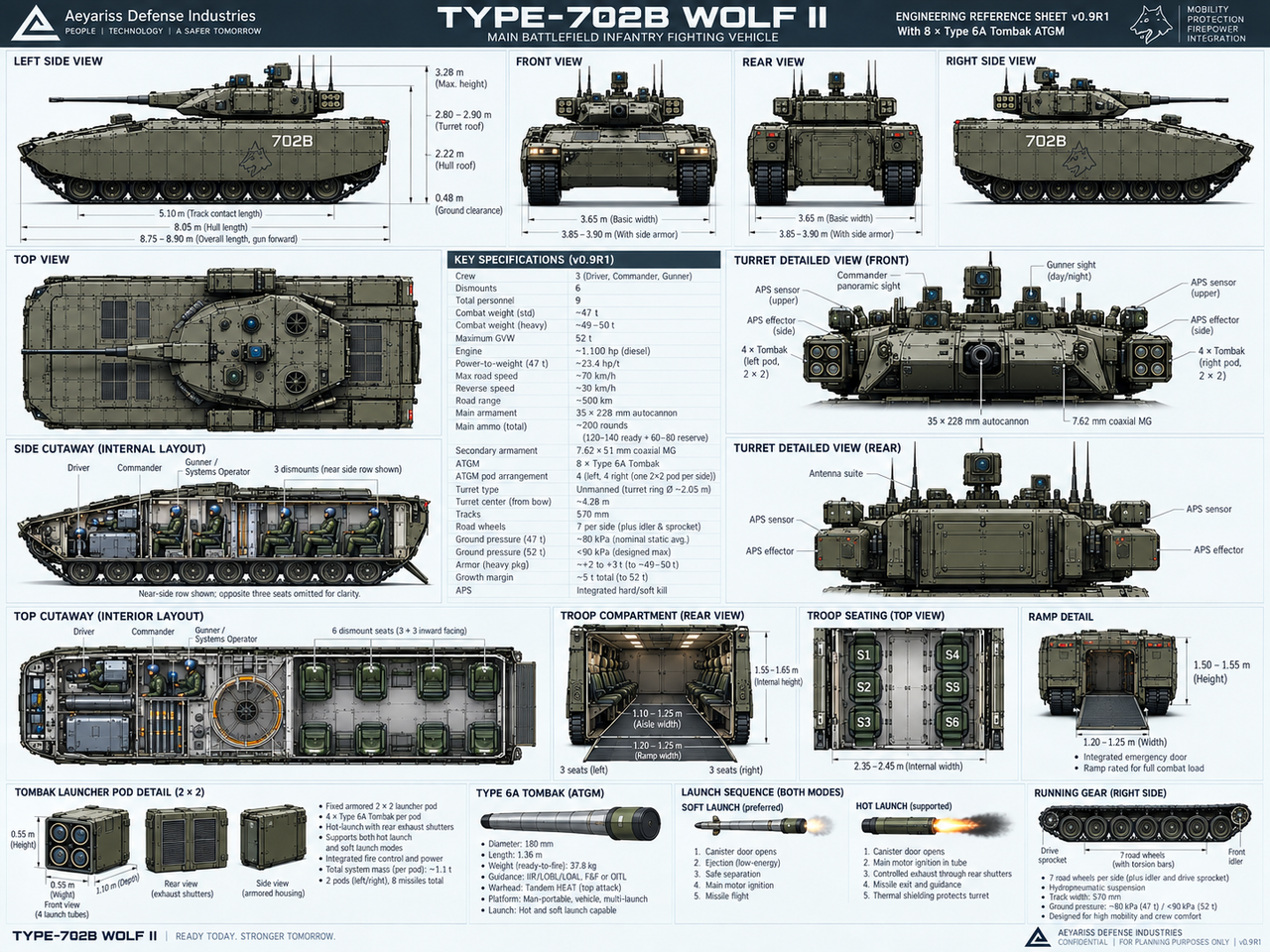
GENERAL OVERVIEW
TYPE-702B WOLF II
Heavy Infantry Fighting Vehicle

Crew: 3
Dismounts: 6
Total Personnel: 9

Combat Weight: ~47 tonnes
Heavy Combat Weight: ~49–50 tonnes
Maximum GVW: 52 tonnes

Length: 8.05 m hull / ~8.75–8.90 m gun forward
Width: 3.65 m / ~3.85–3.90 m with heavy armor
Height: ~3.28 m
Ground Clearance: ~0.48 m

Engine: ~1,100 hp turbo-diesel
Power-to-Weight: ~23.4 hp/t
Maximum Road Speed: ~70 km/h
Reverse Speed: ≥30 km/h
Operational Range: ≥500 km
Suspension: Adjustable hydropneumatic
Running Gear: 7 road wheels per side

Main Armament: 1× 35×228 mm autocannon
Main Gun Ammunition: ~200 rounds
Secondary Armament: 1× 7.62×51 mm coaxial machine gun
Anti-Tank Armament: 8× Type 6A Tombak ATGM
ATGM Arrangement: 2× armored 2×2 launcher pods
ATGM Launch Modes: Hot Launch / Soft Launch
Turret: Unmanned

Protection: Modular composite armor
Active Protection: Integrated hard-kill / soft-kill APS
Mine Protection: Reinforced blast-protected hull and energy-attenuating seating
NBC Protection: Integrated

Vertical Obstacle: ≥0.8 m
Trench Crossing: ≥2.5 m
Fording: ≥1.2 m unprepared
Gradient: ≥60%
Side Slope: ≥30%
Amphibious: No

Strategic Transport: Rail / Sealift / Heavy Equipment Transporter


Image
Last edited by Aeyariss on Sun Sep 20, 2026 8:15 pm, edited 3 times in total.
The MOST SERENE EMPIRE of AEYARISS
The Wyvern Empire
International Alliance: (Primary) United Defense Accords|| Other: CSL | SACTO | Imperion|| Region: Kali Yuga|| Misc Link: Database|| UDA Joint War College ||Wyvern Military Industries|| Lore: SoTW

User avatar
Aeyariss
Powerbroker
 
Posts: 7550
Founded: Mar 26, 2010
Civil Rights Lovefest

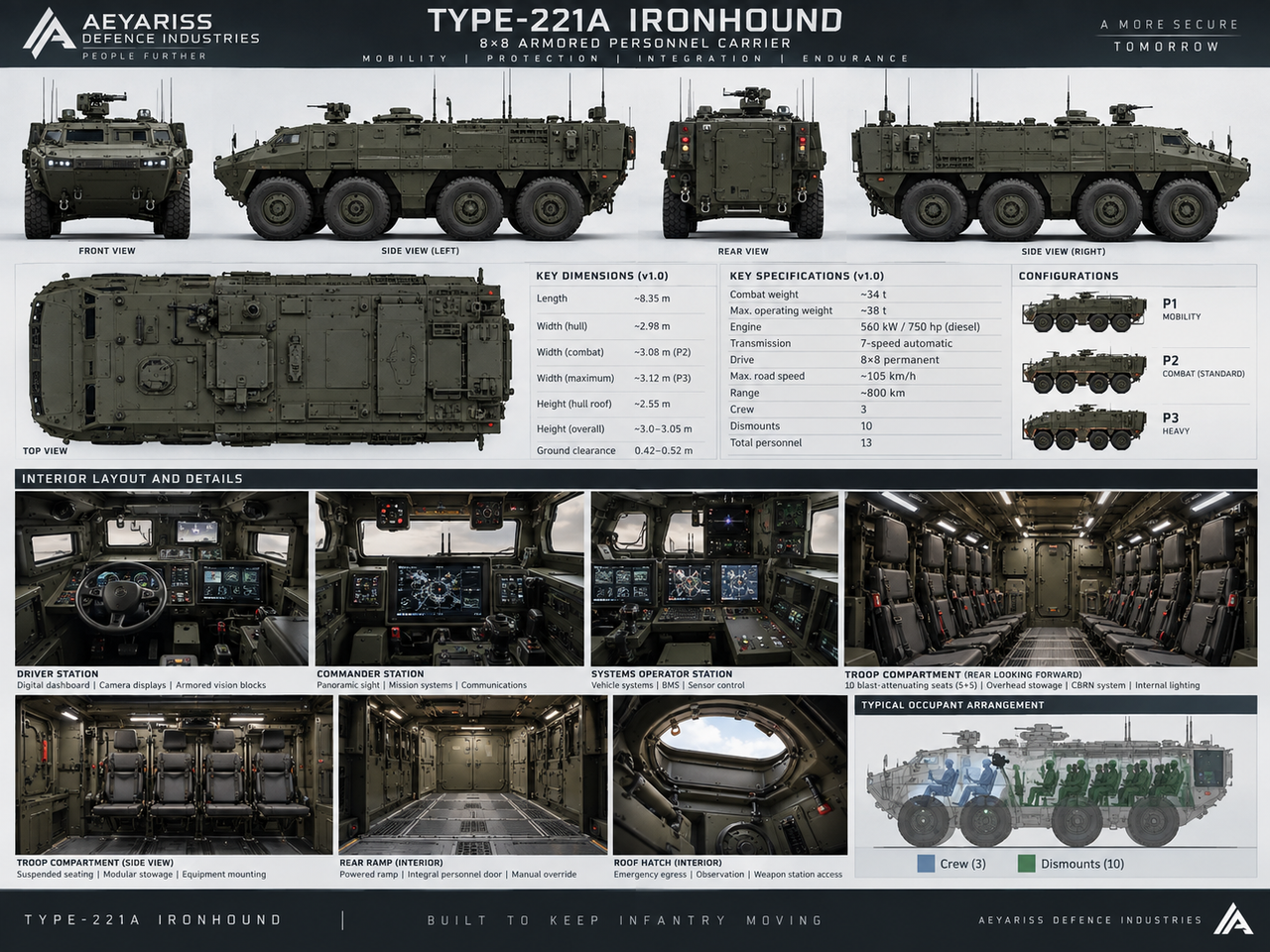
TYPE-221 IRONHOUND APC

Postby Aeyariss » Mon Sep 07, 2026 10:27 am
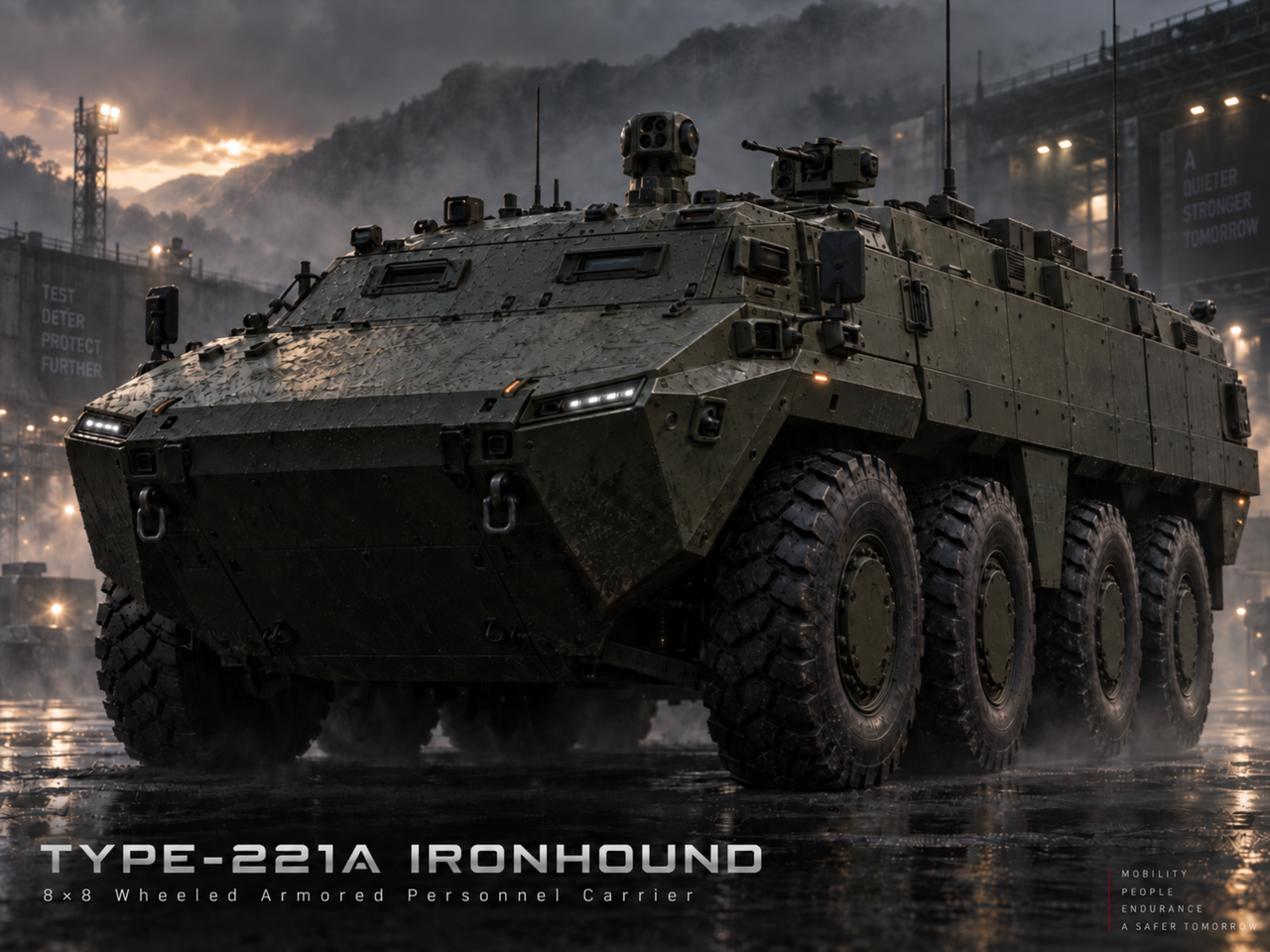

TYPE-221 IRONHOUND
ARMORED PERSONNEL CARRIER


Image


CategorySpecification
Type8×8 Wheeled Armored Personnel Carrier
ManufacturerAeyariss Defence Industries
Crew3 — Driver, Commander, Systems Operator
Dismount Capacity10 infantry
Total Personnel13
Length~8.35 m
Bare Hull Width~2.98 m
Combat Width~3.08 m standard / ~3.12 m heavy protection
Hull Roof Height~2.55 m
Overall Height~3.0–3.05 m with baseline roof systems
Ground Clearance0.42–0.52 m adjustable
Combat Weight~34 tonnes
Maximum Operating Weight~38 tonnes
Engine560 kW / 750 hp turbocharged diesel
Transmission7-speed automatic with two-range transfer case
DrivePermanent 8×8
Power-to-Weight Ratio~22.1 hp/t at 34 t; ~19.7 hp/t at 38 t
SuspensionIndependent double-wishbone hydropneumatic
SteeringAxles 1 and 2; low-speed counter-steering on axle 4
Tires16R20-class military radial, CTIS and run-flat equipped
Maximum Road Speed~105 km/h
Operational Range~800 km
Fuel Capacity~700 L protected multi-cell system
Turning Diameter~15–16 m
Gradient~60%
Side Slope~30%
Vertical Obstacle~0.7 m class
Trench Crossing~2.0 m
Fording~1.2 m unprepared; ~1.5–1.8 m prepared
Amphibious CapabilityNo
Primary AccessPowered rear ramp with integral personnel door
Troop Seating10 blast-attenuating suspended seats, 5+5 arrangement
Hull ConstructionWelded armored-steel structural monocoque
Protection ArchitectureProtected crew citadel with modular external armor packages
Protection ConfigurationsP1 Mobility / P2 Combat / P3 Heavy
Underbody ProtectionBlast-managed shallow double-V/faceted underbody with isolated internal floor
Spall ProtectionReplaceable internal spall liner
Fire SuppressionAutomatic multi-zone fire detection and suppression
CBRN ProtectionPositive-pressure collective filtration system
Situational Awareness360° camera suite, thermal driving system and commander panoramic sensor
Defensive SystemsLaser warning, multispectral obscurants and modular threat-warning interfaces
Active ProtectionAPS-ready architecture
Electrical Architecture28 V / 48 V dual-bus system
Electrical Generation~50–60 kW continuous
Silent Watch~4–8 hours depending mission load
NavigationGNSS, inertial navigation and wheel-odometry backup
NetworkingIntegrated battlefield management and redundant digital vehicle backbone
Recovery Equipment15–18 t-class self-recovery winch and reinforced towing points
Service Life25–30 years with scheduled rebuilds


Image
Last edited by Aeyariss on Sun Sep 20, 2026 8:15 pm, edited 5 times in total.
The MOST SERENE EMPIRE of AEYARISS
The Wyvern Empire
International Alliance: (Primary) United Defense Accords|| Other: CSL | SACTO | Imperion|| Region: Kali Yuga|| Misc Link: Database|| UDA Joint War College ||Wyvern Military Industries|| Lore: SoTW

User avatar
Aeyariss
Powerbroker
 
Posts: 7550
Founded: Mar 26, 2010
Civil Rights Lovefest

Postby Aeyariss » Mon Sep 07, 2026 10:28 am


TYPE 104 SPEARHEAD
Strategic Long-Range High-Speed Interceptor


Image

PRICE: Standard Export Aircraft: 250,000,000 NSD


OVERVIEW

Manufacturer: Imperial Aerospace Industries
Country of Origin: The Most Serene Empire of Aeyariss
Role: Strategic Interceptor / Long-Range Air Defence / High-Speed Counter-Air
Crew: 2
Export Status: Available to approved customers

Most fighters are designed to control the air around the battlefield. The Type 104 Spearhead is designed to control the airspace before the battlefield ever reaches you.

Built for nations facing long coastlines, enormous maritime approaches, remote territories, sparse basing networks, or strategic air threats arriving from hundreds of kilometres away, the Spearhead is not another multirole fighter competing for the same tactical niche. It occupies a different layer of air power altogether. At 30.2 metres in length, with nearly thirty tonnes of internal fuel, a twin-engine propulsion system producing approximately 440 kN of combined thrust, and an integrated multisensor architecture centered upon passive detection and cooperative engagement, the Type 104 is a strategic interceptor in the classical sense rebuilt for the networked battlespace.

Its purpose is simple:

Detect early.
Understand first.
Cross the distance.
Intercept before the threat reaches what matters.

AIRFRAME DATA

    Overall Length: 30.2 m
    Wingspan: 19.5 m
    Wing Area: approximately 170 m²
    Aspect Ratio: approximately 2.24
    Length-to-Span Ratio: approximately 1.55

    Configuration: Twin-engine, tandem two-seat strategic interceptor

Primary aerodynamic configuration:
    Long sharply chined forebody
    Deep blended lifting centerbody
    Low-aspect-ratio cranked swept wing
    Twin outward-canted vertical stabilizers
    Separate all-moving horizontal stabilators
    Large bilateral variable-compression side inlets

The Spearhead's proportions immediately distinguish it from conventional tactical fighters. The aircraft is deliberately long relative to its span, giving the design the internal volume required for fuel, sensors, mission systems, propulsion, and long-range operations without turning the aircraft into an oversized conventional fighter. The broad blended centerbody provides structural depth and usable internal volume while transitioning smoothly into the substantial inner wing panels. The outer wing sections narrow sharply beyond the characteristic planform break, preserving the high-speed character of the aircraft.

Image


ARMAMENTS
    Standard combat load: 12 internal AAMs
    Maximum air-to-air load: 14 internal AAMs
    Heavy interceptor load: 8–10 larger long-range / very-long-range missiles
    Mixed load: 10–12 missiles of different classes
    Gun: 1 × 27–30 mm cannon with ~150–180 rounds

MASS DATA

Operating Empty Weight: approximately 35.15 tonnes
Internal Fuel: approximately 29.5 tonnes
Reference Loaded Mass: approximately 69.65 tonnes
Maximum Takeoff Mass Target: approximately 72.0 tonnes
Validation Contingency: approximately 72.5 tonnes if required by configuration growth

The Type 104 is unapologetically large.

That size is not wasted mass.

It buys fuel.

It buys cooling capacity.

It buys sensor volume.

It buys electrical generation.

And, most importantly, it buys distance.

PROPULSION

Engine Count: 2
Engine Thrust Class: approximately 220 kN each
Combined Thrust Class: approximately 440 kN

The twin-engine installation is optimized around sustained high-altitude performance, long-range cruise efficiency, rapid acceleration, thermal endurance, and substantial electrical generation for onboard mission systems.

Large side-mounted variable-compression inlets manage airflow across a broad operating envelope and provide the mass flow required for high-speed interception without compromising the Spearhead's long-range cruise role.

Spearhead's propulsion philosophy is not built around remaining at maximum speed throughout a sortie.

The aircraft cruises economically when distance matters.

It accelerates when time matters.

PERFORMANCE

Normal Cruise: Mach 0.88 to Mach 0.95
High-Speed Transit: Mach 1.8 to Mach 2.2
Operational Maximum Speed Objective: Mach 2.7
Development Stretch Objective: Mach 2.9

Combat Radius Objective: approximately 1,600 km
Ferry Range Objective: approximately 4,500 to 5,000 km

Flight Controls:
Quad-redundant digital fly-by-wire

Published figures represent the Block 3.1V design baseline and may vary according to mission profile, payload, altitude, atmospheric conditions, fuel reserves, national equipment, and customer-specific integration.

Spearhead is intended to spend most of its life below its maximum speed.

The importance of Mach 2-class performance is not the number itself.

It is the ability to transform a contact hundreds of kilometres away from a future problem into a present engagement.

FUEL AND PERSISTENCE

Internal Fuel: approximately 29.5 tonnes

Long-range interception begins with fuel.

The Type 104 therefore carries its endurance internally rather than depending upon external tanks to become strategically useful.

The aircraft's large centerbody, extensive internal volume, and long fuselage were developed around this requirement from the beginning.

The result is an interceptor capable of operating further from its bases, spending more time within distant patrol sectors, and retaining greater tactical flexibility once it arrives.

Aerial refuelling further expands the aircraft's ability to maintain barrier patrols, reinforce distant sectors, escort strategic aviation, or remain airborne during extended air-defence operations.

MSF-2 INTEGRATED MISSION FUSION SYSTEM

Block 3.1V introduces the MSF-2 architecture as the heart of the Spearhead's combat system.

The Type 104 does not present the crew with a collection of separate sensor pictures.

It attempts to present one battlespace.

MSF-2 combines information from the aircraft's onboard sensors, defensive systems, identification equipment, navigation systems, and external tactical networks into a unified tactical object database.

A radar contact, passive RF bearing, infrared detection, and offboard AEW&C track may all represent the same aircraft.

MSF-2 is designed to recognize that.

The crew sees one correlated track rather than four unrelated detections.

Each tactical track can incorporate:

Position
Altitude
Velocity
Heading
Track confidence
Identification confidence
Emission status
Threat classification
Track history
Contributing sensor sources

This reduces crew workload while improving the quality of tactical decision-making during long-range, multi-contact engagements.

PRIMARY AESA RADAR

The Spearhead's primary electronically scanned radar provides the active long-range sensing component of the integrated mission system.

Functions may include:

Long-range air search
Multi-target tracking
Engagement-quality track generation
High-resolution mapping
Navigation support
Weather functions
Cooperative sensor cueing

The radar is not intended to operate in isolation.

MSF-2 allows radar information to be reinforced by passive and offboard sources, permitting the aircraft to decide when active emissions provide a tactical advantage rather than treating radar transmission as the default condition of awareness.

EO/IRST

Block 3.1V introduces a baseline long-range Electro-Optical / Infrared Search-and-Track system.

The primary EO/IRST aperture is integrated flush into the forward chine and upper-forward fuselage region.

There is no conventional spherical chin turret.

There is no external optical pod.

The sensor is built into the aircraft.

Its installation preserves the Spearhead's distinctive high-speed forebody while providing a passive means of detecting, tracking, and identifying airborne targets.

Primary functions include:

Passive infrared search
Angular tracking
Electro-optical identification
Passive target confirmation
Radar-track refinement
Offboard-track acquisition
Low-emission intercept support

The primary EO/IRST serves as the aircraft's long-range passive telescope.

DISTRIBUTED EO/IR SYSTEM

A network of small flush optical apertures distributed around the airframe provides broader electro-optical and infrared awareness.

The system contributes to:

Missile warning
Peripheral target awareness
Close-range infrared detection
Threat localization
Situational awareness
Sensor-fusion track refinement

The architecture gives the aircraft something approaching peripheral vision while avoiding external sensor clutter.

The apertures remain small, conformal, and subordinate to the aircraft's aerodynamic surfaces.

PASSIVE RF / ELECTRONIC SUPPORT MEASURES

Conformal RF apertures distributed around the Spearhead allow the aircraft to monitor the electromagnetic environment without relying upon its own radar transmissions.

The passive RF / ESM suite supports:

Emitter detection
Bearing estimation
Threat classification
Electronic order-of-battle development
Sensor cueing
Radar-warning functions
Cooperative track correlation

A target may therefore enter the Spearhead's tactical picture before the interceptor ever radiates.

That changes the logic of interception.

Listen first.

Look second.

Transmit when useful.

NETWORKED BATTLESPACE INTEGRATION

The Type 104 is designed to operate as part of an air-defence system rather than merely inside one.

MSF-2 can incorporate secure offboard information from:

AEW&C aircraft
Other fighters
Ground-based radar networks
Naval combat systems
Unmanned aircraft
Reconnaissance platforms
Satellite-derived surveillance
Command-and-control networks

A Spearhead patrol may therefore receive a contact generated hundreds of kilometres away, begin passive correlation using ESM and EO/IRST, and build tactical confidence before activating its own radar.

The aircraft's sensor horizon is no longer limited to the sensors physically carried inside the airframe.

Its effective horizon becomes the network.

MISSION COMPUTING

The Block 3.1V avionics architecture uses distributed modular processing rather than treating each major sensor as an isolated avionics island.

Redundant mission-computing nodes support:

Radar processing
EO/IR processing
Electronic-support processing
Image processing
Track correlation
Data association
Electronic warfare
Tactical networking
Crew displays
Navigation
Mission planning
System diagnostics

This architecture also provides the foundation for long-term upgrades.

New processors, sensors, communications systems, and mission software can be introduced without requiring the aircraft to be conceptually rebuilt every time its electronics evolve.

That matters for an interceptor expected to remain relevant through decades of changing threats.

ELECTRICAL ARCHITECTURE

Block 3.1V separates major electrical loads into distinct functional domains.

Flight-critical power
Mission-system power
Radar and sensor power
Electronic-warfare power
Growth capacity

Flight controls and essential aircraft systems remain electrically protected from high-demand mission-system loads.

This gives the Spearhead room for future radar, communications, electronic-warfare, and sensor upgrades without forcing every improvement to compete directly with flight-critical systems.

THERMAL MANAGEMENT

High-speed aircraft are thermal machines.

So are high-performance sensor systems.

Block 3.1V therefore incorporates dedicated thermal-management provisions for:

AESA electronics
EO/IRST detector hardware
Optical windows
Mission computers
Electronic warfare equipment
Communications systems
Associated avionics

The thermal system is designed as part of the aircraft rather than as an afterthought attached to the electronics.

That distinction becomes especially important during sustained high-speed flight, where the environment outside the aircraft is already working hard to heat everything inside it.

CREW SYSTEM

Crew: 2
Arrangement: Tandem

Forward Station:
Pilot / Aircraft Commander

Primary responsibilities include aircraft control, navigation, formation management, tactical maneuvering, engagement execution, and command decisions.

Rear Station:
Mission Systems Officer

Primary responsibilities include sensor supervision, electronic warfare, identification, cooperative tracking, tactical networking, and management of complex multi-contact engagements.

Automation handles correlation.

The crew handles judgment.

For a strategic interceptor spending hours managing distant contacts, distributed forces, and changing threat pictures, that division of workload is not a luxury.

It is part of the weapon system.

PRIMARY MISSION SET

The Type 104 is optimized for:

Long-range bomber interception
Cruise-missile carrier interception
Strategic airspace defence
Maritime air-defence patrol
Remote frontier defence
Long-duration combat air patrol
Forward barrier patrol
Rapid reinforcement of distant sectors
Escort of strategic aviation
Counter-air operations
Fleet air-defence support
Network-enabled interception

Spearhead is particularly attractive to operators responsible for large geographical areas where covering every avenue of approach with conventional fighter bases would be prohibitively expensive or operationally inefficient.

CUSTOMER VALUE PROPOSITION

The Type 104 is not intended to replace every tactical fighter in an air force.

That would misunderstand the aircraft.

Spearhead is intended to close the capability gap between local fighter defence and strategic airspace control.

For the right operator, that means fewer aircraft can influence a much larger defensive area.

The platform is best suited to:

Archipelagic states
Large continental powers
Maritime nations
States with long coastlines
Countries with remote territories
Operators with sparse airbase networks
Strategic fleet operators
Nations facing long-range bomber or missile-carrier threats

A conventional fighter asks:

"How well can I fight once the enemy arrives?"

Spearhead asks:

"Why allow him to arrive?"

EXPORT CONFIGURATION

Approved customers may tailor the Block 3.1V architecture to national requirements.

Potential integration areas include:

National datalinks
Communications systems
IFF
Cryptographic equipment
Electronic-warfare suites
Radar software
EO/IR configuration
Navigation systems
Mission computers
Weapon interfaces
Cockpit symbology
Mission-planning systems
Ground-support architecture

Sovereign mission data and nationally controlled software environments may be retained under customer authority subject to programme arrangements.

SUPPORT PACKAGE

Available procurement packages may include:

Aircraft
Spare engines
Initial spares
Ground-support equipment
Maintenance tooling
Technical documentation
Pilot conversion training
Mission-systems officer training
Maintainer training
Flight simulators
Mission simulators
Mission-planning systems
Initial logistics support
Long-term fleet-support agreements

Customer programmes may be structured around independent national support, partnered sustainment, or comprehensive manufacturer-backed lifecycle support.

WHY SPEARHEAD?

Because geography does not care how capable your fighter is if that fighter cannot reach the threat in time.

Because the first advantage in an interception is often not manoeuvrability.

It is warning.

The second is understanding.

The third is distance.

And the fourth is the ability to erase that distance faster than the enemy expected.

The Type 104 Spearhead Block 3.1V brings those advantages together in one aircraft.

A strategic interceptor with the fuel to wait.

The sensors to watch.

The network to understand.

And the speed to arrive.

TYPE 104 SPEARHEAD

See without transmitting.

Correlate before committing.

Accelerate when distance must disappear.

Image
Last edited by Aeyariss on Sun Sep 20, 2026 3:11 am, edited 3 times in total.
The MOST SERENE EMPIRE of AEYARISS
The Wyvern Empire
International Alliance: (Primary) United Defense Accords|| Other: CSL | SACTO | Imperion|| Region: Kali Yuga|| Misc Link: Database|| UDA Joint War College ||Wyvern Military Industries|| Lore: SoTW

User avatar
Aeyariss
Powerbroker
 
Posts: 7550
Founded: Mar 26, 2010
Civil Rights Lovefest

Postby Aeyariss » Fri Sep 11, 2026 9:00 am

Executive Summary
WYV-E160A Engine

Image


The WYV-E160A is the dedicated propulsion system developed for the Type-69D Wyvern advanced combat aircraft. The engine was designed specifically around the Wyvern’s existing airframe geometry, performance requirements, and low-observable configuration, avoiding any requirement to enlarge or redesign the aircraft around the propulsion system.

The finalized design is a two-spool, low-bypass, afterburning turbofan delivering 105 kN dry thrust and 160 kN maximum augmented thrust per engine. The Type-69D uses two engines, providing a combined output of 210 kN dry thrust and 320 kN augmented thrust.

The engine measures approximately 5.45 metres in length, has a maximum casing diameter of 1.29 metres, and an estimated dry mass of approximately 2,200 kilograms. Its 1.10-metre fan and compact architecture allow the engine to fit within the Wyvern’s existing twin-engine fuselage arrangement while maintaining required structural, thermal, and systems clearances.

The core turbomachinery uses a 13-stage configuration, comprising one fan stage, three low-pressure compressor stages, six high-pressure compressor stages, one high-pressure turbine stage, and two low-pressure turbine stages. The engine operates at an overall pressure ratio of approximately 38.3:1, with a maximum airflow in the region of 135 kg/s.

The propulsion system incorporates a dual-channel FADEC, integrated starter-generator architecture, and approximately 400 kW of continuous electrical generation per engine. This supports the Wyvern’s high electrical demand from sensors, avionics, electronic warfare systems, flight controls, and onboard thermal-management systems.

A major design priority is low-observable integration. The WYV-E160A is installed deep within the fuselage and is paired with the Wyvern’s shielded intake system and a variable-area low-observable convergent-divergent exhaust nozzle. The design deliberately avoids external thrust-vectoring paddles in order to preserve rear-aspect signature control and the aircraft’s established external geometry.

The engine is capable of supporting the Type-69D’s principal performance objectives. Mach 1.7 sustained supercruise without afterburner is also feasible, with the strongest high-mass operating region occurring at approximately 16 to 17 kilometres altitude. Performance margin increases as the aircraft burns fuel and approaches normal combat mass.

The engine also provides sufficient augmented thrust to support the Wyvern’s stated Mach 2.2 maximum-speed requirement. At this regime, the dominant constraints are expected to be inlet performance, thermal loading, structural heating, and exhaust temperature rather than insufficient thrust.
Last edited by Aeyariss on Fri Sep 11, 2026 9:52 am, edited 2 times in total.
The MOST SERENE EMPIRE of AEYARISS
The Wyvern Empire
International Alliance: (Primary) United Defense Accords|| Other: CSL | SACTO | Imperion|| Region: Kali Yuga|| Misc Link: Database|| UDA Joint War College ||Wyvern Military Industries|| Lore: SoTW

User avatar
Aeyariss
Powerbroker
 
Posts: 7550
Founded: Mar 26, 2010
Civil Rights Lovefest

Postby Aeyariss » Sat Sep 12, 2026 8:03 am


RAVLAS
Replenishable At-Sea Vertical Launch System


Image


Modern warships face a simple problem: once their vertical-launch cells are empty, their combat endurance can collapse long before fuel, provisions, or machinery become limiting factors. Inspired by the TRAM concept, RAVLS was created to change that. The Replenishable At-Sea Vertical Launch System is a modular naval magazine architecture built around removable, sealed launch-cell cassettes that can be exchanged by suitably equipped support vessels without requiring the combatant to return to a major naval base. Instead of treating the vertical-launch battery as a permanent part of the hull, RAVLS treats selected launcher capacity as a replaceable mission module. The result is a fleet that can regenerate missile capacity farther from home, sustain operations for longer periods, and distribute replenishment across a network of tenders, arsenal ships, logistics vessels, and forward support bases.

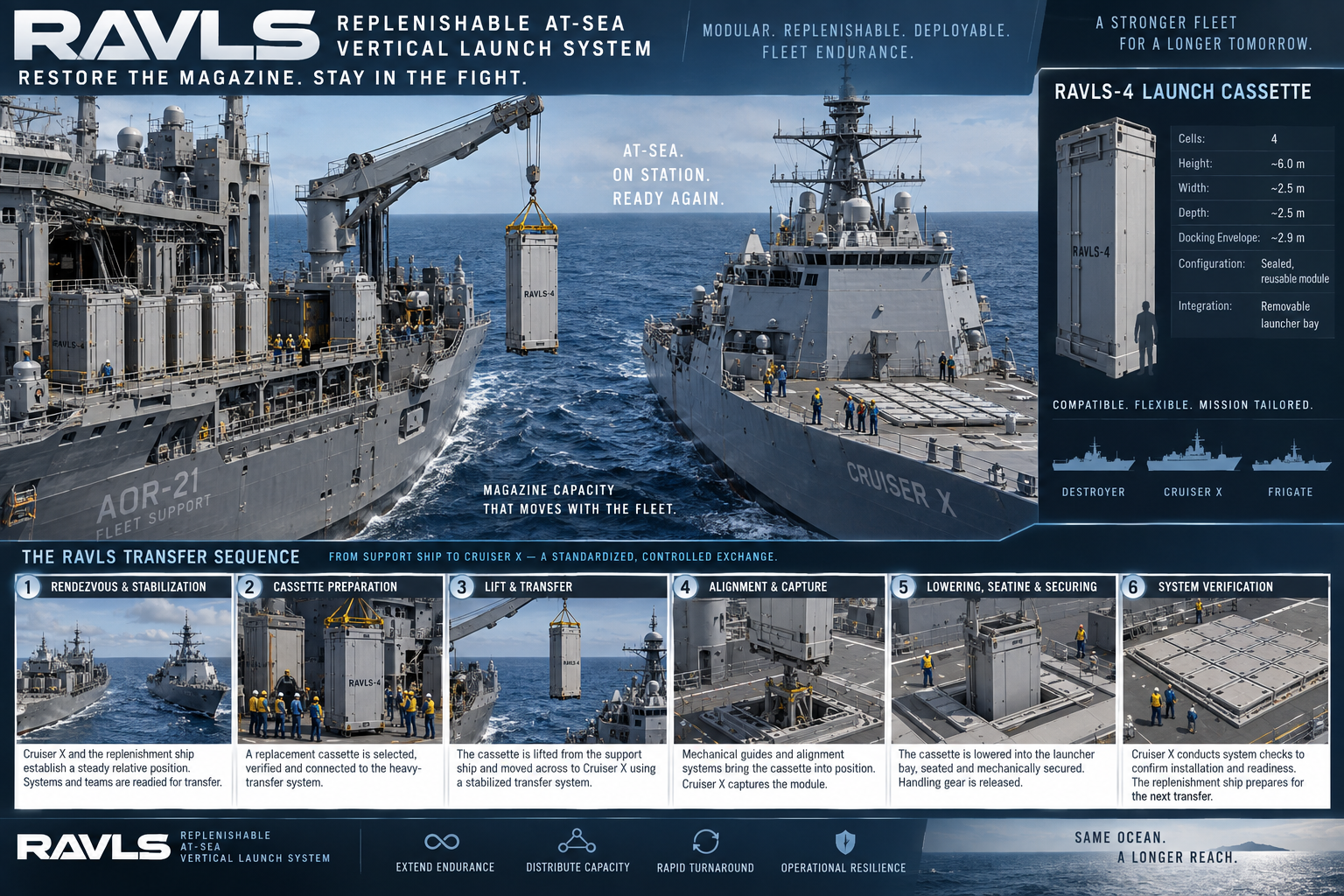
RAVLS-4 MODULAR LAUNCH CASSETTE

At the heart of the system is the RAVLS-4, a reusable four-cell vertical-launch cassette. Each cassette forms a self-contained structural magazine module containing four protected launch positions together with the interfaces required for installation into a compatible shipboard launcher bay.

Baseline configuration:

Designation: RAVLS-4
Type: Replenishable vertical-launch cassette
Launcher capacity: 4 cells
Nominal cassette height: 6.0 m
Nominal cassette width: 2.5 m
Nominal cassette depth: 2.5 m
Docking / handling envelope: 2.9 m class
Installation: Removable modular launcher bay
Replenishment concept: Tender, support ship, depot or naval base exchange
Orientation: Vertical installation
Cassette architecture: Sealed, reusable structural module

Individual launcher and missile configurations depend on the host vessel and mission package. RAVLS is therefore not tied to a single ship class. A compatible combatant may incorporate several cassette positions into its weapons deck, allowing launcher capacity to be scaled according to displacement, mission and available internal volume.

Image


MODULAR MAGAZINE ARCHITECTURE

Traditional vertical-launch systems permanently integrate their cells into the ship, RAVLS instead divides the magazine into two elements:

Shipboard Launcher Foundation
The vessel contains the permanent structural bay, electrical architecture, combat-system connection, environmental services and protective structure.

Replaceable Launch Cassette
The RAVLS cassette occupies that bay as a removable module.

When a cassette has expended its assigned payload, the entire cassette can be withdrawn and replaced with another prepared cassette. This changes the logistics problem. Rather than transferring individual missiles into individual launch cells at sea, replenishment can be performed as a module-exchange operation. The support vessel handles a prepared cassette as a single controlled unit.

WHY RAVLS?

Magazine Regeneration.
A combatant no longer necessarily has to return to port simply because its primary missile battery has been depleted. A support group carrying replacement RAVLS modules can regenerate part of the force's magazine capacity forward.

Reduced Handling Complexity
The replenishment operation centres around exchanging standardized modules rather than repeatedly handling individual weapons at the combatant.

Distributed Logistics
Prepared modules can move through naval logistics networks as standardized cargo units: Depot → naval base → ammunition facility → replenishment vessel → combatant. This creates a more flexible magazine supply chain.

Mission Tailoring
Ships can embark different cassette packages according to mission requirements. One deployment might emphasize fleet air defence. Another might emphasize anti-surface warfare, land attack, or other compatible mission packages. The launcher bay remains the same while the embarked magazine changes.

Faster Turnaround
A depleted cassette can be removed while a prepared replacement cassette is installed. The recovered unit can then be inspected, serviced and prepared away from the combatant.

THE RAVLS TRANSFER CONCEPT

The defining capability of RAVLS is the ability to conduct a controlled cassette exchange between a support vessel and a compatible combatant. The operation is designed around six broad phases.

Image


1. RENDEZVOUS AND STABILIZATION

The combatant and replenishment vessel establish a coordinated replenishment station. Both vessels maintain an agreed relative position and heading appropriate to the prevailing sea conditions. The ships' replenishment teams establish communications and verify that the transfer station, receiving bay and handling equipment are ready. Before cassette movement begins, the receiving launcher position is placed into its designated safe servicing condition.

2. CASSETTE PREPARATION
A replacement RAVLS cassette is selected aboard the support vessel. The module remains secured until the transfer system is ready. The replenishment crew verifies the cassette identification, configuration and handling status before movement. The cassette is then connected to the ship's heavy-transfer equipment. The important design philosophy is that the support ship handles the cassette as a single standardized module, minimizing unnecessary handling of its internal contents.

3. LIFT AND TRANSFER
The cassette is raised from its storage position and brought into the transfer envelope between the two vessels. Depending on the support vessel, the movement may be performed using a dedicated heavy-replenishment crane, stabilized handling system, transfer frame or other compatible naval logistics equipment. The transfer system controls the cassette's gross movement while guide systems limit uncontrolled rotation and swinging. Throughout this stage, the module remains under positive handling control. The cassette is moved laterally toward the receiving ship and positioned above the designated RAVLS launcher bay.

4. ALIGNMENT AND CAPTURE
As the module approaches the receiving position, the operation transitions from gross movement to controlled docking. Mechanical guides and alignment references bring the cassette into the correct relationship with the receiving bay. The shipboard installation structure then captures the module. At this point the cassette changes from being a suspended load to being supported by the ship's launcher foundation.

This is one of the central ideas behind RAVLS: The transfer equipment moves the cassette. The launcher foundation positions and supports it. The heavy-transfer system therefore does not need to perform the final structural integration itself.

5. LOWERING, SEATING AND SECURING
Once captured, the cassette is lowered into its launcher position. The receiving structure guides the module downward until it reaches its installed seating position. The cassette is then mechanically secured within the launcher bay. External handling gear is removed only after the module is confirmed to be fully supported and retained by the ship. The permanent launcher foundation subsequently provides the cassette with the services required by the host vessel's combat architecture.

6. SYSTEM VERIFICATION
Installation does not immediately mean operational readiness. The host ship conducts an automated and crew-supervised verification sequence. This confirms that the cassette is correctly installed, recognized by the ship's systems and communicating through the intended launcher interfaces. Only after the required safety and system checks are completed is the module returned to the ship's normal combat-system architecture. The replenishment vessel can then prepare another cassette transfer if required.

DEPLETED-CASSETTE RECOVERY
RAVLS can also operate in reverse. A depleted module is disconnected from the shipboard launcher architecture, released from its installed position and transferred back to the support vessel. The recovered cassette can then be returned through the logistics chain for: inspection, maintenance, reconfiguration, refurbishment, and preparation for future deployment. This creates a closed-loop launcher logistics system rather than treating launch cells as permanent shipboard infrastructure.

THE RAVLS LOGISTICS CYCLE
The complete operational concept can be summarized as: Prepare → Transport → Transfer → Install → Employ → Recover → Refurbish → Reissue. A fleet could maintain a circulating inventory of launcher modules rather than relying exclusively on the launcher capacity physically installed aboard individual warships. That distinction becomes increasingly important during prolonged operations.

RAVLS SUPPORT VESSELS
RAVLS is intended to operate as part of a wider naval logistics ecosystem. Potential support platforms include:
  • Aammunition replenishment vessels,
  • Dedicated missile tenders,
  • Arsenal-support ships,
  • Fleet logistics vessels,
  • Forward depot ships,
  • and suitably configured naval bases.

A large tender may carry numerous prepared modules, effectively functioning as a mobile fleet magazine. Instead of every combatant independently returning to an ammunition facility, the magazine comes to the force.

DISTRIBUTED FLEET MAGAZINE
RAVLS transforms missile capacity from a purely ship-level resource into a fleet-level logistical resource. A naval task force might contain: destroyers and frigates carrying operational launcher modules,
arsenal ships carrying large combat magazines, and logistics vessels carrying replacement RAVLS cassettes. Missile capacity can therefore be redistributed through the force according to operational demand. A ship that has expended heavily during one engagement can receive fresh modules while another vessel retains its own magazine. This makes the missile inventory of the fleet more fungible, mobile and resilient.

DESIGN PHILOSOPHY

RAVLS is built around five principles.

Modularity.
Launcher capacity should be replaceable rather than permanently trapped inside the ship.

Replenishability.
Fleet missile endurance should not automatically end when the first magazine is exhausted.

Standardization.
The same cassette architecture should be usable across multiple compatible ships and logistics platforms.

Distributed Sustainment.
Magazine capacity should move through the fleet's logistics network like other critical resources.

Operational Resilience.
A fleet should be able to restore combat power without depending exclusively on distant fixed bases.
Last edited by Aeyariss on Tue Sep 22, 2026 2:17 am, edited 3 times in total.
The MOST SERENE EMPIRE of AEYARISS
The Wyvern Empire
International Alliance: (Primary) United Defense Accords|| Other: CSL | SACTO | Imperion|| Region: Kali Yuga|| Misc Link: Database|| UDA Joint War College ||Wyvern Military Industries|| Lore: SoTW

User avatar
Aeyariss
Powerbroker
 
Posts: 7550
Founded: Mar 26, 2010
Civil Rights Lovefest

Postby Aeyariss » Sun Sep 20, 2026 5:59 am


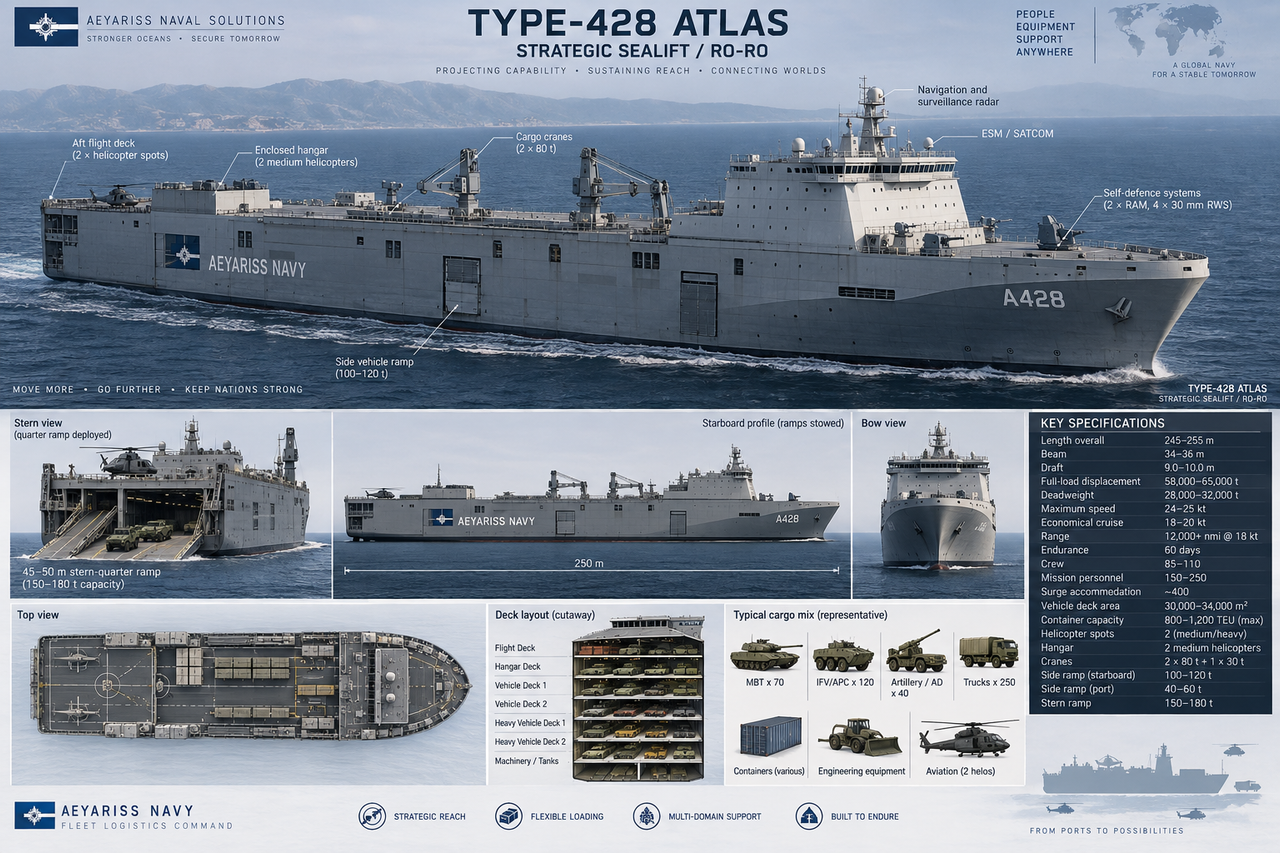
TYPE-428 ATLAS
STRATEGIC SEALIFT MOBILITY RORO VESSEL


Image


TYPE-428 ATLAS — STRATEGIC SEALIFT / RO-RO

SpecificationValue
TypeStrategic Sealift / Large RO-RO Transport
RoleHeavy equipment transport, brigade sealift, logistics support
OperatorAeyariss Navy – Fleet Logistics Command
Length overall250 m
Beam35 m
Draft9.5 m
Full-load displacement~62,000 t
Deadweight~30,000 t
Hull formHigh-freeboard military RO-RO, double-hull machinery/fuel zones
Propulsion4 × medium-speed diesel engines, twin-shaft
Installed propulsion power~50 MW
Propellers2 × controllable-pitch propellers
Maneuvering2 × bow thrusters, 1 × stern thruster
Maximum speed25 kt
Economic cruise18–20 kt
Range12,000+ nmi @ 18 kt
Endurance60 days
Core crew~95
Mission/logistics personnel150–250
Surge accommodation~400 personnel
Vehicle deck area~32,000 m²
Vehicle lane length~8–10 km
Heavy vehicle deck area~13,000 m²
General vehicle deck area~15,000 m²
Flexible cargo deck~4,000 m²
Maximum container capacity~1,000 TEU
Stern-quarter ramp150–180 t
Starboard side ramp100–120 t
Port side ramp40–60 t
Heavy cargo elevators2 × 80–100 t
Main cargo cranes2 × 80 t
Stores crane1 × 30 t
Flight deck1 heavy + 1 medium helicopter spot
Hangar2 × medium helicopters / UAV detachment
Aviation fuelOrganic helicopter/UAV refueling capability
Primary radarMedium-range 3-D air/surface surveillance radar
Navigation radarDual commercial/military navigation radar
EO/IRMulti-spectral surveillance / weapon-director systems
ESMIntegrated electronic support measures suite
CommunicationsSATCOM, fleet datalink, logistics network
Self-defense missiles2 × RAM-class launchers
Close-in weapons4 × 30–35 mm RWS
Light weapons4 × 12.7 mm RWS
Soft-kill defensesChaff, flare, RF decoys, IR decoys
Torpedo defenseTowed acoustic / torpedo decoy
Damage controlZoned fire suppression, redundant pumps, distributed DC stations
Cargo trackingRFID/UWB automated cargo-management network
Typical service life35–40 years
Last edited by Aeyariss on Mon Sep 21, 2026 5:17 am, edited 4 times in total.
The MOST SERENE EMPIRE of AEYARISS
The Wyvern Empire
International Alliance: (Primary) United Defense Accords|| Other: CSL | SACTO | Imperion|| Region: Kali Yuga|| Misc Link: Database|| UDA Joint War College ||Wyvern Military Industries|| Lore: SoTW

User avatar
Aeyariss
Powerbroker
 
Posts: 7550
Founded: Mar 26, 2010
Civil Rights Lovefest

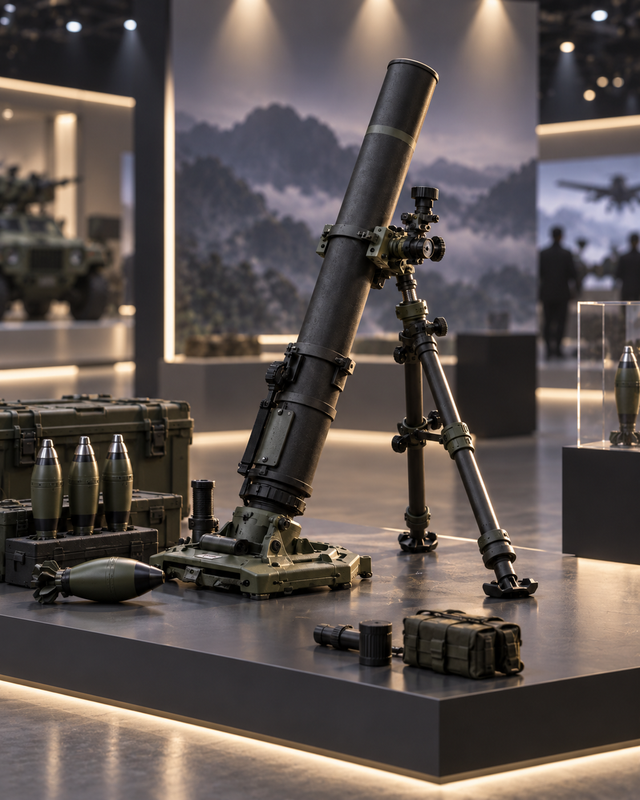
60mm Excalibur Mortar

Postby Aeyariss » Mon Sep 21, 2026 6:12 am


EXCALIBUR
60MM LIGHT INFANTRY COMPANY MORTAR


Image

TypeLightweight dual-mode infantry mortar
Calibre60 mm
Primary RoleImmediate organic indirect-fire support
Primary UsersLight infantry, airborne, air-assault, jungle, mountain, littoral and reconnaissance forces
Unit EchelonCompany-owned, platoon-detachable
Crew2 minimum / 3 preferred for sustained operations
ArchitectureCommon-core dual-mode system
Patrol / Commando Mass~7.0 kg class
Supported Configuration Mass~13.5 kg class
Digital Supported Mass~14.3 kg class
Conventional Range Objective~3.2–3.5 km class
Patrol Range Objective~1.5–2.0 km class
Basic SightNon-powered optical / mechanical sight
Digital Fire ControlOptional removable module
Navigation SupportGNSS / inertial aided, with manual fallback
Network IntegrationDigital fire-mission reception and observer interface
Degraded OperationFully usable without batteries, GNSS or data network
Ammunition PhilosophyCompatible with qualified 60 mm ammunition families
Supported EffectsHE, smoke / obscuration, visible illumination, IR illumination and training
Precision CapabilityFuture-compatible through qualified ammunition and fire-control systems
The MOST SERENE EMPIRE of AEYARISS
The Wyvern Empire
International Alliance: (Primary) United Defense Accords|| Other: CSL | SACTO | Imperion|| Region: Kali Yuga|| Misc Link: Database|| UDA Joint War College ||Wyvern Military Industries|| Lore: SoTW

User avatar
Aeyariss
Powerbroker
 
Posts: 7550
Founded: Mar 26, 2010
Civil Rights Lovefest

Postby Aeyariss » Mon Sep 21, 2026 7:10 am


ZULFIQAR MORTAR
81MM MEDIUM WEIGHT INFANTRY BATTALION MORTAR


Image


TypeLightweight medium infantry mortar
Calibre81 mm
Primary RoleOrganic company/battalion indirect-fire support
Primary UsersInfantry, light infantry, airborne, air-assault, mountain, jungle, littoral and expeditionary forces
Unit EchelonBattalion mortar platoon / company mortar section
Crew3 minimum / 4 preferred for sustained operations
ArchitectureCommon-core three-load supported mortar
Standard Mass~32.8 kg
Digital Configuration Mass~33.8 kg
Normal Maximum Range~5.8–6.1 km class
Extended-Range Objective~6.5 km class
Basic SightPassive optical / mechanical sight
Digital Fire ControlOptional removable Digital Fire-Control Kit
Navigation SupportGNSS / inertial aided with manual fallback
Network IntegrationDigital observer / FDC fire-mission interface
Degraded OperationFully operable without batteries, GNSS or data network
Ammunition PhilosophyCompatible with qualified standard 81 mm ammunition families
Supported EffectsHE, smoke / obscuration, visible illumination, IR illumination and training
Precision CapabilityFuture-compatible through qualified ammunition and fire-control systems
Environmental DesignTropical, jungle, maritime, desert, mountain and cold-weather operations
Maintenance PhilosophySoldier-level routine maintenance with modular accessory replacement


Last edited by Aeyariss on Tue Sep 22, 2026 12:26 am, edited 1 time in total.
The MOST SERENE EMPIRE of AEYARISS
The Wyvern Empire
International Alliance: (Primary) United Defense Accords|| Other: CSL | SACTO | Imperion|| Region: Kali Yuga|| Misc Link: Database|| UDA Joint War College ||Wyvern Military Industries|| Lore: SoTW

User avatar
Aeyariss
Powerbroker
 
Posts: 7550
Founded: Mar 26, 2010
Civil Rights Lovefest

Postby Aeyariss » Mon Sep 21, 2026 7:40 am


120MM DURANDAL
SELF PROPELLD MORTAR SYSTEM


Image
The MOST SERENE EMPIRE of AEYARISS
The Wyvern Empire
International Alliance: (Primary) United Defense Accords|| Other: CSL | SACTO | Imperion|| Region: Kali Yuga|| Misc Link: Database|| UDA Joint War College ||Wyvern Military Industries|| Lore: SoTW

User avatar
Aeyariss
Powerbroker
 
Posts: 7550
Founded: Mar 26, 2010
Civil Rights Lovefest

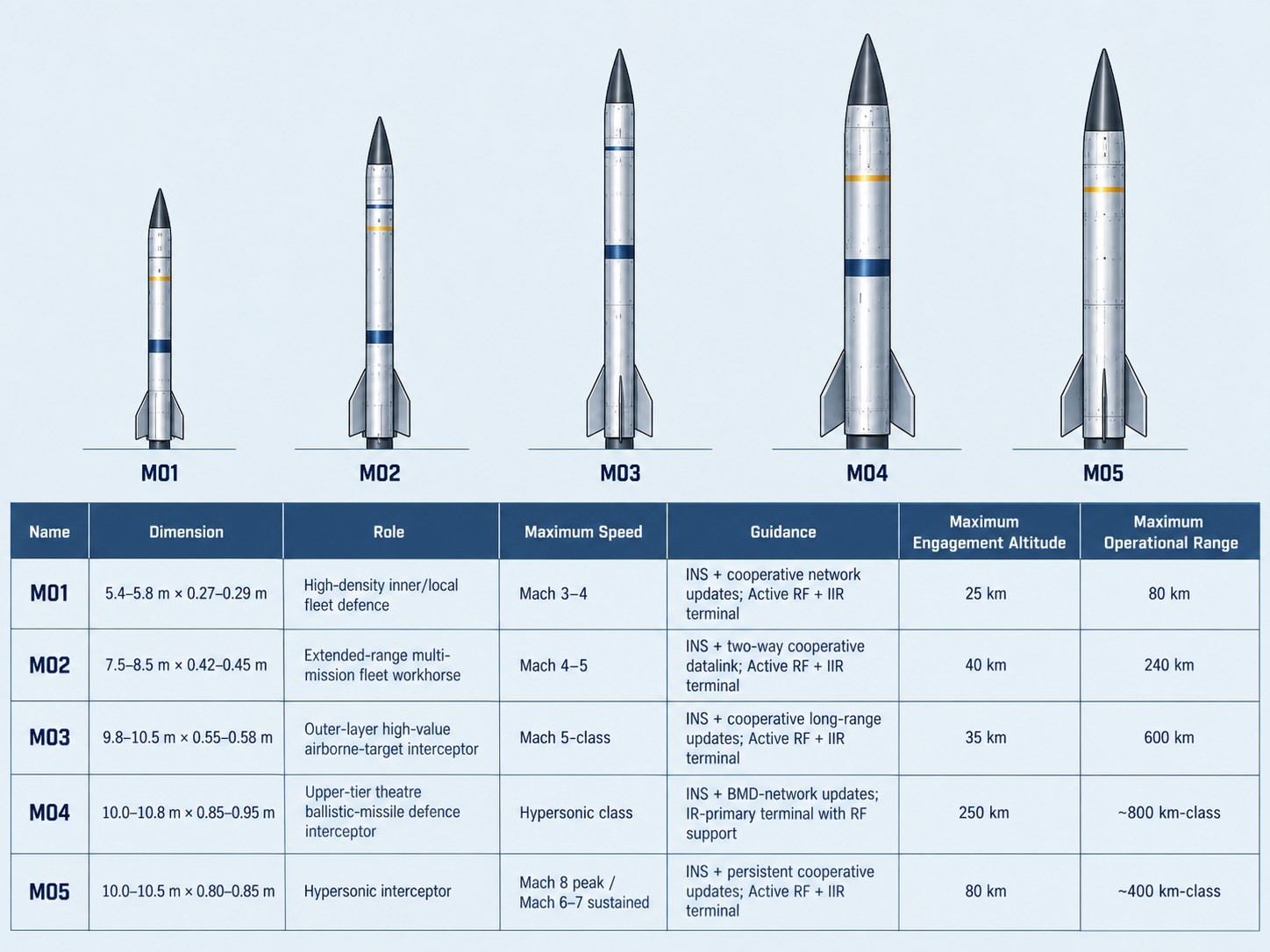
M-SERIES INTERCEPTOR SYSTEM

Postby Aeyariss » Tue Sep 22, 2026 7:39 am


M-SERIES
INTERCEPTOR MISSILE


Image
Last edited by Aeyariss on Tue Sep 22, 2026 5:27 pm, edited 4 times in total.
The MOST SERENE EMPIRE of AEYARISS
The Wyvern Empire
International Alliance: (Primary) United Defense Accords|| Other: CSL | SACTO | Imperion|| Region: Kali Yuga|| Misc Link: Database|| UDA Joint War College ||Wyvern Military Industries|| Lore: SoTW

User avatar
Aeyariss
Powerbroker
 
Posts: 7550
Founded: Mar 26, 2010
Civil Rights Lovefest

Type XA-01 AEW

Postby Aeyariss » Wed Sep 30, 2026 8:32 pm

EXPORT RESTRICTED: Not Available for International Market


Image


TECHNICAL SUMMARY

Category- AEW-XA
Length - 51 m
Span - 60 m
MTOW - ~135 t
Engines - 2 × ~190 kN
Cruise Speed - Mach ~0.75
Altitude - 45,000ft Operating Altitude
Endurance - ~14 h class
Electrical generation ~2 MW

Sensor architecture Distributed conformal AESA / passive multisensor
Air-surveillance range 500+ km class against large targets
Reduced-signature surveillance ~300 km class
Maritime surveillance 00+ km class against large vessels

ISC-1 INTEGRATED SURVEILLANCE COMPLEX
ISC-1 combines active radar, passive electronic surveillance, passive-radar exploitation, electro-optical/infrared sensing, cooperative identification and multisensor data fusion.
ASC-1 Long-range active air surveillance
SSC-1 Maritime, surface and ground surveillance
PSC-EW Passive electronic surveillance / emitter detection
PSC-PR Passive-radar / multistatic surveillance
EOIR-1 Electro-optical / infrared confirmation
CIS-1 Cooperative identification
MCFC-1/FUS-1 Multisensor fusion and battle-management processing
ISC-1 uses a distributed conformal aperture architecture and does not require a traditional rotodome.

Passive emitter surveillance range: (Classified)
Radar surveillance range: (Classified)
EO/IR identification Up to ~100 km class depending on target/environment
Fused track capacity - 3,000+
Coverage 360° multi-domain fused surveillance

Image


Image
Image
Last edited by Aeyariss on Wed Sep 30, 2026 9:03 pm, edited 8 times in total.
The MOST SERENE EMPIRE of AEYARISS
The Wyvern Empire
International Alliance: (Primary) United Defense Accords|| Other: CSL | SACTO | Imperion|| Region: Kali Yuga|| Misc Link: Database|| UDA Joint War College ||Wyvern Military Industries|| Lore: SoTW

User avatar
Aeyariss
Powerbroker
 
Posts: 7550
Founded: Mar 26, 2010
Civil Rights Lovefest

Type XTA-110R Heavy Strategic Airlifter Aircraft

Postby Aeyariss » Wed Sep 30, 2026 9:33 pm

Image


Image
Last edited by Aeyariss on Fri Oct 02, 2026 6:12 am, edited 3 times in total.
The MOST SERENE EMPIRE of AEYARISS
The Wyvern Empire
International Alliance: (Primary) United Defense Accords|| Other: CSL | SACTO | Imperion|| Region: Kali Yuga|| Misc Link: Database|| UDA Joint War College ||Wyvern Military Industries|| Lore: SoTW

Previous

Advertisement

Remove ads

Return to Global Economics and Trade

Who is online

Users browsing this forum: No registered users

Advertisement

Remove ads