


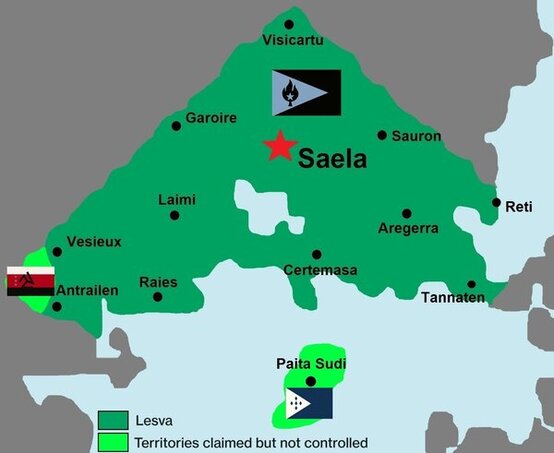
Map of Lesva.
The Lesvan Revolution overthrew the one-party regime of the Throngist Movement Party of Lesva (TMPL) and replaced it with the communal ochlocracy under the new regime's leader Marshal Iuna Scadi, formally categorizing itself as a "unitary de jure direct social democracy under a de facto personalist dictatorship." This new reality has existed in Lesva since the beginning of 2024, as the Revolution achieved its' goal by the end of January, whereas previously the country had to endure Throngism from 2021 to 2024. While the 2010's were not golden in Lesva either, as that was the decade of democratic backsliding and a transition to dominant party authoritarianism, the new decade that came after brought Lesva from authoritarianism into full-blown totalitarian territory. And even with the regime change, the country, or at least the territory that the new regime controls, remains in that reality, just a different flavor of totalitarianism - from one political party's ideological tyranny to mob tyranny. And yet, despite not just regime change but also ideology change, one thing that managed to survive the Revolution, was isolation and the isolationist approach, which seems to be shared by the regime that came before and one that exists today.
The Throngist Republic of Lesva was closed off and its' international interactions were limited to the United Federation of Gael, which is a supranational union with Balnik, and fellow member states of the Eastern Tripartite (ET). Arguably, a breakdown of that crucial relationship with Balnik is what greatly contributed to the fall of the Throngist system in the end and set the spark for the flame of the Lesvan Revolution, as Balnik's "safety pillow" and key support was gone for the collapsing regime, which was once similar and fraternal. The new regime that rose from the ashes, retained the isolationism and arguably doubled down on it, despite being different from the previous regime and hostile to it, giving the predecessors the label of the previous tyranny that the new regime overthrew and "freed the people from." Even with some belief system and policy overlap, the two ultimately different regimes that are mutually exclusive to each other, retain a key feature and that is isolationism. It goes to show that even with different ideologies, isolationism is one of key traits of totalitarianism as a whole because in order to trully build an alternative reality within the borders of the territory you now control, you need to cut it off from outside influences that could corrupt the ideological experiment. And this approach is what the previous Throngists and the current Scadiists share the most, apart from some policies from the Throngist era, which the Scadiists seem to have "retained" from the same people they deposed.
Setting foot in the Peopledom of today is not illegal, except for the citizens of the United Commonwealths of Great Altera. But anybody obtaining a visa and travelling to the Peopledom is a brave soul, because if you do not share the beliefs of the alternative reality you are about to witness by setting foot there, then you risk a lot. And yet, those brave souls, undeterred by danger, end up appearing, which is its' own phenomena of the human psyche and spirit.
