

NATION

PASSWORD

My Kingdom for a Horse [PMT|CLOSED|MAINT]

A staging-point for declarations of war and other major diplomatic events. [In character]
User avatar
Cossack Peoples
Diplomat
 
Posts: 908
Founded: Jul 11, 2019
Corporate Police State

My Kingdom for a Horse [PMT|CLOSED|MAINT]

Postby Cossack Peoples » Fri Sep 18, 2026 2:04 pm

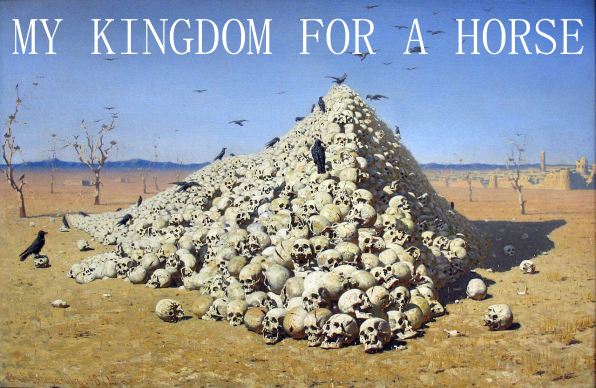
Image


This is an internal maintenance thread for the Federal Republic of Czaslyudian Peoples, set in Greater Dienstad. Do not post here unless directly allowed by OP. Enjoy.


A DAY IN CZASLYUDIYA
"RICHARD III: Slave, I have set my life upon a cast,
And I will stand the hazard of the die:
I think there be six Richmonds in the field;
Five have I slain to-day instead of him."

There is confusion on the faces of the youth. They do not understand how their lessons on their history, from kingdom to colonization to revolutionary, can somehow coincide with what they are confronted with out of the schoolhouse doors. There are colorfully done pages on their history books, exhalting the olive, blue, and red cloaks and flags of their partisans, their martyrs, their forefathers, and on the next page-- or on the block over-- there are slate-grey monuments, statues with severe expressions, smokestacks wedged in historical residential areas. A poster across the street announces how it all represents progress. Politicians declare on the boxy television sets from yesteryear "Life has become more joyful." At the end of their schooling, faced with a choice between menial labor and military service for social advancement-- higher education is nearly inaccessible for non-veterans-- it does not show on their faces.

There is acceptance on the faces of the mature. They have a longer memory than their offspring. Some of them remember their own parents, many of them veterans of a war that decimated their generation and gouging deep and still-visible wounds on the landscape. They remember themselves the confusion of the Commonwealth, the confusion and terror of the early Federal Republic, but they got over their confusion. They lost their farms. But rapid industrialization meant they had good jobs. Military service, by then mandatory, gave them benefits and the ensuing governments kept laying the benefits on. It was far from perfect-- the air was pisspoor, their benefits affording them only the smallest comforts, but they suffer what they must. They see what they have and remember the dirt floors of their family farmhouse-- they are content with their three bottles of Ozhdukh* a week and mostly functioning heating.

There is a disease readily apparent everywhere you look. Patriotism here is negative, rather than positive. The services describe enlistment as an honor and an opportunity, both to take in drifting young men and women and to repeatedly inform enlistees what all the sadistic suffering they endure is for. The young are overrepresented in sports, underrepresented in government. The retirement age does not seem to apply to bureaucrats and career politicians, who wear the medals of wars long since passed as if those pins stuck them to the council chairs they sat in. The poor hate the rich, the rich hate the government, the government hates change, and change they say hates the poor. Government programs provide for much, but they can only provide so much. The wonderful free market means people are paid more and they afford less. All the while, the largest factories and centers for productivity-- all deemed essential to national security-- are managed by the government. The economy is growing, but taxes and poverty remain the same old problem. The army takes in people of all classes, races, and creeds. They have no other choice. The machine needs to be fed.

There is a rot readily apparent under every foundation. The capital may be in a new city, nearly out in the countryside, but is it not telling the former capital is a husk of its former self? The grasslands are turning to deserts, they project, in the next fifty years; however, desertification is a pillar of the community and provides many jobs. The healthcare for the privileged is through the military, and 'paying taxes early' gets one even more privileged care. In the west, Raskovya and Minstravia operate as if they are separate countries. They are begrudgingly Czaslyudians, wearing their own uniforms and their own customs. The national government is all that is ever shown on the television sets and social media. Nobody questions the obtuse prices put on renovations to District administrative plazas.


An ideal Czaslyudian is pious, industrious, and honorable, like the knights (husar'skyy) of medieval legend. For this, the stereotype mostly holds up, except with the omission that it is said that there can be no more quarrelsome, individually unambitious, and pedantic a people to walk the face of the Earth than the Czaslyudian. It would be well to terminate the discussion on this point, however, it ought to be said a "Czaslyudian" is a myth. As any ever-contentious inhabitant of Czaslyudiya would tell you, under the veneer of the 'Czaslyudian' is a hodgepodge of cultures, some of heredity indigenous to the land, other heritage Czas inserts, and still others of Ralkovian make and their census-designated blends, set apart from the rest. Each believes themselves to be the inheritor of the land, which has led to too many significant brawls that found their origin over a chat during tea.

It must be said, however, that there are clear signs to who derives the most advantage from possession of the land, and the answer lies certainly not in the genetic stock of the inhabitants. The revolutionary cadre that won the country passed their torch to what was left of the country. They inherited cinders and a beaten people. But where individuals were sallow and quashed, aggregates arose. Those were the pork barons, the military, and the unions. Soon, great influential figures drove through the military and unions the first great Czaslyudian ideology-- it killed hundreds of thousands through starvation and unrest, blood paid in exchange for industrialization. The ideologues soon died off, martyrs to a obsolete cause, leaving only the aggregates-- blood, industry, ranchers, unions, and soldiers. Like a rising of the tide, recent history has shown there to be those at the margins, filled with inexplicable pompousness and pride, who wish to change this deadlock, and others who, tempered by years and the reality of managing such a land, wish to keep it the same. And so it was to any who remember, and to anyone with their eyes lifted from the ashen streets they walk, so it remains.

It is a new day in Czaslyudiya. A day worker breaks their fast before dawn with a meal of strictly regimented budget tea, soft cheese and cured ham before scouring the main industrial district throughway for their day's pay, from adding to the ever-expanding scaffolding throughout the city's aging concrete to working in sweltering-hot warehouses moving intermediate goods from shelf to train. A man in a stuffy and bland tweed suit his father wore takes their neobkhidnyy† as they settle into their windowless cubicle, ancient lights that will not be replaced anytime soon casting their last sunset over their memoranda and reports on affairs of state. A gang of Federal Militia, identified easily by their antiquated plain olive fatigues, sleepily exchange bullets for coins and coins for cigarettes beside an idling truck as old as any of them, enjoying their rural reprieve as they drift through their day of state service. Everyone, everywhere, seems as if they are sleepwalking.


* - Ozhdukh. Czaslyudian national liquor, clear or slightly violet color. 30% ABV. Distilled from Brusnytsyn, Czaslyudian dewberry wine.
† - neobkhidnyy (Czaslyudian: 'necessary'). A preparation of coffee common in cities among the white collar professions, using 3 ounces of espresso and 3 ounces of typically Ozhdukh.
Last edited by Cossack Peoples on Sun Sep 20, 2026 6:38 pm, edited 5 times in total.

"You give a monkey a stick, inevitably he’ll beat another monkey to death with it."
— Sadavir Errinwright, Expanse S2E12
"Вечнасць для Czaslyudiya!"
Federal Republic of Czaslyudian Peoples

A corrupt, Post-Soviet anocracy whose de facto third branch of government is an arms manufacturer.
Sponsoring this signature
We're also the Czaslyudian Peoples now. Don't ask.

User avatar
Cossack Peoples
Diplomat
 
Posts: 908
Founded: Jul 11, 2019
Corporate Police State

Postby Cossack Peoples » Sun Sep 20, 2026 11:04 pm

SEVYICH, FEDERAL REPUBLIC OF CZASLYUDIAN PEOPLES
Smoke filled room.
There are threats, and there are risks.

Any fool who knows how to keep their head above water in the Czaslyudian bureaucracy knows how to balance them. There is a reason the bureaucrats are the one enduring feature of the government, surviving regime change, two civil wars, and the change of administrations like the passing of seasons. The object of the bureaucracy is not efficiency or responsiveness, it is, apparently, perseverance. Bureaucracy is the first form of biotechnology, having flesh and blood perform mechanical and mind-numbing tasks ad infinitum. It is a technological field that the Czaslyudians pride themselves in being foremost in.

Still, there is the element of nature to every aspect of life. Disease preys upon the cells and organs of living beings, not because it is malicious or predatory, but because that is what the groove they were set in, the way the cogs of their God-created machines were meant to spin. A cog in the machine does not question its purpose, only that it knows to perform its function. Likewise, in even a bureaucracy there is a competition for, if not life, then livelihood.

The individuals around this table were some of the most rapidly-ascendant machines to rise above the cacophony of the bureaucracy. Cutthroat, methodical, and with complete confidence in their decisions. So cut-throat, and so confident, that even while at the final possible point in their career advancement, they jockeyed with one another as if to rise even further by subsuming one another's office and role. Thankfully, mutual distrust and the balance of office politics, like a microcosm of geopolitics, kept each one in check, being cut down in proportion for their every overreach. This was the 'One Committee', the longest standing institution of Czaslyudian politics and natural evolution of the classical war councils, which had since been adopted by ancient king and rifle-toting revolutionary alike.

The One Committee was a congregation of military officials, with one of each main service, members of the intelligence community on the side of government of the Principle Chairman, and those in the employ of the foreign service. It totalled eleven chairs, from functionaries of the Office of the Principle Chairman to a pair advising on foreign policy with the Department of Foreign Relations, and finally six individual chairs, each occupied by a chief of a segment of the Czaslyudian military. An exercise in bureaucratic resilience would be to read each of the placards of the officers sequentially and not get any mixed up: PRINCIPLE CHAIRMAN; CHIEF OF STAFF; SPECIAL ADVISOR TO THE PRINCIPLE CHAIRMAN; CHAIRMAN OF THE DEPARTMENT OF WAR; CHIEF OF THE GENERAL STAFF; CHIEF OF LAND FORCE OPERATIONS; CHIEF OF NAVAL OPERATIONS; CHIEF OF AIR OPERATIONS; CHIEF DIRECTOR, USDR; CHAIRMAN-MINISTER; CHIEF DIRECTOR, DIRECTORATE FOR FOREIGN POLICY ANALYSIS AND STRATEGIC COMMUNICATIONS. Eyes blurred, but eleven chairs was the most concise council a Czaslyudian head of state could convene. The One Committee was so called because the entirety of the head of state's tasks could be completed here, and policy diligently deliberated and executed.

A digital clock in the corner of the room, providing the only indication of time to the denizens to the underground structure, loomed over the walnut-backed chairs and elliptical conference table. Never had an abandoned nickel mine looked so good, though the reinforced concrete that served as the backbone for a facade of wood paneling did little to detract from how inhospitable it felt some hundred meters underground. The arrangement of the chairs around the table reminded one of how tribal leaders would adjourn their councils, cross-legged as equals and swords and bows in their laps, only room enough between them for a dim fire. However, when the time had come, only ten seats were found occupied.

"Where is he?" Came a gruff military voice, accustomed to punctuality.

"Currently held up in Vedrosya. He won't be able to make it, and has instructed us to carry on in his stead." Came the return promptly, originating from not the head, but very near the head of the table. Beside an empty seat, a bloated, splotched tombstone of a man sat, dressed in foreign synthetic-thread business casual. His face was ringed by the wispy tentacles of a white beard, like a stained-glass Czasarian saint, and his head was clear from his brow to his nape. Before him was the placard of his position-- Special Advisor to the Principle Chairman-- but everyone knew him as Dr. Rudnitsky, the veritable guru to the Principle Chairman and his colleague, Moisei Saldadze, also present behind the looming title of CHAIRMAN-MINISTER.

"This is highly irregular," spoke the armed forces' Chief of the General Staff, Barvinsky, "we cannot start deciding on a course of action without clear guidance from Principle Chairman Pelsh."

"Seconded." Added the Chairman-Minister, impatiently.

"Official instructions were wired to Olya Yevhenovych* by the Principle Chairman, they set the agenda. We are to discuss and arrive to a consensus, which we will securely wire to the Principle Chairman for his approval." The tombstone replied, undisturbed. He motioned to the senior adjutant, just across the single jarringly empty chair, who withdrew from their possessions a stack of papers, then duly disseminated them.

The papers displayed the proper authentication, demonstrated the style and 'distinctive' diction of their superior, and made no pretense of politesse or other frivolities. It read, in clear print across the top of the body, "ON THE ESCALATING STRATEGIC SITUATION."

Slight murmurs arose between the sects-- the Chairman-Minister and his number two in this chamber, the service chiefs amongst themselves while the Chairman of the Department of War and chief of its General Staff exchanging sharp words, the sole foreign intelligence figure pivoting between the two. Those from the Office of the Principle Chairman, centered at the head of the table, sat headless without the absence. "If we have given enough time to review the agenda of today, I feel it prudent, my friends, to establish a clear presidency over the affairs today." The tombstone spoke succinctly, as if saving every extraneous bit of breath.

There were scowls. Barvinsky was the first to speak. "Now, this is highly irregular. Seniority and the subject at hand would designate my colleague, Chairman Stratan, and the Department of War foremost on this issue."

The tombstone's breath rattled as he sat back into his chair. "The Principle Chairman has decided, due to the severity of the situation, of a need for a civilian to lead this council and exercise restraint. Due to the subordinate responsibilities of most here, it was determined that the best option for a clear chain of command would flow from my office, that of Special Advisor." The chamber shifted uncomfortably. Each minute in this compound, it seemed, revealed an even more discomforting fact than the last. "Now, I have been empowered by Principle Chairman Pelsh to proceed. We are so informed by a report that tovarysh Chornovil's directorate made late last night that there is credible intelligence that the Theocratic Matriarchy is planning a great provocation in the Shartourn Sea. If they succeed in their intentions, this will obviously pit two of the strongest tsentralit in the region against each other in an open war, something that has not occurred in some time. The fragility of the regional order may finally be broken." Pausing for a breath, and wiping the corners of their mouth with a red handkerchief, the large figure looked from their papers toward the others in the chamber, who returned grim expressions. "Now, the Principle Chairman is not irresponsible for not being in our midst-- currently, as he has informed me, he is predisposed on another matter of diplomacy."

"Was supposed to be back by now." Interjected the Chairman-Minister.

"I've been informed they've hit a snag." A snag, or perhaps a major difference in policy between a Solisian and a Czaslyudian some eight-hundred kilometers away in a secret meeting on the outskirts of Maksima. Ideally, it would not be over the principal issue: whether or not to go to war. "In any case, the Principle Chairman has impressed upon us to begin sorting out what is to be done, now, while those crucial negotiations are underway."

The raincloud of a personality that was the head of the foreign intelligence, Stepan Chornovil, tilted his head in thought as he twirled a freshly-lit cigarette. "I am not in opposition. We better get a damn start before we're behind." Barvinsky, Saldadze, and the other dissidents subdued, the tombstone left one last death rattle of an exhale.

"Then, we should begin." Rudnitsky cut. "Tovarysh Chornovil, perhaps you can begin with the state of our intelligence?"

Taking a hit, the deflated Chief Director sighed impatiently. "The USDR in the recent past gained an intelligence asset in the Eitoan foreign service-- codenamed EMILIA-- who is sympathetic to our people and our cause. They are a valuable source of high-impact intelligence, which we've been verifying since. In the last 24 hours, they made a dead drop to their handler revealing the Marshites were gearing for a provocation, in the hopes of instigating a war to rid the Ordenites from the Inner Seas. Just this morning, that is corroborated by submarine SIGINT that we have stationed in the theater as well as satellite intelligence reporting large fleet movements. By our estimates, between the Ordenites and Marshites, there's close to a thousand surface combatants between the two of them, not to mention what they have on their shores. The Shartourn looks to be a littoral bloodbath. Our intelligence, with high confidence, suggests that the focus of the blockade and the fleet movements is to topple the De Vega regime in Locelea. They will, by the correlation of forces it seems, be successful."

Barvinsky cut in. "What about the force posturing of the Ordenites? Has there been any significant change? Do they mean to commit to the Shartourn fight?"

"They certainly mean to hold bulwarks like Fustera and Potthan, particularly so they do not fall into Marshite hands. From their force dispositions, they are on the defensive in this sector."

There was a silence, about of half a minute or so. Then, flexing his hands together, the foreign minister spoke. "The stakes are clear-- how does that pertain to us?"

Barvinsky was quick to speak. "The conflict will be our long-awaited opportunity to reset the balance of power. In the chaos, we will finally have freedom of maneuver without fear of unilateral great-power retribution." The Chief of the General Staff was clearly agitated, although it was unclear about what. The chief of the Czaslyudian Stavka, Henshrada, was in charge of every military preparation dictated by policy. If there was an upheaval in the international order, the diplomatic and economic routes that so often overrid his apparatus' efforts would not be so desirable.

"Tovarysh Barvinsky is correct." The tombstone spake. "It should be made clear that the Principle Chairman goes to Maksima to assemble our allies and vote on whether we engage in war this year." Sensing a hint of listlessness in the committee, he continued, "I will hear your opinions. Dissent will be recorded and included in our report to the Principle."

The Chairman-Minister, sitting counterclockwise to the tombstone, began. "War to excise the tsentralit, as you call them, from our hemisphere will necessarily mean a drawn-out affair, involving many combatting many alliances several times our strength and financial status. " Saldadze's voice wavered as he reached for a glass and a pitcher of water. "I believe war is not in our capabilities, not on this scale, and not with our commitments elsewhere. Our fiscal situation is dependent on trade, and as we carve out some allies and double the number of enemies, we will find it increasingly difficult to find customers for gas, for example. TISEP† will crumble the second combat operations begin in our Inland Sea, and will likely be a convenient target. As a Potthani once said, war is more a matter of money than arms. At peace, we have a lot of flexibility for investment and loans-- although they are part and parcel to an empire system we claim to oppose, most of the banks and financial sector of the region resides in Central Greater Dienstad. What I mean to say is that we would be hard-pressed to find sources of funding to remain remotely solvent. Victory or defeat, after this war we will not be financially independent-- if not to the same powers we throw stones at, then to others in the west. I vote no."

The tombstone grimaced, but said nothing. The Chief of Staff spoke out of turn. "I vote yes." Matevusheva spoke slowly, eyeing her compatriots as if gauging their reactions. She was a bureaucrat, more responsible for the office and official image of the Principle Chairman than any dealing of strategy or foreign politics. Yet still, each word was resolute, like a good politician. "Every time the Principle Chairman has set out a policy for the region to follow, every diplomatic and economic action is deliberately undermined and competed against by our southerly neighbors. The northwest will always be divided and in ruin unless it follows a common goal. The Republic of Eitoan has always sabotaged the Principle Chairman's policies. If policy fails, there is little solution other than force. This could be a chance for us, our nation, to remove obstacles to Zmyletina and Rozshyrennya's development. The nation is ready-- Varathron and the Periphery are dragging on too long, and a victory here, where anyone can find the battles on a map, would be an incredible boon to this administration. We... well, that is my opinion."

Stratan, clenching and unclenching his jaw this whole time, raised his hand to speak. The Chairman, his position some blurred point between civilian and military, apparatchyk and military advisor, was known to support some of the Principle Chairman's expeditionary ambitions, particularly in reshaping the armed forces to support this mission. When he spoke, it was like a low growl of a lynx. He could have been speaking out of a tube in his throat and it would have surprised no one. "My vote is yes. We have the means, the plans, and determination to succeed on the battlefield. We are numerically inferior ourselves but we have many allies. Our forces are, anyhow, accustomed to fighting at a disadvantage and the shock and initiative that the Czaslyudian warfighter displays puts us primus inter pares. The war is inevitable, although acting with conviction now will gain us opportunities we would not have if we waited for the war to inevitably grow and lash out at us and our interests. There are high risks, particularly when their outcomes decide how permissive our neighbors and near abroad are to Czaslyudian interests in the future. If we are bold, we could permanently put an end to the threat of the Eitoan axis, and finally we can be in an environment where our security is assured. If we continue on, worried about budgets and costs, we will be forever neutered by the presence of the proxies of Macabean bankers. Let's remember why we are fighting this war-- we are doing so because we need to fight. Otherwise we will never secure our interests and will never earn the prestige we need to lead Zmyletina on its own path. If the present is when they have determined a time for fighting is, we will fight them without scruple and show them who we are."

The civilian gave way to the military head. The Chief of the General Staff started slowly, but gained more and more speed. "A war with Ordena or the Mar'si necessarily invokes their alliances with Istoloa or the Macabeans. If the Macabeans are called upon, they will see our opposition to the Marshite plans and summon their ally, our neighbor, and its entire rotten dominion. It would be prudent to avoid all this-- fight just Berlina, sparing the Theocratic Matriarchy. But if we leave the Mar'si to strengthen its hold, and in fact enable them to seize the Inner Seas by opposing the totalitarians-- our natural buffer zone to their games of imperialism-- who do you think the Mar'si will turn to, open and willing to accept their patronage, in order to consolidate the northern frontiers of their domination? The conflict of Ordena against the Matriarchy must ultimately become a conflict against Ordena and the Matriarchy. We must go to war-- however, we must go to war only when wise, and only against one or the other. Our gravest threat is our nearby seas becoming anything but our own, and our need for trade becoming the leverage used to control us and bring us into some other sphere of influence. Although the Ordenites and Macabeans have tried, their attempts have been impermanent due to the vastness of the Northern Vanguat. Instead, the greatest risk of our fears coming true come from the Eitoani. With our allies in support, there are many stumbling blocks and swamps along our path, but victory is attainable. It will not be easy, but the reward it will bring outweighs any risk, in my calculation. My vote is yes." With this, the quintessential officer leaned back in their chair.

The individual service chiefs were wont to show off before their nominal superiors, but in this instance they refrained. The Chief of Land Force Operations, Mankin, voted yea. The Czaslyudian Land Forces were ready, considering themselves more than an equal to Eitoan and any other NMAA ally combined. He remarked that the Eitoans had not nearly enough general officers to even manage their paltry millions of men-- they had colonels doing the jobs of marshalls. The Chief of Air Operations yea as well. Pravilov sauntered on about new doctrines, new equipment which gave them an edge over their enemies, even the Ordenites. It was perhaps not to be believed. The Chief of Naval Operations, Yurchenko, was more sober.

"The Sea Forces will be the lynchpin of any of our plans. Without it, any war on land will not succeed. We have greatly increased in numbers in the last few years, and our capabilities have tripled, but we cannot afford to spread ourselves across the theater like we see our adversaries. Our strength lies in the survival of our fleet-- if that is taken away, we have nothing. This is too much risk to incur, and if we fail we risk everything. My vote is no." Yurchenko was the only one among them who had fought in a war with another nation. For it, he earned the Medal "For Naval Merit", which he fidgeted with anxiously.

The second figure in foreign affairs then went and said her piece. It was short, with a distracted focus. In the end it amounted to the pithy statements, "Action is perceived better than inaction. We can only get the respect we need by acting. I vote yes."

The Chief Director of their foreign intelligence glared at each of the speakers, crushing the butt of the cigarette between his fingers as he twisted it around, and around, and around. When it came his turn to speak, he gave each of them a hateful look and extinguished his cigarette. "I vote no."

After a silence, the tombstone began to badger him. "If you dissent, you ought to provide your reasoning."

His jaw clenching and unclenching, as if contemplating his next words, he settled firmly, "No."

Over the course of the war council, the room began to feel oppressively hot, the air damp and heavy like an old shed. The older members of the committee, of which there were many, clearly felt it. For a moment, some could smell sulfur, only for the scent to disappear. For some, their skin tingled. Their heartbeats fastened. The tombstone at the head of the table (nearly the head of the table), apparently unaffected, nodded stoically as he tallied the votes, on column for 'yea', a much smaller column for 'nay'. Noticing the pause, he looked up and saw it was finally his turn. "I have already justified my decision to the Principle Chairman. I vote yea." And with that, one more mark on that single page of a legal pad, Czaslyudiya voted for war, 7-3.

Matevusheva and Rudnitsky began to gather their belongings. Rudnitsky spoke without looking up. "I will relay our decision to the Principle Chairman. We ought to recess, for the time being, and we will begin planning when the Principle Chairman returns from Maksima." As the room began to empty, a lone figure remained slouched at their seat. Moving their hand from their medal to a silver pendant around their neck, they spoke a silent prayer.


* - Diminuitive and patronymic of Chief of Staff, Olena Yevhenovych Matevusheva
† - Trans-Inland Sea Energy Partnership, featuring Czaslyudiya and Stralkovia.


VLADARSIK, REPUBLIC OF EITOAN
Evening in the apartment.
Cozy?

A man stumbled into his apartment, tired and thankful for the rest, but not yet free. The open door lit the room, revealing a clean place-- not an absence, but certainly a scarcity of decoration. There was only a place to set one coat, and one hat, immediately next to the door on a hook. Across the room, wall-length windows showed the man how life in Vladarsik went on without the man, in its brilliant lights and churning, never-ending rhythm. Sighing, he trudged through and closed the blinds, dimming the outside world somewhat. Closing his eyes, he felt the weight of identity lift from his shoulders, at least somewhat. Now, he was just a silhouette, a blank figure without a face or a name.

His attention turning toward the natural, he set out through his apartment, navigating furniture and hazards blindly, yet still found and pressed his finger on the mezuzah on the way to the kitchen. He undid his cuffs and rolled his sleeves, letting cold tap water wash over his hands, lathering soap diligently, ritualistically. The man took simple pleasure in ensuring the cleanliness of himself, his home. It was one piece of worldly assurance he had-- that his hands were clean, although his heart felt filthy. Recovering ingredients from the fridge, and finally relenting from anonymity and turning on the stovetop light for his work, EMILIA, the highest-level intelligence asset the Czaslyudian Federal Republic had ever gotten on a foreign nation, began the process of resuscitating leftover gnocchi with creamy mushroom sauce.

Betraying his country was a change of careers he had not pictured for himself. He was a diligent, hard worker that rose through the ranks quickly. He did not take stake out many personal attachments that his colleagues did, so was less distracted, more effective, and more driven. It was all he had. The gnocchi was still too cold. He stirred. He had been in their intelligence bureau long enough to gain a fairly good picture of what was going on within it at any time-- the compartmentalization of information in his division no longer applied to him, as he was officially a security risk to move outside the country. It was cold. He remembered early in his career, a counterintelligence officer coming to speak with him, routinely or otherwise. The officer probed his romantic history-- paltry-- his financial situation, his political beliefs, his career aspirations. It was vexing to see the mocking smile, however quickly suppressed, when he gave his frank answers. How was he in the sad situation? He was doubtlessly more upwardly mobile than the lowest-rung counterintelligence officer. Nevertheless, this man who would be known as EMILIA received commendations for his work, piecing together Ralkovian organizational structures in real-time as military forces whittled them down. He moved from being a targeting analyst to overseeing a division of them-- from there, he ascended to be the head of the regional bureau. Still, without personal attachments. Still, the fucking pasta was too cold. He was perhaps the greatest intelligence officer the country had, but that gained him no traction when it came to the insufferable social games he had to play with Vladarsik bureaucrats and politicians, drinking sparkling wines he had no love for and speaking about inane nothings. A consummate waste of time, but when he stormed out of one of these mixers suddenly his career came to a halt, for the longest period of stagnancy it had ever faced: three years, four months, eleven days. Suddenly, all he had was not enough. The walls of his bureau were closing in on him.

One night, trying once to escape-- to breathe-- a nearly manic social atmosphere in the embassy quarter, he encountered a puzzling figure. A figure in a cheap suit and a tousled head of black hair-- cut to military length-- approached him and attempted to make small talk. It was the most obvious proposition by a foreign intelligence body he had ever seen, at least in person. Still somewhat bewildered, and partly not wanting to return to the social just yet, the man heard out the one who spoke with Czaslyudian undertones in his otherwise grammatically perfect Eitoan Dienstadi. There were the obvious appeals, veiled behind the usual diplomatic twisting and contorting of speech; money, ideology, sympathy for the FRCP, an underdog, and women, as if this agent didn't realize he was offering a financial burden in the same breath as a subsidy. It was so bizarre, so bewildering, and so pitiful. It was so pitiful that when by 'chance' meeting again in transit, he took the first offer of money he got. He did not need it. He needed more space to grow into, and his current job did not offer it. The money occasionally went out in the trash, though he was careful to conceal it within other refuse.

If he had known his codename was 'Emilia', after some minor figure in an obscure Stevidian play with archaic notions of race, perhaps he would have been upset. But it had given him more to do.

For example, how to launder intelligence.

EMILIA sat on their sofa, twice-vacuumed that morning, and cracked open a copy of Magic Wand: Gifted Children-- he shuddered at the selection, as there were certainly a great many other Tangatarehuan authors of significantly more merit-- and palmed through the pages until he found what looked to be a bookmark-- nothing more than a white rectangle of index paper, blank on both sides. However, tracing it reveals its grooves, which were a series of randomized ciphers. With him, however, which was probably the only damning evidence he had in his apartment, was a codebook for one-time pads. With the key for this message, he was able to translate the small, discrete message. His handler had decided to choose a public library EMILIA frequented-- although he had warned his handler that they simply did not look the type to frequent a library and would only draw attention to himself-- as the way to pass information to EMILIA. The handler would have an agent drop off a book with coded messages secreted in its pages through an innocuous forgotten bookmark, and if there was a message waiting for him, he would see an agent selling only fresh strawberries and cherries from Shekana on his daily commute. Then he would know to return whatever book he had last and move to the next book on his reading list. If he had anything to drop off, it was a simpler format of him sticking a thumbdrive on the inner part of a mailbox near that same library. The message, however, meant he had information, and more than that, marching orders. The thing he loved about encoded messages is that there were no pleasantries. They just got straight to the point.


25 7 16 6 18 2 5 11 15 17 17 20 4 6 15 18 2 4 22 14 6 7 20 14 13 24 23 5 4 19 10 2 22 11 26 6 21 14 18 22 1 15 9 4 22 1 18 12 15 24 17 16 25 25 23 19 5 26 16 8 6 26 19 22 3 16 25 26 18 13 17 21 13 17 16 1 18 5 17 18 18 15 24 4 15 8 22 24 21 21 6 23 21 5 5 1 4 5 7 16 11 14 11 17 9 15 21 22 3 17 8 18 9 4

HARAZH INTEL GOOD -BREAK- BRAVO -BREAK- ORDER MISSION DISINFO -BREAK- TIME PENDING -BREAK- CORROBORATE CARDINAL PRIORITY IF WAR CONQUEST VIZIER -BREAK- COMMIT
END

The answer, of course, to how to launder information is to leave it to someone to find. It is somewhat easier than money laundering in some ways-- you do not require a full business to support the venture. Rather, you simply have to be part of a spy ring that had a few cooperative Czaslyudian double agents. The Eitoani foreign service, believing themselves to have a motley bunch of Czaslyudians from different walks of life-- to say nothing of the actual Czaslyudian agents of the Eitoani-- at their disposal, will receive word from Sevyich to start harping up a narrative-- this dockworker reported talking to sailors who said they "weren't not going far", a businessman apparently got a gentle intimation that the right place to be in the near future would be the Eitoani side of the border from a colleague then in the armed forces, an indulgent adjutant to the Czaslyudian embassy in Agar, greedily raiding the reception hall's drink trolley, admitting softly the Czaslyudians would prefer one quick war as opposed to a long one; also a war against just the one state rather than all of them. Handlers passed this information back to their office in Vladarsik, and in Vladarsik certain strings could be pulled to highlight certain bits of intelligence, playing up the validity of one possibility: Czaslyudiya would attempt to swiftly subdue Eitoan on the outbreak of war between their nations.

The ashes of the encrypted message on his modest coffee table, EMILIA sat back relaxedly, his face blank as he mashed the lukewarm pasta between his molars. He liked how he was now. Faceless. Unknown. Schrödinger's cat in a one-bedroom box apartment. Underneath any responsibility known to man. But he knew a chain bound him-- bound him to the streets dozens of meters below, bound him to his mediocre case officer, some world away. And as much as he pressed, surged upward, he knew what awaited him. Burning taste of wine and faked smiles, a kind of torture he would never wish to subject even his worst enemies. Although he was not the man enslaved, the figure in the dark knew he would never be free.
Last edited by Cossack Peoples on Sun Sep 20, 2026 11:18 pm, edited 2 times in total.

"You give a monkey a stick, inevitably he’ll beat another monkey to death with it."
— Sadavir Errinwright, Expanse S2E12
"Вечнасць для Czaslyudiya!"
Federal Republic of Czaslyudian Peoples

A corrupt, Post-Soviet anocracy whose de facto third branch of government is an arms manufacturer.
Sponsoring this signature
We're also the Czaslyudian Peoples now. Don't ask.


Return to International Incidents

Who is online

Users browsing this forum: Lhazastan

Advertisement

Remove ads