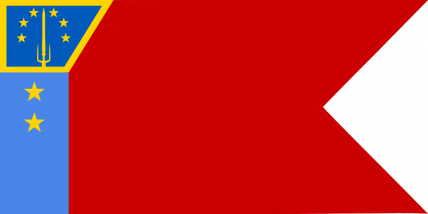
Istoloa and her former colonies.
THE SECOND TARAO WAR
IC THREAD
Istoloa, a one-time power long past its zenith, has recently attempted to reassert influence over its former colonies through a mix of diplomatic pressure and military provocation. But successive complications have undermined Istoloa's government's ability to project strength, leading to a rising undercurrent of dissent and anti-dictatorship demonstrations. To help shore up its image at home and abroad, the government has decided to distract by agitating the Tarao countries into rejoining PANTEU under the original treaty's terms. It has threatened military action against Ladero.
A recent invasion of Ladero failed under international pressure. However, the soldiers originally deployed to eastern Ladero remain in the country, although they are formally disavowed by the Istoloan military. Nevertheless, it is obvious who they take their orders from. They have been waging a low-intensity insurgency against Laderan government forces in the area, although so far the conflict is quite limited in geographic and material scale. Under the unofficial command of Marechal Roque Cipriano de Vega, the units (about four mechanized infantry division equivalents) are some of Istoloa's finest soldiers and have been reorganized into "homegrown" Laderan separatist units with their own structure and naming conventions.
A vocal wing of the government, led by de Vega, is known to be actively calling for war in the west. De Vega stands to gain the most from a victory over Ladero and is widely viewed as the leading contender to succeed Rodrigo Fremonero as Marechalisimo. His calls for war have only intensified since the series of stinging defeats in Fustera. Fustera, a former colony, is suffering from a terrible civil war, during which its white-minority government has gradually become entirely dependent on the Ordenite Reich for military, political, and economic support.
Growing popular dissent against the Fremonero dictatorship has further increased tensions within the country. The government has been forced to issue recurring mobilization orders to replace losses abroad and to grow the armed forces, more generally. Opposition to military service and foreign wars is widespread, as emigration to other parts of the region has sharply risen as many fighting-age men flee the country.
Most agree that war is no longer a question of if, but when.
N.B. This intro will change and lengthen after the IC thread is launched. There will be two primary events that launch the conflict: a military coup in Irat and a major unofficial Istoloan offensive in eastern Ladero.
INVOLVED FACTIONS AND SUBFACTIONS
N.B. These are subject to expansion and change over the course of the RP.
ISTOLOAN
- Government Forces
- — Old Guard Militarists: led by Marechal Roque Cipriano de Vega
- — New Guard Militarists: led by Tenente General Leandro Rosa
- — Red Tulip Revolutionaries: a secretive pro-democracy group of military officers
- Partido dos Trabalhadores de Istoloa: outlawed communist political party gaining membership in recent years
LADERAN
N.B. Will likely be attacked by Istoloa.
- Government Forces
- Camarzela Separatist Army: led by Comandante-Geral João Ganchas
IRATI
N.B. Will likely be attacked by Istoloa.
- Military Forces
- Government-in-exile
SOROFIAN
N.B. Was attacked by Irati recently.
- Government Forces
FOREIGN
- Grán Républica Revolucionaria del Refugio Seguro: Global communist revolution.
- Lirvittian Empire: Harass Marshite efforts in Ladero, maximize attrition and prolong any war begun in this area. Establish groundwork for Dienstadi Intelligence-networking.
- Norwaay-sweden-finland: Will help Irati end its civil war and to defend both countries from Istoloa.
- Ordena: Intends on supporting the resumption of hostilities with Ladero by supporting Istoloan forces with Ordenite troops and more. It seeks to ensure the survivability of Marechalisimo Fremonero's regime.
- Republic of Zenik: Support the Irati Government and gain an ally in the region, counter Istoloan aggression
- The Confederacy of Novaris Union: Encourage and support the speedy conclusion of hostilities.
- The Federal Republic of Czaslyudian Peoples: Ensure Istoloan success and survival in conflict; create diplomatic inroads to Istoloan government; deter or balance against Central Dienstadi influence.
- The Golden Throne: Interested in backing a Laderan-led economic union inclusive of all former Istoloan colonies, with investment and oversight from Fedala. Operating out of Samarasta, an unofficial vassal of the Golden Throne, it also seeks to deny the area to Ordena.
- The Republic of Eitoan: Will support economic union of former Istoloan colonies.
- The Sublime Empire of Mahdah: Mahdah seeks to garner more influence among the Tarao countries by opposing the Istoloan invasion of Ladero. This stems from historical on-going disputes over the Strait between Asadabad and Istoloa. It also opposes the involvement of Ordena in the conflict.
- The Theocratic Matriarchy of Holy Marsh: Establish growing presence to counter Ordenite influence. Establish further containment for Anti-Ralkovian operations. Eliminate Ordenite allies in the region in preparation for the coming greater conflict. Establish significant Marshite presence, up to whatever is possible and applicable to the situation. Isolate Fustera in full.
MECHANICS
This RP is inspired by the ongoing Commonwealth RP OPd by Holy Marsh.
All outcomes will be determined by dice rolls. All dice rolls will be done on the public Discord channel.
Attacks will be rolled with a d20s. Damage will be rolled with a d40 or d70, depending on how successful the attack is. A crit success will be a d100.
SIGN-UP
- Code: Select all
[i]National Name:[/i]
[i]Full National Name:[/i]
[i]Government Type:[/i]
[i]Faction(s) Supported:[/i]
[i]Support Offered:[/i]
[i]Agenda:[/i]
A BRIEF HISTORY OF ISTOLOA & ITS FORMER COLONIES
Istoloa's formation as a modern country did not come suddenly, the name Istoloa first being used to describe a common nation in the late 14th century C.E. Its capital, Loçelea, has a much longer history, extending into antiquity but entering the early modern age as a republic in 1031 C.E. It shared the land that became the Istoloan heartland with other cities, which suffered from the same servitude during the dark ages and the same freedoms when cities regained their political dominance. Thus, for more than 300 years Loçelea was just a city among many. But, with its budding debt-backed financial system, inclusive — yet oligarchical — republican institutions, and its large natural harbor's direct access to the sea, Loçelea slowly consolidated its role as the leading city of the Istoloan hills and plains, establishing the Istoloan Confederacy in 1387.
As the balance of power between the cities shifted toward Loçelea, the other cities began to resent it and in 1414 rebelled. The "Forty Years Social War" was fought until 1453, when Loçelea agreed to a power-sharing arrangement to maintain its leadership over the Istoloan cities. Forming the Istoloan Republic, Loçelea became the capital of a larger community represented in a two-house legislature — a popularly elected lower house and an aristocratic upper house whose members held their position for life. The republic was headed by a dorado, appointed by the upper house. Early on, the new Republic was shaped by its landed aristocracy, who had managed to acquire a disproportionate amount of power in the administration of Istoloa. The popular lower house gave power to the cities, but these had their elites who monopolized power as well and many were also among the landed aristocracy. Indeed, the sprawling mansions of the wealthy landowners came to line the main boulevards of great cities like Loçelea, providing them with summer homes to enjoy the big city. The Republic's shift to tyranny, thus, came as little surprise.
For hundreds of years, commerce had been Loçelea's and the other city's primary economic outlet. However, as a whole, Istoloa's economy was agrarian, and in ancient days it had known slavery. Oftentimes these slaves were from neighboring cities or villages, other times they were brought from long-off wars, and in some cases they were imported. By the end of antiquity, slavery as a practice began to die and in its place rose the serf. In some areas, the serf was less of a serf and perhaps even owned his own land. In others, the serf was such in the truest sense of the word. Sometimes one would be more accurate to call it slavery. But, slavery in its modern trappings did not come to Istoloa until it began to trade with the much wider world of western Greater Díenstad. At first, the expansion of the economic and political field came with innocent contacts, and perhaps the establishment of a small trade post. By the middle of the 16th century, however, these first contacts had grown into something more, and as Istoloa began to realize that there were benefits to political expansion and the opening of new markets it began to conquer. And with conquests returned slavery.
At the first, the import of overseas slaves came at a trickle. Throughout the 16th and 17th centuries, the peak years of imports could be measured in the hundreds of persons. Fueled by the expansion of acquired overseas markets and the resulting deep returns to agricultural scale, the demand for human labor boomed and slaves began arriving in the thousands per year by the mid-18th century. By the mid-19th century, millions of slaves worked the plantation fields from one corner of the nascent Istoloan empire to the other and they were imported from as far as modern-day Holy Panooly, Theohuanacu, and Safehaven.
Agricultural economies of scale and conquest gave the aristocracy the additional power it needed to acquire even an even more dominant political role in the country. In 1714, the then-dorado, Aguso Sinálo, declared himself emperor as Aguso I and the Republic turned Empire of Istoloa. Istoloa remained ruled by emperors until the abdication of Ferdinando III in 1927. By the end of the 19th century, the empire reached its maximum extent. It remained at this peak until the 1950s, even as it transitioned back into a republic of sorts. After the 1950s, until the late 1990s, a series of wars were fought instigating the excruciatingly slow and painful process of decolonization. Although the last of these independence wars ended in 1997, and since then three decades have passed, Istoloa and its former colonies remain in a geopolitical stranglehold defined by the struggle between the former master and the servants.
AN INTRODUCTION TO THE FORMER COLONIES
Ladero —
Capital: Lavença
One of three "Tarao countries," along with Sorofi and Irat, Ladero has become the most successful ex-colony of Istoloa. It is also one of the most fiercely independent ex-colonies, and its aggressive policies of "de-Istoloanization" have created friction with Istoloa since Ladero's independence in 1991. It holds its capital at Lavença, sitting on the glistening light blue waters of the Bay of Jurado.
Ladero officially earned its independence in 1991, the first of the three Tarao colonies to be recognized as independent during the Tarao Wars. A new democratic government based in Lavença was granted sovereignty status on August 23, 1991, after six months of heavy fighting between revolutionary forces and the small Istoloan garrison. A contentious, highly criticized decision made by President Ernando Pereço of Istoloa, the withdrawal of forces from Ladero allowed Istoloa to continue its long-term independence conflicts against Sorofi and Irat. Relations between Ladero and its former colonizer have normalized since the Peace of Tiribao, signed on November 11, 1997. Today, Ladero is one of Istoloa's largest trade partners and was the first Tarao country to join the Pan-Tarao Economic Union (PANTEU) in 2009.
With a population of 3.7 billion, Ladero is the strongest former colony of Istoloa. Economically, it is the only former colony to be within the same magnitude as Istoloa in terms of per capita income, marginal productivity, and trade volume.
Sorofi —
Capital: Barbaro
Sorofi earned its independence on 14 March 1997, after more than seven years of hard-fought war against an Istoloan counterinsurgency. Most of the country's surface area is rural and about 34 percent of its people live outside of the cities and towns, including much of Sorofi's immigrant population. The remaining 76 percent live the large coastal cities, the capital city of Barbaro, and the other large towns of the interior. Although the past two decades have been characterized by significant economic growth, Sorofi is considered a developing country with an average income of $21,000 USD.
Immigrants make up a significant part of Sorofi's population of 2.3 billion and culture. As the overseas slave market came to life in the 16th century, a separate slave market developed across the Tarao colonies. Rather than import slaves from central Greater Díenstad and settling them on great plantations, slaves imported into Sorofi came from the west. This practice gave way in most of the Tarao by the late 18th century, although survived in Sorofi until 1893 — when slavery was formally abolished throughout the empire. With its expansive fertile steppes, economies of scale have characterized Sorofi's agriculture and this was a strong force in favor of a continued tradition of slavery. While slavery is formally illegal today, immigrants continue to make up the bulk of the rural labor force, and the practice of funneling wages back into the farm by forcing laborers to live on the farm and use farm stores is widespread. Rural incomes remain very low, except for upper farm management and owners, most of whom live in the towns or cities. Crime and terrorism are common in rural Sorofi, especially in the southwest.
A unicameral legislature dominated by landowners and industrialists share power with a president, who acts as the executive. President Marbalo Tutto has been Sorofi's only president since 1998, after winning the first and only democratic elections for president in the country's history. Tutto was given a mandate for perpetual rule by the legislature, which passed the 'One Man, One Vision Act of 2001.' The country's judicial system has been accused of rampant corruption and human rights abuses.
Sorofi joined PANTEU in 2011.
Irat —
Capital: Teniza
The third of the Tarao countries, Irat is also the smallest, with a population of 1.4 billion. Its southern border is formed by the great Juntao River and much of it, especially the land closest to the close, is heavily marshland.
Historically, Irat was never a slave society, but rather a society with slaves. Slavery was practiced until the mid-18th century, by which time it had completely dissipated and was replaced by wage labor. Not characterized by large economies of scale to agriculture, due in part to the nature of the country's terrain, Irat instead employed its slaves as skilled laborers in the cities. These included blacksmiths, pottery makers, and other artisans. Over time, abolitionism gain paced as non-slave artisans found it difficult to compete against free labor, therefore lobbying the local colonial government to protect wage labor against the interests of slave owners. Therefore, slaves were a much more integrated part of society with respect to, for example, Sorofi. And the social transition away from slavery came quite organically.
Irat earned its independence on 2 February 1997. It joined PANTEU in early 2012.
Its government is composed of a bicameral legislature, an elected president who can run for two five-year terms, and an independent judicial system. Almost 91 percent of its population lives in cities or large towns, and over 75 percent live within the country's coastal provinces. With an average income of $31,000 USD, Irat has enjoyed a strong period of economic growth since its independence.
A cyberattack during the 2028 elections has brought attention to Irat and put into question the true purity of its democracy. President Junipero Lola, voted into power for the first time, has been accused of being a puppet of the Istoloan government.
Samarasta —
Capital: Tongolosi
Samarasta was inhabited by a patchwork of local kingdoms when Istoloa established its first trade post on the western tip, a town known as Forea. Forea was founded in 1516, after Istoloan merchants received permission from the local King Tarogox IV. After a century of meddling in local Samarastan affairs, the area was fully conquered and occupied over a series of wars between 1597 and 1621. In 1627, Samarasta was reorganized into a single territory belonging to the city of Istoloa. In 1715, it was once again reorganized as a territory of the Empire of Istoloa under Aguso I.
It has a population of 5.4 billion, very few of which can trace their ancestors to the original occupants of the land. Much of the indigenous population either died, was forced to flee eastward on the island, or were incorporated into a colonist elite involved in an expanding plantation economy. A trickle of hundreds of new slaves each year began to be imported from as far as Theohuanacu and Holy Panooly. By the late 17th century, hundreds had turned into thousands, and by the middle of the 19th century the Samarastan slave population was in the millions — in fact, over half of the population were slaves by as early as 1790. Because the overseas slave trade was the primary source of new slaves, mortality on the island was high, fertility was low, and slaves were never able to develop a strong local culture as these attempts were continuously washed out by the arrival of new slaves that spoke different languages and had different customs. If Irat was a society with slaves, Samarasta was a slave society, and one could see it by the ocean of chain gangs that spoke foreign tongues and believed in exotic gods. After the abolition of slavery in the empire, in 1893, much of this former slave population became tenet farmers and a new, unique "creoloso" culture developed that now defines the country.
In 1957, Samarasta entered into a violent period of political upheaval and military insurgency. A long war of independence was fought between 1957 and 1972, when its sovereignty was recognized by the Istoloan Republic. Samarasta's colonial elite retained power until 1989, when the first open democratic election was held. President Arujo Mandabi became Samarasta's first Creoloso president in 1990, winning the 1989 elections. Since the 1990s, much of the country's colonial population has emigrated to Istoloa, Fustera, or Tupenga.
The current president is Jurado Mabuto, who was first elected in 2017 to begin his first term in 2018. He is the first Samarastan president to serve more than two terms, currently on his fourth term. He is deeply anti-Istoloan and has created antagonism by being one of the forces behind the rising instability in Tupenga. The former colonial capital of Forea was renamed Tongolosi in 1973, after the conclusion of the Samarastan War of Independence.
Samarasta has in recent years become an unofficial vassal of the Golden Throne.
Tupenga —
Capital: Crifoso
Tupenga followed a similar path to Samarasta, becoming the center of an enormous plantation economy that quickly expanded between the middle of the 16th and 18th centuries. Colonized a few decades later, the first trade entrepots were founded in the 1520s and 30s. Parts of the southern coastline were fully annexed by the early 17th century, but it wasn't until the late 17th century that much of the interior was subdued. Tupenga was not organized into a territory until 1721, when it was formally incorporated into the nascent Istoloan Empire under Aguso I.
Like Samarasta, Tupenga was a slave society until 1893. It remained a part of the empire, and later the republic, until 1981. A war of independence was fought between 1958 and 1981. More than 70,000 Istoloan soldiers died in counterinsurgency operations in Tupenga until the country's sovereignty was recognized by Istoloa. An Istoloan colonial elite managed to retain control of the country until 2001, when a civil war broke out and led to the deployment of Istoloan troops. The civil war raged until 2013, when a power-sharing agreement with the majority Creoloso populations was signed. However, fighting persisted through a low-intensity civil war has grew more and more violent until the country's liberation by Holy Marsh.
Fustera —
Capital: Elani
Fustera is the largest of Istoloa's former colonies. Like Tupenga and Samarasta, it found its exploitation under the banner of the plantation economy and, consequently, imported large Panooly and Theohuanacan populations.
A war of independence began in Fustera much earlier than in the other Istoloan colonies. A plantation owner-led rebellion was sparked in 1891 after a series of unpopular trade policies designed to protect Istoloan manufacturers were implemented to the detriment of colonial agriculture. This first rebellion was easily quashed by 1893, but a second rebellion broke out in 1896 and lasted until 1903. A fourth rebellion, beginning in 1907, concluded with the Treaty of Migroso in 1913, which granted Fustera's local elites considerable autonomy. By 1927, Fustera had earned full sovereignty and this colonial elite-led regime has continued in power until present day. A number of insurgencies (1936–46, 1953–62, 1971–1977, 1992–2002, and 2007–24) were all eventually contained, but never extinguished and terrorism has been a part of Fusteran life since the first years of the 20th century.
Creolosos are not permitted to vote, are restricted to certain places to live, and suffer from a variety of other rights abuses that condemn them into membership in a highly oppressed caste defined by ancestry and the color of one's skin.
The late Prime Minister Ton Elepao was recently assassinated by suspected PMLF rebels. The country is considered to be a vassal of the Ordenite Reich.