NATION

PASSWORD

The Return of History (MT)

A staging-point for declarations of war and other major diplomatic events. [In character]
User avatar
Generic empire
Envoy
 
Posts: 233
Founded: Jun 05, 2004
Ex-Nation

The Return of History (MT)

Postby Generic empire » Sat May 11, 2024 6:05 pm

[This concerns the reconquest of a region that has declared independence, and a subsequent insurgency. Open to reactions, otherwise TG for entry]

Part I
Part 2
Part 3
Part 4

Latest News
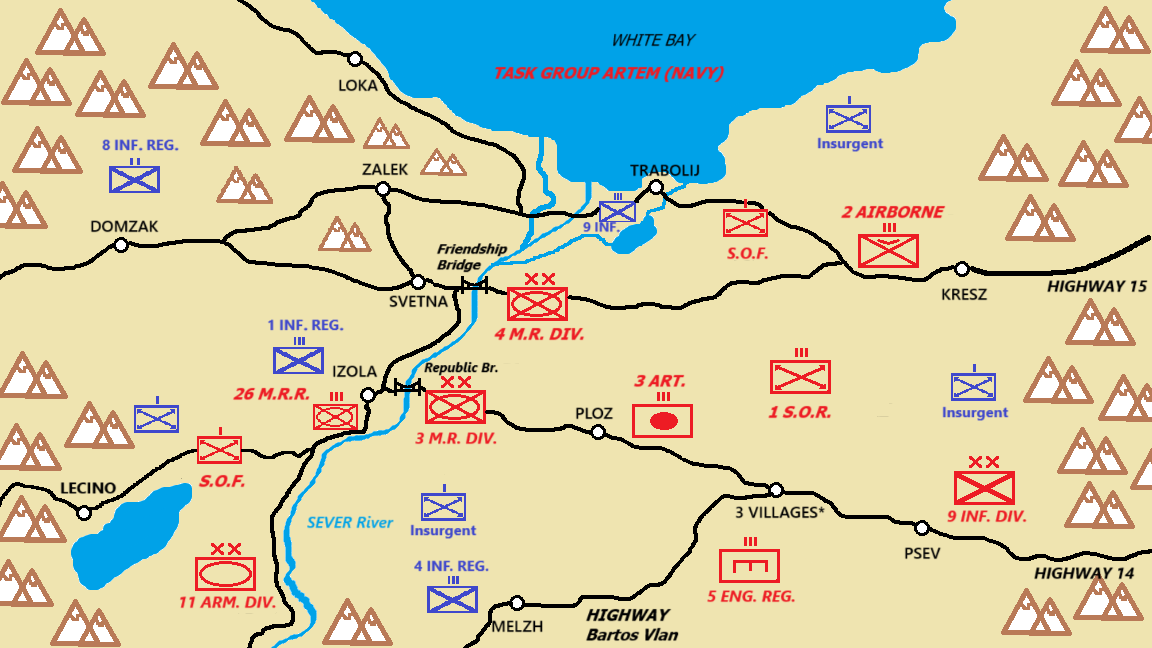
Image

Red: Generian Formations
Blue: Alberian Formations [Known or Suspected]


I: Yakov's Rush

Image

May, Present Day, Self-Declared Republic of Alberia

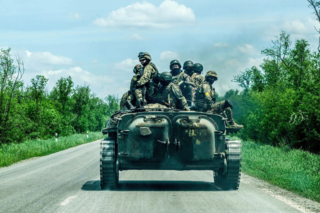
Lieutenant Vasiliev placed a hand against the side of the BTR, the rumble of the engine vibrating through his arm and deep into his chest. He withdrew it almost instantly, hoping that the men – fanned out in a broad semicircle around him – hadn’t noticed the inadvertent display of unease. Perhaps they also felt the tension – the street was a cavern of gray midrise tenements buildings, still bearing scars from the last pacification operation. Every dark window yawned like a mouth ready to spit a rifle bullet or a rocket propelled grenade down at the Generian soldiers below.

An Alberian insurgent would have had plenty of targets to choose from: two companies of the 26th Motor Rifle Regiment’s finest snaked down the wide avenue that bisected the city of Psev. This was called Promenade Dmitri Setchikev by the locals, after the Republican hero who had led one of the first risings against the Generic Emperors more than 100 years ago. The Generians preferred to use its name from the Federal era, Imperial Boulevard. What it was called didn’t seem to matter much to Vasiliev right now, concerned as he was with staying alive.

He shouldn’t have been: it was the duty of an Imperial soldier to meet death wherever and whenever he was required to. It was also the duty of a good Generian Orthodox Christian to leave it in the hands of God. But he couldn’t help the chill in his spine, or the sweat that was building up in the space between his palms and the interior of his gloves, these in turn pressed tightly against the stamped metal of an automatic rifle.

That this equipment – the gun, the gloves, and the armored vehicles – was more than 20 years old also did little to reassure him. It was possible that they had aged like wine – he was assured by the supply officers that the guns had been tested and certified at the depots in Port Belgrade before they were shipped north – but his experience with supply officers was that any reliable or new equipment would end up stolen and sold off before it got halfway across the Empire.

His boots at least had held up, which was something, and the musty ballistic vest seemed durable even as it weighed down his slight frame. Vasiliev hadn’t had the chance to see for himself whether the rifle worked: despite being promised “a rapid-tempo operation to restore order in the rebellious province of Alberia” (to quote operational orders), their entry into the self-proclaimed Alberian Republic had been tortuously slow: months waiting in bivouacs near the jumping off points while they waited for snow melt in the mountain passes. Then a long, slow crawl through these same passes and a descent to the plains. And there on the flatland, trucks becoming bogged not in snow but in thick, glutinous mud that replaced it.

He had felt boredom then, rather than tension, and even when they passed through the rural villages – deserted by their inhabitants, afraid no doubt of the Emperor’s wrath – he had felt mainly curiosity. Who were these people who had defied the Young Emperor, Alexei VI? The question remained unanswered – the few examples he had seen of them were old men and women, fair-haired and hardy, like any other Generian. There was nothing inherently menacing about them.

He understood them to be a poor people, but their villages were neat and tidy, and looked no worse than his own, far to the south in the Generian heartland. The village churches, ostensibly of a separate denomination, also seemed identical to those he had known as a boy.

And yet these people had been shedding Imperial blood and having their own shed in return for nearly a century. Indeed, his own father had been a General in the last war, in the chaotic days of the old Emperor Pavel – Saint Pavel, now, he corrected himself – before the Young Emperor, and the Federation, and the Constitution saved it all from the brink.

But his father, a taciturn man, had never spoken about the war, and there were few chronicles: a defeat did not stir the poet’s hand or the singer’s heart, and the last war had been a fiasco. What he remembered of it from the little news coverage and the sparse articles in Officer’s School textbooks suggested that the fault lay entirely with the generals and the rebellious Democrats of Generia City, strangling the Army as it tried to hold back the tide of Alberian nationalism. He wasn’t sure about that: his father had been many things, but he never struck him as the drunken incompetent that these books made the commanders in that war out to be.

But the past was the past. This was the New Era, the era of Constitutionalism and Federalism, and the revived, modernized Imperial Army. It was the Alberians who clung to the past, and the Young Emperor who was going to drag them into the future, kicking and screaming.

The noise, a crack like stepping on a twig, barely intruded on his thoughts. It was the reaction of the men around him that startled him out of it. Beside him, one of the soldiers – a big ex-stevedore from Port Belgrade named Mikhail – turned and let off a burst at one of the buildings nearby, only a few inches from Vasiliev’s ear. He winced, crouching with his hands to his ringing ear. Up and down the column, he heard the noise of automatic rifle fire as others followed Mikhail’s lead. Well, at least the guns worked.

He reached out and grabbed the big man by the pantleg, shouting to cease fire. The man stopped, but only when his magazine ran dry. Vasiliev stood up and ran to each of the men, pulling at their clothes and shouting at them to cease fire. They did, and eventually calm was restored. The tracks had stopped, and their turrets rotated frenetically to the windows and the pockmarked facades of the various buildings.

“It was a marksman,” Vasiliev said, to no one in particular. As if to punctuate this, he heard another snap, followed by a sound like a tree falling. Then he felt a heavy weight land across his foot, and yelped. Looking down, he saw that what had fallen was a rifle. A few inches to the right was the writhing form of Mikhail, clutching at his throat, a deep crimson bubbling up from between his clasped hands, running down his wrists, and dripping in great globules onto the blacktop.

The cacophony resumed. Vasiliev crouched in the shadow of the BTR, as its own turret opened up through a gap between buildings. Vasiliev crossed himself, and as he did so, glanced up the street towards the head of the column, a few hundred yards ahead. As his eyes fell on the lead vehicle, a tank, it disappeared in a ball of bright orange. The ground shook.

***

Generian International Newswire

Generian Imperial forces have achieved a major victory in the Alberian Pacification Operation, announced the public affairs department of the Imperial Army today. In a brief but violent encounter in the city of Psev, in southern Alberia, Generian forces scattered and destroyed an insurgent column that was attempting to ambush elements of the 26th Motor Rifle Regiment. The Alberians reportedly suffered more than two dozen casualties, while Generian casualties were reported as light wounds and no KIA.

Spokesman for the Imperial Army, Sergei Yakov, reported that Emperor Alexei VI had been informed the event, and offered his personal congratulations to the Regiment.

Emperor Alexei, with the blessing of the Federal Assembly, announced his intention to deploy Imperial troops to Alberia last month after representatives of the unrecognized Alberian Republic repeatedly rebuffed Imperial overtures to rejoin the Federation. Generia considers the mineral-rich region of Alberia to be legally part of its territory.
Last edited by Generic empire on Thu Dec 19, 2024 10:50 am, edited 34 times in total.

User avatar
Generic empire
Envoy
 
Posts: 233
Founded: Jun 05, 2004
Ex-Nation

Postby Generic empire » Sat May 11, 2024 7:54 pm

The White Citadel, Sofia, Generic Empire
6 Months Earlier


Chancellor Pyotr Leontev was tenuously holding on to his patience. Even as he opened his mouth to speak, the Emperor raised a hand, and he remained silent. The Young Emperor, they called him, and he was that – relatively speaking. Certainly, since succeeding his uncle Pavel (now, absurdly, Saint Pavel), the lines on his face had multiplied, his beard had gotten grayer, and some of the definition had gone out of his once athletic physique. The task of statecraft – specifically, holding together a continental, multi-ethnic state like the Generic Empire – would age anyone before their fortieth birthday, which in Alexei’s case was just around the corner.

But he preserved the qualities of youth: a fierce idealism manifested as a belief in his mission as a leader of his people, the head of his Church, and the Commander in Chief of the Imperial Army. Also a boundless energy: he worked some days nearly 17 hours straight, barely stopping for meals, going to bed in the wee hours of the morning after long sessions with his council, and rising before any of his Ministers had even gotten to bed. But the vices of youth were still there too: a tendency to argue with his councilors, for one; an to indulge himself in tasks he found pleasant at the expense of others – rearranging the Imperial army and entertaining foreign ambassadors took precedence over studying the latest proposed regulations of the Imperial Stock Exchange.

But these foibles could be forgiven, for on the whole the Emperor had done a man’s job. Before he came to the throne, Leontev would have thought no one, least of all his feeble predecessor, could save Generia from collapse. But comes the moment, come the man, thought the Chancellor: recollecting the first time he had seen him truly in his element, there on the steps of the White Palace, the mob barely held back by the soldiers of Pavel’s Guard – a young face, but stern, eyes flashing with regal dignity, arms outstretched in a gesture of peace. He had seen the same thing the entire country had seen – even the demonstrators that had brought the old Pavel to his grave from a stress-induced heart attack. The face of a patriot-king, and a promise that, if he was given his chance, all would be well.

And it had been, to a large extent. The crisis that Pavel had provoked by promising and then reneging on his promises to form a Constitutional Convention was avoided. The Emperor convened it, and – amazingly – abided by its recommendations. Inheriting a throne and absolute power, he had accepted rule of law, a Parliament, and Federalism for the Empire’s many long-suffering regions. Accepted without cynicism: the Young Emperor – his epithet given to him by the people – seemed genuinely committed to ensuring that these institutions functioned, and that the deep divisions in Generian society were soothed and healed. One by one, the regions had returned to the Imperial fold, the crowds in the streets of the Twin Capitals had dispersed, shops and factories had reopened, and life had – seemingly -returned to normal.

With one, glaring exception: Alberia. Leontev could have predicted it. The province had been a thorn in the side of the Empire since it was pacified during the days of the first Alexei, when men still drove coaches and dressed in furs. That the Alberians, even after these hundreds of years, had never adjusted to their status within the Empire was a mystery to wiser men than Leontev, especially when the Generians had absorbed so much of the Alberian culture: Alberian menus were now staples, and Alberian soldiers had led the armies of Generia in its foreign wars almost from the beginning of the unification. But they had kicked against Imperial authority almost as long, and when – seeing that authority crumbling – they had seized their moment, Leontev had at first thought “like a bad spouse, just let them go.”

But he knew that that was also impossible. The Young Emperor had chosen to rest his throne on three pillars: law, the respect and admiration of the Generian people, and the unity of the Empire. That Isheria, itself a relatively new conquest, should be a part of the federation, while Alberia was allowed to escape? It would spell doom for the whole project. Yes, Alberia would have to be brought back into the fold. Leontev and the Emperor both had hoped that this could be achieved peacefully. Leontev still hoped that this was possible.

The strains of the last violin faded, echoing around the high wood ceilings of the Emperor’s study – a comparatively small room in the White Palace that had been used by his father when he served as his brother Pavel’s Chancellor. The Emperor let his hand fall gently onto the arm of the chair. With the other hand, he reached over and switched off the stereo. He sighed and sank back against the cushions, a look of pure pleasure on his face.

“Divine,” he sighed. “Now, you see why I couldn’t let you interrupt, Uncle Pyotr.”

Leontev shifted on his feet, swallowing his annoyance. “Certainly, your Majesty.”

“I know you have no ear, but really – how can you not appreciate a Soprano like that? Her voice would raise the dead.”

“I am sure she is very talented. Perhaps at another time, we could arrange to have her -”

The Emperor burst out laughing. “I would love nothing more, but I’m afraid it’s not possible. She’s been dead for nearly twenty years.”

“Oh, I didn’t know.”

“Of course you didn’t – but it’s why we must treasure these recordings.”

The Emperor stood up and removed the needle from the turntable. He gingerly placed the record in its sleeve, then in its leather case, and, walking across the room, replaced it on the shelf.

“If I may -” Leontev started.

“Yes, yes, you may,” said the Emperor, returning to his chair and sitting down, his expression quite placid.

“The Alberian matter -”

“Again!” said the Emperor sitting up straight and leaning forward.

“I’m afraid so, your Majesty.”

“Well?”

“Our latest overtures have not gone exactly as we hoped, but still I suspect -”

“What is it with them?” asked the Emperor, getting to his feet, and folding his hands behind his back. He began to pace. “We offer them every concession, and still they resist us.”

“I was saying, I suspect that they may be holding out for additional concessions. Economic development, local control over natural resource extraction -”

“Indeed! Why don’t I simply offer them the throne at the same time?”

“Your Majesty is being a bit dramatic, I think.”

“In what way? They have already usurped my legal authority – my holy authority by illegally seceding from this Federation. Why not simply give them the chair, then?” he said, gesturing at the armchair behind him – a stand in for the throne.

“I truly believe, with a little patience and some delicacy, we can coax them into an agreement.”

“But at what cost? What has patience and delicacy gained us? Has it not already gotten the Isherians coming back to the drawing board – looking for a similar package of concessions? And what of the mining firms and the oil firms, on whose financial support we rely?”

“An agreement is possible, Majesty.”

The Emperor sighed and collapsed back into the chair. “You may be right, Uncle.”

“Very good, Majesty, I was going to say -”

“But -” the Emperor continued, “I believe we must temper our expectations, and plan for contingencies. I plan to ask the Council of State and Parliament to approve expenditures for an operation, should our discussions fail.”

“Majesty, I think that would be unwise.”

“Unwise to plan for contingencies?”

“The Alberians are sensitive to such things. If they thought we planned to coerce them -”

“Well, what if we do? We would legally be within our rights.”

“Yes, legally, but morally -”

“Their secession and continued defiance of lawful authority is far from moral. And I speak as the Head of the church.”

“Certainly, Majesty, but having avoided civil war, do we really want to risk starting another?”

“It is the furthest desire from my heart,” said the Emperor, touching a hand to his chest. “And I pray – I genuinely pray – that our negotiators can succeed in persuading them. But we must make difficult decisions in our business.”

“Certainly, Majesty. But sometimes choosing peace is the hardest decision, is it not?”

“Sometimes such a choice is impossible.”

***

Psev, Alberia
Present Day


Lieutenant Vasiliev was racked by another fit of coughing. The acrid smoke from burning insulation and cordite was still lodged deep in his lungs, even as he stood there in the park on the banks of the river in the center of Psev. Glancing around him, he could see the source of his pain: tall columns of black smoke rising from the wrecked carcasses of armored vehicles and the rubble of buildings.

His baptism by fire had not been all that he would have hoped: along with Mikhail, nearly half his platoon had been wiped out in the firefight, even as the armored column was pinned by unseen attacked and guided anti-tank rockets launched from across the river. It had taken repeated passes by a pair of “Babushka” helicopter gunships to suppress the insurgent cadres long enough for a proper sweep of the buildings to be mounted. For their pains, they had counted only a dozen insurgents killed. He wondered how many there really had been? If 12 men could cause so much damage, what could an entire province full of them do to the Imperial Army?

He glanced towards the mounds of Earth that covered the fresh graves, dug into the hard, cold soil of the park. His comrades rested there, and the thought of their mangled bodies – Mikhail writhing in pain – sent a shudder down his spine.

A shout from behind him interrupted his reverie. He turned to see the round form of Captain Konstanz crossing the street. The man rolled more than walked, supporting 200 pounds of meat and gristle on a pair of stubby peasant legs. He was the bastard offspring of an Isherian peasant girl and a roving soldier. He had followed his father’s footsteps, both into the army and as the father of a string of bastards across nearly the whole width of the Empire. His hopes to continue his streak in Alberia had been widely expressed.

“Misha,” the big man called. “There you are. Why aren’t you with your platoon? Ah!” he said, glancing down at the fresh graves. “Good man, giving the last rites, eh? But we can’t wait on the dead, Misha. The living have work for us to do!”

Vasiliev picked up his rifle from where it was perched against a tree stump and slung it over his shoulder. “I’m ready.”

“Good. Dickhead wants you up front.”

‘Dickhead’ was Major Timofeyev, B Company’s commander. The nickname was roughly reflective of what Captain Konstanz thought about him.

“Up front for what?”

“Albos are still taking potshots at us from the other side of the river – thinks we drove them into the suburbs. B’s gonna clear ‘em out. You’re up front. Get going.”

Misha scratched his head as he wandered back towards the pair of BTRs and what remained of his Platoon. The men took it well enough, climbing up onto the armor without complaint. He jumped up beside them, on the first vehicle, as the small column rolled down the street, turning towards the wide bridge that spanned the river. A pair of BMPs trained their autocannons at the silent buildings on the far side. A group of soldiers, lounging beside them, waved their hats and offered a halfhearted cheer.

A pair of “Babushkas” passed low overhead, their jet engines piercing to Vasiliev’s already deadened ears. As they passed out of sight over the nearest row of apartments, he heard the buzzing of their cannon as they opened fire on a target somewhere. He felt the dull thud of rocket fire a few moments later, even as the APCs made landfall on the far bank.

The column kept moving, past rows of empty shops, the facade of one of which was blown out and smoldering. They eventually reached a large park, most of the trees having been cut down – presumably by the insurgents, to clear firing lines. He and the men dismounted, and he ordered one of his squads to cover the other as they leapfrogged across the open ground. They reached the other side without incident, and he ordered his men to take up positions while the rest of the column crossed.

An hour later, he found himself perched on the porch of an abandoned house, staring out over a vista of rolling hills and unsown fields. Behind him, the city was quiet, as the sun began its descent to the horizon. They hadn’t met any insurgents – just empty streets and houses like this one. The road stretched on towards that horizon, through those fields. He wondered how many little cities like this they would pass through on their way up that road – and how long until they could go home.
Last edited by Generic empire on Wed May 15, 2024 12:04 pm, edited 1 time in total.

User avatar
Generic empire
Envoy
 
Posts: 233
Founded: Jun 05, 2004
Ex-Nation

Postby Generic empire » Sat May 11, 2024 9:12 pm

The Democrat Club, Generia City

Generia City was one of Generia’s “Twin Capitals,” but in some ways it was something of an evil twin. Where Sofia, the seat of the Imperial Government, was dominated by the marble domes and soaring buttresses of palaces and cathedrals, Generia City’s skyline was a jagged mouth of highrise skyscrapers.

Foreign writers often referred to it as the country’s “Financial Capital,” considering that it was the seat of the Empire’s main stock exchange and the headquarters of its largest banking and industrial concerns. Naturally, it was also the center of gravity of the Empire’s bourgeoisie, which spent the week in its luxury hotels and penthouse apartments before driving to their “dachas” – really, mansions – on Lake Generia for the weekend.

The beating heart of Generian capitalism was also, fittingly, the heart of its seedier underbelly. Nowhere else in the Empire was one likely to see more naked poverty: homelessness, rare in Sofia, was more common here, with street people and gypsies drawn by the larger concentration of wealth, foot traffic, and easy access to banned and controlled substances. The city was also home to a sizable Alberian minority, the majority of whom were respectable middle class citizens. The minority dominated the city’s criminal underworld as a well-organized network of “mafia” families.

Generia City was thus a demos to itself, and with its mixture of bourgeoisie, working people, and ne’er-do-wells, it was unsurprising that it was the birthplace of the Empire’s Democratic movement. That such a movement had managed to come into being at all in the reign of the Emperor Pavel – an avowed authoritarian – was a tantamount to the independent spirit of Generia City’s people, and their commitment to free enterprise, even at the cost of the wider Empire’s traditions.

Even the Young Emperor, with the good will of the people, had had no end of trouble keeping the Democrats from toppling his throne. Even as the Emperor restored the privileges of Sofia’s noble families, it had taken concessions to the local Council of Generia City – to the point of elevating it to official status as a “second Capital” – to tamp down the more fiery representatives of bourgeois class consciousness.

Pacified, but not vanquished, these elements continued to meet in their favorite haunt: the elegant Glass Swan Hotel, purchased by the President of the Stock Exchange and now renamed the Democrat Club. Its membership counted most of the leading lights of the city’s capitalist class, while the stuffier families with titles and histories of Imperial service preferred the nearby Empire Club. There were few representatives of the working class in either establishment, unless they were – well – working there. But certainly the leading lights of the Democrat Club presumed to speak on their behalf.

It was on their behalf that one of these lights was speaking now: Igor Valentin, whose brother was the Chairman of the Industrial Bank of Generia, and who was something of a politician. Addressing a group of about two dozen, he took for his theme the Alberian Pacification Operation:

“And what are we to gain from all this bloodshed?” he asked his audience. “The ruination of the entire Alberian economy? The decimation of its people? Our Emperor presumes the goodwill of the people. And he presumably considers these to be his people, does he not? So, how long can he expect to enjoy the goodwill of a people that he makes war on?”

“Careful, Gorya,” groaned a member of the audience – a prominent insurance executive.

“What?” shot back Igor. “I am a royalist, am I not? A people have the right to petition their sovereign, don’t we? Am I not allowed to ask my sovereign what he hopes to gain by launching an ill-considered, ill-advised, costly war that the best people of this country are expected to pay for?”

“No one wants the war,” replied a member of the audience – heiress to a particularly large shopping mall fortune – “but what do you expect him to do? Let them get away with it?”

“Get away with it?” asked another observer, a young woman who had no discernible occupation. “Get away with what? Asserting their natural right to self determination? To secede from chaos?”

“Chaos,” replied the heiress, “maybe before, but not now. We have the Constitution.”

“And what has it gotten us!” both the young woman and Igor said at once, and then glanced at each other. Igor continued: “I see great minds think alike! What good is the Constitution if it does not constrain the ability of the Emperor to make war on our brothers, the Alberians?”

“Not my brothers,” spat the insurance man. “Beggars and thieves, the lot of them. Social parasites.”

“And if they are that -” Igor replied, “then isn’t it our own fault, for forcing them into a position of subservience and dependency? If they wish to be full partners in the Empire, let them! But if not, then let them go – and spare us the cost of governing them!”

In the back of the room, behind the bar, a red-headed young woman was half listening as she polished a crystal tumbler. Though she agreed with the sentiments, she had to laugh at their pretensions: that these fat cats thought they should speak on behalf of the Alberian people was so ridiculous that one couldn’t help but laugh. The club couldn’t count a single Alberian member – though several of its staff were, whether club management knew or not. And the naked self interest displayed here – that the cost of the destruction of her homeland should be the primary contention – rather than the slaughter and displacement of her people?

Stefanij Vera could not call herself a Democrat, or a Nationalist. She also could not call herself a Generian, though she was legally as much a citizen of the Empire as any of these men. In her mind, she was a worker – a poor woman who was lucky to have a job in this beast of a city that devoured so many of its young. For most of her life, politics had been the furthest thing from her mind. Like her uncle Jan – called “Chief” by the army of thugs and hustlers that he commanded – had always said, “politics is a game for suckers, and we Veras are not suckers.”

But things were changing. Even her uncle – whose entire mode of being revolved around keeping his head down, keeping his mouth shut, and getting one over on the losers – had made off-the-cuff remarks in her presence about the outrage of the Pacification Operation. And she had to admit that, even while working a demeaning job like this in the heart of the Generian upper crust, to know that there was a free Alberian Republic existing out there had meant something. And now, they were going to strangle it.

She realized that she was gripping the glass quite hard, and quickly relaxed her hand lest any of the customers see. Thankfully, the end of her shift was only a few moments away. She finished tidying the bar, grabbed her things, and made for the elevators. Outside, she lit a cigarette, and composed herself. That she was so agitated frightened her – the chance of making a remark that could blow up in her face was ever-present. She was lucky to be away from the Club, and she flagged down a taxi to take her home.

Home was a multi-level condo in a decent building, right in the heart of what was called “Little Alberia.” Her uncle owned the building – through a series of shell companies – and she happily lived there for free with two of her cousins and an elderly aunt, a dear, deaf old woman. It was them that she expected to see when she opened the door, and she was instead quite surprised to find the front room filled with five large, red-bearded men. She recognized two of them: one was her uncle Jan, and the other was his ever-present bodyguard, Numa the Nose (a piece of which he was missing). The rest, though, she had never seen before.

The men were deep in conversation, but it ceased as she came in. The men all stood at once – Alberians were unfailingly polite and reserved in their dealings with women, even close family members – and she bowed to her Uncle.

“Stefa, come in, and meet these people,” he said, extending a huge hand and gesturing for her to come towards him. She wasn’t sure she wanted to meet “these people,” but it would have been rude to refuse, so come in she did. She bowed to them, and they returned the gesture.

“Stefa, these men have come to us from the Republic.”

This was shocking, and her widening eyes perhaps gave away the game. Her Uncle placed a hand on her shoulder to reassure her. “Don’t worry Stefa, there’s no danger. They’re friends of ours – patriots.”

Her sense of dread grew at the word.

“They’ve come to ask our hospitality for a little while,” her uncle continued. “And I’ve told them that they may have the upstairs rooms.”

There was no logistical problem with this: the upstairs was basically a separate ecosystem, and the bedrooms up there were small and rarely used except for guests. But Stefa worried for other reasons. Her uncle had always been very careful to shield her from his business – he loved her like a father, and had always been kind. The few of his associates whom she knew had rarely had anything to do with her more than offer a polite bow. That said, these men – these “patriots” as her uncle called him – didn’t have the look of the gangster about them. There was an almost military bearing among them, though they had the same hardness in their eyes as some of the tattooed thugs she had seen in her uncle’s company.

But what could she say? Hospitality was the birthright of any Alberian, and to refuse it was an unthinkable offense.

“Now, don’t worry, these men are gentlemen,” her uncle said, “and they’re going to stay out of the way. And it’s only for a few days.”

Stefa bowed to her uncle and the men, and mounted the steps to clear the few of her things that she kept upstairs. As she departed, the men began talking again in hushed Alberian. She caught only a few words, one of which sounded like “stock exchange.”

User avatar
Generic empire
Envoy
 
Posts: 233
Founded: Jun 05, 2004
Ex-Nation

Postby Generic empire » Sun May 12, 2024 8:04 am

Outside Psev, Alberia

Major General Semyon Emmanuel remembered the last war. He had been a Colonel then, commanding a tank brigade during the headlong dash across the steppe to seize Izola back from the insurgents. It was June, there were good roads, and his men were young and willing to do as they were ordered. It should have been the simplest thing.

But it wasn’t. They got to the outskirts of Izola, and then stopped dead. He remembered his bafflement at the report of a young Major, whose name he couldn’t recall, when he told him that his entire company was gone. Gone. Its burial place was a cluster of smoking wrecks, guided missiles streaking over them to land among the other vehicles of his division. He thought now how foolish he had been – how foolish they all had been – when they had sized up the Alberians as a ragtag collection of bandits, farmers-turned-militia. The men defending Izola were professionals: all of them had served in the Imperial forces, some likely under his own command. And they were armed, not by foreign agitators like the old Emperor Pavel had claimed, but by the Empire itself. Its military stores in Izola, foolishly guarded by an Alberian regiment, had vanished when the regiment went over wholesale to the enemy.

Those weapons had not been recovered, and the Alberians had gotten their hands on plenty more in the intervening decade and a half – picked off the corpses of Imperial troops or bought and paid for from abroad. Alberia had always been a hard nut to crack, but now it was taking on the aspect of a rock.

These thoughts plagued him as he studied the map table that had been set up in the living room of an abandoned dacha just outside Psev. He was one of two dozen officers standing around the table as Colonel General Anton Yakov pontificated. Yakov was a diminutive, enthusiastic man. He was a political favorite: the Emperor had handpicked him to command Operation Jupiter, the Alberian Pacification Operation. To his credit, he was here in Alberia. In the last war, the commanders of armies and divisions alike had directed things from miles away from the fighting, across the mountains in some cases. While it was not necessary for an officer to share the privations of his men, he did have to understand the battles they fought. That was impossible to do without seeing something of them, even their aftermath.

But General Emmanuel had concerns. Yakov was a patriot, no doubt: one of the Young Emperors first and fiercest supporters, and an old delegate to the Constitutional Convention. But his enthusiasm had something of bluster in it, and the tone of his operational orders was – to put it mildly – optimistic. The crossing of the mountains had taken far longer than anticipated, throwing the timetable that the Emperor had approved into disarray. Yakov now hoped to make up for lost time by forcing a passage up the main highway that linked Psev to Izola.

This brought back Yakov’s unpleasant memories of the last war. While it would not be fair to characterize Yakov’s Rush – the name it would later be given – as a mad dash, there was an element of recklessness to it. Yakov trusted the elan of the Generian troops, and was right to do so: Imperial soldiers would fight and die wherever they were ordered to. But this was not the army that Emmanuel and Yakov and their compatriots had come up in. It was a smaller one, modern and elegant, more like a rapier than a hammer. It had to be preserved. The fighting to take Psev had already cost too many lives. Bloody, unnecessary battles – wandering into ambushes – over time, these were the things that would demoralize a force, and make it combat ineffective.

On Emmanuel’s right, Major General Ivan Bratsev was asking a question. He stood nearly a head taller than everyone else in the room, and had the physique of a male ballerina – which in fact he had been before he found his true calling! Bratsev commanded the 1st Special Operations Regiment of the Imperial Guard, considered an elite formation of light infantry, air mobile, and trained for arctic and mountain warfare. Emmanuel had great respect for the Specials. These were the heirs to the old Praetorian units, that had been disbanded after the Constitution was ratified as too “reactionary.” Emmanuel had no political opinions, but he felt that a few battalions of Praetorians marching with the army would have stiffened its spine somewhat. The Specials would have to do.

General Yakov was gesturing at a cluster of villages in the center of the map table, the first about a dozen kilometers up the highway. The road ran mostly through flat agricultural land, with a few elevated points scattered here and there. The villages formed a rough triangle, each situated on one of these high points, and commanding the country around it. The Specials had reconnoitered them in the night, and it was suspected that there were several ATGM emplacements in the villages, which were collectively held by about a Company’s-worth of insurgent troops.

That a Colonel General should be involved in this level of operational planning evidently rankled some of the men around the table. Professionals like Bratsev expected and deserved an element of independence within the chain of command. However, Emmanuel understood Yakov’s desire to be in the thick of things: the Emperor had entrusted him personally with this command, and failure would mean disgrace and the ruination of any of his political hopes.

As the council broke up, Emmanuel stepped into the cool sunlight outside of the dacha to smoke a cigarette. Where dawn was breaking along the horizon line, a pair of “Bullfrog” attack aircraft soared in tandem, off to strike targets in the direction of the cluster of villages, he assumed.

“Well,” came a voice behind him. Emmanuel turned to see Bratsev, who evidently had had the same idea about a morning smoke. “What do you think about this latest harebrained scheme?” asked the tall, thin officer.

Emmanuel shrugged. Office politics had never been his strong suit. It was why he now commanded a basic Motor Rifle Division instead of what he had hoped for, a Tank Division or a unit of the Guard. But he knew enough not to speak out of school about the Army commander.

“Seems straightforward enough.”

“It’s a death trap,” Bratsev said, striking a match. “For your boys at least. You’ll be going right into the thick of it.”

“Sounds like you won’t have an easy time either.”

“Psh. It’s nothing for us. We drop in after the place has been softened, grab some prisoners, shot the rest of them. Easy,” he shrugged.

“Easy,” repeated Emmanuel. “Nothing’s easy in Alberia.”

“That’s right,” said Bratsev. “You were in the last one.”

Emmanuel nodded.

“Flashbacks?” asked Bratsev, with a smile. The veterans of the last war had been parodied in various political films as PTSD-riddled drunks and hobos, so it was something of a slight. Emmanuel let it slide.

“We’re better off this time.”

“That’s right. We have a government this time.”

“That we do.”

“And the same politicians here in the field.”

“Maybe. But we’ll do what we’re told to.”

“Always,” agreed Bratsev. “It’s the Imperial way.”

In the distance, they both felt the thunder of a heavy artillery battery coming into life. Jump-off was a few hours away.
Last edited by Generic empire on Thu Jun 27, 2024 9:05 am, edited 1 time in total.

User avatar
Generic empire
Envoy
 
Posts: 233
Founded: Jun 05, 2004
Ex-Nation

Postby Generic empire » Sun May 12, 2024 11:28 am

Vzhov, Alberia

Vzhov, Kristyi, Zhebrev. The three villages and their environs created a rough triangle with an area of about ten kilometers. Vasiliev studied the map, spread out on the ground in the shade of a tree. The paper vibrated now and again as the ground shook with the rumble of the heavy batteries that were shelling the town.

Konstanz placed a fat finger right over the center of Vzhov, marked as occupying the crest of an oblong height that surrounded a basin, dotted with farms and other isolated buildings on the other side of which lay Kristyi.

“So, Misha, Dickhead says it’s our lucky day. A’s going to occupy this ridge here, and we’re going to cross the fields and take the heights.”

“Lucky day,” Vasiliev repeated.

“Get over it,” said Konstanz, punching his subordinate good-naturedly in the shoulder. “There’s worse jobs.”

“Like what?”

Konstanz shrugged and grinned. “Can’t think of one at the moment.”

Overhead, a group of three transport helicopters escorted by a gunship passed low over a stand of nearby trees.

“There goes the ballerina, doing his dance,” Konstanz remarked. “Here, give me a cigarette, and get going.” Vasiliev took two from the pack, and stood up, walking over towards where the armored vehicles were parked in a row on a patch of hard ground. It had dropped below freezing in the night, so the unpaved back roads that led through the warren of fields and irrigation channels were expected to be passable by armor – however, nothing was certain.

Beside his vehicle, a Sergeant was squinting into the sun and pointing. “There, you can kind of see it.”

“I can’t see it at all,” said a private, trying to follow his gaze.

“There! The little flash, just now.”

“Oh yeah. That’s it?”

“Yep, the ‘Moth’, right there.”

Vasiliev glanced in the direction they were pointing. Squinting, he could just discern the cross-like fuselage of the observation drone, an M-IV “Moth”. It was an old model, but with good range. The operators were all safely over the mountains. He would have wished that they had a squadron of the newer “Fly” models, which were smaller, operated on a single network that allowed for three dimensional pictures of the battle environment – functionally allowing commanders at the platoon level to see through walls and around corners. But these were still packed into crates on the other side of the passes – another victim of the logistical problems that paved the start of the operation. He hoped they’d get their hands on them before they got to Izola – provided they got there at all, he corrected himself.

The Company priest was passing up the line of troops and armor, recognizable by the Orthodox cross and enormous gray beard that hung over his fatigues. He paused briefly to say a prayer to the Virgin with the men, and to St. Michael, asking the archangel to bless their arms. Vasiliev wondered if the Alberians had their own chaplains.

Vasiliev got to his feet, and he and the men boarded their BTRs. In the rear compartment, he watched the screens – one showing an accurate GPS plot of their position on a map of the terrain, with their objectives superimposed, the others footage from hull-mounted cameras showing their environment. In the protected environment of the compartment, the thunder of the artillery was still just discernible. There was nothing to do but wait.

High above them, the “Moth” circled. The operator, in a small dark office at an airbase on the far side of the Alberian passes, could see the operation commencing in macro from several cameras in the orbiting aircraft – data that was simultaneously transmitted to commanders at the Regimental and Division level. Two regiments of the 3rd Combined Division would be involved in the operation: the 26th Motor Rifle Regiment would be primarily responsible for combat operations, while the 30th provided security and acted as a reserve. Elements of the 20th Independent Armored Brigade would also provide support.

From their jumping off positions, the drone operator watched the APCs and the IFVs of the 26th rumble towards their first phase line positions. The ground, frozen as it was, gave off little sign of their passing – none of the telltale dust clouds that would mark the passage of large armored forces in the summer months. Within minutes, it became apparent that there was a problem. A company’s leading platoon of IFVs had become bogged almost as soon as it moved from the blacktop onto the back roads. It was holding up the rest of the company, preventing them from making their way to the ridge line from which they were to cover B’s advance. The drone operator listened to the chatter over the radio: Major General Emmanuel, commanding the 3rd Combined Division of which the 26th Regiment was a part, was spitting mad, urging the 26th’s General Ivanov to “clear the bloody road.” The drone operator groaned. It was going to be a long day.

“What the hell is going on with A?” Vasiliev asked.

Konstanz’s voice came over the radio, “forget about A. Just get to your green line.”

Vasiliev stifled a curse – it wasn’t good to temp fate in the middle of a battle. Their green line was the edge of an unsown wheat field about a kilometer from the beginning of the rise on which Vzhov sat. It was open country the whole way, and he had been counting on spotting and fire support from A to cover B’s advance. Without that, they would be sitting ducks for any ATGMs or autocannons mounted in the village.

As the BTR took up a slightly hull-down position in a shallow irrigation ditch, he panned the periscope to take in the village. Thick clouds of smoke were rising from the first row of buildings, obscuring his view. The preparatory bombardment wasn’t looking like such a good idea now. He switched to the thermals, but these in the old BTRs were piss-poor, and he saw nothing but a blue haze. He cursed for real now.

“Are you in position?” came Konstanz’s voice.

“Yes,” he replied. “Is A coming up?”

“Still bogged. You’re on your own.”

“Are you serious?”

“Don’t wet yourself. Air force is sending a pair of ‘Babushkas’ to hold your hand.”

“How long?”

“Don’t know. But you’re out of time, so get a move on.”

If he had been paying attention, the drone operator would have seen the 12 vehicles, BTRs and BMPs, of B company move from their positions into the field. They advanced just quickly enough to avoid getting bogged. Suddenly, he would have seen a yellow flash from a position near an outbuilding, obscured by smoke, and the telltale white contrail of a guided missile.

The missile slammed into the vehicle beside Vasiliev’s, sending a shudder through the metal and flesh inside.

“You see it?” Vasiliev asked the vehicle gunner.

“No, looking,” came the reply.

“Being lased,” the driver called back. Vasiliev gave the order to deploy IR smoke and reverse – orders that were repeated down the line of vehicles.

“Got him,” the gunner said, peering through the periscope’s thermals. The vehicle shook as the gunner send several bursts of 30mm cannon fire in the direction of the outbuilding, destroying it.

“You get ‘em?” asked Vasiliev.

“I think so.”

The column switched gears again, resuming its advance.

“‘Babushkas’ are coming on station,” came Konstanz’s voice. On cue, Vasiliev watched through the periscope as a trail of cannon fire from a position behind them landed among the outbuildings, further obscuring Vzhov.

Over the radio, Vasiliev heard one of his fellow platoon commanders report on the status of the destroyed BTR: “No survivors.”

Konstanz acknowledge: “Carry on.”

The Company continued to advance. Vasiliev’s platoon was slightly ahead of the rest of them, and they made the edge of the rise leading into the village. Suddenly, the track shook again with the force of a large explosion. He rotated the periscope and saw the wrecks of two burning BTRs from a neighboring platoon.

“What the hell was that? We’re too close for ATGMs.”

“Mines,” Konstanz said over the radio. “Keep going.”

The vehicles pulled into cover behind a cluster of village outbuildings. As the gates dropped, the full noise of the battlefield struck Vasiliev’s ears: the thunder of invisible artillery, the roar of jet engines overhead, and the rumble of heavy vehicle engines. The front of the nearest building had a gaping hole where a mortar shell had blown in the door and doorframe. Vasiliev took shelter in this, finding an oasis of peace from the noise around him.

As the platoon dismounted, the armored vehicles took up positions between the outbuildings. The nearest opened up with a deafening blast of 30mm at a target that Vasiliev could not see. He moved through the ruined front room of the house, and peered through the back windows. The back garden opened onto a large grassy space, enclosed by a cluster of two and three-story houses. As he watched, the top story of one of these vanished in a cloud of dust and smoke as a rocket fired from an IFV slammed into it. He pulled his face back from the window just as it shattered inward from the blast wave.

Vasiliev felt the wind knocked out of his lungs as he landed on his back. Sputtering, he clawed frantically at his eyes, terrified that some of the glass might have blinded him. But, blinking, he found his vision gradually returning – materializing into an amorphous shape hovering over him. He blinked again, as the shape resolved itself into a human form. In the dark of the house, he couldn’t discern a face, but there was something off: he didn’t recognize the camouflage pattern on the man’s jacket.

Vasiliev tried to roll, but he was too late, feeling a bootheel come crashing down on his chin – sending his vision into a starry spiral. Through the murk, he saw the man lifting his foot to try again for his throat. He closed his eyes and waited for the blow.

He heard a thud, and felt the ground shudder. Had the Alberian’s foot missed him? Cautiously, he opened one eye, then the other. The man was gone. He took a deep breath, afraid to move.

“Hey, get up!”

He turned his neck slowly and saw, standing in the doorway, the fat frame of Konstanz, a rifle in his hand. He glanced the other way and found himself looking into the glassy eyes of his assailant. Konstanz crossed the room quickly and helped him to his feet.

“You idiot,” he said. “You always check the building.”

User avatar
Generic empire
Envoy
 
Posts: 233
Founded: Jun 05, 2004
Ex-Nation

Postby Generic empire » Sun May 12, 2024 7:20 pm

Generia City, Generic Empire

The Generia City Stock Exchange (GCSE) was the Empire’s largest – and one of the world’s largest, measuring well over 1 trillion Genera in market capitalization. The exchange was physically located on the lower floors of the Inkana Chemicals skyscraper, which dominated Chasseur Place, a large open square in the financial district. The Exchange was notable for trading six days a week, which was one of the first things foreign traders who moved to GC to take a lucrative job offers found out – and which fueled the trade in illicit stimulants that kept the city’s financial engine going.

Consequently, the downtown traffic this morning – a Saturday – was no better than any other weekday. GC’s congestion tended to be better than similarly-sized metropolises elsewhere, owing to an efficient network of private highways (paid for by high tolls and advertising revenue) and a ‘smart’ traffic control system, but there was little that could be done about the comparatively narrow side streets and alleys that crisscrossed the Chasseur Place neighborhood, without demolishing any of the prized commercial real estate or the historical St. Michael’s Cathedral.

This left Vladimir Valentin in something of a bind. The Chairman of the Industrial Bank of Generia was due to ring the opening bell at the GCSE at 7 AM, a mere ten minutes from now. It was an enormous honor, rarely bestowed by the Presidents of the Exchange, and only through paying a positively enormous bribe had he managed to secure it for himself. To miss out on such an expensive honor – for the Exchange would open, with or without him – was unthinkable.

Valentin was not a high strung man, and his agitation was barely perceptible except to those who knew him extremely well. His bodyguard, Oleg, was one of those who did. To him, the tension in the old man’s jaw was so evident that it caused his own to hurt, and he feared a serious crisis if progress was not made soon. The bodyguard, a thin, athletic veteran of the old Imperial Guard, rolled down the glass divider that separated the rear compartment of the limousine from the driver’s cab. To the back of the chauffeur’s iron-gray head, he spoke quickly but in emphatic terms, urging him to hurry up. The man – himself a veteran of the Emperor’s bodyguard – barely turned his head, merely shrugging his shoulders.

“What do you want me to do? Drive on the curb?”

Oleg glanced over at Valentin, who was staring out the window, pretending not to be paying them any mind.

“Can you do that?” Oleg asked.

“Do you want to be late, or do you want to be in jail?” asked the driver.

He had a point. GC’s automated traffic control systems were merciless even for minor infractions – taking a nearly three ton limousine up onto the curb was likely to land them in hot water that would cost a small fortune to get out of.

The inched along the narrow street. Oleg could see the dome that marked St. Michael’s, standing just next door to the entrance to the Exchange. He checked his watch. Eight minutes. He cursed.

“We’re not going to make it.”

Valentin glanced over at him as if he had just noticed that he was not alone.

“Oh? Well, let’s get out and walk.”

Oleg hesitated.

“It’s just over there,” Valentin said, reaching for the handle.

Before he could stop him, the Chairman had opened the door and stepped out into the street. Oleg scrambled to follow, jumping out onto the curb and around to escort the old man out of the traffic. The old man ignored him, and set off at a brisk pace. Oleg glanced back at the driver through the windshield, who shrugged. The bodyguard turned and scrambled after him.

The Chairman’s agility at 70 always surprised his much younger bodyguard – the man had nearly covered the block before Oleg caught up to him, dodging men in ties and women in pantsuits scrambling to their own nearly-missed appointments. The noise of the traffic – honking horns and roaring engines – deadened his senses. He didn’t like the situation at all: it was impossible to control anything in a crowded street. There were too many variables.

Not that he anticipated any threats – the old man was rich, but he paid his dues to the right people in the city, and Oleg had his own friends on the police and in the underworld who kept him apprised of any potential snags. Still, you couldn’t be too sure. This was a cushy gig, he thought, and he didn’t want to risk losing it through the ill advised actions of his patron.

They crossed the remaining blocks quickly, and the dome of the Cathedral was now plain to see across the square, and beside it the columns of the Exchange. “Let me go ahead,” he called out, but the Chairman ignored him, stepping right out into traffic and crossing three lanes to make the open space of the plaza. Oleg dashed among cars to follow him, succeeding finally in putting himself in front of the old man. The plaza was nearly empty, except for a pair of hefty-looking city maintenance employees, lounging around a battered equipment van.

Valentin, seeing the stock exchange just across the street, picked up the pace still further. Oleg, who had been glancing behind him, looking ahead to see that his charge was once more getting away. He broke into a jog, and ran right into one of the maintenance men, who seemed to have stepped in front of him.

“Hey, watch it,” he said. The man turned – his frame really was enormous – and cast a cold, blue gaze at him. “I said, move it, punk,” Oleg spat, taking a step back. The man’s wide mouth broke into an enormous grin through a huge red beard. Oleg bent to his side, to glance around the man’s huge shoulder. Valentin seemed to have run into the same problem – the other rude city employee had stepped into his way as well.

“Get out of here, or I’m going to -”

Oleg thought at first that the man had punched him – strange, because he had not seen him move his fist. Instinctively, he brought a hand to his diaphragm, which was hot, and wet. He glanced down: the white shirt he had put on this morning had turned a very dark shade. He looked up at the huge man, disbelief spreading on his eyes. The man seemed to be laughing at him, but his vision was going and he couldn’t be sure.

Oleg felt his legs going, and he tried to steady himself, then gave up and sat down on the pavement. He could see through the big man’s legs that his colleague seemed to have hold of Valentin. Oleg thought suddenly to reach for his phone, but he couldn’t make his arms work. He took a breath, then another, shallower one, and then the world went dark.

User avatar
Generic empire
Envoy
 
Posts: 233
Founded: Jun 05, 2004
Ex-Nation

Postby Generic empire » Mon May 13, 2024 9:10 am

Vzhov, Alberia

Vasiliev removed his helmet and placed it gingerly on a pile of displaced bricks and cinder blocks beside him. He mopped his brow with the back of a sleeve. He leaned back against the ruined wall of the house, and reached into an empty ammunition pouch for his cigarettes. From below freezing, the temperature of the day had risen substantially and the air was still and muggy. It was also quiet, comparatively speaking. The ground still shook with the explosions of distant munitions, several kilometers away where the 24th was still fighting over Kristyi, but Vzhov was peaceful.

Across the open village green, he watched a pair of Specials – distinguishable by their black helmets – worked their way through a row of dead insurgents. Vasiliev’s platoon had helped drag them out into the sun from the ruins of their fighting positions in the houses, and the Specials now went through their pockets, taking electronics, papers, mementos – whatever they found.

Vasiliev had counted twenty dead in the center of the little town, and there were probably more, buried in the rubble of collapsed houses and shops and outbuildings lining the fields below. The Alberian insurgents had fought tenaciously, house to house, even as Generian armor tore the buildings down around them. There had been very few captured, and all of these too wounded to resist being taken prisoner.

Vasiliev thought that they must have known their cause was hopeless. Still, they hadn’t run from their deaths, or made any attempt to withdraw: maybe they knew they were surrounded, and that if they ran they’d just die tired. Something about their resistance, though, filled him with an unexpected pride. These men didn’t behave like bandits or rebels: they fought well, from good positions, and stood up tall when outnumbered. It was a shame that they were enemies.

Vasiliev closed his eyes and drew deeply on the cigarette – the tobacco smoke was the only thing that could drive the taste of burning rubber from his throat. He felt like he’d smelled and tasted nothing else but sweat and char for the past week. It was a reminder of their losses. His platoon alone had lost two tracks and 14 men killed or wounded – almost half its strength, and B company had lost in a similar proportion over the week’s fighting.

The country was against them: flat and rural for the most part, which should have been ideal for armored units, but the Alberians had a genius for using nearly invisible contours in the ground to hide their hunter-killer teams. And elevated positions like these villages that could command the country and its main highways for miles around. The Generian artillery preparation had done little to dislodge the defenders, and the air support was – as always, in his experience – too little too late. He prayed that they’d work out the kinks in their coordination before they got to Izola.

“Hey.”

He opened his eyes as he felt the toe of a heavy boot nudge his leg. Konstanz, red faced from the exertion of crossing the green, looked down at him, a shit-eating grin plastered across his face.

“Hey,” Vasiliev said, making to get to his feet.

“No, relax. Just give me a smoke.”

Vasiliev handed the Captain what was left of the pack.

“You did good,” the fat man said.

“Thanks,” said Vasiliev, not really meaning it.

“Hey, cheer up,” Konstanz said. “I mean it. Even Dickhead was happy.”

“We lost another track.”

Konstanz shrugged. “BTRs are made to be blown up.”

“And the guys inside?”

“Them too – this is the Imperial Army. No one lives forever.” Konstanz handed the pack back. He turned and looked back towards the Specials, picking their way through the dead. “You start thinking you’re gonna live forever, that’s when you run into trouble. See those guys? They knew they were cooked. ‘So what,’ they said.”

“Yeah. See where it got them.”

“Hey, there’s worse things.”

“Than having your head blown off, your enemies turning your pockets out?”

“Stiffs don’t care. Plus, they’d do the same to you if the shoe was on the other foot. Relax. This is war, after all.”

“That’s right.”

“Hey, you hear about this?” Konstanz reached into his pocket and pulled out a cell phone – it was contraband, an old model, probably snatched from one of the dead insurgents under the Specials’ noses. Vasiliev looked through the cracks on the screen and read a news headline: Prominent Industrialist Kidnapped by Terrorists. Below the headline was a picture of a battered-looking, knife-faced old man.

“Who’s that guy?”

“Some guy named Valentin, banker of some sort. Says they snatched him right off the street in the middle of GC.”

“Generia City? Who, Alberians?”

“Doesn’t say, but if I was a betting man.”

“You are a betting man.”

“Right – so, I’ll bet you ten Genera it was them.”

“No bet.”

“Yeah, that’s a sucker’s bet anyway.”

“Lord, if they’re snatching people off the street. What the hell do they want him for?”

“Doesn’t say, just that they released his picture with some garbage about the ‘national liberation struggle.’ Punks. So,” he said, gesturing with a thumb at the row of corpses, “don’t feel too bad for those stiffs over there.”

“Yeah, guess so,” said Vasiliev.

A group of officers had moved into the green, shouting. Behind the nearest row of houses, he heard the honking of an air horn from one of the BTRs.

“Let’s go,” Konstanz said. Vasiliev slowly got to his feet.

User avatar
Generic empire
Envoy
 
Posts: 233
Founded: Jun 05, 2004
Ex-Nation

Postby Generic empire » Mon May 13, 2024 9:15 pm

The Democrat Club, Generia City

Stefanij Vera vigorously rubbed the rag against the crystal, squeezing it tightly with the other hand. The glass was spotless, but she knew that if she stopped, there was a chance someone would see her hands shaking. Then they might notice the dark circles under her eyes that her makeup couldn’t quite hide – or, God forbid, the redness of the eyes themselves.

But no one would have noticed anyway. All of the members and most of the staff were focused on Igor Valentin. The man sat by himself at the far end of the lounge, staring into the fireplace, as he had been for the past three days. It was a worrying change for a man whose longest periods of silence were typically measured in minutes. She wondered why he came here, instead of staying at home, and why his brother’s ordeal had had such an impact on him: to her knowledge, the two weren’t even close. Perhaps it was some sense of having betrayed him – Igor’s commitment to the anti-war position in light of what had happened had a sour irony to it.

She tried not to feel bad for him. Tried not to pay much attention to him at all. She would have stayed home, if Uncle Jan hadn’t insisted that she continue going to work and about her business as normal. Uncle Jan had rarely insisted on anything before, when it came to her life, but he had become agitated in the days since the kidnapping. He had never shown much interest in her job before, but now he was curious about what was going on at the Club – what the Members were saying. If anyone had taken any interest in her. It made for a surreal experience, and the agitation that prevented sleep and kept her in a daze was taking a toll.

As she left the Club, she considered calling in sick the next day. But going where? She couldn’t stay home. Maybe she could stay with Louisa, on the other side of town – would Uncle Jan even notice her absence? She shook her head as she reached into her purse for a pack of cigarettes. Why the hell had he brought those men to their home? Wasn’t a man like him, a Chieftain, supposed to have safehouses? Real ones, not the ones that his relatives were already occupying.

When they had turned on the news that morning at work, she had known instantly what had happened and who had made it happen. Her first reaction was panic, then fury at her uncle for his naivete – and for getting her even tangentially involved. Touched as the members were by the kidnapping of someone close to one of their own, she had heard very little about the Alberian war and independence in the days since. She wondered at the tactics of her countrymen: if these people had been their most vocal supporters in the Empire, why harm them? It seemed to defy common sense.

She walked the whole way home, ignoring the buses and metro stations, lost as she was in her own thoughts. As she turned the corner onto her block, she was startled to see a pair of black cars – not the stylish SUVs that her uncle and his people often traveled in, but the boxier, military-style ones that were known to carry government officials. Government officials and policemen, of the more secretive sort. Both were parked, the engines seemingly off, and she saw no one standing in the street or near the entrance to the building. Still, as she passed inside, she felt that she was being watched.

She rode the elevator to the top floor, and got out. The hallway was empty, and quiet as usual, but as she came up to their door, she heard the sound of voices inside. She recognized her uncle’s voice, agitated, speaking in a rapid mixture of Generian and Alberian, and another that she had never heard before. She knocked, and the voices fell silent, as she opened the door.

The living room was once more full of strangers. She recognized her Uncle, huge and red-faced, standing a few feet away from a short, slight man in a dark suit. The man smiled at her good-naturedly, even as her Uncle glanced nervously in her direction.

“And who do I have the pleasure of - ?” asked the little man. Uncle Jan glanced at him, uncertainty in his eyes.

“My niece, Stefa. Stefanij.”

“Stefa, it’s a pleasure,” he said, walking towards her. He reached for her hand, took it gently, and placed a pair of pale, thin lips on her skin. She allowed him to do it, but felt the sensation of a moth alighting on the nape of her neck.

“I’m a very old friend of your uncle’s,” the man said. “My name is Zhenya.”

“Pleasure,” she muttered, wilting under the gaze of a pair of very dark eyes. She took a step towards her uncle, hoping to get to her room, but he raised a large hand.

“Wait, Stefa. I’m sorry. You’re going to have to go with him.”

“Excuse me?” she said, frozen.

“You have to go away from here for a little while,” he said, not meeting her eyes. “There’s – it’s not safe.”

She glanced down at the little man, who smiled apologetically. “I’m afraid he’s right. But there’s no need to be frightened.”

“Where – where am I supposed to go?” she asked, thinking of how she should have simply gone to Louisa’s after all.

“You’re going home, my dear, just for a little while,” the little man smiled.

“Home?”

“The Republic,” her uncle said, softly.

She stood up stark straight. “No,” she said. “That’s not possible.”

“Oh, you’ll be perfectly safe,” the little man said.

“You’ll stay with your cousins,” Jan said. “You remember Berya and Levi?”

She didn’t – she couldn’t even place the name. The last time she had set foot in Izola she had been five or six years old.

“Now, don’t fret,” said the little man. “Go pack a bag – just a few things, though, we must travel light. You’ll have everything you want when you get where you’re going.”

“Stefa,” said her uncle, as she brushed past him, not looking at him, trying to hide her fear and the welling in her eyes. “I’m sorry, but there’s no other choice.”

Downstairs in the street, the little man ushered her quickly to the second of the two black cars. He held the door for her, and her hand as he helped her up. Momentary surprise at the presence of another passenger was replaced by dawning recognition – one of her uncle’s “patriots” who had stayed with them. She wondered whether the others were in the next car – and who else might be.

With the sun setting and shadows falling on the narrow streets, the SUVs slowly pulled out and around the corner, making for the highway. She wondered when, if ever, she would see this city again.

User avatar
Generic empire
Envoy
 
Posts: 233
Founded: Jun 05, 2004
Ex-Nation

Postby Generic empire » Tue May 14, 2024 4:21 pm

Above Kristyi, Alberia

General Emmanuel glanced below him, through the glass cockpit of the helicopter. The Vorobej was not a comfortable ride, too lightly built and with sensitive controls, and riding in one always made him airsick. He would have preferred to make the drive from Psev to the battlefields of the three villages by staff car, but Yakov’s security officers had forbidden it – there had been reports that the Alberians were deploying loitering munitions behind the advancing Generian lines, and snagging a Major General would be an unacceptable PR coup for the insurgents.

So he skipped breakfast and boarded the chopper, and now tried to concentrate on a fixed point below as the aircraft was buffeted by gusts of wind. The wind was bending the columns of thick black smoke that rose from the fields around Kristyi, uncovering a scene of devastation.

Of the three objectives, Kristyi had been the toughest to crack: the 24th had taken nearly half a day to clear it out, and lost a shocking amount of equipment doing it. The old BTR-11As, lacking modern optics and any sort of active protection – even IR smoke launchers – were extremely vulnerable in the open country to the ATGMs that the Alberians deployed in covered positions. The General counted a half dozen of them smoking below, along with a disabled tank.

Before leaving for Alberia, he had pleaded with division supply to unlock a shipment of upgraded BTR-11Cs that were sitting in a rail depot, but he had been rebuffed: the 3rd Division was one of those slated to receive the new “Morzh” APCs, he was told, and weren’t eligible. Fat lot of good that did them, he thought, wondering which lucky Territorial unit would get the 11Cs to show off at the Empire Day parades.

Equipment wasn’t everything, of course, and whining about tools was the behavior of a bad craftsmen. But he regretted the loss of life that the wrecks down below represented. Surely, the Alberians had lost as badly – worse, really, since their experienced fighters were less easily replaced. As the chopper circled, he could see that there wasn’t a building or outbuilding in Kristyi that was untouched. The center of the village had been reduced to a smoking crater through repeated heavy artillery strikes – he could only imagine what the men holding that position would have gone through, and preferred not to.

The insurgents’ resistance had been fierce, to be sure, but he wondered how many more pitched battles like this they could fight. Intelligence reports indicated that the insurgent “Republican” government in Izola intended to contest every inch of Alberian territory, and to bleed the Generians white before they got to the capital.

But the Imperials were moving fast, not just up this road – the main Izola-Psev highway – but in the open country. Also, bombs were falling on Izola daily. How long until the insurgents were forced to abandon their pretensions to being a national army, and melt into the civilian population to fight a guerilla war?

That, frankly, was what terrified him. So long as the Generians could see the Alberians, they could beat them. But a drawn out insurgency, with the Imperial government just getting back on its feet, could be disastrous. He feared that the reports coming from GC and Sofia of kidnappings and shootings might simply be a harbinger of things to come.

Not for the first time, he regretted that the Imperial government had given up on negotiations so quickly, sending the Alberian delegation home. The Generians had won a rapid succession of victories – costly as they might have been – and this could have been used by wily negotiators to hammer home the impossibility of Alberian independence. The province could have rejoined the Empire with its honor intact. But, having launched a punitive expedition, they couldn’t stop now. Perhaps the Alberians deserved it, he shrugged, glancing down at the ruins of their fields, shops, and homes.

They circled back towards Psev, and fifteen minutes later, Emmanuel was safely on the ground. His adjutant, Brigadier Vyshev, met him with his breakfast: a cigarette and a tot of brandy. Emmanuel gratefully accepted both, which served to calm the nausea and ward off the chill of the evening air.

“How was the view?” Vyshev asked.

Emmanuel laughed.

“You know, my grandmother was born not far from Kristyi.”

“You don’t say?” Emmanuel hadn’t known that Vyshev was parly Alberian.

“Yep. Before the last century. She was baptized in the church there.”

“I didn’t see the church.”

Vyshev laughed. “I’m sure it’s gone, after the pounding from the rocket forces.”

“Probably.”

They stepped into the school building that Emmanuel’s staff had appropriated for his headquarters, following thick trails of cables into what had been an assembly hall or gymnasium of some sort. They had replaced the Alberians who had occupied the building first. Now the large hall was filled with Generian computer equipment, packing crates, and a cluster of sullen insurgent prisoners in the corner, under the guard of a group of Specials from the intelligence section.

Glancing at them, Emmanuel said to Vyshev, “I didn’t know you were Alberian.”

“I’m Generian,” the Brigadier bristled.

Emmanuel smiled. “That’s not what I meant.”

“My grandfather who married that girl from Kristyi fought in the 4th hussars, in the civil war against the Reds.”

Emmanuel vaguely remembered this. “There was a big mural of the 4th at the Battle of Port Belgrade at St. Nicholas’s in Sofia,” he said. In a roundabout way, the old Hussar and Dragoon Regiments were ancestors of the Motor Rifles.

“You don’t have to worry about my loyalties, General,” Vyshev said, his tone still a little cold.

“I don’t.”

As they passed, one of the Specials directed a kick at the ribs of one of the insurgents, who bore it with a slight grunt.

Passing through the operations center, they came into a long corridor of classrooms, the largest of which had become Emmanuel’s office. Opening the door, Emmanuel was startled to see General ‘Ballerina’ Bratsev standing there. He smiled broadly and walked forward to shake hands.

“Sorry to ambush you.”

“It’s your job, though, being special forces,” Emmanuel said.

“Fair enough. You came through the last scrape all right.”

“Safely here, watching the drone feed.”

Bratsev chuckled. “Privileges of command.”

“I hear your boys are leapfrogging up to Ploz.”

“Leapfrogged already. We’re holding positions halfway to Izola.” That was nearly 200 kilometers away, nothing for air mobile troops, but if it was so then the Alberian resistance was collapsing faster than he had expected.

“They’re falling apart,” said Emmanuel.

“Don’t count on it. We’ve got them surrounded in Ploz, but they’re not running. They’re serious when they say they’re going to fight for every inch of this damn country.”

“I wish they’d get the message. Come back to the table.”

Bratsev sucked air over his front teeth. “And miss out on all this? Never. Honestly, Semyon, for a general you don’t seem terribly enthusiastic about warfare.”

“I do what I’m told.”

“Not one of those hippy types, the peacenik warriors, are you?”

Emmanuel laughed coolly, and brushed past Bratsev towards his desk.

“I assume you didn’t come to shoot the breeze.”

“Unfortunately not. I came by to collect my prisoners.”

“You could have sent a staff officer.”

“And miss the chance to see my old friend?”

Emmanuel smiled. In spite of himself, he liked Bratsev. There was an irony about him that seemed to cut through the absurdities of war and politics – a quality that the best soldiers possessed and that Emmanuel had never managed to cultivate. His failure to do so resulted in a depressive air, and a sour attitude at parties.

“Well, take them.”

“And one more thing, your spy – Nikov.”

“Major Nikov?”

“Yep.”

Emmanuel frowned. Nikov was one of his better intelligence officers, married to an Alberian woman and fluent in the language.

“What do you want with him?”

“Need a new linguist, I’m afraid. Ours just bought it outside Ploz.”

Emmanuel sighed. “Take better care of him. He’s a valuable man.”

Bratsev placed a hand over his heart – “I’ll treat him like my own son.”

“Fine. Watch him all the same. And yourself. They say the roads are no good.”

“That’s your problem, I gather.”

“How so?”

“The 4th’s moving up to Ploz, and the 3rd is on road security.”

“Are you serious?”

“Afraid so. Take care,” said Bratsev, tapping his fellow officer on the shoulder and wheeling out of the room.

“Road security?” asked Vyshev.

“I don’t know,” said Emmanuel. “Hell of a reward for our boys.”

User avatar
Generic empire
Envoy
 
Posts: 233
Founded: Jun 05, 2004
Ex-Nation

Postby Generic empire » Wed May 15, 2024 1:07 pm

Somewhere in time, the Empire

Oleg was drifting. Later, he would say that he didn’t remember having any dreams, which also might have been true. Now, he was back in Sofia, hovering just above the barricades, the White Citadel at his back. Below him, the scattered remains of the guard. He knew his cousin Fyodor was down there by the sound of his voice, which was ringing in his ears. It wasn’t really Fyodor’s voice, but that of the tenor, Evegeniy Orokhin. Fyodor had had a tin ear, and it was puzzling how he was able to sing the lines with such precision – but in a dream one had to accept certain incongruities.

Like the uniforms of the Imperial Guard, which were those of the old 4th Hussars from the ugly mural in that church, with all of the chaos and the sky that looked like the muralist had hired a family of monkeys to hurl blue and white paint at the wall. It was well that the Emperor Pavel had shut down that church – sedition or some such. Not that Oleg had much cause to go there. The Guard died, but they didn’t expect heaven. Pavel might make them pray, but Oleg knew it wasn’t any use. They were the devil’s instruments.

Down there, Fyodor wore the devil’s red face as he glanced up to where Oleg hovered over the gates. He beckoned him back down, singing the lines, and Oleg drifted down towards the barricades. The army of the damned, a gaggle of thousands of monkeys armed with paint cans, filled the street opposite them. Fyodor, as the devil, was touching a match to the touchhole of a great bronze cannon, and the explosion blew down the gate and the whole street. Even the ground cracked open, and Oleg felt himself falling.

He bolted upright, but instantly regretted it: the pain in his abdomen took his breath away. He fell backwards, his head caught by a pillow. He gasped, and stared. The ceiling was bare white. Painfully, he turned his neck. The walls, also bare. He heard an electronic beeping, and turned his head again, seeking its source. He tried to lift his arms, but he felt something entangling them. He glanced down: cables and wires covered his arms and his torso. The beeping, he realized, was his heart.

“He’s awake!” A feminine voice in the doorframe. He tried to sit, but he felt a hand – a small one – restraining him, and decided not to fight. The nurse was a slight blond, an expression of pleasant surprise on his face. “Don’t try to get up,” she said. “Actually, best not to move at all.”

Gradually, it came back. The square in Generia City, the maintenance men. He had been shot. This was a hospital. He was alive. Spare hell for the time being. He should have felt relieved, but the sensation that filled his mind was one of profound anticlimax.

“Where’s Valentin?” he said, but his voice was a dry rasp – nothing like it should have been. Fyodor could sing it for him. Oh, he thought, but Fyodor is dead – and he couldn’t sing anyway.

He opened his eyes, surprised that he had fallen back to sleep. The nurse was gone. A white-haired man in scrubs was standing over him. He produced a pen and shined it into his eyes.

“Where am I?” he asked.

“Saint Sebastian Hospital,” the man said, absently. “Generia City,” he added. “You were shot.”

“Yeah, I remember.”

“You do? That’s a good sign. Most coma patients have some degree of amnesia – forget how they got here. Not that you’d remember. You were unconscious when they brought you – nearly dead. You’re very lucky.”

The doctor flicked off the pen light, and turned, nodding towards the doorway. Then he left.

“Oleg Ivanovic,” came the voice of a tenor in the doorway, using his patronymic. Oleg tried to sit up again, but the pain in his stomach was just as severe.

“They say you shouldn’t try to sit. I gather they cut out a few yards of your guts.”

By lowering his chin to his chest he could see the speaker, a broad-shouldered man in civvies. He was bald, likely in his 50s. His bearing and his talk all screamed cop.

“I don’t know what I’d do,” said the man, stepping into the room, “if I had to shit in a bag.” He moved a chair across the floor towards the bed. The legs scraped the tile. It was piercing.

“Where’s Valentin,” Oleg rasped.

“Gone,” said the man, moving a flat palm through the air and whistling with his teeth.

Oleg grunted. He saw a vision of the old man, one of the huge maintenance guys grabbing him around the shoulder, before it all went dark.

“Not a good look,” continued the cop. “For a bodyguard. I gotta say, if you get out of here, you’re gonna have to find a new job.”

Oleg closed his eyes. He had a bad feeling about this conversation.

“Wouldn’t be the first time, though,” the cop went on. “Looks like you landed on your feet when they drummed you out of the Guard. That’s what happened, right?”

Oleg didn’t answer. He’d learned many years ago that it was best to keep your mouth shut when you dealt with the civilian cops. They might hit you, but they were easily bored. The Specials, M.I. - those guys you talked to, cuz they’d pull it out of you anyway.

“Who did it?” he asked, curious how far they’d gotten.

“What? Shot you? Kidnapped your boss?” asked the cop. “Screwed up your digestion for the foreseeable future?” The man leaned across the bed and placed a huge hand over Oleg’s abdomen, and pressed. Oleg nearly blacked out. The monitor went crazy.

“Please!” came a voice, barely audible. The cop smiled and lifted his hand.

“Sorry, doc, just checking his stitches, you know?”

“Don’t do that.”

Footsteps receding. The monitor slowed again, and Oleg’s vision cleared.

“Tender, isn’t it?” asked the cop. “Even with the morphine.”

Oleg grunted. “What do you want?”

“Who did it,” the cop said, repeating an earlier question. “Who else? Terrorists. Albos. But you knew that.”

Oleg had to admit that he did. Probably not for the reasons the cop thought he did.

“More than that,” the cop said, “I was hoping maybe you could tell me.”

“Tell you what?”

“You know, the usual. Names. Telephone numbers. Little details like that.”

“What the hell are you talking about.”

“Don’t know,” said the cop. “Just spitballing.”

Oleg coughed, which turned into a spasm of agony in the stomach.

“Fuck you,” he groaned.

“What was that?” said the cop, leaning towards him. “Didn’t quite hear that.”

Oleg turned his head towards the cop’s head, his big bald grinning face. “Fuck you,” he breathed.

The cop smiled, and slowly got to his feet. With the added leverage, the blow didn’t even register. It just put his lights out.

No dreams this time – just a long static, like a radio dial tuned between stations. There was a sensation of heat, but very little else. A faint red glow. Gradually it grew, and resolved into something resembling pain – a shooting, cutting sort of pain that started in the guts and spread to the toes and the shoulders. It got worse, and he heard himself muttering and groaning somewhere in space. Then the heat became a pleasant warmth, and he drifted again.

“He’s coming around again.”

He opened his eyes. A young man, wearing a white coat, and a gaggle of female faces. The ceiling looked different.

“Welcome back,” said the man, smiling.

“What?” he rasped.

“Welcome back,” he repeated. “To the land of the living.”

“What?”

His vision began to clear, and he tried to move. The abdominal pain was there, but it was dull now, like something you knew you were forgetting.

“I wouldn’t shift too much,” said the doctor.

“What do you mean?” Oleg asked.

“I’m sorry?” said the doctor.

“The land of the living.”

“You died, Mr. Gorovkin.”

“What?”

The doctor smiled. “You’re very lucky.”

“That’s what the last guy said,” he said, or thought he said. He closed his eyes.

“You have a visitor,” said a female voice, waking him.

“No visitors,” Oleg replied, without opening his eyes.

“He says he’s a friend of yours.”

“Then he’s definitely not.”

“Shall I send him away?”

Oleg nodded, pressing the button to deliver another dose of morphine.

Above, and a thousand kilometers away, Stefa Vera woke up with a start. Beside her, one of the ‘patriots’, whose name was Luka, was snoring. She wondered if that was what had woken her. She glanced around her, craning her neck into the aisle to look up and down the aisle. The passengers in the cabin were all asleep. She saw no sign of Zhenya, the little man. Had he boarded the plane? She thought he had. He had promised to look after her. Or was that a lie?

She reached over the sleeping Luka and lifted the window shade. The sky outside was pitch black, full of stars, and a sheet of clouds stretching out below them. She had no way of knowing where she was. She had a feeling, absurd as it was, that they were going north. That it was getting colder.

“The airport?” she had asked when the small convoy of trucks pulled off the highway, towards Boris Artemyov International Airport. The Alberian Luka had shushed her with a glance, not of intimidation but of caution. He had glanced towards her protector in the front seat, who had not said a word since leaving Uncle Jan’s apartment. Was it a warning?

They had driven past the main passenger terminal, and through a gate guarded by a pair of uniformed soldiers, past rows of light general aviation aircraft – jets and helicopters and little prop planes – then straight out onto the tarmac. There a jet of their own was waiting, small, and she noticed that it had no tail number.

The big man had helped her climb out of the car, helped her up the ramp, and helped her to her seat. Was he her protector then? She supposed she could do worse – the little Zhenya gave her the creeps. Now, part of her hoped he hadn’t made the flight.

Those hopes were dashed when she saw his little frame pass through the door to the cockpit, and stroll up the aisle towards her seat.

“Well, my dear,” he said, glancing at her. “Quite comfortable?”

“Where are we?” she asked.

“Not long now,” he smiled, glancing through the window.

Beside her, Luka stirred.

“Don’t worry,” said the little man, and walked towards the rear of the cabin, passing through another door into another compartment.

“Alberia,” came a low voice beside her. She glanced over and saw the back of Luka’s enormous head, craned, blocking the window. He leaned back and pointed down. “Down there.”

“We’re over Alberia?”

Luka grunted and nodded.

“But there’s a war," she said.

He nodded again.

“Won’t they shoot us down?”

Luka turned to her, his face a mask, but the ghost of a smile on his lips.

“Is that man,” she began, almost thinking better of it, “with us?”

Luka raised an eyebrow.

“The one from the television? The businessman? Is he, on this plane?”

The ghost of a smile resolved into a smirk. The big man shrugged, and leaned back in his chair, closing his eyes.

She glanced through the window into the blackness and shivered.
Last edited by Generic empire on Wed May 15, 2024 1:26 pm, edited 2 times in total.

User avatar
Generic empire
Envoy
 
Posts: 233
Founded: Jun 05, 2004
Ex-Nation

II: Izola Express

Postby Generic empire » Thu May 16, 2024 10:21 am

II: Izola Express

Image
June, Highway 14, Alberia


If Vasiliev had expected a break, he was getting anything but. All of ‘B’ had been caught off guard by the 3rd’s redeployment to rear area security. Sure, they had taken casualties, but nowhere near a level that would render them combat ineffective. After the fight for the villages, the whole division had fully expected to continue the drive on Ploz, and that they would be the first to enter Izola.

Vasiliev didn’t consider himself a great strategist, but it seemed that bringing up the 4th and redeploying the 3rd consumed valuable time, and that any advantages in impulse that the Generians had gained through hard fighting would be lost as the Alberians regrouped around Ploz. He wondered if there wasn’t some political maneuvering going on behind the scenes. Vasiliev knew little the world of Generals, but he understood that they were generally careerists. Had General Emmanuel rubbed someone the wrong way?

Vasiliev’s train of thought was derailed by an explosion of cursing from one of the combat engineers. The man hunched over a terminal a few meters away, at the edge of the long, straight stretch of blacktop that was Highway 14 – the straight shot between Psev and Izola. Psev was up ahead of them – ‘B’ had drawn back more than 100 kilometers as it became apparent that the Alberian insurgents were still in their rear, working to disrupt their communications.

UAS’s – loitering munitions and drones – scared him the most, but they had had limited encounters with them. Those that they had run across were the bigger, older varieties that were easily detected and engaged by their towed 30mm systems or disrupted by vehicle-mounted jammers. So far, they’d seen none of the little systems that they’d heard horrible rumors about, the “Jungle Darts” that popped up from ground level and beelined straight for a man’s knees or groin. He hoped that pattern would continue.

What they had found, and in surprising quantities, were mines. This was worse in a way, especially when keeping the road open was the principal objective. The road to Psev had been cleared by the engineers during their initial advance, but now it was like they had never been there. They found mines of all types, ranging from captured Generian anti-vehicle models to IEDs constructed from mortar and artillery shells and rigged up with wires, proximity sensors, and remote detonators.

The captured Generian mines were the worst – especially the new Mk-7 “smart” mines. These ones, equipped with little tracks or legs like one of his sons’ toy cars, moved from position to position every night, filling gaps or slipping back into stretches of road that they had just cleared the previous day.

It was impossible to tell where they were coming from – probably a handful of insurgents with a cache somewhere out in the back country had let them loose in the fields. But they hadn’t seen any sign of the human element at all, which was the most frustrating. They knew that they were out there, somewhere, mixed in with the farmers and the old babushkas that hadn’t fled the Generian advance, or that had gradually trickled back to their homes after the fall of Psev.

It wasn’t a “smart” mine that the Engineer was working on now, but a big IED – an artillery shell that seemed to be rigged with a remote trigger. The Engineers had been guiding their ULS – a small unmanned land-based system with a payload of tools that could be remotely manipulated. But the thing had stalled 20 meters from the device, and was now slowly turning in circles.

“Cheap piece of garbage,” the Engineer swore.

“What’s wrong with it?” Vasiliev asked.

“Contract goes to the lowest bidder,” fumed the Engineer. “We get cheap plastic garbage.”

“Sounds like the Army,” he smiled.

The Engineer fiddled with the touchscreen on the terminal, and Vasiliev watched as this too eventually cut to black.

He glanced around at the fields, flat with sloping elevations here and there. He considered whether the Alberians were the ones messing with them. There were no outbuildings that he could see, or any cover except a small stand of trees more than a kilometer away. So it probably wasn’t them. Just Lady Luck herself.

“It’s dead,” the Engineer said. “Cheap garbage,” he shouted, standing and landing a well-placed kick at the computer. Cheap, maybe, but it seemed solid enough: the thing barely moved and the Engineer danced around in pain.

“So what do we do?” asked Vasiliev. The Engineer gingerly set his foot back on the ground, and glared at him.

“You’re going to have to defuse it manually.”

“What?” he said, aghast.

“It’s the only way.”

“Me? You’re the Engineer.”

“I’m the only one who’s trained to pilot the remote system. If I get blown up, the mission’s compromised.”

“That’s ridiculous. We don’t know anything about defusing bombs.”

“It’s easy. I’ll walk you through it.”

“No way.”

The Engineer’s glare grew a little more menacing. “I outrank you.”

“You do not – you’re a Lieutenant.”

“You’re placed under my orders.”

This was true, technically, but no one in the 26th would have expected an Imperial Engineer to try to pull rank on it.

“If you want to settle it at a court martial,” said the Engineer. “Be my guest.”

Vasiliev glanced across the 100 meters to where the device lay – a small lump next to a growth of weed on the roadside.

“Which of your men do you want to go?” asked the Engineer.

“I’ll go myself,” said Vasiliev. The Engineer raised an eyebrow in surprise, though Vasiliev didn’t know why. There was no other reasonable choice – it was a bullshit order and he wouldn’t subject any of his men to it.

The Engineer showed Vasiliev the bomb suit, a remarkably bulky and uncomfortable contraption that reeked of sweat. He took one look at the thing and declined.

“Probably smart,” said the Engineer. “If the shell goes, it won’t do you any good anyway.”

Vasiliev turned and took a few steps in the direction of the device. He glanced back at the Engineer, who shrugged. “It looks like a remote detonator, so they won’t even be able to detonate it with all the signal jamming.”

“How do you know it’s working?”

“It hasn’t gone off yet, has it?”

Fair enough. Vasiliev took a deep breath – the only way out was through, it seemed – and strode down the highway like he was on parade. He didn’t stop or slow down, sure that if he did, it would be harder to continue. The device, which had seemed a small smudge, grew much larger as he got close to it: it was a big shell, 155mm. He could see a neat arrangement of black and blue wiring and some metal clamps gleaming in the sun. The Alberian who had laid this was a professional, who took pains in his work: he wished that man was with them instead of the Engineer who had sent him out here.

“Hey!” the Engineer called. Vasiliev stopped and looked back at him. The man was smiling and giving a thumbs up. “You’re not dead yet!”

Vasiliev chuckled in spite of himself.

“What do I do?” he called back?

“Cut the red one!” called the Engineer.

Vasiliev looked down at the device. “There’s no red one!” he shouted back.

“What is there?” the man called.

“Black and blue. And some white.”

“There should be red!”

Vasiliev turned and shrugged his shoulders in an exaggerated fashion.

“Fine, I’ll call for the dozer.”

“You can do that?” he shouted back. The Engineer stalked off towards one of the trucks parked on the edge of the road. Vasiliev glanced back down at the device, only a few feet from him now. He stared at the thing, and strangely found himself mesmerizing. It was so – inert. He felt strangely that he had already died, and was frozen in the seconds before – watching and waiting for the thing to explode.

Suddenly frightened, he took a step back.

“Hey!” called the Engineer behind him. “Get away from it, the dozer’s coming.”

Sitting on the roof of a BTR, he smoked a cigarette. The dozer – an armored bulldozer – came up half an hour later. He watched it start slowly along the track he had walked. But before it had gotten within 20 meters of the bomb, it was obscured in a great haze of gray dust and smoke. Vasiliev was knocked backwards from his perch, and felt hard dirt against his back. For the second time in a couple of weeks, the wind was knocked from his lungs.

His ears ringing, he pushed himself to his feet. The dozer was still there, a cloud of acrid smoke and road dust swirling around it. He got to his feet, trying to control his breathing, coaxing the air back into his lungs. He took a few steps into the road. The Engineer came up a moment later.

“You’re blessed,” the man said, his voice muffled in Vasiliev’s ears. Vasiliev glanced over at him, shaking his head in astonishment.

“Seriously,” the man continued. “Go play the lottery.”
Last edited by Generic empire on Thu Jun 20, 2024 9:09 am, edited 5 times in total.

User avatar
Generic empire
Envoy
 
Posts: 233
Founded: Jun 05, 2004
Ex-Nation

Postby Generic empire » Sat May 18, 2024 3:30 pm

Generia City

Oleg pulled his coat tighter around him. He was sweating profusely in the hot air of the evening, but even in the anonymity of the crowded streets of downtown Generia City, he felt exposed. It was not a feeling he was familiar with, or one that he enjoyed. It had stalked him – the sense that someone was waiting around a corner, or peering through a keyhole, or hovering just over his shoulder – since he had come back into his senses in that hospital bed. He had been to Hell – of that he was certain – and wondered if it was some devil that had come back.

Or, more likely, it was something more physical than metaphysical. He glanced over his shoulder, through the crowds of suits and shoppers. The traffic was bumper to bumper – taxis and black cars and buses. How could anyone tail anyone in this soup?

That was a foolish question. He’d done it himself, dozens of times. And he knew the GC cops and the MI spooks were far better at it than he was. If that’s who it was who was giving him the creeps – but there were the Albos too, and the goon squad in the GC Metro division. Was that who the buzzcut had been? He certainly had the look of metro – not a Fed, or a spook. Too fat, too strong. Too direct.

The guy had killed him, after all. Sent him to the hot place – to Satan. But he’d been pulled back out just as his feet touched the fire. Hadn’t he? Had he dreamed it? Had the cop been there at all?

He hadn’t taken any chances. He’d gotten out of there as soon as he could walk – which had taken long enough, too long for comfort. A week, before they got his guts in order and his legs stopped shaking every time he put weight on them. They were working now – adrenaline was a miracle drug. Adrenaline and Genedrone – a match made in heaven. He smiled to himself, against the pain and the creeping paranoia, and lowered his shoulders against the crowd.

The walk had been ill-advised, but he couldn’t see another way. The ambulance would stand out, and the black cars were all tagged – he knew that from what friends he still had at Metro. Taxis wouldn’t take cash. So he tagged pavement – twenty blocks of it, all the way to Zelenyye – Green Gardens, with its dozen highrises and the little paved park, and not a scrap of green in the whole neighborhood. Brass sculptures – ugly things, celebrating the Constitution and the Empire and the Free Market and Labor, gifts of the Clubs. One of these, a twisting, snakelike thing covered in bulbous orbs that looked like little eyes, seemed to watch him as he turned the corner and swiped his hand across the scanner to open the gates to his building.

Anonymity in G.C. was bought and paid for. There were no cameras or facial scanners or Metro goons in the lobby of Zelenyye 7, the St. Thomas Building. Just the same smiling old receptionist who had worked there for 12 years. Not smiling now, though, he noticed. Surprised to see him? Surprised to see him alive?

He stopped, and walked towards the desk. The old woman glanced cautiously towards the elevator bank, and then behind her – absurdly, since there was nothing but a wall there (right?) - and leaned across the desk.

“Oleg Ivanovic,” she said. It was a friendly greeting, but it didn’t escape him that the last person to use it had killed him, technically.

“Maria,” he said, mustering a smile.

“Oleg Ivanovic, you have a visitor.”

“Oh?”

“He said that he’s your uncle.”

“My uncle?”

“Your uncle Jan.”

“Right? So?”

“So, you’ve lived here 12 years Oleg Ivanovic. And you’ve never had a visitor. Not once.”

“I’ve been in hospital,” he said.

“Ah, I see,” she said, eyeing him skeptically.

Oleg looked around the lobby, which was empty.

“So, where is he? Old Uncle – Jan, you said?”

“Jan,” she said, her eyes narrowing. “I let him up.”

“Excuse me?”

“Well,” she said. “I had to.”

“Why?”

“He was on your visitor list.”

Oleg had to laugh. “That’s fine, Maria.”

He felt her watching him as he walked towards the elevator bank. “Uncle Jan,” he said to himself as the doors closed. “Good old Uncle Jan.”

The big man with his mop of red hair and great beard was unmistakable, though he didn’t recognize him in a double-breasted suit. He was used to seeing him in greasy coveralls, stalking about in the back of the body shop, bellowing at the other huge red-beards as they cut and welded and stripped down cars. Sure, it had been years since he’d been there. Maybe old Jan Vera had moved up in the world – or found a new disguise.

The smile was the same as it had always been. Warm, genuine, even as he was sharpening a knife behind his back.

He seemed to be alone. All the lights in the living room were on, and the kitchen door stood open. Maybe there was someone back there, or crouched on the landing above, waiting to finish an unfinished job. If that was the case, Oleg knew he was already cooked. So he shrugged, stepped inside, and shook the man’s enormous hand.

“It’s been too long,” he boomed. “You don’t come around the shop.”

“Work,” he shrugged.

“Too busy for Jan? Or too important?”

“Too busy.”

Jan laughed, and smacked his shoulder. “I understand. But don’t forget who got you the job, eh? When you were down on your luck, who helped you?”

“I don’t forget.”

“You might need my help again,” said the huge Alberian.

“How’s that?”

“I gather you didn’t do that job too well. Your boss -”

“They tried to kill me,” he interrupted. The smile vanished from his face. He stared hard into the big man’s huge face. “Did you know that?”

“I sent a man, to the hospital. To check on you.”

“That was you?”

“You wouldn’t see him,” shrugged Jan.

“I wasn’t in the mood for visitors.”

“Then what can I do? I tried.”

“They tried to kill me,” he repeated. “What do you know about that?”

“Nothing,” shrugged Jan.

Oleg felt a rage building inside him. He shook it off, and it came out as a cold laugh. He brushed past the huge man and went into the kitchen. It was empty. He went into the fridge and grabbed two bottles of Aysberg, knocked the tops off on the well-worn edge of the counter, and walked back into the living room. He handed one of the bottles to the Albo, and sat down in his armchair. He gestured at the couch, and the big man sat down. He took up nearly two cushions.

Oleg drank the beer, which went down too easily. Jan sipped his like tea.

“Why are you here?”

“To check on you, first,” said Jan.

“Well, you’ve done that. I’m still alive. Does that annoy you?”

“Why would it annoy me?”

“Because your boys didn’t succeed in bumping me off.”

Jan tilted the bottle and eyed him quizzically.

“So, you think it was me?”

“Who else? The guy who shot me wasn’t quite as big as you, but big enough. Big enough to be one of your boys.”

“You should know me better than that. My boys don’t shoot bodyguards in the middle of the street.”

“Do they kidnap oligarchs?”

“No,” said Jan flatly.

“So you don’t know anything about what happened? You expect me to believe that.”

“No, I don’t.”

“Don’t what?”

“Don’t expect you to believe that.”

“So, why did you come here?”

Jan tilted the bottle and drained what was left with a swallow. He set it gently on the glass coffee table. “I have a problem,” he said.

“You have a problem,” Oleg parroted. He felt the anger coming back, and he tried to drown it with beer.

“I don’t expect you to believe I don’t know anything about what happened, because that would be a lie. And I don’t expect you to believe a lie.”

“Okay, so you do know.”

“Unfortunately, yes.”

“So you did try to have me killed.”

“Of course not,” said Jan, frowning. Something in his eyes looked genuinely offended.

“Then, what the hell happened?”

“The men who took your boss, weren’t my men.”

“Then whose were they?”

“The Republic’s.”

“What?”

“They were soldiers.”

“Terrorists,” Oleg spat.

“Soldiers.”

“What did they have to do with you? When I knew you, you never got involved in politics.”

“I thought this was different. You wouldn’t understand. Karolina would have understood.”

“Don’t mention her name,” Oleg said, his voice like the flat of a knife.

“Don’t deny it. She loved her motherland. Even with you, she loved it.”

“She hated these wars.”

“And who is responsible for them?”

“She would have said, your ‘soldiers’ – these terrorists. The ones who’ve brought hell and death down on Alberia for two dozen years.”

Jan sat back and waved a hand. “Maybe.”

“You helped these terrorists?”

“I gave them a safehouse.”

“And where are they now? Still with you?”

“No.”

“You helped them get out?”

“No. They had other friends for that.”

“What do you mean?”

“Other friends. Same as the ones you used to call friends.”

Oleg scowled and leaned forward. “What do you mean?”

“You know what I mean.”

“That’s not possible.”

“I assure you, it is.”

“Why would they – but they’re at war there.”

Jan laughed coldly. “What do I know? Cops, I understand. Gangsters, I understand. Even washed up ex-troopers like you, I get. Spies, I do not understand. Will never understand. I’ve spent my whole life trying to stay out of trouble.”

It was Oleg’s turn to laugh.

“You laugh,” said Jan, “But it’s true. I never make trouble for anyone who doesn’t have it coming. And I don’t bother the innocent. And I don’t get involved with spies and secret policemen. It’s why I’m still alive, when so many of my peers are pushing up daisies.”

“So you’re telling me that M.I. was complicit in the kidnapping of a Generian oligarch? And you helped them?”

Jan shrugged. “And that’s not the worst of it.”

“What do you mean? How can it be any worse?”

“They took Stefa with them.”

Oleg blinked. “What?” The last time he had seen the girl she had barely been taller than his knees. She would be older now.

“The spook,” he said. Oleg thought he detected a tremble in the man’s lip.

“What? He kidnapped her?”

“No,” Jan said. “I let it happen.”

Oleg was stunned. He knew that the big gangster loved her like a daughter. The Alberians were a people given to passionate vendettas, especially where family was concerned. The idea that a man like Jan would have let anyone take his niece from him without a fight was madness.

“How?”

“I don’t know,” said the man, folding his head in his hands. “I don’t know. They said she’d be safe. That the police would be coming for me, and that they’d hurt her to get to me. It was a lie – they wanted her as a hostage for my good behavior. I see that now.”

“Where did they take her?”

“The Republic.”

“But where? Izola?”

“Izola, maybe. I don’t know. I have no way of knowing.”

“You have sources, back home.”

“I did, but I can’t get in touch with them. I don’t know. I think they screwed me, Oleg. Screwed me.” He slammed a huge hand on the arm of the couch, and nearly tore it off. “I don’t get screwed!” He roared. “I do the screwing!”

Oleg got up and fetched two more bottles. He handed one to the giant.

“So, what are you going to do?”

“I have to get her back,” said Jan.

“How? There’s a war on. And if your people over there are – dead, or whatever they are.”

“That’s why I came here.”

Oleg sipped his beer and turned towards him. “Why?”

“I need you, Oleg.”

“No way,” he said, flatly.

“You have to go.”

Oleg laughed. The beer was settling in his ruined gut, and it turned now against itself in a wave of nausea. He took another swallow to stifle it.

“You have to go,” repeated Jan.

“How in God’s name am I supposed to go?”

“You’re an Ismerian. Not Generian, not Alberian. You have friends in the army. You can move there.”

“My mother was Ismerian. My name is Generian.”

“Use her name then. They won’t know the difference. They like Ismerians there.”

“They’ll kill me,” he said. “One or both sides, they’ll kill me.”

“No. I have a plan.”

Oleg shook his head. “I don’t want to hear it.”

“There’s an arms shipment,” he said anyway. “Going from Port Belgrade. A week from today. I can get you on the boat.”

“No way in hell.”

“It will work. Oleg, there’s no other choice. I have to get her back.”

“It won’t work. She’s gone.”

“Please, Oleg. I’ll pay you.”

“I don’t want your money. I took enough of your money.”

“Take more.”

“No.”

“She’ll die.”

“We’re all going to die.”

“Is your life worth more than hers?”

Oleg paused.

“It will work,” Jan said, quietly. “But I need you to help me.”

The beer went down like a slurry of ash.
Last edited by Generic empire on Sun May 19, 2024 9:21 pm, edited 1 time in total.

User avatar
Generic empire
Envoy
 
Posts: 233
Founded: Jun 05, 2004
Ex-Nation

Postby Generic empire » Sun May 19, 2024 9:20 pm

Highway Bartos Vlan, near Melzh, Alberia

Vasiliev had no idea who Bartos Vlan was, or why there was a highway named after him. He just knew that he didn’t want to be on it.

From minesweeping on Highway 14, the 26th had been moved up again, through Psev and the ruins of the villages – quiet now, but still smoldering – and down towards the South. Highway Bartos Vlan ran vaguely Southwest, towards the Severn River, which bisected the province of Alberia as it flowed North to empty into White Bay, and the White Sea beyond. The road could take a person out of Alberia entirely, and back to the Imperial heartland, which sounded pretty good to Vasiliev at the moment.

It sounded particularly good because Highway Bartos Vlan passed straight through the town of Melzh, which was less than 15 kilometers up the road from where he stood. And there was nothing between him and Melzh but a lot of blacktop and open country. Konstanz had told him that he was being a koshke – that Melzh had been declared an “open city.” That there were no serious Alberian formations within 100 kilometers of it, all having been pulled back to Ploz and the Severn. The only armed groups in that part of the country, according to the all-knowing M.I, were small bands of irregulars – the same as they had been dealing with since they fell back off the line.

Now, irregulars weren’t anyone’s idea of a picnic. The mine war had caused every man in the 26th to lose whatever sleep he managed to steal on campaign. But a reinforced Motor Rifle Regiment, with AFVs and air support, could deal with irregulars on its own. Hell, the 26th could deal with a lot worse than that. The thing that concerned Vasiliev about being so close to Melzh, with only “B” and a platoon of combat engineers, was the presence of the Melzh Tank School. More specifically, the tanks that might be found at the Melzh Tank School.

When the Empire had pulled out of Alberia more than a decade ago, they had not been diligent in removing their equipment – the fact that the government in Sofia was tottering had something to do with it. They had managed to get most of their heavy armor over the border, but some of their older vehicles and those laid up for repair had been left behind. That included a number of the highly capable Type 14 main battle tanks and more of the older, but still serviceable, Type 11s.

No one was entirely sure how many of these had been left behind – if M.I. had circulated estimates, they hadn’t made their way down to the lowly level of the Motor Rifle Company. But rumors had been circulating that, pre-war, the Alberians had cobbled together at least a Regiment’s worth. And they had schooled their people in how to use them at the Melzh Tank School.

Vasiliev knew that the air campaign that had been waged against the province before they had gotten into the country had focused on degrading the Alberians’ conventional capabilities. This included tanks. Melzh had been hit just as hard as Psev and Izola, if not harder. The Generians planned to occupy Melzh eventually, but Yakov’s Rush prioritized the race to the Severn, securing the bridges, and taking Izola. In the brass’s minds, it was enough to cover Melzh with air units and guard the approaches to Highway 14, especially if the Air Force was sure it had degraded the Alberians heavy armor in the South.

But Vasiliev was too much of a born infantryman to trust the pilots, and he had too much respect for the wily Alberians to think that they’d let the Empire wipe out all their armor before it got a shot off. Plus, as far as Vasiliev knew, they hadn’t run across any tanks in their advance. To his mind, this meant there were at least still some out there.

The Alberian 14s and 11s weren’t a match for the current gen Type 20s or their lighter counterparts, the 18s. But even a few of these would make mincemeat of BTRs and BMPs and dismounted infantry. To ease his mind, Konstanz had requested that Regiment send up an 18 to reinforce “B”. Vasiliev hadn’t liked the way Konstanz chuffed him about it, but he had to admit seeing the thing parked there on the roadside made him feel better.

It did something at least to distract his attention from the fact that their drone had just been retasked, and their field of vision had just shrunk to the range of a pair of binoculars. The Engineers, milling about on the pavement smoking, didn’t seem to be worried about any of this. After Highway 14, Bartos Vlan was a vacation – there were far fewer booby traps on this route, and most of their clearing was done by mid-morning. Typically, they spent the rest of the day smoking while the combat troops of “B” conducted patrols into the hinterland, hoping to scare up an insurgent or two.

So far, they’d been disappointed in those hopes – Vasiliev had to concede that the “open city” theory was borne out at least by the lack of resistance. This duty had to beat what was happening up at Ploz – from what he heard from Konstanz, the 4th were getting hell clearing the city. “Like Psev, but way worse,” was how he had described it. He didn’t envy them, but there was something about being shot at by the Alberians that was reassuring – at least you knew they were there. Here, alone on these roads, he always felt like he was being watched. It didn’t matter if they had the drone up, and all their thermals scanning the flatland for kilometers in every direction – the hairs on his neck never quite stood down.

He was looking forward to Thursday – a few days from now – when “B” would be pulled back once again, given the comparatively easy duty of running checkpoints between Psev and Ploz. Anything to put some distance between them and Melzh.

The sun set without any further incident, however, and they pulled back to blocking positions a kilometer back. Even that extra kilometer was a welcome cushion, psychologically, and Vasiliev allowed himself to relax, as he took a cup of tea. Floodlights illuminated the straight four lanes of the highway for a hundred meters, and then the whole was plunged into blackness. Pickets, out in the countryside, watched the rest of the country through NV scopes and thermals. He suddenly felt very silly for his anxiety – perhaps the close encounters of the last month had made him jumpy. He’d have to nip it in the bud: the hour of a man’s death was fixed, after all. He could only control how he went through life.

But there was no harm in being cautious, was there.

He nearly spit the tea out of his mouth as the radio chirped in his ear. He was jumpy.

“Alpha,” he said, acknowledging the call. “Send it.”

“Bravo Alpha, Bravo Three Alpha. We’re seeing movement on the scope.”

“Bearing?”

Vasiliev rushed towards his BTR, nearly stumbling up the ramp into the dim red light of the interior. Bravo Three Alpha had plotted the potential target in the Battle Link system with an approximate bearing, and a little blip was moving slowly over the contour map as they tracked it on the scope. With no aerial units, an abstract map was all they had, and Bravo Three had been having trouble with the visual link for weeks.

“You think it’s armor?” Vasiliev asked.

Three Alpha hesitated. “Can’t say. Definitely a vehicle, or vehicles. The grounds pretty uneven. It’s behind some kind of rise, going now into the tree cover off to our left.”

“Can you hear anything?”

“Wait one.”

Vasiliev waited. From the interior of the BTR, they wouldn’t be able to hear properly. They’d have to get out and check. Vasiliev patted his pockets for his cigarettes, and placed one between his lips, but he didn’t light it. He keyed the radio and called Konstanz.

“Alpha, Bravo Alpha, possible armor moving on our left.” He gave the approximate grid position as he watched the little blip move slowly in a straight line, almost parallel to Three’s position.

“Armor?” Konstanz’s voice came through crystal clear. “You sure?”

“Negative,” Vasiliev said.

His radio chirped, and Three Alpha’s voice came through again. “Can’t tell if it’s a track. Sounds heavy. Do you want us to close and confirm?”

“Negative,” he said, switching back to Konstanz. “Can’t confirm if it’s tracked, but Three thinks it’s a heavy vehicle.”

“Shit,” said Konstanz. “Military?”

“Can’t confirm.”

“Not a tractor?”

“Can’t say,” Vasiliev said. He wished more than anything that the drone was on station, or that he was there. He’d crawl out himself and confirm, but he was hesitant to ask Three Alpha to do it.

“I’m sending vid,” came the man’s voice. Vasiliev connected to the feed, which came through after a few seconds. The quality was terrible, but he could discern a bright white shape against the noise. It did look vaguely domed, like a tortoise shell. It could be the turret of an 11, but it was impossible to tell through the blur and the obstructions. It was definitely something though, and not one of theirs.

“What do you want to do?” Konstanz asked.

Vasiliev hesitated.

“Can you get us a Moth?”

“Negative, they’re all on other tasking. You’re on your own for the night. What do you want to do?” he asked again.

“I’m gonna pop it,” Vasiliev said, at last. The resolution relieved a bit of the tension.

“Good hunting,” Konstanz said.

“Can you engage?” Vasiliev asked Three Alpha.

“It’s in defilade, but we can get it with the Kopye, if we can acquire.” The Kopye was a top-attack ATGM.

“Okay, you’re free to fire if you can get a lock.”

It was a risk. They’d give their position away immediately, and whatever else was out there would come down on them. The rest of the Company would have to come up, and in that time a tank platoon could make short work of their BTRs. Vasiliev said a prayer to the Virgin and waited. The video link gave up the ghost, just as Three Alpha confirmed that they had acquired the target.

“Weapon on the way.”

Vasiliev reached for his lighter.

“Hit.”

He struck it to the tip of the cigarette. The blip had stopped moving. The video link came back, showing a mess of white and gray static.

“It’s a kill.”

“Anything moving?”

“Nope,” Three Alpha said.

Vasiliev waited. Outside, the platoon was tense. The floodlights cut out, as everyone turned to their scopes, scanning the highway and the fields.

“Anyone have anything?”

The reports came in, negative. Five minutes later, doubt started to sink in.

“Three Alpha, go check it out.”

“Alright.”

“On foot,” he added. “And watch yourself.”

He placed another cigarette, his last, between his lips and lit it. The inside of the BTR was a dull red haze, and deathly quiet. The radio chirp didn’t startle him as much this time.

“Well,” came Three Alpha’s voice. “We bagged a tractor.”

“Jesus,” Vasiliev spit, the tension flowing out of him.

“Who the hell drives a tractor around at midnight?” Konstanz asked. “In the middle of a damn warzone?”

“It’s Alberia,” Vasiliev answered. That seemed to be the only explanation for a lot of things these days.

“True. Don’t waste any more missiles blowing up farmers, though.”

User avatar
Generic empire
Envoy
 
Posts: 233
Founded: Jun 05, 2004
Ex-Nation

Postby Generic empire » Mon May 20, 2024 7:50 am

Image


CIVILIAN DEATH TOLL MOUNTS IN “PACIFICATION OPERATION”


Image


The death toll continues to rise in the ongoing war in Alberia, referred to by the Imperial government as a “pacification operation.” Data provided by Alberian emergency personnel and NGOs operating in the country suggest that Imperial military operations – air and ground – have led directly to the deaths of more than 10,000 people, mostly women and children.

Alberian sources indicate that most of these deaths were the result of air strikes carried out by Imperial Air and Naval forces on major population centers, particularly the capital of the unrecognized Alberian Republic, Izola, which had a pre-war population of more than 600,000. Generian authorities have assured the public that the air campaign from the beginning of the Operation has been carried out with the intention of minimizing collateral damage. However, military spokesmen have admitted that the necessity of degrading Alberian military capabilities justifies conducting strikes in built up areas, including dense cityscapes like Izola.

Izola has been under nearly constant bombardment for the past month, as Generian ground forces advance through the province. Human rights organizations both in the Empire and abroad have expressed concern about the possibility for the civilian death toll to skyrocket once the Imperial Army reaches the city, and conducts what is predicted to be a brutal operation to root out Alberian resistance. Calls for a return to the negotiating table have become more urgent as the Operation has progressed.

Reliable reports also continue to emerge of steadily mounting casualties among Generian military personnel. Imperial authorities, including spokesmen for both the White Palace and the Imperial Army, have been cagey about discussing casualty figures since the beginning of the ground operation last month. However, sources close to the deployment have told us that the total number of killed and injured on the Generian side has already surpassed 1,000. Sources have told us that many of the wounded have been airlifted to facilities in the neighboring Kalazh province, with the most serious cases being flown to eastern medical facilities in Generia City and Sofia.

Alberian authorities have not released their own casualty figures. These are expected to be high.

Chancellor Leontev has not made a public statement since the beginning of the war, preferring to rely on the public affairs departments of the military and the White Palace to communicate with the press. However, he is scheduled to deliver a regular address to the Federal Assembly at the end of the month. It is expected that he will address the issue of the war at this time.
Last edited by Generic empire on Tue May 21, 2024 9:54 am, edited 1 time in total.

User avatar
Generic empire
Envoy
 
Posts: 233
Founded: Jun 05, 2004
Ex-Nation

President Kristjan Visits the Front Lines

Postby Generic empire » Tue May 21, 2024 8:37 am

Image

PRESIDENT OF THE REPUBLIC VISITS THE FRONT LINES

Image


President of the Alberian Republic Juriy Kristjan visited the front lines of Ploz today, risking his own life to offer congratulations to the patriotic forces currently holding the enemy at bay. The President was greeted by hearty cheers and an outpouring of patriotic support from Alberia’s bravest who are manning frontline and rear area positions in and around the nation’s “Hero City.”

The national army has shocked the world with its stout defense of Ploz against overwhelming odds – though this has been no shock to the courageous people of Alberia, whose confidence in their arms and willingness to resist tyranny at all costs is well-known. The President offered words of support to the men holding the line, advising them that they have already “given the Empire a bloody nose,” and to hold fast until final victory.

Accompanied by Vice Presidents Stefan and Aljaz, and General-in-Chief Augustin, the Alberian delegation showed no fear even as nearby positions came under shellfire and air attack during their hour-long tour. The visit demonstrated the resilience of the National Government in the face of existential crisis, and that the Alberian nation will not allow itself to be intimidated by naked force.

After touring the front lines, the President returned to Izola via Freedom Bridge, making an impromptu parade for the crowds of civilians and soldiers who had gathered to catch a glimpse of their leader. Echoing the danger facing the national government, the Presidential Palace and the National Parliament came under air attack as the convoy returned to Izola. No one was injured in the attacks, which the President dismissed out of hand as “the impotent rage of the colonizer.”
Last edited by Generic empire on Tue May 21, 2024 8:44 am, edited 1 time in total.

User avatar
Generic empire
Envoy
 
Posts: 233
Founded: Jun 05, 2004
Ex-Nation

Postby Generic empire » Tue May 21, 2024 7:54 pm

Near Psev, Alberia

Emmanuel read the translated article in disbelief.

“It’s almost funny,” said Vyshev, who had brought it to his attention. “Almost.”

“How the hell -” Emmanuel asked, shaking his head. “Of all the intel failures. To let their President and half his cabinet get within a kilometer of the front lines.”

“Boggles the mind,” Vyshev agreed, taking back his tablet.

“This is gonna play well back in Sofia,” Emmanuel said.

“I’ve been hearing from some of my friends at the General Staff that the Emperor’s already thinking of replacing Yakov. This isn’t going to help.”

“No kidding.”

Emmanuel had worn a uniform for too long to be surprised by much – even M.I. kicking an own-goal like this. But things weren’t going well up at Ploz. Even Yakov, the eternal optimist, would have to admit that the 4th was stalled. Part of it was the plan: trying to take Ploz, known to be swarming with Alberian fighters and heavy equipment, instead of isolating it and moving on to the Severn bridges – the real targets. It was a vanity, like all ill-advised attacks on built up urban centers throughout history, and the results were predictable.

Emmanuel wasn’t a political operator, and he didn’t speak out of school about his superiors. But he did think for himself, and he didn’t ignore what he saw. It was hard to escape the conclusion that Yakov really didn’t know how to fight the army he commanded.

Yakov wasn’t a bad officer – he’d commanded a Regiment before he entered the General Staff. And he was well-liked, which in a bureaucratic organization was an absolute requirement for success. But he was a product of the old Imperial Army, before the reforms – when quantity was still believed by the brass to have a quality all of its own. To the Young Emperor’s credit, one of his key priorities – amid an ocean of them – was dragging Generia’s armed forces into the 21st century. Public-private partnerships, modernization, rebuilding the Academies and the War College. Getting rid of the dinosaurs and the dead weight at all levels. Turning the Empire’s enormous, lumbering Army into a more refined instrument.

Now, Emmanuel couldn’t put too fine a point on it: the Imperial Army still resembled more of a machete than a rapier. But it wasn’t something you threw into a meat grinder. And Ploz, every week, came more and more to resemble a meat grinder. Losses weren’t staggering yet, but whatever reports were getting out back home about casualties were definitely erring on the low side. And the 4th was losing equipment at an unsustainable rate.

So part of the problem was planning – Yakov himself, his eternal optimism. But he had to acknowledge that the other part of it was the opposition. The Alberians were far more capable than anyone in the Imperial Army – himself included – would have expected. He had expected them to melt away after the Generians brushed them aside in their initial advance – to fight a guerilla war. But they were standing up in Ploz and fighting like what they said they were – a national army.

They also had far more munitions than Imperial estimates had stated – particularly ATGMs of not only Generian but also foreign manufacture. That the Alberians had made contact with other nations during their brief independence was suspected, but it was unknown whether and to what extent these contacts had borne fruit. Evidently, they had managed to acquire arms from international sources and were now turning them against their old masters.

Emmanuel sighed, sitting down at his desk. The whole thing rankled, especially since his own 3rd Division was kilometers away, on road security. He still had no idea why they’d been sidelined. Perhaps they were lucky – perhaps they would have been the ones getting ground down. But personally he thought he might have avoided some of the same pitfalls the 4th had stepped in.

The one bright spot was Bratsev’s Specials, whom he had heard were covering themselves in glory, operating far behind the Alberian lines, laying ambushes, gathering intelligence, and disrupting communications in the best style. It surprised him that the Alberian dignitaries had managed to get to the Ploz lines without running into some of Bratsev’s guys. When he saw Ivan, he’d have to remember to congratulate him.

Vyshev entered with two cups of coffee, and set one down in front of Emmanuel. As he reached for it, his phone rang. He picked it up. As naming calls, he heard Bratsev’s voice.

“Well, Sema,” he said.

“Good morning Ivan. Where are you calling from?”

“Sofia,” he answered.

“Really?” So, Bratsev had been called to the capital.

“The boss sends his best.”

“General Yakov?”

“Him too.”

So, he’d met the Emperor. Things were moving, then. He suppressed a pang of jealousy, which he considered unprofessional.

“I’m jumping the chain of command,” Bratsev said.

“How do you mean?”

“Well, since I put in the good word for you, I thought I should be the one to tell you.”

“Oh?”

“You’re off janitorial duties.”

“What?”

“The 3rd’s going up to Ploz. Or around it.”

Emmanuel raised an eyebrow. “You don’t say?”

“I do say – and you can thank me later, if you don’t get yourself killed. That’s the new rule – you’ve got to get up there yourself. The boss doesn’t want the bigshots just hanging around back in Psev and not getting near the action. I think it sounds like a great way to run out of Generals, but what do I know. Anyway, you’re moving. They’ll send someone today. Pack your work clothes.”

Emmanuel laughed. “Thanks, Ivan.”

“I said thank me later.”

The line clicked. Vyshev looked at him, quizzically. “What was that about?”

“We’re back in business,” Emmanuel smiled.

User avatar
Generic empire
Envoy
 
Posts: 233
Founded: Jun 05, 2004
Ex-Nation

Postby Generic empire » Wed May 22, 2024 9:42 pm

Izola, Alberia

Stefa Vera’s breath caught in her throat as the building shook once again. She resisted the urge to rush to the window, and mastering herself walked as casually as she could. She placed her hands on the sill to steady herself, and as she did, she felt it vibrate again. The strikes were very close today – from her room on the tenth floor of the building she could see fresh black smoke rising from behind the trees on the far side of Independence Square.

The dome of the National Parliament was still visible – the Generians had avoided striking it and other landmarks, with the exception of the President’s palace, which had been reduced to a heap of rubble a few days ago. She wondered why the government had been stupid enough to pull such a publicity stunt, knowing that it would only irritate the Empire and bring retaliation down on the heads of the unlucky civilians who couldn’t get out.

When the bombardment had begun the other night, she had practically begged Luka to take her to the basement, but the big man had merely laughed and gone back to reading a football magazine. Then, when the lights flickered and then went out entirely, he sat back in the big recliner and fell asleep almost instantly.

She envied his ability to do this – since arriving in Izola she could measure the amount of sleep she had gotten in hours. It wasn’t because of a lack of comfort – the apartment was spacious, and the room she had been given was larger than hers back in G.C. And she wasn’t afraid of Luka – the man had shown her almost no interest, and the bedroom door even had a lock.

The fear of being obliterated by an Imperial missile was part of it, but so was the general strangeness of the situation. She still wasn’t entirely sure whether she was a prisoner or not. Part of her thought that if she had chosen to simply walk out of the apartment and into the street, no one would have stopped her. But then again, where would she go? She had barely set foot in Izola before – her relatives lived in a small town to the north. And what was she supposed to do – wander around in the middle of an air raid?

But there was a growing sense that, despite the comfort of the cage, she was indeed being held prisoner. Not necessarily by Luka and the other Alberians who came through occasionally to speak to him, but by the little Imperial – Zhenya. She had decided that he was a government man – a security functionary of some type. He had the worm-like constitution and the plastic smile of a spy or an informer – the kind of people that her uncle had taught her to sniff out from the time she was old enough to talk. How Jan had gotten mixed up with someone like that – and what he had to do with these Alberians – was anyone’s guess.

She had seen him only once since they touched down in Izola. He had come by the apartment a few days ago, to speak to Luka. She had not been able to hear what they were saying through the cracked door to her room – he spoke in a whisper, a harsher tone of voice than the liquid simper he had used in her presence. He had left after a few moments, and – emerging from her room – she had seen a strange expression on Luka’s mask of a face, something approaching concern.

This event contributed to a general sense that she was in some danger, and it took all the willpower she had to suppress her instinct to run – at least until she had a sense of where she would run to. There were her cousins in the north – but she didn’t remember the name of the town they lived in, and had no way to get there anyway. The streets were crawling with soldiers, too, and there was a curfew in effect – even if she had transportation. The door to the outside world might not have been locked, but the apartment felt more and more like a prison with each day that passed.

Sever River, Kalazh Province, Generia

Oleg, for his part, also felt a strong sense of being unable to escape his own prison. A nautical one in this case that rocked uncomfortably on even the gentle swell of the Sever. The humid damp of a tugboat’s lower decks were not a fit environment to sustain human life, he decided, as he tossed for the thousandth time on a thin mattress, trying to find a position that didn’t cause his injured guts to ache.

That position, he was beginning to suspect, didn’t exist – or if it did, he wasn’t going to discover it here. But the cramped little cubbyhole of a cabin was the only spot on the boat he was actually welcome. The crew, a mix of Alberians of the type that consorted with a man like Jan, and the scrapings of a half dozen other Imperial provinces, had made it clear that they thought little of having a passenger aboard. What little effort he had made at conversation had been met with, at best, cold stares and at worst outright violence. So he had spent the better part of a week in the airless little hole.

He might have been better riding the barge, he thought. Even 3,000 tons of trash couldn’t smell worse than this sweat-drenched mattress. He fumbled in the dark for his cigarettes, and lit one – more to drive away the odor of must and stale tobacco than because he needed any more nicotine. There wasn’t anything to do but smoke – and wait, and think.

Vera hadn’t lied – his boat was there when he showed up in Alyesk, an industrial river and rail port in the southern half of Kalazh province. Kalazh was mostly steppe, and Alyesk was a collection point for livestock and oil tank cars, slaughterhouses and refineries processing the contents and shipping them on to the real world by road, rail, and river. But it wasn’t a cargo vessel or a tanker that he was meant to hitch a ride on. Jan’s smugglers were too clever by half for that.

He wondered again how he’d gotten talked into this. He didn’t owe the old gangster anything. Indeed, it was more like the opposite: Jan had helped the assholes who shot him. And he didn’t really owe Valentin anything either – he’d lost enough of his small intestine to pay back any fault of his that led to the big man’s kidnapping. The girl? Pity? Maybe. Unlikely. It wasn’t an emotion that he had a great store of these days.

Really, he thought lying there in the dark, it was because of that damn cop. The one who had put his lights out. Was he real? A figment of his imagination? A manifestation of the devil? Maybe. He’d heard stories in the Army of guys who had a near miss – a bad wound and a bleed-out, or who got blown up – and came back from near the edge of life and death. Maybe some of them felt guilty, or grateful, turned to God. All he felt was pissed off. And going to Alberia on Jan’s wild goose chase seemed as good a way to find the guy who’d blown out his guts as sitting on his ass back home in G.C.

So he sat and smoked in the dark, and waited. Generian patrols were getting thicker. He knew this because the barge was stopping more frequently, anchoring and laying to in the middle of the river. They’d been boarded a couple of times, had their papers examined by the Coast Guard. To him, it meant they were getting closer to Alberia itself. There was no guarantee they’d make it – just because no one had had the heart to go digging through a mountain of garbage to find the contraband beneath (Guns? Explosives? Drugs?) didn’t mean their luck would hold. If it didn’t, they wouldn’t even be arrested – just dumped over the edge into the Sever. Hell, it was war.

Maybe that was a better fate to hope for than whatever this was. Sneaking into a warzone was about as insane a plan as they came, even without the details about the girl and the oligarch, lost who knows where. But wherever they were, the guy who’d put a bullet in him wouldn’t be too far away. That was what his instincts told him. He still trusted those, at least.
Last edited by Generic empire on Wed May 22, 2024 9:43 pm, edited 1 time in total.

User avatar
Generic empire
Envoy
 
Posts: 233
Founded: Jun 05, 2004
Ex-Nation

Postby Generic empire » Thu May 23, 2024 9:41 pm

Near Ploz, Alberia

“They’ve got to run out of missiles at some point,” Vasiliev muttered. “Where the hell did they get them all?”

“Us, I guess,” Konstanz said. From the belltower of the church, they looked out over fields littered with armored wrecks. A white contrail hung in the air, arcing from the Alberian defensive line to a shattered tree stump a few hundred meters ahead of them.

“What the hell were they thinking?” Konstanz asked, studying the wrecks. “A frontal assault against a position they’ve had weeks to prepare?”

“I thought BTRs were made to get blown up?” Vasiliev chided.

“Be serious. That’s half the 14th Motor Rifles down there.”

“No wonder we’ve been stuck here for almost a month.”

As Vasiliev lowered the binoculars, he heard a sharp pop next to his right ear, and felt a rain of plaster fall down his collar. He and Konstanz both ducked, and slipped back behind the posts, before hurrying down the stairs.

“Fucking marksmen,” Konstanz muttered, as they emerged in the chancel of the church.

“Good thing they can’t shoot,” said Vasiliev.

“Tell that to Felix Velinevic.”

“God, Felix got it?” Vasiliev asked.

“Through the throat,” Konstanz nodded.

“Where?”

“Coming off the line near Kamec – got a bit of shrapnel in his ankle, was going to be medevac’d.”

“You’re kidding,” Vasiliev said.

“One minute, he’s going to the military hospital, the next -” he clutched his throat and made a squirming motion. Vasiliev felt queasy in the pit of his stomach.

“Well, at least he’s not in Ploz anymore.”

“Fair,” Konstanz grinned.

They ducked out of the church and quickly crossed an open square to the cover of a low wall. The rumble of diesel engines rose up from scattered vehicles, momentarily drowned out by the jet engines of a passing pair of Babushkas.

“What I wouldn’t give for Bullfrog support,” Vasiliev said.

“Quit whining. You’re going to have a battery of 120s.”

“So the Albos will have nice big craters to shoot at us from.”

“They’ll be too busy – well, being dead, to shoot at you.”

“Here’s hoping,” Vasiliev said.

“Don’t be so cynical,” Konstanz chuffed him. “You’re still alive.”

It was true, but Vasiliev wondered how much stock to put in that. The worst fight they’d been in had been Vzhov, and compared to Ploz that was nothing at all. They’d passed a few units of the 4th Division on their way up Highway 14. The men looked dirty, hollowed out. Too many of them were walking – a testament to the damage the Alberians had done to their armored transports.

The 26th had taken up positions south of Ploz, near the extreme left of the Imperial line. The arrival of the third had extended that line by several kilometers, forcing the Alberians to stretch their own defenses, thinning them out in the process. They had been forced to weaken prepared positions that they had held for nearly a month and dig new ones, like those facing Vasiliev and B Company directly across from the little village of Marbuz.

Marbuz was one of few villages around Ploz that still warranted the name: only newly occupied by the Generians, it hadn’t seen any of the hard fighting that had leveled much of the countryside around the city, reducing small towns to clusters of rubble and mere marks on a map. It was a charming place in its own way, Vasiliev thought, rather like a crossroads village in his own province of Lutesk, in Southern Generia. Though bullet and shrapnel scars on the sides of many of the buildings facing the Alberian lines placed it in its proper context: a northern warzone rather than a peaceful Imperial province.

Konstanz stopped with him as he reached his BTR. “Give me a cigarette,” he said, sticking out his hand. Vasiliev, smiling, handed him one – it had proven lucky during this campaign to let Konstanz bum a cigarette.

“Jump off at dusk,” Konstanz said, placing the cigarette between his lips. He glanced down at his wristwatch. “Three hours. Try and get some sleep.” The Captain stalked off towards the rear, where Dickhead and his own vehicle were parked.

Vasiliev knew better than to expect to sleep, though several of his men were snoring on the grass around their vehicles. It was a risky move, he thought, jumping off at dark. Every combat soldier in the 3rd had trained in night operations, of course, but even with modern technology, darkness added a world of complications. Units went astray, and wandered into the enemy at the wrong places – or worse, into their own lines, provoking friendly fire. And, no matter how well-trained, darkness made human beings jumpy.

But there was a good reason for it – if things went according to plan, they’d suppress the Alberians in their ditches across the way, and drive right over them – out into the open country. Then, bending north, they’d lead the 26th in a great encircling motion that would do what the Generians should have done to begin with: cut off Ploz and turn it into a death trap for the troops the Alberians had already committed, and free up the rest of the Army to move on to its true objective: Izola.

Vasilliev hoped to God it would work.

He woke to thunder several hours later: distant, but near enough to shake the ground beneath him. Maybe the big 152s or 203s that were firing on Ploz itself, kilometers away. Not close enough to be their cue.

He sat up on the bench seat and rubbed his eyes. He had slept after all. He was more exhausted than he thought. Even now, his limbs ached and his head felt like it was submerged in warm milk. He slapped himself on the cheek to snap himself out of it.

The radio chirped: “Alpha, Bravo Alpha,” came Konstanz’s familiar voice. “Ten minute warning.”

Outside the vehicle, men were standing around smoking, or in various states of repose. Someone handed him a tin cup of coffee. He drank the scalding liquid as quickly as he dared, and lit a cigarette of his own. The sky had turned a deep shade of purple. The shadow of the belltower fell across their faces, rendering them indistinguishable to Vasiliev.

Gradually, they finished their cigarettes and mounted their tracks, or moved towards fighting positions in the buildings. Overhead, he caught the glinting reflection of the sun’s last rays on a Hawk, circling high overhead. It was a reassuring sight.

The 120s, when they began to fall, were less reassuring. He’d lost some faith in the artillery during the campaign: it always seemed to make a lot of noise, but the Alberians were still there when you got within shooting range. He’d have rather had a flight of Bullfrogs throwing napalm, or a couple of Kometa cruise missiles.

Mounted, he manned the periscope. The Alberian line was just visible over the wall, now a mass of smoke and flying dirt as the mortars fell, left and right as far as he could see.

“To God be the glory,” he murmured.

The bombardment continued for a good ten minutes. Any longer than that, and the enemy began to get used to it. Returns diminished: everyone who was going to catch a bit of shrapnel in an artery or a direct hit in their foxhole had already done it by that point.

By the time it stopped, they were already moving. Through the scope, he saw lines of tracers from heavy machine guns playing across the Alberian lines as he led his BTRs to the South. At the designated spot – a gravel track crossing the fields, they turned right and the vehicles picked up speed. Several of the artillery shells had been smoke rounds, and they vanished into the haze as glowing tracers whipped around them.

Absurdly, he felt that the smoke somehow muffled things – that a sense of quiet descended on them as they passed through. Perhaps it was the calm of finally going into action, after the discomfort of waiting – action always focused the mind.

The sensation was blown away a moment later. He felt himself violently thrown back from the scope as the vehicle suddenly stopped. His first thought was that they had been hit by a rocket, but since they were still alive and didn’t seem to be on fire, he decided it probably was something else.

“Mine?” he called to the driver through the intercom.

“I don’t know,” came the response.

Stock still, just outside the smoke screen, they were in a deeply vulnerable position. Ahead, he saw the rest of the company advancing, but slowing. He keyed the radio and told them to keep up the pace.

“We might be tracked,” the driver called. “Someone’s gotta go look.”

He checked the scope. The shock of the bombardment had worn off, and he could see rival lines of tracers streaming towards them from the Alberian dugouts. He cursed, and worked his way through the tangle of legs and gear towards the rear. One of his men, a Sergeant named Kozlov, moved from his seat and pulled the lever, opening the ramp to the outside world.

It was desperately loud – the thunder of guns and the whir of bullets far overhead mingled with the drone of the diesel engine. In the darkness, the noise disoriented him, and he narrowly avoided a misstep that would have thrown him face-first into the dirt. Kozlov landed on the dirt beside him, and took his elbow, gently guiding him into a crouch. Not needing an order, the rest of the squad filed out behind him, and took up positions in the open ground around the vehicle.

Vasiliev slowly worked his way around the track, willing himself to ignore the din around him. Kozlov followed him, and he was grateful for the presence of another human being, which had a steadying effect. He walked close to the treads, touching them when he couldn’t see clearly. As he neared the front of the vehicle, he was nearly blinded by an orange spark and felt a blow on his helmet that knocked him backwards.

A strong hand pulled him back towards the rear of the vehicle, then others took hold of him, dragging him into cover. Gingerly, he touched his helmet, and dislodged a hot ball of metal that landed in his lap. He fingered it: a large caliber bullet. A ricochet, bouncing off the BTR and smacking him on the head. Lucky, he thought, shaking his head.

He climbed back into the track. “I don’t see anything wrong,” he called. The driver swore, and he felt the vehicle’s gears grinding. Suddenly, it lurched forward. The men came streaming back into the passenger compartment, as they drove forward.

In the comparative security of the track, Vasiliev caught his breath before focusing on the scope. The tracks were still on line. Heavy 30mm tracers now joined those of the heavy machine guns in Marbuz. He saw the treeline and the slight elevation that marked the Alberian positions approaching fast, and instinctively braced himself.

Then, the next thing he knew, they were through. Behind him, as he swung the scope, he looked into the face of a bewildered Alberian, perched against a dirt rampart, staring at the vehicles, his weapon hanging limply in his hands. The scene dissolved as a machine gun opened up around the man, kicking up dust and obscuring the view.

Ahead, there was nothing but open country. They rumbled on into the dark.

User avatar
Generic empire
Envoy
 
Posts: 233
Founded: Jun 05, 2004
Ex-Nation

Everything Must Go

Postby Generic empire » Fri May 24, 2024 8:19 pm

III. Everything Must Go

Image

July, Izola, Alberia


“There’s an old proverb, from the village of Loz. It goes, ‘it’s too late to teach a drowning man to swim.’ My grandmother said that to me once. But she’d also never seen a body of water bigger than an irrigation ditch, so what the hell did she know.”

General-in-Chief of the Alberian Republic Franc Augustin tossed the butt of his cigarette onto the pavement and stomped on it. He glanced across what was left of Independence Square at the scarred ruin of what had been a beautiful Beaux Arts facade.

“You know, I saw Julia Polakova there once.”

“The fiddle player?” asked Urban.

“The violinist,” he corrected, shooting a disgusted glance at the flat-faced Colonel. “First chair in the Imperial symphony – back when that meant something. She was fantastic.”

“Well, don’t think we’ll be getting any concerts coming through any time soon.”

“It’s a shame they had to blow it up,” he said, looking wistfully at the cratered facade, the collapsed pediment, the scarred mascarons – these enormous, and many still distinguishable even across the square.

“Barbarians,” said the Colonel, glancing at his watch.

“You’re one to talk,” the General said, bitterly. “Fiddle player, honestly.”

They turned, passing through the wrought iron gates into the small courtyard of a nondescript office building – an ugly, stooped concrete structure that was barely noticeable among the grandeur of the rest of the square’s edifices. The lobby was cold, though high windows allowed in a fair amount of afternoon light. The electricity above ground was, naturally, off – better not to attract attention from orbiting bombers and drones. However, the elevators worked fine – and the two men rode one down several floors below ground level.

Here, the fluorescents were blinding, and the ventilation whirring so loudly that Augustin felt his head begin to throb immediately.

“Living like mole people down here,” he muttered, as they passed by scores of men in various degrees of uniform, and a few young women. “We’ll all be blind by the time this is over.”

“Now that we’ve had our cigarettes,” came the nasally voice of David Aljaz, a Vice President who served as Assistant Chair of the war cabinet. The meeting room was blissfully dim after the incandescence of the corridor, and General Augustin placidly took his seat.

“How’s the outside world, Franc?” asked President Kristjan.

“Some of it’s still there, Excellency,” he answered.

Aljaz cleared his throat. “Excellency, with your permission, we’ll resume where we left off. The situation in Ploz.”

The incipient disaster at Ploz, Augustin thought, studying the relative positions as they appeared projected onto the far wall. Well, he said to himself, the good times couldn’t last forever. Sooner or later the Generians were bound to figure out how to fight a war. To go around the damn city instead of trying to barrel through it.

He smirked in spite of himself: he’d known Yakov in the old Army. A pigheaded, stupid man, he’d considered him – but charming, good at parties. He knew how to work a fashionable room in Sofia in a way that had always evaded Augustin. It wasn’t that the Alberian lacked education or breeding – his family was at least as old as the Imperial family itself – but his foot always seemed to find its way into his mouth. Perhaps it was an Alberian thing – for as long as the two peoples had existed, the whole Alberian nation always seemed to find itself on the wrong side of it with the Generians.

Obviously, it was better for everyone that they just went their separate ways. But the Empire was like Yakov: stubborn, bullheaded, violent underneath its superficial refinement. They just couldn’t take no for an answer.

“Pigheaded bastards,” he said aloud.

Aljaz stopped in the middle of his hamfisted explanation of the tactical explanation and stared at him. The President himself glanced in his direction, albeit with a bemused expression rather than the daggers flying from Aljaz’s lights.

“Did you want to add something, General-in-Chief Augustin?” asked Aljaz.

“Besides what I already told you two hours ago?” he said.

“I recall you presenting your opinion that we should consider withdrawing our fighters from their prepared positions towards -”

“I said we should get our boys the hell out of there, while we still have a damn army,” he said, steadily.

Aljaz bristled. President Kristjan smiled.

“You really don’t see it, do you,” Augustin said, gesturing with a large fist at the wall. “They’re closing the noose.”

“As we discussed, it is imperative for morale that we continue to hold Ploz,” Aljaz replied, in his pedantic academic tone – he had been a college Professor in Sofia before the last war.

“What do you think being cut off is going to do for morale?” Augustin asked.

“I’m not convinced that we’re going to be cut off. The Empire’s advance has stalled.”

“Not stalled, you moron,” he said, exasperated. “Paused. While they focus on Trabolij. Once they’ve got the port locked up – which they will, sooner rather than later – they’ll cut that road on drive on the Sever. Don’t you get it? They want you to pour as many troops and supplies into Ploz as possible. Then, when they bottle ‘em up, there’ll be nothing left to hold the river with.”

He slammed an open palm on the table. “Hell, they’re already across the river. The 11th is coming up from the South, and they’ve got the marines on the Western side of White Bay. Gents,” he said, looking around the table, “we’ve got bigger problems than Ploz.”

Aljaz’s face had turned as red as his mustache. He looked like a man entirely without words. When he did begin to speak, all that came out was a string of high-pitched invective, jargon, and the repeated word ‘defeatism.’

Eventually, President Kristjan himself had to intervene. A politician who was comfortable in committees, he preferred to let others do the talking when he could avoid it. How the man had ever attached himself to someone like Aljaz was beyond Augustin’s comprehension, but he favored the pencil-necked academic, and the rest of the cabinet had to tolerate him. Now, he raised a hand, twirling a pencil, and called for peace.

“Franc,” he said, turning to Augustin. “I hate to say it, but you’re right.”

Augustin sat back in his chair, folding his arms. He detected a trap.

“But,” the President continued, “David’s got a point. We’ve put a lot into holding Ploz. A lot of patriots are dying to hold that city. And, let’s not forget, that was your advice.”

“Last month,” Augustin said. “That was my advice last month, when they were throwing the whole 3rd Division into our teeth, and bleeding themselves white. Let them do it, I said, because why interrupt them making a mistake? But they got wise.”

“Maybe,” said the President. “Maybe not.”

“Don’t underestimate them,” Augustin said, leaning forward. “That’s the mistake we’ve always made. We think since we’re smarter and bigger and better looking -” this prompting a chuckle around the table “-that there’s no way we can lose against these people. But, we always lose.”

The room was silent. Even the President’s perpetual smile fell a few degrees.

“Not this time, though,” the President said at last.

“Fine, yes,” Augustin agreed. “Not this time. But that means we have to fight smart. We’ve hurt them in Ploz. Now, let’s pull back to the river, and hurt them again there.”

“Ploz is the key to the capital’s defenses,” stormed Aljaz.

“Ploz is a name on a map,” Augustin countered.

“So is Alberia,” Aljaz spat back.

“No it isn’t!” Augustin shouted back. Murmurs of agreement went up around the table. “It is most certainly more than that. And we can’t risk it because we’re too stubborn to know when a battle is lost.”

“You got your way,” said Colonel Urban.

Augustin shrugged as the elevator doors closed. “If it’s not too late.”

They emerged into the lobby as air raid sirens sounded across the city. As the sun sank behind the hills, streaks of light flashed across the sky. The ground shook under their feet, and elsewhere in the city glass shattered and concrete was wrenched from steel supports.

User avatar
Generic empire
Envoy
 
Posts: 233
Founded: Jun 05, 2004
Ex-Nation

Postby Generic empire » Sun May 26, 2024 10:34 pm

Ploz, Alberia

From the crown of Hill 330, General Emmanuel looked East. From his vantage point, he could just see the tops of a cluster of highrise apartments that marked the limits of Ploz. The rest of the skyline was smothered by clouds of thick smoke and dust, the product of the barrage of rocket artillery that had just ended. Behind him, the ribbon of Highway 14 ran straight as an arrow, towards the Sever, Friendship Bridge, and Izola – now a very near hundred kilometers away.

They had closed the loop at last. The 3rd had done what the 4th couldn’t – punched through the prepared positions of the Alberians and trapped them in a noose. The plan had worked.

Bratsev grinned over a mug of hot tea. How he stood it in the July heat, Emmanuel couldn’t tell. All he wanted was a tall, cold glass of water, instead of the lukewarm swill he was drinking. He felt that he had been tasting smoke for the better part of a week – cigarettes and cooked rubber and burning insulation. The fruits of their labor.

“Why don’t they surrender?” he asked.

“They don’t know they’re caught,” Bratsev shrugged. “They probably haven’t been told. Who knows – maybe they think they’re heroes.”

The most dangerous thought a soldier could have, Emmanuel thought. War was dangerous enough.

“They poured another thousand fighters in, before we cut them off,” Bratsev continued. “We watched them do it.”

“What were they thinking?”

“That they were winning,” Bratsev smiled.

“They were.”

“Still so cynical,” said Bratsev. “Even when things are going our way.”

Emmanuel sighed. “I’ve been around a long time. Live long enough, you only see ups and downs.”

“You’re younger than me,” laughed Bratsev. “Smile, Semya. They’ll give you a medal when we take Izola. And a promotion.”

“Something behind a desk,” Emmanuel said.

“If you’re lucky.”

“You know, when the crisis ended, I had the strangest feeling. The feeling that things were going to change. That we wouldn’t be – doing this.”

“What? Fighting a war?”

“Fighting this kind of war.”

Bratsev shrugged. “You don’t get to leave the Empire. It’ll kill you to keep you.”

“What about the Constitution? The Regional Assemblies? All that plush talk about a new era.”

“The Alberians didn’t want any part of it. They picked this,” he said, gesturing towards the distant city.

“Their politicians picked it for them.”

“That’s always how it is. They get orders, just like us.”

Their voices were drowned out by the engines of a flight of bullfrogs, bearing off towards Ploz. Emmanuel watched as they popped up, turned, and dived towards a target. He saw the trails of smoke from their rockets and heard the distant rumble of impacts. As they came out of their attack pattern, he saw one of the aircraft bear away, releasing a string of flares. A white trail chased the aircraft from a position near the cluster of highrises. The aircraft dived out of sight.

“We sent them a message yesterday, offering a ceasefire. You know what they told us?”

“What?”

“To pound sand,” Bratsev laughed.

“Of course they did.”

“I would have said the same thing.”

“Would you? It’s a hopeless position.”

“What would you do?” Bratsev asked, glancing at him, interested.

Emmanuel shrugged. “Tell us to pound sound.”

Bratsev laughed.

A few miles up the Highway, Vasiliev watched a parade. Hundreds of haggard civilians, mostly old women, mothers, and children trudged by. They were silent – even the children barely murmured. He heard the tramp of their footsteps on the pavement. They were dirty – caked in road dust and soot. Few had any luggage. He had seen the Specials up the road stripping them of their baggage, opening suitcases and dumping their contents onto the pavement, sorting through clothes and keepsakes with the toes of their boots. Searching for weapons, documents.

Even now, as he watched, two Specials darted into the mass of refugees and seized one of the few young men walking with them. The woman he was walking with paused, glanced at him, and kept going. They dragged him over to a vehicle, rifled his pockets, and tossed him inside. He had heard that they’d found weapons on a few of their detainees – some desperate insurgent who thought the game was up. But there weren’t many – most of them were staying back, hanging on, fighting back. What a people, he thought.

As he watched, an old woman broke from the crowd and came towards him. In perfect Generian, the florid accent of Sofia, she asked if she could trouble him for a drink of water. He gave her his canteen, and she sipped daintily from it. She thanked him, and rejoined the flood. What would they do when they got to where they were going – Izola, presumably? When the Empire got there, would they take to the road and march West again? What if they just kept walking, until they got to the shores of the Western Ocean? Where would they go then? Where was the limit of Empire?

Stefa Vera wondered the same thing. In the street below, a group of absurdly young men – uniformed, armed – had surrounded a balding man and a young boy. They were shouting things at one another that she couldn’t hear. They seized him, and as the child clung to his father, they brushed him aside. The man looked back at the boy as they dragged him away – off to some barracks or prison – with a shake of his head. The boy stood there for several minutes, before he finally sat down on the pavement.

The noise of a radio broadcast – a soccer match, G.C. versus Port Belgrade – was blaring in the next room. Luka was drunk. She’d never seen him drink before, but when she’d come out into the living room, he was red-faced, a half-empty bottle of Ismerian rum sitting on the table in front of him. He didn’t look at her or say anything, and she went back into her room.

The mood in the capital had changed. There was no real news in Izola. There were newspapers and radio broadcasts of course, and they talked about the war, but not the real war. They hadn’t mentioned Ploz in the past week. Before, it had been on all of their lips. Now, they talked only about patriotic struggle in highly general terms. It was this, and the covert looks of the people as they passed one another in the street down below, and Luka’s binge that told her that things were not going well.

The air attacks had lessened, which was something. The fear of death was no longer acute, but something in the background of her mind. Her death at least: Izola’s death seemed to be growing closer by the day.

In the other room, she heard voices rising over the noise of the match. Luka’s, a low bellow, and the high nasally voice of Zhenya, the Generian. She walked cautiously towards the door and listened.

“He’s not playing ball,” Zhenya said. “You know what you have to do.”

“I think we wait,” the Alberian slurred. “He’ll come around.”

“We don’t have time. In case you hadn’t noticed, things are deteriorating. Quickly.”

“We wait.”

She heard a loud crash, and the soccer match suddenly cut out.

“Tonight,” Zhenya said. She heard the front door open and close again.

She crept back to her bed and got in, lying down, staring at the ceiling.

She was surprised that she slept, but her waking from a blank dream told her that she had. A blade of light fell over her from the open door, a large silhouette leaning against the door frame. She sat up.

“Luka?”

The silhouette shifted.

“What is it?”

“We need to go,” he said.

She placed her feet on the cold floor. “Are we coming back?”

“No.”

“I’ll pack my things.”

“No. Just, what you can put in a backpack.”

He dropped one on the floor. The door closed. She got up, and glanced around the room. Her possessions were a suitcase and a few changes of clothes. She selected a few articles and placed them in the pack.

Luka was standing in the living room, staring at the floor. Wordlessly, he turned towards the front door, and she followed him.

The street was deserted. A few soldiers were milling around on the corner. They cast suspicious glances at them as they passed. Luka ignored them, turning the corner into a narrow street. She followed. He came to a stop in front of a small city car, and turned a key in the lock.

“Get in.”

“Where are we going?” she asked, as they pulled out into the street.

Luka didn’t reply.

User avatar
Generic empire
Envoy
 
Posts: 233
Founded: Jun 05, 2004
Ex-Nation

Chancellor Leontev Addresses Federal Assembly

Postby Generic empire » Tue May 28, 2024 3:23 pm

Image


Chancellor Leontev Addresses Federal Assembly

This evening, Imperial Chancellor Pyotr Leontev delivered a scheduled address to the Imperial Assembly of Regions. Leontev, who is the Assembly’s nominal President and the chief advisor to the Emperor, spoke for nearly two hours, primarily concerning the Pacification Operation in Alberia.

Chancellor Leontev spent the bulk of his time reviewing the rationale for the military Operation, focusing particularly on the refusal of the Alberian government to accede to the Imperial Constitution. The Chancellor noted that the leadership of the so-called Alberian Republic was unwilling to accept any role of the government in Sofia in its internal affairs, even after the Empire offered concessions towards a greater degree of self-rule than is enjoyed by other Imperial provinces.

Chancellor Leontev recalled that the Alberian delegation had left talks in Sofia, and thus left the Emperor no choice by to seek a military solution. He noted that the Empire remains willing to negotiate with the Alberians, but that a precondition is their acceptance of the Constitution and the natural role of the central government in the affairs of its provinces.

The Chancellor shied away from discussing the details of ongoing operations, noting only that the Imperial Army had achieved its key objectives over the past three months of fighting: the reduction of Alberian military capabilities through air strikes; the neutralization of major Alberian formations through encirclement and breakthrough; and the disruption of command, control, and intelligence capacities of the insurgent leadership in the city of Izola.

The Chancellor did not address rumors of high casualties in the ongoing battle of Ploz, but noted that significant Alberian forces had been tied up in the city, which he confirmed is currently encircled by Imperial forces. Nor did he address rumors of friction between the Emperor and the commander of Imperial forces in Alberia, Colonel General Yakov. Instead, Chancellor Leontev offered general praise to the Imperial soldiers and their officers for their achievements on behalf of the Empire.

The Chancellor did not take questions from the Assembly, though some representatives – particularly those affiliated with the Democratic Club – shouted their queries as he departed the Hall. These seemed to focus largely on the cost of the war – a subject that was barely touched on – and Imperial casualties.
Last edited by Generic empire on Sat Jun 01, 2024 9:48 am, edited 1 time in total.

User avatar
Generic empire
Envoy
 
Posts: 233
Founded: Jun 05, 2004
Ex-Nation

Postby Generic empire » Wed May 29, 2024 10:28 pm

Garbage barge, Sever River

The song "The Burlaks of the Sever" was booming in Oleg’s ear as he started awake. Beside him the singer, a mustachioed Kalza, grinned as he applied a cologne-soaked sponge to his nude frame. The smell was indistinguishable from the overpowering miasma of the garbage barge, and he wondered why the man bothered. He threw back the thin blanket that covered his bunk, and pulled on his boots.

He had collapsed into sleep with the help of a quart of rum. He had dreamed he was back in Ismeria, during the last war, before the Crisis. With Sergey and Maksim, in the village of Dreuv, proving to them that he wasn’t a koshka, afraid to shoot people that looked like him. He’d proved it, for what it was worth: emptying the whole magazine into a little povstanets – a pov, insurgent – while the two Guardsmen laughed.

The way the little guy fell, with his arms limp on the split rails of a fence – like a scarecrow. Maksim was still talking about it six months later, the day he stepped on a bouncing mine and blew himself in half. Thick-skulled idiots. Maksim dead, and Sergey in jail the same day he got his discharge papers. A whole generation of drunks and malcontents conceived by the marriage of dumb power and blind ambition. Ismeria – his mother’s homeland, and where she was buried. He’d never go back there again if he could help it.

Alberia was a different story. Jan had said they liked Ismerians up there, but the redheaded giants on the crew hadn’t interacted with him in any way, except to cast suspicious glances. They all knew who he was, though, who had sent him: they wouldn’t touch him. Over the border, if they got there, that was a different story.

Jan’s plans always had a way of falling apart – of blowing up in everyone’s faces except for Jan. Jan would give a guy a chance, though – that was something that couldn’t be said for most G.C. employers who talked a big game about helping the proles, but didn’t think a disabled vet was “quite what they were looking for” in a typist or a computer technician. Janitors and security guards, sure. But there was now minimum wage in the Empire, and the company scrip only spent so far – you couldn’t use it to buy zombi or even good vodka.

Oleg had stayed in as long as they’d let him, before the new regime started the reforms and drummed out the old veterans – even the one’s who’d backed the Young Emperor, stood on the barricades against the mob. Being Ismerian – even half Ismerian – didn’t help, with things looking dicey in the province. It was alright – he got it. He did what he was told, followed orders – turned in his kit and put on his civvies, and next thing – poof – he was a free man. Free to do what?

That was one he still hadn’t quite figured out. Even now, he was free: his boss was probably dead, after all. No one, not Jan or the boat crew or anyone else, was going to stop him just going over the side and taking off into the steppe. Move west, to the coast, settle down. Or just keep going – over the ocean, to some foreign country, where they didn’t have gangsters and soldiers and civil wars.

He laughed at the absurdity. The world was a hellhole, and after all, it really didn’t matter how close you were to the sphincter.

“Heave, ho! Heave, ho!” sung the Kalza. Nomads – shepherds. He wondered what one was doing on a garbage boat. You didn’t see Kalze back East – they tended to stick to their steppes. Still didn’t trust the Generians, even after 500 years of fighting their wars and sharing the spoils. How could he blame them? The Alberians had played ball, sort of – he’d fought with dozens of them in Ismeria. None of them had any qualms about shooting rebels down there. They probably still didn’t – those of them that were alive. Some peoples were built differently.

The air horn on the barge blared above decks. He pulled on his jacket and walked up the stairwell, emerging onto the causeway at the stern – he imagined that the superstructure blocked some of the stink, but it didn’t really. He lit a cigarette as the horn blew again, and looked back over the wake spreading out on the wide, dark Sever.

Izola was a dream. He’d never get there. This whole trip was a joke. He blew a ring of smoke, and shook his head.

Overhead, he heard the roar of jet engines, and a moment later watched a pair of Bullfrog attack aircraft cross low and slow over the treeline on the eastern side of the river. They curved in a wide arc towards the North. Alberia was still more than 100 miles up the river, but they were getting close.

Izola, Alberia

General Augustin hung up the phone. With a great sigh, he buried his head in his hands. Urban, sitting across the desk, popped the cork out of the bottle, took a swig, and placed it in front of the boss.

“They’re cut off,” Augustin said, shaking his head. “The damn fools. I warned them.”

“You did. But it’s too late,” Urban said, shrugging. The bottle stood untouched for a moment too long, so he reached for it and took another swig. “Too late,” he said with a shudder.

“We won’t get them out. Their Special Forces are already at Friendship Bridge. We killed a group of them this morning – they saw the tags. One of them knew a couple of them, from the old army. This war,” he said.

“It’s every war,” shrugged Urban. “But I’ll tell you what. I’d take this any day of the week over being back in Ismeria.”

“That’s nonsense,” Augustin said, with a hand wave.

“No way – you were sitting pretty behind a desk. You weren’t out there in the woods. The mines. Little skinny black bastards with beady eyes poking up from every other patch of grass and riverbank to shoot you in the back!” Urban laughed coldly and took another drink.

“We’ll be those skinny bastards in a few months,” Augustin said.

“Maybe. If we’re lucky,” said Urban. “I figure, we’ll be dead in a few months.”

“You’re an optimist then,” said Augustin. “I figure we’ll be dead in a few weeks.”

“At least the bombing stopped. For today, at least.”

“They’re saving their munitions – or using them on the Trabolij positions.”

Urban made a sickly sound of sucking air over his teeth. “Trabolij. Poor bastards.”

“No worse now than Ploz.”

“Ploz, they have food. Trabolij’s been cut off since the war started.”

Augustin frowned and sat back. He didn’t like to contemplate the fate of his home city.

The lights flickered, and went out. A second later they came back on. Augustin’s frown deepened – the power to the government bunker complex was drawn from a research reactor beneath Izola Polytechnic university. It was supposed to be well-protected, but if something knocked that out then the city would be a very unhealthy place to be.

“Let’s get some air,” he said. Urban handed him his flak jacket, but he brushed it aside. “Why wait weeks?” he asked.

Outside, the clouds had cleared and the sun was shining down on the rubble in the middle of Republic Square. Someone with a bulldozer had done a hero’s job clearing the streets, and there were even a few private cars driving on them – going God knows where. They walked around the square, smoking cigarettes in silence.

“I wonder if they’ll ever rebuild it,” Augustin said at last.

“What? Izola?”

“Yeah, sure.”

“I’m sure we will. Unless we lose. Then they’ll salt the Earth.”

Augustin laughed, because it was probably true.
Last edited by Generic empire on Wed May 29, 2024 10:34 pm, edited 2 times in total.

User avatar
Generic empire
Envoy
 
Posts: 233
Founded: Jun 05, 2004
Ex-Nation

Proof of Life

Postby Generic empire » Fri May 31, 2024 8:07 pm

Image

Proof of Life: Vladimir Valentin


The first images of Vladimir Valentin, Chairman of the Industrial Bank of Generia, were seen today since shortly after he was kidnapped from the streets of Generia City. Valentin disappeared in May of this year, and an investigation was opened into a possible disappearance after his wife reported him missing.

Subsequently, Valentin’s captors released an image of their bound and bruised captive to the Generian media shortly after he disappeared. Valentin’s captors did not identify themselves at the time, though it was widely speculated that his disappearance might have had some connection to ongoing Alberian affairs, given the Industrial Bank’s heavy involvement in the defense sector and Valentin’s own business connections to Alberia prior to the region’s illegal secession.

This speculation would seem to be confirmed, after the release of a video from various social media accounts linked to the Alberian insurgency. The video shows several clips of an individual who appears to be Valentin speaking about the Alberian crisis. Valentin, who speaks slowly and deliberately, criticizes the Pacification operation as “an illegal war” and a “colonialist misadventure” in the longest clip:

“My name is Vladimir Valentin. I am a citizen of the Generic Empire and the Chairman of the Industrial Bank of Generia. I am speaking to you today about the ongoing illegal war of the Empire against the Republic of Alberia. It has become increasingly clear to me – and to many citizens of the Empire – that this war is a colonialist misadventure, the purpose of which is to crush and subjugate the free citizens of Alberia.

From the perspective of the civilians of Alberia, this war cannot be characterized as anything other than a massacre: tens of thousands of Alberians have been killed, primarily children, including in the deliberate targeting of civilian infrastructure, such as school, hospitals, and places of worship. The citizens of the world must unite and stand up against this injustice, especially in Generia itself.”


Later in the video, Valentin makes reference to his “Alberian hosts,” seemingly confirming that he has been taken by Alberian insurgents. Whether this was arranged by the Alberian leadership in Izola is not clear, but it seems apparent that the terrorist kidnapping operation must have been conducted with their connivance. Sources close to Imperial law enforcement have told us that they do not know whether the video featuring Valentin was filmed in Alberia or elsewhere in the Empire.

Through a spokesman, Valentin’s family was quick to denounce the video as a “cheap propaganda stunt by a terrorist gang,” asserting that Valentin’s statement was “obviously coerced,” and that he is a “patriot.” They called on the Imperial government to prioritize Valentin’s rescue, if he is alive.

Most social media websites have since removed the video. A spokesman from the White Palace assured the public that national intelligence and law enforcement agencies are investigating its contents and distribution.
Last edited by Generic empire on Fri May 31, 2024 8:11 pm, edited 2 times in total.

User avatar
Generic empire
Envoy
 
Posts: 233
Founded: Jun 05, 2004
Ex-Nation

Postby Generic empire » Sat Jun 01, 2024 9:57 am

The Democratic Club, Generia City

“Gorya is inconsolable.” Anita Antonova tapped the end of her cigarette holder, and a clump of ash fell to the carpet below. Without being summoned, a Shooban steward appeared with a dustpan and silently swept it up.

“I haven’t seen him,” replied Nikolai Tseitlan, the owner of Premiya Investments, one of Generia’s largest private equity firms.

“Oh, it’s a tragedy,” drawled Antonova, the heiress to an enormous bottled water fortune. “Taking no food, no vodka. He’s even sworn of cigarettes. He’ll be wearing a hair shirt next.”

“He’s found religion?” sneered the investment guru.

“So tawdry,” the heiress said, pursing her lips around the butt of the cigarette holder.

“How would you feel, if your brother was taken by terrorists and made to exhibit himself like that?”

“It couldn’t be worse than his current problems. He’s decided he’s a painter now. No talent. He’s drained half the wine cellar at the dacha.”

“Perhaps I should visit him,” mused Tseitlan. “My cousin manages his portfolio. The war’s pushed Zvezda General Systems through the roof. Maybe that will cheer him up.”

“Oh, spare yourself, Kolya. It’s a depressing sight. He’s nothing like he was – with his speeches and his politics. Just mopes around the house all day.”

“Well, he’d best come out of it, if he wants to have a chance at the mayoral elections next year. No one’s going to donate to a candidate that doesn’t shake the right hands, right?”

“It’s a tragedy. He would have been so good for the Club. For the business people.”

“For you, you mean?” sneered Tseitlin.

“For the productive people,” countered the heiress, tapping the end of her cigarette holder. Once again, the ash fell, and once again the silent Shooban appeared to sweep it up.

“It’s this damn war,” muttered Tseitlin. “If we hadn’t embarked on this ridiculous – adventure, then none of this would have happened. To think, Vladimir grabbed right off the street, in front of the stock exchange. And after he paid all that money to that useless bodyguard.”

“An Ismerian,” frowned the heiress. “You know, I heard that the police actually suspected he might have been in league with them.”

“Well, his career is over, at least.”

“No one’s seen him since the event.”

“They say he was shot. I wonder if he died. It would be about what he deserved,” Tseitlan mused, raising his empty glass. A Shooban took it and replaced it with a full one.

“Someone really should do something, though,” the heiress continued. “If they can get Vladimir, none of us are safe.”

“Not to mention the expense,” Tseitlin said. “Like Gorya was always going on about.”

“I must have my father talk to Pyotr.”

“Pyotr’s useless,” scoffed Tseitlin. “He betrayed our interests the second the Emperor shook his hand.”

“How power corrupts,” sighed the heiress, knocking a third clump of ash onto the carpet. The Shooban appeared a moment later. She wheeled on him, a demonic expression on her face: “Stop hovering, you little pygmy!” The Shooban, expressionless, backed away. “Honestly,” she said, turning to Tseitlin, “the quality of service here has really gone downhill. I wonder what happened to that pleasant young woman who used to bring the drinks?”

“Who?” asked Tseitlin, stirring his.

“You know, the little redheaded girl.”

Tseitlin shrugged. “I hadn’t noticed her.”

Stefa woke with a start. The glare of the headlights through the windshield illuminated an endless stretch of straight tarmac. The moonless night revealed none of the landscape, though she noticed that Luka had turned on the heater. Even in summer, it was cold in the mountains north of Izola. They had been forced to take a detour through Domzak, finding that the lowland road to White Bay was closed by a military blockade. She wondered what Luka was thinking – Trabolij was under siege, under bombardment. They’d have worse to worry about than roadblocks.

“Where are we?” she asked

“The ring road, around Domzak,” replied Luka.

“How long was I asleep?”

He glanced at her, and she detected the ghost of a smile. “It’s nearly 4 in the morning,” he said.

She closed her eyes again, and listened to the hum of the tires on the road.
Last edited by Generic empire on Tue Jun 25, 2024 1:21 pm, edited 1 time in total.

User avatar
Generic empire
Envoy
 
Posts: 233
Founded: Jun 05, 2004
Ex-Nation

Postby Generic empire » Wed Jun 05, 2024 4:36 pm

Ploz, Alberia

An armored bulldozer was at work clearing what remained of a duplex. How it was still standing was anyone’s guess: artillery had leveled the rest of the neighborhood, almost an acre square. The mechanical leviathan rumbled slowly up to one load bearing wall and plowed through it, then reversed, its green paint now entirely beige. Yet the thing stood.

Vasiliev contemplated this as he picked at a ration of potted meat. A Type-99 tank stood inert behind him, its commander lazily snapping a picture of the scene on his phone. Beyond the empty space, covered as it was in rubble, was a line of highrises, scorched and cratered by shellfire. Their windows were dark and the whole scene had an air of peace – sepulchral, perhaps, but still.

As Vasiliev ate, a short young man lumbered forward under the weight of a rocket launcher. Vasiliev watched impassively as he walked up, a few dozen feet from him, and shouldered the thing. With a roar and a gust, the rocket exploded downrange, tracing a straight, lazy trail towards one of the apartment buildings. Vasiliev heard the distant pop as the thermobaric round exploded, a puff of gray smoke and a little fire in the dark window. The soldier dumped the launcher on the ground and lumbered back towards where he had been sitting.

Vasiliev suddenly felt very tired. If they were going to bulldoze or blow up the city of Ploz, he wished that they’d get on with it.

He was tired of Ploz, and tired of Alberia. Tired of Alberians, and Generians, and Kalza, and the whole bloody Empire. He was dirty, and thirsty from the salted meat. He wanted very badly to go home.

He finished the tin, and tossed it over near the discarded rocket launcher. As he stared at the trash, he heard a pair of footsteps behind him.

“Vasiliev?” someone asked. He grunted, without looking up.

“This is for you.”

The unseen figure dangled a letter in front of his eyes. He snatched it, and, still watching the empty tin, broke the seal with his fingers. Gradually, he broke his stare and glanced down at the typewriting.

“News from home?” called the tanker, who had been watching him. “Come on, share. Haven’t gotten a letter in a month,” he spat.

Vasiliev folded the letter and stuffed it into his pocket. “I’ve been promoted. Senior Lieutenant,” he said.

“Ah, screw you!” called the tanker.

“Where’s Konstanz?” he asked, glancing up at the man who had brought the letter, a young warrant officer.

“Didn’t you hear? He bought it three days ago.”

“Where?” Vasiliev asked, flatly.

“Where? Ploz. Where else?”

Vasiliev listened to the man’s footsteps recede. Overhead, he heard the whoosh of rockets, and behind the line of buildings, watched as clouds of black and gray blotted out the morning sky.

Next

Advertisement

Remove ads

Return to International Incidents

Who is online

Users browsing this forum: Anarchic atheism, Google Adsense [Bot], The Natufian Nation

Advertisement

Remove ads