NATION

PASSWORD

Bergiervilean Newswire [CLOSED]

Where nations come together and discuss matters of varying degrees of importance. [In character]
User avatar
BergieRvile
Diplomat
 
Posts: 549
Founded: Nov 07, 2025
Capitalist Paradise

Bergiervilean Newswire [CLOSED]

Postby BergieRvile » Fri Sep 11, 2026 11:40 pm

Please do not post in this thread unless you have been given prior consent by Bergiervile.


BERGIERVILEAN NEWSWIRE

Administered by the Bergiervilean Broadcasting Network, the 3-National Corporation and News 24.


This thread shall serve the purpose of conveying updates about Bergiervile to the public. The state-owned Bergiervilean Broadcasting Network (BBN), the media conglomerate 3-National and the independent News 24 Agency have joined together under Newswire to deliver these messages to our country and the world.

Bergiervile is a medium-sized European country of 17.7 million, located in the North Sea. It borders Norway, the United Kingdom and shares close sea passages with Denmark, Germany, the Netherlands, Belgium and France. Its primary languages are English (spoken by nearly all Bergiervileans), Bergier (spoken by nearly half of the population despite only 15% saying they use it regularly), German, Fierann and Declimes French (all minorities).

More About Bergiervile

Political System
Political Parties
National Assembly
Senate
Cabinet
Next General Election
2022 General Election
2025 United Party Leadership Election

Last edited by BergieRvile on Fri Sep 25, 2026 1:59 pm, edited 3 times in total.
Australian liberal conservative currently living in Sydney, studying commerce and property economics. Feel free to TG about anything!

User avatar
BergieRvile
Diplomat
 
Posts: 549
Founded: Nov 07, 2025
Capitalist Paradise

Postby BergieRvile » Fri Sep 11, 2026 11:43 pm

Reserved.
Australian liberal conservative currently living in Sydney, studying commerce and property economics. Feel free to TG about anything!

User avatar
BergieRvile
Diplomat
 
Posts: 549
Founded: Nov 07, 2025
Capitalist Paradise

Postby BergieRvile » Fri Sep 25, 2026 12:51 am

Image

George Hessleton Elected Leader of Alliance, Promising a Fiscally Liberal Turn


By Stephen Fullen, Chief Politics Editor, News 24.

VELSMORE — When Alliance leader and Deputy Prime Minister Clara Fox announced her abrupt but not altogether unexpected resignation, many in her party and in the press scrambled to make out how key factional powerbrokers would react. To show their colleagues they wouldn’t be pushed around when it came to crucial leadership questions, nearly all senior Alliance MPs (with one notable exception) hit the airwaves in the afternoon following the announcement. When they were inevitably asked about the leadership, in a show of stupidity, they appeared positively baffled at why they were being questioned about such matters. The notable exception to this coterie of radio interviewees was of course Health Minister George Hessleton; the second most important person in the party room and the man seen as the obvious successor to Fox, who was attending an EU health policy summit in Brussels. According to an anonymous source close to Hessleton, his team was caught completely off-guard, and believed it was an attempt by Fox and her centre-left faction to disadvantage Hessleton in the leadership race.

‘Clara [Fox] completely blindsided us,’ the source said,‘when you leave it so late, possibly only a couple months out from the election, it’s intuitive to think that you won’t be resigning.

‘She definitely told her allies in the Left faction about her intentions, possibly weeks earlier, with the goal of putting whichever candidate she handpicks ten yards ahead of us.’

This centre-left candidate was key Fox ally and Environment Minister Kiara Bentley. Bentley is seen as highly environmentalist and supporting a large social welfare programme, inviting accusations that she wants to turn the party into ‘Labour-lite’: perhaps justified to some degree by her policy positions but nonetheless an unhelpful political spin. She has generally been seen as a continuation candidate from the centre-left establishment that has been dominant under both the current leadership and longtime former leader Gerrit Citroen. On the other side, George Hessleton was described as ‘irate’ by colleagues in the hours immediately following Fox’s sudden exit, which forced him to rush home and hastily declare his candidacy, days after Bentley had already established herself. To add insult to injury, the first rally he held happened to be the site of a Neo-Nazi protest, so they were forced to cancel it and hold another one, which was the site of a different demonstration. Despite being the overwhelming favourite going into this race, Hessleton’s campaign was described as uninspired at best and shambolic at worst. For instance, when News 24 offered to host a debate between the candidates, he declined, saying ‘the soundbites that would inevitably come from it would distract from the real issues in this leadership election.’ However, Bentley showed up anyway, answering questions next to an empty podium, further building momentum for her side.

Furthermore, a female staffer alleged that one of his allies and confidants, Oyster Cove MP Julian Robertson, had teased and bullied her on multiple occasions, while Hessleton also faced backlash for labelling non-MP Gabriel de Gaulle’s campaign as ‘unserious.’ All these issues combined gradually depleted Hessleton’s support, until it was neck and neck between him and Bentley.

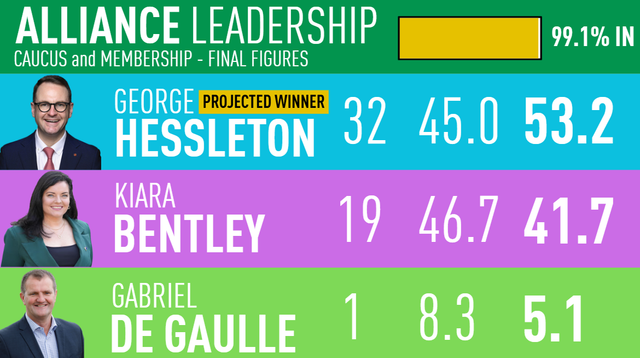
The way Alliance’s leadership elections work, like most Bergiervilean political parties, is a 50% equally-weighted vote between the caucus vote of parliamentary members and a broader vote of all card-carrying party members in the country. Parliamentary Chief Whip Patricia Heath announced that the ballot of caucus members would take place on Tuesday 15 September, while Party Vice-President and Organizational Co-Ordinator Eric Flowers said that membership voting would be open 17-19 September. The results would be announced the day after. Hessleton had a significant advantage among the caucus vote, while Bentley was seen to have a small lead among the membership. The results of the membership vote among the 36 Assembly Members and 16 Senators was 32-19 in favour of Hessleton, with only 1 MP voting for de Gaulle. The membership vote panned out 46.7% for Bentley, 45.0% for Hessleton and 8.3% for de Gaulle, meaning that Hessleton was elected with a 11.5% overall lead over his closest opponent, Bentley. The full results can be found in the graphic below.

Following his election as leader, George Hessleton promised that Alliance would return to its traditional liberal-centrist roots, while maintaining the party’s commitment to social liberalism and a strong social safety net. In his victory speech, Hessleton thanked party members and parliamentary colleagues, but struck a notably conciliatory tone towards Bentley and her supporters.

‘This was a contest within a party, not a war between factions,' Hessleton told supporters. ‘Kiara and I share far more than divides us. The Alliance Party is bigger than any one candidate.’

He also appeared keen to distance himself from the controversies that had dogged his campaign. Asked about the decision to decline the News 24 debate, Hessleton admitted that he had ‘misjudged the moment,’ while refusing to concede that the controversy surrounding Julian Robertson had reflected on his own conduct. Bentley, for her part, conceded the election shortly after the results were announced and congratulated Hessleton on his victory. She said that the membership vote demonstrated that there was 'a substantial constituency within Alliance demanding a more ambitious approach to social policy and the environment.'

Hessleton said his immediate priority would be to unite the party ahead of the general election, which was now only months away. He promised a programme focused on economic growth, responsible government, public services and individual liberty. However, the picture at the moment looks bleak for Alliance, seats in Tulip Bay and New Mercia were identified at risk, with predictions that they will not only fall into fourth place on vote share, but also lose up to 10 seats. Many analysts even pointed out the possibility that he could lose his own seat of Ambleside, in the suburbs of Velsmore, currently held on a two-party preferred margin of just 1.5%. The expected uniform swing against Alliance in New Mercia is 4.7%, meaning that Ambleside is highly likely to fall — News 24 gives Hessleton a bleak 19% chance of staying on.

Image
Last edited by BergieRvile on Fri Sep 25, 2026 12:56 am, edited 2 times in total.
Australian liberal conservative currently living in Sydney, studying commerce and property economics. Feel free to TG about anything!

User avatar
BergieRvile
Diplomat
 
Posts: 549
Founded: Nov 07, 2025
Capitalist Paradise

Postby BergieRvile » Tue Oct 06, 2026 2:34 pm

Image

Incumbent Centre-Left Coalition Narrowly Wins Declimes Cantonal Election


By Adèle Dauphin, News 24.

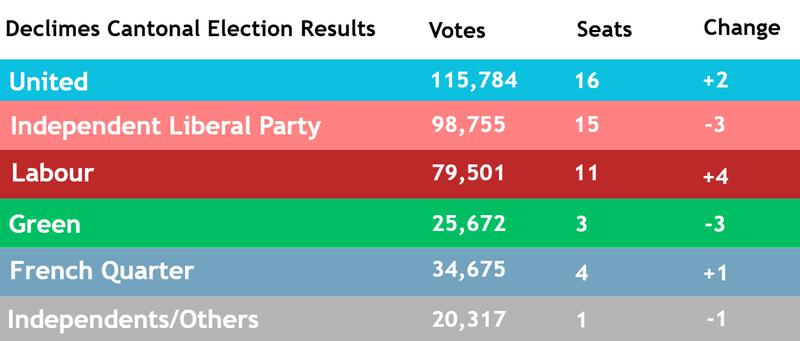
PERAUNTVILLE — The much overlooked election in the small, French-speaking canton of Declimes took place on Saturday, with the incumbent centre-left coalition, consisting of the Independent Liberal Party, Labour Party and the Green Party (not taking part in the next coalition) being re-elected with around the same combined vote share as last election. The ILP, led by Premier Martin Jüri, is a centrist and regionalist party that only operates in Declimes, not standing in federal elections either. It failed to maintain its status as the largest party in the Legislative Assembly, a status it has held since 1998, which it lost to the canton's branch of United. United won 16 seats, a gain of 2, while the ILP lost 3, falling to just 15 seats. However, Jüri was still the one who could form a coalition, negotiating with the third-place Labour Party and retaining his premiership despite not leading the largest party.

The election began when Declimes' independent Governor Pierre Regnard announced that the general election for the canton would take place on October 3. He made this statement on August 29, setting up a relatively brief 5-week campaign. This was slightly ahead of schedule; the election was only expected to be held in early November, but Regnard stated that "holding the election earlier would prevent Declimes voters from having to go to the ballot box twice in the same month for different elections" referring to the upcoming federal election (which many analysts predict will be called in a matter of days). The governing ILP had been thrashed by a series of scandals under the administration of former Premier Juliette Naegelen (2018-2025) which severely impaired the party's reputation among middle-class voters and ordinary citizens, especially when these scandals revolved around corporate donations and bribery. Naegelen and most senior party figures were cleared of any criminal responsibility, but they were consistently unable to shake their perception as a worn-out controversy-plagued machine. As Opposition Leader Estelle Sauvignon said: "you can't teach an old dog new tricks."

Sauvignon herself, as the longtime MP for Allevaner-Ouest, has played a key role in the gradual turn to the right of the Declimes United Party. The 47-year-old former journalist has a reputation for being ruthless in her pursuit of political — and often factional — goals. Her father, Charles, was a notorious leader of the Declimes Separatism Movement, known for his fiery and confrontational style, excelling in public forums and debates. A young Estelle worked as the editor-in-chief of a pro-separation tabloid La Sentinelle, often publishing fervent appeals addressed to "the people of Declimes." After that ran its course, she moved into the mainstream, becoming a correspondent for the canton's largest newspaper Le Monde in 1997. She became the company's chief political editor in 2003, and her excellent column-writing skills as well as her English language proficiency earned her a spot as a national TV presenter and a screenwriter for 3-National. At age 35, she decided to return to Declimes and put her hand up for the seat of Allevaner-Ouest with the United Party, and was successful.

In contrast, Martin Jüri's political career is more conventional. He began as a rail signaller in the south of the Canton, before becoming involved in the railway workers' union and eventually rising through its ranks. He entered politics in 2006, winning a seat in the Legislative Assembly for Saint-Véran as an Independent Liberal. Initially a relatively obscure backbencher, Jüri quickly established himself as a pragmatic and effective parliamentarian, particularly on transport and infrastructure issues. He became Minister for Transport in 2014, a position he held for four years before becoming Deputy Premier in 2018 under Juliette Naegelen. His time under the Naegelen administration was spent primarily defending the many attacks directed at the government, and while his colleagues would go on the offensive with handpicked lines, he bore the brunt of the criticism on a plethora of topics. Upon his predecessor’s resignation, Jüri won the leadership, defeating Raphael Guevremont 13-5.

Now, despite the fact that Sauvignon’s United came out on top in the election with 16 seats to the ILP’s 15, the Premier was still the one to form a government. Labour, which gained 4 seats to a new high of 11 (largely thanks to their charismatic leader Bernard Caron), was quick to agree to a coalition deal with the ILP, one that would hold 26/50 seats in the Cantonal Assembly — a majority of one. While this is an on-paper success, both the shaky arithmetic and the lack of dominance over his coalition partner greatly reduces Premier Martin Jüri’s authority. A majority of one means that one vote, just one dispute, can topple the government. The fact that the ILP is only 4 seats larger than Labour also puts the party’s legitimacy as the commander of the coalition at risk, and the near-even split of ministers also makes it more difficult for Jüri to push his own agenda.

The result of the cantonal election will be difficult to deny for the Independent Liberal Party, especially as their 28-year stranglehold on the Cantonal Assembly has finally run its course. This means the knives internally will begin to sharpen, and a Premier who has only recently taken office may meet his demise sooner than anyone expected.

Image
Australian liberal conservative currently living in Sydney, studying commerce and property economics. Feel free to TG about anything!

User avatar
BergieRvile
Diplomat
 
Posts: 549
Founded: Nov 07, 2025
Capitalist Paradise

Postby BergieRvile » Sat Oct 17, 2026 12:00 am

Image

WEEKLY ROUNDUP: Hauschild Calls the Election for Nov. 28, Zollerland Premier Jeremy Stratton Resigns, Cost of Living, Housing the Most Important Issues for Voters Heading into Campaign


By Mark Duffy and Beatrice Hunqueran.

It's been a big week in the world of politics — with the election right around the corner, parties are gearing up for a campaign set to be dominated by the economy and the volatile state of the world order, while a deeply unpopular cantonal government feels the heat.

Hauschild Calls the Election for November 28

LAURENTIEN — President Philipp Hauschild has formally called a general election for Saturday, November 28, triggering a 44-day campaign period that will determine the composition of the next National Assembly. The announcement brings the current parliamentary term to an end and sets the stage for a fiercely contested national campaign.

The campaign officially begins on Thursday, October 15, giving political parties just over six weeks to present their platforms, organise rallies and convince voters. Candidate nominations will close on Monday, October 19, with the first televised leaders' debate scheduled for the following week. Parties are expected to publish their full manifestos before the final fortnight of campaigning. The final week will see party leaders travel across the country, making their closing arguments before polling stations open on November 28. The election timetable is as follows:

October 15: Official campaign begins.

October 19: Candidate nominations close.

October 27: First televised leaders' debate.

November 7: Campaign midpoint and major polling review.

November 14: Final fortnight begins; major party manifestos due.

November 27: Final day of campaigning.

November 28: General election and polling day.

Zollerland Premier Jeremy Stratton Resigns

SCANDBOROUGH — The embattled and deeply unpopular Premier of the Canton of Zollerland tendered his resignation on Wednesday in an outdoor conference area in the canton's capital, Scandborough, surrounded by his wife Annalise Lawson (who is a federal MP), stepson Matt and infant son James. In the final speech of his premiership, he thanked supporters and colleagues, saying 'it has been the greatest honour of my life to serve the people of Zollerland in the highest office of our canton's government, as premier.'

The government of Jeremy Stratton, a 54-year-old former merchant banker, and his United Party, became highly unpopular following numerous scandals and project delays. This included an incident in which it was uncovered that members of his government gave extra funding to roads and community centres in marginal seats. Furthermore, the East-West link across the canton's capital of Scandborough, a policy first introduced in 2011 by United, was delayed continuously without constructive dates. These issues and many others contributed to Stratton having a net approval rating of -34.

The race to replace Stratton has already begun, with Deputy Leader Sarah Williams, who is considered a member of the party's moderate wing, declaring her candidacy. Williams, while young, is also very associated with Stratton himself and reign over United, which begun in 2018. There is a large possibility that the next leader may be a backbencher, for instance, first-term MCAs Michael Cavanaugh and Gerald Hope, who have both put themselves forward as more conservative candidates. Former United MP Declan Fresh defected to form the right-wing populist One Zollerland party last February and has been rapidy gaining traction after a merger with the canton's division of Horizon, and has been campaigning on the slogan A Fresh Start for Zollerland, a play on words with Mr. Fresh's name. Many strategists believe choosing a more conservative option will stem the bleeding rightwards.

Reyner-National Poll Shows Top Voter Priorities as Campaign Begins

LAURENTIEN — Reyner-National published its traditional mega-poll of voter priorities before the election today, and with over 45,000 respondents asked their positions over the period of 1 month, this was the largest single political opinion poll ever conducted in Bergiervile. Aside from the regular questions about age, sex, income, location and ethnicity, there was only one question, asking voters to rank, in order, these 12 policy areas: [climate change, cost of living, crime, education, foreign affairs, government integrity, healthcare, housing, immigration, infrastructure and transport, jobs and wages, national security and defence] in order of priority that would inform them of their vote this election. Here were the results (percentages indicate how many voters placed it as an issue of major concern to them):

  • Cost of Living - 66%
  • Housing - 39%
  • Healthcare - 22%
  • Jobs and Wages - 20%
  • Immigration - 20%
  • Crime - 20%
  • Education - 17%
  • Foreign Affairs - 12%
  • Climate Change - 8%
  • Infrastructure and Transport - 8%
  • National Security and Defence - 7%
  • Government Integrity - 5%

Responding to this poll, which had Cost of Living on both its highest score and largest lead ever, both major party leaders visited areas affected by the cost of living crisis. Francine Huntingdon was in her hometown of Bay City, which entrenched its position as the second-largest city in the country in this year's census, visiting poorer neighbourhoods. The party's official campaign launch will be held on the 23rd, in Helsingstadt, Votterden. Helsingstadt and Votterden generally has been considered safe territory for United since their monstrous lanslide win in the 2025 Cantonal Election, where it won 65 of 75 available seats. Michal Bennett's Labour, however, will be organizing their ranks to head to Vandenbergen, a little-known town in the Easter Valley region of New Mercia. The town of just 16,000 will be home to their campaign launch in 2026.
Last edited by BergieRvile on Sat Oct 17, 2026 12:01 am, edited 1 time in total.
Australian liberal conservative currently living in Sydney, studying commerce and property economics. Feel free to TG about anything!


Return to NationStates

Who is online

Users browsing this forum: Chrinthanium

Advertisement

Remove ads