Tumbra — History
The United States of Tumbra (1848 to 1864) The flag of the United States of Tumbra
When independence from the Empire was declared in 1848, two successor republican nations broke away from the Empire of Tumbra, with both implicitly working together to secure their political futures. In the east was the United States of Tumbra, formed by and led by the White League. In the west was the Western Tumbran Republic, led by the former Commander-General of Western Forces, Benjamin Washington. Because of the low-level rebellion in the West that had lasted longer, the West was effectively abandoned early by the Empire as it tried to hold on to its eastern holdings; Washington was effectively able to govern unopposed from his capital in Fontwell. This section covers political developments within the United States of Tumbra, essentially serving as a political chronicle of the United States of Tumbra in 1848 to its eventual reformation into the Federal Republic of Tumbra in 1864.
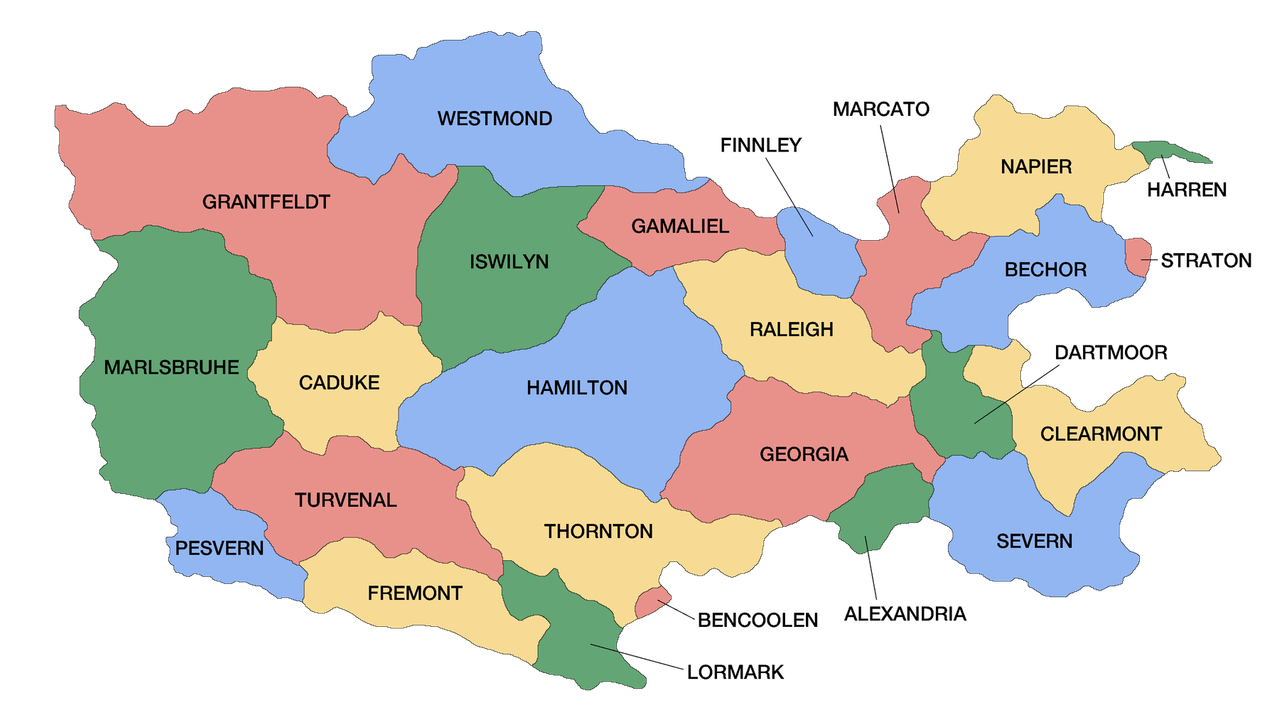
A League, A Project, And A FlagMost of the preparatory work for the United States had been done in secret in the years leading up to the Revolution; in essence, the entirety of the United States had been an elite-driven project foisted upon a populace at its limits and willing to accept any alternative. The White League had essentially done zero public consultation when it came to how the new United States would work; it was so secret that Benjamin Washington, who would seize power in the West and rule for three terms as President there, was not even included despite his stature in that region. Little wonder, then, did the leader refuse to join the new United States. Yet, with its cabal of carefully-chosen elites sprinkled amongst the eighteen states that would eventually join the United States, the transitions went relatively smoothly at first; by the time of the first elections, every state would be able to send a Congressional delegation to Couno, with the Imperial Forces only really having control over the centre of the country.
The new Articles of Union of the United States were not adopted by any referendum or democratic manoeuvre; when the Civil War was declared on the morning of 5 January, those joining the United States had implicitly accepted the new terms with which they were to be governed under. To be fair, they were much more liberal than the highly-centralised Empire had been; but, as the later history of the United States would prove, perhaps they were
too liberal. Individual states were effectively sovereign nations within the United States, with full abilities to levy taxes, set tariffs, and so on; the only authority they would delegate to the central government, first based out in Couno, would be on foreign affairs, treaties, and currencies and measures. Outside of that, the new central government — the Congress of the United States — had little real power. It had no power to tax, regulate commerce outside of standard currencies, nor levy an army; instead, the individual states would provide funding and manpower. The founding document of the Congress gave them the power to elect a President of the United States, with overall responsibility for foreign affairs and the administration of the extremely lean central government; the President could choose a small Cabinet, including the role of Chancellor — who would essentially serve as the President's plenipotentiary to the eighteen states to negotiate for funding and to essentially serve as a intermediary between them in case of conflicts. Yet this was not accepted by everyone who signed on to the new political project.
Two factions of politicians formed as early as the First Congress, elected in 1848. The first of these were the Perpetualists, who sought to maintain the highly-decentralised nature of the United States, seeking to maintain the Union as simply a confederacy through which the eighteen states would act in tandem on the world stage in matters such as treaties and diplomacy. The other faction were the Reformists, who sought to further reform the United States into what would eventually become a federal republic with a central government. These groupings, at first, were loose and politicians were not elected under any official party lines; in fact, the Reformists would not become an actual faction and party until after these first elections. Later, the Perpetualists would try to re-invent themselves as the Democrats, given their (formal) organisational name of the
Democratic Party for the Perpetual Union of the United States of Tumbra, but the name had stuck. The Reformists would stick to their popular name, even as the Perpetualists attempted to call them Republicans, given their formal organisational name of the
Reformist Movement for a Federal Republic of Tumbra. The first elections in the United States of Tumbra were held a mere two months after the Declaration of the Republic; people would directly elect 225 members of the Chamber of Deputies, while state legislatures would elect three Councillors per state to seat in the Council of States. While each state was supposed to be split into legislative districts, the hasty nature of the elections, the ongoing chaotic war situation, and desire to get things off to a running start meant that fourteen of the eighteen states elected their prospective members of the Chamber of Deputies at-large.
The first Congress met hastily in Couno five months after the Declaration and two after the first set of elections; many were unfamiliar with each other, but of the 279 members of the First Congress, all of them came from the middle class at minimum. Many were part of the landed gentry in the Empire. There were no working-class members of the First Congress, nor would there be any working-class members in any of the Eight Congresses of the United States. For later historians, this drove home the point that the United States was an elite-driven governance movement, with suffrage only extended to male members of the working class in order to get them onboard the nascent political project. The romantic narrative of a liberal revolution did not matter; power only truly shifted hands from the old royals to a new, perhaps more democratically-chosen set of elites, but elites nonetheless.
There were two questions for them to discuss; the nature of a flag, and that of the chief executive. The flag chosen by the White League was accepted easily, but there was still the question of the symbol in the middle; there was much debate on an eighteen-pointed star, an eagle, and others. Eventually, a single tree, representing the birth of new life and the hope that the United States would be as sturdy as one, would be chosen.
The new and exciting political project, as Alexander Marsh, a newly-elected Member of the Chamber of Deputies so described it, was now under way.
The United States Chooses A President — Henry ShawHenry Shaw would eventually be chosen as the first President of the United States by Congress, with the main justification given by the presses being that Shaw was the highest-ranked diplomat in the Empire to defect, and would thus be best-placed to negotiate support and international recognition for the fledgling political project from other countries. Shaw was seen as a mild Perpetualist, and he took little action to fight this sentiment; his choice of Chancellor in the form of a Perpetualist, Louis Richardson, would reflect this. Shaw, however, was not elected without opposition. Gerald Evander Gerritsen, a newly-elected and little-known Councillor from Alexandria, and who was also a committed hardline Reformist, would self-nominate on the floor of the Congress. To describe Gerritsen as a Reformist at the time of his self-nomination would be anachronistic, as it was Gerritsen's fiery speech on the floor of Congress in favour of immediate Constitutional reform into a Federal Republic that would eventually lead into the formation of the Reformist faction of the United States. Gerritsen would, however, be handily defeated 188-87. This would be the first of six presidential runs across both Republics and the beginning of a long political career full of controversy; he would eventually come to become the known as the "gadfly" or "bugbear" of the United States, a term he would come to take with pride.
Shaw's choice of Cabinet members would essentially be handwaved through by the Council of State. It was a small Cabinet, comprising of seven members; outside of Shaw as President and Richardson as Chancellor, Simon Pearson-Stanley would serve as Minister for Foreign Affairs, John Seymour as Treasurer, William Ravencroft as Attorney-General, Oliver Cavendish as Minister for War, and future Chancellor Pierre Crowley as Postmaster-General. Most of them were members of the White League, and before that, part of the Imperial machinery.
Chiefly devoting his time in office to securing international recognition for the fledgling republic, Shaw spent his first six months in office "putting affairs in order" and shepherding some legislation through Congress; but afterwards departed to make international goodwill trips, trying to secure materiel for the Civil War. In total, Shaw spent nearly half of his presidency abroad; such were the breadth and depth of his trips to as many countries as possible. While his role as President meant that he had the force of his office behind him, in his personal writings Shaw wrote of his discomfort at essentially being "an absentee President." Shaw's long absences also meant that most of the domestic war effort was led by Chancellor Louis Richardson and Minister for War Oliver Cavendish; who, in tandem with General of the Army Gordon Hamilton and Admiral of the Navy Henry Jackson, directed the military front of things. Richardson's personal writings, published after his retirement, tell of a "great sadness" that Congress could not help more with the perpetual food shortages and supply line interruptions the states suffered during the Civil War, hinting at an early, and eventually fatal, limitation of the governance model of the new United States. Yet he seemed to almost fatalistically accept them. Others, like the Reformists and Gerald Gerritsen, chose not to.
The Apex and Decline of Perpetualist Power — Edmund Reid and James FairbanksAt the end of his two-year term, Shaw declined to run for re-election, citing his belief that he would be better placed in a diplomatic role. Richardson, too, declined to run for the presidency, instead running for Governor of Westmond. After the 1850 elections, the Perpetualists then put forth Edmund Reid, who had served as the Perpetualist leader in the Council of States, evidently to fend off the threat put forth by Gerald Gerritsen, who again was the effective nominee of the Reformists. Reid would end up beating Gerritsen handily on the floor vote of Congress, but polarisation was evident; candidates who had run on explicitly reforming the United States won 83 seats in the Chamber of Deputies, up 36 from just two years prior; additionally, some Perpetualists and Reformists had begun explicitly identifying as such in their election campaigns.
Reid's Cabinet, despite his lack of involvement with the Shaw administration, would be seen as a continuity Cabinet; he would end up selecting Shaw's Postmaster-General, Pierre Crowley, as his Chancellor. Simon Pearson-Stanley and Oliver Cavendish would remain as Minister for Foreign Affairs and Minister for War, respectively; new to the Cabinet would be George McDonohue as Treasurer, Leonard Hood as Attorney-General, and Jasper Grant as Postmaster-General. Former president Shaw would be appointed as Ambassador-at-large, allowing for him to focus fully on his diplomatic duties, and be invited to sit in Cabinet, but he declined, citing that Pearson-Stanley should be the chief and only person in charge of the Union's foreign affairs. Reid's presidency would end up overseeing the largest expansion of the nascent country's diplomatic corps to date, largely at Pearson-Stanley and Shaw's urgings. The Ministry of Foreign Affairs would eventually be established in Straton, which would mark the beginning of the gradual shift in the country's power centre from Couno to Straton.
The greatest achievement of the Reid presidency, however anaemic the presidency of the United States was, ended up being the final victory of the Republic over the Empire at the Battle of Clover Hill in 1852; months before the elections due to take place that year. The amount of goodwill generated toward Reid's Perpetualist administration allowed for the Perpetualists to win both houses of Congress easily; but once again the Perpetualists, basking in victory, faced a crisis of nominating a suitable next President. Reid would decline, following the manner of Shaw, to run for a second term, instead choosing to take the lead on negotiations for the eventual final Peace Treaty; Chancellor Crowley and Minister for War Cavendish would follow suit, and both would become Reid's right-hand men in the negotiations. An attempt to nominate Foreign Minister Pearson-Stanley for the presidency was aborted when the indignant Bechor native angrily wrote from Straton to not choose him; he was eventually named as Ambassador to [].
While realising he had no chance of winning the Presidency, Reformist leader Gerald Gerritsen lambasted the Perpetualists on the floor of the Council of States for winning an election "with no plan to win the Peace that our brave soldiers have so gallantly fought and died for." Gerritsen's own political future was hanging by a thread; his penchant for making enemies in politics had effectively killed a run for Governor of Finnley before it had even began. His two runs for President, alongside nationwide campaigning for the cause of the Federal Republic, had left the state legislature extremely annoyed that he had not been in fact executing his primary role as a Councillor, and was only re-elected by them as the third and final representative to the Council of States after days of debate. Still, running unopposed for the nomination of the Reformists, there was a real chance he could win by default if the Perpetualists failed to nominate anyone. Factional disputes within the Perpetualists meant that at this point, this was a real possibility; several candidates from both within and outside the scene of federal politics proposed were rejected out of hand. Cecil Wood, the Governor of Napier, was deemed too divisive within the party; Jack Redfern, the Governor of Alexandria, was thought of to be too friendly to Reformists for congressional Perpetualists' liking.
In the end, the Perpetualists coalesced around James Fairbanks, a member of the Chamber of Deputies from Clearmont; the little-known Fairbanks was primarily selected on the basis of his previous writings that had argued on the merits of the United States, as opposed to the Federal Republic, and his "agreeableness to everyone and hostility from no-one." In the end, despite his own reported doubts about his suitability for office, Fairbanks was shepherded through the electoral process; with an absolute majority in both Houses, he won easily, handing Gerritsen his third defeat for President. Lacking prominent allies in Congress, Fairbanks was effectively forced to select internal power-broker Russell Chatham as Chancellor.
Fairbanks' Cabinet choices would essentially be Chatham's choices; the selection of Hugo Weathers and Benjamin Northfield as Foreign Affairs Minister and Treasurer respectively were essentially patronage appointments for Chatham loyalists; other prominent members of the Perpetualists either negotiated themselves onto the Cabinet or appointed surrogates. This left Fairbanks with remarkably little space for manoeuvring; for his two years in office, remarkably little would come to pass as individual states worked amidst themselves to rebuild. The withdrawal of military forces was so stark that at one point Congress considered disestablishing the position of Minister for War, since almost every state had stood down their armies or taken back control; but a small, rump volunteer force was kept under central government control in order for operational readiness.
Historians have come to describe Fairbanks' two years as a critical time period of missed opportunities, especially when it came to post-war reconstruction. Some have remarked that thanks to Chatham's interference, Fairbanks' presidency was "over before it even began;" biographer Amanda Henley's verdict was that Fairbanks "was a mediocre politician, with an ultimate limited ability, unwillingly thrust into a spotlight through his writings, which are the only true part of his legacy that cannot come in for criticism." The country was now ready for a change, and the 1854 elections delivered; merely two years after giving the Perpetualists an overall majority in the Chamber of Deputies, they would give the Refomists a plurality.
The Student Repudiates the Master — Quentin LykensIt was quite evident early into Fairbanks' term that he would not even attempt to run for re-election, thus effectively solidifying the norm of presidents serving one two-year term. In his absence, Chancellor Russell Chatham would secure the 1854 Perpetualist nomination for president, despite strident opposition from within his party; even with a diminished caucus, he still easily saw off a challenge from Michael Hartington, a more moderate member of the Perpetualists, who argued that the now quasi-official party needed to reinvent itself. Chatham had a path to the presidency, even with the Perpetualists now only controlling 101 seats in the Chamber of Deputies and 28 in the Council of States to the Reformists' 110 in the Chamber and 22 in the Council; all he needed was to get a majority of unaffiliated members in either House to side with him.
But his opponent this time would not be Gerald Gerritsen, who had finally been defeated in his re-election push for a spot on the Council of States by the state legislature. In the fiery Reformist's absence, Gerritsen's deputy Quentin Lykens, a relatively mild-mannered Severnian, would quickly establish himself as the frontrunner for the nomination. The election was widely expected to be the first truly contested election for President in Congress' history, but Chatham would utilise the threat of a potential Lykens presidency seeing Gerritsen appointed to Cabinet; perhaps mirroring his own experience with Fairbanks, he accused Lykens of being a Gerritsen puppet.
In his speech to Congress two days before the presidential vote, Quentin Lykens would thoroughly repudiate Gerald Gerritsen, saying that his confrontational approach had harmed the country more than it had helped it; that even though he was a Reformist, he would not push for immediate reformation of the United States into a federal republic, and that he would not appoint Gerritsen to any role in his Cabinet. Gerritsen, who had by now decamped to Nantwich following his election loss, was enraged when he read the full text of the speech; he immediately began penning an indignant reply, but it was too late. Lykens would beat Chatham handily in the final vote, and become the first Reformist to become President.
The Straton Times, then the most pro-Perpetualist paper in Tumbra, would describe Chatham's defeat as "ultimately a brief Lykensian interlude" and lambasted Chatham as "a candidate tarred with inaction and by association to the Fairbanks presidency, which squandered most of its goodwill almost instantly." Ever-ebullient on the chances of the Perpetualists, the paper endorsed Michael Hartington to lead the party for at least the next two years, and cautioned the country against overreach from the Lykens administration.
Lykens' cabinet, while relatively inexperienced, was not the menagerie of horrors that the Perpetualists had attempted to paint the then-party of opposition as. The membership of the Reformists was effectively drawn from the ranks of the same elite that comprised the Perpetualists; Gerritsen, the middle-class firebrand philosopher, was the anomaly. The ever-indignant Gerritsen would return to Couno a few days after Lykens' election, demanding an audience with the new President. It was granted; Lykens' and Gerritsen's diaries have different accounts of the meeting (Lykens' diary describes it as cordial; Gerritsen says he and Lykens had a heated argument), but the eventual conclusion was the same. Gerritsen was not welcome in Lykens' government, and Gerritsen once again left for Nantwich after three days.
The new president would stay true to his campaign promise of not explicitly pushing for reformation into a federal republic, but instead chose to push issues to instead demonstrate the need for a federal republic while at the same time working within the system. With his Chancellor, Philip Moore (a moderate Reformist from Gamaliel), they chose to push on the issue of a single unified tariff for the entire country. This would fall under regulating commerce — which was not a power that the Congress of the Republic, let alone the presidency, had — but the salience of the issue was clear and growing. Each of the eighteen states could set individual tariffs; each were essentially in competition with each other, generating tensions between them. It did not help that states often set tariffs on each other as well. The strategy the President-Chancellor duo essentially settled on was for Moore, in his role as plenipotentiary to the states, to publicly negotiate with states to lower their tariffs to a more common level; and when that inevitably failed, for Lykens to subtly hint that a single, national, enforceable tariff was perhaps preferable, while neither did any concrete action to actually put one in place — all operating within the bounds of the Articles of the Union.
Predictably, the response when Lykens addressed Congress on the issue was fast and sharp; the pro-Perpetualist newspapers, which dominated the media landscape, did not let up on the president. Crucially, however, they did acknowledge — even if only in passing — that the issue of tariffs, as well as the issues of railway-building (different states were finding it impossible to co-ordinate railway gauges or station locations, leading to situations where travellers were forced to disembark and change trains at almost every state borders) and that of the issue of a National Navy (the Navy was under the auspices of the Minister for War, but maintanence costs and the costs of procurement of new ships had increased) were severely hindered by the lack of a central government — or, more specifically, the lack of authority that one had.
The naval issue was resolved relatively quickly, in one of the few legislative victories for the beleaguered administration, with Congress authorising the formation of a ministry to handle the Navy; the small peninsular state of Harren was chosen to host the nation's Civil War-era fleet.The railways issue was quietly put back in the closet for future administrations to use; the tariff issue would dominate popular discourse across the second year of Lykens' presidency. Lykens, having been a banker before the Civil War, welcomed it; he would frequently write rebuttals in the very same newspapers that would criticise him for overstepping the bounds of the presidency, correctly predicting that the newspapers' desire to sell papers bearing the President's writings far outstripped any ideological leanings they held.
The rest of Lykens' presidency would be relatively more calm, though near the end of the twenty-four months the papers would begin their attacks on him again to get the population to vote Perpetualist. But, as historian Peter Lloyd would put it, the election and subsequent administration of Quentin Lykens as president would prove to be pivotal in the short history of the Republic. Outside of the obvious — that Lykens was the first Reformist to serve as President — the movement now had spokespeople with enough credibility outside of the divisive Gerald Gerritsen who could be put forth as leaders of the party in the future. More crucially, they had a strategy to gradually convince the population of the need of a centralised, federal government. Ever shrewd, Lykens toyed with the idea of running for re-election, but eventually announced that he, too, would stick with established tradition and step down after two years in office.
The Pendulum Swings Back — Jacob FitzwilliamThe concerted media campaign backing the Perpetualists had a tangible effect on the 1856 campaign, with the party winning a small majority in the Chamber of Deputies. This election saw the party take a different tack when it came to its presidential candidate; it chose him before the full election campaign, and essentially centred their whole campaign around their presidential candidate. Such a move was lambasted as improper by the Reformists, but the Perpetualists' choice of candidate lent itself well to this strategy. Most had been expecting Michael Hartington, who wrested control of the party from former Chancellor Russell Chatham in the wake of the 1854 debacle, to be the Perpetualist nominee; but the party, with Hartington's explicit blessing, chose Jacob Fitzwilliam, charismatic war hero and two-term Governor of Georgia.
Later historians would claim the Perpetualists' campaign was light on substance and essentially centred around Fitzwilliam's agreeable personality, but it was the ability of the party to put a recognisable face to the campaign that helped them beat the Reformists, who lacked one. Fitzwilliam was no Fairbanks, either; instead of coming off as a reluctant, plucked-from-the-sky backbencher, Fitzwilliam was public about his ambition, with his letter accepting the nomination being published nationwide in pro-Perpetualist papers. The result was still closer than most expected, however; Perpetualists who were expecting to win about 125 seats in the Chamber of Deputies were severely disappointed when they ended up with an overall majority of three. Yet this was still enough for Fitzwilliam to become President with 146 votes to Treasurer Daniel Scott, the eventual Reformist candidate's 133.
Most of the concerns that might have curtailed a Fitzwilliam candidacy, and did end the candidacies of talented individuals such as Cecil Wood and Jack Redfern (see the above section on the Fairbanks presidency) — such as his outspoken personality and lack of time spent in Couno — were passed over simply because of the Perpetualist desire to win back the Presidency. Party elders in Couno expected for Fitzwilliam to reverse most of the reforms made during the Lykens administration, but would eventually be disappointed; Fitzwilliam, in his opening address to Congress, explicitly said he would maintain key reforms, including the formation of the Navy Ministry. What shocked most, however, was his ambitious plan to move the capital of the United States from Couno to elsewhere. He did not explicitly state where in his speech, but it was understood that Fitzwilliam privately wished for it to move to Kingsbury, the old imperial capital.
The speech garnered mixed reviews from both Perpetualists and Reformists. A common thread around both was that Couno was too far in the north-east to be be a place of unity for the country, and while the previous administration had considered floating the idea of moving the capital, the lack of a suitable location and the choice of the tariff issue to press meant that it was not raised. For Fitzwilliam to do so practically defied political logic, but it would come to define his term, and also serve as a useful distraction for the public from other issues that could potentially swing the federalism-confederation debate either way. Georgia had been one of the states most divided by debates on both federalism and the capital, with most Georgians still stinging at the fact that Kingsbury was no longer the heart of the country, and that they were now expected to be loyal to a government so far away. Fitzwilliam himself was weary of treading on the issue, considering that he nearly lost his bid for re-election in 1854 thanks to the Reformist wave; while he had been an outspoken Perpetualist in his first term, he had moderated considerably in his second term.
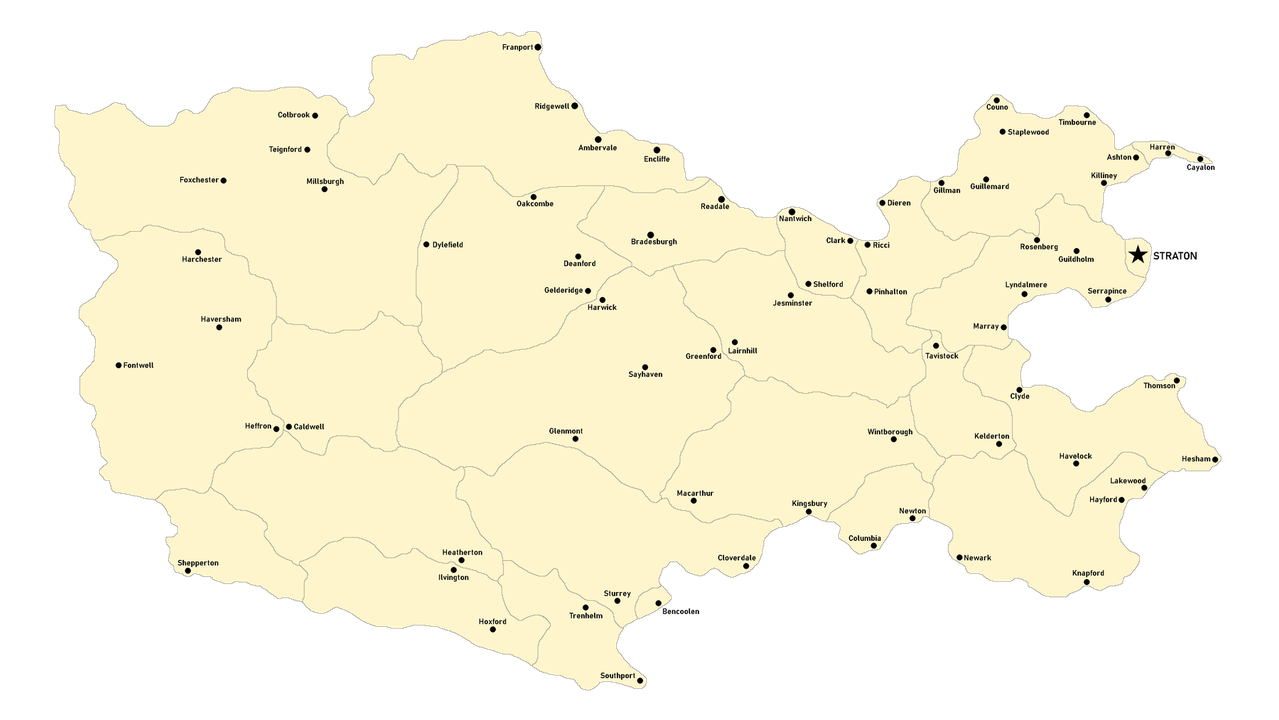
Stunningly, however, Fitzwilliam would eventually find common cause with Reformists on the issue of the capital city, though they did warn him in no uncertain terms that Kingsbury would not be an acceptable location for the new capital. Acquiescing, they went through several locations — Hesham, Lakewood, and the construction of a new capital in the state of Keybrook, along the River Hewnbrook — before settling on Straton as a compromise choice. The city itself, given Free City status during the Imperial era, was considering merging into the neighbouring state of Bechor due to revenue issues. Crucially, Straton pleased everyone to some extent but nobody fully. The move meant that the capital wags still in the northeast, which pleased the most populated region of the country to the detriment of those further west. It took power away from the country's most populous state, Napier, and gave it to the relative minnows of Straton, which pleased everyone not from Napier. It essentially settled the argument over the capital, as there was a move, but not as drastic as what some wanted.
Yet as much as Fitzwilliam used his personal charm to govern, his administration would largely paper over the cracks that had continued to set in regarding the problem of the federalism-confederalism divide. Noted Perpetualist grandee Dalton Everett, patriarch of the long-running family of politicians which would later encompass three Prime Ministers, would defect to the Reformists on the floor of the Chamber of Deputies; late in his administration, a corruption scandal involving Treasurer Alfred Browning also raised questions about whether Fitzwilliam knew about his dealings, and whether the President was involved. Ultimately, he would ride out the scandals, but the Perpetualists seemed to be on a course of decline that was beginning to feel irreversible.
The Presidency Goes Executive — Philip Moore1858 would, for the first time, see the Reformists become the largest party in both Houses of Congress for the first time, which made the election of their chosen presidential candidate a near certainty. This time, there would be no hesitation on former Chancellor Philip Moore's part to run for the Reformist nomination; most stepped aside for him. The Perpetualists attempted to do a rerun of their 1856 campaign, by confirming their nominee — Michael Hartington, who by now was the last prominent party member standing after scandal rocked the party — early, but the country returned a comfortable Reformist majority. Hartington's lack of geniality or true name recognition meant that his campaign missed out on most of the energy that Fitzwilliam was able to bring to his, and the results were evidence of this.
Moore, while still adhering to the Lykensian playbook of gradual change by calling attention to pressure points on the political infrastructure of the United States, privately wished to accelerate the process of change a little. "Year by year, as processes and traditions solidify, the chance that we will be able to move decisively toward our ultimate aim of a new Republic grows dimmer," he wrote in a letter to his eventual Attorney-General Chester Warburton, attempting to convince him to join his Cabinet. Renewed attention was paid to the question of the single national tariff — which had gone unanswered during the Fitzwilliam administration — as well as what Moore termed "projects of great national interest," which were essentially large public works projects that individual states often lacked the capacity to finance or build individually.
Seizing upon the change in the location of the nation's capital, Moore chose to focus on the construction of a railway between Couno and Straton, which had long been in the works yet had never really taken off. The Napier, Bechor, and to a lesser extent Straton state governments could not come to an agreement on the route; the Napier state government wanted any route to pass through the state's second largest city of Timbourne, while the Bechor government wanted it to pass through the town of Guildholm, the site of the country's oldest university, and
their second largest city, Rosenberg. Chancellor Richard Halleck would eventually bring the three states to the table and offer the central government's help to construct both lines, but only if they were granted express permission by Congress. Despite the Reformist plurality in the Council of States and their majority in the House, this was easier said than done; some balked at the pace with which Moore was moving.
 A map of the proposed Couno to Straton rail link. The line in red represents the government of Napier's proposed route, while the line in blue represents the government of Bechor's proposed route.
After much political wrangling, the railway-building legislation would eventually pass Congress. The expected Perpetualist backlash arrived on cue, but Moore's patience with them had run out; unlike Fitzwilliam and the Reformists, few in the Perpetualists were willing to extend the same hand of co-operation to Moore. Attempts to stymie the building of the railway failed in both states' courts, which meant that the first true cross-state public infrastructure project — which Moore felt was key to convincing people of the need for federalism — was now underway. Disparagingly, hardline Perpetualists would both decry this as simultaneously an attempt for the government to regulate commerce and also something so pithy it did not deserve the government's time. Late in 1859, Perpetualist deputy Paul Oakton would call Moore the "President of the United States of Tumbran Railways" on the floor of the Chamber of Deputies; the Reformists' Majority Leader, Harald Hakkinen, would respond that Moore could claim to at least the president of
something.Hakkinen's comment, while made in the heat of the moment, reignited the confederation-federalism debate; while it was fought largely in newspapers, the continued laggard pace of postwar reconstruction due to the lack of a central government was only stoking discontent in the country. The western border states — Westmond, Iswilyn, Keybrook, and Thornton — were all losing population to the Western Tumbran Republic, which had stronger economic growth on average. The squabble over the railway might have been relatively minor, but it was proof that perhaps a more centralised approach to governance was looking more and more palatable each day. In public, Moore said nothing about Hakkinen reigniting the debate on federalism; privately, Moore was at first worried, then relieved when he saw the response to Hakkinen's comments.
Moore would have two last legislative actions before Congress broke for the election period. The first would be to establish a ministry overseeing the railways. This one was established at Chancellor Richard Halleck's insistence, and afterwards the presumptive front-runner for the 1860 Perpetualist nomination announced publicly that he would
not, in fact, be running for the presidency; but he would like to be appointed as the minister in charge of that ministry if the Reformists won in April. The other was to establish a commission on establishing a single external national tariff, which would essentially draw the battle lines for the election and was regarded by the Perpetualists as a mortal sin. To the ever-eager press, this was finally the sign that they needed that the Reformists were just Imperials in disguise, looking at the first moment to re-establish a centralised government which paid zero heed to economic liberties.
The short-term effect of Moore's presidency was that people began to finally warm to the idea of a central government with more power. He became the first president to since Henry Shaw to actually attempt to govern; except where Shaw attempted to busy himself with external affairs, Moore would be the first to truly focus on internal issues. His more active presidency was both an effective continuation and slight repudiation of Quentin Lykens'; but that administration occurred in a different context. The more forceful, executive style with which Moore moved proved to be more suited to meet the growing frustration with the lack of central administration and leadership the country faced; the immediate impact of the Couno-Straton railway ended up being the states of Dartmoor and Clearmont agreeing to turn over their own stalled railway project between their capitals of Tavistock and Hesham to the Reformists.
In the end, Halleck not running for the presidential nomination of the Reformists opened up the field to multiple characters who saw where the wind was blowing and were eager to take their chances. Harald Hakkinen, the Majority Leader of the Reformists in the Chamber of Deputies, was the frontrunner. Perpetualist-turned-Reformist Dalton Everett was chomping at the bit to take the reins of power in his new party, but he had no real base in the party. There were the ambitious young hotshots of Michael Turner and Ralph Davidson, who were rapidly rising through the ranks of the party. Last but not least, nobody could forget the party's founder, Gerald Evander Gerritsen, who had held his tongue for the past two years but felt that now was the time to re-enter national politics.
Disciplined Momentum — The Election of 1860 and Harald HakkinenThe results of the 1860 elections were unexpectedly good for the Reformists, who were expecting a modest gain of about 10 seats but instead ended up winning 155. Wary of squandering the party's new-found advantage in a manner similar to how the Perpetualists did after the 1852 election, the Reformist Majority Leader, Harald Hakkinen, attempted to centralise party discipline more. The caucus had no way of influencing who ran under the Reformist banner, as that decision was made, more often than not, locally; but Hakkinen now had to juggle his personal ambitions for the presidency, party discipline, and getting legislation through both chambers of Congress. There were less problems on the side of the House of Councillors, where Hakkinen's close personal friend Oliver Grosvenor led the chamber with an iron fist; with only four additional Councillors there, he had less of a problem attempting to herd that particular group of legislators.
Back in the lower chamber, Hakkinen's first problem was keeping Gerald Gerritsen — who had chosen a district in Finnley to run in and be comfortably elected, ending a six-year period of exile from national politics — away from the levers of power. While Gerritsen was a forceful speaker and had admirers nationwide, party leaders were convinced that letting Gerritsen anywhere near the presidency would cause immense harm to the federalist cause, considering how brash and abrasive he could be. Dalton Everett, the Perpetualist defector, had all the markings of high office, but did not hold strong support from any part of the party; Hakkinen himself was suspicious of Everett's motives for his defection and sought to keep him at arm's length.
The Reformists had no perfect candidates for the presidency in 1860. At least outwardly, Hakkinen was reluctant to let go of the Majority Leader role for one that demanded more scrutiny and would likely be a thankless one. Ralph Davidson and Michael Turner, two Deputies widely regarded as the future of the party, were seen as too inexperienced for the presidency. Richard Halleck, the early frontrunner and current Chancellor, had designs on the Railway Ministry, which he saw as the pathway toward federalism. Whether or not it was personal ambition or the fact that the party had nobody else to nominate, Hakkinen became the nominee after reportedly refusing twice, handily defeating Gerritsen and Everett. Everett was made the Perpetualist nominee for Speaker of the Chamber of Deputies after Hakkinen decided to bring the Napier politician into his tent. It was unprecedented for a single politician to hold this much influence in the Reformist caucus, but Hakkinen was one of a select group who had served continuously since 1848; his seniority was a gift in this situation.
Winning the actual vote on the floor of Congress easily, defeating Perpetualist nominee, Thornton Governor Daniel Thorneycroft, Hakkinen now had to turn to the more complicated task of assembling a Cabinet. This was a normal dilemma faced by most Presidents, but factionalism was rife; Hakkinen somehow had to make his presence known while also letting the factions have an about-equivalent share of the power. In the end, most of his potential opponents were given places in his Cabinet; Michael Turner was made Chancellor, while Ralph Davidson was made Postmaster-General. The move to put Turner above Davidson turbocharged a decades-long rivalry that Hakkinen managed to mediate while he was in office, but which exploded after; the disdain the two men held for each other continued beyond the time of the United States. Richard Halleck was, as expected, given his position of Minister for Railways; while future luminaries such as Alexander Henderson, Richard Barker, and William Butler also entered Cabinet.
Hakkinen had long since decided that decisive action was now required to force the issue of federalism during this term after the progress the Moore administration had made on the issue; in a letter reply from the former President, who was now enjoying retirement on the southern coast of the country, Moore would concur with Hakkinen's outlook on the situation. Theoretically, Hakkinen could force it now; the Reformists had a two-thirds majority in Congress. The Perpetualists had gone into what felt like a death spiral; the closest thing the party had to a federal leader, Michael Hartington, had passed away during Moore's term and they were struggling to find a replacement. The press was still hostile, but there was a general sense that the issue of federalism had popular support throughout the country, most for a variety of reasons. The very visible project of railway-building was perhaps the most visible driver of popular support for the issue; most people now associated national infrastructure with economic rebuilding, which had started and stopped at various times after the war, and the second-order association was with a strong central government.
The commission that was started under Moore on a single national tariff returned its report in November 1860; while it did return that a single, unified national tariff would boost national competitiveness as a whole, the central government implementing it would likely be unconstitutional. Instead, it would require all eighteen states to agree to harmonise their tariff rates, but the report said that such an action would be exceptionally difficult to achieve. Hakkinen let the report stew across the holidays; then, in his 1861 New Year's Address, published in the newspapers, he announced that he would be looking into the establishment of a new constitutional convention, and would convene a drafting committee to write a draft constitution.
"Our Nation has suffered greatly from War, and yet the pace of rebuilding and progress is slow," read the now-famous third paragraph of the address. "For twelve years, our Nation's potential has been held back by those who would prioritise the rights of individuals above those of the greater citizenry. It is true that individual liberties will lead to prosperity, and that the yoke of kings and royals will lead to stagnation, as those of us who lived before the War will remember. Yet the Nation now requires an effort which will require the entirety of its populace; for a select few, whom Providence has looked upon kindly, to be able to succeed while the country languishes behind its neighbours. To this end, our Nation has failed its citizens, to which its first priority should be."
The head of the drafting committee would be the Chancellor, Michael Turner; but there would be several other famous personages, too. The two most notable of these were jurist Samuel Cohen and former General of the Republican Army, Gordon Hamilton. Hamilton was reluctant to enter the realm of politics, but had been convinced over the course of the past few years that the country needed a new structure of governance. Both Reformists and Perpetualists had attempted to get him to join on their side, but Hamilton made clear that him joining the Committee did not mean he was partisan in any way. If anything, this somewhat assuaged Perpetualist fears that the new drafting committee would be unfairly biased in favour of the Reformists. It still would be, numerically, but Hamilton was respected enough on both sides of the aisle that the fears were sated. Given their mandate, the drafting committee began their work in March 1861.
That the Perpetualists in Congress put up less than a fight than the presses that backed them was a reflection of several things. It was an acknowledgement that they were simply numerically outclassed — they had just 55 members in the Chamber of Deputies, down from 114 just two years earlier. It was also an acknowledgement that the disastrous, do-nothing Fairbanks and Fitzwilliam presidencies had seemingly permanently tainted the party's brand, when compared to the more activist Moore and now Hakkinen presidencies. Lastly, it was likely an acknowledgement of popular sentiment, which after the past four years seemed to have its momentum permanently swung in favour of federalism, and the new reality that there would likely be a new political calculus in the next decade — and it was better to have at least some input into it than risk being shut out permanently. The Perpetualist nominee in the 1860 election, former Thornton governor and now-Councillor Daniel Thorneycroft, summed up the mood pervasive in the party. "Our political experiment is approaching an end," he would say in one speech, particularly morosely according to a later press report. "Reformists would have us be slouching toward federalism, but seem to be doing so at a speed all too inappropriate for the current landscape." Senate Majority Leader Oliver Grosvenor would fire back almost immediately: "That may be so, but if the Hon. Councillor would deign to tell this Chamber what his and his party's preferred speed would be, it would likely be zero."
The imagery of trains and the speed of progress would ultimately lend itself well for the Reformists' 1862 election campaign. "The march of Progress," one pamphlet with a triumphant image of a train and President Hakkinen would read, "can only be achieved with Reform." While there were once again plenty of claimants for the Reformist nomination, a lot more of the prominent faces stood back. This included Chancellor Turner and Postmaster-General Davidson, who both now did not wish to ascend to the apex of Tumbran politics this early. Gerald Gerritsen would once again put his name forth, attempting to position himself as the final steward of the United States and the one who would bring the country into a new era; but Hakkinen would put his thumb on the scale for Oliver Grosvenor, who he personally thought was far more suited to the task. With the Reformists holding on to their two-thirds majority in the Chamber of Deputies and gaining a two-thirds majority in the Council of States after the April elections, the path forward was now clear.
The End of the Experiment — Oliver GrosvenorOliver Grosvenor would end up defeating Reformist leader Daniel Thorneycroft easily in what would turn out to be the last-ever presidential election in the United States. While he privately wished to retain Harald Hakkinen's services as Chancellor, the outgoing President assured Grosvenor that he would be retiring from politics. In his absence, Grosvenor effectively had two choices; he could keep incumbent Chancellor Michael Turner on for a then-unprecedented second term, or he could bring on Ralph Davidson, the Postmaster-General. Both men wrote to Grosvenor, but Davidson, who had taken the time to cultivate a closer relationship with Grosvenor when in Cabinet, ultimately prevailed. Turner took this as a slight from Grosvenor, and ultimately he turned down the new President's offer of the Attorney-General role; his friendship with Davidson also ended.
Grosvenor saw his role as President as largely a shepherding one, but one with unique power to determine how much power the next government would have, especially when it came to the expanded civil service. His first year, however, would largely be concerned with the final stage of the shift in the capital from Couno to Straton; there was also the question of determining how exactly the new Constitution would be amended and, ultimately, ratified. Garnering a two-thirds majority in both chambers of Congress was obvious; but whether there would be a national referendum and ratification by thirteen or more states was up for debate. Ultimately, Grosvenor decided all three. He thought it best, after how the Articles of the Union were effectively foisted upon a population who did not know better, that the new Constitution should have as wide a democratic mandate as possible.
The draft Constitution would end up being presented to Congress in January 1863, with several amendments made by Congress; but the main changes would be undisputed. A new system of federalism was the main change, but the system would now be a parliamentary one. The President and upper house — to be renamed the Senate — were now elected every six years. The President, too, would have substantially less powers and be more of a national figurehead. The lower house, meanwhile, would have four year term limits, but the Prime Minister could go to the country largely whenever he wished. The executive government, now entrusted to a new position called the Prime Minister, would have greater powers over more issues, and he had to come from within Parliament. But the biggest new thing was a national court system, which could hear certain cases. After two months of debate, the Constitution passed Congress; now it would be sent for a referendum, to be held in July, and ratification by at least thirteen states. With the Reformists in control of fifteen of the eighteen state governments — the last holdouts being Thornton, Keybrook, and Raleigh — the latter was easy.
"I choose to believe that it is the people's widespread frustration with the current system of government over a true desire for change that has left us in the driving seat of what is to come," wrote Grosvenor in his personal papers — which are widely regarded as the best, most well-preserved sources on the United States as a whole — the day after Napier ratified the new Constitution in May, perhaps catching on better to the public mood than he intended. "Should the Opposition be in a stronger position, no doubt they would be able to publish some thousand and one reasons why each individual should not vote for the new Constitution, and each individual need only select one grievance they have to declare their opposition to the document in its entirety." This was the pervasive fear amidst Reformists; and while they finally let Gerald Evander Gerritsen out of the virtual quiet cell he'd been locked in politically to campaign for the new Constitution, there was still a fear that voters would reject the entire exercise on July 1.
That, thankfully, did not come to pass; by a near six-to-four margin, voters overwhelmingly chose to enact the new Constitution. The nation would now enter a nine-month transitory period, with the first elections for the new Federal Republic to be held on 25 March 1864, with Grosvenor now charged with managing the transition and beginning to establish the civil service and judiciary. There would be three new ministries established for the new Federal Republic, at least initially; one for regulating trade and commerce, one to oversee national policing and national security, and the office of the deputy Prime Minister — which would have oversight over items like poor laws and healthcare. "It is in the interest of the new Federal Republic for it to have a well-staffed civil service," Grosvenor would write in his papers. "I have received requests, from people like Kempinski [the Governor of Bechor] and Butler [the former Attorney-General] to run for President; but I have gently refused, citing my main cause as ensuring the transition." He was more worried about an impending split in the Reformists, between Richard Barker and Alexander Henderson, on the issue of tariffs and free trade; but did not see it proper to intervene.
The prophesised splits did eventually occur, with Richard Barker and Ralph Davidson on one side, and Alexander Henderson and Michael Turner on the other; the split would eventually become the pro-tariff Federalists and the pro-free trade Liberals which would come to dominate the first party system of the Federal Republic. By the time the Federal Republic was finally instituted on 15 April 1864, Grosvenor was well-regarded by both Perpetualists and Reformists, and would retire to his home in Westmond with the flag of the United States of Tumbra. Thus the United States of Tumbra did come to a close, replaced by a new Federal Republic; ending the democratic experiment that had lasted for merely sixteen years.
LegacyWhat was the legacy of the United States? The short sixteen-year interlude between the old monarchy and the modern Federal Republic was the first time that a near-unified Tumbra experienced democratic government on a large scale, even with the government itself barely being one. The experiment clearly succeeded on its merits. While lambasted in its time for its ineffectiveness, most leading Reformists (perhaps with one glaring exception) would defend its merits. While the United States' central government clearly fell short of what was needed in the immediate post-war reconstruction needs, its model of federalism was mostly strengthened and reinforced in the early days of the new Federal Republic, before it was weakened to prioritise the federal government.
Historically, the era was home to perhaps the most interesting set of historical personages in Tumbran history, and the sixteen-year interlude is perhaps still one of the most-analysed periods of Tumbran history, at least on the academic level. Several of those mentioned here would go on to hold high office in the new Federal Republic. Gordon Hamilton, who served as General of the Army and who later reluctantly joined the Drafting Committee for the new Constitution, would be elected as its first President in a landslide. Michael Turner would serve as his Vice-President, defeating Ralph Davidson in the next chapter of their rivalry. Richard Barker, William Butler, and Alexander Henderson would go on to serve as Prime Minister in future governments; while Gerald Evander Gerritsen would run for President thrice more. What does remain interesting to analyse is how little each of the eight Presidents of the United States ended up being involved in the new Federal Republic; while this was unavoidable for some — Hakkinen, for example, passed away in 1863, and by the time the new Constitution was ratified Henry Shaw was enfeebled by old age — the other six chose to stay out of politics. Oliver Grosvenor's personal writings hint at there being a concord between the six remaining Presidents, but for others, such as Fairbanks, there might just have been a simple disinterest towards being involved in politics despite their status as a former President.
Little of the United States is celebrated today. The two major nation-building holidays of modern Tumbra — Independence Day on 5 January and Memorial Day on 14 May — both do not really hold the United States as the centrepiece of their celebrations, despite independence transitioning the country from a monarchy to a republic, and the war ending under the United States. It is taught in schools to a certain level of detail, but an emphasis on the post-1864 nation-building reality and progress has meant that the sixteen years of largely stagnant governance are sometimes glossed over. Perhaps interestingly, and in contrast to the academic level, the curiosity, nostalgia, and romanticism that surrounds the Western Tumbran Republic has led to the United States' contemporary to be regarded with more interest by the public at large. Most cannot name a single president of the United States — the answer to 'Who was the first President of Tumbra' is, more often than not, 'Gordon Hamilton'. Despite being largely well-documented, the lack of esteem the United States is held in by public memory is deeply puzzling — and is perhaps the last enigma of that era for contemporary historians to unravel.
 Posted: Fri Apr 16, 2021 1:40 pm