Page 1 of 1

Ceremonial Units of Your Nation's Forces

PostPosted: Fri Jul 07, 2017 9:09 am
by Imvizhk
Many nations have certain military formations that are permanently assigned to ceremonial duties, such as a royal guard. They may be assigned to stand watch over certain government buildings, historical sites, monuments, mausoleums, etc -- or, they may be the personal bodyguard of monarchs, presidents, ministers or other government officials.

Some real-world examples include the British Guards Division, the US Army's "Old Guard" at the Tomb of the Unknown Soldier, and the Swiss Guard.

Code: Select all
[b]Unit Name[/b]:
[b]Number of Personnel[/b]:
[b]Place and/or Person(s) Guarded[/b]:
[b]Description / Picture of Uniform[/b]:
[b]Armament[/b]:

[b]Are there any special requirements to join this unit?[/b] :
[b]Is there any reason why this unit was chosen for this duty?[/b] :
[b]Is the guard force part of a larger combat unit?[/b] :
[b]Is the unit actually equipped to defend itself (i.e. live ammunition, etc.) or is it purely a ceremonial force?[/b]:
[b]Is viewing this unit considered a "tourist attraction" for your country?[/b] :

PostPosted: Fri Jul 07, 2017 9:27 am
by The Transylvanian States
Unit Name: The Prince's Guard
Number of Personnel: 4200
Place and/or Person(s) Guarded: They are the main infantry unit in our capital Cluj Napoca.
-Cluj Castle Palace
-Bran Castle barracks
Description / Picture of Uniform:
-Dark Navy Tunic
-Cerimonial Military Cap and feather
-Gold and Red Epaulettes
-Medals (If Applicable)
-Dark blue striped smart trousers
-Black polished boots
Image
Armament: Armed with a FAMAS Export F1 Assault Rifle, Officers carry a holstered standard issue Berretta Pistol and a Ceremonial Saber

Are there any special requirements to join this unit? : No
Is there any reason why this unit was chosen for this duty? : Yes Originally it was the royal family's personal Army, now however they are a part of the regular army
Is the guard force part of a larger combat unit? : Yes
Is the unit actually equipped to defend itself (i.e. live ammunition, etc.) or is it purely a ceremonial force?: On duty yes, during ceremony no
Is viewing this unit considered a "tourist attraction" for your country? : Yes

PostPosted: Fri Jul 07, 2017 9:41 am
by Sleet Clans
Unit Name: Imperial Bodyguard
Number of Personnel: 9,150
Place and/or Person(s) Guarded: The Emperor and President, the Imperial Palace, various government buildings in Silca, various high-ranking government officials
Description / Picture of Uniform: The Imperial Bodyguard all wear full body armor painted red with gold accents. They also wear red and gold colored combat helmets.
Armament: D2 Pistols, arc casters, CR40 rifles

Are there any special requirements to join this unit? : You must have served at least one year in the mainline military to try out for the Imperial Bodyguard
Is there any reason why this unit was chosen for this duty? : Traditionally, since Lukoi Espurik established the Confederacy and united Sleetavia, there was always one division (Led by a Captain of the Guard) dedicated to guarding the monarch and various critical locations.
Is the guard force part of a larger combat unit? : No, the Imperial Bodyguard operates as it's own unit
Is the unit actually equipped to defend itself (i.e. live ammunition, etc.) or is it purely a ceremonial force?: The Bodyguard is capable if defending itself, the Emperor, and anybody under their protection should they come under attack
Is viewing this unit considered a "tourist attraction" for your country? : Not really, since they are less a ceremonial unit and more a unit for kicking the ass of anybody who wants to hurt the leaders of Sleetavia. However, some people do go to Sleetavia to view the Bodyguard.

PostPosted: Fri Jul 07, 2017 9:42 am
by Fatatatutti
Our military is not affiliated with the government and our politicians get no perks, so the question is moot.

PostPosted: Fri Jul 07, 2017 10:21 am
by Japan and Pacific States
Unit Name: Imperial Japanese Royal Guard
Number of Personnel: 14,000
Place and/or Person(s) Guarded:
Places Guarded: The Imperial Royal Palace (Kyoto), IJA Head Quarters in Japanese Occupied US Territory, and other places across the Japanese Empire of vital importance
Persons Guarded: Shogun Mitsurugi Meiya, Emperor Hiroshi Takano, Members of the Five Regent Houses, Military Commandant of IJA Occupied Seattle Colonel Komaki Sayoko, Head of IJA Special Projects, 1st Division Director Kouzuki Yuuko, & Head of the fifth Regent House of Takatsukasa, Minister of Japanese Occupied Territories, and Ambassador to the United States of America, Kyoko Takatsukasa
Description / Picture of Uniform:
Image
Image
Image
Image
Image
Image

Armament: Security and Ceremonial Armaments consist of the Type 64 Battle Rifle, Type 14 Nambu and whatever else is issued for the occasion aside from bayonets which often is lethal grenades, smoke grenades and ammunition. Otherwise when called upon in actual combat the Imperial Japanese Royal Guard makes effective use of the Type-00 Tactical Surface Fighter

Are there any special requirements to join this unit?: For Non-Nobility members, they must show great combat prowess on the field of battle or in official war games between units of the IJA and Imperial Royal Guard
Is there any reason why this unit was chosen for this duty?:(Classified Information at this time)
Is the guard force part of a larger combat unit?: The Imperial Japanese Royal Guard itself is a fully fledged combat unit with unit groups posted in areas of vital importance to the Japanese Empire
Is the unit actually equipped to defend itself (i.e. live ammunition, etc.) or is it purely a ceremonial force?: The Imperial Japanese Royal Guard is both a Combat unit and a Ceremonial unit
Is viewing this unit considered a "tourist attraction" for your country?: To a slight degree in Japanese Occupied US territories.

PostPosted: Fri Jul 07, 2017 1:34 pm
by The Free Tribal Military Alliance
Unit Name: Fedayeen Al Arab
Number of Personnel: 150
Place and/or Person(s) Guarded: Tribal leaders and High ranking officials
Description / Picture of Uniform:
Image

Armament: Each man is armed with an assault rifle, pistol, grenade, combat knife or bayonet, handcuffs, and a bomb belt in case of extreme emergencies

Are there any special requirements to join this unit? : They are chosen personally by tribal leaders usually from their families or clans
Is there any reason why this unit was chosen for this duty? : It exists as a bodyguard force for the tribal leadership
Is the guard force part of a larger combat unit? : No but they do take part in combat with other units
Is the unit actually equipped to defend itself (i.e. live ammunition, etc.) or is it purely a ceremonial force?: They are armed with lethal weapons
Is viewing this unit considered a "tourist attraction" for your country? : No

PostPosted: Fri Jul 07, 2017 1:49 pm
by Imvizhk
Unit Name: The 1st Regiment of Guards
Number of Personnel: About 1,000
Place and/or Person(s) Guarded: The Presidential Palace, Senate and the Military Monument.
Description / Picture of Uniform:

Image

Armament:
Karabină-Valknik M1936
Image


Are there any special requirements to join this unit? :
- Applicants must have at least 2 full years of service in the regular army.
- Must have a letter of recommendation from commanding officer
- No military charges of bad conduct or substandard performance
- Applicants must be at least 5'10" and be within weight and fitness standards
- Must pass a drill and uniform evaluation.

Is there any reason why this unit was chosen for this duty? : The 1st Regiment has always been tasked with protection of government officials.
Is the guard force part of a larger combat unit? : No.
Is the unit actually equipped to defend itself (i.e. live ammunition, etc.) or is it purely a ceremonial force?:
All guards carry a full magazine in their rifle, but no round is chambered for safety reasons. Guards also wear two pouches of ammunition on their belt, for a total of 35 rifle rounds. However, due to the antiquated nature of their bolt-action rifles, if serious protection or self-defense is a concern, guards will also carry a concealed 5.45 pistol and an additional magazine (seen below).

Image

Is viewing this unit considered a "tourist attraction" for your country? : Yes, certainly.

PostPosted: Fri Jul 07, 2017 2:51 pm
by Imperium Sidhicum
Purely-ceremonial units are a waste of manpower and resources much better spent on actual fighting in Sidh eyes. That being said, regular soldiers of various branches of the armed forces can be and are appointed to serve as honour guard as well as actual protection detail to prominent officials, state ceremonies and other state events. Most often that distinction falls to the Imperial Guard, which also provides actual security and serves as the Empress's personal army of enforcers.

Unit Name: Imperial Guard
Number of Personnel: ~25 million
Place and/or Person(s) Guarded: The Empress, the Imperial Spire, Aedun, New Aedun, various prominent officials and dignitaries, Imperial embassies and government buildings, strategic installations
Description / Picture of Uniform:
Image
Armament: Mk.IX Longinus-patter heavy energy rifle, energy sword, Mk.VI Paladin powered armor suit

Are there any special requirements to join this unit?: One word - experience. Even the lowliest rank-and-file soldier in the Guard has served in the Army or Navy for many decades and fought in dozens or even hundreds of campaigns, often having survived against impossible odds. Joining the Guard is usually by invitation only, volunteers rarely being deemed accomplished enough for the honour.
Is there any reason why this unit was chosen for this duty?: The Guard is not the only military unit to assume such duties, but simply the most commonly-seen around Imperial edifices and events of note.
Is the guard force part of a larger combat unit?: The Imperial Guard totals 13 legions strong and has it's own naval branch, effectively being an independent branch of service.
Is the unit actually equipped to defend itself (i.e. live ammunition, etc.) or is it purely a ceremonial force?: As said before, any Sidh would see a purely-ceremonial force as a waste, so Imperial Guard is always fully armed and prepared to do combat. Most of the Guard in fact spends their days doing just that, only a tiny fraction of their total number assuming ceremonial duties at any one time.
Is viewing this unit considered a "tourist attraction" for your country?: Visitors no doubt enjoy the spectacle of seeing the towering Guardsmen on parade when they happen to partake in one, but they are also hardly an uncommon sight on the core worlds.

PostPosted: Fri Jul 07, 2017 3:52 pm
by Diarcesia
Unit Name: The Red Guards
Number of Personnel: Seven
Place and/or Person(s) Guarded: The Temple of Magical Learning (Bologra'trai-hi) in Buclatrachys, Odrioya
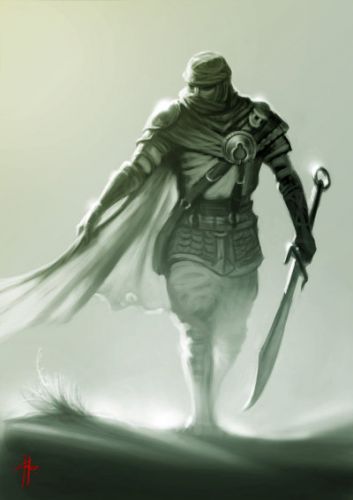
Description / Picture of Uniform: Image
Armament: Shehai (Spirit-sword)

Are there any special requirements to join this unit? : Each member of this guard must be a master of the Way of the Sword
Is there any reason why this unit was chosen for this duty? : The knowledge of the Way of the Sword gradually dwindled after the Ragada landed in Odrioya, with the number of swordmasters dwindling to just a hundred by the time Diarcesia conquered the land in the 19th century. Even then, such was these warriors' resistance and skill that at the exact moment the Treaty of Buclatrachys was signed, seven of the original twenty sword-singers defending the very first structure their ancestors constructed still stand against the siege of the technologically and numerically superior Diarcesian army. As an addendum to the Treaty, the Diarcesian Monarch personally pledged that no one from the army or the government would enter the temple except at the temple defenders' invitation. Thus, the Red Guards was born.
Is the guard force part of a larger combat unit? : No. Tradition dictates that they are to guard the temple and only the temple.
Is the unit actually equipped to defend itself (i.e. live ammunition, etc.) or is it purely a ceremonial force?: They are capable of defending themselves. They know how to use modern arms, but with their skill with their spirit-swords, they would inflict more damage using the latter.
Is viewing this unit considered a "tourist attraction" for your country? : No, as the Odrioyans look down upon such a practice on this unit

PostPosted: Fri Jul 07, 2017 10:33 pm
by Zhouran
Unit Name: Zhouranese People's Army Ceremonial Guard Command

Number of Personnel: Varies due to personnel rotations, generally up to 50,000

Place and/or Person(s) Guarded: Important monuments and landmarks in Ouyang (capital) and other major cities

Description / Picture of Uniform:
Image

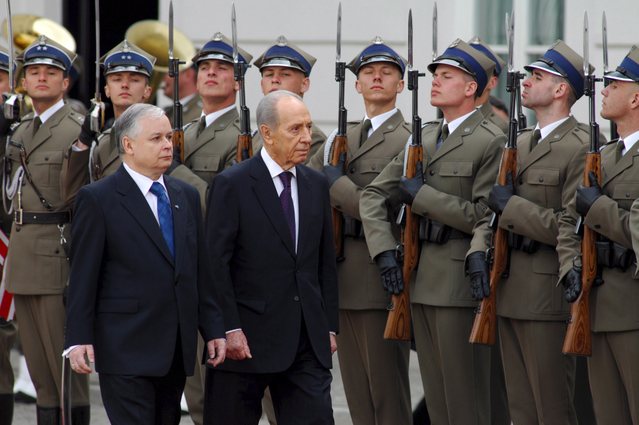
Uniform used by honor guards of the Zhouranese People's Army Ceremonial Guard Command.

The example seen here is an honor guard from the Ground Force. The Air Force version is dark blue with sky blue outlines. The Navy version is black with white outlines and the Public Security Corps version is black with red outlines.


Armament: Unlike some honor guards of foreign militaries, honor guards from the Ceremonial Guard Command don't use traditional bolt-action rifles. Instead, they use modern assault rifles or battle rifles, although the exact models of said firearms would depend on each sub-unit of honor guards and where they are stationed at.

Are there any special requirements to join this unit?: Soldiers from all service branches of the Zhouranese People's Army (Ground Force, Air Force, Navy and Public Security Corps) would be carefully screened for their physical ability and dexterity. Only those soldiers who are highly motivated and maintain exceptionally high standards of appearance and conduct and show aptitude for ceremonial duty are likely to be considered.

Is there any reason why this unit was chosen for this duty?: They are the official designated ceremonial guard unit of the Zhouranese People's Army, however under the Zhouranese honor guard model*, there two honor guard types* with the Ceremonial Guard Command being responsible for ceremonial guards while each military unit in each service branch has their own field guards.

Is the guard force part of a larger combat unit?: The Ceremonial Guard Command is separate.

Is the unit actually equipped to defend itself (i.e. live ammunition, etc.) or is it purely a ceremonial force?: Ceremonial guards in the Ceremonial Guard Command do not carry ammunition, except for blank rounds. Other than that, in the event of an emergency or war, the ceremonial guards would return to their original units for combat.

Is viewing this unit considered a "tourist attraction" for your country?: No, since ceremonial guards of the Ceremonial Guard Command can be found in major cities apart from the capital Ouyang.

The Zhouranese honor guard model, which was created in early 1862, focuses on discipline, cohesion and perfection.

When standing at attention, each honor guard stands upright with chin up and rifle on the right hand while its buttstock touches the ground. During review, honor guards tilt their head back, place their chin up and look at the dignitaries, their rifle raised up vertically with right hand on the rifle grip and left hand on the middle of the rifle. This would be the same during flag raising, except that honor guards face the flag.

When marching, the rifle is placed vertically on the left hand with its bottom side facing left. When the left leg is lifted up, the right arm moves inward towards the chest and bends, and as the left leg is placed down and right leg is lifted up, the right arm is swung outwards towards the back and straightens.

For honor guards standing at the side of a parade square, they slowly march towards their places and face the parade square once they arrive. They would then raise their rifle up vertically with their right hand on the rifle grip and left hand on the middle of the rifle, while leaning forwards with chin up. The honor guards standing at the side of a parade square have little banners attached to the bottom of the rifle barrel near the muzzle.

During ceremonies, reviews and military parades, honor guards are split into guard groups, which is led by a group commander and two deputies. The group commander would salute while for the two deputies, both carry a sword each. During parade, review or flag raising, the deputies take out their swords and hold it vertically with the hilt on the same height as their chin. For flagbearers, the flagpole is held vertically with the right hand placed above the left. When at rest, the flag rests vertically on the right side of the flagbearer, with the flagpole touching the ground.

During review, a guard inspector marches while guiding the dignitaries. Guard inspectors would take out their swords and hold it vertically with the hilt on the same hight as their chins.

During parades, each guard group is split into three layers: the front layer consists of a group commander and two deputies who are placed in a triangular formation (with the group commander in the front) and the group commander salutes towards the dignitaries while the deputies take out their swords and hold it vertically with the hilt at the same height as their chin; the middle layer, which consists of the flagbearer/s (who is/are flanked by honor guards); and the layer in the rear, which consists of honor guards in a formation shaped liked a square or rectangle. Honor guards on the right side of the rear layer face forward at all times while the rest face towards the dignitaries. During reviews or ceremonies, when standing at a straight line formation with each honor guard standing side-by-side, the group commander is first in line, followed by the deputies, the flagbearer/s who is/are flanked by honor guards, and the rest of the guard group.


As part of the Zhouranese honor guard model, which was created in early 1862, there are two types of honor guards: Ceremonial Guards and Field Guards.

Ceremonial Guards are soldiers who have been carefully screened for their physical ability and dexterity. Soldiers who are highly motivated and maintain exceptionally high standards of appearance and conduct, and show aptitude for ceremonial duty are likely to be considered. Trained to execute synchronized and precise performances, a primary role for ceremonial guards is to serve in ceremonial occasions like parades, funeral honors for fallen comrades, and to guard national monuments, as well as to be reviewed by visiting heads of state. Ceremonial guards wear formal uniform, regardless of the occasion.

Field Guards are soldiers that have been assigned to represent the military unit they belong in for ceremonial occasions such as parades and funeral honors for fallen comrades, as well as to be reviewed by visiting commanders from other military units or foreign militaries. Depending on the circumstance, field guards can wear either formal uniform or field uniform.

PostPosted: Fri Jul 07, 2017 10:40 pm
by Greater Slavic Union
- reserved -